

- Market Size (2026)
- USD 4.8 Bn
- Forecast (2036)
- USD 9.9 Bn
- CAGR (2026 to 2036)
- 7.6%
How big is the data center construction tools and anchoring systems market in 2026?
USD 4.8 billion in 2026 and USD 9.9 billion by 2036 at a 7.6% CAGR.
The data center construction tools and anchoring systems market is forecast to grow from USD 4.4 billion in 2025 to USD 9.9 billion by 2036 at 7.6% CAGR. Demand is shaped by AI data hall construction, denser MEP support work and the need for approved anchors during fast-track fit-out.
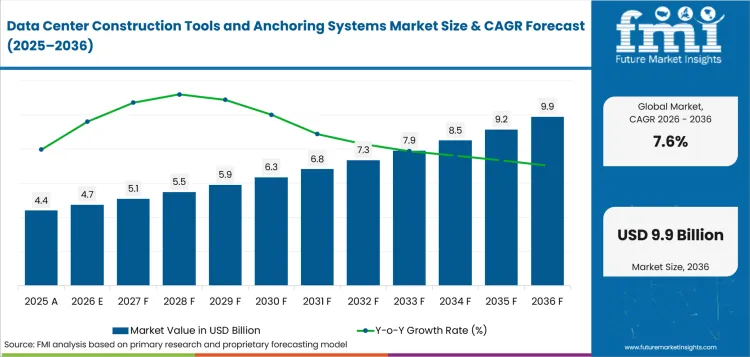
Data Center Construction Tools and Anchoring Systems Market Overview: Size and Forecast
- 2026 Market Size: USD 4.8 billion
- 2036 Market Size: USD 9.9 billion
- Forecast CAGR: 7.6% from 2026 to 2036
- Leading Product Group: Anchors
- Anchors Share in 2026: 38.0%
- Leading Fixing Type: Mechanical Anchors
- Mechanical Anchors Share in 2026: 42.0%
- Fastest-growing Country: India
- India CAGR: 8.9% by 2036
Summary of center construction tools and anchoring systems market
- Demand and Growth Drivers
- Rising global investments in hyperscale and colocation data centers are significantly driving demand for advanced construction tools and high-performance anchoring systems, particularly in North America and Asia-Pacific regions.
- Increasing adoption of prefabricated and modular construction techniques is accelerating the uptake of precision anchoring solutions that support faster installation and enhanced structural reliability.
- Strong growth in retrofit and expansion projects across existing data centers is boosting sales of specialized anchoring systems designed for vibration control, seismic resilience, and heavy equipment stabilization.
- The market is witnessing heightened demand for technologically advanced, corrosion-resistant anchoring products as operators prioritize long-term durability and compliance with stringent safety and uptime requirements.
- Product and Segment View
- Anchors are projected to secure 38.0% share in 2026 as equipment pads and MEP hangers need code-listed fixing.
- Mechanical anchors are estimated to hold 42.0% share in 2026 due to fast placement in repeated concrete fastening.
- MEP supports are expected to hold 34.0% share in 2026 as cooling pipes, cable trays, and busways crowd ceiling zones.
- Geography and Competitive Outlook
- India is projected to record 8.9% CAGR by 2036 as cloud data center capacity expands from a smaller base.
- South Korea is expected to expand at 8.6% CAGR through 2036 as AI data center policy supports regional capacity.
- Hilti, Stanley Black & Decker, fischer Group, Simpson Strong-Tie, Würth Group, Sika, and ITW form the verified supplier group.
- Specialist suppliers compete where firestop, seismic approvals, and contractor training decide purchase decisions.
- Analyst Opinion
- Sudip saha, Associate Vice President at FMI says, “This market is moving away from product-by-product buying and toward verified installation systems. Data center builders are buying fewer missed holes, faster overhead work, cleaner cable changes, and documentation that survives handover. Suppliers with approved anchors and dust-controlled tools gain only when they connect those products with layout data, BIM workflows, field training, and firestop records.”
Global data center power growth is translating directly into higher construction intensity, with the International Energy Agency estimating electricity use rising from about 415 TWh in 2024 to ~945 TWh by 2030. That change increases the number of slab drilling points, cable penetrations, overhead supports, and equipment anchors that contractors must install accurately. In the U.S., accelerating data center energy demand is reshaping procurement and supplier competition, with the Department of Energy indicating consumption could rise from 176 TWh in 2023 to 325–580 TWh by 2028, pushing owners toward standardized, high-volume sourcing strategies.
What supports value in the data center construction tools and anchoring systems market?
Approved anchors, verified jobsite tools, and firestop documentation support value across data center construction packages.
- Market value is supported by anchors and tools used before white-space handover and equipment installation.
- Supplier pricing reflects approval depth before ordinary product availability affects final selection.
- Revenue improves when owners buy anchors, tools, firestop, and modular supports as a coordinated project package.
- Inspection records raise value because data center builders need proof that each fixing and penetration was installed correctly.
Why is the Data Center Construction Tools and Anchoring Systems Market Growing?
AI data halls require denser overhead services because accelerated servers raise power and cooling loads.
Hyperscale construction is changing the way anchors and tools are purchased. Builders do not judge a drilling tool only by power or price once thousands of holes must match a digital layout. DEWALT stated in January 2026 that its data center drilling robot achieved 99.97% drilling accuracy across more than 90,000 holes. That turns drilling into a schedule-control process rather than a manual marking task.
Energy density is creating another route for demand. Data centers need heavier busway runs, denser cable trays, and larger cooling pipe supports as computing loads grow. Suppliers gain when they prove load ratings, fire ratings, and installation speed within one construction workflow.
How is the data center construction tools and anchoring systems market segmented?
The industry is segmented by product group, fixing type, project type, application, and channel.
- Anchors are projected to secure 38.0% share in 2026, led by repeated concrete fixing in rack lines and MEP support work.
- Mechanical anchors are estimated to hold 42.0% share in 2026 because speed matters in repeated overhead installation.
- Hyperscale projects are expected to represent 52.0% share in 2026 as large owners standardize approved systems.
- MEP supports are anticipated to account for 34.0% share in 2026 with cooling and power distribution driving fixture density.
- Direct enterprise channels are projected to hold 39.0% share in 2026 as owner-approved vendor lists guide contractor buying.
Why do anchors lead the data center construction tools and anchoring systems market?
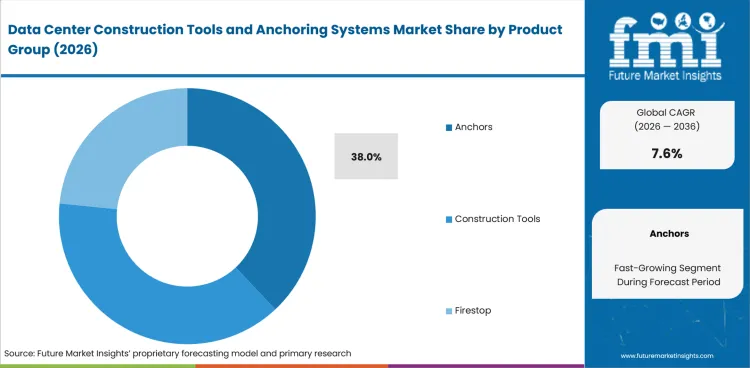
- Anchors are projected to account for 38.0% share in 2026, influenced by repeated concrete fastening in white-space and plant-room areas.
- Construction tools remain central because dust-controlled drilling and torque control decide installation quality.
Which fixing type leads the data center construction tools and anchoring systems market?
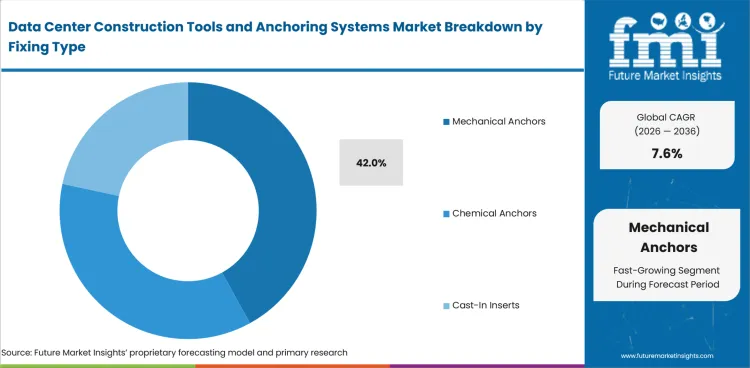
- Mechanical anchors are estimated to represent 42.0% share in 2026 due to fast installation in repetitive overhead work.
- Chemical anchors gain use in heavier retrofit and seismic conditions where bond strength matters more than placement speed.
Which project type leads the data center construction tools and anchoring systems market?
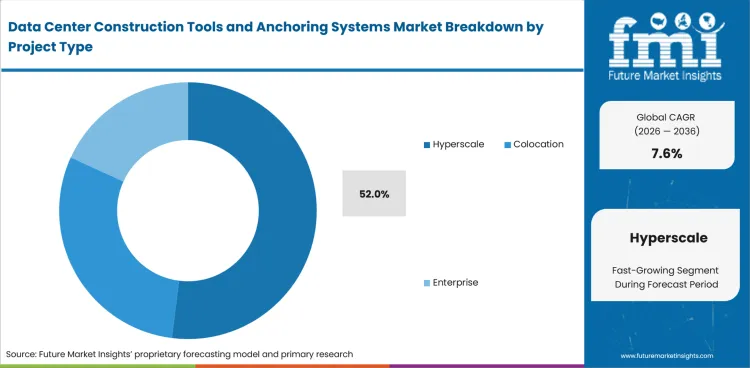
- Hyperscale is expected to capture 52.0% share in 2026 as large campuses need repeatable tool and support packages.
- Colocation projects create added demand where tenants require frequent cable and rack changes after commissioning.
Which application leads the data center construction tools and anchoring systems market?
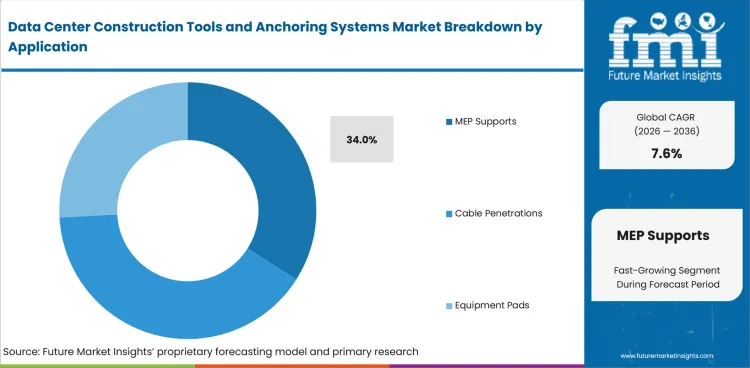
- MEP supports are anticipated to hold 34.0% share in 2026, shaped by dense power distribution and cooling loops.
- Cable penetrations gain value when operators need firestop systems that can handle day-two cable changes.
Which channel leads the data center construction tools and anchoring systems market?
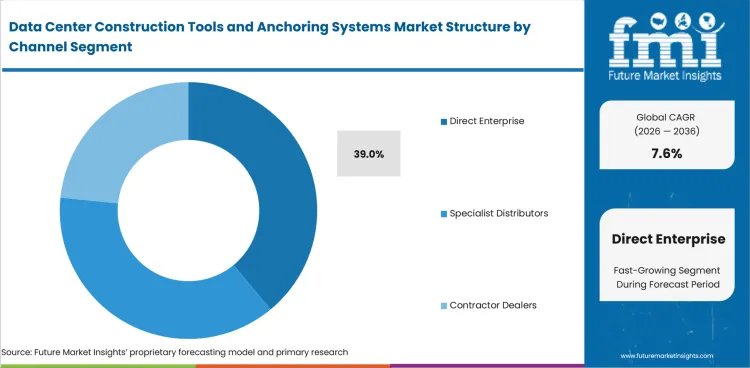
- Direct enterprise channels are projected to account for 39.0% share in 2026 as owners approve systems before contractor buying begins.
- Specialist distributors remain important for replenishment and local availability during fast fit-out work.
What are the driver, restraints, and opportunities in the data center construction tools and anchoring systems market?
AI hall density and construction automation support growth while grid delays restrict some local build schedules.
- Driver: AI-ready data halls are increasing fixture density across power, cooling, and cable support pathways.
- Restraint: Grid connection delays can pause fit-out demand even after land and civil work move forward.
- Opportunity: Bundled anchors, tools, firestop, and modular supports can reduce rework for hyperscale contractors.
AI Halls Increase Verified Fixing Points
AI-ready data halls are raising the number of fixing points across cable trays and busway supports plus cooling loops and firestop penetrations. In January 2025, Lawrence Berkeley National Laboratory reported that U.S. data center electricity use rose from 58 TWh in 2014 to 176 TWh in 2023 and could reach 325 TWh to 580 TWh by 2028. That demand signal matters for tools and anchors because higher power density creates more overhead routing and heavier MEP support with tighter inspection at handover. Contractors therefore need approved anchors, layout tools and installation records that prove each fixing point was placed correctly.
Grid Delays Slow Fit-out Conversion
Grid connection delays can restrict local tool and anchoring demand even after land work and shell construction move forward. In December 2025, Lawrence Berkeley National Laboratory reported about 10,300 active U.S. interconnection projects at the end of 2024. It also reported 1,400 GW of generation and about 890 GW of storage seeking grid connection. This matters because data center fit-outs do not convert into full anchor and tool packages until energization schedules are credible. Suppliers may therefore see uneven order timing in constrained power markets.
Bundled Systems Reduce Rework at Handover
Bundled anchors and tools with firestop and modular supports create a practical selling route for hyperscale contractors. In May 2025, Hilti said its PROFIS Engineering software supports more than 100,000 engineers worldwide with code-compliant structural connection design. The same source highlighted modular support systems for MEP bracing and preformed firestop blocks for easier standards compliance. This supports bundled procurement because contractors can reduce missed holes and simplify submittals with one documented system. It also gives suppliers a stronger position with EPC teams that buy on installed cost rather than unit price.
Which countries are growing fastest in the data center construction tools and anchoring systems market?
India reaches 8.9% CAGR followed by South Korea at 8.6% through 2036.
.webp "Top Country Growth Comparison Data Center Construction Tools And Anchoring Systems Market Cagr (2026 2036)")
| Country | CAGR |
|---|---|
| United States | 8.4% |
| United Kingdom | 7.3% |
| Germany | 6.8% |
| France | 8.0% |
| Japan | 7.1% |
| China | 7.8% |
| South Korea | 8.6% |
| India | 8.9% |
Source: Future Market Insights, 2026.
How do country-level CAGRs compare in the data center construction tools and anchoring systems market?
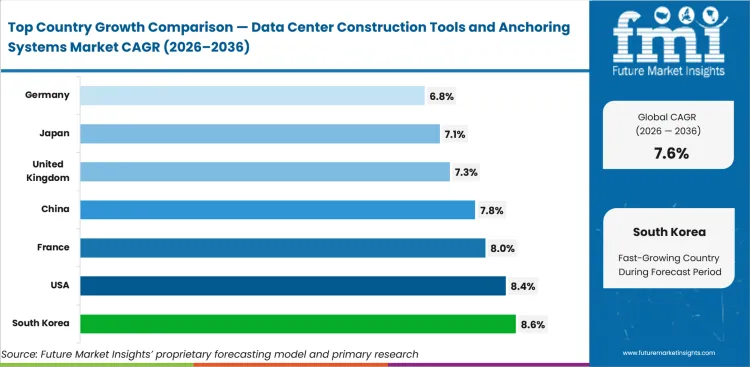
India leads country growth while Germany records the most cautious expansion outlook among profiled markets.
- United States is projected to record 8.4% CAGR by 2036 with large AI campuses and grid-backed build plans.
- United Kingdom is projected to record 7.3% CAGR by 2036 with critical infrastructure status and AI Growth Zone planning.
- Germany is projected to record 6.8% CAGR by 2036 with technical approval depth and cautious power access.
- France is projected to record 8.0% CAGR by 2036 with AI infrastructure pledges and low-carbon power positioning.
- Japan is projected to record 7.1% CAGR by 2036 with seismic requirements and cloud infrastructure expansion.
- China is projected to record 7.8% CAGR by 2036 with clustered build-out and coastal project diversity.
- South Korea is projected to record 8.6% CAGR by 2036 with AI data center policy and semiconductor depth.
- India is projected to record 8.9% CAGR by 2036 with capacity expansion from a smaller installed base.
What is the data center construction tools and anchoring systems market outlook in the United States?
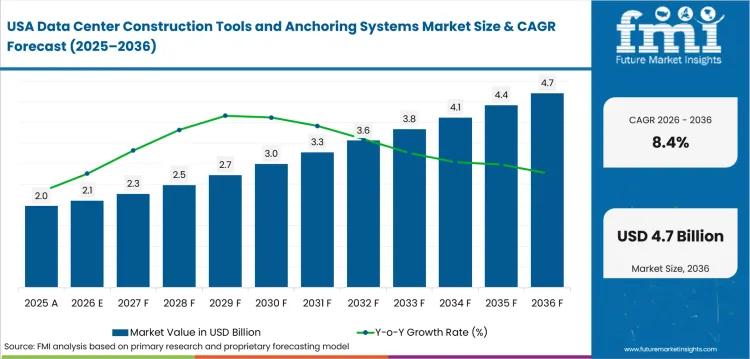
An 8.4% CAGR through 2036 reflects AI campus construction and heavy MEP support intensity.
Country Market Snapshot Table
| Parameter | Value |
|---|---|
| Market Size in 2025 (Value) | USD 1,429.9 million |
| Market Size in 2026 (Value) | USD 1,550.0 million |
| Market Forecast in 2036 (Value) | USD 3,472.4 million |
| CAGR (2026 to 2036) | 8.4% |
| Years Considered | 2021 to 2036 |
| Base Year | 2025 |
| Forecast Period | 2026 to 2036 |
| Units Considered | Value (USD million) |
| Leading Sub-Region | Northern Virginia and Texas AI campus corridors |
United States Data Center Construction Tools and Anchoring Systems Market Outlook
- United States demand is shaped by hyperscale campus scale and local power bottlenecks. Large builds in Northern Virginia, Texas, Arizona, Georgia, and Ohio create recurring demand for anchors, drilling systems, modular supports, and firestop documentation.
- Buyers give priority to approved fastening families and repeatable installation packages. Contractors are expected to select suppliers that can support BIM workflows, robotic drilling, dust control, and inspection records across multi-phase projects.
Key Growth Drivers
- AI and cloud loads are increasing the fixture base for anchors. The U.S. Department of Energy reported data center electricity use at 176 TWh in 2023 and projected 325 TWh to 580 TWh by 2028.
- Construction spending supports a large contractor base for approved systems. The U.S. Census Bureau estimated April 2026 construction spending at a seasonally adjusted annual rate of USD 2,172.4 billion.
- Robotic drilling is expected to expand where hyperscale halls require thousands of repeated hole locations and tighter installation records.
- Seismic and wind-zone requirements in California and coastal markets are expected to support tested anchors and documented installation steps.
Key Restraints
- Grid capacity remains a practical limit. The U.S. Department of Energy stated that data centers could consume 6.7% to 12.0% of U.S. electricity by 2028.
- Local water, noise, and land-use reviews can delay campus approvals before contractors release tool and anchor packages.
- Trade labor shortages can raise installation cost when several large AI campuses move through fit-out at the same time.
What makes United States unique
The United States is unique because robotic drilling pilots and hyperscale owner standards are moving fastest at jobsite volume.
Key Companies
- Hilti North America
- DEWALT
- Simpson Strong-Tie
- ITW Red Head
- Sika USA
- Würth Baer Supply
- nVent CADDY
Sales & Marketing Channels
- Direct enterprise sales
- National distributor contracts
- Contractor dealer networks
- Hyperscale approved vendor lists
- BIM and engineering service channels
- Certified installer programs
Market Taxonomy and Sub-Regions Covered
| Segment | Sub-Segments |
|---|---|
| By Product Group | Anchors · Construction Tools · Firestop · Modular Supports · Layout Robotics |
| By Fixing Type | Mechanical Anchors · Chemical Anchors · Cast-In Inserts · Threaded Rods |
| By Project Type | Hyperscale · Colocation · Enterprise · Edge |
| By Application | MEP Supports · Cable Penetrations · Equipment Pads · Rack Lines · Seismic Bracing |
| By Channel | Direct Enterprise · Specialist Distributors · Contractor Dealers · Digital Procurement |
| Key Sub-Regions Covered, Data Center Construction Clusters | Northern Virginia · Texas · Arizona · Georgia · Ohio · California |
Frequently Asked Questions
How fast is United States data center construction tools and anchoring systems market growing?
United States is projected to expand at 8.4% CAGR from 2026 to 2036, guided by northern virginia and texas ai campus corridors.
Who leads United States data center construction tools and anchoring systems market?
Hilti North America, DEWALT, Simpson Strong-Tie, ITW Red Head compete through approved anchor systems, power tools, and project-support channels.
What is driving adoption in United States data center construction tools and anchoring systems market?
Data center capacity expansion and tighter installation documentation are moving buyers toward approved tool and anchoring packages.
How is the data center construction tools and anchoring systems market performing in the United Kingdom?
A 7.3% CAGR through 2036 is supported by critical infrastructure status and AI growth-zone planning.
Country Market Snapshot Table
| Parameter | Value |
|---|---|
| Market Size in 2025 (Value) | USD 354.1 million |
| Market Size in 2026 (Value) | USD 380.0 million |
| Market Forecast in 2036 (Value) | USD 768.7 million |
| CAGR (2026 to 2036) | 7.3% |
| Years Considered | 2021 to 2036 |
| Base Year | 2025 |
| Forecast Period | 2026 to 2036 |
| Units Considered | Value (USD million) |
| Leading Sub-Region | London, Slough, Cardiff, and North Wales data center corridors |
United Kingdom Data Center Construction Tools and Anchoring Systems Market Outlook
United Kingdom demand is shaped by policy recognition, constrained land, and owner-led construction frameworks. CNI status gives data center construction a clearer resilience position within national infrastructure planning.
Tool and anchoring suppliers are expected to gain when they support firestop records, engineering approval, and contractor training across Slough, London, Cardiff, and emerging AI Growth Zones.
Key Growth Drivers
- Critical infrastructure status supports resilient construction packages. The UK government designated data centres as Critical National Infrastructure in September 2024 and cited nearly GBP 4.0 billion in proposed Hertfordshire data center investment.
- AI infrastructure policy is expected to create larger power-led projects. The UK government response to the AI Opportunities Action Plan referenced a 100 MW data center beginning point with plans to scale to 500 MW.
- AI Growth Zones are expected to improve site selection where power access and planning coordination are stronger.
- Colocation and cloud clusters around London and Slough are expected to keep demand active for firestop, anchors, and modular support systems.
Key Restraints
- Power access can constrain site timing. The UK government response to the AI plan shows individual projects moving from 100 MW to 500 MW scale, which increases grid-planning pressure.
- Brownfield sites can raise retrofit complexity for anchors, sleeves, and cable penetration systems.
- Planning reviews can slow purchasing even when cloud demand remains strong.
What makes United Kingdom unique
The United Kingdom is unique because data center construction is linked directly with national resilience policy.
Key Companies
- Hilti Great Britain
- DEWALT UK
- Sika Limited
- fischer Fixings UK
- Würth UK
- Simpson Strong-Tie UK
- nVent CADDY UK
Sales & Marketing Channels
- Contractor framework agreements
- Specialist fixing distributors
- Direct owner specification
- Firestop installer networks
- Digital procurement platforms
- Engineering consultant referrals
Market Taxonomy and Sub-Regions Covered
| Segment | Sub-Segments |
|---|---|
| By Product Group | Anchors · Construction Tools · Firestop · Modular Supports · Layout Robotics |
| By Fixing Type | Mechanical Anchors · Chemical Anchors · Cast-In Inserts · Threaded Rods |
| By Project Type | Hyperscale · Colocation · Enterprise · Edge |
| By Application | MEP Supports · Cable Penetrations · Equipment Pads · Rack Lines · Seismic Bracing |
| By Channel | Direct Enterprise · Specialist Distributors · Contractor Dealers · Digital Procurement |
| Key Sub-Regions Covered, Data Center Construction Clusters | London · Slough · Cardiff · North Wales · Manchester · Scotland |
Frequently Asked Questions
How fast is United Kingdom data center construction tools and anchoring systems market growing?
United Kingdom is projected to expand at 7.3% CAGR from 2026 to 2036, guided by london, slough, cardiff, and north wales data center corridors.
Who leads United Kingdom data center construction tools and anchoring systems market?
Hilti Great Britain, DEWALT UK, Sika Limited, fischer Fixings UK compete through approved anchor systems, power tools, and project-support channels.
What is driving adoption in United Kingdom data center construction tools and anchoring systems market?
Data center capacity expansion and tighter installation documentation are moving buyers toward approved tool and anchoring packages.
What is the data center construction tools and anchoring systems market forecast for Germany?
A 6.8% CAGR through 2036 reflects technical approvals and energy-efficiency review across data center builds.
Country Market Snapshot Table
| Parameter | Value |
|---|---|
| Market Size in 2025 (Value) | USD 318.4 million |
| Market Size in 2026 (Value) | USD 340.0 million |
| Market Forecast in 2036 (Value) | USD 656.4 million |
| CAGR (2026 to 2036) | 6.8% |
| Years Considered | 2021 to 2036 |
| Base Year | 2025 |
| Forecast Period | 2026 to 2036 |
| Units Considered | Value (USD million) |
| Leading Sub-Region | Frankfurt and southern industrial data center clusters |
Germany Data Center Construction Tools and Anchoring Systems Market Outlook
- Germany demand is specification-led and concentrated around Frankfurt, cloud interconnection, and high-compliance construction routes. Contractors usually need anchor approvals, load calculations, and documented installation methods before substitution is accepted.
- The market is expected to move more cautiously than India or South Korea. Power access, efficiency regulation, and high documentation requirements keep buyers focused on tested systems rather than low-cost alternatives.
Key Growth Drivers
- Large installed capacity supports continued tool and anchor demand. Germany’s federal economic ministry cited over 2,000 data centres and more than 2,700 MW of installed IT power demand.
- Energy use places data centers inside national planning. German official research stated that data centers and smaller IT installations used 20 TWh of electricity in 2024.
- Frankfurt’s exchange and cloud ecosystem is expected to keep data center work concentrated in high-specification colocation builds.
- German engineering practice is expected to favor approved anchors, chemical fixing records, and documented firestop installation.
Key Restraints
- Reporting requirements add compliance work for operators. EU rules cover data centres with an installed IT power demand of at least 500 kW under the common Union rating scheme.
- Grid connection and power-price pressure can delay new capacity before fit-out packages are purchased.
- Strict documentation can slow replacement of specified anchor systems during construction.
What makes Germany unique
Germany is unique because technical approval depth carries direct sales value in data center projects.
Key Companies
- Hilti Deutschland
- fischer Group
- Würth Group
- Sika Deutschland
- Stanley Black & Decker Germany
- EJOT
- nVent CADDY Germany
Sales & Marketing Channels
- Technical specification selling
- Fachhandel distributor networks
- Contractor training programs
- Engineering office influence
- Direct key account channels
- Digital procurement
Market Taxonomy and Sub-Regions Covered
| Segment | Sub-Segments |
|---|---|
| By Product Group | Anchors · Construction Tools · Firestop · Modular Supports · Layout Robotics |
| By Fixing Type | Mechanical Anchors · Chemical Anchors · Cast-In Inserts · Threaded Rods |
| By Project Type | Hyperscale · Colocation · Enterprise · Edge |
| By Application | MEP Supports · Cable Penetrations · Equipment Pads · Rack Lines · Seismic Bracing |
| By Channel | Direct Enterprise · Specialist Distributors · Contractor Dealers · Digital Procurement |
| Key Sub-Regions Covered, Data Center Construction Clusters | Frankfurt · Hesse · Bavaria · Berlin · Hamburg · North Rhine-Westphalia |
Frequently Asked Questions
How fast is Germany data center construction tools and anchoring systems market growing?
Germany is projected to expand at 6.8% CAGR from 2026 to 2036, guided by frankfurt and southern industrial data center clusters.
Who leads Germany data center construction tools and anchoring systems market?
Hilti Deutschland, fischer Group, Würth Group, Sika Deutschland compete through approved anchor systems, power tools, and project-support channels.
What is driving adoption in Germany data center construction tools and anchoring systems market?
Data center capacity expansion and tighter installation documentation are moving buyers toward approved tool and anchoring packages.
What is driving data center construction tools and anchoring systems growth in France?
An 8.0% CAGR through 2036 is supported by AI infrastructure pledges and power-led site selection.
Country Market Snapshot Table
| Parameter | Value |
|---|---|
| Market Size in 2025 (Value) | USD 287.0 million |
| Market Size in 2026 (Value) | USD 310.0 million |
| Market Forecast in 2036 (Value) | USD 669.3 million |
| CAGR (2026 to 2036) | 8.0% |
| Years Considered | 2021 to 2036 |
| Base Year | 2025 |
| Forecast Period | 2026 to 2036 |
| Units Considered | Value (USD million) |
| Leading Sub-Region | Paris, Marseille, and Hauts-de-France AI corridors |
France Data Center Construction Tools and Anchoring Systems Market Outlook
- France demand is pulled by AI infrastructure commitments, low-carbon power positioning, and large regional site announcements. Paris, Marseille, and northern France are expected to shape the strongest tool and anchoring demand.
- Large halls need industrialized support packages rather than ordinary jobsite replenishment. Suppliers are expected to gain when they combine approved anchors, prefabricated supports, firestop documentation, and construction chemistry.
Key Growth Drivers
- AI investment pledges are increasing project scale. The French presidency referenced EUR 109.0 billion in AI investment pledges in February 2025.
- Data center capacity plans support high-load construction packages. The French AI investment document cited up to EUR 15.0 billion of Brookfield-related data center investment and more than 500 MW of Data4 capacity plans.
- SoftBank’s first phase in Hauts-de-France is expected to create large repeatable MEP support demand through planned AI data center capacity.
- Marseille’s subsea cable position is expected to support colocation builds that require cable penetration and firestop documentation.
Key Restraints
- Energy scrutiny can slow local approvals. French public digital analysis cited ADEME work showing data center electricity consumption could increase 3.7-fold in France by 2035 without action.
- Permitting and grid-connection timing can slow conversion of announced campuses into anchor and tool orders.
- Large simultaneous projects can tighten subcontractor availability and raise demand for certified installation crews.
What makes France unique
France is unique because nuclear-backed power and national AI policy strengthen the case for large AI campuses.
Key Companies
- Hilti France
- Sika France
- fischer France
- Würth France
- Stanley Black & Decker France
- Rawlplug France
- nVent CADDY France
Sales & Marketing Channels
- Engineering-led procurement
- Specialist construction distributors
- Direct enterprise accounts
- EPC buying groups
- Firestop installer networks
- Digital procurement portals
Market Taxonomy and Sub-Regions Covered
| Segment | Sub-Segments |
|---|---|
| By Product Group | Anchors · Construction Tools · Firestop · Modular Supports · Layout Robotics |
| By Fixing Type | Mechanical Anchors · Chemical Anchors · Cast-In Inserts · Threaded Rods |
| By Project Type | Hyperscale · Colocation · Enterprise · Edge |
| By Application | MEP Supports · Cable Penetrations · Equipment Pads · Rack Lines · Seismic Bracing |
| By Channel | Direct Enterprise · Specialist Distributors · Contractor Dealers · Digital Procurement |
| Key Sub-Regions Covered, Data Center Construction Clusters | Paris · Marseille · Hauts-de-France · Lyon · Bordeaux · Toulouse |
Frequently Asked Questions
How fast is France data center construction tools and anchoring systems market growing?
France is projected to expand at 8.0% CAGR from 2026 to 2036, guided by paris, marseille, and hauts-de-france ai corridors.
Who leads France data center construction tools and anchoring systems market?
Hilti France, Sika France, fischer France, Würth France compete through approved anchor systems, power tools, and project-support channels.
What is driving adoption in France data center construction tools and anchoring systems market?
Data center capacity expansion and tighter installation documentation are moving buyers toward approved tool and anchoring packages.
How fast is Japan data center construction tools and anchoring systems market growing?
A 7.1% CAGR through 2036 is supported by seismic requirements and steady cloud infrastructure expansion.
Country Market Snapshot Table
| Parameter | Value |
|---|---|
| Market Size in 2025 (Value) | USD 270.8 million |
| Market Size in 2026 (Value) | USD 290.0 million |
| Market Forecast in 2036 (Value) | USD 575.8 million |
| CAGR (2026 to 2036) | 7.1% |
| Years Considered | 2021 to 2036 |
| Base Year | 2025 |
| Forecast Period | 2026 to 2036 |
| Units Considered | Value (USD million) |
| Leading Sub-Region | Tokyo, Osaka, and Hokkaido cloud locations |
Japan Data Center Construction Tools and Anchoring Systems Market Outlook
- Japan demand is shaped by seismic risk, urban site constraints, and cloud infrastructure expansion. Data center construction tools and anchors need to support equipment stability as well as fast installation.
- Buyers are expected to value torque control, chemical anchoring performance, and inspection records. Hokkaido and other power-led sites can add demand outside the Tokyo and Osaka corridors.
Key Growth Drivers
- Data center electricity growth supports steady construction needs. The International Energy Agency projected Japan data center electricity demand to rise by around 15 TWh by 2030 and grow roughly 80% from 2024.
- Digital policy gives computing infrastructure a stronger public role. Japan’s Digital Agency stated that the 2025 priority plan was approved by the Cabinet on June 13, 2025.
- Seismic design practice is expected to favor tested anchors, chemical fixing, and documented installation discipline.
- Hokkaido and regional power-led sites are expected to support construction outside the highest-cost metro areas.
Key Restraints
- Energy load growth can tighten site review. The International Energy Agency’s Japan projection points to about 15 TWh of additional data center electricity demand by 2030.
- Urban land scarcity makes staging and tool logistics harder near Tokyo and Osaka.
- Conservative approval processes can slow substitution of unproven anchors and support systems.
What makes Japan unique
Japan is unique because seismic assurance and installation precision weigh as heavily as speed.
Key Companies
- Hilti Japan
- Stanley Black & Decker Japan
- Sika Japan
- fischer Japan
- Würth Japan
- Tajima Tool Corporation
- Nippon Steel Trading construction channels
Sales & Marketing Channels
- General contractor specification
- Specialist distributor sales
- Engineering consultant influence
- Direct cloud operator accounts
- Certified installer networks
- Digital procurement
Market Taxonomy and Sub-Regions Covered
| Segment | Sub-Segments |
|---|---|
| By Product Group | Anchors · Construction Tools · Firestop · Modular Supports · Layout Robotics |
| By Fixing Type | Mechanical Anchors · Chemical Anchors · Cast-In Inserts · Threaded Rods |
| By Project Type | Hyperscale · Colocation · Enterprise · Edge |
| By Application | MEP Supports · Cable Penetrations · Equipment Pads · Rack Lines · Seismic Bracing |
| By Channel | Direct Enterprise · Specialist Distributors · Contractor Dealers · Digital Procurement |
| Key Sub-Regions Covered, Data Center Construction Clusters | Tokyo · Osaka · Hokkaido · Yokohama · Nagoya · Fukuoka |
Frequently Asked Questions
How fast is Japan data center construction tools and anchoring systems market growing?
Japan is projected to expand at 7.1% CAGR from 2026 to 2036, guided by tokyo, osaka, and hokkaido cloud locations.
Who leads Japan data center construction tools and anchoring systems market?
Hilti Japan, Stanley Black & Decker Japan, Sika Japan, fischer Japan compete through approved anchor systems, power tools, and project-support channels.
What is driving adoption in Japan data center construction tools and anchoring systems market?
Data center capacity expansion and tighter installation documentation are moving buyers toward approved tool and anchoring packages.
What is the data center construction tools and anchoring systems market outlook in China?
A 7.8% CAGR through 2036 reflects clustered build-out and wider project diversity across coastal and inland sites.
Country Market Snapshot Table
| Parameter | Value |
|---|---|
| Market Size in 2025 (Value) | USD 510.2 million |
| Market Size in 2026 (Value) | USD 550.0 million |
| Market Forecast in 2036 (Value) | USD 1,165.6 million |
| CAGR (2026 to 2036) | 7.8% |
| Years Considered | 2021 to 2036 |
| Base Year | 2025 |
| Forecast Period | 2026 to 2036 |
| Units Considered | Value (USD million) |
| Leading Sub-Region | Yangtze River Delta and east-data-west-computing clusters |
China Data Center Construction Tools and Anchoring Systems Market Outlook
- China demand is large but uneven by region. The national computing hub strategy moves some construction toward energy-rich western provinces, while coastal cities still need low-latency capacity.
- Cost pressure is stronger than in the United States or Germany. International suppliers are expected to gain mainly where approvals, corrosion protection, firestop quality, or multinational specifications matter.
Key Growth Drivers
- Special data center structures are widening construction requirements. China’s State Council reported a Shanghai underwater data center project with 24 MW of capacity and CNY 1.6 billion of investment.
- Low-energy site design supports non-standard installation needs. The State Council report stated that the underwater project uses offshore wind power and seawater cooling.
- National computing hubs are expected to create demand across clustered construction zones in inland and western regions.
- Coastal projects are expected to require corrosion protection, sealing systems, and high-specification support packages.
Key Restraints
- Regional utilization risk can slow purchasing. Inland capacity depends on successful workload transfer from coastal demand centers.
- Domestic alternatives can pressure imported anchors and tools in standard fixing categories.
- Price-led procurement can limit uptake of premium systems unless owners enforce approved vendor lists.
What makes China unique
China is unique because data center construction settings range from inland clusters to offshore-style infrastructure.
Key Companies
- Hilti China
- Sika China
- fischer China
- Würth China
- Stanley Black & Decker China
- EJOT China
- nVent CADDY China
Sales & Marketing Channels
- EPC contractor buying
- Local fastener distributors
- Direct multinational accounts
- Digital procurement platforms
- Engineering specification channels
- Hyperscale owner frameworks
Market Taxonomy and Sub-Regions Covered
| Segment | Sub-Segments |
|---|---|
| By Product Group | Anchors · Construction Tools · Firestop · Modular Supports · Layout Robotics |
| By Fixing Type | Mechanical Anchors · Chemical Anchors · Cast-In Inserts · Threaded Rods |
| By Project Type | Hyperscale · Colocation · Enterprise · Edge |
| By Application | MEP Supports · Cable Penetrations · Equipment Pads · Rack Lines · Seismic Bracing |
| By Channel | Direct Enterprise · Specialist Distributors · Contractor Dealers · Digital Procurement |
| Key Sub-Regions Covered, Data Center Construction Clusters | Shanghai · Beijing-Tianjin-Hebei · Guangdong · Guizhou · Inner Mongolia · Chengdu-Chongqing |
Frequently Asked Questions
How fast is China data center construction tools and anchoring systems market growing?
China is projected to expand at 7.8% CAGR from 2026 to 2036, guided by yangtze river delta and east-data-west-computing clusters.
Who leads China data center construction tools and anchoring systems market?
Hilti China, Sika China, fischer China, Würth China compete through approved anchor systems, power tools, and project-support channels.
What is driving adoption in China data center construction tools and anchoring systems market?
Data center capacity expansion and tighter installation documentation are moving buyers toward approved tool and anchoring packages.
What is supporting data center construction tools and anchoring systems demand in South Korea?
An 8.6% CAGR through 2036 is supported by AI compute build-out and regional capacity planning.
Country Market Snapshot Table
| Parameter | Value |
|---|---|
| Market Size in 2025 (Value) | USD 202.6 million |
| Market Size in 2026 (Value) | USD 220.0 million |
| Market Forecast in 2036 (Value) | USD 502.0 million |
| CAGR (2026 to 2036) | 8.6% |
| Years Considered | 2021 to 2036 |
| Base Year | 2025 |
| Forecast Period | 2026 to 2036 |
| Units Considered | Value (USD million) |
| Leading Sub-Region | Seoul region and Ulsan AI infrastructure corridor |
South Korea Data Center Construction Tools and Anchoring Systems Market Outlook
- South Korea demand is shifting from Seoul concentration toward AI infrastructure clusters in Ulsan and other regional industrial locations. This changes the buying pattern for high-load anchors, modular MEP support, and firestop systems.
- Contractors need products that satisfy global cloud standards and local construction practice. Semiconductor depth and AI policy are expected to keep specification levels high.
Key Growth Drivers
- Ulsan AI construction expands non-Seoul demand. South Korea’s science ministry stated that the Ulsan AI Data Center is expected to expand national AI computing capacity.
- Project scale raises anchor and support intensity. Public reports on the Ulsan AI data center cite 60,000 GPUs and approximately 100 MW initial capacity.
- Semiconductor and cloud ecosystems are expected to raise data center specification maturity across mechanical and electrical support packages.
- Regional redevelopment around Ulsan is expected to increase demand for EPC-led procurement and direct cloud operator approvals.
Key Restraints
- Power concentration remains a barrier. Public reporting on Korea’s data center pipeline cited a 2,625 MW supply shortfall against requested power by 2027.
- Seoul-area congestion limits easy expansion in mature data center corridors.
- Imported premium systems face cost scrutiny when local contractors manage standardized anchor and tool categories.
What makes South Korea unique
South Korea is unique because AI compute growth is tied closely to semiconductor policy and regional industrial redevelopment.
Key Companies
- Hilti Korea
- Sika Korea
- DEWALT Korea
- fischer Korea
- Würth Korea
- nVent CADDY Korea
- Korea Fastener distributors
Sales & Marketing Channels
- Direct cloud operator sales
- Chaebol contractor frameworks
- Specialist distributor channels
- Engineering consultant approvals
- EPC project packages
- Certified installer programs
Market Taxonomy and Sub-Regions Covered
| Segment | Sub-Segments |
|---|---|
| By Product Group | Anchors · Construction Tools · Firestop · Modular Supports · Layout Robotics |
| By Fixing Type | Mechanical Anchors · Chemical Anchors · Cast-In Inserts · Threaded Rods |
| By Project Type | Hyperscale · Colocation · Enterprise · Edge |
| By Application | MEP Supports · Cable Penetrations · Equipment Pads · Rack Lines · Seismic Bracing |
| By Channel | Direct Enterprise · Specialist Distributors · Contractor Dealers · Digital Procurement |
| Key Sub-Regions Covered, Data Center Construction Clusters | Seoul · Ulsan · Incheon · Gumi · Busan · Daejeon |
Frequently Asked Questions
How fast is South Korea data center construction tools and anchoring systems market growing?
South Korea is projected to expand at 8.6% CAGR from 2026 to 2036, guided by seoul region and ulsan ai infrastructure corridor.
Who leads South Korea data center construction tools and anchoring systems market?
Hilti Korea, Sika Korea, DEWALT Korea, fischer Korea compete through approved anchor systems, power tools, and project-support channels.
What is driving adoption in South Korea data center construction tools and anchoring systems market?
Data center capacity expansion and tighter installation documentation are moving buyers toward approved tool and anchoring packages.
How fast is India data center construction tools and anchoring systems market growing?
An 8.9% CAGR through 2036 reflects the fastest country outlook among profiled markets.
Country Market Snapshot Table
| Parameter | Value |
|---|---|
| Market Size in 2025 (Value) | USD 238.8 million |
| Market Size in 2026 (Value) | USD 260.0 million |
| Market Forecast in 2036 (Value) | USD 609.9 million |
| CAGR (2026 to 2036) | 8.9% |
| Years Considered | 2021 to 2036 |
| Base Year | 2025 |
| Forecast Period | 2026 to 2036 |
| Units Considered | Value (USD million) |
| Leading Sub-Region | Mumbai, Chennai, Hyderabad, Noida, Pune, and Gujarat |
India Data Center Construction Tools and Anchoring Systems Market Outlook
- India demand is moving from early colocation growth into AI and sovereign cloud capacity. Mumbai, Chennai, Hyderabad, Noida, Pune, and Gujarat are expected to remain important construction corridors.
- Suppliers must balance premium approvals with local contractor training and availability. Demand is expected to favor vendors that combine technical documentation, site support, and distributor reach.
Key Growth Drivers
- Cloud capacity expansion supports anchor and tool demand. India’s Press Information Bureau cited cloud data center capacity of around 1,280 MW with four to five times growth expected by 2030.
- Policy support improves foreign cloud investment planning. India’s Press Information Bureau stated that Budget 2026-27 proposed a tax holiday till 2047 for eligible foreign cloud providers operating through India-based data center infrastructure.
- Global hyperscale specifications are expected to increase demand for approved anchors, firestop systems, and dust-controlled drilling.
- Tier-one cloud corridors are expected to generate repeated fit-out demand across MEP supports, cable penetrations, and rack-line fixing.
Key Restraints
- Installer readiness can lag capacity growth. India’s expected four-to-five-times capacity expansion by 2030 raises demand for trained crews faster than many local ecosystems can supply them.
- Price-sensitive contractors may substitute weaker products where owner control and inspection discipline are limited.
- Power and water access can delay projects outside the strongest data center corridors.
What makes India unique
India is unique because the fastest growth rate meets the widest gap between global specifications and local installer readiness.
Key Companies
- Hilti India
- Stanley Black & Decker India
- fischer India
- Sika India
- Würth India
- nVent India
- EJOT India
Sales & Marketing Channels
- Direct enterprise sales
- Contractor dealer networks
- Specialist fixing distributors
- EPC procurement teams
- Certified installer training
- Digital procurement platforms
Market Taxonomy and Sub-Regions Covered
| Segment | Sub-Segments |
|---|---|
| By Product Group | Anchors · Construction Tools · Firestop · Modular Supports · Layout Robotics |
| By Fixing Type | Mechanical Anchors · Chemical Anchors · Cast-In Inserts · Threaded Rods |
| By Project Type | Hyperscale · Colocation · Enterprise · Edge |
| By Application | MEP Supports · Cable Penetrations · Equipment Pads · Rack Lines · Seismic Bracing |
| By Channel | Direct Enterprise · Specialist Distributors · Contractor Dealers · Digital Procurement |
| Key Sub-Regions Covered, Data Center Construction Clusters | Mumbai · Chennai · Hyderabad · Noida · Pune · Gujarat |
Frequently Asked Questions
How fast is India data center construction tools and anchoring systems market growing?
India is projected to expand at 8.9% CAGR from 2026 to 2036, guided by mumbai, chennai, hyderabad, noida, pune, and gujarat.
Who leads India data center construction tools and anchoring systems market?
Hilti India, Stanley Black & Decker India, fischer India, Sika India compete through approved anchor systems, power tools, and project-support channels.
What is driving adoption in India data center construction tools and anchoring systems market?
Data center capacity expansion and tighter installation documentation are moving buyers toward approved tool and anchoring packages.
Who are the leading companies in the data center construction tools and anchoring systems market?
Hilti, Stanley Black & Decker, fischer Group, Simpson Strong-Tie, and Sika lead the supplier field.
- Integrated tool and anchor suppliers hold an advantage where owners require one approved package for repeated installation work.
- Fastening specialists gain share when load ratings, seismic approvals, and contractor familiarity decide selection.
- Firestop and construction chemistry suppliers benefit when cable churn raises the value of documented penetration systems.
- Regional distributors remain important for replenishment and installer access during compressed fit-out schedules.
Established companies compete on system trust before product price. Hilti has a clear position across anchors, cordless tools, modular supports, firestop, engineering support, and BIM-enabled jobsite services. Stanley Black & Decker is using DEWALT to link tools, anchors, and robotics. fischer, Simpson Strong-Tie, Würth, Sika, ITW, EJOT, Rawlplug, and nVent CADDY compete where application detail and local channel strength matter.
Entry is difficult because products must pass both formal approvals and contractor trust tests. A new anchor or firestop system may have a technical data sheet, but buyers still ask whether installers can place it correctly under schedule pressure.
How do top data center construction tools and anchoring systems companies compare?
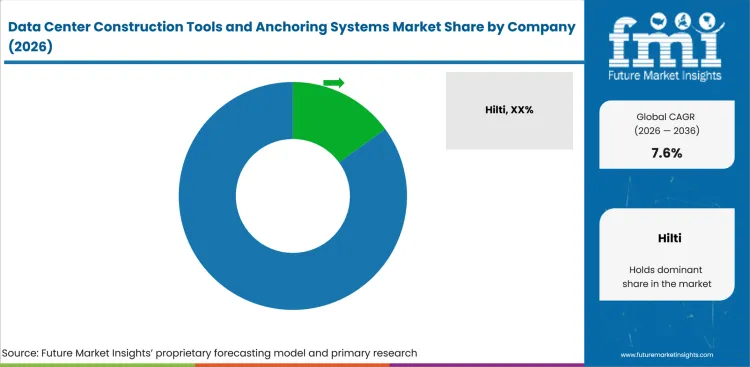
Hilti scores strongest on system breadth while DEWALT leads robotic drilling relevance.
| Company | Relevance to Market Title | Anchor Approval Depth | Jobsite Productivity Systems | Firestop and MEP Support Fit | Geographic Footprint |
|---|---|---|---|---|---|
| Hilti | Very High | Very Strong | Very Strong | Very Strong | Global |
| Stanley Black & Decker / DEWALT | Very High | Strong | Very Strong | Moderate | Global |
| fischer Group | High | Very Strong | Moderate | Moderate | Europe and Global |
| Simpson Strong-Tie | High | Very Strong | Moderate | Low | North America and Europe |
| Würth Group | High | Strong | Moderate | Moderate | Global |
| Sika | High | Moderate | Low | Very Strong | Global |
| ITW Construction Products | High | Very Strong | Moderate | Low | North America and Europe |
| EJOT | Moderate | Moderate | Moderate | Low | Europe and Asia |
| Rawlplug | Moderate | Strong | Moderate | Low | Europe and Asia |
| nVent CADDY | High | Moderate | Moderate | Very Strong | Global |
Source: Future Market Insights competitive analysis, 2026.
Who are the key players in the data center construction tools and anchoring systems market?
Hilti, Stanley Black & Decker, fischer Group, Simpson Strong-Tie, and Sika are listed with Würth and ITW among other suppliers.
Key global companies leading the data center construction tools and anchoring systems market include:
-
Hilti
- Stanley Black & Decker
- DEWALT
- fischer Group
- Simpson Strong-Tie
- Würth Group
- Sika
- ITW Construction Products
- EJOT
- Rawlplug
- nVent CADDY
Key Developments in Data Center Construction Tools and Anchoring Systems Market
- In January 2026, DEWALT unveiled a downward drilling robot for data center construction. The system links robotic drilling with anchors and supports lower cost per accurate hole.
- In October 2025, Hilti launched more than 60 heavy-duty Nuron products. The launch strengthened cordless tool coverage for high-load construction jobs.
- In June 2025, Sika outlined data center construction solutions in Dallas. The company cited more than 1,000 data centers built using Sika solutions.
- In January 2025, fischer highlighted FAZ II Plus for steel and plant engineering uses. The anchor’s fire and approval profile supports high-load concrete fastening.
Key Players in the Data Center Construction Tools and Anchoring Systems Market
Integrated Tool and Anchor Platforms
- Hilti
- Stanley Black & Decker
- DEWALT
Fastening and Structural Anchor Specialists
- fischer Group
- Simpson Strong-Tie
- Würth Group
- ITW Construction Products
- Rawlplug
- EJOT
Firestop and Construction Chemistry Specialists
- Sika
- Hilti
- nVent CADDY
Data Center Construction Tools and Anchoring Systems Market - Scope & Definition
| Attribute | Detail |
|---|---|
| Market Definition | Tools, anchors, supports, and firestop systems used during data center construction and fit-out. |
| Functions Covered | Concrete fixing, slab drilling, dust control, cable penetration sealing, modular support, layout marking, and installation documentation. |
| Applications Covered | MEP supports, cable penetrations, equipment pads, rack lines, and seismic bracing. |
| End-Use Industries | Hyperscale data centers, colocation facilities, enterprise data centers, and edge data centers. |
| Grades Covered | Mechanical anchors, chemical anchors, cast-in inserts, threaded rods, modular rails, firestop systems, and layout robotics. |
| Inclusions | Commercially sold anchors, construction tools, firestop products, modular supports, layout systems, drilling automation, direct enterprise sales, specialist distribution, and contractor channels. |
| Exclusions | Servers, storage equipment, switchgear, UPS systems, chillers, generators, structural steel, general civil construction, ordinary hand tools, and maintenance products used after commissioning. |
Data Center Construction Tools and Anchoring Systems Market - Research Methodology
| Method | Description |
|---|---|
| Primary Research | FMI analyst interviews with data center contractors, MEP installers, anchor distributors, firestop specialists, tool fleet managers, and construction technology buyers. |
| Desk Research | Review of energy demand data, construction spending releases, data center policy updates, code-listed anchor documentation, company portfolios, and official company releases. |
| Market Sizing & Forecasting | Bottom-up project-boundary approach using data center construction activity, product penetration, project type mix, average anchor and tool spend, and regional labor intensity. |
| Data Validation | Cross-verification using regulatory approvals, construction activity, official capacity statements, supplier documentation, and market activity checks. |
Data Center Construction Tools and Anchoring Systems Market - Report Scope
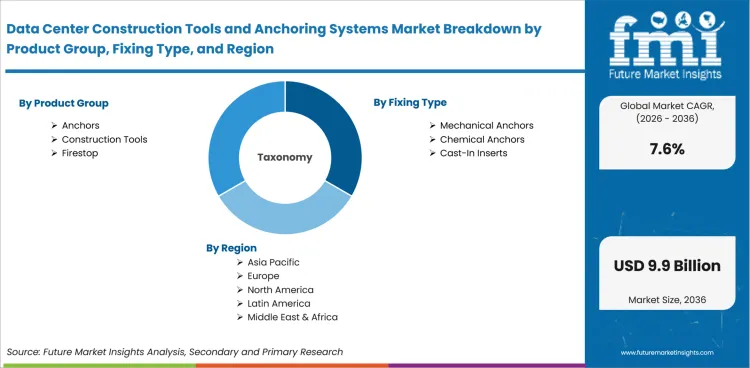
| Parameter | Value |
|---|---|
| Market size by 2036 | USD 9.9 billion |
| Growth rate | 7.6% CAGR from 2026 to 2036 |
| Forecast period | 2026 to 2036 |
| Base year value (2025) | USD 4.4 billion |
| By product group | Anchors, construction tools, firestop, modular supports, layout robotics |
| By fixing type | Mechanical anchors, chemical anchors, cast-in inserts, threaded rods |
| By project type | Hyperscale, colocation, enterprise, edge |
| By application | MEP supports, cable penetrations, equipment pads, rack lines, seismic bracing |
| By channel | Direct enterprise, specialist distributors, contractor dealers, digital procurement |
| Regions covered | North America, Latin America, Europe, East Asia, South Asia and Pacific, Middle East and Africa |
| Countries covered | United States, United Kingdom, Germany, France, Japan, China, South Korea, India |
| Key companies profiled | Hilti, Stanley Black & Decker, fischer Group, Simpson Strong-Tie, Würth Group, Sika, ITW |
| Approach | Bottom-up project-boundary approach using eligible anchor, tool, support, and firestop revenue across data center construction |
Source: Future Market Insights, 2026.
Key segments
Data Center Construction Tools and Anchoring Systems Market Segmented by Product Group
- Anchors
- Construction Tools
- Firestop
- Modular Supports
- Layout Robotics
Data Center Construction Tools and Anchoring Systems Market Segmented by Fixing Type
- Mechanical Anchors
- Chemical Anchors
- Cast-In Inserts
- Threaded Rods
Data Center Construction Tools and Anchoring Systems Market Segmented by Project Type
- Hyperscale
- Colocation
- Enterprise
- Edge
Data Center Construction Tools and Anchoring Systems Market Segmented by Application
- MEP Supports
- Cable Penetrations
- Equipment Pads
- Rack Lines
- Seismic Bracing
Data Center Construction Tools and Anchoring Systems Market Segmented by Channel
- Direct Enterprise
- Specialist Distributors
- Contractor Dealers
- Digital Procurement
Data Center Construction Tools and Anchoring Systems Market by Region
- North America
- Latin America
- Europe
- East Asia
- South Asia and Pacific
- Middle East and Africa
Research Sources and Bibliography
- International Energy Agency. (2025, April). Energy demand from AI. International Energy Agency.
- USA Department of Energy. (2024, December 20). DOE releases new report evaluating increase in electricity demand from data centers.
- USA Census Bureau. (2026, June 1). Monthly construction spending, April 2026.
- Department for Science, Innovation and Technology. (2024, September 12). Data centres to be given massive boost and protections from cyber criminals and IT blackouts. GOV.UK.
- Department for Science, Innovation and Technology. (2025, January 13). AI Opportunities Action Plan: Government response. GOV.UK.
- European Commission. (2024, March 14). Commission Delegated Regulation (EU) 2024/1364 on the first phase of the establishment of a common Union rating scheme for data centres.
- Federal Ministry for Economic Affairs and Climate Action. (2025). Status and development of the German data centre landscape: Executive summary.
- Digital Agency of Japan. (2025, July 28). Priority Plan for the Advancement of a Digital Society.
- State Council of the People’s Republic of China. (2025, October 21). China completes construction of world’s first wind-powered underwater data center.
- Ministry of Science and ICT. (2025). Ulsan AI Data Center launch sparks dialogue on AI infrastructure.
- Press Information Bureau of India. (2026, February 14). Budget 2026–27 sets the stage for India as a global hub for AI and cloud data centres.
- DEWALT. (2026, January 20). DEWALT unveils the world’s first downward drilling, fleet-capable robot to accelerate data center construction.
- Hilti Group. (2025, October 21). Hilti launches heavy-duty cordless tools to drive productivity.
- Sika. (2025, June 12). Sika is unlocking smart and durable solutions for data center construction.
- fischer Group. (2025, January 28). Steel and plant engineering of the future.
- SoftBank Group Corp. (2026, May 31). SoftBank Group to build 5 GW of AI data center capacity in France.
- French Presidency. (2025, February 10). Make France an AI powerhouse.
- ADEME and Société Numérique. (2026, March 19). Data centers: The industrial side of digital technology puts the climate transition to the test.
This bibliography is provided for reader reference and is not exhaustive. The full report contains the complete reference list and detailed citations.
This Report Answers
- What is the 2026 value and 2036 forecast for data center construction tools and anchoring systems market?
- What product group is projected to hold the leading share during the forecast period?
- What fixing type is expected to account for the leading 2026 share?
- How do AI data halls change demand for anchors, drilling tools, and firestop systems?
- What companies compete in data center construction tools and anchoring systems?
Frequently Asked Questions
What is the data center construction tools and anchoring systems market size in 2026?
The data center construction tools and anchoring systems market size is anticipated to cross USD 4.8 billion in 2026.
What is the data center construction tools and anchoring systems market forecast for 2036?
The industry revenue is predicted to reach USD 9.9 billion by 2036 as AI data halls raise fixture intensity.
What is the data center construction tools and anchoring systems market CAGR?
The sector is projected to expand at 7.6% CAGR from 2026 to 2036.
What segment leads the data center construction tools and anchoring systems market?
Anchors are likely to capture 38.0% share in 2026 due to repeated concrete fixing needs.
What country grows fastest in the data center construction tools and anchoring systems market?
India is set to record 8.9% CAGR by 2036, driven by cloud capacity expansion and AI infrastructure policy.
Preview the report firsthand - request a free sample
Get SampleGet the brochure for pricing and purchase details.
Get PDFTable of Content
- Key Takeaways
- Market Size and CAGR
- Top Growth Driver
- Fastest Growing Segment
- Leading Region
- Key Companies
- Emerging Opportunities
- Executive Summary
- Global Market Outlook
- Demand-side Trends
- Supply-side Trends
- Technology Roadmap Analysis
- Analysis and Recommendations
- Analyst Perspective (What is happening? Why now? What should investors know?)
- Key Questions Answered
- How large is the market?
- What is the CAGR?
- What are key trends?
- Which region dominates?
- Who are the leaders?
- Market Overview
- Market Coverage / Taxonomy
- Market Definition / Scope / Limitations
- Research Methodology
- Chapter Orientation
- Analytical Lens and Working Hypotheses
- Market Structure, Signals, and Trend Drivers
- Benchmarking and Cross-market Comparability
- Market Sizing, Forecasting, and Opportunity Mapping
- Research Design and Evidence Framework
- Desk Research Programme (Secondary Evidence)
- Expert Input and Fieldwork (Primary Evidence)
- Tooling, Models, and Reference Databases
- Data Engineering and Model Build
- Quality Assurance and Audit Trail
- Market Background
- Market Dynamics (Drivers, Restraints, Opportunity, Trends)
- Scenario Forecast (Optimistic, Likely, Conservative)
- Impact Analysis
- AI Impact
- Sustainability Impact
- Regulatory Impact
- Technology Impact
- Consumer / Buyer Analysis
- Purchase Drivers
- Adoption Barriers
- Buyer Journey
- Opportunity Map Analysis
- Product Life Cycle Analysis
- Supply Chain Analysis
- Investment Feasibility Matrix
- Value Chain Analysis
- PESTLE and Porter's Analysis
- Regulatory Landscape
- Regional Parent Market Outlook
- Production and Consumption Statistics
- Import and Export Statistics
- Global Market Analysis and Forecast, 2021 to 2036
- Historical Market Size Value (USD Billion) & Volume (Unit) Analysis, 2021 to 2025
- Current and Future Market Size Value (USD Billion) & Volume (Unit) Projections, 2026 to 2036
- Y-o-Y Growth Trend Analysis
- Absolute $ Opportunity Analysis
- Global Market Pricing Analysis, 2021 to 2036
- Global Market Analysis and Forecast, By Product Group, 2021 to 2036
- Introduction / Key Findings
- Historical Market Size Value (USD Billion) & Volume (Unit) Analysis By Product Group, 2021 to 2025
- Current and Future Market Size Value (USD Billion) & Volume (Unit) Analysis and Forecast By Product Group, 2026 to 2036
- Anchors
- Construction Tools
- Firestop
- Modular Supports
- Layout Robotics
- Anchors
- Y-o-Y Growth Trend Analysis By Product Group, 2021 to 2025
- Absolute $ Opportunity Analysis By Product Group, 2026 to 2036
- Global Market Analysis and Forecast, By Fixing Type, 2021 to 2036
- Introduction / Key Findings
- Historical Market Size Value (USD Billion) & Volume (Unit) Analysis By Fixing Type, 2021 to 2025
- Current and Future Market Size Value (USD Billion) & Volume (Unit) Analysis and Forecast By Fixing Type, 2026 to 2036
- Mechanical Anchors
- Chemical Anchors
- Cast-In Inserts
- Threaded Rods
- Mechanical Anchors
- Y-o-Y Growth Trend Analysis By Fixing Type, 2021 to 2025
- Absolute $ Opportunity Analysis By Fixing Type, 2026 to 2036
- Global Market Analysis and Forecast, By Project Type, 2021 to 2036
- Introduction / Key Findings
- Historical Market Size Value (USD Billion) & Volume (Unit) Analysis By Project Type, 2021 to 2025
- Current and Future Market Size Value (USD Billion) & Volume (Unit) Analysis and Forecast By Project Type, 2026 to 2036
- Hyperscale
- Colocation
- Enterprise
- Edge
- Hyperscale
- Y-o-Y Growth Trend Analysis By Project Type, 2021 to 2025
- Absolute $ Opportunity Analysis By Project Type, 2026 to 2036
- Global Market Analysis and Forecast, By Application, 2021 to 2036
- Introduction / Key Findings
- Historical Market Size Value (USD Billion) & Volume (Unit) Analysis By Application, 2021 to 2025
- Current and Future Market Size Value (USD Billion) & Volume (Unit) Analysis and Forecast By Application, 2026 to 2036
- MEP Supports
- Cable Penetrations
- Equipment Pads
- Rack Lines
- Seismic Bracing
- MEP Supports
- Y-o-Y Growth Trend Analysis By Application, 2021 to 2025
- Absolute $ Opportunity Analysis By Application, 2026 to 2036
- Global Market Analysis and Forecast, By Channel, 2021 to 2036
- Introduction / Key Findings
- Historical Market Size Value (USD Billion) & Volume (Unit) Analysis By Channel, 2021 to 2025
- Current and Future Market Size Value (USD Billion) & Volume (Unit) Analysis and Forecast By Channel, 2026 to 2036
- Direct Enterprise
- Specialist Distributors
- Contractor Dealers
- Digital Procurement
- Direct Enterprise
- Y-o-Y Growth Trend Analysis By Channel, 2021 to 2025
- Absolute $ Opportunity Analysis By Channel, 2026 to 2036
- Global Market Analysis and Forecast, By Region, 2021 to 2036
- Introduction
- Historical Market Size Value (USD Billion) & Volume (Unit) Analysis By Region, 2021 to 2025
- Current Market Size Value (USD Billion) & Volume (Unit) Analysis and Forecast By Region, 2026 to 2036
- North America
- Latin America
- Western Europe
- Eastern Europe
- East Asia
- South Asia and Pacific
- Middle East & Africa
- Market Attractiveness Analysis By Region
- North America Market Analysis and Forecast, By Country, 2021 to 2036
- Historical Market Size Value (USD Billion) & Volume (Unit) Trend Analysis By Market Taxonomy, 2021 to 2025
- Market Size Value (USD Billion) & Volume (Unit) Forecast By Market Taxonomy, 2026 to 2036
- By Country
- USA
- Canada
- Mexico
- By Product Group
- By Fixing Type
- By Project Type
- By Application
- By Channel
- By Country
- Market Attractiveness Analysis
- By Country
- By Product Group
- By Fixing Type
- By Project Type
- By Application
- By Channel
- Key Takeaways
- Latin America Market Analysis and Forecast, By Country
- Historical Market Size Value (USD Billion) & Volume (Unit) Trend Analysis By Market Taxonomy, 2021 to 2025
- Market Size Value (USD Billion) & Volume (Unit) Forecast By Market Taxonomy, 2026 to 2036
- By Country
- Brazil
- Chile
- Rest of Latin America
- By Product Group
- By Fixing Type
- By Project Type
- By Application
- By Channel
- By Country
- Market Attractiveness Analysis
- By Country
- By Product Group
- By Fixing Type
- By Project Type
- By Application
- By Channel
- Key Takeaways
- Western Europe Market Analysis and Forecast, By Country
- Historical Market Size Value (USD Billion) & Volume (Unit) Trend Analysis By Market Taxonomy, 2021 to 2025
- Market Size Value (USD Billion) & Volume (Unit) Forecast By Market Taxonomy, 2026 to 2036
- By Country
- Germany
- UK
- Italy
- Spain
- France
- Nordic
- BENELUX
- Rest of Western Europe
- By Product Group
- By Fixing Type
- By Project Type
- By Application
- By Channel
- By Country
- Market Attractiveness Analysis
- By Country
- By Product Group
- By Fixing Type
- By Project Type
- By Application
- By Channel
- Key Takeaways
- Eastern Europe Market Analysis and Forecast, By Country
- Historical Market Size Value (USD Billion) & Volume (Unit) Trend Analysis By Market Taxonomy, 2021 to 2025
- Market Size Value (USD Billion) & Volume (Unit) Forecast By Market Taxonomy, 2026 to 2036
- By Country
- Russia
- Poland
- Hungary
- Balkan & Baltic
- Rest of Eastern Europe
- By Product Group
- By Fixing Type
- By Project Type
- By Application
- By Channel
- By Country
- Market Attractiveness Analysis
- By Country
- By Product Group
- By Fixing Type
- By Project Type
- By Application
- By Channel
- Key Takeaways
- East Asia Market Analysis and Forecast, By Country
- Historical Market Size Value (USD Billion) & Volume (Unit) Trend Analysis By Market Taxonomy, 2021 to 2025
- Market Size Value (USD Billion) & Volume (Unit) Forecast By Market Taxonomy, 2026 to 2036
- By Country
- China
- Japan
- South Korea
- By Product Group
- By Fixing Type
- By Project Type
- By Application
- By Channel
- By Country
- Market Attractiveness Analysis
- By Country
- By Product Group
- By Fixing Type
- By Project Type
- By Application
- By Channel
- Key Takeaways
- South Asia and Pacific Market Analysis and Forecast, By Country
- Historical Market Size Value (USD Billion) & Volume (Unit) Trend Analysis By Market Taxonomy, 2021 to 2025
- Market Size Value (USD Billion) & Volume (Unit) Forecast By Market Taxonomy, 2026 to 2036
- By Country
- India
- ASEAN
- Australia & New Zealand
- Rest of South Asia and Pacific
- By Product Group
- By Fixing Type
- By Project Type
- By Application
- By Channel
- By Country
- Market Attractiveness Analysis
- By Country
- By Product Group
- By Fixing Type
- By Project Type
- By Application
- By Channel
- Key Takeaways
- Middle East & Africa Market Analysis and Forecast, By Country
- Historical Market Size Value (USD Billion) & Volume (Unit) Trend Analysis By Market Taxonomy, 2021 to 2025
- Market Size Value (USD Billion) & Volume (Unit) Forecast By Market Taxonomy, 2026 to 2036
- By Country
- Kingdom of Saudi Arabia
- Other GCC Countries
- Türkiye
- South Africa
- Other African Union
- Rest of Middle East & Africa
- By Product Group
- By Fixing Type
- By Project Type
- By Application
- By Channel
- By Country
- Market Attractiveness Analysis
- By Country
- By Product Group
- By Fixing Type
- By Project Type
- By Application
- By Channel
- Key Takeaways
- Key Countries Market Analysis
- USA
- Pricing Analysis
- Market Share Analysis, 2025
- By Product Group
- By Fixing Type
- By Project Type
- By Application
- By Channel
- Canada
- Pricing Analysis
- Market Share Analysis, 2025
- By Product Group
- By Fixing Type
- By Project Type
- By Application
- By Channel
- Mexico
- Pricing Analysis
- Market Share Analysis, 2025
- By Product Group
- By Fixing Type
- By Project Type
- By Application
- By Channel
- Brazil
- Pricing Analysis
- Market Share Analysis, 2025
- By Product Group
- By Fixing Type
- By Project Type
- By Application
- By Channel
- Chile
- Pricing Analysis
- Market Share Analysis, 2025
- By Product Group
- By Fixing Type
- By Project Type
- By Application
- By Channel
- Germany
- Pricing Analysis
- Market Share Analysis, 2025
- By Product Group
- By Fixing Type
- By Project Type
- By Application
- By Channel
- UK
- Pricing Analysis
- Market Share Analysis, 2025
- By Product Group
- By Fixing Type
- By Project Type
- By Application
- By Channel
- Italy
- Pricing Analysis
- Market Share Analysis, 2025
- By Product Group
- By Fixing Type
- By Project Type
- By Application
- By Channel
- Spain
- Pricing Analysis
- Market Share Analysis, 2025
- By Product Group
- By Fixing Type
- By Project Type
- By Application
- By Channel
- France
- Pricing Analysis
- Market Share Analysis, 2025
- By Product Group
- By Fixing Type
- By Project Type
- By Application
- By Channel
- India
- Pricing Analysis
- Market Share Analysis, 2025
- By Product Group
- By Fixing Type
- By Project Type
- By Application
- By Channel
- ASEAN
- Pricing Analysis
- Market Share Analysis, 2025
- By Product Group
- By Fixing Type
- By Project Type
- By Application
- By Channel
- Australia & New Zealand
- Pricing Analysis
- Market Share Analysis, 2025
- By Product Group
- By Fixing Type
- By Project Type
- By Application
- By Channel
- China
- Pricing Analysis
- Market Share Analysis, 2025
- By Product Group
- By Fixing Type
- By Project Type
- By Application
- By Channel
- Japan
- Pricing Analysis
- Market Share Analysis, 2025
- By Product Group
- By Fixing Type
- By Project Type
- By Application
- By Channel
- South Korea
- Pricing Analysis
- Market Share Analysis, 2025
- By Product Group
- By Fixing Type
- By Project Type
- By Application
- By Channel
- Russia
- Pricing Analysis
- Market Share Analysis, 2025
- By Product Group
- By Fixing Type
- By Project Type
- By Application
- By Channel
- Poland
- Pricing Analysis
- Market Share Analysis, 2025
- By Product Group
- By Fixing Type
- By Project Type
- By Application
- By Channel
- Hungary
- Pricing Analysis
- Market Share Analysis, 2025
- By Product Group
- By Fixing Type
- By Project Type
- By Application
- By Channel
- Kingdom of Saudi Arabia
- Pricing Analysis
- Market Share Analysis, 2025
- By Product Group
- By Fixing Type
- By Project Type
- By Application
- By Channel
- Türkiye
- Pricing Analysis
- Market Share Analysis, 2025
- By Product Group
- By Fixing Type
- By Project Type
- By Application
- By Channel
- South Africa
- Pricing Analysis
- Market Share Analysis, 2025
- By Product Group
- By Fixing Type
- By Project Type
- By Application
- By Channel
- USA
- Market Structure Analysis
- Competition Dashboard
- Competition Benchmarking
- Market Share Analysis of Top Players
- By Regional
- By Product Group
- By Fixing Type
- By Project Type
- By Application
- By Channel
- Emerging Startups
- Innovation Benchmarking
- Competition Analysis
- Competition Deep Dive
- Hilti
- Overview
- Product Portfolio
- Profitability by Market Segments (Product/Region/Sales Channel)
- Sales Footprint
- Strategy Overview
- Marketing Strategy
- Product Strategy
- Channel Strategy
- Stanley Black & Decker
- DEWALT
- fischer Group
- Simpson Strong-Tie
- Würth Group
- ITW Construction Products
- Rawlplug
- EJOT
- Sika
- Hilti
- nVent CADDY
- Hilti
- Case Studies
- Success Stories
- Recent Developments
- Competition Deep Dive
- Assumptions & Acronyms Used


