

- Industry Size (2025)
- USD 0.6 Bn
- Forecast (2035)
- USD 1.6 Bn
- CAGR (2025 to 2035)
- 10.5%
Demand for Email Application in USA Forecast and Outlook 2025 to 2035
The demand for email applications in the USA is expected to grow from USD 0.6 billion in 2025 to USD 1.6 billion by 2035, reflecting a compound annual growth rate (CAGR) of 10.5%. Email applications, including both personal and enterprise-level platforms, are essential tools for communication, marketing, and collaboration. The growing shift toward digital communication in both personal and professional environments, along with the increasing demand for advanced email features, including integration with other software tools, security enhancements, and automation, is expected to drive steady market growth.
The market will experience consistent growth, starting at USD 0.6 billion in 2025 and increasing to USD 0.6 billion in 2026, USD 0.7 billion in 2027, and USD 0.8 billion in 2028. By 2029, demand for email applications will rise to USD 0.9 billion, continuing its upward trajectory through the 2030s. By 2035, the demand for email applications is expected to reach USD 1.6 billion, driven by advancements in email technologies, the integration of artificial intelligence (AI) and machine learning (ML) for email management, and increasing business adoption of email marketing and communication platforms.
Quick Stats of the Demand for Email Application in USA
- Demand for Email Application in USA Value (2025): USD 0.6 billion
- Demand for Email Application in USA Forecast Value (2035): USD 1.6 billion
- Demand for Email Application in USA Forecast CAGR (2025 to 2035): 10.5%
- Demand for Email Application in USA Key Deployment: 60% Public Cloud
- Demand for Email Application in USA Key Growth Regions: West USA, South USA, Northeast USA, Midwest USA
- Demand for Email Application in USA Key Players: Microsoft Outlook, Gmail (Google), Apple Mail, Yahoo Mail, Zoho Mail
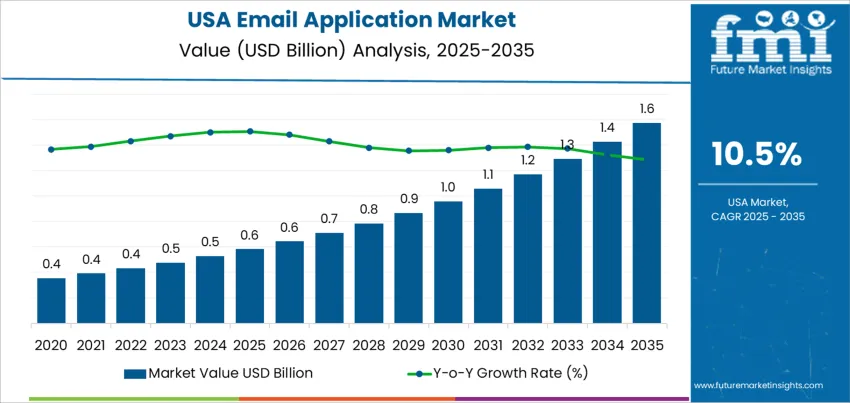
What is the Growth Forecast for the Email Application Industry in USA through 2035?
The long-term value accumulation curve for email applications shows a consistent, steady increase in market value over the forecast period. Starting at USD 0.6 billion in 2025, the market will accumulate value incrementally, with each year contributing to overall growth. The curve highlights a gradual, but persistent upward trend as email applications continue to evolve and expand in both personal and business communication sectors.
The value accumulation is expected to accelerate as the market matures, particularly after 2029, when demand for advanced features like AI-driven tools, integrated customer relationship management (CRM) systems, and enhanced security protocols for email applications become more widespread. By 2035, the market is expected to reach USD 1.6 billion, reflecting the continued adoption of these innovations and the overall expansion of email as a critical communication tool in a digitally connected world. This steady growth reflects the increasing reliance on email across industries and personal Usage, cementing its place as a core tool in both business operations and personal communication.
USA Email Application Industry Key Takeaways
| Metric | Value |
|---|---|
| Industry Sales Value (2025) | USD 0.6 billion |
| Industry Forecast Value (2035) | USD 1.6 billion |
| Industry Forecast CAGR (2025 to 2035) | 10.5% |
Why is the Demand for Email Applications in USA Growing?
Demand for email applications in the USA is rising as email remains a core communication tool for both individuals and businesses. A large majority of American adults use email regularly. As remote work, hybrid workplaces, and digital collaboration have expanded, the reliance on email platforms for business correspondence, project coordination, and notifications has grown. Many companies, educational institutions, and service providers require email for essential communication, which supports consistent demand for robust and secure email applications. The widespread use of smartphones and mobile internet connectivity reinforces this demand because email apps offer flexibility and access from anywhere at any time.
At the same time business needs, marketing practices, and regulatory compliance increase demand for advanced email application features. Organizations require tools that support secure messaging, encryption, large scale mailing, integrated calendars, collaboration, and data management. The growth of remote services, online customer interactions, and digital workflows drives adoption of enterprise grade email solutions. In addition, the volume of email use remains high - both for personal communication and commercial correspondence - which ensures that demand for email applications remains stable. As digital communication continues to evolve and businesses digitize operations, demand for reliable email applications in the USA is likely to grow steadily in years ahead.
What Is the Current State of the Demand for Email Applications in the USA in Terms of Product Type and Deployment?
The demand for email applications in the USA is primarily driven by product type and deployment. The leading product type is cloud business email, which accounts for 45% of the market share, while public cloud is the dominant deployment model, capturing 60% of the demand. Email applications are widely used for communication in personal, business, and enterprise environments. As businesses continue to migrate to cloud-based solutions for flexibility, security, and scalability, the demand for cloud-based business email solutions and public cloud deployments remains strong.
How Is Cloud Business Email Leading the Product Type Demand for Email Applications in the USA?
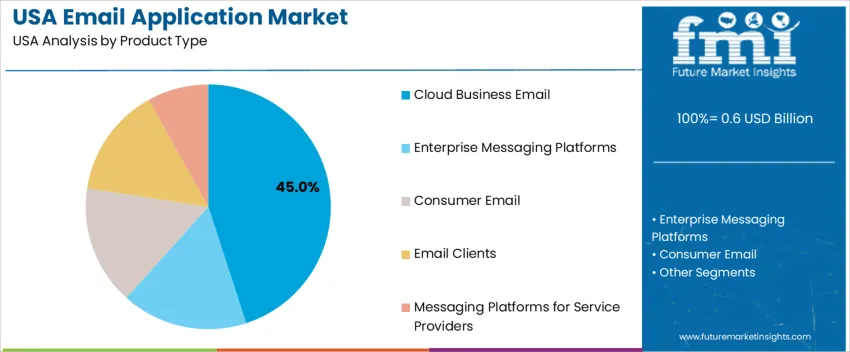
Cloud business email leads the demand for email applications in the USA, holding 45% of the market share. Cloud-based business email solutions are preferred for their scalability, reliability, and ease of integration with other cloud-based tools and services. These solutions allow organizations to manage email services without the need for maintaining on-site hardware, providing flexibility and reducing infrastructure costs. Cloud business email platforms are particularly beneficial for businesses with remote teams or those that require secure, easily accessible communication channels across multiple devices.
The demand for cloud business email is driven by its advantages, including cost-efficiency, accessibility from any location with an internet connection, and enhanced security features like encryption and multi-factor authentication. As organizations continue to embrace digital transformation and remote work, cloud-based email solutions are increasingly becoming the preferred choice. The ability to access business emails on-demand, combined with seamless integration with other cloud tools, ensures that cloud business email will continue to dominate the email application market in the USA.
How Is Public Cloud Leading the Deployment Demand for Email Applications in the USA?
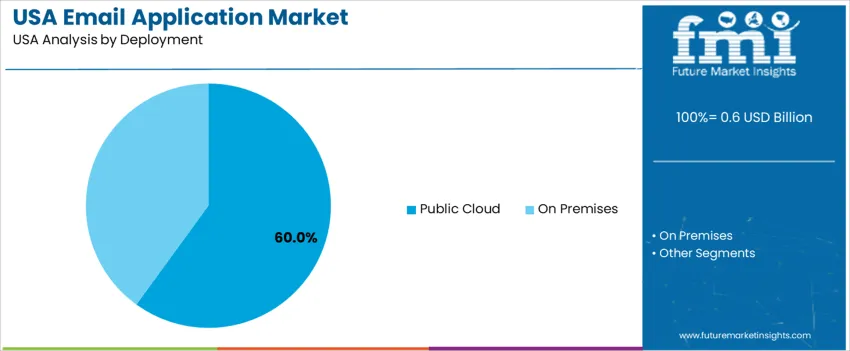
Public cloud leads the deployment demand for email applications in the USA, capturing 60% of the market share. Public cloud deployments are popular due to their flexibility, scalability, and cost-effectiveness, as businesses do not have to invest in and maintain their own infrastructure. Cloud service providers manage the hardware, software, and security, allowing businesses to focus on their core operations. Public cloud email solutions also enable easy collaboration, with access to emails, calendars, and contacts from virtually any device.
The demand for public cloud deployment is driven by the increasing need for businesses to streamline operations, improve scalability, and reduce overhead costs. As organizations seek to optimize their IT infrastructure, the public cloud offers a low-maintenance, high-performance solution for email management. The growing trend of remote work, the rise of cloud-based collaboration tools, and the push for digital transformation are further boosting the adoption of public cloud-based email applications. As these trends continue, public cloud deployments are expected to remain the leading choice for email applications in the USA.
What is the Summary of Demand for Email Applications in the USA?
Demand for email applications in the USA remains very high and stable. A vast majority of adults regularly use email for personal and professional communication. Email tools serve as a core channel for business correspondence, e commerce, marketing, customer service, and everyday personal messaging. As more people check mail on mobile devices or desktops, and as digital communication continues to expand, email applications maintain their role as essential infrastructure for connectivity.
What are the Drivers of Demand for Email Applications in the USA?
Email applications are driven by widespread internet access and high adoption across age groups, making email nearly universal for adults in the USA. Many businesses continue to rely on email for official communications, documentation, and client interactions - even as newer messaging tools emerge. Email serves as a backbone for formal exchanges where reliability, record keeping, and broad compatibility matter. The growth of remote work, online services, and digital commerce increases daily email traffic for orders, confirmations, support, and notifications. In addition, both individuals and companies use email for subscription services, newsletters, promotions, and personal communication, sustaining consistent demand across demographics.
What are the Restraints on Demand for Email Applications in the USA?
Despite strong demand, email applications face competition and certain limitations. Alternative digital communication tools such as instant messaging, team collaboration platforms, and social media reduce reliance on email for informal conversations and quick interactions. Email overload and spam continue to be a burden for users, which can reduce perceived usefulness or prompt users to limit frequency of checking. Privacy and security concerns - especially around phishing, spam, and data leaks - make some users cautious about sensitive correspondence over email. For occasional or young users, simpler or more mobile first communication apps may feel more convenient, which can limit growth in certain segments. Finally, for marketing or bulk mail senders, increasing regulatory attention on spam, consent, and data protection may make email outreach more challenging.
What are the Key Trends Influencing Demand for Email Applications in the USA?
A major trend is continued integration of email with mobile devices - many users read and respond on smartphones, making email accessible on the go and supporting high engagement. Another trend is growing use of email for business continuity, remote work, and hybrid office models, reinforcing email as a core professional communication channel. Email remains central for transactional messages in e commerce, subscriptions, bills, and notifications, which supports long term demand. At the same time, improvements in security, spam filtering, and email management tools aim to make email more user friendly and trustworthy. There is also steady adoption of email for marketing and customer engagement by businesses that value its broad reach and direct channel to consumers. Because email combines familiarity, reliability, and versatility, it continues to thrive even as new communication platforms arise.
What is the Regional Demand Outlook for Email Applications in the USA?
The demand for email applications in the USA is projected to grow across all regions, with the West USA leading at a CAGR of 12.0%. The South USA follows at 10.8%, the Northeast USA at 9.6%, and the Midwest USA at 8.4%. These regional variations reflect differences in technological adoption, business activity, and communication infrastructure. The growing use of email for both personal and professional communication, along with the rise of digital marketing and e-commerce, continues to drive demand for email applications across the country.
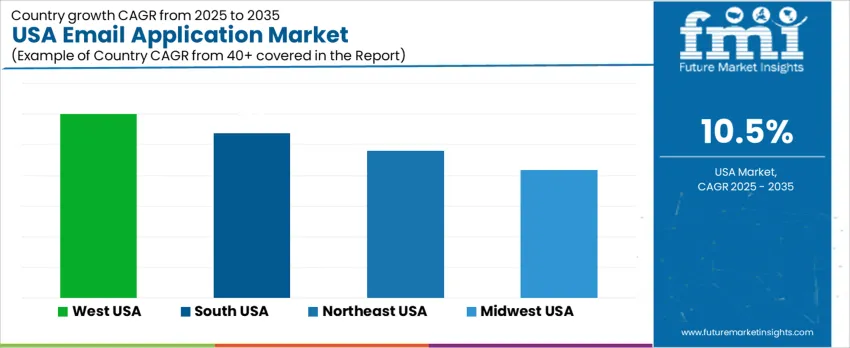
| Region | CAGR (%) |
|---|---|
| West USA | 12.0 |
| South USA | 10.8 |
| Northeast USA | 9.6 |
| Midwest USA | 8.4 |
What Drives Demand for Email Applications in the West USA?
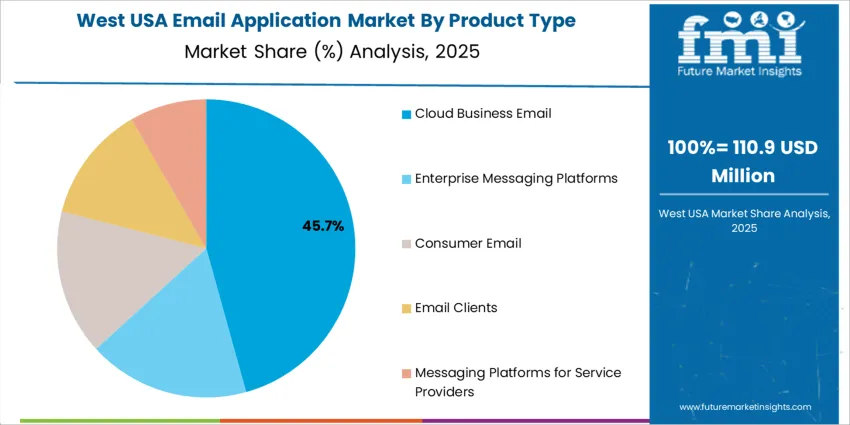
In the West USA, the demand for email applications is expected to grow at a CAGR of 12.0%. The region’s strong technology sector, high concentration of businesses, and e-commerce activity contribute to the increasing use of email for both business and personal communication. The West is home to major tech hubs such as Silicon Valley, where digital marketing, cloud services, and email marketing platforms are essential tools for companies. The increasing reliance on digital communication and marketing further fuels demand for sophisticated email applications that offer features such as automation, integration with CRM systems, and analytics. Additionally, the adoption of remote work and virtual collaboration tools, especially in tech-driven companies, accelerates the need for effective email solutions that enhance communication and productivity.
Why is Demand for Email Applications Growing in the South USA?
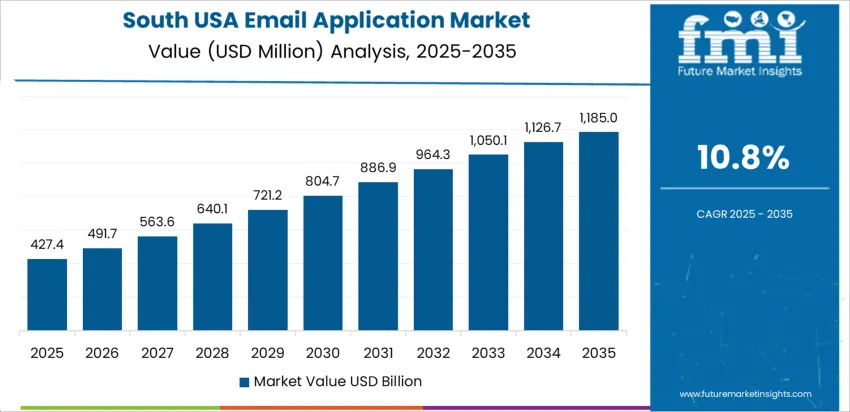
In the South USA, the demand for email applications is projected to grow at a CAGR of 10.8%. The region’s expanding business environment, particularly in sectors such as retail, healthcare, and logistics, drives the need for efficient communication tools. As the South continues to experience growth in both traditional industries and tech startups, email applications are increasingly essential for business operations, marketing, and customer engagement. The rise of e-commerce and the growing trend of digital customer communication, particularly in the retail sector, further support the demand for email applications with advanced marketing features. Furthermore, the adoption of cloud-based email services and the shift toward remote work increase the need for scalable and secure email solutions across businesses of all sizes in the South.
What Supports Demand for Email Applications in the Northeast USA?
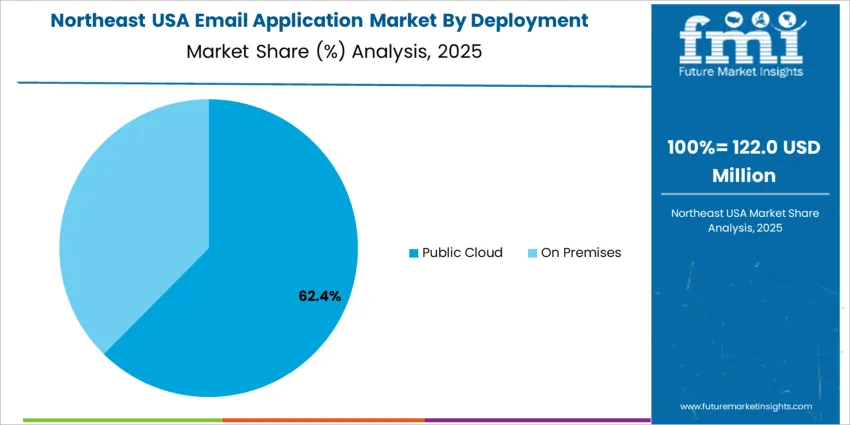
In the Northeast USA, the projected CAGR for email applications is 9.6%. The region’s dense urban population, high concentration of financial services, healthcare organizations, and educational institutions contributes to the widespread use of email for communication and business operations. As digital marketing continues to grow, email applications are vital for businesses looking to engage customers, manage communications, and improve customer service. The Northeast’s focus on industries that rely heavily on secure and efficient communication, such as finance and government, further fuels demand for advanced email applications that offer encryption, automation, and integration with other business tools. The increasing trend of hybrid work in this region also boosts the need for efficient and reliable email solutions to support remote communication and collaboration.
How is Demand for Email Applications Evolving in the Midwest USA?
In the Midwest USA, the demand for email applications is expected to grow at a CAGR of 8.4%. While growth in this region is somewhat slower compared to others, steady demand remains due to the strong presence of manufacturing, agriculture, and small businesses. As companies in the Midwest increasingly turn to digital communication, email applications become an essential tool for marketing, customer support, and internal collaboration. The adoption of cloud-based email solutions and the rise of e-commerce in this region further contribute to the demand. Additionally, businesses in the Midwest are embracing automation, data-driven marketing, and CRM integrations, all of which require sophisticated email applications. While growth is more moderate, the continued digital transformation of industries in the Midwest ensures ongoing demand for effective email communication tools.
What is the Competitive Landscape for the Email Application Market in the USA?
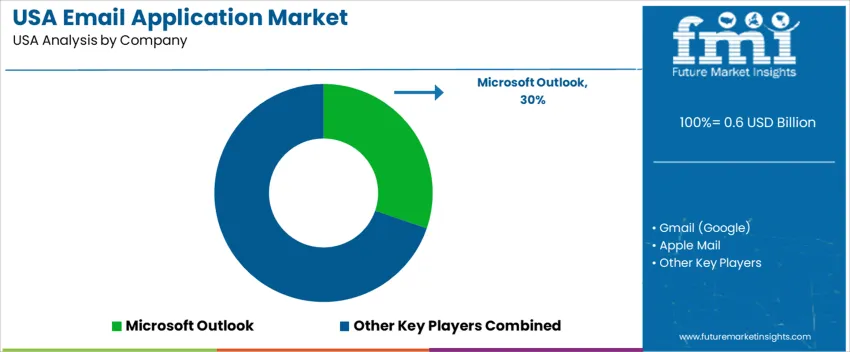
The market for email applications in the USA remains shaped by consumer and enterprise demand for reliable, integrated communication tools. According to recent Usage data, the top email clients by share of email opens are Apple Mail, Gmail and Microsoft Outlook. For example, one dataset reported Apple Mail at about 49.8%, Gmail at 28.2% and Outlook at 7.7% based on opens. These figures suggest that while Gmail and Outlook remain important, a substantial portion of users rely on Apple’s built in client, particularly on iOS and macOS devices.
Given this context, your list of companies and assumptions about market share (Gmail, Outlook, etc.) reflects a competitive environment where different providers serve different segments. The firm you named as leading (Microsoft Outlook) is in reality smaller in open share compared with Apple Mail and Gmail. Others listed - Gmail, Yahoo Mail, and Zoho Mail - have varying presence depending on demographic, device type, and Usage patterns. Competition among them involves factors such as integration with devices or operating systems, ease of use, security features, synchronization across platforms, and support for both personal and business use. Demand for email applications continues to evolve with growth in remote work, hybrid communication needs and integration with calendars, cloud storage and collaboration tools.
Key Players of the Email Application Industry in USA
- Microsoft Outlook
- Gmail (Google)
- Apple Mail
- Yahoo Mail
- Zoho Mail
Scope of the Report
| Items | Details |
|---|---|
| Quantitative Units | USD Billion |
| Regions Covered | USA |
| Product Type | Cloud Business Email, Enterprise Messaging Platforms, Consumer Email, Email Clients, Messaging Platforms for Service Providers |
| Deployment | Public Cloud, On Premises |
| Key Companies Profiled | Microsoft Outlook, Gmail (Google), Apple Mail, Yahoo Mail, Zoho Mail |
| Additional Attributes | Dollar sales by product type and deployment show strong demand for cloud business email solutions, particularly in enterprises, with cloud-based services like Microsoft Outlook and Gmail dominating the market. Consumer email platforms, such as Yahoo Mail and Apple Mail, continue to be widely used. Public cloud deployment is preferred by businesses and consumers for scalability and ease of access. Major companies like Microsoft, Google, and Zoho lead the market with their comprehensive email and messaging services. The market is expected to continue growing as businesses and individuals increasingly rely on email communication and cloud-based solutions. |
Key Segments in the Demand for Email Application in USA
Product Type:
- Cloud Business Email
- Enterprise Messaging Platforms
- Consumer Email
- Email Clients
- Messaging Platforms for Service Providers
Deployment:
- Public Cloud
- On Premises
Region:
- Northeast USA
- West USA
- Midwest USA
- South USA
Frequently Asked Questions
How big is the demand for email application in USA in 2025?
The demand for email application in USA is estimated to be valued at USD 0.6 billion in 2025.
What will be the size of email application in USA in 2035?
The market size for the email application in USA is projected to reach USD 1.6 billion by 2035.
How much will be the demand for email application in USA growth between 2025 and 2035?
The demand for email application in USA is expected to grow at a 10.5% CAGR between 2025 and 2035.
What are the key product types in the email application in USA?
The key product types in email application in USA are cloud business email, enterprise messaging platforms, consumer email, email clients and messaging platforms for service providers.
Which deployment segment is expected to contribute significant share in the email application in USA in 2025?
In terms of deployment, public cloud segment is expected to command 60.0% share in the email application in USA in 2025.
Preview the report firsthand - request a free sample
Get SampleGet the brochure for pricing and purchase details.
Get PDFTable of Content
- Executive Summary
- USA Market Outlook
- Demand-side Trends
- Supply-side Trends
- Technology Roadmap Analysis
- Analysis and Recommendations
- Market Overview
- Market Coverage / Taxonomy
- Market Definition / Scope / Limitations
- Market Background
- Market Dynamics
- Drivers
- Restraints
- Opportunity
- Trends
- Scenario Forecast
- Demand in Optimistic Scenario
- Demand in Likely Scenario
- Demand in Conservative Scenario
- Opportunity Map Analysis
- Product Life Cycle Analysis
- Supply Chain Analysis
- Investment Feasibility Matrix
- Value Chain Analysis
- PESTLE and Porter’s Analysis
- Regulatory Landscape
- Regional Parent Market Outlook
- Production and Consumption Statistics
- Import and Export Statistics
- Market Dynamics
- USA Market Analysis 2020 to 2024 and Forecast, 2025 to 2035
- Historical Market Size Value (USD Million) Analysis, 2020 to 2024
- Current and Future Market Size Value (USD Million) Projections, 2025 to 2035
- Y-o-Y Growth Trend Analysis
- Absolute $ Opportunity Analysis
- USA Market Pricing Analysis 2020 to 2024 and Forecast 2025 to 2035
- USA Market Analysis 2020 to 2024 and Forecast 2025 to 2035, By Product Type
- Introduction / Key Findings
- Historical Market Size Value (USD Million) Analysis By Product Type , 2020 to 2024
- Current and Future Market Size Value (USD Million) Analysis and Forecast By Product Type , 2025 to 2035
- Cloud Business Email
- Enterprise Messaging Platforms
- Consumer Email
- Email Clients
- Messaging Platforms for Service Providers
- Y-o-Y Growth Trend Analysis By Product Type , 2020 to 2024
- Absolute $ Opportunity Analysis By Product Type , 2025 to 2035
- USA Market Analysis 2020 to 2024 and Forecast 2025 to 2035, By Deployment
- Introduction / Key Findings
- Historical Market Size Value (USD Million) Analysis By Deployment, 2020 to 2024
- Current and Future Market Size Value (USD Million) Analysis and Forecast By Deployment, 2025 to 2035
- Public Cloud
- On Premises
- Y-o-Y Growth Trend Analysis By Deployment, 2020 to 2024
- Absolute $ Opportunity Analysis By Deployment, 2025 to 2035
- Market Structure Analysis
- Competition Dashboard
- Competition Benchmarking
- Market Share Analysis of Top Players
- By Regional
- By Product Type
- By Deployment
- Competition Analysis
- Competition Deep Dive
- Microsoft Outlook
- Overview
- Product Portfolio
- Profitability by Market Segments (Product/Age /Sales Channel/Region)
- Sales Footprint
- Strategy Overview
- Marketing Strategy
- Product Strategy
- Channel Strategy
- Gmail (Google)
- Apple Mail
- Yahoo Mail
- Zoho Mail
- Microsoft Outlook
- Competition Deep Dive
- Assumptions & Acronyms Used
- Research Methodology


