

- Industry Size (2025)
- USD 12.2 Bn
- Forecast (2035)
- USD 21.4 Bn
- CAGR (2025 to 2035)
- 5.8%
Demand for Business Email in USA Forecast and Outlook 2025 to 2035
In 2025, the demand for business email in the USA is valued at USD 12.2 billion and is projected to reach USD 21.4 billion by 2035 at a CAGR of 5.8%. Market growth is anchored in the continued role of email as the core identity and authentication layer for enterprise software access, client communication, and regulatory archiving. Business-to-business USAge dominates with a 61% share as corporate workflows, vendor management, and compliance reporting remain email-centric. Cloud-based deployment accounts for 72% of total installations, reflecting migration away from legacy on-premises infrastructure toward scalable subscription platforms. Adoption is reinforced by cross-integration with productivity suites, identity management systems, and cybersecurity monitoring tools used across finance, healthcare, and professional services.
After 2030, value expansion is driven more by security layering and platform consolidation than by new user creation. Demand rises from about USD 16.1 billion in 2030 toward USD 21.4 billion by 2035 as enterprises invest in encryption, phishing detection, zero-trust access, and regulatory retention controls. Business-to-customer communication holds 39% share through marketing automation, service notifications, and transaction messaging. Microsoft Outlook, Gmail, Apple Mail, Zoho Mail, and ProtonMail anchor competitive activity across different security and enterprise integration tiers. Vendor strategy centers on uptime reliability, sovereign data hosting, anti-spoofing resilience, and enterprise-grade compliance features aligned with USA data protection and audit frameworks.
Quick Stats of the Demand for Business Email in USA:
- Demand for Business Email in USA Value (2025): USD 12.2 billion
- Demand for Business Email in USA Forecast Value (2035): USD 21.4 billion
- Demand for Business Email in USA Forecast CAGR (2025 to 2035): 5.8%
- Demand for Business Email in USA Leading Channel: Business-to-Business (61%)
- Demand for Business Email in USA Key Growth Regions: West, South, Northeast, Midwest
- Demand for Business Email in USA Top Players: Microsoft Outlook, Gmail (Google), Apple Mail, Zoho Mail, Proton Mail
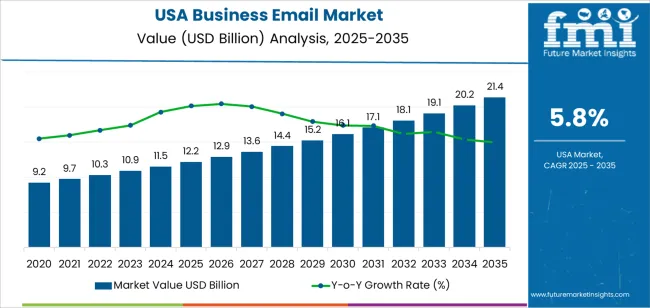
What is the Demand Forecast for Business Email in USA through 2035?
The overall demand for business email in USA increases from USD 12.2 billion in 2025 to USD 16.1 billion by 2030, adding USD 3.9 billion in absolute value. This phase reflects steady expansion in enterprise communication infrastructure as cloud migration, hybrid work models, and cybersecurity compliance reshape corporate IT spending. Growth is supported by rising deployment of secure email gateways, multi-factor authentication, encryption services, and compliance archiving across regulated industries such as banking, healthcare, and government. Demand remains USAge anchored rather than price driven, with value growth coming from higher per-seat security layers, spam filtering sophistication, and integration with collaboration ecosystems rather than basic mailbox provisioning.
From 2030 to 2035, the market expands from USD 16.1 billion to USD 21.4 billion, adding a larger USD 5.3 billion within five years. This back weighted acceleration reflects the shift of business email from a standalone communication tool into a core digital identity and security control layer. Advanced threat protection, behavioral phishing detection, AI based filtering, and zero trust email access models raise value per user. As regulatory scrutiny over data privacy, breach disclosure, and communication auditability intensifies, email platforms evolve into compliance infrastructure rather than simple productivity tools, pushing demand from stable IT spending into higher value enterprise risk management budgets.
Business Email Industry in USA Key Takeaways
| Metric | Value |
|---|---|
| Industry Value (2025) | USD 12.2 billion |
| Forecast Value (2035) | USD 21.4 billion |
| Forecast CAGR (2025 to 2035) | 5.8% |
How Is Business Email Use Evolving Among USA Companies?
Business email remains central to corporate communication in the USA even as newer tools emerge. Many organizations continue to rely on email for formal exchanges, record keeping, and external correspondence because it supports auditability, traceability, and cross-department visibility. In complex or regulated businesses, critical communications such as legal notices, contracts, purchase orders, compliance documentation, and customer correspondence still flow primarily through email. The consistency, reliability, and asynchronous nature of email make it suitable for distributed teams, remote work, and multi-channel coordination - conditions that have grown more common in recent years.
Looking forward, growth in demand for business email solutions will be shaped by increasing regulatory complexity, hybrid working models, and integration needs with broader enterprise systems. Firms will seek advanced email platforms that offer secure encryption, compliance logging, email archiving, identity management, and smooth integration with collaboration and CRM tools. Smaller firms and startups may adopt hosted business email services rather than build in-house infrastructure. At the same time, competition from real-time messaging, collaboration suites, and project-management platforms could restrict growth. Market expansion will depend on how well email platforms adapt to security requirements, mobile USAge, and hybrid workflows rather than simply replacing personal email with business accounts.
How Are Channel and Deployment Structuring the Demand for Business Email in USA?
The demand for business email in the USA is structured by communication channel and deployment model. Business to business USAge accounts for 61% of total demand, while business to customer communication represents the remaining share. By deployment, cloud based platforms hold 72.0% of total adoption, followed by on premises systems. Demand patterns are shaped by enterprise communication volume, regulatory compliance requirements, scalability needs, and cybersecurity controls. These segments reflect how internal collaboration, external customer engagement, and IT infrastructure strategies determine email platform selection across corporate, commercial, and service sectors in the USA.
Why Does Business to Business Communication Lead Business Email Demand in USA?
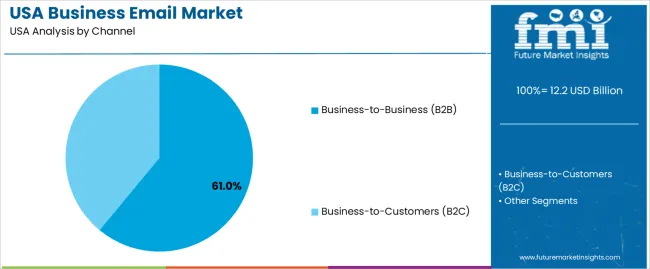
Business to business communication accounts for 61% of total business email demand in the USA due to the high volume of inter-organizational messaging that supports operations, procurement, logistics coordination, and financial transactions. Enterprises rely on email for contract exchange, invoice processing, document approval, and regulatory correspondence. Large corporations, professional services firms, manufacturers, and technology companies generate continuous internal and external business traffic that sustains elevated email USAge levels across daily operations.
B2B communication also requires structured email systems that support encryption, data retention, and audit trails for compliance. Legal, banking, healthcare administration, and government contractors rely on secure business email to meet documentation obligations. Email remains the primary formal communication channel for supplier negotiations and service confirmations. These compliance intensity, transaction volume, and operational dependency factors position B2B as the dominant channel for business email demand across the USA.
Why Does Cloud Based Deployment Dominate Business Email Demand in USA?
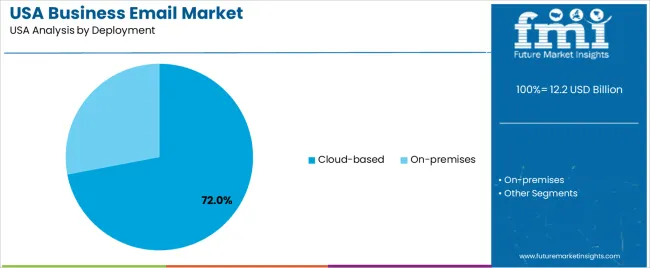
Cloud based deployment accounts for 72.0% of total business email demand in the USA due to its scalability, cost efficiency, and centralized management capabilities. Cloud platforms allow enterprises to add or remove users without physical infrastructure expansion. Automatic software updates, security patching, and system maintenance reduce internal IT workload across organizations of all sizes. Cloud email also supports remote workforce operations and multi-location access without reliance on corporate network boundaries.
Cloud based systems further offer advanced security controls such as multi factor authentication, threat detection, and data loss prevention tools. Integration with collaboration platforms, document sharing systems, and customer relationship management software strengthens workflow automation. Subscription pricing supports predictable budgeting across annual IT spending cycles. These operational efficiency, security, and integration advantages position cloud deployment as the dominant model for business email adoption across the USA.
What Forces Are Driving the Demand for Business Email in the USA?
Demand for business email in the USA is driven by its role as the primary identity layer for corporate communication, authentication, and workflow access. Every enterprise system, from finance and HR to customer support and cloud platforms, is anchored to email-based identity. Growth in remote work, distributed teams, and contractor-based staffing increases dependence on secure, role-based business email accounts. Legal documentation, compliance notices, customer correspondence, and transaction confirmations continue to require formal email channels. These functional, legal, and access-control roles make business email a core digital utility rather than a simple messaging tool.
How Do Enterprise Operations, Compliance, and Client Communication Shape Demand?
USA enterprises rely on business email for regulated communication across healthcare, finance, insurance, legal services, and government contracting. Audit trails, retention policies, and legal discovery requirements reinforce continued use of structured email systems. Client onboarding, invoice delivery, contract exchange, and service notifications still depend heavily on email rather than chat platforms. Sales teams, procurement units, and vendor coordination workflows remain email-centric for traceability. Integration with CRM, ERP, and ticketing platforms further anchors email in daily operations. These compliance-heavy and external communication needs sustain structurally stable demand.
What Security, Cost, and Platform Pressures Restrain Market Expansion?
Business email demand in the USA faces constraints from rising cybersecurity threats, cost of advanced protection layers, and platform consolidation. Phishing, impersonation, and ransomware risks force companies to invest in encryption, filtering, and zero-trust access controls, raising total cost of ownership. Small firms struggle with premium security subscriptions. Platform bundling inside large cloud productivity suites reduces vendor diversity and price flexibility. Employee fatigue from overloaded inboxes also drives partial shift toward collaboration tools for internal use. These pressures limit unchecked volume growth while strengthening demand for secure enterprise-grade solutions.
How Are Security Automation, AI Filtering, and Workflow Integration Reshaping Demand?
Business email in the USA is evolving into an automated security and workflow control system rather than a passive communication pipe. AI-driven spam detection, behavioral threat analysis, and automated incident response now operate in real time. Smart routing links emails directly to CRM cases, procurement approvals, and service tickets. Data loss prevention policies monitor outbound content for compliance risk. Encrypted external email portals support sensitive document exchange. These trends show business email shifting into an intelligent compliance and risk-management interface at the core of USA enterprise communication infrastructure.
What is the Demand for Business Email in USA by Region?
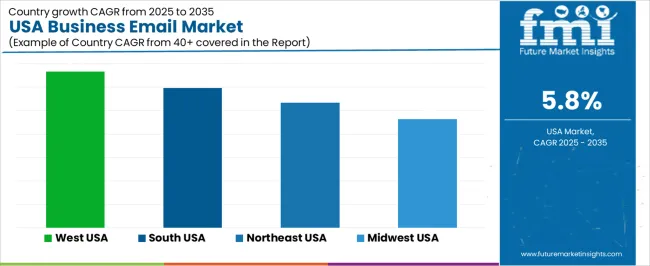
| Region | CAGR (%) |
|---|---|
| West | 6.7% |
| South | 6.0% |
| Northeast | 5.3% |
| Midwest | 4.6% |
The demand for business email in the USA is expanding steadily across all regions, with the West leading at a 6.7% CAGR. Growth in this region is supported by a high concentration of technology firms, startups, and digital service providers that rely heavily on secure and scalable email platforms. The South follows at 6.0%, driven by rapid growth in small and mid sized enterprises, expanding service sectors, and rising digital adoption among traditional businesses. The Northeast records 5.3% growth, supported by dense corporate activity, financial services, and professional firms with consistent demand for enterprise communication tools. The Midwest shows comparatively moderate growth at 4.6%, reflecting steady digital adoption among manufacturing, logistics, and regional business hubs transitioning toward cloud based communication systems.
What Is Driving Business Email Demand in the West Region of USA?
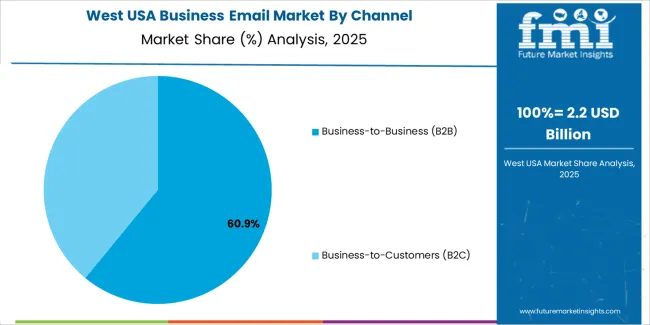
Expansion in the West reflects a CAGR of 6.7% through 2035 for business email demand, supported by high concentration of technology companies, digital first enterprises, and cloud based service adoption. Software firms, ecommerce sellers, and digital media agencies depend on secure email platforms for client interaction and marketing operations. Startup density sustains continuous account creation and license upgrades. Cybersecurity requirements also raise demand for encrypted business communication tools. Demand remains USAge intensive rather than headcount driven, with scalable subscriptions supporting steady revenue flow across enterprise, mid sized, and small digital businesses.
- Technology firms sustain high email account density
- Ecommerce and media agencies drive daily USAge volume
- Encryption needs strengthen premium service adoption
- Subscription scaling supports predictable revenue growth
How Is the South Supporting Business Email Demand in USA?
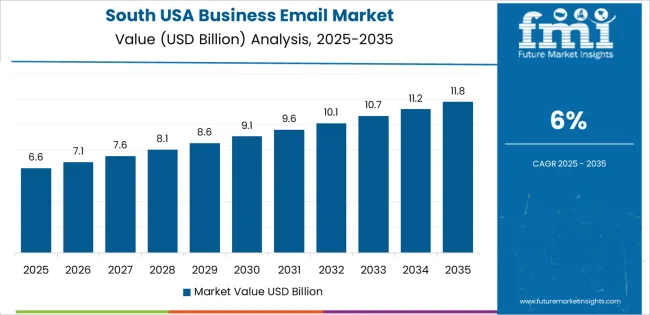
The South advances at a CAGR of 6.0% through 2035 for business email demand, driven by rapid small business formation, logistics expansion, and growth in healthcare administration and professional services. Real estate firms, construction contractors, regional banks, and medical offices rely on email for daily operations and client documentation. Migration inflows increase new business formation across suburban markets. Cloud hosted email systems dominate adoption due to cost sensitivity and ease of setup. Demand remains volume driven, aligned with steady business registration growth and service sector employment expansion.
- Small business formation sustains steady account growth
- Healthcare and finance offices drive daily email USAge
- Suburban migration supports new enterprise creation
- Cloud deployment dominates cost sensitive adoption
Why Is Business Email Demand Rising Steadily in the Northeast Region of USA?
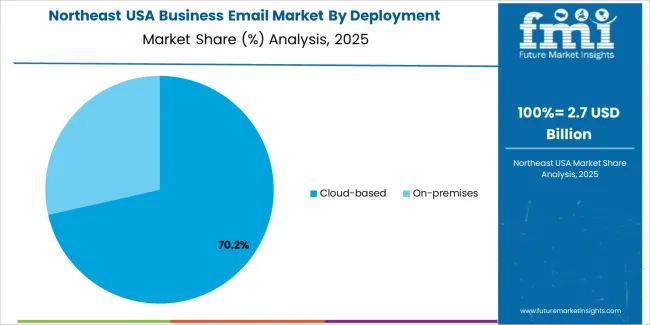
The Northeast records a CAGR of 5.3% through 2035 for business email demand, shaped by dense professional services employment, financial institutions, and strong education and healthcare sectors. Law firms, insurance providers, universities, and hospital systems rely on structured email communication for compliance and documentation. High regulatory oversight supports continued demand for secure archiving and audit trails. Urban office density sustains large installed user bases. Growth remains steady and stability driven, with upgrades focused on security, storage, and integration rather than new account creation.
- Legal and insurance firms anchor compliance driven use
- Universities and hospitals sustain institutional demand
- Secure archiving supports regulatory documentation needs
- Upgrades focus on storage and security enhancement
What Is Influencing Business Email Demand in the Midwest Region of USA?
The Midwest expands at a CAGR of 4.6% through 2035 for business email demand, supported by manufacturing administration, regional banking, logistics coordination, and wholesale trade communication needs. Industrial firms rely on email for procurement, supplier coordination, and order documentation. Agricultural supply chains maintain steady transactional messaging requirements. Cost control remains a key purchasing factor, favoring bundled productivity suites. Demand stays operational and predictable, guided by stable enterprise employment rather than rapid digital service expansion across regional commercial and industrial business networks.
- Manufacturing firms drive procurement communication volume
- Agricultural supply chains sustain transactional USAge
- Bundled productivity suites guide purchasing choices
- Stable enterprise employment supports predictable demand
What Is Driving the Demand for Business Email in the USA and Who Are the Key Providers Shaping It?
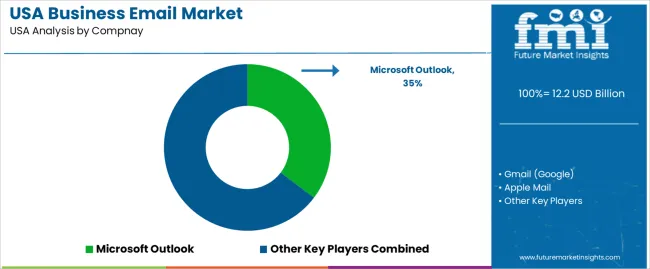
Demand for business email services in the USA remains strong because companies, nonprofits, institutions, and freelancers consistently need reliable communication channels that support official correspondence, collaboration, record keeping, and client relations. As remote work, hybrid workplaces, and digital business operations grow, secure, cloud based and feature rich email platforms become essential. Business continuity requirements, regulatory compliance, data retention, and integration with productivity tools and collaboration suites drive adoption. Small and medium businesses value cost effective, easy to deploy email hosting. Large enterprises favor enterprise grade email infrastructure with advanced security, user management, and compliance support.
Leading providers in the USA business email market include Microsoft Outlook (via Microsoft 365), Gmail (via Google Workspace), Apple Mail, Zoho Mail, and privacy focused services such as ProtonMail. Gmail holds a large share among business users thanks to its integration with Google’s productivity ecosystem and widespread familiarity. Outlook remains widely used in enterprise and corporate settings due to deep integration with Microsoft Office tools and Exchange services. Apple Mail is common among companies using Apple devices. Zoho Mail serves many small and medium sized businesses that seek domain based email hosting with flexible pricing. ProtonMail and similar secure mail providers attract users prioritizing encryption and privacy. This mix of major global platforms and niche providers ensures that businesses of all sizes and needs find appropriate email solutions.
Key Players in Business Email industry the USA
- Microsoft Outlook
- Gmail (Google)
- Apple Mail
- Zoho Mail
- ProtonMail
Scope of the Report
| Items | Values |
|---|---|
| Quantitative Units (2025) | USD billion |
| Channel | Business-to-Business (B2B), Business-to-Customer (B2C) |
| Deployment | Cloud-based, On-premises |
| Region | Northeast USA, West USA, Midwest USA, South USA |
| Countries Covered | USA |
| Key Companies Profiled | Microsoft Outlook, Gmail (Google), Apple Mail, Zoho Mail, ProtonMail |
| Additional Attributes | Dollar by sales by channel (B2B 61%, B2C 39%), Dollar by sales by deployment (Cloud 72%, On-premises 28%), Regional CAGR (West 6.7%, South 6.0%, Northeast 5.3%, Midwest 4.6%), Enterprise adoption trends, AI filtering and automation integration, Cybersecurity layer adoption, Compliance and regulatory alignment, Hybrid work integration |
Business Email industry the USA Segmentation
Channel:
- Business-to-Business (B2B)
- Business-to-Customers (B2C)
Deployment:
- Cloud-based
- On-premises
Region:
- Northeast USA
- West USA
- Midwest USA
- South USA
Frequently Asked Questions
How big is the demand for business email in USA in 2025?
The demand for business email in USA is estimated to be valued at USD 12.2 billion in 2025.
What will be the size of business email in USA in 2035?
The market size for the business email in USA is projected to reach USD 21.4 billion by 2035.
How much will be the demand for business email in USA growth between 2025 and 2035?
The demand for business email in USA is expected to grow at a 5.8% CAGR between 2025 and 2035.
What are the key product types in the business email in USA?
The key product types in business email in USA are business-to-business (b2b) and business-to-customers (b2c).
Which deployment segment is expected to contribute significant share in the business email in USA in 2025?
In terms of deployment, cloud-based segment is expected to command 72.0% share in the business email in USA in 2025.
Preview the report firsthand - request a free sample
Get SampleGet the brochure for pricing and purchase details.
Get PDFTable of Content
- Executive Summary
- USA Market Outlook
- Demand-side Trends
- Supply-side Trends
- Technology Roadmap Analysis
- Analysis and Recommendations
- Market Overview
- Market Coverage / Taxonomy
- Market Definition / Scope / Limitations
- Market Background
- Market Dynamics
- Drivers
- Restraints
- Opportunity
- Trends
- Scenario Forecast
- Demand in Optimistic Scenario
- Demand in Likely Scenario
- Demand in Conservative Scenario
- Opportunity Map Analysis
- Product Life Cycle Analysis
- Supply Chain Analysis
- Investment Feasibility Matrix
- Value Chain Analysis
- PESTLE and Porter’s Analysis
- Regulatory Landscape
- Regional Parent Market Outlook
- Production and Consumption Statistics
- Import and Export Statistics
- Market Dynamics
- USA Market Analysis 2020 to 2024 and Forecast, 2025 to 2035
- Historical Market Size Value (USD Million) Analysis, 2020 to 2024
- Current and Future Market Size Value (USD Million) Projections, 2025 to 2035
- Y-o-Y Growth Trend Analysis
- Absolute $ Opportunity Analysis
- USA Market Pricing Analysis 2020 to 2024 and Forecast 2025 to 2035
- USA Market Analysis 2020 to 2024 and Forecast 2025 to 2035, By Channel
- Introduction / Key Findings
- Historical Market Size Value (USD Million) Analysis By Channel , 2020 to 2024
- Current and Future Market Size Value (USD Million) Analysis and Forecast By Channel , 2025 to 2035
- Business-to-Business (B2B)
- Business-to-Customers (B2C)
- Y-o-Y Growth Trend Analysis By Channel , 2020 to 2024
- Absolute $ Opportunity Analysis By Channel , 2025 to 2035
- USA Market Analysis 2020 to 2024 and Forecast 2025 to 2035, By Deployment
- Introduction / Key Findings
- Historical Market Size Value (USD Million) Analysis By Deployment, 2020 to 2024
- Current and Future Market Size Value (USD Million) Analysis and Forecast By Deployment, 2025 to 2035
- Cloud-based
- On-premises
- Y-o-Y Growth Trend Analysis By Deployment, 2020 to 2024
- Absolute $ Opportunity Analysis By Deployment, 2025 to 2035
- Market Structure Analysis
- Competition Dashboard
- Competition Benchmarking
- Market Share Analysis of Top Players
- By Regional
- By Channel
- By Deployment
- Competition Analysis
- Competition Deep Dive
- Microsoft Outlook
- Overview
- Product Portfolio
- Profitability by Market Segments (Product/Age /Sales Channel/Region)
- Sales Footprint
- Strategy Overview
- Marketing Strategy
- Product Strategy
- Channel Strategy
- Gmail (Google)
- Apple Mail
- Zoho Mail
- ProtonMail
- Microsoft Outlook
- Competition Deep Dive
- Assumptions & Acronyms Used
- Research Methodology


