

- Market Size (2026)
- USD 585.0 Mn
- Forecast (2036)
- USD 8065.0 Mn
- CAGR (2026 to 2036)
- 30.0%
How big is the Demining & Mine-Clearance Robots Market in 2026?
USD 585.0 million in 2026 and USD 8,065.0 million by 2036 at a 30.0% CAGR.
Sales of demining and mine-clearance robots are estimated to rise at 30.0% CAGR through 2036, increasing valuation from USD 585.0 million in 2026 to USD 8,065.0 million by 2036. Hazardous field operations necessitate specialized remote machinery capable of reducing direct operator exposure during excavation and neutralization work. Expanding contamination zones directly drive widespread adoption of robotic platforms globally. National Mine Action Platform reported in 2026 noting up to 144,000 square kilometers of Ukrainian territory may need survey and clearance. Large-scale operational pressure shifts clearance strategies heavily toward autonomous and remote solutions.
Deploying equipment successfully relies on meeting distinct regional deployment criteria. Eastern European teams emphasize increasing fielding with operator training near contaminated land. European Union agencies focus on assistance-backed equipment transfers and standardized operator protocols. Adapting to specific regional frameworks becomes urgent since international support actively delivers sophisticated hardware to active zones. UNDP reported on July 2025 announcing six demining machines for Ukraine featuring remote operation up to 1,500 meters, improving safety and clearance capacity across contaminated regions. Platform developers secure vital program approvals once hardware demonstrates repeatable clearance performance and reliable service readiness worldwide.
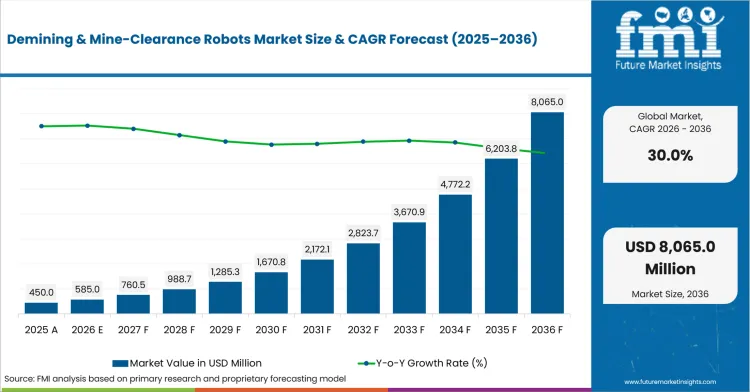
| Metric | Value |
|---|---|
| 2025 Market Size | USD 450.0 million |
| 2026 Market Size | USD 585.0 million |
| 2036 Market Size | USD 8,065.0 million |
| Forecast CAGR (2026-2036) | 30.0% |
| Component Focus | Platforms |
| Platforms Share (2026) | 58.0% |
| Product Focus | Heavy Flail and Tiller Vehicles |
| Heavy Flail and Tiller Vehicles Share (2026) | 52.0% |
| End User Focus | Governments and Armed Forces |
| Governments and Armed Forces Share (2026) | 48.0% |
Summary of Demining & Mine-Clearance Robots Market
| Market Signal | Commercial Impact |
|---|---|
| Demand and Growth Drivers | Demand for demining and mine-clearance robots is expected to rise as field teams shift dangerous excavation and clearance tasks toward remote platforms. Account decisions are projected to reflect safety records and field training depth across national mine-action programs.
|
| Product and Segment View | Segment demand is led by heavy flail and tiller vehicles and governments and armed forces. Specification work is anticipated to concentrate on machines supporting remote control and field service readiness.
|
| Geography and Growth Outlook | Country demand is expected to reflect contamination scale and national mine-action capacity. Supplier gains are likely to depend on local service access and operator training depth near field programs.
|
| Competitive View | Competition is expected to focus on remote operation and field maintenance. Account gains are anticipated to favor suppliers with proven platforms and support access near mine-action operators.
|
| Analyst Perspective | Demining and mine-clearance robots are developing into a safety-led robotics segment linked to field clearance speed and personnel protection. Supplier progress is projected to improve through operator training and machine evidence aligned with national mine-action programs.
|
Source: Future Market Insights analysis, 2026.
How is demining and mine-clearance robots market segmented?
The demining and mine-clearance robots industry is segmented by product, application, component, end user, business model and region.
The demining and mine-clearance robots sector covers six parent segments. Product coverage includes heavy flail and tiller vehicles alongside medium clearance robots and small UGV detectors. Application coverage includes humanitarian demining, military route clearance and post-conflict reconstruction. Component coverage includes platforms, detection payloads and services and training. End user coverage includes governments and armed forces, NGOs and UN agencies and commercial operators. Business model coverage includes government funded purchase, donor-funded programs and service contracts. Regional coverage includes North America and Latin America. Coverage also includes Europe, East Asia, South Asia, Oceania and Middle East and Africa.
How do heavy flail and tiller vehicles shape product purchasing?
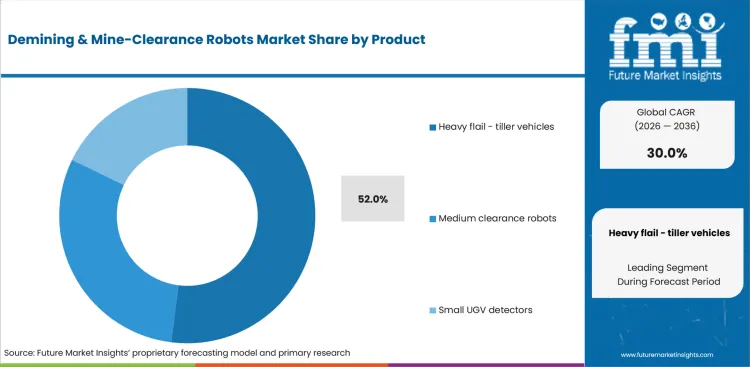
Heavy flail and tiller vehicles are estimated to lead product purchasing as large contaminated areas need mechanical ground processing. Field teams value machines supporting remote operation and safe vegetation removal before manual checks. UNDP reported on July 2025 announcing 2 heavy-duty units able to clear up to 3,000 square meters per hour, demonstrating why mechanical clearance platforms remain central for high-output demining programs.
- Heavy flail and tiller vehicles are forecast to hold 52.0% share in 2026, helped by mechanical clearance needs across suspected hazardous land. Buyers prefer heavy systems after blast tolerance and operator distance evidence are documented.
- Medium clearance robots and small UGV detectors support tighter access tasks and detection work. Heavy flail and tiller vehicles retain selection strength after programs need repeatable processing across wider fields.
How does humanitarian demining influence application demand?
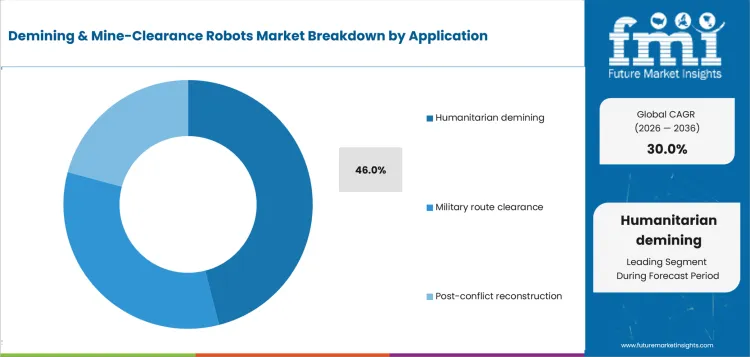
Landmine Monitor reported on December 2025 recording at least 6,279 mine and explosive-remnant casualties in 2024, highlighting the safety pressure behind robotic clearance adoption. Humanitarian demining is anticipated to guide application demand as civil land return programs need safer survey and clearance methods. Mine-action operators assess clearance output and equipment reliability before field deployment.
- Based on application, humanitarian demining is likely to capture 46.0% share in 2026 since civilian protection programs need safer detection and clearance routines. Suppliers gain approval after field evidence supports safer work near explosive hazards.
- Military route clearance and post-conflict reconstruction create additional application demand. Humanitarian demining receives preference after donors and governments link equipment spending with community access restoration.
How do platforms support component demand?
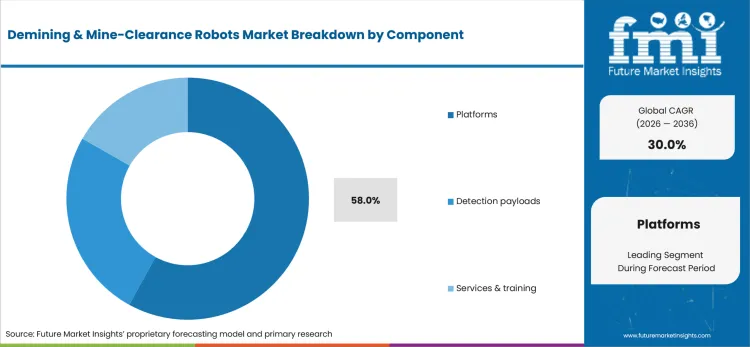
Platforms are expected to lead component demand as robotic mine clearance depends on tracked vehicles and tool interfaces. Buyers review machine survivability and control reliability before adding detection payloads or training packages. Digger Foundation reported in May 2026 noting its DIGGER D-250 clears 300 to 1,800 square meters per hour, reinforcing platform value across mechanical demining work.
- In 2026, platforms are anticipated to represent 58.0% share due to high equipment intensity across remote clearance programs. Operators prefer platform spending after machine output and service files match field workloads.
- Detection payloads and services and training support mission refinement and operator readiness. Platforms gain account attention after buyers compare terrain movement and tool compatibility.
Why do governments and armed forces shape end user demand?
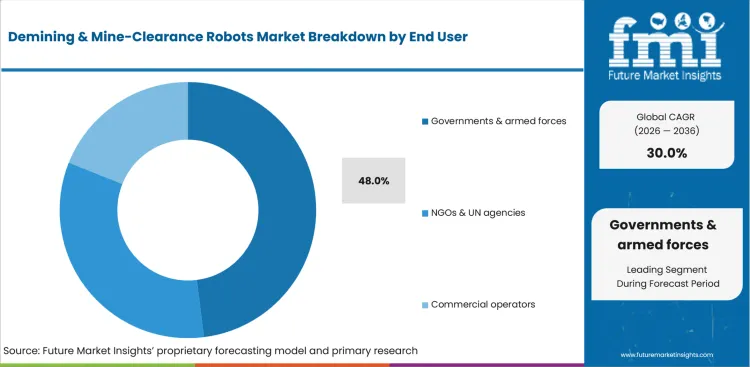
Governments and armed forces are expected to promote end user as national mine-action programs combine public safety and land return requirements. Account teams assess availability of trained crews and donor coordination before approving purchases. Ukraine Ministry of Defence reported on March 2025 noting 62 GCS-200 machines were operating and 26 more were planned, showing public-sector fleet expansion across active clearance programs.
- Governments and armed forces are estimated to secure 48.0% share of end user demand in 2026, backed by national safety programs and security-related clearance needs. Suppliers gain review strength after machines meet field use and training requirements.
- NGOs and UN agencies remain important for humanitarian programs and grant-backed equipment use. Commercial operators also influence demand after landowners and infrastructure teams require certified clearance support.
How do government funded purchases support business model demand?
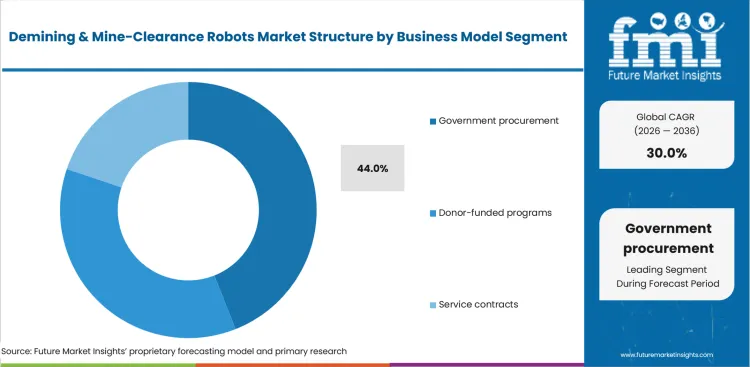
Government of Japan reported on March 2025 stating one DMR added to a mine-clearing team improved overall performance by 20.0%, influencing public funding interest in targeted robotic tools. Government funded purchases are anticipated to support business model demand as public agencies control large clearance programs and equipment qualification. Buyers compare operator training and service commitments before awarding machine orders.
- By business model, government funded purchases are projected to account for 44.0% share in 2026 due to national mine-action agencies needing accountable equipment deployment. Public contracts improve response after machines align with training and inspection requirements.
- Donor-funded programs and service contracts support equipment access across constrained budgets. Government funded purchases gain preference after agencies need durable assets and accountable field support.
What are drivers, restraints, and opportunities in demining and mine-clearance robots market?
Near-term purchases are shaped by safety requirements and field-service adoption paths outlined below.
- Driver: Mine-action operators are replacing direct manual exposure with remote systems designed to reduce blast-zone risk and improve clearance productivity.
- Restraint: Adoption slows if machines cannot match terrain and maintenance capability during field approval. Training gaps also affect deployment timing.
- Opportunity: Suppliers offering operator training, spare parts and service support improve approval chances across government and humanitarian accounts.
Manual mine clearance exposes trained personnel to hidden explosive hazards during excavation and disposal work. Landmine Monitor reported on December 2025 recording casualties across 52 countries and areas during 2024, highlighting why operators seek remote-controlled machines for safer clearance workflows. Robotic systems are expected to gain priority as agencies connect safety outcomes with equipment modernization.
Securing approvals remains difficult after platform claims fail to match field terrain, tool depth or repair capacity. Government of Japan reported on March 2025 stating the DMR uses compressed air for 60 to 90 seconds to expose hidden mines, demonstrating how operating method details guide buyer screening. Programs are likely to delay purchases if terrain capability and service support remain unclear.
Opportunity is expected to improve as innovation programs connect mine-action teams with new sensors and remote-control methods. GICHD reported during its 2025 innovation conference noting explosive ordnance continues to endanger more than 75 million people worldwide, creating need for practical robotics and risk-reduction methods. Suppliers with field-tested platforms are anticipated to gain review strength as mine-action programs seek safer work models.
What country CAGRs are profiled in demining and mine-clearance robots market?
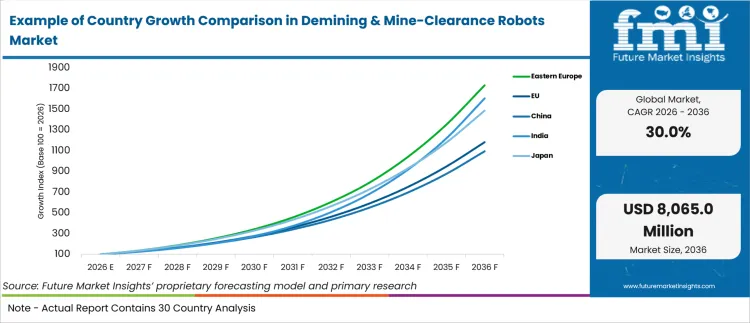
| Country | CAGR |
|---|---|
| European Union | 28.0% |
| Eastern Europe | 33.0% |
Source: Future Market Insights analysis, 2026.
How do country-level CAGRs compare in demining and mine-clearance robots market?
Country demand in demining and mine-clearance robots is expected to be guided by contamination scale and public mine-action funding. Service access also shapes supplier selection. European Union programs are likely to connect demand with equipment assistance and training alignment. Eastern Europe is anticipated to connect adoption with active contamination and field fleet expansion.
- Coordinated mine-action support with assistance-backed equipment transfers helps forecast market expansion for European Union at a 28.0% CAGR through 2036, demonstrating increased robotic system exposure among public mine-action buyers. European External Action Service reported on August 2024 stating handing over 2 GCS-200 mine-clearing machines to Ukraine, improving robotic system exposure among public mine-action buyers. Profit for equipment providers is likely to depend on fulfilling agency requirements for standardized support and operator readiness.
- Eastern Europe mine-clearance robot sector is projected to scale at a 33.0% CAGR between 2026 and 2036. guided by active contamination and local repair readiness. Highlighting the scale of operations, the National Mine Action Platform in 2026 listed 133 active mine-action operators with above 40 or more in progress, creating a critical need for scalable equipment and robust documentation systems. Local service depth is expected to remain central to supplier preference as field programs continue expanding across regions.
Who are notable companies in demining and mine-clearance robots market?
Rheinmetall Unmanned Vehicles d.o.o. under DOK-ING lineage and Global Clearance Solutions AG are expected to shape market direction. Digger Foundation and Armtrac Ltd. add mechanical demining and remote-controlled vehicle depth. IOS Inc. supports compact excavation robotics. Pearson Engineering Ltd. adds MineWolf clearance platform capability.
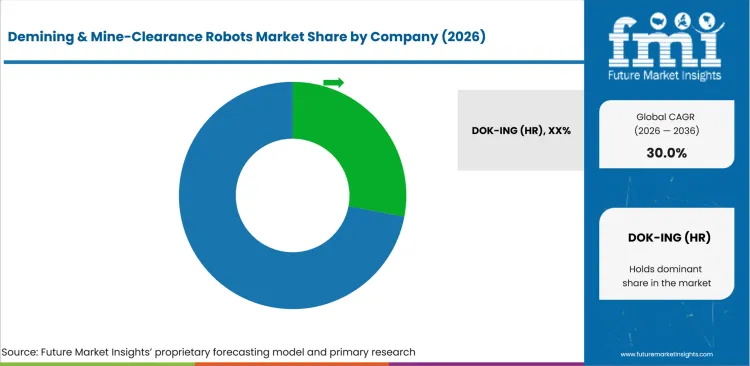
Competition in demining and mine-clearance robots is anticipated to center on blast tolerance and field service. Operator training and spare-part access guide final supplier review. Account teams are likely to compare suppliers based on field evidence and support for recurring mine-action programs after first deployment. Rheinmetall Unmanned Vehicles d.o.o. under DOK-ING lineage is expected to receive review attention due to robotic demining depth. Global Clearance Solutions AG is anticipated to add modular platform strength. Digger Foundation is projected to compete through remote-controlled mechanical clearance. Armtrac Ltd. is estimated to compete based on UGV versatility. IOS Inc. and Pearson Engineering Ltd. are forecast to support account demand through specialized robotics and clearance equipment.
- Rheinmetall Unmanned Vehicles d.o.o. under DOK-ING lineage and Global Clearance Solutions AG are expected to gain account attention based on robotic clearance experience. Platform evidence is likely to support programs needing operator training and repeated field deployment.
- Digger Foundation and Armtrac Ltd. are anticipated to compete through remote-controlled mechanical clearance. Digger Foundation is projected to improve supplier review after buyers assess platform output and accident-avoidance records.
- IOS Inc. is forecast to support demand due to compact excavation robotics. Pearson Engineering Ltd. is expected to help buyers compare heavy mechanical clearance capability and field service needs.
Competitive Benchmarking: Demining & Mine-Clearance Robots Market
| Company | Portfolio Depth | Platform Match | Application Support | Service Reach |
|---|---|---|---|---|
| Rheinmetall Unmanned Vehicles d.o.o. (DOK-ING lineage) | High | High | High | Global |
| Global Clearance Solutions AG | High | High | High | Global |
| Digger Foundation | Medium | High | Medium | Regional/Global |
| Armtrac Ltd. | Medium | High | Medium | Global |
| IOS Inc. | Medium | Medium | Medium | Regional/Global |
| Pearson Engineering Ltd. | High | High | Medium | Global |
Source: Future Market Insights competitive analysis, 2026.
Key Developments in Demining & Mine-Clearance Robots Market
- In September 2025, DOK-ING advanced its Ukraine localization program for robotic demining systems. DOK-ING stated on September 2025 its partner assembled eight machines and supplied 3,630 spare parts in 2024, strengthening local maintenance capacity for MV-4 and MV-10 systems.
- In October 2025, Armtrac Ltd. presented its 20T C-IED Robot Mk2 as a remote-controlled unmanned ground vehicle for land clearance. Armtrac Ltd. stated on October 2025 the platform weighs 1,840 kilograms and traverses 45-degree slopes, supporting restricted-access clearance tasks.
- In January 2026, Pearson Engineering Ltd. launched its MineWolf 370 Next Generation mine-clearance platform. Pearson Engineering Ltd. stated on January 2026 the uncrewed platform clears up to 4,500 square meters per hour, improving review for high-output mechanical clearance programs.
Key Players in Demining & Mine-Clearance Robots Market
Robotic demining platform providers
- Rheinmetall Unmanned Vehicles d.o.o. (DOK-ING lineage)
- Global Clearance Solutions AG
- Armtrac Ltd.
Mechanical clearance and humanitarian demining specialists
- Digger Foundation
- Pearson Engineering Ltd.
Compact mine-clearing robotics specialists
- IOS Inc.
Demining & Mine-Clearance Robots Market - Report Scope
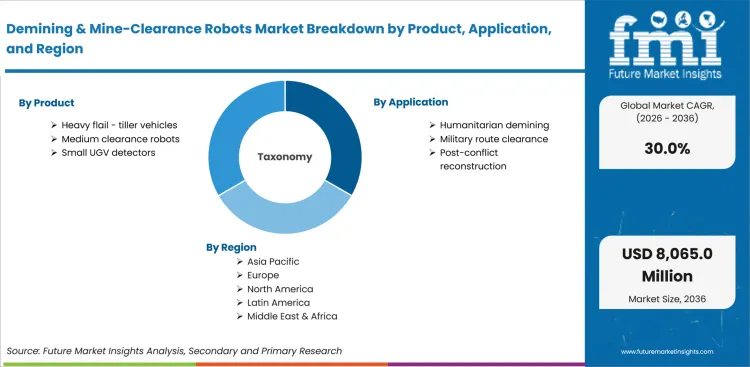
| Coverage field | Report scope |
|---|---|
| Market breakdown | Demining & Mine-Clearance Robots Market breakdown by product alongside application, component, end user, business model and region |
| Quantitative Units | USD million in 2026 to USD million by 2036 at a CAGR |
| Market Definition | Demining and mine-clearance robots are remote-controlled or semi-autonomous systems used to support detection, excavation, clearance, disposal and route safety tasks across contaminated land and explosive-hazard zones. |
| Regions Covered | North America and Latin America alongside Europe, East Asia, South Asia, Oceania and Middle East and Africa |
| Countries Covered | European Union and Eastern Europe alongside United States, Canada, Germany, United Kingdom, France, Italy, Spain, China, Japan, South Korea, India, Thailand, Indonesia, Australia, New Zealand, GCC countries, South Africa and Türkiye |
| Key Companies Profiled | Rheinmetall Unmanned Vehicles d.o.o. under DOK-ING lineage and Global Clearance Solutions AG alongside Digger Foundation, Armtrac Ltd., IOS Inc. and Pearson Engineering Ltd. |
| Forecast Period | 2026 to 2036 |
| Approach | Hybrid bottom-up and top-down methodology using segment share, country CAGR, contamination signals, platform adoption, operator requirements, company portfolio depth and service exposure |
Source: Future Market Insights analysis, 2026.
Demining & Mine-Clearance Robots Market - Research Methodology
| Method | Approach |
|---|---|
| Primary Research | Primary interviews covered mine-action agencies and defence buyers alongside NGOs, commercial operators, equipment distributors and service teams. Discussions focused on platform type and remote operation. Training needs, spare parts, safety distance and terrain access guided repeat-deployment readiness. |
| Desk Research | Desk research reviewed official mine-action platforms and international agency releases. Company product pages, government equipment announcements, humanitarian mine-action sources and robotics indicators supported source checks. |
| Market Sizing and Forecasting | Market sizing used a hybrid model across segment mix and country CAGR. Contamination scale, field machine deployment, platform capability and service coverage informed demining and mine-clearance robots estimates. |
| Data Validation | Data validation compares interview findings from mine-action operators, equipment engineers, humanitarian agencies and field service teams against official mine-action programs and company equipment evidence. Analysts test country-level expansion against segment shares, country CAGRs, company alignment and official source signals to avoid unsupported claims and unrelated robotics leakage. Forecast is triangulated across mine-action fleet expansion, clearance technology adoption and recurring maintenance cycles influencing repeat demining robot demand. |
Source: Future Market Insights analysis, 2026.
Demining & Mine-Clearance Robots Market by Segments
Demining & Mine-Clearance Robots Market segmented by Product:
- Heavy Flail and Tiller Vehicles
- Medium Clearance Robots
- Small UGV Detectors
Demining & Mine-Clearance Robots Market segmented by Application:
- Humanitarian Demining
- Military Route Clearance
- Post-conflict Reconstruction
Demining & Mine-Clearance Robots Market segmented by Component:
- Platforms
- Detection Payloads
- Services and Training
Demining & Mine-Clearance Robots Market segmented by End User:
- Governments and Armed Forces
- NGOs and UN Agencies
- Commercial Operators
Demining & Mine-Clearance Robots Market segmented by Business Model:
- Government Funded Purchase
- Donor-funded Programs
- Service Contracts
Demining & Mine-Clearance Robots Market by Region:
- North America
- United States
- Canada
- Latin America
- Brazil
- Mexico
- Argentina
- Europe
- Germany
- United Kingdom
- France
- Italy
- Spain
- East Asia
- China
- Japan
- South Korea
- South Asia
- India
- Thailand
- Indonesia
- Oceania
- Australia
- New Zealand
- Middle East and Africa
- GCC countries
- South Africa
- Türkiye
Research Sources and Bibliography
- Armtrac Ltd. (2025, October 7). How unmanned ground vehicles are revolutionising land clearance.
- Digger Foundation. (2026, May 20). Our solutions.
- DOK-ING. (2025, September 12). Ukraine demining: DOK-ING reaches 30% of local production milestone.
- European External Action Service. (2024, August 16). EU continues providing Ukraine with modern mine-clearing machines and demining equipment.
- Geneva International Centre for Humanitarian Demining. (2025, October). The GICHD Innovation Conference 2025.
- Government of Japan. (2025, March 28). Safer demining through technology: Japanese robotics boosts a mine-free world.
- International Campaign to Ban Landmines - Cluster Munition Coalition. (2025, December 1). Landmine Monitor 2025: Civilian landmine casualties escalate while five countries take dangerous step away from humanitarian mine ban.
- Ministry of Defence of Ukraine. (2025, March 3). This year, 26 more GCS mechanized demining machines will be delivered to Ukraine.
- National Mine Action Platform. (2026). Main.
- Pearson Engineering Ltd. (2026, January 19). Pearson Engineering launch the next generation of mine clearance.
- United Nations Development Programme. (2025, July 17). Six new demining machines to boost Ukraine’s mine clearance efforts.
This bibliography is provided for reader reference and is not exhaustive. The full report contains the complete reference list and detailed citations.
This Report Answers
- What segments shape demand across product, application, component, end user and business model?
- How do mine-action agencies evaluate demining and mine-clearance robots before replacing manual exposure-heavy workflows?
- How do country CAGRs differ across profiled markets?
- What companies compete through robotic clearance depth and field service support?
- How does FMI validate forecasts using a hybrid bottom-up and top-down approach?
- What factors do account teams address before larger account expansion?
- How do training records and field-service evidence affect supplier selection?
- What limits return on investment for teams adding demining and mine-clearance robots to mine-action programs?
- How do remote operation records and maintenance support influence account approval?
- What supplier capabilities improve long-term account confidence?
Frequently Asked Questions
What supports demand in demining and mine-clearance robots market?
Demand is likely to be supported by mine-action teams needing remote systems reducing exposure during excavation and clearance work. Accounts are expected to prefer suppliers combining platform evidence, training and service response.
Who are key players in demining and mine-clearance robots market?
Key companies are anticipated to include Rheinmetall Unmanned Vehicles d.o.o. under DOK-ING lineage and Global Clearance Solutions AG among others supporting competition. Competition is likely to be based on platform evidence and regional service coverage.
What restraint affects demining and mine-clearance robots market?
A major restraint is the proof burden created during terrain matching and repair-readiness review across approval teams. Accounts slow adoption if machines lack field evidence or service response needed for safe deployment.
Why do executives track demining and mine-clearance robots market?
Executives are expected to track demining and mine-clearance robot demand as equipment choices affect safety and program credibility. Factors such as operator distance and service support shape buyer reviews.
What business problem does demining and mine-clearance robots market address?
Demining and mine-clearance robots market addresses the practical safety gap created by field teams needing to clear explosive hazards without direct exposure. Governments and commercial operators need platforms supporting safer movement and clearance routines.
What do account teams evaluate before selecting suppliers?
Account teams are likely to evaluate platform class and repeat-deployment reliability before supplier approval. Training support and spare-part documentation are expected to guide final supplier review.
What limits return on investment for purchasing teams?
Return on investment weakens if machine capability or account acceptance is not proven before field deployment. Rework, downtime and parts delays reduce expected program gains.
How do suppliers build long-term account confidence?
Suppliers build account confidence by providing consistent machine performance and evidence specific to demining and mine-clearance robots. Installation records and responsive troubleshooting support are expected to influence repeat-order trust.
Preview the report firsthand - request a free sample
Get SampleGet the brochure for pricing and purchase details.
Get PDFTable of Content
- Key Takeaways
- Market Size and CAGR
- Top Growth Driver
- Fastest Growing Segment
- Leading Region
- Key Companies
- Emerging Opportunities
- Executive Summary
- Global Market Outlook
- Demand-side Trends
- Supply-side Trends
- Technology Roadmap Analysis
- Analysis and Recommendations
- Analyst Perspective (What is happening? Why now? What should investors know?)
- Key Questions Answered
- How large is the market?
- What is the CAGR?
- What are key trends?
- Which region dominates?
- Who are the leaders?
- Market Overview
- Market Coverage / Taxonomy
- Market Definition / Scope / Limitations
- Research Methodology
- Chapter Orientation
- Analytical Lens and Working Hypotheses
- Market Structure, Signals, and Trend Drivers
- Benchmarking and Cross-market Comparability
- Market Sizing, Forecasting, and Opportunity Mapping
- Research Design and Evidence Framework
- Desk Research Programme (Secondary Evidence)
- Expert Input and Fieldwork (Primary Evidence)
- Tooling, Models, and Reference Databases
- Data Engineering and Model Build
- Quality Assurance and Audit Trail
- Market Background
- Market Dynamics (Drivers, Restraints, Opportunity, Trends)
- Scenario Forecast (Optimistic, Likely, Conservative)
- Impact Analysis
- AI Impact
- Sustainability Impact
- Regulatory Impact
- Technology Impact
- Consumer / Buyer Analysis
- Purchase Drivers
- Adoption Barriers
- Buyer Journey
- Opportunity Map Analysis
- Product Life Cycle Analysis
- Supply Chain Analysis
- Investment Feasibility Matrix
- Value Chain Analysis
- PESTLE and Porter's Analysis
- Regulatory Landscape
- Regional Parent Market Outlook
- Production and Consumption Statistics
- Import and Export Statistics
- Global Market Analysis and Forecast, 2021 to 2036
- Historical Market Size Value (USD Million) Analysis, 2021 to 2025
- Current and Future Market Size Value (USD Million) Projections, 2026 to 2036
- Y-o-Y Growth Trend Analysis
- Absolute $ Opportunity Analysis
- Global Market Pricing Analysis, 2021 to 2036
- Global Market Analysis and Forecast, By Product, 2021 to 2036
- Introduction / Key Findings
- Historical Market Size Value (USD Million) Analysis By Product, 2021 to 2025
- Current and Future Market Size Value (USD Million) Analysis and Forecast By Product, 2026 to 2036
- Heavy flail - tiller vehicles
- Medium clearance robots
- Small UGV detectors
- Heavy flail - tiller vehicles
- Y-o-Y Growth Trend Analysis By Product, 2021 to 2025
- Absolute $ Opportunity Analysis By Product, 2026 to 2036
- Global Market Analysis and Forecast, By Application, 2021 to 2036
- Introduction / Key Findings
- Historical Market Size Value (USD Million) Analysis By Application, 2021 to 2025
- Current and Future Market Size Value (USD Million) Analysis and Forecast By Application, 2026 to 2036
- Humanitarian demining
- Military route clearance
- Post-conflict reconstruction
- Humanitarian demining
- Y-o-Y Growth Trend Analysis By Application, 2021 to 2025
- Absolute $ Opportunity Analysis By Application, 2026 to 2036
- Global Market Analysis and Forecast, By Component, 2021 to 2036
- Introduction / Key Findings
- Historical Market Size Value (USD Million) Analysis By Component, 2021 to 2025
- Current and Future Market Size Value (USD Million) Analysis and Forecast By Component, 2026 to 2036
- Platforms
- Detection payloads
- Services & training
- Platforms
- Y-o-Y Growth Trend Analysis By Component, 2021 to 2025
- Absolute $ Opportunity Analysis By Component, 2026 to 2036
- Global Market Analysis and Forecast, By End User, 2021 to 2036
- Introduction / Key Findings
- Historical Market Size Value (USD Million) Analysis By End User, 2021 to 2025
- Current and Future Market Size Value (USD Million) Analysis and Forecast By End User, 2026 to 2036
- Governments & armed forces
- NGOs & UN agencies
- Commercial operators
- Governments & armed forces
- Y-o-Y Growth Trend Analysis By End User, 2021 to 2025
- Absolute $ Opportunity Analysis By End User, 2026 to 2036
- Global Market Analysis and Forecast, By Business Model, 2021 to 2036
- Introduction / Key Findings
- Historical Market Size Value (USD Million) Analysis By Business Model, 2021 to 2025
- Current and Future Market Size Value (USD Million) Analysis and Forecast By Business Model, 2026 to 2036
- Government procurement
- Donor-funded programs
- Service contracts
- Government procurement
- Y-o-Y Growth Trend Analysis By Business Model, 2021 to 2025
- Absolute $ Opportunity Analysis By Business Model, 2026 to 2036
- Global Market Analysis and Forecast, By Region, 2021 to 2036
- Introduction
- Historical Market Size Value (USD Million) Analysis By Region, 2021 to 2025
- Current Market Size Value (USD Million) Analysis and Forecast By Region, 2026 to 2036
- North America
- Latin America
- Western Europe
- Eastern Europe
- East Asia
- South Asia and Pacific
- Middle East & Africa
- Market Attractiveness Analysis By Region
- North America Market Analysis and Forecast, By Country, 2021 to 2036
- Historical Market Size Value (USD Million) Trend Analysis By Market Taxonomy, 2021 to 2025
- Market Size Value (USD Million) Forecast By Market Taxonomy, 2026 to 2036
- By Country
- USA
- Canada
- By Product
- By Application
- By Component
- By End User
- By Business Model
- By Country
- Market Attractiveness Analysis
- By Country
- By Product
- By Application
- By Component
- By End User
- By Business Model
- Key Takeaways
- Latin America Market Analysis and Forecast, By Country
- Historical Market Size Value (USD Million) Trend Analysis By Market Taxonomy, 2021 to 2025
- Market Size Value (USD Million) Forecast By Market Taxonomy, 2026 to 2036
- By Country
- Brazil
- Mexico
- Chile
- Rest of Latin America
- By Product
- By Application
- By Component
- By End User
- By Business Model
- By Country
- Market Attractiveness Analysis
- By Country
- By Product
- By Application
- By Component
- By End User
- By Business Model
- Key Takeaways
- Western Europe Market Analysis and Forecast, By Country
- Historical Market Size Value (USD Million) Trend Analysis By Market Taxonomy, 2021 to 2025
- Market Size Value (USD Million) Forecast By Market Taxonomy, 2026 to 2036
- By Country
- Germany
- UK
- Italy
- Spain
- France
- Nordic
- BENELUX
- Rest of Western Europe
- By Product
- By Application
- By Component
- By End User
- By Business Model
- By Country
- Market Attractiveness Analysis
- By Country
- By Product
- By Application
- By Component
- By End User
- By Business Model
- Key Takeaways
- Eastern Europe Market Analysis and Forecast, By Country
- Historical Market Size Value (USD Million) Trend Analysis By Market Taxonomy, 2021 to 2025
- Market Size Value (USD Million) Forecast By Market Taxonomy, 2026 to 2036
- By Country
- Russia
- Poland
- Hungary
- Balkan & Baltic
- Rest of Eastern Europe
- By Product
- By Application
- By Component
- By End User
- By Business Model
- By Country
- Market Attractiveness Analysis
- By Country
- By Product
- By Application
- By Component
- By End User
- By Business Model
- Key Takeaways
- East Asia Market Analysis and Forecast, By Country
- Historical Market Size Value (USD Million) Trend Analysis By Market Taxonomy, 2021 to 2025
- Market Size Value (USD Million) Forecast By Market Taxonomy, 2026 to 2036
- By Country
- China
- Japan
- South Korea
- By Product
- By Application
- By Component
- By End User
- By Business Model
- By Country
- Market Attractiveness Analysis
- By Country
- By Product
- By Application
- By Component
- By End User
- By Business Model
- Key Takeaways
- South Asia and Pacific Market Analysis and Forecast, By Country
- Historical Market Size Value (USD Million) Trend Analysis By Market Taxonomy, 2021 to 2025
- Market Size Value (USD Million) Forecast By Market Taxonomy, 2026 to 2036
- By Country
- India
- ASEAN
- Australia & New Zealand
- Rest of South Asia and Pacific
- By Product
- By Application
- By Component
- By End User
- By Business Model
- By Country
- Market Attractiveness Analysis
- By Country
- By Product
- By Application
- By Component
- By End User
- By Business Model
- Key Takeaways
- Middle East & Africa Market Analysis and Forecast, By Country
- Historical Market Size Value (USD Million) Trend Analysis By Market Taxonomy, 2021 to 2025
- Market Size Value (USD Million) Forecast By Market Taxonomy, 2026 to 2036
- By Country
- Kingdom of Saudi Arabia
- Other GCC Countries
- Türkiye
- South Africa
- Other African Union
- Rest of Middle East & Africa
- By Product
- By Application
- By Component
- By End User
- By Business Model
- By Country
- Market Attractiveness Analysis
- By Country
- By Product
- By Application
- By Component
- By End User
- By Business Model
- Key Takeaways
- Key Countries Market Analysis
- USA
- Pricing Analysis
- Market Share Analysis, 2025
- By Product
- By Application
- By Component
- By End User
- By Business Model
- Canada
- Pricing Analysis
- Market Share Analysis, 2025
- By Product
- By Application
- By Component
- By End User
- By Business Model
- Mexico
- Pricing Analysis
- Market Share Analysis, 2025
- By Product
- By Application
- By Component
- By End User
- By Business Model
- Brazil
- Pricing Analysis
- Market Share Analysis, 2025
- By Product
- By Application
- By Component
- By End User
- By Business Model
- Chile
- Pricing Analysis
- Market Share Analysis, 2025
- By Product
- By Application
- By Component
- By End User
- By Business Model
- Germany
- Pricing Analysis
- Market Share Analysis, 2025
- By Product
- By Application
- By Component
- By End User
- By Business Model
- UK
- Pricing Analysis
- Market Share Analysis, 2025
- By Product
- By Application
- By Component
- By End User
- By Business Model
- Italy
- Pricing Analysis
- Market Share Analysis, 2025
- By Product
- By Application
- By Component
- By End User
- By Business Model
- Spain
- Pricing Analysis
- Market Share Analysis, 2025
- By Product
- By Application
- By Component
- By End User
- By Business Model
- France
- Pricing Analysis
- Market Share Analysis, 2025
- By Product
- By Application
- By Component
- By End User
- By Business Model
- India
- Pricing Analysis
- Market Share Analysis, 2025
- By Product
- By Application
- By Component
- By End User
- By Business Model
- ASEAN
- Pricing Analysis
- Market Share Analysis, 2025
- By Product
- By Application
- By Component
- By End User
- By Business Model
- Australia & New Zealand
- Pricing Analysis
- Market Share Analysis, 2025
- By Product
- By Application
- By Component
- By End User
- By Business Model
- China
- Pricing Analysis
- Market Share Analysis, 2025
- By Product
- By Application
- By Component
- By End User
- By Business Model
- Japan
- Pricing Analysis
- Market Share Analysis, 2025
- By Product
- By Application
- By Component
- By End User
- By Business Model
- South Korea
- Pricing Analysis
- Market Share Analysis, 2025
- By Product
- By Application
- By Component
- By End User
- By Business Model
- Russia
- Pricing Analysis
- Market Share Analysis, 2025
- By Product
- By Application
- By Component
- By End User
- By Business Model
- Poland
- Pricing Analysis
- Market Share Analysis, 2025
- By Product
- By Application
- By Component
- By End User
- By Business Model
- Hungary
- Pricing Analysis
- Market Share Analysis, 2025
- By Product
- By Application
- By Component
- By End User
- By Business Model
- Kingdom of Saudi Arabia
- Pricing Analysis
- Market Share Analysis, 2025
- By Product
- By Application
- By Component
- By End User
- By Business Model
- Türkiye
- Pricing Analysis
- Market Share Analysis, 2025
- By Product
- By Application
- By Component
- By End User
- By Business Model
- South Africa
- Pricing Analysis
- Market Share Analysis, 2025
- By Product
- By Application
- By Component
- By End User
- By Business Model
- USA
- Market Structure Analysis
- Competition Dashboard
- Competition Benchmarking
- Market Share Analysis of Top Players
- By Regional
- By Product
- By Application
- By Component
- By End User
- By Business Model
- Emerging Startups
- Innovation Benchmarking
- Competition Analysis
- Competition Deep Dive
- DOK-ING (HR)
- Overview
- Product Portfolio
- Profitability by Market Segments
- Sales Footprint
- Strategy Overview
- Marketing Strategy
- Product Strategy
- Channel Strategy
- GCS (UK)
- Digger Foundation (CH)
- Armtrac (UK)
- DOK-ING (HR)
- Case Studies
- Success Stories
- Recent Developments
- Competition Deep Dive
- Assumptions & Acronyms Used


