

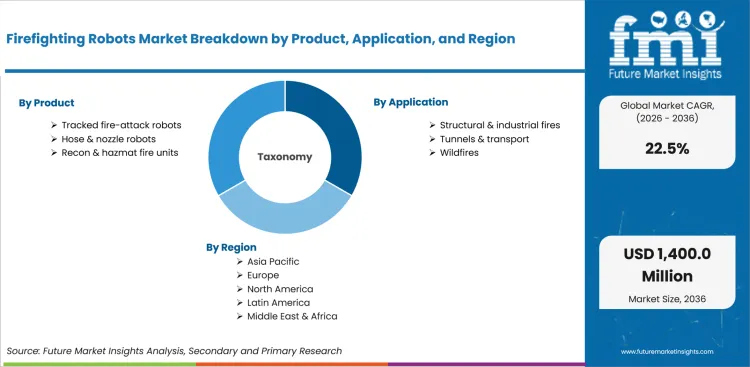
- Market Size (2026)
- USD 184.0 Mn
- Forecast (2036)
- USD 1400.0 Mn
- CAGR (2026 to 2036)
- 22.5%
How big is the Firefighting Robots Market size?
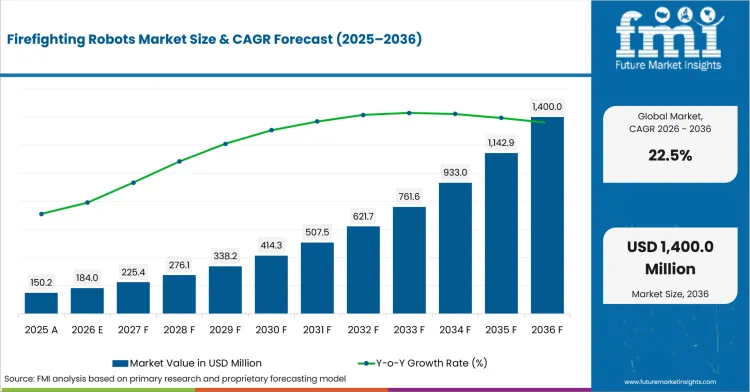
USD 184.0 million in 2026 and USD 1,400.0 million by 2036 at a 22.5% CAGR.
Demand for firefighting robots is projected to expand at 22.5% CAGR between 2026 and 2036, increasing valuation from USD 184.0 million in 2026 to USD 1,400.0 million by 2036. Protecting emergency personnel from extreme heat and hazardous materials drives growing demand for remote robotic platforms. Escalating incident volumes globally accelerate evaluations of tracked robots built for inspection and scene clearance. The National Fire Protection Association reported 1,388,000 fires in the United States during 2024. High frequency of fire events expands testing and qualification needs for automated response machinery across urban and industrial environments.
United States departments prioritize fleet readiness alongside high-flow suppression capability. The European Union emergency agencies focus on wildfire staging and cross-border response support. Tailoring features to localized field conditions remains crucial since public safety organizations continuously manage high-risk emergency responses. Fire and Disaster Management Agency released in March 2026 reporting 72,017 rescue activities in 2024. Such significant rescue volumes highlight an immediate operational need for remote reconnaissance and safer handling tools worldwide.
Key Takeaways of Firefighting Robots Market
- Demand for firefighting robots is driven by fire brigades' need for remote operation that improves firefighter safety and suppression continuity, with account decisions reflecting training support and proof files.
- By component, platforms are expected to lead with 58.0% share in 2026, driven by chassis and payload integration needs.
- Fire brigades are the dominant end-user segment, projected to hold 56.0% share in 2026, driven by municipal response teams needing safer fireground tools.
- Tracked fire-attack robots are estimated to lead the product category with 54.0% share in 2026, led by rough-terrain entry needs.
- Water delivery capability, camera coverage, and training support remain critical to supplier evaluation, as robots alter scene-control procedures for emergency teams.
- The United States, European Union, and Japan are expected to form the higher-growth country tier, advancing at 24.0%, 23.0%, and 21.0% CAGR respectively through 2036, supported by fire incident volume, wildfire readiness, and industrial fire exposure.
- Competition centers on Shark Robotics, Magirus GmbH, Howe & Howe (Textron Systems), and LUF GmbH, with vendors differentiating through firefighting platform depth, remote suppression design, and operator training support.
Analyst Perspective
"The firefighting robots market is advancing as emergency response agencies seek technologies that improve firefighter safety without compromising operational effectiveness. Purchasing decisions are guided by proven performance in hazardous environments, dependable remote operation, and the ability to integrate with established emergency response procedures. Suppliers that combine rugged robotic platforms with comprehensive operator training, application expertise, and responsive maintenance support are likely to build lasting partnerships with fire brigades and industrial emergency response teams."
- Nikhil Kaitwade, Principal Consultant for Industrial Automation at Future Market Insights
Source: Future Market Insights analysis, 2026.
How is Firefighting Robots Market segmented?
The firefighting robots industry is segmented by product, application, component, end user, business model and region.
The firefighting robots market covers six parent segments. Product coverage includes tracked fire-attack robots alongside hose and nozzle robots and recon or hazmat fire units. Application coverage includes structural and industrial fires alongside tunnels and transport and wildfires. Component coverage includes platforms, sensors and thermal AI and services. End user coverage includes fire brigades, industrial fire services and airports or defense. Business model coverage includes municipal contracts, industrial direct and leasing. Regional coverage includes North America and Latin America. Coverage also includes Europe, East Asia, South Asia, Oceania and Middle East and Africa.
How do tracked fire-attack robots shape product purchasing?
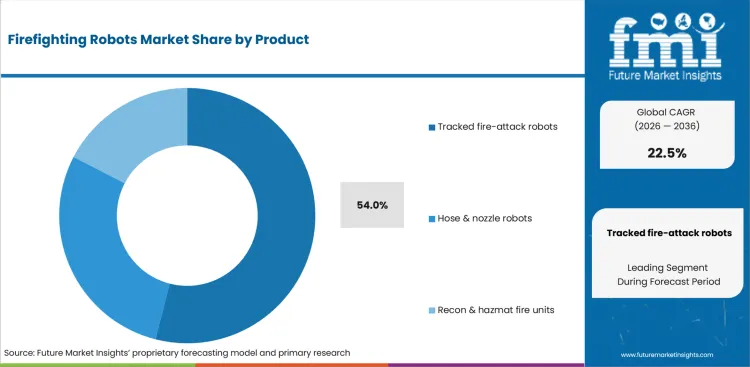
Tracked fire-attack robots are estimated to lead purchasing as fireground access often involves debris and unstable flooring. Emergency teams value chassis designs supporting remote nozzle work and equipment transport during field response. United States Fire Administration reported in July 2026 claiming fires represented 3.7% of United States fire department responses in 2024. Such incident specialization is anticipated to raise buyer review of tracked machines used for direct fire engagement and protected standoff operation.
- Tracked fire-attack robots are expected to represent 54.0% share in 2026, helped by rough-surface movement and safer suppression distance. Buyers prefer tracked units after nozzle reach and camera evidence are documented.
- Hose and nozzle robots and recon or hazmat units support defined response needs. Tracked formats retain selection strength after departments need one platform for suppression and equipment movement.
How are structural and industrial fires positioned within application demand?
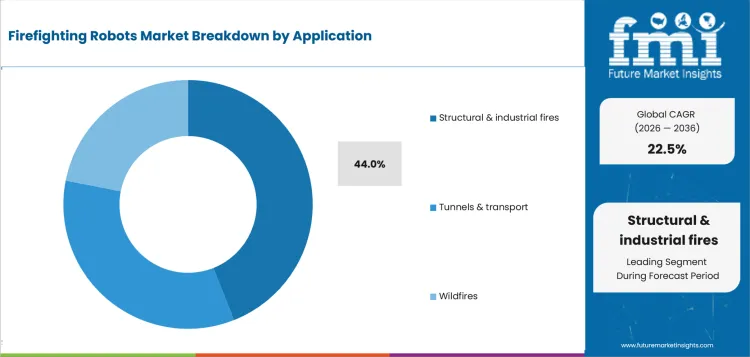
Fire and Disaster Management Agency released in March 2026 noting hazardous-material facility fire accidents reached 267 in 2024. Industrial incident exposure is likely to raise demand for robots supporting standoff suppression and inspection near risky materials. Buyers review communications range and training burden before standardizing on a robot supplier. Structural and industrial fires are expected to guide selection as fire brigades need platforms capable of controlled water delivery and thermal review before crew entry.
- In 2026, structural and industrial fires are anticipated to secure 44.0% share since industrial sites and building fires need suppression access under heat stress. Suppliers gain approval after response records support training and maintenance review.
- Tunnels and transport alongside wildfires require robots suited to confined access or terrain variation. Structural and industrial fires gain preference after buyers compare response speed and operator safety across repeat incident types.
How do platforms support component demand?
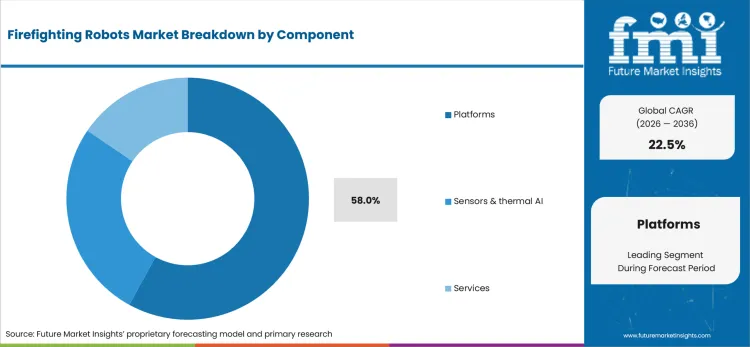
Platforms are anticipated to support robot builds needing battery control and payload mounting. Fire service buyers prefer equipment reducing configuration risk and keeping maintenance tasks clear. Shark Robotics announced in October 2025 highlighting Colossus carried more than 10 mission-specific modules. This modularity promotes demand for platform-led systems used across reconnaissance and equipment transport.
- Based on component, platforms are projected to account for 58.0% share in 2026 owing to battery and payload integration needs. Fire teams prefer platform-led robots after drive stability and module fit match response programs.
- Sensors and thermal AI alongside services address visibility and maintenance needs. Platforms gain account attention after buyers compare mechanical durability and operator training time across emergency scenes.
Why do fire brigades influence end user demand?
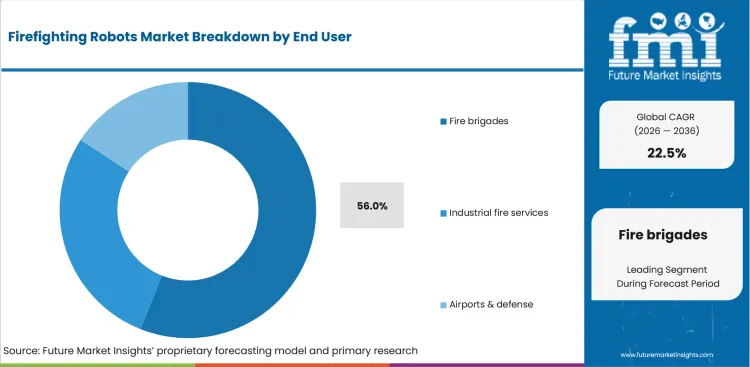
Fire brigades are expected to influence end user as municipal response teams need remote systems for high-risk fireground tasks. Buyers assess operator training, hose connection and command visibility before moving from demonstration to fleet planning. The European Commission announced in May 2025 that 20 certified ground firefighting teams, each of at least 30 personnel, would be available for EU mobilization. Organized response staffing is anticipated to support robotic tools used by brigade crews during wildfire and structure-fire programs.
- Fire brigades are estimated to garner 56.0% share of end user in 2026, backed by frontline exposure and municipal response responsibility. Suppliers gain review strength after robots show safer standoff operation for suppression and reconnaissance.
- Industrial fire services and airports or defense generate sustained demand for specialized response equipment. Fire brigades influence account review after buyers compare training support and field durability.
How do municipal contracts support business model demand?
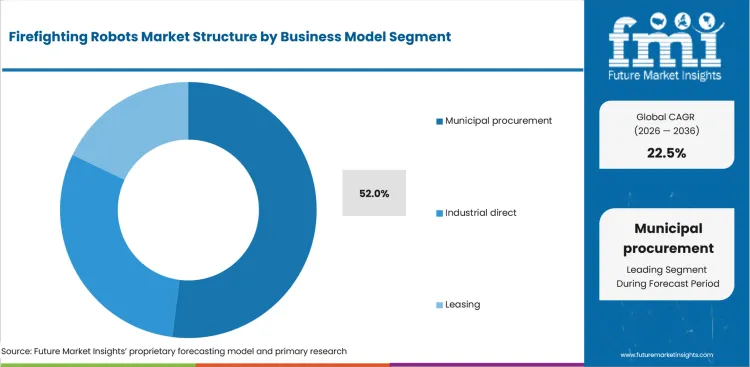
Fire and Disaster Management Agency released in March 2026 announcing fire prevention consent work in Japan totaled 192,946 cases during FY2024. Large administrative review volume is expected to reinforce documented buying processes for safety equipment. Municipal contracts are anticipated to support specification control as fire departments need budget approval and maintenance terms before adoption. Account teams prefer supplier contact reducing delays between demonstration and acceptance.
- By business model, municipal contracts are projected to account for 52.0% share in 2026 due to public fire-service purchasing and budgeted safety programs. Contract review improves response after robot configuration affects training and service planning.
- Industrial direct and leasing options remain useful for private facilities and trial programs. Municipal contracts gain preference after fire agencies need product evidence aligned with response policies.
What are drivers, restraints, and opportunities in Firefighting Robots Market?
Hazardous response needs raise purchasing interest as weak training records and service proof delay approvals.
- Driver: Fire brigades are replacing direct crew exposure with remote units designed to improve suppression access and reduce incident uncertainty.
- Restraint: Adoption slows if training, hose connection and radio-control procedures remain unclear during equipment approval. Maintenance access and service files also affect review timing.
- Opportunity: Manufacturers offering demonstrations and local troubleshooting improve approval chances across municipal and industrial emergency accounts.
Residential fire activity creates a continuous need for tools supporting safer suppression from controlled distance. United States Fire Administration reported in July 2026 stating the 2024 estimate of residential building fires reached 343,000. Persistent residential fire response volume is expected to build a steady appetite for remote units across fire brigade programs.
Securing new sales remains difficult after training claims fail to match exact procedures required by live emergency teams. Fire and Disaster Management Agency released in March 2026 reporting onsite inspections by firefighting agencies totaled 759,676 in FY2024. Such inspection discipline makes public buyers demand stronger evidence before approving robotic firefighting equipment.
Opportunity improves as civil protection agencies add staged assets for wildfire and emergency response. European Commission announced in May 2025 noting 22 firefighting airplanes would be stationed across Member States. Aircraft staging highlights coordinated response planning and supports supplier review for ground robots complementing suppression resources.
What country CAGRs are profiled in Firefighting Robots Market?
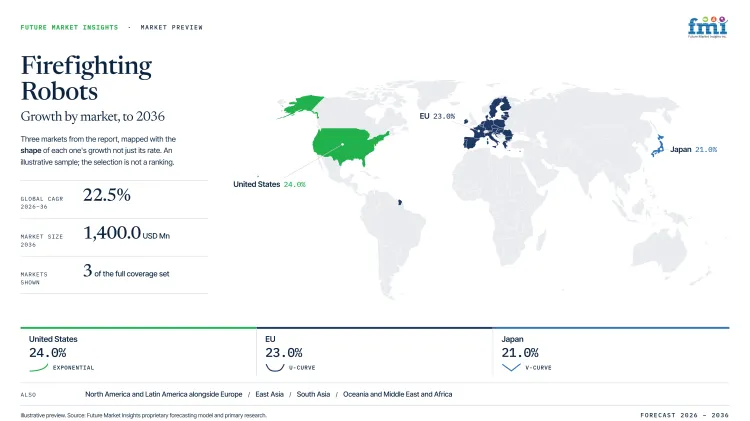
| Country | CAGR |
|---|---|
| United States | 24.0% |
| EU | 23.0% |
| Japan | 21.0% |
Source: Future Market Insights analysis, 2026.
How do country-level CAGRs compare in Firefighting Robots Market?
The country comparison spans 3.0 percentage points and reveals a compact growth pattern across the Firefighting Robots Market. The United States, the European Union and Japan all remain within a narrow range, indicating that investment in robotic emergency response is advancing across major developed markets. Growth is shaped by firefighter safety initiatives, modernization of emergency response capabilities and increasing deployment of robots in hazardous operating environments.
- The United States records the highest CAGR at 24.0% as fire departments, industrial operators and emergency response agencies expand the use of robotic firefighting systems for high-risk incidents involving chemical facilities, tunnels, warehouses and other hazardous locations where reducing firefighter exposure is a priority.
- The European Union follows 1.0 percentage point behind the United States. Demand is supported by modernization of municipal fire services, stronger emphasis on responder safety and increasing adoption of robotic platforms capable of operating in environments with extreme heat, toxic gases and structural instability across member states.
- Japan stands 2.0 percentage points below the European Union, reflecting continued investment in disaster preparedness, industrial safety and advanced robotics for emergency response. Adoption is encouraged by the country's expertise in robotics and the need for specialized equipment that can operate safely in confined spaces and high-risk disaster scenarios.
Comparable CAGRs can still produce different market entry conditions. Differences in emergency response infrastructure, industrial risk profiles, public safety investment and regulatory standards influence deployment timelines and long-term commercial opportunities. The full report provides country-level CAGR analysis across North America, Latin America, Europe, East Asia, South Asia, Oceania and the Middle East and Africa.
Country-wise Analysis
- High incident volume and local fire-service equipment review position United States sector as predicted to rise at 24.0% CAGR during the forecast period. Tragic outcomes elevate urgency for automated solutions capable of navigating hazardous environments where human safety remains paramount. The National Fire Protection Association recorded 3,920 civilian fire deaths in 2024, reinforcing buyer focus on tools reducing responder exposure during difficult fireground operations.
- Wildfire readiness and cross-border response planning support European Union demand, with sales forecast to expand at 23.0% CAGR from 2026 to 2036. Expanding technological deployment across dangerous frontline zones allows teams to maintain operational efficiency amidst increasingly volatile conditions. European Commission announced in May 2025 almost 650 firefighters would be positioned in high-risk locations, supporting review of ground robots near frontline wildfire crews.
- Urban rescue pressure combined with formal inspection culture guides Japan as anticipated to grow at 21.0% CAGR over forecast period. Prioritizing technological intervention allows agencies to enhance victim survival rates through improved reconnaissance efficiency. Fire and Disaster Management Agency released in March 2026 data reporting 67,894 people were rescued through rescue activities in 2024, strengthening demand for safer reconnaissance and remote response tools.
Who are companies in Firefighting Robots Market?
Shark Robotics and Magirus GmbH are expected to shape market direction. Howe & Howe (Textron Systems) adds Thermite firefighting robot depth. LUF GmbH supports remote suppression and ventilator-linked firefighting machine capability.
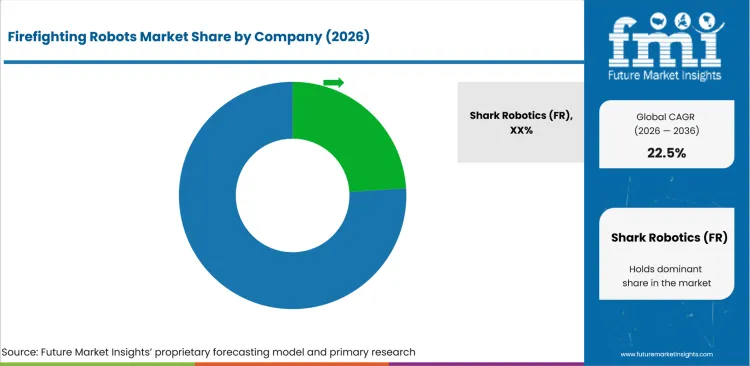
Competition in firefighting robots is anticipated to center on platform durability and operator standoff. Thermal imaging and local service response guide final supplier review. Account teams are likely to compare suppliers based on product evidence and training support after first demonstration. Shark Robotics is expected to receive review attention due to modular firefighting robots and field deployment depth. Magirus GmbH, owned by Mutares SE & Co. KGaA since January 2025 following its separation from Iveco Group, is anticipated to add tactical response robot capability. Howe & Howe (Textron Systems) is projected to compete led by Thermite RS3 training and remote suppression experience. LUF GmbH is estimated to compete based on unmanned firefighting machine specialization.
- Shark Robotics and Magirus GmbH are expected to gain account attention based on platform breadth and field deployment records. Fire robot experience is likely to promote programs needing technical files and response discipline.
- Howe & Howe (Textron Systems) is anticipated to compete driven by Thermite RS3 training evidence. Operator support improves supplier review as departments assess robotic firefighting before fleet adoption.
- LUF GmbH is forecast to support demand due to firefighting machine specialization. Buyers compare nozzle performance and remote-control reliability through demonstrations and service review.
- Product specialists are estimated to gain review strength depending on thermal imaging, suppression reach and field service access. Supplier attention is likely to improve as fire brigades need tested remote systems.
Competitive Benchmarking: Firefighting Robots Market
| Company | Portfolio Depth | Fire-Robot Match | Application Support | Service Reach |
|---|---|---|---|---|
| Shark Robotics | High | High | High | Global |
| Magirus GmbH | High | High | High | Global |
| Howe & Howe (Textron Systems) | High | High | High | Global |
| LUF GmbH | Medium | High | Medium | Regional/Global |
Source: Future Market Insights competitive analysis, 2026.
Key Developments in Firefighting Robots Market
- In June 2025, Magirus GmbH delivered a Wolf R1 tactical response robot to DLF Limited in New Delhi. Magirus listed a water and foam monitor at 2,500 l/min, supporting high-flow suppression review for commercial and urban emergency programs.
- In September 2025, Howe & Howe trained Ukrainian first responders with Thermite RS3. Howe & Howe stated on 10 September 2025 the training included six tests ranging from oil-fire extinguishing to vehicle extraction, improving operator confidence for hazardous response settings.
- In October 2025, Shark Robotics announced Colossus selection for the 2025 Made in France Grand Exhibition. Shark Robotics stated on 22 October 2025 Colossus was one of 123 products selected, reinforcing institutional visibility for modular firefighting robots.
Key Players in Firefighting Robots Market
Firefighting robot platform manufacturers
- Shark Robotics
- Magirus GmbH
Remote suppression and tactical response specialists
- Howe & Howe (Textron Systems)
- LUF GmbH
Firefighting Robots Market - Report Scope
| Coverage field | Report scope |
|---|---|
| Market breakdown | Firefighting Robots Market breakdown by product, application, component, end user, business model and region |
| Quantitative Units | USD million in 2026 to USD million by 2036 at a CAGR |
| Market Definition | Firefighting robots are remotely operated or semi-autonomous emergency response machines used to support fire suppression, reconnaissance, debris handling, casualty evacuation and hazardous-scene inspection. |
| Regions Covered | North America and Latin America alongside Europe, East Asia, South Asia, Oceania and Middle East and Africa |
| Countries Covered | United States and Japan alongside EU, China, India, South Korea, Germany, Canada, Brazil, Mexico, United Kingdom, France, Italy, Spain, Thailand, Indonesia, Australia, New Zealand, GCC countries, South Africa and Türkiye |
| Key Companies Profiled | Shark Robotics and Magirus GmbH alongside Howe & Howe (Textron Systems) and LUF GmbH |
| Forecast Period | 2026 to 2036 |
| Approach | Hybrid bottom-up and top-down methodology using segment share, country CAGR, fire incident statistics, civil protection readiness, product capability, supplier portfolio depth and service exposure |
Source: Future Market Insights analysis, 2026.
Firefighting Robots Market - Research Methodology
| Method | Approach |
|---|---|
| Primary Research | FMI analysts gathered input from manufacturers, service providers, technology developers, distributors, end users, sourcing teams, and subject-matter experts. Interviews examined purchasing decisions, product or service evaluation, adoption barriers, approval requirements, pricing considerations, and expectations for technical or commercial support. Respondents were also asked what evidence is required before a trial, pilot, or initial order develops into regular purchasing. |
| Desk Research | Desk research covered government statistics, regulatory publications, trade data, industry associations, technical literature, standards, company filings, product information, and official corporate announcements. Sources were reviewed for relevance, publication date, geographic coverage, and consistency with the defined market scope. Claims relating to performance, applications, approvals, capacity, investment, and commercial activity were retained only when supported by credible public evidence. |
| Market Sizing and Forecasting | The market model combined the baseline value with historical performance, segment structure, pricing and volume indicators, adoption levels, company participation, and country-level demand conditions. Forecast assumptions considered economic activity, investment trends, regulatory developments, technology adoption, purchasing cycles, supply availability, and barriers to wider market use. Segment and regional estimates were reconciled before the final market total was calculated. |
| Data Validation | Estimates were checked against multiple independent indicators, including public data, company activity, trade patterns, industry developments, and findings from primary interviews. Validation also tested whether products, services, applications, and company revenues fell within the defined market boundaries. Adjacent categories, unsupported claims, overlapping revenues, and activities without direct market relevance were excluded to reduce double counting and maintain consistency across segments and countries. |
Source: Future Market Insights analysis, 2026.
Firefighting Robots Market by Segments
Firefighting Robots Market segmented by Product:
- Tracked fire-attack robots
- Hose and nozzle robots
- Recon and hazmat fire units
Firefighting Robots Market segmented by Application:
- Structural and industrial fires
- Tunnels and transport
- Wildfires
Firefighting Robots Market segmented by Component:
- Platforms
- Sensors and thermal AI
- Services
Firefighting Robots Market segmented by End User:
- Fire brigades
- Industrial fire services
- Airports and defense
Firefighting Robots Market segmented by Business Model:
- Municipal contracts
- Industrial direct
- Leasing
Firefighting Robots Market by Region:
- North America
- United States
- Canada
- Latin America
- Brazil
- Mexico
- Argentina
- Europe
- Germany
- United Kingdom
- France
- Italy
- Spain
- East Asia
- China
- Japan
- South Korea
- South Asia
- India
- Thailand
- Indonesia
- Oceania
- Australia
- New Zealand
- Middle East and Africa
- GCC countries
- South Africa
- Türkiye
Research Sources and Bibliography
- European Commission, Directorate-General for European Civil Protection and Humanitarian Aid Operations. (2025, May 26). EU organises firefighting teams and fleet of aircraft to support wildfire-hit countries.
- Fire and Disaster Management Agency. (2026, March 23). Extract of the 2025 White Paper on Fire Service.
- Howe & Howe. (2025, September 10). Ukrainian first responders train with Thermite RS3.
- Magirus GmbH. (2025, June). WOLF R1 for New Delhi
- Shark Robotics. (2025, October 22). Colossus: The French firefighting robot selected for the 2025 Made in France Grand Exhibition.
- US Fire Administration. (2026, July 6). Statistics
- National Fire Protection Association. (2025, November). Fire Loss in the United States During 2024. NFPA.
This bibliography is provided for reader reference and is not exhaustive. The full report contains the complete reference list and detailed citations.
This Report Answers
- What segments shape demand across product, application, component, end user and business model?
- How do fire brigades evaluate firefighting robots before replacing manual exposure in hazardous scenes?
- How do country CAGRs differ across profiled markets?
- What companies compete through firefighting robot depth and service support?
- How does FMI validate forecasts using a hybrid bottom-up and top-down approach?
- What factors do account teams address before wider fleet adoption?
- How do training files and field evidence affect supplier selection?
- What limits return on investment for teams adding firefighting robots to emergency programs?
- How do thermal imaging records and nozzle performance influence account approval?
- What supplier capabilities improve long-term account confidence?
Frequently Asked Questions
What supports demand in firefighting robots market?
Demand is likely to be supported by fire brigades needing remote units protecting crews during collapse and hazmat incidents. Accounts are expected to prefer suppliers combining field proof and service response.
Who are key companies in firefighting robots market?
Key companies are anticipated to include Shark Robotics and Magirus GmbH among others supporting competition. Competition is likely to be based on fire robot evidence and regional service coverage.
What restraint affects firefighting robots market?
A major restraint is the proof burden created during operator training review and hose connection evaluation across approval teams. Accounts slow adoption if robots lack acceptance evidence or supplier response needed for field approval.
Why do executives track firefighting robots market?
Executives are expected to track firefighting robot demand as emergency equipment choices affect responder safety and operating continuity. Factors such as suppression distance and supplier support shape buyer reviews.
What business problem does firefighting robots market address?
Firefighting robots market addresses the practical response gap created by teams needing remote suppression and dependable scene inspection. Fire brigades and industrial fire services need robots supporting safer operation and field-ready service evidence.
What do account teams evaluate before selecting suppliers?
Account teams are likely to evaluate platform durability and training reliability before supplier approval. Thermal imaging support and technical documentation are expected to guide final supplier review.
What limits return on investment for purchasing teams?
Return on investment weakens if robot performance or account acceptance is not proven before field deployment. Training rework and maintenance downtime reduce expected operating gains.
How do suppliers build long-term account confidence?
Suppliers build account confidence by providing consistent robot quality and evidence specific to firefighting robots. Installation records and responsive troubleshooting support are expected to influence repeat-order trust.
Preview the report firsthand - request a free sample
Get SampleGet the brochure for pricing and purchase details.
Get PDFTable of Content
- Key Takeaways
- Market Size and CAGR
- Top Growth Driver
- Fastest Growing Segment
- Leading Region
- Key Companies
- Emerging Opportunities
- Executive Summary
- Global Market Outlook
- Demand-side Trends
- Supply-side Trends
- Technology Roadmap Analysis
- Analysis and Recommendations
- Analyst Perspective (What is happening? Why now? What should investors know?)
- Key Questions Answered
- How large is the market?
- What is the CAGR?
- What are key trends?
- Which region dominates?
- Who are the leaders?
- Market Overview
- Market Coverage / Taxonomy
- Market Definition / Scope / Limitations
- Research Methodology
- Chapter Orientation
- Analytical Lens and Working Hypotheses
- Market Structure, Signals, and Trend Drivers
- Benchmarking and Cross-market Comparability
- Market Sizing, Forecasting, and Opportunity Mapping
- Research Design and Evidence Framework
- Desk Research Programme (Secondary Evidence)
- Expert Input and Fieldwork (Primary Evidence)
- Tooling, Models, and Reference Databases
- Data Engineering and Model Build
- Quality Assurance and Audit Trail
- Market Background
- Market Dynamics (Drivers, Restraints, Opportunity, Trends)
- Scenario Forecast (Optimistic, Likely, Conservative)
- Impact Analysis
- AI Impact
- Sustainability Impact
- Regulatory Impact
- Technology Impact
- Consumer / Buyer Analysis
- Purchase Drivers
- Adoption Barriers
- Buyer Journey
- Opportunity Map Analysis
- Product Life Cycle Analysis
- Supply Chain Analysis
- Investment Feasibility Matrix
- Value Chain Analysis
- PESTLE and Porter's Analysis
- Regulatory Landscape
- Regional Parent Market Outlook
- Production and Consumption Statistics
- Import and Export Statistics
- Global Market Analysis and Forecast, 2021 to 2036
- Historical Market Size Value (USD Million) Analysis, 2021 to 2025
- Current and Future Market Size Value (USD Million) Projections, 2026 to 2036
- Y-o-Y Growth Trend Analysis
- Absolute $ Opportunity Analysis
- Global Market Pricing Analysis, 2021 to 2036
- Global Market Analysis and Forecast, By Product, 2021 to 2036
- Introduction / Key Findings
- Historical Market Size Value (USD Million) Analysis By Product, 2021 to 2025
- Current and Future Market Size Value (USD Million) Analysis and Forecast By Product, 2026 to 2036
- Tracked fire-attack robots
- Hose & nozzle robots
- Recon & hazmat fire units
- Tracked fire-attack robots
- Y-o-Y Growth Trend Analysis By Product, 2021 to 2025
- Absolute $ Opportunity Analysis By Product, 2026 to 2036
- Global Market Analysis and Forecast, By Application, 2021 to 2036
- Introduction / Key Findings
- Historical Market Size Value (USD Million) Analysis By Application, 2021 to 2025
- Current and Future Market Size Value (USD Million) Analysis and Forecast By Application, 2026 to 2036
- Structural & industrial fires
- Tunnels & transport
- Wildfires
- Structural & industrial fires
- Y-o-Y Growth Trend Analysis By Application, 2021 to 2025
- Absolute $ Opportunity Analysis By Application, 2026 to 2036
- Global Market Analysis and Forecast, By Component, 2021 to 2036
- Introduction / Key Findings
- Historical Market Size Value (USD Million) Analysis By Component, 2021 to 2025
- Current and Future Market Size Value (USD Million) Analysis and Forecast By Component, 2026 to 2036
- Platforms
- Sensors & thermal AI
- Services
- Platforms
- Y-o-Y Growth Trend Analysis By Component, 2021 to 2025
- Absolute $ Opportunity Analysis By Component, 2026 to 2036
- Global Market Analysis and Forecast, By End User, 2021 to 2036
- Introduction / Key Findings
- Historical Market Size Value (USD Million) Analysis By End User, 2021 to 2025
- Current and Future Market Size Value (USD Million) Analysis and Forecast By End User, 2026 to 2036
- Fire brigades
- Industrial fire services
- Airports & defense
- Fire brigades
- Y-o-Y Growth Trend Analysis By End User, 2021 to 2025
- Absolute $ Opportunity Analysis By End User, 2026 to 2036
- Global Market Analysis and Forecast, By Business Model, 2021 to 2036
- Introduction / Key Findings
- Historical Market Size Value (USD Million) Analysis By Business Model, 2021 to 2025
- Current and Future Market Size Value (USD Million) Analysis and Forecast By Business Model, 2026 to 2036
- Municipal procurement
- Industrial direct
- Leasing
- Municipal procurement
- Y-o-Y Growth Trend Analysis By Business Model, 2021 to 2025
- Absolute $ Opportunity Analysis By Business Model, 2026 to 2036
- Global Market Analysis and Forecast, By Region, 2021 to 2036
- Introduction
- Historical Market Size Value (USD Million) Analysis By Region, 2021 to 2025
- Current Market Size Value (USD Million) Analysis and Forecast By Region, 2026 to 2036
- North America
- Latin America
- Western Europe
- Eastern Europe
- East Asia
- South Asia and Pacific
- Middle East & Africa
- Market Attractiveness Analysis By Region
- North America Market Analysis and Forecast, By Country, 2021 to 2036
- Historical Market Size Value (USD Million) Trend Analysis By Market Taxonomy, 2021 to 2025
- Market Size Value (USD Million) Forecast By Market Taxonomy, 2026 to 2036
- By Country
- USA
- Canada
- By Product
- By Application
- By Component
- By End User
- By Business Model
- By Country
- Market Attractiveness Analysis
- By Country
- By Product
- By Application
- By Component
- By End User
- By Business Model
- Key Takeaways
- Latin America Market Analysis and Forecast, By Country
- Historical Market Size Value (USD Million) Trend Analysis By Market Taxonomy, 2021 to 2025
- Market Size Value (USD Million) Forecast By Market Taxonomy, 2026 to 2036
- By Country
- Brazil
- Mexico
- Chile
- Rest of Latin America
- By Product
- By Application
- By Component
- By End User
- By Business Model
- By Country
- Market Attractiveness Analysis
- By Country
- By Product
- By Application
- By Component
- By End User
- By Business Model
- Key Takeaways
- Western Europe Market Analysis and Forecast, By Country
- Historical Market Size Value (USD Million) Trend Analysis By Market Taxonomy, 2021 to 2025
- Market Size Value (USD Million) Forecast By Market Taxonomy, 2026 to 2036
- By Country
- Germany
- UK
- Italy
- Spain
- France
- Nordic
- BENELUX
- Rest of Western Europe
- By Product
- By Application
- By Component
- By End User
- By Business Model
- By Country
- Market Attractiveness Analysis
- By Country
- By Product
- By Application
- By Component
- By End User
- By Business Model
- Key Takeaways
- Eastern Europe Market Analysis and Forecast, By Country
- Historical Market Size Value (USD Million) Trend Analysis By Market Taxonomy, 2021 to 2025
- Market Size Value (USD Million) Forecast By Market Taxonomy, 2026 to 2036
- By Country
- Russia
- Poland
- Hungary
- Balkan & Baltic
- Rest of Eastern Europe
- By Product
- By Application
- By Component
- By End User
- By Business Model
- By Country
- Market Attractiveness Analysis
- By Country
- By Product
- By Application
- By Component
- By End User
- By Business Model
- Key Takeaways
- East Asia Market Analysis and Forecast, By Country
- Historical Market Size Value (USD Million) Trend Analysis By Market Taxonomy, 2021 to 2025
- Market Size Value (USD Million) Forecast By Market Taxonomy, 2026 to 2036
- By Country
- China
- Japan
- South Korea
- By Product
- By Application
- By Component
- By End User
- By Business Model
- By Country
- Market Attractiveness Analysis
- By Country
- By Product
- By Application
- By Component
- By End User
- By Business Model
- Key Takeaways
- South Asia and Pacific Market Analysis and Forecast, By Country
- Historical Market Size Value (USD Million) Trend Analysis By Market Taxonomy, 2021 to 2025
- Market Size Value (USD Million) Forecast By Market Taxonomy, 2026 to 2036
- By Country
- India
- ASEAN
- Australia & New Zealand
- Rest of South Asia and Pacific
- By Product
- By Application
- By Component
- By End User
- By Business Model
- By Country
- Market Attractiveness Analysis
- By Country
- By Product
- By Application
- By Component
- By End User
- By Business Model
- Key Takeaways
- Middle East & Africa Market Analysis and Forecast, By Country
- Historical Market Size Value (USD Million) Trend Analysis By Market Taxonomy, 2021 to 2025
- Market Size Value (USD Million) Forecast By Market Taxonomy, 2026 to 2036
- By Country
- Kingdom of Saudi Arabia
- Other GCC Countries
- Türkiye
- South Africa
- Other African Union
- Rest of Middle East & Africa
- By Product
- By Application
- By Component
- By End User
- By Business Model
- By Country
- Market Attractiveness Analysis
- By Country
- By Product
- By Application
- By Component
- By End User
- By Business Model
- Key Takeaways
- Key Countries Market Analysis
- USA
- Pricing Analysis
- Market Share Analysis, 2025
- By Product
- By Application
- By Component
- By End User
- By Business Model
- Canada
- Pricing Analysis
- Market Share Analysis, 2025
- By Product
- By Application
- By Component
- By End User
- By Business Model
- Mexico
- Pricing Analysis
- Market Share Analysis, 2025
- By Product
- By Application
- By Component
- By End User
- By Business Model
- Brazil
- Pricing Analysis
- Market Share Analysis, 2025
- By Product
- By Application
- By Component
- By End User
- By Business Model
- Chile
- Pricing Analysis
- Market Share Analysis, 2025
- By Product
- By Application
- By Component
- By End User
- By Business Model
- Germany
- Pricing Analysis
- Market Share Analysis, 2025
- By Product
- By Application
- By Component
- By End User
- By Business Model
- UK
- Pricing Analysis
- Market Share Analysis, 2025
- By Product
- By Application
- By Component
- By End User
- By Business Model
- Italy
- Pricing Analysis
- Market Share Analysis, 2025
- By Product
- By Application
- By Component
- By End User
- By Business Model
- Spain
- Pricing Analysis
- Market Share Analysis, 2025
- By Product
- By Application
- By Component
- By End User
- By Business Model
- France
- Pricing Analysis
- Market Share Analysis, 2025
- By Product
- By Application
- By Component
- By End User
- By Business Model
- India
- Pricing Analysis
- Market Share Analysis, 2025
- By Product
- By Application
- By Component
- By End User
- By Business Model
- ASEAN
- Pricing Analysis
- Market Share Analysis, 2025
- By Product
- By Application
- By Component
- By End User
- By Business Model
- Australia & New Zealand
- Pricing Analysis
- Market Share Analysis, 2025
- By Product
- By Application
- By Component
- By End User
- By Business Model
- China
- Pricing Analysis
- Market Share Analysis, 2025
- By Product
- By Application
- By Component
- By End User
- By Business Model
- Japan
- Pricing Analysis
- Market Share Analysis, 2025
- By Product
- By Application
- By Component
- By End User
- By Business Model
- South Korea
- Pricing Analysis
- Market Share Analysis, 2025
- By Product
- By Application
- By Component
- By End User
- By Business Model
- Russia
- Pricing Analysis
- Market Share Analysis, 2025
- By Product
- By Application
- By Component
- By End User
- By Business Model
- Poland
- Pricing Analysis
- Market Share Analysis, 2025
- By Product
- By Application
- By Component
- By End User
- By Business Model
- Hungary
- Pricing Analysis
- Market Share Analysis, 2025
- By Product
- By Application
- By Component
- By End User
- By Business Model
- Kingdom of Saudi Arabia
- Pricing Analysis
- Market Share Analysis, 2025
- By Product
- By Application
- By Component
- By End User
- By Business Model
- Türkiye
- Pricing Analysis
- Market Share Analysis, 2025
- By Product
- By Application
- By Component
- By End User
- By Business Model
- South Africa
- Pricing Analysis
- Market Share Analysis, 2025
- By Product
- By Application
- By Component
- By End User
- By Business Model
- USA
- Market Structure Analysis
- Competition Dashboard
- Competition Benchmarking
- Market Share Analysis of Top Players
- By Regional
- By Product
- By Application
- By Component
- By End User
- By Business Model
- Emerging Startups
- Innovation Benchmarking
- Competition Analysis
- Competition Deep Dive
- Shark Robotics (FR)
- Overview
- Product Portfolio
- Profitability by Market Segments
- Sales Footprint
- Strategy Overview
- Marketing Strategy
- Product Strategy
- Channel Strategy
- LUF (AT)
- Howe & Howe Thermite (US)
- Magirus (DE)
- Shark Robotics (FR)
- Case Studies
- Success Stories
- Recent Developments
- Competition Deep Dive
- Assumptions & Acronyms Used


