

- Market Size (2026)
- USD 176.0 Mn
- Forecast (2036)
- USD 883.0 Mn
- CAGR (2026 to 2036)
- 17.5%
How big is the police and first-responder robots market size?
USD 176.0 million in 2026 and USD 883.0 million by 2036 at a 17.5% CAGR.
Sales in police and first-responder robots market are projected to grow at 17.5% CAGR through 2036, driving valuation to USD 883.0 million by 2036 from USD 176.0 million in 2026. Police and court security units are expected to assess robots through operational safety and equipment readiness. Remote reconnaissance and ground inspection needs are anticipated to support repeat purchases across throwable and legged systems. Department of Homeland Security Science and Technology Directorate reported in June 2026 stating SAVER had more than 1,100 publications, strengthening evidence-led review for emergency-response equipment purchases.
United States departments place heavier weight on tactical-entry proof and grant-aligned buying support. European and South Korean agencies review robots through emergency-response suitability and multilingual command needs. Regional account planning differs as each buyer group connects robot approval with incident command and service access. USA Department of Justice reported in June 2026 stating Congress allocated USD 400 million for the COPS Technology and Equipment Program, promoting agency purchases of law-enforcement technologies and equipment. Supplier progress is projected to improve after demonstrations match agency procedures and documented field support.
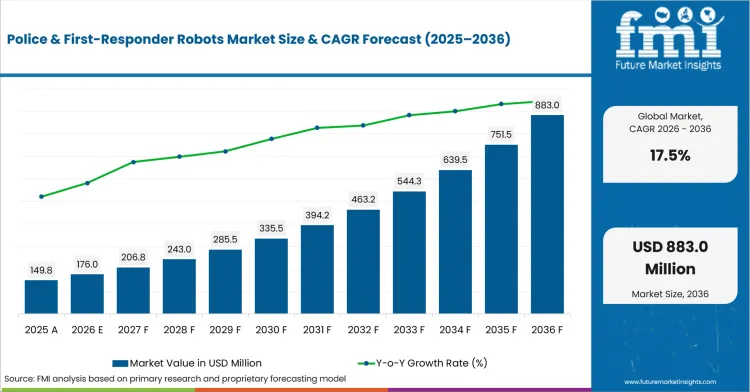
Key Takeaways of Police & First-Responder Robots Market
- Demand for police and first-responder robots is driven by the need for remote situational awareness before entry, with agencies adopting them in uncertain incidents where sending an officer or firefighter first carries the greatest risk.
- By component, hardware is anticipated to hold 58.0% share in 2026, shaping early revenue and account decisions as camera quality and deployment speed set the operating limits that determine how quickly a team can act.
- Police and SWAT users are anticipated to lead adoption with 54.0% share in 2026, as tactical teams need remote inspection of rooms, vehicles, and stairwells before forced entry, while fire, rescue, corrections, and court security users extend the same tools into hazardous structures and confined spaces.
- Direct purchase from vendors is estimated to hold the leading channel position at 48.0% share in 2026, as agencies prefer demonstrated field proof and hands-on training over intermediated supply.
- Long-term spending is expected to follow service response and repair turnaround rather than isolated demonstrations, with channel partners gaining accounts once training and support reduce hesitation about keeping systems in operation.
- The United States is projected to grow at an 18.0% CAGR through 2036, the European Union at 17.0% CAGR over the same period, and South Korea at 17.0% CAGR, led respectively by tactical safety needs, police staffing scale and safety governance, and emergency-response modernization tied to command-center integration.
- Competition centers on controller simplicity and field training, with vendors differentiating through throwable and tactical ground robot depth, remote handling and hazardous-response experience, service network reach, and documented public-safety deployment records.
Analyst Perspective
"Public safety agencies are evaluating robotic systems on their ability to improve operational awareness while keeping responders out of high-risk situations. Successful deployments rely on dependable performance during real-world incidents, straightforward operator training, and seamless integration with established emergency response protocols. Vendors that provide mission-ready platforms, practical field support, and reliable lifecycle services are likely to earn sustained confidence as agencies expand robotic capabilities across tactical and emergency operations."
- Nikhil Kaitwade, Principal Consultant for Industrial Automation at Future Market Insights
How is Police and First-Responder Robots Market segmented?
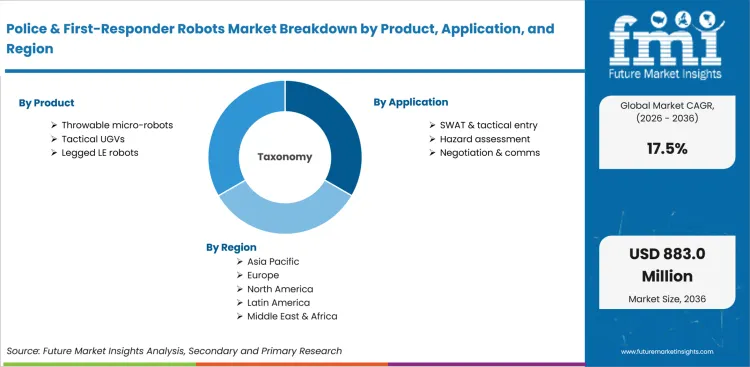
The police and first-responder robots industry is segmented by product, application, component, end user, business model and region.
Product coverage includes throwable micro-robots alongside tactical unmanned ground vehicles and legged law enforcement robots. Application coverage includes SWAT and tactical entry, hazard assessment and negotiation and communications. Component coverage includes hardware, software, services and training. End user coverage includes police and SWAT, fire and rescue, corrections and courts. Business model coverage includes sourcing purchase, grants-funded purchases and leasing. Regional coverage includes North America and Latin America. Coverage also includes Europe, East Asia, South Asia, Oceania and Middle East and Africa.
How do throwable micro-robots shape product purchasing?
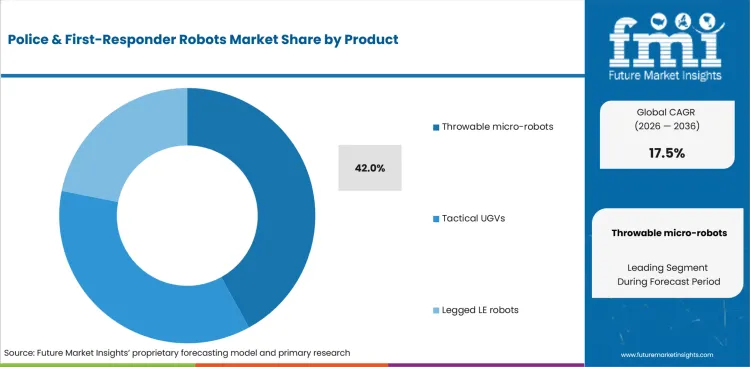
Throwable micro-robots are estimated to lead product purchasing as tactical teams need stairwell and vehicle inspection before entry. Compact form and live viewing are expected to support repeat evaluations across SWAT and patrol response teams. National Institute of Standards and Technology updated its response-robot program in April 2026 noting more than 50 test methods and more than 20 standardized methods. Such testing depth strengthens buyer review of small robots before field teams approve repeat use.
- Throwable micro-robots are forecast to secure 42.0% share in 2026, helped by rapid deployment and compact reconnaissance use. Buyers prefer throwable formats on training teams confirming video range and retrieval performance.
- Tactical unmanned ground vehicles and legged law enforcement robots support heavier inspection and complex terrain movement. Throwable formats retain selection strength as agencies need portable tools for uncertain rooms and barricaded spaces.
How does SWAT and tactical entry influence application demand?
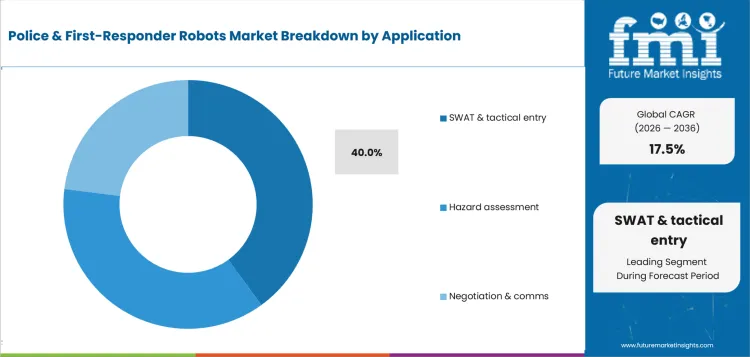
Federal Bureau of Investigation reported in June 2025 stating 24 active shooter incidents occurred in 2024 across 19 states and 5 location categories. The incident spread influences tactical reconnaissance tools helping responders inspect dangerous scenes from safer positions. SWAT and tactical entry are anticipated to guide application demand as entry teams require live visibility before clearing structures. Agencies review robot durability and command workflow before moving from trial use to formal equipment programs.
- By application, SWAT and tactical entry are likely to account for 40.0% share in 2026 as teams need safer inspection before physical entry. Suppliers achieve review strength since robots show stable viewing and quick deployment under training scenarios.
- Hazard assessment and negotiation or communications support other incident response needs. Tactical entry acquires account attention on agencies comparing deployment speed and operator confidence across live exercises.
How does hardware guide component demand?
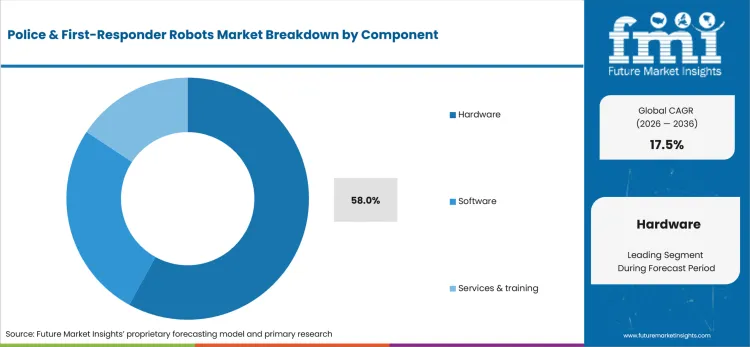
Hardware is expected to dominate component need as agencies fund manipulators and control systems through equipment budgets. Public-safety buyers assess ruggedness and maintenance access before expanding fleets. Department of Homeland Security Science and Technology Directorate reported in June 2026 stating evaluators assessed each emergency-response UGV against 20 criteria in 3 SAVER categories. Such structured assessment reinforces hardware proof around usability and deployability.
- Based on component, hardware is projected to represent 58.0% share in 2026 due to physical robot cost and mission payload needs. Equipment teams prefer hardware-backed systems based on controller and camera performance aligning with field drills.
- Software and training remain important for command workflows and operator readiness. Hardware preference is led by agencies needing durable robots able to function during uncertain incidents.
Why do police and SWAT users lead end user demand?
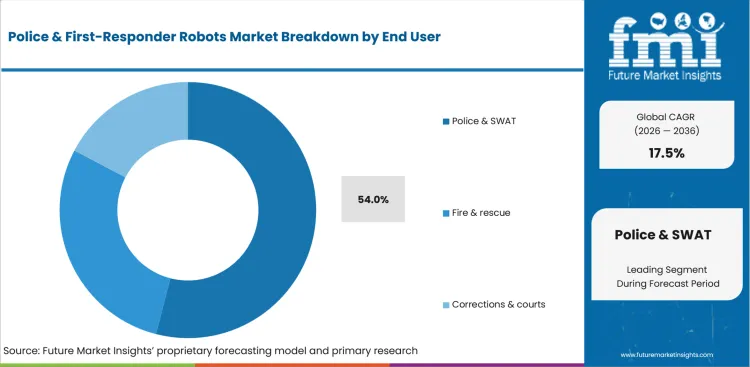
Federal Bureau of Investigation reported in May 2026 stating 53 officers were feloniously killed in 2025, reinforcing equipment interest designed to reduce exposure during dangerous response. Police and SWAT users are estimated to lead end user adoption as tactical response creates direct need for remote sight and movement inside hazardous spaces. Agencies assess platform training and evidence handling before repeat orders.
- Police and SWAT are expected to garner 54.0% share of end user in 2026, backed by tactical reconnaissance and barricade response needs. Vendors profit approval led by robots demonstrating safer viewing prior to officers approaching uncertain spaces.
- Fire and rescue and courts generate demand for inspection and controlled access duties. Police and SWAT retain selection weight driven by tactical programs requiring increasing deployment and documented training outcomes.
How does procurement purchase support business model demand?
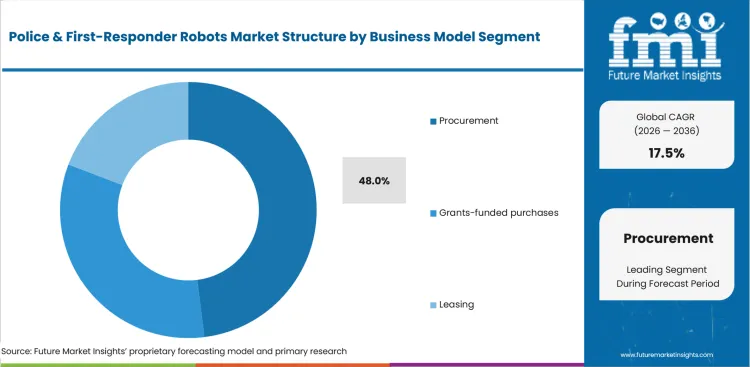
Procurement purchase is anticipated to influence business model as public-safety teams need vendor training and proof documentation during approval. Agency buyers prefer direct contact after robot functions affect incident safety and staff confidence. Department of Homeland Security Science and Technology Directorate reported in June 2026 that evaluators assessed multifunctional emergency-response unmanned ground vehicles across usability, deployability and maintainability, reinforcing evidence-led review of ground robots.
- In 2026, procurement purchase is anticipated to capture 48.0% share since buyer needs impact direct training and support. Agency contact improves response since robot selection affects operating procedures and field readiness.
- Grants-funded purchases and leasing support agencies balancing budget timing with response equipment needs. procurement purchase achieves preference depending on teams needing vendor accountability across onboarding and service.
What are drivers, restraints, and opportunities in Police and First-Responder Robots Market?
Responder safety and field readiness drive robot evaluation across police and emergency teams. Agency approvals slow if training proof and service access lack clear evidence.
- Driver: Departments need safer ways to inspect unclear spaces before firefighters or rescue teams enter hazardous scenes.
- Restraint: Adoption slows if robots require lengthy training or unclear maintenance support during agency review.
- Opportunity: Suppliers offering training and service support improve approval chances across public-safety accounts.
Responder exposure remains the core purchase driver for police and first-responder robots. Eurostat reported in August 2025 stating the EU had 390,600 professional firefighters in 2024, reflecting a sizable emergency-response workforce needing safer hazard assessment tools. Agencies are expected to evaluate robots as practical systems for seeing along with listening and inspecting before personnel approach dangerous spaces.
Training and operational fit proves to be restraints as agencies compare performance claims with real incident routines. Department of Homeland Security Science and Technology Directorate reported in May 2026 stating its mission-critical push-to-talk market survey identified 18 products, highlighting the wider review burden around emergency technology integration. Buyers are likely to delay adoption if robots are unable to align with command practice and staff onboarding checks.
Opportunity is expanding around tested platforms with documented value for public-safety missions. Department of Homeland Security Science and Technology Directorate reported in June 2025 stating the Blue UAS urban assessment evaluators reviewed 5 products, showing agency appetite for structured responder technology comparisons. Suppliers are anticipated to gain account attention by connecting demonstrations with agency-specific training plans.
What country CAGRs are profiled in Police and First-Responder Robots Market?
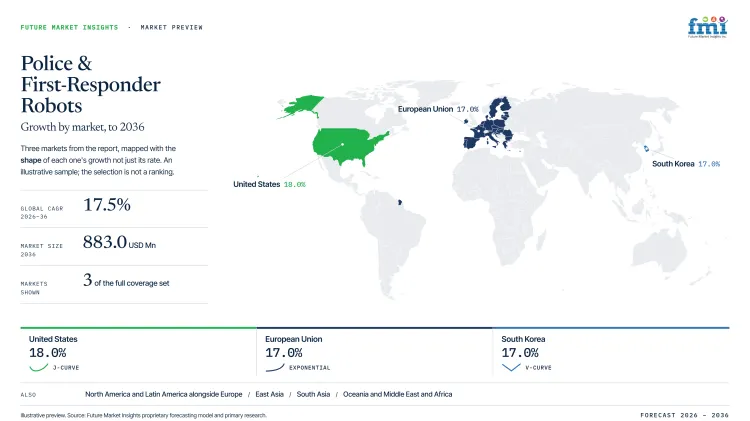
| Country | CAGR |
|---|---|
| United States | 18.0% |
| European Union | 17.0% |
| South Korea | 17.0% |
Source: Future Market Insights analysis, 2026.
How do country-level CAGRs compare in the Police and First-Responder Robots Market?
The country comparison spans 1.0 percentage point, indicating a highly concentrated growth outlook across the police and first-responder robots market. The United States leads at 18.0% CAGR, while the European Union and South Korea each record 17.0%. The minimal variation suggests that public safety agencies across these markets are expanding investment in robotic systems for hazardous operations, with differences arising from operational priorities rather than overall adoption momentum.
-
The United States records the highest CAGR at 18.0% as law enforcement agencies and emergency responders continue evaluating robotic platforms for bomb disposal, hostage situations, hazardous material incidents and search operations where reducing personnel exposure remains a key objective.
-
Both the European Union and South Korea register a CAGR of 17.0%, placing them 1.0 percentage point below the United States. Across the European Union, adoption reflects continued modernization of public safety capabilities and growing use of robotic systems during high-risk emergency response, although deployment varies among member states. In South Korea, investment is centered on advanced public safety technologies and intelligent robotic platforms that assist police and emergency services in operating within hazardous or difficult-to-access environments.
Comparable CAGRs can still produce different market entry conditions. Differences in public safety priorities, emergency response frameworks, technology integration and funding strategies influence deployment timelines and long-term commercial opportunities. The full report provides country-level CAGR analysis across North America, Latin America, Europe, East Asia, South Asia, Oceania and the Middle East and Africa.
Country-wise Analysis
The police and first-responder robots industry demand in different countries are expected to be guided by tactical-response depth and emergency technology readiness. Training access also influences supplier selection. United States agencies are likely to connect demand with officer safety and federal support. European Union and South Korean agencies are anticipated to impact adoption with coordinated response and service proof.
-
Sector in the United States is projected to expand at 18.0% CAGR during the assessment period, driven by tactical-entry requirements and agency interest in standoff reconnaissance. Federal Bureau of Investigation reported in May 2026 stating agencies recorded 90,178 officer assaults in 2025, strengthening the case for robots reducing responder exposure during hazardous incidents.
-
Eurostat reported in May 2026 noting the EU had 1,551,663 police officers in 2024, creating a large training and service base for robotic response tools. Industry in the European Union is anticipated to scale at 17.0% CAGR between 2026 and 2036, guided by safety oversight and coordinated agency equipment evaluation.
-
The market in South Korea is forecast to record 17.0% CAGR by 2036, helped by emergency command modernization and connected response operations. Korean Culture and Information Service reported in March 2024 confirming foreign-language interpretation for the 112 police hotline moved to 24-hour operation, influencing coordinated incident response requiring clearer communication and remote assessment.
Who are notable companies in Police and First-Responder Robots Market?
ReconRobotics Inc. and Teledyne FLIR Defense are expected to shape product review. Boston Dynamics Inc. and Telerob Gesellschaft für Fernhantierungstechnik mbH add mobility and remote handling depth. ICOR Technology Inc. and BRINC Drones Inc. support public-safety response coverage. Robotican Ltd. and SuperDroid Robots Inc. add specialist unmanned systems support.
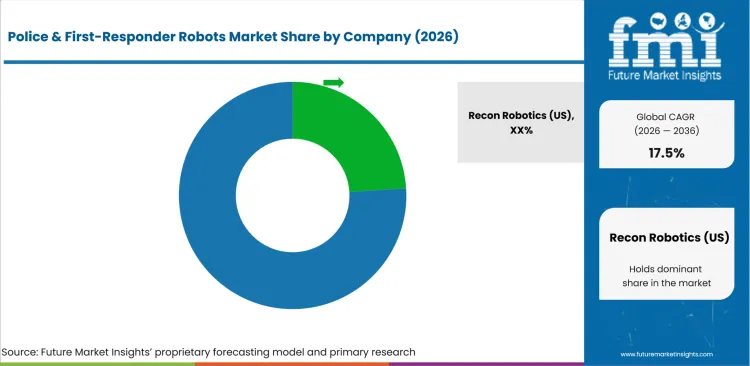
Competition in police and first-responder robots is anticipated to center on field durability and live reconnaissance quality. Operator training and local service response guide final supplier review. Account teams are likely to compare suppliers based on proof files and support for repeat agency programs after first approval. ReconRobotics Inc. and Teledyne FLIR Defense are expected to receive review attention due to tactical robot depth. Boston Dynamics Inc. is anticipated to add legged mobility support. Telerob Gesellschaft für Fernhantierungstechnik mbH and ICOR Technology Inc. are projected to compete led by remote handling and bomb-response expertise. BRINC Drones Inc. is estimated to compete on public-safety incident workflows, with ground-adjacent relevance limited to its indoor tactical platforms rather than its outdoor DFR fleet. Robotican Ltd. and SuperDroid Robots Inc. are forecast to support account demand through specialist unmanned platform knowledge. Ghost Robotics Corporation is likely to add legged robot alternatives for security users.
- Recon Robotics Inc. and Teledyne FLIR Defense draw buyer interest through their depth in tactical robots and experience with public-safety deployments. Their reconnaissance track record appeals to programs that need compact inspection tools and consistent training support.
- Boston Dynamics Inc. and Telerob Gesellschaft für Fernhantierungstechnik mbH compete on the strength of mobility and remote-handling capabilities. ICOR Technology Inc. sees closer supplier scrutiny as agencies compare bomb-squad and SWAT robot options before finalizing purchases.
- BRINC Drones Inc. and Robotican Ltd. benefit from demand for incident-response systems and tactical unmanned platforms. SuperDroid Robots Inc. stands out to buyers comparing custom robot build quality, given its engineering support.
- Ghost Robotics Corporation strengthens its position through its legged-robot expertise and access to security buyers. Suppliers overall see more attention as public-safety teams look for proven, field-tested robotic systems.
Competitive Benchmarking: Police & First-Responder Robots Market
| Company | Portfolio Depth | Robot Format Match | Application Support | Service Reach |
|---|---|---|---|---|
| ReconRobotics Inc. | High | High | High | Global |
| Teledyne FLIR Defense | High | High | High | Global |
| Boston Dynamics Inc. | High | High | High | Global |
| Telerob Gesellschaft für Fernhantierungstechnik mbH | High | Medium | High | Global |
| ICOR Technology Inc. | Medium | High | High | Global |
| BRINC Drones Inc. | High | Medium | High | Global |
| Robotican Ltd. | Medium | Medium | Medium | Regional/Global |
| SuperDroid Robots Inc. | Medium | Medium | Medium | Regional |
| QinetiQ Group plc | Medium | Medium | High | Global |
| Ghost Robotics Corporation | Medium | High | Medium | Global |
Source: Future Market Insights competitive analysis, 2026.
Key Developments in Police & First-Responder Robots Market
- In April 2025, BRINC Drones Inc. announced a strategic alliance with Motorola Solutions. BRINC stated in April 2025 claiming the drone video feeds are likely to integrate with CommandCentral Aware, promoting emergency-response coordination for public-safety agencies.
- In May 2025, Boston Dynamics released Spot 5.0 with public-safety features for driving Spot and using Spot Arm to manipulate objects. Such update is anticipated to support remote inspection and hazardous-scene assessment programs.
- In May 2026, Teledyne FLIR Defense unveiled FirstLook 125 throwable reconnaissance robot. Teledyne FLIR Defense stated in May 2026 reporting for the robot weighing 5.7 lb and able to withstand 16 ft drops, strengthening compact ground reconnaissance options.
Key Players in Police & First-Responder Robots Market
Throwable and tactical ground robot companies
- ReconRobotics Inc.
- Teledyne FLIR Defense
- ICOR Technology Inc.
- Robotican Ltd.
- SuperDroid Robots Inc.
Legged and remote handling robot companies
- Boston Dynamics Inc.
- Telerob Gesellschaft für Fernhantierungstechnik mbH
- QinetiQ Group plc
- Ghost Robotics Corporation
Public-safety robotics and response system companies
- BRINC Drones Inc.
- AeroVironment Inc.
- L3Harris Technologies Inc.
- Ondas Autonomous Systems (Roboteam)
Police & First-Responder Robots Market - Report Scope
| Coverage field | Report scope |
|---|---|
| Market breakdown | Police & First-Responder Robots Market breakdown by product, application, component, end user, business model and region |
| Market Definition | Police and first-responder robots are throwable, tactical ground, legged, and related robotic systems used to support remote inspection, hazard assessment, tactical entry, incident communication, and responder safety. |
| Regions Covered | North America and Latin America alongside Europe, East Asia, South Asia, Oceania and Middle East and Africa |
| Countries Covered | United States and European Union alongside South Korea, Canada, Mexico, Brazil, United Kingdom, Germany, France, Spain, Italy, China, Japan, India, Australia, New Zealand, GCC countries, South Africa and Türkiye |
| Key Companies Profiled | ReconRobotics Inc. and Teledyne FLIR Defense alongside Boston Dynamics Inc., Telerob Gesellschaft für Fernhantierungstechnik mbH, ICOR Technology Inc., BRINC Drones Inc., Robotican Ltd., SuperDroid Robots Inc., QinetiQ Group plc, Ghost Robotics Corporation, AeroVironment Inc., L3Harris Technologies Inc. and Ondas Autonomous Systems (Roboteam) |
| Forecast Period | 2026 to 2036 |
| Approach | Hybrid bottom-up and top-down methodology using segment share, country CAGR, public-safety agency demand, tactical-response requirements, robot performance, supplier portfolio depth and channel exposure |
Source: Future Market Insights analysis, 2026.
Police & First-Responder Robots Market - Research Methodology
| Method | Approach |
|---|---|
| Primary Research | FMI analysts gathered input from manufacturers, service providers, technology developers, distributors, end users, sourucng teams, and subject-matter experts. Interviews examined purchasing decisions, product or service evaluation, adoption barriers, approval requirements, pricing considerations, and expectations for technical or commercial support. Respondents were also asked what evidence is required before a trial, pilot, or initial order develops into regular purchasing. |
| Desk Research | Desk research covered government statistics, regulatory publications, trade data, industry associations, technical literature, standards, company filings, product information, and official corporate announcements. Sources were reviewed for relevance, publication date, geographic coverage, and consistency with the defined market scope. Claims relating to performance, applications, approvals, capacity, investment, and commercial activity were retained only when supported by credible public evidence. |
| Market Sizing and Forecasting | The market model combined the baseline value with historical performance, segment structure, pricing and volume indicators, adoption levels, company participation, and country-level demand conditions. Forecast assumptions considered economic activity, investment trends, regulatory developments, technology adoption, purchasing cycles, supply availability, and barriers to wider market use. Segment and regional estimates were reconciled before the final market total was calculated. |
| Data Validation | Estimates were checked against multiple independent indicators, including public data, company activity, trade patterns, industry developments, and findings from primary interviews. Validation also tested whether products, services, applications, and company revenues fell within the defined market boundaries. Adjacent categories, unsupported claims, overlapping revenues, and activities without direct market relevance were excluded to reduce double counting and maintain consistency across segments and countries. |
Police & First-Responder Robots Market by Segments
Police & First-Responder Robots Market segmented by Product:
- Throwable Micro-Robots
- Tactical Unmanned Ground Vehicles
- Legged Law Enforcement Robots
Police & First-Responder Robots Market segmented by Application:
- SWAT and Tactical Entry
- Hazard Assessment
- Negotiation and Communications
Police & First-Responder Robots Market segmented by Component:
- Hardware
- Software
- Services and Training
Police & First-Responder Robots Market segmented by End User:
- Police and SWAT
- Fire and Rescue
- Corrections and Courts
Police & First-Responder Robots Market segmented by Business Model:
- Direct Agency Purchase
- Grants-Funded Purchases
- Leasing
Police & First-Responder Robots Market by Region:
- North America
- United States
- Canada
- Latin America
- Brazil
- Mexico
- Argentina
- Europe
- European Union
- United Kingdom
- Germany
- France
- Italy
- Spain
- East Asia
- China
- Japan
- South Korea
- South Asia
- India
- Thailand
- Indonesia
- Oceania
- Australia
- New Zealand
- Middle East and Africa
- GCC countries
- South Africa
- Türkiye
Research Sources and Bibliography
- Boston Dynamics. (2025, May 13). Spot 5.0 release notes.
- BRINC Drones Inc. (2025, April 18). BRINC x Motorola Solutions: A game-changer for public safety.
- Department of Homeland Security, Science and Technology Directorate. (2025, June 23). Blue UAS for first responders in urban environments assessment report.
- Department of Homeland Security, Science and Technology Directorate. (2026, January 29). Blue UAS for first responders.
- Department of Homeland Security, Science and Technology Directorate. (2026, May 15). Mission critical push-to-talk systems market survey report.
- Department of Homeland Security, Science and Technology Directorate. (2026, June 3). Multifunctional unmanned ground vehicles for emergency response.
- Department of Homeland Security, Science and Technology Directorate. (2026, June 10). System Assessment and Validation for Emergency Responders.
- Eurostat. (2025, August 26). Firefighting in the EU: 390 600 professionals in 2024.
- Eurostat. (2026, May). Police, court and prison personnel statistics.
- Federal Bureau of Investigation. (2025, June 3). FBI releases 2024 active shooter incidents in the United States report.
- Federal Bureau of Investigation. (2026, May 11). FBI releases Officers Killed and Assaulted in the Line of Duty, 2025 special report and law enforcement employee counts.
- Korean Culture and Information Service. (2024, March 19). Interpretation service for 112 police hotline expanded to 24/7.
- National Institute of Standards and Technology. (2026, April 24). Performance of emergency response robots.
- Teledyne FLIR Defense. (2026, May 19). Teledyne FLIR Defense unveils new FirstLook 125 throwable recon robot.
- USA Department of Justice. (2026, June 9). Justice Department encourages communities to apply for nearly $700M in grants to support law enforcement.
- Ondas Holdings Inc. (2025, December 17). Ondas completes acquisition of Roboteam
This bibliography is provided for reader reference and is not exhaustive. The full report contains the complete reference list and detailed citations.
This Report Answers
- What segments shape demand across product, application, component, end user and business model?
- How do agencies evaluate police and first-responder robots before replacing established response equipment?
- How do country CAGRs differ across profiled markets?
- What companies compete through tactical robot depth and public-safety service?
- How does FMI validate forecasts using a hybrid bottom-up and top-down approach?
- What factors do account teams address before larger account expansion?
- How do training files and deployment evidence affect supplier selection?
- What limits return on investment for teams adding police and first-responder robots?
- How do robot durability records and operator guidance influence account approval?
- What supplier capabilities improve long-term account confidence?
Frequently Asked Questions
What supports demand in police and first-responder robots market?
Demand is likely to be supported by agencies needing robot systems protecting responders during hazardous scene assessment. Accounts are expected to prefer suppliers combining product proof and service response.
Who are key players in police and first-responder robots market?
Key companies are anticipated to include ReconRobotics Inc. and Teledyne FLIR Defense among others to support competition. Competition is likely to be based on robot evidence and regional service coverage.
What restraint affects police and first-responder robots market?
A major restraint is the proof burden created during operator training review and incident-command integration across approval teams. Accounts slow adoption if robots lack acceptance evidence or supplier response needed for field approval.
Why do executives track police and first-responder robots market?
Executives are expected to track police and first-responder robot demand as response equipment choices affect personnel safety and incident control. Factors such as remote visibility and supplier support shape buyer reviews.
What business problem does police and first-responder robots market address?
Police and first-responder robots market addresses the practical response gap created by agencies needing safer visibility before personnel enter hazardous spaces. Police and tactical teams need robots supporting remote assessment and field-ready service evidence.
What do account teams evaluate before selecting suppliers?
Account teams are likely to evaluate deployment speed and service reliability before supplier approval. Robot durability support and technical documentation are expected to guide final supplier review.
What limits return on investment for purchasing teams?
Return on investment weakens if robot performance or account acceptance is not proven before field release. Rework and replacement parts reduce expected safety and budget gains.
How do suppliers build long-term account confidence?
Suppliers build account confidence by providing consistent robot quality and evidence specific to police and first-responder robots. Training records and responsive troubleshooting support are expected to influence repeat-order trust.
Preview the report firsthand - request a free sample
Get SampleGet the brochure for pricing and purchase details.
Get PDFTable of Content
- Key Takeaways
- Market Size and CAGR
- Top Growth Driver
- Fastest Growing Segment
- Leading Region
- Key Companies
- Emerging Opportunities
- Executive Summary
- Global Market Outlook
- Demand-side Trends
- Supply-side Trends
- Technology Roadmap Analysis
- Analysis and Recommendations
- Analyst Perspective (What is happening? Why now? What should investors know?)
- Key Questions Answered
- How large is the market?
- What is the CAGR?
- What are key trends?
- Which region dominates?
- Who are the leaders?
- Market Overview
- Market Coverage / Taxonomy
- Market Definition / Scope / Limitations
- Research Methodology
- Chapter Orientation
- Analytical Lens and Working Hypotheses
- Market Structure, Signals, and Trend Drivers
- Benchmarking and Cross-market Comparability
- Market Sizing, Forecasting, and Opportunity Mapping
- Research Design and Evidence Framework
- Desk Research Programme (Secondary Evidence)
- Expert Input and Fieldwork (Primary Evidence)
- Tooling, Models, and Reference Databases
- Data Engineering and Model Build
- Quality Assurance and Audit Trail
- Market Background
- Market Dynamics (Drivers, Restraints, Opportunity, Trends)
- Scenario Forecast (Optimistic, Likely, Conservative)
- Impact Analysis
- AI Impact
- Sustainability Impact
- Regulatory Impact
- Technology Impact
- Consumer / Buyer Analysis
- Purchase Drivers
- Adoption Barriers
- Buyer Journey
- Opportunity Map Analysis
- Product Life Cycle Analysis
- Supply Chain Analysis
- Investment Feasibility Matrix
- Value Chain Analysis
- PESTLE and Porter's Analysis
- Regulatory Landscape
- Regional Parent Market Outlook
- Production and Consumption Statistics
- Import and Export Statistics
- Global Market Analysis and Forecast, 2021 to 2036
- Historical Market Size Value (USD Million) Analysis, 2021 to 2025
- Current and Future Market Size Value (USD Million) Projections, 2026 to 2036
- Y-o-Y Growth Trend Analysis
- Absolute $ Opportunity Analysis
- Global Market Pricing Analysis, 2021 to 2036
- Global Market Analysis and Forecast, By Product, 2021 to 2036
- Introduction / Key Findings
- Historical Market Size Value (USD Million) Analysis By Product, 2021 to 2025
- Current and Future Market Size Value (USD Million) Analysis and Forecast By Product, 2026 to 2036
- Throwable micro-robots
- Tactical UGVs
- Legged LE robots
- Throwable micro-robots
- Y-o-Y Growth Trend Analysis By Product, 2021 to 2025
- Absolute $ Opportunity Analysis By Product, 2026 to 2036
- Global Market Analysis and Forecast, By Application, 2021 to 2036
- Introduction / Key Findings
- Historical Market Size Value (USD Million) Analysis By Application, 2021 to 2025
- Current and Future Market Size Value (USD Million) Analysis and Forecast By Application, 2026 to 2036
- SWAT & tactical entry
- Hazard assessment
- Negotiation & comms
- SWAT & tactical entry
- Y-o-Y Growth Trend Analysis By Application, 2021 to 2025
- Absolute $ Opportunity Analysis By Application, 2026 to 2036
- Global Market Analysis and Forecast, By Component, 2021 to 2036
- Introduction / Key Findings
- Historical Market Size Value (USD Million) Analysis By Component, 2021 to 2025
- Current and Future Market Size Value (USD Million) Analysis and Forecast By Component, 2026 to 2036
- Hardware
- Software
- Services & training
- Hardware
- Y-o-Y Growth Trend Analysis By Component, 2021 to 2025
- Absolute $ Opportunity Analysis By Component, 2026 to 2036
- Global Market Analysis and Forecast, By End User, 2021 to 2036
- Introduction / Key Findings
- Historical Market Size Value (USD Million) Analysis By End User, 2021 to 2025
- Current and Future Market Size Value (USD Million) Analysis and Forecast By End User, 2026 to 2036
- Police & SWAT
- Fire & rescue
- Corrections & courts
- Police & SWAT
- Y-o-Y Growth Trend Analysis By End User, 2021 to 2025
- Absolute $ Opportunity Analysis By End User, 2026 to 2036
- Global Market Analysis and Forecast, By Business Model, 2021 to 2036
- Introduction / Key Findings
- Historical Market Size Value (USD Million) Analysis By Business Model, 2021 to 2025
- Current and Future Market Size Value (USD Million) Analysis and Forecast By Business Model, 2026 to 2036
- Procurement
- Grants-funded purchases
- Leasing
- Procurement
- Y-o-Y Growth Trend Analysis By Business Model, 2021 to 2025
- Absolute $ Opportunity Analysis By Business Model, 2026 to 2036
- Global Market Analysis and Forecast, By Region, 2021 to 2036
- Introduction
- Historical Market Size Value (USD Million) Analysis By Region, 2021 to 2025
- Current Market Size Value (USD Million) Analysis and Forecast By Region, 2026 to 2036
- North America
- Latin America
- Western Europe
- Eastern Europe
- East Asia
- South Asia and Pacific
- Middle East & Africa
- Market Attractiveness Analysis By Region
- North America Market Analysis and Forecast, By Country, 2021 to 2036
- Historical Market Size Value (USD Million) Trend Analysis By Market Taxonomy, 2021 to 2025
- Market Size Value (USD Million) Forecast By Market Taxonomy, 2026 to 2036
- By Country
- USA
- Canada
- By Product
- By Application
- By Component
- By End User
- By Business Model
- By Country
- Market Attractiveness Analysis
- By Country
- By Product
- By Application
- By Component
- By End User
- By Business Model
- Key Takeaways
- Latin America Market Analysis and Forecast, By Country
- Historical Market Size Value (USD Million) Trend Analysis By Market Taxonomy, 2021 to 2025
- Market Size Value (USD Million) Forecast By Market Taxonomy, 2026 to 2036
- By Country
- Brazil
- Mexico
- Chile
- Rest of Latin America
- By Product
- By Application
- By Component
- By End User
- By Business Model
- By Country
- Market Attractiveness Analysis
- By Country
- By Product
- By Application
- By Component
- By End User
- By Business Model
- Key Takeaways
- Western Europe Market Analysis and Forecast, By Country
- Historical Market Size Value (USD Million) Trend Analysis By Market Taxonomy, 2021 to 2025
- Market Size Value (USD Million) Forecast By Market Taxonomy, 2026 to 2036
- By Country
- Germany
- UK
- Italy
- Spain
- France
- Nordic
- BENELUX
- Rest of Western Europe
- By Product
- By Application
- By Component
- By End User
- By Business Model
- By Country
- Market Attractiveness Analysis
- By Country
- By Product
- By Application
- By Component
- By End User
- By Business Model
- Key Takeaways
- Eastern Europe Market Analysis and Forecast, By Country
- Historical Market Size Value (USD Million) Trend Analysis By Market Taxonomy, 2021 to 2025
- Market Size Value (USD Million) Forecast By Market Taxonomy, 2026 to 2036
- By Country
- Russia
- Poland
- Hungary
- Balkan & Baltic
- Rest of Eastern Europe
- By Product
- By Application
- By Component
- By End User
- By Business Model
- By Country
- Market Attractiveness Analysis
- By Country
- By Product
- By Application
- By Component
- By End User
- By Business Model
- Key Takeaways
- East Asia Market Analysis and Forecast, By Country
- Historical Market Size Value (USD Million) Trend Analysis By Market Taxonomy, 2021 to 2025
- Market Size Value (USD Million) Forecast By Market Taxonomy, 2026 to 2036
- By Country
- China
- Japan
- South Korea
- By Product
- By Application
- By Component
- By End User
- By Business Model
- By Country
- Market Attractiveness Analysis
- By Country
- By Product
- By Application
- By Component
- By End User
- By Business Model
- Key Takeaways
- South Asia and Pacific Market Analysis and Forecast, By Country
- Historical Market Size Value (USD Million) Trend Analysis By Market Taxonomy, 2021 to 2025
- Market Size Value (USD Million) Forecast By Market Taxonomy, 2026 to 2036
- By Country
- India
- ASEAN
- Australia & New Zealand
- Rest of South Asia and Pacific
- By Product
- By Application
- By Component
- By End User
- By Business Model
- By Country
- Market Attractiveness Analysis
- By Country
- By Product
- By Application
- By Component
- By End User
- By Business Model
- Key Takeaways
- Middle East & Africa Market Analysis and Forecast, By Country
- Historical Market Size Value (USD Million) Trend Analysis By Market Taxonomy, 2021 to 2025
- Market Size Value (USD Million) Forecast By Market Taxonomy, 2026 to 2036
- By Country
- Kingdom of Saudi Arabia
- Other GCC Countries
- Türkiye
- South Africa
- Other African Union
- Rest of Middle East & Africa
- By Product
- By Application
- By Component
- By End User
- By Business Model
- By Country
- Market Attractiveness Analysis
- By Country
- By Product
- By Application
- By Component
- By End User
- By Business Model
- Key Takeaways
- Key Countries Market Analysis
- USA
- Pricing Analysis
- Market Share Analysis, 2025
- By Product
- By Application
- By Component
- By End User
- By Business Model
- Canada
- Pricing Analysis
- Market Share Analysis, 2025
- By Product
- By Application
- By Component
- By End User
- By Business Model
- Mexico
- Pricing Analysis
- Market Share Analysis, 2025
- By Product
- By Application
- By Component
- By End User
- By Business Model
- Brazil
- Pricing Analysis
- Market Share Analysis, 2025
- By Product
- By Application
- By Component
- By End User
- By Business Model
- Chile
- Pricing Analysis
- Market Share Analysis, 2025
- By Product
- By Application
- By Component
- By End User
- By Business Model
- Germany
- Pricing Analysis
- Market Share Analysis, 2025
- By Product
- By Application
- By Component
- By End User
- By Business Model
- UK
- Pricing Analysis
- Market Share Analysis, 2025
- By Product
- By Application
- By Component
- By End User
- By Business Model
- Italy
- Pricing Analysis
- Market Share Analysis, 2025
- By Product
- By Application
- By Component
- By End User
- By Business Model
- Spain
- Pricing Analysis
- Market Share Analysis, 2025
- By Product
- By Application
- By Component
- By End User
- By Business Model
- France
- Pricing Analysis
- Market Share Analysis, 2025
- By Product
- By Application
- By Component
- By End User
- By Business Model
- India
- Pricing Analysis
- Market Share Analysis, 2025
- By Product
- By Application
- By Component
- By End User
- By Business Model
- ASEAN
- Pricing Analysis
- Market Share Analysis, 2025
- By Product
- By Application
- By Component
- By End User
- By Business Model
- Australia & New Zealand
- Pricing Analysis
- Market Share Analysis, 2025
- By Product
- By Application
- By Component
- By End User
- By Business Model
- China
- Pricing Analysis
- Market Share Analysis, 2025
- By Product
- By Application
- By Component
- By End User
- By Business Model
- Japan
- Pricing Analysis
- Market Share Analysis, 2025
- By Product
- By Application
- By Component
- By End User
- By Business Model
- South Korea
- Pricing Analysis
- Market Share Analysis, 2025
- By Product
- By Application
- By Component
- By End User
- By Business Model
- Russia
- Pricing Analysis
- Market Share Analysis, 2025
- By Product
- By Application
- By Component
- By End User
- By Business Model
- Poland
- Pricing Analysis
- Market Share Analysis, 2025
- By Product
- By Application
- By Component
- By End User
- By Business Model
- Hungary
- Pricing Analysis
- Market Share Analysis, 2025
- By Product
- By Application
- By Component
- By End User
- By Business Model
- Kingdom of Saudi Arabia
- Pricing Analysis
- Market Share Analysis, 2025
- By Product
- By Application
- By Component
- By End User
- By Business Model
- Türkiye
- Pricing Analysis
- Market Share Analysis, 2025
- By Product
- By Application
- By Component
- By End User
- By Business Model
- South Africa
- Pricing Analysis
- Market Share Analysis, 2025
- By Product
- By Application
- By Component
- By End User
- By Business Model
- USA
- Market Structure Analysis
- Competition Dashboard
- Competition Benchmarking
- Market Share Analysis of Top Players
- By Regional
- By Product
- By Application
- By Component
- By End User
- By Business Model
- Emerging Startups
- Innovation Benchmarking
- Competition Analysis
- Competition Deep Dive
- Recon Robotics (US)
- Overview
- Product Portfolio
- Profitability by Market Segments
- Sales Footprint
- Strategy Overview
- Marketing Strategy
- Product Strategy
- Channel Strategy
- Telerob (DE)
- Boston Dynamics (US)
- Recon Robotics (US)
- Case Studies
- Success Stories
- Recent Developments
- Competition Deep Dive
- Assumptions & Acronyms Used


