

- Market Size (2026)
- USD 383.0 Mn
- Forecast (2036)
- USD 4348.0 Mn
- CAGR (2026 to 2036)
- 27.5%
How big is Security Patrol Robots (Commercial) Market size?
USD 383.0 million in 2026 and USD 4348.0 million by 2036 at a 27.5% CAGR.
The security patrol robots (commercial) industry valuation is estimated at USD 383.0 million in 2026 and USD 4348.0 million by 2036, representing a 27.5% CAGR across the forecast period. Commercial properties require reliable patrol coverage during unattended operating periods to maintain facility security. During these off-hours, mobile observation technology provides continuous monitoring. Constant surveillance helps security teams review unusual activity immediately compared to traditional methods. Growing public concern over safety makes such automated monitoring solutions increasingly necessary for business owners. Gallup reported 53% of Americans worried greatly about crime and violence in March 2024. This high level of public concern reinforced management attention toward deterrence and incident awareness. Encouraging commercial facilities to deploy such mobile observation systems to prevent security breaches and protect valuable assets.
Different regional markets prioritize distinct features when evaluating commercial security robots. United States operators prioritize documented response workflows and nationwide field support during their platform review. Buyers in South Korea and European Union emphasize local integration and strict privacy controls. Differing regional demands drive steady global sales growth across the professional service robotics industry. International Federation of Robotics recorded 3,100 search-and-rescue or security robot sales during 2024 in October 2025. Such impressive volume established a documented deployment base for commercial patrol suppliers globally. Resulting with manufacturers requiring to adapt their robotic features by meeting specific regional preferences to succeed in the growing security market.
-market-value-analysis.webp "Security Patrol Robots (commercial) Market Value Analysis")
Key Takeaways of Security Patrol Robots (Commercial) Market
- Demand for commercial security patrol robots is driven by coverage continuity and response discipline, with program reviews considering terrain testing and service readiness.
- By business model, RaaS-subscription leads with 58.0% share in 2026, aided by bundled maintenance across recurring contracts.
- Hardware is estimated to hold 48.0% share in 2026, reflected by physical platform value across commercial deployments.
- Wheeled outdoor patrol is the dominant robot type segment, holding 44.0% share in 2026, led by efficient travel across paved commercial properties.
- Charging reliability and remote monitoring remain critical to adoption, supporting rapid verification for on-site escalation decisions during unattended periods.
- The United States, South Korea, and the European Union are expected to form the higher-growth country tier, advancing at 29.0%, 27.0%, and 26.0% CAGR respectively through 2036, supported by multi-site property portfolios and established robotics engineering capability.
- Competition centers on Knightscope, Ascento AG, Cobalt AI, Daxbot, SMP Robotics Systems, and Robotnik Automation, with vendors differentiating through exterior patrol programs, indoor/public-space deployments, and industrial perimeter assignments.
Analyst Perspective
"The commercial patrol robots market is shifting toward outcome-based adoption, where consistent patrol execution and integration with existing security operations matter more than autonomous mobility alone. Organizations are prioritizing platforms that improve situational awareness, reduce routine patrol workloads, and operate reliably across multiple sites. Vendors that support seamless deployment and dependable field performance will strengthen long-term commercial opportunities."
- Nikhil Kaitwade, Principal Consultant for Industrial Automation at Future Market Insights
Source: Future Market Insights analysis, 2026.
How is Security Patrol Robots (Commercial) Market segmented?
The security patrol robots (commercial) industry is segmented by platform, application, component, end user, business model, and region.
The security patrol robots (commercial) industry is segmented by platform, application, component, end user, business model, and region. Platform coverage includes wheeled outdoor patrol with indoor patrol robots and legged patrol units. Application coverage includes perimeter & parking patrol with campus & corporate and critical infrastructure. Component coverage includes hardware with monitoring software and services. End-user coverage includes corporate campuses with logistics & industrial sites and public venues. Business-model coverage includes RaaS - subscription with direct and managed security services. Regional coverage includes North America and Latin America. Europe and East Asia form additional coverage. South Asia and Oceania follow. Middle East and Africa complete geographic coverage.
Why does wheeled outdoor patrol shape platform selection?
-market-analysis-by-platform.webp "Security Patrol Robots (commercial) Market Analysis By Platform")
Outdoor patrol programs require dependable movement across pavement and gradual ramps to preserve route continuity. Reliable charging then keeps mobile units available across extended schedules and repeated patrol cycles. Star Robotics reported in July 2025 stating Watchbot runs up to 8 hours per charge, supporting full-shift commercial patrols.
- Wheeled outdoor patrol represents 44.0% share of platform in 2026, led by efficient travel across parking areas and paved boundaries. Security managers assess slope control and docking accuracy across complete patrol cycles during expansion reviews.
- Indoor patrol robots support corridors and reception areas requiring controlled movement near occupants. Legged patrol units address stairs and broken ground across specialized facilities containing irregular terrain.
How does perimeter & parking patrol guide application activity?
-market-analysis-by-application.webp "Security Patrol Robots (commercial) Market Analysis By Application")
Federal Bureau of Investigation recorded more than 14 million criminal offenses for 2024 in August 2025, stating timely incident evidence requirements across monitored commercial property. Parking zones combine moving vehicles with access points beyond fixed-camera coverage, creating surveillance gaps across large exterior areas. Mobile patrols address such gaps through repeated route inspection and evidence capture outside static camera views.
- In 2026, perimeter & parking patrol holds 42.0% share since extensive outdoor areas require recurring boundary checks.Buyers compare detection range and escalation speed across complete routes under changing light conditions.
- Campus & corporate programs focus on building approaches and visitor areas requiring repeatable observation. Critical infrastructure deployments emphasize controlled access and dependable patrol continuity near sensitive assets.
Why does hardware account for component leadership?
-market-analysis-by-component.webp "Security Patrol Robots (commercial) Market Analysis By Component")
Commercial patrol performance relies on durable mobility hardware and dependable onboard sensing, since both elements govern movement and detection quality. Monitoring software converts sensor feeds into alerts, linking physical patrol activity with operator review. Timofte and colleagues reported 89.3% weapon-detection accuracy in October 2025, reinforcing careful validation of camera placement and local processing across robotic security systems.
- By component, hardware captures 48.0% share in 2026 as physical platforms contain mobility equipment and processing systems needed across patrol activity. Buyers compare weather protection and repair access across planned routes during commercial approval.
- Monitoring software supports fleet control and structured event review across operating teams. Services provide deployment planning with maintenance support needed for safe patrol activity.
How do corporate campuses influence end-user evaluation?
-market-analysis-by-end-user.webp "Security Patrol Robots (commercial) Market Analysis By End User")
Michalik reported a study covering 745 million square feet in November 2025, indicating substantial environments requiring coordinated facility oversight. Corporate campuses combine office buildings with parking areas and restricted zones, creating mixed patrol conditions across dispersed property footprints. Patrol robots provide repeatable route evidence across such spaces and support coordinated monitoring by facility teams.
- Based on end-user, corporate campuses hold 38.0% share in 2026 owing to mixed indoor and outdoor coverage requirements. Facility teams evaluate route safety and integration quality across complete operating periods during expansion reviews.
- Logistics & industrial sites emphasize perimeter protection around restricted operational areas. Public venues require safe navigation near visitors and documented human escalation across scheduled patrols.
How does RaaS - subscription retain business model strength?
-market-analysis-by-business-model.webp "Security Patrol Robots (commercial) Market Analysis By Business Model")
Subscription access through robotics as a service (RaaS) combines platform access with continuing maintenance under recurring terms. Centralized technical support protects operating continuity across multiple commercial locations, and direct ownership transfers service responsibility to internal teams. Knightscope stated 90% of service issues received remote resolution in April 2025, showing centralized service support protecting operating continuity without a local repair team.
- RaaS - subscription is set to garner 58.0% share in 2026, helped by bundled maintenance across recurring commercial contracts. Customers assess uptime commitments and replacement support across contract periods during service expansion.
- Direct arrangements support asset ownership and internal policies across assigned commercial sites. Managed security services combine mobile patrol with remote monitoring and trained human response.
What are drivers, restraints, and opportunities in Security Patrol Robots (Commercial) Market?
Staffing pressure and repeatable site coverage support commercial patrol robot evaluation. Terrain mismatch and weak escalation design may delay regular use.
- Driver: Commercial properties need persistent coverage during unattended hours. Mobile robots extend patrol frequency and supply evidence for human review.
- Restraint: Terrain incompatibility may interrupt routes and reduce operating uptime. Privacy concerns may slow approval across public-facing facilities.
- Opportunity: Integrated sensing may improve incident verification across commercial properties. Service programs are expected to extend access across multi-site property groups.
United States Bureau of Labor Statistics projected 162,300 annual openings for security guards and gambling surveillance officers in its August 2025 update, highlighting recurring staffing needs across protective services. Patrol robots are expected to extend routine coverage and preserve human attention for escalated incidents.
Poor route design may reduce detection quality across occupied spaces. Privacy review is likely to examine camera use and data retention across operating periods. Ye and Robert reviewed 47 human-security robot studies in 2024, demonstrating limited field evidence and supporting careful deployment assessment.
Sensor advances are projected to improve detection quality during complex patrol activity. Shi and colleagues reported an improved model raised gun-situation detection speed by 4.91% in September 2025, indicating practical scope for quicker robotic recognition across crowded security environments. Structured human oversight may convert faster identification into useful response gains.
How are country CAGRs aligned in Security Patrol Robots (Commercial) Market?
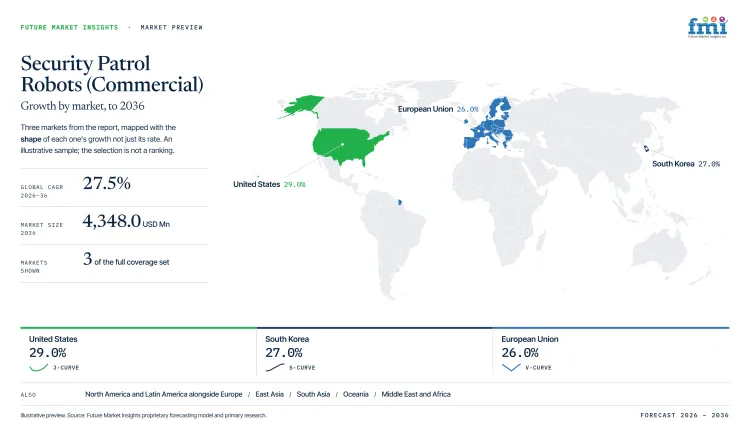
| Country or Market | CAGR |
|---|---|
| United States | 29.0% |
| South Korea | 27.0% |
| European Union | 26.0% |
Source: Future Market Insights country analysis, 2026.
How do country-level CAGRs compare in Security Patrol Robots (Commercial) Market?
Country comparison shows a gradual step-down in growth across the markets covered. United States leads the range, followed by South Korea and the European Union. A three-point spread separates the leading and trailing entries, showing closely grouped expansion across the comparison. Relative positions indicate different levels of commercial readiness and robotics capability. European Union figure represents a regional average, so individual member countries may record higher or lower growth.
- United States leads the comparison and establishes North America as the primary growth center among the markets shown.
- South Korea follows closely, indicating limited separation from the leading position.
- The European Union forms the next growth band and maintains a modest gap from South Korea.
- The pattern resembles a gradual downward slope instead of a sharp separation between high-growth and lower-growth markets.
Markets with similar CAGRs may present different entry conditions due to property structure, robotics engineering capability and privacy requirements. The full report provides country-level analysis across North America, Latin America, Europe, East Asia, South Asia, Oceania and the Middle East and Africa.
Country-wise Analysis
- The sector in the United States is set to rise at 29.0% CAGR during the forecast period, led by extensive property portfolios requiring repeatable exterior coverage. Nationwide service availability may shorten repair intervals and improve confidence across multi-site programs. Federal Bureau of Investigation estimated a 12.4% property-crime decline during 2025 in its May 2026 release, increasing pressure for security programs to demonstrate additional prevention value.
- Electronics and automotive facilities provide established settings for monitored mobile patrol. Influenced by local robotics engineering, the adoption in South Korea is anticipated to grow at 27.0% CAGR between 2026 and 2036 owing to dependable integration across technically advanced properties. International Federation of Robotics reported 1,220 robots per 10,000 manufacturing employees in April 2026, promoting buyer familiarity with autonomous equipment and planned maintenance.
- Eurostat reported 20.0% of European Union enterprises used AI technologies during 2025 in a December 2025 release, strengthening organizational familiarity with automated analysis across commercial operations. Privacy governance and multi-country service readiness are expected to shape approval cycles. Established facility standards support the market in European Union as projected to expand at 26.0% CAGR from 2026 to 2036, driven by structured assessment of robotic patrol systems.
Who are notable companies in Security Patrol Robots (Commercial) Market?
Knightscope, Inc. and Ascento AG support exterior autonomous patrol programs. Cobalt AI and Daxbot address monitored operations across commercial properties. SMP Robotics Systems Corp. and Robotnik Automation S.L. (a United Robotics Group company) provide platforms suited to industrial perimeter assignments. OTSAW and Star Robotics add autonomous security products for indoor or outdoor facilities.
-market-analysis-by-company.webp "Security Patrol Robots (commercial) Market Analysis By Company")
The security patrol robots industry competes based on route reliability and incident-response integration. Buyer teams compare suppliers based on field support during deployment review. Knightscope, Inc. and Ascento AG receive attention across outdoor patrol programs. Cobalt AI and Daxbot support monitored commercial workflows. SMP Robotics Systems Corp. addresses industrial perimeter assignments through rugged outdoor platforms. Robotnik Automation S.L. (a United Robotics Group company) and Star Robotics compete across security and inspection use. OTSAW supports mixed indoor-outdoor deployments through autonomous mobile products.
- Knightscope, Inc. and Ascento AG receive review attention led by exterior patrol portfolios serving commercial properties. Buyer teams assess docking reliability and remote support across complete operating shifts.
- Cobalt AI and Daxbot compete depending on monitored mobility across occupied commercial environments. Public-space operators compare human oversight and alert escalation across every planned route.
- SMP Robotics Systems Corp. and Robotnik Automation S.L. (a United Robotics Group company) support industrial security assignments based on rugged mobile platforms. Facility teams examine weather protection and sensor integration during task-specific trials.
- OTSAW and Star Robotics serve mixed commercial environments driven by autonomous indoor-outdoor security products. Regional partners influence deployment planning and continuing service across participating facilities.
Competitive Benchmarking: Security Patrol Robots (Commercial) Market
| Company | Portfolio Depth | Commercial Patrol Match | Service Support | Service Reach |
|---|---|---|---|---|
| Knightscope, Inc. | High | High | High | United States |
| Ascento AG | High | High | High | Switzerland and Europe |
| Cobalt AI | Medium | High | High | United States |
| SMP Robotics Systems Corp. | High | High | Medium | United States and international |
| Daxbot | Medium | High | High | United States |
| OTSAW | Medium | High | Medium | Singapore and international |
| Star Robotics | Medium | High | Medium | Spain with Europe and United Kingdom |
| Robotnik Automation S.L. (a United Robotics Group company) | Medium | High | Medium | Spain and Europe |
| Enova Robotics | Medium | High | Medium | Tunisia with Europe and Middle East |
| Boston Dynamics, Inc. | High | Medium | High | United States and global |
Source: Future Market Insights competitive analysis, 2026.
Key Developments in Security Patrol Robots (Commercial) Market
- In February 2025, SMP Robotics presented new Argus S5 security and video-surveillance functions for ISC West. Product demonstrations expanded evaluation access for buyers considering outdoor patrol and perimeter monitoring.
- In October 2025, Star Robotics partnered with Wilson James to place Watchbot into live United Kingdom security operations. Deployment connects autonomous patrol capability with human expertise and provides a practical operating reference for commercial buyers.
- In December 2025, Knightscope opened early access for its K7 autonomous security robot. Product expansion may extend platform choice for customers planning an integrated security program across robots and trained personnel.
Key Players in Security Patrol Robots (Commercial) Market
Commercial autonomous security robot providers
- Knightscope, Inc.
- Ascento AG
- Cobalt AI
- SMP Robotics Systems Corp.
Indoor and public-space patrol specialists
- Daxbot
- SEQSENSE Inc. (an Iris Group company)
- OTSAW
- Star Robotics
Industrial patrol and inspection platform providers
- Robotnik Automation S.L. (a United Robotics Group company)
- Enova Robotics
- Boston Dynamics, Inc.
- ANYbotics AG
Security Patrol Robots (Commercial) Market Report Scope
-market-breakdown-by-platform,-application,-and-region.webp "Security Patrol Robots (commercial) Market Breakdown By Platform, Application, And Region")
| Coverage field | Report scope |
|---|---|
| Market breakdown | Security Patrol Robots (Commercial) Market breakdown by platform, application, component, end user, business model, and region |
| Market Definition | Security patrol robots include autonomous mobile systems and monitoring software supporting commercial patrol, incident detection and human escalation. |
| Regions Covered | North America and Latin America alongside Europe, East Asia, South Asia, Oceania, Middle East and Africa |
| Countries Covered | United States and Canada alongside Brazil, Mexico, Argentina, Germany, United Kingdom, France, Italy, Spain, China, Japan, South Korea, India, Thailand, Indonesia, Australia, New Zealand, GCC countries, South Africa and Turkey |
| Key Companies Profiled | Knightscope, Inc. and Ascento AG alongside Cobalt AI, SMP Robotics Systems Corp., Daxbot, SEQSENSE Inc. (an Iris Group company), OTSAW, Star Robotics, Robotnik Automation S.L. (a United Robotics Group company), Enova Robotics, Boston Dynamics, Inc. and ANYbotics AG. |
| Forecast Period | 2026 to 2036 |
| Approach | Hybrid bottom-up and top-down methodology using segment share, country CAGR, platform evidence, company participation and service coverage |
Source: Future Market Insights scope analysis, 2026.
Security Patrol Robots (Commercial) Market - Research Methodology
| Method | Approach |
|---|---|
| Primary Research | FMI analysts gathered input from manufacturers, service providers, technology developers, distributors, end users, sourcing teams, and subject-matter experts. Interviews examined purchasing decisions, product or service evaluation, adoption barriers, approval requirements, pricing considerations, and expectations for technical or commercial support. Respondents were also asked what evidence is required before a trial, pilot, or initial order develops into regular purchasing. |
| Desk Research | Desk research covered government statistics, regulatory publications, trade data, industry associations, technical literature, standards, company filings, product information, and official corporate announcements. Sources were reviewed for relevance, publication date, geographic coverage, and consistency with the defined market scope. Claims relating to performance, applications, approvals, capacity, investment, and commercial activity were retained only when supported by credible public evidence. |
| Market Sizing and Forecasting | The market model combined the baseline value with historical performance, segment structure, pricing and volume indicators, adoption levels, company participation, and country-level demand conditions. Forecast assumptions considered economic activity, investment trends, regulatory developments, technology adoption, purchasing cycles, supply availability, and barriers to wider market use. Segment and regional estimates were reconciled before the final market total was calculated. |
| Data Validation | Estimates were checked against multiple independent indicators, including public data, company activity, trade patterns, industry developments, and findings from primary interviews. Validation also tested whether products, services, applications, and company revenues fell within the defined market boundaries. Adjacent categories, unsupported claims, overlapping revenues, and activities without direct market relevance were excluded to reduce double counting and maintain consistency across segments and countries. |
Source: Future Market Insights methodology analysis, 2026.
Security Patrol Robots (Commercial) Market by Segments
Security Patrol Robots (Commercial) Market segmented by Platform:
- Wheeled outdoor patrol
- Indoor patrol robots
- Legged patrol units
Security Patrol Robots (Commercial) Market segmented by Application:
- Perimeter & parking patrol
- Campus & corporate
- Critical infrastructure
Security Patrol Robots (Commercial) Market segmented by Component:
- Hardware
- Monitoring software
- Services
Security Patrol Robots (Commercial) Market segmented by End User:
- Corporate campuses
- Logistics & industrial sites
- Public venues
Security Patrol Robots (Commercial) Market segmented by Business Model:
- RaaS - subscription
- Direct
- Managed security services
Security Patrol Robots (Commercial) Market segmented by Region:
- North America
- United States
- Canada
- Latin America
- Brazil
- Mexico
- Argentina
- Europe
- Germany
- United Kingdom
- France
- Italy
- Spain
- East Asia
- China
- Japan
- South Korea
- South Asia
- India
- Thailand
- Indonesia
- Oceania
- Australia
- New Zealand
- Middle East and Africa
- GCC countries
- South Africa
- Turkey
Research Sources and Bibliography
- Saad, L. (2024, March 29). Inflation, immigration rank among top USA issue concerns. Gallup.
- International Federation of Robotics. (2025, October 7). Service robots see global growth boom.
- Star Robotics. (2025, July 30). How Watchbot reinforces the work of security guards with autonomous robotics.
- Federal Bureau of Investigation. (2025, August 5). FBI releases 2024 reported crimes in the nation statistics.
- Timofte, E. M., Dimian, M., Potorac, A. D., Balan, D., Hrițcan, D.-F., Pușcașu, M., & Chiraș, O. (2025, October 1). ARGUS: An autonomous robotic guard system for uncovering security threats in cyber-physical environments. Journal of Cybersecurity and Privacy, 5(4), Article 78.
- Michalik, M. (2025, November 10). Planning, not guesswork: Prioritizing portfolio optimization. International Facility Management Association.
- Knightscope. (2025, April 21). A smarter way to secure your property.
- United States Bureau of Labor Statistics. (2025, August 28). Security guards and gambling surveillance officers. Occupational Outlook Handbook.
- Ye, X., & Robert, L. P. (2024, December). A human-security robot interaction literature review. ACM Transactions on Human-Robot Interaction, 14(2), Article 21, 1-36.
- Shi, Y., Zhang, X., Wang, Q., & Liu, X. (2025, September 10). Public security patrol and alert recognition for police patrol robots based on improved YOLOv8 algorithm. Mathematical and Computational Applications, 30(5), Article 97.
- Federal Bureau of Investigation. (2026, May 13). FBI releases historic early look at annual crime data.
- International Federation of Robotics. (2026, April 8). Robot density surges in Europe, Asia, and Americas.
- Eurostat. (2025, December 11). 20% of EU enterprises use AI technologies.
- SMP Robotics. (2025, February 28). Security robots at ISC West 2025.
- Star Robotics. (2025, October 16). Wilson James and Star Robotics pave the way for a new era of security innovation.
- Knightscope. (2025, December 9). Knightscope autonomous security force.
This bibliography is provided for reader reference and is not exhaustive. The full report contains the complete reference list and detailed citations.
This Report Answers
- What parent segments shape commercial patrol demand?
- How do commercial property teams evaluate patrol robots for routine site coverage?
- How do country CAGRs differ across profiled markets?
- What companies compete through dependable platforms and service support?
- How are forecasts validated through a hybrid bottom-up and top-down approach?
- What factors guide account teams during multi-site expansion?
- How do route reliability and alert quality affect equipment selection?
- What limits return on investment during security patrol robot deployment?
- How do privacy controls and response guidance influence account approval?
- What vendor capabilities improve long-term account confidence?
Frequently Asked Questions
What supports demand in security patrol robots (commercial) market?
Demand is likely to receive support from commercial properties needing repeatable coverage during unattended hours. Customers are expected to favor suppliers providing clear human escalation and dependable service access.
Who are key players in security patrol robots (commercial) market?
Key companies are anticipated to include Knightscope, Inc. and Ascento AG. Cobalt AI among others support additional commercial patrol competition. Competition centers on remote monitoring capability and dependable field support.
What restraint affects security patrol robots (commercial) market?
A major restraint arises from terrain incompatibility across occupied commercial facilities. Account approval may slow if platforms lack dependable routing or documented privacy controls.
Why do executives track security patrol robots (commercial) market?
Executives are expected to track patrol robotics as security staffing needs change. Platform uptime and response integration shape management review across multi-site commercial portfolios.
What business problem does security patrol robots (commercial) market address?
Security patrol robots address gaps between recurring coverage and limited human patrol capacity. Mobile sensing supports incident evidence for escalation to trained personnel across dispersed properties.
What do account teams evaluate prior to selecting vendors?
Account teams are likely to examine terrain compatibility during complete patrol trials. Service responsiveness and integration records are expected to guide final approval.
What limits return on investment for purchasing teams?
Return on investment weakens if route design remains unproven during deployment. Low uptime and unresolved alerts reduce expected operating gains across participating sites.
How do vendors build long-term account confidence?
Vendors build account confidence due to consistent performance during commercial patrol work. Training records and responsive troubleshooting are anticipated to influence repeat orders.
Preview the report firsthand - request a free sample
Get SampleGet the brochure for pricing and purchase details.
Get PDFTable of Content
- Key Takeaways
- Market Size and CAGR
- Top Growth Driver
- Fastest Growing Segment
- Leading Region
- Key Companies
- Emerging Opportunities
- Executive Summary
- Global Market Outlook
- Demand-side Trends
- Supply-side Trends
- Technology Roadmap Analysis
- Analysis and Recommendations
- Analyst Perspective (What is happening? Why now? What should investors know?)
- Key Questions Answered
- How large is the market?
- What is the CAGR?
- What are key trends?
- Which region dominates?
- Who are the leaders?
- Market Overview
- Market Coverage / Taxonomy
- Market Definition / Scope / Limitations
- Research Methodology
- Chapter Orientation
- Analytical Lens and Working Hypotheses
- Market Structure, Signals, and Trend Drivers
- Benchmarking and Cross-market Comparability
- Market Sizing, Forecasting, and Opportunity Mapping
- Research Design and Evidence Framework
- Desk Research Programme (Secondary Evidence)
- Expert Input and Fieldwork (Primary Evidence)
- Tooling, Models, and Reference Databases
- Data Engineering and Model Build
- Quality Assurance and Audit Trail
- Market Background
- Market Dynamics (Drivers, Restraints, Opportunity, Trends)
- Scenario Forecast (Optimistic, Likely, Conservative)
- Impact Analysis
- AI Impact
- Sustainability Impact
- Regulatory Impact
- Technology Impact
- Consumer / Buyer Analysis
- Purchase Drivers
- Adoption Barriers
- Buyer Journey
- Opportunity Map Analysis
- Product Life Cycle Analysis
- Supply Chain Analysis
- Investment Feasibility Matrix
- Value Chain Analysis
- PESTLE and Porter's Analysis
- Regulatory Landscape
- Regional Parent Market Outlook
- Production and Consumption Statistics
- Import and Export Statistics
- Global Market Analysis and Forecast, 2021 to 2036
- Historical Market Size Value (USD Million) Analysis, 2021 to 2025
- Current and Future Market Size Value (USD Million) Projections, 2026 to 2036
- Y-o-Y Growth Trend Analysis
- Absolute $ Opportunity Analysis
- Global Market Pricing Analysis, 2021 to 2036
- Global Market Analysis and Forecast, By Platform, 2021 to 2036
- Introduction / Key Findings
- Historical Market Size Value (USD Million) Analysis By Platform, 2021 to 2025
- Current and Future Market Size Value (USD Million) Analysis and Forecast By Platform, 2026 to 2036
- Wheeled outdoor patrol
- Indoor patrol robots
- Legged patrol units
- Wheeled outdoor patrol
- Y-o-Y Growth Trend Analysis By Platform, 2021 to 2025
- Absolute $ Opportunity Analysis By Platform, 2026 to 2036
- Global Market Analysis and Forecast, By Application, 2021 to 2036
- Introduction / Key Findings
- Historical Market Size Value (USD Million) Analysis By Application, 2021 to 2025
- Current and Future Market Size Value (USD Million) Analysis and Forecast By Application, 2026 to 2036
- Perimeter & parking patrol
- Campus & corporate
- Critical infrastructure
- Perimeter & parking patrol
- Y-o-Y Growth Trend Analysis By Application, 2021 to 2025
- Absolute $ Opportunity Analysis By Application, 2026 to 2036
- Global Market Analysis and Forecast, By Component, 2021 to 2036
- Introduction / Key Findings
- Historical Market Size Value (USD Million) Analysis By Component, 2021 to 2025
- Current and Future Market Size Value (USD Million) Analysis and Forecast By Component, 2026 to 2036
- Hardware
- Monitoring software
- Services
- Hardware
- Y-o-Y Growth Trend Analysis By Component, 2021 to 2025
- Absolute $ Opportunity Analysis By Component, 2026 to 2036
- Global Market Analysis and Forecast, By End User, 2021 to 2036
- Introduction / Key Findings
- Historical Market Size Value (USD Million) Analysis By End User, 2021 to 2025
- Current and Future Market Size Value (USD Million) Analysis and Forecast By End User, 2026 to 2036
- Corporate campuses
- Logistics & industrial sites
- Public venues
- Corporate campuses
- Y-o-Y Growth Trend Analysis By End User, 2021 to 2025
- Absolute $ Opportunity Analysis By End User, 2026 to 2036
- Global Market Analysis and Forecast, By Business Model, 2021 to 2036
- Introduction / Key Findings
- Historical Market Size Value (USD Million) Analysis By Business Model, 2021 to 2025
- Current and Future Market Size Value (USD Million) Analysis and Forecast By Business Model, 2026 to 2036
- RaaS - subscription
- Direct
- Managed security services
- RaaS - subscription
- Y-o-Y Growth Trend Analysis By Business Model, 2021 to 2025
- Absolute $ Opportunity Analysis By Business Model, 2026 to 2036
- Global Market Analysis and Forecast, By Region, 2021 to 2036
- Introduction
- Historical Market Size Value (USD Million) Analysis By Region, 2021 to 2025
- Current Market Size Value (USD Million) Analysis and Forecast By Region, 2026 to 2036
- North America
- Latin America
- Western Europe
- Eastern Europe
- East Asia
- South Asia and Pacific
- Middle East & Africa
- Market Attractiveness Analysis By Region
- North America Market Analysis and Forecast, By Country, 2021 to 2036
- Historical Market Size Value (USD Million) Trend Analysis By Market Taxonomy, 2021 to 2025
- Market Size Value (USD Million) Forecast By Market Taxonomy, 2026 to 2036
- By Country
- USA
- Canada
- By Platform
- By Application
- By Component
- By End User
- By Business Model
- By Country
- Market Attractiveness Analysis
- By Country
- By Platform
- By Application
- By Component
- By End User
- By Business Model
- Key Takeaways
- Latin America Market Analysis and Forecast, By Country
- Historical Market Size Value (USD Million) Trend Analysis By Market Taxonomy, 2021 to 2025
- Market Size Value (USD Million) Forecast By Market Taxonomy, 2026 to 2036
- By Country
- Brazil
- Mexico
- Chile
- Rest of Latin America
- By Platform
- By Application
- By Component
- By End User
- By Business Model
- By Country
- Market Attractiveness Analysis
- By Country
- By Platform
- By Application
- By Component
- By End User
- By Business Model
- Key Takeaways
- Western Europe Market Analysis and Forecast, By Country
- Historical Market Size Value (USD Million) Trend Analysis By Market Taxonomy, 2021 to 2025
- Market Size Value (USD Million) Forecast By Market Taxonomy, 2026 to 2036
- By Country
- Germany
- UK
- Italy
- Spain
- France
- Nordic
- BENELUX
- Rest of Western Europe
- By Platform
- By Application
- By Component
- By End User
- By Business Model
- By Country
- Market Attractiveness Analysis
- By Country
- By Platform
- By Application
- By Component
- By End User
- By Business Model
- Key Takeaways
- Eastern Europe Market Analysis and Forecast, By Country
- Historical Market Size Value (USD Million) Trend Analysis By Market Taxonomy, 2021 to 2025
- Market Size Value (USD Million) Forecast By Market Taxonomy, 2026 to 2036
- By Country
- Russia
- Poland
- Hungary
- Balkan & Baltic
- Rest of Eastern Europe
- By Platform
- By Application
- By Component
- By End User
- By Business Model
- By Country
- Market Attractiveness Analysis
- By Country
- By Platform
- By Application
- By Component
- By End User
- By Business Model
- Key Takeaways
- East Asia Market Analysis and Forecast, By Country
- Historical Market Size Value (USD Million) Trend Analysis By Market Taxonomy, 2021 to 2025
- Market Size Value (USD Million) Forecast By Market Taxonomy, 2026 to 2036
- By Country
- China
- Japan
- South Korea
- By Platform
- By Application
- By Component
- By End User
- By Business Model
- By Country
- Market Attractiveness Analysis
- By Country
- By Platform
- By Application
- By Component
- By End User
- By Business Model
- Key Takeaways
- South Asia and Pacific Market Analysis and Forecast, By Country
- Historical Market Size Value (USD Million) Trend Analysis By Market Taxonomy, 2021 to 2025
- Market Size Value (USD Million) Forecast By Market Taxonomy, 2026 to 2036
- By Country
- India
- ASEAN
- Australia & New Zealand
- Rest of South Asia and Pacific
- By Platform
- By Application
- By Component
- By End User
- By Business Model
- By Country
- Market Attractiveness Analysis
- By Country
- By Platform
- By Application
- By Component
- By End User
- By Business Model
- Key Takeaways
- Middle East & Africa Market Analysis and Forecast, By Country
- Historical Market Size Value (USD Million) Trend Analysis By Market Taxonomy, 2021 to 2025
- Market Size Value (USD Million) Forecast By Market Taxonomy, 2026 to 2036
- By Country
- Kingdom of Saudi Arabia
- Other GCC Countries
- Türkiye
- South Africa
- Other African Union
- Rest of Middle East & Africa
- By Platform
- By Application
- By Component
- By End User
- By Business Model
- By Country
- Market Attractiveness Analysis
- By Country
- By Platform
- By Application
- By Component
- By End User
- By Business Model
- Key Takeaways
- Key Countries Market Analysis
- USA
- Pricing Analysis
- Market Share Analysis, 2025
- By Platform
- By Application
- By Component
- By End User
- By Business Model
- Canada
- Pricing Analysis
- Market Share Analysis, 2025
- By Platform
- By Application
- By Component
- By End User
- By Business Model
- Mexico
- Pricing Analysis
- Market Share Analysis, 2025
- By Platform
- By Application
- By Component
- By End User
- By Business Model
- Brazil
- Pricing Analysis
- Market Share Analysis, 2025
- By Platform
- By Application
- By Component
- By End User
- By Business Model
- Chile
- Pricing Analysis
- Market Share Analysis, 2025
- By Platform
- By Application
- By Component
- By End User
- By Business Model
- Germany
- Pricing Analysis
- Market Share Analysis, 2025
- By Platform
- By Application
- By Component
- By End User
- By Business Model
- UK
- Pricing Analysis
- Market Share Analysis, 2025
- By Platform
- By Application
- By Component
- By End User
- By Business Model
- Italy
- Pricing Analysis
- Market Share Analysis, 2025
- By Platform
- By Application
- By Component
- By End User
- By Business Model
- Spain
- Pricing Analysis
- Market Share Analysis, 2025
- By Platform
- By Application
- By Component
- By End User
- By Business Model
- France
- Pricing Analysis
- Market Share Analysis, 2025
- By Platform
- By Application
- By Component
- By End User
- By Business Model
- India
- Pricing Analysis
- Market Share Analysis, 2025
- By Platform
- By Application
- By Component
- By End User
- By Business Model
- ASEAN
- Pricing Analysis
- Market Share Analysis, 2025
- By Platform
- By Application
- By Component
- By End User
- By Business Model
- Australia & New Zealand
- Pricing Analysis
- Market Share Analysis, 2025
- By Platform
- By Application
- By Component
- By End User
- By Business Model
- China
- Pricing Analysis
- Market Share Analysis, 2025
- By Platform
- By Application
- By Component
- By End User
- By Business Model
- Japan
- Pricing Analysis
- Market Share Analysis, 2025
- By Platform
- By Application
- By Component
- By End User
- By Business Model
- South Korea
- Pricing Analysis
- Market Share Analysis, 2025
- By Platform
- By Application
- By Component
- By End User
- By Business Model
- Russia
- Pricing Analysis
- Market Share Analysis, 2025
- By Platform
- By Application
- By Component
- By End User
- By Business Model
- Poland
- Pricing Analysis
- Market Share Analysis, 2025
- By Platform
- By Application
- By Component
- By End User
- By Business Model
- Hungary
- Pricing Analysis
- Market Share Analysis, 2025
- By Platform
- By Application
- By Component
- By End User
- By Business Model
- Kingdom of Saudi Arabia
- Pricing Analysis
- Market Share Analysis, 2025
- By Platform
- By Application
- By Component
- By End User
- By Business Model
- Türkiye
- Pricing Analysis
- Market Share Analysis, 2025
- By Platform
- By Application
- By Component
- By End User
- By Business Model
- South Africa
- Pricing Analysis
- Market Share Analysis, 2025
- By Platform
- By Application
- By Component
- By End User
- By Business Model
- USA
- Market Structure Analysis
- Competition Dashboard
- Competition Benchmarking
- Market Share Analysis of Top Players
- By Regional
- By Platform
- By Application
- By Component
- By End User
- By Business Model
- Emerging Startups
- Innovation Benchmarking
- Competition Analysis
- Competition Deep Dive
- Knightscope (US)
- Overview
- Product Portfolio
- Profitability by Market Segments
- Sales Footprint
- Strategy Overview
- Marketing Strategy
- Product Strategy
- Channel Strategy
- Ascento (CH)
- Cobalt AI (US)
- SMP Robotics (US)
- Knightscope (US)
- Case Studies
- Success Stories
- Recent Developments
- Competition Deep Dive
- Assumptions & Acronyms Used


