

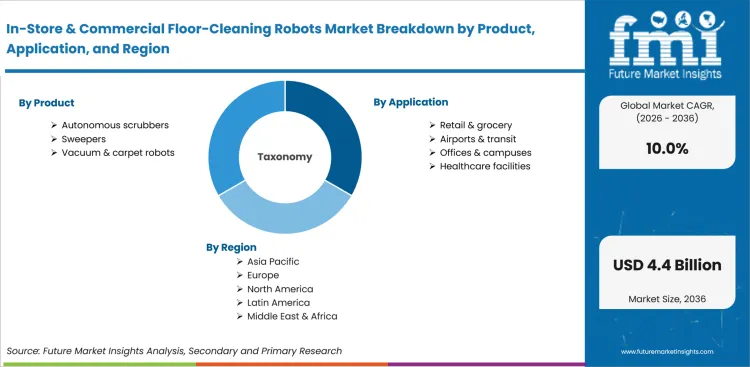
- Market Size (2026)
- USD 1.7 billion
- Forecast (2036)
- USD 4.4 billion
- CAGR (2026 to 2036)
- 10.0%
How big is In-Store & Commercial Floor-Cleaning Robots Market size?
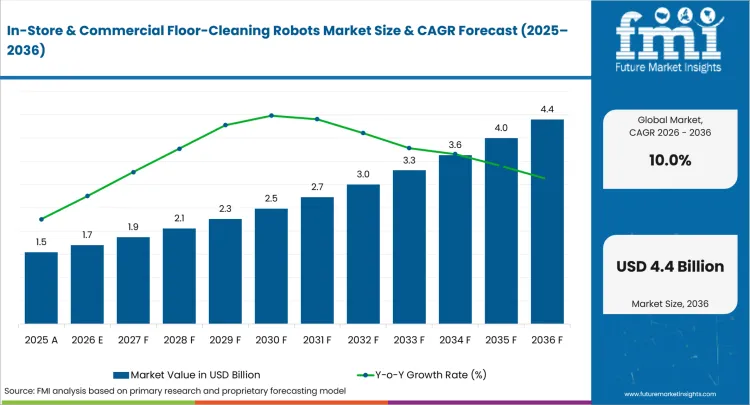
USD 1.7 billion in 2026 and USD 4.4 billion by 2036 at a 10.0% CAGR.
Industry valuation for in-store and commercial floor-cleaning robots is anticipated to advance from USD 1.7 billion in 2026 to USD 4.4 billion by 2036, representing a 10.0% CAGR across the forecast period. Labor shortages force modern businesses to automate the daily maintenance routines. Staffing constraints and fixed floor-care windows specifically encourage machine deployment across retail stores and commercial facilities. In August 2025, the United States Bureau of Labor Statistics projections cited about 36,400 openings each year for administrative services and facilities managers through 2034. Such persistent labor deficits encourage operators to pair facility management services with repeatable autonomous cleaning records. Leading commercial facilities to rely on robotic solutions to maintain high cleanliness standards without traditional hiring struggles.
Different global markets prioritize unique operational features when choosing floor-cleaning platforms. Operators in South Korea and United States emphasize fleet coverage and local maintenance depth. European Union and Japan facilities favor compact navigation and documented safety controls. Extensive real-world usage data proves the effectiveness of these autonomous choices. Brain Corp reported more than 250 billion square feet cleaned by its autonomous fleet in November 2024. This milestone supplies vital field evidence for mobile robots completing recurring commercial assignments. Encouraging documented route completion and facility management software records guiding approvals across multi-site portfolios.
Summary of In-Store & Commercial Floor-Cleaning Robots Market
| Market Signal | Commercial Impact |
|---|---|
| Demand and Growth Drivers | In-store and commercial floor-cleaning robot selection progresses as operators connect routine floor coverage with staffing continuity. Program reviews examine completed routes and intervention frequency across scheduled assignments.
|
| Product and Segment View | Segment direction is led by hardware followed by autonomous scrubbers and retail chains. Specification review is estimated to focus on durability and route completion.
|
| Geography and Growth Outlook | Country movement differs based on automation familiarity and commercial-facility operating patterns. Company progress reflects local support and operator training across multi-site programs.
|
| Competitive View | Competition centers on autonomous navigation and cleaning performance across commercial operating conditions. Commercial progress favors companies providing dependable field support based on regional service teams.
|
| Analyst Perspective | Commercial floor-cleaning robots serve as scheduling instruments for repetitive work across extensive facilities. Company progress improves due to measured pilots and service planning across multi-site programs.
|
Source: Future Market Insights analysis, 2026.
How is In-Store & Commercial Floor-Cleaning Robots Market segmented?
The in-store & commercial floor-cleaning robots market is segmented by product, application, component, end user, business model, and region.
The in-store and commercial floor-cleaning robots sector is segmented by product, application, component, end user, business model, and region. Product coverage includes autonomous scrubbers, sweepers, vacuum robots, and carpet robots designed for distinct debris conditions. Application coverage includes retail and grocery facilities, airports and transit locations, offices and campuses, and healthcare facilities. Component coverage includes hardware, autonomy software, and services supporting continued machine availability across commercial fleets. End-user coverage includes retail chains, facility-service companies, and transport hubs. Business-model coverage includes direct sales, robotics as a service, and service contracts. Regional coverage spans North America, Latin America, Europe, East Asia, South Asia, Oceania, Middle East, and Africa.
Why do autonomous scrubbers lead product selection?
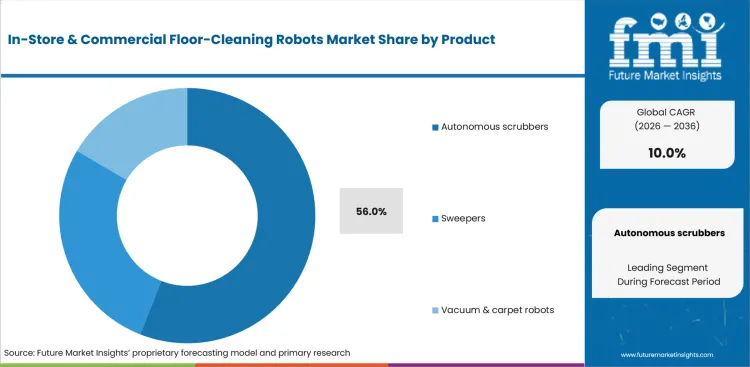
Autonomous scrubbers wash and dry hard flooring during one pass across recurring commercial cleaning routes. International Federation of Robotics reported professional cleaning robot sales exceeding 25,000 units during 2024 in its October 2025 release, supplying a scale reference for floor cleaning and mopping machines needing consistent route coverage. Product selection changes with floor material and debris type as facility layouts influence maneuverability during scheduled assignments.
- In 2026, autonomous scrubbers are anticipated to represent 56.0% share in 2026, backed by combined washing and drying across hard-floor routes. Facility teams examine cleaned area and intervention frequency across complete assignments to confirm dependable service during low-traffic periods.
- Sweepers support dry-debris collection across entrances and open public spaces requiring frequent surface maintenance without introducing moisture. Combined portfolios let operators match dry collection or textile maintenance to zones excluded from wet scrubbing schedules.
How does retail & grocery influence application activity?
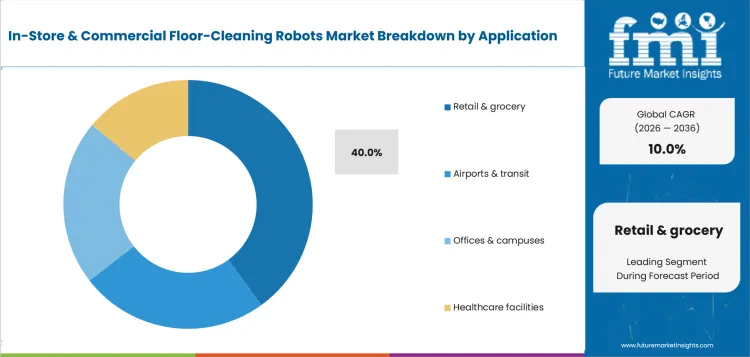
Walmart reported 10,771 retail units as of January 2025 in its March 2025 annual filing, illustrating how large store networks create repeated deployment settings for retail automation and autonomous floor care. Retail and grocery sites combine long aisles with recurring foot traffic and restricted cleaning windows. Cleaning plans shift across applications as passenger movement and hygiene controls define permissible machine activity.
- Retail and grocery are likely to secure 40.0% share of application in 2026, led by repeated aisles and cleaning periods outside busy trading hours. Store teams compare route consistency and edge coverage across departments prior to fleet expansion.
- Airports and transit facilities need extended corridor coverage during changing passenger flows and restricted service windows. Offices and campuses favor mixed-floor flexibility whereas healthcare facilities require controlled movement aligned with site-specific cleaning procedures.
Why does hardware lead component selection?
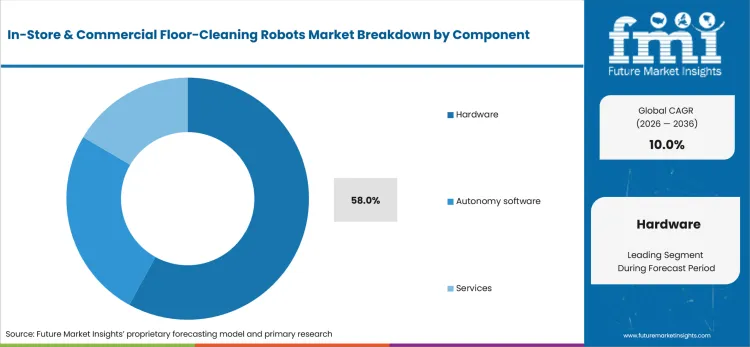
Hardware includes scrub decks and docking equipment supporting autonomous cleaning. A Brain Corp specification published in March 2024 stated Tennant X4 ROVR cleans up to 20,000 square feet on one full tank, highlighting physical capacity guiding equipment comparison within service robotics. Component choices reflect how physical cleaning capacity and software control share responsibility across each autonomous assignment.
- Based on component, hardware is forecast to capture 58.0% share in 2026 as machine frames and cleaning assemblies represent substantial product value. Buyers compare tank capacity and battery endurance across expected floor conditions.
- Autonomy software records routes and exceptions across operating fleets for continued performance review at several facilities. Service teams preserve operating continuity through setup guidance and scheduled care across distributed facility fleets.
How do retail chains guide end-user demand?
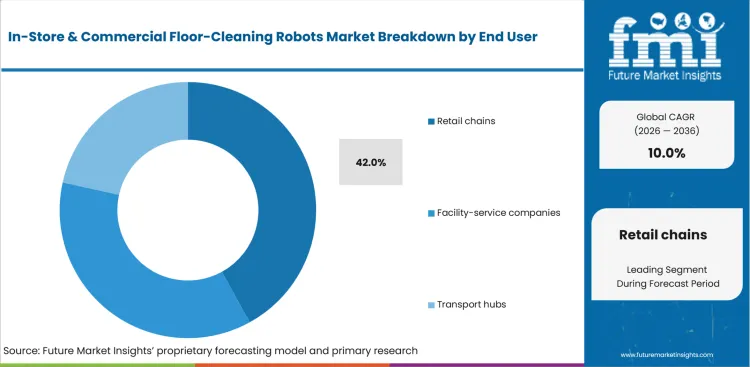
Target Corporation reported 1,995 stores at January 2026, showing extensive store networks influencing comparable floor-care procedures and centralized equipment review. End-user requirements diverge as network governance and public access determine acceptable supervision levels. Retail chains provide repeated store formats suited to standardized equipment assessment and training across several operating regions.
- Retail chains are projected to hold 42.0% share in 2026, guided by repeated layouts and centralized operating standards across store portfolios. Account teams evaluate route completion and local technician access prior to approving additional locations through staged store programs.
- Facility-service companies place machines across client sites with varied flooring and separate operating rules under contract-specific schedules. Transport hubs need machines capable of recovering from temporary obstructions without disrupting passenger circulation or security routines.
How does direct retain business model strength?
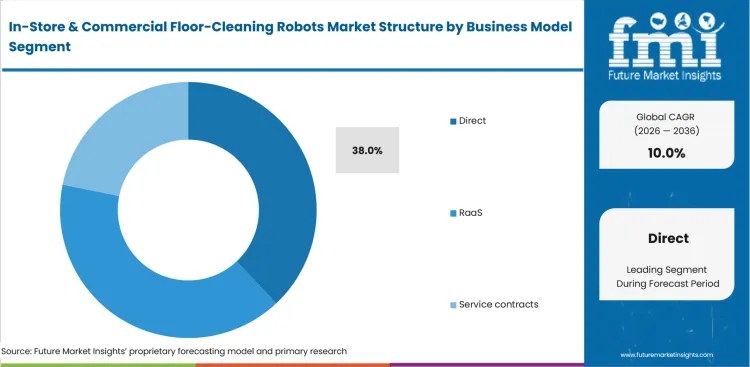
Direct sales promote assigned machines and internal maintenance planning under facility control with predictable equipment access. Tennant Company reported selling its 10,000th robotic scrubber in June 2025, marking commercial acceptance of owned autonomous equipment across established customer programs. Commercial models differ through asset control and support responsibility across equipment life cycles.
- By business model, direct sales are estimated to garner 38.0% share in 2026 since it is aided by buyer control over machine availability and site-level operating procedures. Organizations connect ownership with trained operators and scheduled servicing to preserve cleaning readiness across assigned shifts.
- RaaS arrangements spread access costs across contract periods and may include maintenance support under bundled service terms. Service agreements place repair response and replacement-part planning under defined provider obligations across deployed machines.
What are drivers, restraints, and opportunities in In-Store & Commercial Floor-Cleaning Robots Market?
Fixed cleaning schedules and staffing pressure support autonomous floor-care evaluation. Site complexity and machine recovery needs may delay regular deployment.
- Driver: Extensive floor areas require dependable cleaning across limited-service windows. Autonomous machines preserve staff time for guest-facing duties.
- Restraint: Reflective surfaces and temporary obstacles may interrupt mapped routes. Poor edge access may require manual recovery or supplementary cleaning.
- Opportunity: Connected docking and fleet records are expected to extend access across multi-site facilities. Subscription programs reduce initial ownership commitments.
United States Bureau of Labor Statistics projections published in August 2025 identified about 788,700 openings each year across building and grounds cleaning occupations through 2034, reinforcing interest in autonomous coverage for repetitive floor work. Employers are expected to place robots beside trained staff and professional cleaning products across scheduled facility programs. Persistent staffing gaps encourage facility managers to assign repetitive floor coverage to autonomous machines during scheduled operations.
Route interruptions may shift operator time toward machine recovery across crowded or changing spaces during cleaning shifts. Safety reviews are likely to examine stop behavior and manual controls prior to multi-site approval. United States Bureau of Labor Statistics reported 2.5 million nonfatal workplace injuries and illnesses during 2024 in its January 2026 release, encouraging careful validation of autonomous equipment operating near staff and visitors.
Airports Council International World and International Civil Aviation Organization reported global passenger traffic reaching 9.5 billion during 2024 in January 2025, creating extensive public-floor activity suited to airport robots during controlled cleaning periods. Fleet dashboards are expected to improve exception analysis and technician planning across distributed facilities with recurring machine activity. Transport and retail operators are projected to combine route records with service-level review across several sites.
How are country CAGRs aligned in In-Store & Commercial Floor-Cleaning Robots Market?
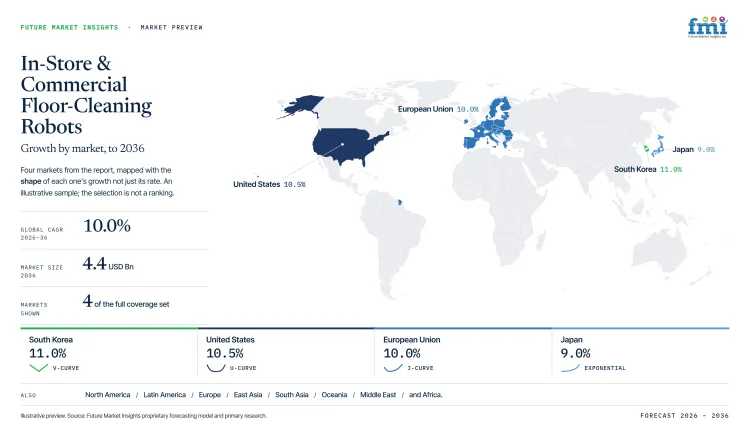
| Country or Market | CAGR |
|---|---|
| South Korea | 11.0% |
| United States | 10.5% |
| European Union | 10.0% |
| Japan | 9.0% |
Source: Future Market Insights analysis, 2026.
How do country-level CAGRs compare in In-Store & Commercial Floor-Cleaning Robots Market?
Country comparison shows a measured step-down in growth across the covered markets. South Korea occupies the upper end of the range, followed closely by the United States. European Union activity forms the next tier with a marginally lower projection. Japan records the lowest CAGR among the listed markets. The two-point spread indicates comparable expansion prospects despite different levels of automation familiarity and commercial-facility readiness. European Union performance represents a regional average, highlighting individual member countries may record different growth rates.
- South Korea leads the comparison and establishes East Asia as an important expansion cluster among the markets shown.
- United States activity follows closely, indicating limited separation from the leading South Korean projection.
- European Union performance forms the next growth band and retains a narrow gap from the United States.
- Japan records the slowest growth among the listed markets, yet its forecast remains positive within the wider commercial cleaning context.
- The pattern resembles a gradual downward slope instead of a sharp division between markets recording different growth rates.
Markets with broadly similar CAGRs may present distinct entry conditions due to commercial infrastructure and automation readiness. The full report provides country-level analysis across North America, Latin America, Europe, East Asia, South Asia, Oceania, Middle East, and Africa.
Country-wise Analysis
- Adoption in South Korea is set to rise at 11.0% CAGR between 2026 and 2036, backed by extensive robotics engineering and local automation experience. Dense automated workplaces provide established procedures for machine supervision and technical support across facility fleets. International Federation of Robotics reported in April 2026 a density of 1,220 robots per 10,000 manufacturing employees, signaling deep familiarity with autonomous equipment and related service skills.
- United States Bureau of Labor Statistics projected in August 2025 about 351,300 openings each year for janitors and building cleaners through 2034, encouraging facility operators to reserve staff attention for variable cleaning duties. Large retail and office portfolios create repeated settings for route validation and service planning across facility networks. The market in United States is predicted to expand at 10.5% CAGR during the assessment period, aided by extensive commercial floor area and established cleaning contractors.
- Company progress across European Union member states is expected to reflect multilingual training and distributed service access. Sales in the European Union are estimated to record 10.0% CAGR from 2026 to 2036, guided by enterprise technology use and structured workplace reviews. Eurostat reported 20.0% of EU enterprises using artificial intelligence technologies during 2025 in its December 2025 release, showing organizational familiarity with software-led operating tools.
- Demand in Japan is forecast to grow at 9.0% CAGR by 2036, influenced by workforce aging and established cleaning-equipment use. Compact commercial spaces favor machines balancing maneuverability with predictable route execution across recurring floor-care assignments. Statistics Bureau of Japan reported 36.243 million residents aged 65 years or older during 2024 in its April 2025 release, heightening attention toward labor-supporting equipment across service operations.
Who are notable companies in In-Store & Commercial Floor-Cleaning Robots Market?
Brain Corp and Tennant Company support integrated autonomy and professional scrubber programs across commercial-facility portfolios. Nilfisk and Kärcher contribute established cleaning-equipment portfolios through regional distribution and service channels. Avidbots Corp. and Gausium provide purpose-built autonomous scrubbers for varied commercial environments requiring repeatable route coverage. LionsBot International and Pudu Robotics add autonomous floor-care systems through regional equipment channels and service partnerships. ICE Cobotics and ECOVACS Commercial Robotics support compact commercial cleaning applications. Amano Corporation and SoftBank Robotics provide additional robotic floor-care systems across Asian commercial facilities.
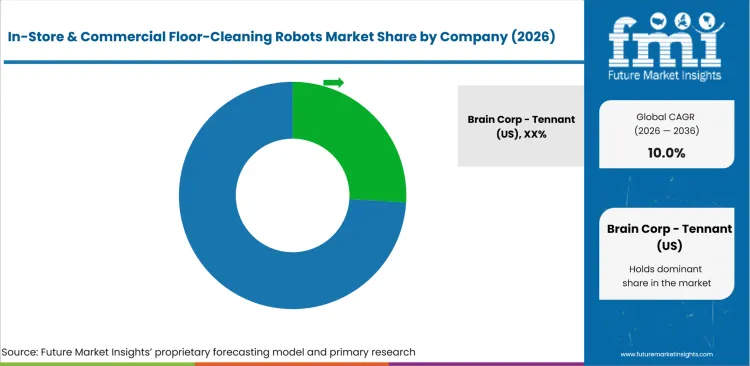
The in-store and commercial floor-cleaning robots industry is anticipated to compete centering on navigation dependability and technician access. Facility teams are likely to compare companies based on route completion and intervention records prior to fleet expansion. Brain Corp and Tennant Company are expected to attract evaluation due to combined autonomy software and scrubber distribution. Nilfisk and Kärcher are projected to draw on professional floor-care experience across varied commercial operating conditions. Avidbots Corp. and Gausium are estimated to compete through purpose-built autonomous cleaning portfolios serving complex public facilities. LionsBot International and Pudu Robotics are anticipated to support compact and multifunction deployments across several regional channels. ICE Cobotics and ECOVACS Commercial Robotics are likely to serve commercial accounts through autonomous floor-care equipment and service partners. Amano Corporation and SoftBank Robotics extend regional choice led by active commercial cleaning robot portfolios.
- Brain Corp and Tennant Company are expected to receive review attention depending on integrated autonomy software and scrubber portfolios. Facility teams are likely to assess route evidence and established service access.
- Nilfisk and Kärcher are anticipated to compete driven by professional cleaning portfolios and distributor reach across commercial accounts. Buyers are projected to compare machine durability and local technician access throughout expected operating periods.
- Avidbots Corp. and Gausium are forecast to receive attention based on purpose-built autonomous scrubbers and fleet-management tools. Large facilities are likely to examine route evidence across complex public spaces and recurring operating conditions.
- LionsBot International and Pudu Robotics are expected to support compact commercial environments and mixed cleaning tasks. Regional partners are anticipated to influence training quality and parts availability across deployed commercial fleets.
Competitive Benchmarking: In-Store & Commercial Floor-Cleaning Robots Market
| Company | Portfolio Depth | Commercial Match | Service Support | Service Reach |
|---|---|---|---|---|
| Brain Corp | High | High | High | United States and global |
| Tennant Company | High | High | High | United States and global |
| Nilfisk | High | High | High | Denmark and global |
| Kärcher | High | High | High | Germany and global |
| Avidbots Corp. | High | High | Medium | Canada and global |
| Gausium | High | High | Medium | China and global |
| LionsBot International | Medium | High | Medium | Singapore and international |
| Pudu Robotics | High | High | Medium | China and global |
| ICE Cobotics | Medium | High | Medium | United States and international |
| ECOVACS Commercial Robotics | High | High | Medium | China and global |
Source: Future Market Insights competitive analysis, 2026.
Key Developments in In-Store & Commercial Floor-Cleaning Robots Market
- In April 2025, Tennant Company announced X6 ROVR with cleaning capacity reaching 75,000 square feet per cycle. Tennant Company stated the machine addressed extensive and complex facilities, extending autonomous scrubber options across warehouse and retail operations.
- In November 2025, Nilfisk launched VP25 with operating duration reaching 3 hours per charge. Nilfisk stated the robotic vacuum supported professional indoor cleaning, adding autonomous coverage across offices and commercial buildings.
- In February 2026, Gausium deployed Omnie cleaning robots at 2 Milan airports supporting Milano Cortina operations. Gausium stated complex public spaces formed the main deployment setting, expanding airport evidence for autonomous floor cleaning amid changing passenger activity.
Key Players in In-Store & Commercial Floor-Cleaning Robots Market
Autonomy platforms and global cleaning-equipment companies
- Brain Corp
- Tennant Company
- Nilfisk
- Kärcher
Autonomous floor-care specialists
- Avidbots Corp.
- Gausium
- LionsBot International
- Pudu Robotics
Regional and professional cleaning-robot providers
- ICE Cobotics
- ECOVACS Commercial Robotics
- Amano Corporation
- SoftBank Robotics
In-Store & Commercial Floor-Cleaning Robots Market Report Scope
| Coverage field | Report scope |
|---|---|
| Market breakdown | In-store & commercial floor-cleaning robots breakdown by product, application, component, end user, business model, and region. |
| Quantitative Units | Revenue in USD Million, CAGR in %. |
| Market Definition | In-store and commercial floor-cleaning robots include autonomous machines and supporting software or services used for recurring floor care across retail and commercial facilities. |
| Regions Covered | North America, Latin America, Europe, East Asia, South Asia, Oceania, Middle East, and Africa. |
| Countries Covered | United States and Canada form North American coverage across profiled retail and commercial facility settings. Brazil, Mexico, and Argentina form Latin American coverage. Germany, United Kingdom, France, Italy, and Spain form European coverage. China, Japan, and South Korea form East Asian coverage. India, Thailand, and Indonesia form South Asian coverage. Australia and New Zealand form Oceanian coverage. GCC countries, South Africa, and Türkiye form Middle Eastern and African coverage. |
| Key Companies Profiled | Brain Corp, Tennant Company, Nilfisk, Kärcher, Avidbots Corp., Gausium, LionsBot International, Pudu Robotics, ICE Cobotics, ECOVACS Commercial Robotics, Amano Corporation, and SoftBank Robotics. |
| Forecast Period | Forecast period covers 2026 through 2036 across every regional and segment estimate. |
| Approach | Hybrid bottom-up and top-down methodology uses segment shares, country CAGRs, product portfolios, operating evidence, and service coverage. |
Source: Future Market Insights analysis, 2026.
In-Store & Commercial Floor-Cleaning Robots Market - Research Methodology
| Method | Approach |
|---|---|
| Primary Research | FMI analysts gathered input from manufacturers, service providers, technology developers, distributors, end users, procurement teams, and subject-matter experts. Interviews examined purchasing decisions, product or service evaluation, adoption barriers, approval requirements, pricing considerations, and expectations for technical or commercial support. Respondents were also asked what evidence is required before a trial, pilot, or initial order develops into regular purchasing. |
| Desk Research | Desk research covered government statistics, regulatory publications, trade data, industry associations, technical literature, standards, company filings, product information, and official corporate announcements. Sources were reviewed for relevance, publication date, geographic coverage, and consistency with the defined market scope. Claims relating to performance, applications, approvals, capacity, investment, and commercial activity were retained only when supported by credible public evidence. |
| Market Sizing and Forecasting | The market model combined the baseline value with historical performance, segment structure, pricing and volume indicators, adoption levels, company participation, and country-level demand conditions. Forecast assumptions considered economic activity, investment trends, regulatory developments, technology adoption, purchasing cycles, supply availability, and barriers to wider market use. Segment and regional estimates were reconciled before the final market total was calculated. |
| Data Validation | Estimates were checked against multiple independent indicators, including public data, company activity, trade patterns, industry developments, and findings from primary interviews. Validation also tested whether products, services, applications, and company revenues fell within the defined market boundaries. Adjacent categories, unsupported claims, overlapping revenues, and activities without direct market relevance were excluded to reduce double counting and maintain consistency across segments and countries. |
Source: Future Market Insights analysis, 2026.
In-Store & Commercial Floor-Cleaning Robots Market by Segments
In-Store & Commercial Floor-Cleaning Robots Market segmented by Product:
- Autonomous scrubbers
- Sweepers
- Vacuum & carpet robots
In-Store & Commercial Floor-Cleaning Robots Market segmented by Application:
- Retail & grocery
- Airports & transit
- Offices & campuses
- Healthcare facilities
In-Store & Commercial Floor-Cleaning Robots Market segmented by Component:
- Hardware
- Autonomy software
- Services
In-Store & Commercial Floor-Cleaning Robots Market segmented by End User:
- Retail chains
- Facility-service companies
- Transport hubs
In-Store & Commercial Floor-Cleaning Robots Market segmented by Business Model:
- Direct
- RaaS
- Service contracts
In-Store & Commercial Floor-Cleaning Robots Market segmented by Region:
- North America
- United States
- Canada
- Latin America
- Brazil
- Mexico
- Argentina
- Europe
- Germany
- United Kingdom
- France
- Italy
- Spain
- East Asia
- China
- Japan
- South Korea
- South Asia
- India
- Thailand
- Indonesia
- Oceania
- Australia
- New Zealand
- Middle East and Africa
- GCC countries
- South Africa
- Türkiye
Research Sources and Bibliography
- USA Bureau of Labor Statistics. (2025, August 28). Administrative services and facilities managers.
- Brain Corp. (2024, November 12). Brain Corp’s autonomous robot fleet hits 250 billion square feet milestone, leads global surge in robotic automation.
- International Federation of Robotics. (2025, October 7). Service robots see global growth boom.
- Walmart Inc. (2025, March 14). Annual report 2025.
- Brain Corp. (2024, March 19). Tennant announces full specification and capabilities of X4 ROVR autonomous floor cleaning machine, its first purpose-built robotic scrubber.
- Target Corporation. (2026, March 3). Target Corporation reports fourth quarter and full-year 2025 earnings.
- Tennant Company. (2025, June 3). Tennant Company sells 10,000th robotic scrubber, underscoring global demand for cleaning automation.
- USA Bureau of Labor Statistics. (2025, August 28). Building and grounds cleaning occupations.
- USA Bureau of Labor Statistics. (2026, January 22). Employer-reported workplace injuries and illnesses, 2023-2024.
- Airports Council International World, & International Civil Aviation Organization. (2025, January 28). Joint ACI World-ICAO passenger traffic report, trends and outlook.
- International Federation of Robotics. (2026, April 8). Robot density surges in Europe, Asia, and Americas.
- USA Bureau of Labor Statistics. (2025, August 28). Janitors and building cleaners.
- Eurostat. (2025, December 11). 20% of EU enterprises use AI technologies.
- Statistics Bureau of Japan. (2025, April 14). Current population estimates as of October 1, 2024.
- Tennant Company. (2025, April 15). Tennant Company launches X6 ROVR: Autonomous cleaning power for extensive and complex facilities.
- ISSA. (2025, November 24). Nilfisk launches the VP25 robotic vacuum for the professional cleaning market.
- Gausium. (2026, February 6). Gausium’s Omnie cleaning robots land at Milan airports ahead of Milano Cortina 2026 Winter Olympics.
This bibliography is provided for reader reference and is not exhaustive. The full report contains the complete reference list and detailed citations.
This Report Answers
- What segments organize demand across product, application, component, end user, and business model?
- How do retail and commercial operators evaluate in-store and commercial floor-cleaning robots prior to replacing manual routines?
- How do country CAGRs differ across profiled economies serving autonomous commercial floor-cleaning programs and facility networks?
- What companies compete through autonomy portfolios and field-service support across profiled commercial applications and regions?
- How are forecasts validated through a hybrid bottom-up and top-down approach using segment and country evidence?
- What operating factors do account teams assess prior to approving autonomous floor-cleaning expansion across multiple facilities?
- How do route completion and intervention frequency affect autonomous cleaning equipment selection across commercial floor conditions?
- What limits return on investment for teams adding in-store and commercial floor-cleaning robots?
- How do training records and technician access influence account approval across distributed commercial facility portfolios?
- What company capabilities improve long-term account confidence across recurring autonomous floor-cleaning programs and service contracts?
Frequently Asked Questions
What supports demand in in-store & commercial floor-cleaning robots market?
Demand is likely to receive support from commercial facilities needing repeatable floor coverage across limited cleaning windows. Operators are expected to favor companies combining route evidence with dependable technician access across participating locations.
Who are key players in in-store & commercial floor-cleaning robots market?
Key companies are anticipated to include Brain Corp and Gausium among others. Competition is likely to be centered on navigation dependability and regional service coverage across commercial facility portfolios.
What restraint affects in-store & commercial floor-cleaning robots market?
A primary restraint involves route interruption from temporary obstacles and changing public-space conditions during scheduled cleaning assignments. Account expansion slows if machines require frequent recovery or leave substantial edge areas unfinished during normal operation.
Why do executives track in-store & commercial floor-cleaning robots market?
Executives are expected to track autonomous floor care as staffing continuity affects commercial-facility planning. Route completion and service support guide capital reviews across store and building portfolios containing varied floor conditions.
What business problem does in-store & commercial floor-cleaning robots market solve?
In-store and commercial floor-cleaning robots cover repetitive floor work across restricted service periods. Facility teams retain human attention for spills and public interaction as machines complete planned routes.
What do account teams evaluate prior to selecting vendors?
Account teams are likely to evaluate floor compatibility and intervention frequency prior to vendor approval. Technician access and operator guidance are expected to guide final review across participating facility locations.
What limits return on investment for purchasing teams?
Return on investment weakens if equipment selection ignores floor layout or normal traffic conditions during scheduled cleaning. Low route completion and frequent manual recovery reduce expected labor-time savings across recurring commercial assignments.
How do vendors build long-term account confidence?
Vendors build account confidence through consistent machine performance and operating evidence specific to commercial floor care. Training records and responsive troubleshooting are expected to influence repeat-order trust across multi-site commercial facility programs.
Preview the report firsthand - request a free sample
Get SampleGet the brochure for pricing and purchase details.
Get PDFTable of Content
- Key Takeaways
- Market Size and CAGR
- Top Growth Driver
- Fastest Growing Segment
- Leading Region
- Key Companies
- Emerging Opportunities
- Executive Summary
- Global Market Outlook
- Demand-side Trends
- Supply-side Trends
- Technology Roadmap Analysis
- Analysis and Recommendations
- Analyst Perspective (What is happening? Why now? What should investors know?)
- Key Questions Answered
- How large is the market?
- What is the CAGR?
- What are key trends?
- Which region dominates?
- Who are the leaders?
- Market Overview
- Market Coverage / Taxonomy
- Market Definition / Scope / Limitations
- Research Methodology
- Chapter Orientation
- Analytical Lens and Working Hypotheses
- Market Structure, Signals, and Trend Drivers
- Benchmarking and Cross-market Comparability
- Market Sizing, Forecasting, and Opportunity Mapping
- Research Design and Evidence Framework
- Desk Research Programme (Secondary Evidence)
- Expert Input and Fieldwork (Primary Evidence)
- Tooling, Models, and Reference Databases
- Data Engineering and Model Build
- Quality Assurance and Audit Trail
- Market Background
- Market Dynamics (Drivers, Restraints, Opportunity, Trends)
- Scenario Forecast (Optimistic, Likely, Conservative)
- Impact Analysis
- AI Impact
- Sustainability Impact
- Regulatory Impact
- Technology Impact
- Consumer / Buyer Analysis
- Purchase Drivers
- Adoption Barriers
- Buyer Journey
- Opportunity Map Analysis
- Product Life Cycle Analysis
- Supply Chain Analysis
- Investment Feasibility Matrix
- Value Chain Analysis
- PESTLE and Porter's Analysis
- Regulatory Landscape
- Regional Parent Market Outlook
- Production and Consumption Statistics
- Import and Export Statistics
- Global Market Analysis and Forecast, 2021 to 2036
- Historical Market Size Value (USD Billion) Analysis, 2021 to 2025
- Current and Future Market Size Value (USD Billion) Projections, 2026 to 2036
- Y-o-Y Growth Trend Analysis
- Absolute $ Opportunity Analysis
- Global Market Pricing Analysis, 2021 to 2036
- Global Market Analysis and Forecast, By Product, 2021 to 2036
- Introduction / Key Findings
- Historical Market Size Value (USD Billion) Analysis By Product, 2021 to 2025
- Current and Future Market Size Value (USD Billion) Analysis and Forecast By Product, 2026 to 2036
- Autonomous scrubbers
- Sweepers
- Vacuum & carpet robots
- Autonomous scrubbers
- Y-o-Y Growth Trend Analysis By Product, 2021 to 2025
- Absolute $ Opportunity Analysis By Product, 2026 to 2036
- Global Market Analysis and Forecast, By Application, 2021 to 2036
- Introduction / Key Findings
- Historical Market Size Value (USD Billion) Analysis By Application, 2021 to 2025
- Current and Future Market Size Value (USD Billion) Analysis and Forecast By Application, 2026 to 2036
- Retail & grocery
- Airports & transit
- Offices & campuses
- Healthcare facilities
- Retail & grocery
- Y-o-Y Growth Trend Analysis By Application, 2021 to 2025
- Absolute $ Opportunity Analysis By Application, 2026 to 2036
- Global Market Analysis and Forecast, By Component, 2021 to 2036
- Introduction / Key Findings
- Historical Market Size Value (USD Billion) Analysis By Component, 2021 to 2025
- Current and Future Market Size Value (USD Billion) Analysis and Forecast By Component, 2026 to 2036
- Hardware
- Autonomy software
- Services
- Hardware
- Y-o-Y Growth Trend Analysis By Component, 2021 to 2025
- Absolute $ Opportunity Analysis By Component, 2026 to 2036
- Global Market Analysis and Forecast, By End User, 2021 to 2036
- Introduction / Key Findings
- Historical Market Size Value (USD Billion) Analysis By End User, 2021 to 2025
- Current and Future Market Size Value (USD Billion) Analysis and Forecast By End User, 2026 to 2036
- Retail chains
- Facility-service companies
- Transport hubs
- Retail chains
- Y-o-Y Growth Trend Analysis By End User, 2021 to 2025
- Absolute $ Opportunity Analysis By End User, 2026 to 2036
- Global Market Analysis and Forecast, By Business Model, 2021 to 2036
- Introduction / Key Findings
- Historical Market Size Value (USD Billion) Analysis By Business Model, 2021 to 2025
- Current and Future Market Size Value (USD Billion) Analysis and Forecast By Business Model, 2026 to 2036
- Direct
- RaaS
- Service contracts
- Direct
- Y-o-Y Growth Trend Analysis By Business Model, 2021 to 2025
- Absolute $ Opportunity Analysis By Business Model, 2026 to 2036
- Global Market Analysis and Forecast, By Region, 2021 to 2036
- Introduction
- Historical Market Size Value (USD Billion) Analysis By Region, 2021 to 2025
- Current Market Size Value (USD Billion) Analysis and Forecast By Region, 2026 to 2036
- North America
- Latin America
- Western Europe
- Eastern Europe
- East Asia
- South Asia and Pacific
- Middle East & Africa
- Market Attractiveness Analysis By Region
- North America Market Analysis and Forecast, By Country, 2021 to 2036
- Historical Market Size Value (USD Billion) Trend Analysis By Market Taxonomy, 2021 to 2025
- Market Size Value (USD Billion) Forecast By Market Taxonomy, 2026 to 2036
- By Country
- USA
- Canada
- By Product
- By Application
- By Component
- By End User
- By Business Model
- By Country
- Market Attractiveness Analysis
- By Country
- By Product
- By Application
- By Component
- By End User
- By Business Model
- Key Takeaways
- Latin America Market Analysis and Forecast, By Country
- Historical Market Size Value (USD Billion) Trend Analysis By Market Taxonomy, 2021 to 2025
- Market Size Value (USD Billion) Forecast By Market Taxonomy, 2026 to 2036
- By Country
- Brazil
- Mexico
- Chile
- Rest of Latin America
- By Product
- By Application
- By Component
- By End User
- By Business Model
- By Country
- Market Attractiveness Analysis
- By Country
- By Product
- By Application
- By Component
- By End User
- By Business Model
- Key Takeaways
- Western Europe Market Analysis and Forecast, By Country
- Historical Market Size Value (USD Billion) Trend Analysis By Market Taxonomy, 2021 to 2025
- Market Size Value (USD Billion) Forecast By Market Taxonomy, 2026 to 2036
- By Country
- Germany
- UK
- Italy
- Spain
- France
- Nordic
- BENELUX
- Rest of Western Europe
- By Product
- By Application
- By Component
- By End User
- By Business Model
- By Country
- Market Attractiveness Analysis
- By Country
- By Product
- By Application
- By Component
- By End User
- By Business Model
- Key Takeaways
- Eastern Europe Market Analysis and Forecast, By Country
- Historical Market Size Value (USD Billion) Trend Analysis By Market Taxonomy, 2021 to 2025
- Market Size Value (USD Billion) Forecast By Market Taxonomy, 2026 to 2036
- By Country
- Russia
- Poland
- Hungary
- Balkan & Baltic
- Rest of Eastern Europe
- By Product
- By Application
- By Component
- By End User
- By Business Model
- By Country
- Market Attractiveness Analysis
- By Country
- By Product
- By Application
- By Component
- By End User
- By Business Model
- Key Takeaways
- East Asia Market Analysis and Forecast, By Country
- Historical Market Size Value (USD Billion) Trend Analysis By Market Taxonomy, 2021 to 2025
- Market Size Value (USD Billion) Forecast By Market Taxonomy, 2026 to 2036
- By Country
- China
- Japan
- South Korea
- By Product
- By Application
- By Component
- By End User
- By Business Model
- By Country
- Market Attractiveness Analysis
- By Country
- By Product
- By Application
- By Component
- By End User
- By Business Model
- Key Takeaways
- South Asia and Pacific Market Analysis and Forecast, By Country
- Historical Market Size Value (USD Billion) Trend Analysis By Market Taxonomy, 2021 to 2025
- Market Size Value (USD Billion) Forecast By Market Taxonomy, 2026 to 2036
- By Country
- India
- ASEAN
- Australia & New Zealand
- Rest of South Asia and Pacific
- By Product
- By Application
- By Component
- By End User
- By Business Model
- By Country
- Market Attractiveness Analysis
- By Country
- By Product
- By Application
- By Component
- By End User
- By Business Model
- Key Takeaways
- Middle East & Africa Market Analysis and Forecast, By Country
- Historical Market Size Value (USD Billion) Trend Analysis By Market Taxonomy, 2021 to 2025
- Market Size Value (USD Billion) Forecast By Market Taxonomy, 2026 to 2036
- By Country
- Kingdom of Saudi Arabia
- Other GCC Countries
- Türkiye
- South Africa
- Other African Union
- Rest of Middle East & Africa
- By Product
- By Application
- By Component
- By End User
- By Business Model
- By Country
- Market Attractiveness Analysis
- By Country
- By Product
- By Application
- By Component
- By End User
- By Business Model
- Key Takeaways
- Key Countries Market Analysis
- USA
- Pricing Analysis
- Market Share Analysis, 2025
- By Product
- By Application
- By Component
- By End User
- By Business Model
- Canada
- Pricing Analysis
- Market Share Analysis, 2025
- By Product
- By Application
- By Component
- By End User
- By Business Model
- Mexico
- Pricing Analysis
- Market Share Analysis, 2025
- By Product
- By Application
- By Component
- By End User
- By Business Model
- Brazil
- Pricing Analysis
- Market Share Analysis, 2025
- By Product
- By Application
- By Component
- By End User
- By Business Model
- Chile
- Pricing Analysis
- Market Share Analysis, 2025
- By Product
- By Application
- By Component
- By End User
- By Business Model
- Germany
- Pricing Analysis
- Market Share Analysis, 2025
- By Product
- By Application
- By Component
- By End User
- By Business Model
- UK
- Pricing Analysis
- Market Share Analysis, 2025
- By Product
- By Application
- By Component
- By End User
- By Business Model
- Italy
- Pricing Analysis
- Market Share Analysis, 2025
- By Product
- By Application
- By Component
- By End User
- By Business Model
- Spain
- Pricing Analysis
- Market Share Analysis, 2025
- By Product
- By Application
- By Component
- By End User
- By Business Model
- France
- Pricing Analysis
- Market Share Analysis, 2025
- By Product
- By Application
- By Component
- By End User
- By Business Model
- India
- Pricing Analysis
- Market Share Analysis, 2025
- By Product
- By Application
- By Component
- By End User
- By Business Model
- ASEAN
- Pricing Analysis
- Market Share Analysis, 2025
- By Product
- By Application
- By Component
- By End User
- By Business Model
- Australia & New Zealand
- Pricing Analysis
- Market Share Analysis, 2025
- By Product
- By Application
- By Component
- By End User
- By Business Model
- China
- Pricing Analysis
- Market Share Analysis, 2025
- By Product
- By Application
- By Component
- By End User
- By Business Model
- Japan
- Pricing Analysis
- Market Share Analysis, 2025
- By Product
- By Application
- By Component
- By End User
- By Business Model
- South Korea
- Pricing Analysis
- Market Share Analysis, 2025
- By Product
- By Application
- By Component
- By End User
- By Business Model
- Russia
- Pricing Analysis
- Market Share Analysis, 2025
- By Product
- By Application
- By Component
- By End User
- By Business Model
- Poland
- Pricing Analysis
- Market Share Analysis, 2025
- By Product
- By Application
- By Component
- By End User
- By Business Model
- Hungary
- Pricing Analysis
- Market Share Analysis, 2025
- By Product
- By Application
- By Component
- By End User
- By Business Model
- Kingdom of Saudi Arabia
- Pricing Analysis
- Market Share Analysis, 2025
- By Product
- By Application
- By Component
- By End User
- By Business Model
- Türkiye
- Pricing Analysis
- Market Share Analysis, 2025
- By Product
- By Application
- By Component
- By End User
- By Business Model
- South Africa
- Pricing Analysis
- Market Share Analysis, 2025
- By Product
- By Application
- By Component
- By End User
- By Business Model
- USA
- Market Structure Analysis
- Competition Dashboard
- Competition Benchmarking
- Market Share Analysis of Top Players
- By Regional
- By Product
- By Application
- By Component
- By End User
- By Business Model
- Emerging Startups
- Innovation Benchmarking
- Competition Analysis
- Competition Deep Dive
- Brain Corp - Tennant (US)
- Overview
- Product Portfolio
- Profitability by Market Segments
- Sales Footprint
- Strategy Overview
- Marketing Strategy
- Product Strategy
- Channel Strategy
- Nilfisk (DK)
- Avidbots (CA)
- Kärcher (DE)
- Brain Corp - Tennant (US)
- Case Studies
- Success Stories
- Recent Developments
- Competition Deep Dive
- Assumptions & Acronyms Used


