

- Market Size (2026)
- USD 1.4 Bn
- Forecast (2036)
- USD 4.5 Bn
- CAGR (2026 to 2036)
- 12.5%
How big is the Pool-Cleaning Robots Market in 2026?
USD 1.4 billion in 2026 and USD 4.5 billion by 2036 at a 12.5% CAGR.
Demand for pool-cleaning robots are estimated to rise at 12.5% CAGR through 2036, with market value increasing from USD 1.4 billion in 2026 to USD 4.5 billion by 2036. Pool cleaning robot adoption is driven by owners’ willingness to automate routine weekly brushing and vacuuming tasks. Effective systems are expected to clean pool floors and walls continuously without frequent lifting or manual touch‑ups during a standard cleaning cycle. In August 2025, the Pool & Hot Tub Alliance reported that 368 companies participated in its 2024 Business Operations Survey, confirming a broad and established service and retail ecosystem for pool equipment. This existing distribution base is anticipated to support robot adoption by giving manufacturers direct access to pool owners through established accessories and maintenance channels.
Regional robot sales can diverge during one pool season despite a positive ten-year demand outlook. North American and European distributors depend on spring orders that place stock ahead of summer demand. Latin America offers more room to build distribution from a smaller installed base of automated cleaners. Fluidra announced in April 2025 that it planned a USD 100 million investment for 27% of Aiper, which reported about USD 195 million in 2024 sales. The deal gives a full-line pool group access to a cordless specialist and its online sales channel. Dealers need local stock and technicians to support the wider pool and spa equipment budget during the summer peak. Pool and spa water treatment chemicals remain a separate sanitation purchase throughout each operating season. A cleaner reduces labor but cannot replace the chemicals needed to protect water quality each season.
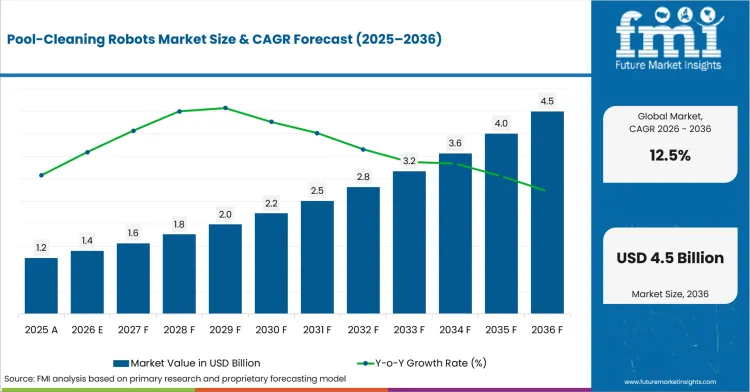
Key Takeaways of Pool-Cleaning Robots Market
- Demand for pool-cleaning robots is driven by owners seeking to remove a repeated chore from weekly pool care, with purchase value tied to how well one cycle covers main surfaces with little owner follow-up.
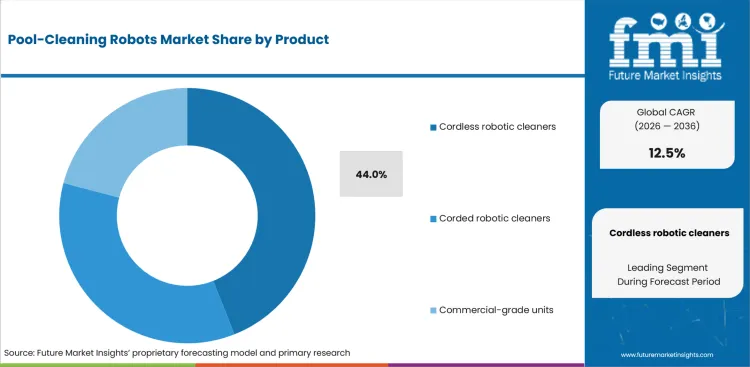
- By product, cordless robotic cleaners are expected to lead with 44.0% share in 2026, supported by easier handling for frequent home use.
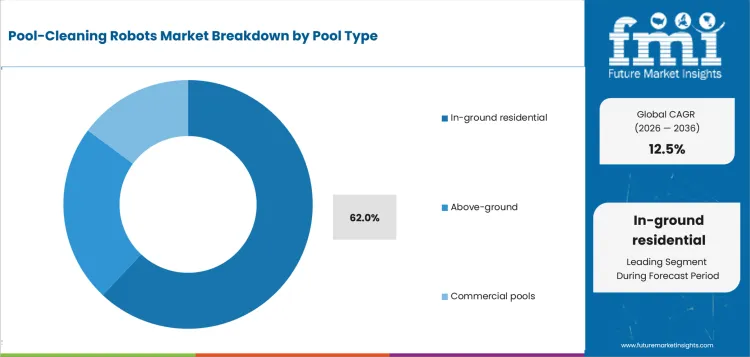
- In-ground residential pools are the dominant pool type segment, projected to hold 62.0% share in 2026, driven by larger surfaces and permanent installation.
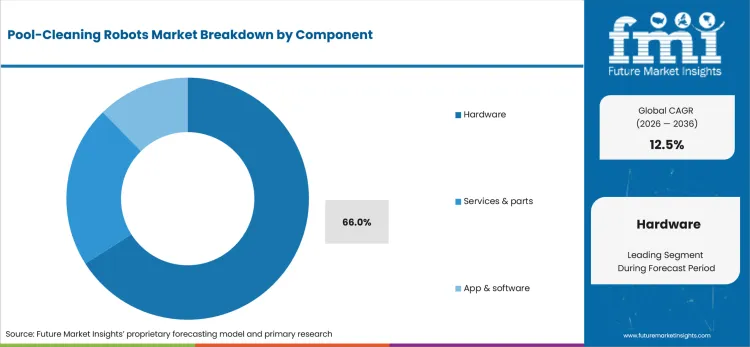
- Hardware is estimated to lead the component category with 66.0% share in 2026, as motors and filters perform the core physical cleaning work.
- Debris capture and wall coverage remain more decisive than app features or settings lists, with seasonal stock gaps capable of delaying sales despite steady household interest through peak swimming months.
- Latin America, the United States, and the European Union are expected to grow at 14.0%, 13.0%, and 12.0% CAGR respectively through 2036, with growth shaped by the installed pool base and strength of local sales and service networks.
- Competition centers on Maytronics, Fluidra, Hayward, Aiper, Beatbot, BWT, Pentair, and WYBOT, with vendors differentiating through dealer network reach, cordless product ranges, and repair and service coverage.
Analyst Perspective
"The robotic pool cleaner market is maturing as buyers look beyond demonstration performance and focus on dependable operation over years of regular use. Purchasing decisions are influenced by cleaning consistency across varied pool layouts, ease of maintenance, battery reliability, and the availability of replacement parts. Manufacturers that combine durable product design with responsive after-sales service and practical maintenance support are likely to build stronger customer loyalty in both residential and commercial segments."
- Rahul Pandita, Future Market Insights Analyst Team
Source: FMI's proprietary forecasting model and primary research
How is the Pool-Cleaning Robots Market segmented?
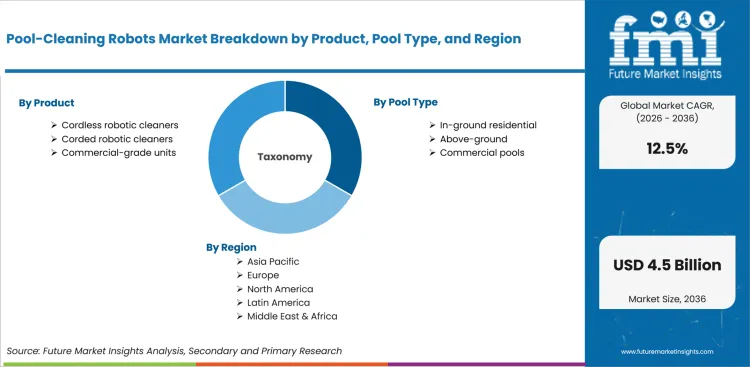
Pool-cleaning robots market is segmented by Product, Pool Type, Component, End User, Sales Channel, and Region
The report separates product design from the pool setting and revenue earned throughout the ownership period. The Product category compares cordless units with corded cleaners and machines built for longer commercial schedules. The Pool Type category separates permanent home pools from above-ground pools and public sites with cleaning demands. The Component category divides the physical robot from parts and app revenue earned across several seasons. End User analysis separates households from hotels and public facilities with tighter weekly cleaning schedules. Sales Channel analysis compares dealer advice with online convenience, and Region explains climate or service differences. This structure prevents a light home unit from being judged against a machine built for daily public-pool work. The broader cleaning robot category uses similar navigation, but underwater travel makes pool units a distinct group.
How does cordless design shape demand within the product category?
Cordless design removes the deck cable, and runtime determines whether one cycle can cover the planned pool area. BWT published its ES Echo operating and service guide for cordless pool cleaners in March 2025. The guide lists two to three hours for full-pool or wall cleaning and 2.5 to 3.5 hours for floor cleaning. BWT states that pool shape and surface conditions can change the runtime achieved during actual use. Owners therefore need runtime evidence from pools that resemble their own size and surface design.
- Cordless robotic cleaners are projected to hold 44.0% of Product share in 2026 due to easier handling across home pools. One dependable charge must cover the normal route without forcing the owner to stop for another charging break. Battery performance links this segment to lithium-ion battery systems and replacement costs during later seasons. Published runtime should match the pool size and cleaning mode used during ordinary household care.
- Households choose cordless cleaners to simplify frequent pool care throughout the main swimming season each year. Compact storage and quick placement reduce the effort needed to start each routine cleaning cycle. Battery wear gradually lowers the area covered per charge and can bring replacement costs forward. Clear battery terms protect the convenience that first justified the purchase across several ownership seasons.
What supports demand for in-ground residential pools within the pool type category?
A home robot earns its price by covering the actual pool shape during each cleaning cycle. In-ground pools often include steps and curved walls that expose weak navigation during routine use. Maytronics reported in March 2025 that private-pool robotic cleaners produced 71.5% of its 2024 sales. That concentration shows how strongly an established robot company depends on recurring household pool care. Complete floor and wall coverage therefore matters more than a long list of cleaning modes.
- By Pool Type, in-ground residential pools are estimated to hold 62.0% share in 2026 due to larger surfaces and permanent use. Owners compare floor coverage and wall climbing with retrieval effort and access to the filter basket. A machine that misses steps returns part of the weekly job to manual brushing and vacuuming. Reliable coverage therefore carries more value than settings that do not change the finished result.
- Homeowners with permanent pools favor robots that remain serviceable across several summer seasons of regular use. Brushes and filter baskets create repeat parts demand without forcing replacement of the entire machine. Local repair access helps fix motor faults and worn traction parts at a reasonable cost. Long-term value depends on parts depth and repair speed as much as performance during the first month.
What makes hardware central to the component category?
Hardware sets the cleaning result and carries most of the ownership risk across several pool seasons. Motors drive tracks and brushes throughout the cycle as filter baskets collect debris from the water. Hayward's 2025 warranty schedule lists two years of coverage for robotic electric cleaners and excludes filters, which highlights the value of serviceable parts beyond the first summer. An app cannot restore worn tracks or clear a blocked filter during a cleaning cycle. Owners compare parts access with the purchase price during the final stages of model selection.
- Hardware is forecast to represent 66.0% in 2026 within the Component category as motors and filters perform the physical cleaning work. Connected controls can improve route selection but cannot restore weak traction across a slippery pool surface. The robot depends on robot sensors for navigation and obstacle detection across floors and walls. Mechanical design sets the practical limit for wall climbing and heavy-debris handling during normal use.
- Dealers favor machines with replaceable wear parts and clear fault codes for routine repair at home. Grit and leaves wear brushes and fill baskets during repeated outdoor cleaning throughout the summer. A durable unit can support parts sales and local service work across several ownership seasons. Missing parts can turn a minor fault into full unit replacement and damage trust in the brand.
What are the drivers, restraints, and opportunities in the Pool-Cleaning Robots Market?
driver: less manual pool care; restraint: battery and software support costs; opportunity: recurring service and commercial-site maintenance
- Driver: Households pay for a robot that removes repeated brushing and vacuuming from the weekly pool-care routine.
- Restraint: Battery wear and software support can raise ownership costs even if the mechanical cleaner remains usable.
- Opportunity: Installed robots create recurring service demand through filter care and wear-part replacement at home and commercial pools.
Demand grows through a simple trade-off between the purchase price and the amount of weekly pool work removed. At IFA in September 2025 WYBOT presented a self-emptying pool cleaner that moved collected debris into a separate container. The design aimed to reduce filter handling at the end of every completed cleaning cycle. Wet leaves and fine grit provide the practical performance test for this self-emptying feature during outdoor use. Across robotic cleaning equipment the commercial payoff comes from less hands-on work rather than extra controls.
Battery ageing can reduce runtime even if the motors and brushes remain useful across later seasons. European Union cybersecurity requirements under the Radio Equipment Directive applied to covered radio products from August 1 2025. A connected cleaner may need secure wireless control and continued software support alongside electrical safety. Manufacturers carry these connected-product duties throughout the expected working life of every covered robotic cleaner. Weak update policies can leave an app unusable even if the mechanical robot continues cleaning the pool.
Installed robots create recurring work through filter care and brush replacement at homes and commercial sites. Hotels and public pools face higher downtime costs as their cleaning schedules allow fewer missed cycles. Service companies can inspect robots during planned water-care visits and carry common wear parts inside the same vehicle. Routine hotel and club water treatment gives robot maintenance a natural place inside an existing service plan.
Which country CAGRs are profiled in the Pool-Cleaning Robots Market?
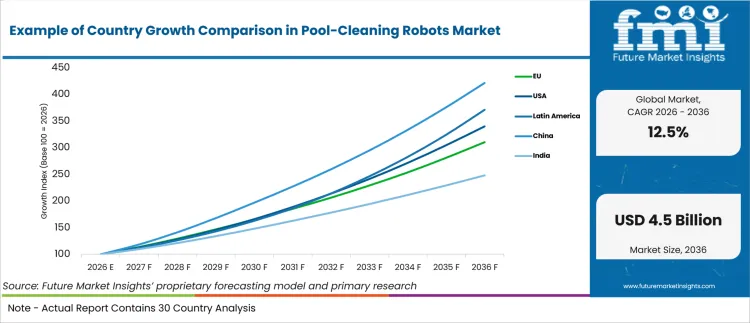
| Profiled Geography | CAGR |
|---|---|
| European Union | 12.0% |
| United States | 13.0% |
| Latin America | 14.0% |
Source: FMI's proprietary forecasting model and primary research
How do country-level CAGRs compare in the Pool-Cleaning Robots Market?
The country comparison spans 2.0 percentage points and highlights a compact growth pattern across the Pool Cleaning Robots Market. Latin America records the highest CAGR, while the United States and the European Union remain within a 1.0-point band below the regional leader. The narrow spread suggests that demand is rising across all three geographies, although each market is being shaped by different factors, including residential pool ownership, tourism infrastructure and adoption of smart home technologies.
- Latin America leads the comparison at 14.0% CAGR as expanding residential housing, increasing installation of private swimming pools and continued investment in hospitality and leisure facilities create favorable conditions for automated pool maintenance equipment.
- The United States follows 1.0 percentage point behind Latin America. High penetration of residential pools, growing preference for connected home devices and consumer demand for labor-saving cleaning solutions continue to support widespread adoption of robotic pool cleaners.
- The European Union records a CAGR of 12.0%, remaining 1.0 percentage point below the United States. Growth is encouraged by rising interest in energy-efficient household appliances, premium outdoor living spaces and automated maintenance technologies, although adoption rates vary across individual member states due to differences in climate and pool ownership.
Comparable CAGRs can still produce different market entry conditions. Differences in residential pool density, climate, consumer spending patterns, hospitality investments and smart home adoption influence commercialization opportunities and long-term market development. The full report provides country-level CAGR analysis across North America, Latin America, Europe, East Asia, South Asia, Oceania and the Middle East and Africa.
Country-wise Analysis
- Europe is expected to benefit from a mature pool‑equipment trade and a large installed base of existing cleaners, with the European Union projected to grow at a 12.0% CAGR from 2026 to 2036. Robot manufacturers are likely to leverage this established import and distribution channel if products meet local electrical standards and connected‑device support requirements. Distributor readiness to stock motors and common wear parts is expected to be critical during the short and highly seasonal summer service window across European markets.
- American households can compare many robot models through local pool stores and national online channels. Pool-cleaning robot demand in the United States is forecast to rise at 13.0% CAGR by 2036. World Bank WITS data show USA imports under HS 842121 totaled USD 2.148 billion in 2024; while this code includes wider water‑filtering machinery, it is anticipated to confirm the presence of a large and established import system relevant to robotic pool equipment. Brands must control landed cost and place warranty service close to the owner throughout the product life.
- Latin American growth depends on local stock and repair coverage across markets with different import costs. The region is estimated to post 14.0% CAGR from 2026 to 2036. World Bank WITS data accessed in July 2026 show Brazil’s 2024 imports under HS 842121 at USD 121.1 million, which, despite covering broader water‑filtering equipment, is projected to indicate an established import route for robotic pool cleaners. Cross‑border repair requirements are anticipated to erode the initial price advantage of lower‑cost units over time, increasing total ownership costs. Clear parts lists and battery terms reduce that financial risk during later ownership seasons for households. Brazil and Mexico offer practical starting points through existing pool equipment distribution channels across the region.
Who are the notable companies in the Pool-Cleaning Robots Market?
Maytronics, Fluidra through Zodiac, Hayward, Aiper, Beatbot, WYBOT, BWT, and Pentair are notable companies across specialist robotics and full-line pool equipment.
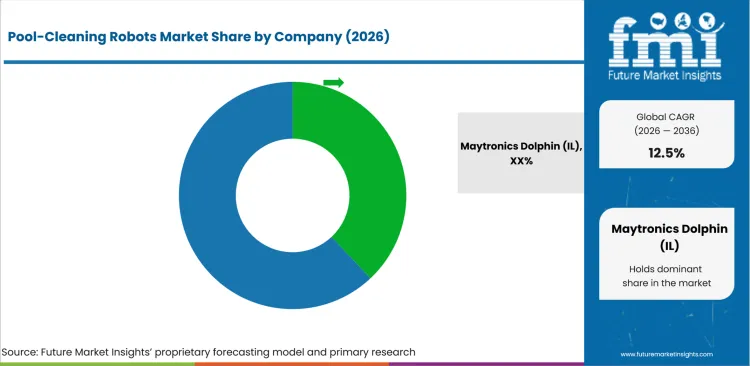
Competition divides between specialist robot makers and full-line pool equipment groups with established service networks. Maytronics brings residential and public-pool experience through the Dolphin range and its repair network worldwide. Fluidra's Zodiac brand and Hayward place cleaners beside pumps and controls in established service channels. BWT spans home and commercial units through established regional channels, and Aiper and Beatbot focus on cordless ranges with direct online promotion. WYBOT competes across several price levels, and Pentair adds connected pool controls through established dealers. Specialists can release new cordless features faster during active product cycles than large multi-category equipment groups. The household robot category shows a similar split between focused brands and larger equipment companies.
- Maytronics and Fluidra compete across home and public-pool cleaning through established international sales and service channels. Maytronics maintains a deeper specialist focus on robotic cleaning technology and dedicated service programs worldwide. Fluidra can place Zodiac units beside pumps and water-care products through a wider dealer network. Their advantage comes from service depth across major pool markets rather than direct online reach alone.
- Aiper and Beatbot compete through cordless home ranges supported by direct product launches and online promotion. Both brands use online sales to reach owners without relying on a local pool store. Their growth depends on clear battery terms and fast replacement support across major sales regions. A national online campaign loses value if returned units wait several weeks for basic service.
- Hayward and Pentair use established pool channels to place robots inside broader equipment plans for each property. BWT combines home and commercial cleaners with water-treatment experience across its established regional network worldwide. WYBOT competes through a wide cordless range offered at several price levels and feature sets. These companies need local parts and trained technicians to turn broad catalogues into lasting robot sales.
Competitive Benchmarking: Pool-Cleaning Robots Market
| Company | Residential Robot Breadth | Commercial Pool Coverage | Connected Control Evidence | Service Reach |
|---|---|---|---|---|
| Maytronics | High | High | High | Global |
| Fluidra through Zodiac | High | High | High | Global |
| Hayward | Medium | Medium | Medium | Global |
| Aiper | High | Low | Medium | North America, Europe and Asia |
| Beatbot | Medium | Low | High | North America, Europe and Asia |
| WYBOT | High | Low | High | North America, Europe and Asia |
| BWT | High | High | Medium | Europe and North America |
| Pentair | Medium | Medium | High | Global |
Scoring basis: High indicates broad direct capability supported by current products or operations. Medium indicates partial coverage and Low indicates limited direct evidence in that dimension.
Source: Future Market Insights competitive analysis, 2026. Ratings compare current portfolio evidence and service reach across the profiled companies.
Key Developments in the Pool-Cleaning Robots Market
- In May 2025, Fluidra acquired 100% of Pooltrackr and planned a global rollout of the service platform for pool professionals. Pooltrackr brings job records and site data into one system that technicians can use during field visits. The acquisition gives Fluidra a direct route to connect equipment sales with recurring service and customer records across multiple regions through one digital system.
- In March 2025, Beatbot opened sales for the three-model AquaSense 2 Series and announced a partnership with the United States SailGP Team. The range covered floor and wall cleaning with added waterline or surface functions on the higher models.
- In March 2025, Aiper announced a voluntary replacement program for about 32,660 Seagull Pro ZT6001 units sold in the United States. The notice followed reports of battery overheating and fire risk during charging under normal household ownership.
- In August 2025, Maytronics outlined a program to reduce its manufactured model range by 30% to 50% over three years. The company planned consolidated assembly and a new robot generation for gradual release during 2026.
Key Players in the Pool-Cleaning Robots Market
Established pool-equipment groups
- Fluidra through Zodiac
- Hayward
- Pentair
- BWT
Specialist robotic pool-cleaner manufacturers
- Maytronics
- Aiper
- Beatbot
- WYBOT
Pool-Cleaning Robots Market - Report Scope
| Report Attribute | Coverage |
|---|---|
| Market Breakdown | Product, Pool Type, Component, End User, Sales Channel, and Region |
| Quantitative Units | USD billion |
| Market Definition | Electric robotic cleaners that remove debris from pool floors and walls with limited manual control |
| Regions Covered | North America, Latin America, Europe, East Asia, South Asia and Pacific, Oceania, and Middle East and Africa |
| Geographies Profiled | European Union, United States, and Latin America |
| Key Companies Profiled | Maytronics, Fluidra through Zodiac, Hayward, Aiper, Beatbot, WYBOT, BWT, and Pentair |
| Approach | Demand-side review of pool use and cleaning routines combined with product portfolio analysis and geographic forecast reconciliation |
Source: Future Market Insights - analysis driven by proprietary forecasting models and primary research
Pool-Cleaning Robots Market - Research Methodology
| Method | Application |
|---|---|
| Primary Research | FMI analysts gathered input from manufacturers, service providers, technology developers, distributors, end users, sourcing teams, and subject-matter experts. Interviews examined purchasing decisions, product or service evaluation, adoption barriers, approval requirements, pricing considerations, and expectations for technical or commercial support. Respondents were also asked what evidence is required before a trial, pilot, or initial order develops into regular purchasing. |
| Desk Research | Desk research covered government statistics, regulatory publications, trade data, industry associations, technical literature, standards, company filings, product information, and official corporate announcements. Sources were reviewed for relevance, publication date, geographic coverage, and consistency with the defined market scope. Claims relating to performance, applications, approvals, capacity, investment, and commercial activity were retained only when supported by credible public evidence. |
| Market Sizing and Forecasting | The market model combined the baseline value with historical performance, segment structure, pricing and volume indicators, adoption levels, company participation, and country-level demand conditions. Forecast assumptions considered economic activity, investment trends, regulatory developments, technology adoption, purchasing cycles, supply availability, and barriers to wider market use. Segment and regional estimates were reconciled before the final market total was calculated. |
| Data Validation | Estimates were checked against multiple independent indicators, including public data, company activity, trade patterns, industry developments, and findings from primary interviews. Validation also tested whether products, services, applications, and company revenues fell within the defined market boundaries. Adjacent categories, unsupported claims, overlapping revenues, and activities without direct market relevance were excluded to reduce double counting and maintain consistency across segments and countries. |
Source: Future Market Insights (FMI) analysis, based on proprietary forecasting model and primary research
Pool-Cleaning Robots Market by Segments
Pool-Cleaning Robots Market segmented by Product:
- Cordless robotic cleaners
- Corded robotic cleaners
- Commercial-grade units
Pool-Cleaning Robots Market segmented by Pool Type:
- In-ground residential pools
- Above-ground pools
- Commercial pools
Pool-Cleaning Robots Market segmented by Component:
- Hardware
- Services and parts
- App and software
Pool-Cleaning Robots Market segmented by End User:
- Residential
- Hotels and resorts
- Public facilities
Pool-Cleaning Robots Market segmented by Sales Channel:
- Pool dealers
- Online
- Mass retail
Pool-Cleaning Robots Market by Region:
- North America
- United States
- Canada
- Latin America
- Brazil
- Mexico
- Argentina
- Europe
- Germany
- United Kingdom
- France
- Italy
- Spain
- East Asia
- China
- Japan
- South Korea
- South Asia and Pacific
- India
- Thailand
- Indonesia
- Oceania
- Australia
- New Zealand
- Middle East and Africa
- GCC countries
- South Africa
- Turkey
Research Sources and Bibliography
- Aiper. (2025, March 20). Aiper and CPSC announce the voluntary recall of the Aiper Seagull Pro.
- Beatbot. (2025, March 3). Beatbot announces USA SailGP partnership and AquaSense 2 Series sales launch.
- BWT. (2025, March). Essential ES Echo troubleshooting and replacement guide.
- European Commission. (2021, September 27). Radio Equipment Directive and cybersecurity requirements.
- Fluidra. (2025, April 1). Fluidra to invest in 27% of Aiper and form a strategic alliance.
- Fluidra. (2025, May 7). Fluidra accelerates digital strategy with acquisition of Pooltrackr.
- Hayward. (2025). Pool product warranty schedule.
- Maytronics. (2025, March 25). 2024 annual financial report.
- Maytronics. (2025, August 19). Second-quarter and first-half 2025 board report.
- Pool & Hot Tub Alliance. (2025, August 14). 2024 Business Operations Survey Report announcement.
- USA Consumer Product Safety Commission. (2025, March 20). Aiper Seagull Pro cordless robotic pool vacuum cleaners recalled.
- USA Customs and Border Protection. (2025, August 22). Ruling N352394: Cordless robotic pool cleaner.
- World Bank WITS. (n.d.). United States imports of HS 842121 during 2024.
- World Bank WITS. (n.d.). Brazil imports of HS 842121 during 2024.
- WYBOT. (n.d.). WYBOT at IFA 2025.
This bibliography is provided for reader reference and uses primary government, standards-body, official trade body, and company sources.
This Report Answers
- What market value is forecast for 2026 and 2036?
- What CAGR is projected from 2026 to 2036?
- Why do cordless robotic cleaners lead the Product category in 2026?
- How do in-ground residential pools differ from above-ground and commercial settings?
- What problems can reduce satisfaction across several pool seasons?
- How do the European Union and United States differ from Latin America?
- Which companies compete through full pool portfolios and which focus on robots?
- What should commercial pool operators review as they add robots to planned care?
- How do connected controls change support duties for manufacturers?
- Which recent company actions are changing cordless pool-cleaning competition?
Frequently Asked Questions
What is driving growth in the Pool-Cleaning Robots Market?
Owners are replacing repeated brushing and vacuuming with machines that follow a planned path across pool floors and walls. Cordless designs reduce setup and remove the power cable from routine deck work during each cleaning cycle.
Who are the key players in the Pool-Cleaning Robots Market?
Maytronics and Fluidra through Zodiac bring established pool-industry reach with repair networks across their main regions. Aiper and Beatbot focus on cordless ranges as WYBOT competes through frequent releases and wider price coverage.
What is a notable restraint in the Pool-Cleaning Robots Market?
Battery wear can reduce runtime even if the rest of a cordless robot remains usable across later seasons. Connected models need software support and warranty terms that remain clear throughout the expected product life.
Why should executives track the Pool-Cleaning Robots Market?
The forecast adds about USD 3.1 billion in market value between 2026 and 2036 across the global industry. Cordless specialists challenge established brands through faster releases and direct online sales that can change price expectations.
What business problem does the Pool-Cleaning Robots Market address?
The market replaces repeated floor brushing and debris removal with a machine that follows a planned cleaning path. A well-matched robot saves time without creating frequent recovery work or difficult filter handling during each cycle.
What should procurement leaders evaluate before selecting suppliers?
Evaluation should test floor coverage and wall climbing on the actual pool shape under normal debris conditions. The review should confirm parts access and repair time ahead of comparisons involving app controls or extra cleaning modes.
What limits return on investment for purchasers?
Return falls if the robot misses common debris or needs manual recovery during each cleaning cycle. Weak battery life and missing wear parts can turn automation into another maintenance problem across later seasons.
How do suppliers build long-term account confidence?
Published runtime and coverage claims build confidence if they match normal pool conditions during routine use. Consistent parts supply and clear repair decisions carry more value than features that do not improve cleaning.
Preview the report firsthand - request a free sample
Get SampleGet the brochure for pricing and purchase details.
Get PDFTable of Content
- Key Takeaways
- Market Size and CAGR
- Top Growth Driver
- Fastest Growing Segment
- Leading Region
- Key Companies
- Emerging Opportunities
- Executive Summary
- Global Market Outlook
- Demand-side Trends
- Supply-side Trends
- Technology Roadmap Analysis
- Analysis and Recommendations
- Analyst Perspective (What is happening? Why now? What should investors know?)
- Key Questions Answered
- How large is the market?
- What is the CAGR?
- What are key trends?
- Which region dominates?
- Who are the leaders?
- Market Overview
- Market Coverage / Taxonomy
- Market Definition / Scope / Limitations
- Research Methodology
- Chapter Orientation
- Analytical Lens and Working Hypotheses
- Market Structure, Signals, and Trend Drivers
- Benchmarking and Cross-market Comparability
- Market Sizing, Forecasting, and Opportunity Mapping
- Research Design and Evidence Framework
- Desk Research Programme (Secondary Evidence)
- Expert Input and Fieldwork (Primary Evidence)
- Tooling, Models, and Reference Databases
- Data Engineering and Model Build
- Quality Assurance and Audit Trail
- Market Background
- Market Dynamics (Drivers, Restraints, Opportunity, Trends)
- Scenario Forecast (Optimistic, Likely, Conservative)
- Impact Analysis
- AI Impact
- Sustainability Impact
- Regulatory Impact
- Technology Impact
- Consumer / Buyer Analysis
- Purchase Drivers
- Adoption Barriers
- Buyer Journey
- Opportunity Map Analysis
- Product Life Cycle Analysis
- Supply Chain Analysis
- Investment Feasibility Matrix
- Value Chain Analysis
- PESTLE and Porter's Analysis
- Regulatory Landscape
- Regional Parent Market Outlook
- Production and Consumption Statistics
- Import and Export Statistics
- Global Market Analysis and Forecast, 2021 to 2036
- Historical Market Size Value (USD Billion) Analysis, 2021 to 2025
- Current and Future Market Size Value (USD Billion) Projections, 2026 to 2036
- Y-o-Y Growth Trend Analysis
- Absolute $ Opportunity Analysis
- Global Market Pricing Analysis, 2021 to 2036
- Global Market Analysis and Forecast, By Product, 2021 to 2036
- Introduction / Key Findings
- Historical Market Size Value (USD Billion) Analysis By Product, 2021 to 2025
- Current and Future Market Size Value (USD Billion) Analysis and Forecast By Product, 2026 to 2036
- Cordless robotic cleaners
- Corded robotic cleaners
- Commercial-grade units
- Cordless robotic cleaners
- Y-o-Y Growth Trend Analysis By Product, 2021 to 2025
- Absolute $ Opportunity Analysis By Product, 2026 to 2036
- Global Market Analysis and Forecast, By Pool Type, 2021 to 2036
- Introduction / Key Findings
- Historical Market Size Value (USD Billion) Analysis By Pool Type, 2021 to 2025
- Current and Future Market Size Value (USD Billion) Analysis and Forecast By Pool Type, 2026 to 2036
- In-ground residential
- Above-ground
- Commercial pools
- In-ground residential
- Y-o-Y Growth Trend Analysis By Pool Type, 2021 to 2025
- Absolute $ Opportunity Analysis By Pool Type, 2026 to 2036
- Global Market Analysis and Forecast, By Component, 2021 to 2036
- Introduction / Key Findings
- Historical Market Size Value (USD Billion) Analysis By Component, 2021 to 2025
- Current and Future Market Size Value (USD Billion) Analysis and Forecast By Component, 2026 to 2036
- Hardware
- Services & parts
- App & software
- Hardware
- Y-o-Y Growth Trend Analysis By Component, 2021 to 2025
- Absolute $ Opportunity Analysis By Component, 2026 to 2036
- Global Market Analysis and Forecast, By End User, 2021 to 2036
- Introduction / Key Findings
- Historical Market Size Value (USD Billion) Analysis By End User, 2021 to 2025
- Current and Future Market Size Value (USD Billion) Analysis and Forecast By End User, 2026 to 2036
- Residential
- Hotels & resorts
- Public facilities
- Residential
- Y-o-Y Growth Trend Analysis By End User, 2021 to 2025
- Absolute $ Opportunity Analysis By End User, 2026 to 2036
- Global Market Analysis and Forecast, By Sales Channel, 2021 to 2036
- Introduction / Key Findings
- Historical Market Size Value (USD Billion) Analysis By Sales Channel, 2021 to 2025
- Current and Future Market Size Value (USD Billion) Analysis and Forecast By Sales Channel, 2026 to 2036
- Pool dealers
- Online
- Mass retail
- Pool dealers
- Y-o-Y Growth Trend Analysis By Sales Channel, 2021 to 2025
- Absolute $ Opportunity Analysis By Sales Channel, 2026 to 2036
- Global Market Analysis and Forecast, By Region, 2021 to 2036
- Introduction
- Historical Market Size Value (USD Billion) Analysis By Region, 2021 to 2025
- Current Market Size Value (USD Billion) Analysis and Forecast By Region, 2026 to 2036
- North America
- Latin America
- Western Europe
- Eastern Europe
- East Asia
- South Asia and Pacific
- Middle East & Africa
- Market Attractiveness Analysis By Region
- North America Market Analysis and Forecast, By Country, 2021 to 2036
- Historical Market Size Value (USD Billion) Trend Analysis By Market Taxonomy, 2021 to 2025
- Market Size Value (USD Billion) Forecast By Market Taxonomy, 2026 to 2036
- By Country
- USA
- Canada
- By Product
- By Pool Type
- By Component
- By End User
- By Sales Channel
- By Country
- Market Attractiveness Analysis
- By Country
- By Product
- By Pool Type
- By Component
- By End User
- By Sales Channel
- Key Takeaways
- Latin America Market Analysis and Forecast, By Country
- Historical Market Size Value (USD Billion) Trend Analysis By Market Taxonomy, 2021 to 2025
- Market Size Value (USD Billion) Forecast By Market Taxonomy, 2026 to 2036
- By Country
- Brazil
- Mexico
- Chile
- Rest of Latin America
- By Product
- By Pool Type
- By Component
- By End User
- By Sales Channel
- By Country
- Market Attractiveness Analysis
- By Country
- By Product
- By Pool Type
- By Component
- By End User
- By Sales Channel
- Key Takeaways
- Western Europe Market Analysis and Forecast, By Country
- Historical Market Size Value (USD Billion) Trend Analysis By Market Taxonomy, 2021 to 2025
- Market Size Value (USD Billion) Forecast By Market Taxonomy, 2026 to 2036
- By Country
- Germany
- UK
- Italy
- Spain
- France
- Nordic
- BENELUX
- Rest of Western Europe
- By Product
- By Pool Type
- By Component
- By End User
- By Sales Channel
- By Country
- Market Attractiveness Analysis
- By Country
- By Product
- By Pool Type
- By Component
- By End User
- By Sales Channel
- Key Takeaways
- Eastern Europe Market Analysis and Forecast, By Country
- Historical Market Size Value (USD Billion) Trend Analysis By Market Taxonomy, 2021 to 2025
- Market Size Value (USD Billion) Forecast By Market Taxonomy, 2026 to 2036
- By Country
- Russia
- Poland
- Hungary
- Balkan & Baltic
- Rest of Eastern Europe
- By Product
- By Pool Type
- By Component
- By End User
- By Sales Channel
- By Country
- Market Attractiveness Analysis
- By Country
- By Product
- By Pool Type
- By Component
- By End User
- By Sales Channel
- Key Takeaways
- East Asia Market Analysis and Forecast, By Country
- Historical Market Size Value (USD Billion) Trend Analysis By Market Taxonomy, 2021 to 2025
- Market Size Value (USD Billion) Forecast By Market Taxonomy, 2026 to 2036
- By Country
- China
- Japan
- South Korea
- By Product
- By Pool Type
- By Component
- By End User
- By Sales Channel
- By Country
- Market Attractiveness Analysis
- By Country
- By Product
- By Pool Type
- By Component
- By End User
- By Sales Channel
- Key Takeaways
- South Asia and Pacific Market Analysis and Forecast, By Country
- Historical Market Size Value (USD Billion) Trend Analysis By Market Taxonomy, 2021 to 2025
- Market Size Value (USD Billion) Forecast By Market Taxonomy, 2026 to 2036
- By Country
- India
- ASEAN
- Australia & New Zealand
- Rest of South Asia and Pacific
- By Product
- By Pool Type
- By Component
- By End User
- By Sales Channel
- By Country
- Market Attractiveness Analysis
- By Country
- By Product
- By Pool Type
- By Component
- By End User
- By Sales Channel
- Key Takeaways
- Middle East & Africa Market Analysis and Forecast, By Country
- Historical Market Size Value (USD Billion) Trend Analysis By Market Taxonomy, 2021 to 2025
- Market Size Value (USD Billion) Forecast By Market Taxonomy, 2026 to 2036
- By Country
- Kingdom of Saudi Arabia
- Other GCC Countries
- Türkiye
- South Africa
- Other African Union
- Rest of Middle East & Africa
- By Product
- By Pool Type
- By Component
- By End User
- By Sales Channel
- By Country
- Market Attractiveness Analysis
- By Country
- By Product
- By Pool Type
- By Component
- By End User
- By Sales Channel
- Key Takeaways
- Key Countries Market Analysis
- USA
- Pricing Analysis
- Market Share Analysis, 2025
- By Product
- By Pool Type
- By Component
- By End User
- By Sales Channel
- Canada
- Pricing Analysis
- Market Share Analysis, 2025
- By Product
- By Pool Type
- By Component
- By End User
- By Sales Channel
- Mexico
- Pricing Analysis
- Market Share Analysis, 2025
- By Product
- By Pool Type
- By Component
- By End User
- By Sales Channel
- Brazil
- Pricing Analysis
- Market Share Analysis, 2025
- By Product
- By Pool Type
- By Component
- By End User
- By Sales Channel
- Chile
- Pricing Analysis
- Market Share Analysis, 2025
- By Product
- By Pool Type
- By Component
- By End User
- By Sales Channel
- Germany
- Pricing Analysis
- Market Share Analysis, 2025
- By Product
- By Pool Type
- By Component
- By End User
- By Sales Channel
- UK
- Pricing Analysis
- Market Share Analysis, 2025
- By Product
- By Pool Type
- By Component
- By End User
- By Sales Channel
- Italy
- Pricing Analysis
- Market Share Analysis, 2025
- By Product
- By Pool Type
- By Component
- By End User
- By Sales Channel
- Spain
- Pricing Analysis
- Market Share Analysis, 2025
- By Product
- By Pool Type
- By Component
- By End User
- By Sales Channel
- France
- Pricing Analysis
- Market Share Analysis, 2025
- By Product
- By Pool Type
- By Component
- By End User
- By Sales Channel
- India
- Pricing Analysis
- Market Share Analysis, 2025
- By Product
- By Pool Type
- By Component
- By End User
- By Sales Channel
- ASEAN
- Pricing Analysis
- Market Share Analysis, 2025
- By Product
- By Pool Type
- By Component
- By End User
- By Sales Channel
- Australia & New Zealand
- Pricing Analysis
- Market Share Analysis, 2025
- By Product
- By Pool Type
- By Component
- By End User
- By Sales Channel
- China
- Pricing Analysis
- Market Share Analysis, 2025
- By Product
- By Pool Type
- By Component
- By End User
- By Sales Channel
- Japan
- Pricing Analysis
- Market Share Analysis, 2025
- By Product
- By Pool Type
- By Component
- By End User
- By Sales Channel
- South Korea
- Pricing Analysis
- Market Share Analysis, 2025
- By Product
- By Pool Type
- By Component
- By End User
- By Sales Channel
- Russia
- Pricing Analysis
- Market Share Analysis, 2025
- By Product
- By Pool Type
- By Component
- By End User
- By Sales Channel
- Poland
- Pricing Analysis
- Market Share Analysis, 2025
- By Product
- By Pool Type
- By Component
- By End User
- By Sales Channel
- Hungary
- Pricing Analysis
- Market Share Analysis, 2025
- By Product
- By Pool Type
- By Component
- By End User
- By Sales Channel
- Kingdom of Saudi Arabia
- Pricing Analysis
- Market Share Analysis, 2025
- By Product
- By Pool Type
- By Component
- By End User
- By Sales Channel
- Türkiye
- Pricing Analysis
- Market Share Analysis, 2025
- By Product
- By Pool Type
- By Component
- By End User
- By Sales Channel
- South Africa
- Pricing Analysis
- Market Share Analysis, 2025
- By Product
- By Pool Type
- By Component
- By End User
- By Sales Channel
- USA
- Market Structure Analysis
- Competition Dashboard
- Competition Benchmarking
- Market Share Analysis of Top Players
- By Regional
- By Product
- By Pool Type
- By Component
- By End User
- By Sales Channel
- Emerging Startups
- Innovation Benchmarking
- Competition Analysis
- Competition Deep Dive
- Maytronics Dolphin (IL)
- Overview
- Product Portfolio
- Profitability by Market Segments
- Sales Footprint
- Strategy Overview
- Marketing Strategy
- Product Strategy
- Channel Strategy
- Fluidra - Zodiac (ES)
- Hayward (US)
- Maytronics Dolphin (IL)
- Case Studies
- Success Stories
- Recent Developments
- Competition Deep Dive
- Assumptions & Acronyms Used


