

- Market Size (2026)
- USD 191.0 Mn
- Forecast (2036)
- USD 2168.0 Mn
- CAGR (2026 to 2036)
- 27.5%
How big is Base & Critical-Infrastructure Patrol Robots Market in 2026?
USD 191.0 million in 2026 and USD 2,168.0 million by 2036 at a 27.5% CAGR.
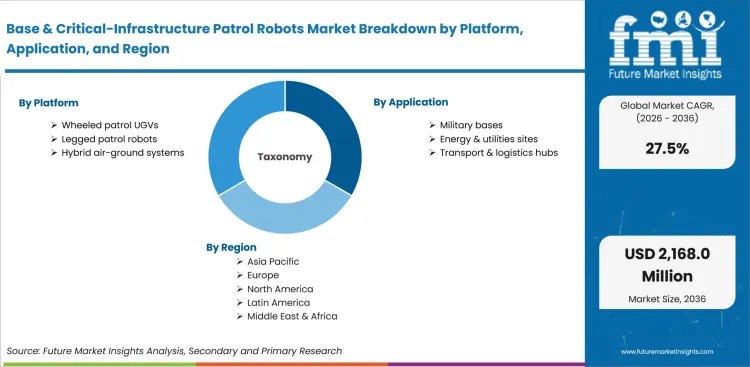
Demand for base and critical-infrastructure patrol robots is projected to grow at 27.5% CAGR from 2026 to 2036. Market value is estimated at USD 191.0 million in 2026 and USD 2,168.0 million by 2036. Military bases and infrastructure sites must inspect long perimeters during every shift, and staffing is often limited. Patrol robots repeat those routes and give staff time to review alerts and control the response. In June 2025, the United States Department of Defense requested USD 13.4 billion for autonomy and autonomous systems in fiscal 2026. The budget gives ground autonomy a place in funded programs which promote adoption of unmanned ground vehicles.
Projects in the United States and Europe begin with different operating needs, so their spending priorities differ. American operators often prioritize remote monitoring and dependable service coverage across several facilities in the same network. European operators commonly start with equipment inspection at energy or transport sites, then add security work to the same route. In both regions, results depend on choosing a machine that matches the route and operating conditions. Wheels suit roads and graded yards, whereas stairs or damaged surfaces need a different mobility design. In October 2025, Energy Robotics raised USD 13.5 million to expand autonomous inspection for critical infrastructure. The funding shows that mobile robots are gaining a wider role in routine site operations, where inspection robots can support both maintenance and security work along the same route.
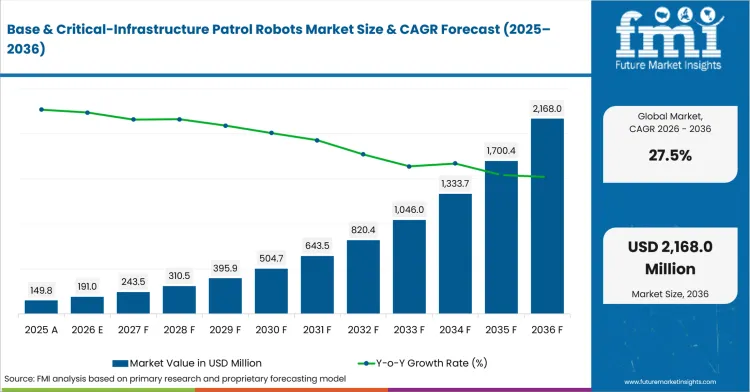
Key Takeaways of Base & Critical-Infrastructure Patrol Robots Market
- Demand for base and critical-infrastructure patrol robots is driven by the need to fill coverage gaps left by fixed cameras and scheduled guard rounds, giving security teams closer visibility into exposed areas while reducing repeated foot patrols.
- By component, hardware is expected to hold dominant share in 2026, as the mobile base and sensors carry much of the first project cost for customers.
- Wheeled patrol UGVs are the preferred platform on prepared routes, favored for simple mobility and lower service needs during repeated perimeter work.
- Legged robots are estimated to gain traction on broken ground and mixed-terrain routes where wheeled units cannot operate, justifying their higher cost.
- Integration with existing control-room tools remains a key adoption factor, as projects scale more smoothly when robot alerts appear inside software security teams already use each day.
- The United States, Europe, and South Korea are expected to follow distinct adoption paths, with the US driven by strong autonomous technology investment, Europe expanding from utility inspection into security roles, and South Korea benefiting from defense modernization programs.
- Competition centers on Ascento, Knightscope, ANYbotics, Boston Dynamics, SMP Robotics, Hyundai Rotem, Ghost Robotics, and Korial, with vendors differentiating through recurring service support, legged mobility for difficult terrain, and fleet software management across large sites.
Analyst Perspective
"The inspection quadruped market is being shaped by operational dependability rather than mobility specifications alone. Security teams and industrial operators are looking for robots that can complete patrols consistently across changing terrain and weather while integrating smoothly with existing incident response workflows. Suppliers that combine reliable autonomous navigation, actionable inspection data, and responsive lifecycle support are likely to strengthen customer confidence and expand deployments across critical infrastructure and industrial facilities."
- Nikhil Kaitwade, Principal Analyst at Future Market Insights
Source: FMI's proprietary forecasting model and primary research
How is the Base & Critical-Infrastructure Patrol Robots Market segmented?
The base & critical-infrastructure patrol robots industry is segmented by platform, application, component, end user, business model, and region.
The report analyzes the base & critical-infrastructure patrol robots market across six key segments. By platform, the market is categorized into wheeled, legged, and hybrid air-ground robotic systems designed to operate across roads, stairways, and diverse terrain conditions. The application segment distinguishes deployments at military bases from those in energy, utility, transportation, and logistics facilities, each characterized by unique security and monitoring requirements.
Based on components, the market is segmented into hardware, autonomy and video management system (VMS) software, and service offerings that support deployment and lifecycle management. The end-user segment includes armed forces, critical infrastructure operators, and security integrators responsible for procuring, deploying, or supporting these solutions. By business model, the market is assessed across Robotics-as-a-Service (RaaS), direct ownership, and managed security service contracts, reflecting varying operational and investment preferences.
How does wheeled patrol mobility shape demand within the platform category?
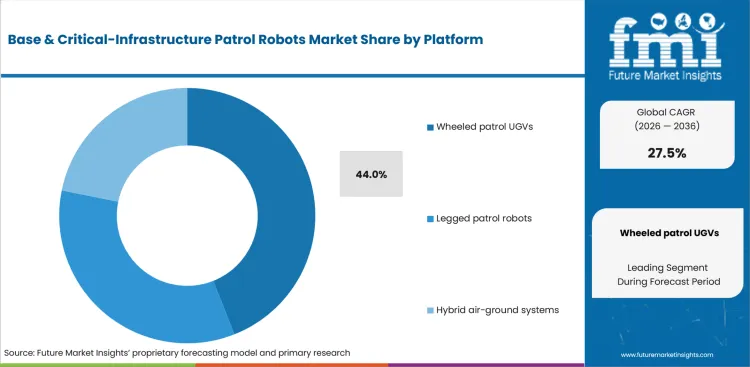
Many patrol routes follow roads, fence lines, and open yards around military or industrial facilities. Simple drive systems give wheeled robots stable movement on prepared ground and reduce maintenance needs during long rounds. Stairs and broken ground require a mobility design that crosses uneven parts of the assigned route. A full site survey should guide the first platform decision and expose areas that need a different machine. Camera quality becomes relevant once the robot completes its route without frequent stops or manual recovery.
- By platform, wheeled patrol UGVs are projected to hold 44.0% share of the platform category in 2026. Their advantage is practical: many facilities already have paved or graded perimeter routes around large protected sites. In February 2025, SMP Robotics presented updated Argus S5 functions at ISC West in Las Vegas. The presentation highlighted how wheeled systems add stronger sensing without losing the simple mobility needed for long outdoor rounds.
- Prepared routes and limited maintenance budgets often favor wheeled robots over more complex mobility designs. Simpler drive parts reduce service needs and make repetitive outdoor rounds easier to maintain over time. Once the machine proves reliable mobility, camera quality and alert accuracy become the next points of comparison, especially as robotic vision systems help operators judge image quality and event detection during routine security work.
What supports demand for military bases within the application category?
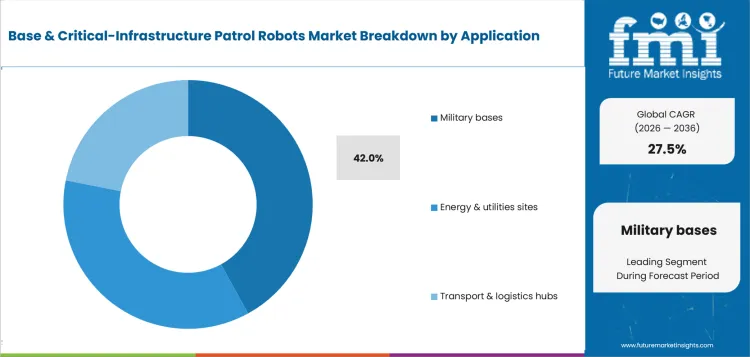
Military bases often include long fence lines and restricted areas that guards cannot watch continuously. Patrol robots repeat assigned rounds and give personnel an earlier view of unusual activity across exposed areas. Trained staff judge every alert and decide whether an event requires a physical response on site. The project fits more easily into daily operations if the machine follows existing command procedures and leaves responsibility with the people already in charge.
- Military bases are expected to lead the application category with 42.0% share in 2026. Constant perimeter duties and restricted areas create a clear use case for autonomous patrol across military installations. In September 2025, Ghost Robotics described an Air Force base project that used a quadruped on steep terrain. The case shows why bases should match mobility to the route and treat cameras as a later decision.
- Armed forces use unmanned systems to inspect uncertain areas from a safer distance and preserve human judgment. The same principle applies to micro tactical ground robots used for close observation in smaller operating areas. A patrol robot earns support by giving personnel a useful first view of risk without removing human control. The machine should improve the decision process and leave final action with the people responsible for security.
How is hardware positioned within the component category?
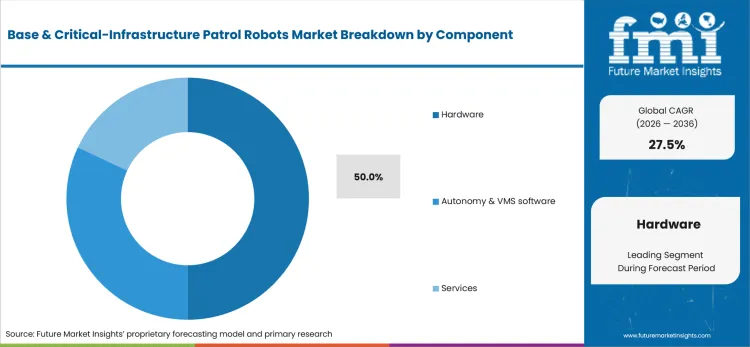
Hardware carries most of the initial project cost, mainly for the mobile base and its sensors. Mobility and sensors determine whether the planned route works under normal traffic and weather conditions. Software becomes more valuable as the fleet grows and alerts must enter existing security tools. Service quality also affects uptime and determines how quickly technical problems are resolved during daily use. The first purchase centers on the machine, but long-term value depends on how well the full system fits normal security work.
- In 2026, hardware is forecast to represent 50.0% share in 2026, reflecting the cost of the machine and its sensors. In May 2025, Boston Dynamics added image analysis features in Orbit for pictures collected by Spot. The release shows how software turns routine patrol images into findings that staff review and use.
- Facilities that operate several robots across multiple routes need shared software and dependable service support. A common view of routes and alerts reduces manual review and sends each event to the right response process. Hardware gets the machine onto the route, but software determines whether the fleet becomes part of routine work. A weak link with existing tools leaves the project isolated and creates extra review work for security staff.
How do armed forces evaluate patrol robots within the end-user category?
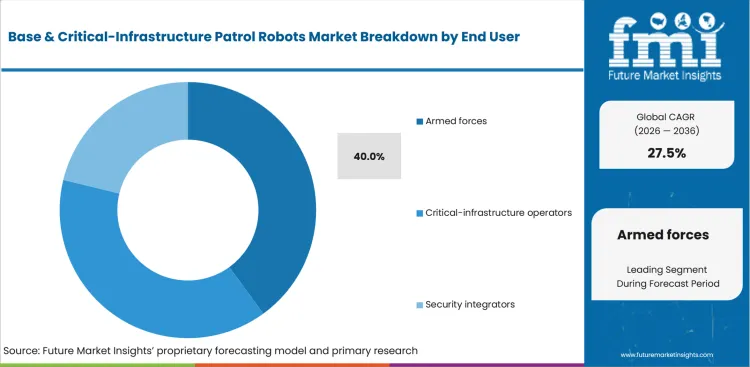
Defense users test patrol robots under field conditions that expose weak navigation and unstable communications. A short demonstration does not prove dependable performance in bad weather or crowded radio conditions. Military reviews also examine secure control, safe recovery, and field support throughout the full operating test. An equipment failure stops a scheduled patrol and creates another task for personnel during a security shift. The same technical limits affect energy and transport sites, so military testing shapes expectations in civilian projects.
- Armed forces are estimated to hold 40.0% share of the end-user category in 2026. Funded unmanned programs and constant perimeter duties support that share across military security budgets and operations. In April 2025, Knightscope explained how its K5 patrols and returns to its charger without human help. The example shows why programs should prove dependable routine behavior first and add demanding security tasks later.
- Military organizations need systems that recover from weak communications and resume a planned route with limited help. Tests should cover navigation, charging, and recovery under normal site traffic during a full operating shift. Field support deserves the same attention as extra sensors during any long-term decision about a larger fleet.
What drives robotics as a service within the business model category?
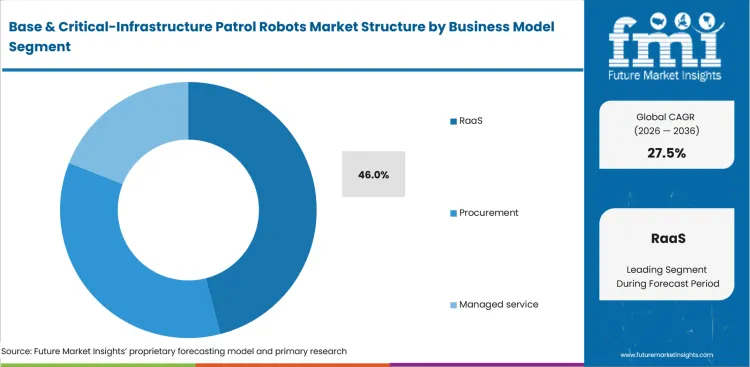
A recurring service contract turns the purchase into an operating cost that includes maintenance and software support. This model suits organizations that want a pilot but do not employ robotics specialists on their own staff. Payment depends on machine availability, so the provider carries more performance risk throughout the service period.
- Robotics as a service is projected to hold 46.0% share of the business model category in 2026. Lower starting costs and included support make the model easier to test across one route or facility. In April 2025, Knightscope described an annual subscription covering the robot and software updates. Technical support was included in the same plan, giving organizations a predictable operating cost without an internal repair team.
- Smaller security departments often prefer a service contract that covers updates, repairs, and charging equipment. A robotics-as-a-service model helps compare recurring support terms with direct purchase and managed security contracts, showing how service agreements shape operating costs throughout the contract period.
What are the drivers, restraints, and opportunities in the Base & Critical-infrastructure Patrol Robots Market?
Patrol automation is expected to ease staffing pressure across long routes, although poor route fit is anticipated to slow adoption and combined inspection work is projected to strengthen the investment case.
- Driver: Long perimeter routes are expected to increase demand for robots that repeat scheduled checks and send unusual events to trained staff.
- Restraint: Poor terrain fit and weak links with existing security tools are anticipated to reduce savings from an otherwise successful pilot.
- Opportunity: Combined security and equipment inspection are projected to support wider investment in patrol robots across protected facilities.
Long perimeter routes create a staffing problem that requires more than installing a machine at the site. Repetitive patrols can be assigned to autonomous systems so experienced personnel remain available for investigations and incident response. ASIS International reported in August 2025 that robots are well suited to repetitive perimeter patrols and continuous monitoring. Human personnel remain necessary for interpretation and response decisions that require judgment.
Terrain compatibility remains a major restraint because stairs and damaged surfaces can interrupt autonomous patrol routes. Wheeled robots may struggle with uneven ground while legged systems often require significantly higher investment and maintenance spending. Facilities must therefore assess route conditions before selecting a platform for continuous perimeter coverage. Onboard cameras also create privacy and cybersecurity concerns because routine patrols may record employees or sensitive equipment.
One of the significant opportunities in the market is the ability to combine security monitoring with equipment inspection and maintenance activities on a single robotic route. This allows operators to generate greater value from each deployment while reducing the need for separate inspection rounds. Thermal cameras can identify unusual temperature patterns, while visual systems document perimeter conditions and equipment status during routine patrols.
Which country CAGRs are profiled in the Base & Critical-Infrastructure Patrol Robots Market?
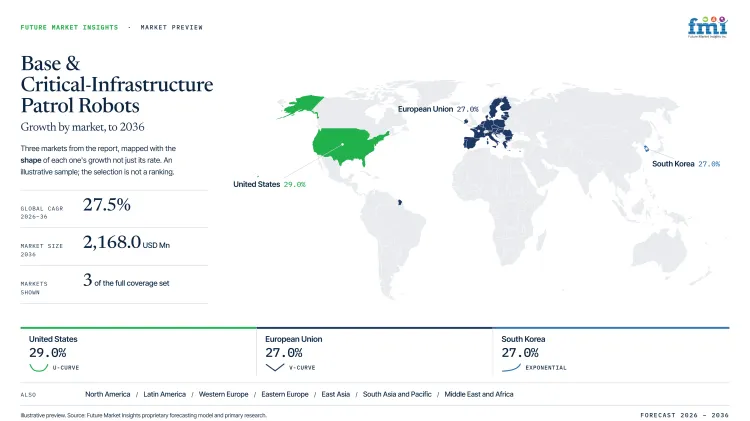
| Country | CAGR |
|---|---|
| United States | 29.0% |
| European Union | 27.0% |
| South Korea | 27.0% |
Source: FMI's proprietary forecasting model and primary research
How do country-level CAGRs compare in the Base & Critical-Infrastructure Patrol Robots Market?
The country comparison spans 2.0 percentage points and reflects a tightly grouped growth outlook across the Base & Critical Infrastructure Patrol Robots Market. The United States leads at 29.0% CAGR, while the European Union and South Korea share the same growth rate at 27.0%. The narrow spread suggests that all three markets are expanding rapidly as operators strengthen autonomous security capabilities for military bases, energy facilities, transport infrastructure and other high-value assets.
- The United States records the highest CAGR at 29.0% as defense agencies and critical infrastructure operators continue expanding the use of autonomous ground patrol robots for perimeter surveillance, threat detection and continuous monitoring across military installations, airports and strategic facilities.
- The European Union posts a CAGR of 27.0%, remaining 2.0 percentage points below the United States. Growth is supported by increasing investment in infrastructure protection, border security and automated surveillance technologies, while deployment rates vary across member states according to national security priorities and modernization programs.
- South Korea also registers a CAGR of 27.0%, matching the European Union. Continued investment in smart defense systems, protection of industrial complexes and security automation across critical infrastructure is encouraging wider deployment of autonomous patrol robots capable of operating in complex environments with limited human intervention.
Comparable CAGRs can still produce different market entry conditions. Differences in defense modernization programs, infrastructure security requirements, regulatory frameworks and investment in autonomous robotic technologies influence deployment strategies and long-term commercial opportunities. The full report provides country-level CAGR analysis across North America, Latin America, Europe, East Asia, South Asia, Oceania and the Middle East and Africa.
Country-wise Analysis
Country growth depends on two practical conditions: funded autonomy programs and dependable local service during routine operations In the United States, strong federal funding and an established remote security market make it easier to expand deployments. In Europe, many projects start with asset inspection or transport monitoring and then add security functions over time. South Korea benefits from experience with unmanned military vehicles, which helps build confidence in autonomous ground systems. National security budgets for homeland security continue to support equipment purchases and long-term service programs for protected assets.
- Federal autonomy programs give US-based developers a direct route from technical trials into funded operations across several facilities. Demand in the United States is forecast to rise at 29.0% CAGR from 2026 to 2036. In June 2025, the United States Department of Defense identified USD 210 million for autonomous ground vehicles in its fiscal 2026 request. The amount covers a broader group of systems, and it confirms direct federal spending on ground autonomy. Large programs need strong cyber controls and dependable field support across several locations in the same network. The outlook depends on repeated service performance across several sites, not one successful demonstration at a single location.
- European projects often begin with equipment inspection and later add security duties to the same route. The European Union outlook is anticipated to advance at 27.0% CAGR from 2026 to 2036. In April 2026, NATO reported that European Allies and Canada invested more than USD 574 billion in defense during 2025 at adjusted prices. Spending rose 20% from the previous year and confirms a large regional budget for security equipment and research. Direct links with existing incident and maintenance tools make wider rollout easier across several facilities.
- South Korea brings military vehicle engineering into a market that demands dependable movement around protected facilities. Adoption is estimated to expand at 27.0% CAGR across the 2026 to 2036 forecast period. In April 2026, SIPRI placed South Korean military spending at USD 47.8 billion in 2025, equal to 2.6% of national GDP. That sustained level of commitment points to continued capacity for defense modernization. Hyundai Rotem displayed the HR-SHERPA multipurpose unmanned ground vehicle at MADEX 2025 in Busan, held from 28 to 31 May, in a configuration refined on the basis of operational feedback from military users.
Who are the notable companies in the Base & Critical-Infrastructure Patrol Robots Market?
Ascento, Knightscope, SMP Robotics, Hyundai Rotem, ANYbotics, Boston Dynamics, Ghost Robotics, and Korial are the notable companies shaping this market.
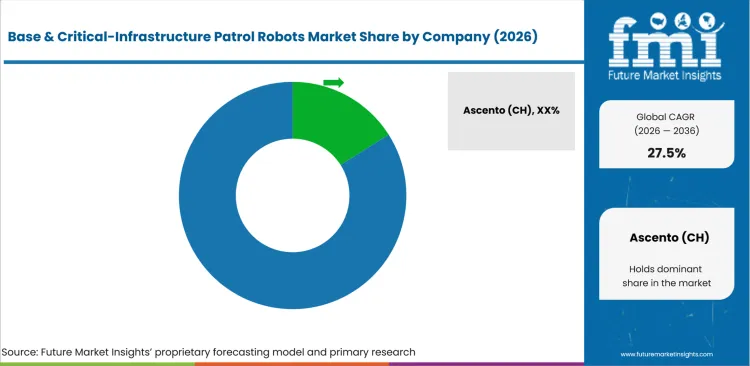
The competitive field includes outdoor security specialists, industrial inspection companies, and defense engineering groups with different strengths. Security specialists compete on dependable patrols and remote response; industrial robotics companies compete on sensing and maintenance software. Defense engineering groups bring rugged mobility and secure control experience from demanding field operations at military sites. The real test is reliable maintenance and a clear path from each alert to the response process. Cameras and monitoring tools from the wider security and surveillance equipment market provide the systems that receive those alerts.
- Ascento and Knightscope sell outdoor patrol as a service, although their machines follow different designs. Ascento uses a compact all-terrain robot backed by full-service support and links with existing video systems. Knightscope combines autonomous machines with remote monitoring and subscriptions for sites that prefer a managed security service. Both strategies respond to organizations that want a dependable security result instead of a one-time equipment sale.
- SMP Robotics serves commercial routes with a wheeled design built for long outdoor patrols and prepared ground. Hyundai Rotem and Ghost Robotics bring military experience to rough terrain and higher-risk missions around protected facilities. The contrast shows why mobility design follows the route and operating risk, not one broad definition of a patrol robot.
- ANYbotics and Boston Dynamics compete in projects combining industrial inspection with security patrols at one facility. Their legged machines reach stairs and uneven areas that stop many wheeled units during a scheduled route. Mobile cameras extend coverage beyond fixed views around large sites, linking patrol robots with the broader video surveillance workflow used by security teams. The value comes from better access and clearer evidence for action, not from an impressive demonstration.
- Korial's position comes from fleet software that works across several robot and drone types used at industrial sites. The system manages inspection programs that use different machines for routes with different terrain and sensor needs. One control view reduces training needs and helps each facility use the right machine without rebuilding its operating process.
Competitive Benchmarking: Base & Critical-Infrastructure Patrol Robots Market
| Company | Outdoor patrol | Industrial inspection | Fleet software and remote oversight | Service reach |
|---|---|---|---|---|
| Ascento | High | Low | High | Europe / Regional |
| Knightscope | High | Low | High | United States / Country-specific |
| SMP Robotics | High | Medium | Medium | Global |
| Hyundai Rotem | Medium | Low | Low | South Korea / Country-specific |
| ANYbotics | Medium | High | High | Global |
| Boston Dynamics | High | High | High | Global |
| Korial | Low | High | High | Global |
| Ghost Robotics | High | Medium | Low | United States / Country-specific |
Scoring basis: High indicates clear and substantial capability in the stated area; Medium indicates partial or partner-supported capability; Low indicates limited direct evidence.
Source: Future Market Insights competitive analysis, 2026. Ratings reflect relative portfolio relevance and workflow fit. Service capability and geographic reach shape the remaining comparison.
Key Developments in the Base & Critical-Infrastructure Patrol Robots Market
- In January 2026, Boston Dynamics added security patrol missions to its Orbit facilities software for Spot. The robot detects a person and captures visual or thermal images for an alert, then resumes its route. This function lets one machine support equipment inspection and off-hours security in the same area.
- In November 2025, Knightscope opened early access for its K7 autonomous security robot under a broader managed security plan. The company plans to connect K7 and K5 units with fixed sensors and remote operations. This model brings mobile patrol and stationary detection into one service for the entire site.
- In March 2026, SMP Robotics began shipping the Argus S5.4 with NVIDIA Jetson Orin NX computing and support for third-party software. The added computing power lets security teams run local video analysis and other site-specific tasks on the robot.
- In May 2026, Energy Robotics adopted the Korial name to reflect its wider software role across robots and drones at large industrial sites. Existing customer programs continued under the new brand, which reduced disruption and preserved familiar support during the transition.
Key Players in the Base & Critical-Infrastructure Patrol Robots Market
Outdoor security patrol specialists
- Ascento
- Knightscope
- SMP Robotics
Agile inspection and patrol platforms
- ANYbotics
- Boston Dynamics
Defense mobility and fleet software providers
- Hyundai Rotem
- Ghost Robotics
- Korial
Base & Critical-Infrastructure Patrol Robots Market - Report Scope
| Coverage field | Report scope |
|---|---|
| Market breakdown | Platform, application, component, end user, business model, and region |
| Quantitative Units | Revenue in USD Million, CAGR in %, and segment share in % |
| Market Definition | Mobile ground robots used for autonomous or remotely supervised patrol around military bases and critical-infrastructure sites. |
| Regions Covered | North America, Latin America, Western Europe, Eastern Europe, East Asia, South Asia and Pacific, Middle East and Africa |
| Countries Covered | United States, European Union member states, South Korea, and 20+ additional countries |
| Key Companies Profiled | Ascento, Knightscope, SMP Robotics, Hyundai Rotem, ANYbotics, Boston Dynamics, Ghost Robotics, and Korial |
| Forecast Period | 2026 to 2036 |
| Approach | Hybrid market sizing using bottom-up company evidence and top-down spending checks |
Source: Future Market Insights - analysis driven by proprietary forecasting models and primary research
Base & Critical-Infrastructure Patrol Robots Market - Research Methodology
| Method | Approach |
|---|---|
| Primary Research | FMI analysts gathered input from manufacturers, service providers, technology developers, distributors, end users, procurement teams, and subject-matter experts. Interviews examined purchasing decisions, product or service evaluation, adoption barriers, approval requirements, pricing considerations, and expectations for technical or commercial support. Respondents were also asked what evidence is required before a trial, pilot, or initial order develops into regular purchasing. |
| Desk Research | Desk research covered government statistics, regulatory publications, trade data, industry associations, technical literature, standards, company filings, product information, and official corporate announcements. Sources were reviewed for relevance, publication date, geographic coverage, and consistency with the defined market scope. Claims relating to performance, applications, approvals, capacity, investment, and commercial activity were retained only when supported by credible public evidence. |
| Market Sizing and Forecasting | The market model combined the baseline value with historical performance, segment structure, pricing and volume indicators, adoption levels, company participation, and country-level demand conditions. Forecast assumptions considered economic activity, investment trends, regulatory developments, technology adoption, purchasing cycles, supply availability, and barriers to wider market use. Segment and regional estimates were reconciled before the final market total was calculated. |
| Data Validation | Estimates were checked against multiple independent indicators, including public data, company activity, trade patterns, industry developments, and findings from primary interviews. Validation also tested whether products, services, applications, and company revenues fell within the defined market boundaries. Adjacent categories, unsupported claims, overlapping revenues, and activities without direct market relevance were excluded to reduce double counting and maintain consistency across segments and countries. |
Source: Future Market Insights (FMI) analysis, based on proprietary forecasting model and primary research
Base & Critical-Infrastructure Patrol Robots Market by Segments
Base & Critical-Infrastructure Patrol Robots Market segmented by Platform:
- Wheeled patrol UGVs
- Legged patrol robots
- Hybrid air-ground systems
Base & Critical-Infrastructure Patrol Robots Market segmented by Application:
- Military bases
- Energy and utilities sites
- Transport and logistics hubs
Base & Critical-Infrastructure Patrol Robots Market segmented by Component:
- Hardware
- Autonomy and VMS software
- Services
Base & Critical-Infrastructure Patrol Robots Market segmented by End User:
- Armed forces
- Critical-infrastructure operators
- Security integrators
Base & Critical-Infrastructure Patrol Robots Market segmented by Business Model:
- Robotics as a service
- Direct procurement
- Managed security service
Base & Critical-Infrastructure Patrol Robots Market by Region:
- North America
- United States
- Canada
- Latin America
- Brazil
- Mexico
- Rest of Latin America
- Western Europe
- Germany
- France
- United Kingdom
- Italy
- Spain
- Nordics
- Benelux
- Rest of Western Europe
- Eastern Europe
- Poland
- Russia
- Rest of Eastern Europe
- East Asia
- China
- Japan
- South Korea
- South Asia and Pacific
- India
- ASEAN
- Australia and New Zealand
- Rest of South Asia and Pacific
- Middle East and Africa
- Gulf Cooperation Council countries
- South Africa
- Türkiye
- Rest of Middle East and Africa
Research Sources and Bibliography
- USA Department of Defense. (2025, June 26). Background briefing on FY 2026 defense budget. USA Department of Defense.
- North Atlantic Treaty Organization. (2026, April 8). Funding NATO. NATO.
- Stockholm International Peace Research Institute. (2026, April). Trends in world military expenditure, 2025. SIPRI.
- ANYbotics. (2025, June 23). Equinor deploys ANYmal at Northern Lights CCS facility. ANYbotics.
- Boston Dynamics. (2025, May 16). See your facility like never before. Boston Dynamics.
- Boston Dynamics. (2026, January 16). A new perspective for facilities inspection. Boston Dynamics.
- Korial. (2025, October 7). Energy Robotics closes $13.5M Series A funding. Korial.
- Korial. (2026, April 30). Korial & CNIAS: Autonomous inspection partnership. Korial.
- Korial. (2026, May 4). Energy Robotics rebrands as Korial. Korial.
- Knightscope. (2025, April 15). How the K5 robot patrols without human help. Knightscope.
- Knightscope. (2025, April 21). A smarter way to secure your property. Knightscope.
- Knightscope. (2025, November). Knightscope launches the Autonomous Security Force. Knightscope.
- SMP Robotics. (2025, February 28). Security robots at ISC West 2025. SMP Robotics.
- SMP Robotics. (2026, March 2). Argus S5.4 with NVIDIA Jetson Orin and third-party AI software. SMP Robotics.
- Ascento. (2026). Secure assets with Robotics and AI. Ascento.
- Hyundai Rotem. (2025, May 21). 현대로템, 국제해양방위산업전 'MADEX' 참가 [Hyundai Rotem participates in MADEX 2025]. Hyundai Rotem.
- Ghost Robotics. (2025, September 23). Autonomous Robots for Mountainous Terrain. Ghost Robotics.
This bibliography is provided for reader reference and uses official government, multilateral, and company sources.
This Report Answers
- What is the market value in 2026, and what valuation is forecast for 2036?
- What CAGR is projected across the 2026 to 2036 forecast period?
- Which platform and application segments shape demand across protected sites?
- Which staffing and safety pressures support autonomous patrol programs?
- Why do forecast CAGRs differ across the United States, the European Union, and South Korea?
- Which companies compete on outdoor patrol, industrial inspection, and fleet control?
- How does FMI validate market size, segment shares, and country forecasts?
- What should security leaders resolve before expanding from one route to a larger fleet?
- How do data rules and system integration affect company selection?
Frequently Asked Questions
What is driving growth in the Base & Critical-Infrastructure Patrol Robots Market?
Growth reflects the need for regular perimeter checks during nights and other lightly staffed periods. Robots extend visibility across exposed routes and let trained staff focus on events that require human judgment.
Who are the key players in the Base & Critical-Infrastructure Patrol Robots Market?
Ascento and Knightscope provide managed outdoor patrol with remote monitoring and technical support. ANYbotics and Boston Dynamics compete on difficult-route mobility and inspection; Korial manages mixed robot fleets through one control system.
What is a notable restraint in the Base & Critical-Infrastructure Patrol Robots Market?
A patrol robot loses value if its mobility does not fit the assigned route and terrain. Weak links with existing security software turn a successful pilot into an isolated system that creates more work.
Why should executives track the Base & Critical-Infrastructure Patrol Robots Market?
The market shows how mobile automation is entering daily security work at military bases and critical-infrastructure sites. The same evidence shows which projects combine security duties with inspection and safety work under one operating plan.
What business problem does the Base & Critical-Infrastructure Patrol Robots Market address?
Patrol robots reduce the time experienced staff spend on long and predictable rounds across protected sites. They provide an earlier view of exposed routes and leave every response decision under human control.
What should procurement leaders evaluate before selecting suppliers?
Teams should test the full route and define how each alert enters the response process. Service coverage and data control deserve equal attention during a larger fleet decision involving several routes or facilities.
What limits return on investment for purchasers?
Poor route design creates frequent stops and manual recovery work during normal patrol rounds across the site. Returns fall further if the robot collects information that no responsible group reviews or uses.
How do suppliers build long-term account confidence?
Companies build trust by proving steady route uptime and clear service response throughout the contract period. Useful links with existing security tools create more value than extra features that slow decisions.
Preview the report firsthand - request a free sample
Get SampleGet the brochure for pricing and purchase details.
Get PDFTable of Content
- Key Takeaways
- Market Size and CAGR
- Top Growth Driver
- Fastest Growing Segment
- Leading Region
- Key Companies
- Emerging Opportunities
- Executive Summary
- Global Market Outlook
- Demand-side Trends
- Supply-side Trends
- Technology Roadmap Analysis
- Analysis and Recommendations
- Analyst Perspective (What is happening? Why now? What should investors know?)
- Key Questions Answered
- How large is the market?
- What is the CAGR?
- What are key trends?
- Which region dominates?
- Who are the leaders?
- Market Overview
- Market Coverage / Taxonomy
- Market Definition / Scope / Limitations
- Research Methodology
- Chapter Orientation
- Analytical Lens and Working Hypotheses
- Market Structure, Signals, and Trend Drivers
- Benchmarking and Cross-market Comparability
- Market Sizing, Forecasting, and Opportunity Mapping
- Research Design and Evidence Framework
- Desk Research Programme (Secondary Evidence)
- Expert Input and Fieldwork (Primary Evidence)
- Tooling, Models, and Reference Databases
- Data Engineering and Model Build
- Quality Assurance and Audit Trail
- Market Background
- Market Dynamics (Drivers, Restraints, Opportunity, Trends)
- Scenario Forecast (Optimistic, Likely, Conservative)
- Impact Analysis
- AI Impact
- Sustainability Impact
- Regulatory Impact
- Technology Impact
- Consumer / Buyer Analysis
- Purchase Drivers
- Adoption Barriers
- Buyer Journey
- Opportunity Map Analysis
- Product Life Cycle Analysis
- Supply Chain Analysis
- Investment Feasibility Matrix
- Value Chain Analysis
- PESTLE and Porter's Analysis
- Regulatory Landscape
- Regional Parent Market Outlook
- Production and Consumption Statistics
- Import and Export Statistics
- Global Market Analysis and Forecast, 2021 to 2036
- Historical Market Size Value (USD Million) Analysis, 2021 to 2025
- Current and Future Market Size Value (USD Million) Projections, 2026 to 2036
- Y-o-Y Growth Trend Analysis
- Absolute $ Opportunity Analysis
- Global Market Pricing Analysis, 2021 to 2036
- Global Market Analysis and Forecast, By Platform, 2021 to 2036
- Introduction / Key Findings
- Historical Market Size Value (USD Million) Analysis By Platform, 2021 to 2025
- Current and Future Market Size Value (USD Million) Analysis and Forecast By Platform, 2026 to 2036
- Wheeled patrol UGVs
- Legged patrol robots
- Hybrid air-ground systems
- Wheeled patrol UGVs
- Y-o-Y Growth Trend Analysis By Platform, 2021 to 2025
- Absolute $ Opportunity Analysis By Platform, 2026 to 2036
- Global Market Analysis and Forecast, By Application, 2021 to 2036
- Introduction / Key Findings
- Historical Market Size Value (USD Million) Analysis By Application, 2021 to 2025
- Current and Future Market Size Value (USD Million) Analysis and Forecast By Application, 2026 to 2036
- Military bases
- Energy & utilities sites
- Transport & logistics hubs
- Military bases
- Y-o-Y Growth Trend Analysis By Application, 2021 to 2025
- Absolute $ Opportunity Analysis By Application, 2026 to 2036
- Global Market Analysis and Forecast, By Component, 2021 to 2036
- Introduction / Key Findings
- Historical Market Size Value (USD Million) Analysis By Component, 2021 to 2025
- Current and Future Market Size Value (USD Million) Analysis and Forecast By Component, 2026 to 2036
- Hardware
- Autonomy & VMS software
- Services
- Hardware
- Y-o-Y Growth Trend Analysis By Component, 2021 to 2025
- Absolute $ Opportunity Analysis By Component, 2026 to 2036
- Global Market Analysis and Forecast, By End User, 2021 to 2036
- Introduction / Key Findings
- Historical Market Size Value (USD Million) Analysis By End User, 2021 to 2025
- Current and Future Market Size Value (USD Million) Analysis and Forecast By End User, 2026 to 2036
- Armed forces
- Critical-infrastructure operators
- Security integrators
- Armed forces
- Y-o-Y Growth Trend Analysis By End User, 2021 to 2025
- Absolute $ Opportunity Analysis By End User, 2026 to 2036
- Global Market Analysis and Forecast, By Business Model, 2021 to 2036
- Introduction / Key Findings
- Historical Market Size Value (USD Million) Analysis By Business Model, 2021 to 2025
- Current and Future Market Size Value (USD Million) Analysis and Forecast By Business Model, 2026 to 2036
- RaaS
- Procurement
- Managed service
- RaaS
- Y-o-Y Growth Trend Analysis By Business Model, 2021 to 2025
- Absolute $ Opportunity Analysis By Business Model, 2026 to 2036
- Global Market Analysis and Forecast, By Region, 2021 to 2036
- Introduction
- Historical Market Size Value (USD Million) Analysis By Region, 2021 to 2025
- Current Market Size Value (USD Million) Analysis and Forecast By Region, 2026 to 2036
- North America
- Latin America
- Western Europe
- Eastern Europe
- East Asia
- South Asia and Pacific
- Middle East & Africa
- Market Attractiveness Analysis By Region
- North America Market Analysis and Forecast, By Country, 2021 to 2036
- Historical Market Size Value (USD Million) Trend Analysis By Market Taxonomy, 2021 to 2025
- Market Size Value (USD Million) Forecast By Market Taxonomy, 2026 to 2036
- By Country
- USA
- Canada
- By Platform
- By Application
- By Component
- By End User
- By Business Model
- By Country
- Market Attractiveness Analysis
- By Country
- By Platform
- By Application
- By Component
- By End User
- By Business Model
- Key Takeaways
- Latin America Market Analysis and Forecast, By Country
- Historical Market Size Value (USD Million) Trend Analysis By Market Taxonomy, 2021 to 2025
- Market Size Value (USD Million) Forecast By Market Taxonomy, 2026 to 2036
- By Country
- Brazil
- Mexico
- Chile
- Rest of Latin America
- By Platform
- By Application
- By Component
- By End User
- By Business Model
- By Country
- Market Attractiveness Analysis
- By Country
- By Platform
- By Application
- By Component
- By End User
- By Business Model
- Key Takeaways
- Western Europe Market Analysis and Forecast, By Country
- Historical Market Size Value (USD Million) Trend Analysis By Market Taxonomy, 2021 to 2025
- Market Size Value (USD Million) Forecast By Market Taxonomy, 2026 to 2036
- By Country
- Germany
- UK
- Italy
- Spain
- France
- Nordic
- BENELUX
- Rest of Western Europe
- By Platform
- By Application
- By Component
- By End User
- By Business Model
- By Country
- Market Attractiveness Analysis
- By Country
- By Platform
- By Application
- By Component
- By End User
- By Business Model
- Key Takeaways
- Eastern Europe Market Analysis and Forecast, By Country
- Historical Market Size Value (USD Million) Trend Analysis By Market Taxonomy, 2021 to 2025
- Market Size Value (USD Million) Forecast By Market Taxonomy, 2026 to 2036
- By Country
- Russia
- Poland
- Hungary
- Balkan & Baltic
- Rest of Eastern Europe
- By Platform
- By Application
- By Component
- By End User
- By Business Model
- By Country
- Market Attractiveness Analysis
- By Country
- By Platform
- By Application
- By Component
- By End User
- By Business Model
- Key Takeaways
- East Asia Market Analysis and Forecast, By Country
- Historical Market Size Value (USD Million) Trend Analysis By Market Taxonomy, 2021 to 2025
- Market Size Value (USD Million) Forecast By Market Taxonomy, 2026 to 2036
- By Country
- China
- Japan
- South Korea
- By Platform
- By Application
- By Component
- By End User
- By Business Model
- By Country
- Market Attractiveness Analysis
- By Country
- By Platform
- By Application
- By Component
- By End User
- By Business Model
- Key Takeaways
- South Asia and Pacific Market Analysis and Forecast, By Country
- Historical Market Size Value (USD Million) Trend Analysis By Market Taxonomy, 2021 to 2025
- Market Size Value (USD Million) Forecast By Market Taxonomy, 2026 to 2036
- By Country
- India
- ASEAN
- Australia & New Zealand
- Rest of South Asia and Pacific
- By Platform
- By Application
- By Component
- By End User
- By Business Model
- By Country
- Market Attractiveness Analysis
- By Country
- By Platform
- By Application
- By Component
- By End User
- By Business Model
- Key Takeaways
- Middle East & Africa Market Analysis and Forecast, By Country
- Historical Market Size Value (USD Million) Trend Analysis By Market Taxonomy, 2021 to 2025
- Market Size Value (USD Million) Forecast By Market Taxonomy, 2026 to 2036
- By Country
- Kingdom of Saudi Arabia
- Other GCC Countries
- Türkiye
- South Africa
- Other African Union
- Rest of Middle East & Africa
- By Platform
- By Application
- By Component
- By End User
- By Business Model
- By Country
- Market Attractiveness Analysis
- By Country
- By Platform
- By Application
- By Component
- By End User
- By Business Model
- Key Takeaways
- Key Countries Market Analysis
- USA
- Pricing Analysis
- Market Share Analysis, 2025
- By Platform
- By Application
- By Component
- By End User
- By Business Model
- Canada
- Pricing Analysis
- Market Share Analysis, 2025
- By Platform
- By Application
- By Component
- By End User
- By Business Model
- Mexico
- Pricing Analysis
- Market Share Analysis, 2025
- By Platform
- By Application
- By Component
- By End User
- By Business Model
- Brazil
- Pricing Analysis
- Market Share Analysis, 2025
- By Platform
- By Application
- By Component
- By End User
- By Business Model
- Chile
- Pricing Analysis
- Market Share Analysis, 2025
- By Platform
- By Application
- By Component
- By End User
- By Business Model
- Germany
- Pricing Analysis
- Market Share Analysis, 2025
- By Platform
- By Application
- By Component
- By End User
- By Business Model
- UK
- Pricing Analysis
- Market Share Analysis, 2025
- By Platform
- By Application
- By Component
- By End User
- By Business Model
- Italy
- Pricing Analysis
- Market Share Analysis, 2025
- By Platform
- By Application
- By Component
- By End User
- By Business Model
- Spain
- Pricing Analysis
- Market Share Analysis, 2025
- By Platform
- By Application
- By Component
- By End User
- By Business Model
- France
- Pricing Analysis
- Market Share Analysis, 2025
- By Platform
- By Application
- By Component
- By End User
- By Business Model
- India
- Pricing Analysis
- Market Share Analysis, 2025
- By Platform
- By Application
- By Component
- By End User
- By Business Model
- ASEAN
- Pricing Analysis
- Market Share Analysis, 2025
- By Platform
- By Application
- By Component
- By End User
- By Business Model
- Australia & New Zealand
- Pricing Analysis
- Market Share Analysis, 2025
- By Platform
- By Application
- By Component
- By End User
- By Business Model
- China
- Pricing Analysis
- Market Share Analysis, 2025
- By Platform
- By Application
- By Component
- By End User
- By Business Model
- Japan
- Pricing Analysis
- Market Share Analysis, 2025
- By Platform
- By Application
- By Component
- By End User
- By Business Model
- South Korea
- Pricing Analysis
- Market Share Analysis, 2025
- By Platform
- By Application
- By Component
- By End User
- By Business Model
- Russia
- Pricing Analysis
- Market Share Analysis, 2025
- By Platform
- By Application
- By Component
- By End User
- By Business Model
- Poland
- Pricing Analysis
- Market Share Analysis, 2025
- By Platform
- By Application
- By Component
- By End User
- By Business Model
- Hungary
- Pricing Analysis
- Market Share Analysis, 2025
- By Platform
- By Application
- By Component
- By End User
- By Business Model
- Kingdom of Saudi Arabia
- Pricing Analysis
- Market Share Analysis, 2025
- By Platform
- By Application
- By Component
- By End User
- By Business Model
- Türkiye
- Pricing Analysis
- Market Share Analysis, 2025
- By Platform
- By Application
- By Component
- By End User
- By Business Model
- South Africa
- Pricing Analysis
- Market Share Analysis, 2025
- By Platform
- By Application
- By Component
- By End User
- By Business Model
- USA
- Market Structure Analysis
- Competition Dashboard
- Competition Benchmarking
- Market Share Analysis of Top Players
- By Regional
- By Platform
- By Application
- By Component
- By End User
- By Business Model
- Emerging Startups
- Innovation Benchmarking
- Competition Analysis
- Competition Deep Dive
- Ascento (CH)
- Overview
- Product Portfolio
- Profitability by Market Segments
- Sales Footprint
- Strategy Overview
- Marketing Strategy
- Product Strategy
- Channel Strategy
- Knightscope (US)
- Hyundai Rotem (KR)
- SMP Robotics (US)
- Ascento (CH)
- Case Studies
- Success Stories
- Recent Developments
- Competition Deep Dive
- Assumptions & Acronyms Used


