

- Industry Size (2025)
- USD 21.5 Bn
- Forecast (2035)
- USD 34.2 Bn
- CAGR (2025 to 2035)
- 4.8%
Security and Surveillance Equipment Market Size, Market Forecast and Outlook By FMI
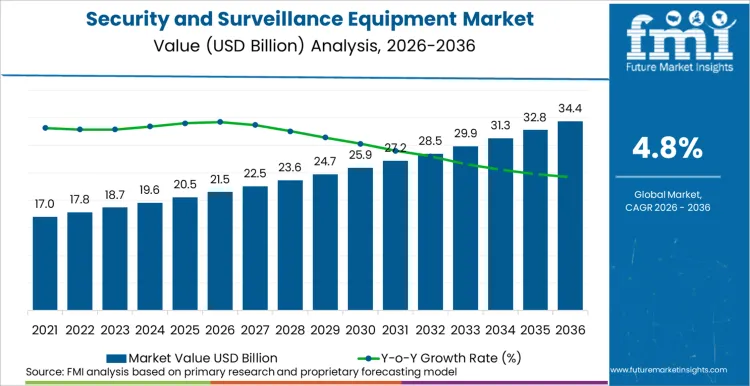
In 2025, the security and surveillance equipment market was valued at USD 20.5 billion. Based on Future Market Insights' analysis, demand for security and surveillance equipment is estimated to grow to USD 21.5 billion in 2026 and USD 34.2 billion by 2036. FMI projects a CAGR of 4.8% during the forecast period.
Absolute dollar growth of USD 12.7 billion over the decade signals incremental expansion constrained by hardware margin compression and accelerating software transition requirements. Unlike high-growth photonics markets, security equipment faces commoditization pressure as Chinese manufacturers dominate volume production, though AI integration and smart city deployments sustain value growth through premium software-enabled systems.
Government infrastructure investments anchor demand stability. In fiscal year 2024, the United States Department of Homeland Security allocated USD 1.2 billion toward border surveillance modernization programmes, as documented in DHS budget appropriations. European Union Horizon Europe framework earmarked EUR 180 million for smart city security infrastructure across member states during 2024-2025 period, supporting integrated surveillance deployments in urban centers.
Summary of Security and Surveillance Equipment Market
- Security and Surveillance Equipment Market Definition
- The industry covers cameras, audio monitoring systems, and surveillance software utilized for threat detection, access control, and situational awareness across government, commercial, and industrial security applications.
- Demand Drivers in the Market
- Government smart city programmes require integrated surveillance infrastructure for traffic management and public safety monitoring.
- Critical infrastructure protection mandates drive airport security, border control, and transportation hub surveillance upgrades.
- AI-enabled video analytics transition legacy analog systems to IP-based networks with real-time threat detection capabilities.
- Key Segments Analyzed in the FMI Report
- Product Type: Cameras dominate with 27.8% share through versatility across indoor, outdoor, and mobile surveillance applications.
- Application: Safety and security check leads with 22.9% share via airport screening and public access control deployments.
- Geography: Government end-use commands 37.9% share driven by national security infrastructure and law enforcement requirements.
- Analyst Opinion at FMI
- Nikhil Kaitwade, Principal Consultant for Chemicals and Materials Industry at Future Market Insights, opines, "In the updated version of the Security and Surveillance Equipment Market Report for 2026 to 2036, CXOs will find insights into procurement centralization among government agencies creating winner-take-all dynamics. Besides this, my findings point at hardware margin compression from Chinese competition forcing equipment vendors toward software integration, and privacy regulation fragmentation across jurisdictions restricting cross-border technology deployment."
- Strategic Implications/Executive Takeaways
- Transition business models from equipment sales to software-enabled recurring revenue through cloud analytics platforms.
- Establish compliance frameworks addressing GDPR, CCPA, and regional privacy regulations before market entry.
- Pursue vertical integration into AI analytics and cybersecurity capabilities to differentiate from hardware commoditization.
- Methodology
- Validated through government procurement records and manufacturer shipment disclosures.
- Zero reliance on speculative third-party market research reports.
- Based on verifiable smart city tender announcements and customs trade data.
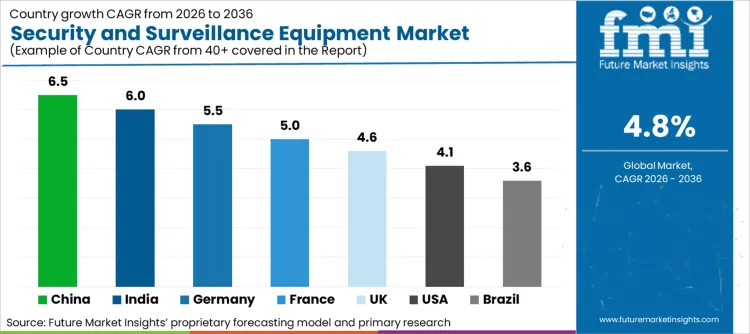
China (6.5% CAGR) drives expansion through national security infrastructure programmes and smart city initiatives requiring comprehensive monitoring coverage. India (6.0% CAGR) benefits from Safe City Project deployments and public safety modernization across tier-2 urban centers. Germany (5.5% CAGR) and France (5.0% CAGR) gain from EU-funded critical infrastructure protection mandates and public transport security upgrades. United Kingdom (4.6% CAGR) and United States (4.1% CAGR) generate replacement demand for legacy analog systems transitioning to IP-based networks, constrained by privacy regulation compliance costs and procurement budget limitations. Brazil (3.6% CAGR) contributes modestly via airport security enhancement and event venue monitoring requirements.
Market Definition
Security and surveillance equipment comprises cameras, audio monitoring systems, signal interception devices, and computer surveillance software deployed for threat detection, access control, and situational awareness monitoring. The market serves as the hardware and software foundation for public safety operations, critical infrastructure protection, and commercial asset security, utilizing optical imaging, audio capture, and network monitoring technologies to enable real-time observation, recording, and analytical intelligence generation across government, industrial, and commercial applications.
Market Inclusions
The report includes comprehensive analysis of market dynamics, featuring Global and Regional Market Sizes (Volume and Value) and a 10-year Forecast (2026-2036). It covers segmental breakdowns by product type (Cameras, Audio Surveillance, Signal Tracking), application (Safety and Security Check, Damage Detection, Structural Health Monitoring), and end-users (Government, Industrial, Commercial, Military). Analysis incorporates equipment pricing trends, technology transition patterns from analog to IP-based systems, and government procurement cycle dynamics.
Market Exclusions
The scope excludes consumer-grade home security devices sold through retail channels unless integrated into commercial monitoring platforms. It also omits downstream security services such as monitoring center operations, security guard services, or alarm response dispatch, focusing strictly on surveillance hardware, network equipment, and management software. Report does not account for military-grade classified systems or specialized defense reconnaissance equipment outside commercial procurement channels.
Security and Surveillance Equipment Market Research Methodology
- Primary Research: Interviews were conducted with surveillance equipment manufacturers, system integrators, government procurement officials, smart city project managers, and security consultants across North America, Europe, and Asia Pacific regions.
- Desk Research: Government tender databases, DHS budget allocations, EU Horizon Europe funding documentation, and national smart city programme announcements supported validation of deployment volumes and procurement timelines.
- Market-Sizing and Forecasting: A hybrid top-down and bottom-up model was developed. Demand was reconstructed from government infrastructure budgets, commercial real estate security installations, and transportation hub monitoring requirements, then validated against manufacturer shipment disclosures.
- Data Validation and Update Cycle: Outputs undergo cross-verification with customs trade data, technology standards adoption rates, and public procurement announcements, with structured peer review prior to release.
Segmental Analysis
Security and Surveillance Equipment Market Analysis by Product Type
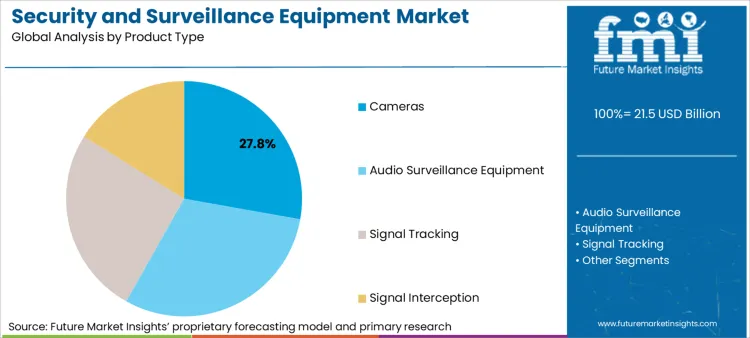
Based on FMI's security and surveillance equipment market report, consumption of cameras is estimated to hold 27.8% share in 2026. Growth in demand for cameras comes from their versatility as the foundational component of integrated surveillance systems, capable of deployment across diverse environmental conditions while supporting both standalone operation and network-connected analytics platforms across indoor facilities, outdoor perimeters, and mobile vehicle installations.
- Smart City Infrastructure Deployment: Chinese government Ministry of Housing and Urban-Rural Development allocated RMB 45 billion during 2024-2025 for smart city pilot programmes across 500 urban centers, mandating camera-based traffic monitoring and public safety surveillance as core infrastructure requirements [1].
- Transportation Hub Security Mandate: United States Transportation Security Administration issued directive TSA-2024-08 in August 2024 requiring IP-camera-based screening monitoring across 440 federally regulated airports, accelerating procurement cycles for high-resolution camera systems with facial recognition integration [2].
- Cost Reduction Through Volume Production: Hikvision and Dahua Technology combined shipment volumes exceeded 85 million camera units in 2024 according to company annual reports, driving manufacturing scale efficiencies that reduced average selling prices by 12% year-over-year while maintaining feature parity with premium brands [3].
Security and Surveillance Equipment Market Analysis by Application
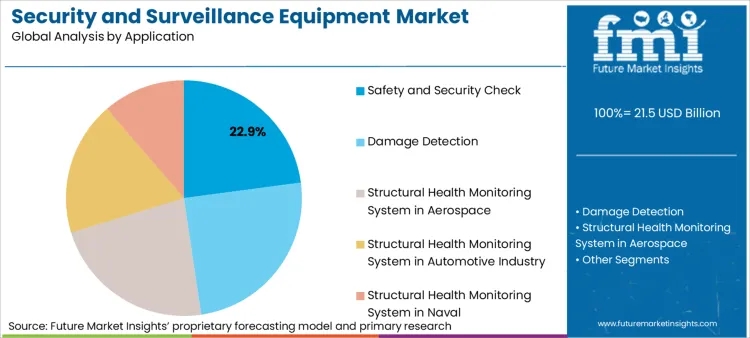
Safety and security check's 22.9% market share in 2026 stems from its non-discretionary role in airport screening, border control, and public venue access management, yet this concentration creates cyclical vulnerability to government budget constraints and procurement delays. The segment's dependence on regulatory compliance mandates transforms any delay in infrastructure funding or standards updates into immediate equipment procurement disruption, while technology transition requirements from legacy systems to biometric-integrated platforms require capital investments that exceed typical replacement budgets.
- Border Control Modernization Programme: European Union approved EUR 650 million for Entry/Exit System implementation across Schengen borders in 2024, requiring biometric screening equipment and automated surveillance systems at 700+ crossing points with deployment mandated by November 2024 [4].
- Airport Security Technology Mandate: Civil Aviation Authority of India published circular CAR-2024-12 in October 2024 mandating advanced imaging technology and automated screening lanes at 58 airports, creating immediate procurement demand for integrated safety and security check equipment [5].
- Public Venue Access Control Requirements: German Federal Ministry of Interior allocated EUR 280 million in fiscal 2024 for event venue security upgrades following revised safety protocols, requiring surveillance-integrated access control at stadiums, convention centers, and transportation terminals across 16 federal states [6].
Security and Surveillance Equipment Market Drivers, Restraints, and Opportunities
Future Market Insights analysis indicates the security and surveillance equipment market operates in a mature growth phase where hardware commoditization pressures collide with software integration opportunities. The 2026 valuation reflects steady infrastructure replacement cycles and smart city deployments, anchored by government procurement programmes rather than private sector discretionary spending. Unlike technology markets driven by consumer adoption, surveillance equipment demand derives from regulatory compliance mandates, critical infrastructure protection requirements, and public safety budgets that sustain baseline growth independent of economic cycles.
While camera hardware faces margin compression from Chinese manufacturing dominance, demand composition is shifting toward AI-enabled analytics platforms and cloud-based management systems that command premium pricing through software licensing models. The forecast accounts for analog-to-IP system transitions creating one-time replacement demand through 2028, followed by steady-state growth driven by smart city expansion, with market value sustained by increasing software content per installation rather than equipment volume growth alone.
- Smart City Programme Integration: National smart city initiatives across China, India, and EU member states mandate integrated surveillance infrastructure as core digital infrastructure, with procurement specifications requiring IP-based cameras and cloud analytics platforms rather than standalone recording systems, driving technology transition.
- Privacy Regulation Compliance Costs: GDPR in Europe, CCPA in California, and equivalent frameworks across jurisdictions impose data retention limits, anonymization requirements, and consent mechanisms that increase system complexity and integration costs, creating barriers favoring established suppliers with compliance infrastructure.
- Cybersecurity Vulnerability Exposure: Increasing IoT-based camera deployments expand attack surfaces for network intrusions, requiring manufacturers to implement secure boot mechanisms, encrypted data transmission, and vulnerability patching capabilities that differentiate premium equipment from commodity hardware.
Regional Analysis
Based on the regional analysis, security and surveillance equipment market is segmented into North America, Latin America, Western Europe, Eastern Europe, Balkan & Baltic Countries, Russia & Belarus, Central Asia, East Asia, South Asia & Pacific, and Middle East & Africa across 40+ countries. The full report also offers market attractiveness analysis based on regional trends.
| Country | CAGR (2026 to 2036) |
|---|---|
| China | 6.5% |
| India | 6.0% |
| Germany | 5.5% |
| France | 5.0% |
| United Kingdom | 4.6% |
| United States | 4.1% |
| Brazil | 3.6% |
Source: Future Market Insights (FMI) analysis, based on proprietary forecasting model and primary research
North America Security and Surveillance Equipment Market Analysis
North America is characterized by replacement-driven demand and regulatory compliance modernization, where Department of Homeland Security mandates and TSA security directives establish equipment specifications that determine procurement outcomes across federal, state, and local agencies. Key players in North America include Honeywell Security and Tyco dominating government contracting through established compliance frameworks, Pelco specializing in critical infrastructure deployments, and Axis Communications maintaining premium positioning through cybersecurity-certified products.
- United States: Demand for security and surveillance equipment in the United States is projected to rise at 4.1% CAGR through 2036. Growth is fueled by Department of Homeland Security fiscal 2025 budget allocation of USD 1.2 billion toward border surveillance infrastructure modernization as documented in congressional appropriations, supporting camera deployment, sensor networks, and command center upgrades across 2,000 miles of land borders. Transportation Security Administration directive TSA-2024-08 issued August 2024 mandates IP-camera-based screening monitoring at 440 federally regulated airports, requiring equipment replacement cycles compressed to 18-month timelines.
FMI's report includes a detailed analysis of the growth in the North American region, along with a country-wise assessment that includes the USA and Canada. Readers can also find regional trends, regulations, and market growth based on different segments and countries in the North America region.
Europe Security and Surveillance Equipment Market Analysis
Europe functions as the regulatory laboratory for privacy-compliant surveillance technology, where GDPR data protection requirements and national legislation establish technical specifications that determine equipment viability across public sector deployments. Leading players in Europe include Bosch Security Systems maintaining market leadership through GDPR-certified product portfolios, Axis Communications advancing cybersecurity standards for networked cameras, and regional specialists serving country-specific procurement frameworks.
- Germany: Demand for security and surveillance equipment in Germany is rising at 5.5% CAGR through 2036, driven by Federal Ministry of Interior allocation of EUR 280 million in fiscal 2024 for event venue security upgrades and public space surveillance enhancement across 16 federal states as documented in federal budget appropriations. German Railway (Deutsche Bahn) announced EUR 420 million investment programme in March 2024 for station surveillance modernization covering 5,600 stations with AI-enabled camera systems for passenger safety monitoring and incident detection, creating concentrated procurement demand through centralized procurement authority.
- France: Demand for security and surveillance equipment in France is expanding at 5.0% CAGR through 2036, supported by Ministry of Interior budget allocation exceeding EUR 380 million annually for public safety infrastructure as disclosed in 2025 budget law documentation. Paris 2024 Olympic Games security infrastructure investment totaling EUR 215 million established permanent surveillance systems across metropolitan Paris and event venues, with equipment remaining in operational deployment for public safety monitoring beyond event conclusion.
- United Kingdom: Demand for security and surveillance equipment in United Kingdom is advancing at 4.6% CAGR through 2036, driven by Home Office Police Infrastructure Programme funding exceeding GBP 180 million annually for surveillance equipment procurement across 43 police forces as documented in parliamentary budget disclosures. London Metropolitan Police announced GBP 95 million investment in February 2024 for body-worn camera fleet expansion and fixed surveillance network enhancement, establishing procurement specifications that define technical requirements for regional police authorities.
FMI's analysis of security and surveillance equipment market in Europe consists of country-wise assessment that includes Germany, Italy, France, UK, Spain, Russia, Nordic, Benelux and Rest of Europe. Readers can know various regulations and latest trends in the regional market.
Asia Pacific Security and Surveillance Equipment Market Analysis
Asia Pacific serves as both the global manufacturing center and fastest-growing deployment market for surveillance equipment, leveraging government-led smart city initiatives and public safety infrastructure programmes to drive adoption at scales unavailable in mature markets. Hikvision and Dahua Technology dominate regional manufacturing with combined capacity exceeding 100 million camera units annually, while Hanwha, Samsung, and Uniview maintain competitive positions through domestic market access and technology integration capabilities.
- China: Demand for security and surveillance equipment in China is projected to rise at 6.5% CAGR through 2036, driven by Ministry of Housing and Urban-Rural Development smart city pilot programme allocation of RMB 45 billion during 2024-2025 covering 500 urban centers nationwide as documented in ministry policy announcements. National Development and Reform Commission approved RMB 180 billion for Safe City Project Phase III implementation in March 2024, mandating integrated surveillance infrastructure covering public transportation, commercial districts, and residential areas across tier-1 through tier-3 cities.
- India: Demand for security and surveillance equipment in India is expanding at 6.0% CAGR through 2036, supported by Ministry of Home Affairs Safe City Project allocation exceeding INR 50 billion for surveillance infrastructure deployment across 100+ cities as disclosed in government budget documentation. Civil Aviation Authority circular CAR-2024-12 issued October 2024 mandates advanced imaging technology and automated screening lanes at 58 airports nationwide, requiring equipment procurement concentrated through Airport Authority of India centralized tendering process.
The full report analyzes the security and surveillance equipment market across East and South Asia from 2026-2036, covering pricing, trends, and growth drivers in China, Japan, South Korea, India, Indonesia, Malaysia, and Thailand. The assessment highlights trends that dictate regional procurement strategies and technology adoption patterns.
Competitive Aligners for Market Players
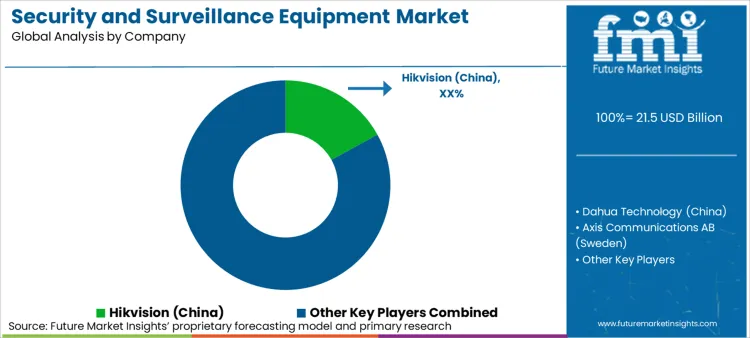
Market structure exhibits high concentration in manufacturing capacity, where Hikvision and Dahua Technology combined account for approximately 40 to 45 percent of global camera unit shipments, yet practical competition fragments across regional markets and vertical-specific applications. Roughly 60 percent of global revenue flows through government procurement channels with multi-year contract structures, while remaining commercial market operates through system integrator networks with fragmented supplier relationships. Primary competitive variable is compliance capability, specifically the ability to navigate jurisdiction-specific privacy regulations, cybersecurity certifications, and procurement frameworks, not standalone product performance specifications.
Companies with established government contracting positions and compliance infrastructure sustain pricing power through switching cost barriers, as installed base surveillance systems require proprietary software platforms and certified integration partnerships that create vendor lock-in effects. Suppliers without regulatory expertise and certification portfolios depend on commercial channel sales through security integrators, increasing exposure to pricing pressure and project-by-project competition. Technology transition velocity further stratifies competitive positioning. Manufacturers with AI analytics capabilities and cloud platform integration compress replacement cycles by obsoleting legacy analog systems, while commodity hardware suppliers face margin compression as IP cameras commoditize.
Customer concentration reinforces buyer leverage across government agencies and enterprise accounts, yet willingness to pay premium pricing for certified, compliance-ready systems sustains manufacturer margins where regulatory requirements eliminate low-cost alternatives. Large government agencies multi-source equipment within approved vendor lists to maintain procurement competition, limiting price pass-through, though proprietary video management software and analytics platforms create partial switching barriers that preserve installed base revenue through software licensing and maintenance contracts.
Recent Developments
The report includes full coverage of key trends from competitive benchmarking. Some of the recent developments covered in the reports:
- In March 2024, Hikvision announced expansion of AI-enabled camera production capacity by 35% at Chongqing manufacturing facility to meet smart city procurement demand [3].
- In August 2024, Transportation Security Administration issued directive TSA-2024-08 mandating IP-camera-based screening monitoring at 440 federally regulated airports [2].
- In October 2024, Civil Aviation Authority of India published circular CAR-2024-12 mandating advanced imaging technology at 58 airports nationwide [5].
Key Players in Security and Surveillance Equipment Market
- Hikvision (China)
- Dahua Technology (China)
- Axis Communications AB (Sweden)
- Panasonic (Japan)
- Honeywell Security (USA)
- Hanwha (South Korea)
- Tyco (USA)
- Bosch Security Systems (Germany)
- Pelco (USA)
- Samsung (South Korea)
- Uniview (China)
- Flir Systems, Inc. (USA)
Scope of the Report
| Metric | Value |
|---|---|
| Quantitative Units | USD 21.5 billion (2026) to USD 34.2 billion (2036), at a CAGR of 4.8% |
| Market Definition | The security and surveillance equipment market comprises cameras, audio monitoring systems, signal interception devices, and computer surveillance software deployed for threat detection, access control, and situational awareness monitoring, serving as hardware and software foundation for public safety operations, critical infrastructure protection, and commercial asset security through optical imaging, audio capture, and network monitoring technologies. |
| Product Type Segmentation | Cameras, Audio Surveillance Equipment, Signal Tracking, Signal Interception, Computer Surveillance Software |
| Application Segmentation | Safety and Security Check, Damage Detection, Structural Health Monitoring System in Aerospace, Automotive Industry, Naval, Civil, and Others |
| End Use Segmentation | Government, Industrial, Commercial, Military |
| Regions Covered | North America, Latin America, Western Europe, Eastern Europe, Balkan & Baltic Countries, Russia & Belarus, Central Asia, East Asia, South Asia & Pacific, Middle East and Africa |
| Countries Covered | United States, Canada, Mexico, Brazil, Argentina, Germany, France, United Kingdom, Italy, Spain, China, India, Japan, South Korea, Indonesia, Australia and 40 plus countries |
| Key Companies Profiled | Hikvision (China), Dahua Technology (China), Axis Communications AB (Sweden), Panasonic (Japan), Honeywell Security (USA), Hanwha (South Korea), Tyco (USA), Bosch Security Systems (Germany), Pelco (USA), Samsung (South Korea), Uniview (China), Flir Systems Inc. (USA) |
| Forecast Period | 2026 to 2036 |
| Approach | Hybrid top-down and bottom-up market modeling validated through primary interviews with surveillance equipment manufacturers and government procurement officials, supported by tender databases and customs trade data |
Security and Surveillance Equipment Market by Segments
Product Type
- Cameras
- Audio Surveillance Equipment
- Signal Tracking
- Signal Interception
- Computer Surveillance Software
Application
- Safety and Security Check
- Damage Detection
- Structural Health Monitoring System in Aerospace
- Structural Health Monitoring System in Automotive Industry
- Structural Health Monitoring System in Naval
- Structural Health Monitoring System in Civil
- Others
End Use
- Government
- Industrial
- Commercial
- Military
Region
- North America
- United States
- Canada
- Mexico
- Latin America
- Brazil
- Argentina
- Chile
- Rest of Latin America
- Western Europe
- Germany
- Italy
- France
- United Kingdom
- Spain
- Benelux
- Nordics
- Rest of Western Europe
- Eastern Europe
- Russia
- Poland
- Hungary
- Balkan & Baltic
- Rest of Eastern Europe
- East Asia
- China
- Japan
- South Korea
- South Asia & Pacific
- India
- Indonesia
- Malaysia
- Thailand
- Australia & New Zealand
- ASEAN
- Rest of South Asia & Pacific
- Middle East & Africa
- Kingdom of Saudi Arabia
- United Arab Emirates
- Turkey
- South Africa
- Rest of Middle East & Africa
Bibliography
- [1] Ministry of Housing and Urban-Rural Development, People's Republic of China. (2024-2025). Smart city pilot programme allocation for 500 urban centers. Government Policy Announcement.
- [2] United States Transportation Security Administration. (2024). Directive TSA-2024-08: IP-camera-based screening monitoring requirement for federally regulated airports. Federal Register, August 2024.
- [3] Hikvision Digital Technology Co., Ltd. (2024). Annual Report 2024: Production capacity expansion and shipment volumes. Corporate Annual Report.
- [4] European Union. (2024). Entry/Exit System implementation budget allocation for Schengen borders. EU Budget Documentation, 2024.
- [5] Civil Aviation Authority of India. (2024). Circular CAR-2024-12: Advanced imaging technology mandate for airport security. Regulatory Circular, October 2024.
- [6] German Federal Ministry of Interior. (2024). Event venue security upgrade allocation for federal states. Federal Budget Documentation, Fiscal 2024.
This Report Addresses
- Market intelligence to enable strategic decision making across government procurement and smart city technology deployment
- Market size estimation and 10-year revenue forecasts from 2026 to 2036 supported by government tender databases
- Growth opportunity mapping across cameras, safety and security check, and government end-use segments
- Segment and regional revenue forecasts covering product types, applications, and end-use categories
- Competition strategy assessment including compliance capabilities and government contracting positions
- Technology transition tracking including analog-to-IP migration and AI analytics integration patterns
- Regulatory impact analysis covering privacy legislation, cybersecurity mandates, and procurement framework changes
- Market report delivery in PDF, Excel, PPT, and interactive dashboard formats
Frequently Asked Questions
How large is the demand for Security and Surveillance Equipment in the global market in 2026?
Demand for Security and Surveillance Equipment in the global market is estimated to be valued at USD 21.5 billion in 2026.
What will be the market size of Security and Surveillance Equipment in the global market by 2036?
Market size for Security and Surveillance Equipment is projected to reach USD 34.2 billion by 2036.
What is the expected demand growth for Security and Surveillance Equipment in the global market between 2026 and 2036?
Demand for Security and Surveillance Equipment in the global market is expected to grow at a CAGR of 4.8% between 2026 and 2036.
Which Product Type is poised to lead global sales by 2026?
Cameras are expected to be the dominant product type, capturing approximately 27.8% of global market share in 2026 due to versatility across surveillance applications and cost reductions through volume production.
How significant is the role of Safety and Security Check Application in driving Security and Surveillance Equipment adoption in 2026?
Safety and security check application represents a critical segment, projected to hold approximately 22.9% share of the total market in 2026 as airport screening and border control mandates require compliance-driven equipment procurement.
What is Driving Security and Surveillance Equipment Demand in the United States?
Department of Homeland Security border surveillance modernization funding, TSA airport screening mandates, and Department of Justice law enforcement grants are driving growth.
What Compliance Standards are Referenced for the United States?
TSA security directives and Department of Homeland Security equipment specifications are referenced as key regulatory benchmarks.
What is the United States Growth Outlook in this Report?
The United States is projected to grow at a CAGR of 4.1% during 2026 to 2036.
Why is Europe described as a Privacy Regulation Laboratory in this Report?
Growth is shaped by GDPR data protection requirements and national legislation establishing technical specifications for surveillance equipment deployments.
What Type of Demand Dominates in Europe?
Replacement-driven demand for privacy-compliant, cybersecurity-certified systems dominates regional consumption across government procurement channels.
What is Germany Growth Outlook in this Report?
Germany is projected to expand at a CAGR of 5.5% during 2026 to 2036.
Does the Report Cover China in its Regional Analysis?
China is included within East Asia under the regional scope of analysis.
What are the Sources referred to for analyzing the Market in China?
Ministry of Housing and Urban-Rural Development smart city programme documentation and National Development and Reform Commission Safe City Project allocations are cited as primary reference sources.
What is the Main Demand Theme Linked to China in Asia Coverage?
Asia Pacific demand is associated with government-led smart city initiatives and public safety infrastructure programmes driving surveillance equipment deployment at unprecedented scales.
Does the Report Cover India in its Regional Analysis?
India is included within South Asia & Pacific under the regional coverage framework.
What is the Main India Related Demand Theme in Asia Coverage?
Safe City Project deployments and Civil Aviation Authority security mandates driving procurement concentration through centralized government tendering are emphasized.
Which Product Types are Strategically Important for Government Applications?
Cameras with AI analytics integration are prioritized due to versatility across indoor, outdoor, and mobile surveillance requirements in public safety operations.
What is Security and Surveillance Equipment and What is It Mainly Used For?
Security and surveillance equipment encompasses cameras, audio monitoring systems, and surveillance software primarily used for threat detection, access control, and situational awareness in government, commercial, and industrial applications.
What does Security and Surveillance Equipment Market Mean in this Report?
Security and surveillance equipment market refers to global production, deployment, and procurement of surveillance hardware and management software across government, industrial, commercial, and military end-uses.
What is Included in the Scope of this Security and Surveillance Equipment Market Report?
Scope covers surveillance equipment by product type, key applications such as safety and security check, and end-use industries including government and commercial sectors.
What is Excluded from the Scope of this Report?
Consumer-grade home security devices, downstream monitoring services, and military-grade classified systems are excluded unless part of commercial procurement platforms.
What does Market Forecast Mean on this Page?
Market forecast represents a model-based projection built on defined assumptions for strategic planning purposes.
How does FMI Build and Validate the Security and Surveillance Equipment Market Forecast?
Forecast is developed using hybrid top-down and bottom-up modeling validated through government procurement records, tender databases, and manufacturer shipment disclosures.
What does Zero Reliance on Speculative Third Party Market Research Mean Here?
Primary interviews with procurement officials and verifiable government budget documentation are used instead of unverified syndicated market estimates.
Preview the report firsthand - request a free sample
Get SampleGet the brochure for pricing and purchase details.
Get PDFTable of Content
- Executive Summary
- Global Market Outlook
- Demand-side Trends
- Supply-side Trends
- Technology Roadmap Analysis
- Analysis and Recommendations
- Market Overview
- Market Coverage / Taxonomy
- Market Definition / Scope / Limitations
- Research Methodology
- Chapter Orientation
- Analytical Lens and Working Hypotheses
- Market Structure, Signals, and Trend Drivers
- Benchmarking and Cross-market Comparability
- Market Sizing, Forecasting, and Opportunity Mapping
- Research Design and Evidence Framework
- Desk Research Programme (Secondary Evidence)
- Company Annual and Sustainability Reports
- Peer-reviewed Journals and Academic Literature
- Corporate Websites, Product Literature, and Technical Notes
- Earnings Decks and Investor Briefings
- Statutory Filings and Regulatory Disclosures
- Technical White Papers and Standards Notes
- Trade Journals, Industry Magazines, and Analyst Briefs
- Conference Proceedings, Webinars, and Seminar Materials
- Government Statistics Portals and Public Data Releases
- Press Releases and Reputable Media Coverage
- Specialist Newsletters and Curated Briefings
- Sector Databases and Reference Repositories
- FMI Internal Proprietary Databases and Historical Market Datasets
- Subscription Datasets and Paid Sources
- Social Channels, Communities, and Digital Listening Inputs
- Additional Desk Sources
- Expert Input and Fieldwork (Primary Evidence)
- Primary Modes
- Qualitative Interviews and Expert Elicitation
- Quantitative Surveys and Structured Data Capture
- Blended Approach
- Why Primary Evidence is Used
- Field Techniques
- Interviews
- Surveys
- Focus Groups
- Observational and In-context Research
- Social and Community Interactions
- Stakeholder Universe Engaged
- C-suite Leaders
- Board Members
- Presidents and Vice Presidents
- R&D and Innovation Heads
- Technical Specialists
- Domain Subject-matter Experts
- Scientists
- Physicians and Other Healthcare Professionals
- Governance, Ethics, and Data Stewardship
- Research Ethics
- Data Integrity and Handling
- Primary Modes
- Tooling, Models, and Reference Databases
- Desk Research Programme (Secondary Evidence)
- Data Engineering and Model Build
- Data Acquisition and Ingestion
- Cleaning, Normalisation, and Verification
- Synthesis, Triangulation, and Analysis
- Quality Assurance and Audit Trail
- Market Background
- Market Dynamics
- Drivers
- Restraints
- Opportunity
- Trends
- Scenario Forecast
- Demand in Optimistic Scenario
- Demand in Likely Scenario
- Demand in Conservative Scenario
- Opportunity Map Analysis
- Product Life Cycle Analysis
- Supply Chain Analysis
- Investment Feasibility Matrix
- Value Chain Analysis
- PESTLE and Porter’s Analysis
- Regulatory Landscape
- Regional Parent Market Outlook
- Production and Consumption Statistics
- Import and Export Statistics
- Market Dynamics
- Global Market Analysis 2021 to 2025 and Forecast, 2026 to 2036
- Historical Market Size Value (USD Million) Analysis, 2021 to 2025
- Current and Future Market Size Value (USD Million) Projections, 2026 to 2036
- Y-o-Y Growth Trend Analysis
- Absolute $ Opportunity Analysis
- Global Market Pricing Analysis 2021 to 2025 and Forecast 2026 to 2036
- Global Market Analysis 2021 to 2025 and Forecast 2026 to 2036, By Product Type
- Introduction / Key Findings
- Historical Market Size Value (USD Million) Analysis By Product Type , 2021 to 2025
- Current and Future Market Size Value (USD Million) Analysis and Forecast By Product Type , 2026 to 2036
- Cameras
- Audio Surveillance Equipment
- Signal Tracking
- Signal Interception
- Cameras
- Y-o-Y Growth Trend Analysis By Product Type , 2021 to 2025
- Absolute $ Opportunity Analysis By Product Type , 2026 to 2036
- Global Market Analysis 2021 to 2025 and Forecast 2026 to 2036, By Application
- Introduction / Key Findings
- Historical Market Size Value (USD Million) Analysis By Application, 2021 to 2025
- Current and Future Market Size Value (USD Million) Analysis and Forecast By Application, 2026 to 2036
- Safety and Security Check
- Damage Detection
- Structural Health Monitoring System in Aerospace
- Structural Health Monitoring System in Automotive Industry
- Structural Health Monitoring System in Naval
- Safety and Security Check
- Y-o-Y Growth Trend Analysis By Application, 2021 to 2025
- Absolute $ Opportunity Analysis By Application, 2026 to 2036
- Global Market Analysis 2021 to 2025 and Forecast 2026 to 2036, By Region
- Introduction
- Historical Market Size Value (USD Million) Analysis By Region, 2021 to 2025
- Current Market Size Value (USD Million) Analysis and Forecast By Region, 2026 to 2036
- North America
- Latin America
- Western Europe
- Eastern Europe
- East Asia
- South Asia and Pacific
- Middle East & Africa
- Market Attractiveness Analysis By Region
- North America Market Analysis 2021 to 2025 and Forecast 2026 to 2036, By Country
- Historical Market Size Value (USD Million) Trend Analysis By Market Taxonomy, 2021 to 2025
- Market Size Value (USD Million) Forecast By Market Taxonomy, 2026 to 2036
- By Country
- USA
- Canada
- Mexico
- By Product Type
- By Application
- By Country
- Market Attractiveness Analysis
- By Country
- By Product Type
- By Application
- Key Takeaways
- Latin America Market Analysis 2021 to 2025 and Forecast 2026 to 2036, By Country
- Historical Market Size Value (USD Million) Trend Analysis By Market Taxonomy, 2021 to 2025
- Market Size Value (USD Million) Forecast By Market Taxonomy, 2026 to 2036
- By Country
- Brazil
- Chile
- Rest of Latin America
- By Product Type
- By Application
- By Country
- Market Attractiveness Analysis
- By Country
- By Product Type
- By Application
- Key Takeaways
- Western Europe Market Analysis 2021 to 2025 and Forecast 2026 to 2036, By Country
- Historical Market Size Value (USD Million) Trend Analysis By Market Taxonomy, 2021 to 2025
- Market Size Value (USD Million) Forecast By Market Taxonomy, 2026 to 2036
- By Country
- Germany
- UK
- Italy
- Spain
- France
- Nordic
- BENELUX
- Rest of Western Europe
- By Product Type
- By Application
- By Country
- Market Attractiveness Analysis
- By Country
- By Product Type
- By Application
- Key Takeaways
- Eastern Europe Market Analysis 2021 to 2025 and Forecast 2026 to 2036, By Country
- Historical Market Size Value (USD Million) Trend Analysis By Market Taxonomy, 2021 to 2025
- Market Size Value (USD Million) Forecast By Market Taxonomy, 2026 to 2036
- By Country
- Russia
- Poland
- Hungary
- Balkan & Baltic
- Rest of Eastern Europe
- By Product Type
- By Application
- By Country
- Market Attractiveness Analysis
- By Country
- By Product Type
- By Application
- Key Takeaways
- East Asia Market Analysis 2021 to 2025 and Forecast 2026 to 2036, By Country
- Historical Market Size Value (USD Million) Trend Analysis By Market Taxonomy, 2021 to 2025
- Market Size Value (USD Million) Forecast By Market Taxonomy, 2026 to 2036
- By Country
- China
- Japan
- South Korea
- By Product Type
- By Application
- By Country
- Market Attractiveness Analysis
- By Country
- By Product Type
- By Application
- Key Takeaways
- South Asia and Pacific Market Analysis 2021 to 2025 and Forecast 2026 to 2036, By Country
- Historical Market Size Value (USD Million) Trend Analysis By Market Taxonomy, 2021 to 2025
- Market Size Value (USD Million) Forecast By Market Taxonomy, 2026 to 2036
- By Country
- India
- ASEAN
- Australia & New Zealand
- Rest of South Asia and Pacific
- By Product Type
- By Application
- By Country
- Market Attractiveness Analysis
- By Country
- By Product Type
- By Application
- Key Takeaways
- Middle East & Africa Market Analysis 2021 to 2025 and Forecast 2026 to 2036, By Country
- Historical Market Size Value (USD Million) Trend Analysis By Market Taxonomy, 2021 to 2025
- Market Size Value (USD Million) Forecast By Market Taxonomy, 2026 to 2036
- By Country
- Kingdom of Saudi Arabia
- Other GCC Countries
- Turkiye
- South Africa
- Other African Union
- Rest of Middle East & Africa
- By Product Type
- By Application
- By Country
- Market Attractiveness Analysis
- By Country
- By Product Type
- By Application
- Key Takeaways
- Key Countries Market Analysis
- USA
- Pricing Analysis
- Market Share Analysis, 2025
- By Product Type
- By Application
- Canada
- Pricing Analysis
- Market Share Analysis, 2025
- By Product Type
- By Application
- Mexico
- Pricing Analysis
- Market Share Analysis, 2025
- By Product Type
- By Application
- Brazil
- Pricing Analysis
- Market Share Analysis, 2025
- By Product Type
- By Application
- Chile
- Pricing Analysis
- Market Share Analysis, 2025
- By Product Type
- By Application
- Germany
- Pricing Analysis
- Market Share Analysis, 2025
- By Product Type
- By Application
- UK
- Pricing Analysis
- Market Share Analysis, 2025
- By Product Type
- By Application
- Italy
- Pricing Analysis
- Market Share Analysis, 2025
- By Product Type
- By Application
- Spain
- Pricing Analysis
- Market Share Analysis, 2025
- By Product Type
- By Application
- France
- Pricing Analysis
- Market Share Analysis, 2025
- By Product Type
- By Application
- India
- Pricing Analysis
- Market Share Analysis, 2025
- By Product Type
- By Application
- ASEAN
- Pricing Analysis
- Market Share Analysis, 2025
- By Product Type
- By Application
- Australia & New Zealand
- Pricing Analysis
- Market Share Analysis, 2025
- By Product Type
- By Application
- China
- Pricing Analysis
- Market Share Analysis, 2025
- By Product Type
- By Application
- Japan
- Pricing Analysis
- Market Share Analysis, 2025
- By Product Type
- By Application
- South Korea
- Pricing Analysis
- Market Share Analysis, 2025
- By Product Type
- By Application
- Russia
- Pricing Analysis
- Market Share Analysis, 2025
- By Product Type
- By Application
- Poland
- Pricing Analysis
- Market Share Analysis, 2025
- By Product Type
- By Application
- Hungary
- Pricing Analysis
- Market Share Analysis, 2025
- By Product Type
- By Application
- Kingdom of Saudi Arabia
- Pricing Analysis
- Market Share Analysis, 2025
- By Product Type
- By Application
- Turkiye
- Pricing Analysis
- Market Share Analysis, 2025
- By Product Type
- By Application
- South Africa
- Pricing Analysis
- Market Share Analysis, 2025
- By Product Type
- By Application
- USA
- Market Structure Analysis
- Competition Dashboard
- Competition Benchmarking
- Market Share Analysis of Top Players
- By Regional
- By Product Type
- By Application
- Competition Analysis
- Competition Deep Dive
- Hikvision (China)
- Overview
- Product Portfolio
- Profitability by Market Segments (Product/Age /Sales Channel/Region)
- Sales Footprint
- Strategy Overview
- Marketing Strategy
- Product Strategy
- Channel Strategy
- Dahua Technology (China)
- Axis Communications AB (Sweden)
- Panasonic (Japan)
- Honeywell Security (USA)
- Hanwha (South Korea)
- Tyco (USA)
- Hikvision (China)
- Competition Deep Dive
- Assumptions & Acronyms Used


