

- Market Size (2026)
- USD 1860.6 Mn
- Forecast (2036)
- USD 3300.7 Mn
- CAGR (2026 to 2036)
- 5.9%
How big is the Dilution Ventilation System Market in 2026?
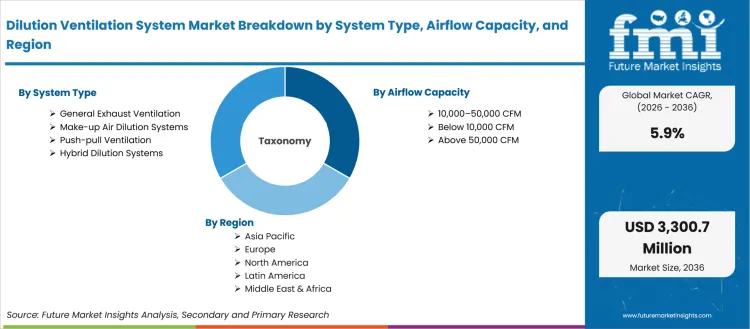
USD 1,860.6 million in 2026 and USD 3,300.7 million by 2036 at a 5.9% CAGR.
Dilution ventilation system demand is shifting from basic fan replacement toward engineered air mixing, make-up air balance and commissioning-led plant airflow control. Manufacturing plants need systems able to dilute heat, odor, low-toxicity vapor and dispersed fumes across wide production areas, supported by OSHA FY 2025 enforcement activity covering 30,273 inspections across programmed and unprogrammed cases. Buyers evaluating dilution ventilation system demand now compare airflow documentation and replacement-air planning alongside fan price.
Mid-capacity airflow packages serve many plants as a single project may need several bays covered without the cost of very large custom systems. ASHRAE Standard 62.1-2025 remains a recognized reference for ventilation system design and acceptable indoor air quality, and ASHRAE reports more than 50,000 members across 132 nations. Specification teams compare CFM range and service access before approving equipment.
Industrial buyers examine ventilation through worker exposure, operating cost and replacement-air discipline. EPA July 2025 indoor air guidance reports that levels of several organic compounds average 2 to 5 times higher indoors than outdoors, and selected activities can raise levels to 1,000 times background outdoor levels for several hours. Commercial decisions rest on reliable air movement and practical retrofit routes.
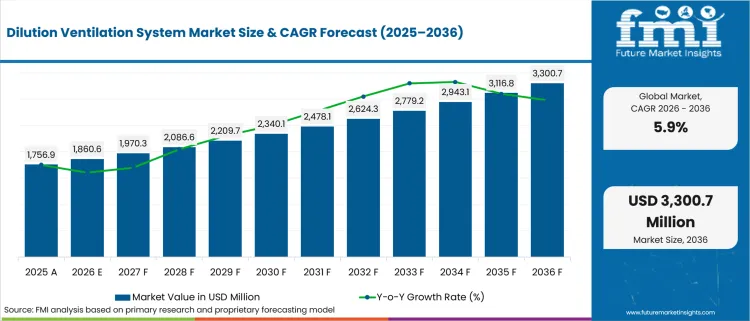
| Metric | Value |
|---|---|
| 2025 Market Size | USD 1,756.9 million |
| 2026 Market Size | USD 1,860.6 million |
| 2036 Market Size | USD 3,300.7 million |
| Forecast CAGR (2026-2036) | 5.9% |
| Leading Airflow Capacity | 10,000-50,000 CFM |
| 10,000-50,000 CFM Share (2026) | 44.5% |
| Leading Sales Channel | Direct OEM |
| Direct OEM Share (2026) | 42.0% |
| Leading End Use | Manufacturing Plants |
| Manufacturing Plants Share (2026) | 40.0% |
| Fastest-growing Country | China |
| China CAGR by 2036 | 6.8% |
Summary of the Dilution Ventilation System Market
| Market Signal | Commercial Impact |
|---|---|
| Demand and Growth Drivers | Demand for dilution ventilation systems is increasing as manufacturing facilities strengthen workplace air quality, regulatory compliance, and contaminant control across industrial operations.
|
| Product and Segment View | Mid-capacity airflow systems, direct OEM sales, and manufacturing plant applications continue to represent the leading commercial opportunities across the market.
|
| Geography and Growth Outlook | Asia continues to drive market expansion through industrial modernization, factory automation, and manufacturing capacity growth.
|
| Competitive Landscape | Competition increasingly focuses on airflow engineering, energy-efficient ventilation systems, and comprehensive industrial service capabilities.
|
| Analyst Perspective | Dilution ventilation systems are evolving from basic air-moving equipment into critical plant airflow management solutions that improve worker safety, regulatory compliance, and operational efficiency.
- Nikhil Kaitwade, Principal Consultant at Future Market Insights |
How is the dilution ventilation system market segmented?
Dilution ventilation system industry demand is segmented by system type, airflow capacity, application, end use, sales channel and region across 6 parent segmentation groups.
Dilution ventilation system coverage includes 4 system types, 3 airflow-capacity classes, 4 application groups, 4 end-use groups, 3 sales channels and 6 regions. By system type, coverage includes General Exhaust Ventilation, Make-up Air Dilution Systems, Push-pull Ventilation and Hybrid Dilution Systems. By airflow capacity, coverage includes below 10,000 CFM, 10,000-50,000 CFM and above 50,000 CFM. By application, coverage includes Industrial Fume Dilution, Heat / Odor Control, Solvent Vapor Dilution and Welding / Fabrication Areas. By end use, demand comes from Manufacturing Plants, Chemical Processing, Warehouses and Automotive / Metalworking. By sales channel, coverage includes Direct OEM, HVAC Contractors and Industrial Ventilation Integrators, with regional coverage across North America, Latin America, Europe, East Asia, South Asia and Pacific and Middle East and Africa.
Why does General Exhaust Ventilation lead within the system-type segment?
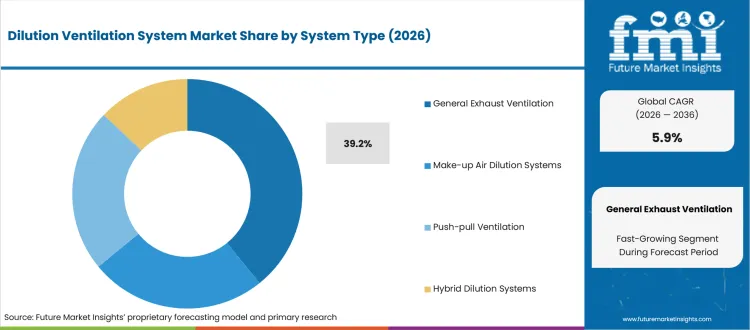
General Exhaust Ventilation leads through practical use across open production halls and mixed work areas. OSHA ventilation guidance identifies 5 basic ventilation system types, including dilution and recirculation systems. Plant buyers use general exhaust systems for heat, odor and low-level fume control, especially once contaminant sources disperse across several workstations.
- General Exhaust Ventilation is expected to account for 39.2% share in 2026, backed by roof and wall exhaust systems that support wide-room air turnover. Open manufacturing spaces prefer such systems as localized capture cannot cover every moving plume or process position.
- Wide-room dilution supports buyers managing heat and nuisance odor during long shifts. CCOHS describes dilution ventilation as a method commonly used to remove 3 contaminant groups, including fumes and vapours, which aligns with general exhaust use across mixed industrial rooms.
What supports demand for the 10,000-50,000 CFM airflow-capacity class?
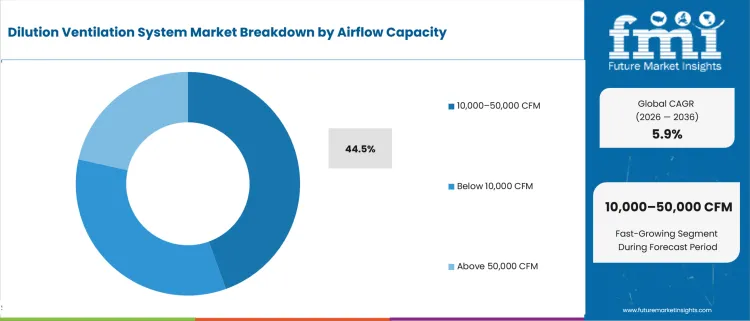
Mid-capacity airflow systems attract buyers that need multi-bay coverage without the design burden of very large custom systems. Greenheck RSQ fan data lists operation up to 3 in. wg of static pressure, showing how airflow capacity and pressure duty must be assessed together. Capacity selection relies on room volume and make-up air availability.
- 10,000-50,000 CFM is anticipated to hold 44.5% share in 2026, led by plant layouts requiring balanced coverage across several workstations. Such capacity bands help buyers coordinate fan horsepower and replacement-air units in retrofit-friendly packages.
- Mid-capacity systems often need variable-speed control as process load changes through a shift. CDC NIOSH ventilation guidance from October 2024 advises aiming for 5 or more air changes per hour of clean air in applicable workplace risk-reduction settings.
Why does Industrial Fume Dilution lead among applications?
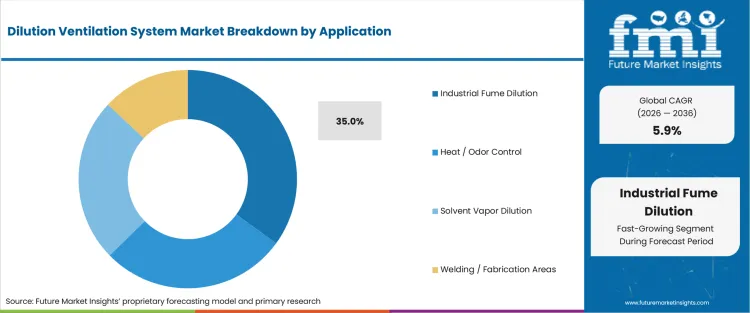
Industrial Fume Dilution gains demand from welding and metalworking areas that create dispersed plumes. HSE 2024 to 2025 workplace data recorded 680,000 working people sustaining an injury at work according to the Labour Force Survey, keeping plant safety investment under management review. General dilution supports room-level concentration control once contaminants move beyond a single hood.
- Industrial Fume Dilution is projected to account for 35.0% share in 2026, shaped by welding smoke and fabrication fumes that spread before a single capture point can remove them. Buyers connect such projects with safety audits and operator comfort in large shops.
- Welding and fabrication sites evaluate dilution systems alongside LEV and filtration equipment. HSE 2025 welding guidance applies fume controls to specialist welders and workers doing even small amounts of welding, giving ventilation suppliers a compliance-linked opening in plants with mixed fabrication tasks.
What market factors influence Manufacturing Plants?
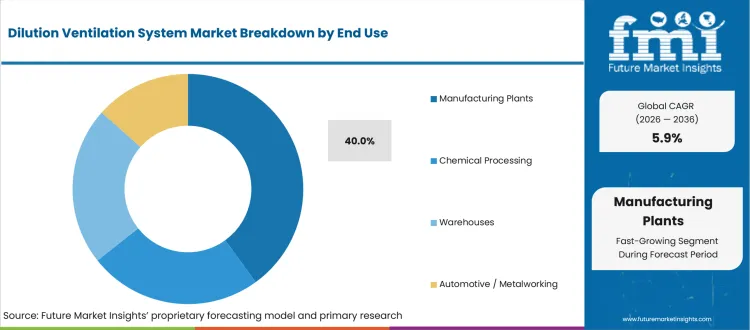
Manufacturing Plants control most end-use approval decisions as ventilation affects safety and room comfort across daily operations. Federal Reserve data for May 2026 showed USA manufacturing output unchanged after rising 0.7% in April, supporting selective replacement rather than open-ended capital spending. Facility teams compare exhaust volume and make-up air cost before approving projects.
- Manufacturing Plants are expected to account for 40.0% share in 2026, reflecting ongoing need for heat relief and contaminant dilution across general production rooms. Federal Reserve data placed USA capacity utilization at 76.2% in May 2026, keeping buyers selective about non-production capital spending.
- Factory buyers value equipment that can be maintained without extended line disruption. OSHA current enforcement summary reported 13,962 programmed inspections in FY 2025, reinforcing buyer interest in documented engineering controls across targeted industries.
How is Direct OEM positioned within the sales-channel segment?
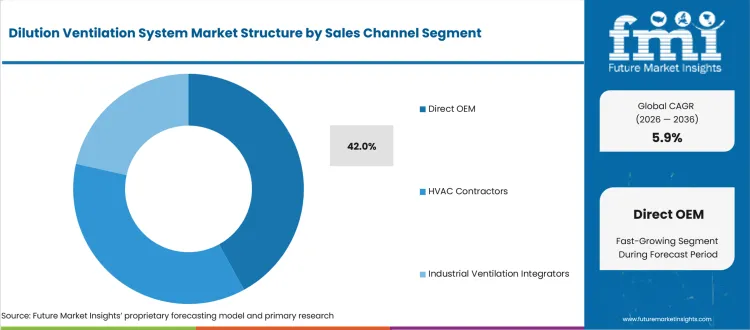
Direct OEM purchasing is preferred for larger projects requiring documented airflow data and coordinated system components. Greenheck RSQ hooded rooftop fan supports up to 3 in. wg of static pressure, showing why large buyers seek direct technical access to fan data. OEM sales teams compete on design support as much as product range.
- Direct OEM is set to secure 42.0% share in 2026, led by buyers that need engineered packages with clear system documentation. Large facilities prefer direct access to technical teams during specification and troubleshooting.
- HVAC contractors and industrial ventilation integrators remain important for retrofit execution. Old roof penetrations, duct conflicts and space constraints often decide final system layout, giving integrators 3 practical retrofit problems to solve before final balancing.
What are the drivers, restraints, and opportunities in the Dilution Ventilation System Market?
Near-term purchases are shaped by exposure control, replacement-air cost and system-integration needs. OSHA ventilation guidance lists 5 ventilation system types and states that ventilation systems generally involve combinations of those approaches, supporting buyer movement toward mixed exhaust, make-up air and control packages.
- Driver: Fume and vapor control drives dilution ventilation demand as factories need room-level air mixing after contaminants spread across work areas. OSHA January 2025 penalty adjustments raised maximum serious and other-than-serious violation penalties to USD 16,550 per violation, keeping facility control documentation commercially important.
- Restraint: Energy cost restrains adoption once exhaust volume removes conditioned air faster than plants can replace it efficiently. Federal Reserve May 2026 data placed industrial production 1.7% above its year-earlier level, keeping many buyers selective about equipment with high operating cost.
- Opportunity: Hybrid dilution systems create opportunity in shops that need general air movement and localized support together. CDC NIOSH October 2024 guidance allows ACH and equivalent ACH to be added together for comparison with the 5+ ACH goal, supporting interest in measurable airflow performance.
Fume spread control supports movement from simple fan replacement toward engineered dilution layouts. Welding and fabrication contaminants can shift across benches and short-batch production cells, and HSE 2024 to 2025 data recorded 59,219 employee injuries reported under RIDDOR. Suppliers that map contaminant spread and worker position can justify higher project value.
Make-up air balance remains the practical buying test for high-volume exhaust. A system removing thousands of cubic feet per minute must replace air with clean supply air, and balancing must address 3 practical risks, including drafts and combustion concerns. Poor balance can create fuel waste during heating or cooling seasons.
Energy penalty risk limits oversized systems. Federal Reserve May 2026 data showed industrial production edging up 0.1% after a 0.9% April rise, keeping facility teams careful about projects with high operating loads. Facilities with long operating hours compare variable-speed fans and staged operation before approving projects.
Executives comparing ventilation equipment opportunities should connect safety evidence with operating-cost evidence. Solvent rooms and adhesive areas are among the three that form 3 process spaces required to document dilution upgrades once vapor accumulation affects operator comfort and control records.
Which country CAGRs are profiled in the Dilution Ventilation System Market?
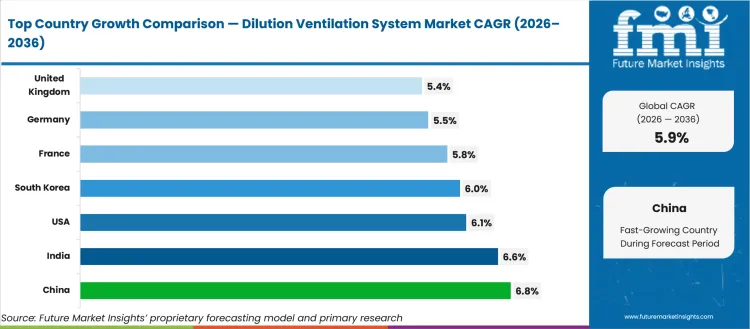
| Country | CAGR |
|---|---|
| China | 6.8% |
| India | 6.6% |
| United States | 6.1% |
| South Korea | 6.0% |
| France | 5.8% |
| Germany | 5.5% |
| United Kingdom | 5.4% |
| Japan | 4.9% |
Source: Future Market Insights analysis, 2026.
How do country-level CAGRs compare in the dilution ventilation system market?
Country demand is expected to be shaped by factory density, industrial safety oversight and available HVAC or fan supply channels. China and India connect higher CAGRs with factory modernization and industrial production, while United States, South Korea, France, Germany, United Kingdom and Japan connect adoption with compliance review and engineering standards. Senior buyers should assess air replacement cost and commissioning depth across 8 profiled countries.
- China is estimated at 6.8% CAGR through 2036, supported by equipment renewal and factory scale that place airflow upgrades near production investments. NBS reported industrial value added above designated size rising 5.9% in 2025, giving ventilation suppliers a strong manufacturing demand base.
- India is projected at 6.6% CAGR by 2036, helped by factory expansion and industrial estate modernization. Ministry data released in January 2026 reported IIP growth of 7.8% for December 2025, while manufacturing rose 8.1%.
- United States is expected to expand at 6.1% CAGR through 2036, backed by safety documentation, warehouse retrofits and direct OEM channels. OSHA January 2025 penalty adjustments raised maximum willful or repeated violation penalties to USD 165,514 per violation, sustaining attention on engineering controls and facility compliance evidence.
- South Korea is estimated to record 6.0% CAGR through 2036, reinforced by electronics, shipbuilding and automotive sites needing reliable fume and heat control. Official monthly industrial statistics placed the manufacturing average capacity utilization rate at 70.9% in November 2025.
- France is projected to rise at 5.8% CAGR through 2036, supported by safety-led workstation assessment and selective manufacturing recovery. INSEE reported manufacturing production rebounded 0.6% in January 2026 after a 0.7% fall in December 2025.
- Germany is forecast to grow at 5.5% CAGR by 2036, underpinned by hazardous-substance rules and disciplined plant engineering. Destatis reported manufacturing order stock 8.4% above April 2025 levels in April 2026.
- United Kingdom is projected to rise at 5.4% CAGR through 2036, shaped by LEV consultant activity and contractor-led retrofit routes. ONS reported production output rising 1.2% during the three months to February 2026, with manufacturing also up 1.2%.
- Japan is set to post 4.9% CAGR by 2036, aided by chemical risk assessment and compact factory retrofit needs. METI revised April 2026 industrial production report showed production at 102.5, up 0.5% from the previous month.
Who are the notable companies in the Dilution Ventilation System Market?
Greenheck, Systemair, Twin City Fan, CaptiveAire, Howden, Daikin Applied, Johnson Controls, Munters, Nederman and Camfil are the 10 notable companies shaping dilution ventilation equipment and industrial air quality support.
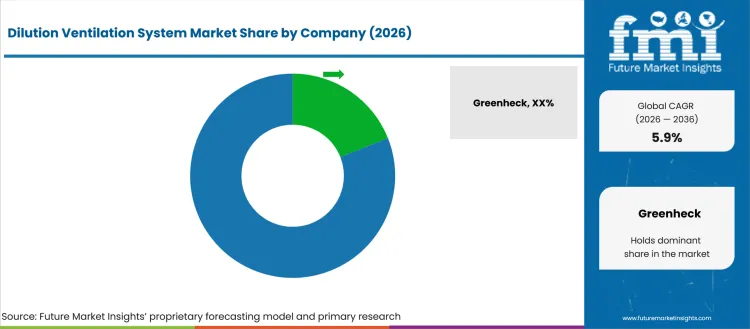
Competition in the dilution ventilation system market is grouped by how buyers want airflow responsibility handled. Greenheck, Systemair, Twin City Fan, CaptiveAire and Howden are stronger in fan selection and high-volume air movement, while Daikin Applied, Johnson Controls and Munters are important once dilution projects require make-up air and controls. Nederman and Camfil add depth once fume and filtration overlap with general dilution across 3 main supplier groups.
- Greenheck has an advantage through fan breadth, make-up air equipment and rooftop airflow products. Its RSQ hooded rooftop fan is available in 12 direct-drive sizes, helping buyers connect supply and exhaust configurations through one equipment source.
- Systemair and Twin City Fan are positioned through industrial fan competence and engineered air movement ranges. Systemair completed the NADI Airtechnics acquisition in August 2025, adding industrial fan competence and complementary fan products for Indian applications.
- Daikin Applied, Johnson Controls and Munters strengthen competition through air handling, thermal control and wider HVAC integration. Daikin Applied, Johnson Controls and Munters serve 3 buyer groups, including plant engineers and HVAC contractors evaluating compact supply-air projects.
- Nederman and Camfil compete around industrial air quality and contaminant control adjacency. Projects involving fumes and air-cleaning requirements can pull such specialists into dilution ventilation decisions across 4 application groups.
Competitive Benchmarking: Dilution Ventilation System Market
| Company | High-CFM Fan Range | Make-up Air Integration | Fume Control Depth | Geographic Reach |
|---|---|---|---|---|
| Greenheck | High | Strong | Medium | Global |
| Systemair | High | Strong | Medium | Global |
| Twin City Fan | High | Medium | Medium | North America and India-facing channels |
| CaptiveAire | Medium | Strong | Low | North America |
| Howden | High | Medium | Medium | Global |
| Daikin Applied | Medium | High | Medium | Global |
| Johnson Controls | Medium | High | Medium | Global |
| Munters | Medium | High | Medium | Global |
| Nederman | Medium | Medium | High | Global |
| Camfil | Medium | Medium | High | Global |
Source: Future Market Insights competitive analysis, 2026.
Key Developments in the Dilution Ventilation System Market
- In December 2024, Greenheck introduced the RSQ hooded rooftop fan for supply or exhaust configuration. Model RSQ supports performance up to 27,100 CFM for supply and 25,200 CFM for exhaust, helping retrofit buyers specify roof-mounted dilution airflow with lower sound and improved service access.
- In October 2024, Daikin launched the Compact L air handling unit range. Compact L is available in 6 sizes with capacities from 150 to more than 4,000 cubic meters per hour, supporting buyers needing packaged ventilation units for constrained plant and commercial spaces.
- In August 2025, Systemair completed the acquisition of NADI Airtechnics. Systemair stated that the deal adds industrial fan competence and a complementary product range, strengthening its position in engineered ventilation and industrial air movement projects.
Key Players in the Dilution Ventilation System Market
Air Movement Specialists
- Greenheck supports high-volume dilution ventilation through 12 RSQ rooftop fan sizes.
- Systemair strengthens industrial fan depth after completing 1 NADI Airtechnics acquisition in 2025.
- Twin City Fan competes through industrial fan ranges serving 3 core airflow project types.
- CaptiveAire supports make-up air and exhaust projects across 2 main commercial and industrial routes.
- Howden supplies engineered air movement equipment across 6 regional demand clusters.
Air Handling and Controls OEMs
- Daikin Applied supports compact ventilation projects through 6 Compact L AHU sizes.
- Johnson Controls competes through building controls and air handling projects across 3 buyer groups.
- Munters supports air treatment decisions across nearly 50 industries through humidity and climate-control solutions.
Industrial Air Quality Specialists
- Nederman supports fume, dust and contaminant control decisions across 4 industrial application groups.
- Camfil supports air filtration and contaminant-control projects across 6 regional demand clusters.
Dilution Ventilation System Market - Report Scope
| Coverage field | Report scope |
|---|---|
| Market breakdown | Dilution Ventilation System Market Breakdown By System Type, Airflow Capacity, Application, End Use, Sales Channel and Region |
| Market Definition | Equipment and integrated packages that use exhaust fans, supply air units, make-up air systems and airflow controls to dilute airborne contaminants across industrial spaces |
| Regions Covered | 6 regions, including North America, Latin America, Europe, East Asia, South Asia and Pacific, Middle East and Africa |
| Countries Covered | United States, United Kingdom, Germany, France, Japan, China, South Korea, India and 30+ countries |
| Key Companies Profiled | 10 companies, including Greenheck, Systemair, Twin City Fan, CaptiveAire, Howden, Daikin Applied, Johnson Controls, Munters, Nederman and Camfil |
| Forecast Period | 2026 to 2036 |
| Approach | Hybrid bottom-up and top-down methodology using equipment demand, airflow capacity, application mix, country industrial activity, channel structure and supplier portfolio validation |
Source: Future Market Insights analysis, 2026.
Dilution Ventilation System Market - Research Methodology
| Method | Approach |
|---|---|
| Primary Research | FMI analysts reviewed inputs from 4 respondent groups, including plant engineers, HVAC contractors, safety managers and industrial ventilation integrators. Discussions focused on airflow capacity, contaminant type, make-up air needs, commissioning proof and service access. |
| Desk Research | Desk research covered 5 evidence groups, including OSHA ventilation guidance, ASHRAE ventilation standards, workplace safety sources, official industrial statistics and company product updates. Product coverage was checked against system type, airflow class, application, end use and channel structure. |
| Market Sizing and Forecasting | Forecast modeling combined 6 variables, including equipment volume, average system price, CFM band, application mix, country industrial activity and sales-channel behavior. Assumptions were adjusted for plant size, contaminant spread, make-up air cost and retrofit complexity. |
| Data Validation | Forecasts were checked against 5 comparison pools, including ventilation equipment, industrial exhaust systems, air handling units, fan portfolios and regional manufacturing indicators. Company portfolios were reviewed to avoid counting products without dilution ventilation use. |
Dilution Ventilation System Market by Segments
Dilution Ventilation System Market segmented by System Type:
- General Exhaust Ventilation
- Make-up Air Dilution Systems
- Push-pull Ventilation
- Hybrid Dilution Systems
Dilution Ventilation System Market segmented by Airflow Capacity:
- Below 10,000 CFM
- 10,000-50,000 CFM
- Above 50,000 CFM
Dilution Ventilation System Market segmented by Application:
- Industrial Fume Dilution
- Heat / Odor Control
- Solvent Vapor Dilution
- Welding / Fabrication Areas
Dilution Ventilation System Market segmented by End Use:
- Manufacturing Plants
- Chemical Processing
- Warehouses
- Automotive / Metalworking
Dilution Ventilation System Market segmented by Sales Channel:
- Direct OEM
- HVAC Contractors
- Industrial Ventilation Integrators
Dilution Ventilation System Market by Region:
- North America
- United States
- Canada
- Mexico
- Latin America
- Brazil
- Chile
- Rest of Latin America
- Western Europe
- Germany
- UK
- Italy
- Spain
- France
- Nordic
- BENELUX
- Rest of Western Europe
- Eastern Europe
- Russia
- Poland
- Hungary
- Balkan and Baltic
- Rest of Eastern Europe
- East Asia
- China
- Japan
- South Korea
- South Asia and Pacific
- India
- ASEAN
- Australia and New Zealand
- Rest of South Asia and Pacific
- Middle East and Africa
- Kingdom of Saudi Arabia
- Other GCC Countries
- Türkiye
- South Africa
- Other African Union
- Rest of Middle East and Africa
Research Sources and Bibliography
- American Society of Heating, Refrigerating and Air-Conditioning Engineers. (2025). ANSI/ASHRAE Standards 62.1 and 62.2. ASHRAE.
- Canadian Centre for Occupational Health and Safety. (2024). Industrial Ventilation - 1. Introduction. Canadian Centre for Occupational Health and Safety.
- Daikin Europe. (2024, October 2). Daikin launches new Compact L air handling unit range. Daikin Europe.
- Federal Reserve Board. (2026, June 17). Industrial Production and Capacity Utilization - G.17. Board of Governors of the Federal Reserve System.
- Federal Statistical Office of Germany. (2026, June 18). Stock of orders in manufacturing in April 2026: +0.4% on the previous month. Destatis.
- Greenheck. (2024, December 4). Greenheck introduces RSQ hooded rooftop fan. Greenheck.
- Health and Safety Executive. (2025, January 27). Welding fume: Protect your workers. Health and Safety Executive.
- Health and Safety Executive. (2026, May 21). Commission your local exhaust ventilation system. Health and Safety Executive.
- Health and Safety Executive. (2025, November 20). Key figures for Great Britain 2024 to 2025. Health and Safety Executive.
- Institut National de la Statistique et des Études Économiques. (2026, March 5). In January 2026, manufacturing output rebounded (+0.6%). INSEE.
- Ministry of Economy, Trade and Industry. (2026, June 12). Revised Report for April 2026: Indices of Industrial Production. Ministry of Economy, Trade and Industry.
- Ministry of Statistics and Programme Implementation. (2026, January 28). Quick Estimate of Index of Industrial Production and Use-based Index for December 2025. Press Information Bureau.
- National Bureau of Statistics of China. (2026, January 20). Industrial Production Operation in December 2025. National Bureau of Statistics of China.
- National Institute for Occupational Safety and Health. (2024, October 3). How Much Ventilation Is Enough? Centers for Disease Control and Prevention.
- Occupational Safety and Health Administration. (2025). Current Enforcement Summary. USA Department of Labor.
- Occupational Safety and Health Administration. (2025, January 14). USA Department of Labor announces adjusted OSHA civil penalty amounts for 2025. USA Department of Labor.
- Office for National Statistics. (2026, April 16). Index of Production, UK: February 2026. Office for National Statistics.
- Statistics Korea. (2025, December 30). Monthly Industrial Statistics, November 2025. Ministry of Data and Statistics.
- Systemair Group. (2025, August 11). Systemair has completed the acquisition of NADI Airtechnics. Systemair Group.
- United States Environmental Protection Agency. (2025, July 24). Volatile organic compounds’ impact on indoor air quality. United States Environmental Protection Agency.
- United States Environmental Protection Agency. (2025, September 8). Technical overview of volatile organic compounds. United States Environmental Protection Agency.
This bibliography is provided for reader reference and is not exhaustive. The full report contains the complete reference list and detailed citations.
This Report Answers
- What is the expected global value of the dilution ventilation system market in 2026 and 2036?
- What CAGR is forecast for dilution ventilation systems during the 2026 to 2036 period?
- Which system type is used to assess General Exhaust Ventilation demand in 2026?
- Why do manufacturing plants and chemical processing facilities buy controlled dilution ventilation systems?
- How do general exhaust and make-up air dilution systems shape industrial airflow choices?
- Which 8 countries are compared in the dilution ventilation system forecast?
- Which 10 companies compete across fan supply and industrial air quality pathways?
- What 4 system types and 4 applications are included within the dilution ventilation system definition?
- How does FMI size and forecast dilution ventilation system demand across 6 parent segments and 6 regions?
- What implementation and supplier-selection factors should executives assess before approving 10,000-50,000 CFM projects?
Frequently Asked Questions
What is driving demand in the Dilution Ventilation System Market?
Demand is driven by manufacturing plants that need documented exposure control and balanced replacement-air systems for fumes and solvent vapor across the core application groups.
Why should executives track the Dilution Ventilation System Market?
Executives should track this market since airflow design affects worker safety and capital spending across industrial demand regions.
What business problem does the Dilution Ventilation System Market address?
It helps plants dilute airborne contaminants across large rooms while coordinating exhaust volume with clean replacement air and practical commissioning evidence across ventilation system approaches.
What should sourcing leaders evaluate before selecting suppliers?
Sourcing leaders should compare airflow engineering depth and commissioning service before approving 10,000-50,000 CFM projects.
What can limit return on investment for buyers?
Return on investment can be delayed once oversized exhaust systems raise heating or cooling loads. Buyers can reduce this risk by specifying variable-speed control and balanced make-up air across the operating modes.
How can suppliers build executive confidence?
Suppliers build confidence through responsive service and practical retrofit planning across sales channels.
Preview the report firsthand - request a free sample
Get SampleGet the brochure for pricing and purchase details.
Get PDFTable of Content
- Key Takeaways
- Market Size and CAGR
- Top Growth Driver
- Fastest Growing Segment
- Leading Region
- Key Companies
- Emerging Opportunities
- Executive Summary
- Global Market Outlook
- Demand-side Trends
- Supply-side Trends
- Technology Roadmap Analysis
- Analysis and Recommendations
- Analyst Perspective (What is happening? Why now? What should investors know?)
- Key Questions Answered
- How large is the market?
- What is the CAGR?
- What are key trends?
- Which region dominates?
- Who are the leaders?
- Market Overview
- Market Coverage / Taxonomy
- Market Definition / Scope / Limitations
- Research Methodology
- Chapter Orientation
- Analytical Lens and Working Hypotheses
- Market Structure, Signals, and Trend Drivers
- Benchmarking and Cross-market Comparability
- Market Sizing, Forecasting, and Opportunity Mapping
- Research Design and Evidence Framework
- Desk Research Programme (Secondary Evidence)
- Expert Input and Fieldwork (Primary Evidence)
- Tooling, Models, and Reference Databases
- Data Engineering and Model Build
- Quality Assurance and Audit Trail
- Market Background
- Market Dynamics (Drivers, Restraints, Opportunity, Trends)
- Scenario Forecast (Optimistic, Likely, Conservative)
- Impact Analysis
- AI Impact
- Sustainability Impact
- Regulatory Impact
- Technology Impact
- Consumer / Buyer Analysis
- Purchase Drivers
- Adoption Barriers
- Buyer Journey
- Opportunity Map Analysis
- Product Life Cycle Analysis
- Supply Chain Analysis
- Investment Feasibility Matrix
- Value Chain Analysis
- PESTLE and Porter's Analysis
- Regulatory Landscape
- Regional Parent Market Outlook
- Production and Consumption Statistics
- Import and Export Statistics
- Global Market Analysis and Forecast, 2021 to 2036
- Historical Market Size Value (USD Million) & Volume (Unit) Analysis, 2021 to 2025
- Current and Future Market Size Value (USD Million) & Volume (Unit) Projections, 2026 to 2036
- Y-o-Y Growth Trend Analysis
- Absolute $ Opportunity Analysis
- Global Market Pricing Analysis, 2021 to 2036
- Global Market Analysis and Forecast, By System Type, 2021 to 2036
- Introduction / Key Findings
- Historical Market Size Value (USD Million) & Volume (Unit) Analysis By System Type, 2021 to 2025
- Current and Future Market Size Value (USD Million) & Volume (Unit) Analysis and Forecast By System Type, 2026 to 2036
- General Exhaust Ventilation
- Make-up Air Dilution Systems
- Push-pull Ventilation
- Hybrid Dilution Systems
- General Exhaust Ventilation
- Y-o-Y Growth Trend Analysis By System Type, 2021 to 2025
- Absolute $ Opportunity Analysis By System Type, 2026 to 2036
- Global Market Analysis and Forecast, By Airflow Capacity, 2021 to 2036
- Introduction / Key Findings
- Historical Market Size Value (USD Million) & Volume (Unit) Analysis By Airflow Capacity, 2021 to 2025
- Current and Future Market Size Value (USD Million) & Volume (Unit) Analysis and Forecast By Airflow Capacity, 2026 to 2036
- 10,000-50,000 CFM
- Below 10,000 CFM
- Above 50,000 CFM
- 10,000-50,000 CFM
- Y-o-Y Growth Trend Analysis By Airflow Capacity, 2021 to 2025
- Absolute $ Opportunity Analysis By Airflow Capacity, 2026 to 2036
- Global Market Analysis and Forecast, By Application, 2021 to 2036
- Introduction / Key Findings
- Historical Market Size Value (USD Million) & Volume (Unit) Analysis By Application, 2021 to 2025
- Current and Future Market Size Value (USD Million) & Volume (Unit) Analysis and Forecast By Application, 2026 to 2036
- Industrial Fume Dilution
- Heat / Odor Control
- Solvent Vapor Dilution
- Welding / Fabrication Areas
- Industrial Fume Dilution
- Y-o-Y Growth Trend Analysis By Application, 2021 to 2025
- Absolute $ Opportunity Analysis By Application, 2026 to 2036
- Global Market Analysis and Forecast, By End Use, 2021 to 2036
- Introduction / Key Findings
- Historical Market Size Value (USD Million) & Volume (Unit) Analysis By End Use, 2021 to 2025
- Current and Future Market Size Value (USD Million) & Volume (Unit) Analysis and Forecast By End Use, 2026 to 2036
- Manufacturing Plants
- Chemical Processing
- Warehouses
- Automotive / Metalworking
- Manufacturing Plants
- Y-o-Y Growth Trend Analysis By End Use, 2021 to 2025
- Absolute $ Opportunity Analysis By End Use, 2026 to 2036
- Global Market Analysis and Forecast, By Sales Channel, 2021 to 2036
- Introduction / Key Findings
- Historical Market Size Value (USD Million) & Volume (Unit) Analysis By Sales Channel, 2021 to 2025
- Current and Future Market Size Value (USD Million) & Volume (Unit) Analysis and Forecast By Sales Channel, 2026 to 2036
- Direct OEM
- HVAC Contractors
- Industrial Ventilation Integrators
- Direct OEM
- Y-o-Y Growth Trend Analysis By Sales Channel, 2021 to 2025
- Absolute $ Opportunity Analysis By Sales Channel, 2026 to 2036
- Global Market Analysis and Forecast, By Region, 2021 to 2036
- Introduction
- Historical Market Size Value (USD Million) & Volume (Unit) Analysis By Region, 2021 to 2025
- Current Market Size Value (USD Million) & Volume (Unit) Analysis and Forecast By Region, 2026 to 2036
- North America
- Latin America
- Western Europe
- Eastern Europe
- East Asia
- South Asia and Pacific
- Middle East & Africa
- Market Attractiveness Analysis By Region
- North America Market Analysis and Forecast, By Country, 2021 to 2036
- Historical Market Size Value (USD Million) & Volume (Unit) Trend Analysis By Market Taxonomy, 2021 to 2025
- Market Size Value (USD Million) & Volume (Unit) Forecast By Market Taxonomy, 2026 to 2036
- By Country
- USA
- Canada
- Mexico
- By System Type
- By Airflow Capacity
- By Application
- By End Use
- By Sales Channel
- By Country
- Market Attractiveness Analysis
- By Country
- By System Type
- By Airflow Capacity
- By Application
- By End Use
- By Sales Channel
- Key Takeaways
- Latin America Market Analysis and Forecast, By Country
- Historical Market Size Value (USD Million) & Volume (Unit) Trend Analysis By Market Taxonomy, 2021 to 2025
- Market Size Value (USD Million) & Volume (Unit) Forecast By Market Taxonomy, 2026 to 2036
- By Country
- Brazil
- Chile
- Rest of Latin America
- By System Type
- By Airflow Capacity
- By Application
- By End Use
- By Sales Channel
- By Country
- Market Attractiveness Analysis
- By Country
- By System Type
- By Airflow Capacity
- By Application
- By End Use
- By Sales Channel
- Key Takeaways
- Western Europe Market Analysis and Forecast, By Country
- Historical Market Size Value (USD Million) & Volume (Unit) Trend Analysis By Market Taxonomy, 2021 to 2025
- Market Size Value (USD Million) & Volume (Unit) Forecast By Market Taxonomy, 2026 to 2036
- By Country
- Germany
- UK
- Italy
- Spain
- France
- Nordic
- BENELUX
- Rest of Western Europe
- By System Type
- By Airflow Capacity
- By Application
- By End Use
- By Sales Channel
- By Country
- Market Attractiveness Analysis
- By Country
- By System Type
- By Airflow Capacity
- By Application
- By End Use
- By Sales Channel
- Key Takeaways
- Eastern Europe Market Analysis and Forecast, By Country
- Historical Market Size Value (USD Million) & Volume (Unit) Trend Analysis By Market Taxonomy, 2021 to 2025
- Market Size Value (USD Million) & Volume (Unit) Forecast By Market Taxonomy, 2026 to 2036
- By Country
- Russia
- Poland
- Hungary
- Balkan & Baltic
- Rest of Eastern Europe
- By System Type
- By Airflow Capacity
- By Application
- By End Use
- By Sales Channel
- By Country
- Market Attractiveness Analysis
- By Country
- By System Type
- By Airflow Capacity
- By Application
- By End Use
- By Sales Channel
- Key Takeaways
- East Asia Market Analysis and Forecast, By Country
- Historical Market Size Value (USD Million) & Volume (Unit) Trend Analysis By Market Taxonomy, 2021 to 2025
- Market Size Value (USD Million) & Volume (Unit) Forecast By Market Taxonomy, 2026 to 2036
- By Country
- China
- Japan
- South Korea
- By System Type
- By Airflow Capacity
- By Application
- By End Use
- By Sales Channel
- By Country
- Market Attractiveness Analysis
- By Country
- By System Type
- By Airflow Capacity
- By Application
- By End Use
- By Sales Channel
- Key Takeaways
- South Asia and Pacific Market Analysis and Forecast, By Country
- Historical Market Size Value (USD Million) & Volume (Unit) Trend Analysis By Market Taxonomy, 2021 to 2025
- Market Size Value (USD Million) & Volume (Unit) Forecast By Market Taxonomy, 2026 to 2036
- By Country
- India
- ASEAN
- Australia & New Zealand
- Rest of South Asia and Pacific
- By System Type
- By Airflow Capacity
- By Application
- By End Use
- By Sales Channel
- By Country
- Market Attractiveness Analysis
- By Country
- By System Type
- By Airflow Capacity
- By Application
- By End Use
- By Sales Channel
- Key Takeaways
- Middle East & Africa Market Analysis and Forecast, By Country
- Historical Market Size Value (USD Million) & Volume (Unit) Trend Analysis By Market Taxonomy, 2021 to 2025
- Market Size Value (USD Million) & Volume (Unit) Forecast By Market Taxonomy, 2026 to 2036
- By Country
- Kingdom of Saudi Arabia
- Other GCC Countries
- Türkiye
- South Africa
- Other African Union
- Rest of Middle East & Africa
- By System Type
- By Airflow Capacity
- By Application
- By End Use
- By Sales Channel
- By Country
- Market Attractiveness Analysis
- By Country
- By System Type
- By Airflow Capacity
- By Application
- By End Use
- By Sales Channel
- Key Takeaways
- Key Countries Market Analysis
- USA
- Pricing Analysis
- Market Share Analysis, 2025
- By System Type
- By Airflow Capacity
- By Application
- By End Use
- By Sales Channel
- Canada
- Pricing Analysis
- Market Share Analysis, 2025
- By System Type
- By Airflow Capacity
- By Application
- By End Use
- By Sales Channel
- Mexico
- Pricing Analysis
- Market Share Analysis, 2025
- By System Type
- By Airflow Capacity
- By Application
- By End Use
- By Sales Channel
- Brazil
- Pricing Analysis
- Market Share Analysis, 2025
- By System Type
- By Airflow Capacity
- By Application
- By End Use
- By Sales Channel
- Chile
- Pricing Analysis
- Market Share Analysis, 2025
- By System Type
- By Airflow Capacity
- By Application
- By End Use
- By Sales Channel
- Germany
- Pricing Analysis
- Market Share Analysis, 2025
- By System Type
- By Airflow Capacity
- By Application
- By End Use
- By Sales Channel
- UK
- Pricing Analysis
- Market Share Analysis, 2025
- By System Type
- By Airflow Capacity
- By Application
- By End Use
- By Sales Channel
- Italy
- Pricing Analysis
- Market Share Analysis, 2025
- By System Type
- By Airflow Capacity
- By Application
- By End Use
- By Sales Channel
- Spain
- Pricing Analysis
- Market Share Analysis, 2025
- By System Type
- By Airflow Capacity
- By Application
- By End Use
- By Sales Channel
- France
- Pricing Analysis
- Market Share Analysis, 2025
- By System Type
- By Airflow Capacity
- By Application
- By End Use
- By Sales Channel
- India
- Pricing Analysis
- Market Share Analysis, 2025
- By System Type
- By Airflow Capacity
- By Application
- By End Use
- By Sales Channel
- ASEAN
- Pricing Analysis
- Market Share Analysis, 2025
- By System Type
- By Airflow Capacity
- By Application
- By End Use
- By Sales Channel
- Australia & New Zealand
- Pricing Analysis
- Market Share Analysis, 2025
- By System Type
- By Airflow Capacity
- By Application
- By End Use
- By Sales Channel
- China
- Pricing Analysis
- Market Share Analysis, 2025
- By System Type
- By Airflow Capacity
- By Application
- By End Use
- By Sales Channel
- Japan
- Pricing Analysis
- Market Share Analysis, 2025
- By System Type
- By Airflow Capacity
- By Application
- By End Use
- By Sales Channel
- South Korea
- Pricing Analysis
- Market Share Analysis, 2025
- By System Type
- By Airflow Capacity
- By Application
- By End Use
- By Sales Channel
- Russia
- Pricing Analysis
- Market Share Analysis, 2025
- By System Type
- By Airflow Capacity
- By Application
- By End Use
- By Sales Channel
- Poland
- Pricing Analysis
- Market Share Analysis, 2025
- By System Type
- By Airflow Capacity
- By Application
- By End Use
- By Sales Channel
- Hungary
- Pricing Analysis
- Market Share Analysis, 2025
- By System Type
- By Airflow Capacity
- By Application
- By End Use
- By Sales Channel
- Kingdom of Saudi Arabia
- Pricing Analysis
- Market Share Analysis, 2025
- By System Type
- By Airflow Capacity
- By Application
- By End Use
- By Sales Channel
- Türkiye
- Pricing Analysis
- Market Share Analysis, 2025
- By System Type
- By Airflow Capacity
- By Application
- By End Use
- By Sales Channel
- South Africa
- Pricing Analysis
- Market Share Analysis, 2025
- By System Type
- By Airflow Capacity
- By Application
- By End Use
- By Sales Channel
- USA
- Market Structure Analysis
- Competition Dashboard
- Competition Benchmarking
- Market Share Analysis of Top Players
- By Regional
- By System Type
- By Airflow Capacity
- By Application
- By End Use
- By Sales Channel
- Emerging Startups
- Innovation Benchmarking
- Competition Analysis
- Competition Deep Dive
- Greenheck
- Overview
- Product Portfolio
- Profitability by Market Segments (Product/Region/Sales Channel)
- Sales Footprint
- Strategy Overview
- Marketing Strategy
- Product Strategy
- Channel Strategy
- Systemair
- CaptiveAire
- Howden
- Johnson Controls
- Munters
- Greenheck
- Case Studies
- Success Stories
- Recent Developments
- Competition Deep Dive
- Assumptions & Acronyms Used


