

- Market Size (2026)
- USD 618.7 Mn
- Forecast (2036)
- USD 2118.9 Mn
- CAGR (2026 to 2036)
- 13.1%
How big is the dough sheeters & laminators market in 2026?
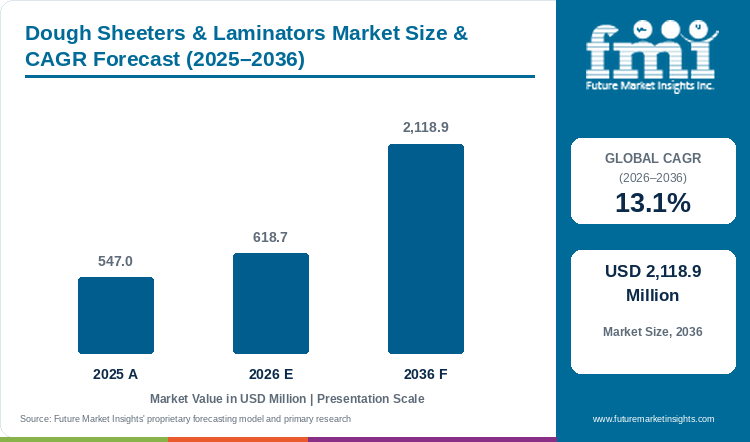
The market was valued at USD 547.0 million in 2025 and is expected to reach USD 618.7 million in 2026. It is projected to reach USD 2,118.9 million by 2036 at a CAGR of 13.1% from 2026 to 2036.
The dough sheeters and laminators market was valued at USD 547.0 million in 2025 and is estimated at USD 618.7 million in 2026. At a forecast CAGR of 13.1%, revenue would reach USD 2,118.9 million by 2036; integrated make-up lines account for 34.0% of equipment type demand in 2026. In July 2026, FRITSCH began construction of an approximately EUR 75.0 million headquarters and production project, planned for completion in the second quarter of 2028.[3] For bakery customers, investment in sheeting and lamination is tied to repeatable layer quality, fewer malformed pastries and changeovers that fit the daily product schedule. Modular extensions can add folding or forming capacity to a suitable existing line, allowing buyers to address a specific production constraint without replacing every stage at once. Commissioning, operator training and recipe transfer are part of the investment because uniform pastry quality depends on settings that can be repeated after installation and during later changeovers.
Key Market Trends & Insights
- By equipment type: Integrated Make-Up Lines represented 34.0% of 2026 equipment type demand. Joining sheeting to cutting and shaping removes transfers where dough can stretch or tear. The test is whether the connected stations run at one pace for the product mix.
- By capacity: 500-2,000 kg/hr accounted for 39.0% of 2026 capacity demand. Width, thickness and the number of reductions set output for each recipe, so one rating says little. It's tested by whether chilling and cutting keep pace with the sheet.
- By automation level: Fully Automatic / Robotic held 43.0% of 2026 automation level demand. Stored roll, belt and fold settings reproduce the layer sequence from one batch to the next. The test is whether the line recovers its layers after a pause on the belts.
Regional Highlights
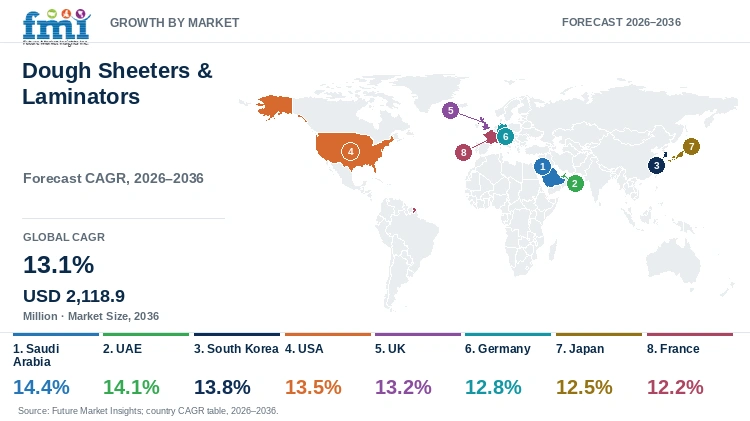
- At 14.4% CAGR through 2036, Saudi Arabia leads the country outlook for dough sheeters and laminators, with recipe transfer and layer consistency important to the value of new lines.
- The UAE is close behind at 14.1%, followed by South Korea at 13.8% and the USA at 13.5%; France has the lowest profiled rate, at 12.2%.
Market Size & Forecast
Table 1: Dough Sheeters & Laminators Market Size and Forecast (USD million), 2025 to 2036
| Market size and forecast | Value |
|---|---|
| 2025 Value (actual) | USD 547.0 million |
| Estimated market size in 2026 | USD 618.7 million |
| Projected market size by 2036 | USD 2,118.9 million |
| CAGR (2026-2036) | 13.1% |
The practical opportunity depends on whether dough and fat keep their layer structure from reduction to the oven. FRITSCH introduced PROGRESSA pastry in May 2025 with quick-release belts and folding devices that are easy to change.[2] Rademaker lists compact laminators at 250 to 1,000 kg of dough per hour and industrial systems at 500 to 10,000 kg per hour.[4] The ranges overlap, so throughput alone does not decide the purchase, and a published range cannot show how a particular dough and fat behave on the line. FDA manufacturing requirements add cleaning and maintenance obligations to every installation.[1] Consequently, actual demand will depend on whether a line holds layer definition across recipes without cleaning and changeover time that offsets the gain.
Dough Sheeters & Laminators Market is segmented by Equipment Type, Capacity, Automation Level, End User, Sales Channel and Region. The forecast period runs from 2026 to 2036.
Sheeting sits within a dough processing system whose stages share the same material. Dough reduction, fat addition, folding and further reduction must preserve a structure that the next operation can handle. Rademaker’s compact and industrial ranges overlap in hourly capacity, showing why output alone does not define the equipment choice.[4] Working width, layer requirement, available floor space and the form of the final product also influence the arrangement. A bakery seeking an additional pastry format may need another forming module or conditioning stage before it needs a faster laminator. That creates opportunities for modular extensions as well as complete-line purchases.
Shorter production runs give attachment changes a direct influence on the economics of mechanised pastry. FRITSCH introduced PROGRESSA pastry for retail bakers in May 2025 with quick-release belts and readily changed folding devices.[2] These features address the time between recipes, when the equipment is occupied but produces nothing for sale. A varied assortment can justify a line only if enough of the day remains available for sheeting and forming. Access to belts and folding components therefore has value alongside consistent thickness. Stored settings support the next setup, while the physical work of removing material and changing attachments determines how quickly another pastry can enter production.
The new FRITSCH site is planned to consolidate five locations and include an approximately 20,000 m² production facility. Its bakery technology centre is intended to join the complex in a later phase.[3] This is a supplier investment in manufacturing and application capability, with benefits developing over several years. Customer projects continue to depend on recipe trials and the installed factory layout. Equipment cleanliness and maintenance access also form part of the FDA’s manufacturing framework.[1] For an operating bakery, the chosen line must fit the available utilities and shutdown period as well as the desired product range. Those installation demands can influence the timing of an order.
Table 2: Supporting Industry Indicators for the Dough Sheeters & Laminators Market, 2025 to 2026 and current product specifications
| Indicator | Data point | Why it matters | Source |
|---|---|---|---|
| Supplier capital investment | FRITSCH announced approximately EUR 75.0 million for its new site in July 2026. | Manufacturing and application capability are receiving long-term investment. | [3] |
| Production-facility plan | The project includes approximately 20,000 m² of production space. | Consolidated manufacturing can support the supplier’s future equipment programme. | [3] |
| Planned completion | The new site is scheduled for the second quarter of 2028. | The investment contributes over a longer period than current customer deliveries. | [3] |
| Compact laminator capacity | Rademaker lists 250–1,000 kg of dough per hour for Radini. | Compact systems address smaller output and varied production needs. | [4] |
| Industrial laminator capacity | Rademaker lists 500–10,000 kg of dough per hour for industrial systems. | Working width, product structure and adjoining stages distinguish industrial configurations. | [4] |
| Retail-pastry line development | FRITSCH introduced PROGRESSA pastry in May 2025. | Accessible belts and folding changes target the time between products. | [2] |
Demand Intensity Analysis
The dough sheeters & laminators market is forecast to generate an additional USD 1,500.2 million in annual revenue between 2026 and 2036, growing at a 13.1% value CAGR. Industrial projects contribute alongside the move from manual or standalone sheeting to connected pastry preparation. FRITSCH’s EUR 75.0 million site commitment and Rademaker’s published capacity ranges illustrate the supplier resources directed at these different scales.[3][4] Growth remains sensitive to the space and capital required for conditioning, reduction and forming to work together. A modular purchase can spread that commitment over time, while a complete line offers closer coordination from the outset. Orders follow when the resulting product range and production hours justify the installed cost, including the work between recipes.
Integrated make-up lines account for USD 210.4 million in 2026. Combining sheeting and forming reduces separate transfers and coordinates the rate at which stations handle dough. It also brings a larger, more interdependent investment. The strongest case arises when several operations need renewal together and recurring products can keep them occupied. Where a serviceable sheeter already supplies the required dough, another cutting or folding module may be sufficient. These alternatives create demand at different capital levels: full integration for repeated production, and focused extensions for an additional format or a constrained stage within the existing line. Each added station raises the cost of an interruption elsewhere in the line.
Fully automatic / robotic equipment contributes USD 266.0 million in 2026. Repeated roll settings, belt speeds and fold counts can reduce dependence on manual adjustment during a long run. Material condition remains the limit: a programme cannot preserve separate layers if the dough and fat no longer deform compatibly. Product changes also occupy belts and attachments while residues are removed and another setup is established. Automation has a stronger economic case when the bakery has enough compatible production to use the line for substantial periods. Accessible components help retain the labour benefit when the assortment requires more frequent changes. The labour saved is real only if operators are not recovering layers by hand after each pause.
Industrial bakeries represent USD 315.5 million in 2026. Their equipment spending is tied to the structure of the finished pastry, because damage to layers may become fully apparent only after proofing or baking. An even sheet is therefore only one part of the manufacturing result. Dough and fat have to deform together, and transfers must preserve their arrangement before the product is formed. Suppliers that understand these relationships can connect lamination with conditioning and final shaping. The commercial opportunity includes better use of existing ingredients and oven capacity through fewer malformed or unevenly risen products. Long-term sales are ultimately determined by whether the line preserves layer definition across the product range without added trim.
Table 3: Demand Intensity Metrics for the Dough Sheeters & Laminators Market, 2026 to 2036 with relevant industry comparisons
| Demand intensity metric | Value | Basis |
|---|---|---|
| Dough sheeters & laminators value CAGR | 13.1% | Global market value growth, 2026 to 2036. |
| Announced supplier investment | Approximately EUR 75.0 million | FRITSCH headquarters and production project, July 2026.[3] |
| Industrial laminator capacity range | 500–10,000 kg dough/hour | Rademaker manufacturer specifications; configuration-dependent.[4] |
| Integrated make-up line revenue, 2026 | USD 210.4 million | Equipment Type category. |
| Industrial-bakery revenue, 2026 | USD 315.5 million | End User category. |
| Fully automatic / robotic revenue, 2026 | USD 266.0 million | Automation Level category. |
| Added revenue through 2036 | USD 1,500.2 million | Increase in market revenue from 2026 to 2036. |
Analyst Perspective
A laminating line earns a lasting place when it keeps dough and fat in distinct layers without disrupting changeovers between pastries. Suppliers that match the degree of integration to recurring volume keep the order, while those selling stations the range cannot occupy lose it.
- Nandini Roy Choudhury, Principal Analyst at Future Market Insights
How is the dough sheeters & laminators market segmented?
The dough sheeters & laminators market is segmented by Equipment Type (Integrated make-up lines, Floor sheeters, Laminators, Tabletop sheeters), Capacity (500-2,000 kg/hr, Below 500 kg/hr, Above 2,000 kg/hr), Automation Level (Fully automatic / robotic, Semi-automatic, Manual), End User (Industrial bakeries, In-store & retail bakeries, Artisan bakeries, Foodservice / QSR central kitchens), and Sales Channel (Direct OEM sales, Dealers & distributors, Aftermarket & refurbished). Regionally, the market is segmented into North America, Latin America, Western Europe, Eastern Europe, East Asia, South Asia and Pacific, and Middle East and Africa.
Why do Integrated make-up lines anchor Equipment Type demand?
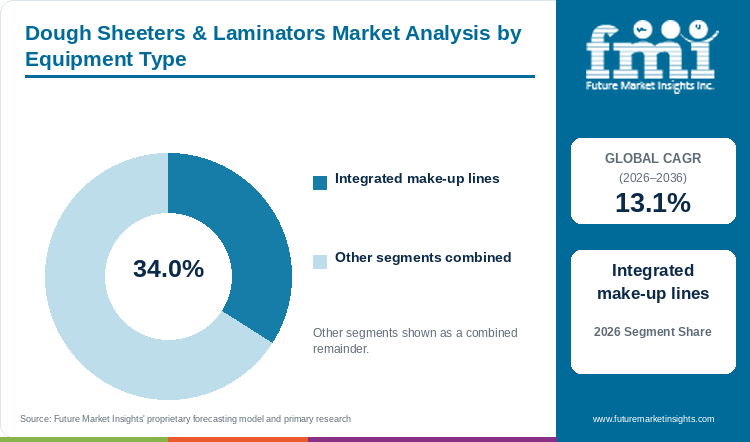
Integrated make-up lines lead with 34.0% of Equipment Type revenue in 2026.
An integrated line connects sheet preparation with cutting and shaping, which removes separate transfers of dough. Coordinated speeds stop material stretching between stations or piling up before forming, and laminated products also need a defined order for fat placement and folding. Rademaker’s modular arrangements let those stages be configured around the intended pastry.[4] Tabletop and floor sheeters keep a role in smaller batches.
- Integrated make-up lines hold 34.0% of Equipment Type, linking sheet preparation with the stations that cut and shape the product.
- The dough supply needs to stay continuous and in the right condition for the connected stations to work together.
Where does the 500-2,000 kg/hr capacity bracket fit?
500-2,000 kg/hr leads with 39.0% of Capacity revenue in 2026.
Working width and final thickness change the mass produced at a set conveyor speed, and the number of reductions varies by recipe. Capacity therefore belongs to the product and the configuration together. Chilling or a slower cutting station can limit the useful sheet, so spending may go to another module rather than a faster sheeter.
- The 500-2,000 kg/hr bracket leads Capacity with 39.0%; sheet dimensions and the reduction sequence establish output for each product.
- Sheet width and thickness need to be fixed before a mass rate is quoted for the line.
Why is Fully automatic / robotic the largest automation category?
Fully automatic / robotic leads with 43.0% of Automation Level revenue in 2026.
Automatic roll adjustment, conveyor synchronisation and fold counts reproduce the mechanical sequence that creates layers. Dough or fat that turns too stiff or too soft can disrupt separation with every setting unchanged, and a pause on the belts gives those conditions time to shift. Automation therefore has to repeat the sequence and allow a manageable recovery after interruption.
- Fully automatic / robotic accounts for 43.0% of Automation Level in 2026, repeating roll settings, conveyor speeds and folding sequences.
- Dough left on the belts during a pause needs to be part of the restart assessment.
What underpins Industrial bakeries as the leading End User?
Industrial bakeries lead with 51.0% of End User revenue in 2026.
Industrial pastry lines multiply the cost of thickness variation across a long run, shown as extra trim and uneven rise. Controlled sheeting reduces those losses while keeping several forming stations fed. Larger installations also lower repetitive manual work, although attachment changes and cleaning still take staff time. A more uniform sheet affects ingredient use, product dimensions and the quantity available for sale.
- Industrial bakeries lead End User at 51.0% in 2026, with sheet variation affecting weight, layer definition and trim through long runs.
- The baked product needs to be the test of sheet variation and layer damage.
Why do Direct OEM sales dominate procurement?
Direct OEM sales hold 56.0% of Sales Channel revenue in 2026.
Several roll stations, fat-handling components and forming modules may share the same controls in a lamination project. Direct contact with the manufacturer establishes how the sheet passes between them and who answers for its condition at each connection. Site layout and application trials come before the final order. Standard machines may be sold through dealers with local installation and maintenance support.
- Direct OEM sales hold 56.0% of Sales Channel revenue in 2026, supporting coordinated design of the dough, fat and forming route.
- Acceptance needs to use the actual recipe, fat condition and changeover method.
What are the drivers, restraints and opportunities in the dough sheeters & laminators market?
Consistent layers support scalable pastry ranges
Mechanised reduction and folding make a defined layer structure reproducible across longer pastry runs. A bakery can then expand recurring production without manual folding for every added batch. Rademaker’s modular approach configures equipment around working width, layer requirements and the intended product.[4] A supplier gains where compatible pastries share one preparation stage before moving to different cutting or forming attachments.
Temperature and sanitation can constrain the planned utilisation
Dough and fat have to deform together through successive reductions, and a line loses distinct layers when their working conditions diverge. Dough chilling systems can contribute to control, but capacity and placement must suit the material in process. Cleaning also claims line time, and FDA manufacturing requirements cover sanitary operations and equipment maintenance.[1] A supplier gains where roll and belt access protect production hours, since faster sheeting alone cannot repay a line that waits for cleaning.
Accessible modular lines can make product changes more practical
Modular attachments let a line serve another pastry format without duplicating every preparation stage. FRITSCH’s May 2025 PROGRESSA pastry introduction emphasised accessible belts and easier folding-device changes for retail bakers.[2] Time spent clearing material and restoring the next setup cuts the hours available for the products that justified the line. A supplier gains where easier changes make shorter runs economic, provided the reduction sequence still suits the added format.
Which country CAGRs are profiled in the dough sheeters & laminators market?
Table 4: Country growth outlook for the dough sheeters & laminators market
| Country | CAGR, 2026 to 2036 |
|---|---|
| Saudi Arabia | 14.4% |
| UAE | 14.1% |
| South Korea | 13.8% |
| USA | 13.5% |
| UK | 13.2% |
| Germany | 12.8% |
| Japan | 12.5% |
| France | 12.2% |
Saudi Arabia
Saudi Arabia has the highest profiled CAGR at 14.4% for 2026 to 2036, above the global rate of 13.1%. The USDA Foreign Agricultural Service’s December 2025 report put Saudi food service sales at about USD 30 billion in 2024 and listed baked frozen pastries among products with potential. The report treats pastry as a product opportunity, not as evidence of sheeting demand. A new pastry installation lets a bakery design conditioning, fat handling and reduction together before the building layout fixes their relationship. However, space for dough in process and access for belts add to the investment. Demand will depend on how many projects commit to integrated lines rather than separate modules at the outset.
UAE
The UAE is forecast at 14.1% CAGR over 2026 to 2036, above the global rate of 13.1%. The USDA Foreign Agricultural Service’s December 2025 food service report counted 8,617 restaurants and 5,240 coffee shops and cafeterias in Dubai, citing Dubai Municipality. The counts show outlet demand for pastry, not how it will be made. Croissants, filled pastries and dough blocks can share a central preparation system while needing different finishing, so the frequency of those transitions decides the useful size of the line. However, chilled or frozen distribution requires the layers to survive holding and a later bake. Demand will depend on how many central kitchens serve enough outlets to keep a connected line busy.
South Korea
South Korea has a 13.8% CAGR outlook through 2036, above the global rate of 13.1%. The National Data Office’s December 2025 franchise statistics showed bakery stores employing 4.25 people on average in 2024, against 3.31 across all franchise stores. The figure shows how labour-intensive bakery work is, not how many stores will buy sheeting equipment. In packaged pastry, small changes in sheet thickness or alignment affect appearance and the dimensions presented to packaging, which gives coordinated reduction and cutting value beyond peak throughput. However, a wider change in dough structure can require more than another attachment. Demand will depend on how many producers can add formats to a common preparation system without a full redesign.
USA
The USA is forecast at 13.5% CAGR from 2026 to 2036, above the global rate of 13.1%. The Bureau of Labor Statistics reported the average price of butter at USD 3.96 per pound in September 2026, 17.3% below a year earlier. Cheaper fat lowers the ingredient saving from less trim, so a project has to justify itself on labour, consistency and changeover time, and the price says nothing about equipment budgets. A replacement can connect a new sheeting section to forming and baking equipment that remains in service. FDA manufacturing requirements also make cleaning and maintenance access relevant to the installed layout.[1] Demand will depend on whether the adjoining stages can use the more consistent sheet.
UK
The UK market is projected at 13.2% CAGR through 2036, slightly above the global rate of 13.1%. The Office for National Statistics reported food and non-alcoholic beverage prices 1.3% higher in September 2026 than a year earlier, the lowest rate since September 2021. Slow price growth leaves little room to recover equipment cost through selling prices, though the rate does not measure capital spending. Moving from batch sheeting to a compact line changes where labour is used, since repeated rolling can become automatic while dough supply, attachment changes and cleaning remain manual. However, a fully connected line may exceed a bakery’s volume and staffing. Demand will depend on how many bakeries find a step between a standalone sheeter and a connected line.
Germany
Germany is projected at 12.8% CAGR over 2026 to 2036, below the global rate of 13.1%. Destatis reported that butter prices in September 2026 were 29.5% lower than a year earlier, and fats and cooking oils 15.0% lower. Cheaper fat helps the economics of laminated products, though the figures say nothing about equipment budgets. FRITSCH, based in Germany, began its consolidated site project in July 2026,[3] which shows continued supplier development locally. Customer demand spans flexible equipment for varied batches and larger integrated lines. However, the first values manageable changes between formats, while the second requires coordination across a full sequence. Demand will depend on how many bakeries can use a connected line for most of the day.
Japan
Japan is projected at 12.5% CAGR from 2026 to 2036, below the global rate of 13.1%. A USDA Foreign Agricultural Service report of March 2026 said Japan’s agriculture ministry will keep the butter tariff-rate quota at 8,000 to 10,000 tonnes for fiscal 2026. It added that the ministry will monitor supply closely. The quota governs imports, not bakery equipment, but it shows that butter availability is a planning issue for laminated pastry. Adding another forming module to a Japanese pastry line changes the handling after lamination, and the layers must survive the extra transfer. Coordination with existing bakery processing equipment therefore influences which product additions are feasible. Demand will depend on how many bakeries add modules rather than replace the laminator.
France
France has the lowest profiled CAGR at 12.2% for 2026 to 2036, below the global rate of 13.1%. INSEE reported that food prices excluding fresh products rose 0.4% over twelve months to September 2026. Modest processed-food inflation leaves little room to recover cost increases, though it does not measure equipment demand. For croissants and other viennoiserie, the value of lamination becomes visible after proofing and baking, when layer separation and rise reveal the effect of reduction and folding. A smaller bakery may retain manual finishing around a sheeter, while central production connects more operations. However, trim handling also affects ingredient use. Demand will depend on how many producers can show less trim from a connected line.
Who are the notable companies in the dough sheeters & laminators market?
Rademaker; FRITSCH; RONDO; Rheon Automatic Machinery; GEA
Rademaker, FRITSCH, RONDO, Rheon and GEA participate through different combinations of sheeting, lamination and forming equipment. Pastry layers and hard-biscuit sheets use successive reduction for different purposes, so application knowledge distinguishes the offers alongside working width and speed. The supplier’s ability to connect preparation with the intended final structure affects the scale of project it can serve.
Integration creates an engineering relationship across conditioning, fat addition, reduction and forming. Modular equipment creates another relationship through later additions and format changes. Suppliers can compete in both by preserving the product structure while making more of the installation available for recurring work. Cleaning and attachment access influence how much of that theoretical flexibility the bakery can use.
Competitive Benchmarking: Dough Sheeters & Laminators Market
Table 5: Company capabilities in the dough sheeters & laminators market
| Company | Relevant offer | Commercial capability |
|---|---|---|
| Rademaker | Industrial and compact sheeting and laminating lines | Modular dough and fat processing configurations |
| FRITSCH | Pastry, sheeting and make-up lines | Hygienic construction and flexible forming arrangements |
| RONDO | Dough sheeters and MLC laminating lines | Equipment across craft and industrial production |
| Rheon Automatic Machinery | HM Pastry Line | Dough stretching, folding and make-up modules |
| GEA | Sheeting and lamination systems | Modular forming for hard sweet biscuits and crackers |
Key Developments in the Dough Sheeters & Laminators Market
- FRITSCH introduced PROGRESSA pastry for retail bakers in May 2025. Accessible belts, hygienic construction and simpler folding-device changes address handling and cleaning between pastry runs.[2]
- Construction began on FRITSCH's consolidated headquarters and production site at Iphofen in July 2026. Completion is planned for the second quarter of 2028, with bakery technology-centre integration intended in a later phase.[3]
Key Players in the Dough Sheeters & Laminators Market
- Rademaker
- FRITSCH
- RONDO
- Rheon Automatic Machinery
- GEA
Dough Sheeters & Laminators Market - Report Scope
Table 6: Report scope for the dough sheeters & laminators market
| Coverage field | Report scope |
|---|---|
| Market breakdown | Equipment Type; Capacity; Automation Level; End User; Sales Channel |
| Quantitative Units | USD Million |
| Market Definition | Revenue from new or refurbished dough sheeters, laminators and the attributable sheeting or lamination equipment portion of integrated make-up lines. Excludes finished bakery-product revenue, stand-alone unrelated mixing/proofing/baking machinery, and parts or service revenue without an equipment sale. |
| Regions Covered | North America; Latin America; Western Europe; Eastern Europe; East Asia; South Asia and Pacific; Middle East and Africa |
| Countries Covered | Saudi Arabia; UAE; South Korea; USA; UK; Germany; Japan; France |
| Key Companies Profiled | Rademaker; FRITSCH; RONDO; Rheon Automatic Machinery; GEA |
| Forecast Period | 2026 to 2036 |
| Approach | Market assessment supported by official technical and regulatory publications, company product information and country operating conditions. |
Dough Sheeters & Laminators Market - Research Methodology
Table 7: Research approach for the dough sheeters & laminators market
| Method | Approach |
|---|---|
| Market coverage | The assessment follows the equipment sold, its bakery application and the revenue boundaries stated in the market definition. |
| Secondary evidence | Government and technical publications are considered alongside first-party product information and dated corporate announcements. |
| Commercial analysis | Purchasing requirements, operating constraints, service needs and country-specific routes to market inform the interpretation of demand. |
| Forecast presentation | Global values, leading segment shares and country growth rates are stated for the 2026 to 2036 forecast period. |
Dough Sheeters & Laminators Market by Segments
Equipment Type
- Integrated make-up lines
- Floor sheeters
- Laminators
- Tabletop sheeters
Capacity
- 500-2,000 kg/hr
- Below 500 kg/hr
- Above 2,000 kg/hr
Automation Level
- Fully automatic / robotic
- Semi-automatic
- Manual
End User
- Industrial bakeries
- In-store & retail bakeries
- Artisan bakeries
- Foodservice / QSR central kitchens
Sales Channel
- Direct OEM sales
- Dealers & distributors
- Aftermarket & refurbished
Dough Sheeters & Laminators Market by Region
- North America
- United States
- Canada
- Latin America
- Brazil
- Mexico
- Argentina
- Chile
- Western Europe
- Germany
- France
- United Kingdom
- Italy
- Spain
- Benelux
- Nordics
- Eastern Europe
- Poland
- Czech Republic
- Romania
- Hungary
- East Asia
- China
- Japan
- South Korea
- South Asia and Pacific
- India
- ASEAN
- Australia and New Zealand
- Middle East and Africa
- GCC Countries
- South Africa
- Türkiye
- Israel
Research Sources and Bibliography
- [1] U.S. Food and Drug Administration. (n.d.). Current Good Manufacturing Practices (CGMPs) for Food and Dietary Supplements.
- [2] FRITSCH. (2025, May 13). PROGRESSA pastry: The new pastry line for retail bakers.
- [3] MULTIVAC. (2026, July 20). Groundbreaking ceremony for new company headquarters.
- [4] Rademaker. (n.d.). Industrial sheeting & laminating line.
This Report Answers
- How large is the dough sheeters & laminators market in 2026, and what is projected for 2036?
- Which production pressures lead bakeries to purchase automated sheeting and lamination machinery?
- Why do Integrated make-up lines lead the Equipment Type segment?
- Why does the 500-2,000 kg/hr category lead by Capacity?
- How do the eight profiled country growth rates compare between 2026 and 2036?
- Which profiled companies offer sheeting, lamination or related integrated make-up systems?
Frequently Asked Questions
How big is the Dough Sheeters & Laminators Market in 2026, and what is forecast for 2036?
The market is USD 618.7 Million in 2026 and projected at USD 2,118.9 Million in 2036.
What is the expected CAGR for the dough sheeters & laminators market from 2026 to 2036?
The projected CAGR is 13.1% from 2026 to 2036.
Which Equipment Type segment leads this market?
Integrated make-up lines lead Equipment Type with a 34.0% share in 2026. Their appeal comes from synchronised sheet-forming and downstream dough processing.
Which Capacity segment has the largest share?
The 500-2,000 kg/hr segment leads Capacity with 39.0% in 2026. Output within the band varies with sheet width, thickness and the reductions required by the recipe.
Which profiled countries have the highest projected growth rates?
Saudi Arabia is highest at 14.4%, followed by UAE at 14.1%, from 2026 to 2036.
Which companies participate in the dough sheeters & laminators market?
Relevant participants include Rademaker, FRITSCH, RONDO, Rheon Automatic Machinery and GEA.
Preview the report firsthand - request a free sample
Get SampleGet the brochure for pricing and purchase details.
Get PDFTable of Content
- Key Takeaways
- Market Size and CAGR
- Top Growth Driver
- Fastest Growing Segment
- Leading Region
- Key Companies
- Emerging Opportunities
- Executive Summary
- Global Market Outlook
- Demand-side Trends
- Supply-side Trends
- Technology Roadmap Analysis
- Analysis and Recommendations
- Analyst Perspective (What is happening? Why now? What should investors know?)
- Key Questions Answered
- How large is the market?
- What is the CAGR?
- What are key trends?
- Which region dominates?
- Who are the leaders?
- Market Overview
- Market Coverage / Taxonomy
- Market Definition / Scope / Limitations
- Research Methodology
- Chapter Orientation
- Analytical Lens and Working Hypotheses
- Market Structure, Signals, and Trend Drivers
- Benchmarking and Cross-market Comparability
- Market Sizing, Forecasting, and Opportunity Mapping
- Research Design and Evidence Framework
- Desk Research Programme (Secondary Evidence)
- Expert Input and Fieldwork (Primary Evidence)
- Tooling, Models, and Reference Databases
- Data Engineering and Model Build
- Quality Assurance and Audit Trail
- Market Background
- Market Dynamics (Drivers, Restraints, Opportunity, Trends)
- Scenario Forecast (Optimistic, Likely, Conservative)
- Impact Analysis
- AI Impact
- Sustainability Impact
- Regulatory Impact
- Technology Impact
- Consumer / Buyer Analysis
- Purchase Drivers
- Adoption Barriers
- Buyer Journey
- Opportunity Map Analysis
- Product Life Cycle Analysis
- Supply Chain Analysis
- Investment Feasibility Matrix
- Value Chain Analysis
- PESTLE and Porter's Analysis
- Regulatory Landscape
- Regional Parent Market Outlook
- Production and Consumption Statistics
- Import and Export Statistics
- Global Market Analysis and Forecast, 2021 to 2036
- Historical Market Size Value (USD Million) Analysis, 2021 to 2025
- Current and Future Market Size Value (USD Million) Projections, 2026 to 2036
- Y-o-Y Growth Trend Analysis
- Absolute $ Opportunity Analysis
- Global Market Pricing Analysis, 2021 to 2036
- Global Market Analysis and Forecast, By Equipment Type, 2021 to 2036
- Introduction / Key Findings
- Historical Market Size Value (USD Million) Analysis By Equipment Type, 2021 to 2025
- Current and Future Market Size Value (USD Million) Analysis and Forecast By Equipment Type, 2026 to 2036
- Integrated make-up lines
- Floor sheeters
- Laminators
- Tabletop sheeters
- Y-o-Y Growth Trend Analysis By Equipment Type, 2021 to 2025
- Absolute $ Opportunity Analysis By Equipment Type, 2026 to 2036
- Global Market Analysis and Forecast, By Capacity, 2021 to 2036
- Introduction / Key Findings
- Historical Market Size Value (USD Million) Analysis By Capacity, 2021 to 2025
- Current and Future Market Size Value (USD Million) Analysis and Forecast By Capacity, 2026 to 2036
- 500-2,000 kg/hr
- Below 500 kg/hr
- Above 2,000 kg/hr
- Y-o-Y Growth Trend Analysis By Capacity, 2021 to 2025
- Absolute $ Opportunity Analysis By Capacity, 2026 to 2036
- Global Market Analysis and Forecast, By Automation Level, 2021 to 2036
- Introduction / Key Findings
- Historical Market Size Value (USD Million) Analysis By Automation Level, 2021 to 2025
- Current and Future Market Size Value (USD Million) Analysis and Forecast By Automation Level, 2026 to 2036
- Fully automatic / robotic
- Semi-automatic
- Manual
- Y-o-Y Growth Trend Analysis By Automation Level, 2021 to 2025
- Absolute $ Opportunity Analysis By Automation Level, 2026 to 2036
- Global Market Analysis and Forecast, By End User, 2021 to 2036
- Introduction / Key Findings
- Historical Market Size Value (USD Million) Analysis By End User, 2021 to 2025
- Current and Future Market Size Value (USD Million) Analysis and Forecast By End User, 2026 to 2036
- Industrial bakeries
- In-store & retail bakeries
- Artisan bakeries
- Foodservice / QSR central kitchens
- Y-o-Y Growth Trend Analysis By End User, 2021 to 2025
- Absolute $ Opportunity Analysis By End User, 2026 to 2036
- Global Market Analysis and Forecast, By Sales Channel, 2021 to 2036
- Introduction / Key Findings
- Historical Market Size Value (USD Million) Analysis By Sales Channel, 2021 to 2025
- Current and Future Market Size Value (USD Million) Analysis and Forecast By Sales Channel, 2026 to 2036
- Direct OEM sales
- Dealers & distributors
- Aftermarket & refurbished
- Y-o-Y Growth Trend Analysis By Sales Channel, 2021 to 2025
- Absolute $ Opportunity Analysis By Sales Channel, 2026 to 2036
- Global Market Analysis and Forecast, By Region, 2021 to 2036
- Introduction
- Historical Market Size Value (USD Million) Analysis By Region, 2021 to 2025
- Current Market Size Value (USD Million) Analysis and Forecast By Region, 2026 to 2036
- North America
- Latin America
- Western Europe
- Eastern Europe
- East Asia
- South Asia and Pacific
- Middle East and Africa
- Market Attractiveness Analysis By Region
- North America Market Analysis and Forecast, By Country, 2021 to 2036
- Historical Market Size Value (USD Million) Trend Analysis By Market Taxonomy, 2021 to 2025
- Market Size Value (USD Million) Forecast By Market Taxonomy, 2026 to 2036
- By Country
- United States
- Canada
- By Equipment Type
- By Capacity
- By Automation Level
- By End User
- By Sales Channel
- By Country
- Market Attractiveness Analysis
- By Country
- By Equipment Type
- By Capacity
- By Automation Level
- By End User
- By Sales Channel
- Key Takeaways
- Latin America Market Analysis and Forecast, By Country
- Historical Market Size Value (USD Million) Trend Analysis By Market Taxonomy, 2021 to 2025
- Market Size Value (USD Million) Forecast By Market Taxonomy, 2026 to 2036
- By Country
- Brazil
- Mexico
- Argentina
- Chile
- By Equipment Type
- By Capacity
- By Automation Level
- By End User
- By Sales Channel
- By Country
- Market Attractiveness Analysis
- By Country
- By Equipment Type
- By Capacity
- By Automation Level
- By End User
- By Sales Channel
- Key Takeaways
- Western Europe Market Analysis and Forecast, By Country
- Historical Market Size Value (USD Million) Trend Analysis By Market Taxonomy, 2021 to 2025
- Market Size Value (USD Million) Forecast By Market Taxonomy, 2026 to 2036
- By Country
- Germany
- France
- United Kingdom
- Italy
- Spain
- Benelux
- Nordics
- By Equipment Type
- By Capacity
- By Automation Level
- By End User
- By Sales Channel
- By Country
- Market Attractiveness Analysis
- By Country
- By Equipment Type
- By Capacity
- By Automation Level
- By End User
- By Sales Channel
- Key Takeaways
- Eastern Europe Market Analysis and Forecast, By Country
- Historical Market Size Value (USD Million) Trend Analysis By Market Taxonomy, 2021 to 2025
- Market Size Value (USD Million) Forecast By Market Taxonomy, 2026 to 2036
- By Country
- Poland
- Czech Republic
- Romania
- Hungary
- By Equipment Type
- By Capacity
- By Automation Level
- By End User
- By Sales Channel
- By Country
- Market Attractiveness Analysis
- By Country
- By Equipment Type
- By Capacity
- By Automation Level
- By End User
- By Sales Channel
- Key Takeaways
- East Asia Market Analysis and Forecast, By Country
- Historical Market Size Value (USD Million) Trend Analysis By Market Taxonomy, 2021 to 2025
- Market Size Value (USD Million) Forecast By Market Taxonomy, 2026 to 2036
- By Country
- China
- Japan
- South Korea
- By Equipment Type
- By Capacity
- By Automation Level
- By End User
- By Sales Channel
- By Country
- Market Attractiveness Analysis
- By Country
- By Equipment Type
- By Capacity
- By Automation Level
- By End User
- By Sales Channel
- Key Takeaways
- South Asia and Pacific Market Analysis and Forecast, By Country
- Historical Market Size Value (USD Million) Trend Analysis By Market Taxonomy, 2021 to 2025
- Market Size Value (USD Million) Forecast By Market Taxonomy, 2026 to 2036
- By Country
- India
- ASEAN
- Australia and New Zealand
- By Equipment Type
- By Capacity
- By Automation Level
- By End User
- By Sales Channel
- By Country
- Market Attractiveness Analysis
- By Country
- By Equipment Type
- By Capacity
- By Automation Level
- By End User
- By Sales Channel
- Key Takeaways
- Middle East and Africa Market Analysis and Forecast, By Country
- Historical Market Size Value (USD Million) Trend Analysis By Market Taxonomy, 2021 to 2025
- Market Size Value (USD Million) Forecast By Market Taxonomy, 2026 to 2036
- By Country
- GCC Countries
- South Africa
- Türkiye
- Israel
- By Equipment Type
- By Capacity
- By Automation Level
- By End User
- By Sales Channel
- By Country
- Market Attractiveness Analysis
- By Country
- By Equipment Type
- By Capacity
- By Automation Level
- By End User
- By Sales Channel
- Key Takeaways
- Key Countries Market Analysis
- United States
- Pricing Analysis
- Market Share Analysis, 2025
- By Equipment Type
- By Capacity
- By Automation Level
- By End User
- By Sales Channel
- Canada
- Pricing Analysis
- Market Share Analysis, 2025
- By Equipment Type
- By Capacity
- By Automation Level
- By End User
- By Sales Channel
- Mexico
- Pricing Analysis
- Market Share Analysis, 2025
- By Equipment Type
- By Capacity
- By Automation Level
- By End User
- By Sales Channel
- Brazil
- Pricing Analysis
- Market Share Analysis, 2025
- By Equipment Type
- By Capacity
- By Automation Level
- By End User
- By Sales Channel
- Chile
- Pricing Analysis
- Market Share Analysis, 2025
- By Equipment Type
- By Capacity
- By Automation Level
- By End User
- By Sales Channel
- Germany
- Pricing Analysis
- Market Share Analysis, 2025
- By Equipment Type
- By Capacity
- By Automation Level
- By End User
- By Sales Channel
- United Kingdom
- Pricing Analysis
- Market Share Analysis, 2025
- By Equipment Type
- By Capacity
- By Automation Level
- By End User
- By Sales Channel
- Italy
- Pricing Analysis
- Market Share Analysis, 2025
- By Equipment Type
- By Capacity
- By Automation Level
- By End User
- By Sales Channel
- Spain
- Pricing Analysis
- Market Share Analysis, 2025
- By Equipment Type
- By Capacity
- By Automation Level
- By End User
- By Sales Channel
- France
- Pricing Analysis
- Market Share Analysis, 2025
- By Equipment Type
- By Capacity
- By Automation Level
- By End User
- By Sales Channel
- India
- Pricing Analysis
- Market Share Analysis, 2025
- By Equipment Type
- By Capacity
- By Automation Level
- By End User
- By Sales Channel
- ASEAN
- Pricing Analysis
- Market Share Analysis, 2025
- By Equipment Type
- By Capacity
- By Automation Level
- By End User
- By Sales Channel
- Australia and New Zealand
- Pricing Analysis
- Market Share Analysis, 2025
- By Equipment Type
- By Capacity
- By Automation Level
- By End User
- By Sales Channel
- China
- Pricing Analysis
- Market Share Analysis, 2025
- By Equipment Type
- By Capacity
- By Automation Level
- By End User
- By Sales Channel
- Japan
- Pricing Analysis
- Market Share Analysis, 2025
- By Equipment Type
- By Capacity
- By Automation Level
- By End User
- By Sales Channel
- South Korea
- Pricing Analysis
- Market Share Analysis, 2025
- By Equipment Type
- By Capacity
- By Automation Level
- By End User
- By Sales Channel
- Poland
- Pricing Analysis
- Market Share Analysis, 2025
- By Equipment Type
- By Capacity
- By Automation Level
- By End User
- By Sales Channel
- Hungary
- Pricing Analysis
- Market Share Analysis, 2025
- By Equipment Type
- By Capacity
- By Automation Level
- By End User
- By Sales Channel
- Türkiye
- Pricing Analysis
- Market Share Analysis, 2025
- By Equipment Type
- By Capacity
- By Automation Level
- By End User
- By Sales Channel
- South Africa
- Pricing Analysis
- Market Share Analysis, 2025
- By Equipment Type
- By Capacity
- By Automation Level
- By End User
- By Sales Channel
- Saudi Arabia
- Pricing Analysis
- Market Share Analysis, 2025
- By Equipment Type
- By Capacity
- By Automation Level
- By End User
- By Sales Channel
- UAE
- Pricing Analysis
- Market Share Analysis, 2025
- By Equipment Type
- By Capacity
- By Automation Level
- By End User
- By Sales Channel
- United States
- Market Structure Analysis
- Competition Dashboard
- Competition Benchmarking
- Market Share Analysis of Top Players
- By Regional
- By Equipment Type
- By Capacity
- By Automation Level
- By End User
- By Sales Channel
- Emerging Startups
- Innovation Benchmarking
- Competition Analysis
- Competition Deep Dive
- Rademaker
- Overview
- Product Portfolio
- Profitability by Market Segments
- Sales Footprint
- Strategy Overview
- Marketing Strategy
- Product Strategy
- Channel Strategy
- FRITSCH
- RONDO
- Rheon Automatic Machinery
- GEA
- Rademaker
- Case Studies
- Success Stories
- Recent Developments
- Competition Deep Dive
- Assumptions & Acronyms Used


