

- Market Size (2026)
- USD 305.3 Mn
- Forecast (2036)
- USD 742.9 Mn
- CAGR (2026 to 2036)
- 9.3%
How big is the dough dividers & rounders market in 2026?
The market was valued at USD 279.3 million in 2025 and is expected to reach USD 305.3 million in 2026. It is projected to reach USD 742.9 million by 2036 at a CAGR of 9.3% from 2026 to 2036.
The dough dividers and rounders market was valued at USD 279.3 million in 2025 and is estimated at USD 305.3 million in 2026. Revenue is projected to reach USD 742.9 million by 2036 at a CAGR of 9.3%, and hydraulic dividers hold 35.0% of equipment type demand in 2026. Bühler's Consumer Foods order intake fell 8.8% in 2025, a reminder that bakery equipment projects still compete for capital.[5] Dividing and rounding equipment can make a clear case when portion weights drift, manual dusting adds correction work or dough pieces are damaged before proofing. Reducing those losses improves usable output and line stability, so a replacement decision may be justified by process control even if a plant's bread volume changes little. To test that case, producers can compare weights and handling losses on representative doughs at the intended line speed, rather than relying on a catalogue's nominal capacity.
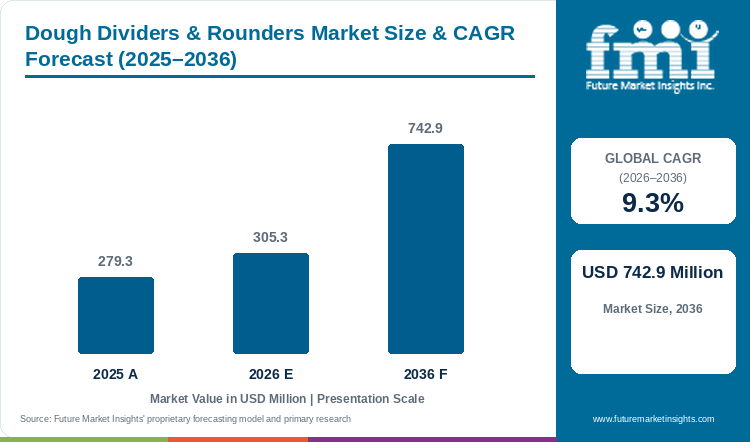
Key Market Trends & Insights
- By equipment type: Hydraulic Dividers represented 35.0% of 2026 equipment type demand. Pressure and release decide how a dough leaves the hopper and reaches rounding, so the mechanism has to match the formulation. The test is whether weight stays stable from the first load to the last.
- By capacity: 500-2,000 kg/hr accounted for 40.0% of 2026 capacity demand. Piece weight and proofing space set how much dividing capacity a bakery can use. It's tested by how many portion sizes the line runs in a shift without losing weight accuracy.
- By automation level: Fully Automatic / Robotic held 41.0% of 2026 automation level demand. Linked feeding, rounding and transfer keep spacing regular into the next stage. The test is how quickly a stopped conveyor clears without damaged or misplaced pieces.
Regional Highlights
- The UAE has the highest dough divider and rounder forecast at 10.5% CAGR through 2036, with portion accuracy and lower handling losses central to the equipment case.
- Saudi Arabia's 10.2% projection is followed by South Korea at 9.9% and the USA at 9.6%, whereas Japan's 8.3% rate is the lowest among the profiled countries.
Market Size & Forecast
Table 1: Dough Dividers & Rounders Market Size and Forecast (USD million), 2025 to 2036
| Market size and forecast | Value |
|---|---|
| 2025 Value (actual) | USD 279.3 million |
| Estimated market size in 2026 | USD 305.3 million |
| Projected market size by 2036 | USD 742.9 million |
| CAGR (2026-2036) | 9.3% |
The practical opportunity depends on whether a divider holds its weight setting across the doughs a bakery actually runs. Koenig’s September 2025 platform covers 28 to 280 g at up to 24,000 pieces per hour in a selected configuration.[1] Baker Perkins lists dedicated dividing and moulding machines in its general-bakery range,[4] and AMF and Puratos opened a joint pilot bakery in New Jersey in June 2025.[2] These offers widen the choice for a buyer, although a published weight range does not show how a sticky or fermented dough behaves at production speed. FDA manufacturing requirements add cleaning and upkeep obligations to every installation.[3] Consequently, actual demand will depend on whether dividers hold weight and release across the doughs in routine production without adding cleaning time.
Dough Dividers & Rounders Market is segmented by Equipment Type, Capacity, Automation Level, End User, Sales Channel and Region. The forecast period runs from 2026 to 2036.
Weight accuracy has to coexist with suitable dough handling. A divider can produce an even portion yet compress or release it in a way that complicates rounding and proofing. The mechanism must therefore suit the dough’s strength, hydration and fermentation stage. Koenig’s published 28 to 280 g range shows how one platform can address several product sizes.[1] A broad range is commercially valuable when it allows a bakery to produce more of its assortment on the same installation. The limit comes from the formulation: a weight setting alone does not establish whether a sticky, seeded or fermented dough will pass through the machine consistently.
The interaction with other dough processing systems gives application development an important role in sales. AMF and Puratos opened their joint pilot bakery in June 2025, combining ingredient and equipment expertise.[2] Following portions through rounding, proofing and baking can reveal whether a change in dividing pressure preserves the required bread structure. It can also show that a problem begins in mixing or dough rest. This narrows the investment to the operation responsible for the loss. For the supplier, the resulting specification connects the mechanism to a product outcome that the bakery can recognise in ordinary production.
Replacement can be limited to dividing or rounding when the adjoining equipment remains suitable. Baker Perkins’ general-bakery range includes dedicated dividing and moulding machines, illustrating the availability of separately specified stages.[4] Their installation still affects transfer height, piece spacing and the rate at which the next machine receives dough. Access for cleaning and service also occupies space. FDA’s manufacturing framework includes equipment condition and sanitary operations.[3] These requirements influence both the initial engineering bill and the time spent between production runs. A compact purchase can consequently involve a substantial change to the bakery’s handling routine, especially in an established line.
Table 2: Supporting Industry Indicators for the Dough Dividers & Rounders Market, 2025 to 2026 and current product specifications
| Indicator | Data point | Why it matters | Source |
|---|---|---|---|
| Wider equipment order activity | Bühler Consumer Foods orders declined 8.8% in 2025. | Efficiency and replacement projects compete for selective capital budgets. | [5] |
| Published portion-weight range | Koenig announced a dividing-and-rounding platform covering 28–280 g. | The stated range supports several product sizes within one platform. | [1] |
| Published piece rate | Koenig specified up to 24,000 pieces per hour in September 2025. | The available speed broadens the platform’s industrial applications. | [1] |
| Application-development facility | AMF and Puratos opened a joint pilot bakery in June 2025. | Dough handling can be examined alongside ingredients and later processing. | [2] |
| Dedicated equipment offer | Baker Perkins lists dividing and moulding machinery within its bakery range. | Separate stages create opportunities for targeted replacement projects. | [4] |
| Factory operating requirement | FDA CGMP requirements include equipment and sanitation. | Contact-part access affects routine maintenance and return to production. | [3] |
Demand Intensity Analysis
The dough dividers & rounders market is forecast to generate an additional USD 437.6 million in annual revenue between 2026 and 2036, growing at a 9.3% value CAGR. New automated installations, replacement of worn mechanisms and expansion into additional portion sizes provide separate sources of orders. Bühler’s Consumer Foods order intake fell 8.8% in 2025, which underlines the need for a disciplined capital case within the wider equipment sector.[5] For dividing and rounding, that case can be closely connected to the bakery’s dough and labour costs. Demand strengthens when equipment reduces repeated excess weight or operator intervention while preserving the dough required for proofing and baking.
The 500-2,000 kg/hr band represents USD 122.1 million in 2026. Its role changes with the assortment: small rolls and larger bread units require different piece rates to occupy the same production capacity. Koenig’s September 2025 platform, with a weight range of 28 to 280 g and output of up to 24,000 pieces per hour in a selected configuration, illustrates the breadth of specifications available.[1] The investment has to accommodate the products assigned to the line and the space available for proofing them. Higher portioning speed can support expansion when those later stages have room. Where they are already full, demand is more likely to concern weight control, handling or another product size.
Hydraulic dividers account for USD 106.9 million in 2026. Their demand is tied to the cost of controlling portion weight while preserving dough quality. A repeatable divide reduces the need for manual adjustment, but the pressure and release arrangement must fit the product. This gives recipe coverage commercial weight, because a mechanism that suits only part of the range leaves the remainder on other equipment. A bakery can justify renewal when its present mechanism requires frequent dusting, separation or weight correction across recurring runs. The benefit accumulates with production volume, making small persistent losses relevant to the purchase even where the plant is not adding another bread line.
Industrial bakeries contribute USD 125.2 million in 2026. Repeated runs make dough giveaway and interruptions at portioning visible in material and labour use. The supplier relationship also continues after installation because wear can change the divide and contact components need attention. Direct OEM sales, at USD 167.9 million, bring that technical responsibility into the original project. Its commercial importance is greatest where a divider, rounder and transfer system are being specified together. A failure in one of them can interrupt the entire make-up sequence, which gives dependable service value beyond the replacement cost of the individual part. Long-term sales are ultimately determined by whether a divider holds its portion weight through routine production.
Table 3: Demand Intensity Metrics for the Dough Dividers & Rounders Market, 2026 to 2036 with relevant industry comparisons
| Demand intensity metric | Value | Basis |
|---|---|---|
| Dough dividers & rounders value CAGR | 9.3% | Global market value, 2026 to 2036. |
| Broader equipment order change | −8.8% | Bühler Consumer Foods, full year 2025.[5] |
| Announced portion-weight range | 28–280 g | Koenig platform announcement, September 2025.[1] |
| Announced maximum piece rate | Up to 24,000 pieces/hour | Koenig platform specification; selected configuration.[1] |
| Hydraulic-divider revenue, 2026 | USD 106.9 million | Equipment Type category. |
| Industrial-bakery revenue, 2026 | USD 125.2 million | End User category. |
| Added revenue through 2036 | USD 437.6 million | Increase in market value between 2026 and 2036. |
Analyst Perspective
A divider earns a lasting place when it holds portion weight across the doughs a bakery runs without disrupting rounding and proofing. Suppliers that remove the weight corrections and cleaning stops win the replacement, while those selling piece rate alone lose it.
- Nandini Roy Choudhury, Principal Analyst at Future Market Insights
How is the dough dividers & rounders market segmented?
The dough dividers & rounders market is segmented by Equipment Type (Hydraulic dividers, Suction dividers, Divider-rounders, Volumetric systems), Capacity (500-2,000 kg/hr, Below 500 kg/hr, Above 2,000 kg/hr), Automation Level (Fully automatic / robotic, Semi-automatic, Manual), End User (Industrial bakeries, In-store & retail bakeries, Artisan bakeries, Foodservice / QSR central kitchens), and Sales Channel (Direct OEM sales, Dealers & distributors, Aftermarket & refurbished). Regionally, the market is segmented into North America, Latin America, Western Europe, Eastern Europe, East Asia, South Asia and Pacific, and Middle East and Africa.
Why do Hydraulic dividers lead the Equipment Type category?
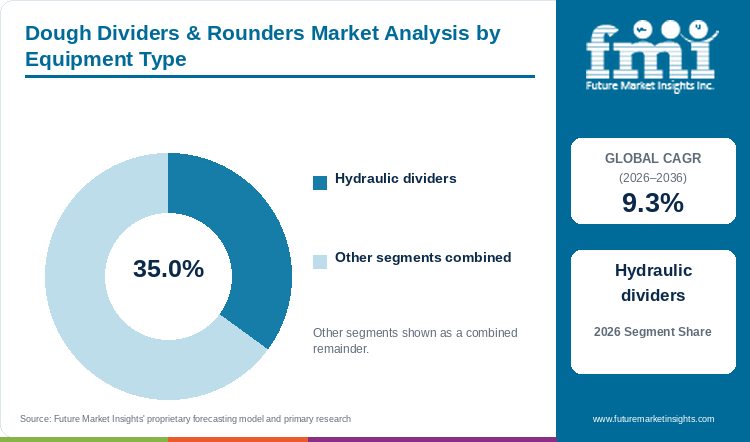
Hydraulic dividers lead with 35.0% of Equipment Type revenue in 2026.
Hydraulic pressure gives the divider a defined method of portioning, with suitability depending on the dough being handled. Hydration, strength and fermentation affect release and the compression a piece tolerates. Suction dividers and Volumetric systems use different feeding arrangements, while Divider-rounders combine two operations. Within bakery processing equipment, these choices influence material use as well as bread structure.
- Hydraulic dividers account for 35.0% of Equipment Type revenue in 2026.
- Pressure and release need to suit the dough’s hydration and fermentation stage.
What keeps 500-2,000 kg/hr at the centre of the Capacity category?
500-2,000 kg/hr leads with 40.0% of Capacity revenue in 2026.
Bakeries running several portion sizes place different demands on the same dividing mechanism. Smaller pieces occupy more positions in the handling sequence, while larger units raise mass output at a lower piece rate. The 500-2,000 kg/hr category covers a wide range of those workloads, and its value depends on the assortment allocated to it and the proofing and baking capacity behind it.
- 500-2,000 kg/hr accounts for 40.0% of Capacity revenue in 2026.
- Portion assortment and proofing capacity need to set the size of the dividing installation.
How does Fully automatic / robotic equipment lead Automation Level?
Fully automatic / robotic leads with 41.0% of Automation Level revenue in 2026.
Automated feeding and transfers reduce handling between dividing and rounding and keep spacing regular as pieces enter the next operation. Those benefits depend on dough staying within the machine’s processing range, since a stopped conveyor can interrupt the sequence. Semi-automatic equipment retains a role where a baker needs frequent hands-on adjustment or runs small batches.
- Fully automatic / robotic accounts for 41.0% of Automation Level revenue in 2026.
- Feeding and spacing need to give the following operation a consistent stream of portions.
Why are Industrial bakeries the primary End User?
Industrial bakeries lead with 41.0% of End User revenue in 2026.
Industrial bakeries spread small weight differences across long production runs, which makes portion control a direct material cost. Similar pieces also keep proofing and baking conditions consistent. More difficult doughs can require dedicated configuration or development work, and maintenance and component condition influence how long the initial performance is sustained.
- Industrial bakeries account for 41.0% of End User revenue in 2026.
- Weight control needs to hold through successive loads, since repeated excess accumulates into material cost.
Why is Direct OEM sales the leading Sales Channel?
Direct OEM sales hold 55.0% of Sales Channel revenue in 2026.
An industrial portioning project often combines dough development with line engineering, so the manufacturer may specify contact parts, rounder configuration and transfers within one order. Dealers & distributors provide another route where equipment is more standardised or local service is central. Aftermarket & refurbished machines can suit a lower initial budget when condition and parts availability match the requirement.
- Direct OEM sales hold 55.0% of Sales Channel revenue in 2026, bringing dough trials and line-interface decisions into the purchase.
- Technical scope needs to cover contact parts, rounder configuration and transfers.
What are the drivers, restraints and opportunities in the dough dividers & rounders market?
Driver: Better portion control improves the economics of repeated production
Consistent portioning protects dough cost and reduces corrections later in the line, and the gain compounds over repeated runs at constant bread volume. AMF and Puratos opened a joint pilot bakery in June 2025 to combine ingredient and equipment development.[2] Following a piece from divider to oven shows whether weight control also preserves the loaf. A supplier gains where excess dough recurs on every run and a trial can trace it to the divider.
Restraint: Dough variability and cleaning requirements complicate replacement
Dough entering a divider changes with flour properties, water addition, mixing and rest, and those changes can move pressure settings and release. A newly installed machine can then depend on adjustments made outside the portioning stage. FDA’s manufacturing guidance covers equipment, sanitation and process controls,[3] so hard-to-reach contact parts cost time between runs. A supplier gains where it can show that the machine holds weight through that variation without extra cleaning stops.
Opportunity: Modular upgrades can stabilise the complete dough preparation sequence
A specific weight-control problem can support a focused upgrade to an existing make-up line, provided the new divider or rounder fits the transfers and dough supply already in place. Temperature variation may instead direct spending to dough chillers and water metering systems before the portioning stage. Diagnosis therefore decides where the money goes. A supplier gains where it locates the source of the loss and sizes the equipment investment to it.
Which country CAGRs are profiled in the dough dividers & rounders market?
Table 4: Country growth outlook for the dough dividers & rounders market
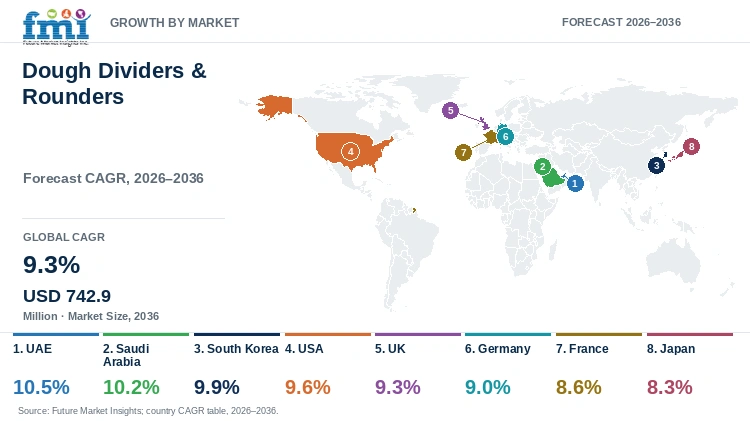
| Country | CAGR, 2026 to 2036 |
|---|---|
| UAE | 10.5% |
| Saudi Arabia | 10.2% |
| South Korea | 9.9% |
| USA | 9.6% |
| UK | 9.3% |
| Germany | 9.0% |
| France | 8.6% |
| Japan | 8.3% |
UAE
The UAE has the highest profiled CAGR at 10.5% for 2026 to 2036, above the global rate of 9.3%. The USDA Foreign Agricultural Service’s April 2026 report forecast wheat consumption at 1.65 million tonnes in 2026/27, up 3.0%. The report measures wheat use, not equipment demand, and 3.0% volume growth would not by itself support the value forecast, which depends on product mix and replacement. A central bakery supplying several outlets may need one dividing installation to cover different bread and roll weights, which can reduce the number of dedicated machines. However, a broad range pays only when each dough releases consistently after a weight change. Demand will depend on how many central bakeries consolidate their portion weights onto fewer machines.
Saudi Arabia
Saudi Arabia has a 10.2% CAGR outlook from 2026 to 2036, above the global rate of 9.3%. The USDA Foreign Agricultural Service’s April 2026 report put 2024 population growth at 4.7%, including about 1.5 million new expatriate workers. It names flat bread as the main wheat product but gives no figures on bakery capacity or equipment. In flatbread production, the weight of each dough ball helps decide the diameter and thickness of the finished piece. A divider-rounder therefore fixes a quality variable as well as a throughput rate. However, the press and oven that follow set the ceiling on output, whatever the divider can deliver. Demand will depend on how many new lines are specified as complete flatbread systems.
South Korea
South Korea is forecast at 9.9% CAGR over 2026 to 2036, above the global rate of 9.3%. The Korea Times reported in August 2026 that the Fair Trade Commission fined seven flour makers a combined KRW 671 billion for price-fixing between November 2019 and October 2025. The commission said flour prices rose by as much as 74.0% over that period. The ruling documents past prices, not current flour costs or bakery equipment spending. For bakery chains producing at scale, each gram of excess dough carries the cost of the main ingredient. However, if flour prices ease, the value of each gram saved falls. Demand will depend on whether chains keep investing in portion control once flour costs normalise.
USA
The USA is projected at 9.6% CAGR during 2026 to 2036, above the global rate of 9.3%. The Bureau of Labor Statistics put white pan bread at USD 1.830 per pound in September 2026, against USD 1.867 a year earlier. Monthly readings have stayed between USD 1.79 and USD 1.87 since June 2025. A shelf price that has barely moved leaves producers little room to pass on excess dough, though the series does not measure plant costs. The AMF-Puratos pilot bakery opened in New Jersey in June 2025 offers a setting for testing where a loss begins.[2] However, a pilot result has to be reproduced at production speed. Demand will depend on whether bread and bun producers can trace losses to portioning before they buy.
UK
The UK outlook is 9.3% CAGR for 2026 to 2036, in line with the global rate of 9.3%. The UK Government raised the National Living Wage 4.1% to GBP 12.71 an hour in April 2026. The rate is a pay floor, not a measure of bakery wages or equipment spending. Baker Perkins lists dedicated dividing and moulding machines within its general-bakery range,[4] so a factory can renew the portioning stage while keeping adjoining equipment. The commercial limit is the engineering at the connections: a change in height, speed or control signals can extend the project and delay the return to production. Demand will depend on whether a compatible replacement can remove manual correction without re-engineering the transfers.
Germany
Germany has a 9.0% CAGR forecast from 2026 to 2036, below the global rate of 9.3%. The VDMA reported in May 2026 that German bakery machinery production fell 1.6% to EUR 670 million in 2025. Food and packaging machinery overall rose 4.9% to almost EUR 17 billion. The figure covers all bakery machinery, not dividers, and includes equipment built for export markets as well as German bakeries. Koenig’s September 2025 platform announcement combines a broad portion range with its Easy Clean design,[1] which addresses the cost of setting sizes and cleaning between campaigns. However, a dedicated high-volume line may weigh sustained portion accuracy above range. Demand will depend on whether consolidating bakeries buy dividers that cover more products.
France
France is forecast at 8.6% CAGR over 2026 to 2036, below the global rate of 9.3%. The Observatoire de la formation des prix et des marges, citing CNGA data, reported that artisan bakeries’ personnel costs rose 9.0% in 2024, against 5.0% for raw-material purchases. Labour costs rose faster than ingredients, which raises the value of reducing hands-on work at the divider as well as the dough saved. The report does not cover equipment spending. For a bakery producing fermented crusty-bread dough, dividing pressure can affect the structure carried into proofing and baking. However, a replacement that saves labour but alters the crumb loses the product it was bought to protect. Demand will depend on whether gentler dividing cuts hands-on work without changing the loaf.
Japan
Japan is projected at 8.3% CAGR from 2026 to 2036, the lowest profiled rate and below the global 9.3%. The USDA Foreign Agricultural Service’s March 2026 Grain and Feed Annual forecast lower wheat imports in marketing year 2026/27, citing higher domestic production and lower feed demand. The report concerns wheat supply, not bread output or equipment. A change in the wheat source can shift flour properties, and the divider has to hold weight and release through that change. Combined dividing and rounding places both operations in one machine, while separate stages spread the service work. However, the choice rests on how reliably the arrangement returns to production after attention to contact parts. Demand will depend on whether settings hold when flour lots change.
Who are the notable companies in the dough dividers & rounders market?
AMF Bakery Systems; Baker Perkins; Koenig; MECATHERM; Rheon Automatic Machinery
AMF Bakery Systems offers bread make-up equipment, Baker Perkins dedicated bread dividers, Koenig dividing and rounding systems, and MECATHERM industrial dividing equipment. Rheon Automatic Machinery provides dough division through its stress-free handling platform. These approaches differ in how they portion and move dough, giving bakeries options for matching the mechanism to the recipe and line.
In food processing equipment, portioning is unusually sensitive to the material entering the machine. Supplier competition therefore depends on familiarity with the customer’s dough as well as the mechanical design. A broad recipe range, suitable contact surfaces and dependable technical support can distinguish offers with similar headline speeds.
Competitive Benchmarking: Dough Dividers & Rounders Market
Table 5: Company capabilities in the dough dividers & rounders market
| Company | Relevant equipment | Procurement focus |
|---|---|---|
| AMF Bakery Systems | Bread make-up and automated dough handling | Coordination with the wider bread or bun line |
| Baker Perkins | Accurist2.1 Washdown Divider | Weight control and access for cleaning[4] |
| Koenig | Dough dividing and rounding systems | Product flexibility and accessible cleaning design[1] |
| MECATHERM | M-NS II divider | Handling requirements for industrial bread recipes |
| Rheon Automatic Machinery | V4-S.F.D. dough dividing platform | Continuous dough handling and portioning configuration |
Key Developments in the Dough Dividers & Rounders Market
- Koenig presented a new generation of dividing and rounding equipment in September 2025. The announcement combined a compact footprint and broad weight range with its Easy Clean design.[1]
- AMF Bakery Systems and Puratos opened a joint pilot bakery in New Jersey in June 2025, bringing ingredient and machinery trials together to examine formulation and automated handling.[2]
Key Players in the Dough Dividers & Rounders Market
- AMF Bakery Systems
- Baker Perkins
- Koenig
- MECATHERM
- Rheon Automatic Machinery
Dough Dividers & Rounders Market - Report Scope
Table 6: Report scope for the dough dividers & rounders market
| Coverage field | Report scope |
|---|---|
| Market breakdown | Equipment Type; Capacity; Automation Level; End User; Sales Channel |
| Quantitative Units | USD Million |
| Market Definition | Revenue from new dough dividers, rounders and divider-rounder machinery sold across the named segments, including the identifiable value of these units in integrated lines. Refurbished dividers and rounders sold as equipment are included under their channel; servicing, spare parts, general mixers, ovens, unrelated forming machinery and finished baked goods are excluded. |
| Regions Covered | North America; Latin America; Western Europe; Eastern Europe; East Asia; South Asia and Pacific; Middle East and Africa |
| Countries Covered | UAE; Saudi Arabia; South Korea; USA; UK; Germany; France; Japan |
| Key Companies Profiled | AMF Bakery Systems; Baker Perkins; Koenig; MECATHERM; Rheon Automatic Machinery |
| Forecast Period | 2026 to 2036 |
| Approach | Market assessment supported by official technical and regulatory publications, company product information and country operating conditions. |
Dough Dividers & Rounders Market - Research Methodology
Table 7: Research approach for the dough dividers & rounders market
| Method | Approach |
|---|---|
| Market definition | Dough dividers, rounders and combined divider-rounders are assessed as equipment. Identifiable units in integrated lines are considered within their attributable equipment scope. |
| Technical research | Manufacturer product information and official announcements are reviewed for dividing mechanisms, rounding arrangements, cleaning access and relevant application trials. |
| Country assessment | Country outlooks are interpreted through bakery operating models, product variety, installation requirements and the practical conditions for commissioning and maintenance. |
| Consistency review | Market values, segment shares and country growth rates are checked for consistent presentation. Equipment capabilities and dated developments are distinguished from analytical purchasing implications. |
Dough Dividers & Rounders Market by Segments
Equipment Type
- Hydraulic dividers
- Suction dividers
- Divider-rounders
- Volumetric systems
Capacity
- 500-2,000 kg/hr
- Below 500 kg/hr
- Above 2,000 kg/hr
Automation Level
- Fully automatic / robotic
- Semi-automatic
- Manual
End User
- Industrial bakeries
- In-store & retail bakeries
- Artisan bakeries
- Foodservice / QSR central kitchens
Sales Channel
- Direct OEM sales
- Dealers & distributors
- Aftermarket & refurbished
Dough Dividers & Rounders Market by Region
- North America
- United States
- Canada
- Latin America
- Brazil
- Mexico
- Argentina
- Chile
- Western Europe
- Germany
- France
- United Kingdom
- Italy
- Spain
- Benelux
- Nordics
- Eastern Europe
- Poland
- Czech Republic
- Romania
- Hungary
- East Asia
- China
- Japan
- South Korea
- South Asia and Pacific
- India
- ASEAN
- Australia and New Zealand
- Middle East and Africa
- GCC Countries
- South Africa
- Türkiye
- Israel
Research Sources and Bibliography
- [1] Koenig. (2025, September 22). Release: The next generation in dividing and rounding.
- [2] AMF Bakery Systems. (2025, June 9). AMF and Puratos launch joint pilot bakery facility to accelerate commercial baking innovation.
- [3] U.S. Food and Drug Administration. (n.d.). Current Good Manufacturing Practices for food and dietary supplements.
- [4] Baker Perkins. (n.d.). General bakery equipment.
- [5] Bühler Group. (2026, February 16). Bühler strengthens its market position.
This Report Answers
- What is the value of the Dough Dividers & Rounders Market in 2026 and 2036?
- Which labour and portion-control pressures support bakery equipment demand?
- Why do Hydraulic dividers lead the Equipment Type category?
- Why is 500-2,000 kg/hr the leading Capacity band?
- How do the eight profiled country growth rates differ from 2026 to 2036?
- Which suppliers offer relevant dividing and rounding equipment, and how should their proposals be compared?
Frequently Asked Questions
How big is the Dough Dividers & Rounders Market in 2026, and what is expected by 2036?
The market is valued at USD 305.3 Million in 2026 and forecast at USD 742.9 Million by 2036. Equipment spending reflects the need for controlled dough portioning and connected make-up operations.
What is the forecast CAGR for the Dough Dividers & Rounders Market?
The market is projected to grow at a 9.3% CAGR from 2026 to 2036. Purchasing decisions centre on consistent portion weight, suitable dough handling and automation that fits the bakery’s production schedule.
Which Equipment Type segment leads the market in 2026?
Hydraulic dividers lead Equipment Type with 35.0% in 2026. Their pressure and release characteristics influence suitability for the intended dough.
Which Capacity band represents the largest segment?
500-2,000 kg/hr leads Capacity with 40.0% in 2026. Portion sizes and the capacity of proofing and baking influence the installation required.
Which profiled countries have the highest growth rates?
The UAE leads at 10.5% CAGR, followed by Saudi Arabia at 10.2%, from 2026 to 2036.
Which companies supply dough dividing and rounding equipment?
The report profiles AMF Bakery Systems, Baker Perkins, Koenig, MECATHERM and Rheon Automatic Machinery. They offer different portioning and dough-handling configurations for bakery production.
Preview the report firsthand - request a free sample
Get SampleGet the brochure for pricing and purchase details.
Get PDFTable of Content
- Key Takeaways
- Market Size and CAGR
- Top Growth Driver
- Fastest Growing Segment
- Leading Region
- Key Companies
- Emerging Opportunities
- Executive Summary
- Global Market Outlook
- Demand-side Trends
- Supply-side Trends
- Technology Roadmap Analysis
- Analysis and Recommendations
- Analyst Perspective (What is happening? Why now? What should investors know?)
- Key Questions Answered
- How large is the market?
- What is the CAGR?
- What are key trends?
- Which region dominates?
- Who are the leaders?
- Market Overview
- Market Coverage / Taxonomy
- Market Definition / Scope / Limitations
- Research Methodology
- Chapter Orientation
- Analytical Lens and Working Hypotheses
- Market Structure, Signals, and Trend Drivers
- Benchmarking and Cross-market Comparability
- Market Sizing, Forecasting, and Opportunity Mapping
- Research Design and Evidence Framework
- Desk Research Programme (Secondary Evidence)
- Expert Input and Fieldwork (Primary Evidence)
- Tooling, Models, and Reference Databases
- Data Engineering and Model Build
- Quality Assurance and Audit Trail
- Market Background
- Market Dynamics (Drivers, Restraints, Opportunity, Trends)
- Scenario Forecast (Optimistic, Likely, Conservative)
- Impact Analysis
- AI Impact
- Sustainability Impact
- Regulatory Impact
- Technology Impact
- Consumer / Buyer Analysis
- Purchase Drivers
- Adoption Barriers
- Buyer Journey
- Opportunity Map Analysis
- Product Life Cycle Analysis
- Supply Chain Analysis
- Investment Feasibility Matrix
- Value Chain Analysis
- PESTLE and Porter's Analysis
- Regulatory Landscape
- Regional Parent Market Outlook
- Production and Consumption Statistics
- Import and Export Statistics
- Global Market Analysis and Forecast, 2021 to 2036
- Historical Market Size Value (USD Million) Analysis, 2021 to 2025
- Current and Future Market Size Value (USD Million) Projections, 2026 to 2036
- Y-o-Y Growth Trend Analysis
- Absolute $ Opportunity Analysis
- Global Market Pricing Analysis, 2021 to 2036
- Global Market Analysis and Forecast, By Equipment Type, 2021 to 2036
- Introduction / Key Findings
- Historical Market Size Value (USD Million) Analysis By Equipment Type, 2021 to 2025
- Current and Future Market Size Value (USD Million) Analysis and Forecast By Equipment Type, 2026 to 2036
- Hydraulic dividers
- Suction dividers
- Divider-rounders
- Volumetric systems
- Y-o-Y Growth Trend Analysis By Equipment Type, 2021 to 2025
- Absolute $ Opportunity Analysis By Equipment Type, 2026 to 2036
- Global Market Analysis and Forecast, By Capacity, 2021 to 2036
- Introduction / Key Findings
- Historical Market Size Value (USD Million) Analysis By Capacity, 2021 to 2025
- Current and Future Market Size Value (USD Million) Analysis and Forecast By Capacity, 2026 to 2036
- 500-2,000 kg/hr
- Below 500 kg/hr
- Above 2,000 kg/hr
- Y-o-Y Growth Trend Analysis By Capacity, 2021 to 2025
- Absolute $ Opportunity Analysis By Capacity, 2026 to 2036
- Global Market Analysis and Forecast, By Automation Level, 2021 to 2036
- Introduction / Key Findings
- Historical Market Size Value (USD Million) Analysis By Automation Level, 2021 to 2025
- Current and Future Market Size Value (USD Million) Analysis and Forecast By Automation Level, 2026 to 2036
- Fully automatic / robotic
- Semi-automatic
- Manual
- Y-o-Y Growth Trend Analysis By Automation Level, 2021 to 2025
- Absolute $ Opportunity Analysis By Automation Level, 2026 to 2036
- Global Market Analysis and Forecast, By End User, 2021 to 2036
- Introduction / Key Findings
- Historical Market Size Value (USD Million) Analysis By End User, 2021 to 2025
- Current and Future Market Size Value (USD Million) Analysis and Forecast By End User, 2026 to 2036
- Industrial bakeries
- In-store & retail bakeries
- Artisan bakeries
- Foodservice / QSR central kitchens
- Y-o-Y Growth Trend Analysis By End User, 2021 to 2025
- Absolute $ Opportunity Analysis By End User, 2026 to 2036
- Global Market Analysis and Forecast, By Sales Channel, 2021 to 2036
- Introduction / Key Findings
- Historical Market Size Value (USD Million) Analysis By Sales Channel, 2021 to 2025
- Current and Future Market Size Value (USD Million) Analysis and Forecast By Sales Channel, 2026 to 2036
- Direct OEM sales
- Dealers & distributors
- Aftermarket & refurbished
- Y-o-Y Growth Trend Analysis By Sales Channel, 2021 to 2025
- Absolute $ Opportunity Analysis By Sales Channel, 2026 to 2036
- Global Market Analysis and Forecast, By Region, 2021 to 2036
- Introduction
- Historical Market Size Value (USD Million) Analysis By Region, 2021 to 2025
- Current Market Size Value (USD Million) Analysis and Forecast By Region, 2026 to 2036
- North America
- Latin America
- Western Europe
- Eastern Europe
- East Asia
- South Asia and Pacific
- Middle East and Africa
- Market Attractiveness Analysis By Region
- North America Market Analysis and Forecast, By Country, 2021 to 2036
- Historical Market Size Value (USD Million) Trend Analysis By Market Taxonomy, 2021 to 2025
- Market Size Value (USD Million) Forecast By Market Taxonomy, 2026 to 2036
- By Country
- United States
- Canada
- By Equipment Type
- By Capacity
- By Automation Level
- By End User
- By Sales Channel
- By Country
- Market Attractiveness Analysis
- By Country
- By Equipment Type
- By Capacity
- By Automation Level
- By End User
- By Sales Channel
- Key Takeaways
- Latin America Market Analysis and Forecast, By Country
- Historical Market Size Value (USD Million) Trend Analysis By Market Taxonomy, 2021 to 2025
- Market Size Value (USD Million) Forecast By Market Taxonomy, 2026 to 2036
- By Country
- Brazil
- Mexico
- Argentina
- Chile
- By Equipment Type
- By Capacity
- By Automation Level
- By End User
- By Sales Channel
- By Country
- Market Attractiveness Analysis
- By Country
- By Equipment Type
- By Capacity
- By Automation Level
- By End User
- By Sales Channel
- Key Takeaways
- Western Europe Market Analysis and Forecast, By Country
- Historical Market Size Value (USD Million) Trend Analysis By Market Taxonomy, 2021 to 2025
- Market Size Value (USD Million) Forecast By Market Taxonomy, 2026 to 2036
- By Country
- Germany
- France
- United Kingdom
- Italy
- Spain
- Benelux
- Nordics
- By Equipment Type
- By Capacity
- By Automation Level
- By End User
- By Sales Channel
- By Country
- Market Attractiveness Analysis
- By Country
- By Equipment Type
- By Capacity
- By Automation Level
- By End User
- By Sales Channel
- Key Takeaways
- Eastern Europe Market Analysis and Forecast, By Country
- Historical Market Size Value (USD Million) Trend Analysis By Market Taxonomy, 2021 to 2025
- Market Size Value (USD Million) Forecast By Market Taxonomy, 2026 to 2036
- By Country
- Poland
- Czech Republic
- Romania
- Hungary
- By Equipment Type
- By Capacity
- By Automation Level
- By End User
- By Sales Channel
- By Country
- Market Attractiveness Analysis
- By Country
- By Equipment Type
- By Capacity
- By Automation Level
- By End User
- By Sales Channel
- Key Takeaways
- East Asia Market Analysis and Forecast, By Country
- Historical Market Size Value (USD Million) Trend Analysis By Market Taxonomy, 2021 to 2025
- Market Size Value (USD Million) Forecast By Market Taxonomy, 2026 to 2036
- By Country
- China
- Japan
- South Korea
- By Equipment Type
- By Capacity
- By Automation Level
- By End User
- By Sales Channel
- By Country
- Market Attractiveness Analysis
- By Country
- By Equipment Type
- By Capacity
- By Automation Level
- By End User
- By Sales Channel
- Key Takeaways
- South Asia and Pacific Market Analysis and Forecast, By Country
- Historical Market Size Value (USD Million) Trend Analysis By Market Taxonomy, 2021 to 2025
- Market Size Value (USD Million) Forecast By Market Taxonomy, 2026 to 2036
- By Country
- India
- ASEAN
- Australia and New Zealand
- By Equipment Type
- By Capacity
- By Automation Level
- By End User
- By Sales Channel
- By Country
- Market Attractiveness Analysis
- By Country
- By Equipment Type
- By Capacity
- By Automation Level
- By End User
- By Sales Channel
- Key Takeaways
- Middle East and Africa Market Analysis and Forecast, By Country
- Historical Market Size Value (USD Million) Trend Analysis By Market Taxonomy, 2021 to 2025
- Market Size Value (USD Million) Forecast By Market Taxonomy, 2026 to 2036
- By Country
- GCC Countries
- South Africa
- Türkiye
- Israel
- By Equipment Type
- By Capacity
- By Automation Level
- By End User
- By Sales Channel
- By Country
- Market Attractiveness Analysis
- By Country
- By Equipment Type
- By Capacity
- By Automation Level
- By End User
- By Sales Channel
- Key Takeaways
- Key Countries Market Analysis
- United States
- Pricing Analysis
- Market Share Analysis, 2025
- By Equipment Type
- By Capacity
- By Automation Level
- By End User
- By Sales Channel
- Canada
- Pricing Analysis
- Market Share Analysis, 2025
- By Equipment Type
- By Capacity
- By Automation Level
- By End User
- By Sales Channel
- Mexico
- Pricing Analysis
- Market Share Analysis, 2025
- By Equipment Type
- By Capacity
- By Automation Level
- By End User
- By Sales Channel
- Brazil
- Pricing Analysis
- Market Share Analysis, 2025
- By Equipment Type
- By Capacity
- By Automation Level
- By End User
- By Sales Channel
- Chile
- Pricing Analysis
- Market Share Analysis, 2025
- By Equipment Type
- By Capacity
- By Automation Level
- By End User
- By Sales Channel
- Germany
- Pricing Analysis
- Market Share Analysis, 2025
- By Equipment Type
- By Capacity
- By Automation Level
- By End User
- By Sales Channel
- United Kingdom
- Pricing Analysis
- Market Share Analysis, 2025
- By Equipment Type
- By Capacity
- By Automation Level
- By End User
- By Sales Channel
- Italy
- Pricing Analysis
- Market Share Analysis, 2025
- By Equipment Type
- By Capacity
- By Automation Level
- By End User
- By Sales Channel
- Spain
- Pricing Analysis
- Market Share Analysis, 2025
- By Equipment Type
- By Capacity
- By Automation Level
- By End User
- By Sales Channel
- France
- Pricing Analysis
- Market Share Analysis, 2025
- By Equipment Type
- By Capacity
- By Automation Level
- By End User
- By Sales Channel
- India
- Pricing Analysis
- Market Share Analysis, 2025
- By Equipment Type
- By Capacity
- By Automation Level
- By End User
- By Sales Channel
- ASEAN
- Pricing Analysis
- Market Share Analysis, 2025
- By Equipment Type
- By Capacity
- By Automation Level
- By End User
- By Sales Channel
- Australia and New Zealand
- Pricing Analysis
- Market Share Analysis, 2025
- By Equipment Type
- By Capacity
- By Automation Level
- By End User
- By Sales Channel
- China
- Pricing Analysis
- Market Share Analysis, 2025
- By Equipment Type
- By Capacity
- By Automation Level
- By End User
- By Sales Channel
- Japan
- Pricing Analysis
- Market Share Analysis, 2025
- By Equipment Type
- By Capacity
- By Automation Level
- By End User
- By Sales Channel
- South Korea
- Pricing Analysis
- Market Share Analysis, 2025
- By Equipment Type
- By Capacity
- By Automation Level
- By End User
- By Sales Channel
- Poland
- Pricing Analysis
- Market Share Analysis, 2025
- By Equipment Type
- By Capacity
- By Automation Level
- By End User
- By Sales Channel
- Hungary
- Pricing Analysis
- Market Share Analysis, 2025
- By Equipment Type
- By Capacity
- By Automation Level
- By End User
- By Sales Channel
- Türkiye
- Pricing Analysis
- Market Share Analysis, 2025
- By Equipment Type
- By Capacity
- By Automation Level
- By End User
- By Sales Channel
- South Africa
- Pricing Analysis
- Market Share Analysis, 2025
- By Equipment Type
- By Capacity
- By Automation Level
- By End User
- By Sales Channel
- UAE
- Pricing Analysis
- Market Share Analysis, 2025
- By Equipment Type
- By Capacity
- By Automation Level
- By End User
- By Sales Channel
- Saudi Arabia
- Pricing Analysis
- Market Share Analysis, 2025
- By Equipment Type
- By Capacity
- By Automation Level
- By End User
- By Sales Channel
- United States
- Market Structure Analysis
- Competition Dashboard
- Competition Benchmarking
- Market Share Analysis of Top Players
- By Regional
- By Equipment Type
- By Capacity
- By Automation Level
- By End User
- By Sales Channel
- Emerging Startups
- Innovation Benchmarking
- Competition Analysis
- Competition Deep Dive
- AMF Bakery Systems
- Overview
- Product Portfolio
- Profitability by Market Segments
- Sales Footprint
- Strategy Overview
- Marketing Strategy
- Product Strategy
- Channel Strategy
- Baker Perkins
- Koenig
- MECATHERM
- Rheon Automatic Machinery
- AMF Bakery Systems
- Case Studies
- Success Stories
- Recent Developments
- Competition Deep Dive
- Assumptions & Acronyms Used


