

- Market Size (2026)
- USD 212.2 Mn
- Forecast (2036)
- USD 555.4 Mn
- CAGR (2026 to 2036)
- 10.1%
How big is Sourdough Fermentation Systems Market in 2026?
The market was valued at USD 192.7 Million in 2025 and is expected to reach USD 212.2 Million in 2026, with growth at a 10.1% CAGR from 2026 to 2036 taking its value to USD 555.4 Million by 2036.
A bakery buys sourdough fermentation equipment to have starter ready when its mixing line needs it, with the culture at the intended condition as well as the required volume. Feeding, temperature control and transfer to the mixer need to fit the time available for cleaning and the timing of successive dough batches, since an upstream delay can leave downstream equipment waiting or force recipe adjustments. Suppliers should demonstrate the installation using the buyer’s flour, recipes and realistic production volumes, including retrofits where existing mixers and proofers remain in use. Automation can make settings repeatable across shifts when operators are trained and maintenance remains accessible. Smaller premises may need compact culture handling, while larger plants need coordinated dosing across several lines. Ambient conditions and ingredient temperatures influence both arrangements. A useful proposal explains routine operation, cleaning and recipe changes as one process, allowing the buyer to judge whether fermentation becomes more dependable without adding unnecessary holding or disruption elsewhere in production. [5]
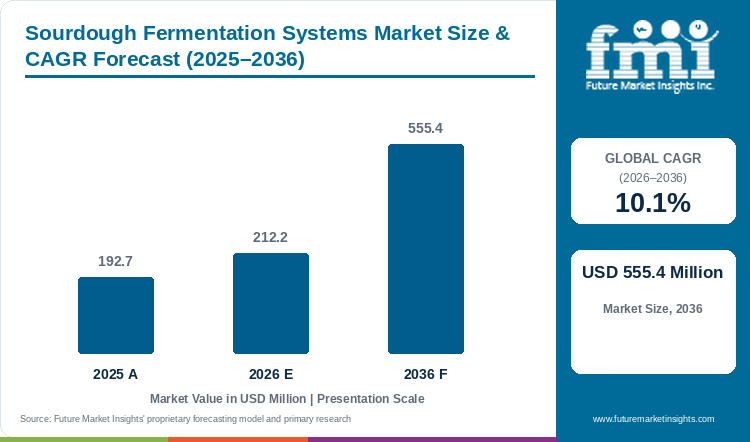
Key Market Trends & Insights
- Liquid levain holds 38.0% of type in 2026, connecting active-culture preparation with metered transfer while dried ingredients meet different storage and recipe needs.
- 500-2,000 kg/hr holds 43.0% of capacity in 2026, providing a mid-capacity choice that needs to match maturation time and the downstream mixing schedule.
- Fully automatic / robotic holds 42.0% of automation level in 2026, linking feeding, temperature adjustment, maturation and hygienic transfer within one repeatable operating sequence.
- Industrial bakeries hold 41.0% of end user in 2026, with buyers assessing consistent fermentation alongside compatibility with existing mixers, dividers and proofers.
Regional Highlights
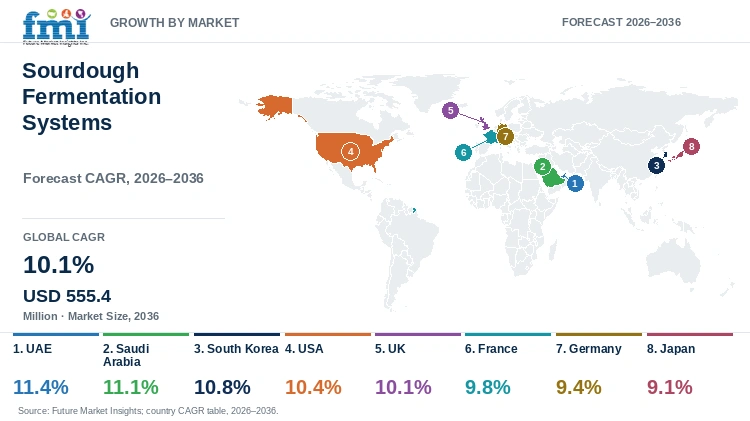
- UAE has the highest profiled CAGR at 11.4% during 2026–2036.
- The next two profiled growth rates are Saudi Arabia at 11.1% and South Korea at 10.8% over the same period.
Market Size & Forecast
| Metric | Value |
|---|---|
| 2025 market value | USD 192.7 Million |
| 2026 market estimate | USD 212.2 Million |
| 2036 market forecast | USD 555.4 Million |
| Forecast CAGR, 2026–2036 | 10.1% |
The market includes sourdough fermentation equipment for culture preparation, maturation and transfer within the specified capacity and automation categories. Finished bread, cultures sold without qualifying equipment and general bakery machinery are excluded.
Sourdough equipment serves bakery products producers that need fermentation to fit a repeatable production schedule rather than depend on individual operator judgment.
Bakery production readiness
| Documented operating context | Source |
|---|---|
| AMF and Puratos announced a joint pilot bakery in June 2025 for commercial baking development. | [1] |
| IFF announced POWERFRESH ACE 2000 in August 2025 as a bread fresh-keeping solution. | [2] |
| Corbion introduced Verdad Essence WH 100 in April 2025 as a cultured-wheat solution for bakery preservation. | [3] |
| FSANZ reviewed the first year of mandatory plain-English allergen labelling in March 2025. | [4] |
Analyst Perspective
A fermentation system needs to reproduce the intended culture condition through normal shifts while fitting the bakery’s mixing and cleaning schedule. Trials using the customer’s recipes and changeovers give buyers a clearer view of daily output than vessel capacity or an ideal single-batch demonstration alone.
- Nandini Roy Choudhury, Principal Analyst at Future Market Insights
How is the sourdough fermentation systems market segmented?
Type covers Liquid levain, Dried sourdough, Ready starters and Flavor concentrates. Capacity covers 500-2,000 kg/hr, Below 500 kg/hr and Above 2,000 kg/hr. Automation Level covers Fully automatic / robotic, Semi-automatic and Manual. End User covers Industrial bakeries, In-store & retail bakeries, Artisan bakeries and Foodservice / QSR central kitchens. Sales Channel covers Direct OEM sales, Dealers & distributors and Aftermarket & refurbished.
Demand associated with ready-to-eat food puts pressure on bakeries to deliver consistent batches even when the underlying culture requires time and careful handling.
Why does Liquid levain lead type demand?
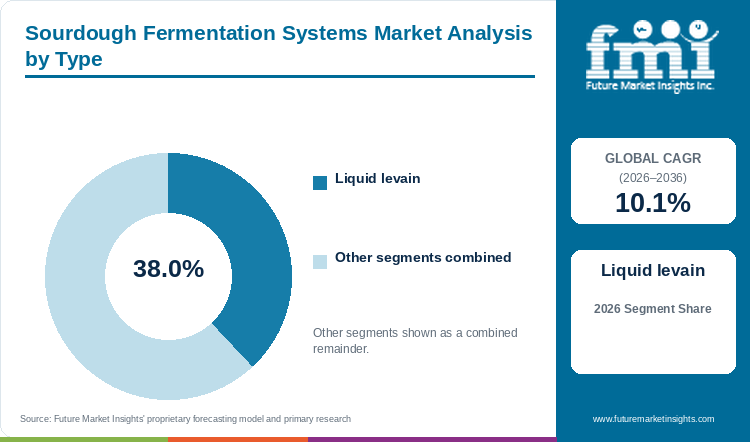
Liquid levain: 38.0% of type in 2026.
Liquid levain can be metered from a maturation vessel into the dough mixer, connecting starter preparation with the wider production process. That arrangement needs control over temperature and residence time before transfer, together with cleaning access for surfaces holding an active culture and product residues. Dried sourdough offers different storage options and may serve chiefly as an ingredient, while ready starters and flavor concentrates meet other preparation or sensory needs. Buyers of a liquid system therefore need to assess feeding, maturation and dosing together against the dough schedule, rather than choose a vessel on volume alone.
- The Liquid levain segment accounts for 38.0% of type in 2026.
- Uniform temperature and accessible cleaning help maintain the culture condition between refreshment and transfer to the mixer.
Why does 500-2,000 kg/hr lead capacity demand?
500-2,000 kg/hr: 43.0% of capacity in 2026.
A 500-2,000 kg/hr installation can supply a bakery line while allowing fermentation time to be allocated across several recipes, between smaller facilities below 500 kg/hr and higher-volume operations above 2,000 kg/hr. The suitable rating depends on how long the culture needs to mature and when the downstream line consumes it. Oversizing can add holding and sanitation work, while undersizing can leave the mixer short of prepared starter, making matched flow rates more useful than the largest available capacity.
- The 500-2,000 kg/hr segment accounts for 43.0% of capacity in 2026.
- Reading Bakery Systems documents its Exact MX mixing range as 50 to 2,000 kg/hr.
What are the drivers, restraints, and opportunities in the sourdough fermentation systems market?
Repeatable fermentation reduces process variation
Bakeries need the culture to reach the required condition consistently across shifts. Recording time and temperature can make those results easier to reproduce than relying solely on individual operator judgment. The investment case is strongest when trial batches show less variation in the buyer’s own doughs. Reliable fermentation also makes the handoff to mixing easier to schedule. These are practical production benefits that can be assessed through rejects and line interruptions. They provide a clearer reason to invest than broad taste or health claims that the equipment itself cannot establish.
Culture management and cleaning complicate scale-up
Fermentation systems add wet-contact surfaces and planned residence periods to the plant’s hygiene schedule. A sound mechanical design can still produce inconsistent starter when cleaning access or temperature measurement is inadequate. Operators need training that connects those tasks with culture management. The installation must also communicate with downstream recipe and dosing controls. Buyers should establish how maintenance and cleaning fit between production runs before selecting equipment. Otherwise an improvement in fermentation capacity may create a new interruption elsewhere in the bakery.
Integrated controls support multi-line production
A retrofit can add monitored tanks and metered starter feed while retaining capable mixing and shaping equipment. Baker Perkins describes mixers that accept pumped ferments. AMF offers controlled fermentation rooms but those serve a different function from a dedicated levain fermenter. Suppliers need to define the relevant connection and test it with the customer’s process. Pilot work can establish the settings needed for a particular recipe before a full installation. Cleaning compatibility and practical commissioning support help turn that trial into a system the bakery can operate routinely rather than a successful demonstration batch alone.
Where output enters frozen baked goods channels, fermentation settings must remain compatible with downstream freezing, storage and final baking.
Which country and market CAGRs are profiled for sourdough fermentation systems?
| Country | CAGR |
|---|---|
| UAE | 11.4% |
| Saudi Arabia | 11.1% |
| South Korea | 10.8% |
| USA | 10.4% |
| UK | 10.1% |
| France | 9.8% |
| Germany | 9.4% |
| Japan | 9.1% |
Country-wise Analysis
UAE
- Hot ambient conditions make temperature control an important part of a UAE sourdough installation. Insulated holding and chilled ingredient handling may be needed for the selected recipes. The UAE has the fastest profiled rate at an 11.4% CAGR from 2026 to 2036. Buyers should assess cleaning records and service arrangements alongside the fermentation vessel. A dependable sanitation routine gives the bakery a clearer operating plan once the equipment is installed. The system needs to maintain the intended culture condition during normal shifts as well as during commissioning.
Saudi Arabia
- Saudi production teams need starter residence time to fit the schedule of their mixing lines. Saudi Arabia is forecast to grow at an 11.1% CAGR over 2026 to 2036. A warm operating environment requires the process settings to be tested for each formula. Staff also need visibility into culture temperature so that a delay can be addressed before it reaches proofing and baking. Hygienic design and maintenance access should be part of the purchasing decision. Automation is useful when the local team can operate it consistently rather than depend on repeated intervention from the supplier.
South Korea
- A centralized South Korean bakery may need one starter installation to serve several dough recipes. South Korea has a 10.8% CAGR for 2026 to 2036. The equipment must support those changes without uncontrolled variation in the culture or gaps in quality records. Recipe trials are therefore more useful than a throughput figure taken from a different plant. Responsive service and operator training also matter when schedules change frequently. A supplier should demonstrate how the system returns to the intended condition between recipes and delivers starter at the required time.
USA
- American industrial bakeries can test fermentation systems against existing mixing schedules and reject rates. US demand is forecast to grow at a 10.4% CAGR from 2026 to 2036. An appealing flavor result will not justify an installation that reduces line output or complicates sanitation. Suppliers need to translate pilot recipes into workable production settings, showing how dosing fits the plant’s staffing and how normal cleaning and recipe changes will be handled during commissioning. This makes the capital decision about repeatable daily production rather than a single batch prepared under ideal conditions.
UK
- UK bakeries considering a fermentation retrofit need to weigh stable output against cleaning downtime and utility requirements. The UK outlook is forecast to grow at a 10.1% CAGR between 2026 and 2036. Producer-price data for fresh bakery manufacturing provide context for that cost discipline. Facilities with capable mixers and proofers may prefer incremental automation to wholesale replacement. A proposal should explain how the new starter equipment connects to those assets and what service is available. The buyer can then assess preparation savings without assuming that flavor improvements alone cover the investment.
France
- French bakers may want automated culture handling while retaining their own flavor objectives and finishing methods. France is assigned 9.8% CAGR from 2026 to 2036. Suppliers need to distinguish settings controlled by the system from decisions left to the operator. Compact premises also require accessible cleaning without an excessive footprint. Industrial users need the fermented material to preserve dough behavior through shaping and proofing. Trials on the actual flour and recipe are necessary because a successful setting for one loaf will not automatically suit another.
Germany
- German capacity-expansion projects need to account for recipe diversity as well as larger starter batches. Germany is forecast to grow at a 9.4% CAGR during 2026 to 2036. A large vessel may reduce flexibility when products change frequently and require cleaning between runs. Modular equipment and dependable dosing can offer a better fit in that situation. Suppliers also need to preserve established bread characteristics and work within the existing plant layout. The useful comparison is how the whole fermentation process changes daily work rather than which proposal offers the highest nominal volume.
Japan
- Japanese bakery users may need controlled starter batches within a limited production footprint. Japan records a 9.1% CAGR for 2026 to 2036. Repeatable temperature and dosing are important when a precise product specification has to be maintained after flour changes. Cleaning access needs to remain practical within the compact layout, with local service capability helping address culture interruptions that could affect several later runs. The equipment should therefore be assessed for recovery and routine operation as well as its ability to achieve the target batch during a trial.
Who are the notable companies in the sourdough fermentation systems market?
AMF Bakery Systems; DIOSNA; Zeppelin Systems; HB-Technik; DAXNER
Fermentation suppliers need to connect culture preparation with dosing and transfer into the bakery’s dough line. The customer has to clean and maintain those stages within its normal schedule, making vessel size useful when the complete process delivers starter at the required condition and time.
Competitive Benchmarking: Sourdough Fermentation Systems Market
| Participant | Commercial focus | Buyer qualification priority |
|---|---|---|
| AMF Bakery Systems | Integrated bakery processing | Fermentation-to-line coordination |
| DIOSNA | Dough and pre-dough systems | Culture handling and sanitation access |
| Zeppelin Systems | Ingredient and dough process systems | Dosing accuracy and vessel integration |
| HB-Technik | Automated bakery ingredient systems | Batch control and recipe repeatability |
| DAXNER | Food ingredient handling systems | Hygienic transfer and system integration |
Key Developments in the Sourdough Fermentation Systems Market
- AMF and Puratos announced a joint pilot bakery in June 2025 for commercial baking development. [1]
- IFF announced POWERFRESH ACE 2000 in August 2025 as a bread fresh-keeping solution. [2]
Key Players in the Sourdough Fermentation Systems Market
- AMF Bakery Systems
- DIOSNA
- Zeppelin Systems
- HB-Technik
- DAXNER
Sourdough Fermentation Systems Market - Report Scope
| Coverage field | Report scope |
|---|---|
| Market breakdown | Type; Capacity; Automation Level; End User; Sales Channel; Region |
| Quantitative unit | USD Million |
| Market definition | The market includes sourdough fermentation equipment for culture preparation, maturation and transfer within the specified capacity and automation categories. Finished bread, cultures sold without qualifying equipment and general bakery machinery are excluded. |
| Regions covered | North America; Latin America; Western Europe; Eastern Europe; East Asia; South Asia and Pacific; Middle East and Africa |
| Countries / markets profiled | UAE; Saudi Arabia; South Korea; USA; UK; France; Germany; Japan |
| Key companies profiled | AMF Bakery Systems; DIOSNA; Zeppelin Systems; HB-Technik; DAXNER |
| Base year / forecast period | 2026 / 2026–2036 |
| Estimate coverage | 2025 and 2026 market estimates; 2036 forecast; segment shares and country / market CAGRs. |
Sourdough Fermentation Systems Market - Research Methodology
| Method | Application |
|---|---|
| Market definition | The analysis follows the stated product or service boundary and distinguishes direct category revenue from adjacent activities. |
| Secondary research | Official technical, regulatory, research and company publications provide the documented operating context and recent developments cited in this report. |
| Forecast and segmentation | Market estimates, segment shares and geographic forecasts are presented as analytical estimates within the stated commercial scope. |
| Competitive assessment | Participants are compared by their relevant products or services, commercial role and buyer qualification requirements. |
| Interpretation | The assessment considers purchasing conditions and the scope of the documented product, service or performance claim. |
Sourdough Fermentation Systems Market by Segments
Type
- Liquid levain
- Dried sourdough
- Ready starters
- Flavor concentrates
Capacity
- 500-2,000 kg/hr
- Below 500 kg/hr
- Above 2,000 kg/hr
Automation Level
- Fully automatic / robotic
- Semi-automatic
- Manual
End User
- Industrial bakeries
- In-store & retail bakeries
- Artisan bakeries
- Foodservice / QSR central kitchens
Sales Channel
- Direct OEM sales
- Dealers & distributors
- Aftermarket & refurbished
Sourdough Fermentation Systems Market by Region
- North America
- United States
- Canada
- Latin America
- Brazil
- Mexico
- Argentina
- Chile
- Western Europe
- Germany
- France
- United Kingdom
- Italy
- Spain
- Benelux
- Nordics
- Eastern Europe
- Poland
- Czech Republic
- Romania
- Hungary
- East Asia
- China
- Japan
- South Korea
- South Asia and Pacific
- India
- ASEAN
- Australia and New Zealand
- Middle East and Africa
- GCC Countries
- South Africa
- Türkiye
- Israel
Research Sources and Bibliography
- [1] AMF Bakery Systems. (2025, June 9). AMF and Puratos launch joint pilot bakery facility to accelerate commercial baking innovation.
- [2] IFF. (2025, August 13). POWERFRESH ACE 2000 bread fresh-keeping solution launch.
- [3] Corbion. (2025, April 21). Corbion introduces Verdad Essence WH 100.
- [4] Food Standards Australia New Zealand. (2025, March 5). Plain English Allergen Labelling: One year of clearer, safer food labels.
- [5] Future Market Insights. (2026). Sourdough Fermentation Systems Market: Global industry analysis and opportunity assessment, 2026–2036.
This Report Answers
- How large is the sourdough fermentation systems market in 2026?
- What value and CAGR are forecast through 2036?
- Which type segment leads in 2026?
- Which capacity segment has the largest share?
- Which profiled country or market has the fastest forecast growth?
- Which participants are covered in the competitive assessment?
Frequently Asked Questions
How large is the sourdough fermentation systems market in 2026?
The market was valued at USD 192.7 Million in 2025 and is expected to reach USD 212.2 Million in 2026.
What value and CAGR are forecast through 2036?
The market is projected to reach USD 555.4 Million by 2036, with a 10.1% CAGR during 2026–2036.
Which type segment leads in 2026?
The Liquid levain segment accounts for 38.0% of type in 2026.
Which capacity segment has the largest share?
The 500-2,000 kg/hr segment accounts for 43.0% of capacity in 2026.
Which profiled country or market has the fastest forecast growth?
UAE has the highest profiled CAGR at 11.4% during 2026–2036.
Which participants are covered in the competitive assessment?
The assessment covers AMF Bakery Systems, DIOSNA, Zeppelin Systems, HB-Technik and DAXNER.
Preview the report firsthand - request a free sample
Get SampleGet the brochure for pricing and purchase details.
Get PDFTable of Content
- Key Takeaways
- Market Size and CAGR
- Top Growth Driver
- Fastest Growing Segment
- Leading Region
- Key Companies
- Emerging Opportunities
- Executive Summary
- Global Market Outlook
- Demand-side Trends
- Supply-side Trends
- Technology Roadmap Analysis
- Analysis and Recommendations
- Analyst Perspective (What is happening? Why now? What should investors know?)
- Key Questions Answered
- How large is the market?
- What is the CAGR?
- What are key trends?
- Which region dominates?
- Who are the leaders?
- Market Overview
- Market Coverage / Taxonomy
- Market Definition / Scope / Limitations
- Research Methodology
- Chapter Orientation
- Analytical Lens and Working Hypotheses
- Market Structure, Signals, and Trend Drivers
- Benchmarking and Cross-market Comparability
- Market Sizing, Forecasting, and Opportunity Mapping
- Research Design and Evidence Framework
- Desk Research Programme (Secondary Evidence)
- Expert Input and Fieldwork (Primary Evidence)
- Tooling, Models, and Reference Databases
- Data Engineering and Model Build
- Quality Assurance and Audit Trail
- Market Background
- Market Dynamics (Drivers, Restraints, Opportunity, Trends)
- Scenario Forecast (Optimistic, Likely, Conservative)
- Impact Analysis
- AI Impact
- Sustainability Impact
- Regulatory Impact
- Technology Impact
- Consumer / Buyer Analysis
- Purchase Drivers
- Adoption Barriers
- Buyer Journey
- Opportunity Map Analysis
- Product Life Cycle Analysis
- Supply Chain Analysis
- Investment Feasibility Matrix
- Value Chain Analysis
- PESTLE and Porter's Analysis
- Regulatory Landscape
- Regional Parent Market Outlook
- Production and Consumption Statistics
- Import and Export Statistics
- Global Market Analysis and Forecast, 2021 to 2036
- Historical Market Size Value (USD Million) Analysis, 2021 to 2025
- Current and Future Market Size Value (USD Million) Projections, 2026 to 2036
- Y-o-Y Growth Trend Analysis
- Absolute $ Opportunity Analysis
- Global Market Pricing Analysis, 2021 to 2036
- Global Market Analysis and Forecast, By Type, 2021 to 2036
- Introduction / Key Findings
- Historical Market Size Value (USD Million) Analysis By Type, 2021 to 2025
- Current and Future Market Size Value (USD Million) Analysis and Forecast By Type, 2026 to 2036
- Liquid levain
- Dried sourdough
- Ready starters
- Flavor concentrates
- Y-o-Y Growth Trend Analysis By Type, 2021 to 2025
- Absolute $ Opportunity Analysis By Type, 2026 to 2036
- Global Market Analysis and Forecast, By Capacity, 2021 to 2036
- Introduction / Key Findings
- Historical Market Size Value (USD Million) Analysis By Capacity, 2021 to 2025
- Current and Future Market Size Value (USD Million) Analysis and Forecast By Capacity, 2026 to 2036
- 500-2,000 kg/hr
- Below 500 kg/hr
- Above 2,000 kg/hr
- Y-o-Y Growth Trend Analysis By Capacity, 2021 to 2025
- Absolute $ Opportunity Analysis By Capacity, 2026 to 2036
- Global Market Analysis and Forecast, By Automation Level, 2021 to 2036
- Introduction / Key Findings
- Historical Market Size Value (USD Million) Analysis By Automation Level, 2021 to 2025
- Current and Future Market Size Value (USD Million) Analysis and Forecast By Automation Level, 2026 to 2036
- Fully automatic / robotic
- Semi-automatic
- Manual
- Y-o-Y Growth Trend Analysis By Automation Level, 2021 to 2025
- Absolute $ Opportunity Analysis By Automation Level, 2026 to 2036
- Global Market Analysis and Forecast, By End User, 2021 to 2036
- Introduction / Key Findings
- Historical Market Size Value (USD Million) Analysis By End User, 2021 to 2025
- Current and Future Market Size Value (USD Million) Analysis and Forecast By End User, 2026 to 2036
- Industrial bakeries
- In-store & retail bakeries
- Artisan bakeries
- Foodservice / QSR central kitchens
- Y-o-Y Growth Trend Analysis By End User, 2021 to 2025
- Absolute $ Opportunity Analysis By End User, 2026 to 2036
- Global Market Analysis and Forecast, By Sales Channel, 2021 to 2036
- Introduction / Key Findings
- Historical Market Size Value (USD Million) Analysis By Sales Channel, 2021 to 2025
- Current and Future Market Size Value (USD Million) Analysis and Forecast By Sales Channel, 2026 to 2036
- Direct OEM sales
- Dealers & distributors
- Aftermarket & refurbished
- Y-o-Y Growth Trend Analysis By Sales Channel, 2021 to 2025
- Absolute $ Opportunity Analysis By Sales Channel, 2026 to 2036
- Global Market Analysis and Forecast, By Region, 2021 to 2036
- Introduction
- Historical Market Size Value (USD Million) Analysis By Region, 2021 to 2025
- Current Market Size Value (USD Million) Analysis and Forecast By Region, 2026 to 2036
- North America
- Latin America
- Western Europe
- Eastern Europe
- East Asia
- South Asia and Pacific
- Middle East and Africa
- Market Attractiveness Analysis By Region
- North America Market Analysis and Forecast, By Country, 2021 to 2036
- Historical Market Size Value (USD Million) Trend Analysis By Market Taxonomy, 2021 to 2025
- Market Size Value (USD Million) Forecast By Market Taxonomy, 2026 to 2036
- By Country
- United States
- Canada
- By Type
- By Capacity
- By Automation Level
- By End User
- By Sales Channel
- By Country
- Market Attractiveness Analysis
- By Country
- By Type
- By Capacity
- By Automation Level
- By End User
- By Sales Channel
- Key Takeaways
- Latin America Market Analysis and Forecast, By Country
- Historical Market Size Value (USD Million) Trend Analysis By Market Taxonomy, 2021 to 2025
- Market Size Value (USD Million) Forecast By Market Taxonomy, 2026 to 2036
- By Country
- Brazil
- Mexico
- Argentina
- Chile
- By Type
- By Capacity
- By Automation Level
- By End User
- By Sales Channel
- By Country
- Market Attractiveness Analysis
- By Country
- By Type
- By Capacity
- By Automation Level
- By End User
- By Sales Channel
- Key Takeaways
- Western Europe Market Analysis and Forecast, By Country
- Historical Market Size Value (USD Million) Trend Analysis By Market Taxonomy, 2021 to 2025
- Market Size Value (USD Million) Forecast By Market Taxonomy, 2026 to 2036
- By Country
- Germany
- France
- United Kingdom
- Italy
- Spain
- Benelux
- Nordics
- By Type
- By Capacity
- By Automation Level
- By End User
- By Sales Channel
- By Country
- Market Attractiveness Analysis
- By Country
- By Type
- By Capacity
- By Automation Level
- By End User
- By Sales Channel
- Key Takeaways
- Eastern Europe Market Analysis and Forecast, By Country
- Historical Market Size Value (USD Million) Trend Analysis By Market Taxonomy, 2021 to 2025
- Market Size Value (USD Million) Forecast By Market Taxonomy, 2026 to 2036
- By Country
- Poland
- Czech Republic
- Romania
- Hungary
- By Type
- By Capacity
- By Automation Level
- By End User
- By Sales Channel
- By Country
- Market Attractiveness Analysis
- By Country
- By Type
- By Capacity
- By Automation Level
- By End User
- By Sales Channel
- Key Takeaways
- East Asia Market Analysis and Forecast, By Country
- Historical Market Size Value (USD Million) Trend Analysis By Market Taxonomy, 2021 to 2025
- Market Size Value (USD Million) Forecast By Market Taxonomy, 2026 to 2036
- By Country
- China
- Japan
- South Korea
- By Type
- By Capacity
- By Automation Level
- By End User
- By Sales Channel
- By Country
- Market Attractiveness Analysis
- By Country
- By Type
- By Capacity
- By Automation Level
- By End User
- By Sales Channel
- Key Takeaways
- South Asia and Pacific Market Analysis and Forecast, By Country
- Historical Market Size Value (USD Million) Trend Analysis By Market Taxonomy, 2021 to 2025
- Market Size Value (USD Million) Forecast By Market Taxonomy, 2026 to 2036
- By Country
- India
- ASEAN
- Australia and New Zealand
- By Type
- By Capacity
- By Automation Level
- By End User
- By Sales Channel
- By Country
- Market Attractiveness Analysis
- By Country
- By Type
- By Capacity
- By Automation Level
- By End User
- By Sales Channel
- Key Takeaways
- Middle East and Africa Market Analysis and Forecast, By Country
- Historical Market Size Value (USD Million) Trend Analysis By Market Taxonomy, 2021 to 2025
- Market Size Value (USD Million) Forecast By Market Taxonomy, 2026 to 2036
- By Country
- GCC Countries
- South Africa
- Türkiye
- Israel
- By Type
- By Capacity
- By Automation Level
- By End User
- By Sales Channel
- By Country
- Market Attractiveness Analysis
- By Country
- By Type
- By Capacity
- By Automation Level
- By End User
- By Sales Channel
- Key Takeaways
- Key Countries Market Analysis
- United States
- Pricing Analysis
- Market Share Analysis, 2025
- By Type
- By Capacity
- By Automation Level
- By End User
- By Sales Channel
- Canada
- Pricing Analysis
- Market Share Analysis, 2025
- By Type
- By Capacity
- By Automation Level
- By End User
- By Sales Channel
- Mexico
- Pricing Analysis
- Market Share Analysis, 2025
- By Type
- By Capacity
- By Automation Level
- By End User
- By Sales Channel
- Brazil
- Pricing Analysis
- Market Share Analysis, 2025
- By Type
- By Capacity
- By Automation Level
- By End User
- By Sales Channel
- Chile
- Pricing Analysis
- Market Share Analysis, 2025
- By Type
- By Capacity
- By Automation Level
- By End User
- By Sales Channel
- Germany
- Pricing Analysis
- Market Share Analysis, 2025
- By Type
- By Capacity
- By Automation Level
- By End User
- By Sales Channel
- United Kingdom
- Pricing Analysis
- Market Share Analysis, 2025
- By Type
- By Capacity
- By Automation Level
- By End User
- By Sales Channel
- Italy
- Pricing Analysis
- Market Share Analysis, 2025
- By Type
- By Capacity
- By Automation Level
- By End User
- By Sales Channel
- Spain
- Pricing Analysis
- Market Share Analysis, 2025
- By Type
- By Capacity
- By Automation Level
- By End User
- By Sales Channel
- France
- Pricing Analysis
- Market Share Analysis, 2025
- By Type
- By Capacity
- By Automation Level
- By End User
- By Sales Channel
- India
- Pricing Analysis
- Market Share Analysis, 2025
- By Type
- By Capacity
- By Automation Level
- By End User
- By Sales Channel
- ASEAN
- Pricing Analysis
- Market Share Analysis, 2025
- By Type
- By Capacity
- By Automation Level
- By End User
- By Sales Channel
- Australia and New Zealand
- Pricing Analysis
- Market Share Analysis, 2025
- By Type
- By Capacity
- By Automation Level
- By End User
- By Sales Channel
- China
- Pricing Analysis
- Market Share Analysis, 2025
- By Type
- By Capacity
- By Automation Level
- By End User
- By Sales Channel
- Japan
- Pricing Analysis
- Market Share Analysis, 2025
- By Type
- By Capacity
- By Automation Level
- By End User
- By Sales Channel
- South Korea
- Pricing Analysis
- Market Share Analysis, 2025
- By Type
- By Capacity
- By Automation Level
- By End User
- By Sales Channel
- Poland
- Pricing Analysis
- Market Share Analysis, 2025
- By Type
- By Capacity
- By Automation Level
- By End User
- By Sales Channel
- Hungary
- Pricing Analysis
- Market Share Analysis, 2025
- By Type
- By Capacity
- By Automation Level
- By End User
- By Sales Channel
- Türkiye
- Pricing Analysis
- Market Share Analysis, 2025
- By Type
- By Capacity
- By Automation Level
- By End User
- By Sales Channel
- South Africa
- Pricing Analysis
- Market Share Analysis, 2025
- By Type
- By Capacity
- By Automation Level
- By End User
- By Sales Channel
- UAE
- Pricing Analysis
- Market Share Analysis, 2025
- By Type
- By Capacity
- By Automation Level
- By End User
- By Sales Channel
- Saudi Arabia
- Pricing Analysis
- Market Share Analysis, 2025
- By Type
- By Capacity
- By Automation Level
- By End User
- By Sales Channel
- United States
- Market Structure Analysis
- Competition Dashboard
- Competition Benchmarking
- Market Share Analysis of Top Players
- By Regional
- By Type
- By Capacity
- By Automation Level
- By End User
- By Sales Channel
- Emerging Startups
- Innovation Benchmarking
- Competition Analysis
- Competition Deep Dive
- AMF Bakery Systems
- Overview
- Product Portfolio
- Profitability by Market Segments
- Sales Footprint
- Strategy Overview
- Marketing Strategy
- Product Strategy
- Channel Strategy
- DIOSNA
- Zeppelin Systems
- HB-Technik
- DAXNER
- AMF Bakery Systems
- Case Studies
- Success Stories
- Recent Developments
- Competition Deep Dive
- Assumptions & Acronyms Used


