

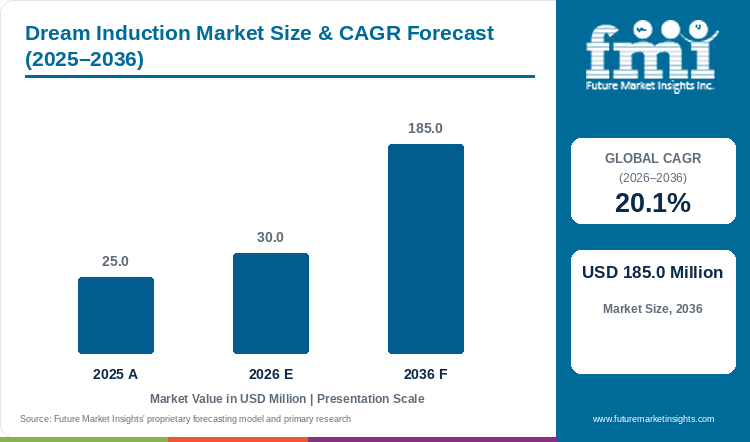
- Market Size (2026)
- USD 30.0 Mn
- Forecast (2036)
- USD 185.0 Mn
- CAGR (2026 to 2036)
- 20.1%
How Big is the Dream Induction Market in 2026?
Sales of dream induction technology are valued at USD 30.0 million in 2026, against USD 25.0 million in 2025, as per FMI.
FMI values the dream induction market at USD 30.0 million in 2026 compared with USD 25.0 million in 2025. Sales are forecast to reach USD 185.0 million by 2036 at a 20.1% CAGR. The category is moving beyond simple light-cue masks toward systems that combine sleep-stage detection with timed stimulation. The UK Government Office for Science reported in February 2025 that commercial neurotechnology is increasingly being explored in wellness. It also noted progress in smaller sensors and AI while warning that movement from laboratory work to commercial use remains difficult. [1]
Current research also shows why timing matters. Radboud University reported that its team is testing lucid-dream induction at home with wearable EEG and REM-specific stimulation. Many of these systems use sensing methods similar to wearable sleep trackers but add a cue or stimulation layer intended to influence dream awareness. [2]
Key Takeaways
- By Product Type, Hardware is projected to account for 65.0% of market revenue in 2026.
- Within Product Type, Software is expected to account for 35.0% of market revenue in 2026.
- The USA is expected to record the fastest country CAGR at 22.6% from 2026 to 2036.
- Prophetic, REMspace and INSPEC are among the notable commercial platforms. MIT Media Lab and Monash University also contribute research systems for dream induction.
Analyst Perspective
“Today, dream-induction systems are still limited by how accurately they can identify sleep stages and deliver cues without waking the user. Over the forecast period, adoption is likely to depend more on better sensing and cue timing than on adding more stimulation features.”
- Rahul Pandita, Principal Consultant, Future Market Insights
How is the Dream Induction Market Segmented?
FMI segments the dream induction market by Product Type, Induction Method, Delivery Mode, Application and Country.
By Product Type, the market is segmented into Hardware and Software. Induction Method includes Sensory Cueing, Neurostimulation, Cognitive and Digital Protocols, and Multimodal Closed-loop Systems. Delivery Mode includes Wearable or Head-mounted, Contactless or Room-based, Mobile or Web-based, and Hybrid Systems. Application includes Lucid Dream Induction, Targeted Dream Incubation, Dream Content Guidance, and Research and Experimental Dream Engineering. By Country, the market is analyzed across the USA, UK, Netherlands, South Korea, Japan, Australia, Canada and Germany and 40+ countries.
Why does Hardware lead demand within the Product Type category?
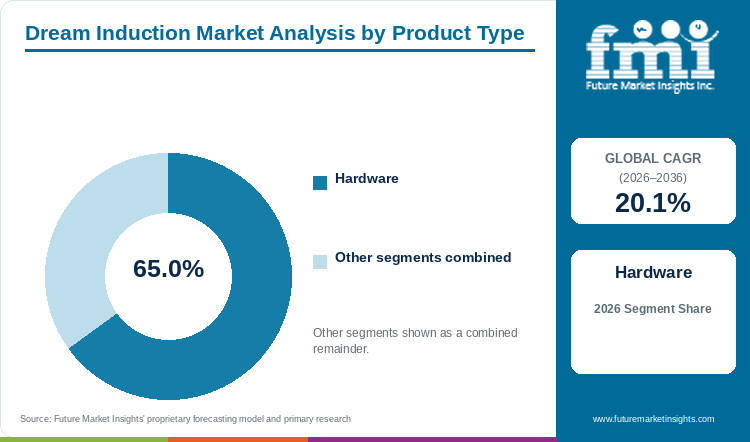
Hardware is projected to account for 65.0% of Product Type revenue in 2026.
Hardware is likely to lead over the forecast period because these systems need sensors to detect the right sleep stage and deliver cues at the right time. Current designs use EEG, eye movement or motion sensing together with light, sound, vibration or neurostimulation. This places dream-induction devices close to the wider brain computing interfaces field where sensing and feedback are combined in one system.
- By Product Type, Hardware is projected to account for 65.0% of market revenue in 2026.
- Software is expected to account for 35.0% of Product Type revenue in 2026 and can deliver audio or visual cueing without a dedicated stimulation device.
What drives demand within the Induction Method category?
Sensory cueing is estimated to hold 46.0% of Induction Method revenue in 2026.
Sensory cueing leads because sounds and other external cues can be used during sleep without more complex brain-stimulation equipment. Neurostimulation and closed-loop systems are developing quickly but require more advanced sensing and precise timing. [5]
- Sensory Cueing uses sound, light or vibration during sleep to influence dream content or increase the chance of lucid awareness. These cues are usually timed to a suitable sleep stage so they can be noticed without fully waking the sleeper.
- Neurostimulation and Multimodal Closed-loop Systems use brain or sleep-state signals to decide when stimulation should be delivered. Closed-loop systems continuously read signals such as EEG and adjust the timing of auditory, electrical or other stimulation based on the sleeper’s current state.
What shapes demand within the Delivery Mode category?
Wearable or Head-mounted systems are estimated to account for 56.0% of Delivery Mode revenue in 2026.
Wearable systems lead due to the fact that dream induction often depends on knowing when the user has entered the right stage of sleep. Sensors worn on the head or body can track signals such as brain activity or movement and then trigger sound, vibration or neurostimulation at the required time. Keeping sensing and cue delivery in the same device also allows the system to respond when the sleeper's state changes.
Contactless systems can make overnight use more comfortable because the user does not need to wear electrodes or a headband. Their limitation is that they may have less direct access to the signals used for precise sleep-stage detection. Mobile and web-based systems are easier to distribute and can deliver timed audio protocols at much lower hardware cost. MIT's work on targeted dream incubation shows that audio cues can also be delivered through a web interface without a wearable sleep-staging device.
- Wearable or Head-mounted systems are estimated to hold 56.0% of Delivery Mode revenue in 2026. They can place sensing and stimulation close to the user and support real-time cue timing.
- Contactless systems reduce the discomfort of wearing equipment during sleep. They are better suited to approaches that do not require direct electrical or neural stimulation.
- Mobile or Web-based systems lower the cost of participation and make audio-based dream-incubation protocols easier to distribute. Their role is likely to expand as software becomes better at working with data from phones, smart speakers and connected sleep devices.
What drives use within the Application category?
Lucid Dream Induction is estimated to account for 52.0% of Application revenue in 2026.
Lucid dream induction leads because it has the clearest consumer use case. The aim is to help a sleeping person recognize that a dream is taking place while remaining asleep. Systems may use sound, light, vibration or neurostimulation during suitable sleep stages. The technical challenge is timing. A cue delivered too early may have little effect while a stronger or poorly timed cue can wake the user.
Targeted Dream Incubation has a narrower purpose. Instead of trying to create dream awareness, it introduces a chosen theme before or during sleep and studies whether that theme later appears in dream content. MIT's Dormio work has used timed auditory cues for this purpose and has examined links between dream content and creativity.
Research and experimental dream-engineering applications go further by studying how sleep-stage detection, cue timing and stimulation affect memory, cognition and dream content. These applications remain more concentrated in research settings because they require controlled protocols and more precise measurement.
- Lucid Dream Induction is estimated to hold 52.0% of Application revenue in 2026. Consumer systems mainly use this approach to increase dream awareness and in some cases support greater control within the dream.
- Targeted Dream Incubation uses selected words, sounds or themes to influence what a person dreams about rather than simply making the person aware of the dream.
- Research and Experimental Dream Engineering uses controlled stimulation and sleep monitoring to study how external cues interact with dreaming, memory and cognition.
What are the Drivers, Restraints, and Opportunities in the Dream Induction Market?
Driver: Better sensing improves cue timing. Restraint: Reliable dream induction is still difficult to prove. Opportunity: Software can lower the cost of trying dream-incubation methods.
- Driver: Demand comes from people who want to experience lucid dreams more often and with greater control. Lucid dreaming is already familiar to a large potential user base, but it occurs irregularly for most people. This creates a clear use case for systems that try to induce the state on demand rather than waiting for it to occur naturally. Research indicates that about 55% of adults have experienced a lucid dream at least once, while only a smaller share experience them regularly. [1]
- Restraint: The market still lacks a method that works reliably across users and nights. A person may follow the same protocol several times and get different results. That weakens the value proposition for a consumer device because buyers are paying for repeatable induction rather than occasional success. Radboud University notes that lucid dreaming remains relatively rare and that researchers are still working on reliable induction methods for home use. [2]
- Opportunity: Software could move part of the market beyond dedicated headsets. Some dream-incubation methods need a well-timed cue rather than direct brain stimulation. MIT has demonstrated targeted dream incubation using timed audio through a web-based system. This creates room for AI-powered sleep technologies that identify the appropriate sleep stage and trigger the cue automatically. [5]
Medical positioning creates a separate commercial route. A recreational product can be sold around dream awareness or dream-content experiences. A product that claims to treat insomnia or another condition faces a much higher evidence burden and moves closer to the regulatory environment of the broader neurostimulation market.
Which country CAGRs are profiled in the Dream Induction Market?
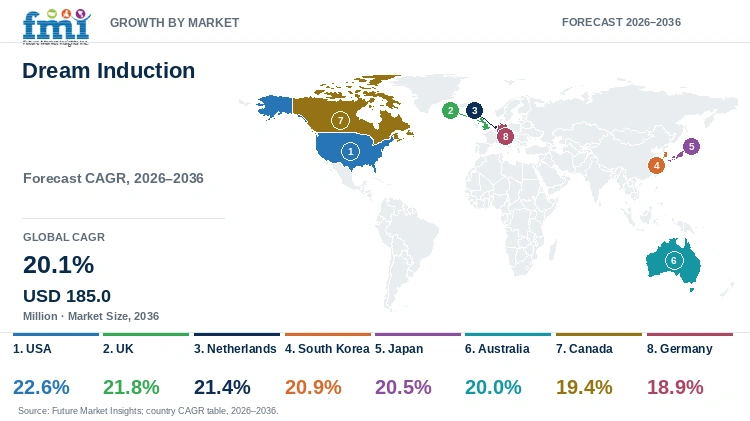
| Country | CAGR |
|---|---|
| USA | 22.6% |
| UK | 21.8% |
| Netherlands | 21.4% |
| South Korea | 20.9% |
| Japan | 20.5% |
| Australia | 20.0% |
| Canada | 19.4% |
| Germany | 18.9% |
Country CAGRs are FMI analyst estimates for 2026 to 2036.
How do country-level CAGRs compare in the Dream Induction Market?
Country growth will depend on whether a market has active dream research, relevant neurotechnology development or a workable route for sleep-related digital products. These factors affect how quickly new systems can move from research into testing and commercial use. They do not mean that every sleep or neurotechnology product belongs within the dream induction market.
- USA: The USA has both commercial dream-induction development and a large university research base in sleep, neuroscience and neurotechnology. This gives developers access to research partners, technical talent and early users. It also supports work across wearable sensing, stimulation and software-led approaches.
- UK: The UK has an active policy focus on neurotechnology including wearable and non-medical applications. This matters for dream-induction developers because many products sit between consumer wellness and more regulated neurological uses. Clearer policy treatment can make product development and testing easier to plan.
- Netherlands: Research activity includes at-home lucid-dream induction using wearable EEG and stimulation timed to REM sleep. This is directly relevant to the market because it addresses one of the main technical problems in dream induction: identifying the right sleep stage and delivering a cue without waking the user.
- South Korea: South Korea has updated rules for digital medical products and guidance related to insomnia digital therapeutics. This gives developers a clearer route for software that monitors sleep or delivers digital interventions. Dream-induction products making medical claims would still need to meet the relevant evidence and regulatory requirements.
- Japan: Japan has an established route for software used in insomnia treatment. This is important for sleep-related digital products because developers can see how software is evaluated when it moves beyond wellness and makes a treatment claim.
- Australia: Australia has direct research on wearable stimulation methods intended to influence lucid dreaming. This gives the market a local research base focused on the core mechanism rather than on general sleep tracking alone.
- Canada: Canada has funded research on lucid dreaming and REM sleep through 2030. Continued research funding can support better understanding of when lucid dreams occur and how they may be influenced. That work is relevant to future induction methods even if commercial adoption remains at an earlier stage.
- Germany: Germany has an established reimbursement route for qualifying digital health applications. For evidence-backed sleep software this can reduce the gap between regulatory approval and paid clinical use. Dream-induction products would only benefit from this route if they meet the required medical and evidence standards.
Country-wise Analysis
- Dream induction demand in the USA is projected to rise at 22.6% CAGR through 2036. The country has activity across both research and product development. MIT has worked on targeted dream incubation, while Prophetic is developing a closed-loop wearable that combines neural sensing with focused ultrasound. Together, these efforts give the market a stronger base for testing different induction methods and moving some of them toward commercial use. [6]
- The UK dream induction market is expected to expand at 21.8% CAGR through 2036. Neurotechnology is gradually moving beyond clinical settings into wellness and consumer use. The UK Government Office for Science highlighted this shift in 2025 and also pointed to progress in smaller sensors and AI. For dream-induction products, this supports the development of lighter wearable systems that can monitor sleep and deliver stimulation without starting from a medical-use model. [1]
- Dream induction activity in the Netherlands is projected to grow at 21.4% CAGR through 2036. Radboud University is studying lucid-dream induction in both sleep laboratories and home settings using wearable EEG and stimulation during REM sleep. The home setting is especially relevant because commercial products will eventually need to identify the right sleep stage without laboratory equipment. This work therefore addresses a practical problem that dream-induction systems still need to solve. [2]
- South Korea is estimated to expand at 20.9% CAGR through 2036. MFDS updated its digital therapeutic review guidance in May 2025 and has also issued guidance for insomnia applications. These rules are not specific to dream induction, but they provide a clearer route for sleep-related software that moves from general wellness into a medical claim. This can become relevant as more dream-related products add monitoring, behavioral or therapeutic functions. [11]
- Japan is expected to record a 20.5% CAGR through 2036. PMDA's treatment of SUSMED insomnia software shows that software-based sleep interventions can move through formal medical-device review. The immediate relevance to dream induction is limited to products that make medical claims. Even so, the pathway gives developers a clearer view of the evidence and review standards that apply when sleep software moves beyond recreational use. [12]
- Australia is projected to grow at 20.0% CAGR through 2036. Monash University published LuciTouch research in 2025 on the use of somatosensory stimulation to influence lucid dreaming. This adds haptic stimulation to the better-known use of sound and light cues. A wider range of stimulation methods gives researchers more options for testing which cues are effective and which can be delivered comfortably through wearable devices. [3]
- Canada is estimated to expand at 19.4% CAGR through 2036. Université de Montréal has funded research through 2030 on lucid dreaming during REM sleep and its relationship with emotion regulation. The near-term value of this work is mainly scientific. Over time, a better understanding of when lucid dreams occur and how they interact with REM sleep can help improve the protocols used in induction systems. [14]
- Germany is projected to rise at 18.9% CAGR through 2036. Germany's DiGA system gives qualifying digital health applications a route into reimbursed care once they meet the required evidence standards. Dream-induction software does not automatically fit this pathway. However, the framework becomes relevant if future products develop a medical use and can demonstrate the evidence required for clinical adoption and reimbursement. [13]
Who are the notable companies and platforms in the Dream Induction Market?
Prophetic, REMspace and INSPEC are among the notable commercial platforms. MIT Media Lab and Monash University contribute research systems for dream induction.
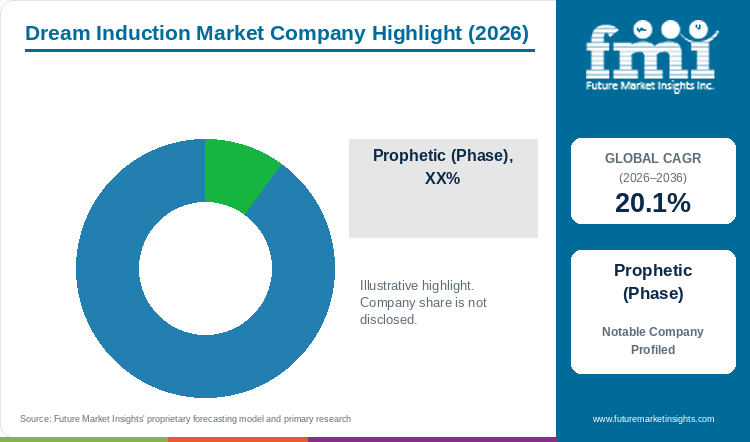
Competition is developing along two main tracks: commercial hardware and research-led induction methods. Prophetic is working on a closed-loop system that combines neural sensing with focused ultrasound stimulation. REMspace uses a mask and companion software to detect REM sleep and deliver cues. INSPEC takes a different approach by using contactless eye-movement detection to decide when cues should be delivered. Alongside these commercial systems, MIT Media Lab is developing targeted dream-incubation protocols while Monash University is studying somatosensory stimulation as another way to influence lucid dreaming.
The market is still at an early stage, so competition is centered less on feature count and more on whether a system can work reliably during sleep. A useful product has to recognize the relevant sleep stage, deliver the cue at the right moment and avoid waking the user. Hardware companies are therefore competing on sensing accuracy, stimulation methods and overnight comfort. Research-led and software-based approaches place more emphasis on cue timing, simpler delivery and reducing the amount of dedicated hardware required.
- Commercial dream-induction hardware: Prophetic, REMspace and INSPEC are developing different ways to detect REM sleep and deliver stimulation or timed cues.
- Research platforms: MIT Media Lab and Monash University are studying how different cues can influence dream content or lucid awareness under controlled conditions.
Competitive Benchmarking: Dream Induction Market
| Organization / Platform | Sleep-state detection | Induction method breadth | Current activity | Geographic reach |
|---|---|---|---|---|
| Prophetic (Phase) | High | High | High | Medium |
| REMspace (LucidMe) | Medium | High | High | Medium |
| INSPEC | High | Medium | Medium | Medium |
| MIT Media Lab (Dormio) | High | Medium | High | High |
| Monash University (LuciTouch) | Medium | Medium | Medium | Medium |
High indicates broad documented capability or current activity. Medium indicates a more focused role. Low indicates a narrower role within the dream induction workflow. Ratings do not represent product quality or market share.
Key Developments in the Dream Induction Market
- In April 2025, Prophetic published patent WO2025085747A1 for a wearable neurostimulation device that combines REM detection, neural sensing and focused ultrasound in a closed-loop design. [6]
- In September 2025, Monash University presented LuciTouch research on using somatosensory stimuli to influence lucid dreams. The work adds touch-based cueing to the existing audio and light approaches. [3]
- In 2026, Radboud University reported ongoing work to induce lucid dreaming at home using wearable EEG and REM-specific stimulation. The approach is aimed at moving induction research beyond expensive sleep-lab sessions. [2]
Key Players
Commercial Dream-Induction Platforms
- Prophetic (Phase)
- REMspace (LucidMe)
- INSPEC
Research and Experimental Platforms
- MIT Media Lab (Dormio)
- Monash University (LuciTouch)
- Donders Institute lucid-dream induction research
Report Scope and Methodology
| Coverage field | Report scope |
|---|---|
| Market breakdown | Product Type (Hardware, Software); Induction Method (Sensory Cueing, Neurostimulation, Cognitive and Digital Protocols, Multimodal Closed-loop Systems); Delivery Mode (Wearable or Head-mounted, Contactless or Room-based, Mobile or Web-based, Hybrid Systems); Application (Lucid Dream Induction, Targeted Dream Incubation, Dream Content Guidance, Research and Experimental Dream Engineering); Country (USA, UK, Netherlands, South Korea, Japan, Australia, Canada, Germany) |
| Quantitative units | USD Million |
| Market definition | Revenue includes hardware and software sold for detecting dream-relevant sleep stages and delivering sensory cues, digital protocols or neurostimulation intended to induce, stabilize or guide dreams. Coverage includes wearable, contactless, mobile, web-based and hybrid delivery systems used for lucid dream induction, targeted dream incubation or experimental dream engineering. General sleep trackers without a dream-induction function are excluded. Insomnia treatment devices are excluded unless they include a direct dream-induction function. |
| Countries covered | USA; UK; Netherlands; South Korea; Japan; Australia; Canada; Germany |
| Key organizations profiled | Prophetic; REMspace; INSPEC; MIT Media Lab; Monash University |
| Forecast period | 2026 to 2036 |
Research Methodology
| Method | Approach |
|---|---|
| Primary and desk research | FMI combines primary market inputs with regulator publications, university research and current product information. Sources are selected for direct relevance to sleep-stage detection, dream cueing and neurostimulation. |
| Market sizing and forecasting | Market sizing considers hardware and software revenue within the defined dream-induction boundary. Forecasting considers product readiness, research activity and country-level commercialization conditions. |
| Country forecasting | Country estimates consider direct dream-research activity, wearable neurotechnology development and applicable digital-health pathways. Country CAGRs are FMI analyst estimates for 2026 to 2036. |
| Data validation | Market estimates are checked against current product status and research activity. General sleep technology and insomnia-only devices are excluded from competitive market participation. |
Dream Induction Market by Segments
Dream Induction Market Segmented by Product Type
- Hardware
- Software
Dream Induction Market Segmented by Induction Method
- Sensory Cueing
- Neurostimulation
- Cognitive and Digital Protocols
- Multimodal Closed-loop Systems
Dream Induction Market Segmented by Delivery Mode
- Wearable or Head-mounted
- Contactless or Room-based
- Mobile or Web-based
- Hybrid Systems
Dream Induction Market Segmented by Application
- Lucid Dream Induction
- Targeted Dream Incubation
- Dream Content Guidance
- Research and Experimental Dream Engineering
Dream Induction Market Segmented by Country
- North America
- United States
- Canada
- Latin America
- Brazil
- Mexico
- Argentina
- Chile
- Western Europe
- Germany
- France
- United Kingdom
- Italy
- Spain
- Benelux
- Nordics
- Eastern Europe
- Poland
- Czech Republic
- Romania
- Hungary
- East Asia
- China
- Japan
- South Korea
- South Asia and Pacific
- India
- ASEAN
- Australia and New Zealand
- Middle East and Africa
- GCC Countries
- South Africa
- Türkiye
- Israel
Research Sources and Bibliography
- [1] Government Office for Science (2025, February 14). Rapid Technology Assessment: Neurotechnology.
- [2] Radboud University, Donders Institute (2026). Why we sleep: insights from current research.
- [3] Monash University (2025). LuciTouch: Influencing Lucid Dreams Through Incorporation of Somatosensory Stimuli.
- [4] U.S. Food and Drug Administration (2025, December 31). 510(k) K252951, Genesis Sleep.
- [5] MIT Media Lab. Targeted Dream Incubation project and Dormio research platform.
- [6] WIPO Patent Publication WO2025085747A1 (2025, April 24). Wearable neurostimulation device, Prophetic Inc.
- [7] Prophetic (2026). Phase ultrasonic lucid-dreaming platform.
- [8] REMspace Inc. (2025-2026). LucidMe lucid-dreaming mask and software.
- [9] INSPEC (2026). Contactless REM detection and lucid-dream cueing device.
- [10] MIT DSpace. Dormio: A targeted dream incubation device.
- [11] Ministry of Food and Drug Safety, Republic of Korea (2025). Digital Therapeutics Approval and Review Guideline.
- [12] Pharmaceuticals and Medical Devices Agency, Japan (2025). SUSMED App for Insomnia Medcle review information.
- [13] Federal Institute for Drugs and Medical Devices, Germany. DiGA Directory and reimbursement framework.
- [14] Université de Montréal (2024-2030). Research on lucid dreaming and REM sleep-dependent emotion regulation.
- [15] Inserm. Scientific overview of lucid-dream induction methods.
This bibliography is provided for reader reference. The full report contains the complete reference list and supporting research.
This Report Answers
- What is the Dream Induction Market size in 2026?
- What value is forecast for the Dream Induction Market by 2036?
- Which Product Type holds the leading share of the Dream Induction Market in 2026?
- How is the Dream Induction Market segmented by Induction Method, Delivery Mode and Application?
- Which countries have notable growth outlooks in the Dream Induction Market through 2036?
- Which companies and research platforms are notable in the Dream Induction Market?
Frequently Asked Questions
How big is the Dream Induction Market in 2026?
As per FMI, the dream induction market is valued at USD 30.0 million in 2026 compared with USD 25.0 million in 2025. Sales are forecast to reach USD 185.0 million by 2036.
What is the CAGR of the Dream Induction Market from 2026 to 2036?
The dream induction market is forecast to expand at a 20.1% CAGR between 2026 and 2036.
Which Product Type holds the largest share of the Dream Induction Market?
By Product Type, Hardware is projected to account for 65.0% of market revenue in 2026. Software is expected to account for 35.0%.
Which country has the strongest growth outlook in the Dream Induction Market?
FMI estimates the USA to record a 22.6% CAGR from 2026 to 2036. Direct product development and university research support the country growth outlook.
How is the Dream Induction Market segmented?
The market is segmented by Product Type, Induction Method, Delivery Mode, Application and Country. The four commercial axes distinguish what is sold, how dreams are influenced, how the system reaches the user and the purpose of use.
Which are the notable companies and platforms in the Dream Induction Market?
Prophetic, REMspace and INSPEC are among the notable commercial platforms. MIT Media Lab and Monash University also contribute research systems for dream induction.
Preview the report firsthand - request a free sample
Get SampleGet the brochure for pricing and purchase details.
Get PDFTable of Content
- Key Takeaways
- Market Size and CAGR
- Top Growth Driver
- Fastest Growing Segment
- Leading Region
- Key Companies
- Emerging Opportunities
- Executive Summary
- Global Market Outlook
- Demand-side Trends
- Supply-side Trends
- Technology Roadmap Analysis
- Analysis and Recommendations
- Analyst Perspective (What is happening? Why now? What should investors know?)
- Key Questions Answered
- How large is the market?
- What is the CAGR?
- What are key trends?
- Which region dominates?
- Who are the leaders?
- Market Overview
- Market Coverage / Taxonomy
- Market Definition / Scope / Limitations
- Research Methodology
- Chapter Orientation
- Analytical Lens and Working Hypotheses
- Market Structure, Signals, and Trend Drivers
- Benchmarking and Cross-market Comparability
- Market Sizing, Forecasting, and Opportunity Mapping
- Research Design and Evidence Framework
- Desk Research Programme (Secondary Evidence)
- Expert Input and Fieldwork (Primary Evidence)
- Tooling, Models, and Reference Databases
- Data Engineering and Model Build
- Quality Assurance and Audit Trail
- Market Background
- Market Dynamics (Drivers, Restraints, Opportunity, Trends)
- Scenario Forecast (Optimistic, Likely, Conservative)
- Impact Analysis
- AI Impact
- Sustainability Impact
- Regulatory Impact
- Technology Impact
- Consumer / Buyer Analysis
- Purchase Drivers
- Adoption Barriers
- Buyer Journey
- Opportunity Map Analysis
- Product Life Cycle Analysis
- Supply Chain Analysis
- Investment Feasibility Matrix
- Value Chain Analysis
- PESTLE and Porter's Analysis
- Regulatory Landscape
- Regional Parent Market Outlook
- Production and Consumption Statistics
- Import and Export Statistics
- Global Market Analysis and Forecast, 2021 to 2036
- Historical Market Size Value (USD Million) Analysis, 2021 to 2025
- Current and Future Market Size Value (USD Million) Projections, 2026 to 2036
- Y-o-Y Growth Trend Analysis
- Absolute $ Opportunity Analysis
- Global Market Pricing Analysis, 2021 to 2036
- Global Market Analysis and Forecast, By Product Type, 2021 to 2036
- Introduction / Key Findings
- Historical Market Size Value (USD Million) Analysis By Product Type, 2021 to 2025
- Current and Future Market Size Value (USD Million) Analysis and Forecast By Product Type, 2026 to 2036
- Hardware
- Software
- Y-o-Y Growth Trend Analysis By Product Type, 2021 to 2025
- Absolute $ Opportunity Analysis By Product Type, 2026 to 2036
- Global Market Analysis and Forecast, By Induction Method, 2021 to 2036
- Introduction / Key Findings
- Historical Market Size Value (USD Million) Analysis By Induction Method, 2021 to 2025
- Current and Future Market Size Value (USD Million) Analysis and Forecast By Induction Method, 2026 to 2036
- Sensory Cueing
- Neurostimulation
- Cognitive and Digital Protocols
- Multimodal Closed-loop Systems
- Y-o-Y Growth Trend Analysis By Induction Method, 2021 to 2025
- Absolute $ Opportunity Analysis By Induction Method, 2026 to 2036
- Global Market Analysis and Forecast, By Delivery Mode, 2021 to 2036
- Introduction / Key Findings
- Historical Market Size Value (USD Million) Analysis By Delivery Mode, 2021 to 2025
- Current and Future Market Size Value (USD Million) Analysis and Forecast By Delivery Mode, 2026 to 2036
- Wearable or Head-mounted
- Contactless or Room-based
- Mobile or Web-based
- Hybrid Systems
- Y-o-Y Growth Trend Analysis By Delivery Mode, 2021 to 2025
- Absolute $ Opportunity Analysis By Delivery Mode, 2026 to 2036
- Global Market Analysis and Forecast, By Application, 2021 to 2036
- Introduction / Key Findings
- Historical Market Size Value (USD Million) Analysis By Application, 2021 to 2025
- Current and Future Market Size Value (USD Million) Analysis and Forecast By Application, 2026 to 2036
- Lucid Dream Induction
- Targeted Dream Incubation
- Dream Content Guidance
- Research and Experimental Dream Engineering
- Y-o-Y Growth Trend Analysis By Application, 2021 to 2025
- Absolute $ Opportunity Analysis By Application, 2026 to 2036
- Global Market Analysis and Forecast, By Region, 2021 to 2036
- Introduction
- Historical Market Size Value (USD Million) Analysis By Region, 2021 to 2025
- Current Market Size Value (USD Million) Analysis and Forecast By Region, 2026 to 2036
- North America
- Latin America
- Western Europe
- Eastern Europe
- East Asia
- South Asia and Pacific
- Middle East and Africa
- Market Attractiveness Analysis By Region
- North America Market Analysis and Forecast, By Country, 2021 to 2036
- Historical Market Size Value (USD Million) Trend Analysis By Market Taxonomy, 2021 to 2025
- Market Size Value (USD Million) Forecast By Market Taxonomy, 2026 to 2036
- By Country
- United States
- Canada
- By Product Type
- By Induction Method
- By Delivery Mode
- By Application
- By Country
- Market Attractiveness Analysis
- By Country
- By Product Type
- By Induction Method
- By Delivery Mode
- By Application
- Key Takeaways
- Latin America Market Analysis and Forecast, By Country
- Historical Market Size Value (USD Million) Trend Analysis By Market Taxonomy, 2021 to 2025
- Market Size Value (USD Million) Forecast By Market Taxonomy, 2026 to 2036
- By Country
- Brazil
- Mexico
- Argentina
- Chile
- By Product Type
- By Induction Method
- By Delivery Mode
- By Application
- By Country
- Market Attractiveness Analysis
- By Country
- By Product Type
- By Induction Method
- By Delivery Mode
- By Application
- Key Takeaways
- Western Europe Market Analysis and Forecast, By Country
- Historical Market Size Value (USD Million) Trend Analysis By Market Taxonomy, 2021 to 2025
- Market Size Value (USD Million) Forecast By Market Taxonomy, 2026 to 2036
- By Country
- Germany
- France
- United Kingdom
- Italy
- Spain
- Benelux
- Nordics
- By Product Type
- By Induction Method
- By Delivery Mode
- By Application
- By Country
- Market Attractiveness Analysis
- By Country
- By Product Type
- By Induction Method
- By Delivery Mode
- By Application
- Key Takeaways
- Eastern Europe Market Analysis and Forecast, By Country
- Historical Market Size Value (USD Million) Trend Analysis By Market Taxonomy, 2021 to 2025
- Market Size Value (USD Million) Forecast By Market Taxonomy, 2026 to 2036
- By Country
- Poland
- Czech Republic
- Romania
- Hungary
- By Product Type
- By Induction Method
- By Delivery Mode
- By Application
- By Country
- Market Attractiveness Analysis
- By Country
- By Product Type
- By Induction Method
- By Delivery Mode
- By Application
- Key Takeaways
- East Asia Market Analysis and Forecast, By Country
- Historical Market Size Value (USD Million) Trend Analysis By Market Taxonomy, 2021 to 2025
- Market Size Value (USD Million) Forecast By Market Taxonomy, 2026 to 2036
- By Country
- China
- Japan
- South Korea
- By Product Type
- By Induction Method
- By Delivery Mode
- By Application
- By Country
- Market Attractiveness Analysis
- By Country
- By Product Type
- By Induction Method
- By Delivery Mode
- By Application
- Key Takeaways
- South Asia and Pacific Market Analysis and Forecast, By Country
- Historical Market Size Value (USD Million) Trend Analysis By Market Taxonomy, 2021 to 2025
- Market Size Value (USD Million) Forecast By Market Taxonomy, 2026 to 2036
- By Country
- India
- ASEAN
- Australia and New Zealand
- By Product Type
- By Induction Method
- By Delivery Mode
- By Application
- By Country
- Market Attractiveness Analysis
- By Country
- By Product Type
- By Induction Method
- By Delivery Mode
- By Application
- Key Takeaways
- Middle East and Africa Market Analysis and Forecast, By Country
- Historical Market Size Value (USD Million) Trend Analysis By Market Taxonomy, 2021 to 2025
- Market Size Value (USD Million) Forecast By Market Taxonomy, 2026 to 2036
- By Country
- GCC Countries
- South Africa
- Türkiye
- Israel
- By Product Type
- By Induction Method
- By Delivery Mode
- By Application
- By Country
- Market Attractiveness Analysis
- By Country
- By Product Type
- By Induction Method
- By Delivery Mode
- By Application
- Key Takeaways
- Key Countries Market Analysis
- United States
- Pricing Analysis
- Market Share Analysis, 2025
- By Product Type
- By Induction Method
- By Delivery Mode
- By Application
- Canada
- Pricing Analysis
- Market Share Analysis, 2025
- By Product Type
- By Induction Method
- By Delivery Mode
- By Application
- Mexico
- Pricing Analysis
- Market Share Analysis, 2025
- By Product Type
- By Induction Method
- By Delivery Mode
- By Application
- Brazil
- Pricing Analysis
- Market Share Analysis, 2025
- By Product Type
- By Induction Method
- By Delivery Mode
- By Application
- Chile
- Pricing Analysis
- Market Share Analysis, 2025
- By Product Type
- By Induction Method
- By Delivery Mode
- By Application
- Germany
- Pricing Analysis
- Market Share Analysis, 2025
- By Product Type
- By Induction Method
- By Delivery Mode
- By Application
- United Kingdom
- Pricing Analysis
- Market Share Analysis, 2025
- By Product Type
- By Induction Method
- By Delivery Mode
- By Application
- Italy
- Pricing Analysis
- Market Share Analysis, 2025
- By Product Type
- By Induction Method
- By Delivery Mode
- By Application
- Spain
- Pricing Analysis
- Market Share Analysis, 2025
- By Product Type
- By Induction Method
- By Delivery Mode
- By Application
- France
- Pricing Analysis
- Market Share Analysis, 2025
- By Product Type
- By Induction Method
- By Delivery Mode
- By Application
- India
- Pricing Analysis
- Market Share Analysis, 2025
- By Product Type
- By Induction Method
- By Delivery Mode
- By Application
- ASEAN
- Pricing Analysis
- Market Share Analysis, 2025
- By Product Type
- By Induction Method
- By Delivery Mode
- By Application
- Australia and New Zealand
- Pricing Analysis
- Market Share Analysis, 2025
- By Product Type
- By Induction Method
- By Delivery Mode
- By Application
- China
- Pricing Analysis
- Market Share Analysis, 2025
- By Product Type
- By Induction Method
- By Delivery Mode
- By Application
- Japan
- Pricing Analysis
- Market Share Analysis, 2025
- By Product Type
- By Induction Method
- By Delivery Mode
- By Application
- South Korea
- Pricing Analysis
- Market Share Analysis, 2025
- By Product Type
- By Induction Method
- By Delivery Mode
- By Application
- Poland
- Pricing Analysis
- Market Share Analysis, 2025
- By Product Type
- By Induction Method
- By Delivery Mode
- By Application
- Hungary
- Pricing Analysis
- Market Share Analysis, 2025
- By Product Type
- By Induction Method
- By Delivery Mode
- By Application
- Türkiye
- Pricing Analysis
- Market Share Analysis, 2025
- By Product Type
- By Induction Method
- By Delivery Mode
- By Application
- South Africa
- Pricing Analysis
- Market Share Analysis, 2025
- By Product Type
- By Induction Method
- By Delivery Mode
- By Application
- Netherlands
- Pricing Analysis
- Market Share Analysis, 2025
- By Product Type
- By Induction Method
- By Delivery Mode
- By Application
- Australia
- Pricing Analysis
- Market Share Analysis, 2025
- By Product Type
- By Induction Method
- By Delivery Mode
- By Application
- United States
- Market Structure Analysis
- Competition Dashboard
- Competition Benchmarking
- Market Share Analysis of Top Players
- By Regional
- By Product Type
- By Induction Method
- By Delivery Mode
- By Application
- Emerging Startups
- Innovation Benchmarking
- Competition Analysis
- Competition Deep Dive
- Prophetic (Phase)
- Overview
- Product Portfolio
- Profitability by Market Segments
- Sales Footprint
- Strategy Overview
- Marketing Strategy
- Product Strategy
- Channel Strategy
- REMspace (LucidMe)
- INSPEC
- MIT Media Lab (Dormio)
- Monash University (LuciTouch)
- Donders Institute lucid-dream induction research
- Prophetic (Phase)
- Case Studies
- Success Stories
- Recent Developments
- Competition Deep Dive
- Assumptions & Acronyms Used


