

- Market Size (2026)
- USD 7.4 Bn
- Forecast (2036)
- USD 13.5 Bn
- CAGR (2026 to 2036)
- 6.2%
How big is Electro Medical Electrotherapeutic Apparatus Market size?
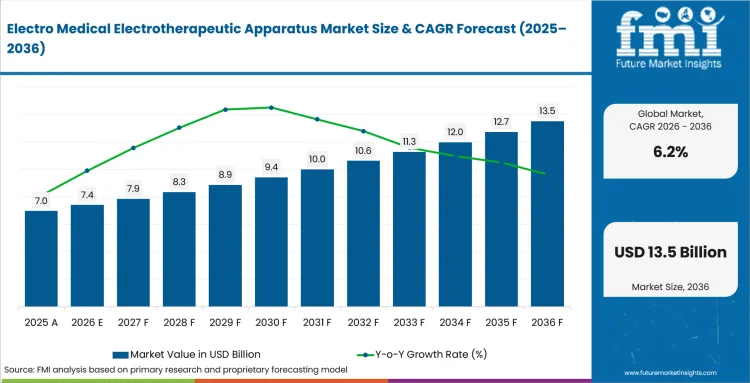
USD 7.4 billion in 2026 and USD 13.5 billion by 2036 at a 6.2% CAGR.
Sales of electro medical electrotherapeutic apparatus are estimated to rise at 6.2% CAGR through 2036, increasing valuation from USD 7.4 billion in 2026 to USD 13.5 billion by 2036. Hospitals acquire electrical diagnostic and treatment equipment through comprehensive service-line budgets to manage pain and provide continuous patient monitoring. In April 2024, the United States Food and Drug Administration approved roughly 12 new or modified devices every single business day. This prompt pace of innovation creates an ongoing pipeline of fresh medical hardware for clinical teams and regulators requiring to carefully evaluate. Resulting with the medical centers to regularly update their inventories to support replacement initiatives across both diagnostic and therapeutic departments.
Healthcare systems around the world focus on completely different priorities on investing in new medical apparatus. Buyers in Japan and France focus heavily on upgrading imaging technology and uninterrupted service contracts. Medical providers in Canada and the United States demand interconnected monitoring platforms that guarantee high equipment availability. Healthcare networks across Germany and Italy prefer standardized equipment fleets because this uniformity simplifies daily clinical operations. In May 2025, Royal Philips discovered for over 75.0% of healthcare professionals lost valuable clinical time due to incomplete or hard-to-reach patient records. Such widespread frustration drives strong commercial demand for integrated hardware platforms to exchange medical data reliably. Global purchasing strategies vary significantly depending on when hospitals plan their equipment upgrades and how desperately they need digital connectivity.
Key Takeaways for the Electro Medical Electrotherapeutic Apparatus Market
- Demand for electro medical electrotherapeutic apparatus is driven by hospital equipment replacement and clinical service expansion, with approved purchases requiring documented performance and defined maintenance responsibilities.
- Direct sales are expected to lead distribution channel with 53.0% share in 2026, influenced by manufacturer-led configuration and installation support across lengthy hospital assessments.
- Hospitals are projected to garner 48.0% share of end user in 2026, backed by concentrated procedure volumes and multidisciplinary diagnostic and therapeutic requirements.
- Extended capital approval periods and interoperability reviews represent primary barriers limiting purchases across apparatus requiring infrastructure changes and specialist training.
- Competition focuses on GE HealthCare, Siemens Healthineers, Royal Philips, Medtronic plc, Abbott Laboratories, Boston Scientific Corporation, Stryker Corporation, FUJIFILM Healthcare, Canon Medical Systems Corporation, and Zimmer Biomet, with providers differentiating based on clinical workflow evidence and service continuity.
Analyst Perspective
“Leadership in electro medical electrotherapeutic apparatus stems from translating engineering capability into measurable clinical value. Healthcare providers increasingly assess how equipment improves decision quality and treatment consistency across diverse care settings. Enduring commercial advantage arises from responsive technical expertise and credible evidence supporting safe clinical use.”
- Anurag Sharma, Principal Analyst for Healthcare at Future Market Insights
How is Electro Medical Electrotherapeutic Apparatus Market segmented?
The electro medical electrotherapeutic apparatus sector is segmented by product, application, end user, technology, distribution channel, and region.
The electro medical electrotherapeutic apparatus industry is segmented by product, application, end user, technology, distribution channel, and region. Product coverage includes diagnostic equipment and therapeutic equipment together with surgical and patient-assistive apparatus. Application coverage addresses cardiology, neurology, orthopedics, oncology, and pain management. End-user coverage includes hospitals and specialist clinics together with diagnostic centers and home healthcare providers. Technology coverage contains digital systems, analog systems, portable devices, hybrid systems, and wireless systems. distribution channel coverage includes direct sales, distributors, and online procurement. Regional coverage extends through North America, Europe, East Asia, South Asia and Pacific, Latin America, Middle East and Africa.
What makes diagnostic equipment central to product selection?
GE HealthCare announced commercial availability of Definium Pace Select ET in July 2025. Floor-mounted configuration includes automated positioning and protocol-selection functions intended to reduce repetitive technologist work. Commercial availability expands equipment choice for facilities balancing diagnostic quality against room and staffing limitations. Diagnostic equipment promotes clinical decisions preceding treatment and follow-up care. Hospitals assess image quality and measurement repeatability under routine workloads.
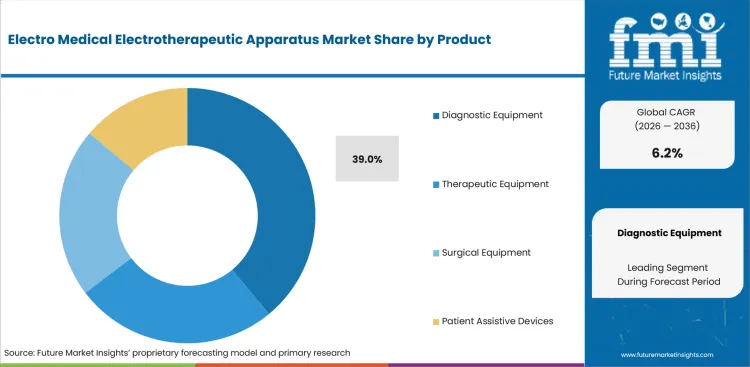
- Diagnostic equipment is predicted to represent 39.0% share of product in 2026, driven by recurring imaging and physiological assessment requirements. Hospitals assess image consistency and service coverage prior to approving system-wide deployment.
- Therapeutic equipment and surgical equipment address defined interventions across pain management and operative care. Patient assistive devices extend electrical support into rehabilitation and respiratory care under separate training and maintenance requirements.
Why does cardiology lead application demand?
Cardiology combines diagnostic testing with therapeutic intervention and continued patient observation. Royal Philips introduced upgraded Compact Ultrasound 5500CV capabilities in March 2025. Company information reported scan-time reductions reaching 50.0% through automated cardiac measurement functions. Reduced examination time raises department capacity without requiring an equivalent increase in scanning rooms.
- Based on application, cardiology is anticipated to account for 26.0% share of in 2026 as it is backed by ECG monitoring and cardiac-rhythm management requirements. Equipment approval reflects measurement consistency and clinician confidence during repeated diagnostic use.
- Neurology and orthopedics require electrical assessment and therapy suited to specialized pathways. Oncology and pain-management apparatus address treatment planning and symptom control through separate evidence requirements.
What supports Hospitals across end user demand?
Hospitals combine imaging and monitoring with intervention and rehabilitation under one clinical organization. Royal Philips announced partnerships with 4 critical-care equipment companies in July 2025. Planned connections cover data from ventilation and infusion equipment inside hospital patient-monitoring systems. Multi-vendor data access reduces fragmented clinical views across departments containing equipment from separate manufacturers.
- By end user, hospitals are estimated to secure 48.0% share in 2026 since being reflected by concentrated procedure volumes and multidisciplinary apparatus requirements. Public and private institutions assess installation work and equipment availability throughout contracted service periods.
- Specialty clinics and diagnostic centers concentrate purchases on narrower procedure groups with predictable utilization. Home healthcare extends monitoring and therapeutic support beyond institutional settings through portable and remotely supervised apparatus.
Why does digital systems lead technology selection?
Siemens Healthineers presented artificial-intelligence radiology services in November 2025. Pilot projects reported chest computed-tomography annotation completed up to 25.0% faster without lowering reported clinical accuracy. Shorter annotation work improves reporting capacity under specialist staffing constraints. Digital systems support configurable protocols and structured clinical records across connected apparatus.
- In 2026, digital systems are projected to represent 44.0% share owing to protocol management and structured clinical-data exchange. Buyer assessment covers software validation and maintained compatibility throughout equipment service life.
- Analog systems retain roles inside established therapeutic workflows requiring limited connectivity. Portable devices and hybrid systems support mobile assessment through varied care locations and infrastructure conditions.
How does direct sales shape distribution channel demand?
Direct sales influence manufacturer involvement during configuration and installation planning. Siemens Healthineers and Tower Health announced a 10-year partnership in April 2025. Agreement coverage includes imaging equipment and technology modernization across radiology and cardiology services. Long-duration agreements consolidate installation and lifecycle planning through one manufacturer relationship.
- Direct sales are forecast to hold 53.0% share in 2026, guided by complex equipment configuration and manufacturer-led service. Hospital customers assess training plans and response obligations during supplier selection.
- Distributors support regional availability for standardized equipment and service parts. Online purchase remains suited to defined products carrying established specifications and limited site-customization requirements.
What are drivers, restraints, and opportunities in Electro Medical Electrotherapeutic Apparatus Market?
Hospital equipment renewal sustains apparatus purchasing across clinical departments. Capital review periods delay replacement programs requiring infrastructure changes.
- Driver: Aging equipment fleets create replacement demand as service interruptions reduce usable procedure hours. Hospitals also favor newer platforms supporting standardized controls across several clinical departments.
- Restraint: Lengthy capital reviews slow orders requiring room preparation and software validation. Budget committees often defer approval until lifecycle costs and implementation plans receive formal assessment.
- Opportunity: Remote diagnostic and monitoring services extend apparatus use beyond conventional inpatient departments. Compact systems create additional demand across ambulatory centers and supervised home-care programs.
Patient access delays strengthen demand for apparatus supporting assessment near care delivery. Royal Philips reported 33.0% of surveyed patients experienced worsening health following physician-access delays in June 2025. Point-of-care imaging helps clinical teams begin assessment during emergency and critical-care encounters. Purchase conversion requires documented diagnostic quality and trained operators within intended care settings.
Software reliability constrains connected apparatus deployment through remediation and verification work. United States Food and Drug Administration identified 3 cybersecurity vulnerabilities affecting named patient-monitor models in January 2025. Hospital buyers examine software-update procedures and service escalation commitments during technical approval. Security remediation may restrict network functionality until specialized installation work is completed.
Home-based inpatient care creates an opening for portable monitoring and therapeutic apparatus. Centers for Medicare & Medicaid Services released nearly 5 years of Acute Hospital Care at Home data in March 2026. Longer evidence histories permit providers to examine operating requirements across remote acute-care programs.
How are country CAGRs aligned in Electro Medical Electrotherapeutic Apparatus Market?
| Country or Market | CAGR |
|---|---|
| Japan | 7.8% |
| France | 7.4% |
| Germany | 7.0% |
| Italy | 6.2% |
| UK | 5.5% |
| Canada | 5.2% |
| USA | 4.5% |
Source: Future Market Insights analysis, 2026.
How do country-level CAGRs compare in Electro Medical Electrotherapeutic Apparatus Market?
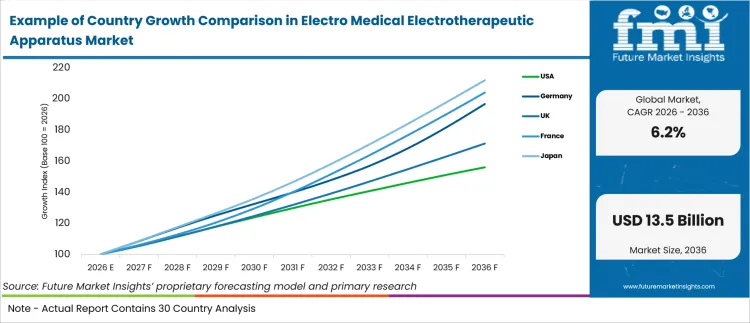
Country comparison shows a measured decline across profiled markets. Japan leads disclosed rates and France follows at a limited distance. Germany occupies the next position through hospital equipment modernization. Italy matches the global assessment rate. The United Kingdom and Canada form a lower forecast band. The United States completes the comparison led by an established installed base and longer replacement cycles. A 3.3-point spread separates Japan from USA.
- Japan is anticipated to lead profiled expansion depending on precision-oriented validation and imaging renewal programs.
- France is projected to follow Japan based on coordinated public-hospital modernization and maintained service arrangements.
- Germany occupies the next forecast position driven by standardized equipment estates and structured lifecycle planning.
- Italy matches the global rate led by hospital modernization and integrated diagnostic information requirements.
- The United Kingdom, Canada, and the United States complete the comparison due to established health systems carrying longer replacement cycles.
Comparable CAGRs are likely to produce different supplier-entry conditions through service coverage and technical approval requirements. Full report coverage includes North America, Europe, East Asia, South Asia and Pacific, Latin America, Middle East and Africa.
Country-wise Analysis
- Industry in Japan is projected to expand at 7.8% CAGR between 2026 and 2036, aided by precision-oriented imaging validation and equipment-renewal planning. Japan Medical Imaging and Radiological Systems Industries Association reported approximately 200 member organizations in June 2024, reflecting an established domestic base for imaging equipment and technical service. Supplier coverage supports hospital comparison of apparatus and maintenance offers during replacement programs.
- Siemens Healthineers reported its Nantes partnership covers 13 public hospitals in October 2024, supporting coordinated imaging replacement across participating facilities. Shared equipment and service planning helps hospital groups standardize diagnostic and interventional imaging. Sector in France is forecast to record 7.4% CAGR during 2026 to 2036, led by coordinated public-hospital modernization and maintained service arrangements.
- Standardized equipment interfaces reduce training variation across clinical departments. Adoption in Germany is estimated to grow at 7.0% CAGR during the forecast period, guided by structured technology partnerships and lifecycle planning. Siemens Healthineers reported replacement and installation of 29 ultrasound systems at Erding Hospital in August 2025, reinforcing fleet standardization across hospital departments.
- The market in Italy is anticipated to register 6.2% CAGR during the study period, helped by hospital imaging modernization and multidisciplinary diagnostic records. GE HealthCare reported Sant’Andrea University Hospital selected a platform spanning 2 diagnostic domains in December 2025, combining radiology and pathology information for oncology review. Apparatus suppliers benefit from compatibility across imaging and laboratory workflows.
- Royal Philips reported an Imperial College Healthcare pilot increased total scanning throughput by 9.0% in February 2025, supporting remote specialist access across imaging sites. Sales in UK are projected to rise at 5.5% CAGR during the assessment period, backed by remote scanning and maintained imaging performance. Purchasing decisions require security controls and documented operating responsibility.
- Sustained inpatient activity maintains diagnostic and therapeutic workloads across provincial health systems. Canadian Institute for Health Information recorded 3.14 million acute inpatient hospitalizations during 2024 to 2025 in its February 2026 release. Industry in Canada is estimated to rise at 5.2% CAGR between 2026 and 2036, led by recurring clinical workloads and province-level equipment replacement.
- Demand in the United States is forecast to increase at 4.5% CAGR by 2036, reflecting an established installed base and continuing replacement expenditure. New inpatient capacity requires standardized monitoring and information continuity across care locations. Royal Philips reported Hoag’s expanded Sun Family Campus plans to add 155 inpatient beds in 2026 through its October 2025 announcement.
Who are notable companies in Electro Medical Electrotherapeutic Apparatus Market?
GE HealthCare, Siemens Healthineers, Royal Philips, Medtronic plc, Abbott Laboratories, Boston Scientific Corporation, Stryker Corporation, FUJIFILM Healthcare, Canon Medical Systems Corporation, and Zimmer Biomet are notable companies serving electro medical electrotherapeutic apparatus requirements.
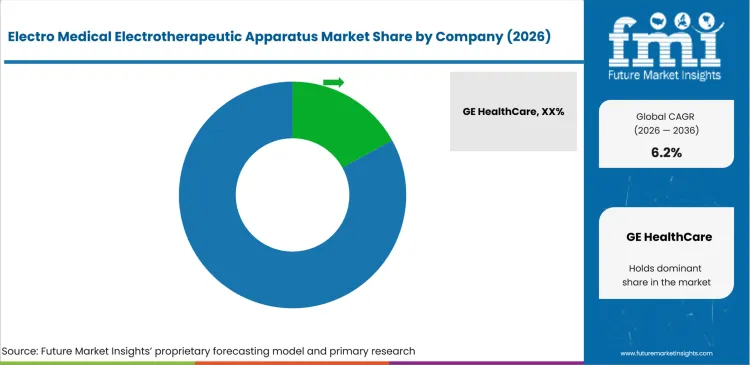
Competition reflects clinical portfolio breadth and documented equipment performance. Integrated manufacturers supply diagnostic imaging and monitoring systems due to global service organizations. Therapeutic-device specialists concentrate on cardiology and neurological intervention. Surgical suppliers connect electrical apparatus with operating-room workflows. Imaging specialists compete through acquisition quality and informatics compatibility. Buyer review covers installation requirements and response commitments throughout equipment life.
- GE HealthCare and Royal Philips compete based on diagnostic imaging and connected hospital equipment. Health systems compare clinical consistency and service capacity across installed fleets.
- Boston Scientific Corporation and Stryker Corporation concentrate on therapeutic and surgical applications. Clinical adoption follows procedure evidence and operator familiarity within defined specialties.
- FUJIFILM Healthcare and Canon Medical Systems Corporation compete depending on diagnostic imaging and information management. Zimmer Biomet addresses orthopedic and surgical apparatus through specialist clinical relationships.
Competitive Benchmarking: Electro Medical Electrotherapeutic Apparatus Market
| Company | Diagnostic Portfolio | Therapeutic Portfolio | Clinical Integration | Service Reach |
|---|---|---|---|---|
| GE HealthCare | High | Medium | High | Global |
| Siemens Healthineers | High | Medium | High | Global |
| Royal Philips | High | High | High | Global |
| Medtronic plc | Medium | High | High | Global |
| Abbott Laboratories | High | High | High | Global |
| Boston Scientific Corporation | Medium | High | High | Global |
| Stryker Corporation | Medium | High | High | Global |
| FUJIFILM Healthcare | High | Medium | High | Global |
| Canon Medical Systems Corporation | High | Medium | High | Global |
| Zimmer Biomet | Medium | High | Medium | Global |
Source: Future Market Insights competitive analysis.
Key Developments in Electro Medical Electrotherapeutic Apparatus Market
- In June 2025, Royal Philips expanded its patient-monitoring partnership with Medtronic through a new multiyear agreement. Integrated respiratory and neurological measurements strengthen access to validated parameters through Philips monitoring systems.
- In February 2025, Medtronic announced USA Food and Drug Administration approval of BrainSense Adaptive deep brain stimulation for people with Parkinson’s disease. The closed-loop system adjusts electrical stimulation using individual brain activity, expanding personalized electrotherapeutic apparatus across implanted neurological treatment.
- In December 2025, GE HealthCare launched artificial-intelligence enhancements for Imaging 360. New functions examine device utilization and protocol consistency across radiology departments. Operational information helps hospitals direct existing imaging capacity toward scheduled demand.
Electro Medical Electrotherapeutic Apparatus Market Report Scope
| Coverage Field | Report Scope |
|---|---|
| Market Breakdown | Electro medical electrotherapeutic apparatus market breakdown includes product, application, end user, technology, distribution channel, and region. |
| Quantitative Units | USD billion in 2026 to USD billion by 2036 at CAGR |
| Market Definition | Electro medical electrotherapeutic apparatus includes electrical medical equipment supporting diagnosis, monitoring, treatment, rehabilitation, pain management, and surgical intervention. Generic hospital software lacking direct apparatus operation is excluded. |
| Regions Covered | North America, Europe, East Asia, South Asia and Pacific, Latin America, Middle East and Africa |
| Countries Covered | Japan, France, Germany, Italy, UK, Canada, USA, and additional countries included within full regional coverage |
| Key Companies Profiled | GE HealthCare, Siemens Healthineers, Royal Philips, Medtronic plc, Abbott Laboratories, Boston Scientific Corporation, Stryker Corporation, FUJIFILM Healthcare, Canon Medical Systems Corporation, and Zimmer Biomet |
| Forecast Period | 2026 to 2036 |
| Approach | Hybrid bottom-up and top-down methodology combines product shares and country CAGRs. Company activity and hospital purchasing evidence support final reconciliation. |
Source: Future Market Insights analysis, 2026.
Electro Medical Electrotherapeutic Apparatus Market Research Methodology
| Method | Approach |
|---|---|
| Primary Research | FMI analysts gathered input from manufacturers, service providers, technology developers, distributors, end users, procurement teams, and subject-matter experts. Interviews examined purchasing decisions, product or service evaluation, adoption barriers, approval requirements, pricing considerations, and expectations for technical or commercial support. Respondents were also asked what evidence is required before a trial, pilot, or initial order develops into regular purchasing. |
| Desk Research | Desk research covered government statistics, regulatory publications, trade data, industry associations, technical literature, standards, company filings, product information, and official corporate announcements. Sources were reviewed for relevance, publication date, geographic coverage, and consistency with the defined market scope. Claims relating to performance, applications, approvals, capacity, investment, and commercial activity were retained only when supported by credible public evidence. |
| Market Sizing and Forecasting | The market model combined the baseline value with historical performance, segment structure, pricing and volume indicators, adoption levels, company participation, and country-level demand conditions. Forecast assumptions considered economic activity, investment trends, regulatory developments, technology adoption, purchasing cycles, supply availability, and barriers to wider market use. Segment and regional estimates were reconciled before the final market total was calculated. |
| Data Validation | Estimates were checked against multiple independent indicators, including public data, company activity, trade patterns, industry developments, and findings from primary interviews. Validation also tested whether products, services, applications, and company revenues fell within the defined market boundaries. Adjacent categories, unsupported claims, overlapping revenues, and activities without direct market relevance were excluded to reduce double counting and maintain consistency across segments and countries. |
Source: Future Market Insights analysis, 2026.
Electro Medical Electrotherapeutic Apparatus Market by Segments
Electro Medical Electrotherapeutic Apparatus Market segmented by Product:
- Hospitals
- Diagnostic Equipment
- Therapeutic Equipment
- Surgical Equipment
- Patient Assistive Devices
Electro Medical Electrotherapeutic Apparatus Market segmented by Application:
- Cardiology
- Neurology
- Orthopedics
- Oncology
Electro Medical Electrotherapeutic Apparatus Market segmented by End User:
- Hospitals
- Specialty Clinics
- Diagnostic Centers
- Home Healthcare
Electro Medical Electrotherapeutic Apparatus Market segmented by Technology:
- Digital Systems
- Analog Systems
- Hybrid Systems
Electro Medical Electrotherapeutic Apparatus Market segmented by Distribution Channel:
- Direct Sales
- Distributors
- Online Procurement
Electro Medical Electrotherapeutic Apparatus Market segmented by Region:
- North America
- United States
- Canada
- Latin America
- Brazil
- Mexico
- Argentina
- Chile
- Western Europe
- Germany
- France
- United Kingdom
- Italy
- Spain
- Benelux
- Nordics
- Eastern Europe
- Poland
- Czech Republic
- Romania
- Hungary
- East Asia
- China
- Japan
- South Korea
- South Asia and Pacific
- India
- ASEAN
- Australia and New Zealand
- Middle East and Africa
- GCC Countries
- South Africa
- Türkiye
- Israel
Research Sources and Bibliography
- United States Food and Drug Administration. (2024, April 17). CDRH issues 2024 safety and innovation reports.
- Royal Philips. (2025, May 15). Philips Future Health Index 2025: AI poised to transform global healthcare, urging leaders to act now.
- GE HealthCare. (2025, July 24). GE HealthCare launches new advanced digital X-ray system to enable access and increase efficiency in high throughput settings.
- Royal Philips. (2025, March 27). Philips unveils AI-powered enhancements for Compact Ultrasound 5500CV, expanding advanced cardiac imaging to more patients.
- Royal Philips. (2025, July 9). Philips partners with major device companies to create the smart healing environment of the future.
- Siemens Healthineers. (2025, November 24). Siemens Healthineers presents new AI-enabled radiology services and simulations to improve hospital operations.
- Siemens Healthineers. (2025, April 3). Tower Health, Siemens Healthineers launch 10-year Value Partnership to advance precision imaging and patient care.
- Royal Philips. (2025, June 17). Philips breaks new ground in Point-of-Care Ultrasound with launch of Flash 5100 POC.
- United States Food and Drug Administration. (2025, January 30). Cybersecurity vulnerabilities with certain patient monitors from Contec and Epsimed: FDA safety communication.
- Centers for Medicare & Medicaid Services. (2026, March 17). Acute Hospital Care at Home Data Release Fact Sheet.
- Japan Medical Imaging and Radiological Systems Industries Association. (2024, June 6). Chairman message.
- Siemens Healthineers. (2024, October 2). Siemens Healthineers and University Hospital Nantes sign 12-year Value Partnership to advance diagnostic and interventional imaging.
- Siemens Healthineers. (2025, August 12). Siemens Healthineers to modernize its entire range of ultrasound equipment at Erding Hospital.
- GE HealthCare. (2025, December 10). Sant Andrea University Hospital to integrate GE HealthCare and Tribun Health’s enterprise imaging and digital pathology solutions to help improve patient care.
- Royal Philips. (2025, February 25). Philips advances imaging innovation with remote scanning capabilities across Europe.
- Canadian Institute for Health Information. (2026, February 19). Hospital stays in Canada, 2024-2025.
- Royal Philips. (2025, October 30). Hoag selects Philips to enhance and unify patient monitoring, elevating care across Orange County, USA.
- Royal Philips. (2025, June 30). Philips expands partnership with Medtronic to enhance access to patient monitoring solutions.
- GE HealthCare. (2025, December 1). GE HealthCare launches Imaging 360 powered by AI to improve operations efficiency.
- Medtronic. (2025, February 24). Medtronic earns USA FDA approval for the world’s first adaptive deep brain stimulation system for people with Parkinson’s.
This bibliography is provided for reader reference and is not exhaustive. The full report contains the complete reference list and detailed citations.
This Report Answers
- How do product and application segments influence electro medical electrotherapeutic apparatus demand?
- What criteria guide hospitals evaluating diagnostic and therapeutic electrical medical equipment?
- Why do country CAGRs differ across profiled national markets?
- What companies compete through imaging and monitoring with therapeutic apparatus capabilities?
- How are forecasts validated through bottom-up and top-down analysis?
- What evidence supports hospital approval prior to multisite equipment deployment?
- Why do service continuity and interoperability influence supplier selection?
- How do long capital reviews restrict returns from installed apparatus?
- What clinical measures support repeat equipment orders and contract renewal?
- How do supplier capabilities influence customer confidence throughout apparatus service life?
Frequently Asked Questions
How big is the Electro Medical Electrotherapeutic Apparatus Market in 2026?
The electro medical electrotherapeutic apparatus market is valued at USD 7.4 billion in 2026 and is forecast to reach USD 13.5 billion by 2036. Growth is supported by continuous hospital equipment renewal, with the United States Food and Drug Administration approving roughly 12 new or modified devices every business day in 2024, sustaining an active pipeline of diagnostic and therapeutic hardware requiring clinical evaluation and inventory replacement across medical centers worldwide.
What is the CAGR of the Electro Medical Electrotherapeutic Apparatus Market from 2026 to 2036?
The electro medical electrotherapeutic apparatus market grows at a CAGR of 6.2% between 2026 and 2036, supported by hospital equipment modernization and expanding clinical service lines, as providers adopt integrated diagnostic and therapeutic platforms once suppliers demonstrate measurement consistency, defined maintenance responsibilities, and service continuity across multi-department installations.
Which product type leads the Electro Medical Electrotherapeutic Apparatus Market?
Diagnostic equipment accounts for 39.0% of the electro medical electrotherapeutic apparatus market by product in 2026, driven by recurring imaging and physiological assessment requirements across hospital departments, where image consistency and service coverage form the primary criteria during system-wide deployment approval preceding treatment and follow-up care decisions.
How much will the Electro Medical Electrotherapeutic Apparatus Market add between 2026 and 2036?
The electro medical electrotherapeutic apparatus market is set to add USD 6.1 billion between 2026 and 2036, growing from USD 7.4 billion to USD 13.5 billion as digital diagnostic systems, connected monitoring platforms, and portable therapeutic apparatus enter hospital replacement programs and ambulatory care settings across both established health systems and modernizing national markets worldwide.
Who are the leading companies in the Electro Medical Electrotherapeutic Apparatus Market?
Ten companies lead the electro medical electrotherapeutic apparatus market, including GE HealthCare, Siemens Healthineers, Royal Philips, Medtronic plc, Abbott Laboratories, Boston Scientific Corporation, Stryker Corporation, FUJIFILM Healthcare, Canon Medical Systems Corporation, and Zimmer Biomet, competing through diagnostic imaging breadth, therapeutic intervention depth, clinical workflow integration, and global service organization reach across hospital and specialist clinical programs worldwide.
Preview the report firsthand - request a free sample
Get SampleGet the brochure for pricing and purchase details.
Get PDFTable of Content
- Key Takeaways
- Market Size and CAGR
- Top Growth Driver
- Fastest Growing Segment
- Leading Region
- Key Companies
- Emerging Opportunities
- Executive Summary
- Global Market Outlook
- Demand-side Trends
- Supply-side Trends
- Technology Roadmap Analysis
- Analysis and Recommendations
- Analyst Perspective (What is happening? Why now? What should investors know?)
- Key Questions Answered
- How large is the market?
- What is the CAGR?
- What are key trends?
- Which region dominates?
- Who are the leaders?
- Market Overview
- Market Coverage / Taxonomy
- Market Definition / Scope / Limitations
- Research Methodology
- Chapter Orientation
- Analytical Lens and Working Hypotheses
- Market Structure, Signals, and Trend Drivers
- Benchmarking and Cross-market Comparability
- Market Sizing, Forecasting, and Opportunity Mapping
- Research Design and Evidence Framework
- Desk Research Programme (Secondary Evidence)
- Expert Input and Fieldwork (Primary Evidence)
- Tooling, Models, and Reference Databases
- Data Engineering and Model Build
- Quality Assurance and Audit Trail
- Market Background
- Market Dynamics (Drivers, Restraints, Opportunity, Trends)
- Scenario Forecast (Optimistic, Likely, Conservative)
- Impact Analysis
- AI Impact
- Sustainability Impact
- Regulatory Impact
- Technology Impact
- Consumer / Buyer Analysis
- Purchase Drivers
- Adoption Barriers
- Buyer Journey
- Opportunity Map Analysis
- Product Life Cycle Analysis
- Supply Chain Analysis
- Investment Feasibility Matrix
- Value Chain Analysis
- PESTLE and Porter's Analysis
- Regulatory Landscape
- Regional Parent Market Outlook
- Production and Consumption Statistics
- Import and Export Statistics
- Global Market Analysis and Forecast, 2021 to 2036
- Historical Market Size Value (USD Billion) Analysis, 2021 to 2025
- Current and Future Market Size Value (USD Billion) Projections, 2026 to 2036
- Y-o-Y Growth Trend Analysis
- Absolute $ Opportunity Analysis
- Global Market Pricing Analysis, 2021 to 2036
- Global Market Analysis and Forecast, By Product, 2021 to 2036
- Introduction / Key Findings
- Historical Market Size Value (USD Billion) Analysis By Product, 2021 to 2025
- Current and Future Market Size Value (USD Billion) Analysis and Forecast By Product, 2026 to 2036
- Diagnostic Equipment
- Imaging Systems
- Patient Monitoring Systems
- Electrocardiographs
- Therapeutic Equipment
- Electrostimulation Devices
- Diathermy Equipment
- Pain Management Devices
- Surgical Equipment
- Electrosurgical Units
- Laser Therapy Systems
- Radiofrequency Devices
- Patient Assistive Devices
- Rehabilitation Equipment
- Respiratory Therapy Devices
- Home Healthcare Devices
- Diagnostic Equipment
- Y-o-Y Growth Trend Analysis By Product, 2021 to 2025
- Absolute $ Opportunity Analysis By Product, 2026 to 2036
- Global Market Analysis and Forecast, By Application, 2021 to 2036
- Introduction / Key Findings
- Historical Market Size Value (USD Billion) Analysis By Application, 2021 to 2025
- Current and Future Market Size Value (USD Billion) Analysis and Forecast By Application, 2026 to 2036
- Cardiology
- ECG Monitoring
- Cardiac Rhythm Management
- Stress Testing
- Neurology
- EEG Systems
- Nerve Stimulators
- Neurorehabilitation
- Orthopedics
- Bone Growth Stimulators
- Muscle Stimulators
- Physiotherapy Devices
- Oncology
- Radiation Therapy Support
- Hyperthermia Therapy
- Pain Management
- Cardiology
- Y-o-Y Growth Trend Analysis By Application, 2021 to 2025
- Absolute $ Opportunity Analysis By Application, 2026 to 2036
- Global Market Analysis and Forecast, By End User, 2021 to 2036
- Introduction / Key Findings
- Historical Market Size Value (USD Billion) Analysis By End User, 2021 to 2025
- Current and Future Market Size Value (USD Billion) Analysis and Forecast By End User, 2026 to 2036
- Hospitals
- Public Hospitals
- Private Hospitals
- Teaching Hospitals
- Specialty Clinics
- Cardiology Clinics
- Neurology Clinics
- Pain Management Clinics
- Diagnostic Centers
- Imaging Centers
- Pathology Centers
- Outpatient Centers
- Home Healthcare
- Home Care Providers
- Ambulatory Care
- Remote Patient Monitoring
- Hospitals
- Y-o-Y Growth Trend Analysis By End User, 2021 to 2025
- Absolute $ Opportunity Analysis By End User, 2026 to 2036
- Global Market Analysis and Forecast, By Technology, 2021 to 2036
- Introduction / Key Findings
- Historical Market Size Value (USD Billion) Analysis By Technology, 2021 to 2025
- Current and Future Market Size Value (USD Billion) Analysis and Forecast By Technology, 2026 to 2036
- Digital Systems
- AI-enabled Devices
- Cloud-connected Devices
- Smart Monitoring
- Analog Systems
- Conventional Therapy Devices
- Basic Monitoring Systems
- Portable Devices
- Hybrid Systems
- Integrated Diagnostic Platforms
- Multi-function Devices
- Wireless Systems
- Digital Systems
- Y-o-Y Growth Trend Analysis By Technology, 2021 to 2025
- Absolute $ Opportunity Analysis By Technology, 2026 to 2036
- Global Market Analysis and Forecast, By Distribution Channel, 2021 to 2036
- Introduction / Key Findings
- Historical Market Size Value (USD Billion) Analysis By Distribution Channel, 2021 to 2025
- Current and Future Market Size Value (USD Billion) Analysis and Forecast By Distribution Channel, 2026 to 2036
- Direct Sales
- OEM Sales
- Hospital Contracts
- Government Procurement
- Distributors
- Medical Equipment Dealers
- Regional Distributors
- Value-added Resellers
- Online Procurement
- E-commerce Platforms
- Digital Procurement Portals
- Hospital e-Tender Platforms
- Direct Sales
- Y-o-Y Growth Trend Analysis By Distribution Channel, 2021 to 2025
- Absolute $ Opportunity Analysis By Distribution Channel, 2026 to 2036
- Global Market Analysis and Forecast, By Region, 2021 to 2036
- Introduction
- Historical Market Size Value (USD Billion) Analysis By Region, 2021 to 2025
- Current Market Size Value (USD Billion) Analysis and Forecast By Region, 2026 to 2036
- North America
- Latin America
- Western Europe
- Eastern Europe
- East Asia
- South Asia and Pacific
- Middle East & Africa
- Market Attractiveness Analysis By Region
- North America Market Analysis and Forecast, By Country, 2021 to 2036
- Historical Market Size Value (USD Billion) Trend Analysis By Market Taxonomy, 2021 to 2025
- Market Size Value (USD Billion) Forecast By Market Taxonomy, 2026 to 2036
- By Country
- USA
- Canada
- By Product
- By Application
- By End User
- By Technology
- By Distribution Channel
- By Country
- Market Attractiveness Analysis
- By Country
- By Product
- By Application
- By End User
- By Technology
- By Distribution Channel
- Key Takeaways
- Latin America Market Analysis and Forecast, By Country
- Historical Market Size Value (USD Billion) Trend Analysis By Market Taxonomy, 2021 to 2025
- Market Size Value (USD Billion) Forecast By Market Taxonomy, 2026 to 2036
- By Country
- Brazil
- Mexico
- Chile
- Rest of Latin America
- By Product
- By Application
- By End User
- By Technology
- By Distribution Channel
- By Country
- Market Attractiveness Analysis
- By Country
- By Product
- By Application
- By End User
- By Technology
- By Distribution Channel
- Key Takeaways
- Western Europe Market Analysis and Forecast, By Country
- Historical Market Size Value (USD Billion) Trend Analysis By Market Taxonomy, 2021 to 2025
- Market Size Value (USD Billion) Forecast By Market Taxonomy, 2026 to 2036
- By Country
- Germany
- UK
- Italy
- Spain
- France
- Nordic
- BENELUX
- Rest of Western Europe
- By Product
- By Application
- By End User
- By Technology
- By Distribution Channel
- By Country
- Market Attractiveness Analysis
- By Country
- By Product
- By Application
- By End User
- By Technology
- By Distribution Channel
- Key Takeaways
- Eastern Europe Market Analysis and Forecast, By Country
- Historical Market Size Value (USD Billion) Trend Analysis By Market Taxonomy, 2021 to 2025
- Market Size Value (USD Billion) Forecast By Market Taxonomy, 2026 to 2036
- By Country
- Russia
- Poland
- Hungary
- Balkan & Baltic
- Rest of Eastern Europe
- By Product
- By Application
- By End User
- By Technology
- By Distribution Channel
- By Country
- Market Attractiveness Analysis
- By Country
- By Product
- By Application
- By End User
- By Technology
- By Distribution Channel
- Key Takeaways
- East Asia Market Analysis and Forecast, By Country
- Historical Market Size Value (USD Billion) Trend Analysis By Market Taxonomy, 2021 to 2025
- Market Size Value (USD Billion) Forecast By Market Taxonomy, 2026 to 2036
- By Country
- China
- Japan
- South Korea
- By Product
- By Application
- By End User
- By Technology
- By Distribution Channel
- By Country
- Market Attractiveness Analysis
- By Country
- By Product
- By Application
- By End User
- By Technology
- By Distribution Channel
- Key Takeaways
- South Asia and Pacific Market Analysis and Forecast, By Country
- Historical Market Size Value (USD Billion) Trend Analysis By Market Taxonomy, 2021 to 2025
- Market Size Value (USD Billion) Forecast By Market Taxonomy, 2026 to 2036
- By Country
- India
- ASEAN
- Australia & New Zealand
- Rest of South Asia and Pacific
- By Product
- By Application
- By End User
- By Technology
- By Distribution Channel
- By Country
- Market Attractiveness Analysis
- By Country
- By Product
- By Application
- By End User
- By Technology
- By Distribution Channel
- Key Takeaways
- Middle East & Africa Market Analysis and Forecast, By Country
- Historical Market Size Value (USD Billion) Trend Analysis By Market Taxonomy, 2021 to 2025
- Market Size Value (USD Billion) Forecast By Market Taxonomy, 2026 to 2036
- By Country
- Kingdom of Saudi Arabia
- Other GCC Countries
- Türkiye
- South Africa
- Other African Union
- Rest of Middle East & Africa
- By Product
- By Application
- By End User
- By Technology
- By Distribution Channel
- By Country
- Market Attractiveness Analysis
- By Country
- By Product
- By Application
- By End User
- By Technology
- By Distribution Channel
- Key Takeaways
- Key Countries Market Analysis
- USA
- Pricing Analysis
- Market Share Analysis, 2025
- By Product
- By Application
- By End User
- By Technology
- By Distribution Channel
- Canada
- Pricing Analysis
- Market Share Analysis, 2025
- By Product
- By Application
- By End User
- By Technology
- By Distribution Channel
- Mexico
- Pricing Analysis
- Market Share Analysis, 2025
- By Product
- By Application
- By End User
- By Technology
- By Distribution Channel
- Brazil
- Pricing Analysis
- Market Share Analysis, 2025
- By Product
- By Application
- By End User
- By Technology
- By Distribution Channel
- Chile
- Pricing Analysis
- Market Share Analysis, 2025
- By Product
- By Application
- By End User
- By Technology
- By Distribution Channel
- Germany
- Pricing Analysis
- Market Share Analysis, 2025
- By Product
- By Application
- By End User
- By Technology
- By Distribution Channel
- UK
- Pricing Analysis
- Market Share Analysis, 2025
- By Product
- By Application
- By End User
- By Technology
- By Distribution Channel
- Italy
- Pricing Analysis
- Market Share Analysis, 2025
- By Product
- By Application
- By End User
- By Technology
- By Distribution Channel
- Spain
- Pricing Analysis
- Market Share Analysis, 2025
- By Product
- By Application
- By End User
- By Technology
- By Distribution Channel
- France
- Pricing Analysis
- Market Share Analysis, 2025
- By Product
- By Application
- By End User
- By Technology
- By Distribution Channel
- India
- Pricing Analysis
- Market Share Analysis, 2025
- By Product
- By Application
- By End User
- By Technology
- By Distribution Channel
- ASEAN
- Pricing Analysis
- Market Share Analysis, 2025
- By Product
- By Application
- By End User
- By Technology
- By Distribution Channel
- Australia & New Zealand
- Pricing Analysis
- Market Share Analysis, 2025
- By Product
- By Application
- By End User
- By Technology
- By Distribution Channel
- China
- Pricing Analysis
- Market Share Analysis, 2025
- By Product
- By Application
- By End User
- By Technology
- By Distribution Channel
- Japan
- Pricing Analysis
- Market Share Analysis, 2025
- By Product
- By Application
- By End User
- By Technology
- By Distribution Channel
- South Korea
- Pricing Analysis
- Market Share Analysis, 2025
- By Product
- By Application
- By End User
- By Technology
- By Distribution Channel
- Russia
- Pricing Analysis
- Market Share Analysis, 2025
- By Product
- By Application
- By End User
- By Technology
- By Distribution Channel
- Poland
- Pricing Analysis
- Market Share Analysis, 2025
- By Product
- By Application
- By End User
- By Technology
- By Distribution Channel
- Hungary
- Pricing Analysis
- Market Share Analysis, 2025
- By Product
- By Application
- By End User
- By Technology
- By Distribution Channel
- Kingdom of Saudi Arabia
- Pricing Analysis
- Market Share Analysis, 2025
- By Product
- By Application
- By End User
- By Technology
- By Distribution Channel
- Türkiye
- Pricing Analysis
- Market Share Analysis, 2025
- By Product
- By Application
- By End User
- By Technology
- By Distribution Channel
- South Africa
- Pricing Analysis
- Market Share Analysis, 2025
- By Product
- By Application
- By End User
- By Technology
- By Distribution Channel
- USA
- Market Structure Analysis
- Competition Dashboard
- Competition Benchmarking
- Market Share Analysis of Top Players
- By Regional
- By Product
- By Application
- By End User
- By Technology
- By Distribution Channel
- Emerging Startups
- Innovation Benchmarking
- Competition Analysis
- Competition Deep Dive
- GE HealthCare
- Overview
- Product Portfolio
- Profitability by Market Segments
- Sales Footprint
- Strategy Overview
- Marketing Strategy
- Product Strategy
- Channel Strategy
- Siemens Healthineers
- Philips Healthcare
- Medtronic plc
- Abbott Laboratories
- Boston Scientific Corporation
- Stryker Corporation
- Fujifilm Healthcare
- Canon Medical Systems
- Zimmer Biomet
- GE HealthCare
- Case Studies
- Success Stories
- Recent Developments
- Competition Deep Dive
- Assumptions & Acronyms Used


