

- Market Size (2026)
- USD 2.5 Bn
- Forecast (2036)
- USD 10.3 Bn
- CAGR (2026 to 2036)
- 15.2%
How big is Medical Technology Accelerator Market in 2026?
USD 2.5 billion in 2026 and USD 10.3 billion by 2036 at a 15.2% CAGR.
Sales in the medical technology accelerator market is projected to expand at 15.2% CAGR from 2026 to 2036, supported by regulated ventures seeking coordinated commercialization services. The industry valuation is set to rise from USD 2.5 billion in 2026 to USD 10.3 billion by 2036, reflecting broader program participation. Program demand reflects the cost of guiding regulated products through clinical validation and market access. The UK government reported in September 2025 that acute trust productivity increased by 2.7% over the prior year as sourcing guidance shifted toward patient outcomes and value for money. Accelerators create value by connecting founders with sourcing evidence before product decisions consume scarce capital.
Medical device founders also need regulatory feedback that arrives early enough to change development plans. The FDA reported in July 2026 that 133 devices were enrolled in its Total Product Life Cycle Advisory Program. The program combines strategic FDA communication with structured engagement from reimbursement and adoption specialists across development. Program coordination supports digital health founders that must align evidence plans with clinical workflows and payment expectations.
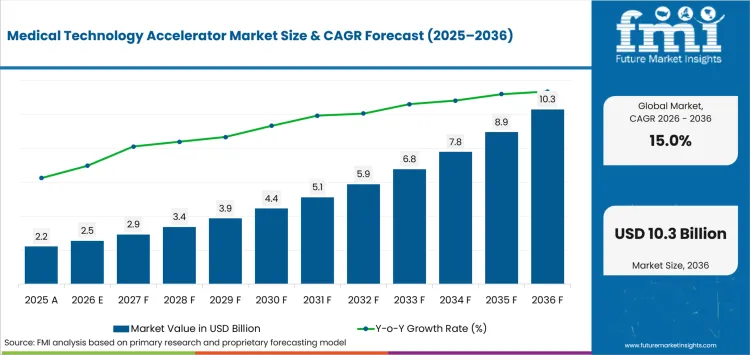
Key Takeaways of Medical Technology Accelerator Market
- Demand for medical technology accelerators is driven by the cost and coordination required to advance regulated health technologies toward commercial use, with hospitals and corporate partners expecting clinical evidence tied to an identifiable care pathway and budget owner.
- By accelerator type, start-up accelerators hold the leading share at 33.8% in 2026, attributable to their broad role across early venture decisions before companies build large internal teams.
- Medical devices lead the technology focus category at 40.6% share in 2026, driven by regulated development requirements across hardware and diagnostic ventures.
- Product development accounts for 30.0% application share in 2026, underpinned by its position across prototype and validation spending.
- Medical technology start-ups lead end-user demand at 43.9% share in 2026, supported by concentrated demand from resource-limited venture teams needing external expertise before revenue supports permanent specialist functions.
- South Korea, India, and the United Kingdom record CAGRs of 17.2%, 16.4%, and 15.7% respectively through 2036, while France and the USA form a central growth band and Germany and Japan show more measured commercialization profiles.
- Competition centers on MedTech Innovator, MedTech Actuator, JLABS, MATTER, T-Hub, SGInnovate, Plug and Play, and NEMIC, with vendors differentiating through regulatory planning depth, innovation platform breadth, and regional mentor/investor network access.
Analyst Perspective
The real value of a medical technology accelerator isn't mentor volume but whether specialist access actually shortens a regulated venture's path to a financing or procurement decision. Device ventures need deeper documentation support than most software startups precisely because safety testing and controlled design changes can't be shortcut, so programs that separate technical feasibility from adoption evidence tend to save founders from expensive redesigns later. Subsidized testing routes, like the cost-sharing models referenced in India's ecosystem, matter less as a discount and more as a way to preserve formal safety checks that cash-strapped founders might otherwise defer or skip, which is where the real commercialization risk sits.-
-Anurag Sharma, Principal Analyst at Future Market Insights
Source: FMI's proprietary forecasting model and primary research
How is the Medical Technology Accelerator Market segmented?
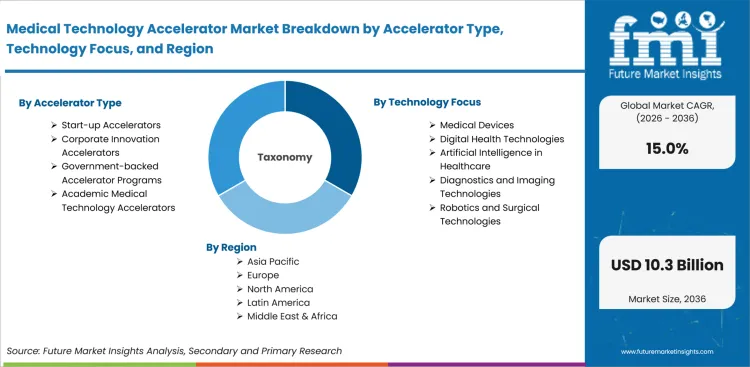
The medical technology accelerator market is segmented by Accelerator Type, Technology Focus, Application, End User, and Region
Accelerator type separates independent start-up programs from corporate models and publicly supported programs operated through academic or government institutions. Technology focus distinguishes medical devices from digital health and artificial intelligence alongside diagnostics and surgical systems. Application categories follow product development through clinical validation and regulatory support toward commercialization and partnership activity. End user analysis separates medical technology startups from healthcare providers and established life science organizations. Regional analysis compares program revenue and commercialization conditions across national medical technology ecosystems with different funding and regulatory structures.
What supports demand for start-up accelerators within the accelerator type category?
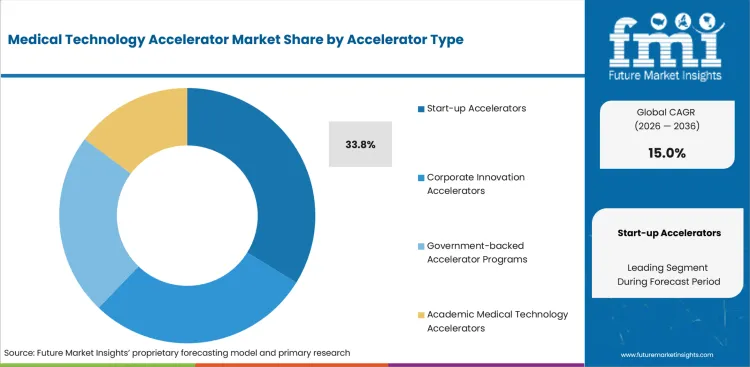
Start-up accelerators organize specialist support around ventures that lack full regulatory and commercialization teams internally. Program design must sequence clinical trials with investor preparation so scarce founder time supports the next financing decision. HealthCapital reported in June 2025 that the 4C Accelerator combines fifteen workshops with six months of individual coaching. The extended structure gives device founders repeated guidance across business modelling and investor readiness without requiring permanent specialist staff.
- Start-up Accelerators are estimated to hold 33.8% share in 2026, attributable to their broad role across early venture decisions. Their share reflects demand for coordinated guidance across product definition and regulatory planning before companies build large internal teams. Program sponsors gain stronger selection discipline once venture milestones expose technical and commercial weaknesses within the same review process.
- Medical technology founders adopt start-up accelerators to secure mentors and testing access during periods of limited cash and staffing. Programs create practical value through sequenced reviews that link evidence gaps with named experts and achievable milestone plans. Sponsors must preserve founder accountability so external advice improves decisions without replacing the venture’s operating responsibility.
Why do medical devices shape the technology focus category?
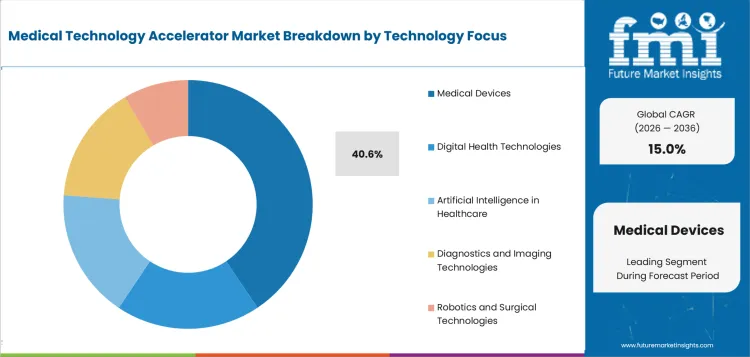
Medical devices require evidence packages that connect engineering performance with safety and intended clinical use. Accelerators serving this category must coordinate testing routes and regulatory strategy across several dependent development steps. Specialized programs connect product engineering with industrial partners and clinical evaluation routes across the commercialization process. France’s enterprise directorate reported in May 2025 that two medical device challenges followed consultation with more than 220 health ecosystem participants.
- Medical Devices are projected to represent 40.6% share in 2026, driven by regulated development requirements across hardware and diagnostic ventures. Device teams need stronger documentation than many general software ventures due to safety testing and controlled design changes. The segment anchors accelerator demand around technical reviews that must survive regulatory and sourcing scrutiny.
- Corporate and academic programs support device ventures through laboratory access and clinician feedback that general accelerators rarely provide at comparable depth. Effective programs separate technical feasibility from adoption evidence so founders understand which milestone controls the next spending decision. Medical device technology support becomes commercially useful once every review names a responsible owner and measurable deliverable.
How does product development shape the application category?
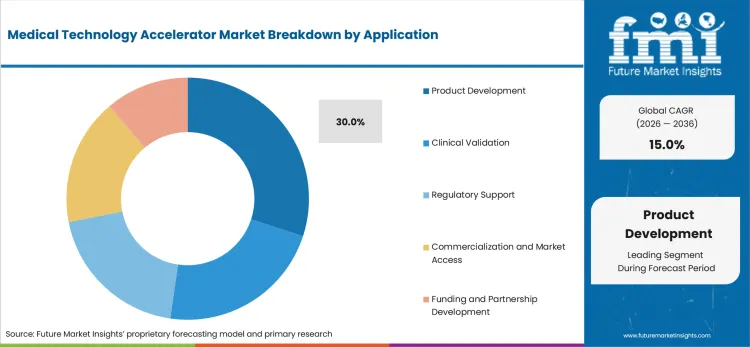
Product development programs help teams convert a clinical concept into a tested design with traceable requirements and manufacturing choices. Testing costs can absorb limited startup capital long before commercial revenue supports a larger technical team. BIRAC reported in October 2025 that referred Indian startups can receive testing-charge subsidies ranging from 40% to 70%. Subsidized device testing services reduce cash pressure while preserving formal checks for electrical safety and biocompatibility.
- Based on application, product development is forecast to account for 30.0% share in 2026, underpinned by its position across prototype and validation spending. Accelerators influence vendor selection and evidence sequencing while founders decide whether a design is ready for broader verification. Program value rises through fewer avoidable redesigns and clearer technical packages for later regulatory discussions.
- Engineering teams use product development support to compare test methods and manufacturing routes within a single milestone plan. Shared laboratories and specialist networks reduce delays caused by searching for qualified testing partners across separate institutions. Accelerators remain accountable for coordination while device developers retain design control and final technical decisions.
Why are medical technology start-ups central to the end user category?
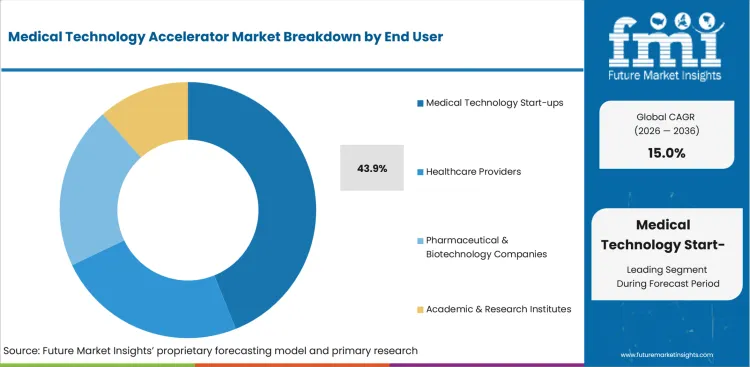
Medical technology startups form the largest end-user group because accelerator services are designed around venture development constraints. Small teams usually need regulatory and commercial expertise before revenue can support permanent specialist functions. Founder-focused accelerators therefore combine technical milestones with financing and partnership preparation across one structured program. MedTech Innovator’s current program lists regulatory exposure and investor access for medical device and digital health companies.
- In 2026, medical technology start-ups are anticipated to hold 43.9% share, supported by concentrated demand from resource-limited venture teams. Early-stage companies need external expertise across several functions but cannot justify full internal departments during early development. The share reflects recurring demand for coordinated reviews that reduce expensive sequencing errors across regulated product development.
- Founders adopt accelerator programs to access AI-enabled devices mentors and commercialization partners beyond their immediate networks. Program participation can improve investor communication by translating technical progress into milestone language that capital providers understand. Accelerators must avoid generic mentoring schedules because venture value depends on advice matched to the current evidence gap.
What are the drivers, restraints, and opportunities in the Medical Technology Accelerator Market?
Regulatory complexity and commercialization cost support demand for coordinated accelerator services across medical technology ventures. Limited evidence and fragmented specialist access restrain participation among startups with narrow budgets and uncertain development timelines. Integrated review pathways create room for programs that shorten decisions across regulation and reimbursement planning.
- Driver: Public and corporate funding supports structured programs that connect technical milestones with investor and regulatory expertise.
- Restraint: Regulatory fees and specialized testing costs reduce participation among ventures with limited capital and uncertain development timelines.
- Opportunity: Integrated public review pathways create demand for accelerators that coordinate evidence across regulation and reimbursement decisions.
Dedicated public funding strengthens accelerator demand by lowering the cost of specialist support for early medical technology ventures. A UK sourcing notice published in October 2025 allocated a contract running for 4 months and 21 days for a venture kickstarter and two biomedical catalyst accelerators. The funded structure connects clinical diagnostics startups with business support around defined health innovation programs rather than general entrepreneurship services. Program operators can convert public funding into durable demand by linking each award with measurable development and commercialization milestones.
Regulatory charges and specialist testing requirements can exceed the cash available to small device companies during early validation. PMDA states that eligible Japanese SMEs can receive a 50% subsidy on selected innovative medical device review fees. The subsidy confirms that formal review costs remain material even within a mature national medical technology system. Accelerators lose relevance whenever they offer broad mentoring without credible routes toward qualified testing and regulatory advice.
Integrated assessment pathways create an opening for accelerators that coordinate regulatory and reimbursement evidence within one development plan. South Korea’s regulator announced in December 2025 that its 2026 integrated review combines device designation with reimbursement classification and health technology assessment. The integrated process allows digital healthcare transformation programs to prepare connected evidence packages instead of treating each decision as an isolated task. Accelerator programs can create stronger commercial value by assigning responsibility across evidence preparation and public agency engagement.
Which country CAGRs are profiled in the Medical Technology Accelerator Market?
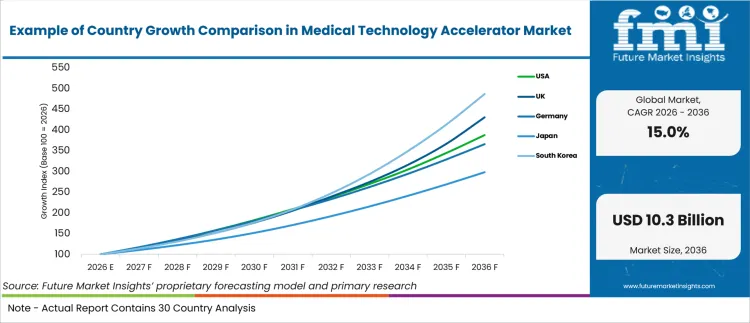
| Country | CAGR |
|---|---|
| South Korea | 17.2% |
| India | 16.4% |
| UK | 15.7% |
| France | 14.8% |
| USA | 14.5% |
| Germany | 13.8% |
| Japan | 11.5% |
How do country-level CAGRs compare in the Medical Technology Accelerator Market?
The seven-country comparison spans 11.5% to 17.2% CAGR and shows a moderate spread rather than a divided growth pattern. South Korea and India occupy the upper range through coordinated public programs and expanding commercialization support. The United Kingdom and France form a central band with policy routes that connect innovation programs with public healthcare priorities. United States growth remains close to that central group despite a more distributed accelerator and purchasing landscape. Germany follows with structured coaching and industrial support while Japan reflects a more selective route through established corporate and regulatory channels. The forecasts describe relative program revenue momentum within this market and do not establish national rankings across the broader healthcare economy.
- South Korea and India form the upper growth cluster as policy support combines with active commercialization programs for medical technology ventures.
- The United Kingdom and France occupy the next band through public sourcing reform and structured health innovation funding.
- The United States remains close to the European middle band through diverse programs that connect founders with regulatory and investor networks.
- Germany records measured growth through specialized coaching and industrial support that favors technically prepared device ventures.
- Japan shows the most selective forecast profile despite strong corporate engagement and targeted regulatory support for innovative devices.
Similar forecast rates can mask large differences in program funding and local service capacity across national medical technology ecosystems. The full report covers more than thirty countries across North America and Latin America with detailed national analysis. Regional coverage also includes Europe and East Asia through country-specific commercialization assessments for founders and program operators. South Asia and Oceania appear alongside the Middle East and Africa within the broader regional framework.
Country-wise Analysis
- United States medical technology ventures operate within a large but fragmented network of regulators and healthcare purchasing organizations. Accelerator revenue in the USA is projected to expand at 14.5% CAGR from 2026 to 2036, aided by specialist regulatory programs. The FDA explains that TAP advisors connect participating developers with non-FDA parties addressing clinical evidence and reimbursement planning. National programs can connect founders with regulatory guidance and commercial feedback before product plans become expensive to change. Service depth varies by region and accelerator, which can force startups to assemble testing and reimbursement support across separate organizations. Programs with named referral routes gain an advantage by reducing coordination work across a geographically dispersed healthcare system.
- United Kingdom device startups work inside a centralized health system that can align sourcing policy with national adoption priorities. Revenue is forecast to rise at 15.7% CAGR through 2036, supported by public programs that emphasize patient access and value. A national regulator and public health service give accelerators recognizable routes toward clinical evaluation and purchasing conversations. The MHRA announced in July 2025 that an early access service would initially support innovative diagnostic devices with unmet clinical needs. Founders must demonstrate budget impact across NHS organizations that apply sourcing guidance through different local operating structures. Programs that prepare evidence for both regulatory review and public purchasing can reduce repeated work across the commercialization pathway.
- German accelerator programs benefit from regional industrial clusters and university networks with established links to medical device engineering. Revenue is estimated to advance at 13.8% CAGR over the forecast period, reflecting structured coaching and industrial partnerships. Germany’s economics ministry reported in July 2025 that ten EXIST Startup Factories brought together 126 research institutions and 144 private partners. The selected group includes GOeFUTURE through Life Science Valley and connects health ventures with regional coaching and research partnerships. Regional service fragmentation can create long travel and referral chains for ventures needing specialized clinical or manufacturing expertise. Programs that connect factories with qualified device specialists can reduce handoff delays across research and commercialization decisions.
- Japanese medical technology ventures often collaborate with established corporations that control manufacturing expertise and domestic distribution relationships. Accelerator revenue in Japan is forecast to record 11.5% CAGR through 2036, shaped by selective corporate and regulatory support. Corporate participation gives accelerators direct access to engineering knowledge and potential commercial partners during product development. METI updated the MedTech ROUND program page in February 2025 and documented four global device companies offering acceleration themes to selected startups. Foreign ventures can face longer relationship-building cycles and concentrated service access around major urban innovation centers. Programs with bilingual support and clear corporate decision routes can improve founder access without weakening local partnership discipline.
- South Korean medical technology ventures operate within a dense national innovation system centered on Seoul and major tertiary hospitals. Revenue is projected to expand at 17.2% CAGR from 2026 to 2036, enabled by coordinated public support and rapid program formation. KHIDI opened applications in October 2025 for MedTech Spotlight New Impact Korea 2026 and accepted submissions through January 2026. The national call gives device companies a defined route into a current commercialization support program. Specialist certification and hospital evaluation resources remain concentrated around major institutions and large metropolitan areas. Accelerators that arrange regional testing and service referrals can reduce travel burdens for ventures outside Seoul.
- French medical technology ventures can access national funding programs that connect industrial policy with clinical innovation priorities. Accelerator revenue in France is anticipated to rise at 14.8% CAGR through 2036, reinforced by structured health industry programs. Structured advice and training connect participating companies with commercial relationships across the national health industry. Bpifrance announced in November 2025 that twelve health startups and SMEs entered an eighteen-month accelerator. Health ventures must navigate separate evaluation and sourcing routes across hospitals and regional care organizations. Programs that connect industrial planning with clinical validation can reduce delays between product development and institutional adoption.
- Indian medical technology ventures operate across a large startup system with uneven access to specialist laboratories and hospital partners. Accelerator revenue in India is projected to increase at 16.4% CAGR through 2036, supported by public funding and commercialization infrastructure. BIRAC reported in August 2025 that its AcE fund had supported 102 biotechnology startups with 102 biotechnology startups through 16 daughter funds in actual investment. Public capital gives accelerators a wider pool of funded ventures that can purchase testing and commercialization support. Specialist service access remains uneven across cities and can extend travel or referral requirements for device teams. Programs that combine remote mentoring with verified laboratory referrals can improve national reach without weakening technical oversight.
Who are the notable companies in the Medical Technology Accelerator Market?
The competitive group spans dedicated medical technology accelerators and broader healthcare platforms including MedTech Innovator; JLABS; MATTER; MedTech Actuator; SGInnovate; T-Hub; Plug and Play; and NEMIC.
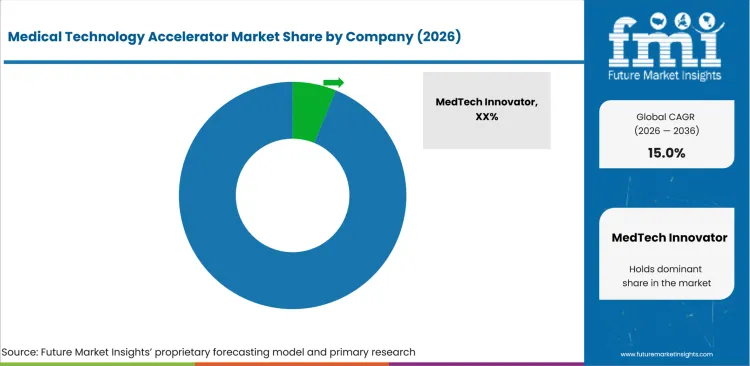
Competition combines specialized device accelerators with healthcare platforms that serve broader venture portfolios across several regions. MedTech Innovator and MedTech Actuator focus directly on medical devices while MATTER and JLABS provide wider healthcare support. T-Hub and SGInnovate connect regional founders with mentors and investment networks across India and Singapore. Plug and Play adds corporate partnerships across several health locations while NEMIC provides concentrated commercialization support in New England. Comparable device contract manufacturing relationships matter because accelerator graduates must translate prototypes into controlled production plans.
- MedTech Innovator and MedTech Actuator provide dedicated medical technology programs with structured regulatory and commercialization support. NEMIC adds a regional program that connects device founders with expert advising and commercialization planning. Their specialization helps founders address product development and market access through one accountable program relationship with defined milestone ownership.
- JLABS and MATTER operate broader healthcare platforms that include medical devices and digital health ventures. SGInnovate supports regional deep technology founders through investment networks and health-focused ecosystem programs serving regulated innovation needs. Each platform offers useful cross-sector connections but may allocate specialist resources across several healthcare categories and venture development stages.
- T-Hub supports healthcare commercialization through mentors and investor access across an India-based startup network with national partnership reach. Plug and Play connects health ventures with corporate partners across an international program footprint spanning several healthcare innovation centers. Both platforms can improve healthcare artificial intelligence access but founders must confirm device-specific regulatory support during program selection.
Competitive Benchmarking: Medical Technology Accelerator Market
| Company | Medical Device Specialization | Regulatory and Clinical Support | Capital and Commercialization Support | Geographic Reach |
|---|---|---|---|---|
| MedTech Innovator | High | High | High | Global |
| JLABS | High | High | High | Global |
| MATTER | Medium | High | High | United States and global partners |
| MedTech Actuator | High | High | High | Australia; Japan; and Singapore |
| SGInnovate | Medium | Medium | High | Singapore and international partners |
| T-Hub | Medium | Medium | High | India and international partners |
| Plug and Play | Medium | Medium | High | Global |
| NEMIC | High | High | Medium | United States |
Key Developments in the Medical Technology Accelerator Market
- In May 2026, MedTech Innovator announced a sixty-five-company cohort selected from more than eighteen hundred applicants. The four-month program included more than USD 800 thousand in available funding and prizes for participating ventures. The organization also introduced the MTI Index as a recognition platform for medical technology companies. The expansion gives sponsors a larger screening pool and creates more structured visibility for selected founders.
- In March 2025, MATTER named five companies for a twelve-week brain health accelerator supported by the Lundbeck US Charitable Fund. Each company received a USD 10 thousand stipend together with mentoring and pitch preparation during the program. The cohort focused on tools addressing measurement and care gaps across several neurological and behavioral health conditions. The program shows how challenge-based funding can concentrate accelerator resources around a defined clinical problem.
- In April 2026, MedTech Actuator described a two-phase Origin Singapore program for first-time health technology founders. Pitch Bootcamp tests clinical needs and value propositions before the Venture Bootcamp addresses intellectual property and regulatory pathways. Top teams receive fast-tracked access to the organization’s Singapore accelerator program for further venture development. The staged format creates a clearer transition from idea testing toward structured accelerator participation for founders.
- In January 2026, NEMIC opened registration for a six-month accelerator serving medical device and digital health entrepreneurs. The program operates with Rhode Island workforce funding and remains free for eligible local participants. Curriculum support covers business formation and commercialization decisions for ventures moving from concept toward market. The local model combines workforce development with venture support inside a concentrated regional medical technology ecosystem.
Key Players in the Medical Technology Accelerator Market
Dedicated Medical Technology Accelerators
- MedTech Innovator
- MedTech Actuator
- NEMIC
Healthcare Innovation Platforms
- JLABS
- MATTER
- Plug and Play
Regional Commercialization Networks
- SGInnovate
- T-Hub
Medical Technology Accelerator Market - Report Scope
| Coverage field | Report scope |
|---|---|
| Market breakdown | Accelerator type; technology focus; application; end user; and region. |
| Market Definition | Revenue includes accelerator programs that directly support medical technology ventures through product development and regulatory planning together with clinical validation and financing preparation for commercialization. The scope includes program fees and sponsorship funding together with institutional contracts and paid specialist services as well as equity-linked program economics. The scope excludes startup fundraising and company valuations together with general coworking revenue and healthcare consulting that lacks a direct accelerator role. |
| Regions Covered | North America; Latin America; Western Europe; Eastern Europe; East Asia; South Asia and Pacific; and Middle East and Africa. |
| Countries Covered | USA; UK; Germany; Japan; South Korea; France; and India. |
| Key Companies Profiled | MedTech Innovator; JLABS; MATTER; MedTech Actuator; SGInnovate; T-Hub; Plug and Play; and NEMIC. |
| Forecast Period | 2026 to 2036. |
| Approach | Hybrid bottom-up and top-down sizing combined official desk research with market-specific program analysis across the defined revenue boundary. |
Medical Technology Accelerator Market - Research Methodology
| Method | Approach |
|---|---|
| Primary Research | FMI analysts gathered input from manufacturers, service providers, technology developers, distributors, end users, sourcing teams, and subject-matter experts. Interviews examined purchasing decisions, product or service evaluation, adoption barriers, approval requirements, pricing considerations, and expectations for technical or commercial support. Respondents were also asked what evidence is required before a trial, pilot, or initial order develops into regular purchasing. |
| Desk Research | Desk research covered government statistics, regulatory publications, trade data, industry associations, technical literature, standards, company filings, product information, and official corporate announcements. Sources were reviewed for relevance, publication date, geographic coverage, and consistency with the defined market scope. Claims relating to performance, applications, approvals, capacity, investment, and commercial activity were retained only when supported by credible public evidence. |
| Market Sizing and Forecasting | The market model combined the baseline value with historical performance, segment structure, pricing and volume indicators, adoption levels, company participation, and country-level demand conditions. Forecast assumptions considered economic activity, investment trends, regulatory developments, technology adoption, purchasing cycles, supply availability, and barriers to wider market use. Segment and regional estimates were reconciled before the final market total was calculated. |
| Data Validation | Estimates were checked against multiple independent indicators, including public data, company activity, trade patterns, industry developments, and findings from primary interviews. Validation also tested whether products, services, applications, and company revenues fell within the defined market boundaries. Adjacent categories, unsupported claims, overlapping revenues, and activities without direct market relevance were excluded to reduce double counting and maintain consistency across segments and countries. |
Medical Technology Accelerator Market by Segments
Medical Technology Accelerator Market segmented by Accelerator Type:
- Start-up Accelerators
- Corporate Innovation Accelerators
- Government-backed Accelerator Programs
- Academic Medical Technology Accelerators
Medical Technology Accelerator Market segmented by Technology Focus:
- Medical Devices
- Digital Health Technologies
- Artificial Intelligence in Healthcare
- Diagnostics and Imaging Technologies
- Robotics and Surgical Technologies
Medical Technology Accelerator Market segmented by Application:
- Product Development
- Clinical Validation
- Regulatory Support
- Commercialization and Market Access
- Funding and Partnership Development
Medical Technology Accelerator Market segmented by End User:
- Medical Technology Start-ups
- Healthcare Providers
- Pharmaceutical & Biotechnology Companies
- Academic & Research Institutes
Medical Technology Accelerator Market by Region:
- North America
- United States
- Canada
- Latin America
- Brazil
- Mexico
- Argentina
- Chile
- Western Europe
- Germany
- France
- United Kingdom
- Italy
- Spain
- Benelux
- Nordics
- Eastern Europe
- Poland
- Czech Republic
- Romania
- Hungary
- East Asia
- China
- Japan
- South Korea
- South Asia and Pacific
- India
- ASEAN
- Australia and New Zealand
- Middle East and Africa
- GCC Countries
- South Africa
- Türkiye
- Israel
Research Sources and Bibliography
- Biotechnology Industry Research Assistance Council. (2025, October 17).
- Biotechnology Industry Research Assistance Council. (2026, May 14).
- Bpifrance. (2025, November 5).
- Department of Health and Social Care & NHS England. (2025, September 26).
- Direction générale des Entreprises. (2025, May 23).
- Federal Ministry for Economic Affairs and Energy. (2025, July 10).
- HealthCapital Berlin-Brandenburg. (2025, June 10).
- Johnson & Johnson Innovation. (2025, May 27).
- Korea Health Industry Development Institute. (2025, October 30).
- MATTER. (2025, March 5).
- MATTER. (n.d.).
- Medicines and Healthcare products Regulatory Agency. (2025, July 31).
- MedTech Actuator. (2026, April 19).
- MedTech Actuator. (n.d.).
- MedTech Innovator. (2026, May 27).
- MedTech Innovator. (n.d.).
- Ministry of Economy, Trade and Industry. (2025, February 17).
- Ministry of Food and Drug Safety. (2025, December 29).
- New England Medical Innovation Center. (2026, January 12).
- New England Medical Innovation Center. (n.d.)
- Pharmaceuticals and Medical Devices Agency. (2026).
- Plug and Play. (2025).
- SGInnovate. (2025, May 21).
- T-Hub. (2026).
- USA Food and Drug Administration. (2026, July 1).
- USA Food and Drug Administration. (2026, July 1).
- UK Government Commercial Function. (2025, October 28).
This Report Answers
- How large is the medical technology accelerator market in 2026 and 2036?
- Which operating conditions support investment in medical technology accelerator programs?
- Why do Start-up Accelerators hold a notable Accelerator Type share during 2026?
- How does Medical Devices influence the Technology Focus category during 2026?
- Why does Product Development account for a significant Application share during 2026?
- How do country growth rates differ across the seven profiled national markets?
- Which companies provide specialized or broader healthcare acceleration services for regulated ventures?
- What limits accelerator participation among medical technology startups with narrow operating budgets?
- How can integrated review pathways improve commercialization support across medical technology ventures?
Frequently Asked Questions
How big is the Medical Technology Accelerator Market in 2026?
The medical technology accelerator market is valued at USD 2.5 billion in 2026 and is forecast to reach USD 10.3 billion by 2036. Growth reflects regulated ventures seeking coordinated commercialization services that connect founders with procurement evidence before product decisions consume scarce capital.
What is the CAGR of the Medical Technology Accelerator Market from 2026 to 2036?
The medical technology accelerator market grows at a CAGR of 15.2% between 2026 and 2036, supported by public and corporate funding that connects technical milestones with investor and regulatory expertise across regulated medical technology ventures.
Which end user leads the Medical Technology Accelerator Market?
Medical technology start-ups account for 43.9% of the medical technology accelerator market by end user in 2026, supported by concentrated demand from resource-limited venture teams that need external expertise before revenue can fund permanent specialist functions.
How much will the Medical Technology Accelerator Market add between 2026 and 2036?
The medical technology accelerator market is set to add USD 7.8 billion between 2026 and 2036, growing from USD 2.5 billion to USD 10.3 billion as coordinated regulatory and commercialization programs extend across a widening base of medical technology ventures.
Who are the leading companies in the Medical Technology Accelerator Market?
Five companies lead the medical technology accelerator market, including MedTech Innovator, MedTech Actuator, JLABS, MATTER, and T-Hub, competing through regulatory planning support, commercialization facilities, and specialist mentor networks for regulated technology ventures.
Preview the report firsthand - request a free sample
Get SampleGet the brochure for pricing and purchase details.
Get PDFTable of Content
- Key Takeaways
- Market Size and CAGR
- Top Growth Driver
- Fastest Growing Segment
- Leading Region
- Key Companies
- Emerging Opportunities
- Executive Summary
- Global Market Outlook
- Demand-side Trends
- Supply-side Trends
- Technology Roadmap Analysis
- Analysis and Recommendations
- Analyst Perspective (What is happening? Why now? What should investors know?)
- Key Questions Answered
- How large is the market?
- What is the CAGR?
- What are key trends?
- Which region dominates?
- Who are the leaders?
- Market Overview
- Market Coverage / Taxonomy
- Market Definition / Scope / Limitations
- Research Methodology
- Chapter Orientation
- Analytical Lens and Working Hypotheses
- Market Structure, Signals, and Trend Drivers
- Benchmarking and Cross-market Comparability
- Market Sizing, Forecasting, and Opportunity Mapping
- Research Design and Evidence Framework
- Desk Research Programme (Secondary Evidence)
- Expert Input and Fieldwork (Primary Evidence)
- Tooling, Models, and Reference Databases
- Data Engineering and Model Build
- Quality Assurance and Audit Trail
- Market Background
- Market Dynamics (Drivers, Restraints, Opportunity, Trends)
- Scenario Forecast (Optimistic, Likely, Conservative)
- Impact Analysis
- AI Impact
- Sustainability Impact
- Regulatory Impact
- Technology Impact
- Consumer / Buyer Analysis
- Purchase Drivers
- Adoption Barriers
- Buyer Journey
- Opportunity Map Analysis
- Product Life Cycle Analysis
- Supply Chain Analysis
- Investment Feasibility Matrix
- Value Chain Analysis
- PESTLE and Porter's Analysis
- Regulatory Landscape
- Regional Parent Market Outlook
- Production and Consumption Statistics
- Import and Export Statistics
- Global Market Analysis and Forecast, 2021 to 2036
- Historical Market Size Value (USD Billion) Analysis, 2021 to 2025
- Current and Future Market Size Value (USD Billion) Projections, 2026 to 2036
- Y-o-Y Growth Trend Analysis
- Absolute $ Opportunity Analysis
- Global Market Pricing Analysis, 2021 to 2036
- Global Market Analysis and Forecast, By Accelerator Type, 2021 to 2036
- Introduction / Key Findings
- Historical Market Size Value (USD Billion) Analysis By Accelerator Type, 2021 to 2025
- Current and Future Market Size Value (USD Billion) Analysis and Forecast By Accelerator Type, 2026 to 2036
- Start-up Accelerators
- Corporate Innovation Accelerators
- Government-backed Accelerator Programs
- Academic Medical Technology Accelerators
- Start-up Accelerators
- Y-o-Y Growth Trend Analysis By Accelerator Type, 2021 to 2025
- Absolute $ Opportunity Analysis By Accelerator Type, 2026 to 2036
- Global Market Analysis and Forecast, By Technology Focus, 2021 to 2036
- Introduction / Key Findings
- Historical Market Size Value (USD Billion) Analysis By Technology Focus, 2021 to 2025
- Current and Future Market Size Value (USD Billion) Analysis and Forecast By Technology Focus, 2026 to 2036
- Medical Devices
- Digital Health Technologies
- Artificial Intelligence in Healthcare
- Diagnostics and Imaging Technologies
- Robotics and Surgical Technologies
- Medical Devices
- Y-o-Y Growth Trend Analysis By Technology Focus, 2021 to 2025
- Absolute $ Opportunity Analysis By Technology Focus, 2026 to 2036
- Global Market Analysis and Forecast, By Application, 2021 to 2036
- Introduction / Key Findings
- Historical Market Size Value (USD Billion) Analysis By Application, 2021 to 2025
- Current and Future Market Size Value (USD Billion) Analysis and Forecast By Application, 2026 to 2036
- Product Development
- Clinical Validation
- Regulatory Support
- Commercialization and Market Access
- Funding and Partnership Development
- Product Development
- Y-o-Y Growth Trend Analysis By Application, 2021 to 2025
- Absolute $ Opportunity Analysis By Application, 2026 to 2036
- Global Market Analysis and Forecast, By End User, 2021 to 2036
- Introduction / Key Findings
- Historical Market Size Value (USD Billion) Analysis By End User, 2021 to 2025
- Current and Future Market Size Value (USD Billion) Analysis and Forecast By End User, 2026 to 2036
- Medical Technology Start-ups
- Healthcare Providers
- Pharmaceutical & Biotechnology Companies
- Academic & Research Institutes
- Medical Technology Start-ups
- Y-o-Y Growth Trend Analysis By End User, 2021 to 2025
- Absolute $ Opportunity Analysis By End User, 2026 to 2036
- Global Market Analysis and Forecast, By Region, 2021 to 2036
- Introduction
- Historical Market Size Value (USD Billion) Analysis By Region, 2021 to 2025
- Current Market Size Value (USD Billion) Analysis and Forecast By Region, 2026 to 2036
- North America
- Latin America
- Western Europe
- Eastern Europe
- East Asia
- South Asia and Pacific
- Middle East & Africa
- Market Attractiveness Analysis By Region
- North America Market Analysis and Forecast, By Country, 2021 to 2036
- Historical Market Size Value (USD Billion) Trend Analysis By Market Taxonomy, 2021 to 2025
- Market Size Value (USD Billion) Forecast By Market Taxonomy, 2026 to 2036
- By Country
- USA
- Canada
- By Accelerator Type
- By Technology Focus
- By Application
- By End User
- By Country
- Market Attractiveness Analysis
- By Country
- By Accelerator Type
- By Technology Focus
- By Application
- By End User
- Key Takeaways
- Latin America Market Analysis and Forecast, By Country
- Historical Market Size Value (USD Billion) Trend Analysis By Market Taxonomy, 2021 to 2025
- Market Size Value (USD Billion) Forecast By Market Taxonomy, 2026 to 2036
- By Country
- Brazil
- Mexico
- Chile
- Rest of Latin America
- By Accelerator Type
- By Technology Focus
- By Application
- By End User
- By Country
- Market Attractiveness Analysis
- By Country
- By Accelerator Type
- By Technology Focus
- By Application
- By End User
- Key Takeaways
- Western Europe Market Analysis and Forecast, By Country
- Historical Market Size Value (USD Billion) Trend Analysis By Market Taxonomy, 2021 to 2025
- Market Size Value (USD Billion) Forecast By Market Taxonomy, 2026 to 2036
- By Country
- Germany
- UK
- Italy
- Spain
- France
- Nordic
- BENELUX
- Rest of Western Europe
- By Accelerator Type
- By Technology Focus
- By Application
- By End User
- By Country
- Market Attractiveness Analysis
- By Country
- By Accelerator Type
- By Technology Focus
- By Application
- By End User
- Key Takeaways
- Eastern Europe Market Analysis and Forecast, By Country
- Historical Market Size Value (USD Billion) Trend Analysis By Market Taxonomy, 2021 to 2025
- Market Size Value (USD Billion) Forecast By Market Taxonomy, 2026 to 2036
- By Country
- Russia
- Poland
- Hungary
- Balkan & Baltic
- Rest of Eastern Europe
- By Accelerator Type
- By Technology Focus
- By Application
- By End User
- By Country
- Market Attractiveness Analysis
- By Country
- By Accelerator Type
- By Technology Focus
- By Application
- By End User
- Key Takeaways
- East Asia Market Analysis and Forecast, By Country
- Historical Market Size Value (USD Billion) Trend Analysis By Market Taxonomy, 2021 to 2025
- Market Size Value (USD Billion) Forecast By Market Taxonomy, 2026 to 2036
- By Country
- China
- Japan
- South Korea
- By Accelerator Type
- By Technology Focus
- By Application
- By End User
- By Country
- Market Attractiveness Analysis
- By Country
- By Accelerator Type
- By Technology Focus
- By Application
- By End User
- Key Takeaways
- South Asia and Pacific Market Analysis and Forecast, By Country
- Historical Market Size Value (USD Billion) Trend Analysis By Market Taxonomy, 2021 to 2025
- Market Size Value (USD Billion) Forecast By Market Taxonomy, 2026 to 2036
- By Country
- India
- ASEAN
- Australia & New Zealand
- Rest of South Asia and Pacific
- By Accelerator Type
- By Technology Focus
- By Application
- By End User
- By Country
- Market Attractiveness Analysis
- By Country
- By Accelerator Type
- By Technology Focus
- By Application
- By End User
- Key Takeaways
- Middle East & Africa Market Analysis and Forecast, By Country
- Historical Market Size Value (USD Billion) Trend Analysis By Market Taxonomy, 2021 to 2025
- Market Size Value (USD Billion) Forecast By Market Taxonomy, 2026 to 2036
- By Country
- Kingdom of Saudi Arabia
- Other GCC Countries
- Türkiye
- South Africa
- Other African Union
- Rest of Middle East & Africa
- By Accelerator Type
- By Technology Focus
- By Application
- By End User
- By Country
- Market Attractiveness Analysis
- By Country
- By Accelerator Type
- By Technology Focus
- By Application
- By End User
- Key Takeaways
- Key Countries Market Analysis
- USA
- Pricing Analysis
- Market Share Analysis, 2025
- By Accelerator Type
- By Technology Focus
- By Application
- By End User
- Canada
- Pricing Analysis
- Market Share Analysis, 2025
- By Accelerator Type
- By Technology Focus
- By Application
- By End User
- Mexico
- Pricing Analysis
- Market Share Analysis, 2025
- By Accelerator Type
- By Technology Focus
- By Application
- By End User
- Brazil
- Pricing Analysis
- Market Share Analysis, 2025
- By Accelerator Type
- By Technology Focus
- By Application
- By End User
- Chile
- Pricing Analysis
- Market Share Analysis, 2025
- By Accelerator Type
- By Technology Focus
- By Application
- By End User
- Germany
- Pricing Analysis
- Market Share Analysis, 2025
- By Accelerator Type
- By Technology Focus
- By Application
- By End User
- UK
- Pricing Analysis
- Market Share Analysis, 2025
- By Accelerator Type
- By Technology Focus
- By Application
- By End User
- Italy
- Pricing Analysis
- Market Share Analysis, 2025
- By Accelerator Type
- By Technology Focus
- By Application
- By End User
- Spain
- Pricing Analysis
- Market Share Analysis, 2025
- By Accelerator Type
- By Technology Focus
- By Application
- By End User
- France
- Pricing Analysis
- Market Share Analysis, 2025
- By Accelerator Type
- By Technology Focus
- By Application
- By End User
- India
- Pricing Analysis
- Market Share Analysis, 2025
- By Accelerator Type
- By Technology Focus
- By Application
- By End User
- ASEAN
- Pricing Analysis
- Market Share Analysis, 2025
- By Accelerator Type
- By Technology Focus
- By Application
- By End User
- Australia & New Zealand
- Pricing Analysis
- Market Share Analysis, 2025
- By Accelerator Type
- By Technology Focus
- By Application
- By End User
- China
- Pricing Analysis
- Market Share Analysis, 2025
- By Accelerator Type
- By Technology Focus
- By Application
- By End User
- Japan
- Pricing Analysis
- Market Share Analysis, 2025
- By Accelerator Type
- By Technology Focus
- By Application
- By End User
- South Korea
- Pricing Analysis
- Market Share Analysis, 2025
- By Accelerator Type
- By Technology Focus
- By Application
- By End User
- Russia
- Pricing Analysis
- Market Share Analysis, 2025
- By Accelerator Type
- By Technology Focus
- By Application
- By End User
- Poland
- Pricing Analysis
- Market Share Analysis, 2025
- By Accelerator Type
- By Technology Focus
- By Application
- By End User
- Hungary
- Pricing Analysis
- Market Share Analysis, 2025
- By Accelerator Type
- By Technology Focus
- By Application
- By End User
- Kingdom of Saudi Arabia
- Pricing Analysis
- Market Share Analysis, 2025
- By Accelerator Type
- By Technology Focus
- By Application
- By End User
- Türkiye
- Pricing Analysis
- Market Share Analysis, 2025
- By Accelerator Type
- By Technology Focus
- By Application
- By End User
- South Africa
- Pricing Analysis
- Market Share Analysis, 2025
- By Accelerator Type
- By Technology Focus
- By Application
- By End User
- USA
- Market Structure Analysis
- Competition Dashboard
- Competition Benchmarking
- Market Share Analysis of Top Players
- By Regional
- By Accelerator Type
- By Technology Focus
- By Application
- By End User
- Emerging Startups
- Innovation Benchmarking
- Competition Analysis
- Competition Deep Dive
- MedTech Innovator
- Overview
- Product Portfolio
- Profitability by Market Segments
- Sales Footprint
- Strategy Overview
- Marketing Strategy
- Product Strategy
- Channel Strategy
- JLABS
- MATTER
- SGInnovate
- MedTech Actuator
- T-Hub
- Plug and Play
- MedTech Momentum
- HealthX Ventures
- A*STAR
- MedTech Innovator
- Case Studies
- Success Stories
- Recent Developments
- Competition Deep Dive
- Assumptions & Acronyms Used


