

- Market Size (2026)
- USD 1018.3 Mn
- Forecast (2036)
- USD 2630.0 Mn
- CAGR (2026 to 2036)
- 9.0%
How big is the Medical Device Cybersecurity Testing Services Market in 2026?
USD 1018.3 million in 2026 and USD 2630.0 million by 2036 at a 9.0% CAGR.
Demand for medical device cybersecurity testing services is set to expand at 9.0% CAGR between 2026 and 2036. The industry valuation is on track to increase from USD 1018.3 million in 2026 to USD 2630.0 million by 2036. Connected products require controlled threat modeling and penetration results that manufacturers can trace through design changes and verified remediation records. In February 2026, the FDA issued final guidance covering cybersecurity design and recommended premarket documentation for devices carrying cybersecurity risk. The guidance places test evidence inside submission readiness rather than treating assessment as an isolated engineering exercise near commercial entry. Laboratories combining security testing with regulated development records can convert technical findings into evidence that supports submission review and corrective design decisions. Experience in medical device testing helps laboratories preserve safety and performance evidence throughout remediation without diluting cybersecurity findings.
United States sponsors work under explicit cyber-device duties, whereas European manufacturers coordinate national conformity routes with common post-market surveillance obligations. In December 2025, the European Commission published MDCG 2025-10 guidance for post-market surveillance of medical devices and in vitro diagnostic devices. The guidance strengthens demand for evidence linking detected weaknesses with corrective actions throughout the commercial device lifecycle. Organizations experienced in preclinical testing services can align cybersecurity findings with established quality records without presenting technical feasibility as commercial authorization. Country differences therefore influence report design and remediation timing even though core testing methods remain comparable across regulated device programs.
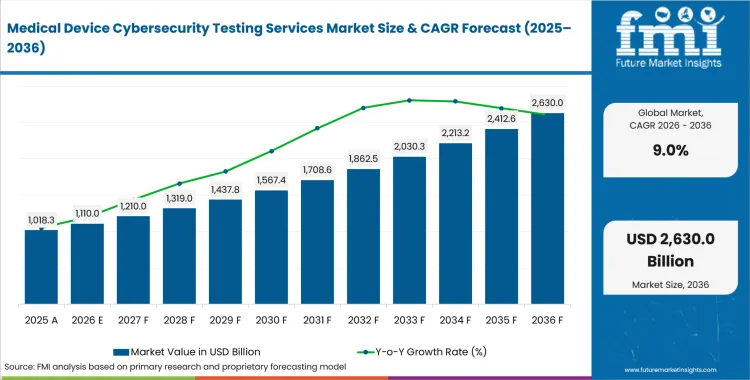
Key Takeaways of Medical Device Cybersecurity Testing Services Market
- Regulatory documentation and connected-device risk management are converting cybersecurity assessment from an isolated project into a recurring lifecycle service.
- Software accounts for 46.5% of product-type revenue in 2026, supported by frequent releases and recurring evidence requirements.
- Hospital settings represent 28.0% of care-setting demand in 2026, reflecting complex networks and direct patient-safety exposure.
- Monitoring applications capture 31.0% of application revenue in 2026, reinforced by persistent connections and continuous clinical data exchange.
- Different national requirements and restricted access to legacy device code extend project schedules despite demand for independent technical assurance.
- UL Solutions, BSI, DEKRA, TÜV SÜD, Intertek, Eurofins, NCC Group, and SGS combine different regulatory and technical service capabilities.
Analyst Perspective
“Medical-device cybersecurity testing creates value through findings that trace directly to affected components and verified design corrections. Laboratories must reproduce device interfaces and clinical network conditions so remediation evidence withstands submission review without weakening essential performance. A controlled lifecycle program also preserves reusable test records across patches and post-market changes instead of treating each software release as an unrelated project.”
- Anurag Sharma, Principal Analyst, Future Market Insights.
How is the Medical Device Cybersecurity Testing Services Market segmented?
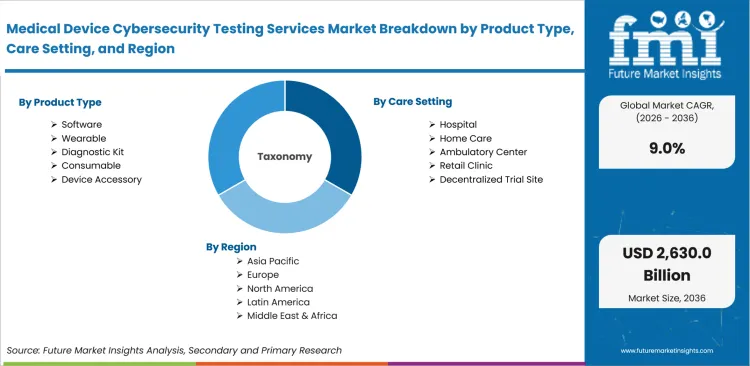
The medical device cybersecurity testing services industry is segmented by product type, care setting, application, end user, and region.
The medical device cybersecurity testing services industry is segmented by product type, care setting, application, end user, and region. Product type separates software assignments from testing linked to wearables, diagnostic kits, consumables, and device accessories across distinct development programs. Care setting identifies the operating environment that shapes access controls and network exposure across digital healthcare systems. Application groups services around monitoring, diagnosis, workflow automation, therapy support, and infection control across clinical technology environments. End user distinguishes hospitals, payers, diagnostic laboratories, medtech firms, and patients that require different forms of independent assurance. Regional analysis reflects approval pathways and laboratory access that influence evidence formats, project timing, and remediation responsibilities across connected medical devices.
What supports software demand within the product type category?
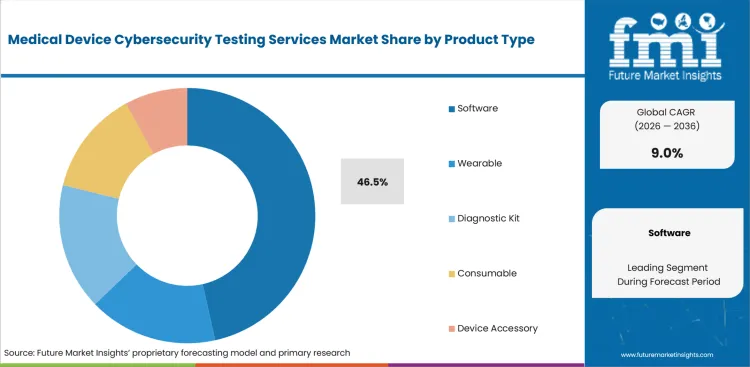
Software releases can alter attack paths and data flows without changing the physical platform used by clinicians or patients. In March 2026, Intertek described cybersecurity documentation as a lifecycle requirement covering design controls and post-market updates. The article also linked effective submissions with threat models and repeatable vulnerability processes rather than static control lists. Manufacturers therefore require new evidence whenever software changes affect interfaces or security controls across regulated product versions.
- Based on product type, software is projected to account for 46.5% in 2026 due to frequent releases and recurring evidence requirements. Independent laboratories verify authentication and update controls across versions that share hardware but carry different software exposure. Controlled retesting confirms that a correction closes the identified weakness without creating another operational risk.
- Device engineering teams commission software assessment across source code and interfaces alongside update mechanisms and external dependencies. Connected-product programs involving wearable device connectivity widen test scope across mobile applications and cloud services that exchange sensitive information. Adoption depends on repeatable methods that preserve a clear record across later regulatory reviews and corrective design decisions.
How do hospital settings shape demand within the care setting category?
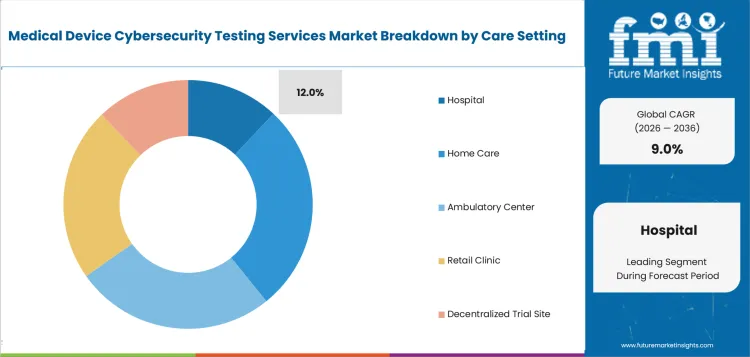
Hospital networks connect patient monitors and imaging systems with electronic records and clinical workstations across several departments. Cybersecurity assignments must reproduce representative network conditions and maintenance constraints rather than test each device as an isolated product. In February 2025, Health-ISAC described changing responsibilities between manufacturers and healthcare organizations across four medical-device lifecycle phases. The shared responsibility model expands testing around lifecycle handoffs and unsupported equipment across complex hospital device fleets.
- Hospitals are set to lead the care setting category with 28.0% share in 2026 due to complex network exposure and direct patient-safety consequences. One exploitable weakness can affect device availability and protected information across several connected clinical units. Testing laboratories need representative configurations and evidence that clinical engineering teams can apply during remediation planning.
- Hospital networks use medtech services to coordinate testing with maintenance windows and lifecycle ownership across installed equipment. Regular risk reviews become more important near end-of-support dates as responsibilities shift between manufacturers and hospital teams. Demand weakens whenever neither organization owns remediation for unsupported software and unresolved vulnerabilities across installed clinical equipment.
What makes monitoring central to the application category?
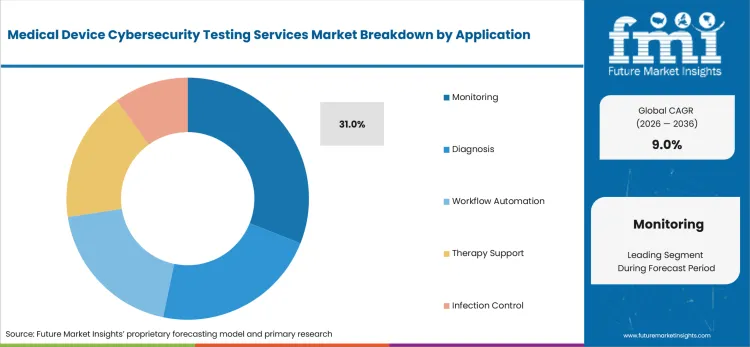
Monitoring devices maintain persistent connections and exchange clinical data throughout routine care instead of operating through occasional offline sessions. In July 2025, the FDA updated its safety communication for Contec and Epsimed patient monitors following a specialized software patch. The patch removed networking functionality from affected devices and restricted them to local monitoring under direct clinical observation. The response demonstrates why testing must examine network behavior and essential clinical performance through the same controlled assessment.
- By application, monitoring is estimated to hold 31.0% share in 2026 owing to persistent connections and continuous clinical data exchange. Persistent communication broadens exposure across device firmware and connected hospital network controls during routine operation. Independent assessment gains commercial value as manufacturers must prove that corrective changes preserve monitoring performance and data continuity.
- Clinical engineering teams prioritize monitoring assessments that reproduce network traffic and alarm behavior alongside update procedures. Expansion of remote patient monitoring adds home networks and mobile gateways that differ from controlled hospital environments. Testing programs gain acceptance as they separate device weaknesses from configuration errors and define practical remediation steps for each operating environment.
How do payers evaluate cybersecurity testing within the end user category?
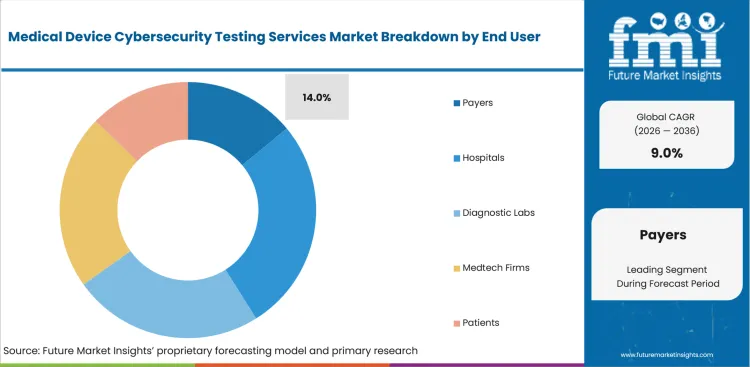
Health plans receive device-generated information through care-management platforms and contracted monitoring services that connect clinical organizations with claims administration. Independent testing does not establish clinical value or reimbursement eligibility for a connected device within this segment. HHS reported in August 2025 that the Change Healthcare breach had affected approximately 192.7 million individuals. The incident increased attention toward third-party controls across payer technology relationships and protected information routes.
- The payer segment is likely to capture 24.0% share in 2026 attributable to third-party assurance reviews across connected-care contracts. Testing evidence supports contractual assurance reviews and incident planning across platforms that receive protected device information. Commercial demand depends on whether each assessment defines remediation ownership across health plans and technology partners.
- Health plans purchase device-related assurance selectively through technology contracts rather than commissioning every product assessment directly. Expansion of connected healthcare monitoring increases the number of third parties handling device information across reimbursement workflows. Testing becomes useful as contract owners can trace interface risks and corrective responsibilities across several organizations.
What are the drivers, restraints, and opportunities in the Medical Device Cybersecurity Testing Services Market?
Regulatory evidence requirements sustain recurring demand; jurisdiction-specific documentation limits delivery efficiency; reusable assurance records create a practical service opening.
- Driver: Medical-device authorization and lifecycle duties require manufacturers to maintain reliable cybersecurity evidence across connected-product software changes.
- Restraint: Different software-risk frameworks and restricted access to legacy code increase evidence work across technically comparable assignments.
- Opportunity: Reusable assurance profiles and structured remediation records can reduce repeated reviews across manufacturers and regulated healthcare organizations.
Regulatory scrutiny is driving direct service demand as manufacturers must defend the reliability of cybersecurity results used in medical-device submissions. In June 2026, the FDA warned that unreliable third-party testing data had prevented authorization decisions for affected devices. The agency told sponsors to evaluate testing facilities and independently verify submitted results prior to regulatory filing. Laboratories with controlled methods and traceable records therefore gain work across premarket reviews and later corrective programs.
Cross-border projects remain constrained by software-risk frameworks that classify similar functions through different regulatory language and documentation routes. In January 2025, the International Medical Device Regulators Forum issued final software-characterization guidance covering risk factors beyond conventional device classifications. Manufacturers must align technical findings with each jurisdictional interpretation rather than reuse one report unchanged. The added work lengthens schedules for smaller organizations and legacy products with restricted code access.
Structured assurance is creating a service opening for laboratories that connect vulnerability findings with corrective actions used across later reviews. In February 2026, the MHRA introduced Risk Ledger profiles to improve security assurance across its third-party supply chain. Reusable profiles can reduce repeated information requests across programs without replacing product-specific testing or regulatory evidence. Providers that organize findings for both device remediation and third-party review can extend one assessment across several controlled decisions.
Which country CAGRs are profiled in the Medical Device Cybersecurity Testing Services Market?
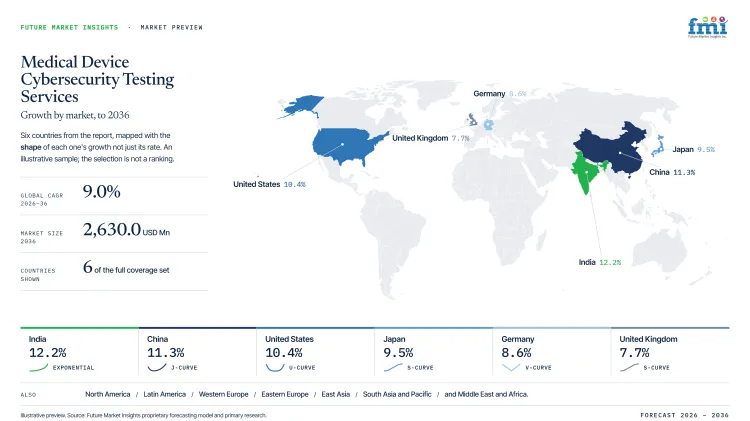
| Country | CAGR |
|---|---|
| India | 12.2% |
| China | 11.3% |
| United States | 10.4% |
| Japan | 9.5% |
| Germany | 8.6% |
| United Kingdom | 7.7% |
How do country-level CAGRs compare in the Medical Device Cybersecurity Testing Services Market?
The country forecasts show a steady progression across the medical device cybersecurity testing services market, with each country positioned within a relatively consistent growth band. India and China lead the comparison, reflecting rising attention to cybersecurity validation as connected medical devices become more prevalent across healthcare systems. The United States follows closely and acts as a bridge between the higher-growth Asian markets and the more mature testing environments in Europe and Japan. Germany, Japan and the United Kingdom form a lower grouping where differences are gradual rather than pronounced. This pattern reflects varying stages of cybersecurity framework adoption, regulatory enforcement and investment in connected healthcare technologies.
- India benefits from expanding digital health infrastructure and increasing adoption of connected medical technologies, creating greater demand for cybersecurity assessment, penetration testing and compliance validation services.
- China's outlook is supported by rapid growth in smart medical devices and stronger focus on cybersecurity controls as healthcare providers and manufacturers address evolving security risks.
- The United States reflects a mature regulatory and technology environment where device developers increasingly integrate cybersecurity testing throughout product development and post-market monitoring activities.
- Japan continues to strengthen medical device security practices as healthcare organizations adopt connected systems while maintaining rigorous quality and reliability standards.
- Germany's market development is influenced by growing integration of digital health technologies and increasing emphasis on security verification within regulated medical device environments.
- The United Kingdom supports steady demand for cybersecurity testing through evolving compliance expectations and continued investment in secure digital healthcare infrastructure.
Similar CAGRs can still represent different business environments for cybersecurity testing providers. Regulatory requirements, device approval processes, healthcare digitization levels and manufacturer cybersecurity maturity vary across countries and can significantly influence testing scope and service demand. Commercialization strategies often depend as much on compliance frameworks and security standards as on forecast market growth. The full report provides country-level CAGR analysis across North America, Latin America, Europe, East Asia, South Asia, Oceania and the Middle East and Africa.
Country-wise Analysis
- India regulates medical-device software through the Medical Devices Rules 2017 and current CDSCO guidance for manufacturers and assessment organizations. Medical-device cybersecurity testing services in India are estimated to post 12.2% CAGR over the forecast period, reinforced by current software guidance and defined evaluation routes. In July 2026, CDSCO listed its Guidance document on Medical Device Software under MDR-2017 through the official medical-device directory. The release gives manufacturers a current software-specific reference for building documentation and selecting independent assessment routes. Domestic engineering talent and approved testing channels support local delivery across software-led device programs in major production clusters. Limited specialist capacity and uneven manufacturer readiness can extend remediation beyond the initial technical assessment.
- China applies current national standards to intelligent medical-device manufacturers and connected clinical technology used across managed networks. Sales of medical-device cybersecurity testing services in China are forecast to expand at 11.3% CAGR by 2036, enabled by national capability standards for intelligent devices. In April 2025, YD/T 6284-2024 entered force with requirements for manufacturers to establish standardized product cybersecurity capabilities. Large domestic device producers provide a substantial operating base for local laboratories and certification organizations across major production clusters. Cross-border programs face friction from restricted firmware access and different expectations for transferring technical evidence. Testing organizations need local-language reports and controlled data-handling routes for multinational programs across several regulatory submissions.
- Manufacturers filing cyber-device submissions in the United States must provide vulnerability-management plans and secure update processes under federal premarket requirements. The medical-device cybersecurity testing sector in the United States is projected to record 10.4% CAGR during the assessment period, driven by explicit federal submission duties. In May 2026, the FDA updated a recognized software-validation standard page that directs manufacturers toward the February 2026 cybersecurity guidance for complete Section 524B assessment. Experienced regulatory specialists and a broad connected-device base support recurring assignments across software releases and material product changes. Restricted code access and high project cost can limit complete lifecycle programs for smaller manufacturers. Laboratories gain an advantage through evidence packages that fit submission sections without weakening technical detail.
- Japanese healthcare organizations follow national security guidance for medical information systems used by hospitals and pharmacies. In June 2026, the Ministry of Health Labour and Welfare released version 7.0 with updated organizational checklists and training materials. Medical-device cybersecurity testing demand in Japan is forecast to rise at 9.5% CAGR over the forecast period, supported by revised healthcare security guidance. Structured hospital operations support controlled device-integration testing across managed clinical networks and planned maintenance schedules. Language requirements and cautious change approval can lengthen technical review across hospital and manufacturer teams. Local engineering partners remain important for connecting findings with ministry documentation and clinical maintenance procedures.
- German hospitals combine European conformity requirements with national field-safety routes governing corrective action for connected clinical equipment. Germany's medical-device cybersecurity testing outlook is anticipated to advance at 8.6% CAGR over the assessment period, sustained by established field-safety routes. In February 2025, BfArM expanded an urgent safety notice across five Contec patient-monitor families following identified cybersecurity vulnerabilities. Accredited laboratories and experienced hospital engineering teams support detailed validation across connected equipment and established maintenance routes. Legacy devices and restricted maintenance access remain material barriers across mixed fleets containing unsupported software generations. Testing programs must verify corrections without interrupting essential clinical functions during scheduled hospital maintenance and device updates.
- Great Britain applies strengthened post-market surveillance duties to medical devices sold through its national regulatory route. In January 2025, the MHRA published guidance covering incident reporting and preventive or corrective actions under the amended regulations. Adoption of medical-device cybersecurity testing in the United Kingdom is estimated to expand at 7.7% CAGR through 2036, enabled by strengthened post-market duties. Approved bodies and conformity specialists provide channels for technical-file review and post-market reporting across Great Britain. Changing recognition arrangements can add cost for programs targeting both Great Britain and the European Union. Laboratories gain commercial relevance through evidence aligned with British reporting timelines and separate European requirements.
Who are the notable companies in the Medical Device Cybersecurity Testing Services Market?
UL Solutions, BSI, DEKRA, TÜV SÜD, Intertek, Eurofins, NCC Group, and SGS are the notable companies shaping this market.
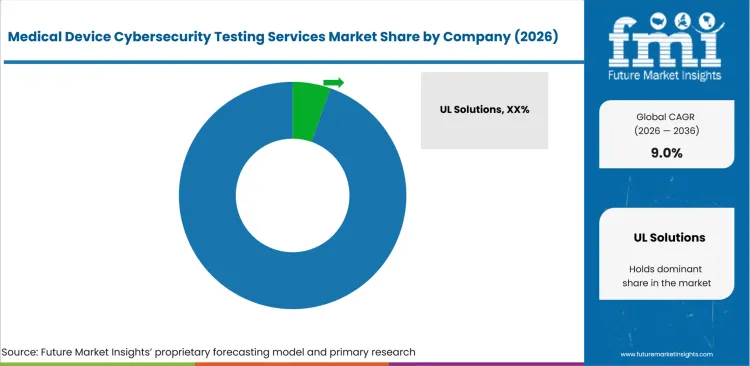
The competitive field combines conformity-assessment groups with specialist cybersecurity teams serving regulated device programs across several jurisdictions. UL Solutions and TÜV SÜD combine device testing with market-access support, whereas NCC Group adds deeper penetration and cyber-physical expertise. Manufacturers compare these roles across connected medical devices rather than selecting organizations through corporate scale alone. Broader security and vulnerability management capabilities become useful as programs extend from product assessment into recurring exposure management.
- UL Solutions and TÜV SÜD combine device cybersecurity testing with market-access support across major regulated product programs. Intertek adds lifecycle documentation guidance and independent assurance across software development and post-market changes for regulated connected products.
- BSI and DEKRA emphasize standards coordination and digital assurance across connected-product lifecycles and conformity responsibilities. SGS adds product-level testing and certification support under recognized medical-device cybersecurity standards across international conformity routes.
- Eurofins provides medical-device cybersecurity testing through laboratory networks covering safety and wireless performance across several regulated product categories. NCC Group contributes specialized penetration testing across health systems and cyber-physical technology environments with complex embedded interfaces.
Competitive Benchmarking: Medical Device Cybersecurity Testing Services Market
| Company | Regulatory Evidence Support | Penetration and Vulnerability Testing | Lifecycle Assurance | Geographic Reach |
|---|---|---|---|---|
| UL Solutions | High | High | High | Global |
| BSI | High | Medium | Medium | Global |
| DEKRA | High | High | High | Global |
| TÜV SÜD | High | High | High | Global |
| Intertek | High | Medium | High | Global |
| Eurofins | High | Medium | Medium | Global |
| NCC Group | Medium | High | Medium | Global |
| SGS | High | High | High | Global |
Key Developments in the Medical Device Cybersecurity Testing Services Market
- In April 2026, UL Solutions began construction of a German electromagnetic and wireless laboratory covering connected medical products and cybersecurity-related connectivity requirements. The facility is scheduled to become operational during mid-2027 rather than providing immediate regional testing capacity for manufacturers. The planned regional location is expected to help European manufacturers coordinate wireless validation with security evidence during product development and later design changes.
- In June 2025, TÜV SÜD documented penetration testing for Edgecare’s ultrasound bladder scanner during its United States 510(k) program. The case connected remediation work with test reports designed for FDA and EU conformity assessments. Manufacturers can apply the same evidence discipline to later software changes without treating each finding as an isolated technical issue.
- In July 2026, SGS announced the first IECEE CB certification under IEC 81001-5-1:2021 for Yaoshi’s Yetsea 300 series ophthalmoscope. The assessment included threat modeling and penetration testing alongside vulnerability scanning and software-bill-of-materials review across the certified device. The certification provides a current example of product-level cybersecurity evidence supporting international medical-device conformity routes.
- In February 2025, DEKRA launched an integrated Digital Trust Service combining cybersecurity and functional safety with AI testing and certification. Medical-device programs can use that coordinated structure as connected functions cross several assurance disciplines throughout regulated product development. The launch expands service options for manufacturers seeking one controlled route across security evidence and product-safety responsibilities.
Key Players in the Medical Device Cybersecurity Testing Services Market
Testing and Certification Leaders
- UL Solutions
- BSI
- DEKRA
- TÜV SÜD
Global Testing Networks
- Intertek
- Eurofins
- SGS
Cybersecurity Specialist
- NCC Group
Medical Device Cybersecurity Testing Services Market - Report Scope
| Coverage field | Report scope |
|---|---|
| Market breakdown | Product type, care setting, application, end user, and region. |
| Quantitative Units | USD Million |
| Market Definition | Commercial demand for independent cybersecurity testing services applied to medical devices and related software across design, submission, deployment, and post-market support. |
| Regions Covered | North America, Latin America, Western Europe, Eastern Europe, East Asia, South Asia and Pacific, and Middle East and Africa. |
| Countries Covered | India, China, United States, Japan, Germany, and United Kingdom, with 30+ countries covered in the full report. |
| Key Companies Profiled | UL Solutions, BSI, DEKRA, TÜV SÜD, Intertek, Eurofins, NCC Group, and SGS. |
| Forecast Period | 2026 to 2036. |
| Approach | Hybrid bottom-up and top-down market sizing supported by primary interviews and official desk research. |
Medical Device Cybersecurity Testing Services Market - Research Methodology
| Method | Approach |
|---|---|
| Primary Research | FMI analysts gathered input from manufacturers, service providers, technology developers, distributors, end users, sourcing teams, and subject-matter experts. Interviews examined purchasing decisions, product or service evaluation, adoption barriers, approval requirements, pricing considerations, and expectations for technical or commercial support. Respondents were also asked what evidence is required before a trial, pilot, or initial order develops into regular purchasing. |
| Desk Research | Desk research covered government statistics, regulatory publications, trade data, industry associations, technical literature, standards, company filings, product information, and official corporate announcements. Sources were reviewed for relevance, publication date, geographic coverage, and consistency with the defined market scope. Claims relating to performance, applications, approvals, capacity, investment, and commercial activity were retained only when supported by credible public evidence. |
| Market Sizing and Forecasting | The market model combined the baseline value with historical performance, segment structure, pricing and volume indicators, adoption levels, company participation, and country-level demand conditions. Forecast assumptions considered economic activity, investment trends, regulatory developments, technology adoption, purchasing cycles, supply availability, and barriers to wider market use. Segment and regional estimates were reconciled before the final market total was calculated. |
| Data Validation | Estimates were checked against multiple independent indicators, including public data, company activity, trade patterns, industry developments, and findings from primary interviews. Validation also tested whether products, services, applications, and company revenues fell within the defined market boundaries. Adjacent categories, unsupported claims, overlapping revenues, and activities without direct market relevance were excluded to reduce double counting and maintain consistency across segments and countries. |
Medical Device Cybersecurity Testing Services Market by Segments
Medical Device Cybersecurity Testing Services Market segmented by Product Type:
- Software
- Wearable
- Diagnostic Kit
- Consumable
- Device Accessory
Medical Device Cybersecurity Testing Services Market segmented by Care Setting:
- Hospital
- Home Care
- Ambulatory Center
- Retail Clinic
- Decentralized Trial Site
Medical Device Cybersecurity Testing Services Market segmented by Application:
- Monitoring
- Diagnosis
- Workflow Automation
- Therapy Support
- Infection Control
Medical Device Cybersecurity Testing Services Market segmented by End User:
- Hospitals
- Payers
- Diagnostic Labs
- Medtech Firms
- Patients
Medical Device Cybersecurity Testing Services Market by Region:
- North America
- USA
- Canada
- Mexico
- Latin America
- Brazil
- Chile
- Rest of Latin America
- Western Europe
- Germany
- UK
- Italy
- Spain
- France
- Nordic
- BENELUX
- Rest of Western Europe
- Eastern Europe
- Russia
- Poland
- Hungary
- Balkan and Baltic
- Rest of Eastern Europe
- East Asia
- China
- Japan
- South Korea
- South Asia and Pacific
- India
- ASEAN
- Australia and New Zealand
- Rest of South Asia and Pacific
- Middle East and Africa
- Kingdom of Saudi Arabia
- Other GCC Countries
- Türkiye
- South Africa
- Other African Union
- Rest of Middle East and Africa
Research Sources and Bibliography
- USA Food and Drug Administration. (2026, February). Cybersecurity in Medical Devices: Quality Management System Considerations and Content of Premarket Submissions.
- European Commission, Directorate-General for Health and Food Safety. (2025, December 19). MDCG 2025-10: Guidance on post-market surveillance of medical devices and in vitro diagnostic medical devices (December 2025).
- Intertek. (2026, March 24). Cybersecurity Documentation for Medical Devices in 2026.
- Health-ISAC. (2025, February 4). Exploring the Cybersecurity Roles of Manufacturers and Healthcare Organizations During the Medical Device Lifecycle.
- USA Food and Drug Administration. (2025, July 2). Cybersecurity Vulnerabilities with Certain Patient Monitors from Contec and Epsimed: FDA Safety Communication.
- USA Department of Health and Human Services. (2025, August 13). Change Healthcare Cybersecurity Incident Frequently Asked Questions.
- USA Food and Drug Administration. (2026, June 25). Notifications on Data Integrity - Medical Devices.
- International Medical Device Regulators Forum. (2025, January 29). Characterization Considerations for Medical Device Software and Software-Specific Risk.
- Medicines and Healthcare products Regulatory Agency. (2026, February 26). Strengthening supply chain cyber security at the MHRA.
- Central Drugs Standard Control Organisation. (2026, July 21). Guidance document on Medical Device Software under MDR-2017.
- State Administration for Market Regulation. (2024, December 10).
- USA Food and Drug Administration. (2026, May 25). Recognized Consensus Standards: Medical Devices.
- Ministry of Health, Labour and Welfare. (2026, June). Guidelines for the Safe Management of Medical Information Systems, Version 7.0 (June 2026)
- Federal Institute for Drugs and Medical Devices. (2025, February 21). Dringende Sicherheitsinformation zu den Patientenmonitoren Contec CMS6000, CMS6500, CMS7000, CMS8000 und CMS9000 von Contec Medical Systems Co., Ltd.
- Medicines and Healthcare products Regulatory Agency. (2025, January 15). Medical devices: post-market surveillance requirements.
- UL Solutions. (2026, April 29). UL Solutions Begins Construction of New Electromagnetic and Wireless Testing Laboratory in Germany.
- TÜV SÜD. (2025, June 18). Edgecare: Cybersecurity penetration testing for medical devices.
- SGS. (2026, July 1). Yaoshi Achieves Global Milestone with First IEC 81001-5-1 CB Certification for a Medical Device.
- DEKRA. (2025, February 14). DEKRA launches the first integrated global "Digital Trust Service” offering.
- BSI. (n.d.). Testing and Certification for Industrial and Medical Connected Devices.
This bibliography is provided for reader reference and is not exhaustive. The full report contains the complete reference list and detailed citations.
This Report Answers
- How large is the medical device cybersecurity testing services market in 2026 and 2036?
- Which regulatory duties support recurring cybersecurity testing across connected medical-device lifecycles?
- Why does software account for the selected product-type share in 2026?
- How do hospital networks influence the scope of cybersecurity testing assignments?
- Why does monitoring capture the selected application share across connected clinical devices?
- How do country growth rates differ across India, China, the United States, Japan, Germany, and the United Kingdom?
- Which companies provide testing and regulatory evidence support for medical-device cybersecurity programs?
- What limits cross-border delivery across different technical files and national requirements?
- How do lifecycle evidence and reusable assurance profiles reduce repeated review work?
Frequently Asked Questions
What is driving growth in the medical device cybersecurity testing services market?
Premarket documentation duties create recurring demand for independent evidence across connected-device software releases and remediation cycles. Manufacturers also commission repeat testing to confirm security corrections remain effective throughout commercial use and later product changes.
Who are the key players in the medical device cybersecurity testing services market?
UL Solutions and TÜV SÜD provide broad testing and regulatory support across several regulated device jurisdictions. BSI and DEKRA compete alongside Intertek and Eurofins; NCC Group and SGS add specialized cybersecurity capabilities across advanced technical assignments.
What is a notable restraint in the medical device cybersecurity testing services market?
Different national evidence formats increase project cost even though many technical requirements remain comparable across jurisdictions. Legacy devices also restrict code access and representative network assessment during remediation programs involving mixed hospital fleets.
Why should executives track the medical device cybersecurity testing services market?
Cybersecurity evidence increasingly affects submission timing and post-market responsibility across connected clinical products and regulated software updates. Testing capacity therefore influences launch schedules and the cost of maintaining installed device fleets throughout supported lifecycles.
What business problem does the medical device cybersecurity testing services market address?
The market addresses uncertainty about connected devices resisting unauthorized access and preserving essential clinical functions during operation. Independent laboratories document weaknesses and verify corrective actions through evidence that manufacturers can apply during regulatory review.
What should medical-device manufacturers evaluate in a testing organization?
Manufacturers should examine exact device experience and method control alongside regulatory documentation support across intended jurisdictions. They should also verify remediation testing and geographic coverage prior to assigning multi-market programs with different evidence requirements.
What limits return on investment in cybersecurity testing services?
Repeated evidence rebuilding and unclear remediation ownership increase spending without shortening submission timelines or corrective-action schedules. Commercial value improves as one controlled program supports several lifecycle decisions across manufacturers and regulated healthcare organizations.
What supports long-term confidence in medical device cybersecurity testing services?
Controlled methods and traceable findings give manufacturers a defensible basis for submission and remediation decisions across software releases. Lifecycle support also confirms that security corrections preserve essential device performance throughout deployment and later maintenance activities.
Preview the report firsthand - request a free sample
Get SampleGet the brochure for pricing and purchase details.
Get PDFTable of Content
- Key Takeaways
- Market Size and CAGR
- Top Growth Driver
- Fastest Growing Segment
- Leading Region
- Key Companies
- Emerging Opportunities
- Executive Summary
- Global Market Outlook
- Demand-side Trends
- Supply-side Trends
- Technology Roadmap Analysis
- Analysis and Recommendations
- Analyst Perspective (What is happening? Why now? What should investors know?)
- Key Questions Answered
- How large is the market?
- What is the CAGR?
- What are key trends?
- Which region dominates?
- Who are the leaders?
- Market Overview
- Market Coverage / Taxonomy
- Market Definition / Scope / Limitations
- Research Methodology
- Chapter Orientation
- Analytical Lens and Working Hypotheses
- Market Structure, Signals, and Trend Drivers
- Benchmarking and Cross-market Comparability
- Market Sizing, Forecasting, and Opportunity Mapping
- Research Design and Evidence Framework
- Desk Research Programme (Secondary Evidence)
- Expert Input and Fieldwork (Primary Evidence)
- Tooling, Models, and Reference Databases
- Data Engineering and Model Build
- Quality Assurance and Audit Trail
- Market Background
- Market Dynamics (Drivers, Restraints, Opportunity, Trends)
- Scenario Forecast (Optimistic, Likely, Conservative)
- Impact Analysis
- AI Impact
- Sustainability Impact
- Regulatory Impact
- Technology Impact
- Consumer / Buyer Analysis
- Purchase Drivers
- Adoption Barriers
- Buyer Journey
- Opportunity Map Analysis
- Product Life Cycle Analysis
- Supply Chain Analysis
- Investment Feasibility Matrix
- Value Chain Analysis
- PESTLE and Porter's Analysis
- Regulatory Landscape
- Regional Parent Market Outlook
- Production and Consumption Statistics
- Import and Export Statistics
- Global Market Analysis and Forecast, 2021 to 2036
- Historical Market Size Value (USD Billion) Analysis, 2021 to 2025
- Current and Future Market Size Value (USD Billion) Projections, 2026 to 2036
- Y-o-Y Growth Trend Analysis
- Absolute $ Opportunity Analysis
- Global Market Pricing Analysis, 2021 to 2036
- Global Market Analysis and Forecast, By Product Type, 2021 to 2036
- Introduction / Key Findings
- Historical Market Size Value (USD Billion) Analysis By Product Type, 2021 to 2025
- Current and Future Market Size Value (USD Billion) Analysis and Forecast By Product Type, 2026 to 2036
- Software
- Wearable
- Diagnostic Kit
- Consumable
- Device Accessory
- Software
- Y-o-Y Growth Trend Analysis By Product Type, 2021 to 2025
- Absolute $ Opportunity Analysis By Product Type, 2026 to 2036
- Global Market Analysis and Forecast, By Care Setting, 2021 to 2036
- Introduction / Key Findings
- Historical Market Size Value (USD Billion) Analysis By Care Setting, 2021 to 2025
- Current and Future Market Size Value (USD Billion) Analysis and Forecast By Care Setting, 2026 to 2036
- Hospital
- Home Care
- Ambulatory Center
- Retail Clinic
- Decentralized Trial Site
- Hospital
- Y-o-Y Growth Trend Analysis By Care Setting, 2021 to 2025
- Absolute $ Opportunity Analysis By Care Setting, 2026 to 2036
- Global Market Analysis and Forecast, By Application, 2021 to 2036
- Introduction / Key Findings
- Historical Market Size Value (USD Billion) Analysis By Application, 2021 to 2025
- Current and Future Market Size Value (USD Billion) Analysis and Forecast By Application, 2026 to 2036
- Monitoring
- Diagnosis
- Workflow Automation
- Therapy Support
- Infection Control
- Monitoring
- Y-o-Y Growth Trend Analysis By Application, 2021 to 2025
- Absolute $ Opportunity Analysis By Application, 2026 to 2036
- Global Market Analysis and Forecast, By End User, 2021 to 2036
- Introduction / Key Findings
- Historical Market Size Value (USD Billion) Analysis By End User, 2021 to 2025
- Current and Future Market Size Value (USD Billion) Analysis and Forecast By End User, 2026 to 2036
- Payers
- Hospitals
- Diagnostic Labs
- Medtech Firms
- Patients
- Payers
- Y-o-Y Growth Trend Analysis By End User, 2021 to 2025
- Absolute $ Opportunity Analysis By End User, 2026 to 2036
- Global Market Analysis and Forecast, By Region, 2021 to 2036
- Introduction
- Historical Market Size Value (USD Billion) Analysis By Region, 2021 to 2025
- Current Market Size Value (USD Billion) Analysis and Forecast By Region, 2026 to 2036
- North America
- Latin America
- Western Europe
- Eastern Europe
- East Asia
- South Asia and Pacific
- Middle East & Africa
- Market Attractiveness Analysis By Region
- North America Market Analysis and Forecast, By Country, 2021 to 2036
- Historical Market Size Value (USD Billion) Trend Analysis By Market Taxonomy, 2021 to 2025
- Market Size Value (USD Billion) Forecast By Market Taxonomy, 2026 to 2036
- By Country
- USA
- Canada
- By Product Type
- By Care Setting
- By Application
- By End User
- By Country
- Market Attractiveness Analysis
- By Country
- By Product Type
- By Care Setting
- By Application
- By End User
- Key Takeaways
- Latin America Market Analysis and Forecast, By Country
- Historical Market Size Value (USD Billion) Trend Analysis By Market Taxonomy, 2021 to 2025
- Market Size Value (USD Billion) Forecast By Market Taxonomy, 2026 to 2036
- By Country
- Brazil
- Mexico
- Chile
- Rest of Latin America
- By Product Type
- By Care Setting
- By Application
- By End User
- By Country
- Market Attractiveness Analysis
- By Country
- By Product Type
- By Care Setting
- By Application
- By End User
- Key Takeaways
- Western Europe Market Analysis and Forecast, By Country
- Historical Market Size Value (USD Billion) Trend Analysis By Market Taxonomy, 2021 to 2025
- Market Size Value (USD Billion) Forecast By Market Taxonomy, 2026 to 2036
- By Country
- Germany
- UK
- Italy
- Spain
- France
- Nordic
- BENELUX
- Rest of Western Europe
- By Product Type
- By Care Setting
- By Application
- By End User
- By Country
- Market Attractiveness Analysis
- By Country
- By Product Type
- By Care Setting
- By Application
- By End User
- Key Takeaways
- Eastern Europe Market Analysis and Forecast, By Country
- Historical Market Size Value (USD Billion) Trend Analysis By Market Taxonomy, 2021 to 2025
- Market Size Value (USD Billion) Forecast By Market Taxonomy, 2026 to 2036
- By Country
- Russia
- Poland
- Hungary
- Balkan & Baltic
- Rest of Eastern Europe
- By Product Type
- By Care Setting
- By Application
- By End User
- By Country
- Market Attractiveness Analysis
- By Country
- By Product Type
- By Care Setting
- By Application
- By End User
- Key Takeaways
- East Asia Market Analysis and Forecast, By Country
- Historical Market Size Value (USD Billion) Trend Analysis By Market Taxonomy, 2021 to 2025
- Market Size Value (USD Billion) Forecast By Market Taxonomy, 2026 to 2036
- By Country
- China
- Japan
- South Korea
- By Product Type
- By Care Setting
- By Application
- By End User
- By Country
- Market Attractiveness Analysis
- By Country
- By Product Type
- By Care Setting
- By Application
- By End User
- Key Takeaways
- South Asia and Pacific Market Analysis and Forecast, By Country
- Historical Market Size Value (USD Billion) Trend Analysis By Market Taxonomy, 2021 to 2025
- Market Size Value (USD Billion) Forecast By Market Taxonomy, 2026 to 2036
- By Country
- India
- ASEAN
- Australia & New Zealand
- Rest of South Asia and Pacific
- By Product Type
- By Care Setting
- By Application
- By End User
- By Country
- Market Attractiveness Analysis
- By Country
- By Product Type
- By Care Setting
- By Application
- By End User
- Key Takeaways
- Middle East & Africa Market Analysis and Forecast, By Country
- Historical Market Size Value (USD Billion) Trend Analysis By Market Taxonomy, 2021 to 2025
- Market Size Value (USD Billion) Forecast By Market Taxonomy, 2026 to 2036
- By Country
- Kingdom of Saudi Arabia
- Other GCC Countries
- Türkiye
- South Africa
- Other African Union
- Rest of Middle East & Africa
- By Product Type
- By Care Setting
- By Application
- By End User
- By Country
- Market Attractiveness Analysis
- By Country
- By Product Type
- By Care Setting
- By Application
- By End User
- Key Takeaways
- Key Countries Market Analysis
- USA
- Pricing Analysis
- Market Share Analysis, 2025
- By Product Type
- By Care Setting
- By Application
- By End User
- Canada
- Pricing Analysis
- Market Share Analysis, 2025
- By Product Type
- By Care Setting
- By Application
- By End User
- Mexico
- Pricing Analysis
- Market Share Analysis, 2025
- By Product Type
- By Care Setting
- By Application
- By End User
- Brazil
- Pricing Analysis
- Market Share Analysis, 2025
- By Product Type
- By Care Setting
- By Application
- By End User
- Chile
- Pricing Analysis
- Market Share Analysis, 2025
- By Product Type
- By Care Setting
- By Application
- By End User
- Germany
- Pricing Analysis
- Market Share Analysis, 2025
- By Product Type
- By Care Setting
- By Application
- By End User
- UK
- Pricing Analysis
- Market Share Analysis, 2025
- By Product Type
- By Care Setting
- By Application
- By End User
- Italy
- Pricing Analysis
- Market Share Analysis, 2025
- By Product Type
- By Care Setting
- By Application
- By End User
- Spain
- Pricing Analysis
- Market Share Analysis, 2025
- By Product Type
- By Care Setting
- By Application
- By End User
- France
- Pricing Analysis
- Market Share Analysis, 2025
- By Product Type
- By Care Setting
- By Application
- By End User
- India
- Pricing Analysis
- Market Share Analysis, 2025
- By Product Type
- By Care Setting
- By Application
- By End User
- ASEAN
- Pricing Analysis
- Market Share Analysis, 2025
- By Product Type
- By Care Setting
- By Application
- By End User
- Australia & New Zealand
- Pricing Analysis
- Market Share Analysis, 2025
- By Product Type
- By Care Setting
- By Application
- By End User
- China
- Pricing Analysis
- Market Share Analysis, 2025
- By Product Type
- By Care Setting
- By Application
- By End User
- Japan
- Pricing Analysis
- Market Share Analysis, 2025
- By Product Type
- By Care Setting
- By Application
- By End User
- South Korea
- Pricing Analysis
- Market Share Analysis, 2025
- By Product Type
- By Care Setting
- By Application
- By End User
- Russia
- Pricing Analysis
- Market Share Analysis, 2025
- By Product Type
- By Care Setting
- By Application
- By End User
- Poland
- Pricing Analysis
- Market Share Analysis, 2025
- By Product Type
- By Care Setting
- By Application
- By End User
- Hungary
- Pricing Analysis
- Market Share Analysis, 2025
- By Product Type
- By Care Setting
- By Application
- By End User
- Kingdom of Saudi Arabia
- Pricing Analysis
- Market Share Analysis, 2025
- By Product Type
- By Care Setting
- By Application
- By End User
- Türkiye
- Pricing Analysis
- Market Share Analysis, 2025
- By Product Type
- By Care Setting
- By Application
- By End User
- South Africa
- Pricing Analysis
- Market Share Analysis, 2025
- By Product Type
- By Care Setting
- By Application
- By End User
- USA
- Market Structure Analysis
- Competition Dashboard
- Competition Benchmarking
- Market Share Analysis of Top Players
- By Regional
- By Product Type
- By Care Setting
- By Application
- By End User
- Emerging Startups
- Innovation Benchmarking
- Competition Analysis
- Competition Deep Dive
- UL Solutions
- Overview
- Product Portfolio
- Profitability by Market Segments
- Sales Footprint
- Strategy Overview
- Marketing Strategy
- Product Strategy
- Channel Strategy
- BSI
- DEKRA
- TUV SUD
- Intertek
- Eurofins
- NCC Group
- SGS
- UL Solutions
- Case Studies
- Success Stories
- Recent Developments
- Competition Deep Dive
- Assumptions & Acronyms Used


