

- Market Size (2026)
- USD 3.9 Bn
- Forecast (2036)
- USD 7.9 Bn
- CAGR (2026 to 2036)
- 7.3%
How big is Medical Instrument Washing Disinfection Market in 2026?
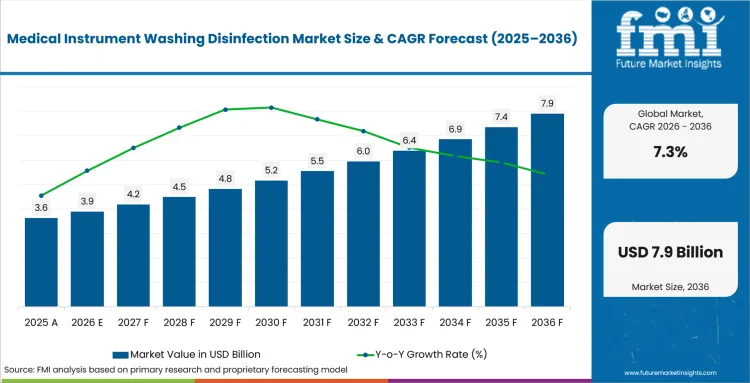
USD 3.9 billion in 2026 and USD 7.9 billion by 2036 at a 7.3% CAGR.
Demand for medical instrument washing disinfection is projected to expand at 7.3% CAGR between 2026 and 2036, increasing valuation from USD 3.9 billion in 2026 to USD 7.9 billion by 2036. Growing attention to sterile processing quality and equipment reliability is increasing demand for effective instrument washing and disinfection systems. AAMI reported in January 2026 that Phoebe Putney Memorial Hospital applied ST108 during an investigation of corrosion and scaling across sterile processing equipment. Independent testing found silica near 33 mg/L and more than 20 of 33 contaminants above ST108 limits, linking water quality with equipment reliability. The case shows why water quality affects equipment used for reprocessed medical devices inside hospital departments. Capital approval therefore depends on documented water controls and dependable load coverage rather than chamber size alone.
Hospital projects differ in utility capacity and instrument mix across the profiled countries during sterile processing equipment qualification. Variation in utilities and instrument mix changes rack configurations and acceptance tests required for each proposed equipment installation program. Brazilian import exposure requires dependable local parts routes and Australian regional facilities need remote diagnostics across long service distances. STERIS explained in March 2025 that overloaded racks and unsuitable accessories can block cleaning solution from instrument surfaces. Surgical instrument tracking can preserve validated loading positions for each reusable device across recurring department loads. Investment decisions therefore depend on representative load testing and practical technician training across routine operating schedules.
Key Takeaways of Medical Instrument Washing Disinfection Market
- Sterile processing departments need repeatable cleaning evidence across varied instrument loads that serve several surgical and diagnostic services.
- By product type, washer-disinfectors are projected to hold 34.0% share in 2026 owing to automated cycle control and documented results.
- Surgical instruments are estimated to represent 36.0% share in 2026 due to complex geometries and demanding rack requirements.
- Hospitals are forecast to capture 42.0% by end user in 2026 owing to concentrated instrument volumes and formal reprocessing accountability.
- Utility work and device-specific instructions can delay equipment qualification if responsibilities remain unclear during sterile department planning.
- Key players such as Getinge and STERIS compete through broad equipment ranges as other companies differentiate through chemistry and local service coverage.
Analyst Perspective
"Medical instrument washing earns its value through reliable soil removal across the complete reusable instrument mix handled each day. Hospital departments should compare rack coverage and cycle records alongside chamber capacity during every replacement decision. Broader automation reduces manual variation across routine loads and protects instrument availability for scheduled procedures. The commercial trade-off remains higher utility and service requirements that must remain practical for local technicians."
- Anurag Sharma, Principal Analyst, Future Market Insights
How is the Medical Instrument Washing Disinfection Market segmented?
The medical instrument washing disinfection industry is segmented by product type, application, end user, distribution channel, technology, and region.
The market is segmented by product type, application, end user, distribution channel, technology, and region for commercial analysis. Product type separates washer-disinfectors and other medical cleaning devices from ultrasonic cleaners, manual equipment, automated systems, and consumables. Application distinguishes surgical, endoscopic, dental, laboratory, ophthalmic, and gynecological instruments through their cleaning geometry and handling requirements. End user covers hospitals, ambulatory surgical centers, diagnostic laboratories, dental clinics, and research institutes with different load profiles. Distribution channel compares direct sales, medical device distributors, service providers, online routes, and local suppliers by purchasing responsibility. Technology reviews thermal, chemical, ultrasonic, robotic, and hybrid processes according to device compatibility and cycle control. Regional analysis compares regulatory requirements, service access, utility conditions, and installed equipment across each profiled geography.
Why do washer-disinfectors lead the product type category?
Washer-disinfectors combine mechanical soil removal with controlled disinfection and recorded cycle parameters inside one sterile processing workflow. Getinge launched the Aquadis 44 in November 2025 with adaptive water and detergent filling for medium-capacity hospital departments. The launch gives sterilization equipment planners a defined configuration that links utility use with repeatable cleaning across routine loads. Sterile processing managers must match every rack with the reusable instrument groups covered by each validated program.
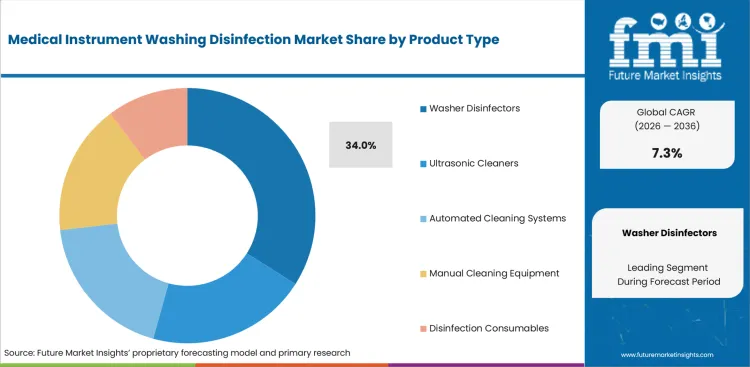
- Based on product type, washer-disinfectors are projected to account for 34.0% in 2026 due to automated multistage cleaning and recorded cycle control. Their programmed temperature and dosing conditions support repeatable results across varied hospital loads during routine daily operation. The position remains dependent on validated coverage for every instrument group processed by the sterile services department.
- Sterile services departments purchase configurable washer-disinfectors to balance tray throughput with water quality and accessible maintenance. Modular racks expand load coverage across several instrument groups without requiring another chamber for each device family. Adoption slows if utility upgrades or service interruptions reduce equipment availability and create instrument backlogs during scheduled replacement work.
How do surgical instruments shape demand within the application category?
Reusable surgical instruments include hinged tools and robotic devices that require direct solution contact across joints and internal channels. STERIS reported in May 2025 that automated cleaning reduced manual work by 66 minutes for each set of four robotic instruments. The result demonstrates a direct labor mechanism for instrument cleaners and detergents rather than using procedure volume as a purchasing proxy. Hospital teams must confirm that validated racks and programs cover every device configuration released for clinical use.
- By application, surgical instruments are estimated to hold 36.0% in 2026 owing to recurring use across operating departments. The category combines high tray volume with demanding turnaround across surgery and sterile processing departments. Its position reflects dedicated racks and validated cycles that protect delicate joints and internal channels throughout repeated use.
- Operating departments are expected to favor automated washing that reduces manual handling without hiding device-specific preparation duties from technicians. Effective programs require clear disassembly instructions and load limits across every operating shift within the department. Planned throughput declines if unsuitable racks or incomplete solution exposure create repeated cleaning work and delay instrument release for clinical use.
What keeps hospitals ahead within the end user category?
Hospitals concentrate reusable instrument volume inside central departments that coordinate decontamination and sterile supply activity across several specialties. MMM reported in April 2025 that it completed a full sterile services department at Kantonsspital Baden with supporting infrastructure. The project places infection prevention equipment inside broader department construction and controlled workflow planning requirements for daily operation. Large facilities therefore require clear separation between contaminated and clean zones throughout the complete reprocessing route.
- By end user, hospitals are forecast to represent 42.0% in 2026 driven by concentrated surgical activity and formal reprocessing accountability. Central departments can spread capital costs across larger instrument volumes processed through shared sterile supply operations. Their position remains tied to proven throughput and maintenance plans that fit established clinical schedules.
- Hospital infection prevention teams purchase systems that create consistent records across instrument loads and operator shifts. Connected records support corrective action during cycle failures that reduce instrument availability for clinical departments. Expansion slows if technician training or spare-part access remains uncertain across satellite facilities inside the same hospital network.
Which buying mechanism supports direct sales within distribution channel?
Direct sales let manufacturers align chamber selection with utilities and commissioning across complex hospital projects. Tuttnauer reported in February 2026 that its washer-disinfector portfolio is supported through ten distribution offices and turnkey project services. The commercial route combines hospital-acquired infection control equipment planning with installation and validation consumables under one accountable relationship. Hospital teams can therefore assess machine configuration and maintenance responsibility during the same capital review.
- Direct sales are set to lead the distribution channel with 39.0% share in 2026 due to technical coordination during installation. Manufacturers can align chamber configuration with chemistry and validation duties across each facility project stage. The route gains value through one accountable organization that resolves utility and workflow changes during commissioning.
- Health systems are expected to favor direct engagement for multi-machine projects that require site surveys and formal acceptance testing. Regional partners remain necessary for response times and spare-part delivery across distant facilities during routine maintenance work. Commercial conversion slows if contract terms separate equipment warranties from the maintenance work supporting validated cycles across the installed base.
What supports thermal disinfection within the technology category?
Thermal disinfection applies controlled time and temperature conditions without leaving chemical disinfectant residues on compatible reusable instruments. MELAG scheduled MELAtherm technical training in January 2026 for authorized service partners responsible for installation and maintenance. The program demonstrates that ultrasonic cleaning and automated washing depend on technicians who understand utilities and validated operating parameters. Facilities must confirm material compatibility across the device inventory prior to standardizing thermal cycles used by each facility.
- The technology category is forecast to be led by thermal disinfection at 38.0% share in 2026 due to measurable time and temperature control. The process creates consistent cycle records across compatible instrument groups and repeated daily load schedules. Its position depends on water quality and validated loading conditions that expose every required surface throughout washing.
- Hospitals purchase thermal systems for heat-resistant loads that enter standardized washer programs without chemical residue concerns. Material limits preserve a role for chemical disinfection across sensitive devices and specialized applications inside each reprocessing department. Adoption requires a complete device inventory and clear routing rules between automated thermal cycles and alternative departmental processes.
What are the drivers, restraints, and opportunities in the Medical Instrument Washing Disinfection Market?
Validated cleaning records support automated washing while utility work and complex device instructions can delay qualification. Integrated equipment, chemistry, training, and maintenance create a practical service opportunity.
- Driver: Hospitals require repeatable cleaning and disinfection records across reusable instrument loads supporting several clinical departments.
- Restraint: Utility work and complex device instructions can extend qualification across installation and routine operating schedules.
- Opportunity: Integrated equipment and chemistry programs can connect cleaning performance with training and maintenance under one service model.
Validated reprocessing requirements create direct demand by requiring visible soil removal across reusable instrument surfaces prior to sterilization. The FDA issued final guidance in March 2015 requiring processing instructions that healthcare staff can follow reliably. The FDA instructions give automated washing a defined role across facilities that handle varied instruments for several clinical departments. Commercial value comes from fewer manual differences and dependable cycle records rather than additional chamber capacity without proven cleaning coverage.
Instrument geometry and existing utilities are some of the hurdles that create qualification burdens for every proposed washing system inside the hospital department. The FDA recognized ASTM F3357-19 in December 2019 as design guidance for reusable devices that improves cleanability. The standard directs technical review toward lumens and internal surfaces that can retain debris during processing. Hospital engineering teams need realistic utility plans and device-specific acceptance tests to prevent delayed replacement programs and repeated validation work.
Integrated service programs are expected to offer lucrative opportunity for companies that combine equipment with chemistry and continuing technical support. Ecolab launched the revised Pay As You Go Endo Bundle in November 2025 with automated reprocessors and full technical support. The program combines validation and training with maintenance and documentation during routine operations for participating departments. Healthcare facilities can improve endoscope reprocessing without funding the complete equipment cost at contract start or creating a separate internal service team.
Which country CAGRs are profiled in the Medical Instrument Washing Disinfection Market?
| Country | CAGR |
|---|---|
| Brazil | 9.4% |
| Australia | 9.1% |
| Canada | 8.2% |
| Japan | 7.6% |
| Germany | 7.1% |
| USA | 6.5% |
| UK | 6.1% |
How do country-level CAGRs compare in the Medical Instrument Washing Disinfection Market?
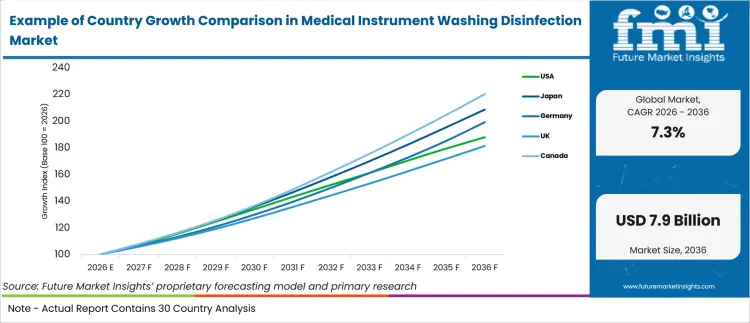
The country forecasts show a gradual progression across the medical instrument washing disinfection market, with growth distributed across all seven countries rather than concentrated in a single region. Brazil and Australia form an upper group with only a limited difference between their forecasts, reflecting strong momentum in infection prevention and sterile processing investments. Canada and Japan create a middle band and remain relatively close in growth terms despite differences in healthcare delivery models. Germany, the USA and the UK form a lower group where the separation between markets is modest and the overall pattern remains continuous rather than segmented.
- Brazil benefits from expanding healthcare capacity and increasing emphasis on standardized instrument reprocessing practices across hospitals and surgical centers.
- Australia reflects strong adoption of infection control technologies, supported by continued investment in healthcare quality improvement and sterilization workflows.
- Canada continues to generate demand through modernization of sterile processing departments and growing focus on operational efficiency in healthcare facilities.
- Japan's outlook is supported by high procedural volumes and sustained demand for reliable instrument cleaning and disinfection systems that meet stringent quality standards.
- Germany maintains steady market development through established reprocessing protocols and ongoing replacement of washing and disinfection equipment across healthcare institutions.
- The USA reflects demand from a large installed base of healthcare facilities, where equipment upgrades and compliance requirements continue to support market activity.
- The UK's growth is influenced by efforts to improve instrument reprocessing efficiency, infection prevention outcomes and long-term healthcare asset management.
Similar CAGRs do not necessarily create identical market opportunities. Differences in healthcare facility structure, reprocessing regulations, procurement practices and investments in sterile processing infrastructure can significantly influence equipment adoption and replacement decisions. As a result, suppliers may encounter distinct commercialization and service requirements despite broadly comparable growth forecasts. The full report provides country-level CAGR analysis across North America, Latin America, Europe, East Asia, South Asia, Oceania and the Middle East and Africa.
Country-wise Analysis
- Brazilian healthcare facilities operate under national rules that distinguish reusable devices from products intended for single use. The Brazilian medical instrument washing disinfection sector is projected to record 9.4% CAGR during the assessment period, supported by renewed attention to validated processing. Anvisa opened a directed consultation in May 2025 covering processing practices and validation protocols for medical devices. The consultation gives hospital departments a clearer basis for comparing automated cycle controls with current reprocessing procedures. Updated expectations support investment in documented washing programs across larger reference hospitals with established sterile processing departments. Import exposure and uneven technical service remain material barriers for facilities located outside metropolitan centers. Wider expansion requires trained local engineers and dependable spare-part routes across regional hospital networks with distant facilities.
- Australian facilities are aligning reusable-device reprocessing departments with AS 5369 across hospitals and smaller clinical settings. The Australian Commission on Safety and Quality in Health Care released a gap-analysis tool in April 2025 for reusable medical devices. In Australia, medical instrument washing disinfection demand is predicted to advance at 9.1% CAGR through 2036 owing to structured gap assessment and replacement planning. The forecast assumes facilities convert formal assessments into funded equipment and workflow upgrades across regional clinical settings. The tool gives facilities a practical method for comparing current controls with required processes inside each department. Formal assessment supports purchasing decisions that link equipment configuration with department readiness during capital reviews. Long service distances increase downtime risk across regional facilities located outside Australia’s metropolitan centers. National contracts therefore need regional parts coverage and remote diagnostic support across dispersed facilities during routine service.
- Canadian hospitals purchase reprocessing equipment through provincial systems that apply separate device and facility controls. Medical instrument washing disinfection sales in Canada are forecast to expand at 8.2% CAGR by 2036, shaped by licensing discipline and regional capital cycles. Health Canada’s August 2025 guidance states that general-use high-level disinfectants should hold separate medical-device licences. The licensing rule gives hospital committees a defined compliance check for proposed equipment and chemistry combinations. Provincial purchasing differences and dispersed service routes can materially extend national installation programs across Canada. Manufacturers need matching licence evidence and dependable maintenance capacity to support hospitals located far from established service centers.
- Japanese acute-care hospitals use formal requests that specify equipment quantities and sterile processing system connections. JETRO published an NTT Medical Center Tokyo request in June 2025 for four washer-disinfectors connected with the sterilization department system. The purchasing record confirms an exact purchasing route and emphasizes integration with hospital workflow software. By 2036, Japan's medical instrument washing disinfection market is projected to grow at 7.6% CAGR underpinned by replacement activity and rigorous equipment acceptance. Detailed documentation and responsive local service raise entry costs for smaller international manufacturers across this market. Commercial plans require trained service partners and configurations that connect reliably with hospital tracking systems.
- German hospitals use engineering-led tenders that test compatibility with established racks and automated transport equipment during replacement projects. Adoption of medical instrument washing disinfection systems in Germany is estimated to expand at 7.1% CAGR through 2036, influenced by installed-base constraints and replacement economics. The Publications Office of the European Union published a Klinikum Fürth tender in August 2025 for cleaning and disinfection equipment. The tender required compatibility with existing Steelco machines and extensive accessories already used by the hospital. Existing accessories can create substantial switching costs across large sterile processing departments during equipment replacement. Challengers need documented interface compatibility and local service capacity to compete for installed-base replacement contracts.
- United States hospitals operate mature sterile processing departments with strict validation and corrective-action duties across large health systems. The FDA classified an AMSCO 7053HP washer-disinfector recall as Class II in December 2025 for twenty-two affected units. The USA medical instrument washing disinfection outlook is anticipated to advance at 6.5% CAGR over the assessment period, associated with replacement activity and documented performance expectations. The record shows how field corrections can affect equipment availability across an installed hospital base. Large health systems can distribute planned replacement investment across several facilities through coordinated capital programs. Legal exposure and evidence requirements increase the value of responsive service and complete corrective-action records during routine operations.
- United Kingdom hospitals obtain decontamination equipment through regional NHS facilities and national purchasing frameworks throughout the country. The medical instrument washing disinfection market in the UK is estimated to post 6.1% CAGR over the forecast period, aided by replacement activity across established sterile services departments. NHS Supply Chain launched a decontamination capital equipment framework in February 2025 covering single-chamber and multi-chamber washer-disinfectors. The framework includes project planning and equipment evaluation support for participating hospital trusts during capital purchasing. National access gives facilities a defined route for comparing equipment and service terms across participating regions. Capital limits and specialist staff availability can delay upgrades across regional sites with aging equipment. Manufacturers need training and service coverage aligned with local decontamination contracts across participating hospital sites.
Who are the notable companies in the Medical Instrument Washing Disinfection Market?
Getinge AB, STERIS plc, SteelcoBelimed AG, Miele & Cie. KG, Ecolab Inc., Tuttnauer Ltd., MMM Münchener Medizin Mechanik GmbH, and MELAG Medizintechnik GmbH & Co. KG are notable companies in the medical instrument washing disinfection market.
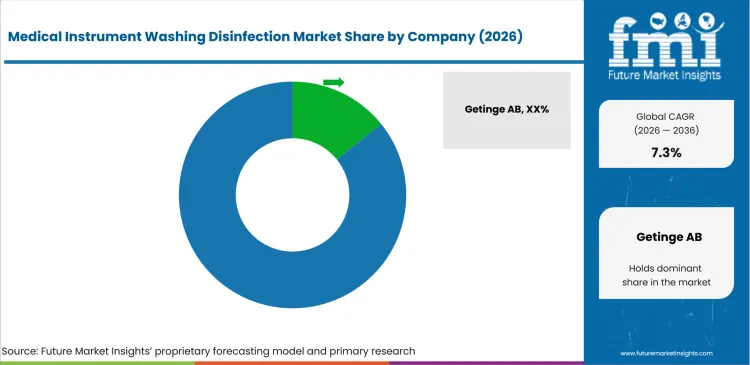
The competitive outlook combines full sterile processing platforms with focused equipment and chemistry specialists across hospital and outpatient settings. Miele’s April 2025 product overview pairs compact thermal disinfectors with process chemicals and routine monitoring tools for smaller practices. The portfolio shows how outpatient facilities can obtain machine technology and validation support through one commercial relationship. Getinge and STERIS compete through broad washer ranges plus software and field service across multi-site hospital networks. SteelcoBelimed and MMM add department planning for complex sterile services facilities and complete project delivery programs. Tuttnauer extends equipment through international distribution and Ecolab supports endoscope reprocessing devices through bundled services. Commercial separation depends on validated load coverage and local repair capacity rather than corporate scale alone.
- Getinge AB and STERIS plc serve high-volume departments through several washer-disinfector models and integrated workflow support. Their commercial advantage comes from broad service coverage and validated equipment options across multi-site hospital networks. Competition centers on utility performance and dependable maintenance across active sterile processing departments throughout complex replacement projects.
- SteelcoBelimed AG and MMM Münchener Medizin Mechanik GmbH combine equipment engineering with complete department delivery. Their project capability supports facilities that need washers and sterilizers integrated with zoning or automated transport systems. Account success depends on interface control and local commissioning expertise across the complete installation program.
- Miele & Cie. KG and MELAG serve smaller medical settings through compact washers and matched process chemistry. Tuttnauer adds international distribution across hospitals and clinics through a broader infection-control portfolio and service network. Ecolab competes through endoscope equipment and service bundles that reduce initial capital requirements for participating departments.
Competitive Benchmarking: Medical Instrument Washing Disinfection Market
| Company | Washer-Disinfector Portfolio | Cleaning Chemistry and Validation | Service and Workflow Support | Geographic Reach |
|---|---|---|---|---|
| Getinge AB | High | Medium | High | Global |
| STERIS plc | High | High | High | Global |
| SteelcoBelimed AG | High | High | High | Global |
| Miele & Cie. KG | Medium | High | Medium | Global |
| Ecolab Inc. | Low | High | High | Global |
| Tuttnauer Ltd. | Medium | Medium | Medium | Global |
| MMM Münchener Medizin Mechanik GmbH | High | Medium | High | Multi-country |
| MELAG Medizintechnik GmbH & Co. KG | Medium | High | Medium | Multi-country |
Key Developments in the Medical Instrument Washing Disinfection Market
- In December 2025, Getinge introduced Automatiq as robotic and software modules designed for sterile reprocessing departments. Automatiq Loaders connect with the 8668 washer-disinfector and coordinate instrument movement through a central software layer. Hospitals can adopt individual modules without redesigning every processing stage across the complete department during implementation. The modular route reduces transition risk for facilities that cannot suspend routine reprocessing during implementation.
- In July 2025, SteelcoBelimed opened an Innovation Hub in Zug to develop customer-focused products and business models for sterile reprocessing. The facility connects interdisciplinary teams with universities and startups across robotics and machine learning applications. Its healthcare program targets smarter sterile processing workflows that reduce repetitive instrument handling and improve equipment reliability. The initiative expands development capacity for cleaning equipment used inside departments adopting broader workflow automation throughout hospital systems.
- MELAG established its Polish subsidiary, MELAG Polska, in Bystrzyca Dolna in late 2024, with the branch announced publicly in early 2025 to provide local consultation and technical support. The expansion gives dealers and medical facilities access to a Polish-speaking team with direct knowledge of the company’s decontamination systems. Local service capacity can shorten troubleshooting routes for washer-disinfectors across regional facilities during routine operations. The branch strengthens distributor support without changing the equipment validation duties assigned to each healthcare site.
Key Players in the Medical Instrument Washing Disinfection Market
Integrated Sterile Processing Providers
- Getinge AB
- STERIS plc
- SteelcoBelimed AG
Equipment and Chemistry Specialists
- Miele & Cie. KG
- Ecolab Inc.
- Tuttnauer Ltd.
Configurable Equipment and Project Providers
- MMM Münchener Medizin Mechanik GmbH
- MELAG Medizintechnik GmbH & Co. KG
Medical Instrument Washing Disinfection Market - Report Scope
| Coverage field | Report scope |
|---|---|
| Market breakdown | Product type, application, end user, distribution channel, technology, and region. |
| Market Definition | Washer-disinfectors, ultrasonic cleaners, automated cleaning systems, manual cleaning equipment, and disinfection consumables used to clean and disinfect reusable medical instruments prior to sterilization or reuse. |
| Regions Covered | North America, Latin America, Europe, East Asia, South Asia and Pacific, and Middle East and Africa. |
| Countries Covered | Brazil, Australia, Canada, Japan, Germany, USA, and UK. |
| Key Companies Profiled | Getinge AB, STERIS plc, SteelcoBelimed AG, Miele & Cie. KG, Ecolab Inc., Tuttnauer Ltd., MMM Münchener Medizin Mechanik GmbH, and MELAG Medizintechnik GmbH & Co. KG. |
| Forecast Period | 2026 to 2036. |
| Approach | Hybrid bottom-up and top-down market sizing supported by primary interviews and official desk research. |
Medical Instrument Washing Disinfection Market - Research Methodology
| Method | Approach |
|---|---|
| Primary Research | FMI analysts gathered input from manufacturers, service providers, technology developers, distributors, end users, procurement teams, and subject-matter experts. Interviews examined purchasing decisions, product or service evaluation, adoption barriers, approval requirements, pricing considerations, and expectations for technical or commercial support. Respondents were also asked what evidence is required before a trial, pilot, or initial order develops into regular purchasing. |
| Desk Research | Desk research covered government statistics, regulatory publications, trade data, industry associations, technical literature, standards, company filings, product information, and official corporate announcements. Sources were reviewed for relevance, publication date, geographic coverage, and consistency with the defined market scope. Claims relating to performance, applications, approvals, capacity, investment, and commercial activity were retained only when supported by credible public evidence. |
| Market Sizing and Forecasting | The market model combined the baseline value with historical performance, segment structure, pricing and volume indicators, adoption levels, company participation, and country-level demand conditions. Forecast assumptions considered economic activity, investment trends, regulatory developments, technology adoption, purchasing cycles, supply availability, and barriers to wider market use. Segment and regional estimates were reconciled before the final market total was calculated. |
| Data Validation | Estimates were checked against multiple independent indicators, including public data, company activity, trade patterns, industry developments, and findings from primary interviews. Validation also tested whether products, services, applications, and company revenues fell within the defined market boundaries. Adjacent categories, unsupported claims, overlapping revenues, and activities without direct market relevance were excluded to reduce double counting and maintain consistency across segments and countries. |
Medical Instrument Washing Disinfection Market by Segments
Medical Instrument Washing Disinfection Market segmented by Product Type:
- Washer Disinfectors
- Floor Standing Washer Disinfectors
- Undercounter Washer Disinfectors
- Ultrasonic Cleaners
- Benchtop Ultrasonic Cleaners
- Industrial Ultrasonic Cleaners
- Automated Cleaning Systems
- Robotic Cleaning Systems
- Integrated Cleaning Systems
- Manual Cleaning Equipment
- Manual Washing Stations
- Cleaning Accessories
- Disinfection Consumables
- Enzymatic Detergents
- High-Level Disinfectants
Medical Instrument Washing Disinfection Market segmented by Application:
- Surgical Instruments
- General Surgery Instruments
- Orthopedic Instruments
- Endoscopic Instruments
- Flexible Endoscopes
- Rigid Endoscopes
- Dental Instruments
- Dental Handpieces
- Dental Surgical Instruments
- Laboratory Instruments
- Glassware
- Analytical Equipment
- Others
- Ophthalmic Instruments
- Gynecology Instruments
Medical Instrument Washing Disinfection Market segmented by End User:
- Hospitals
- Public Hospitals
- Private Hospitals
- Ambulatory Surgical Centers
- Day Care Surgical Centers
- Specialty Surgical Centers
- Diagnostic Laboratories
- Pathology Laboratories
- Clinical Laboratories
- Dental Clinics
- General Dental Clinics
- Specialty Dental Clinics
- Research Institutes
- Academic Research Centers
- Biomedical Research Institutes
Medical Instrument Washing Disinfection Market segmented by Distribution Channel:
- Direct Sales
- Hospital Procurement
- Group Purchasing Organizations
- Medical Device Distributors
- National Distributors
- Regional Distributors
- Third-Party Service Providers
- Equipment Integrators
- Service Contractors
- Online Procurement
- B2B E-Commerce Platforms
- E-Procurement Portals
- Retail & Local Suppliers
- Authorized Dealers
- Local Medical Suppliers
Medical Instrument Washing Disinfection Market segmented by Technology:
- Thermal Disinfection
- High Temperature Washing
- Steam-Based Disinfection
- Chemical Disinfection
- High-Level Chemical Disinfection
- Low-Level Chemical Disinfection
- Ultrasonic Cleaning
- Single Frequency Systems
- Multi-Frequency Systems
- Automated Robotic Cleaning
- AI-Assisted Cleaning
- Programmable Cleaning Systems
- Hybrid Cleaning Technologies
- Thermal-Chemical Systems
- Ultrasonic-Thermal Systems
Medical Instrument Washing Disinfection Market by Region:
- North America
- United States
- Canada
- Latin America
- Brazil
- Mexico
- Argentina
- Chile
- Western Europe
- Germany
- France
- United Kingdom
- Italy
- Spain
- Benelux
- Nordics
- Eastern Europe
- Poland
- Czech Republic
- Romania
- Hungary
- East Asia
- China
- Japan
- South Korea
- South Asia and Pacific
- India
- ASEAN
- Australia and New Zealand
- Middle East and Africa
- GCC Countries
- South Africa
- Türkiye
- Israel
Research Sources and Bibliography
- Association for the Advancement of Medical Instrumentation. (2026, January 5). Corrosion threatens sterile processing-until standards step in.
- STERIS. (2025, March 25). How to load washer racks in sterile processing.
- Getinge AB. (2025, November 13). Utility-efficient washer-disinfector Aquadis 44 helps hospitals reduce costs and meet environmental targets.
- STERIS. (2025, May 23). Maximizing your investment in robotic surgery.
- MMM Group. (2025, April 19). MMM Switzerland secures prestigious hospital project.
- Tuttnauer Ltd. (2026, February 11). How Tuttnauer delivers end-to-end sterilization solutions across the globe.
- MELAG Medizintechnik GmbH & Co. KG. (2026, January 26). Basis-Schulung: MELAtherm - Serie und Zubehör | 26.01.-27.01.2026 -> Ausgebucht!
- USA Food and Drug Administration. (2015, March). Reprocessing medical devices in health care settings: Validation methods and labeling guidance for industry and Food and Drug Administration staff.
- USA Food and Drug Administration. (2019, December 23). Recognized Consensus Standards: Medical Devices [ASTM F3357-19].
- Ecolab Healthcare ANZ. (2025, November 10). Introducing the Pay As You Go Endo Bundle: A New Era in Endoscope Reprocessing.
- Agência Nacional de Vigilância Sanitária. (2025, May 16). Anvisa lança consulta dirigida sobre dispositivos médicos de uso único e boas práticas de processamento.
- Australian Commission on Safety and Quality in Health Care. (2025, April 9). Gap analysis tool to support reprocessing of reusable medical devices.
- Health Canada. (2025, August 29). Guidance for determining medical device application type: Disinfectants as medical devices.
- Japan External Trade Organization. (2025, June 16). Washer disinfector one set: Notice of request for submission of materials - NTT EAST, Inc.
- Publications Office of the European Union. (2025, August 28). Cleaning and disinfection equipment LV.383.
- USA Food and Drug Administration. (2025, December 11). Class 2 Device Recall AMSCO [AMSCO 7053HP washer/disinfector].
- NHS Supply Chain. (2025, February 19). Decontamination capital equipment, associated accessories and services.
- STERIS. (2025, January 1). No longer serviceable letter: Reliance 777 washer disinfector.
- Getinge AB. (2025, December 19). Getinge transforms sterile reprocessing with Automatiq - a full range of logistic automation modules.
- SteelcoBelimed AG. (2025, July 10). SteelcoBelimed Innovation Hub.
- MELAG Medizintechnik GmbH & Co. KG. (2025, January 1). MELAG launches new Polish branch office.
- Miele & Cie. KG. (2025, April). Product Overview: Solutions for Dental Practices.
This bibliography is provided for reader reference and is not exhaustive. The full report contains the complete reference list and detailed citations
This Report Answers
- How large is the medical instrument washing disinfection market in 2026 and 2036?
- Which operating requirements support investment in automated instrument washing and disinfection?
- Why do washer-disinfectors hold the largest product type share in 2026?
- How do surgical instruments influence rack selection and cleaning validation?
- Why do hospitals account for the largest end user share in 2026?
- How do country growth rates differ across Brazil, Australia, Canada, Japan, Germany, the USA, and the UK?
- Which companies provide equipment, chemistry, validation, or service across medical instrument reprocessing?
- What limits adoption across facilities with complex instruments and constrained utility infrastructure?
- How can integrated service contracts improve equipment uptime and cycle accountability?
Frequently Asked Questions
How big is the Medical Instrument Washing Disinfection Market in 2026?
The medical instrument washing disinfection market is valued at USD 3.9 billion in 2026 and is forecast to reach USD 7.9 billion by 2036. Growth is supported by growing attention to sterile processing quality and equipment reliability increasing demand for effective instrument washing and disinfection systems across hospital and surgical center reprocessing departments worldwide.
What is the CAGR of the Medical Instrument Washing Disinfection Market from 2026 to 2036?
The medical instrument washing disinfection market grows at a CAGR of 7.3% between 2026 and 2036, supported by hospitals adopting automated washer-disinfector systems once those platforms demonstrate repeatable soil removal, documented cycle records, and dependable rack coverage across varied surgical and diagnostic instrument loads throughout daily sterile processing operations.
Which product type leads the Medical Instrument Washing Disinfection Market?
Washer-disinfectors account for 34.0% of the medical instrument washing disinfection market by product type in 2026, driven by automated multistage cleaning and recorded cycle control that support repeatable results across varied hospital loads and reduce manual variation throughout routine daily sterile processing department operations.
How much will the Medical Instrument Washing Disinfection Market add between 2026 and 2036?
The medical instrument washing disinfection market is set to add USD 4.0 billion between 2026 and 2036, growing from USD 3.9 billion to USD 7.9 billion as washer-disinfectors, robotic automation modules, and integrated equipment and chemistry service programs enter funded sterile processing replacement pathways across a widening base of hospital and surgical center programs worldwide.
Who are the leading companies in the Medical Instrument Washing Disinfection Market?
Five companies lead the medical instrument washing disinfection market, including Getinge AB, STERIS plc, SteelcoBelimed AG, Miele & Cie. KG, and Ecolab, competing through broad washer-disinfector portfolios, integrated workflow software, validated cleaning chemistry, robotic processing modules, and multi-country field service coverage across hospital sterile processing programs worldwide.
Preview the report firsthand - request a free sample
Get SampleGet the brochure for pricing and purchase details.
Get PDFTable of Content
- Key Takeaways
- Market Size and CAGR
- Top Growth Driver
- Fastest Growing Segment
- Leading Region
- Key Companies
- Emerging Opportunities
- Executive Summary
- Global Market Outlook
- Demand-side Trends
- Supply-side Trends
- Technology Roadmap Analysis
- Analysis and Recommendations
- Analyst Perspective (What is happening? Why now? What should investors know?)
- Key Questions Answered
- How large is the market?
- What is the CAGR?
- What are key trends?
- Which region dominates?
- Who are the leaders?
- Market Overview
- Market Coverage / Taxonomy
- Market Definition / Scope / Limitations
- Research Methodology
- Chapter Orientation
- Analytical Lens and Working Hypotheses
- Market Structure, Signals, and Trend Drivers
- Benchmarking and Cross-market Comparability
- Market Sizing, Forecasting, and Opportunity Mapping
- Research Design and Evidence Framework
- Desk Research Programme (Secondary Evidence)
- Expert Input and Fieldwork (Primary Evidence)
- Tooling, Models, and Reference Databases
- Data Engineering and Model Build
- Quality Assurance and Audit Trail
- Market Background
- Market Dynamics (Drivers, Restraints, Opportunity, Trends)
- Scenario Forecast (Optimistic, Likely, Conservative)
- Impact Analysis
- AI Impact
- Sustainability Impact
- Regulatory Impact
- Technology Impact
- Consumer / Buyer Analysis
- Purchase Drivers
- Adoption Barriers
- Buyer Journey
- Opportunity Map Analysis
- Product Life Cycle Analysis
- Supply Chain Analysis
- Investment Feasibility Matrix
- Value Chain Analysis
- PESTLE and Porter's Analysis
- Regulatory Landscape
- Regional Parent Market Outlook
- Production and Consumption Statistics
- Import and Export Statistics
- Global Market Analysis and Forecast, 2021 to 2036
- Historical Market Size Value (USD Billion) Analysis, 2021 to 2025
- Current and Future Market Size Value (USD Billion) Projections, 2026 to 2036
- Y-o-Y Growth Trend Analysis
- Absolute $ Opportunity Analysis
- Global Market Pricing Analysis, 2021 to 2036
- Global Market Analysis and Forecast, By Product Type, 2021 to 2036
- Introduction / Key Findings
- Historical Market Size Value (USD Billion) Analysis By Product Type, 2021 to 2025
- Current and Future Market Size Value (USD Billion) Analysis and Forecast By Product Type, 2026 to 2036
- Washer Disinfectors
- Floor Standing Washer Disinfectors
- Undercounter Washer Disinfectors
- Ultrasonic Cleaners
- Benchtop Ultrasonic Cleaners
- Industrial Ultrasonic Cleaners
- Automated Cleaning Systems
- Robotic Cleaning Systems
- Integrated Cleaning Systems
- Manual Cleaning Equipment
- Manual Washing Stations
- Cleaning Accessories
- Disinfection Consumables
- Enzymatic Detergents
- High-Level Disinfectants
- Washer Disinfectors
- Y-o-Y Growth Trend Analysis By Product Type, 2021 to 2025
- Absolute $ Opportunity Analysis By Product Type, 2026 to 2036
- Global Market Analysis and Forecast, By Application, 2021 to 2036
- Introduction / Key Findings
- Historical Market Size Value (USD Billion) Analysis By Application, 2021 to 2025
- Current and Future Market Size Value (USD Billion) Analysis and Forecast By Application, 2026 to 2036
- Surgical Instruments
- General Surgery Instruments
- Orthopedic Instruments
- Endoscopic Instruments
- Flexible Endoscopes
- Rigid Endoscopes
- Dental Instruments
- Dental Handpieces
- Dental Surgical Instruments
- Laboratory Instruments
- Glassware
- Analytical Equipment
- Others
- Ophthalmic Instruments
- Gynecology Instruments
- Surgical Instruments
- Y-o-Y Growth Trend Analysis By Application, 2021 to 2025
- Absolute $ Opportunity Analysis By Application, 2026 to 2036
- Global Market Analysis and Forecast, By End User, 2021 to 2036
- Introduction / Key Findings
- Historical Market Size Value (USD Billion) Analysis By End User, 2021 to 2025
- Current and Future Market Size Value (USD Billion) Analysis and Forecast By End User, 2026 to 2036
- Hospitals
- Public Hospitals
- Private Hospitals
- Ambulatory Surgical Centers
- Day Care Surgical Centers
- Specialty Surgical Centers
- Diagnostic Laboratories
- Pathology Laboratories
- Clinical Laboratories
- Dental Clinics
- General Dental Clinics
- Specialty Dental Clinics
- Research Institutes
- Academic Research Centers
- Biomedical Research Institutes
- Hospitals
- Y-o-Y Growth Trend Analysis By End User, 2021 to 2025
- Absolute $ Opportunity Analysis By End User, 2026 to 2036
- Global Market Analysis and Forecast, By Distribution Channel, 2021 to 2036
- Introduction / Key Findings
- Historical Market Size Value (USD Billion) Analysis By Distribution Channel, 2021 to 2025
- Current and Future Market Size Value (USD Billion) Analysis and Forecast By Distribution Channel, 2026 to 2036
- Direct Sales
- Hospital Procurement
- Group Purchasing Organizations
- Medical Device Distributors
- National Distributors
- Regional Distributors
- Third-Party Service Providers
- Equipment Integrators
- Service Contractors
- Online Procurement
- B2B E-Commerce Platforms
- E-Procurement Portals
- Retail & Local Suppliers
- Authorized Dealers
- Local Medical Suppliers
- Direct Sales
- Y-o-Y Growth Trend Analysis By Distribution Channel, 2021 to 2025
- Absolute $ Opportunity Analysis By Distribution Channel, 2026 to 2036
- Global Market Analysis and Forecast, By Technology, 2021 to 2036
- Introduction / Key Findings
- Historical Market Size Value (USD Billion) Analysis By Technology, 2021 to 2025
- Current and Future Market Size Value (USD Billion) Analysis and Forecast By Technology, 2026 to 2036
- Thermal Disinfection
- High Temperature Washing
- Steam-Based Disinfection
- Chemical Disinfection
- High-Level Chemical Disinfection
- Low-Level Chemical Disinfection
- Ultrasonic Cleaning
- Single Frequency Systems
- Multi-Frequency Systems
- Automated Robotic Cleaning
- AI-Assisted Cleaning
- Programmable Cleaning Systems
- Hybrid Cleaning Technologies
- Thermal-Chemical Systems
- Ultrasonic-Thermal Systems
- Thermal Disinfection
- Y-o-Y Growth Trend Analysis By Technology, 2021 to 2025
- Absolute $ Opportunity Analysis By Technology, 2026 to 2036
- Global Market Analysis and Forecast, By Region, 2021 to 2036
- Introduction
- Historical Market Size Value (USD Billion) Analysis By Region, 2021 to 2025
- Current Market Size Value (USD Billion) Analysis and Forecast By Region, 2026 to 2036
- North America
- Latin America
- Western Europe
- Eastern Europe
- East Asia
- South Asia and Pacific
- Middle East & Africa
- Market Attractiveness Analysis By Region
- North America Market Analysis and Forecast, By Country, 2021 to 2036
- Historical Market Size Value (USD Billion) Trend Analysis By Market Taxonomy, 2021 to 2025
- Market Size Value (USD Billion) Forecast By Market Taxonomy, 2026 to 2036
- By Country
- USA
- Canada
- By Product Type
- By Application
- By End User
- By Distribution Channel
- By Technology
- By Country
- Market Attractiveness Analysis
- By Country
- By Product Type
- By Application
- By End User
- By Distribution Channel
- By Technology
- Key Takeaways
- Latin America Market Analysis and Forecast, By Country
- Historical Market Size Value (USD Billion) Trend Analysis By Market Taxonomy, 2021 to 2025
- Market Size Value (USD Billion) Forecast By Market Taxonomy, 2026 to 2036
- By Country
- Brazil
- Mexico
- Chile
- Rest of Latin America
- By Product Type
- By Application
- By End User
- By Distribution Channel
- By Technology
- By Country
- Market Attractiveness Analysis
- By Country
- By Product Type
- By Application
- By End User
- By Distribution Channel
- By Technology
- Key Takeaways
- Western Europe Market Analysis and Forecast, By Country
- Historical Market Size Value (USD Billion) Trend Analysis By Market Taxonomy, 2021 to 2025
- Market Size Value (USD Billion) Forecast By Market Taxonomy, 2026 to 2036
- By Country
- Germany
- UK
- Italy
- Spain
- France
- Nordic
- BENELUX
- Rest of Western Europe
- By Product Type
- By Application
- By End User
- By Distribution Channel
- By Technology
- By Country
- Market Attractiveness Analysis
- By Country
- By Product Type
- By Application
- By End User
- By Distribution Channel
- By Technology
- Key Takeaways
- Eastern Europe Market Analysis and Forecast, By Country
- Historical Market Size Value (USD Billion) Trend Analysis By Market Taxonomy, 2021 to 2025
- Market Size Value (USD Billion) Forecast By Market Taxonomy, 2026 to 2036
- By Country
- Russia
- Poland
- Hungary
- Balkan & Baltic
- Rest of Eastern Europe
- By Product Type
- By Application
- By End User
- By Distribution Channel
- By Technology
- By Country
- Market Attractiveness Analysis
- By Country
- By Product Type
- By Application
- By End User
- By Distribution Channel
- By Technology
- Key Takeaways
- East Asia Market Analysis and Forecast, By Country
- Historical Market Size Value (USD Billion) Trend Analysis By Market Taxonomy, 2021 to 2025
- Market Size Value (USD Billion) Forecast By Market Taxonomy, 2026 to 2036
- By Country
- China
- Japan
- South Korea
- By Product Type
- By Application
- By End User
- By Distribution Channel
- By Technology
- By Country
- Market Attractiveness Analysis
- By Country
- By Product Type
- By Application
- By End User
- By Distribution Channel
- By Technology
- Key Takeaways
- South Asia and Pacific Market Analysis and Forecast, By Country
- Historical Market Size Value (USD Billion) Trend Analysis By Market Taxonomy, 2021 to 2025
- Market Size Value (USD Billion) Forecast By Market Taxonomy, 2026 to 2036
- By Country
- India
- ASEAN
- Australia & New Zealand
- Rest of South Asia and Pacific
- By Product Type
- By Application
- By End User
- By Distribution Channel
- By Technology
- By Country
- Market Attractiveness Analysis
- By Country
- By Product Type
- By Application
- By End User
- By Distribution Channel
- By Technology
- Key Takeaways
- Middle East & Africa Market Analysis and Forecast, By Country
- Historical Market Size Value (USD Billion) Trend Analysis By Market Taxonomy, 2021 to 2025
- Market Size Value (USD Billion) Forecast By Market Taxonomy, 2026 to 2036
- By Country
- Kingdom of Saudi Arabia
- Other GCC Countries
- Türkiye
- South Africa
- Other African Union
- Rest of Middle East & Africa
- By Product Type
- By Application
- By End User
- By Distribution Channel
- By Technology
- By Country
- Market Attractiveness Analysis
- By Country
- By Product Type
- By Application
- By End User
- By Distribution Channel
- By Technology
- Key Takeaways
- Key Countries Market Analysis
- USA
- Pricing Analysis
- Market Share Analysis, 2025
- By Product Type
- By Application
- By End User
- By Distribution Channel
- By Technology
- Canada
- Pricing Analysis
- Market Share Analysis, 2025
- By Product Type
- By Application
- By End User
- By Distribution Channel
- By Technology
- Mexico
- Pricing Analysis
- Market Share Analysis, 2025
- By Product Type
- By Application
- By End User
- By Distribution Channel
- By Technology
- Brazil
- Pricing Analysis
- Market Share Analysis, 2025
- By Product Type
- By Application
- By End User
- By Distribution Channel
- By Technology
- Chile
- Pricing Analysis
- Market Share Analysis, 2025
- By Product Type
- By Application
- By End User
- By Distribution Channel
- By Technology
- Germany
- Pricing Analysis
- Market Share Analysis, 2025
- By Product Type
- By Application
- By End User
- By Distribution Channel
- By Technology
- UK
- Pricing Analysis
- Market Share Analysis, 2025
- By Product Type
- By Application
- By End User
- By Distribution Channel
- By Technology
- Italy
- Pricing Analysis
- Market Share Analysis, 2025
- By Product Type
- By Application
- By End User
- By Distribution Channel
- By Technology
- Spain
- Pricing Analysis
- Market Share Analysis, 2025
- By Product Type
- By Application
- By End User
- By Distribution Channel
- By Technology
- France
- Pricing Analysis
- Market Share Analysis, 2025
- By Product Type
- By Application
- By End User
- By Distribution Channel
- By Technology
- India
- Pricing Analysis
- Market Share Analysis, 2025
- By Product Type
- By Application
- By End User
- By Distribution Channel
- By Technology
- ASEAN
- Pricing Analysis
- Market Share Analysis, 2025
- By Product Type
- By Application
- By End User
- By Distribution Channel
- By Technology
- Australia & New Zealand
- Pricing Analysis
- Market Share Analysis, 2025
- By Product Type
- By Application
- By End User
- By Distribution Channel
- By Technology
- China
- Pricing Analysis
- Market Share Analysis, 2025
- By Product Type
- By Application
- By End User
- By Distribution Channel
- By Technology
- Japan
- Pricing Analysis
- Market Share Analysis, 2025
- By Product Type
- By Application
- By End User
- By Distribution Channel
- By Technology
- South Korea
- Pricing Analysis
- Market Share Analysis, 2025
- By Product Type
- By Application
- By End User
- By Distribution Channel
- By Technology
- Russia
- Pricing Analysis
- Market Share Analysis, 2025
- By Product Type
- By Application
- By End User
- By Distribution Channel
- By Technology
- Poland
- Pricing Analysis
- Market Share Analysis, 2025
- By Product Type
- By Application
- By End User
- By Distribution Channel
- By Technology
- Hungary
- Pricing Analysis
- Market Share Analysis, 2025
- By Product Type
- By Application
- By End User
- By Distribution Channel
- By Technology
- Kingdom of Saudi Arabia
- Pricing Analysis
- Market Share Analysis, 2025
- By Product Type
- By Application
- By End User
- By Distribution Channel
- By Technology
- Türkiye
- Pricing Analysis
- Market Share Analysis, 2025
- By Product Type
- By Application
- By End User
- By Distribution Channel
- By Technology
- South Africa
- Pricing Analysis
- Market Share Analysis, 2025
- By Product Type
- By Application
- By End User
- By Distribution Channel
- By Technology
- USA
- Market Structure Analysis
- Competition Dashboard
- Competition Benchmarking
- Market Share Analysis of Top Players
- By Regional
- By Product Type
- By Application
- By End User
- By Distribution Channel
- By Technology
- Emerging Startups
- Innovation Benchmarking
- Competition Analysis
- Competition Deep Dive
- Getinge AB
- Overview
- Product Portfolio
- Profitability by Market Segments
- Sales Footprint
- Strategy Overview
- Marketing Strategy
- Product Strategy
- Channel Strategy
- STERIS plc
- Ecolab Inc.
- Miele Group
- BELIMED AG
- Steelco S.p.A.
- Tuttnauer
- Shinva Medical Instrument Co., Ltd.
- Matachana Group
- MMM Group
- Getinge AB
- Case Studies
- Success Stories
- Recent Developments
- Competition Deep Dive
- Assumptions & Acronyms Used


