

- Market Size (2026)
- USD 1248.2 Mn
- Forecast (2036)
- USD 2770.5 Mn
- CAGR (2026 to 2036)
- 8.3%
How big is Medical Technology Regulatory Modernization Market in 2026?
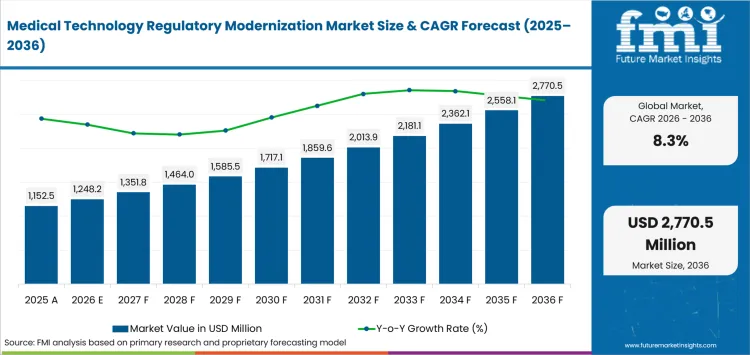
USD 1248.2 million in 2026 and USD 2770.5 million by 2036 at an 8.3% CAGR.
Demand for medical technology regulatory modernization is expected to expand at 8.3% CAGR from 2026 to 2036, increasing valuation from USD 1248.2 million in 2026 to USD 2770.5 million by 2036. Digital submission mandates are increasing demand for regulatory information management platforms that maintain one approved record across changing authority formats. In September 2025, the FDA stated that De Novo submissions would require eSTAR from October 1. The rule covers original requests and later supplements or amendments, which makes consistent product data essential throughout the complete review cycle. Modern platforms reduce repeated document assembly and reveal incomplete fields prior to formal submission, which lowers avoidable rework across active programs. Spending becomes easier to justify if the system lowers avoidable rework and gives each regulatory task a named owner.
Regulatory teams in the United States and Europe rely on the same product history but follow different authority routes. American programs emphasize eSTAR submission structure and QMSR alignment across FDA device review and inspection processes. European programs coordinate mandatory EUDAMED modules with national implementation steps and separate authority responsibilities across member states. A shared platform can reduce handoff errors across internal departments and regulatory affairs outsourcing partners supporting several jurisdictions. Cloud deployment also helps dispersed teams review the same current record without maintaining separate regional copies. Each manufacturer must test migration quality and access controls across representative records prior to retiring established archives or regional systems. The strongest purchasing case combines fewer manual reconciliations with clear responsibility for every submission and continuing authority commitment.
Key Takeaways of Medical Technology Regulatory Modernization Market
- Demand for medical technology regulatory modernization is driven by regulatory teams needing one approved product record to support submissions and continuing compliance duties, with the market growing from USD 1152.5 million in 2025 to USD 1248.2 million in 2026, reaching USD 2,770.5 million by 2036 at an 8.3% CAGR.
- By technology, regulatory information management systems hold the leading share at 36.4% in 2026, due to their role as the controlled source for product records across several jurisdictions.
- Medical device approval management is the dominant application segment, holding 38.7% share in 2026, owing to its direct control over authorization work, reinforced by mandatory eSTAR requirements for 510(k) and De Novo submissions.
- Medical device manufacturers lead end-user demand at 39.8% share in 2026, reflecting their legal responsibility for active product lifecycles across every country served.
- Cloud-based solutions capture 47.0% deployment share in 2026, as distributed teams seek faster access and managed updates.
- The UK and USA record CAGRs of 10.0% and 9.0% respectively through 2036, while Japan, Germany, and South Korea maintain distinct portal requirements and digital-product rules that shape configurable workflow demand.
- Competition centers on Veeva Systems, ArisGlobal, Rimsys, MasterControl, IQVIA, Ennov, Freyr Solutions, and Generis, with vendors differentiating through regulatory lifecycle platform breadth, quality-management integration, and regulatory publishing capabilities.
Analyst Perspective
The mandatory EUDAMED module rollout gives manufacturers a hard deadline to map device data and ownership, but the platforms that hold up under that pressure are the ones preserving an accountable owner for every update rather than just centralizing storage. Most successful implementations start narrow, with registrations or submission planning before quality and post-market workflows get layered on, since a staged rollout limits migration risk and gives regulatory teams evidence before committing to a broader deployment. Approval management platforms only pay off if they reduce rework and speed authority responses; configuration that adds review steps without cutting incomplete-package rates is a cost without the offsetting benefit manufacturers are actually buying the system for.
- Anurag Sharma, Principal Analyst at Future Market Insights
Source: FMI's proprietary forecasting model and primary research
How is the Medical Technology Regulatory Modernization Market segmented?
The medical technology regulatory modernization industry is segmented by technology and application with end-user and deployment-model analysis across regions.
Technology separates systems that manage regulatory data from tools that automate submission work or analyze compliance risks. Application categories follow operating tasks across device approval and evidence generation with post-market surveillance and quality compliance under separate workflows. End-user analysis distinguishes manufacturers and biotechnology companies from contract research organizations and regulatory consulting firms with different legal responsibilities. Deployment analysis compares cloud and on-premise models with hybrid systems according to control and maintenance requirements. Regional coverage reflects authority portals and language requirements alongside domestic service capacity and product-specific regulatory routes in each assessed country. The framework keeps software capability separate from the organization using it and the work performed through it.
What supports demand for regulatory information management systems within the technology category?
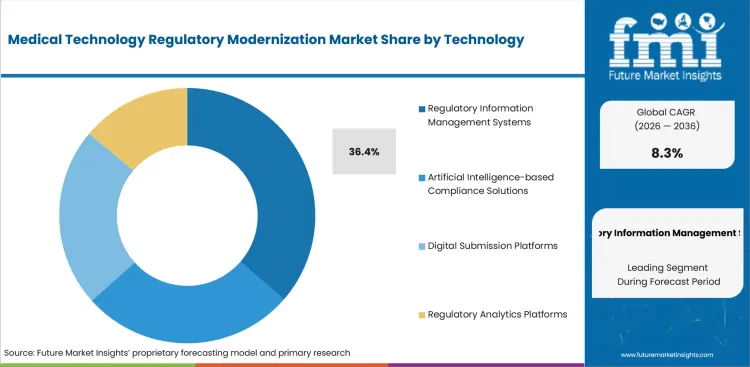
Regulatory teams need one controlled product record linking registrations and submissions with labels and continuing authority commitments. The record must remain accurate as product changes create new filings or updates across several countries. In November 2025 the European Commission confirmed that four EUDAMED modules would become mandatory on May 28 2026. The transition gives manufacturers a direct reason to map device data and ownership prior to mandatory reporting. Life sciences analytics can identify missing records, but the platform must preserve each approved source and accountable owner throughout later regulatory work.
- Regulatory information management systems are set to lead the technology category with 36.4% share in 2026 due to their role as the controlled source for product records. The same governed record supports registrations and submissions with authority correspondence across several jurisdictions, reducing reconciliation during renewals and product changes.
- Global regulatory departments favor RIM platforms that assign every update to a named owner and preserve the approved source record. Most implementations begin with registrations or submission planning prior to adding quality and post-market workflows. A staged rollout limits migration risk and produces clear evidence for broader deployment across additional product portfolios.
How does medical device approval management shape demand within the application category?
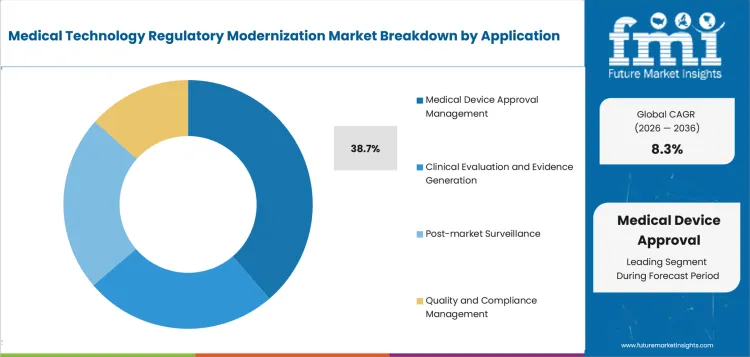
Approval teams assemble technical evidence and administrative forms under authority formats that check completeness in different ways. Reusable content matters most for manufacturers managing several device families through multiple submission routes and authority formats. Manual assembly increases review effort and makes ownership harder to trace across dossier sections during authority questions or revisions. The operating problem extends beyond document storage and includes controlled handoffs from evidence preparation through publishing and authority response.
- By application, medical device approval management is estimated to hold 38.7% share in 2026 owing to its direct control over authorization work. In June 2026 the FDA confirmed that eSTAR remained mandatory for 510(k) and De Novo submissions. Structured workflows separate evidence preparation from publishing and response ownership throughout the complete review process.
- Regulatory departments adopt approval platforms to connect engineering evidence with clinical data management outputs across each submission section. Strong adoption depends on fewer incomplete packages and clearer responsibility for authority questions across active device programs. Configuration loses value if it adds review steps without reducing rework or delayed authority responses.
Why are medical device manufacturers central to the end user category?
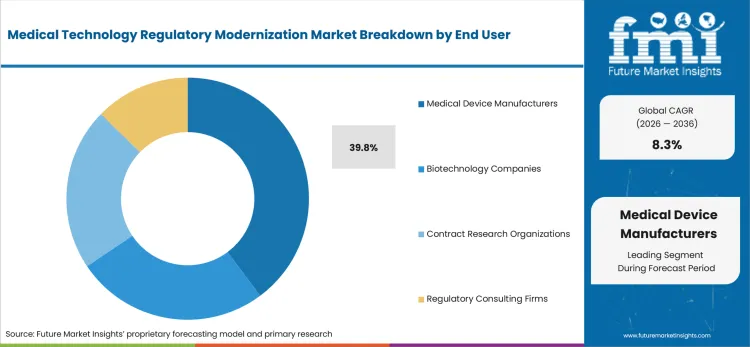
Medical device manufacturers retain legal responsibility for authorization and product changes across every commercial product lifecycle. Their post-market duties also continue through incident review and continuing authority commitments for each active product. Connected records help regulatory staff decide whether a design change requires new filings in affected countries. Fragmented systems separate quality investigations from authorization terms that govern continued product access across affected countries and device classes. Separate systems increase review time and create uncertainty during inspections or reportable events across active portfolios.
- Medical device manufacturers are expected to represent 39.8% of the end-user category in 2026, reflecting their legal responsibility for active product lifecycles. Internal regulatory teams assess design changes and maintain authorizations across every country served by the company. Platform spending supports recurring compliance work instead of a temporary documentation project tied to one submission route.
- Medical-device regulatory teams use modernization platforms to connect design changes with country-specific commitments across active product portfolios. In June 2025 the MHRA strengthened post-market surveillance duties through active monitoring and faster incident responses. Preclinical testing services provide evidence inputs, yet manufacturers retain responsibility for final regulatory decisions and required authority actions.
How are cloud-based Solutions positioned within the deployment model category?
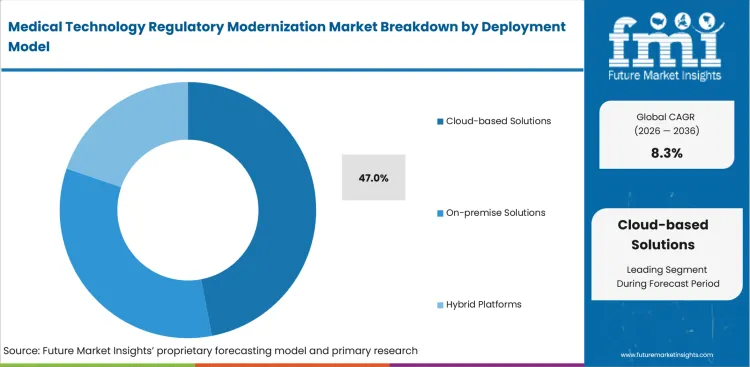
Distributed regulatory teams need secure access to current records without maintaining separate installations in every office. In April 2025 Japan's health ministry issued updated rules for online applications through the Gateway and medical-device web platform. The filing route supports healthcare cloud infrastructure that gives remote teams one controlled workspace for preparation and authority submission. Data residency and validation requirements can extend implementation schedules for manufacturers with several historical repositories.
- Cloud-based solutions are projected to hold 47.0% share within the deployment model category in 2026, underpinned by faster access for distributed regulatory teams. Central configuration gives regional offices one governed workflow and reduces duplicated infrastructure administration across operating locations. Managed updates help smaller departments maintain current software without funding a separate platform engineering function internally.
- Mid-sized manufacturers favor cloud subscriptions that spread implementation costs across predictable operating periods and reduce server administration. Adoption depends on validated access controls and dependable migration support from the software provider throughout implementation and routine regulatory operations. Clear hosting options and service responsibilities give regulatory departments a practical basis for comparing competing platforms.
What are the drivers, restraints, and opportunities in the Medical Technology Regulatory Modernization Market?
Electronic submission mandates and connected quality records are increasing demand for governed regulatory platforms across medical-device portfolios. Legacy data and country-specific reporting routes can slow adoption through extensive migration work and formal validation requirements.
- Driver: Electronic submission mandates increase demand for controlled regulatory data and repeatable approval workflows across complex medical-device portfolios.
- Restraint: Legacy records and country-specific formats increase migration effort and raise validation risk across established regulatory operations.
- Opportunity: Connected platforms can link approval evidence with quality and post-market actions through one governed product history.
Quality-system alignment is expected to drive demand for platforms that connect regulatory records with documented manufacturing controls. Device manufacturers need one owner for quality changes and submission impacts across linked medical-device portfolios. In February 2026 the FDA made QMSR effective and incorporated ISO 13485:2016 into the device quality framework. The change requires consistent quality information across inspection and submission activities within each affected manufacturing and regulatory process. Platform investment becomes easier to defend if regulatory and quality teams can work from the same controlled product record.
Country-specific reporting formats create a material restraint for manufacturers maintaining parallel records across several authority systems. Migration teams must preserve complete historical cases and configure every national reporting route inside the replacement platform. In May 2025 the MHRA published updated MORE forms and implementation schemas for incident and corrective-action reporting. The revised schemas require local form maintenance across pharmacovigilance services and medical-device vigilance operations managed through separate reporting routes. Implementation costs rise if each reporting route needs separate validation and dependable technical support throughout routine use and future updates.
Digital-product regulation creates a practical opening for platforms that coordinate approvals and lifecycle evidence across software-driven medical technologies. South Korea's MFDS issued an implementation guide in January 2025 following commencement of the Digital Medical Products Act. The guide gives regulatory teams defined approval responsibilities and evidence fields for eClinical software workflows. Providers can serve this need through Korean-language templates and configurable review routes aligned with national classification and submission procedures. Manufacturers retain legal responsibility for every classification and submission decision under the national regulatory framework.
Which country CAGRs are profiled in the Medical Technology Regulatory Modernization Market?
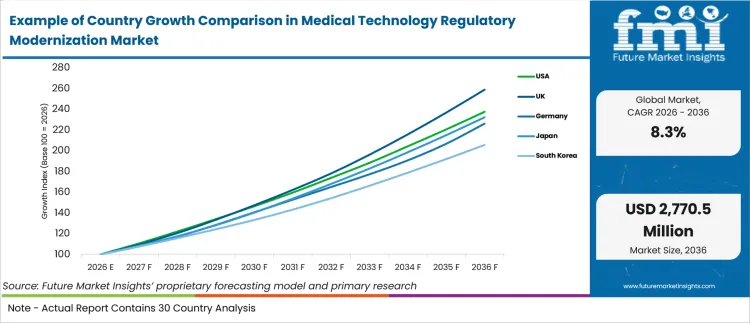
| Country | CAGR |
|---|---|
| USA | 9.0% |
| UK | 10.0% |
| Germany | 8.5% |
| Japan | 8.8% |
| South Korea | 7.5% |
How do country-level CAGRs compare in the Medical Technology Regulatory Modernization Market?
The country forecasts occupy a compressed 2.5-point range across countries modernizing medical-device regulatory workflows. The UK and USA form the upper band with one percentage point separating their approved growth rates. Japan remains close to this group, while Germany sits between Japan and South Korea within the measured range. South Korea sets the lower boundary, yet its forecast does not create a separate low-growth tier. Different authority portals and validation duties mean similar forecasts can produce materially different market-entry conditions.
- The UK and USA remain clustered as both markets digitize authority workflows under demanding evidence requirements. Their similar rates conceal distinct purchasing routes shaped by national oversight and enterprise validation practices within regulated organizations.
- Japan stays near the upper cluster despite language requirements and certificate costs affecting foreign implementation teams. Careful submission preparation and experienced domestic support therefore carry greater commercial importance for multinational manufacturers.
- Germany occupies the middle position as manufacturers prepare for EUDAMED and national device information system changes. Parallel data mapping creates implementation work and raises demand for local configuration support across active product records.
- South Korea defines the lower boundary within a comparison that remains compressed across all five countries. Its digital-product framework creates targeted demand for domestic configuration and specialist training across software-driven devices.
- The forecasts form one compressed band instead of separate high-growth and low-growth groups across the profiled countries. Commercial outcomes depend more on authority integration and service capacity than small differences between approved rates.
Market entry plans should account for authority portals and domestic language support alongside local capacity to validate configured workflows. The full report provides country-level CAGR analysis across North America, Latin America, Europe, East Asia, South Asia, Oceania and the Middle East and Africa.
Country-wise Analysis
- United States device manufacturers use electronic FDA submission routes within a quality framework aligned more closely with ISO 13485. Medical technology regulatory modernization platform sales in the USA are forecast to expand at 9.0% CAGR by 2036, facilitated by mandatory electronic templates and structured quality records. Structured eSTAR templates give software teams a stable configuration target across active 510(k) and De Novo submission programs. In October 2025 the FDA issued draft guidance on quality-management information for certain premarket submission reviews. The guidance creates a direct need to connect quality evidence with submission packages under controlled ownership. Long approval histories and complex migrations can extend purchasing cycles for manufacturers maintaining large portfolios of active products.
- Great Britain combines centralized MHRA oversight with stronger post-market duties and separate routes for continued device access. In July 2025 the MHRA published its response concerning international reliance and proposed UKCA marking routes. Demand for medical technology regulatory modernization platforms in the UK is predicted to advance at 10.0% CAGR through 2036, reinforced by changing market-access and reporting requirements. Remote implementation and cloud subscriptions can support smaller regulatory departments managing several product portfolios across different authority routes. Proposed pathways may simplify selected entry work, yet distinct Great Britain requirements remain part of each configured submission route. Legislative timing creates a material friction that can change configuration schedules and delay commercial planning for implementation teams.
- German manufacturers manage national device procedures and prepare for EUDAMED through updated clinical-investigation workflows across parallel authority systems. Germany's medical technology regulatory modernization market outlook is anticipated to advance at 8.5% CAGR over the assessment period, attributable to parallel European and national reporting requirements. In June 2025 BfArM announced a renewed DMIDS clinical-investigations module for July 1 with improved usability and a new radiation-application route. The update creates direct demand for local-language workflow mapping and validated data migration across affected clinical-investigation records. Experienced domestic consultants provide implementation support across active product records that require national and European authority mapping. Planned service interruptions remain a material friction during system changes involving live regulatory data and active submission programs.
- Japanese regulatory operations use PMDA review routes that require bilingual document preparation and local process knowledge across medical-device submissions. Japan's medical technology regulatory modernization sector is estimated to post 8.8% CAGR over the forecast period, shaped by digital submission routes and structured review information. Bilingual review summaries help global manufacturers compare evidence expectations across selected device categories and documented approval decisions. In March 2025 PMDA announced that Japanese and English review summaries would cover selected medical devices from fiscal 2025. Domestic implementation partners support training and authority communication through procedures that foreign regulatory teams may not manage internally. Limited English coverage creates additional review work for device categories without translated summaries or familiar domestic precedents.
- South Korea operates a specialized digital-medical-product framework alongside established national device approval and reporting procedures. In April 2025 the MFDS issued regulations covering approval and certification with reporting and evaluation requirements for digital medical products. The medical technology regulatory modernization market in South Korea is projected to grow at 7.5% CAGR through 2036, supported by digital-product rules and cloud-ready infrastructure. The regulations provide direct configuration targets for approval and evidence workflows across each regulated digital-product submission route. Domestic specialists support Korean-language implementation and classification decisions across software-driven medical products with different evidence requirements. Product classification increases dependence on specialist services during platform validation and later maintenance of national submission workflows.
Who are the notable companies in the Medical Technology Regulatory Modernization Market?
Veeva Systems, IQVIA, ArisGlobal, Rimsys, MasterControl, Freyr Solutions, Ennov, and Generis are the notable companies shaping this market.
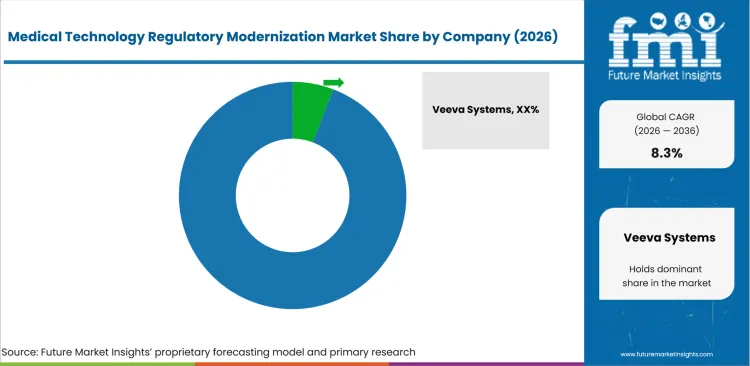
The competitive field includes dedicated RIM providers and broader compliance platforms that manage regulatory content across product lifecycles. IQVIA describes SmartSolve as one environment for quality and regulatory work across life-sciences product lifecycles. Dedicated RIM providers compete through registration control and submission publishing with authority correspondence across multiple regulated product classes. Broader platforms compete through links with quality and clinical trials workflows that support regulated decisions. Selection depends on verified medical-device coverage and implementation support rather than general company size or unrelated software breadth. Regulatory departments should test migration quality and supported authority formats prior to comparing wider portfolio breadth.
- Veeva Systems and ArisGlobal provide lifecycle platforms covering registrations and submissions with authority correspondence across regulated product portfolios. Rimsys focuses on medical-device regulatory operations and governed product data across global registrations and continuing lifecycle obligations. Their differentiation depends on device-specific configuration and dependable migration support for active authorization records managed globally.
- IQVIA and MasterControl connect regulatory work with quality processes affecting approvals and continuing post-market responsibilities across medical-device portfolios. Ennov combines regulatory information management with submission publishing and quality capabilities designed for regulated medical-device portfolios. The combined platforms suit organizations that need controlled data and connected compliance workflows across several product and country records.
- Freyr Solutions combines submission publishing tools with regulatory services covering several jurisdictions and authority formats. Generis supports applications and registrations with medical-device submissions and health-authority correspondence through the CARA platform. Its quality workflows also cover events and controlled documents across medical-device compliance processes and inspections. Evaluation should focus on exact device coverage and implementation support across active product records before selection.
Competitive Benchmarking: Medical Technology Regulatory Modernization Market
| Company | Regulatory Data Management | Submission Workflow | Quality and Post-market | Geographic Reach |
|---|---|---|---|---|
| Veeva Systems | High | High | High | Global |
| IQVIA | High | High | High | Global |
| ArisGlobal | High | High | High | Global |
| Rimsys | High | High | Medium | Global |
| MasterControl | Medium | Medium | High | Multi-region |
| Freyr Solutions | High | High | Medium | Global |
| Ennov | High | High | High | Global |
| Generis | High | High | High | Global |
Key Developments in the Medical Technology Regulatory Modernization Market
- In September 2025, Veeva Systems announced that more than 450 organizations had adopted Veeva RIM on its unified regulatory platform. The announcement also described partnerships connecting Veeva RIM with multi-authority collaboration environments across regulated submission processes.
- In March 2025, ArisGlobal launched LifeSphere Unify with NavaX Insights and Advanced Compliance Docs across the regulated platform portfolio. The platform connects safety and medical affairs data with regulatory and quality information across one environment. The release broadens access to connected information without replacing the governed records supporting formal regulatory work across regulated life-sciences operations.
- In April 2025, Rimsys added EUDAMED machine-to-machine bulk UDI transmission and Rimsys Connect for enterprise data synchronization. The release gives medtech teams a direct route for bulk device-data submission and near-real-time reporting access across medical-device portfolios.
- In March 2025, Generis formed a partnership with Regenold to connect medical-device regulatory expertise with the CARA platform. The partnership covers regulatory information and quality management for medical-device organizations that need software with specialist implementation support.
Key Players in the Medical Technology Regulatory Modernization Market
Regulatory Information Platform Providers
- Veeva Systems
- ArisGlobal
- Rimsys
Quality and Regulatory Platform Providers
- IQVIA
- MasterControl
- Ennov
Regulatory Content and Submission Providers
- Freyr Solutions
- Generis
Medical Technology Regulatory Modernization Market - Report Scope
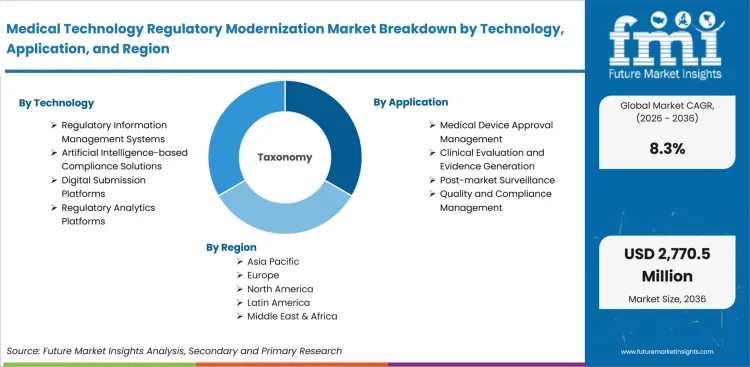
| Coverage field | Report scope |
|---|---|
| Market breakdown | Technology, application, end user, deployment model, and region. |
| Market Definition | Software platforms and related services used to manage medical-technology regulatory information, submissions, approval workflows, compliance evidence, and post-market regulatory responsibilities. |
| Regions Covered | North America, Latin America, Western Europe, Eastern Europe, East Asia, South Asia and Pacific, and Middle East and Africa. |
| Countries Covered | USA, UK, Germany, Japan, and South Korea. |
| Key Companies Profiled | Veeva Systems, IQVIA, ArisGlobal, Rimsys, MasterControl, Freyr Solutions, Ennov, and Generis. |
| Forecast Period | 2026 to 2036. |
| Approach | Hybrid bottom-up and top-down market sizing supported by primary interviews and authoritative desk research. |
Medical Technology Regulatory Modernization Market - Research Methodology
| Method | Approach |
|---|---|
| Primary Research | FMI analysts gathered input from manufacturers, service providers, technology developers, distributors, end users, sourcing teams, and subject-matter experts. Interviews examined purchasing decisions, product or service evaluation, adoption barriers, approval requirements, pricing considerations, and expectations for technical or commercial support. Respondents were also asked what evidence is required before a trial, pilot, or initial order develops into regular purchasing. |
| Desk Research | Desk research covered government statistics, regulatory publications, trade data, industry associations, technical literature, standards, company filings, product information, and official corporate announcements. Sources were reviewed for relevance, publication date, geographic coverage, and consistency with the defined market scope. Claims relating to performance, applications, approvals, capacity, investment, and commercial activity were retained only when supported by credible public evidence. |
| Market Sizing and Forecasting | The market model combined the baseline value with historical performance, segment structure, pricing and volume indicators, adoption levels, company participation, and country-level demand conditions. Forecast assumptions considered economic activity, investment trends, regulatory developments, technology adoption, purchasing cycles, supply availability, and barriers to wider market use. Segment and regional estimates were reconciled before the final market total was calculated. |
| Data Validation | Estimates were checked against multiple independent indicators, including public data, company activity, trade patterns, industry developments, and findings from primary interviews. Validation also tested whether products, services, applications, and company revenues fell within the defined market boundaries. Adjacent categories, unsupported claims, overlapping revenues, and activities without direct market relevance were excluded to reduce double counting and maintain consistency across segments and countries. |
Medical Technology Regulatory Modernization Market by Segments
Medical Technology Regulatory Modernization Market segmented by Technology:
- Regulatory Information Management Systems
- Artificial Intelligence-based Compliance Solutions
- Digital Submission Platforms
- Regulatory Analytics Platforms
Medical Technology Regulatory Modernization Market segmented by Application:
- Medical Device Approval Management
- Clinical Evaluation and Evidence Generation
- Post-market Surveillance
- Quality and Compliance Management
Medical Technology Regulatory Modernization Market segmented by End User:
- Medical Device Manufacturers
- Biotechnology Companies
- Contract Research Organizations
- Regulatory Consulting Firms
Medical Technology Regulatory Modernization Market segmented by Deployment Model:
- Cloud-based Solutions
- On-premise Solutions
- Hybrid Platforms
Medical Technology Regulatory Modernization Market by Region:
- North America
- United States
- Canada
- Latin America
- Brazil
- Mexico
- Argentina
- Chile
- Western Europe
- Germany
- France
- United Kingdom
- Italy
- Spain
- Benelux
- Nordics
- Eastern Europe
- Poland
- Czech Republic
- Romania
- Hungary
- East Asia
- China
- Japan
- South Korea
- South Asia and Pacific
- India
- ASEAN
- Australia and New Zealand
- Middle East and Africa
- GCC Countries
- South Africa
- Türkiye
- Israel
Research Sources and Bibliography
- USA Food and Drug Administration. (2025, September 30).
- European Commission. (2025, November 27).
- USA Food and Drug Administration. (2026, June 1).
- Medicines and Healthcare products Regulatory Agency. (2025, June 16).
- Ministry of Health, Labour and Welfare. (2025, April 1).
- USA Food and Drug Administration. (2026, February 2).
- Medicines and Healthcare products Regulatory Agency. (2025, May 16).
- Ministry of Food and Drug Safety. (2025, January 24).
- USA Food and Drug Administration. (2025, October).
- Medicines and Healthcare products Regulatory Agency. (2025, July 22).
- Federal Institute for Drugs and Medical Devices. (2025, June 24)
- Pharmaceuticals and Medical Devices Agency. (2025, March 24).
- Ministry of Food and Drug Safety. (2025, April 15).
- IQVIA. (n.d.).
- ArisGlobal. (n.d.).
- Generis. (n.d.).
- MasterControl. (n.d.).
- Freyr Solutions. (n.d.).
- Freyr Solutions. (n.d.).
- Veeva Systems. (2025, September 2).
- ArisGlobal. (2025, March 19).
- Rimsys. (2025, April 29).
- Generis. (2025, March 31).
- Rimsys. (n.d.).
- Freyr Solutions. (n.d.).
This bibliography is provided for reader reference and is not exhaustive. The full report contains the complete reference list and detailed citations
This Report Answers
- How large is the medical technology regulatory modernization market in 2026 and 2036?
- Which regulatory changes support investment in structured submission and compliance platforms?
- Why do Regulatory Information Management Systems hold the main Technology share in 2026?
- How does Medical Device Approval Management influence authorization workflows and commercial entry?
- Why do Medical Device Manufacturers account for the main End User share in 2026?
- How do country growth rates differ across the USA, UK, Germany, Japan, and South Korea?
- Which companies provide regulatory platforms or connected quality and safety workflows?
- What limits platform adoption across legacy records and local authority formats?
- How can cloud deployment support distributed regulatory teams without weakening validation controls?
Frequently Asked Questions
How big is the Medical Technology Regulatory Modernization and Innovation Pathways Market in 2026?
The medical technology regulatory modernization and innovation pathways market is valued at USD 1051.4 million in 2026 and is forecast to reach USD 4842.1 million by 2036. Growth reflects regulatory agencies replacing isolated document exchanges with lifecycle expectations that connect evidence planning and post-market oversight.
What is the CAGR of the Medical Technology Regulatory Modernization and Innovation Pathways Market from 2026 to 2036?
The medical technology regulatory modernization and innovation pathways market grows at a CAGR of 16.5% between 2026 and 2036, supported by structured lifecycle rules that increase demand for systems coordinating evidence updates and controlled regulatory submissions across product changes.
Which pathway type leads the Medical Technology Regulatory Modernization and Innovation Pathways Market?
Regulatory modernization programs account for 33.4% of the medical technology regulatory modernization and innovation pathways market by pathway type in 2026, attributable to their ability to coordinate several approval and compliance activities within a common operating structure.
How much will the Medical Technology Regulatory Modernization and Innovation Pathways Market add between 2026 and 2036?
The medical technology regulatory modernization and innovation pathways market is set to add USD 3790.7 million between 2026 and 2036, growing from USD 1051.4 million to USD 4842.1 million as lifecycle governance platforms extend across a widening base of device manufacturers worldwide.
Who are the leading companies in the Medical Technology Regulatory Modernization and Innovation Pathways Market?
Five companies lead the medical technology regulatory modernization and innovation pathways market, including Veeva Systems, Rimsys, IQVIA, ArisGlobal, and Oracle Life Sciences, competing through device regulatory information management, regulatory workflows, and broader life-sciences data capabilities.
Preview the report firsthand - request a free sample
Get SampleGet the brochure for pricing and purchase details.
Get PDFTable of Content
- Key Takeaways
- Market Size and CAGR
- Top Growth Driver
- Fastest Growing Segment
- Leading Region
- Key Companies
- Emerging Opportunities
- Executive Summary
- Global Market Outlook
- Demand-side Trends
- Supply-side Trends
- Technology Roadmap Analysis
- Analysis and Recommendations
- Analyst Perspective (What is happening? Why now? What should investors know?)
- Key Questions Answered
- How large is the market?
- What is the CAGR?
- What are key trends?
- Which region dominates?
- Who are the leaders?
- Market Overview
- Market Coverage / Taxonomy
- Market Definition / Scope / Limitations
- Research Methodology
- Chapter Orientation
- Analytical Lens and Working Hypotheses
- Market Structure, Signals, and Trend Drivers
- Benchmarking and Cross-market Comparability
- Market Sizing, Forecasting, and Opportunity Mapping
- Research Design and Evidence Framework
- Desk Research Programme (Secondary Evidence)
- Expert Input and Fieldwork (Primary Evidence)
- Tooling, Models, and Reference Databases
- Data Engineering and Model Build
- Quality Assurance and Audit Trail
- Market Background
- Market Dynamics (Drivers, Restraints, Opportunity, Trends)
- Scenario Forecast (Optimistic, Likely, Conservative)
- Impact Analysis
- AI Impact
- Sustainability Impact
- Regulatory Impact
- Technology Impact
- Consumer / Buyer Analysis
- Purchase Drivers
- Adoption Barriers
- Buyer Journey
- Opportunity Map Analysis
- Product Life Cycle Analysis
- Supply Chain Analysis
- Investment Feasibility Matrix
- Value Chain Analysis
- PESTLE and Porter's Analysis
- Regulatory Landscape
- Regional Parent Market Outlook
- Production and Consumption Statistics
- Import and Export Statistics
- Global Market Analysis and Forecast, 2021 to 2036
- Historical Market Size Value (USD Million) Analysis, 2021 to 2025
- Current and Future Market Size Value (USD Million) Projections, 2026 to 2036
- Y-o-Y Growth Trend Analysis
- Absolute $ Opportunity Analysis
- Global Market Pricing Analysis, 2021 to 2036
- Global Market Analysis and Forecast, By Technology, 2021 to 2036
- Introduction / Key Findings
- Historical Market Size Value (USD Million) Analysis By Technology, 2021 to 2025
- Current and Future Market Size Value (USD Million) Analysis and Forecast By Technology, 2026 to 2036
- Regulatory Information Management Systems
- Artificial Intelligence-based Compliance Solutions
- Digital Submission Platforms
- Regulatory Analytics Platforms
- Regulatory Information Management Systems
- Y-o-Y Growth Trend Analysis By Technology, 2021 to 2025
- Absolute $ Opportunity Analysis By Technology, 2026 to 2036
- Global Market Analysis and Forecast, By Application, 2021 to 2036
- Introduction / Key Findings
- Historical Market Size Value (USD Million) Analysis By Application, 2021 to 2025
- Current and Future Market Size Value (USD Million) Analysis and Forecast By Application, 2026 to 2036
- Medical Device Approval Management
- Clinical Evaluation and Evidence Generation
- Post-market Surveillance
- Quality and Compliance Management
- Medical Device Approval Management
- Y-o-Y Growth Trend Analysis By Application, 2021 to 2025
- Absolute $ Opportunity Analysis By Application, 2026 to 2036
- Global Market Analysis and Forecast, By End User, 2021 to 2036
- Introduction / Key Findings
- Historical Market Size Value (USD Million) Analysis By End User, 2021 to 2025
- Current and Future Market Size Value (USD Million) Analysis and Forecast By End User, 2026 to 2036
- Medical Device Manufacturers
- Biotechnology Companies
- Contract Research Organizations
- Regulatory Consulting Firms
- Medical Device Manufacturers
- Y-o-Y Growth Trend Analysis By End User, 2021 to 2025
- Absolute $ Opportunity Analysis By End User, 2026 to 2036
- Global Market Analysis and Forecast, By Deployment Model, 2021 to 2036
- Introduction / Key Findings
- Historical Market Size Value (USD Million) Analysis By Deployment Model, 2021 to 2025
- Current and Future Market Size Value (USD Million) Analysis and Forecast By Deployment Model, 2026 to 2036
- Cloud-based Solutions
- On-premise Solutions
- Hybrid Platforms
- Cloud-based Solutions
- Y-o-Y Growth Trend Analysis By Deployment Model, 2021 to 2025
- Absolute $ Opportunity Analysis By Deployment Model, 2026 to 2036
- Global Market Analysis and Forecast, By Region, 2021 to 2036
- Introduction
- Historical Market Size Value (USD Million) Analysis By Region, 2021 to 2025
- Current Market Size Value (USD Million) Analysis and Forecast By Region, 2026 to 2036
- North America
- Latin America
- Western Europe
- Eastern Europe
- East Asia
- South Asia and Pacific
- Middle East & Africa
- Market Attractiveness Analysis By Region
- North America Market Analysis and Forecast, By Country, 2021 to 2036
- Historical Market Size Value (USD Million) Trend Analysis By Market Taxonomy, 2021 to 2025
- Market Size Value (USD Million) Forecast By Market Taxonomy, 2026 to 2036
- By Country
- USA
- Canada
- By Technology
- By Application
- By End User
- By Deployment Model
- By Country
- Market Attractiveness Analysis
- By Country
- By Technology
- By Application
- By End User
- By Deployment Model
- Key Takeaways
- Latin America Market Analysis and Forecast, By Country
- Historical Market Size Value (USD Million) Trend Analysis By Market Taxonomy, 2021 to 2025
- Market Size Value (USD Million) Forecast By Market Taxonomy, 2026 to 2036
- By Country
- Brazil
- Mexico
- Chile
- Rest of Latin America
- By Technology
- By Application
- By End User
- By Deployment Model
- By Country
- Market Attractiveness Analysis
- By Country
- By Technology
- By Application
- By End User
- By Deployment Model
- Key Takeaways
- Western Europe Market Analysis and Forecast, By Country
- Historical Market Size Value (USD Million) Trend Analysis By Market Taxonomy, 2021 to 2025
- Market Size Value (USD Million) Forecast By Market Taxonomy, 2026 to 2036
- By Country
- Germany
- UK
- Italy
- Spain
- France
- Nordic
- BENELUX
- Rest of Western Europe
- By Technology
- By Application
- By End User
- By Deployment Model
- By Country
- Market Attractiveness Analysis
- By Country
- By Technology
- By Application
- By End User
- By Deployment Model
- Key Takeaways
- Eastern Europe Market Analysis and Forecast, By Country
- Historical Market Size Value (USD Million) Trend Analysis By Market Taxonomy, 2021 to 2025
- Market Size Value (USD Million) Forecast By Market Taxonomy, 2026 to 2036
- By Country
- Russia
- Poland
- Hungary
- Balkan & Baltic
- Rest of Eastern Europe
- By Technology
- By Application
- By End User
- By Deployment Model
- By Country
- Market Attractiveness Analysis
- By Country
- By Technology
- By Application
- By End User
- By Deployment Model
- Key Takeaways
- East Asia Market Analysis and Forecast, By Country
- Historical Market Size Value (USD Million) Trend Analysis By Market Taxonomy, 2021 to 2025
- Market Size Value (USD Million) Forecast By Market Taxonomy, 2026 to 2036
- By Country
- China
- Japan
- South Korea
- By Technology
- By Application
- By End User
- By Deployment Model
- By Country
- Market Attractiveness Analysis
- By Country
- By Technology
- By Application
- By End User
- By Deployment Model
- Key Takeaways
- South Asia and Pacific Market Analysis and Forecast, By Country
- Historical Market Size Value (USD Million) Trend Analysis By Market Taxonomy, 2021 to 2025
- Market Size Value (USD Million) Forecast By Market Taxonomy, 2026 to 2036
- By Country
- India
- ASEAN
- Australia & New Zealand
- Rest of South Asia and Pacific
- By Technology
- By Application
- By End User
- By Deployment Model
- By Country
- Market Attractiveness Analysis
- By Country
- By Technology
- By Application
- By End User
- By Deployment Model
- Key Takeaways
- Middle East & Africa Market Analysis and Forecast, By Country
- Historical Market Size Value (USD Million) Trend Analysis By Market Taxonomy, 2021 to 2025
- Market Size Value (USD Million) Forecast By Market Taxonomy, 2026 to 2036
- By Country
- Kingdom of Saudi Arabia
- Other GCC Countries
- Türkiye
- South Africa
- Other African Union
- Rest of Middle East & Africa
- By Technology
- By Application
- By End User
- By Deployment Model
- By Country
- Market Attractiveness Analysis
- By Country
- By Technology
- By Application
- By End User
- By Deployment Model
- Key Takeaways
- Key Countries Market Analysis
- USA
- Pricing Analysis
- Market Share Analysis, 2025
- By Technology
- By Application
- By End User
- By Deployment Model
- Canada
- Pricing Analysis
- Market Share Analysis, 2025
- By Technology
- By Application
- By End User
- By Deployment Model
- Mexico
- Pricing Analysis
- Market Share Analysis, 2025
- By Technology
- By Application
- By End User
- By Deployment Model
- Brazil
- Pricing Analysis
- Market Share Analysis, 2025
- By Technology
- By Application
- By End User
- By Deployment Model
- Chile
- Pricing Analysis
- Market Share Analysis, 2025
- By Technology
- By Application
- By End User
- By Deployment Model
- Germany
- Pricing Analysis
- Market Share Analysis, 2025
- By Technology
- By Application
- By End User
- By Deployment Model
- UK
- Pricing Analysis
- Market Share Analysis, 2025
- By Technology
- By Application
- By End User
- By Deployment Model
- Italy
- Pricing Analysis
- Market Share Analysis, 2025
- By Technology
- By Application
- By End User
- By Deployment Model
- Spain
- Pricing Analysis
- Market Share Analysis, 2025
- By Technology
- By Application
- By End User
- By Deployment Model
- France
- Pricing Analysis
- Market Share Analysis, 2025
- By Technology
- By Application
- By End User
- By Deployment Model
- India
- Pricing Analysis
- Market Share Analysis, 2025
- By Technology
- By Application
- By End User
- By Deployment Model
- ASEAN
- Pricing Analysis
- Market Share Analysis, 2025
- By Technology
- By Application
- By End User
- By Deployment Model
- Australia & New Zealand
- Pricing Analysis
- Market Share Analysis, 2025
- By Technology
- By Application
- By End User
- By Deployment Model
- China
- Pricing Analysis
- Market Share Analysis, 2025
- By Technology
- By Application
- By End User
- By Deployment Model
- Japan
- Pricing Analysis
- Market Share Analysis, 2025
- By Technology
- By Application
- By End User
- By Deployment Model
- South Korea
- Pricing Analysis
- Market Share Analysis, 2025
- By Technology
- By Application
- By End User
- By Deployment Model
- Russia
- Pricing Analysis
- Market Share Analysis, 2025
- By Technology
- By Application
- By End User
- By Deployment Model
- Poland
- Pricing Analysis
- Market Share Analysis, 2025
- By Technology
- By Application
- By End User
- By Deployment Model
- Hungary
- Pricing Analysis
- Market Share Analysis, 2025
- By Technology
- By Application
- By End User
- By Deployment Model
- Kingdom of Saudi Arabia
- Pricing Analysis
- Market Share Analysis, 2025
- By Technology
- By Application
- By End User
- By Deployment Model
- Türkiye
- Pricing Analysis
- Market Share Analysis, 2025
- By Technology
- By Application
- By End User
- By Deployment Model
- South Africa
- Pricing Analysis
- Market Share Analysis, 2025
- By Technology
- By Application
- By End User
- By Deployment Model
- USA
- Market Structure Analysis
- Competition Dashboard
- Competition Benchmarking
- Market Share Analysis of Top Players
- By Regional
- By Technology
- By Application
- By End User
- By Deployment Model
- Emerging Startups
- Innovation Benchmarking
- Competition Analysis
- Competition Deep Dive
- Veeva Systems
- Overview
- Product Portfolio
- Profitability by Market Segments
- Sales Footprint
- Strategy Overview
- Marketing Strategy
- Product Strategy
- Channel Strategy
- IQVIA
- Oracle Health Sciences
- Parexel
- Medidata Solutions
- ArisGlobal
- Rimsys
- Freyr Solutions
- Dassault Systèmes
- MasterControl
- Veeva Systems
- Case Studies
- Success Stories
- Recent Developments
- Competition Deep Dive
- Assumptions & Acronyms Used


