

- Industry Size (2026)
- USD 520 Mn
- Forecast (2036)
- USD 1324.4 Mn
- CAGR (2026 to 2036)
- 9.8%
Endocrine Disruptor Removal Agents Market Forecast and Outlook 2026 to 2036
The endocrine disruptor removal agents market is estimated at USD 520 million in 2026 and is expected to reach USD 1,324.4 million by 2036 at a CAGR of 9.8%. Initial growth between 2026 and 2030 is driven by increasing use in municipal and industrial wastewater treatment systems. Activated carbon, advanced oxidation chemicals, and enzymatic agents dominate the removal processes. Regulatory pressures, awareness of endocrine-disrupting compounds in drinking water, and the push for safer effluent discharge drive early adoption, particularly in urbanized and industrialized regions.
From 2031 to 2036, growth is propelled by expanding applications in hospital wastewater, pilot research facilities, and integrated water treatment systems. Hybrid chemical-biological removal mechanisms gain prominence, while innovations in adsorption, oxidation, and enzymatic degradation enhance treatment efficiency. Investments in sustainable water management and automated dosing technologies further support widespread deployment. By 2036, the market exhibits broad adoption across municipal, industrial, and healthcare water streams, consolidating a stable and mature growth phase.
Quick Stats for Endocrine Disruptor Removal Agents Market
- Endocrine Disruptor Removal Agents Market Value (2026): USD 520 million
- Endocrine Disruptor Removal Agents Market Forecast Value (2036): USD 1,324.4 million
- Endocrine Disruptor Removal Agents Market Forecast CAGR: 9.8%
- Leading Type in Endocrine Disruptor Removal Agents Market: Activated Carbon & Adsorbents
- Key Growth Regions in Endocrine Disruptor Removal Agents Market: North America, Europe, and Asia Pacific
- Top Players in Endocrine Disruptor Removal Agents Market: Veolia Water Technologies, Ecolab, Kemira, SUEZ Water Technologies, Solenis
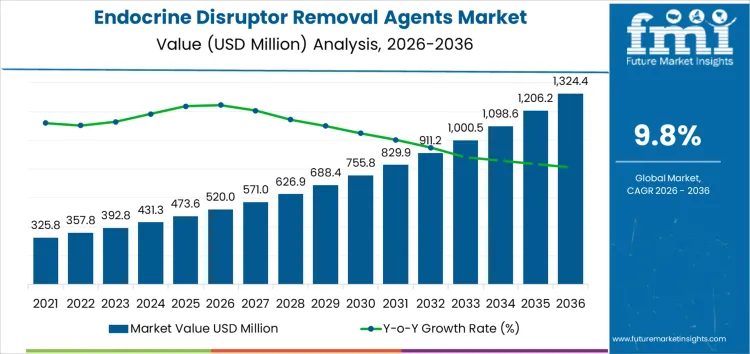
What is the Growth Forecast for the Endocrine Disruptor Removal Agents Market through 2036?
From 2026 to 2031, the endocrine disruptor removal agents market grows from USD 520 million to approximately USD 788 million, representing the early adoption phase. Annual increments increase from USD 52 million in 2026 to USD 78 million in 2031. Growth is driven by adoption in municipal and industrial water treatment, pharmaceutical effluent management, and wastewater treatment plants, where endocrine-disrupting compounds such as hormones and pharmaceuticals require targeted chemical removal. North America and Europe account for roughly 60% of early adoption, with uptake concentrated in high-volume urban and industrial facilities validating chemical efficacy, compliance with environmental standards, and operational integration.
Between 2031 and 2036, the market expands from roughly USD 788 million to USD 1,383 million, illustrating the late adoption phase characterized by structural deployment and broader commercialization. Annual increments rise from USD 78 million to USD 135 million, supported by portfolio-wide implementation, repeat procurement, and expansion into emerging markets in Asia Pacific and Latin America. Growth is reinforced by stricter environmental regulations, rising public and industrial demand for safe water, and normalization of removal agent use across global water treatment networks. Early growth relied on selective high-value sites and pilot programs, while later expansion reflects full-scale deployment and standardized adoption across municipal and industrial facilities.
Endocrine Disruptor Removal Agents Market Key Takeaways
| Metric | Value |
|---|---|
| Market Value (2026) | USD 520 million |
| Forecast Value (2036) | USD 1,324.4 million |
| Forecast CAGR (2026 to 2036) | 9.8% |
What Is Driving Demand in the Endocrine Disruptor Removal Agents Market?
Demand for endocrine disruptor removal agents emerged from recognition that traditional water and wastewater treatment processes do not reliably eliminate trace organic contaminants that interfere with hormonal systems. Compounds such as certain pharmaceuticals, pesticides, plasticizers and personal care product residues persist through conventional treatment trains, resisting coagulation, sedimentation and basic disinfection. Water utilities and industrial facilities began observing measurable levels of these substances in effluent and receiving waters as analytical detection improved. This raised ecological and public health concerns because endocrine disruptors can affect reproductive and developmental processes in wildlife and, at very low concentrations, carry uncertain long-term human health implications.
Future demand for endocrine disruptor removal agents will be shaped by evolving regulatory requirements, performance-based treatment standards and documented contaminant monitoring rather than incidental application alone. Regulatory bodies and water quality programmes in multiple regions are expanding monitoring frameworks to include emerging contaminants of concern, pressuring utilities to demonstrate removal performance. Endocrine disruptor removal agents are being specified as part of multi-stage treatment approaches that align with source water protection plans and compliance expectations. Advances in molecularly selective adsorbents, tailored oxidation pathways and integrative treatment sequencing are improving removal at trace concentrations without producing harmful by-products.
What Factors Are Affecting the Demand for Endocrine Disruptor Removal Agents Market in Terms of Removal Agent Type and Application Area?
The endocrine disruptor removal agents market is shaped by rising regulatory attention on trace contaminants, growing evidence of long term ecological impact, and increasing monitoring of water systems. Demand is concentrated on treatment solutions that can reduce hormonally active compounds at low concentrations while integrating with existing infrastructure. Market adoption reflects compliance urgency, treatment reliability, and operational feasibility rather than widespread replacement of conventional water treatment chemistries.
What Is Driving Leadership by Removal Agent Type in the Endocrine Disruptor Removal Agents Market?
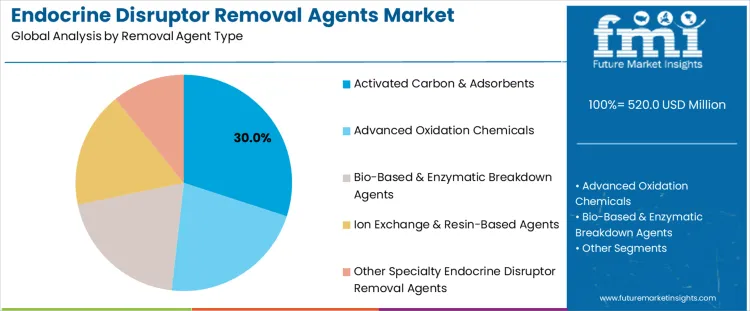
Activated carbon and adsorbents account for about 30% of demand because they provide broad spectrum removal of endocrine disrupting compounds through physical adsorption. Utilities favor these agents for their proven performance, scalability, and ease of integration into tertiary treatment stages. Granular and powdered carbon systems are widely deployed to reduce hormones, pharmaceuticals, and personal care residues without altering core treatment processes. Their regulatory familiarity and predictable operation reinforce adoption in both retrofit and new installations.
Advanced oxidation chemicals, bio based agents, ion exchange resins, and specialty formulations complement adsorbents but remain more application specific. Oxidation systems degrade compounds but require higher energy and control. Bio based agents depend on stable conditions. Resin systems target select molecules. These options expand treatment capability without displacing activated carbon as the foundational removal approach.
What Is Driving Leadership by Application Area in the Endocrine Disruptor Removal Agents Market?
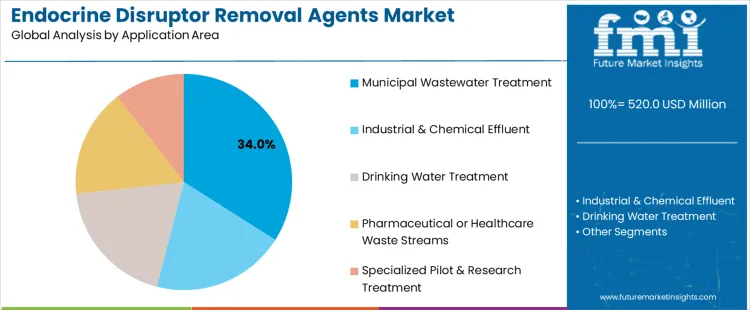
Municipal wastewater treatment represents about 34% of demand because it aggregates endocrine disruptors from domestic, industrial, and healthcare sources. Regulatory pressure to protect receiving waters and downstream drinking water supplies drives adoption of removal agents at centralized facilities. Municipal plants have the scale and monitoring capacity to justify investment in advanced tertiary treatment. Continuous flow volumes reinforce recurring chemical demand.
Industrial effluent, drinking water treatment, healthcare waste streams, and research systems form secondary applications. These settings address specific point sources or polishing requirements but operate at smaller scale or intermittently. Adoption is driven by site specific compliance needs rather than system wide mandates. Application leadership therefore reflects population exposure risk and centralized treatment responsibility rather than total number of treatment locations.
How Are Endocrine Disruptor Removal Agents Being Applied Across Water and Wastewater Treatment?
Use appears in municipal drinking water systems, industrial effluent facilities, and advanced treatment plants where endocrine-disrupting compounds (EDCs) such as hormones, pharmaceuticals, and personal care residues pose health risks. Operators adopt removal agents including adsorbents, oxidants, and advanced chemical treatments to reduce EDC concentrations and protect human and aquatic health. Water utilities, pharmaceutical manufacturers, and industrial processors implement these agents to meet regulatory limits and minimize environmental impact. These applications reflect operational and safety priorities rather than aesthetic objectives, with adoption driven by contaminant removal efficiency and compliance.
What Operational and Material Conditions Support Adoption of Endocrine Disruptor Removal Agents?
Selection aligns with systems handling variable concentrations of micropollutants and diverse water matrices. Agents are optimized for selective binding, oxidation, or precipitation of EDCs without interfering with water chemistry or downstream processes. Operators monitor dosage, contact time, and residual levels to ensure effective removal. Facilities integrate these agents with filtration, coagulation, or membrane systems to achieve consistent treatment outcomes. These conditions emerge from operational reliability, water quality assurance, and regulatory adherence priorities in structured treatment workflows.
Which Practical Considerations Limit Wider Use of Endocrine Disruptor Removal Agents?
High chemical and operational costs can limit adoption in smaller facilities. Removal efficiency varies with water composition, pH, temperature, and organic load. Handling, storage, and safety protocols increase operational complexity. Some byproducts may require further treatment or disposal. Regulatory approval and monitoring requirements differ across regions. These factors lead to selective deployment where EDC removal, compliance, and operational performance justify incremental cost and process management.
What is the Demand for Endocrine Disruptor Removal Agents by Country?
| Country | CAGR (%) |
|---|---|
| India | 10.6% |
| China | 10.3% |
| USA | 8.5% |
| Germany | 7.9% |
| South Korea | 7.6% |
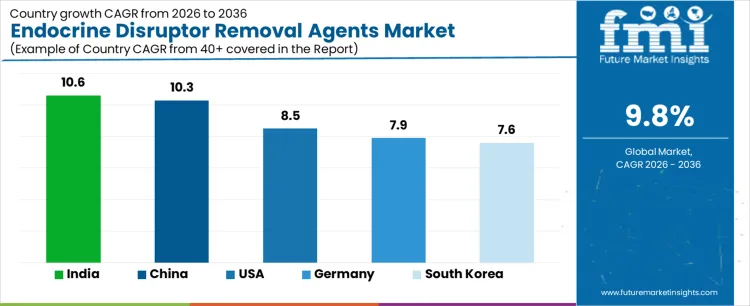
The demand for endocrine disruptor removal agents varies across countries, driven by water quality regulations, public health concerns, and adoption of advanced treatment technologies. India leads with a 10.6% CAGR, supported by growing municipal and industrial water treatment infrastructure and rising awareness of endocrine disrupting contaminants. China follows at 10.3%, driven by extensive water treatment programs, regulatory compliance, and adoption of chemical removal agents in industrial and municipal wastewater. The USA grows at 8.5%, reflecting adoption in advanced municipal and industrial treatment facilities. Germany records 7.9%, shaped by mature water treatment systems and stringent environmental standards. South Korea posts 7.6%, supported by industrial water treatment initiatives and emerging contaminant management.
How Are Endocrine Disruptor Removal Agents Improving Water Safety in India?
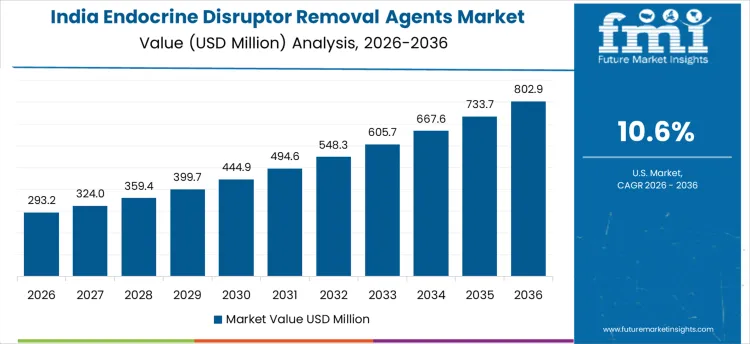
In India, the Endocrine Disruptor Removal Agents Market is expanding at a CAGR of 10.6% through 2036, driven by increasing demand from municipal water treatment plants, industrial facilities, and pharmaceutical manufacturing units. Facilities are adopting specialized removal agents to eliminate hormone-mimicking compounds, micropollutants, and contaminants from drinking and process water, ensuring compliance with environmental and health regulations. Demand is concentrated in urban water networks, industrial processing plants, and pharmaceutical effluent treatment units. Domestic suppliers provide high-performance, environmentally compatible chemicals suitable for multiple water treatment technologies. Regulatory oversight, recurring treatment cycles, and growing public awareness are sustaining robust adoption nationwide.
- Urban water networks, industrial plants, and pharmaceutical treatment units drive adoption
- Chemicals remove hormone-mimicking compounds and micropollutants
- Domestic suppliers provide environmentally compatible, high-performance solutions
- Recurring treatment cycles sustain robust adoption
How Are Water Quality Regulations Supporting Growth in China?
In China, revenue is growing at a CAGR of 10.3% through 2036, supported by stringent water quality regulations and increased awareness of endocrine-disrupting contaminants. Municipal utilities, industrial facilities, and pharmaceutical plants are adopting removal agents to reduce micropollutants, endocrine-active chemicals, and hormone-mimicking compounds in water systems. Demand is concentrated in urban water treatment plants, industrial zones, and pharmaceutical effluent systems. Domestic suppliers are scaling production of high-performance, treatment-compatible chemicals. Expansion of urban water infrastructure, regulatory enforcement, and recurring treatment programs are sustaining rapid adoption nationwide.
- Urban water treatment plants, industrial zones, and pharmaceutical effluent systems drive adoption
- Agents reduce endocrine-active compounds and micropollutants
- Domestic suppliers scale high-performance, treatment-compatible chemicals
- Recurring treatment programs sustain rapid adoption
How Are Industrial Water Safety Programs Driving Adoption in the United States?
In the United States, the market is expanding at a CAGR of 8.5% through 2036, driven by growing adoption of endocrine disruptor removal agents in municipal water systems, industrial plants, and pharmaceutical facilities. Utilities and industrial treatment plants are using these agents to degrade hormone-mimicking contaminants, micropollutants, and endocrine-active chemicals while ensuring regulatory compliance. Demand is concentrated in urban water networks, industrial processing units, and pharmaceutical effluent treatment facilities. Domestic suppliers provide high-performance, regulatory-compliant chemicals compatible with existing water treatment technologies. Recurring treatment operations, regulatory oversight, and increasing public health awareness are sustaining predictable adoption nationwide.
- Urban water networks, industrial processing units, and pharmaceutical facilities drive adoption
- Chemicals degrade endocrine-active compounds and micropollutants
- Domestic suppliers provide regulatory-compliant, high-performance solutions
- Recurring treatment operations sustain predictable adoption
How Are Environmental Standards Driving Adoption in Germany?
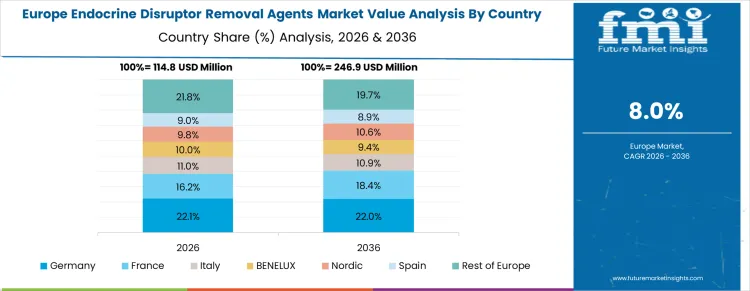
In Germany, revenue is growing at a CAGR of 7.9% through 2036, supported by strict EU and national regulations on micropollutant removal in drinking water and industrial effluents. Municipal utilities and industrial facilities are adopting endocrine disruptor removal agents to degrade hormone-mimicking chemicals, prevent contamination, and comply with water quality standards. Demand is concentrated in municipal water treatment plants, industrial processing facilities, and pharmaceutical effluent units. Domestic suppliers provide high-performance, environmentally compatible chemicals suitable for advanced water treatment systems. Regulatory compliance, recurring treatment cycles, and water quality monitoring are sustaining steady adoption nationwide.
- Municipal water plants, industrial processing units, and pharmaceutical effluents drive adoption
- Agents degrade hormone-mimicking chemicals and prevent contamination
- Domestic suppliers provide environmentally compatible, high-performance chemicals
- Recurring treatment cycles sustain steady adoption
How Are Industrial Water and Regulatory Needs Driving Growth in South Korea?
In South Korea, the market is expanding at a CAGR of 7.6% through 2036, driven by adoption of endocrine disruptor removal agents in municipal water treatment, industrial processing, and pharmaceutical facilities. Companies are using these agents to eliminate hormone-mimicking compounds, micropollutants, and emerging contaminants while meeting environmental and health regulations. Demand is concentrated in urban water treatment plants, industrial manufacturing sites, and pharmaceutical effluent treatment systems. Domestic suppliers provide high-performance, treatment-compatible chemicals suitable for recurring water treatment cycles. Growing regulatory oversight, industrial water treatment requirements, and repeated operations are sustaining steady adoption nationwide.
- Urban water treatment plants, industrial sites, and pharmaceutical facilities drive adoption
- Chemicals eliminate hormone-mimicking compounds and micropollutants
- Domestic suppliers provide high-performance, treatment-compatible solutions
- Recurring water treatment cycles sustain steady adoption
Which Strategic Approaches Are Companies Using to Compete in The Endocrine Disruptor Removal Agents Market?
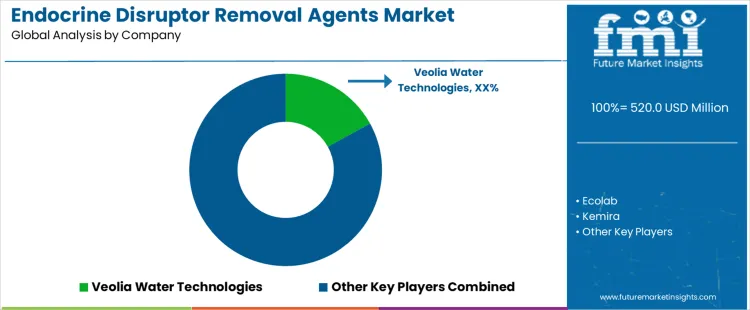
Competition in the Endocrine Disruptor Removal Agents Market is organized around risk reduction and regulatory preparedness rather than point solutions. Veolia Water Technologies and SUEZ Water Technologies pursue treatment train strategies, where removal agents are deployed alongside adsorption, oxidation, and biological polishing to address compounds that act at very low concentrations. Their approach emphasizes pilot studies, compound class coverage, and verification under changing source water conditions. Kemira and Solenis compete by refining coagulants, adsorbents, and auxiliary chemistries that reduce endocrine active precursors or improve capture efficiency upstream. Utilities favor suppliers that demonstrate stable removal performance across seasons and avoid creating secondary byproducts that complicate compliance.
Service integration and operational governance differentiate competitive positions. Ecolab frames endocrine disruptor control within managed water programs that combine chemistry selection with monitoring, dose optimization, and documentation aligned to audit requirements. Across the market, companies invest in field validation, analytical support, and conservative deployment pathways to address uncertainty in detection thresholds and evolving standards. Strategies prioritize adaptability, allowing treatment schemes to be adjusted as new compounds are regulated or testing methods change. Competitive advantage is built through trust in execution, transparency in performance data, and the ability to integrate removal agents without disrupting existing treatment assets. Adoption favors suppliers that support long planning horizons and regulatory confidence rather than rapid chemistry substitution.
Key Players in the Endocrine Disruptor Removal Agents Market
- Veolia Water Technologies
- Ecolab
- Kemira
- SUEZ Water Technologies
- Solenis
Scope of the Report
| Items | Values |
|---|---|
| Quantitative Units (2026) | USD million |
| Removal Agent Type | Activated Carbon & Adsorbents, Advanced Oxidation Chemicals, Bio-Based & Enzymatic Breakdown Agents, Ion Exchange & Resin-Based Agents, Other Specialty Endocrine Disruptor Removal Agents |
| Application Area | Municipal Wastewater Treatment, Industrial & Chemical Effluent, Drinking Water Treatment, Pharmaceutical / Healthcare Waste Streams, Specialized Pilot & Research Treatment |
| Removal Mechanism | Adsorption-Based Removal, Chemical Oxidation & Degradation, Biochemical & Enzymatic Deactivation, Precipitation & Coagulation, Hybrid & Emerging Technologies |
| End-Use Industry | Municipal Utilities, Industrial Facilities, Pharmaceutical & Healthcare, Research & Pilot Facilities, Water Reuse & Treatment Plants |
| Region | Asia Pacific, Europe, North America, Latin America, Middle East & Africa |
| Countries Covered | China, Japan, South Korea, India, Australia & New Zealand, ASEAN, Rest of Asia Pacific, Germany, United Kingdom, France, Italy, Spain, Nordic, BENELUX, Rest of Europe, USA, Canada, Mexico, Brazil, Chile, Rest of Latin America, Kingdom of Saudi Arabia, Other GCC Countries, Turkey, South Africa, Other African Union, Rest of Middle East & Africa |
| Key Companies Profiled | Veolia Water Technologies, Ecolab, Kemira, SUEZ Water Technologies, Solenis |
| Additional Attributes | Dollar by sales by removal agent type, Dollar by sales by removal mechanism, Dollar by sales by application area, Dollar by sales by region, Annual procurement cycles, Adoption intervals / breakpoints, Regulatory compliance (EPA, EU, local standards), Operational efficiency metrics, System compatibility, Lifecycle impact assessment, Recurring treatment operations, Performance under varying pH, temperature, and contaminant concentrations, Integration with automated dosing systems, Domestic vs. international supplier distribution |
Endocrine Disruptor Removal Agents Market Segmentation
By Removal Agent Type:
- Activated Carbon & Adsorbents
- Advanced Oxidation Chemicals
- Bio-Based & Enzymatic Breakdown Agents
- Ion Exchange & Resin-Based Agents
- Other Specialty Endocrine Disruptor Removal Agents
By Application Area:
- Municipal Wastewater Treatment
- Industrial & Chemical Effluent
- Drinking Water Treatment
- Pharmaceutical / Healthcare Waste Streams
- Specialized Pilot & Research Treatment
By Removal Mechanism:
- Adsorption-Based Removal
- Chemical Oxidation & Degradation
- Biochemical & Enzymatic Deactivation
- Precipitation & Coagulation
- Hybrid & Emerging Technologies
By Region:
- Asia Pacific
- China
- Japan
- South Korea
- India
- Australia & New Zealand
- ASEAN
- Rest of Asia Pacific
- Europe
- Germany
- United Kingdom
- France
- Italy
- Spain
- Nordic
- BENELUX
- Rest of Europe
- North America
- United States
- Canada
- Mexico
- Latin America
- Brazil
- Chile
- Rest of Latin America
- Middle East & Africa
- Kingdom of Saudi Arabia
- Other GCC Countries
- Turkey
- South Africa
- Other African Union
- Rest of Middle East & Africa
Frequently Asked Questions
How big is the endocrine disruptor removal agents market in 2026?
The global endocrine disruptor removal agents market is estimated to be valued at USD 520.0 million in 2026.
What will be the size of endocrine disruptor removal agents market in 2036?
The market size for the endocrine disruptor removal agents market is projected to reach USD 1,324.4 million by 2036.
How much will be the endocrine disruptor removal agents market growth between 2026 and 2036?
The endocrine disruptor removal agents market is expected to grow at a 9.8% CAGR between 2026 and 2036.
What are the key product types in the endocrine disruptor removal agents market?
The key product types in endocrine disruptor removal agents market are activated carbon & adsorbents, advanced oxidation chemicals, bio-based & enzymatic breakdown agents, ion exchange & resin-based agents and other specialty endocrine disruptor removal agents.
Which application area segment to contribute significant share in the endocrine disruptor removal agents market in 2026?
In terms of application area, municipal wastewater treatment segment to command 34.0% share in the endocrine disruptor removal agents market in 2026.
Preview the report firsthand - request a free sample
Get SampleGet the brochure for pricing and purchase details.
Get PDFTable of Content
- Executive Summary
- Global Market Outlook
- Demand-side Trends
- Supply-side Trends
- Technology Roadmap Analysis
- Analysis and Recommendations
- Market Overview
- Market Coverage / Taxonomy
- Market Definition / Scope / Limitations
- Market Background
- Market Dynamics
- Drivers
- Restraints
- Opportunity
- Trends
- Scenario Forecast
- Demand in Optimistic Scenario
- Demand in Likely Scenario
- Demand in Conservative Scenario
- Opportunity Map Analysis
- Product Life Cycle Analysis
- Supply Chain Analysis
- Investment Feasibility Matrix
- Value Chain Analysis
- PESTLE and Porter’s Analysis
- Regulatory Landscape
- Regional Parent Market Outlook
- Production and Consumption Statistics
- Import and Export Statistics
- Market Dynamics
- Global Market Analysis 2021 to 2025 and Forecast, 2026 to 2036
- Historical Market Size Value (USD Million) Analysis, 2021 to 2025
- Current and Future Market Size Value (USD Million) Projections, 2026 to 2036
- Y-o-Y Growth Trend Analysis
- Absolute $ Opportunity Analysis
- Global Market Pricing Analysis 2021 to 2025 and Forecast 2026 to 2036
- Global Market Analysis 2021 to 2025 and Forecast 2026 to 2036, By Removal Agent Type
- Introduction / Key Findings
- Historical Market Size Value (USD Million) Analysis By Removal Agent Type , 2021 to 2025
- Current and Future Market Size Value (USD Million) Analysis and Forecast By Removal Agent Type , 2026 to 2036
- Activated Carbon & Adsorbents
- Advanced Oxidation Chemicals
- Bio-Based & Enzymatic Breakdown Agents
- Ion Exchange & Resin-Based Agents
- Other Specialty Endocrine Disruptor Removal Agents
- Activated Carbon & Adsorbents
- Y-o-Y Growth Trend Analysis By Removal Agent Type , 2021 to 2025
- Absolute $ Opportunity Analysis By Removal Agent Type , 2026 to 2036
- Global Market Analysis 2021 to 2025 and Forecast 2026 to 2036, By Application Area
- Introduction / Key Findings
- Historical Market Size Value (USD Million) Analysis By Application Area, 2021 to 2025
- Current and Future Market Size Value (USD Million) Analysis and Forecast By Application Area, 2026 to 2036
- Municipal Wastewater Treatment
- Industrial & Chemical Effluent
- Drinking Water Treatment
- Pharmaceutical or Healthcare Waste Streams
- Specialized Pilot & Research Treatment
- Municipal Wastewater Treatment
- Y-o-Y Growth Trend Analysis By Application Area, 2021 to 2025
- Absolute $ Opportunity Analysis By Application Area, 2026 to 2036
- Global Market Analysis 2021 to 2025 and Forecast 2026 to 2036, By Removal Mechanism
- Introduction / Key Findings
- Historical Market Size Value (USD Million) Analysis By Removal Mechanism, 2021 to 2025
- Current and Future Market Size Value (USD Million) Analysis and Forecast By Removal Mechanism, 2026 to 2036
- Adsorption-Based Removal
- Chemical Oxidation & Degradation
- Biochemical & Enzymatic Deactivation
- Precipitation & Coagulation
- Hybrid & Emerging Technologies
- Adsorption-Based Removal
- Y-o-Y Growth Trend Analysis By Removal Mechanism, 2021 to 2025
- Absolute $ Opportunity Analysis By Removal Mechanism, 2026 to 2036
- Global Market Analysis 2021 to 2025 and Forecast 2026 to 2036, By Region
- Introduction
- Historical Market Size Value (USD Million) Analysis By Region, 2021 to 2025
- Current Market Size Value (USD Million) Analysis and Forecast By Region, 2026 to 2036
- North America
- Latin America
- Western Europe
- Eastern Europe
- East Asia
- South Asia and Pacific
- Middle East & Africa
- Market Attractiveness Analysis By Region
- North America Market Analysis 2021 to 2025 and Forecast 2026 to 2036, By Country
- Historical Market Size Value (USD Million) Trend Analysis By Market Taxonomy, 2021 to 2025
- Market Size Value (USD Million) Forecast By Market Taxonomy, 2026 to 2036
- By Country
- USA
- Canada
- Mexico
- By Removal Agent Type
- By Application Area
- By Removal Mechanism
- By Country
- Market Attractiveness Analysis
- By Country
- By Removal Agent Type
- By Application Area
- By Removal Mechanism
- Key Takeaways
- Latin America Market Analysis 2021 to 2025 and Forecast 2026 to 2036, By Country
- Historical Market Size Value (USD Million) Trend Analysis By Market Taxonomy, 2021 to 2025
- Market Size Value (USD Million) Forecast By Market Taxonomy, 2026 to 2036
- By Country
- Brazil
- Chile
- Rest of Latin America
- By Removal Agent Type
- By Application Area
- By Removal Mechanism
- By Country
- Market Attractiveness Analysis
- By Country
- By Removal Agent Type
- By Application Area
- By Removal Mechanism
- Key Takeaways
- Western Europe Market Analysis 2021 to 2025 and Forecast 2026 to 2036, By Country
- Historical Market Size Value (USD Million) Trend Analysis By Market Taxonomy, 2021 to 2025
- Market Size Value (USD Million) Forecast By Market Taxonomy, 2026 to 2036
- By Country
- Germany
- UK
- Italy
- Spain
- France
- Nordic
- BENELUX
- Rest of Western Europe
- By Removal Agent Type
- By Application Area
- By Removal Mechanism
- By Country
- Market Attractiveness Analysis
- By Country
- By Removal Agent Type
- By Application Area
- By Removal Mechanism
- Key Takeaways
- Eastern Europe Market Analysis 2021 to 2025 and Forecast 2026 to 2036, By Country
- Historical Market Size Value (USD Million) Trend Analysis By Market Taxonomy, 2021 to 2025
- Market Size Value (USD Million) Forecast By Market Taxonomy, 2026 to 2036
- By Country
- Russia
- Poland
- Hungary
- Balkan & Baltic
- Rest of Eastern Europe
- By Removal Agent Type
- By Application Area
- By Removal Mechanism
- By Country
- Market Attractiveness Analysis
- By Country
- By Removal Agent Type
- By Application Area
- By Removal Mechanism
- Key Takeaways
- East Asia Market Analysis 2021 to 2025 and Forecast 2026 to 2036, By Country
- Historical Market Size Value (USD Million) Trend Analysis By Market Taxonomy, 2021 to 2025
- Market Size Value (USD Million) Forecast By Market Taxonomy, 2026 to 2036
- By Country
- China
- Japan
- South Korea
- By Removal Agent Type
- By Application Area
- By Removal Mechanism
- By Country
- Market Attractiveness Analysis
- By Country
- By Removal Agent Type
- By Application Area
- By Removal Mechanism
- Key Takeaways
- South Asia and Pacific Market Analysis 2021 to 2025 and Forecast 2026 to 2036, By Country
- Historical Market Size Value (USD Million) Trend Analysis By Market Taxonomy, 2021 to 2025
- Market Size Value (USD Million) Forecast By Market Taxonomy, 2026 to 2036
- By Country
- India
- ASEAN
- Australia & New Zealand
- Rest of South Asia and Pacific
- By Removal Agent Type
- By Application Area
- By Removal Mechanism
- By Country
- Market Attractiveness Analysis
- By Country
- By Removal Agent Type
- By Application Area
- By Removal Mechanism
- Key Takeaways
- Middle East & Africa Market Analysis 2021 to 2025 and Forecast 2026 to 2036, By Country
- Historical Market Size Value (USD Million) Trend Analysis By Market Taxonomy, 2021 to 2025
- Market Size Value (USD Million) Forecast By Market Taxonomy, 2026 to 2036
- By Country
- Kingdom of Saudi Arabia
- Other GCC Countries
- Turkiye
- South Africa
- Other African Union
- Rest of Middle East & Africa
- By Removal Agent Type
- By Application Area
- By Removal Mechanism
- By Country
- Market Attractiveness Analysis
- By Country
- By Removal Agent Type
- By Application Area
- By Removal Mechanism
- Key Takeaways
- Key Countries Market Analysis
- USA
- Pricing Analysis
- Market Share Analysis, 2025
- By Removal Agent Type
- By Application Area
- By Removal Mechanism
- Canada
- Pricing Analysis
- Market Share Analysis, 2025
- By Removal Agent Type
- By Application Area
- By Removal Mechanism
- Mexico
- Pricing Analysis
- Market Share Analysis, 2025
- By Removal Agent Type
- By Application Area
- By Removal Mechanism
- Brazil
- Pricing Analysis
- Market Share Analysis, 2025
- By Removal Agent Type
- By Application Area
- By Removal Mechanism
- Chile
- Pricing Analysis
- Market Share Analysis, 2025
- By Removal Agent Type
- By Application Area
- By Removal Mechanism
- Germany
- Pricing Analysis
- Market Share Analysis, 2025
- By Removal Agent Type
- By Application Area
- By Removal Mechanism
- UK
- Pricing Analysis
- Market Share Analysis, 2025
- By Removal Agent Type
- By Application Area
- By Removal Mechanism
- Italy
- Pricing Analysis
- Market Share Analysis, 2025
- By Removal Agent Type
- By Application Area
- By Removal Mechanism
- Spain
- Pricing Analysis
- Market Share Analysis, 2025
- By Removal Agent Type
- By Application Area
- By Removal Mechanism
- France
- Pricing Analysis
- Market Share Analysis, 2025
- By Removal Agent Type
- By Application Area
- By Removal Mechanism
- India
- Pricing Analysis
- Market Share Analysis, 2025
- By Removal Agent Type
- By Application Area
- By Removal Mechanism
- ASEAN
- Pricing Analysis
- Market Share Analysis, 2025
- By Removal Agent Type
- By Application Area
- By Removal Mechanism
- Australia & New Zealand
- Pricing Analysis
- Market Share Analysis, 2025
- By Removal Agent Type
- By Application Area
- By Removal Mechanism
- China
- Pricing Analysis
- Market Share Analysis, 2025
- By Removal Agent Type
- By Application Area
- By Removal Mechanism
- Japan
- Pricing Analysis
- Market Share Analysis, 2025
- By Removal Agent Type
- By Application Area
- By Removal Mechanism
- South Korea
- Pricing Analysis
- Market Share Analysis, 2025
- By Removal Agent Type
- By Application Area
- By Removal Mechanism
- Russia
- Pricing Analysis
- Market Share Analysis, 2025
- By Removal Agent Type
- By Application Area
- By Removal Mechanism
- Poland
- Pricing Analysis
- Market Share Analysis, 2025
- By Removal Agent Type
- By Application Area
- By Removal Mechanism
- Hungary
- Pricing Analysis
- Market Share Analysis, 2025
- By Removal Agent Type
- By Application Area
- By Removal Mechanism
- Kingdom of Saudi Arabia
- Pricing Analysis
- Market Share Analysis, 2025
- By Removal Agent Type
- By Application Area
- By Removal Mechanism
- Turkiye
- Pricing Analysis
- Market Share Analysis, 2025
- By Removal Agent Type
- By Application Area
- By Removal Mechanism
- South Africa
- Pricing Analysis
- Market Share Analysis, 2025
- By Removal Agent Type
- By Application Area
- By Removal Mechanism
- USA
- Market Structure Analysis
- Competition Dashboard
- Competition Benchmarking
- Market Share Analysis of Top Players
- By Regional
- By Removal Agent Type
- By Application Area
- By Removal Mechanism
- Competition Analysis
- Competition Deep Dive
- Veolia Water Technologies
- Overview
- Product Portfolio
- Profitability by Market Segments (Product/Age /Sales Channel/Region)
- Sales Footprint
- Strategy Overview
- Marketing Strategy
- Product Strategy
- Channel Strategy
- Ecolab
- Kemira
- SUEZ Water Technologies
- Solenis
- Veolia Water Technologies
- Competition Deep Dive
- Assumptions & Acronyms Used
- Research Methodology


