

- Industry Size (2026)
- USD 29.6 Bn
- Forecast (2036)
- USD 39.5 Bn
- CAGR (2026 to 2036)
- 2.9%
Demand for Eco Flooring in USA 2026 to 2036
The USA eco flooring demand is valued at USD 29.6 billion in 2026 and is forecasted to reach USD 39.5 billion by 2036, reflecting a CAGR of 2.9%. Growth is supported by increased adoption of sustainable construction materials, heightened consumer preference for low-emission indoor products, and stronger green building certification requirements. Residential renovations and commercial real estate upgrades continue to reinforce demand for environmentally responsible flooring.
Wood leads the material type segment because it offers renewable sourcing, long-term durability, and compatibility with eco-certified finishes and adhesives. Engineered and solid wood flooring benefit from enhanced manufacturing techniques that reduce waste and improve dimensional stability. Buyers prioritize products with verified sustainability credentials, including FSC certification and low-VOC coatings.
Quick Stats for USA Eco Flooring Demand
- USA Eco Flooring Sales Value (2026): USD 29.6 billion
- USA Eco Flooring Forecast Value (2036): USD 39.5 billion
- USA Eco Flooring Forecast CAGR (2026 to 2036): 2.9%
- Leading Material Type in USA Eco Flooring Demand: Wood
- Key Growth Regions in USA Eco Flooring Demand: West USA, South USA, Northeast USA
- Top Players in USA Eco Flooring Demand: BerryAlloc, Formica, Somerset Hardwood Flooring Inc., Provenza Floors Inc., Boral Limited
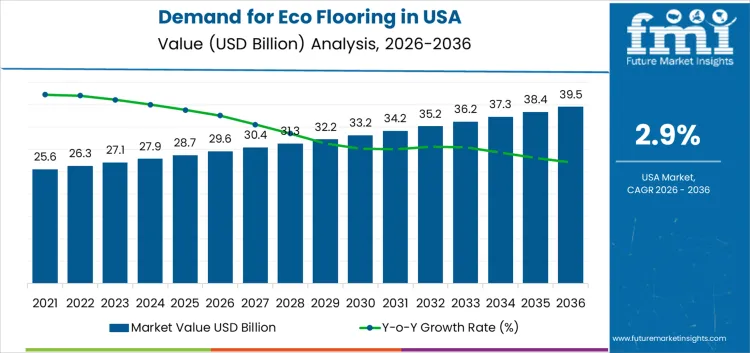
What is the Growth Forecast for Eco Flooring Industry in USA through 2036?
The West, South, and Northeast regions show strong demand linked to active construction activity, sustainability-focused building codes, and widespread acceptance of natural material aesthetics. Key suppliers include BerryAlloc, Formica, Somerset Hardwood Flooring Inc., Provenza Floors Inc., and Boral Limited. Their strategies focus on expanding sustainable wood portfolios, improving recyclable product options, and developing high-performance surfaces that support environmentally compliant building practices.
The acceleration and deceleration pattern for eco flooring demand in the United States reflects shifts linked to construction cycles, material innovation, and regulatory direction. Early acceleration appears as residential and commercial projects incorporate low-emission surfaces aligned with indoor air quality standards. This phase gains momentum because builders evaluate alternatives to traditional vinyl and laminate options while pursuing certification-linked performance requirements. Procurement volumes rise as recycled, bio-based, and low-VOC materials achieve broader specification acceptance.
A deceleration phase follows when construction activity softens during interest rate increases or delayed project starts. These conditions reduce short-term purchasing and flatten the demand curve. Deceleration also emerges when builders reassess material costs during periods of supply volatility, which introduces pauses in adoption until pricing stabilizes. Subsequent acceleration returns as product formulations improve durability and moisture resistance, enabling wider use across mixed commercial environments.
These refinements strengthen confidence in long-term performance, supporting renewed growth. A secondary deceleration appears when regional code updates progress slowly, limiting uniform adoption across states. This produces uneven uptake and lowers overall momentum. The resulting pattern alternates between acceleration driven by sustainability goals and material advances and deceleration shaped by economic conditions, project timing, and regulatory variability across the domestic construction landscape.
USA Eco Flooring Key Takeaways
| Metric | Value |
|---|---|
| USA Eco Flooring Sales Value (2026) | USD 29.6 billion |
| USA Eco Flooring Forecast Value (2036) | USD 39.5 billion |
| USA Eco Flooring Forecast CAGR (2026-2036) | 2.9% |
Why is the Demand for Eco Flooring in USA Growing?
Demand for eco flooring in the United States grows due to rising interest in materials that support indoor environmental quality, durability, and sustainable construction practices. Residential builders and commercial developers adopt flooring made from bamboo, cork, recycled wood, recycled rubber, and low emission composites to meet certification requirements linked to energy efficient and environmentally aligned buildings. Homeowners select eco materials due to interest in low VOC adhesives, improved air quality, and products sourced from rapidly renewable or recycled inputs. Corporate campuses, schools, and healthcare facilities integrate sustainable flooring to align interior design with long term maintenance goals and environmental policies.
Growth in renovation activity strengthens use of modular, recyclable flooring systems that reduce installation waste. Manufacturers supply engineered materials designed to deliver moisture resistance, dimensional stability, and extended service life. Supply chains expand through retailers and distributors offering certified sustainable products that meet performance criteria for heavy traffic areas. Public awareness of lifecycle impacts encourages replacement of traditional flooring with options that support reduced resource consumption. E commerce channels increase access to specialized eco flooring lines for small contractors and homeowners.
Which Material Type and End Use Segments Lead Demand for Eco Flooring in USA?
Demand for eco flooring in the USA is shaped by sustainability goals, indoor air-quality requirements, and interest in renewable or low-emission materials across residential and commercial projects. Buyers evaluate durability, installation efficiency, and lifecycle impact when selecting flooring alternatives. Adoption patterns reflect consumer preference for natural materials, regulatory emphasis on green building standards, and wider institutional acceptance of environmentally responsible construction products.
By Material Type, Wood Accounts for the Largest Share of Demand
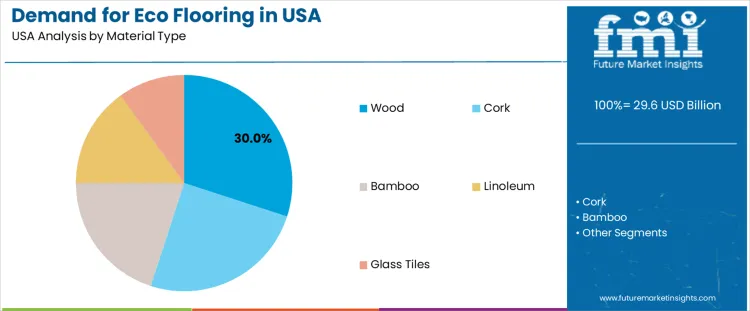
Wood holds 30.0%, making it the leading material type in USA eco flooring demand. Engineered and sustainably sourced wood products support durability, aesthetic flexibility, and compliance with green-certification requirements. Cork holds 25.0%, driven by its acoustic performance, comfort, and renewable harvesting cycle. Bamboo holds 20.0%, valued for high tensile strength, rapid regrowth characteristics, and suitability for varied interior applications. Linoleum holds 15.0%, used in commercial and residential settings requiring resilient, low-VOC surfaces. Glass tiles hold 10.0%, supporting recycled-content specifications for decorative or moisture-prone areas. Material distribution reflects design preference, sustainability criteria, and performance expectations.
Key Points:
- Wood offers durability and broad design compatibility.
- Cork supports acoustic comfort and renewable sourcing.
- Bamboo provides strength and rapid renewability.
- Material use aligns with sustainability targets and interior requirements.
By End Use, Residential Applications Represent the Largest Segment
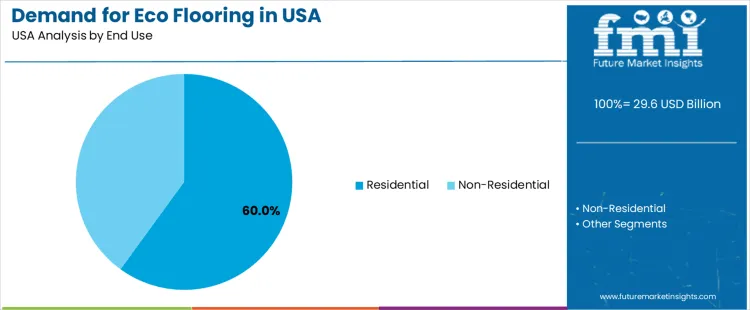
Residential use holds 60.0%, making it the dominant segment in USA demand for eco flooring. Homeowners prioritize natural materials, low-emission options, and sustainable certifications for flooring installations. Renovation activity and new housing projects increase usage across wood, cork, bamboo, and linoleum categories. Non-residential applications hold 40.0%, supported by offices, institutions, and commercial facilities adopting eco flooring for compliance with green-building standards and lifecycle-cost considerations. Distribution reflects differences in project volume, aesthetic preferences, and sustainability procurement goals.
Key Points:
- Residential demand is driven by sustainability and indoor air-quality priorities.
- Non-residential projects adopt eco flooring for certification compliance.
- Segment distribution reflects installation scale and design requirements.
- End-use patterns align with construction trends and material performance.
What are the Key Dynamics in the Eco Flooring Industry?
Ecofriendly construction goals, indoor air quality standards, and material preference shifts are driving demand.
Demand increases as US residential and commercial builders adopt eco flooring to meet sustainability targets set by green building programs. Developers select low-VOC materials to support indoor air quality requirements in offices, schools, and healthcare facilities. Homeowners show interest in flooring made from bamboo, cork, recycled wood, and reclaimed materials due to durability and reduced environmental impact. Corporate real estate projects integrate eco flooring to align with environmental reporting commitments. Retailers expand offerings that support moisture resistance and long life-cycle performance. Regional renovation activity strengthens interest in products compatible with existing subfloor conditions across varied climates.
Higher upfront costs, installation complexity, and variable performance perceptions restrain broader utilization.
Procurement teams evaluate price premiums associated with certified sustainable flooring, which affects adoption in cost-sensitive projects. Installers report learning requirements for materials that behave differently from conventional vinyl or laminate. Some facilities experience concerns regarding moisture tolerance in environments with high humidity, which influences material selection. Retail consumers encounter inconsistent product information that complicates comparison across eco-focused brands. Builders managing tight schedules limit use of materials requiring extended acclimation periods. Insurance and warranty conditions vary for newer materials, which raises caution during large-scale specification. Supply availability fluctuates when sourcing relies on certified or reclaimed inputs.
Recycled-content innovation, regional regulations, and resilient material development shape current trends.
US manufacturers expand production of flooring made from recycled plastics, reclaimed wood, and composite materials designed for improved wear resistance. States with strong environmental regulations encourage adoption of flooring with verified emissions profiles. Commercial developers evaluate resilient eco flooring suited to high-traffic environments such as retail and hospitality spaces. Homeowners adopt click-lock installation formats that reduce adhesives and simplify replacement. Modular tiles gain traction due to ease of repair and flexible design options. Product labelling initiatives increase transparency regarding sourcing and chemical composition. Construction firms integrate life-cycle assessment tools to guide material selection across sustainability-focused projects.
Analysis of the Demand for Eco Flooring in the USA by Region
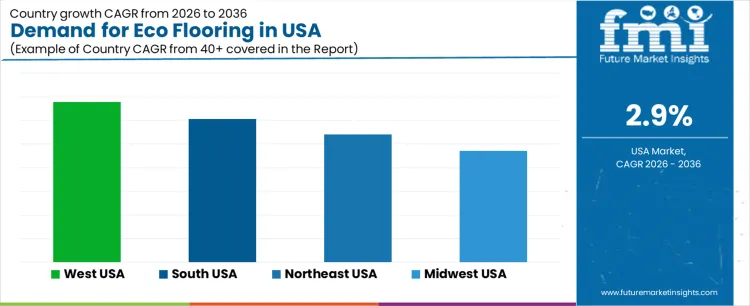
Demand for eco flooring in the USA is rising due to increased interest in sustainable construction materials, wider adoption of low-emission products, and growing alignment with residential and commercial green-building standards. West USA records a CAGR of 3.4% supported by strong environmental preferences and active construction activity. South USA shows a 3.0% CAGR driven by ongoing residential expansion and steady acceptance of sustainable flooring alternatives. Northeast USA posts a 2.7% CAGR due to dense renovation activity and interest in regulated indoor-air-quality materials. Midwest USA holds a 2.4% CAGR supported by stable building activity and gradual incorporation of renewable or recycled flooring options.
| Region | CAGR (2026-2036) |
|---|---|
| West USA | 3.4% |
| South USA | 3.0% |
| Northeast USA | 2.7% |
| Midwest USA | 2.4% |
How is the West USA driving demand for Eco Flooring?
West USA drives demand through strong consumer alignment with sustainability goals and consistent activity across residential and commercial construction. The region’s CAGR of 3.4% reflects steady use of eco flooring materials such as bamboo, cork, recycled composites, and low-VOC engineered surfaces. Builders incorporate eco flooring in projects aligned with environmental guidelines and energy-efficiency programs. Renovation markets favor materials that improve indoor-air quality and reduce lifecycle impacts. Retail channels maintain broad availability of certified flooring options. Institutional projects integrate sustainable materials to meet long-term performance and compliance requirements.
- Strong sustainability-oriented consumer base
- Broad use of low-VOC and renewable flooring options
- Active renovation markets supporting environmentally aligned materials
- Consistent institutional adoption of certified flooring systems
How is the South USA driving demand for Eco Flooring?
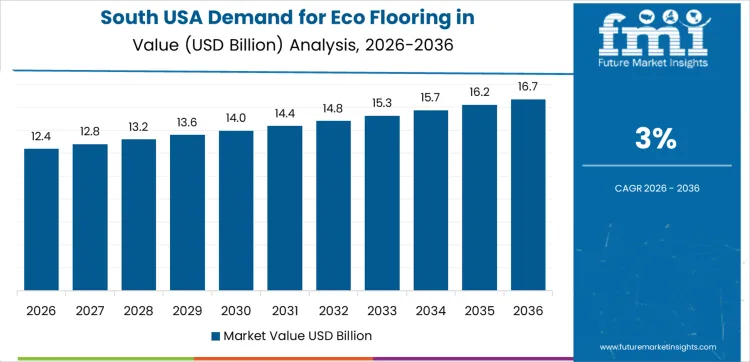
South USA supports rising demand due to expanding residential construction, steady commercial development, and interest in durable, low-maintenance eco flooring types. The region’s CAGR of 3.0% reflects increased circulation of renewable and recycled flooring materials across new housing and multifamily projects. Builders select eco flooring to support improved indoor-air-quality standards and predictable performance under varied climate conditions. Retailers offer a wide portfolio of sustainable options suited to high-traffic environments. Growing awareness of long-term maintenance benefits supports gradual adoption across households and commercial facilities.
- Expanding residential construction activity
- Broad retail availability of sustainable flooring options
- Use of eco flooring for indoor-air-quality compliance
- Growing adoption across commercial and multifamily projects
How is the Northeast USA driving demand for Eco Flooring?
Northeast USA drives demand due to dense renovation markets, regulated indoor-environment standards, and strong institutional interest in environmentally compliant materials. The region’s CAGR of 2.7% reflects consistent adoption of eco flooring in residential upgrades, office refurbishments, and public-sector projects. Builders and facility managers prioritize materials with low emissions and stable long-term performance. Urban renovation cycles support continuous use of recycled and renewable flooring components. Retail and professional channels maintain dependable availability of certified flooring materials that meet regional compliance expectations.
- Dense renovation and upgrade activity
- Institutional emphasis on low-emission materials
- Stable demand for recycled and renewable flooring types
- Broad availability of certified eco flooring options
How is the Midwest USA driving demand for Eco Flooring?
Midwest USA maintains steady demand due to its established construction sector and gradual transition toward sustainable building products. The region’s CAGR of 2.4% reflects measured incorporation of eco flooring across residential, commercial, and institutional projects. Builders adopt sustainable flooring to meet evolving performance and environmental expectations. Renovation markets rely on eco flooring for durability and indoor-air-quality benefits. Retailers supply a steady mix of renewable and recycled flooring materials aligned with regional cost and performance priorities. Institutional procurement supports continued circulation of eco flooring across public facilities.
- Broad construction activity supporting gradual adoption
- Use of eco flooring in renovation and upgrade projects
- Retail availability aligned with regional cost expectations
- Institutional procurement sustaining consistent demand
What is the competitive landscape of the demand for eco flooring in the USA?
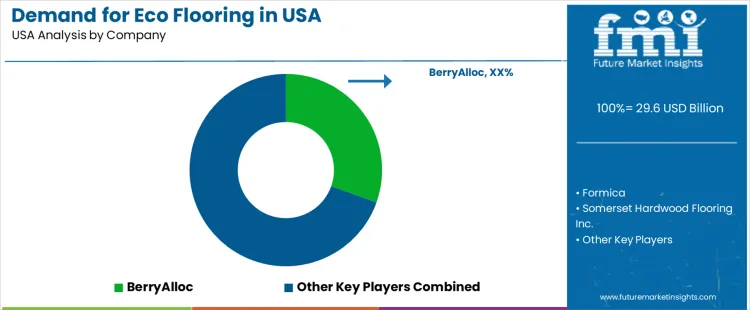
Demand for eco flooring in the USA is shaped by requirements for low-emission materials, durable surface performance, and compatibility with residential and commercial installation standards. Buyers evaluate certified sustainability attributes, moisture resistance, acoustic behavior, and long-term wear properties across hardwood, laminate, vinyl, and composite categories. Procurement teams prioritize supply reliability, installation support, and product consistency aligned with green building guidelines. Adoption patterns reflect interest in renewable materials, recycled content, and reduced chemical emissions supporting indoor environmental quality.
BerryAlloc holds an estimated 30.5% share. Its position reflects established laminate and engineered flooring solutions incorporating environmentally conscious materials and durable surface technologies. Formica participates through high-pressure laminate flooring options used in settings requiring stable structural properties and design versatility. Somerset Hardwood Flooring Inc. maintains visibility with domestically sourced hardwood products emphasizing responsible forestry and consistent milling quality.
Provenza Floors Inc. contributes through engineered wood and specialty finishes suited for premium residential applications emphasizing aesthetic performance. Boral Limited supports demand with wood products and composite materials aligned with sustainability expectations in both residential and light commercial projects. Competitive positioning in the USA reflects certified material sourcing, surface durability, installation efficiency, and distribution capability supporting builders, contractors, and retail channels.
Key Players in USA Eco Flooring Demand
- BerryAlloc
- Formica
- Somerset Hardwood Flooring Inc.
- Provenza Floors Inc.
- Boral Limited
Scope of the Report
| Items | Values |
|---|---|
| Quantitative Units | USD billion |
| Material Type | Wood, Cork, Bamboo, Linoleum, Glass Tiles |
| End Use | Residential, Non-Residential |
| Price Range | Economy, Mid-range, Premium |
| Distribution Channel | Online, Offline |
| Regions Covered | West USA, South USA, Northeast USA, Midwest USA |
| Key Companies Profiled | BerryAlloc, Formica, Somerset Hardwood Flooring Inc., Provenza Floors Inc., Boral Limited |
| Additional Attributes | Dollar sales by material type, end-use applications, and price range; regional demand distribution across West, South, Northeast, and Midwest USA; competitive landscape for sustainable and low-VOC flooring solutions; adoption trends in bamboo, cork, linoleum, and recycled glass tiles; impact of green building certifications (LEED, WELL); consumer shift toward renewable and biodegradable flooring products; growth in online flooring purchases and professional installation networks. |
USA Eco Flooring Demand by Segments
Material Type:
- Wood
- Cork
- Bamboo
- Linoleum
- Glass Tiles
End Use:
- Residential
- Non-Residential
Price Range:
- Economy
- Mid-range
- Premium
Distribution Channel:
- Online
- Offline
Region:
- West USA
- South USA
- Northeast USA
- Midwest USA
Frequently Asked Questions
How big is the demand for eco flooring in USA in 2026?
The demand for eco flooring in USA is estimated to be valued at USD 29.6 billion in 2026.
What will be the size of eco flooring in USA in 2036?
The market size for the eco flooring in USA is projected to reach USD 39.5 billion by 2036.
How much will be the demand for eco flooring in USA growth between 2026 and 2036?
The demand for eco flooring in USA is expected to grow at a 2.9% CAGR between 2026 and 2036.
What are the key product types in the eco flooring in USA?
The key product types in eco flooring in USA are wood, cork, bamboo, linoleum and glass tiles.
Which end use segment is expected to contribute significant share in the eco flooring in USA in 2026?
In terms of end use, residential segment is expected to command 60.0% share in the eco flooring in USA in 2026.
Preview the report firsthand - request a free sample
Get SampleGet the brochure for pricing and purchase details.
Get PDFTable of Content
- Executive Summary
- USA Market Outlook
- Demand-side Trends
- Supply-side Trends
- Technology Roadmap Analysis
- Analysis and Recommendations
- Market Overview
- Market Coverage / Taxonomy
- Market Definition / Scope / Limitations
- Market Background
- Market Dynamics
- Drivers
- Restraints
- Opportunity
- Trends
- Scenario Forecast
- Demand in Optimistic Scenario
- Demand in Likely Scenario
- Demand in Conservative Scenario
- Opportunity Map Analysis
- Product Life Cycle Analysis
- Supply Chain Analysis
- Investment Feasibility Matrix
- Value Chain Analysis
- PESTLE and Porter’s Analysis
- Regulatory Landscape
- Regional Parent Market Outlook
- Production and Consumption Statistics
- Import and Export Statistics
- Market Dynamics
- USA Market Analysis 2020 to 2024 and Forecast, 2025 to 2035
- Historical Market Size Value (USD Million) Analysis, 2020 to 2024
- Current and Future Market Size Value (USD Million) Projections, 2025 to 2035
- Y-o-Y Growth Trend Analysis
- Absolute $ Opportunity Analysis
- USA Market Pricing Analysis 2020 to 2024 and Forecast 2025 to 2035
- USA Market Analysis 2020 to 2024 and Forecast 2025 to 2035, By Material Type
- Introduction / Key Findings
- Historical Market Size Value (USD Million) Analysis By Material Type , 2020 to 2024
- Current and Future Market Size Value (USD Million) Analysis and Forecast By Material Type , 2025 to 2035
- Wood
- Cork
- Bamboo
- Linoleum
- Glass Tiles
- Y-o-Y Growth Trend Analysis By Material Type , 2020 to 2024
- Absolute $ Opportunity Analysis By Material Type , 2025 to 2035
- USA Market Analysis 2020 to 2024 and Forecast 2025 to 2035, By End Use
- Introduction / Key Findings
- Historical Market Size Value (USD Million) Analysis By End Use, 2020 to 2024
- Current and Future Market Size Value (USD Million) Analysis and Forecast By End Use, 2025 to 2035
- Residential
- Non-Residential
- Y-o-Y Growth Trend Analysis By End Use, 2020 to 2024
- Absolute $ Opportunity Analysis By End Use, 2025 to 2035
- USA Market Analysis 2020 to 2024 and Forecast 2025 to 2035, By Price Range
- Introduction / Key Findings
- Historical Market Size Value (USD Million) Analysis By Price Range, 2020 to 2024
- Current and Future Market Size Value (USD Million) Analysis and Forecast By Price Range, 2025 to 2035
- Economy
- Mid-range
- Premium
- Y-o-Y Growth Trend Analysis By Price Range, 2020 to 2024
- Absolute $ Opportunity Analysis By Price Range, 2025 to 2035
- USA Market Analysis 2020 to 2024 and Forecast 2025 to 2035, By Distribution Channel
- Introduction / Key Findings
- Historical Market Size Value (USD Million) Analysis By Distribution Channel, 2020 to 2024
- Current and Future Market Size Value (USD Million) Analysis and Forecast By Distribution Channel, 2025 to 2035
- Online
- Offline
- Y-o-Y Growth Trend Analysis By Distribution Channel, 2020 to 2024
- Absolute $ Opportunity Analysis By Distribution Channel, 2025 to 2035
- Market Structure Analysis
- Competition Dashboard
- Competition Benchmarking
- Market Share Analysis of Top Players
- By Regional
- By Material Type
- By End Use
- By Price Range
- By Distribution Channel
- Competition Analysis
- Competition Deep Dive
- BerryAlloc
- Overview
- Product Portfolio
- Profitability by Market Segments (Product/Age /Sales Channel/Region)
- Sales Footprint
- Strategy Overview
- Marketing Strategy
- Product Strategy
- Channel Strategy
- Formica
- Somerset Hardwood Flooring Inc.
- Provenza Floors Inc.
- Boral Limited
- BerryAlloc
- Competition Deep Dive
- Assumptions & Acronyms Used
- Research Methodology


