

- Industry Size (2025)
- USD 381.7 Mn
- Forecast (2035)
- USD 670.5 Mn
- CAGR (2025 to 2035)
- 5.8%
Demand for Eco Bowls in USA 2025 to 2035
The USA eco bowls demand is valued at USD 381.7 million in 2025 and is forecasted to reach USD 670.5 million by 2035, reflecting a CAGR of 5.8%. Growth is driven by expanding preference for sustainable food packaging across quick-service restaurants, meal delivery providers, and retail food segments. Regulations targeting single-use plastics and stronger consumer awareness of environmental impact continue to accelerate the shift toward eco-friendly serving solutions.
Bioplastics lead material adoption because they offer compostability, reduced fossil resource dependence, and compatibility with molded bowl formats used for salads, entrées, and ready-to-eat meals. Manufacturers invest in improving heat resistance, structural strength, and barrier properties to ensure reliable performance in both hot and cold applications. Product certification for commercial composting strengthens procurement confidence among institutional buyers.
The West, South, and Northeast regions show strong demand due to high sustainability commitments in foodservice operations and broad adoption of eco-conscious packaging standards. Key suppliers include Mondi Group, Crown Holdings, Huhtamaki Oyj, WestRock, and Smurfit Kappa. Their strategies focus on scaling renewable material supply, developing recyclable and compostable designs, and expanding partnerships with national restaurant and grocery chains to support the transition toward environmentally compliant packaging.
Quick Stats for USA Eco Bowls Demand
- USA Eco Bowls Sales Value (2025): USD 381.7 million
- USA Eco Bowls Forecast Value (2035): USD 670.5 million
- USA Eco Bowls Forecast CAGR (2025–2035): 5.8%
- Leading Material in USA Eco Bowls Demand: Bioplastics
- Key Growth Regions in USA Eco Bowls Demand: West USA, South USA, Northeast USA
- Top Players in USA Eco Bowls Demand: Mondi Group, Crown Holdings, Huhtamaki Oyj, WestRock, Smurfit Kappa
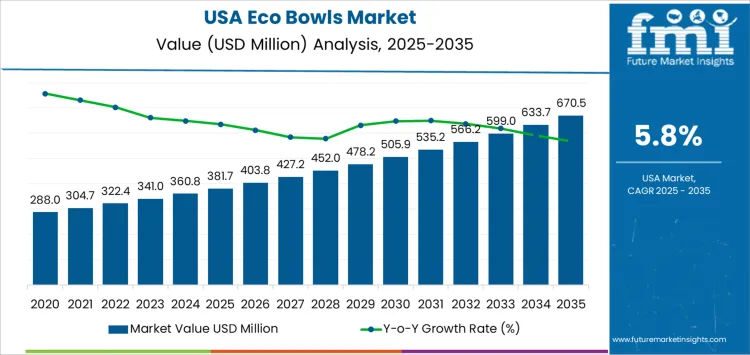
What is the Growth Forecast for Eco Bowls Industry in USA through 2035?
Saturation Point Analysis for eco bowls in the United States focuses on demand progression relative to functional, regulatory, and behavioral ceilings. Current demand operates below the structural saturation point because large segments of institutional food service and household consumption still rely on conventional disposable materials. Adoption grows as procurement policies shift toward compostable formats, yet penetration remains uneven across regions with varied waste management infrastructure. The saturation threshold remains distant because composting access and municipal collection systems develop at gradual rates that influence product viability.
Consumer preference for low-impact packaging raises adoption, although price sensitivity shapes the upper limit of acceptance in high-volume settings. This dynamic keeps the saturation point flexible rather than fixed. Commercial food delivery and quick-service operators increase usage, although operational constraints related to heat resistance and durability define functional ceilings for certain applications. These ceilings establish technical boundaries that delay saturation. Retail channels expand availability, although shelf space allocation and category rotation maintain a moderated growth curve. Regulatory activity related to single-use plastics elevates baseline demand, although state-level variation limits uniform progression toward saturation. The saturation remains medium-distance because infrastructural, economic, and technical factors prevent rapid convergence toward maximum feasible adoption.
USA Eco Bowls Key Takeaways
| Metric | Value |
|---|---|
| USA Eco Bowls Sales Value (2025) | USD 381.7 million |
| USA Eco Bowls Forecast Value (2035) | USD 670.5 million |
| USA Eco Bowls Forecast CAGR (2025-2035) | 5.8% |
Why is the Demand for Eco Bowls in USA Growing?
Demand for eco bowls in the United States expands as foodservice operators, retailers, and households shift toward packaging that aligns with waste reduction expectations. Regulatory measures at state and city levels restrict single use plastics, which directs purchasing toward fiber based, compostable, and biodegradable serving formats. Quick service restaurants and delivery platforms rely on eco bowls due to thermal stability, leak resistance, and compatibility with hot and cold foods. Consumer preference for packaging made from sugarcane bagasse, bamboo fiber, and recycled paper supports consistent adoption. Retail grocery chains stock ecofriendly tableware to meet rising demand for sustainable household products.
Growth in ready to eat meals increases the requirement for sturdy, disposable containers suited for transport. Corporate campuses and institutional food programs integrate environmentally aligned serving items within sustainability policies. Commercial composting infrastructure expands in select regions, which increases acceptance of compostable bowls in local waste streams. Manufacturers deliver lightweight, resin free formats that meet food contact safety requirements. Private labels introduce cost competitive alternatives that encourage broader procurement across mid-sized businesses. E commerce supply chains maintain steady distribution of bulk eco bowl packs for small food outlets.
Which Material and Product Type Segments Lead Demand for Eco Bowls in USA?
Demand for eco bowls in the USA is shaped by sustainability requirements, compostability standards, and the shift toward low-impact foodservice packaging. Buyers evaluate material resilience, heat tolerance, and alignment with environmental commitments adopted across restaurants, cafeterias, and retail food distribution. Adoption patterns reflect regulatory pressure on single-use plastics, interest in renewable inputs, and the need for durable, food-safe structures suitable for varied serving conditions.
By Material, Bioplastics Account for the Largest Share of Demand
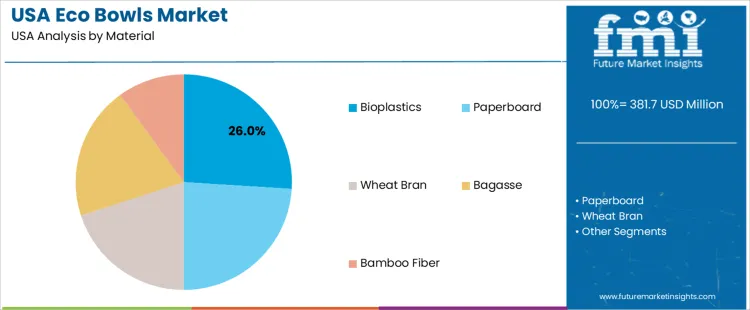
Bioplastics hold 26.0%, making them the leading segment in USA eco bowl usage. These materials support compostable and bio-based packaging programs while offering structural strength suitable for hot and cold food applications. Paperboard holds 24.0%, driven by its lightweight composition, printability, and established supply chains in foodservice operations. Wheat bran and bagasse each hold 20.0%, serving buyers seeking natural fibers with adequate rigidity and thermal resistance for disposable bowls. Bamboo fiber holds 10.0%, supporting premium or specialty applications requiring higher tensile strength. Distribution reflects varied performance needs across quick-service dining, prepared meals, and institutional food settings.
Key Points:
- Bioplastics support compostable and durable packaging.
- Paperboard offers lightweight structure and print compatibility.
- Wheat bran and bagasse provide natural fiber strength for disposables.
- Material selection reflects functional and environmental requirements.
By Product Type, Degradable Bowls Represent the Largest Segment
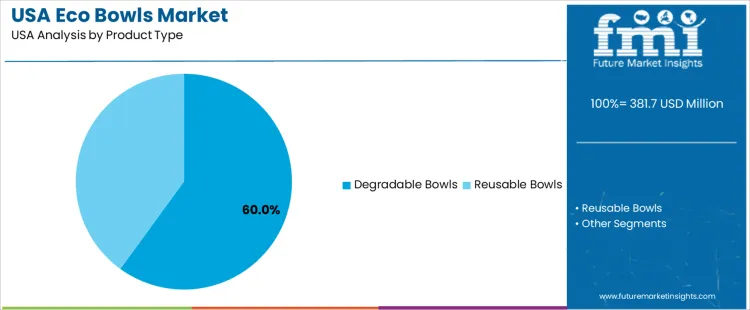
Degradable bowls hold 60.0%, making them the leading product type in USA eco bowl demand. These units align with institutional composting programs and regulatory initiatives that favor reduced-waste serving formats. Their composition supports single-use applications across quick-service restaurants, food delivery, and event catering. Reusable bowls hold 40.0%, used in settings requiring repeated wash cycles and higher structural durability. Adoption increases across universities, corporate cafeterias, and meal-service programs promoting waste reduction through returnable container systems. Product type distribution reflects operational workflows, disposal infrastructure, and the balance between convenience requirements and sustainability commitments.
Key Points:
- Degradable bowls align with regulated composting systems.
- Reusable formats support multi-cycle foodservice operations.
- Selection varies with waste management capabilities and durability needs.
What are the Key Dynamics in the Eco Bowls Industry?
Ecofriendly policies, foodservice practices, and consumer preferences are driving demand.
Demand increases as US foodservice operators adopt compostable and biodegradable packaging to meet state-level sustainability regulations. Several jurisdictions enforce restrictions on expanded polystyrene, which encourages restaurants to shift toward plant-based bowls made from bagasse, bamboo, and molded fiber. Quick-service restaurants seek packaging that supports temperature retention, structural stability, and leak resistance during delivery. Retail grocery chains increase procurement of eco bowls for prepared meals that require microwave-safe formats. Consumer interest in low-impact materials strengthens adoption across cafes, stadiums, and institutional dining. Corporate procurement programs incorporate environmental criteria, which raises the share of renewable packaging in high-volume operations.
Cost pressures, supply constraints, and uneven composting infrastructure restrict adoption.
Procurement teams face higher unit prices for molded fiber and plant-based materials compared with conventional plastic bowls. Domestic supply availability fluctuates due to limited US-based fiber processing capacity that affects lead times during peak foodservice demand. Several municipalities maintain incomplete composting networks, which reduces end-of-life efficiency for compostable products. Restaurants require packaging that handles sauces, heat, and oil without structural degradation, which narrows material choices. Operators with thin margins experience difficulty absorbing price differentials during seasonal traffic variation. Large distributors prioritize standardized SKUs, which restricts smaller brands offering niche eco-bowl formats.
Material innovation, regional regulations, and food delivery growth shape current trends.
US manufacturers expand production of molded fiber bowls engineered for higher oil and heat resistance without chemical coatings. States with advanced waste-management systems encourage adoption of certified compostable formats that match local processing capabilities. Food delivery platforms increase demand for durable eco bowls that resist lid separation and moisture accumulation during transit. Retailers introduce recyclable paper-based bowls for ready-to-eat meals that require portion control and tamper-evident lids. Institutional buyers evaluate lifecycle assessments to validate environmental claims. Packaging suppliers develop lightweight fiber structures that reduce raw material use while maintaining performance for high-turnover foodservice operations.
Analysis of the Demand for Eco Bowls in the USA by Region
Demand for eco bowls in the USA is rising due to expanding adoption of sustainable food-service packaging and stronger regulatory pressure on single-use plastic formats. West USA shows a CAGR of 6.7% supported by higher usage of plant-based containers across restaurants and retail channels. South USA records a 6.0% CAGR driven by wider availability of compostable packaging and rising quick-service food activity. Northeast USA holds a 5.3% CAGR due to policy-aligned packaging preferences and dense consumption clusters. Midwest USA posts a 4.6% CAGR supported by manufacturing output and the steady shift toward environmentally compliant disposable food-service containers.
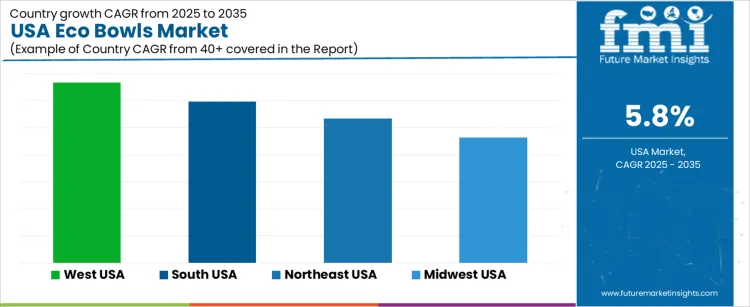
| Region | CAGR (2025-2035) |
|---|---|
| West USA | 6.7% |
| South USA | 6.0% |
| Northeast USA | 5.3% |
| Midwest USA | 4.6% |
How is the West USA driving demand for Eco Bowls?
West USA drives demand through high adoption of sustainable packaging across food-service operators, grocery chains, and institutional buyers. The region’s CAGR of 6.7% reflects expanding usage of compostable containers among restaurants offering takeout and delivery services. Cities within the region maintain established waste-management programs that support compostable material collection, which strengthens procurement of plant-based bowls. Consumer preference aligns with recyclable and biodegradable formats used in meal preparation, salad bars, and ready-to-eat product sections. Retailers continue to add fiber-based packaging solutions that comply with evolving environmental standards. The region sustains consistent circulation of eco bowls due to a robust convenience-food ecosystem and stable demand for disposable yet compliant containers.
- High adoption of compostable food-service packaging
- Strong presence of environmentally aligned retail channels
- Expanding takeout and delivery consumption
- Supportive waste-management programs for compostable materials
How is the South USA driving demand for Eco Bowls?
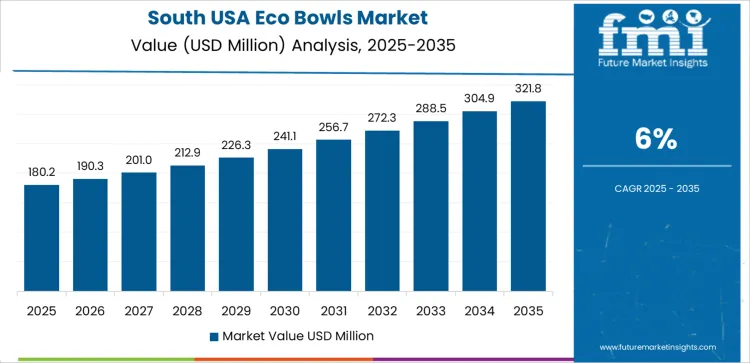
South USA supports rising demand through its expanding quick-service food sector and broader acceptance of fiber-based packaging formats. The region’s CAGR of 6.0% reflects higher volumes of disposable food containers required across cafeterias, fast-casual outlets, and institutional dining facilities. Growth in suburban populations increases consumption of prepared meals that rely on sturdy, lightweight, and compostable bowls. Food distributors operating across the region continue integrating eco-compliant materials into supply pipelines to align with procurement expectations from retail and hospitality sectors. The availability of competitively priced molded-fiber and plant-based options sustains steady adoption across multiple food-service channels.
- Wider use of eco bowls across quick-service formats
- Rising suburban consumption of prepared meals
- Regional distributors adding compostable options
- Institutional dining adopting sustainable containers
How is the Northeast USA driving demand for Eco Bowls?
Northeast USA drives demand due to strong regulatory alignment with sustainable packaging requirements and dense food-service activity across urban centers. The region’s CAGR of 5.3% reflects consistent procurement of compostable and recyclable containers by restaurants, universities, and corporate dining operations. High turnover of takeout meals supports the circulation of molded-fiber bowls that comply with environmental standards. Retail grocery chains continue shifting toward plant-based containers within salad bars, deli counters, and prepared-meal sections. Waste-management structures across major cities reinforce adoption of packaging formats designed for composting or regulated recycling streams, which maintains stable demand for eco bowls.
- Strong policy alignment favoring sustainable packaging
- Dense consumption of prepared and takeout foods
- Retail movement toward plant-based containers
- Institutional procurement of compostable bowls
How is the Midwest USA driving demand for Eco Bowls?
Midwest USA influences demand through its manufacturing presence, food-processing activity, and expanding circulation of sustainable disposables across retail and institutional channels. The region’s CAGR of 4.6% reflects gradual yet consistent preference for molded-fiber and plant-based containers used in cafeterias, workplace dining, and convenience-food outlets. Supply chains across the region integrate eco-compliant materials to meet changing procurement criteria from supermarkets and hospitality operators. The growing presence of prepared-meal programs in grocery stores enhances usage of durable and compostable bowls. Stable demand is also supported by institutional buyers requiring environmentally aligned disposables for routine food-service operations.
- Adoption of eco bowls across institutional dining
- Integration of compostable packaging in supply chains
- Growth of prepared-meal programs in retail stores
- Steady use of fiber-based containers across food service
What is the competitive landscape of the demand for eco bowls in the USA?
Demand for eco bowls in the USA reflects shifts toward recyclable materials, fiber-based packaging, compostable substrates, and lightweight designs used in foodservice, retail meal kits, and institutional catering. Procurement teams focus on material integrity, moisture resistance, heat tolerance, and certified sustainability claims aligned with regulatory expectations. Buyers examine coating chemistry, board stiffness, barrier performance, and compatibility with automated filling lines. Distribution reliability and production scale influence sourcing decisions across national restaurant chains, grocery suppliers, and prepared food processors. Huhtamaki Oyj maintains strong visibility in foodservice operations that use molded fiber bowls, insulated structures, and grease-resistant substrates. WestRock participates through coated unbleached kraft bowl systems that support heat-seal functions and institutional feeding programs. Smurfit Kappa supplies paperboard solutions for fresh food applications relying on structural rigidity and tailored geometries. Competitive positioning in the USA aligns with coating innovation, raw material availability, and supply stability across distribution networks serving national and regional foodservice operators.
Key Players in USA Eco Bowls Demand
- Mondi Group
- Crown Holdings
- Huhtamaki Oyj
- WestRock
- Smurfit Kappa
Scope of the Report
| Items | Values |
|---|---|
| Quantitative Units | USD million |
| Material | Bioplastics, Paperboard, Wheat Bran, Bagasse, Bamboo Fiber |
| Product Type | Degradable Bowls, Reusable Bowls |
| Regions Covered | West USA, South USA, Northeast USA, Midwest USA |
| Key Companies Profiled | Mondi Group, Crown Holdings, Huhtamaki Oyj, WestRock, Smurfit Kappa |
| Additional Attributes | Dollar sales by material and product-type categories; adoption trends across biodegradable, compostable, and fiber-based bowl formats; regional consumption differences across West, South, Northeast, and Midwest; demand shifts driven by single-use reduction policies; procurement patterns in foodservice packaging; lifecycle attributes for paperboard, bagasse, wheat bran, and bioplastic-based bowls; competitive landscape among manufacturers of molded fiber and sustainable food-contact containers. |
USA Eco Bowls Demand by Segments
Material:
- Bioplastics
- Paperboard
- Wheat Bran
- Bagasse
- Bamboo Fiber
Product Type:
- Degradable Bowls
- Reusable Bowls
Region:
- West USA
- South USA
- Northeast USA
- Midwest USA
Frequently Asked Questions
How big is the demand for eco bowls in USA in 2025?
The demand for eco bowls in USA is estimated to be valued at USD 381.7 million in 2025.
What will be the size of eco bowls in USA in 2035?
The market size for the eco bowls in USA is projected to reach USD 670.5 million by 2035.
How much will be the demand for eco bowls in USA growth between 2025 and 2035?
The demand for eco bowls in USA is expected to grow at a 5.8% CAGR between 2025 and 2035.
What are the key product types in the eco bowls in USA?
The key product types in eco bowls in USA are bioplastics, paperboard, wheat bran, bagasse and bamboo fiber.
Which product type segment is expected to contribute significant share in the eco bowls in USA in 2025?
In terms of product type, degradable bowls segment is expected to command 60.0% share in the eco bowls in USA in 2025.
Preview the report firsthand - request a free sample
Get SampleGet the brochure for pricing and purchase details.
Get PDFTable of Content
- Executive Summary
- USA Market Outlook
- Demand-side Trends
- Supply-side Trends
- Technology Roadmap Analysis
- Analysis and Recommendations
- Market Overview
- Market Coverage / Taxonomy
- Market Definition / Scope / Limitations
- Market Background
- Market Dynamics
- Drivers
- Restraints
- Opportunity
- Trends
- Scenario Forecast
- Demand in Optimistic Scenario
- Demand in Likely Scenario
- Demand in Conservative Scenario
- Opportunity Map Analysis
- Product Life Cycle Analysis
- Supply Chain Analysis
- Investment Feasibility Matrix
- Value Chain Analysis
- PESTLE and Porter’s Analysis
- Regulatory Landscape
- Regional Parent Market Outlook
- Production and Consumption Statistics
- Import and Export Statistics
- Market Dynamics
- USA Market Analysis 2020 to 2024 and Forecast, 2025 to 2035
- Historical Market Size Value (USD Million) Analysis, 2020 to 2024
- Current and Future Market Size Value (USD Million) Projections, 2025 to 2035
- Y-o-Y Growth Trend Analysis
- Absolute $ Opportunity Analysis
- USA Market Pricing Analysis 2020 to 2024 and Forecast 2025 to 2035
- USA Market Analysis 2020 to 2024 and Forecast 2025 to 2035, By Material
- Introduction / Key Findings
- Historical Market Size Value (USD Million) Analysis By Material , 2020 to 2024
- Current and Future Market Size Value (USD Million) Analysis and Forecast By Material , 2025 to 2035
- Bioplastics
- Paperboard
- Wheat Bran
- Bagasse
- Bamboo Fiber
- Y-o-Y Growth Trend Analysis By Material , 2020 to 2024
- Absolute $ Opportunity Analysis By Material , 2025 to 2035
- USA Market Analysis 2020 to 2024 and Forecast 2025 to 2035, By Product Type
- Introduction / Key Findings
- Historical Market Size Value (USD Million) Analysis By Product Type, 2020 to 2024
- Current and Future Market Size Value (USD Million) Analysis and Forecast By Product Type, 2025 to 2035
- Degradable Bowls
- Reusable Bowls
- Y-o-Y Growth Trend Analysis By Product Type, 2020 to 2024
- Absolute $ Opportunity Analysis By Product Type, 2025 to 2035
- Market Structure Analysis
- Competition Dashboard
- Competition Benchmarking
- Market Share Analysis of Top Players
- By Regional
- By Material
- By Product Type
- Competition Analysis
- Competition Deep Dive
- Mondi Group
- Overview
- Product Portfolio
- Profitability by Market Segments (Product/Age /Sales Channel/Region)
- Sales Footprint
- Strategy Overview
- Marketing Strategy
- Product Strategy
- Channel Strategy
- Crown Holdings
- Huhtamaki Oyj
- WestRock
- Smurfit Kappa
- Mondi Group
- Competition Deep Dive
- Assumptions & Acronyms Used
- Research Methodology


