

- Industry Size (2026)
- USD 51.8 Mn
- Forecast (2036)
- USD 81.1 Mn
- CAGR (2026 to 2036)
- 4.6%
Demand for Eco Bowls in Japan Forecast and Outlook 2026 to 2036
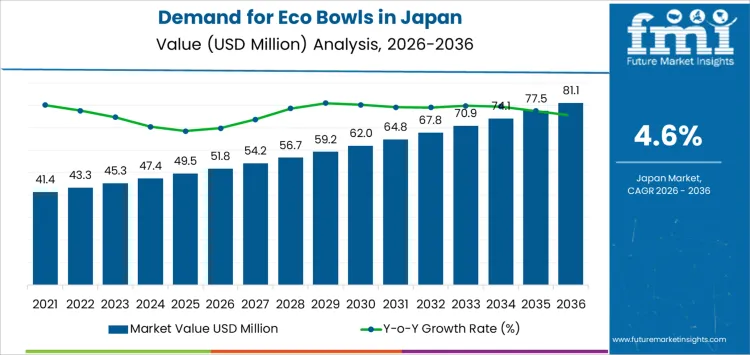
The demand for eco bowls in Japan is valued at USD 51.8 million in 2026 and is projected to reach USD 81.1 million by 2036, reflecting a CAGR of 4.6%. The rise from USD 39.6 million in 2020 to USD 51.8 million in 2026 is supported by steady use across food service operators and packaged meal providers. Degradable bowls hold the larger share due to widespread adoption in takeaway environments, while paperboard, wheat bran, bagasse, and bamboo fiber each serve specific performance needs in heat resistance and sturdiness.
From 2027 onward, values increase from USD 54.2 million to USD 64.8 million by 2031, then advance to USD 81.1 million by 2036 through consistent annual gains. Reusable bowls add modest growth where institutional kitchens and workplace cafeterias adopt longer lifecycle formats. Food delivery platforms and convenience stores maintain predictable demand tied to prepared meal sales. Material diversity widens as operator’s match bowl type to menu requirements. Long term growth reflects routine procurement, gradual menu expansion, and ongoing substitution away from conventional formats across Japan’s food service and retail meal sectors.
Quick Stats of the Demand for Eco Bowls in Japan
- Demand for Eco Bowls in Japan Value (2026): USD 51.8 million
- Demand for Eco Bowls in Japan Forecast Value (2036): USD 81.1 million
- Demand for Eco Bowls in Japan Forecast CAGR (2026 to 2036): 4.6%
- Demand for Eco Bowls in Japan Leading Product Type: Degradable Bowls (60%)
- Demand for Eco Bowls in Japan Key Growth Regions: Kyushu & Okinawa, Kanto, Kansai
- Demand for Eco Bowls in Japan Top Players: Mondi Group, Crown Holdings, Huhtamaki Oyj, WestRock, Smurfit Kappa
What is the Growth Forecast for Eco Bowls in Japan through 2036?
Between 2026 and 2031, demand for eco bowls in Japan increases from USD 51.8 million to USD 62.0 million, reflecting a gradual expansion of USD 10.2 million over five years. Growth during this phase is shaped by steady uptake in quick service restaurants, cafeterias, and meal delivery operators adopting paper-based and plant-fiber packaging. Earlier demand reflected niche interest among selective foodservice chains, while near term progression shows broader institutional switching driven by menu standardization and operational consistency rather than abrupt category shifts.
From 2031 to 2036, demand rises from USD 62.0 million to USD 81.1 million, adding USD 19.1 million and indicating a firmer acceleration compared to the earlier period. Growth strengthens as procurement programs within retail food counters, convenience stores, and ready-meal manufacturers incorporate fiber molded bowls into baseline packaging templates. Earlier advances stemmed from pilot transitions, while later expansion reflects systemwide adoption across high-volume operators, improved bowl durability, and better sealing performance for hot and cold meals. Broader supplier networks and standardized production capacity support long term scaling across Japan’s prepared food ecosystem.
Eco Bowls Industry in Japan Key Takeaways
| Metric | Value |
|---|---|
| Industry Value (2026) | USD 51.8 million |
| Forecast Value (2036) | USD 81.1 million |
| Forecast CAGR (2026 to 2036) | 4.6% |
What Is Driving the Demand for Eco Bowls in Japan from 2026 to 2036?
Demand for eco bowls in Japan increased as foodservice operators and households sought alternatives to conventional plastic disposables. Cafes, convenience stores, and meal delivery services adopted fibre-based and paper-based bowls suited to hot and cold foods. Historical demand grew through steady expansion of takeout meals and workplace lunches that required lightweight, sturdy containers. Buyers selected bowls based on heat resistance, stability, and ease of disposal within local waste systems. Manufacturers supplied designs compatible with common sealing films, portion requirements, and retail packaging standards.
Demand from 2026 to 2036 is expected to rise as policy support, brand commitments, and consumer habits shift toward lower waste packaging. Ready meal producers adopt bowls designed for composting, recycling, or rapid biodegradation under controlled facilities. Foodservice chains evaluate bowl shapes that integrate secure lids, prevent leakage, and withstand reheating within compact urban kitchens. Historical growth centred on basic substitution of plastic containers. Future growth focuses on material optimisation, lighter weights, and closer alignment with municipal waste sorting. Buyers assess supply stability, bowl performance in transit, and clarity of environmental labelling when making procurement decisions.
What Is the Demand for Eco Bowls in Japan by Material and Product Type for 2026 to 2036?
The demand for eco bowls in Japan from 2026 to 2036 is shaped by waste-reduction policies, growing interest in low-impact food packaging, and steady expansion of takeaway meal formats. Bioplastics and paperboard hold equal shares among materials, supported by active adoption in quick-service dining and meal kit packaging. Degradable bowls lead by product type as food vendors prioritize formats that meet disposal and compostability expectations in urban regions. Procurement is led by food service distributors, packaging converters, and retail chains. Import reliance remains present for plant-based polymer feedstock. Substitution pressure exists from molded pulp trays and coated paper containers. Demand stability is supported by consistent consumption of ready meals and government-backed waste initiatives.
Why do bioplastics account for 25% of the demand for eco bowls in Japan by material from 2026 to 2036?
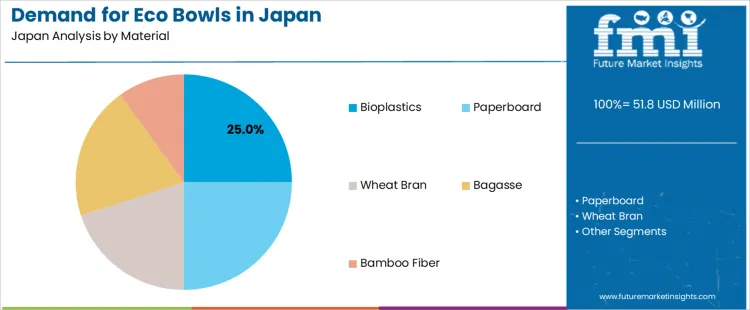
Bioplastics account for 25% of the demand for eco bowls in Japan by material because food service operators seek lighter, heat-tolerant, and visually clean packaging with reduced fossil-based content. Consumption intensity increases in takeaway chains and convenience stores that prefer uniform bowl shapes suitable for automated filling lines. Usage remains steady because bioplastic grades offer improved rigidity and predictable sealing behavior with standard lidding films. Procurement is driven by packaging suppliers adopting plant-based polymers for high-volume runs.
Bioplastics maintain stable demand from 2026 to 2036 as supplier’s increase capacity and improve material consistency. Repeat utilization stays predictable as meal service operators standardize menu packaging. Buyers favor grades that run efficiently on forming and sealing machinery. Margin structure remains steady under shared supply contracts. Regulatory exposure centers on bio-content verification and end-of-life management rules. Import reliance persists for starch-based and sugarcane-derived polymers. Substitution pressure from bamboo fiber and bagasse remains limited where precise bowl shaping and liquid resistance are essential.
Why do degradable bowls represent 60.0% of the demand for eco bowls in Japan by product type?
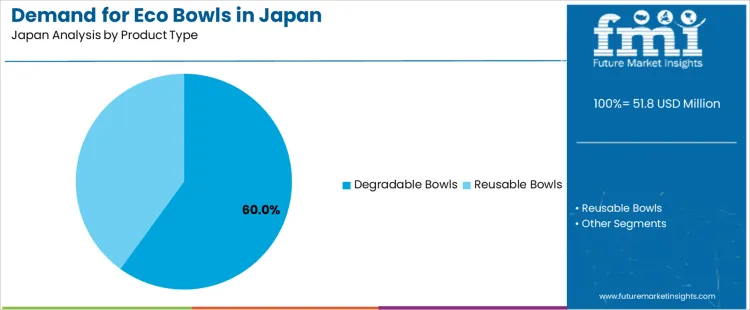
Degradable bowls represent 60.0% of the demand for eco bowls in Japan by product type because they align with food service requirements for simple disposal and reduced environmental burden. Consumption intensity rises across cafeterias, franchise restaurants, and meal-delivery platforms that handle large daily volumes. Usage remains steady because degradable formats maintain structure under warm foods and resist moisture during typical serving periods. Procurement is dominated by operators shifting from coated plastics to compost-compatible formats. Degradable bowls maintain predictable demand across 2026 to 2036 as municipal systems expand their acceptance of compostable food packaging. Repeat utilization stays consistent because single-use formats accompany high turnover meal categories.
Buyers favor products with uniform forming quality and reliable stacking behavior for automated dispensing. Margin structure remains steady through ongoing improvements in renewable fiber processing. Regulatory exposure centers on compostability verification and packaging content disclosure. Import reliance persists for certain molded natural fiber blends. Substitution pressure from reusable bowls remains limited in fast-moving, single-serve food segments.
How Is Demand for Eco Bowls in Japan Taking Shape Across Local Food Service Practices?
Interest grows through practical shifts in retail and meal service routines across Japan. Convenience stores increase ready-to-eat offerings that call for containers suited to existing waste rules. City programs in Yokohama and Kawasaki strengthen public familiarity with biodegradable formats. Tourist zones use compostable bowls during seasonal events, which reinforces visible adoption. Regional suppliers refine shapes that match bento portions. These changes create steady local pull without relying on broad global narratives or generic environmental themes.
What Local Conditions Are Driving Demand for Eco Bowls in Japan?
Local drivers stem from adjustments in municipal waste procedures across major cities, where separation rules guide container selection in food service settings. Restaurants in Kyoto and Nara choose compostable bowls to meet event guidelines during festivals. Convenience stores expand chilled meal ranges that require lighter packaging to fit current disposal pathways. Delivery operators in Tokyo request containers that hold moisture during transport, which leads buyers toward improved fiber-based designs. These factors arise from local operations rather than broad international influences.
What Local Constraints Limit Wider Use of Eco Bowls in Japan?
Barriers link to differences in cost structures between compostable bowls and standard plastics, which creates hesitation among small eateries. Many prefectures rely on mixed-waste incineration without dedicated composting routes, which reduces functional benefits and restricts procurement. Rural vendors prefer inexpensive alternatives because daily margins remain slim. Some fast-casual restaurants need sturdier containers to manage hot broths or reheated meals. Fiber-based bowls do not always meet these demands, which slows adoption in certain categories and regions.
What is the Demand for Eco Bowls in Japan by Region?
| Region | CAGR (%) |
|---|---|
| Kyushu & Okinawa | 5.7% |
| Kanto | 5.3% |
| Kansai | 4.6% |
| Chubu | 4.1% |
| Tohoku | 3.6% |
| Rest of Japan | 3.4% |
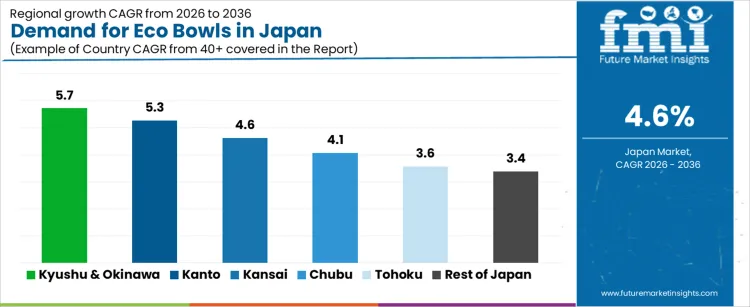
The demand for eco bowls in Japan is growing steadily across foodservice, retail, and environmentally conscious consumer segments, led by Kyushu and Okinawa at a 5.7% CAGR. Growth in this region is supported by tourism driven food packaging needs, wider adoption of biodegradable tableware, and increased use by cafés, street vendors, and convenience outlets. Kanto follows at 5.3%, driven by dense urban foodservice activity, strong presence of eco focused brands, and rising use in meal delivery and takeaway formats. Kansai records 4.6% growth, reflecting stable demand from regional restaurant chains and supermarkets. Chubu at 4.1% shows moderate uptake linked to manufacturing linked foodservice networks. Tohoku and the Rest of Japan, at 3.6% and 3.4%, reflect slower growth shaped by cost sensitivities and more traditional packaging usage patterns.
How Are Consumer Shifts Supporting Eco Bowls Demand in Kyushu and Okinawa?
Demand for eco bowls in Kyushu and Okinawa is rising at a CAGR of 5.7% from 2026 to 2036 as households, cafes, and small food manufacturers adopt plant aligned packaging formats for routine use. Families use eco bowls for ready meals, snacks, and lunch portions that require light, durable containers. Foodservice outlets include these bowls in takeaway and delivery menus due to consistent handling properties. Retailers maintain steady stock movement shaped by predictable purchasing behavior across coastal and inland areas. Overall demand reflects practical usage habits and growing reliance on low impact packaging formats across everyday food routines.
- Families rely on bowls for daily meals
- Foodservice integrates bowls for takeaway needs
- Retailers support regular category turnover
What Factors Influence Eco Bowls Usage Across Kanto?
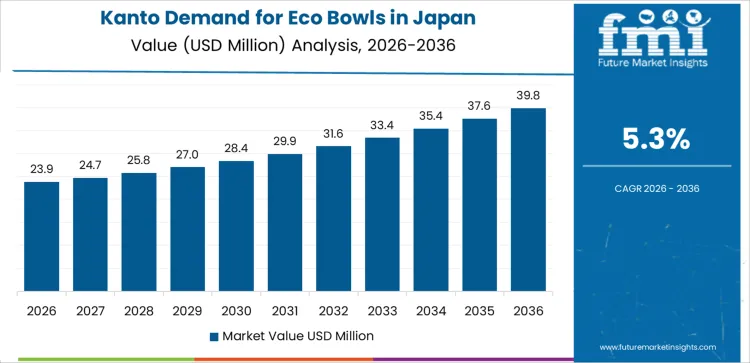
Demand for eco bowls in Kanto is progressing at a CAGR of 5.3% from 2026 to 2036 as dense urban consumption and active foodservice networks adopt reliable packaging options for varied meal formats. Families use eco bowls for convenience based meal preparation and storage. Restaurants and delivery focused operators use these containers to support consistent presentation and dependable transport. Retailers rotate inventory frequently because of steady category turnover across metropolitan outlets. Growth reflects broad usage by households, foodservice providers, and small manufacturers that depend on consistent, easy to handle packaging solutions across a wide range of applications.
- Families use bowls for routine storage
- Foodservice adopts bowls for delivery menus
- Retailers maintain high replenishment cycles
How Is Product Practicality Driving Eco Bowls Adoption in Kansai?
Demand for eco bowls in Kansai is increasing at a CAGR of 4.6% from 2026 to 2036 as households and food operators select containers that offer convenient handling and dependable structure. Families use eco bowls for meal prepping, children’s lunches, and small portion storage. Restaurants adopt these containers for side dishes and ready meals that require uniform presentation. Retailers manage consistent stock levels guided by moderate turnover across suburban and urban districts. Regional demand reflects stable food habits and a steady shift toward packaging formats that support easy disposal and practical everyday use in home and commercial settings.
- Families rely on bowls for varied meal uses
- Restaurants use bowls for prepared dishes
- Retailers maintain steady inventory movement
Which Conditions Support Eco Bowls Demand Across Chubu?
Demand for eco bowls in Chubu is trending at a CAGR of 4.1% from 2026 to 2036 as households and food producers integrate practical packaging solutions into regular routines. Families choose eco bowls for portion control and meal organization. Foodservice operators use these containers in limited but consistent applications where lightweight structure supports ease of handling. Retail channels maintain measured inventory aligned with local purchasing patterns. Growth continues due to reliable container performance and ongoing adoption across mid sized cities and towns that favor functional packaging solutions suited to daily meal preparation and takeaway needs.
- Families use bowls for simple meal routines
- Foodservice relies on lightweight packaging
- Retailers follow stable ordering rhythms
How Do Local Food Patterns Influence Eco Bowls Demand in Tohoku?
Demand for eco bowls in Tohoku is moving at a CAGR of 3.6% from 2026 to 2036, supported by households and small foodservice operators that require dependable and easy to handle packaging options. Families use eco bowls for home prepared lunches, side dishes, and snacks requiring simple portion control. Restaurants adopt these containers for selected takeaway items aligned with regional meal preferences. Retailers manage steady stock movement guided by community level purchasing habits. Growth reflects practical household behavior and consistent acceptance of eco aligned packaging across both urban centers and rural communities in the region.
- Families rely on bowls for lunch and sides
- Restaurants apply bowls to targeted dishes
- Retailers track predictable purchasing patterns
What Maintains Eco Bowls Demand Across Rest of Japan?
Demand for eco bowls in Rest of Japan is advancing at a CAGR of 3.4% from 2026 to 2036 as households and regional foodservice outlets incorporate simple, durable containers into everyday routines. Families select eco bowls for regular food storage and reheatable meal portions. Food operators use these formats for takeaway dishes requiring light structure and consistent shape. Retail outlets maintain modest but steady replenishment cycles aligned with local consumption patterns. Regional demand reflects practical usage needs and dependable access through retailers serving dispersed communities where routine meal preparation supports consistent adoption.
- Families adopt bowls for everyday storage
- Foodservice uses bowls for regular takeaway
- Retailers maintain modest stock rotation
What Is Driving the Demand for Eco Bowls in Japan and Which Companies Shape Food Packaging Adoption
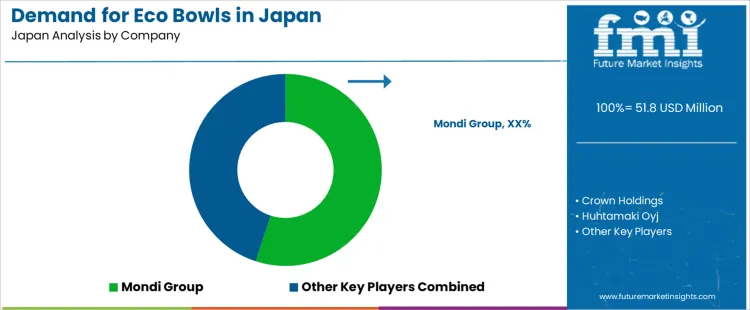
The demand for eco bowls in Japan is shaped by interest in fiber based packaging, growth in takeaway meals, and retailer efforts to reduce plastic use across convenience stores and supermarkets. Domestic paper producers and converters lead supply through molded pulp and coated paper bowls designed for rice dishes, noodles, and ready meals. Huhtamaki Oyj supports demand through molded fiber bowls adapted for hot foods and microwave reheating. WestRock participates through coated paperboard formats used in convenience meal sets. Smurfit Kappa reaches Japan through fiber packaging for imported food products and selected quick service chains. Mondi Group contributes through specialty paper solutions routed to premium deli categories.
Crown Holdings remains limited in this segment through metal packaging lines rather than fiber bowls. Product selection in Japan is governed by heat resistance, oil barrier performance, lid compatibility, and recyclability within municipal systems. Retailers prefer bowls that hold shape during transport and maintain food quality under steam and moisture. Food manufacturers emphasize sealing consistency on automated filling lines and stable supply for seasonal menus. Restaurants adopt fiber bowls to align with consumer expectations for reduced plastic contact and clean presentation. Usage spans convenience store bento, ramen and curry takeout, salads, and ready to heat meals.
Key Players in the Eco Bowls Industry in Japan
- Mondi Group
- Crown Holdings
- Huhtamaki Oyj
- WestRock
- Smurfit Kappa
Scope of the Report
| Items | Values |
|---|---|
| Quantitative Units (2026) | USD million |
| Material | Bioplastics; Paperboard; Wheat Bran; Bagasse; Bamboo Fiber |
| Product Type | Degradable Bowls; Reusable Bowls |
| End Use / Application | Food Service; Packaged Meal Providers; Retail Convenience; Institutional Kitchens |
| Regions Covered | Kyushu & Okinawa; Kanto; Kansai; Chubu; Tohoku; Rest of Japan |
| Countries Covered | Japan |
| Key Companies Profiled | Mondi Group; Crown Holdings; Huhtamaki Oyj; WestRock; Smurfit Kappa |
| Additional Attributes | Dollar by sales by material and product categories; heat resistance and oil barrier performance; lid compatibility and sealing requirements; compostability and recyclability certification criteria; forming quality and stacking behaviour for automated filling lines; import reliance for plant based polymer feedstock; supplier capacity and seasonal supply constraints; municipal waste stream compatibility and labelling requirements. |
Eco Bowls Industry in Japan Segmentation
Material:
- Bioplastics
- Paperboard
- Wheat Bran
- Bagasse
- Bamboo Fiber
Product Type:
- Degradable Bowls
- Reusable Bowls
Region
- Kyushu & Okinawa
- Kanto
- Kansai
- Chubu
- Tohoku
- Rest of Japan
Frequently Asked Questions
How big is the demand for eco bowls in Japan in 2026?
The demand for eco bowls in Japan is estimated to be valued at USD 51.8 million in 2026.
What will be the size of eco bowls in Japan in 2036?
The market size for the eco bowls in Japan is projected to reach USD 81.1 million by 2036.
How much will be the demand for eco bowls in Japan growth between 2026 and 2036?
The demand for eco bowls in Japan is expected to grow at a 4.6% CAGR between 2026 and 2036.
What are the key product types in the eco bowls in Japan?
The key product types in eco bowls in Japan are bioplastics, paperboard, wheat bran, bagasse and bamboo fiber.
Which product type segment is expected to contribute significant share in the eco bowls in Japan in 2026?
In terms of product type, degradable bowls segment is expected to command 60.0% share in the eco bowls in Japan in 2026.
Preview the report firsthand - request a free sample
Get SampleGet the brochure for pricing and purchase details.
Get PDFTable of Content
- Executive Summary
- Japan Market Outlook
- Demand-side Trends
- Supply-side Trends
- Technology Roadmap Analysis
- Analysis and Recommendations
- Market Overview
- Market Coverage / Taxonomy
- Market Definition / Scope / Limitations
- Market Background
- Market Dynamics
- Drivers
- Restraints
- Opportunity
- Trends
- Scenario Forecast
- Demand in Optimistic Scenario
- Demand in Likely Scenario
- Demand in Conservative Scenario
- Opportunity Map Analysis
- Product Life Cycle Analysis
- Supply Chain Analysis
- Investment Feasibility Matrix
- Value Chain Analysis
- PESTLE and Porter’s Analysis
- Regulatory Landscape
- Regional Parent Market Outlook
- Production and Consumption Statistics
- Import and Export Statistics
- Market Dynamics
- Japan Market Analysis 2020 to 2024 and Forecast, 2025 to 2035
- Historical Market Size Value (USD Million) Analysis, 2020 to 2024
- Current and Future Market Size Value (USD Million) Projections, 2025 to 2035
- Y-o-Y Growth Trend Analysis
- Absolute $ Opportunity Analysis
- Japan Market Pricing Analysis 2020 to 2024 and Forecast 2025 to 2035
- Japan Market Analysis 2020 to 2024 and Forecast 2025 to 2035, By Material
- Introduction / Key Findings
- Historical Market Size Value (USD Million) Analysis By Material , 2020 to 2024
- Current and Future Market Size Value (USD Million) Analysis and Forecast By Material , 2025 to 2035
- Bioplastics
- Paperboard
- Wheat Bran
- Bagasse
- Bamboo Fiber
- Y-o-Y Growth Trend Analysis By Material , 2020 to 2024
- Absolute $ Opportunity Analysis By Material , 2025 to 2035
- Japan Market Analysis 2020 to 2024 and Forecast 2025 to 2035, By Product Type
- Introduction / Key Findings
- Historical Market Size Value (USD Million) Analysis By Product Type, 2020 to 2024
- Current and Future Market Size Value (USD Million) Analysis and Forecast By Product Type, 2025 to 2035
- Degradable Bowls
- Reusable Bowls
- Y-o-Y Growth Trend Analysis By Product Type, 2020 to 2024
- Absolute $ Opportunity Analysis By Product Type, 2025 to 2035
- Market Structure Analysis
- Competition Dashboard
- Competition Benchmarking
- Market Share Analysis of Top Players
- By Regional
- By Material
- By Product Type
- Competition Analysis
- Competition Deep Dive
- Mondi Group
- Overview
- Product Portfolio
- Profitability by Market Segments (Product/Age /Sales Channel/Region)
- Sales Footprint
- Strategy Overview
- Marketing Strategy
- Product Strategy
- Channel Strategy
- Crown Holdings
- Huhtamaki Oyj
- WestRock
- Smurfit Kappa
- Mondi Group
- Competition Deep Dive
- Assumptions & Acronyms Used
- Research Methodology


