

- Market Size (2026)
- USD 15.64 Bn
- Forecast (2036)
- USD 29.94 Bn
- CAGR (2026 to 2036)
- 6.7%
Facial Injectables Market Size, Market Forecast and Outlook By FMI
The facial injectables market is estimated at USD 14.94 billion in 2025. Industry value is forecast to reach USD 15.64 billion in 2026 and USD 29.94 billion by 2036 at 6.7% CAGR. Botulinum toxin is projected to account for 45.0% of product-type demand in 2026. Facial line correction is estimated to represent 39.0% of application demand in 2026.
Facial injectables are growing through repeat, office-based care rather than one-time surgical decisions. The American Society of Plastic Surgeons reported 2024 USA procedure volumes of 9.48 million neuromodulator injections and 5.29 million hyaluronic acid filler procedures. It also reported 932,861 non-hyaluronic acid filler procedures in 2024. These numbers show why the category is anchored in repeat visits and trained injector capacity. Regulation matters as well, since FDA guidance says dermal fillers are not approved for several high-risk uses and needle-free filler devices are not approved for filler injection.
Summary of the Facial Injectables Market
- Demand and Growth Drivers
- Repeat wrinkle correction supports botulinum toxin demand because treatment effects are temporary and patients return for maintenance.
- Hyaluronic acid fillers support value growth through lips, cheeks, nasolabial folds and contouring use.
- GLP-1 weight-loss use is creating new interest in facial-volume restoration among some aesthetic providers and injectable brands.
- Regulated channels matter because the FDA warned in November 2025 about unapproved botulinum toxin products sold online.
- Product and Segment View
- Botulinum toxin is projected to account for 45.0% share in 2026 as repeat treatment cycles support strong volume.
- Facial line correction is estimated to represent 39.0% share in 2026 as upper-face treatment remains a common entry point.
- Dermatology clinics are expected to hold 48.0% share in 2026 because trained injectors and repeat patient records shape treatment safety.
- Geography and Competitive Outlook
- China is projected to record 9.2% CAGR by 2036 as aesthetics clinics and approved toxin products expand access.
- India is expected to expand at 8.6% CAGR by 2036 as urban dermatology clinics and medical aesthetics chains scale.
- AbbVie, Galderma and Merz Aesthetics hold strong supplier positions through toxin and filler portfolios.
- Evolus, Hugel and Revance compete through newer neurotoxin positioning and physician-focused commercialization.
- Analyst Opinion
- Sabyasachi Ghosh, Principal Consultant at FMI, observes, facial injectables are shifting from event-based beauty spending to maintenance-led medical aesthetics.
- Facial Injectables Market Value Analysis
- Botulinum toxin supports recurring revenue because many patients repeat treatment within months.
- Hyaluronic acid fillers carry high value per visit as facial contouring and lip treatment need material volume and injector skill.
- Biostimulatory injectables are gaining higher-value use where patients seek collagen stimulation and longer correction cycles.
- Safety and authenticity concerns raise the role of licensed channels and reduce tolerance for gray-market products.
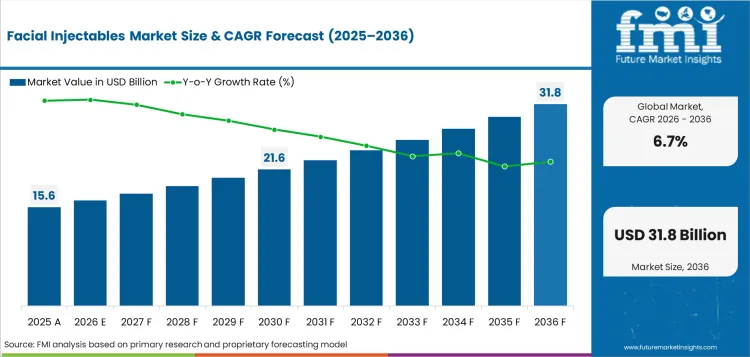
Key Takeaways, Market Size, and Forecast
- The facial injectables market value is estimated at USD 14.94 billion in 2025.
- Global facial injectables market is projected to reach USD 29.94 billion by 2036 as minimally invasive aesthetic procedures remain central to facial rejuvenation.
- The market is expected to expand at 6.7% CAGR from 2026 to 2036 across botulinum toxin, hyaluronic acid fillers and biostimulatory injectables.
- The market is projected to create an incremental opportunity of USD 14.30 billion between 2026 and 2036.
- Botulinum toxin is expected to account for 45.0% share in 2026 due to repeat treatment cycles and broad wrinkle-correction use.
- Facial line correction is estimated to represent 39.0% share in 2026 as glabellar lines, forehead lines and crow’s feet remain common treatment areas.
- China at 9.2% CAGR and India at 8.6% CAGR are expected to record the fastest country-level pace by 2036.
Facial Injectables Market Definition
The sector covers injectable aesthetic products used for facial wrinkle correction, volume restoration, contouring and skin-quality improvement. Included products cover botulinum toxin, hyaluronic acid fillers, calcium hydroxylapatite fillers, poly-L-lactic acid injectables and other approved soft-tissue fillers. The scope includes physician-administered and licensed-practitioner-administered treatments in dermatology clinics, medspas, plastic surgery centers and aesthetic clinics.
Topical anti-aging creams, facial implants, surgical facelifts, energy-based devices and non-injectable skin treatments fall outside this study. Unapproved fillers, counterfeit toxins and over-the-counter injectable products are excluded from legitimate market revenue.
Facial Injectables Market Inclusions
The study includes botulinum toxin, hyaluronic acid fillers, calcium hydroxylapatite, poly-L-lactic acid, facial line correction, lip treatment, cheek augmentation, chin contouring, dermatology clinics, medspas, plastic surgery centers, direct physician sales, distributor sales and global geography.
Market scope covers commercially traded facial injectables by product type, including botulinum toxin and dermal fillers; application, including facial lines and volume restoration; end user, including clinics and medspas; and channel, including direct sales and distributors.
Revenue scope covers 2026 to 2036. The key stakeholders include injectable manufacturers, dermatologists, plastic surgeons, aesthetic physicians, medspa operators, distributors, regulators, training bodies, insurers for liability coverage and patient-safety organizations.
Facial Injectables Market Exclusions
The study excludes surgical implants, facelifts, thread lifts, lasers, radiofrequency devices, topical cosmetics, counterfeit botulinum toxin, non-approved fillers and needle-free filler devices not cleared for filler injection.
Facial Injectables Market Research Methodology
- Primary Research: FMI analysts reviewed dermatologists, plastic surgeons, medspa operators and aesthetic distributors. Interviews focused on product choice, injector training, patient repeat behavior, pricing and safety concerns.
- Desk Research: The desk review used FDA product and safety guidance, procedure statistics, company disclosures and professional association data. Product scope was checked against approved facial indications and aesthetic-use boundaries.
- · Market Sizing and Forecasting: The forecast combined procedure volumes, average treatment value, product mix and country-level injector density. Segment shares were checked against toxin and filler procedure patterns.
- Data Validation: Final values were checked against USA and global procedure data, approved product launches, competitive portfolios and regional clinic growth patterns.
Why is the Facial Injectables Market Growing?
- Patients choose injectables when they want facial correction without surgery or long downtime.
- Botulinum toxin supports repeat use as wrinkle-relaxing effects wear off over time.
- Hyaluronic acid fillers support demand in lips and cheeks where visible contour change is expected.
- Medspas and dermatology clinics improve access as trained injector networks expand in large cities.
- Counterfeit product risk makes regulated supply and licensed administration more important for long-term growth.
Facial Injectables Market Segmentation
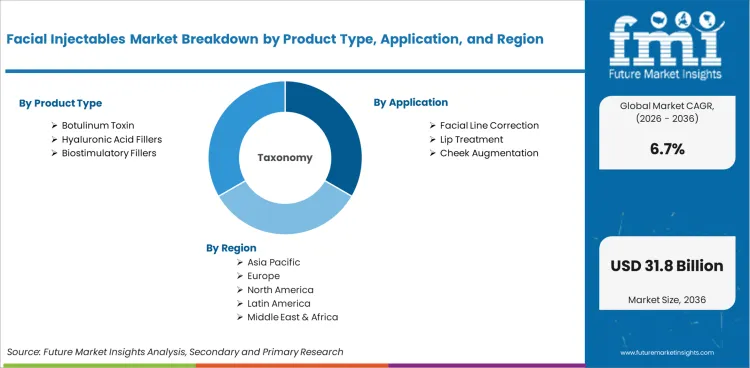
The facial injectables market is segmented by product type into botulinum toxin, hyaluronic acid fillers, biostimulatory fillers and other dermal fillers. By application, the market is divided into facial line correction, lip treatment, cheek augmentation and chin contouring.
Based on end user, the market is segmented into dermatology clinics, medspas, plastic surgery centers and hospitals. By distribution channel, the market is categorized into direct sales, distributors and online professional portals.
Procedure volume explains why injectables remain the center of non-surgical aesthetics. ISAPS reported that botulinum toxin and hyaluronic acid filler were the two most popular non-surgical aesthetic procedures in 2024. ASPS reported 9.48 million neuromodulator injections and 5.29 million hyaluronic acid filler procedures in the United States in 2024. This procedure base gives suppliers recurring demand, but it also raises quality-control pressure. Repeat care depends on safe product handling and injector competence.
Facial Injectables Market Analysis by Product Type
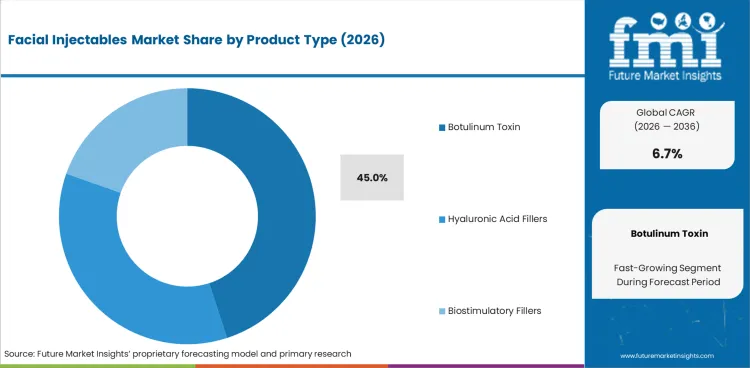
Botulinum toxin is expected to account for 45.0% share in 2026 as upper-face wrinkle treatment creates repeat treatment cycles.
Hyaluronic acid fillers gain value where patients seek lip volume, cheek contour and nasolabial fold correction.
Insights into Hyaluronic Acid Fillers Segment
Hyaluronic acid fillers are expected to gain share in younger patient groups seeking lips and contouring instead of deep wrinkle correction.
ASPS reported 5.29 million hyaluronic acid filler procedures in the United States in 2024, showing scale beyond small premium clinics.
Facial Injectables Market Analysis by Application
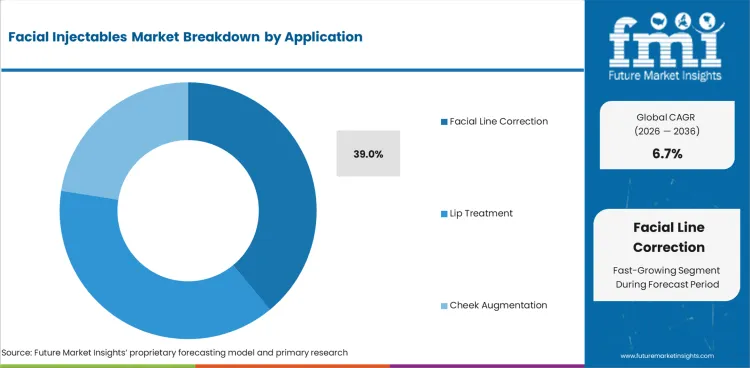
Facial line correction is estimated to represent 39.0% share in 2026 as forehead lines, glabellar lines and crow’s feet remain core treatment areas.
Lip treatment grows through younger consumers but faces stronger scrutiny around overcorrection and unnatural outcomes.
Insights into Lip Treatment Segment
Lip treatment is shaped by social visibility and quick result expectations, which raises the role of injector judgment.
ASPS stated that 1,589,502 patients chose hyaluronic acid fillers to enhance their pout in 2024.
Facial Injectables Market Analysis by End User
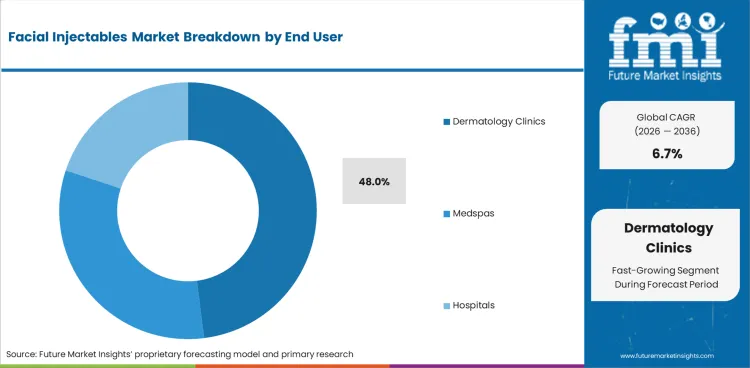
Dermatology clinics are projected to hold 48.0% share in 2026 because facial injectables need clinical assessment and adverse-event handling.
Medspas expand access where physician oversight, trained injectors and standardized product sourcing are clearly managed.
Insights into Medspas Segment
Medspas are expected to gain share in urban areas where consumers seek convenient maintenance treatments outside hospital settings.
The segment faces regulatory and trust pressure when discount pricing weakens confidence in product authenticity and injector qualification.
Facial Injectables Market Analysis by Distribution Channel
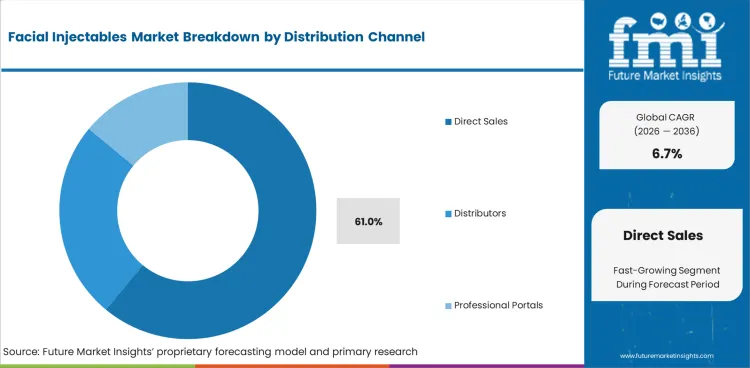
Direct sales are expected to hold 61.0% share in 2026 as manufacturers prefer controlled physician and clinic relationships.
Distributors serve smaller clinics and regional aesthetic centers where local inventory access shapes treatment scheduling.
Insights into Distributor Sales Segment
Distributor sales remain important outside major metro areas where clinics need flexible order size and faster replenishment.
Product authentication becomes a key distributor requirement as regulators warn against unapproved toxins and unauthorized online sellers.
Facial Injectables Market Drivers, Restraints, and Opportunities
- Maintenance-based facial aesthetics drives repeat toxin use as patients return after visible effects decline.
- Facial volume restoration supports filler demand as aging and weight-loss-related volume loss change treatment needs.
- Upper-face indication expansion supports neurotoxin competition as brands seek broader approved use.
- Counterfeit and unapproved products restrain trust because unsafe injections can damage the category.
- Male aesthetics and younger prevention users create new demand pools for conservative correction.
Maintenance-Based Toxin Demand
Botulinum toxin demand is built on repeat treatment. The product relaxes facial muscles for a limited period, so revenue depends on patient return behavior and physician retention. ASPS reported 9.48 million neuromodulator injections in the United States in 2023. This procedure volume demonstrates the scale of routine office-based use. Appointment cadence and injector loyalty are as important as new patient acquisition in this market. Suppliers that support consistent outcomes and clinic education hold stronger repeat demand.
Volume Restoration After Weight Loss
Facial fillers are gaining new attention from weight-loss-related volume change. GLP-1 weight-loss drug use has raised demand for aesthetic treatments tied to facial volume loss and loose skin, opening additional consultation routes for fillers and biostimulatory injectables. Patients who lose weight quickly may notice hollowness in cheeks or temples. Aesthetic clinics can address that concern with volume-restoration treatment plans. Practitioners must guard against overcorrection to ensure natural-looking outcomes remain central.
Safety and Authenticity Pressure
The biggest restraint is unsafe product access. FDA warned in November 2025 that unapproved botulinum toxin products were being sold online and noted that approved products are available by prescription from licensed practitioners. The agency also states that dermal fillers are not approved for several high-risk uses and that injectable silicone is not approved for aesthetic contouring. This enforcement environment makes channel control a growth condition rather than a compliance detail. Manufacturers must protect authorized distribution because patient harm can reduce trust in the full category.
Regional Analysis
.webp "Top Country Growth Comparison Facial Injectables Market Cagr (2026 2036)")
| Country | CAGR 2026 to 2036 |
|---|---|
| China | 9.2% |
| India | 8.6% |
| South Korea | 7.8% |
| United States | 6.1% |
| Brazil | 5.8% |
| Germany | 4.9% |
| Japan | 4.3% |
Source: Future Market Insights analysis based on aesthetic procedure demand, approved product access and public regulatory source checks in 2026.
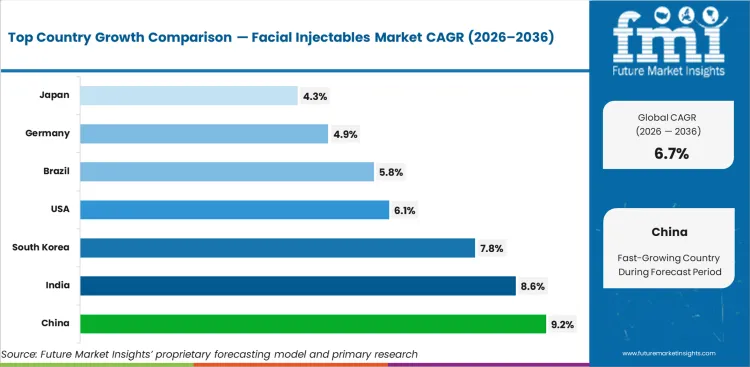
Analysis of Facial Injectables Market by Key Countries
- China is expected to grow at 9.2% CAGR by 2036, led by urban aesthetic clinics and broader access to approved injectables.
- India is projected to follow at 8.6% CAGR by 2036 as dermatology chains and premium urban clinics expand.
- South Korea demand is expected to advance at 7.8% CAGR by 2036 as medical aesthetics and cosmetic dermatology remain culturally established.
- United States demand is forecast at 6.1% CAGR by 2036 through high procedure volume and newer toxin approvals.
- Brazil is expected to expand at 5.8% CAGR by 2036 due to large aesthetic procedure volumes and strong plastic surgery culture.
- Germany at 4.9% CAGR expands through regulated physician-led aesthetics and premium clinic demand.
- Japan at 4.3% CAGR grows through conservative aesthetic use and mature urban clinic networks.
Country growth differs with injector density, income levels and product approval access. China, India and South Korea are forecast above the global pace because urban clinic networks and younger aesthetic consumers expand faster there. The United States remains the largest value pool but grows closer to the global average due to maturity. Germany and Japan track below faster Asian markets because patient behavior is more conservative.
Demand Outlook for Facial Injectables Market in China
Demand for facial injectables in China is projected to rise at 9.2% CAGR by 2036, supported by urban medical aesthetics clinics and stronger consumer acceptance. The country has a large base of beauty-service users moving toward physician-administered products. Growth is concentrated in Shanghai, Beijing and Shenzhen where premium clinics have stronger purchasing power. China also benefits from domestic toxin and filler producers seeking wider acceptance. Adoption will depend on product approval discipline and consumer trust in licensed providers.
- Shanghai supports premium injectable demand through medical beauty clinics and higher-income aesthetic consumers.
- Beijing clinics benefit from stronger physician networks and regulatory visibility around licensed aesthetic services.
- Shenzhen supports younger aesthetic demand through beauty retail culture and private clinic growth.
Demand Outlook for Facial Injectables Market in India
The sector in India is expected to expand at 8.6% CAGR by 2036 as urban dermatology and aesthetic clinics scale. Demand is concentrated in metros where disposable income and social media exposure shape treatment interest. Mumbai, Delhi NCR and Bengaluru have the clearest injector networks for premium brands. Price sensitivity remains a major barrier outside these cities. Growth will depend on training quality and whether clinics can make conservative outcomes feel safer for first-time patients.
- Mumbai supports early premium injectable demand through dermatology clinics and celebrity-linked aesthetic culture.
- Delhi NCR has strong clinic density across dermatology, plastic surgery and medspa-style providers.
- Bengaluru adds demand from younger professionals seeking low-downtime facial maintenance treatments.
Demand Outlook for Facial Injectables Market in South Korea
Facial injectables demand in South Korea is projected to record 7.8% CAGR by 2036 as medical aesthetics remains deeply embedded in beauty culture. Seoul has one of Asia’s strongest aesthetic clinic ecosystems. Domestic companies such as Hugel and Medytox give the country a strong toxin manufacturing base. Export-oriented Korean aesthetics also supports product familiarity abroad. Domestic growth will depend on whether clinics preserve trust while competing on price in crowded treatment districts.
- Seoul’s Gangnam district remains a major hub for aesthetic clinics and injectable treatment demand.
- Korean toxin companies support regional competitiveness through botulinum toxin manufacturing and export activity.
- Busan and Daegu clinics help spread aesthetic treatment beyond the Seoul metro area.
Demand Outlook for Facial Injectables Market in the United States
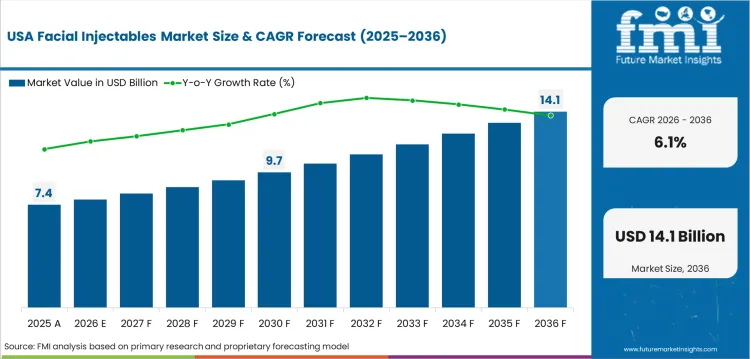
The United States remains the anchor value market for facial injectables due to procedure scale and product choice. ASPS reported 9.48 million neuromodulator injections in 2023 and 5.29 million hyaluronic acid filler procedures. These volumes generate a large recurring treatment pool for toxins and fillers. FDA approvals also shape competition, with Hugel’s Letybo approved for glabellar lines in February 2024 and Merz’s Xeomin expanded for upper facial lines in July 2024. Growth is steady because the market is already mature.
- California and New York support high-value injectable demand through dense dermatology and plastic surgery networks.
- Florida remains relevant through medical aesthetics clinics serving both residents and cosmetic tourism demand.
- FDA enforcement against unapproved online toxin sellers raises the value of authorized product channels.
Demand Outlook for Facial Injectables Market in Brazil
The sector in Brazil is expected to expand at 5.8% CAGR by 2036 due to large aesthetic procedure volumes and strong cosmetic surgery culture. Brazil is a major global aesthetics market with broad consumer acceptance of appearance-focused treatments. São Paulo and Rio de Janeiro anchor premium demand through dermatology and plastic surgery networks. Injectables benefit from lower downtime than surgery. Growth will depend on affordability and the ability of brands to reach licensed clinics beyond the largest cities.
- São Paulo supports premium demand through dense cosmetic dermatology and private clinic networks.
- Rio de Janeiro contributes through strong beauty culture and high consumer awareness of facial aesthetics.
- Brazil’s plastic surgery ecosystem gives injectables a strong referral base from aesthetic physicians.
Demand Outlook for Facial Injectables Market in Germany
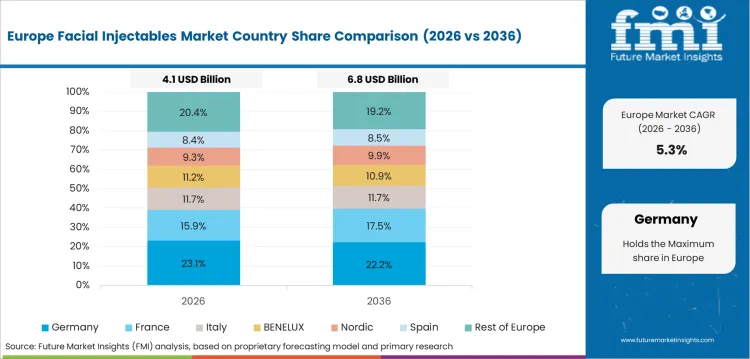
The sector in Germany is expected to expand at 4.9% CAGR by 2036 through regulated aesthetic medicine and premium clinic use. German consumers tend to favor conservative results and physician-led care. This supports trusted brands but slows extreme treatment uptake. Berlin, Munich and Hamburg form key demand centers for injectables. Suppliers need strong medical education and clear safety positioning. Growth is steadier than in Asia because patient acceptance is mature but more cautious.
- Berlin supports aesthetic clinic demand through a younger urban consumer base and private dermatology providers.
- Munich anchors premium injectable use through higher-income patients and physician-led aesthetics.
- Hamburg clinics support conservative facial rejuvenation demand among professional consumers.
Demand Outlook for Facial Injectables Market in Japan
The sector in Japan is expected to expand at 4.3% CAGR by 2036 due to mature urban clinic networks and cautious treatment preferences. Tokyo and Osaka remain the main demand centers. Japanese consumers often prefer subtle change, which supports smaller-dose toxin and filler treatment patterns. Growth is limited by conservative beauty norms and careful product adoption. Suppliers that train physicians on natural outcomes and risk control are better placed than brands built around dramatic transformation.
- Tokyo supports premium injectable demand through aesthetic dermatology and private beauty clinics.
- Osaka contributes through regional clinic networks and steady consumer interest in non-surgical care.
- Japan’s conservative aesthetic culture favors subtle wrinkle correction and restrained filler use.
Competitive Landscape
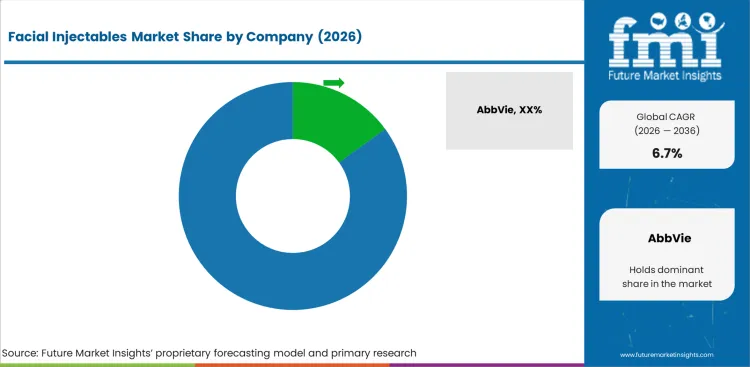
- The market is moderately concentrated with global toxin and filler brands competing against newer regional entrants.
- AbbVie holds the strongest Botox and Juvederm position through long-standing physician awareness.
- Galderma competes through Dysport, Restylane and Sculptra across toxin and filler categories.
- Merz Aesthetics benefits from Xeomin, Radiesse and Belotero with a broad aesthetics portfolio.
- Entry barriers include regulatory approval, injector trust, cold-chain control and adverse-event monitoring.
Competition in facial injectables is shaped by brand trust and injector habit. AbbVie benefits from Botox and Juvederm familiarity across aesthetic practices. Galderma competes with Dysport, Restylane and Sculptra in both toxin and filler use. Merz Aesthetics brings Xeomin, Radiesse and Belotero into clinics that want portfolio breadth. This structure gives large suppliers an advantage because injectors prefer predictable products and consistent training support. Smaller entrants must overcome switching friction inside practices.
Regulatory approvals have intensified neurotoxin competition. Hugel’s Letybo received FDA approval in February 2024 for glabellar lines. Merz Aesthetics received FDA approval in July 2024 for Xeomin as the first neurotoxin for simultaneous treatment of upper facial lines. These approvals expand physician choice and increase pressure on legacy brands. The commercial effect will depend on pricing, sampling and injector confidence. Payers matter less here than clinic economics and patient willingness to switch.
More competition does not automatically improve category health. Discounting can bring new users into clinics, yet poor outcomes and counterfeit supply can damage trust quickly. FDA warning letters in 2025 against unapproved toxin sellers illustrate why authorized distribution matters. Premium brands protect share through training support, traceability systems and safety messaging. Low-price entrants must demonstrate that they can match outcomes without raising adverse-event anxiety.
Key Companies in the Facial Injectables Market
- AbbVie
- Galderma
- Merz Aesthetics
- Evolus
- Hugel
- Revance Therapeutics
Prollenium Medical Technologies
Global Leaders
- AbbVie
- Galderma
- Merz Aesthetics
Regional and Challenger Brands
- Evolus
- Hugel
- Revance Therapeutics
- Prollenium Medical Technologies
Competitive Benchmarking: Facial Injectables Market
| Company | Toxin Portfolio Strength | Filler Portfolio Depth | Injector Training Reach | Geographic Footprint |
|---|---|---|---|---|
| AbbVie | High | High | High | Global |
| Galderma | High | High | High | Global |
| Merz Aesthetics | High | High | Strong | Global |
| Evolus | Medium | Low | Medium | United States and select markets |
| Hugel | Medium | Low | Medium | South Korea and global expansion |
| Revance Therapeutics | Medium | Medium | Medium | United States |
| Prollenium Medical Technologies | Low | Medium | Medium | North America and select markets |
Source: Future Market Insights competitive analysis, 2026. Ratings reflect relative positioning based on toxin portfolio strength, filler portfolio depth and injector training reach.
Key Developments in Facial Injectables Market
- In February 2024, Hugel received FDA approval for Letybo for glabellar lines. The approval added another botulinum toxin option in the USA market.
- In July 2024, Merz Aesthetics received FDA approval for Xeomin for treatment of upper facial lines. The approval widened the product’s facial aesthetics position.
- In August 2025, FDA-linked educational material noted that soft-tissue fillers have no approved indications for the neck or décolletage. This supports clearer indication discipline.
- In November 2025, FDA warned against unapproved botulinum toxin products sold online. The action strengthened the role of licensed channels and authorized supply.
- GLP-1 weight-loss drug use is increasing demand for aesthetic treatments tied to facial volume loss, creating additional filler consultation routes.
Report Scope and Coverage
| Parameter | Details |
|---|---|
| Quantitative Units | USD 15.64 billion in 2026 to USD 29.94 billion in 2036, at a CAGR of 6.7% |
| Market Definition | Injectable aesthetic products used for facial wrinkle correction, volume restoration, contouring and skin-quality improvement. |
| Regions Covered | North America, Latin America, Europe, East Asia, South Asia and Pacific, Middle East and Africa |
| Countries Covered | China, India, South Korea, United States, Brazil, Germany, Japan and 30+ countries |
| Key Companies Profiled | AbbVie, Galderma, Merz Aesthetics, Evolus, Hugel, Revance Therapeutics and Prollenium Medical Technologies |
| Forecast Period | 2026 to 2036 |
| Approach | Hybrid bottom-up and top-down methodology based on procedure volumes, treatment value, product mix and country-level injector access |
Facial Injectables Market by Segments
Facial Injectables Market Segmented by Product Type:
- Botulinum Toxin
- Hyaluronic Acid Fillers
- Biostimulatory Fillers
- Other Dermal Fillers
Facial Injectables Market Segmented by Application:
- Facial Line Correction
- Lip Treatment
- Cheek Augmentation
- Chin Contouring
Facial Injectables Market Segmented by End User:
- Dermatology Clinics
- Medspas
- Plastic Surgery Centers
- Hospitals
Facial Injectables Market Segmented by Distribution Channel:
- Direct Sales
- Distributors
- Professional Portals
Facial Injectables Market by Region:
- North America
- United States
- Canada
- Mexico
- Latin America
- Brazil
- Chile
- Rest of Latin America
- Western Europe
- Germany
- UK
- France
- Italy
- Spain
- BENELUX
- Nordic
- Rest of Western Europe
- Eastern Europe
- Russia
- Poland
- Hungary
- Balkan and Baltic
- Rest of Eastern Europe
- East Asia
- China
- Japan
- South Korea
- South Asia and Pacific
- India
- ASEAN
- Australia and New Zealand
- Rest of South Asia and Pacific
- Middle East and Africa
- Kingdom of Saudi Arabia
- Other GCC Countries
- Turkiye
- South Africa
- Other African Union
- Rest of Middle East and Africa
Research Sources and Bibliography
- American Society of Plastic Surgeons. 2024. Plastic Surgery Statistics Report.
- International Society of Aesthetic Plastic Surgery. 2024. Global Survey 2024: Full Report and Press Releases.
- USA Food and Drug Administration. Dermal Fillers, Soft Tissue Fillers.
- USA Food and Drug Administration. 2025. Korean Aesthetic dba Korean Fillers Warning Letter.
- USA Food and Drug Administration. 2025. The Use of Dermal Fillers in the Neck and Décolletage.
- Evolus. 2024. Annual Report disclosure on Letybo FDA approval.
- Merz Aesthetics. 2024. Xeomin upper facial lines FDA approval disclosure.
This Report Answers
- How large is the facial injectables market in 2026 and how much incremental value is expected by 2036?
- What factors are shaping demand for botulinum toxin, hyaluronic acid fillers and biostimulatory injectables?
- Which facial applications are expected to lead adoption across line correction, lips, cheeks and chin contouring?
- How are product approvals and counterfeit-product enforcement changing the facial injectables market?
- Which countries are forecast to grow faster than the global average and why?
- How are GLP-1 weight-loss trends and facial-volume concerns affecting filler demand?
- Which companies are best positioned across toxin portfolios, filler products and injector training?
Frequently Asked Questions
What is the current value of the facial injectables market?
The facial injectables market is estimated at USD 15.64 billion in 2026.
What is the projected value of the facial injectables market by 2036?
The market is forecast to reach USD 29.94 billion by 2036.
What CAGR is expected for the facial injectables market?
The market is projected to expand at 6.7% CAGR from 2026 to 2036.
Which application is expected to lead the market?
Facial line correction is projected to lead with 39.0% share in 2026.
Which country is expected to grow fastest?
China is projected to grow fastest at 9.2% CAGR by 2036.
What is the main competitive shift in this market?
The main competitive shift is broader neurotoxin competition after newer approvals and stronger regulatory pressure on unapproved online products.
What are facial injectables used for?
Facial injectables are used for wrinkle relaxation, volume restoration, lip shaping, cheek contouring and selected facial-line correction.
Facial injectables are used for wrinkle relaxation, volume restoration, lip shaping, cheek contouring and selected facial-line correction
Botox relaxes facial muscles to reduce lines. Fillers add volume under the skin to shape lips, cheeks or facial folds.
How long do facial injectables last?
Botulinum toxin usually lasts a few months. Fillers can last longer depending on product type, injection area and patient metabolism.
What are the disadvantages of facial injectables?
The main disadvantages are bruising, swelling, asymmetry, overcorrection, vascular complications and risk from counterfeit or unapproved products.
Preview the report firsthand - request a free sample
Get SampleGet the brochure for pricing and purchase details.
Get PDFTable of Content
- Executive Summary
- Global Market Outlook
- Demand-side Trends
- Supply-side Trends
- Technology Roadmap Analysis
- Analysis and Recommendations
- Market Overview
- Market Coverage / Taxonomy
- Market Definition / Scope / Limitations
- Research Methodology
- Chapter Orientation
- Analytical Lens and Working Hypotheses
- Market Structure, Signals, and Trend Drivers
- Benchmarking and Cross-market Comparability
- Market Sizing, Forecasting, and Opportunity Mapping
- Research Design and Evidence Framework
- Desk Research Programme (Secondary Evidence)
- Company Annual and Sustainability Reports
- Peer-reviewed Journals and Academic Literature
- Corporate Websites, Product Literature, and Technical Notes
- Earnings Decks and Investor Briefings
- Statutory Filings and Regulatory Disclosures
- Technical White Papers and Standards Notes
- Trade Journals, Industry Magazines, and Analyst Briefs
- Conference Proceedings, Webinars, and Seminar Materials
- Government Statistics Portals and Public Data Releases
- Press Releases and Reputable Media Coverage
- Specialist Newsletters and Curated Briefings
- Sector Databases and Reference Repositories
- FMI Internal Proprietary Databases and Historical Market Datasets
- Subscription Datasets and Paid Sources
- Social Channels, Communities, and Digital Listening Inputs
- Additional Desk Sources
- Expert Input and Fieldwork (Primary Evidence)
- Primary Modes
- Qualitative Interviews and Expert Elicitation
- Quantitative Surveys and Structured Data Capture
- Blended Approach
- Why Primary Evidence is Used
- Field Techniques
- Interviews
- Surveys
- Focus Groups
- Observational and In-context Research
- Social and Community Interactions
- Stakeholder Universe Engaged
- C-suite Leaders
- Board Members
- Presidents and Vice Presidents
- R&D and Innovation Heads
- Technical Specialists
- Domain Subject-matter Experts
- Scientists
- Physicians and Other Healthcare Professionals
- Governance, Ethics, and Data Stewardship
- Research Ethics
- Data Integrity and Handling
- Primary Modes
- Tooling, Models, and Reference Databases
- Desk Research Programme (Secondary Evidence)
- Data Engineering and Model Build
- Data Acquisition and Ingestion
- Cleaning, Normalisation, and Verification
- Synthesis, Triangulation, and Analysis
- Quality Assurance and Audit Trail
- Market Background
- Market Dynamics
- Drivers
- Restraints
- Opportunity
- Trends
- Scenario Forecast
- Demand in Optimistic Scenario
- Demand in Likely Scenario
- Demand in Conservative Scenario
- Opportunity Map Analysis
- Product Life Cycle Analysis
- Supply Chain Analysis
- Investment Feasibility Matrix
- Value Chain Analysis
- PESTLE and Porter’s Analysis
- Regulatory Landscape
- Regional Parent Market Outlook
- Production and Consumption Statistics
- Import and Export Statistics
- Market Dynamics
- Global Market Analysis 2021 to 2025 and Forecast, 2026 to 2036
- Historical Market Size Value (USD Million) Analysis, 2021 to 2025
- Current and Future Market Size Value (USD Million) Projections, 2026 to 2036
- Y-o-Y Growth Trend Analysis
- Absolute $ Opportunity Analysis
- Global Market Pricing Analysis 2021 to 2025 and Forecast 2026 to 2036
- Global Market Analysis 2021 to 2025 and Forecast 2026 to 2036, By Product Type
- Introduction / Key Findings
- Historical Market Size Value (USD Million) Analysis By Product Type , 2021 to 2025
- Current and Future Market Size Value (USD Million) Analysis and Forecast By Product Type , 2026 to 2036
- Botulinum Toxin
- Hyaluronic Acid Fillers
- Biostimulatory Fillers
- Botulinum Toxin
- Y-o-Y Growth Trend Analysis By Product Type , 2021 to 2025
- Absolute $ Opportunity Analysis By Product Type , 2026 to 2036
- Global Market Analysis 2021 to 2025 and Forecast 2026 to 2036, By Application
- Introduction / Key Findings
- Historical Market Size Value (USD Million) Analysis By Application, 2021 to 2025
- Current and Future Market Size Value (USD Million) Analysis and Forecast By Application, 2026 to 2036
- Facial Line Correction
- Lip Treatment
- Cheek Augmentation
- Facial Line Correction
- Y-o-Y Growth Trend Analysis By Application, 2021 to 2025
- Absolute $ Opportunity Analysis By Application, 2026 to 2036
- Global Market Analysis 2021 to 2025 and Forecast 2026 to 2036, By End User
- Introduction / Key Findings
- Historical Market Size Value (USD Million) Analysis By End User, 2021 to 2025
- Current and Future Market Size Value (USD Million) Analysis and Forecast By End User, 2026 to 2036
- Dermatology Clinics
- Medspas
- Hospitals
- Dermatology Clinics
- Y-o-Y Growth Trend Analysis By End User, 2021 to 2025
- Absolute $ Opportunity Analysis By End User, 2026 to 2036
- Global Market Analysis 2021 to 2025 and Forecast 2026 to 2036, By Distribution Channel
- Introduction / Key Findings
- Historical Market Size Value (USD Million) Analysis By Distribution Channel, 2021 to 2025
- Current and Future Market Size Value (USD Million) Analysis and Forecast By Distribution Channel, 2026 to 2036
- Direct Sales
- Distributors
- Professional Portals
- Direct Sales
- Y-o-Y Growth Trend Analysis By Distribution Channel, 2021 to 2025
- Absolute $ Opportunity Analysis By Distribution Channel, 2026 to 2036
- Global Market Analysis 2021 to 2025 and Forecast 2026 to 2036, By Region
- Introduction
- Historical Market Size Value (USD Million) Analysis By Region, 2021 to 2025
- Current Market Size Value (USD Million) Analysis and Forecast By Region, 2026 to 2036
- North America
- Latin America
- Western Europe
- Eastern Europe
- East Asia
- South Asia and Pacific
- Middle East & Africa
- Market Attractiveness Analysis By Region
- North America Market Analysis 2021 to 2025 and Forecast 2026 to 2036, By Country
- Historical Market Size Value (USD Million) Trend Analysis By Market Taxonomy, 2021 to 2025
- Market Size Value (USD Million) Forecast By Market Taxonomy, 2026 to 2036
- By Country
- USA
- Canada
- Mexico
- By Product Type
- By Application
- By End User
- By Distribution Channel
- By Country
- Market Attractiveness Analysis
- By Country
- By Product Type
- By Application
- By End User
- By Distribution Channel
- Key Takeaways
- Latin America Market Analysis 2021 to 2025 and Forecast 2026 to 2036, By Country
- Historical Market Size Value (USD Million) Trend Analysis By Market Taxonomy, 2021 to 2025
- Market Size Value (USD Million) Forecast By Market Taxonomy, 2026 to 2036
- By Country
- Brazil
- Chile
- Rest of Latin America
- By Product Type
- By Application
- By End User
- By Distribution Channel
- By Country
- Market Attractiveness Analysis
- By Country
- By Product Type
- By Application
- By End User
- By Distribution Channel
- Key Takeaways
- Western Europe Market Analysis 2021 to 2025 and Forecast 2026 to 2036, By Country
- Historical Market Size Value (USD Million) Trend Analysis By Market Taxonomy, 2021 to 2025
- Market Size Value (USD Million) Forecast By Market Taxonomy, 2026 to 2036
- By Country
- Germany
- UK
- Italy
- Spain
- France
- Nordic
- BENELUX
- Rest of Western Europe
- By Product Type
- By Application
- By End User
- By Distribution Channel
- By Country
- Market Attractiveness Analysis
- By Country
- By Product Type
- By Application
- By End User
- By Distribution Channel
- Key Takeaways
- Eastern Europe Market Analysis 2021 to 2025 and Forecast 2026 to 2036, By Country
- Historical Market Size Value (USD Million) Trend Analysis By Market Taxonomy, 2021 to 2025
- Market Size Value (USD Million) Forecast By Market Taxonomy, 2026 to 2036
- By Country
- Russia
- Poland
- Hungary
- Balkan & Baltic
- Rest of Eastern Europe
- By Product Type
- By Application
- By End User
- By Distribution Channel
- By Country
- Market Attractiveness Analysis
- By Country
- By Product Type
- By Application
- By End User
- By Distribution Channel
- Key Takeaways
- East Asia Market Analysis 2021 to 2025 and Forecast 2026 to 2036, By Country
- Historical Market Size Value (USD Million) Trend Analysis By Market Taxonomy, 2021 to 2025
- Market Size Value (USD Million) Forecast By Market Taxonomy, 2026 to 2036
- By Country
- China
- Japan
- South Korea
- By Product Type
- By Application
- By End User
- By Distribution Channel
- By Country
- Market Attractiveness Analysis
- By Country
- By Product Type
- By Application
- By End User
- By Distribution Channel
- Key Takeaways
- South Asia and Pacific Market Analysis 2021 to 2025 and Forecast 2026 to 2036, By Country
- Historical Market Size Value (USD Million) Trend Analysis By Market Taxonomy, 2021 to 2025
- Market Size Value (USD Million) Forecast By Market Taxonomy, 2026 to 2036
- By Country
- India
- ASEAN
- Australia & New Zealand
- Rest of South Asia and Pacific
- By Product Type
- By Application
- By End User
- By Distribution Channel
- By Country
- Market Attractiveness Analysis
- By Country
- By Product Type
- By Application
- By End User
- By Distribution Channel
- Key Takeaways
- Middle East & Africa Market Analysis 2021 to 2025 and Forecast 2026 to 2036, By Country
- Historical Market Size Value (USD Million) Trend Analysis By Market Taxonomy, 2021 to 2025
- Market Size Value (USD Million) Forecast By Market Taxonomy, 2026 to 2036
- By Country
- Kingdom of Saudi Arabia
- Other GCC Countries
- Turkiye
- South Africa
- Other African Union
- Rest of Middle East & Africa
- By Product Type
- By Application
- By End User
- By Distribution Channel
- By Country
- Market Attractiveness Analysis
- By Country
- By Product Type
- By Application
- By End User
- By Distribution Channel
- Key Takeaways
- Key Countries Market Analysis
- USA
- Pricing Analysis
- Market Share Analysis, 2025
- By Product Type
- By Application
- By End User
- By Distribution Channel
- Canada
- Pricing Analysis
- Market Share Analysis, 2025
- By Product Type
- By Application
- By End User
- By Distribution Channel
- Mexico
- Pricing Analysis
- Market Share Analysis, 2025
- By Product Type
- By Application
- By End User
- By Distribution Channel
- Brazil
- Pricing Analysis
- Market Share Analysis, 2025
- By Product Type
- By Application
- By End User
- By Distribution Channel
- Chile
- Pricing Analysis
- Market Share Analysis, 2025
- By Product Type
- By Application
- By End User
- By Distribution Channel
- Germany
- Pricing Analysis
- Market Share Analysis, 2025
- By Product Type
- By Application
- By End User
- By Distribution Channel
- UK
- Pricing Analysis
- Market Share Analysis, 2025
- By Product Type
- By Application
- By End User
- By Distribution Channel
- Italy
- Pricing Analysis
- Market Share Analysis, 2025
- By Product Type
- By Application
- By End User
- By Distribution Channel
- Spain
- Pricing Analysis
- Market Share Analysis, 2025
- By Product Type
- By Application
- By End User
- By Distribution Channel
- France
- Pricing Analysis
- Market Share Analysis, 2025
- By Product Type
- By Application
- By End User
- By Distribution Channel
- India
- Pricing Analysis
- Market Share Analysis, 2025
- By Product Type
- By Application
- By End User
- By Distribution Channel
- ASEAN
- Pricing Analysis
- Market Share Analysis, 2025
- By Product Type
- By Application
- By End User
- By Distribution Channel
- Australia & New Zealand
- Pricing Analysis
- Market Share Analysis, 2025
- By Product Type
- By Application
- By End User
- By Distribution Channel
- China
- Pricing Analysis
- Market Share Analysis, 2025
- By Product Type
- By Application
- By End User
- By Distribution Channel
- Japan
- Pricing Analysis
- Market Share Analysis, 2025
- By Product Type
- By Application
- By End User
- By Distribution Channel
- South Korea
- Pricing Analysis
- Market Share Analysis, 2025
- By Product Type
- By Application
- By End User
- By Distribution Channel
- Russia
- Pricing Analysis
- Market Share Analysis, 2025
- By Product Type
- By Application
- By End User
- By Distribution Channel
- Poland
- Pricing Analysis
- Market Share Analysis, 2025
- By Product Type
- By Application
- By End User
- By Distribution Channel
- Hungary
- Pricing Analysis
- Market Share Analysis, 2025
- By Product Type
- By Application
- By End User
- By Distribution Channel
- Kingdom of Saudi Arabia
- Pricing Analysis
- Market Share Analysis, 2025
- By Product Type
- By Application
- By End User
- By Distribution Channel
- Turkiye
- Pricing Analysis
- Market Share Analysis, 2025
- By Product Type
- By Application
- By End User
- By Distribution Channel
- South Africa
- Pricing Analysis
- Market Share Analysis, 2025
- By Product Type
- By Application
- By End User
- By Distribution Channel
- USA
- Market Structure Analysis
- Competition Dashboard
- Competition Benchmarking
- Market Share Analysis of Top Players
- By Regional
- By Product Type
- By Application
- By End User
- By Distribution Channel
- Competition Analysis
- Competition Deep Dive
- AbbVie
- Overview
- Product Portfolio
- Profitability by Market Segments (Product/Age /Sales Channel/Region)
- Sales Footprint
- Strategy Overview
- Marketing Strategy
- Product Strategy
- Channel Strategy
- Galderma
- Merz Aesthetics
- Evolus
- Hugel
- Revance Therapeutics
- Prollenium Medical Technologies
- AbbVie
- Competition Deep Dive
- Assumptions & Acronyms Used


