


Fiberglass Market : Global Industry Analysis and Opportunity Assessment, 2036
The Fiberglass Market is segmented by Product Type (Rovings, Chopped Strands, Yarn, Mats, Fabrics), Glass Type (E-Glass, S-Glass, C-Glass, A-Glass, AR-Glass), Application (Construction, Transportation, Wind Energy, Electrical, Marine), Manufacturing Process (Pultrusion, Compression Molding, Filament Winding, Injection Molding, Layup), and Sales Channel (Direct Sales, Distributors, Online Sales). Forecast for 2026 to 2036.
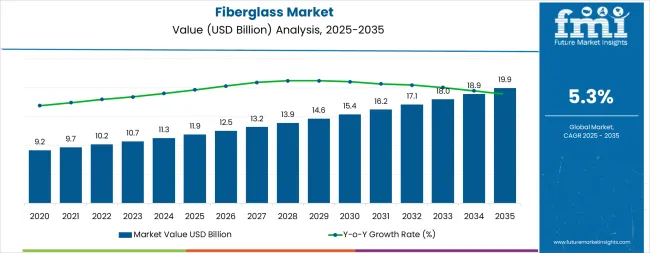
- Market Size (2026): USD 12.5 Bn
- Forecast (2036): USD 21.0 Bn
- CAGR (2026 to 2036): 5.3%
Fiberglass Market Size, Market Forecast and Outlook By FMI
Summary of the Fiberglass Market
- Demand and Growth Drivers
- Construction is expected to hold 29.0% share in 2026, as insulation and panels use fiberglass for thermal control.
- Wind energy supports higher-value rovings, with blade makers needing strength at manageable material cost.
- Transportation demand rises through weight reduction, as these fiberglass are increasingly being used in panels and underbody components.
- India is projected to grow at a 7.8% compound annual growth rate, supported by strong infrastructure expansion and rising investment in renewable energy manufacturing.
- China is expected to register a 5.9% CAGR, driven by its extensive composite manufacturing capacity and a well‑established wind blade production ecosystem.
- Product and Segment View
- Rovings are projected to lead product type demand with 46.0% share in 2026, as fabricators need continuous fiber input.
- E-glass is estimated to lead glass type demand with 67.0% share in 2026, given its balance of strength and cost.
- Construction is expected to dominate application demand with 29.0% share in 2026, supported by insulation and panels.
- Pultrusion is projected to account for 31.0% share in 2026, as structural profiles need repeatable strength.
- Direct sales are estimated to hold 61.0% share in 2026, with large buyers needing grade support.
- Geography and Competitive Outlook
- India and China are forecast above the global average, supported by wind energy and construction materials.
- The United States is projected at 2.9% CAGR, as replacement demand and building codes guide demand.
- Main companies include Owens Corning, China Jushi, Taishan Fiberglass, CPIC, Nippon Electric Glass, Saint-Gobain, and Johns Manville.
- China Jushi is estimated to hold the dominant share reflecting large-scale glass fiber capacity.
- Analyst Opinion
- Nikhil Kaitwade, Associate Vice President at FMI says, “Our analysis indicates that fiberglass market growth is being shaped by two distinct demand drivers. Construction continues to garner significant volumes by supporting steady consumption in insulation and building applications, while wind energy and transportation composites are driving higher‑specification and higher‑value demand.”
- Fiberglass Market Value Analysis
- Fiberglass market is projected to rise from USD 12.5 billion in 2026 to USD 21.0 billion by 2036.
- Rovings are expected to lead product demand with 46.0% share in 2026, as blade and panel makers need continuous fibers.
- Construction is projected to hold 29.0% share in 2026, helped by insulation and panel applications.
- Direct sales are estimated to account for 61.0% share in 2026, with large processors needing grade-specific support.
- Energy cost and furnace uptime will affect margins across high-volume fiberglass plants.
Fiberglass Market Definition
The fiberglass market includes glass fibers used as reinforcement and insulation. Filtration media and composite inputs also fall within scope. Scope covers rovings and chopped strands. Yarn and mats are included. Fabrics sold into construction and transport applications also form part of scope. Wind energy and electrical applications are included. Marine applications are covered. The market excludes finished boats and finished turbine blades. Finished electronic devices are excluded. Non-glass fiber reinforcements such as carbon fiber and aramid fiber are outside scope.
Fiberglass Market Inclusions
Scope includes E-glass and S-glass. C-glass and A-glass are included. AR-glass also falls within scope. Rovings and chopped strands are covered. Yarn and mats are included. Fabrics form part of the product scope. Direct sales and distributors are covered. Online channels are included. All major global regions fall within scope.
Fiberglass Market Exclusions
Scope excludes carbon fiber composites and aramid fiber products. Finished wind blades and finished FRP tanks are outside scope. Mineral wool without fiberglass content is excluded. Unrelated glass packaging products are also outside scope.
Fiberglass Market Research Methodology
- Primary Research: FMI analysts reviewed fiberglass producers and composite fabricators. Insulation converters and distributors were covered. End-use buyers were included. Interviews focused on grade selection and furnace supply reliability. Technical documentation and price movement were reviewed.
- Desk Research: Desk research used customs classifications and mineral inputs. Wind energy data and building insulation references were reviewed. Official company product information was used. The study avoided syndicated commercial market figures for market sizing.
- Market Sizing and Forecasting: Market sizing combined product volume estimates and fiberglass price bands. Country-level use rates and end-use growth assumptions were included. Forecasts were checked against construction and wind energy indicators. Automotive and electrical demand indicators were also reviewed.
- Data Validation: Forecasts were cross-checked with company capacity signals and public trade data. Wind installation trends and official energy statistics were reviewed. Segment shares were validated against product use across rovings and mats. Fabrics and chopped strands were also checked.
Why is the Fiberglass Market Growing?
- Wind blade manufacturing needs rovings that offer stiffness and cost control in large composite structures.
- Building insulation demand supports fiberglass wool use in walls and HVAC systems.
- Transportation manufacturers use fiberglass composites when steel replacement needs lower weight and stable cost.
- Electrical applications need glass fiber yarns and fabrics for circuit boards and insulation layers.
- Infrastructure repair uses glass fiber reinforced materials in rebar and structural reinforcement.
Wind energy is one of the significant factor driving demand for fiberglass rovings. GWEC reported that global wind installations reached 117 GW in 2024, creating a large blade production base that uses glass fiber reinforcement in many turbine designs. Blade demand matters because blade makers need long fiber formats with stable tensile strength and predictable resin wet-out. Larger blades raise the value of consistent rovings, as small fiber variation can affect blade quality. Suppliers that can support blade factories with dependable sizing chemistry gain better positions in renewable energy composites.
Transportation is another aspect which influences fiberglass adoption because vehicle makers want lighter parts without moving every component to carbon fiber. IEA reported that electric car sales exceeded 17 million globally in 2024, with more than 20% of new cars sold worldwide being electric. This creates demand for lighter panels and underbody components. Fiberglass fits many of these parts because it balances weight saving with lower cost than carbon fiber. The outcome is wider use in mid-cost vehicle platforms where material economics still matter.
Market Segmentation Analysis
- Rovings are projected to account for 46.0% share in 2026, as continuous reinforcement is essential for composites.
- E-glass is estimated to hold 67.0% share in 2026, with cost and performance suited to broad use.
- Construction is expected to represent 29.0% share in 2026, as fiberglass supports insulation and panel systems.
- Pultrusion is projected to hold 31.0% share in 2026, with profiles used in building and infrastructure products.
- Direct sales are anticipated to account for 61.0% share in 2026, as large users need technical support.
Segmentation follows the factors buyers consider before placing fiberglass orders. Product type guides selection because rovings and chopped strands behave differently in resin systems. Yarns and mats behave differently in insulation lines. Glass type guides selection because E-glass covers most cost-sensitive uses. S-glass and specialty grades serve higher-stress applications. The construction segment leads because insulation and panels need steady volumes across residential and commercial buildings. Pultrusion holds a high process share since it produces repeatable profiles used in gratings and ladders. Structural members create another use base. Direct sales lead where large processors need consistent grade supply and plant-level technical guidance.
Insights into the Rovings Product Type Segment
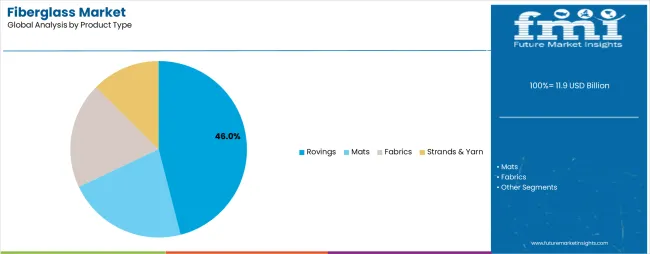
- Rovings are projected to account for 46.0% in 2026 due to continuous reinforcement with stable strength needed for wind blade and panel makers.
- Chopped strands appear in molded parts and compounds as processors need shorter fiber length and easier dispersion in thermoplastic or thermoset systems.
Insights into the E-Glass Glass Type Segment
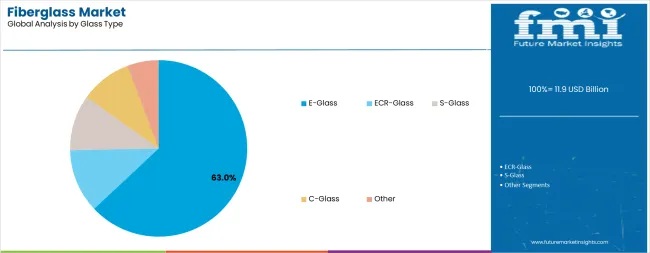
- E-glass is estimated to hold 67.0% of glass type demand in 2026, as it offers enough strength and electrical resistance for common industrial uses.
- S-glass remains a higher-cost option for aerospace and defense parts, where strength-to-weight performance can justify a narrower supplier base.
Insights into the Construction Application Segment
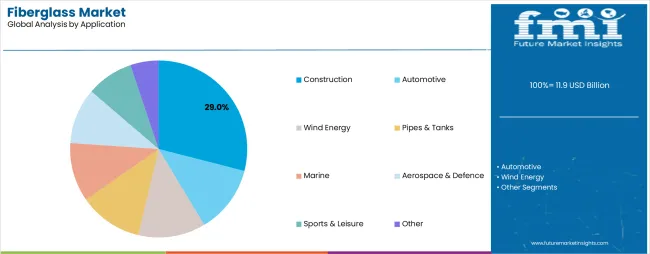
- Construction is expected to represent 29.0% of application demand in 2026, as fiberglass insulation, panels, and reinforcement products are widely used in buildings.
- Wind energy uses fewer product forms than construction. Blade rovings can create higher value per ton through tighter technical needs.
Insights into the Pultrusion Manufacturing Process Segment
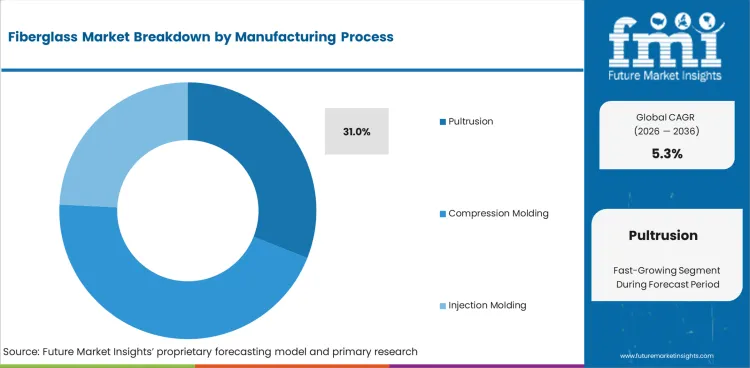
- Pultrusion is projected to account for 31.0% of process demand in 2026, with continuous profiles used in ladders and infrastructure parts.
- Filament winding is more common in tanks and pipes, where hoop strength matters more than flat panel finish or profile repeatability.
Insights into the Direct Sales Channel Segment
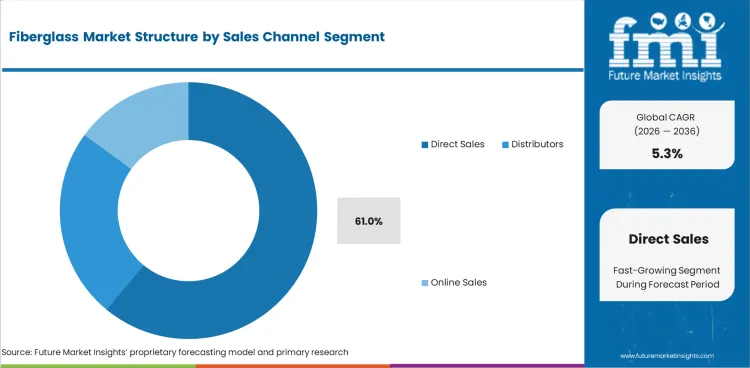
- Direct sales are anticipated to hold 61.0% of channel demand in 2026, as large fabricators need grade matching and supply planning.
- Distributors serve smaller processors better, mainly buyers that need mixed glass forms without committing to full truckload volumes.
Fiberglass Market Drivers, Restraints, and Opportunities
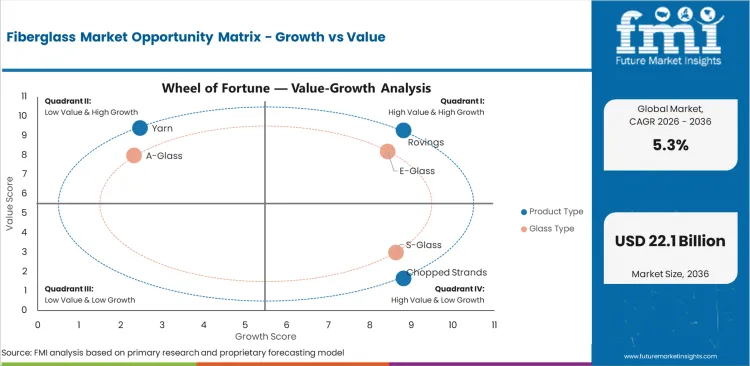
- Wind blade reinforcement raises rovings demand, with turbine makers needing stable fiber strength across longer blades.
- Building energy efficiency supports fiberglass insulation use, mainly in walls and roofing systems.
- Transportation lightweighting expands composite use, as fiberglass offers a lower-cost path than carbon fiber.
- Furnace energy cost remains the main restraint, since glass melting needs stable heat and continuous operation.
- Recycled glass fiber processing creates an opportunity as composite waste rules tighten across Europe.
Wind Blade Roving Demand
Wind blades are anticipated to propel the fiberglass demand which offers both volume and technical consistency. Global wind installations reached 117 GW in 2024, and each new project needs blade materials that can manage bending loads and fatigue cycles. Rovings must run cleanly through resin systems and maintain fiber alignment. Blade makers compare suppliers on sizing chemistry and shipment reliability before changing approved grades. Fiberglass producers with wind application teams can protect margins better than sellers competing only on price. Long qualification cycles give larger suppliers an advantage in long qualification cycles.
Building Insulation Pull
Building insulation creates a stable volume base for fiberglass because walls and HVAC ducts need low-cost thermal control. The USA Department of Energy notes that heating and cooling account for about half of a typical home’s energy use, which keeps insulation central to energy-saving work. This raises fiberglass demand in batts, blankets, and duct wrap formats. Material choice is driven by fire performance, price, and installer familiarity. Suppliers that serve both residential and commercial channels can smooth demand across building cycles. This reduces dependence on one end-use sector.
Furnace Cost Pressure
Fiberglass production carries cost risk because furnaces need steady energy input and controlled melting conditions. USGS reported 2024 mineral production data across industrial minerals in January 2025, including silica sand and related glass inputs used in glass manufacturing. Glass fiber producers face exposure to raw material availability and energy costs together. Plants with modern furnaces can reduce waste and improve yield. Older assets face more pressure when selling into price-sensitive construction or commodity composite uses.
Analysis of Fiberglass Market By Key Countries
.webp "Top Country Growth Comparison Fiberglass Market Cagr (2026 2036)")
| Country | CAGR |
|---|---|
| India | 7.8% |
| China | 5.9% |
| Brazil | 5.7% |
| United States | 2.9% |
| Germany | 2.8% |
| France | 2.4% |
| Japan | 2.2% |
Source: FMI analysis based on primary research and proprietary forecasting model.
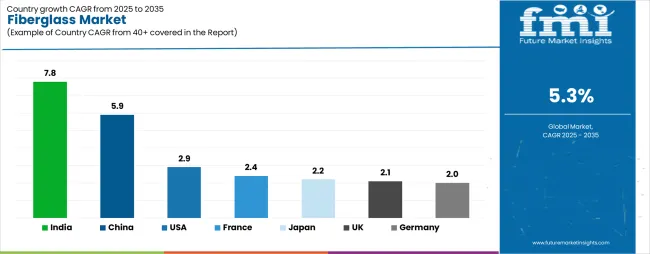
Fiberglass Market CAGR Analysis By Country
- India is projected to record a 7.8% CAGR through 2036 as infrastructure and wind energy create broad fiberglass use.
- China is expected to expand at 5.9% CAGR through 2036 since domestic blade and construction material output stays large.
- Brazil is forecast to grow at 5.7% CAGR through 2036 as wind energy and industrial construction support composites.
- The United States is expected to advance at 2.9% CAGR through 2036 given its mature insulation and composites base.
- Germany is projected to rise at 2.8% CAGR through 2036 where wind repowering and industrial composites guide demand.
- France is forecast at 2.4% CAGR through 2036 as building efficiency and transport composites support stable use.
- Japan is expected to post 2.2% CAGR through 2036 with specialty glass fiber use in electronics and transport applications.
India, China, and Brazil are forecast above the global average because their wind energy and construction pipelines need large material volumes. The United States, Germany, France, and Japan are forecast below the global average because their demand base is more mature. The spread reflects the difference between new project-led growth and replacement-driven use.
Demand Outlook for Fiberglass Market in India
India has one of the highest fiberglass growth rates because wind power, construction, and vehicle manufacturing are expanding together. The country is projected to record a 7.8% CAGR through 2036, with faster use across rovings and insulation. India’s Ministry of New and Renewable Energy reported that wind capacity crossed 56 GW after the highest-ever annual addition of 6.05 GW in FY 2025-26. This supports roving demand because wind blade production needs continuous glass fiber input. Suppliers with links to Gujarat and Karnataka gain better access to blade and infrastructure buyers.
- Tamil Nadu remains important for wind equipment, with blade and nacelle supply chains serving southern renewable energy projects.
- Gujarat supports fiberglass use through wind projects and ports connected to composite component movement.
- Maharashtra creates demand through vehicle parts and industrial composite users around Pune and Mumbai.
Sales Analysis of Fiberglass Market in China
China’s fiberglass position depends on its large manufacturing base and wind energy scale. The country is expected to expand at 5.9% CAGR through 2036, with demand highest in rovings and construction-linked products. National Energy Administration data cited in 2025 showed China’s wind power capacity reached about 520 GW by 2024. This scale is because blade producers and composite processors need large glass fiber volumes at consistent grades. Domestic producers benefit from furnace scale, lower unit cost, and nearby customer clusters. Export exposure still creates pricing pressure when trade measures change across Europe and North America.
- Zhejiang remains important because China Jushi’s Tongxiang base anchors large glass fiber production capacity.
- Jiangsu supports demand through wind blade and industrial composite processing clusters.
- Shandong creates added pull through wind power projects and building material production near coastal industrial zones.
Demand Analysis of Fiberglass Market in Brazil
Brazil’s fiberglass demand is tied to wind energy and industrial panels. Brazil is forecast to grow at 5.7% rate through 2036 as renewable power and transport needs support composites. GWEC listed Brazil among the top markets after China and the United States for 2024 wind additions. Wind blade use creates demand for rovings and fabrics with tighter technical consistency. Suppliers serving Ceará and Rio Grande do Norte can gain from project proximity and port access.
- Bahia has strong wind project activity, which supports demand for blade materials and related composite inputs.
- Ceará benefits from port-linked wind equipment movement and renewable energy investment around coastal zones.
- São Paulo supports fiberglass use through vehicle parts, industrial panels, and distribution networks.
Opportunity Analysis of Fiberglass Market in the United States
The United States has a mature fiberglass base, so growth depends on replacement and advanced composites. The country is expected to advance at 2.9% CAGR through 2036, with construction remaining the largest steady outlet. DOE’s wind market materials show the domestic land-based wind sector supports 125,580 jobs, which signals a large supplier and service base for blade maintenance and replacement. Fiberglass suppliers gain from both new parts and repair materials. Owens Corning’s Kansas City fiberglass insulation line adds another signal of domestic construction demand.
- Kansas City gains relevance from Owens Corning’s new fiberglass insulation line announced in September 2025.
- Texas supports composite demand through wind energy, industrial facilities, and Gulf Coast infrastructure.
- Georgia benefits from Johns Manville’s planned Climate Pro production line in Winder.
Future Outlook for Fiberglass Market in Germany
Germany’s fiberglass demand is due to wind repowering and energy-efficient buildings. Germany is projected to rise at 2.8% CAGR through 2036, with slower growth than Asia due to a more established manufacturing base. BWE and VDMA reported that total German onshore wind capacity increased to around 68,100 MW by early 2026. This raises fiberglass demand in blades, nacelle parts, and maintenance materials. Suppliers face pressure from energy cost and import competition, so high-consistency grades matter more than total volume. German buyers are likely to favor dependable technical support and local qualification records.
- Lower Saxony supports wind energy demand through large onshore capacity and blade service activity.
- North Rhine-Westphalia uses fiberglass across industrial composites, chemical plants, and construction materials.
- Bavaria contributes through automotive suppliers that test glass fiber reinforced parts for lighter components.
Demand Outlook for Fiberglass Market in France
Fiberglass adoption in France grows through construction efficiency and wind-related composites. The country is forecast to register 2.4% CAGR through 2036, below the global average because its building and transport markets are well developed. EU vehicle and building efficiency rules support steady material use rather than sharp volume jumps. Fiberglass insulation gains when renovation projects need affordable thermal control. Composite demand improves when transport buyers need lower weight without premium carbon fiber cost. Suppliers with French distribution and EU compliance documentation will have a stronger route to recurring orders.
- Hauts-de-France supports wind-related demand through ports and energy projects near the Channel coast.
- Île-de-France renovation work supports insulation demand across public and commercial buildings.
- Auvergne-Rhône-Alpes contributes through industrial composites and transport-linked suppliers.
In-depth Analysis of Fiberglass Market in Japan
Fiberglass demand is Japan is technically selective than many larger countries. Japan is expected to post 2.2% CAGR through 2036 as electronics and specialty composites support steady use. Nippon Electric Glass launched D2 Fiber in December 2025 for advanced semiconductors and high-speed communication applications. Japan’s fiberglass demand includes high-value electronic glass fiber beyond common construction uses. Domestic suppliers compete on dielectric performance, quality control, and customer qualification. Volume growth stays moderate, but specialty grades can protect value in electronics and data infrastructure.
- Shiga remains important because Nippon Electric Glass is headquartered in Otsu.
- Aichi supports transport composite use through automotive production and supplier engineering.
- Kyushu contributes through semiconductor investment that can support electronic glass fiber demand.
Competition and Strategic Positioning
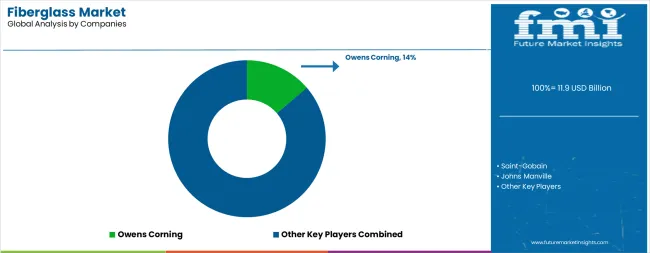
- Competition is moderately concentrated, with large producers controlling furnace scale and qualification access.
- China Jushi, Owens Corning, and Johns Manville compete through broad product coverage and international channels.
- Specialist companies compete in electronic glass fiber and local conversion support.
- Entry barriers are high because furnace cost and customer approvals take time.
Established fiberglass companies compete on furnace scale and product consistency and customer qualification history. Owens Corning’s April 2026 amended agreement to sell its glass reinforcements business to Praana Group shows how portfolio focus is changing across global suppliers. Reinforcements require scale and deep customer ties. Some building products groups prefer simpler insulation and construction exposure. Buyers are watching ownership changes closely because grade approvals can be disrupted when supply contracts shift. Suppliers that protect continuity during ownership changes can retain more large composite accounts.
Capability depth separates global players from local sellers in fiberglass. Nippon Electric Glass launched D2 Fiber in December 2025, aimed at low-dielectric performance for advanced semiconductors and data centers. The launch indicates how fiberglass value can move beyond bulk reinforcement into electronics-grade performance. Buyers in electronics care about signal loss and stable fiber dimensions. Producers with advanced melting control and R&D capacity can defend premium niches. Specialty grades give these producers a different route than competing directly against China-based volume producers.
Construction insulation remains a major competitive base because it gives recurring volume and local channel access. Johns Manville announced a planned Climate Pro production line in Georgia in February 2025, which adds capacity for blown-in fiberglass insulation. These moves point to steady demand in residential and commercial building envelopes. Suppliers with regional plants can reduce freight exposure and improve service timing.
Key Companies in the Fiberglass Market
Fiberglass competition is best viewed by producer role, since companies differ by volume, specialty grade depth, and regional reach.
- Global Glass Fiber Producers: China Jushi, Owens Corning, Taishan Fiberglass, and CPIC compete through large furnace networks, rovings, chopped strands, yarns, and mats. Their strengths include scale, export channels, grade portfolios, and the ability to serve wind blade, construction, and industrial composite buyers across multiple regions.
- Specialty Glass Fiber Producers: Nippon Electric Glass and Saint-Gobain compete through higher-value glass technologies, specialty fabrics, and advanced material know-how. Their advantage is stronger in electronics, high-performance composites, and applications where dielectric behavior, thermal control, or tight product qualification is more important than the lowest price.
- Insulation and Building-Focused Suppliers: Johns Manville and Owens Corning compete through fiberglass insulation, duct wrap, batts, and building products. Their advantage comes from brand recognition, contractor channels, code familiarity, and plant proximity to construction demand in North America and Europe.
Competitive Benchmarking: Fiberglass Market
| Company | Furnace Scale Depth | Roving Grade Breadth | Application Support Depth | Geographic Footprint |
|---|---|---|---|---|
| China Jushi | High | High | Strong | Global |
| Owens Corning | High | Strong | Strong | Global |
| Taishan Fiberglass | High | High | Moderate | Asia, Europe |
| CPIC | High | Strong | Moderate | Asia, Europe |
| Johns Manville | Strong | Medium | Strong | North America, Europe |
| Nippon Electric Glass | Medium | Strong | High | Japan, Europe, Asia |
| Saint-Gobain | Strong | Medium | High | Global |
| AGY | Medium | Strong | High | North America, Europe |
Source: Future Market Insights competitive analysis, 2026. Ratings reflect relative positioning based on furnace scale depth, roving grade breadth, and application support depth.
Recent Developments in Fiberglass Market
- In February 2025, Owens Corning agreed to sell its glass reinforcements business to Praana Group. The move changes ownership exposure in reinforcement-focused fiberglass.
- In February 2025, Johns Manville announced a planned Climate Pro production line in Georgia. The investment supports blown-in fiberglass insulation demand.
- In December 2025, Nippon Electric Glass launched D2 Fiber for advanced semiconductors. The product supports low-loss glass fiber demand in data infrastructure.
- In April 2025, Nippon Electric Glass announced a strategic review of Electric Glass Fiber UK. The step showed cost pressure in European fiberglass production.
Key Players in the Fiberglass Market
Global Glass Fiber Producers
- China Jushi
- Owens Corning
- Taishan Fiberglass
- CPIC
Specialty Glass Fiber Producers
- Nippon Electric Glass
- Saint-Gobain
- AGY
Insulation and Building-Focused Suppliers
- Johns Manville
- Owens Corning
Report Scope and Coverage
| Parameter | Details |
|---|---|
| Quantitative Units | USD 12.5 billion in 2026 to USD 21.0 billion by 2036, at 5.3% CAGR |
| Market Definition | Glass fibers used as reinforcement, insulation, filtration media, fabric, yarn, mat, and composite input. |
| Regions Covered | North America, Latin America, Europe, East Asia, South Asia and Pacific, Middle East and Africa |
| Countries Covered | India, China, Brazil, United States, Germany, France, Japan, and 30+ countries |
| Key Companies Profiled | Owens Corning, China Jushi, Johns Manville, Nippon Electric Glass, Saint-Gobain, Taishan Fiberglass, CPIC |
| Forecast Period | 2026 to 2036 |
| Approach | Hybrid bottom-up and top-down methodology using end-use volumes, product pricing, and country-level demand indicators |
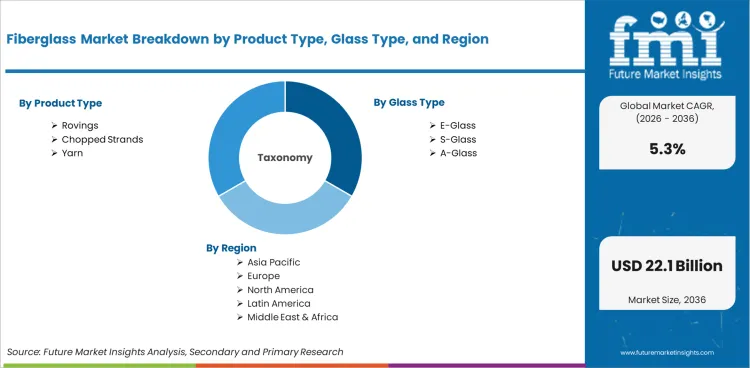
Fiberglass Market Breakdown By Product Type, Glass Type, Application, Manufacturing Process, Sales Channel, and Region
Fiberglass Market Segmented by Product Type
- Rovings
- Chopped Strands
- Yarn
- Mats
- Fabrics
Fiberglass Market Segmented by Glass Type
- E-Glass
- S-Glass
- C-Glass
- A-Glass
- AR-Glass
Fiberglass Market Segmented by Application
- Construction
- Transportation
- Wind Energy
- Electrical
- Marine
Fiberglass Market Segmented by Manufacturing Process
- Pultrusion
- Compression Molding
- Filament Winding
- Injection Molding
- Layup
Fiberglass Market Segmented by Sales Channel
- Direct Sales
- Distributors
- Online Sales
Fiberglass Market by Region
- North America
- United States
- Canada
- Mexico
- Latin America
- Brazil
- Chile
- Rest of Latin America
- Western Europe
- Germany
- UK
- Italy
- Spain
- France
- Nordic
- BENELUX
- Rest of Western Europe
- Eastern Europe
- Russia
- Poland
- Hungary
- Balkan & Baltic
- Rest of Eastern Europe
- East Asia
- China
- Japan
- South Korea
- South Asia and Pacific
- India
- ASEAN
- Australia & New Zealand
- Rest of South Asia and Pacific
- Middle East & Africa
- Kingdom of Saudi Arabia
- Other GCC Countries
- Turkiye
- South Africa
- Other African Union
- Rest of Middle East & Africa
Research Sources and Bibliography
- International Energy Agency. (2025, May 14). Global EV outlook 2025.
- Global Wind Energy Council. (2025, April 23). Wind industry installs record capacity in 2024 despite policy instability.
- USA Geological Survey. (2025, January 31). Mineral commodity summaries 2025. USA Department of the Interior.
- Ministry of New and Renewable Energy. (2026, April 6). India achieves highest-ever annual wind energy addition of 6.05 GW in 2025-26. Press Information Bureau.
- Bundesverband WindEnergie & VDMA Power Systems. (2026, January 15). Stabilise high expansion, ensure resilience.
- Owens Corning. (2026, April 15). Owens Corning enters into amended agreement with Praana Group for sale of glass reinforcements business.
- Johns Manville. (2025, February 25). Johns Manville announces plan for new Climate Pro production line in Georgia.
- Owens Corning. (2026, February 1). Owens Corning building state-of-the-art fiberglass line.
- Nippon Electric Glass. (2025, December 2). Launch of D2 Fiber, NEG’s new low dielectric glass fiber.
- Nippon Electric Glass. (2025, April 3). Announcement of strategic review of composites business at Electric Glass Fiber UK, Ltd.
The bibliography is provided for reader reference and uses FMI pages for interlink context plus primary official, trade body, government, and company sources for market evidence.
This Report Answers
- What is the projected value of fiberglass demand in 2026 and 2036?
- What CAGR is forecast for fiberglass sales from 2026 to 2036?
- Which product type is projected to lead fiberglass demand in 2026?
- Which application is expected to account for the highest fiberglass share in 2026?
- Why do wind energy and construction remain central to fiberglass demand?
- How do furnace cost and energy exposure affect fiberglass supplier margins?
- Which countries are forecast to grow faster than the global fiberglass average?
- Which companies compete in fiberglass through scale, specialty grades, and insulation channels?
- What products and applications are included within the fiberglass market scope?
- How does FMI size and validate fiberglass market forecasts?
Frequently Asked Questions
What is the global market demand for fiberglass in 2026?
In 2026, the global fiberglass market is expected to be worth USD 12.5 billion, supported by construction and wind energy.
What will the fiberglass market be worth by 2036?
By 2036, fiberglass demand is projected to reach USD 21.0 billion, with growth across insulation and composite applications.
What is the CAGR of the fiberglass market from 2026 to 2036?
The fiberglass market is forecast to grow at 5.3% CAGR from 2026 to 2036.
Which product type is expected to lead the fiberglass market in 2026?
Rovings are projected to lead with 46.0% share in 2026, supported by wind blade and pultrusion use.
Which application is expected to lead fiberglass demand in 2026?
Construction is expected to lead with 29.0% share in 2026, supported by insulation and panel applications.
Why is India the fastest-growing fiberglass country?
India is projected at 7.8% CAGR through 2036, supported by wind capacity additions and infrastructure use.
What does the fiberglass market include?
The market includes glass fibers used in rovings, chopped strands, yarns, mats, fabrics, insulation, and reinforced plastics.
How does FMI forecast fiberglass demand?
FMI uses end-use volume mapping, product pricing, country-level demand indicators, and company capacity signals to validate forecasts.
Table of Content
- Executive Summary
- Global Market Outlook
- Demand-side Trends
- Supply-side Trends
- Technology Roadmap Analysis
- Analysis and Recommendations
- Market Overview
- Market Coverage / Taxonomy
- Market Definition / Scope / Limitations
- Research Methodology
- Chapter Orientation
- Analytical Lens and Working Hypotheses
- Market Structure, Signals, and Trend Drivers
- Benchmarking and Cross-market Comparability
- Market Sizing, Forecasting, and Opportunity Mapping
- Research Design and Evidence Framework
- Desk Research Programme (Secondary Evidence)
- Company Annual and Sustainability Reports
- Peer-reviewed Journals and Academic Literature
- Corporate Websites, Product Literature, and Technical Notes
- Earnings Decks and Investor Briefings
- Statutory Filings and Regulatory Disclosures
- Technical White Papers and Standards Notes
- Trade Journals, Industry Magazines, and Analyst Briefs
- Conference Proceedings, Webinars, and Seminar Materials
- Government Statistics Portals and Public Data Releases
- Press Releases and Reputable Media Coverage
- Specialist Newsletters and Curated Briefings
- Sector Databases and Reference Repositories
- FMI Internal Proprietary Databases and Historical Market Datasets
- Subscription Datasets and Paid Sources
- Social Channels, Communities, and Digital Listening Inputs
- Additional Desk Sources
- Expert Input and Fieldwork (Primary Evidence)
- Primary Modes
- Qualitative Interviews and Expert Elicitation
- Quantitative Surveys and Structured Data Capture
- Blended Approach
- Why Primary Evidence is Used
- Field Techniques
- Interviews
- Surveys
- Focus Groups
- Observational and In-context Research
- Social and Community Interactions
- Stakeholder Universe Engaged
- C-suite Leaders
- Board Members
- Presidents and Vice Presidents
- R&D and Innovation Heads
- Technical Specialists
- Domain Subject-matter Experts
- Scientists
- Physicians and Other Healthcare Professionals
- Governance, Ethics, and Data Stewardship
- Research Ethics
- Data Integrity and Handling
- Primary Modes
- Tooling, Models, and Reference Databases
- Desk Research Programme (Secondary Evidence)
- Data Engineering and Model Build
- Data Acquisition and Ingestion
- Cleaning, Normalisation, and Verification
- Synthesis, Triangulation, and Analysis
- Quality Assurance and Audit Trail
- Market Background
- Market Dynamics
- Drivers
- Restraints
- Opportunity
- Trends
- Scenario Forecast
- Demand in Optimistic Scenario
- Demand in Likely Scenario
- Demand in Conservative Scenario
- Opportunity Map Analysis
- Product Life Cycle Analysis
- Supply Chain Analysis
- Investment Feasibility Matrix
- Value Chain Analysis
- PESTLE and Porter’s Analysis
- Regulatory Landscape
- Regional Parent Market Outlook
- Production and Consumption Statistics
- Import and Export Statistics
- Market Dynamics
- Global Market Analysis 2021 to 2025 and Forecast, 2026 to 2036
- Historical Market Size Value (USD Million) Analysis, 2021 to 2025
- Current and Future Market Size Value (USD Million) Projections, 2026 to 2036
- Y-o-Y Growth Trend Analysis
- Absolute $ Opportunity Analysis
- Global Market Pricing Analysis 2021 to 2025 and Forecast 2026 to 2036
- Global Market Analysis 2021 to 2025 and Forecast 2026 to 2036, By Product Type
- Introduction / Key Findings
- Historical Market Size Value (USD Million) Analysis By Product Type , 2021 to 2025
- Current and Future Market Size Value (USD Million) Analysis and Forecast By Product Type , 2026 to 2036
- Rovings
- Chopped Strands
- Yarn
- Rovings
- Y-o-Y Growth Trend Analysis By Product Type , 2021 to 2025
- Absolute $ Opportunity Analysis By Product Type , 2026 to 2036
- Global Market Analysis 2021 to 2025 and Forecast 2026 to 2036, By Glass Type
- Introduction / Key Findings
- Historical Market Size Value (USD Million) Analysis By Glass Type, 2021 to 2025
- Current and Future Market Size Value (USD Million) Analysis and Forecast By Glass Type, 2026 to 2036
- E-Glass
- S-Glass
- A-Glass
- E-Glass
- Y-o-Y Growth Trend Analysis By Glass Type, 2021 to 2025
- Absolute $ Opportunity Analysis By Glass Type, 2026 to 2036
- Global Market Analysis 2021 to 2025 and Forecast 2026 to 2036, By Application
- Introduction / Key Findings
- Historical Market Size Value (USD Million) Analysis By Application, 2021 to 2025
- Current and Future Market Size Value (USD Million) Analysis and Forecast By Application, 2026 to 2036
- Construction
- Transportation
- Electrical
- Construction
- Y-o-Y Growth Trend Analysis By Application, 2021 to 2025
- Absolute $ Opportunity Analysis By Application, 2026 to 2036
- Global Market Analysis 2021 to 2025 and Forecast 2026 to 2036, By Manufacturing Process
- Introduction / Key Findings
- Historical Market Size Value (USD Million) Analysis By Manufacturing Process, 2021 to 2025
- Current and Future Market Size Value (USD Million) Analysis and Forecast By Manufacturing Process, 2026 to 2036
- Pultrusion
- Compression Molding
- Injection Molding
- Pultrusion
- Y-o-Y Growth Trend Analysis By Manufacturing Process, 2021 to 2025
- Absolute $ Opportunity Analysis By Manufacturing Process, 2026 to 2036
- Global Market Analysis 2021 to 2025 and Forecast 2026 to 2036, By Sales Channel
- Introduction / Key Findings
- Historical Market Size Value (USD Million) Analysis By Sales Channel, 2021 to 2025
- Current and Future Market Size Value (USD Million) Analysis and Forecast By Sales Channel, 2026 to 2036
- Direct Sales
- Distributors
- Online Sales
- Direct Sales
- Y-o-Y Growth Trend Analysis By Sales Channel, 2021 to 2025
- Absolute $ Opportunity Analysis By Sales Channel, 2026 to 2036
- Global Market Analysis 2021 to 2025 and Forecast 2026 to 2036, By Region
- Introduction
- Historical Market Size Value (USD Million) Analysis By Region, 2021 to 2025
- Current Market Size Value (USD Million) Analysis and Forecast By Region, 2026 to 2036
- North America
- Latin America
- Western Europe
- Eastern Europe
- East Asia
- South Asia and Pacific
- Middle East & Africa
- Market Attractiveness Analysis By Region
- North America Market Analysis 2021 to 2025 and Forecast 2026 to 2036, By Country
- Historical Market Size Value (USD Million) Trend Analysis By Market Taxonomy, 2021 to 2025
- Market Size Value (USD Million) Forecast By Market Taxonomy, 2026 to 2036
- By Country
- USA
- Canada
- Mexico
- By Product Type
- By Glass Type
- By Application
- By Manufacturing Process
- By Sales Channel
- By Country
- Market Attractiveness Analysis
- By Country
- By Product Type
- By Glass Type
- By Application
- By Manufacturing Process
- By Sales Channel
- Key Takeaways
- Latin America Market Analysis 2021 to 2025 and Forecast 2026 to 2036, By Country
- Historical Market Size Value (USD Million) Trend Analysis By Market Taxonomy, 2021 to 2025
- Market Size Value (USD Million) Forecast By Market Taxonomy, 2026 to 2036
- By Country
- Brazil
- Chile
- Rest of Latin America
- By Product Type
- By Glass Type
- By Application
- By Manufacturing Process
- By Sales Channel
- By Country
- Market Attractiveness Analysis
- By Country
- By Product Type
- By Glass Type
- By Application
- By Manufacturing Process
- By Sales Channel
- Key Takeaways
- Western Europe Market Analysis 2021 to 2025 and Forecast 2026 to 2036, By Country
- Historical Market Size Value (USD Million) Trend Analysis By Market Taxonomy, 2021 to 2025
- Market Size Value (USD Million) Forecast By Market Taxonomy, 2026 to 2036
- By Country
- Germany
- UK
- Italy
- Spain
- France
- Nordic
- BENELUX
- Rest of Western Europe
- By Product Type
- By Glass Type
- By Application
- By Manufacturing Process
- By Sales Channel
- By Country
- Market Attractiveness Analysis
- By Country
- By Product Type
- By Glass Type
- By Application
- By Manufacturing Process
- By Sales Channel
- Key Takeaways
- Eastern Europe Market Analysis 2021 to 2025 and Forecast 2026 to 2036, By Country
- Historical Market Size Value (USD Million) Trend Analysis By Market Taxonomy, 2021 to 2025
- Market Size Value (USD Million) Forecast By Market Taxonomy, 2026 to 2036
- By Country
- Russia
- Poland
- Hungary
- Balkan & Baltic
- Rest of Eastern Europe
- By Product Type
- By Glass Type
- By Application
- By Manufacturing Process
- By Sales Channel
- By Country
- Market Attractiveness Analysis
- By Country
- By Product Type
- By Glass Type
- By Application
- By Manufacturing Process
- By Sales Channel
- Key Takeaways
- East Asia Market Analysis 2021 to 2025 and Forecast 2026 to 2036, By Country
- Historical Market Size Value (USD Million) Trend Analysis By Market Taxonomy, 2021 to 2025
- Market Size Value (USD Million) Forecast By Market Taxonomy, 2026 to 2036
- By Country
- China
- Japan
- South Korea
- By Product Type
- By Glass Type
- By Application
- By Manufacturing Process
- By Sales Channel
- By Country
- Market Attractiveness Analysis
- By Country
- By Product Type
- By Glass Type
- By Application
- By Manufacturing Process
- By Sales Channel
- Key Takeaways
- South Asia and Pacific Market Analysis 2021 to 2025 and Forecast 2026 to 2036, By Country
- Historical Market Size Value (USD Million) Trend Analysis By Market Taxonomy, 2021 to 2025
- Market Size Value (USD Million) Forecast By Market Taxonomy, 2026 to 2036
- By Country
- India
- ASEAN
- Australia & New Zealand
- Rest of South Asia and Pacific
- By Product Type
- By Glass Type
- By Application
- By Manufacturing Process
- By Sales Channel
- By Country
- Market Attractiveness Analysis
- By Country
- By Product Type
- By Glass Type
- By Application
- By Manufacturing Process
- By Sales Channel
- Key Takeaways
- Middle East & Africa Market Analysis 2021 to 2025 and Forecast 2026 to 2036, By Country
- Historical Market Size Value (USD Million) Trend Analysis By Market Taxonomy, 2021 to 2025
- Market Size Value (USD Million) Forecast By Market Taxonomy, 2026 to 2036
- By Country
- Kingdom of Saudi Arabia
- Other GCC Countries
- Turkiye
- South Africa
- Other African Union
- Rest of Middle East & Africa
- By Product Type
- By Glass Type
- By Application
- By Manufacturing Process
- By Sales Channel
- By Country
- Market Attractiveness Analysis
- By Country
- By Product Type
- By Glass Type
- By Application
- By Manufacturing Process
- By Sales Channel
- Key Takeaways
- Key Countries Market Analysis
- USA
- Pricing Analysis
- Market Share Analysis, 2025
- By Product Type
- By Glass Type
- By Application
- By Manufacturing Process
- By Sales Channel
- Canada
- Pricing Analysis
- Market Share Analysis, 2025
- By Product Type
- By Glass Type
- By Application
- By Manufacturing Process
- By Sales Channel
- Mexico
- Pricing Analysis
- Market Share Analysis, 2025
- By Product Type
- By Glass Type
- By Application
- By Manufacturing Process
- By Sales Channel
- Brazil
- Pricing Analysis
- Market Share Analysis, 2025
- By Product Type
- By Glass Type
- By Application
- By Manufacturing Process
- By Sales Channel
- Chile
- Pricing Analysis
- Market Share Analysis, 2025
- By Product Type
- By Glass Type
- By Application
- By Manufacturing Process
- By Sales Channel
- Germany
- Pricing Analysis
- Market Share Analysis, 2025
- By Product Type
- By Glass Type
- By Application
- By Manufacturing Process
- By Sales Channel
- UK
- Pricing Analysis
- Market Share Analysis, 2025
- By Product Type
- By Glass Type
- By Application
- By Manufacturing Process
- By Sales Channel
- Italy
- Pricing Analysis
- Market Share Analysis, 2025
- By Product Type
- By Glass Type
- By Application
- By Manufacturing Process
- By Sales Channel
- Spain
- Pricing Analysis
- Market Share Analysis, 2025
- By Product Type
- By Glass Type
- By Application
- By Manufacturing Process
- By Sales Channel
- France
- Pricing Analysis
- Market Share Analysis, 2025
- By Product Type
- By Glass Type
- By Application
- By Manufacturing Process
- By Sales Channel
- India
- Pricing Analysis
- Market Share Analysis, 2025
- By Product Type
- By Glass Type
- By Application
- By Manufacturing Process
- By Sales Channel
- ASEAN
- Pricing Analysis
- Market Share Analysis, 2025
- By Product Type
- By Glass Type
- By Application
- By Manufacturing Process
- By Sales Channel
- Australia & New Zealand
- Pricing Analysis
- Market Share Analysis, 2025
- By Product Type
- By Glass Type
- By Application
- By Manufacturing Process
- By Sales Channel
- China
- Pricing Analysis
- Market Share Analysis, 2025
- By Product Type
- By Glass Type
- By Application
- By Manufacturing Process
- By Sales Channel
- Japan
- Pricing Analysis
- Market Share Analysis, 2025
- By Product Type
- By Glass Type
- By Application
- By Manufacturing Process
- By Sales Channel
- South Korea
- Pricing Analysis
- Market Share Analysis, 2025
- By Product Type
- By Glass Type
- By Application
- By Manufacturing Process
- By Sales Channel
- Russia
- Pricing Analysis
- Market Share Analysis, 2025
- By Product Type
- By Glass Type
- By Application
- By Manufacturing Process
- By Sales Channel
- Poland
- Pricing Analysis
- Market Share Analysis, 2025
- By Product Type
- By Glass Type
- By Application
- By Manufacturing Process
- By Sales Channel
- Hungary
- Pricing Analysis
- Market Share Analysis, 2025
- By Product Type
- By Glass Type
- By Application
- By Manufacturing Process
- By Sales Channel
- Kingdom of Saudi Arabia
- Pricing Analysis
- Market Share Analysis, 2025
- By Product Type
- By Glass Type
- By Application
- By Manufacturing Process
- By Sales Channel
- Turkiye
- Pricing Analysis
- Market Share Analysis, 2025
- By Product Type
- By Glass Type
- By Application
- By Manufacturing Process
- By Sales Channel
- South Africa
- Pricing Analysis
- Market Share Analysis, 2025
- By Product Type
- By Glass Type
- By Application
- By Manufacturing Process
- By Sales Channel
- USA
- Market Structure Analysis
- Competition Dashboard
- Competition Benchmarking
- Market Share Analysis of Top Players
- By Regional
- By Product Type
- By Glass Type
- By Application
- By Manufacturing Process
- By Sales Channel
- Competition Analysis
- Competition Deep Dive
- China Jushi
- Overview
- Product Portfolio
- Profitability by Market Segments (Product/Age /Sales Channel/Region)
- Sales Footprint
- Strategy Overview
- Marketing Strategy
- Product Strategy
- Channel Strategy
- Owens Corning
- Taishan Fiberglass
- CPIC
- Nippon Electric Glass
- China Jushi
- Competition Deep Dive
- Assumptions & Acronyms Used


