

- Market Size (2026)
- USD 748.0 Mn
- Forecast (2036)
- USD 1417.3 Mn
- CAGR (2026 to 2036)
- 6.6%
How big is Foot Peel Masks Market in 2026?
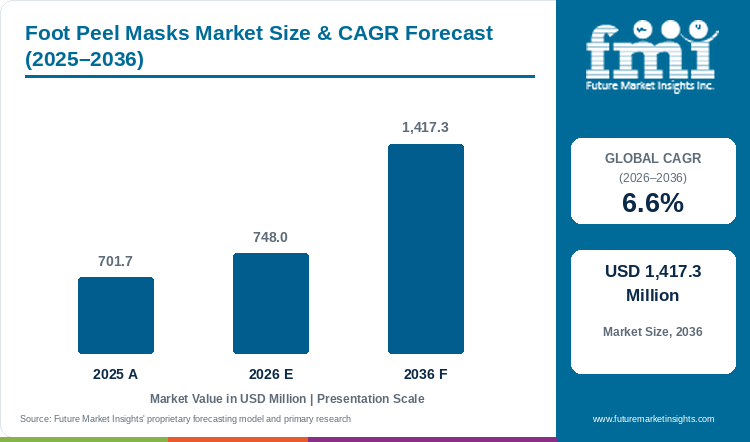
Demand for foot peel masks is projected to expand at 6.6% CAGR between 2026 and 2036. Industry value grows from USD 701.7 million in 2025 to USD 748.0 million in 2026 and reaches USD 1,417.3 million by 2036.
The global foot peel masks market was valued at USD 701.7 million in 2025 and rises from USD 748.0 million in 2026 to USD 1,417.3 million by 2036, at 6.6% CAGR from 2026 to 2036. As per FMI, core / classic lines accounted for the leading 38.0% share in 2026, because the one-hour exfoliating peel treatment is the format shoppers already recognise. Baby Foot asks for one hour on the feet, with peeling that usually begins after 5 to 7 days and can take up to 14 days.[1] Dr. Scholl’s states 60 to 90 minutes of wear and 6 to 8 weeks between uses.[2] Liberta reports that the Baby Foot series has passed 32 million cumulative units.[3] Retail prices run from USD 3.39 for a Dr. Scholl’s pair at Target to USD 24.99 for Baby Foot Original at Sally Beauty.[4]
Key Market Trends & Insights
- By Product Type: Core/classic foot peel masks remained the largest product category in 2026, generating USD 284.2 million and representing 38.0% of market revenue. Products from Baby Foot, Dr. Scholl’s and Patchology typically require 60 to 90 minutes of application
- By Nature: Conventional products contributed more than half of total sales at 52.0%, valued at USD 389.0 million. According to the FDA, the exfoliating effect of these formulations depends on the type and concentration of acids used, their pH and other ingredients.
- By Format: Creams and balms represented 31.0% of the market, with sales reaching USD 231.9 million in 2026. Manufacturers are also introducing more targeted treatments. For instance, Liberta has developed a heel-care product that uses a silicone sock to hold fruit-acid gel against the skin.
- By Price Positioning: Mass-market products generated USD 269.3 million in revenue, giving them a 36.0% share in 2026. Affordable options include Dr. Scholl’s Exfoliating Foot Mask at USD 3.39 per pair at Target and Balea callus-removing socks at EUR 2.95 per pair at dm.
- By Sales Channel: E-commerce and DTC sales reached USD 216.9 million in 2026, accounting for 29.0% of the market. Online retail is well established in major consumer markets, representing 17.1% of total US retail sales in Q2 2026 and 27.5% in the UK in 2025.
Regional Highlights
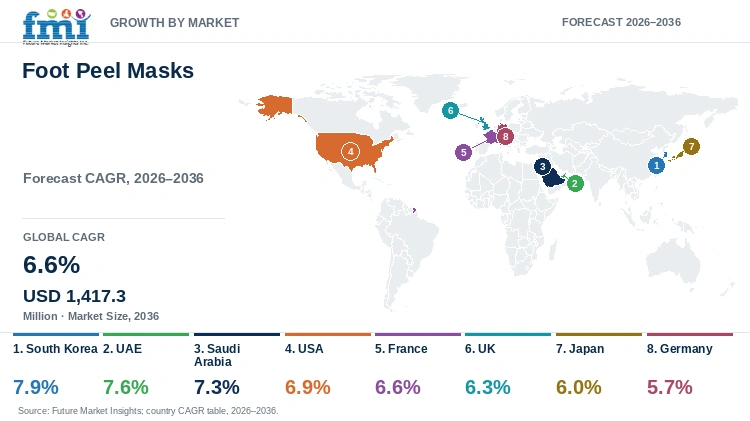
- South Korea: Foot peel mask sales are forecast to grow at a 7.9% CAGR through 2036, the fastest among the countries covered.
- Other Countries: The UAE follows with a projected CAGR of 7.6%, ahead of Saudi Arabia at 7.3%. Germany will register the slowest growth among the profiled markets at 5.7%.
- Cosmetics Trade: South Korea's cosmetics exports reached USD 11.4 billion in 2025, increasing 11.8% from the previous year. Exports to the UAE rose by 67.2% during the same period [11].
Market Size & Forecast
Table 1: Market Size and Forecast for the Foot Peel Masks Market (USD million and percentage), 2025 to 2036
| Metric | Value |
|---|---|
| 2025 Market Size | USD 701.7 million |
| Estimated Market Size in 2026 | USD 748.0 million |
| Projected Market Size by 2036 | USD 1,417.3 million |
| CAGR, 2026 to 2036 | 6.6% |
| Added Revenue, 2026 to 2036 | USD 669.3 million |
| Market Expansion Multiple | 1.9x |
A foot peel is bought a few times a year per user, so market demand depends on how many people finish a first treatment and how many return at the label interval. Directions differ by supplier. Baby Foot’s FAQ lists maintenance every 3 to 4 months[1], its July 2025 guidance says every two months for most people[12], KOCOSTAR recommends monthly use[13] and Dr. Scholl’s allows 6 to 8 weeks[2]. At USD 25.00 a pack, three to six Baby Foot packs a year cost one user USD 75 to 150, while 6.5 to 8.7 Dr. Scholl’s pairs at USD 3.39 cost USD 22 to 29. Delayed peeling, exclusions for pregnancy and diabetes, and substitutes such as files may limit wider use, and the category sits next to foot care products and foot patches in the same shopping basket.
Treatment Evidence and Purchase Readiness
Foot peel demand is not determined by foot-care need alone. Treatment time, reuse interval, suitability limits and price per pair decide the practical opportunity. Current listings show three positions: dedicated peel brands, foot-care and beauty brands, and retailer-owned socks.
Table 2: Treatment, Price and Channel Indicators for the Foot Peel Masks Market (minutes, days, months, local currency per pair, and percentage), mixed reporting years from 2025 to 2026
| Indicator | Data Point | Why It Matters | Source |
|---|---|---|---|
| Baby Foot protocol | One hour on the feet; peeling begins after 5 to 7 days and can take up to 14; single-use booties | Sets the reference timeline other peels are compared with | [1] |
| Baby Foot reuse interval | 3 to 4 months in the FAQ; every two months for most people in July 2025 guidance | The interval sets pairs per buyer per year | [1][12] |
| Dr. Scholl’s mask | USD 3.39 per pair; 60 to 90 minutes; 6 to 8 weeks between uses | Entry price with a shorter reuse cycle | [2] |
| Patchology PoshPeel PediCure | GBP 20.00; 60 minutes, extendable to 90 | Premium treatment price point | [5] |
| Retailer-owned socks | dm Balea EUR 2.95 for one pair; Boots Smoothing Foot Peel Socks | Low-price alternatives inside the same format | [8][14] |
| Heel-only formats | Baby Foot for Heels JPY 1,760 from 25 April 2025; Scholl heel peels in France and Italy | A narrower use occasion than a full-foot peel | [7][15][16] |
| Baby Foot Japan range | 30 and 60 minute formats and men’s variants | Shorter wear time answers one reason for skipping the treatment | [17] |
| US online share of retail | 17.1% in Q2 2026 | Sets online reach for packs sold through retailer sites | [9] |
| UK online share of retail | 27.5% in 2025 | Listings are compared on price within a few clicks | [10] |
| Liberta Q1 FY2026 net sales | JPY 1,857.6 million, up 16.0% | Company trading in the home market of Baby Foot | [18] |
Analyst Perspective
“Category revenue is buyers times pairs per buyer times price per pair. Growth that comes from a lower price or a one-time trial does not compound. Growth that comes from users who finish a treatment and return at the label interval does. Suppliers that print the timeline and the exclusions on the pack protect that second purchase.”
- Rahul Pandita, Future Market Insights.
How is the foot peel masks market segmented?
Foot peel masks market is segmented by product type, nature, format, price positioning, sales channel, and region. In 2026, core / classic lines hold 38.0%, conventional products 52.0%, cream and balm formats 31.0%, mass price positioning 36.0%, and e-commerce and DTC 29.0%.
- By product type: core / classic lines, targeted treatment lines, sensitive and gentle lines, premium and clinical lines, and kits and sets.
- By nature: conventional, vegan and cruelty-free, natural and organic, dermocosmetic and clinical, and fragrance-free and sensitive.
- By format: cream and balm, liquid and serum, stick and solid, spray and mist, sheet and patch, and powder.
- By price positioning: mass, masstige, premium, and professional.
- By sales channel: e-commerce and DTC, specialty beauty retail, pharmacies and drugstores, supermarkets and hypermarkets, and salons and spas.
- By region: North America, Latin America, Western Europe, Eastern Europe, East Asia, South Asia and Pacific, and Middle East and Africa.
Why do core / classic lines retain a notable product type share?
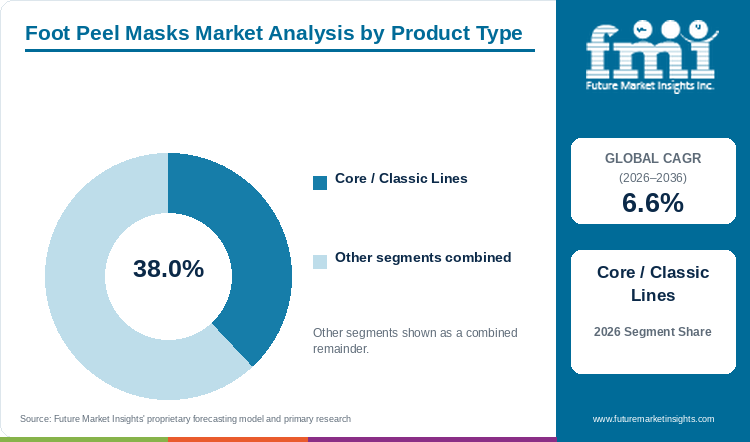
Core / classic lines hold 38.0% of product type demand in 2026, equal to USD 284.2 million, as the one-hour bootie treatment is the shared reference protocol.
Core / classic lines are the full-foot peel with a fixed protocol. Baby Foot asks for one hour on the feet[1], Dr. Scholl’s for 60 to 90 minutes[2] and Patchology for 60 minutes, extendable to 90[5]. A buyer who has used one reads any other in the same terms, so the single-treatment line becomes the benchmark that targeted and premium lines are priced against. Wider interest in glycolic acid peels in skin care keeps the exfoliation mechanism familiar to first-time foot peel buyers.
- Core / classic lines account for 38.0% share in 2026, equal to USD 284.2 million.
- Baby Foot, Dr. Scholl’s and Patchology share a 60 to 90 minute wear window with shedding in the days that follow.[1][2][5]
Why does conventional formulation anchor the nature category?
Conventional products hold 52.0% of nature demand in 2026, equal to USD 389.0 million, as acid chemistry is shared across the shelf.
Baby Foot Original lists lactic, glycolic, salicylic, malic and citric acids[4], the Dr. Scholl’s mask lists glycolic, lactic and salicylic acid with urea[2], Patchology lists glycolic, salicylic, lactic and citric acids[5] and dm describes its Balea socks as fruit-acid callus removers[8]. FDA states that the effect of an exfoliant depends on acid type, concentration, pH and the other ingredients[6], so a natural or botanical label changes the story around the product more than the peel. That story carries a burden of proof, since French guidance requires effect claims to rest on adequate, verifiable evidence[19]. Demand for AHA and BHA peels in facial care supplies the ingredient familiarity.
- Conventional products account for 52.0% share in 2026, equal to USD 389.0 million.
- Natural and clinical claims need support before they can carry a price premium.[19]
Why does cream and balm lead the format category?
Cream and balm formats hold 31.0% of format demand in 2026, equal to USD 231.9 million, as the product body stays on the foot with few steps.
Format decides how many steps sit between the pack and the foot. Baby Foot Original arrives as a sealed pair of booties that the user cuts open and tapes at the ankle[20], and the Dr. Scholl’s directions are to slip a foot into each bootie and massage the remaining product in afterwards[2]. Patchology adds a step, as the user pours an activating essence into a sock and spreads it along the lining[5]. Liberta’s heel product holds a fruit-acid gel in a silicone sock, and the fit of the sock keeps the gel in place[7]. Scholl’s French range adds an AHA heel mask that concentrates treatment on the heel[15]. Pre-assembled packs with a gel or cream body keep handling to cutting, taping and waiting, which also separates a peel from the plain moisturizing creams that sit nearby on the shelf.
- Cream and balm formats account for 31.0% share in 2026, equal to USD 231.9 million.
- A silicone sock holds the gel against the heel in the 2025 Baby Foot heel product.[7]
Why does mass price positioning hold the leading price share?
Mass products hold 36.0% of price positioning demand in 2026, equal to USD 269.3 million, as low-priced pairs reach the largest number of buyers.
Price per pair and the reuse interval together decide annual spend. A Dr. Scholl’s user buys 6.5 to 8.7 pairs a year at USD 3.39, or USD 22 to 29[2], while a Baby Foot Original user buys three to six packs at USD 25.00, or USD 75 to 150[4][1]. Retailer-owned socks sit below both: dm lists Balea socks at EUR 2.95 for one pair[8] and Boots sells its own Smoothing Foot Peel Socks[14]. At USD 3.39 a pair, USD 269.3 million of mass revenue equals about 79 million pairs, while the same revenue at USD 25.00 equals about 10.8 million packs. Mass leads on the number of buyers who try the format, and a premium cosmetics brand has to give those buyers a visible reason to pay more.
- Mass products account for 36.0% of Price Positioning in 2026.
- Entry ticket: USD 3.39 for a Dr. Scholl’s pair at Target against USD 24.99 for Baby Foot Original at Sally Beauty.[2][4]
- Promotional ticket: Ulta lists Baby Foot Original for Men at USD 18.75 on sale against USD 25.00 regular.[20]
What do the growth analysis, future potential and risk assessment show for the foot peel masks market?
In the foot peel masks market, a one-hour home protocol supports trial, heel-only, shorter and better-fitting formats open repeat occasions, and delayed results, suitability limits and price erosion are what can pull demand down.
Growth Analysis: A One-Hour Home Protocol Supports Trial
The qualitative case for growth is convenience and privacy: the pack needs a seat, an hour and a sink, and no appointment. Liberta reported cumulative Baby Foot sales of 30 million units by the end of February 2025[7] and above 32 million by December 2025[3], and described the product as sold in more than 60 countries[3]. Home-market trading stayed firm, with Q1 FY2026 net sales up 16.0% to JPY 1,857.6 million[18]. The same protocol appears in the Dr. Scholl’s directions to leave the booties on for 60 to 90 minutes[2]. The move from USD 748.0 million in 2026 to USD 1,417.3 million in 2036 depends on more buyers finishing that routine.
Future Potential: Heel-Only, Shorter and Better-Fitting Formats Open Repeat Occasions
Suppliers are removing the reasons people skip a peel. Liberta said customers wanted heels cared for more often and wanted to use the pack while wearing foot nail polish, and launched a JPY 1,760 heel product on 25 April 2025[7]. Baby Foot Japan already sells 30 and 60 minute formats and men’s variants[17], Chemist Warehouse lists Milky Foot in a large size[27] and KOCOSTAR describes fit improvements in its premium version[13]. Limited editions add occasions: a Bergamot scent chosen in a poll of 1,005 votes went on sale on 3 June 2025[28], a Cinnamoroll edition with socks followed on 16 September 2025 at JPY 2,200[29] and a Cinderella edition on 8 April 2026[3]. Aftercare creams sold once peeling ends add to a supplier’s wider foot-care business and sit outside the peel category.
Risk Assessment of the Foot Peel Masks Market: What Can Pull Demand Down
At a fixed geography and revenue boundary, category revenue equals buyers times pairs per buyer times price per pair, so fewer buyers, fewer pairs or a lower price each reduce it. Suitability limits shrink the buyer pool: Baby Foot excludes pregnant and nursing users, sends diabetics to a physician and rules out open cuts or sores[1], Scholl’s French heel mask flags diabetes and circulation problems[15] and NIDDK stresses careful foot care in diabetes[30]. FDA reports adverse reactions associated with AHA skin care products generally[6], and a complaint wave would cut trial across brands. Related foot-health spend, such as foot fungus treatments, does not convert into peel buyers, since the same labels rule out damaged skin.
Pairs per buyer and price are the other two levers. Reuse intervals run from monthly at KOCOSTAR[13] to every 3 to 4 months in the Baby Foot FAQ[1], and a buyer can switch to files and other removal products in the same retail assortment[31]. Retailer-owned socks at EUR 2.95[8] pull the average price per pair down if mix moves to low-priced packs. Baby Foot’s single-use booties[1] and Skin Republic’s biodegradable mask and pack[32] show that disposal is already part of positioning. Compliance adds cost: MoCRA requires safety substantiation records and serious adverse event reports within 15 business days[33], Great Britain requires a Responsible Person and notification[34] and the EU adds fragrance allergen labelling[35]. The weakest combination is low repeat purchase, a switch to quicker substitutes and falling realised prices, which would remove customers and price together.
Which country CAGRs are profiled in the foot peel masks market?
Table 3: Country CAGR Comparison for the Foot Peel Masks Market (CAGR percentage), 2026 to 2036
| Country | CAGR |
|---|---|
| South Korea | 7.9% |
| UAE | 7.6% |
| Saudi Arabia | 7.3% |
| USA | 6.9% |
| France | 6.6% |
| UK | 6.3% |
| Japan | 6.0% |
| Germany | 5.7% |
Country-wise Analysis
South Korea is forecast to lead the eight countries with a 7.9% CAGR through 2036. The country has an established selection of foot exfoliation products from domestic skincare manufacturers. Olive Young offers foot peeling masks alongside other callus-removal products, while KOCOSTAR sells its Korean-made Foot Peeling Pack [13][31]. Korean brands also reach international customers through platforms such as Olive Young Global, which carries Ariul foot peel products [25]. South Korea's total cosmetics exports reached USD 11.4 billion in 2025 after increasing by 11.8% [11]. Manufacturers are also preparing for changes to cosmetic safety requirements. A September 2025 US International Trade Administration brief outlined planned safety assessment obligations with pilot programs in 2026 and 2027, followed by phased implementation from 2028 for businesses exceeding KRW 1 billion in sales [37].
Imported beauty products are an important part of UAE’s retail assortment. South Korean cosmetics exports to the UAE increased by 67.2% in 2025 compared with 11.8% growth in Korean cosmetics exports worldwide [11]. While these figures cover cosmetics generally, they show the UAE's growing importance as a destination for Korean beauty brands. Companies selling foot peel masks through online channels must comply with local business requirements. Federal Decree by Law No. 14 of 2023 requires businesses carrying out e-commerce activities to hold the appropriate commercial licence [38]. Product labelling and reliable distribution will remain important for international suppliers entering the market.
International foot peel mask brands must meet Saudi Arabia’s cosmetic import and labelling requirements before their products can reach retailers. In February 2025, the Saudi Food and Drug Authority restricted packaging statements such as "For Export Only" and "European Market Edition" because these indicate that a product was prepared for another market [36]. The Ministry of Commerce also reviewed 100 online stores against ten compliance criteria in August 2025 [39]. These requirements make local regulatory compliance important for companies distributing foot peel masks through pharmacies and online retailers. Manufacturers selling the same products internationally will need to review their packaging before supplying the Saudi market.
Consumers in the US can choose from several foot peel mask brands at different price points. Dr. Scholl's Exfoliating Foot Mask is available for USD 3.39 at Target, while Baby Foot Original sells for approximately USD 25.00 [2][4]. Patchology also offers foot exfoliation treatments through beauty retail channels [5]. The price difference gives consumers a choice between basic treatments and premium products. Manufacturers must also comply with applicable requirements under the Modernization of Cosmetics Regulation Act. These include maintaining safety substantiation records and reporting serious adverse events to the FDA within 15 business days [33]. Online retail accounted for 17.1% of total US retail sales in the second quarter of 2026 [9], providing another established distribution channel for beauty products.
Foot peel products in France are available in formulations developed for specific concerns such as rough heels and callus buildup. Scholl's French product range includes an AHA-based heel mask that requires an application period of 60 to 90 minutes [15]. Its instructions also warn against use on damaged or irritated skin and advise caution for consumers with diabetes or circulation problems. Product claims remain subject to regulatory scrutiny. In guidance published on 4 December 2025, France's DGCCRF stated that cosmetic effect claims must be supported by verifiable evidence [19]. Manufacturers offering targeted exfoliation treatments will therefore need to provide clear instructions and ensure their product claims are properly supported.
Competition in the UK comes from retailer-owned products and specialist skincare brands. Boots sells its own Smoothing Foot Peel Socks, while Skin Republic offers a branded Foot Peel Mask [14][32]. Premium alternatives are also available through beauty retailers, including Patchology's PoshPeel PediCure at GBP 20.00 on Cult Beauty [5]. Online shopping remains an established purchasing channel, accounting for 27.5% of UK retail sales in 2025 [10]. Cosmetic suppliers must also meet the relevant regulatory requirements. Great Britain requires a UK-based Responsible Person, product notification and a Product Information File [34]. Northern Ireland operates under a separate regulatory framework, requiring manufacturers to check compliance for each market.
Japan is home to Baby Foot, which has developed an established range of exfoliating treatments. Its products include 30-minute and 60-minute foot peels along with versions designed for men [17]. On 25 April 2025, manufacturer Liberta introduced a heel-only treatment for consumers who require exfoliation in a smaller area [7]. Such products give existing customers additional choices based on treatment duration and application area. Liberta also reported a 16.0% increase in company-wide net sales to JPY 1,857.6 million in the first quarter of FY2026 [18]. Japan's goods e-commerce ratio stood at 9.8% [26], with physical stores continuing to play an important role in the wider consumer goods market.
Germany will record a 5.7% CAGR through 2036, the lowest among the eight countries. Affordable foot exfoliation products are available through established drugstore chains. For instance, dm sells Balea fruit-acid callus-removing socks for EUR 2.95 per pair [8]. These products create price competition for premium brands, which may need to offer improvements in formulation or application convenience to justify higher prices. Manufacturers must also comply with European cosmetic labelling requirements. Regulation (EU) 2023/1545 expands fragrance allergen disclosure requirements, with labelling thresholds of 0.001% for leave-on products and 0.01% for rinse-off products [35]. Online shopping is also widespread across Europe, with 78% of EU internet users aged 16 to 74 making online purchases in 2025 [40].
Which are the notable companies in foot peel masks market?
Baby Foot (Liberta), Dr. Scholl’s, Patchology, TONYMOLY, KOCOSTAR, Ariul, Boots, dm (Balea), grace and stella, LuxaDerme, Sanfe, Skin Republic, and Milky Foot are profiled in this market.
Foot peel masks market spans dedicated peel brands, foot-care suppliers, beauty treatment brands and retailer-owned products. Liberta’s Baby Foot is the dedicated brand, sold in more than 60 countries[3]. Dr. Scholl’s approaches the task from foot care and Patchology from beauty treatment[2][5], while Boots and dm sell own-brand socks at accessible prices[14][8]. Korean, Indian and Australian suppliers add fit and format choice, and brands competing for foot care budgets are widening ranges with heel-only packs, shorter wear times and limited editions.
- Dedicated peel and mask specialists: Baby Foot (Liberta), KOCOSTAR, Milky Foot, Skin Republic, and LuxaDerme.
- Foot-care and beauty treatment brands: Dr. Scholl’s, Patchology, TONYMOLY, Ariul, grace and stella, and Sanfe.
- Retailer-owned products: Boots and dm (Balea).
Prices are listed retail prices in local currency on 9 October 2026, and company entries do not indicate market share or company rank.
Key Players in the Foot Peel Masks Market
- Dedicated Peel and Mask Specialists
- Baby Foot (Liberta)
- KOCOSTAR
- Milky Foot
- Skin Republic
- LuxaDerme
- Foot-Care and Beauty Treatment Brands
- Dr. Scholl’s
- Patchology
- TONYMOLY
- Ariul
- grace and stella
- Sanfe
- Retailer-Owned Products
- Boots
- dm (Balea)
Foot Peel Masks Market - Report Scope
Table 5: Report Scope for the Foot Peel Masks Market (coverage fields and definitions), 2026 to 2036
| Coverage field | Report scope |
|---|---|
| Market breakdown | Product type; nature; format; price positioning; sales channel; region |
| Quantitative units | USD million |
| Market definition | First-sale revenue from acid-based foot peeling booties, socks and targeted heel masks intended for cosmetic exfoliation, counting only the identifiable mask component of mixed kits. Moisturizing masks, creams, files, scrubs, professional treatments, ingredient sales, standalone accessories and salon service fees are excluded. |
| Regions covered | North America; Latin America; Western Europe; Eastern Europe; East Asia; South Asia and Pacific; Middle East and Africa |
| Countries covered | South Korea; UAE; Saudi Arabia; USA; France; UK; Japan; Germany |
| Key companies profiled | Baby Foot (Liberta), Dr. Scholl’s, Patchology, TONYMOLY, KOCOSTAR, Ariul, Boots, dm (Balea), grace and stella, LuxaDerme, Sanfe, Skin Republic, Milky Foot |
| Forecast period | 2026 to 2036 |
| Approach | Hybrid bottom-up and top-down sizing that reconciles product listings, price per pair, purchase interval, channel mix, company participation, and country-level adoption conditions within the defined revenue boundary. |
Foot Peel Masks Market - Research Methodology
Table 6: Research Methodology for the Foot Peel Masks Market (research methods and approach), 2026 edition
| Method | Approach |
|---|---|
| Primary Research | Primary research includes interviews with manufacturers, brand owners, distributors, retailers, end users and industry experts. Interviews cover product selection, adoption, pricing, purchase interval and channel requirement. |
| Desk Research | Desk research covers government publications, regulatory guidance, official company announcements, filings, retailer product pages and statistical releases. |
| Market Sizing and Forecasting | Market sizing combines base value, segment share, product pricing, purchase interval, adoption and country demand condition. |
| Data Validation | Market estimates are checked with public data, official company activity, regulatory records and primary research findings. Overlapping revenue is excluded. |
Foot Peel Masks Market by Segments
Foot Peel Masks Market segmented by Product Type:
- Core / Classic Lines
- Targeted Treatment Lines
- Sensitive and Gentle Lines
- Premium and Clinical Lines
- Kits and Sets
Foot Peel Masks Market segmented by Nature:
- Conventional
- Vegan and Cruelty-Free
- Natural and Organic
- Dermocosmetic and Clinical
- Fragrance-Free and Sensitive
Foot Peel Masks Market segmented by Format:
- Cream and Balm
- Liquid and Serum
- Stick and Solid
- Spray and Mist
- Sheet and Patch
- Powder
Foot Peel Masks Market segmented by Price Positioning:
- Mass
- Masstige
- Premium
- Professional
Foot Peel Masks Market segmented by Sales Channel:
- E-commerce and DTC
- Specialty Beauty Retail
- Pharmacies and Drugstores
- Supermarkets and Hypermarkets
- Salons and Spas
Foot Peel Masks Market by Region
- North America
- United States
- Canada
- Latin America
- Brazil
- Mexico
- Argentina
- Chile
- Western Europe
- Germany
- France
- United Kingdom
- Italy
- Spain
- Benelux
- Nordics
- Eastern Europe
- Poland
- Czech Republic
- Romania
- Hungary
- East Asia
- Japan
- South Korea
- South Asia and Pacific
- ASEAN
- Australia and New Zealand
- Middle East and Africa
- GCC Countries
- South Africa
- Türkiye
- Israel
Research Sources and Bibliography
- [1] Baby Foot. (accessed 2026, October 9). Exfoliation peel FAQ.
- [2] Target. (accessed 2026, October 9). Dr. Scholl’s Exfoliating Foot Mask, 1 pair. Product page.
- [3] Liberta. (2026, March 31). Baby Foot Easy Pack, Cinderella Package. Press release.
- [4] Sally Beauty. (accessed 2026, October 9). Original Exfoliation Foot Peel, Baby Foot. Product page.
- [5] Cult Beauty. (accessed 2026, October 9). Patchology PoshPeel PediCure, 1 treatment. Product page.
- [6] US Food and Drug Administration. (accessed 2026, October 9). Alpha hydroxy acids. Web page.
- [7] Liberta. (2025, March 26). Baby Foot for Heels, launch on 25 April 2025. Press release. https://prtimes.jp/main/html/rd/p/000000126.000052173.html
- [8] dm-drogerie markt. (accessed 2026, October 9). Balea callus removing foot mask socks, one pair. Product page.
- [9] US Census Bureau. (2026, August 18). Quarterly retail e-commerce sales, 2nd quarter 2026.
- [10] UK Office for National Statistics. (2026, September 18). Internet sales as a percentage of total retail sales (ratio).
- [11] Korea JoongAng Daily. (2026, May 23). Korea surpasses US in cosmetics exports with record $11.4 billion.
- [12] Baby Foot. (2025, July 7). How often should you apply a foot peel for the best results.
- [13] KOCOSTAR. (accessed 2026, October 9). Foot Peeling Pack. Product page.
- [14] Boots. (accessed 2026, October 9). Smoothing Foot Peel Socks. Product page.
- [15] Scholl France. (accessed 2026, October 9). Exfoliating heel mask. Product page.
- [16] Scholl Italia. (accessed 2026, October 9). Expert Care heel peel. Product page.
- [17] Baby Foot Japan. (accessed 2026, October 9). Product range.
- [18] Liberta. (2026, May 15). Consolidated financial results for Q1 FY2026.
- [19] DGCCRF, French Ministry of Economy. (2025, December 4). Les produits cosmétiques. Practical guide.
- [20] Ulta Beauty. (accessed 2026, October 9). Baby Foot Original Exfoliant Foot Peel for Men. Product page.
- [21] LuxaDerme India. (accessed 2026, October 9). Exfoliating Foot Peeling Mask. Product page.
- [22] Nykaa. (accessed 2026, October 9). LuxaDerme Peeling and Exfoliating Foot Mask. Product page.
- [23] grace and stella. (accessed 2026, October 9). Exfoliating Foot Peel Mask. Product page.
- [24] TONYMOLY USA. (accessed 2026, October 9). Changing U Magic Foot Peeling Shoes. Product page.
- [25] Olive Young Global. (accessed 2026, October 9). Ariul Smooth and Pure Foot Peeling Mask. Product page.
- [26] Japan Ministry of Economy, Trade and Industry. (2025, August 26). Results of FY2024 e-commerce market survey compiled.
- [27] Chemist Warehouse Australia. (accessed 2026, October 9). Milky Foot Intense Exfoliating Foot Mask, Large. Product page.
- [28] Liberta. (2025, May 27). Baby Foot Easy Pack, Bergamot Scent, limited edition. Press release.
- [29] Liberta. (2025, August 28). Baby Foot 60-Minute Type, Cinnamoroll Package. Press release.
- [30] National Institute of Diabetes and Digestive and Kidney Diseases. (accessed 2026, October 9). Diabetes and foot problems. Web page.
- [31] Olive Young Korea. (accessed 2026, October 9). Foot care product selection. Category page.
- [32] Skin Republic UK. (accessed 2026, October 9). Foot Peel Mask. Product page.
- [33] US Food and Drug Administration. (accessed 2026, October 9). Modernization of Cosmetics Regulation Act of 2022 (MoCRA). Web page. https://www.fda.gov/cosmetics/cosmetics-laws-regulations/modernization-cosmetics-regulation-act-2022-mocra
- [34] UK Department for Business and Trade, & Office for Product Safety and Standards. (accessed 2026, October 9). Making cosmetic products available to consumers in Great Britain. Guidance. https://www.gov.uk/guidance/making-cosmetic-products-available-to-consumers-in-great-britain
- [35] European Commission. (accessed 2026, October 9). Commission Regulation (EU) 2023/1545 on labelling of fragrance allergens in cosmetic products. https://eur-lex.europa.eu/eli/reg/2023/1545/oj/eng
- [36] International Trade Administration, US Department of Commerce. (2025, August 4). Saudi Arabia cosmetics and perfumery labeling update. Market intelligence.
- [37] International Trade Administration, US Department of Commerce. (2025, September 30). South Korea cosmetics safety regulations. Market intelligence.
- [38] UAE Government. (accessed 2026, October 9). eCommerce. Web page.
- [39] Saudi Arabia Ministry of Commerce. (2025, August 18). Ministry of Commerce announces the results of e-commerce store evaluation. Press release.
- [40] Eurostat. (accessed 2026, October 9). E-commerce statistics for individuals. Statistics Explained.
- [41] Bluemercury. (accessed 2026, October 9). Baby Foot Original Exfoliation Foot Peel. Product page.
- [42] Sanfe. (accessed 2026, October 9). Exfoliating Foot Mask, one pair. Product page.
- [43] Sanfe. (accessed 2026, October 9). Company history. Web page.
- [44] Chemist Warehouse Australia. (accessed 2026, October 9). Foot Peels and Masks category. Category page.
This Report Answers
- How big is the foot peel masks market during 2026?
- What value is projected by 2036?
- Which product type holds notable share?
- Which nature segment holds notable share?
- Which countries have notable growth?
- Which brands and suppliers are notable in the market?
Frequently Asked Questions
How large is the foot peel masks market expected in 2026?
Future Market Insights estimates that the foot peel masks market will be valued at USD 748.0 million in 2026. The market reaches USD 1,417.3 million by 2036, reflecting steady growth over the forecast period.
What CAGR is projected for the foot peel masks market through 2036?
As per FMI analysis, the foot peel masks market is projected to grow at a CAGR of 6.6% from 2026 to 2036. This growth rate reflects the market’s expected expansion throughout the forecast period.
Which product type holds a notable market share in 2026?
Core / classic lines hold 38.0% of product type demand in 2026. Their leading share is supported by the one-hour treatment protocol that buyers recognise across brands.
Which nature segment holds a notable share in 2026?
Conventional products account for 52.0% of nature demand in 2026. Their leading share reflects acid chemistry that is shared across the shelf.
Which country has a notable expansion outlook through 2036?
The South Korea foot peel masks market records the highest CAGR, 7.9% from 2026 to 2036, followed by the UAE at 7.6% and Saudi Arabia at 7.3%.
Who are the key companies in the foot peel masks market?
Profiled companies include Baby Foot (Liberta), Dr. Scholl’s, Patchology, TONYMOLY, KOCOSTAR, Ariul, Boots, dm (Balea), grace and stella, LuxaDerme, Sanfe, Skin Republic, and Milky Foot.
Preview the report firsthand - request a free sample
Get SampleGet the brochure for pricing and purchase details.
Get PDFTable of Content
- Key Takeaways
- Market Size and CAGR
- Top Growth Driver
- Fastest Growing Segment
- Leading Region
- Key Companies
- Emerging Opportunities
- Executive Summary
- Global Market Outlook
- Demand-side Trends
- Supply-side Trends
- Technology Roadmap Analysis
- Analysis and Recommendations
- Analyst Perspective (What is happening? Why now? What should investors know?)
- Key Questions Answered
- How large is the market?
- What is the CAGR?
- What are key trends?
- Which region dominates?
- Who are the leaders?
- Market Overview
- Market Coverage / Taxonomy
- Market Definition / Scope / Limitations
- Research Methodology
- Chapter Orientation
- Analytical Lens and Working Hypotheses
- Market Structure, Signals, and Trend Drivers
- Benchmarking and Cross-market Comparability
- Market Sizing, Forecasting, and Opportunity Mapping
- Research Design and Evidence Framework
- Desk Research Programme (Secondary Evidence)
- Expert Input and Fieldwork (Primary Evidence)
- Tooling, Models, and Reference Databases
- Data Engineering and Model Build
- Quality Assurance and Audit Trail
- Market Background
- Market Dynamics (Drivers, Restraints, Opportunity, Trends)
- Scenario Forecast (Optimistic, Likely, Conservative)
- Impact Analysis
- AI Impact
- Sustainability Impact
- Regulatory Impact
- Technology Impact
- Consumer / Buyer Analysis
- Purchase Drivers
- Adoption Barriers
- Buyer Journey
- Opportunity Map Analysis
- Product Life Cycle Analysis
- Supply Chain Analysis
- Investment Feasibility Matrix
- Value Chain Analysis
- PESTLE and Porter's Analysis
- Regulatory Landscape
- Regional Parent Market Outlook
- Production and Consumption Statistics
- Import and Export Statistics
- Global Market Analysis and Forecast, 2021 to 2036
- Historical Market Size Value (USD Million) Analysis, 2021 to 2025
- Current and Future Market Size Value (USD Million) Projections, 2026 to 2036
- Y-o-Y Growth Trend Analysis
- Absolute $ Opportunity Analysis
- Global Market Pricing Analysis, 2021 to 2036
- Global Market Analysis and Forecast, By Product Type, 2021 to 2036
- Introduction / Key Findings
- Historical Market Size Value (USD Million) Analysis By Product Type, 2021 to 2025
- Current and Future Market Size Value (USD Million) Analysis and Forecast By Product Type, 2026 to 2036
- Core / Classic Lines
- Targeted Treatment Lines
- Sensitive and Gentle Lines
- Premium and Clinical Lines
- Kits and Sets
- Y-o-Y Growth Trend Analysis By Product Type, 2021 to 2025
- Absolute $ Opportunity Analysis By Product Type, 2026 to 2036
- Global Market Analysis and Forecast, By Nature, 2021 to 2036
- Introduction / Key Findings
- Historical Market Size Value (USD Million) Analysis By Nature, 2021 to 2025
- Current and Future Market Size Value (USD Million) Analysis and Forecast By Nature, 2026 to 2036
- Conventional
- Vegan and Cruelty-Free
- Natural and Organic
- Dermocosmetic and Clinical
- Fragrance-Free and Sensitive
- Y-o-Y Growth Trend Analysis By Nature, 2021 to 2025
- Absolute $ Opportunity Analysis By Nature, 2026 to 2036
- Global Market Analysis and Forecast, By Format, 2021 to 2036
- Introduction / Key Findings
- Historical Market Size Value (USD Million) Analysis By Format, 2021 to 2025
- Current and Future Market Size Value (USD Million) Analysis and Forecast By Format, 2026 to 2036
- Cream and Balm
- Liquid and Serum
- Stick and Solid
- Spray and Mist
- Sheet and Patch
- Powder
- Y-o-Y Growth Trend Analysis By Format, 2021 to 2025
- Absolute $ Opportunity Analysis By Format, 2026 to 2036
- Global Market Analysis and Forecast, By Price Positioning, 2021 to 2036
- Introduction / Key Findings
- Historical Market Size Value (USD Million) Analysis By Price Positioning, 2021 to 2025
- Current and Future Market Size Value (USD Million) Analysis and Forecast By Price Positioning, 2026 to 2036
- Mass
- Masstige
- Premium
- Professional
- Y-o-Y Growth Trend Analysis By Price Positioning, 2021 to 2025
- Absolute $ Opportunity Analysis By Price Positioning, 2026 to 2036
- Global Market Analysis and Forecast, By Sales Channel, 2021 to 2036
- Introduction / Key Findings
- Historical Market Size Value (USD Million) Analysis By Sales Channel, 2021 to 2025
- Current and Future Market Size Value (USD Million) Analysis and Forecast By Sales Channel, 2026 to 2036
- E-commerce and DTC
- Specialty Beauty Retail
- Pharmacies and Drugstores
- Supermarkets and Hypermarkets
- Salons and Spas
- Y-o-Y Growth Trend Analysis By Sales Channel, 2021 to 2025
- Absolute $ Opportunity Analysis By Sales Channel, 2026 to 2036
- Global Market Analysis and Forecast, By Region, 2021 to 2036
- Introduction
- Historical Market Size Value (USD Million) Analysis By Region, 2021 to 2025
- Current Market Size Value (USD Million) Analysis and Forecast By Region, 2026 to 2036
- North America
- Latin America
- Western Europe
- Eastern Europe
- East Asia
- South Asia and Pacific
- Middle East and Africa
- Market Attractiveness Analysis By Region
- North America Market Analysis and Forecast, By Country, 2021 to 2036
- Historical Market Size Value (USD Million) Trend Analysis By Market Taxonomy, 2021 to 2025
- Market Size Value (USD Million) Forecast By Market Taxonomy, 2026 to 2036
- By Country
- United States
- Canada
- By Product Type
- By Nature
- By Format
- By Price Positioning
- By Sales Channel
- By Country
- Market Attractiveness Analysis
- By Country
- By Product Type
- By Nature
- By Format
- By Price Positioning
- By Sales Channel
- Key Takeaways
- Latin America Market Analysis and Forecast, By Country
- Historical Market Size Value (USD Million) Trend Analysis By Market Taxonomy, 2021 to 2025
- Market Size Value (USD Million) Forecast By Market Taxonomy, 2026 to 2036
- By Country
- Brazil
- Mexico
- Argentina
- Chile
- By Product Type
- By Nature
- By Format
- By Price Positioning
- By Sales Channel
- By Country
- Market Attractiveness Analysis
- By Country
- By Product Type
- By Nature
- By Format
- By Price Positioning
- By Sales Channel
- Key Takeaways
- Western Europe Market Analysis and Forecast, By Country
- Historical Market Size Value (USD Million) Trend Analysis By Market Taxonomy, 2021 to 2025
- Market Size Value (USD Million) Forecast By Market Taxonomy, 2026 to 2036
- By Country
- Germany
- France
- United Kingdom
- Italy
- Spain
- Benelux
- Nordics
- By Product Type
- By Nature
- By Format
- By Price Positioning
- By Sales Channel
- By Country
- Market Attractiveness Analysis
- By Country
- By Product Type
- By Nature
- By Format
- By Price Positioning
- By Sales Channel
- Key Takeaways
- Eastern Europe Market Analysis and Forecast, By Country
- Historical Market Size Value (USD Million) Trend Analysis By Market Taxonomy, 2021 to 2025
- Market Size Value (USD Million) Forecast By Market Taxonomy, 2026 to 2036
- By Country
- Poland
- Czech Republic
- Romania
- Hungary
- By Product Type
- By Nature
- By Format
- By Price Positioning
- By Sales Channel
- By Country
- Market Attractiveness Analysis
- By Country
- By Product Type
- By Nature
- By Format
- By Price Positioning
- By Sales Channel
- Key Takeaways
- East Asia Market Analysis and Forecast, By Country
- Historical Market Size Value (USD Million) Trend Analysis By Market Taxonomy, 2021 to 2025
- Market Size Value (USD Million) Forecast By Market Taxonomy, 2026 to 2036
- By Country
- Japan
- South Korea
- By Product Type
- By Nature
- By Format
- By Price Positioning
- By Sales Channel
- By Country
- Market Attractiveness Analysis
- By Country
- By Product Type
- By Nature
- By Format
- By Price Positioning
- By Sales Channel
- Key Takeaways
- South Asia and Pacific Market Analysis and Forecast, By Country
- Historical Market Size Value (USD Million) Trend Analysis By Market Taxonomy, 2021 to 2025
- Market Size Value (USD Million) Forecast By Market Taxonomy, 2026 to 2036
- By Country
- ASEAN
- Australia and New Zealand
- By Product Type
- By Nature
- By Format
- By Price Positioning
- By Sales Channel
- By Country
- Market Attractiveness Analysis
- By Country
- By Product Type
- By Nature
- By Format
- By Price Positioning
- By Sales Channel
- Key Takeaways
- Middle East and Africa Market Analysis and Forecast, By Country
- Historical Market Size Value (USD Million) Trend Analysis By Market Taxonomy, 2021 to 2025
- Market Size Value (USD Million) Forecast By Market Taxonomy, 2026 to 2036
- By Country
- GCC Countries
- South Africa
- Türkiye
- Israel
- By Product Type
- By Nature
- By Format
- By Price Positioning
- By Sales Channel
- By Country
- Market Attractiveness Analysis
- By Country
- By Product Type
- By Nature
- By Format
- By Price Positioning
- By Sales Channel
- Key Takeaways
- Key Countries Market Analysis
- United States
- Pricing Analysis
- Market Share Analysis, 2025
- By Product Type
- By Nature
- By Format
- By Price Positioning
- By Sales Channel
- Canada
- Pricing Analysis
- Market Share Analysis, 2025
- By Product Type
- By Nature
- By Format
- By Price Positioning
- By Sales Channel
- Mexico
- Pricing Analysis
- Market Share Analysis, 2025
- By Product Type
- By Nature
- By Format
- By Price Positioning
- By Sales Channel
- Brazil
- Pricing Analysis
- Market Share Analysis, 2025
- By Product Type
- By Nature
- By Format
- By Price Positioning
- By Sales Channel
- Chile
- Pricing Analysis
- Market Share Analysis, 2025
- By Product Type
- By Nature
- By Format
- By Price Positioning
- By Sales Channel
- Germany
- Pricing Analysis
- Market Share Analysis, 2025
- By Product Type
- By Nature
- By Format
- By Price Positioning
- By Sales Channel
- United Kingdom
- Pricing Analysis
- Market Share Analysis, 2025
- By Product Type
- By Nature
- By Format
- By Price Positioning
- By Sales Channel
- Italy
- Pricing Analysis
- Market Share Analysis, 2025
- By Product Type
- By Nature
- By Format
- By Price Positioning
- By Sales Channel
- Spain
- Pricing Analysis
- Market Share Analysis, 2025
- By Product Type
- By Nature
- By Format
- By Price Positioning
- By Sales Channel
- France
- Pricing Analysis
- Market Share Analysis, 2025
- By Product Type
- By Nature
- By Format
- By Price Positioning
- By Sales Channel
- ASEAN
- Pricing Analysis
- Market Share Analysis, 2025
- By Product Type
- By Nature
- By Format
- By Price Positioning
- By Sales Channel
- Australia and New Zealand
- Pricing Analysis
- Market Share Analysis, 2025
- By Product Type
- By Nature
- By Format
- By Price Positioning
- By Sales Channel
- Japan
- Pricing Analysis
- Market Share Analysis, 2025
- By Product Type
- By Nature
- By Format
- By Price Positioning
- By Sales Channel
- South Korea
- Pricing Analysis
- Market Share Analysis, 2025
- By Product Type
- By Nature
- By Format
- By Price Positioning
- By Sales Channel
- Poland
- Pricing Analysis
- Market Share Analysis, 2025
- By Product Type
- By Nature
- By Format
- By Price Positioning
- By Sales Channel
- Hungary
- Pricing Analysis
- Market Share Analysis, 2025
- By Product Type
- By Nature
- By Format
- By Price Positioning
- By Sales Channel
- Türkiye
- Pricing Analysis
- Market Share Analysis, 2025
- By Product Type
- By Nature
- By Format
- By Price Positioning
- By Sales Channel
- South Africa
- Pricing Analysis
- Market Share Analysis, 2025
- By Product Type
- By Nature
- By Format
- By Price Positioning
- By Sales Channel
- UAE
- Pricing Analysis
- Market Share Analysis, 2025
- By Product Type
- By Nature
- By Format
- By Price Positioning
- By Sales Channel
- Saudi Arabia
- Pricing Analysis
- Market Share Analysis, 2025
- By Product Type
- By Nature
- By Format
- By Price Positioning
- By Sales Channel
- United States
- Market Structure Analysis
- Competition Dashboard
- Competition Benchmarking
- Market Share Analysis of Top Players
- By Regional
- By Product Type
- By Nature
- By Format
- By Price Positioning
- By Sales Channel
- Emerging Startups
- Innovation Benchmarking
- Competition Analysis
- Competition Deep Dive
- Baby Foot (Liberta)
- Overview
- Product Portfolio
- Profitability by Market Segments
- Sales Footprint
- Strategy Overview
- Marketing Strategy
- Product Strategy
- Channel Strategy
- Dr. Scholl’s
- Patchology
- TONYMOLY
- KOCOSTAR
- Ariul
- Boots
- dm (Balea)
- grace and stella
- LuxaDerme
- Sanfe
- Skin Republic
- Milky Foot
- Dedicated Peel and Mask Specialists
- Foot-Care and Beauty Treatment Brands
- Retailer-Owned Products
- Baby Foot (Liberta)
- Case Studies
- Success Stories
- Recent Developments
- Competition Deep Dive
- Assumptions & Acronyms Used


