

- Industry Size (2026)
- USD 1.3 Bn
- Forecast (2036)
- USD 2.9 Bn
- CAGR (2026 to 2036)
- 8.7%
Fragrance Encapsulation Agents Market Forecast and Outlook 2026 to 2036
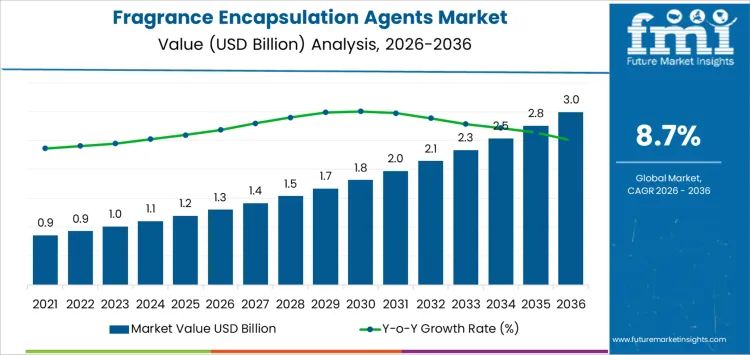
The fragrance encapsulation agents market is projected to grow from USD 1.3 billion in 2026 to USD 3.0 billion by 2036, reflecting a compound annual growth rate (CAGR) of 8.7%. These agents are used in various applications, including personal care, household products, and automotive air fresheners, to encapsulate fragrance compounds and release them over time. The demand for fragrance encapsulation agents is driven by consumer preference for long-lasting and controlled-release scents. The ability to maintain fragrance intensity and longevity while reducing the frequency of reapplication makes these agents particularly popular in consumer goods products, including perfumes, shampoos, and cleaning products.
The market growth is supported by innovations in encapsulation technology, which allow for better control over fragrance release and enhance the consumer experience. The increasing demand for premium personal care products and home fragrances, along with a growing focus on product longevity and sensory appeal, is driving the adoption of fragrance encapsulation agents. Furthermore, the rising awareness of product ingredients and the preference for more sustainable, long-lasting fragrance solutions are contributing to the expansion of this market.
Quick Stats of the Fragrance Encapsulation Agents Market
- Fragrance Encapsulation Agents Market Value (2026): USD 1.3 billion
- Fragrance Encapsulation Agents Market Forecast Value (2036): USD 3.0 billion
- Fragrance Encapsulation Agents Market Global Forecast CAGR (2026-2035): 8.7%
- Fragrance Encapsulation Agents Market Leading Segment: Capsule Size Range (Medium 10–30 µm) 44%
- Key Growth Regions in Fragrance Encapsulation Agents Market: China
- Top Players in Fragrance Encapsulation Agents Market: dsm-firmenich, Givaudan, IFF, Symrise, Microcaps (by Symrise), Balchem, Sensient Technologies, Encapsys, Kerry Group, Croda
What is the Growth Forecast for the Fragrance Encapsulation Agents Market through 2036?
The year-on-year (YoY) growth analysis for the fragrance encapsulation agents market shows steady, incremental growth throughout the forecast period. Starting at USD 1.3 billion in 2026, the market grows to USD 1.4 billion in 2027 and USD 1.5 billion in 2028, reflecting gradual adoption as industries increasingly adopt fragrance encapsulation technology. These early years reflect the rising demand for longer-lasting, controlled fragrance release in consumer products, as well as ongoing technological improvements in encapsulation methods.
From 2028 to 2030, the market continues to expand, reaching USD 1.6 billion in 2029 and USD 1.8 billion in 2030. This period marks a moderate acceleration in growth, driven by increasing consumer preference for premium personal care and home fragrance products. By 2031, the market reaches USD 2 billion, followed by USD 2.1 billion in 2032 and USD 2.3 billion in 2033, indicating consistent demand for high-quality, long-lasting fragrances. The final years of the forecast show a continued upward trend, with the market projected to reach USD 2.5 billion by 2035 and USD 3.0 billion by 2036. This sustained growth reflects the increasing use of fragrance encapsulation across various industries, driven by both technological advances and shifting consumer preferences for long-lasting, eco-friendly products.
Fragrance Encapsulation Agents Market Key Takeaways
| Metric | Value |
|---|---|
| Industry Sales Value (2026) | USD 1.3 billion |
| Industry Forecast Value (2036) | USD 2.9 billion |
| Industry Forecast CAGR (2026-2036) | 8.7% |
What Is Driving the Demand for the Fragrance Encapsulation Agents Market Globally?
The global demand for fragrance encapsulation agents is being driven by growth in personal care, home care, and fine fragrance products where prolonged scent delivery and controlled release are valued. Fragrance encapsulation agents are materials-often polymers, cyclodextrins, or other microencapsulation matrices-that trap volatile fragrance molecules and release them over time or under specific triggers such as heat, friction, or humidity. In personal care and beauty products, encapsulated fragrances help maintain scent impact through long wear periods in lotions, deodorants, shampoos, and body sprays. In home care and fabric care categories, these agents enhance product appeal by sustaining fresh scent profiles on surfaces, garments, and linens. Consumer preference for products that maintain scent performance over longer durations without needing frequent re application supports the adoption of encapsulation technologies. Rising disposable incomes and expanded access to premium and differentiated products in emerging markets have increased consumption of fragranced goods, reinforcing the need for encapsulation solutions that improve sensory experience and product performance.
Future demand for fragrance encapsulation agents is expected to grow as formulators and brands pursue more sophisticated scent delivery systems and sustainability goals. Advances in encapsulation technologies-such as biodegradable or bio based carriers, controlled release mechanisms, and targeted activation triggers-will broaden application possibilities and improve environmental profiles, making encapsulated fragrance solutions more attractive to both manufacturers and consumers. Growth of e commerce and direct to consumer channels has amplified competition in fragranced goods, prompting brands to differentiate offerings through sensory innovation, including sustained fragrance release. Regulatory focus on ingredient safety and volatile organic compound (VOC) management will influence how encapsulation agents are formulated and used, encouraging development of compliant materials. Expansion of home care, personal care, and premium fragrance categories in global markets will continue to support demand as consumer expectations evolve toward longer lasting and more personalised scent experiences. As product developers balance performance, safety, and sustainability, fragrance encapsulation agents are likely to play an increasingly central role in formulation strategies across a broad range of consumer products worldwide.
What are the Leading Segments in the Global Fragrance Encapsulation Agents Market?
The global fragrance encapsulation agents market is primarily segmented into encapsulation technology and application. Polymer-shell microcapsules hold the largest share in the encapsulation technology segment, driven by their effectiveness in delivering long-lasting fragrance in various consumer products. Other technologies such as spray-dried encapsulates, coacervates, and inclusion complexes also contribute to the market but occupy smaller shares. On the application side, laundry detergents lead the market, followed by significant demand from fabric softeners, personal care products (such as body and hair care), and home care & air care products. The growth of this market is driven by increasing demand for longer-lasting, controlled-release fragrances across multiple industries, as well as ongoing innovations in encapsulation technologies that improve product performance.
What Drives the Growth of Polymer-Shell Microcapsules in the Fragrance Encapsulation Agents Market?
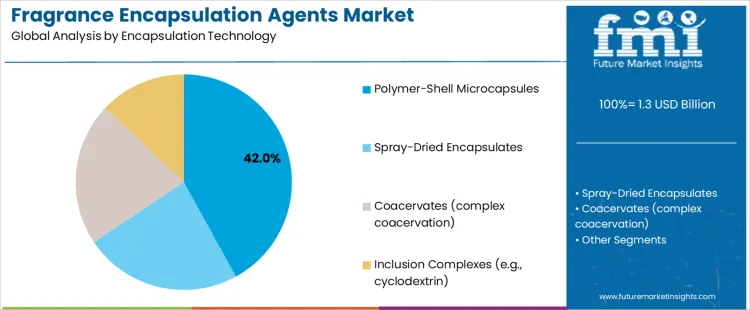
Polymer-shell microcapsules are the leading encapsulation technology in the fragrance encapsulation agents market, accounting for the largest share due to their ability to provide effective, long-lasting fragrance release. These microcapsules are widely used in various consumer products, particularly in laundry detergents, fabric softeners, and personal care products, to ensure that fragrances remain intact until use. The polymer shell protects the fragrance from external environmental factors, such as light and air, which could degrade the scent, and allows for the controlled release of fragrance when the product is used.
This technology is highly valued for its efficiency in offering sustained fragrance performance, especially in laundry detergents and fabric softeners, where consumers demand long-lasting freshness. In addition to household products, polymer-shell microcapsules are gaining traction in personal care products, such as body lotions and hair care, where controlled fragrance release enhances the overall consumer experience. As the demand for enhanced sensory experiences in consumer goods rises, polymer-shell microcapsules are expected to remain a dominant technology. Innovations in capsule formulations, which improve stability and fragrance retention, are further supporting their growth. Furthermore, the increasing focus on sustainability and eco-friendly products, with microcapsules offering more efficient use of fragrances and reducing waste, is likely to bolster demand for this encapsulation technology.
What Factors Drive the Demand for Laundry Detergents in the Fragrance Encapsulation Agents Market?
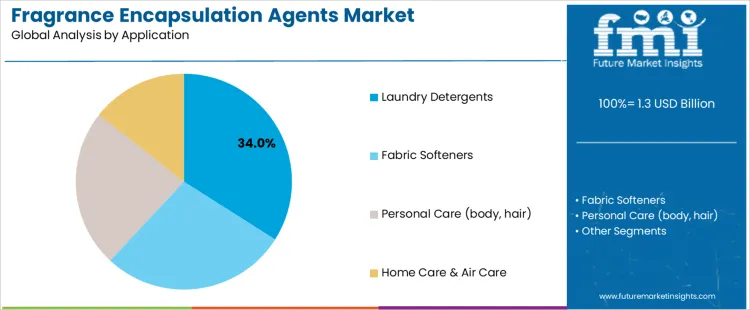
Laundry detergents are the leading application in the fragrance encapsulation agents market, driven by the increasing consumer demand for long-lasting fragrance in laundry products. Fragrance encapsulation agents, particularly polymer-shell microcapsules, are used in detergents to provide a prolonged release of fragrance during the washing and drying process. This innovation allows consumers to experience fresh, lasting scents on their clothes for extended periods after washing. The demand for enhanced fragrance performance in laundry products has been further fueled by the growing trend of premium and specialized laundry detergents, which often incorporate high-quality scents that consumers associate with cleanliness and freshness.
As consumer preferences shift towards products that offer both cleaning and lasting fragrance benefits, the role of fragrance encapsulation agents has become even more important. Furthermore, the convenience of having longer-lasting fragrance without the need for frequent reapplication is a significant driver of growth in this segment. Additionally, the rise of eco-conscious consumers has led to an increased interest in products that provide better fragrance retention without compromising on sustainability. As the laundry detergent market continues to grow globally, particularly in emerging economies, the demand for fragrance encapsulation solutions is expected to remain strong, solidifying laundry detergents as a key application in the fragrance encapsulation agents market.
What are the Key Dynamics of the Global Fragrance Encapsulation Agents Market?
The global fragrance encapsulation agents market is growing as personal care, home care and consumer goods brands adopt technologies that prolong scent release and improve product stability. Encapsulation agents trap fragrance molecules in micro or nano sized carriers that gradually release odorants during use, storage or triggered by humidity, heat or friction. Demand spans laundry detergents, fabric care, deodorants, cosmetics and air care products where long lasting scent and controlled delivery enhance consumer experience. Expansion reflects increased interest in premium sensory effects, product differentiation and formulation performance across markets worldwide.
What are the Key Drivers for the Global Fragrance Encapsulation Agents Market?
Rising consumer preference for products with enhanced and long lasting scent performance motivates brands to integrate encapsulation technologies that provide controlled fragrance release. Growth in personal care and home care categories such as fabric softeners, body sprays and candles supports greater use of encapsulated systems. Formulators seek agents that protect sensitive odorants from degradation during processing and storage, improving shelf life and reliability. Innovation in encapsulation materials-such as polymers, cyclodextrins and lipid systems-broadens options for targeted release profiles. Expansion of premium and differentiated product portfolios in competitive markets encourages adoption of advanced fragrance delivery solutions.
What are the Restraints for the Global Fragrance Encapsulation Agents Market?
One restraint is the additional formulation complexity and cost associated with integrating encapsulation agents compared with conventional fragrance addition. Manufacturers must balance carrier selection, encapsulation efficiency and compatibility with diverse formulation bases, which requires expertise and testing. Some encapsulation systems may interact with other actives or matrix components, affecting product sensory and stability outcomes. Regulatory scrutiny on certain encapsulation materials and safety evaluation requirements vary by region, adding compliance considerations. Cost sensitivity in value oriented segments may lead some brands to prioritise basic fragrance approaches over advanced delivery technologies.
What is the Key Trends in the Global Fragrance Encapsulation Agents Market?
A key trend is development of environmentally friendly and biodegradable encapsulation systems that align with sustainable and clean label positioning in personal and home care products. Suppliers are focusing on bio based carriers and green processes that reduce environmental impact while delivering controlled release. Industry interest is growing in sensory design platforms that combine fragrance encapsulation with formal parameter tuning-such as release timing, scent intensity and wearer experience. Integration of microencapsulation with smart delivery triggers (e.g., moisture or motion activated release) is gaining traction. Collaboration between encapsulant developers and brand formulators helps tailor solutions for specific applications, improving performance and consumer appeal.
What is the Country-Wise Analysis of the Fragrance Encapsulation Agents Market?
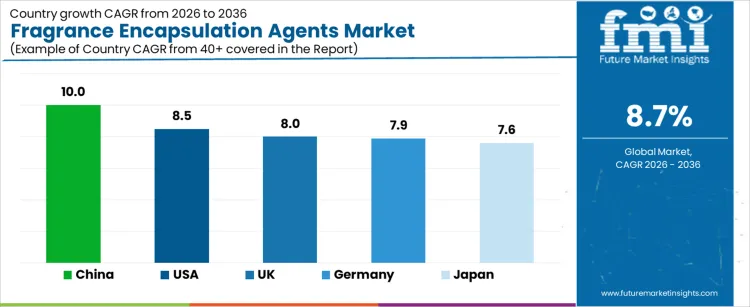
The fragrance encapsulation agents market is expected to experience steady growth, driven by increasing demand for long-lasting, controlled fragrance release in a variety of consumer products, including personal care, home care, and air fresheners. Fragrance encapsulation involves the use of specialized agents to trap fragrance molecules, allowing them to be released gradually over time, improving the longevity and intensity of scents. High-growth regions like China and the USA are leading the market due to their large manufacturing bases and strong demand for advanced fragrance technologies. Meanwhile, Europe, including the UK and Germany, is witnessing steady growth driven by consumer demand for premium and sustainable fragrance solutions. The adoption of fragrance encapsulation agents is expected to grow globally as consumers increasingly seek products with prolonged fragrance experiences.
| Country | CAGR (2026-2036) |
|---|---|
| China | 10% |
| United States | 8.5% |
| United Kingdom | 8% |
| Germany | 7.9% |
| Japan | 7.6% |
What is the Growth Outlook for the Fragrance Encapsulation Agents Market in China?
The fragrance encapsulation agents market in China is expected to grow at the highest rate, with a projected CAGR of 10%. China’s rapidly expanding consumer goods market, particularly in personal care, home care, and air freshener products, is driving the demand for fragrance encapsulation technologies. The increasing popularity of long-lasting fragrances in everyday products, combined with the growing demand for high-quality, premium fragrances, is contributing to the growth of the market. As China continues to modernize its manufacturing processes and consumer demand for advanced, effective fragrance delivery systems rises, the market for fragrance encapsulation agents is set to experience robust growth.
What is the Market Outlook for the Fragrance Encapsulation Agents Market in the United States?
The fragrance encapsulation agents market in the United States is projected to grow steadily, with a projected CAGR of 8.5%. The U.S. is one of the largest markets for consumer goods, particularly in the personal care, home care, and air freshener sectors. As consumers seek products that offer long-lasting and consistent fragrance experiences, the demand for fragrance encapsulation agents is increasing. Additionally, advancements in encapsulation technologies that enhance the efficiency and effectiveness of fragrance release are further driving market growth. The market is also supported by increasing interest in premium, high-quality fragrances and sustainable, eco-friendly formulations, which are key factors contributing to steady market growth.
What is the Growth Forecast for the Fragrance Encapsulation Agents Market in the United Kingdom?
The fragrance encapsulation agents market in the United Kingdom is expected to grow at a moderate pace, with a projected CAGR of 8%. The UK’s growing personal care, home care, and air freshener markets are fueling the demand for advanced fragrance delivery systems. Consumers in the UK are increasingly seeking products that offer prolonged fragrance release, leading to a rise in the adoption of fragrance encapsulation technologies. Additionally, the growing interest in premium and sustainable products, along with an increasing focus on longer-lasting fragrance solutions, is driving market growth. The UK’s well-established fragrance industry is expected to continue fostering innovation, contributing to steady growth in the fragrance encapsulation agents market.
What is the Market Outlook for the Fragrance Encapsulation Agents Market in Germany?
The fragrance encapsulation agents market in Germany is expected to grow at a steady rate, with a projected CAGR of 7.9%. Germany, known for its strong consumer goods sector, particularly in personal care, home care, and air care products, is seeing increasing demand for products with long-lasting fragrance performance. As consumers in Germany look for premium products with enhanced fragrance experiences, the demand for encapsulation agents is rising. Additionally, Germany’s commitment to sustainability and eco-friendly formulations is contributing to the adoption of innovative, environmentally responsible fragrance technologies. As the market for premium and sustainable fragrance solutions grows, Germany is expected to see steady growth in fragrance encapsulation agents.
What are the Growth Prospects for the Fragrance Encapsulation Agents Market in Japan?
The fragrance encapsulation agents market in Japan is expected to experience moderate growth, with a projected CAGR of 7.6%. Japan’s strong consumer goods sector, especially in personal care and home care products, is driving the demand for fragrance encapsulation solutions. Japanese consumers are increasingly seeking long-lasting, high-quality fragrances in a variety of products, including cosmetics, air fresheners, and household goods. As interest in premium fragrances and advanced technologies grows, fragrance encapsulation agents are becoming more popular. Additionally, Japan’s focus on sustainability and eco-friendly products is pushing the development and adoption of more responsible, effective fragrance delivery systems. The market is expected to continue growing steadily as demand for innovative, long-lasting fragrance solutions increases.
What is the Competitive Landscape for the Fragrance Encapsulation Agents Market?
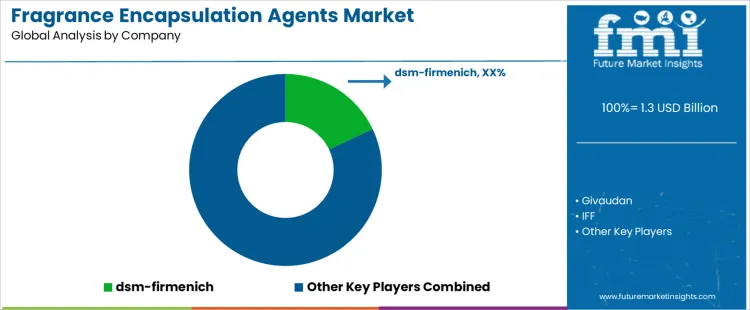
The fragrance encapsulation agents market is expanding as industries seek innovative solutions for controlled fragrance release and enhanced product performance. dsm-firmenich leads the market with its advanced fragrance encapsulation technologies, offering solutions that ensure long-lasting fragrance release and improve the stability of fragrance in various applications. Their focus on sustainability, performance, and product innovation positions them as a key player. Givaudan, IFF, and Symrise are strong competitors, each providing advanced fragrance encapsulation solutions tailored for the fragrance and personal care industries. Givaudan offers high-performance encapsulation agents that provide enhanced fragrance longevity, while IFF and Symrise focus on creating customized encapsulation systems that address the evolving needs of consumers and manufacturers.
Microcaps (by Symrise), Balchem, Sensient Technologies, Encapsys, Kerry Group, and Croda further contribute to the competitive landscape by offering specialized encapsulation technologies for fragrance applications. Microcaps focuses on microencapsulation systems that enhance fragrance release in personal care products. Balchem and Sensient Technologies specialize in controlled-release systems, particularly for fragrances in household products. Encapsys offers effective microencapsulation solutions for various applications, while Kerry Group and Croda deliver customized fragrance encapsulation agents that improve fragrance stability and performance. These companies compete by focusing on innovation, product performance, and the ability to meet the growing demand for sustainable and high-quality fragrance encapsulation solutions.
Key Players of the Fragrance Encapsulation Agents Market
- dsm-firmenich
- Givaudan
- IFF
- Symrise
- Microcaps (by Symrise)
- Balchem
- Sensient Technologies
- Encapsys
- Kerry Group
- Croda
Scope of the Report
| Items | Values |
|---|---|
| Quantitative Units (2026) | USD Billion |
| Encapsulation Technology | Polymer-Shell Microcapsules, Spray-Dried Encapsulates, Coacervates (Complex Coacervation), Inclusion Complexes (e.g., Cyclodextrin) |
| Application | Laundry Detergents, Fabric Softeners, Personal Care (Body, Hair), Home Care & Air Care |
| Release Trigger | Friction / Rub-Activated, Moisture / Humidity-Activated, Heat / Drying-Activated, Time / Slow-Release |
| Capsule Size Range | Fine (1–10 µm), Medium (10–30 µm), Coarse (30–80 µm), Mixed Distributions |
| Companies | dsm-firmenich, Givaudan, IFF, Symrise, Microcaps (by Symrise), Balchem, Sensient Technologies, Encapsys, Kerry Group, Croda |
| Regions Covered | North America, Latin America, Western Europe, Eastern Europe, South Asia and Pacific, East Asia, Middle East & Africa |
| Countries Covered | United States, Canada, Mexico, Brazil, Argentina, Germany, France, United Kingdom, Italy, Spain, Netherlands, China, India, Japan, South Korea, ANZ, GCC Countries, South Africa |
| Additional Attributes | Dollar by sales by encapsulation technology, application, release trigger, capsule size range, and region. Includes market trends in fragrance encapsulation agents, focusing on polymer-shell microcapsules, spray-dried encapsulates, coacervates, and inclusion complexes. Highlights the role of friction, moisture, heat, and time-based release triggers in various applications like laundry, fabric softeners, and personal care. Focus on cost-effectiveness, regulatory compliance, sustainability, market share, and competitive positioning of key companies in the fragrance encapsulation space. |
Fragrance Encapsulation Agents Market Segmentation
Encapsulation Technology
- Polymer-Shell Microcapsules
- Spray-Dried Encapsulates
- Coacervates (complex coacervation)
- Inclusion Complexes (e.g., cyclodextrin)
Application
- Laundry Detergent
- Fabric Softeners
- Personal Care (body, hair)
- Home Care & Air Care
Release Trigger
- Friction / Rub-Activated
- Moisture / Humidity-Activated
- Heat / Drying-Activated
- Time / Slow-Release
Capsule Size Range
- Fine (1–10 µm)
- Medium (10–30 µm)
- Coarse (30–80 µm)
- Mixed Distributions
Region
- Asia Pacific
- China
- Japan
- South Korea
- India
- Australia & New Zealand
- ASEAN
- Rest of Asia Pacific
- Europe
- Germany
- United Kingdom
- France
- Italy
- Spain
- Nordic
- BENELUX
- Rest of Europe
- North America
- United States
- Canada
- Mexico
- Latin America
- Brazil
- Chile
- Rest of Latin America
- Middle East & Africa
- Kingdom of Saudi Arabia
- Other GCC Countries
- Turkey
- South Africa
- Other African Union
- Rest of Middle East & Africa
Frequently Asked Questions
How big is the fragrance encapsulation agents market in 2026?
The global fragrance encapsulation agents market is estimated to be valued at USD 1.3 billion in 2026.
What will be the size of fragrance encapsulation agents market in 2036?
The market size for the fragrance encapsulation agents market is projected to reach USD 3.0 billion by 2036.
How much will be the fragrance encapsulation agents market growth between 2026 and 2036?
The fragrance encapsulation agents market is expected to grow at a 8.7% CAGR between 2026 and 2036.
What are the key product types in the fragrance encapsulation agents market?
The key product types in fragrance encapsulation agents market are polymer-shell microcapsules, spray-dried encapsulates, coacervates (complex coacervation) and inclusion complexes (e.g., cyclodextrin).
Which application segment to contribute significant share in the fragrance encapsulation agents market in 2026?
In terms of application, laundry detergents segment to command 34.0% share in the fragrance encapsulation agents market in 2026.
Preview the report firsthand - request a free sample
Get SampleGet the brochure for pricing and purchase details.
Get PDFTable of Content
- Executive Summary
- Global Market Outlook
- Demand-side Trends
- Supply-side Trends
- Technology Roadmap Analysis
- Analysis and Recommendations
- Market Overview
- Market Coverage / Taxonomy
- Market Definition / Scope / Limitations
- Market Background
- Market Dynamics
- Drivers
- Restraints
- Opportunity
- Trends
- Scenario Forecast
- Demand in Optimistic Scenario
- Demand in Likely Scenario
- Demand in Conservative Scenario
- Opportunity Map Analysis
- Product Life Cycle Analysis
- Supply Chain Analysis
- Investment Feasibility Matrix
- Value Chain Analysis
- PESTLE and Porter’s Analysis
- Regulatory Landscape
- Regional Parent Market Outlook
- Production and Consumption Statistics
- Import and Export Statistics
- Market Dynamics
- Global Market Analysis 2021 to 2025 and Forecast, 2026 to 2036
- Historical Market Size Value (USD Million) Analysis, 2021 to 2025
- Current and Future Market Size Value (USD Million) Projections, 2026 to 2036
- Y-o-Y Growth Trend Analysis
- Absolute $ Opportunity Analysis
- Global Market Pricing Analysis 2021 to 2025 and Forecast 2026 to 2036
- Global Market Analysis 2021 to 2025 and Forecast 2026 to 2036, By Encapsulation Technology
- Introduction / Key Findings
- Historical Market Size Value (USD Million) Analysis By Encapsulation Technology , 2021 to 2025
- Current and Future Market Size Value (USD Million) Analysis and Forecast By Encapsulation Technology , 2026 to 2036
- Polymer-Shell Microcapsules
- Spray-Dried Encapsulates
- Coacervates (complex coacervation)
- Inclusion Complexes (e.g., cyclodextrin)
- Y-o-Y Growth Trend Analysis By Encapsulation Technology , 2021 to 2025
- Absolute $ Opportunity Analysis By Encapsulation Technology , 2026 to 2036
- Global Market Analysis 2021 to 2025 and Forecast 2026 to 2036, By Application
- Introduction / Key Findings
- Historical Market Size Value (USD Million) Analysis By Application, 2021 to 2025
- Current and Future Market Size Value (USD Million) Analysis and Forecast By Application, 2026 to 2036
- Laundry Detergents
- Fabric Softeners
- Personal Care (body, hair)
- Home Care & Air Care
- Y-o-Y Growth Trend Analysis By Application, 2021 to 2025
- Absolute $ Opportunity Analysis By Application, 2026 to 2036
- Global Market Analysis 2021 to 2025 and Forecast 2026 to 2036, By Release Trigger
- Introduction / Key Findings
- Historical Market Size Value (USD Million) Analysis By Release Trigger, 2021 to 2025
- Current and Future Market Size Value (USD Million) Analysis and Forecast By Release Trigger, 2026 to 2036
- Friction / Rub-Activated
- Moisture / Humidity-Activated
- Heat / Drying-Activated
- Time / Slow-Release
- Y-o-Y Growth Trend Analysis By Release Trigger, 2021 to 2025
- Absolute $ Opportunity Analysis By Release Trigger, 2026 to 2036
- Global Market Analysis 2021 to 2025 and Forecast 2026 to 2036, By Capsule Size Range
- Introduction / Key Findings
- Historical Market Size Value (USD Million) Analysis By Capsule Size Range, 2021 to 2025
- Current and Future Market Size Value (USD Million) Analysis and Forecast By Capsule Size Range, 2026 to 2036
- Medium (10–30 µm)
- Fine (1–10 µm)
- Coarse (30–80 µm)
- Mixed Distributions
- Y-o-Y Growth Trend Analysis By Capsule Size Range, 2021 to 2025
- Absolute $ Opportunity Analysis By Capsule Size Range, 2026 to 2036
- Global Market Analysis 2021 to 2025 and Forecast 2026 to 2036, By Region
- Introduction
- Historical Market Size Value (USD Million) Analysis By Region, 2021 to 2025
- Current Market Size Value (USD Million) Analysis and Forecast By Region, 2026 to 2036
- North America
- Latin America
- Western Europe
- Eastern Europe
- East Asia
- South Asia and Pacific
- Middle East & Africa
- Market Attractiveness Analysis By Region
- North America Market Analysis 2021 to 2025 and Forecast 2026 to 2036, By Country
- Historical Market Size Value (USD Million) Trend Analysis By Market Taxonomy, 2021 to 2025
- Market Size Value (USD Million) Forecast By Market Taxonomy, 2026 to 2036
- By Country
- USA
- Canada
- Mexico
- By Encapsulation Technology
- By Application
- By Release Trigger
- By Capsule Size Range
- By Country
- Market Attractiveness Analysis
- By Country
- By Encapsulation Technology
- By Application
- By Release Trigger
- By Capsule Size Range
- Key Takeaways
- Latin America Market Analysis 2021 to 2025 and Forecast 2026 to 2036, By Country
- Historical Market Size Value (USD Million) Trend Analysis By Market Taxonomy, 2021 to 2025
- Market Size Value (USD Million) Forecast By Market Taxonomy, 2026 to 2036
- By Country
- Brazil
- Chile
- Rest of Latin America
- By Encapsulation Technology
- By Application
- By Release Trigger
- By Capsule Size Range
- By Country
- Market Attractiveness Analysis
- By Country
- By Encapsulation Technology
- By Application
- By Release Trigger
- By Capsule Size Range
- Key Takeaways
- Western Europe Market Analysis 2021 to 2025 and Forecast 2026 to 2036, By Country
- Historical Market Size Value (USD Million) Trend Analysis By Market Taxonomy, 2021 to 2025
- Market Size Value (USD Million) Forecast By Market Taxonomy, 2026 to 2036
- By Country
- Germany
- UK
- Italy
- Spain
- France
- Nordic
- BENELUX
- Rest of Western Europe
- By Encapsulation Technology
- By Application
- By Release Trigger
- By Capsule Size Range
- By Country
- Market Attractiveness Analysis
- By Country
- By Encapsulation Technology
- By Application
- By Release Trigger
- By Capsule Size Range
- Key Takeaways
- Eastern Europe Market Analysis 2021 to 2025 and Forecast 2026 to 2036, By Country
- Historical Market Size Value (USD Million) Trend Analysis By Market Taxonomy, 2021 to 2025
- Market Size Value (USD Million) Forecast By Market Taxonomy, 2026 to 2036
- By Country
- Russia
- Poland
- Hungary
- Balkan & Baltic
- Rest of Eastern Europe
- By Encapsulation Technology
- By Application
- By Release Trigger
- By Capsule Size Range
- By Country
- Market Attractiveness Analysis
- By Country
- By Encapsulation Technology
- By Application
- By Release Trigger
- By Capsule Size Range
- Key Takeaways
- East Asia Market Analysis 2021 to 2025 and Forecast 2026 to 2036, By Country
- Historical Market Size Value (USD Million) Trend Analysis By Market Taxonomy, 2021 to 2025
- Market Size Value (USD Million) Forecast By Market Taxonomy, 2026 to 2036
- By Country
- China
- Japan
- South Korea
- By Encapsulation Technology
- By Application
- By Release Trigger
- By Capsule Size Range
- By Country
- Market Attractiveness Analysis
- By Country
- By Encapsulation Technology
- By Application
- By Release Trigger
- By Capsule Size Range
- Key Takeaways
- South Asia and Pacific Market Analysis 2021 to 2025 and Forecast 2026 to 2036, By Country
- Historical Market Size Value (USD Million) Trend Analysis By Market Taxonomy, 2021 to 2025
- Market Size Value (USD Million) Forecast By Market Taxonomy, 2026 to 2036
- By Country
- India
- ASEAN
- Australia & New Zealand
- Rest of South Asia and Pacific
- By Encapsulation Technology
- By Application
- By Release Trigger
- By Capsule Size Range
- By Country
- Market Attractiveness Analysis
- By Country
- By Encapsulation Technology
- By Application
- By Release Trigger
- By Capsule Size Range
- Key Takeaways
- Middle East & Africa Market Analysis 2021 to 2025 and Forecast 2026 to 2036, By Country
- Historical Market Size Value (USD Million) Trend Analysis By Market Taxonomy, 2021 to 2025
- Market Size Value (USD Million) Forecast By Market Taxonomy, 2026 to 2036
- By Country
- Kingdom of Saudi Arabia
- Other GCC Countries
- Turkiye
- South Africa
- Other African Union
- Rest of Middle East & Africa
- By Encapsulation Technology
- By Application
- By Release Trigger
- By Capsule Size Range
- By Country
- Market Attractiveness Analysis
- By Country
- By Encapsulation Technology
- By Application
- By Release Trigger
- By Capsule Size Range
- Key Takeaways
- Key Countries Market Analysis
- USA
- Pricing Analysis
- Market Share Analysis, 2025
- By Encapsulation Technology
- By Application
- By Release Trigger
- By Capsule Size Range
- Canada
- Pricing Analysis
- Market Share Analysis, 2025
- By Encapsulation Technology
- By Application
- By Release Trigger
- By Capsule Size Range
- Mexico
- Pricing Analysis
- Market Share Analysis, 2025
- By Encapsulation Technology
- By Application
- By Release Trigger
- By Capsule Size Range
- Brazil
- Pricing Analysis
- Market Share Analysis, 2025
- By Encapsulation Technology
- By Application
- By Release Trigger
- By Capsule Size Range
- Chile
- Pricing Analysis
- Market Share Analysis, 2025
- By Encapsulation Technology
- By Application
- By Release Trigger
- By Capsule Size Range
- Germany
- Pricing Analysis
- Market Share Analysis, 2025
- By Encapsulation Technology
- By Application
- By Release Trigger
- By Capsule Size Range
- UK
- Pricing Analysis
- Market Share Analysis, 2025
- By Encapsulation Technology
- By Application
- By Release Trigger
- By Capsule Size Range
- Italy
- Pricing Analysis
- Market Share Analysis, 2025
- By Encapsulation Technology
- By Application
- By Release Trigger
- By Capsule Size Range
- Spain
- Pricing Analysis
- Market Share Analysis, 2025
- By Encapsulation Technology
- By Application
- By Release Trigger
- By Capsule Size Range
- France
- Pricing Analysis
- Market Share Analysis, 2025
- By Encapsulation Technology
- By Application
- By Release Trigger
- By Capsule Size Range
- India
- Pricing Analysis
- Market Share Analysis, 2025
- By Encapsulation Technology
- By Application
- By Release Trigger
- By Capsule Size Range
- ASEAN
- Pricing Analysis
- Market Share Analysis, 2025
- By Encapsulation Technology
- By Application
- By Release Trigger
- By Capsule Size Range
- Australia & New Zealand
- Pricing Analysis
- Market Share Analysis, 2025
- By Encapsulation Technology
- By Application
- By Release Trigger
- By Capsule Size Range
- China
- Pricing Analysis
- Market Share Analysis, 2025
- By Encapsulation Technology
- By Application
- By Release Trigger
- By Capsule Size Range
- Japan
- Pricing Analysis
- Market Share Analysis, 2025
- By Encapsulation Technology
- By Application
- By Release Trigger
- By Capsule Size Range
- South Korea
- Pricing Analysis
- Market Share Analysis, 2025
- By Encapsulation Technology
- By Application
- By Release Trigger
- By Capsule Size Range
- Russia
- Pricing Analysis
- Market Share Analysis, 2025
- By Encapsulation Technology
- By Application
- By Release Trigger
- By Capsule Size Range
- Poland
- Pricing Analysis
- Market Share Analysis, 2025
- By Encapsulation Technology
- By Application
- By Release Trigger
- By Capsule Size Range
- Hungary
- Pricing Analysis
- Market Share Analysis, 2025
- By Encapsulation Technology
- By Application
- By Release Trigger
- By Capsule Size Range
- Kingdom of Saudi Arabia
- Pricing Analysis
- Market Share Analysis, 2025
- By Encapsulation Technology
- By Application
- By Release Trigger
- By Capsule Size Range
- Turkiye
- Pricing Analysis
- Market Share Analysis, 2025
- By Encapsulation Technology
- By Application
- By Release Trigger
- By Capsule Size Range
- South Africa
- Pricing Analysis
- Market Share Analysis, 2025
- By Encapsulation Technology
- By Application
- By Release Trigger
- By Capsule Size Range
- USA
- Market Structure Analysis
- Competition Dashboard
- Competition Benchmarking
- Market Share Analysis of Top Players
- By Regional
- By Encapsulation Technology
- By Application
- By Release Trigger
- By Capsule Size Range
- Competition Analysis
- Competition Deep Dive
- dsm-firmenich
- Overview
- Product Portfolio
- Profitability by Market Segments (Product/Age /Sales Channel/Region)
- Sales Footprint
- Strategy Overview
- Marketing Strategy
- Product Strategy
- Channel Strategy
- Givaudan
- IFF
- Symrise
- Microcaps (by Symrise)
- Balchem
- Sensient Technologies
- Encapsys
- Kerry Group
- Croda
- dsm-firmenich
- Competition Deep Dive
- Assumptions & Acronyms Used
- Research Methodology


