

- Market Size (2026)
- USD 213.7 Mn
- Forecast (2036)
- USD 441.0 Mn
- CAGR (2026 to 2036)
- 7.5%
How big is the freeze dried blueberry market in 2026?
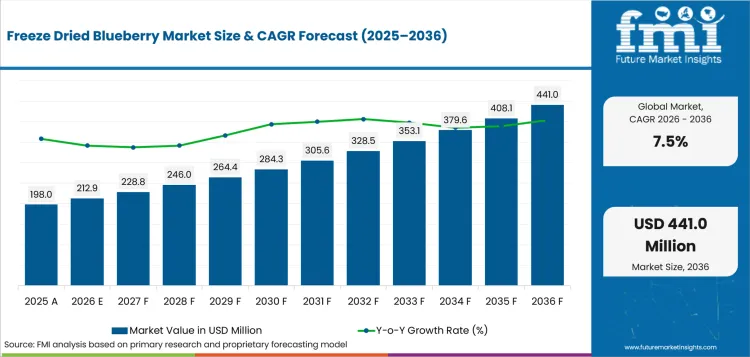
USD 213.7 million in 2026 and USD 441.0 million by 2036 at a 7.5% CAGR.
The freeze dried blueberry market value is forecast to grow from USD 198.0 million in 2025 to USD 441.0 million by 2036 at 7.5% CAGR as cereal, bakery, and nutrition brands add shelf-stable berry formats. Pieces are projected to represent 43.0% share in 2026 because visible fruit identity matters in dry mixes and snack packs. B2B ingredients are expected to secure 63.0% share in 2026, led by bulk orders from food manufacturers.
Freeze Dried Blueberry Market Overview: Size and Forecast
- 2026 Market Size: USD 213.7 million
- 2036 Market Size: USD 441.0 million
- Forecast CAGR: 7.5% from 2026 to 2036
- Leading Form: Pieces
- Pieces Share in 2026: 43.0%
- Leading Channel: B2B Ingredients
- B2B Ingredients Share in 2026: 63.0%
- Fastest-growing Country: India
- India CAGR: 8.7% by 2036
Summary of Freeze Dried Blueberry Market
- Demand and Growth Drivers
- Cereal brands are using blueberry pieces to add visible fruit without raising product water activity.
- Bakery makers are choosing low-moisture pieces where frozen berries create color bleed.
- Nutrition brands are using powder where blueberry color and fruit positioning support drink mixes.
- Product and Segment View
- Pieces are forecast to represent 43.0% share in 2026, led by visible fruit identity and lower moisture release.
- B2B ingredients are projected to hold 63.0% share in 2026, influenced by bulk orders from cereal and bakery producers.
- Cultivated blueberries are expected to secure 72.0% share in 2026, supported by stable sizing and farm supply.
- Geography and Competitive Outlook
- India is projected to record 8.7% CAGR by 2036, backed by premium e-commerce and nutrition use.
- China is expected to expand at 8.2% CAGR by 2036 through imported berry use in premium snacks and dairy.
- Thrive Freeze Dry and Van Drunen Farms compete through freeze-dry capacity and fruit ingredient depth.
- Chaucer Foods, European Freeze Dry, and Paradiesfrucht focus on fruit formats for cereal and bakery buyers.
- Analyst Opinion
- Nandini Roy Choudhury, Principal Consultant at FMI, observes, "Freeze dried blueberry demand is shifting from simple snack packs into a technical ingredient business. Cereal makers want pieces that keep color after storage. Bakery teams want fruit that does not bleed into dough. Nutrition brands want powder with clean taste and a short label. Suppliers with fruit sourcing control and tight water activity checks should hold the strongest position."
- What supports value in the freeze dried blueberry market?
- Finished pieces, powder demand, and low-moisture processing controls support market value across B2B and retail channels.
- Market value is supported by premium freeze-dried fruit revenue before cereal and bakery processing margins add incremental value.
- Supplier pricing reflects fruit grade and drying cost before packaging format affects retail value.
- Revenue improves as foodmakers shift blueberry from seasonal fruit use into shelf-stable ingredient systems.
- Buyer confidence increases when product labels and lot documents make moisture control easier to review.
Supply planning is the main pressure point for freeze dried blueberry products because fresh, frozen, and processed channels compete for the same crop. USDA reported cultivated blueberry output at 789.5 million pounds in 2024 with a USD 1.15 billion farm value. FDA issued low-moisture ready-to-eat food guidance in January 2025 that covers sanitation programs and corrective actions. These checks matter before freeze-dried pieces reach cereal and snack plants.
Why is the freeze dried blueberry market growing?
Food manufacturers are moving toward low-moisture blueberry formats with better shelf stability and cleaner ingredient communication.
Cereal and granola buyers create the largest repeat order flow for freeze-dried blueberry pieces. WITS recorded United States HS 081040 imports at USD 2.43 billion in 2024. Freeze-dried suppliers use the same fruit network but sell into ambient shelf formats with higher value per kilogram. FDA low-moisture guidance in January 2025 raised attention on sanitation programs for dry ready-to-eat foods. This makes lot control and environmental monitoring practical purchase filters for freeze-dried berry suppliers.
How is the freeze dried blueberry market segmented?
The freeze dried blueberry industry is segmented by form, nature, application, channel, and source type.
- Pieces are projected to secure 43.0% share in 2026, led by cereal visibility and bakery topping use.
- Conventional products are anticipated to hold 66.0% share in 2026 since bulk cereal users need cost control.
- Cereal applications are expected to capture 28.0% share in 2026 due to dry breakfast inclusion demand.
- B2B ingredients are forecast to represent 63.0% share in 2026, guided by foodmaker bulk ordering.
- Cultivated source products are projected to account for 72.0% share in 2026, reflected by highbush fruit sizing.
Why do pieces lead the freeze dried blueberry market?
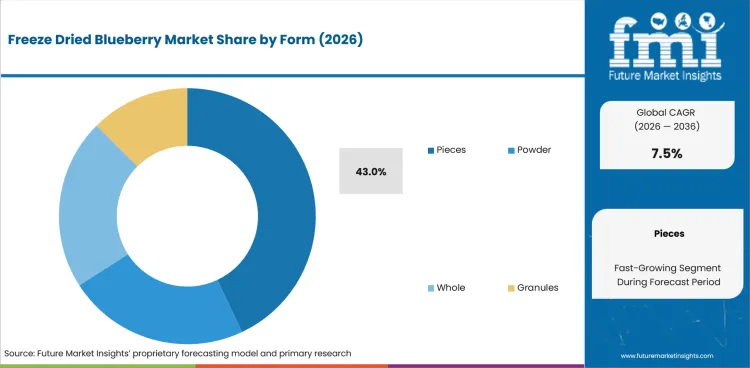
- Pieces are projected to account for 43.0% share in 2026, influenced by cereal visibility and bakery topping use.
- Powder gains use as nutrition blends need color and faster dispersion.
Which nature leads the freeze dried blueberry market?
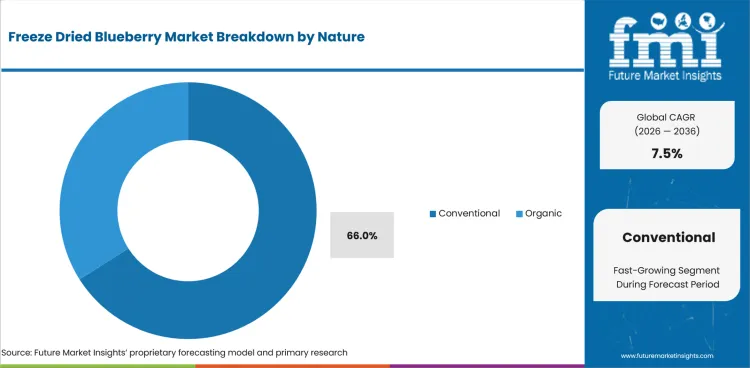
- Conventional products are expected to represent 66.0% share in 2026, shaped by lower ingredient cost for cereal and bakery buyers.
- Organic products gain value in retail snack packs and kids products.
Which application leads the freeze dried blueberry market?
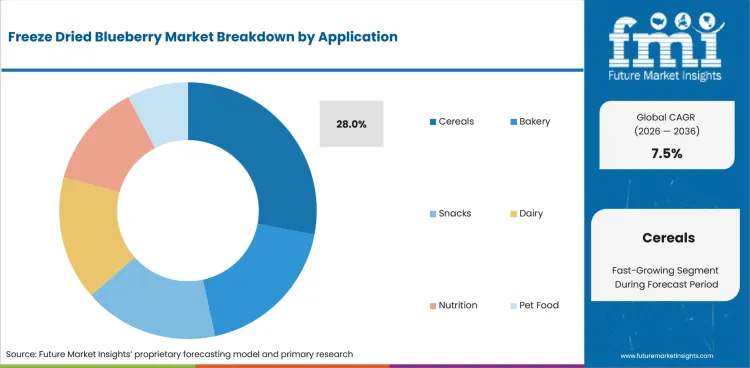
- Cereal applications are anticipated to hold 28.0% share in 2026, supported by dry breakfast inclusion demand.
- Bakery applications add demand where low-moisture fruit helps limit dough staining.
Which channel leads the freeze dried blueberry market?
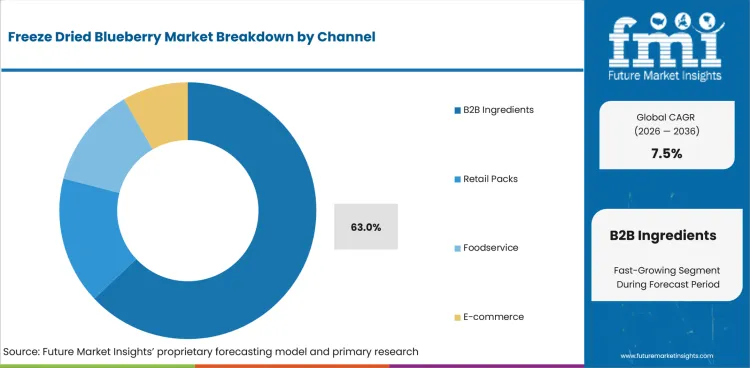
- B2B ingredients are estimated to account for 63.0% share in 2026, led by cereal and bakery procurement.
- Retail packs gain value through single-fruit snacks and no-added-sugar positioning.
Which source type leads the freeze dried blueberry market?
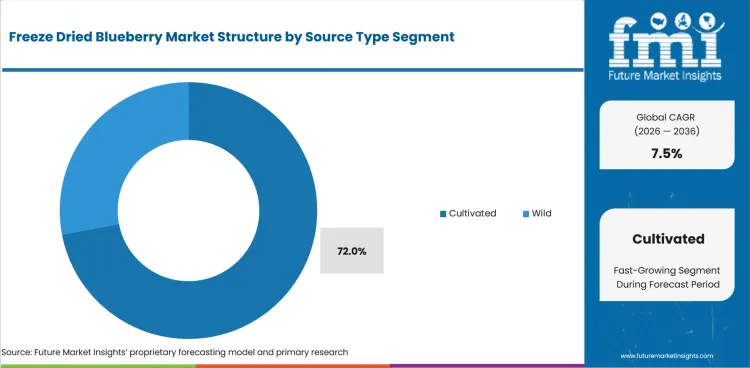
- Cultivated source products are projected to represent 72.0% share in 2026, influenced by highbush fruit sizing and farm availability.
- Wild blueberries remain relevant for powders where stronger color is preferred.
What are the drivers, restraints, and opportunities in the freeze dried blueberry market?
Cereal inclusion and low-moisture safety support growth while raw fruit price volatility limits wider use.
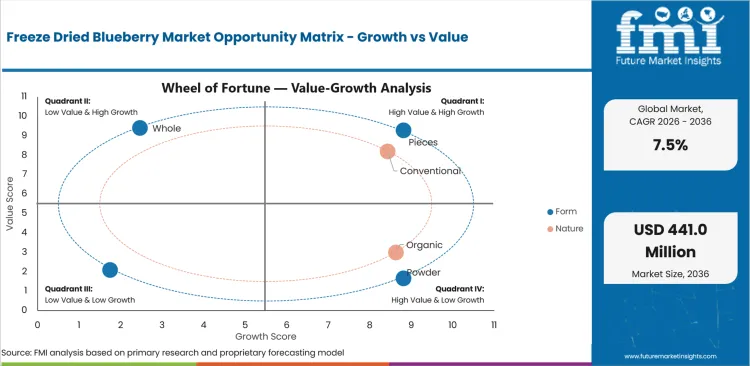
- Driver: Cereal buyers are using blueberry pieces where visible fruit raises perceived value in dry breakfast products.
- Restraint: Raw fruit price volatility can restrict margins when fresh and frozen channels pay more for premium fruit.
- Opportunity: Organic and no-added-sugar retail packs can reach premium snack aisles through smaller pack sizes.
Berry ingredient buyers now review fruit safety and moisture control more closely. FDA reported frozen berry sampling results in January 2025 and found HAV or norovirus prevalence below 1% for each tested berry type. FDA also issued low-moisture ready-to-eat food guidance in January 2025. These two signals make preventive controls and traceability more important for suppliers selling into cereal and snack plants.
Raw Fruit Channel Competition Pressures Margins
Raw blueberry availability can restrict freeze dried blueberry margins when fresh and frozen channels compete for higher-grade fruit. In May 2025, USDA NASS reported 789.0 million pounds of cultivated blueberry utilized production in 2024 and said 431.0 million pounds went to the fresh market. The same report placed processing use at 359.0 million pounds. This split matters because freeze drying needs consistent size and color rather than low-grade surplus. Suppliers therefore face tighter procurement risk when fresh buyers pull premium fruit during strong seasonal pricing.
Organic Snack Packs Support Premium Shelf Placement
Organic and no-added-sugar freeze dried blueberry packs can create a premium route beyond cereal ingredient use. In January 2026, USDA ERS reported USA organic food sales of USD 65.4 billion in 2024 and said produce accounted for 33% of organic food sales. That supports smaller retail packs because shoppers already associate organic produce with quality and ingredient trust. Freeze dried blueberry brands can use that position to defend higher price per ounce through clean labels and portion-controlled snack formats.
Who are the leading companies in the freeze dried blueberry market?
Thrive Freeze Dry, Van Drunen Farms, Chaucer Foods, European Freeze Dry, and Paradiesfrucht lead supplier relevance.
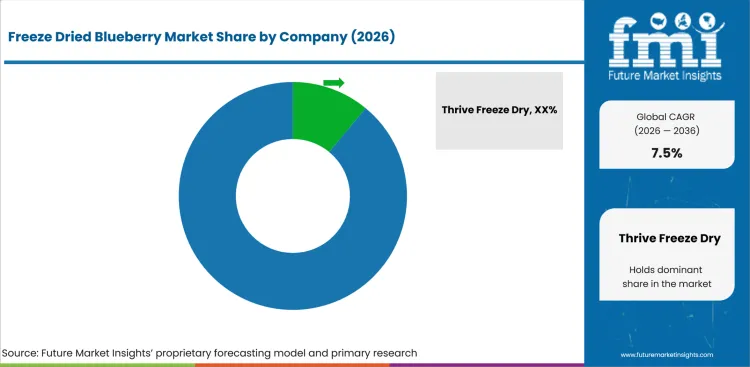
- Scaled freeze-dry processors hold an advantage where foodmakers need repeat lots and water activity documentation.
- European ingredient specialists gain business through cereal, bakery, and private-label programs.
- Retail and specialty brands compete through small packs and single-fruit snack positioning.
- Supplier choice depends on fruit sourcing, low-moisture control, and application support.
Large processors compete by combining drying capacity with fruit sourcing and application support. Thrive Freeze Dry signed a definitive agreement in April 2024 to acquire Paradiesfrucht GmbH. The target operated 20 freeze dryers across two German facilities. This strengthened European ingredient reach for cereal, snack, bakery, and confectionery customers.
Regional specialists can win through smaller runs and custom formats. Chaucer Foods offers freeze-dried powders, melts, and baked product formats. European Freeze Dry offers freeze-dried food ingredients and commission drying services for industrial users. These capabilities matter because buyers need a low-moisture ingredient that works in factory lines.
How do top freeze dried blueberry companies compare?
Thrive Freeze Dry scores strongest on scale while Van Drunen Farms and Chaucer Foods remain relevant through fruit ingredient depth.
| Company | Relevance to Market Title | Blueberry Format Depth | Low-Moisture Control | B2B Application Support | Geographic Footprint |
|---|---|---|---|---|---|
| Thrive Freeze Dry | Very High | High | Very Strong | Strong | Global |
| Van Drunen Farms | Very High | High | Strong | Strong | North America and Europe |
| Chaucer Foods | High | High | Strong | Medium | United States and United Kingdom |
| European Freeze Dry | High | Medium | Strong | Strong | Europe |
| Paradiesfrucht | High | High | Strong | Strong | Europe |
| Mercer Foods | Moderate to High | Medium | Medium | Medium | North America |
| Freeze-Dry Foods | Moderate to High | Medium | Strong | Strong | Europe |
| Crispy Green | Moderate | Medium | Medium | Low | North America |
| Sow Good | Moderate | Low | Medium | Low | United States |
| Döhler Group | Moderate to High | Medium | Strong | Strong | Global |
Source: Future Market Insights competitive analysis, 2026.
Who are the key players in the freeze dried blueberry market?
Thrive Freeze Dry, Van Drunen Farms, Chaucer Foods, European Freeze Dry, Paradiesfrucht and Mercer Foods are listed with retail specialists.
Key global companies leading the freeze dried blueberry market include:
- Thrive Freeze Dry
- Van Drunen Farms
- Chaucer Foods
- European Freeze Dry
- Paradiesfrucht
- Mercer Foods
- Freeze-Dry Foods
- Crispy Green
- Sow Good
- Döhler Group
Key Developments in Freeze Dried Blueberry Market
- In April 2024, Thrive Freeze Dry signed a definitive agreement to acquire Paradiesfrucht GmbH. The deal expanded European freeze-dried fruit capacity and ingredient access.
- In October 2025, USA Highbush Blueberry Council named Pluff the USD 20,000 grand prize winner of the Blueberry Boost Accelerator Pitch Competition. The earlier cohort profile identified Pluff’s Berry Blast mousse-style dessert as a high-protein product made with freeze-dried blueberries, which shows how freeze-dried blueberry pieces are moving into functional indulgence formats.
- In July 2025, Chaucer Foods relaunched its Crunchies brand website with updated packaging and a refreshed retail identity for freeze-dried fruit snacks. The move matters for freeze dried blueberry suppliers because stronger shelf branding and recipe-led usage can support repeat purchase beyond cereal inclusions.
Which countries are growing fastest in the freeze dried blueberry market?
India reaches 8.7% CAGR followed by China at 8.2% through 2036.
.webp "Top Country Growth Comparison Freeze Dried Blueberry Market Cagr (2026 2036)")
| Country | CAGR |
|---|---|
| India | 8.7% |
| China | 8.2% |
| South Korea | 7.9% |
| United States | 7.2% |
| Japan | 6.9% |
| Germany | 6.8% |
| United Kingdom | 6.7% |
| France | 6.5% |
Source: Future Market Insights, 2026.
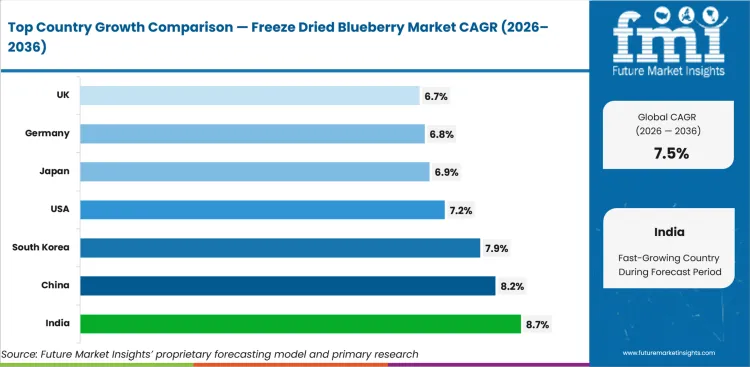
How do country-level CAGRs compare in the freeze dried blueberry market?
India leads country growth while France records the most cautious expansion outlook among profiled markets.
- India is forecast to record 8.7% CAGR by 2036 as premium e-commerce and nutrition brands expand imported berry use.
- China is projected to rise at 8.2% CAGR from 2026 to 2036 due to premium snacks and dairy toppings.
- South Korea is expected to grow at 7.9% CAGR through 2036, reflected by convenience snack and dessert applications.
- The United States is estimated to advance at 7.2% CAGR by 2036 with domestic processing and cereal demand.
- Japan is forecast to post 6.9% CAGR through 2036 as small-pack premium fruit formats gain space.
- Germany is anticipated to expand at 6.8% CAGR by 2036 through muesli and bakery ingredient demand.
- The United Kingdom is projected to grow at 6.7% CAGR by 2036 with private-label snack and cereal programs.
- France is expected to record 6.5% CAGR through 2036 as bakery and dairy topping use remains concentrated.
Why is India the fastest-growing freeze dried blueberry market?
An 8.7% CAGR through 2036 reflects premium e-commerce, nutrition blends, and imported berry formats.
Country Market Snapshot Table
| Parameter | Value |
|---|---|
| Market Size in 2025 (Value) | USD 2.9 million |
| Market Size in 2026 (Value) | USD 3.2 million |
| Market Forecast in 2036 (Value) | USD 7.4 million |
| CAGR (2026 to 2036) | 8.7% |
| Years Considered | 2021 to 2036 |
| Base Year | 2025 |
| Forecast Period | 2026 to 2036 |
| Units Considered | Value (USD million) |
| Leading Sub-Region | Mumbai, Delhi NCR, and Bengaluru premium retail corridors |
India Freeze Dried Blueberry Market Outlook
India starts from a small premium base and relies heavily on imported fruit inputs. Growth is expected to come first through e-commerce, nutrition brands, bakery kits, and premium grocery channels.
Price sensitivity will shape pack design. Smaller pouches and powder formats can reduce sticker shock while allowing brands to use blueberry color and no-added-sugar claims.
Key Growth Drivers
- India imports are small but rising from a premium base. WITS recorded HS 081040 imports at USD 11.4 million and 1.35 million kg in 2024.
- Peru dominates the supply route. WITS listed Peru at USD 10.2 million and 1.24 million kg in India HS 081040 imports in 2024.
- Bengaluru nutrition brands can use blueberry powder in smoothies and supplement blends.
- Delhi NCR and Mumbai premium stores can test no-added-sugar freeze-dried fruit packs.
Key Restraints
- Import concentration is high. WITS showed Peru supplied most of India HS 081040 import value in 2024.
- High import cost limits blueberry pieces in mass packaged foods and school snack packs.
- Limited cold-chain berry supply keeps local fruit sourcing difficult for processors.
What makes India unique
India is unique because demand is growing fastest from a small premium base and remains highly import dependent.
Key Companies
- Saraf Foods
- Paradise Fruits India channels
- Nutty Yogi
- Urban Platter
- Happilo sourcing channels
- Premium DTC fruit snack brands
Sales & Marketing Channels
- E-commerce snack stores
- Premium grocery chains
- Nutrition brand partnerships
- Bakery ingredient distributors
- Direct-to-consumer brands
- Hotel and cafe suppliers
Country Segment Breakdown Table
| Segment | Sub-Segments |
|---|---|
| By Form | Pieces, Powder, Whole, Granules |
| By Nature | Conventional, Organic |
| By Application | Cereals, Bakery, Snacks, Dairy, Nutrition, Pet Food |
| By Channel | B2B Ingredients, Retail Packs, Foodservice, E-commerce |
| By Source Type | Cultivated, Wild |
| Key Sub-Regions Covered, Launch and Distribution Areas | Mumbai, Delhi NCR, Bengaluru, Pune, Hyderabad, Chennai |
Frequently Asked Questions
How fast is India freeze dried blueberry market growing?
India is projected to post 8.7% CAGR from 2026 to 2036 through premium imported berry formats.
Who leads India freeze dried blueberry market?
Saraf Foods, DTC snack brands, and imported ingredient distributors support the early supply base.
What is driving adoption in India freeze dried blueberry market?
E-commerce, nutrition powders, and premium grocery channels are driving adoption in India.
How fast is the freeze dried blueberry market growing in China?
An 8.2% CAGR through 2036 reflects premium snack, dairy, and e-commerce testing.
Country Market Snapshot Table
| Parameter | Value |
|---|---|
| Market Size in 2025 (Value) | USD 14.8 million |
| Market Size in 2026 (Value) | USD 16.0 million |
| Market Forecast in 2036 (Value) | USD 35.2 million |
| CAGR (2026 to 2036) | 8.2% |
| Years Considered | 2021 to 2036 |
| Base Year | 2025 |
| Forecast Period | 2026 to 2036 |
| Units Considered | Value (USD million) |
| Leading Sub-Region | Shanghai and Shenzhen premium snack channels |
China Freeze Dried Blueberry Market Outlook
China demand is split between consumer snack packs and B2B ingredient use. Premium dairy, bakery, and beverage powder brands can use blueberry for color and fruit positioning.
E-commerce channels allow fast testing, but sourcing concentration creates risk. Suppliers need stable origin plans and pack sizes that fit price-sensitive online buyers.
Key Growth Drivers
- China has a meaningful imported berry base. WITS recorded HS 081040 imports at USD 354.7 million and 38.7 million kg in 2024.
- Peru dominates China supply. WITS recorded Peru at USD 321.9 million and 34.6 million kg in China HS 081040 imports in 2024.
- Shanghai premium dairy brands can use freeze-dried blueberry toppings for higher-value cup formats.
- E-commerce sellers can test small fruit packs through live commerce and flagship stores.
Key Restraints
- Sourcing concentration raises supply risk. WITS showed Peru supplied more than USD 321.9 million of China HS 081040 imports in 2024.
- Price-sensitive snack buyers can switch to lower-cost strawberry and mango freeze-dried packs.
- Domestic fruit price swings can complicate premium blueberry positioning in mass retail.
What makes China unique
China is unique because import scale and e-commerce testing can move new freeze-dried fruit formats quickly.
Key Companies
- Qingdao Richfield Food
- Shanghai Richfield Food
- Jinan Haihong International Trade
- Chaucer Foods China channels
- Döhler China
- Local freeze-dried fruit packers
Sales & Marketing Channels
- E-commerce flagship stores
- Premium grocery chains
- Dairy brand co-development
- Bakery ingredient distributors
- Import agents
- Social commerce sampling
Country Segment Breakdown Table
| Segment | Sub-Segments |
|---|---|
| By Form | Pieces, Powder, Whole, Granules |
| By Nature | Conventional, Organic |
| By Application | Cereals, Bakery, Snacks, Dairy, Nutrition, Pet Food |
| By Channel | B2B Ingredients, Retail Packs, Foodservice, E-commerce |
| By Source Type | Cultivated, Wild |
| Key Sub-Regions Covered, Launch and Distribution Areas | Shanghai, Shenzhen, Guangzhou, Beijing, Hangzhou, Chengdu |
Frequently Asked Questions
How fast is China freeze dried blueberry market growing?
China is forecast to expand at 8.2% CAGR from 2026 to 2036 through premium snack and dairy use.
Who leads China freeze dried blueberry market?
Local packers, import agents, and multinational ingredient suppliers support early freeze-dried blueberry growth.
What is driving adoption in China freeze dried blueberry market?
E-commerce discovery and premium dairy applications are driving adoption in China.
What is the freeze dried blueberry market outlook in South Korea?
A 7.9% CAGR through 2036 reflects premium convenience snacks and dairy topping use.
Country Market Snapshot Table
| Parameter | Value |
|---|---|
| Market Size in 2025 (Value) | USD 4.4 million |
| Market Size in 2026 (Value) | USD 4.8 million |
| Market Forecast in 2036 (Value) | USD 10.3 million |
| CAGR (2026 to 2036) | 7.9% |
| Years Considered | 2021 to 2036 |
| Base Year | 2025 |
| Forecast Period | 2026 to 2036 |
| Units Considered | Value (USD million) |
| Leading Sub-Region | Seoul and Gyeonggi convenience retail clusters |
South Korea Freeze Dried Blueberry Market Outlook
South Korea demand is small but premium. Convenience stores, dessert cafes, and yogurt brands value visual quality and small pack sizes.
Imported fruit supply remains important because domestic blueberry processing scale is limited. Suppliers with stable color and pack consistency should gain better access with premium food brands.
Key Growth Drivers
- Imported fruit provides the main supply base. WITS recorded South Korea HS 081040 imports at USD 61.2 million and 5.2 million kg in 2024.
- Chile anchors the seasonal supply route. WITS listed Chile at USD 53.2 million and 4.5 million kg in South Korea HS 081040 imports in 2024.
- Seoul dessert cafes can use blueberry toppings in premium yogurt and bakery formats.
- Convenience retailers can test small fruit packs for office and student demand.
Key Restraints
- Import reliance is high. WITS showed Chile accounted for most South Korea HS 081040 import value in 2024.
- High ingredient cost can limit wider use in mass-market snack packs.
- Limited domestic blueberry scale keeps local freeze-dried processing less cost competitive.
What makes South Korea unique
South Korea is unique because convenience retail and dessert channels favor small packs with strong visual quality.
Key Companies
- CJ Freshway sourcing channels
- Pulmuone ingredient channels
- Lotte Wellfood channels
- Chaucer Foods distribution partners
- Local freeze-dried snack packers
- Imported ingredient distributors
Sales & Marketing Channels
- Convenience retail buyers
- Imported ingredient distributors
- Dairy brand partnerships
- Dessert cafe supply chains
- Online snack platforms
- Nutrition brand suppliers
Country Segment Breakdown Table
| Segment | Sub-Segments |
|---|---|
| By Form | Pieces, Powder, Whole, Granules |
| By Nature | Conventional, Organic |
| By Application | Cereals, Bakery, Snacks, Dairy, Nutrition, Pet Food |
| By Channel | B2B Ingredients, Retail Packs, Foodservice, E-commerce |
| By Source Type | Cultivated, Wild |
| Key Sub-Regions Covered, Launch and Distribution Areas | Seoul, Gyeonggi, Busan, Incheon, Daegu, Daejeon |
Frequently Asked Questions
How fast is South Korea freeze dried blueberry market growing?
South Korea is projected to grow at 7.9% CAGR from 2026 to 2036 through premium convenience demand.
Who leads South Korea freeze dried blueberry market?
Imported ingredient distributors and domestic food groups support freeze-dried blueberry applications.
What is driving adoption in South Korea freeze dried blueberry market?
Convenience snacks, yogurt toppings, and dessert cafes are driving adoption in South Korea.
How fast is the freeze dried blueberry market growing in the United States?
A 7.2% CAGR through 2036 reflects domestic blueberry processing depth and B2B cereal demand.
Country Market Snapshot Table
| Parameter | Value |
|---|---|
| Market Size in 2025 (Value) | USD 52.2 million |
| Market Size in 2026 (Value) | USD 56.0 million |
| Market Forecast in 2036 (Value) | USD 112.2 million |
| CAGR (2026 to 2036) | 7.2% |
| Years Considered | 2021 to 2036 |
| Base Year | 2025 |
| Forecast Period | 2026 to 2036 |
| Units Considered | Value (USD million) |
| Leading Sub-Region | Pacific Northwest and national ingredient corridors |
United States Freeze Dried Blueberry Market Outlook
United States demand is shaped by large blueberry availability and established ingredient processing capacity. Food manufacturers can source freeze-dried pieces and powders with shorter lead times than import-heavy markets.
Cereal, snack, and bakery buyers are expected to favor suppliers that can document lot traceability and low-moisture food safety controls. This makes processors with domestic fruit sourcing and audited drying systems more credible for multi-year contracts.
Key Growth Drivers
- Domestic blueberry output gives processors a large raw material pool. USDA reported cultivated blueberry output at 789.5 million pounds in 2024 with a USD 1.15 billion farm value.
- Fresh berry import volume supports year-round processing options. WITS recorded United States HS 081040 imports at USD 2.43 billion and 349.5 million kg in 2024.
- Cereal and snack producers can use pieces to add visible fruit identity without raising product moisture during storage.
- Domestic processors can offer shorter technical sampling cycles for foodmakers using blueberry powders in nutrition blends.
Key Restraints
- Food safety review raises supplier qualification work. FDA reported HAV in eight frozen berry samples and norovirus in ten samples across its FY 2019 to FY 2023 sampling report.
- Fresh and frozen channels compete for premium fruit which can squeeze margins for freeze-drying processors.
- High drying cost limits wider use in price-sensitive private-label cereal and snack lines.
What makes United States unique
The United States is unique because domestic fruit supply and freeze-dry capacity are both available at commercial scale.
Key Companies
- Thrive Freeze Dry
- Van Drunen Farms
- Mercer Foods
- Crispy Green
- Sow Good
- North Bay Trading Co.
Sales & Marketing Channels
- B2B ingredient contracts
- Cereal brand sourcing
- Snack pack retail
- Nutrition brand co-development
- Private-label tenders
- Online specialty food stores
Country Segment Breakdown Table
| Segment | Sub-Segments |
|---|---|
| By Form | Pieces, Powder, Whole, Granules |
| By Nature | Conventional, Organic |
| By Application | Cereals, Bakery, Snacks, Dairy, Nutrition, Pet Food |
| By Channel | B2B Ingredients, Retail Packs, Foodservice, E-commerce |
| By Source Type | Cultivated, Wild |
| Key Sub-Regions Covered, Launch and Distribution Areas | Pacific Northwest, California, Midwest cereal corridors, Northeast snack channels, Southeast bakery clusters |
Frequently Asked Questions
How fast is United States freeze dried blueberry market growing?
The United States market is projected to expand at 7.2% CAGR from 2026 to 2036 through domestic processing and B2B demand.
Who leads United States freeze dried blueberry market?
Thrive Freeze Dry, Van Drunen Farms, and Mercer Foods compete through fruit drying capacity and ingredient supply.
What is driving adoption in United States freeze dried blueberry market?
Cereal inclusions and nutrition powders are moving processors toward freeze-dried blueberry pieces and powders.
What is the freeze dried blueberry market outlook in Japan?
A 6.9% CAGR through 2036 reflects small-pack retail and high-specification ingredient demand.
Country Market Snapshot Table
| Parameter | Value |
|---|---|
| Market Size in 2025 (Value) | USD 4.9 million |
| Market Size in 2026 (Value) | USD 5.2 million |
| Market Forecast in 2036 (Value) | USD 10.1 million |
| CAGR (2026 to 2036) | 6.9% |
| Years Considered | 2021 to 2036 |
| Base Year | 2025 |
| Forecast Period | 2026 to 2036 |
| Units Considered | Value (USD million) |
| Leading Sub-Region | Tokyo and Osaka small-pack retail corridors |
Japan Freeze Dried Blueberry Market Outlook
Japan demand is format-sensitive and quality-led. Buyers favor small pouches, confectionery inclusions, yogurt toppings, and baby snack formats where appearance matters.
Suppliers must manage color, breakage, and odor pickup during storage. This makes tight specification control more important than general fruit sourcing claims.
Key Growth Drivers
- Imported fruit supports premium format development. WITS recorded Japan HS 081040 imports at USD 25.0 million and 1.9 million kg in 2024.
- Mexico and the United States anchor Japan supply. WITS listed Mexico at USD 15.0 million and the United States at USD 5.4 million in 2024 imports.
- Convenience stores can test small freeze-dried fruit packs where portion control is valued.
- Confectionery and yogurt brands can use powder and pieces to add color in premium products.
Key Restraints
- Japan has a smaller import base than western markets. WITS recorded only 1.9 million kg of HS 081040 imports in 2024.
- High unit prices can limit household repeat purchase outside premium stores.
- Strict appearance expectations can increase rejection risk for broken pieces and high fines.
What makes Japan unique
Japan is unique because portion control and visual consistency guide both retail and B2B approval.
Key Companies
- Asuzac Foods Co. Ltd.
- Amano Foods
- Chaucer Foods distribution partners
- Mitsubishi Shokuhin channels
- Tomizawa Shoten
- Natural Lawson suppliers
Sales & Marketing Channels
- Convenience store buyers
- Premium grocery distributors
- Confectionery ingredient houses
- Baby food brand partnerships
- Online specialty snacks
- Import trading companies
Country Segment Breakdown Table
| Segment | Sub-Segments |
|---|---|
| By Form | Pieces, Powder, Whole, Granules |
| By Nature | Conventional, Organic |
| By Application | Cereals, Bakery, Snacks, Dairy, Nutrition, Pet Food |
| By Channel | B2B Ingredients, Retail Packs, Foodservice, E-commerce |
| By Source Type | Cultivated, Wild |
| Key Sub-Regions Covered, Launch and Distribution Areas | Tokyo, Osaka, Yokohama, Nagoya, Fukuoka, Sapporo |
Frequently Asked Questions
How fast is Japan freeze dried blueberry market growing?
Japan is expected to rise at 6.9% CAGR from 2026 to 2036 through premium small-pack demand.
Who leads Japan freeze dried blueberry market?
Asuzac Foods, Amano Foods, and imported ingredient distributors are relevant to freeze-dried fruit channels.
What is driving adoption in Japan freeze dried blueberry market?
Small portions, visual quality, and premium toppings are supporting demand in Japan.
How is the freeze dried blueberry market performing in Germany?
A 6.8% CAGR through 2036 is supported by muesli demand and European freeze-dry processing links.
Country Market Snapshot Table
| Parameter | Value |
|---|---|
| Market Size in 2025 (Value) | USD 18.7 million |
| Market Size in 2026 (Value) | USD 20.0 million |
| Market Forecast in 2036 (Value) | USD 38.6 million |
| CAGR (2026 to 2036) | 6.8% |
| Years Considered | 2021 to 2036 |
| Base Year | 2025 |
| Forecast Period | 2026 to 2036 |
| Units Considered | Value (USD million) |
| Leading Sub-Region | Lower Saxony and national muesli clusters |
Germany Freeze Dried Blueberry Market Outlook
Germany demand is shaped by muesli, granola, bakery, and organic snack applications. Buyers are technical and often require residue checks, certification files, and moisture data before approval.
Local and European processors can serve B2B buyers with stronger audit support than small import-only suppliers. This helps Germany remain one of the most demanding European markets for freeze-dried blueberry pieces.
Key Growth Drivers
- Large import volume supports fruit ingredient availability. WITS recorded Germany HS 081040 imports at USD 588.5 million and 82.8 million kg in 2024.
- Peru, Spain, and Morocco created diversified sourcing for German buyers. WITS recorded USD 167.4 million from Peru and USD 124.1 million from Spain in 2024.
- Muesli and granola manufacturers can use blueberry pieces for color contrast and premium pack identity.
- German freeze-dry sites improve B2B service access for cereal and bakery customers.
Key Restraints
- Import dependence raises specification risk. WITS showed Germany sourced from Peru, Spain, Morocco, Poland, and Chile in 2024.
- Energy-intensive drying can pressure processor margins when electricity costs remain elevated.
- EU residue testing expectations can raise qualification cost for import-heavy berry supply.
What makes Germany unique
Germany is unique because technical cereal buyers and European freeze-dry sites support specification-led demand.
Key Companies
- Paradiesfrucht GmbH
- Freeze-Dry Foods GmbH
- Thrive Freeze Dry Europe
- Döhler Group
- Martin Braun-Gruppe
- Berrifine A/S distribution partners
Sales & Marketing Channels
- Direct foodmaker contracts
- Organic retail distributors
- Muesli brand co-manufacturers
- Bakery ingredient wholesalers
- Drugstore snack shelves
- Trade fair sampling
Country Segment Breakdown Table
| Segment | Sub-Segments |
|---|---|
| By Form | Pieces, Powder, Whole, Granules |
| By Nature | Conventional, Organic |
| By Application | Cereals, Bakery, Snacks, Dairy, Nutrition, Pet Food |
| By Channel | B2B Ingredients, Retail Packs, Foodservice, E-commerce |
| By Source Type | Cultivated, Wild |
| Key Sub-Regions Covered, Launch and Distribution Areas | Lower Saxony, Saxony-Anhalt, North Rhine-Westphalia, Bavaria, Berlin, Hamburg |
Frequently Asked Questions
How fast is Germany freeze dried blueberry market growing?
Germany is forecast to advance at 6.8% CAGR from 2026 to 2036 through muesli and bakery use.
Who leads Germany freeze dried blueberry market?
Paradiesfrucht, Freeze-Dry Foods, and Thrive Freeze Dry Europe compete through European freeze-dry ingredient capacity.
What is driving adoption in Germany freeze dried blueberry market?
Muesli, granola, and bakery applications are supporting freeze-dried blueberry adoption in Germany.
What is the freeze dried blueberry market outlook in the United Kingdom?
A 6.7% CAGR through 2036 reflects private-label snacking and imported berry ingredient demand.
Country Market Snapshot Table
| Parameter | Value |
|---|---|
| Market Size in 2025 (Value) | USD 16.9 million |
| Market Size in 2026 (Value) | USD 18.0 million |
| Market Forecast in 2036 (Value) | USD 34.4 million |
| CAGR (2026 to 2036) | 6.7% |
| Years Considered | 2021 to 2036 |
| Base Year | 2025 |
| Forecast Period | 2026 to 2036 |
| Units Considered | Value (USD million) |
| Leading Sub-Region | London and Midlands private-label corridors |
United Kingdom Freeze Dried Blueberry Market Outlook
United Kingdom demand is guided by imported fruit availability and private-label product testing. Retailers use freeze-dried blueberry in snack packs and cereal inclusions where pack claims need clear fruit identity.
Food manufacturers are expected to rely on ingredient distributors because local blueberry-only freeze-drying capacity is limited. Suppliers that can manage import volatility and retailer audits should gain better shelf access.
Key Growth Drivers
- Berry import depth gives manufacturers a larger fruit base. WITS recorded United Kingdom HS 081040 imports at USD 520.1 million and 72.1 million kg in 2024.
- Peru and Morocco gave the United Kingdom broad supply coverage. WITS listed Peru at USD 130.3 million and Morocco at USD 108.9 million in 2024 HS 081040 imports.
- Private-label cereal buyers can use blueberry pieces to lift visible fruit content without changing ambient storage systems.
- Bakery suppliers in Manchester and Birmingham can use low-moisture pieces in mixes and filled bars.
Key Restraints
- Import dependence creates supply exposure. WITS showed the top five suppliers provided most 2024 HS 081040 import value for the United Kingdom.
- Retailer price pressure can reduce freeze-dried blueberry use in mass breakfast cereal lines.
- Smaller packers face higher audit work when supplying private-label retailers.
What makes United Kingdom unique
The United Kingdom is unique because private-label retail buyers shape pack formats and fruit inclusion specifications early.
Key Companies
- Chaucer Foods
- European Freeze Dry
- Paradise Fruits Solutions
- Healthy Supplies
- Buy Whole Foods Online
- Suma Wholefoods
Sales & Marketing Channels
- Retail private-label tenders
- Ingredient distributors
- Bakery mix suppliers
- Online grocery platforms
- Natural food wholesalers
- Direct brand sampling
Country Segment Breakdown Table
| Segment | Sub-Segments |
|---|---|
| By Form | Pieces, Powder, Whole, Granules |
| By Nature | Conventional, Organic |
| By Application | Cereals, Bakery, Snacks, Dairy, Nutrition, Pet Food |
| By Channel | B2B Ingredients, Retail Packs, Foodservice, E-commerce |
| By Source Type | Cultivated, Wild |
| Key Sub-Regions Covered, Launch and Distribution Areas | London, Manchester, Birmingham, Leeds, Bristol, Glasgow |
Frequently Asked Questions
How fast is United Kingdom freeze dried blueberry market growing?
The United Kingdom market is forecast to grow at 6.7% CAGR from 2026 to 2036 through imported berry applications.
Who leads United Kingdom freeze dried blueberry market?
Chaucer Foods and European Freeze Dry are relevant suppliers through freeze-dried fruit activity and B2B channels.
What is driving adoption in United Kingdom freeze dried blueberry market?
Private-label cereal and snack programs are supporting freeze-dried blueberry demand in the United Kingdom.
What is the freeze dried blueberry market forecast for France?
A 6.5% CAGR through 2036 reflects bakery, dairy, and premium specialty retail use.
Country Market Snapshot Table
| Parameter | Value |
|---|---|
| Market Size in 2025 (Value) | USD 8.9 million |
| Market Size in 2026 (Value) | USD 9.5 million |
| Market Forecast in 2036 (Value) | USD 17.8 million |
| CAGR (2026 to 2036) | 6.5% |
| Years Considered | 2021 to 2036 |
| Base Year | 2025 |
| Forecast Period | 2026 to 2036 |
| Units Considered | Value (USD million) |
| Leading Sub-Region | Paris and Lyon premium bakery corridors |
France Freeze Dried Blueberry Market Outlook
France demand is concentrated in bakery, pastry, dairy toppings, and specialty grocery formats. Freeze-dried blueberry works best where low water activity and visual fruit identity justify the ingredient premium.
Ingredient distributors are expected to remain central because local blueberry-only processing scale is limited. Suppliers that provide application testing for pastry and dairy buyers should gain stronger acceptance.
Key Growth Drivers
- Fresh berry import demand supports premium ingredient use. WITS recorded France HS 081040 imports at USD 153.1 million and 23.1 million kg in 2024.
- Morocco and Spain anchor nearby supply routes. WITS listed Morocco at USD 67.8 million and Spain at USD 38.7 million in 2024 French HS 081040 imports.
- Premium bakery chains can use freeze-dried pieces in muffins and filled bars where color bleed must stay controlled.
- Dairy brands can use blueberry pieces in topping compartments and premium yogurt formats.
Key Restraints
- Import scale is smaller than Germany and the United Kingdom. WITS recorded France HS 081040 imports at USD 153.1 million in 2024 compared with Germany at USD 588.5 million.
- Fresh pastry culture can limit freeze-dried fruit use in artisanal channels.
- Smaller local processing scale can keep blueberry-only product costs high.
What makes France unique
France is unique because bakery and dairy texture needs shape demand more than broad snack volume.
Key Companies
- Döhler France
- Givaudan Taste & Wellbeing France
- Naturex supply channels
- European Freeze Dry partners
- Chaucer Foods distribution partners
- Specialty ingredient distributors
Sales & Marketing Channels
- Bakery ingredient distributors
- Dairy ingredient suppliers
- Premium grocery retail
- Foodservice wholesalers
- Direct pastry brand trials
- Online specialty food stores
Country Segment Breakdown Table
| Segment | Sub-Segments |
|---|---|
| By Form | Pieces, Powder, Whole, Granules |
| By Nature | Conventional, Organic |
| By Application | Cereals, Bakery, Snacks, Dairy, Nutrition, Pet Food |
| By Channel | B2B Ingredients, Retail Packs, Foodservice, E-commerce |
| By Source Type | Cultivated, Wild |
| Key Sub-Regions Covered, Launch and Distribution Areas | Paris, Lyon, Lille, Nantes, Marseille, Bordeaux |
Frequently Asked Questions
How fast is France freeze dried blueberry market growing?
France is projected to grow at 6.5% CAGR from 2026 to 2036 through bakery and dairy applications.
Who leads France freeze dried blueberry market?
Ingredient distributors and European freeze-dried fruit suppliers support French demand.
What is driving adoption in France freeze dried blueberry market?
Bakery moisture control and premium dairy toppings are driving French freeze-dried blueberry use.
Freeze Dried Blueberry Market - Scope & Definition
| Attribute | Detail |
|---|---|
| Market Definition | Whole blueberries, pieces, granules, and powders made through freeze drying for food, nutrition, and pet food uses |
| Functions Covered | Shelf-stable fruit inclusion, low-moisture fruit delivery, powder color support, rehydration control, visible fruit identity |
| Applications Covered | Cereals, bakery, snacks, dairy, nutrition, pet food, foodservice toppings, and retail packs |
| End-Use Industries | Food processing, breakfast cereal, bakery, snacks, dairy, nutrition, pet food, and specialty retail |
| Grades Covered | Whole, pieces, granules, powder, conventional, organic, cultivated, and wild source formats |
| Inclusions | All commercially sold freeze-dried blueberry formats across form, nature, application, channel, and source type |
| Exclusions | Fresh blueberries, frozen blueberries, sweetened dried blueberries, puree, juice concentrate, extracts, flavor compounds, farm-level fruit trade, and freeze-drying equipment revenue |
Freeze Dried Blueberry Market - Research Methodology
| Method | Description |
|---|---|
| Primary Research | FMI analyst interviews with fruit processors, cereal formulators, bakery procurement teams, snack brands, ingredient distributors, and private-label suppliers across key markets |
| Desk Research | Review of blueberry production data, berry trade flows, FDA low-moisture food guidance, company product pages, acquisition updates, and peer-reviewed drying studies |
| Market Sizing & Forecasting | Bottom-up product-boundary approach using eligible SKU revenue, processed blueberry availability, retail pricing, channel presence, and country-level application demand |
| Data Validation | Cross-verification using trade data, food safety guidance, company disclosures, country application patterns, and supplier portfolio checks |
Freeze Dried Blueberry Market - Report Scope
| Item | Value |
|---|---|
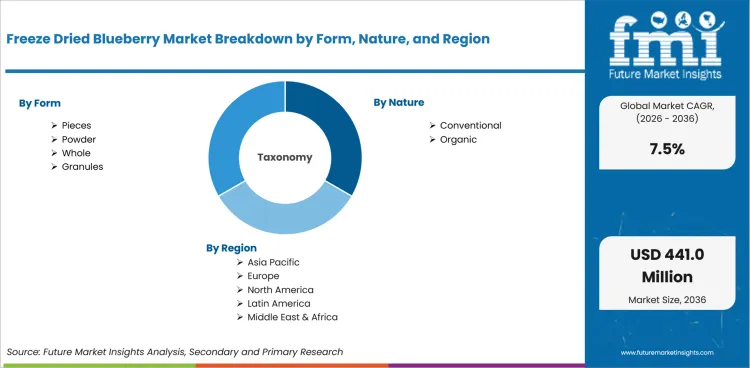
| Market size by 2036 | USD 441.0 million |
| Growth rate | 7.5% CAGR from 2026 to 2036 |
| Forecast period | 2026 to 2036 |
| Base year value (2025) | USD 198.0 million |
| By form | Pieces, powder, whole, granules |
| By nature | Conventional, organic |
| By application | Cereals, bakery, snacks, dairy, nutrition, pet food |
| By channel | B2B ingredients, retail packs, foodservice, e-commerce |
| By source type | Cultivated, wild |
| Regions covered | North America, Latin America, Europe, East Asia, South Asia and Pacific, Middle East and Africa |
| Countries covered | United States, United Kingdom, Germany, France, Japan, China, South Korea, India |
| Key companies profiled | Thrive Freeze Dry, Van Drunen Farms, Chaucer Foods, European Freeze Dry, Paradiesfrucht, Mercer Foods, Freeze-Dry Foods |
| Approach | Bottom-up product-boundary approach using eligible SKU revenue, blueberry supply, channel presence, application use, and country-level adoption |
Source: Future Market Insights, 2026.
Freeze Dried Blueberry Market Breakdown by Form, Nature, Application, Channel, Source Type, and Region
Freeze Dried Blueberry Market Segmented by Form
- Pieces
- Powder
- Whole
- Granules
Freeze Dried Blueberry Market Segmented by Nature
- Conventional
- Organic
Freeze Dried Blueberry Market Segmented by Application
- Cereals
- Bakery
- Snacks
- Dairy
- Nutrition
- Pet Food
Freeze Dried Blueberry Market Segmented by Channel
- B2B Ingredients
- Retail Packs
- Foodservice
- E-commerce
Freeze Dried Blueberry Market Segmented by Source Type
- Cultivated
- Wild
Freeze Dried Blueberry Market by Region
- North America
- Latin America
- Europe
- East Asia
- South Asia and Pacific
- Middle East and Africa
This Report Answers
- What is the 2026 value and 2036 forecast for freeze dried blueberry market?
- What form is projected to hold the leading share during the forecast period?
- What channel is expected to account for the leading 2026 share?
- How do low-moisture food safety expectations affect supplier selection?
- What companies compete in freeze dried blueberry products?
Research Sources and Bibliography
- United States Department of Agriculture Economic Research Service. (2025, September 18). Most cultivated blueberries are destined for the fresh market, while wild blueberries are bound for processing.
- World Integrated Trade Solution. (2026, June 17). United States cranberries, milberries and other Vaccinium fruits, fresh imports by country in 2024.
- World Integrated Trade Solution. (2026, June 16). United Kingdom cranberries, milberries and other Vaccinium fruits, fresh imports by country in 2024.
- World Integrated Trade Solution. (2026, June 16). Germany cranberries, milberries and other Vaccinium fruits, fresh imports by country in 2024.
- World Integrated Trade Solution. (2026, June 16). France cranberries, milberries and other Vaccinium fruits, fresh imports by country in 2024.
- World Integrated Trade Solution. (2026, June 16). Japan cranberries, milberries and other Vaccinium fruits, fresh imports by country in 2024.
- World Integrated Trade Solution. (2026, June 16). China cranberries, milberries and other Vaccinium fruits, fresh imports by country in 2024.
- World Integrated Trade Solution. (2026, June 16). Korea, Rep. cranberries, milberries and other Vaccinium fruits, fresh imports by country in 2024.
- World Integrated Trade Solution. (2026, June 16). India cranberries, milberries and other Vaccinium fruits, fresh imports by country in 2024.
- USA Food and Drug Administration. (2025, January 17). FY 2019 to 2023 frozen berries microbiological surveillance sampling.
- USA Food and Drug Administration. (2025, January 6). Draft guidance for industry: Establishing sanitation programs for low-moisture ready-to-eat human foods.
- USA Food and Drug Administration. (2025, January 17). FDA releases prevention strategy for the control of enteric viruses in berries.
- Jakubczyk, E., et al. (2025, February). Pre-treatment impact on freeze-drying process and properties of dried blueberries. Processes.
- Entrepreneurial Equity Partners. (2024, April 9). Thrive Freeze Dry signs definitive acquisition agreement with Paradiesfrucht GmbH.
This bibliography is provided for reader reference and is not exhaustive. The full report contains the complete reference list and detailed citations.
Frequently Asked Questions
What is the freeze dried blueberry market size in 2026?
The freeze dried blueberry market size is anticipated to reach USD 213.7 million in 2026.
What is the freeze dried blueberry market forecast for 2036?
The freeze dried blueberry industry revenue is predicted to reach USD 441.0 million by 2036 as shelf-stable berry formats expand.
What is the freeze dried blueberry market CAGR?
The freeze dried blueberry sector is projected to expand at 7.5% CAGR from 2026 to 2036.
What segment leads the freeze dried blueberry market?
Pieces are likely to capture 43.0% share in 2026 due to cereal and bakery inclusion demand.
What country grows fastest in the freeze dried blueberry market?
India is set to record 8.7% CAGR by 2036, driven by premium e-commerce and nutrition use.
Preview the report firsthand - request a free sample
Get SampleGet the brochure for pricing and purchase details.
Get PDFTable of Content
- Key Takeaways
- Market Size and CAGR
- Top Growth Driver
- Fastest Growing Segment
- Leading Region
- Key Companies
- Emerging Opportunities
- Executive Summary
- Global Market Outlook
- Demand-side Trends
- Supply-side Trends
- Technology Roadmap Analysis
- Analysis and Recommendations
- Analyst Perspective (What is happening? Why now? What should investors know?)
- Key Questions Answered
- How large is the market?
- What is the CAGR?
- What are key trends?
- Which region dominates?
- Who are the leaders?
- Market Overview
- Market Coverage / Taxonomy
- Market Definition / Scope / Limitations
- Research Methodology
- Chapter Orientation
- Analytical Lens and Working Hypotheses
- Market Structure, Signals, and Trend Drivers
- Benchmarking and Cross-market Comparability
- Market Sizing, Forecasting, and Opportunity Mapping
- Research Design and Evidence Framework
- Desk Research Programme (Secondary Evidence)
- Expert Input and Fieldwork (Primary Evidence)
- Tooling, Models, and Reference Databases
- Data Engineering and Model Build
- Quality Assurance and Audit Trail
- Market Background
- Market Dynamics (Drivers, Restraints, Opportunity, Trends)
- Scenario Forecast (Optimistic, Likely, Conservative)
- Impact Analysis
- AI Impact
- Sustainability Impact
- Regulatory Impact
- Technology Impact
- Consumer / Buyer Analysis
- Purchase Drivers
- Adoption Barriers
- Buyer Journey
- Opportunity Map Analysis
- Product Life Cycle Analysis
- Supply Chain Analysis
- Investment Feasibility Matrix
- Value Chain Analysis
- PESTLE and Porter's Analysis
- Regulatory Landscape
- Regional Parent Market Outlook
- Production and Consumption Statistics
- Import and Export Statistics
- Global Market Analysis and Forecast, 2021 to 2036
- Historical Market Size Value (USD Million) & Volume (Unit) Analysis, 2021 to 2025
- Current and Future Market Size Value (USD Million) & Volume (Unit) Projections, 2026 to 2036
- Y-o-Y Growth Trend Analysis
- Absolute $ Opportunity Analysis
- Global Market Pricing Analysis, 2021 to 2036
- Global Market Analysis and Forecast, By Form, 2021 to 2036
- Introduction / Key Findings
- Historical Market Size Value (USD Million) & Volume (Unit) Analysis By Form, 2021 to 2025
- Current and Future Market Size Value (USD Million) & Volume (Unit) Analysis and Forecast By Form, 2026 to 2036
- Pieces
- Powder
- Whole
- Granules
- Pieces
- Y-o-Y Growth Trend Analysis By Form, 2021 to 2025
- Absolute $ Opportunity Analysis By Form, 2026 to 2036
- Global Market Analysis and Forecast, By Nature, 2021 to 2036
- Introduction / Key Findings
- Historical Market Size Value (USD Million) & Volume (Unit) Analysis By Nature, 2021 to 2025
- Current and Future Market Size Value (USD Million) & Volume (Unit) Analysis and Forecast By Nature, 2026 to 2036
- Conventional
- Organic
- Conventional
- Y-o-Y Growth Trend Analysis By Nature, 2021 to 2025
- Absolute $ Opportunity Analysis By Nature, 2026 to 2036
- Global Market Analysis and Forecast, By Application, 2021 to 2036
- Introduction / Key Findings
- Historical Market Size Value (USD Million) & Volume (Unit) Analysis By Application, 2021 to 2025
- Current and Future Market Size Value (USD Million) & Volume (Unit) Analysis and Forecast By Application, 2026 to 2036
- Cereals
- Bakery
- Snacks
- Dairy
- Nutrition
- Pet Food
- Cereals
- Y-o-Y Growth Trend Analysis By Application, 2021 to 2025
- Absolute $ Opportunity Analysis By Application, 2026 to 2036
- Global Market Analysis and Forecast, By Channel, 2021 to 2036
- Introduction / Key Findings
- Historical Market Size Value (USD Million) & Volume (Unit) Analysis By Channel, 2021 to 2025
- Current and Future Market Size Value (USD Million) & Volume (Unit) Analysis and Forecast By Channel, 2026 to 2036
- B2B Ingredients
- Retail Packs
- Foodservice
- E-commerce
- B2B Ingredients
- Y-o-Y Growth Trend Analysis By Channel, 2021 to 2025
- Absolute $ Opportunity Analysis By Channel, 2026 to 2036
- Global Market Analysis and Forecast, By Source Type, 2021 to 2036
- Introduction / Key Findings
- Historical Market Size Value (USD Million) & Volume (Unit) Analysis By Source Type, 2021 to 2025
- Current and Future Market Size Value (USD Million) & Volume (Unit) Analysis and Forecast By Source Type, 2026 to 2036
- Cultivated
- Wild
- Cultivated
- Y-o-Y Growth Trend Analysis By Source Type, 2021 to 2025
- Absolute $ Opportunity Analysis By Source Type, 2026 to 2036
- Global Market Analysis and Forecast, By Region, 2021 to 2036
- Introduction
- Historical Market Size Value (USD Million) & Volume (Unit) Analysis By Region, 2021 to 2025
- Current Market Size Value (USD Million) & Volume (Unit) Analysis and Forecast By Region, 2026 to 2036
- North America
- Latin America
- Western Europe
- Eastern Europe
- East Asia
- South Asia and Pacific
- Middle East & Africa
- Market Attractiveness Analysis By Region
- North America Market Analysis and Forecast, By Country, 2021 to 2036
- Historical Market Size Value (USD Million) & Volume (Unit) Trend Analysis By Market Taxonomy, 2021 to 2025
- Market Size Value (USD Million) & Volume (Unit) Forecast By Market Taxonomy, 2026 to 2036
- By Country
- USA
- Canada
- Mexico
- By Form
- By Nature
- By Application
- By Channel
- By Source Type
- By Country
- Market Attractiveness Analysis
- By Country
- By Form
- By Nature
- By Application
- By Channel
- By Source Type
- Key Takeaways
- Latin America Market Analysis and Forecast, By Country
- Historical Market Size Value (USD Million) & Volume (Unit) Trend Analysis By Market Taxonomy, 2021 to 2025
- Market Size Value (USD Million) & Volume (Unit) Forecast By Market Taxonomy, 2026 to 2036
- By Country
- Brazil
- Chile
- Rest of Latin America
- By Form
- By Nature
- By Application
- By Channel
- By Source Type
- By Country
- Market Attractiveness Analysis
- By Country
- By Form
- By Nature
- By Application
- By Channel
- By Source Type
- Key Takeaways
- Western Europe Market Analysis and Forecast, By Country
- Historical Market Size Value (USD Million) & Volume (Unit) Trend Analysis By Market Taxonomy, 2021 to 2025
- Market Size Value (USD Million) & Volume (Unit) Forecast By Market Taxonomy, 2026 to 2036
- By Country
- Germany
- UK
- Italy
- Spain
- France
- Nordic
- BENELUX
- Rest of Western Europe
- By Form
- By Nature
- By Application
- By Channel
- By Source Type
- By Country
- Market Attractiveness Analysis
- By Country
- By Form
- By Nature
- By Application
- By Channel
- By Source Type
- Key Takeaways
- Eastern Europe Market Analysis and Forecast, By Country
- Historical Market Size Value (USD Million) & Volume (Unit) Trend Analysis By Market Taxonomy, 2021 to 2025
- Market Size Value (USD Million) & Volume (Unit) Forecast By Market Taxonomy, 2026 to 2036
- By Country
- Russia
- Poland
- Hungary
- Balkan & Baltic
- Rest of Eastern Europe
- By Form
- By Nature
- By Application
- By Channel
- By Source Type
- By Country
- Market Attractiveness Analysis
- By Country
- By Form
- By Nature
- By Application
- By Channel
- By Source Type
- Key Takeaways
- East Asia Market Analysis and Forecast, By Country
- Historical Market Size Value (USD Million) & Volume (Unit) Trend Analysis By Market Taxonomy, 2021 to 2025
- Market Size Value (USD Million) & Volume (Unit) Forecast By Market Taxonomy, 2026 to 2036
- By Country
- China
- Japan
- South Korea
- By Form
- By Nature
- By Application
- By Channel
- By Source Type
- By Country
- Market Attractiveness Analysis
- By Country
- By Form
- By Nature
- By Application
- By Channel
- By Source Type
- Key Takeaways
- South Asia and Pacific Market Analysis and Forecast, By Country
- Historical Market Size Value (USD Million) & Volume (Unit) Trend Analysis By Market Taxonomy, 2021 to 2025
- Market Size Value (USD Million) & Volume (Unit) Forecast By Market Taxonomy, 2026 to 2036
- By Country
- India
- ASEAN
- Australia & New Zealand
- Rest of South Asia and Pacific
- By Form
- By Nature
- By Application
- By Channel
- By Source Type
- By Country
- Market Attractiveness Analysis
- By Country
- By Form
- By Nature
- By Application
- By Channel
- By Source Type
- Key Takeaways
- Middle East & Africa Market Analysis and Forecast, By Country
- Historical Market Size Value (USD Million) & Volume (Unit) Trend Analysis By Market Taxonomy, 2021 to 2025
- Market Size Value (USD Million) & Volume (Unit) Forecast By Market Taxonomy, 2026 to 2036
- By Country
- Kingdom of Saudi Arabia
- Other GCC Countries
- Türkiye
- South Africa
- Other African Union
- Rest of Middle East & Africa
- By Form
- By Nature
- By Application
- By Channel
- By Source Type
- By Country
- Market Attractiveness Analysis
- By Country
- By Form
- By Nature
- By Application
- By Channel
- By Source Type
- Key Takeaways
- Key Countries Market Analysis
- USA
- Pricing Analysis
- Market Share Analysis, 2025
- By Form
- By Nature
- By Application
- By Channel
- By Source Type
- Canada
- Pricing Analysis
- Market Share Analysis, 2025
- By Form
- By Nature
- By Application
- By Channel
- By Source Type
- Mexico
- Pricing Analysis
- Market Share Analysis, 2025
- By Form
- By Nature
- By Application
- By Channel
- By Source Type
- Brazil
- Pricing Analysis
- Market Share Analysis, 2025
- By Form
- By Nature
- By Application
- By Channel
- By Source Type
- Chile
- Pricing Analysis
- Market Share Analysis, 2025
- By Form
- By Nature
- By Application
- By Channel
- By Source Type
- Germany
- Pricing Analysis
- Market Share Analysis, 2025
- By Form
- By Nature
- By Application
- By Channel
- By Source Type
- UK
- Pricing Analysis
- Market Share Analysis, 2025
- By Form
- By Nature
- By Application
- By Channel
- By Source Type
- Italy
- Pricing Analysis
- Market Share Analysis, 2025
- By Form
- By Nature
- By Application
- By Channel
- By Source Type
- Spain
- Pricing Analysis
- Market Share Analysis, 2025
- By Form
- By Nature
- By Application
- By Channel
- By Source Type
- France
- Pricing Analysis
- Market Share Analysis, 2025
- By Form
- By Nature
- By Application
- By Channel
- By Source Type
- India
- Pricing Analysis
- Market Share Analysis, 2025
- By Form
- By Nature
- By Application
- By Channel
- By Source Type
- ASEAN
- Pricing Analysis
- Market Share Analysis, 2025
- By Form
- By Nature
- By Application
- By Channel
- By Source Type
- Australia & New Zealand
- Pricing Analysis
- Market Share Analysis, 2025
- By Form
- By Nature
- By Application
- By Channel
- By Source Type
- China
- Pricing Analysis
- Market Share Analysis, 2025
- By Form
- By Nature
- By Application
- By Channel
- By Source Type
- Japan
- Pricing Analysis
- Market Share Analysis, 2025
- By Form
- By Nature
- By Application
- By Channel
- By Source Type
- South Korea
- Pricing Analysis
- Market Share Analysis, 2025
- By Form
- By Nature
- By Application
- By Channel
- By Source Type
- Russia
- Pricing Analysis
- Market Share Analysis, 2025
- By Form
- By Nature
- By Application
- By Channel
- By Source Type
- Poland
- Pricing Analysis
- Market Share Analysis, 2025
- By Form
- By Nature
- By Application
- By Channel
- By Source Type
- Hungary
- Pricing Analysis
- Market Share Analysis, 2025
- By Form
- By Nature
- By Application
- By Channel
- By Source Type
- Kingdom of Saudi Arabia
- Pricing Analysis
- Market Share Analysis, 2025
- By Form
- By Nature
- By Application
- By Channel
- By Source Type
- Türkiye
- Pricing Analysis
- Market Share Analysis, 2025
- By Form
- By Nature
- By Application
- By Channel
- By Source Type
- South Africa
- Pricing Analysis
- Market Share Analysis, 2025
- By Form
- By Nature
- By Application
- By Channel
- By Source Type
- USA
- Market Structure Analysis
- Competition Dashboard
- Competition Benchmarking
- Market Share Analysis of Top Players
- By Regional
- By Form
- By Nature
- By Application
- By Channel
- By Source Type
- Emerging Startups
- Innovation Benchmarking
- Competition Analysis
- Competition Deep Dive
- Thrive Freeze Dry
- Overview
- Product Portfolio
- Profitability by Market Segments (Product/Region/Sales Channel)
- Sales Footprint
- Strategy Overview
- Marketing Strategy
- Product Strategy
- Channel Strategy
- Van Drunen Farms
- Chaucer Foods
- European Freeze Dry
- Paradiesfrucht
- Mercer Foods
- Freeze-Dry Foods
- Crispy Green
- Sow Good
- Döhler Group
- Thrive Freeze Dry
- Case Studies
- Success Stories
- Recent Developments
- Competition Deep Dive
- Assumptions & Acronyms Used


