

- Market Size (2026)
- USD 260.5 Mn
- Forecast (2036)
- USD 605.4 Mn
- CAGR (2026 to 2036)
- 8.8%
How big is Gastric Cancer Nutrition Market in 2026?
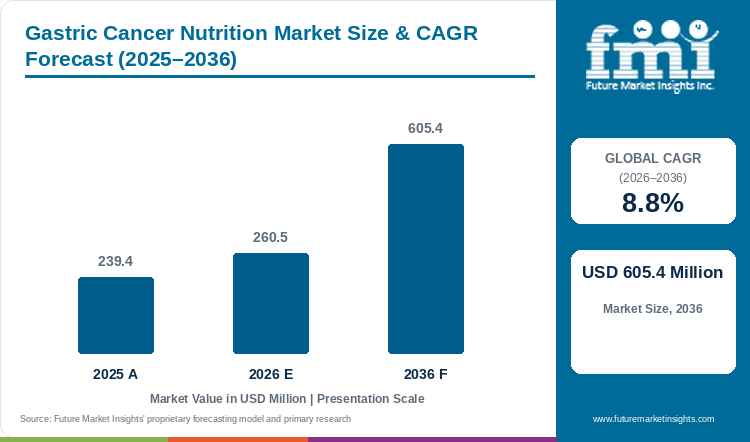
USD 260.5 Million in 2026 and USD 605.4 Million by 2036 at an 8.8% CAGR.
The gastric cancer nutrition market is estimated at USD 260.5 Million in 2026 and forecast to reach USD 605.4 Million by 2036, at an 8.8% CAGR. The 2025 market value is USD 239.4 Million. That is an increase of USD 344.9 million, or 2.32 times the 2026 base. The clinical demand for the gastric cancer nutrition market is fundamentally anchored by the severe metabolic toll of the disease and its aggressive surgical treatments, which can leave affected patients at high risk of malnutrition. Because the stomach plays a central role in digestion, tumors and subsequent partial or total gastrectomies severely compromise a patient's ability to maintain adequate caloric intake, transforming specialized Medical Nutrition Therapy from an optional supportive measure into a strict standard of care. This clinical mandate drives product utilization across two distinct phases of the patient journey. In the acute perioperative phase, clinical guidelines strongly recommend specialized immunonutrition and oral nutritional supplements to mitigate severe weight loss, reduce postoperative infection rates, and preserve lean muscle mass during recovery. [1][6][7]
Beyond the hospital stay, the market is sustained by the lifelong anatomical and physiological changes caused by stomach resection, which leave survivors vulnerable to chronic malabsorption, dumping syndrome, and severe micronutrient deficiencies. Consequently, the ongoing need for lifelong dietary management, including targeted vitamin B12 and iron repletion products, ensures a steady, recurring demand for medical nutrition formulations throughout the entirety of the survivorship journey.[6]
Key Market Trends & Insights
- The gastric cancer nutrition market is projected to expand from USD 260.5 million in 2026 to USD 605.4 million by 2036 at an 8.8 percent CAGR. This growth is heavily anchored in institutional care, with cancer centers and hospital pharmacies driving nearly half of all end-user demand and sales channel volume.
- Perioperative care serves as a primary market catalyst, capturing 42.2 percent of the treatment phase in 2026. Clinical teams are increasingly initiating nutritional support prior to surgery, aligning directly with updated 2025 guidelines that recommend preoperative immunonutrition to optimize patient outcomes during major tumor resections.
- Because surgical removal of the stomach severely restricts eating capacity, small-volume oral nutritional supplements dominate the product landscape with a 48.6 percent market share. These specialized formulas align with clinical advice for frequent meals, while ready-to-use liquid formats capture over 42 percent of the market by offering convenient options that eliminate mixing requirements.
- While liquid formats offer immediate convenience, healthcare systems actively manage budgets by favoring cost-effective powdered alternatives. Prescribing guidance frequently recommends powders when patients or dedicated caregivers have the physical capacity and support to prepare them safely at home.
- Realizing the full projected market value depends heavily on patient compliance and physical tolerability. Nutritional support courses are naturally limited by recovery timelines and can be prematurely disrupted by gastrointestinal side effects, meaning supplementation typically concludes as soon as ordinary dietary intake becomes adequate.
Regional Highlights
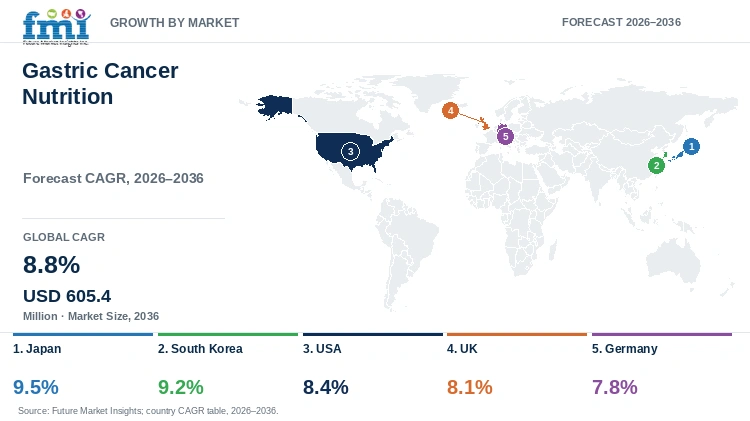
- Fastest-growing profiled country: Japan (9.5% CAGR, 2026 to 2036).
- South Korea follows at 9.2% CAGR, while the USA is 8.4% and the UK is 8.1%. Germany has the lowest profiled CAGR at 7.8%.
- Japan has specialist gastric surgery centers and a multicenter trial of oral nutritional supplements.[7][11] South Korea offers biennial stomach screening to adults aged 40 and over.[5]
Market Size & Forecast
Table 1: Market Size and Forecast for the Gastric Cancer Nutrition Market (USD Million and percentage), 2025 to 2036
| Metric | Value |
|---|---|
| 2025 Market Size | USD 239.4 Million |
| Estimated Market Size in 2026 | USD 260.5 Million |
| Projected Market Size by 2036 | USD 605.4 Million |
| CAGR, 2026 to 2036 | 8.8% |
| Added Revenue, 2026 to 2036 | USD 344.9 Million |
| Market Expansion Multiple | 2.32x |
The addressable patient pool for gastric cancer nutrition is driven by steady incidence rates, the necessity of aggressive surgical interventions, and extending survivorship timelines. In the United States, the National Cancer Institute projects over 31,000 new stomach cancer cases in 2026. With a five-year relative survival rate of 39.8%, a substantial and growing cohort of patients transitions into long-term survivorship, creating sustained demand for chronic nutritional management to combat post-surgical malabsorption. In established European markets, Germany recorded nearly 15,000 new diagnoses in 2022, anchoring a steady baseline demand for perioperative clinical nutrition. Furthermore, aggressive national screening programs in high-incidence regions like South Korea offer stomach screening every two years for adults aged 40 and over. While these programs facilitate earlier detection, the resulting high volume of surgical resections ensures that hospital-based clinical teams remain the primary decision-makers for initiating specialized post-gastrectomy diets and prescribing oral nutritional supplements.[3][4][5]
Clinical Evidence and Treatment Readiness
The research references are specific to care settings. Clinical evidence informs product use and tolerability; diagnosis and screening statistics are context rather than counts of nutrition purchases.
Table 2: Clinical Evidence and Treatment Pathway Indicators for the Gastric Cancer Nutrition Market, reporting years 2025 to 2026
| Indicator | Data Point | Why It Matters | Source |
|---|---|---|---|
| Postoperative ONS trial | 124 patients at 19 Japanese institutions; 4.8% versus 6.4% weight loss at eight weeks | Shows a measured difference in weight loss for one short-term regimen; symptom scores were higher during supplementation. | [7] |
| Surgical nutrition guidance | 2025 ESPEN guideline; grade B and 93% consensus for immunonutrition before or around major tumor surgery | Guidance informs hospital protocols rather than proving gastric-specific purchase rates. | [1] |
| Post-gastrectomy intake | NHS advice suggests six small meals daily | Lower meal capacity is relevant to small-volume supplement selection. | [6] |
| South Korea diagnosis route | Stomach screening every two years for adults aged 40 and over | Creates an established diagnosis pathway, but does not measure nutrition sales. | [5] |
| UK prescribing practice | Food-first sequence; cost-effective powders when preparation is possible; dietitian initiation for Fresubin Pro Compact | Defines when specialist ONS can enter a local prescribing and supply pathway. | [8][9] |
Analyst Perspective
"A nutrition plan must remain practical after the patient leaves the hospital. While compact formats help accommodate reduced eating capacity, sustained use also requires routine tolerance checks, a reliable supply route, and clinical follow-up as natural intake improves. Ultimately, these post-discharge management decisions directly dictate the duration and volume of clinically indicated purchases."
- Anurag Sharma, Principal Consultant, Future Market Insights
How is the gastric cancer nutrition market segmented?
The market is segmented by Product Type, Treatment Phase, Product Form, End User and Sales Channel.
- By product type: Post-Gastrectomy Small-Volume ONS, Perioperative Immunonutrition, Jejunal Feeding Formulas, B12 / Iron Repletion Products, and Others.
- By treatment phase: Perioperative, Post-Gastrectomy Adaptation, Chemotherapy, and Palliative.
- By product form: RTD, Enteral Tube Feeds, Powders, and Others.
- By end user: Cancer Centers & Hospitals, Homecare, Hospice & Palliative, and Others.
- By sales channel: Hospital Pharmacy, Retail Pharmacy, Online, Institutional Tender, and Others.
- By region: North America, Latin America, Western Europe, Eastern Europe, East Asia, South Asia and Pacific, and Middle East and Africa.
Why do Post-Gastrectomy Small-Volume ONS lead the Product Type category?
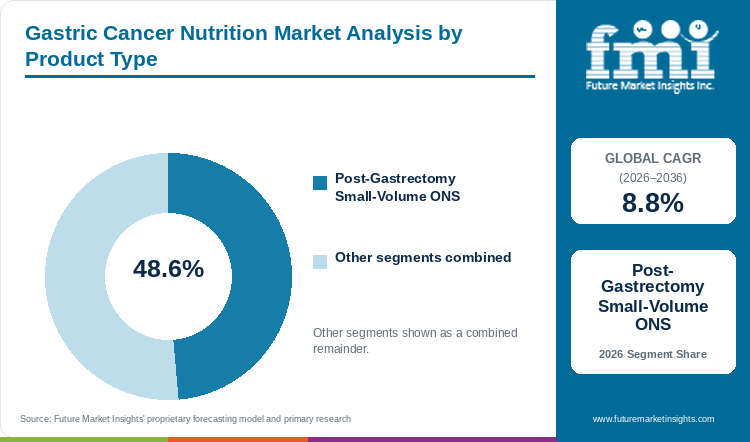
Post-Gastrectomy Small-Volume ONS account for 48.6% of Product Type in 2026, equivalent to about USD 126.6 Million.
Table 3: Product Type Share for the Gastric Cancer Nutrition Market (percentage share), 2026
| Product Type | Share (2026) |
|---|---|
| Post-Gastrectomy Small-Volume ONS | 48.6% |
| Other Segments Combined | 51.4% |
| Total | 100.0% |
Surgical removal of part or all of the stomach fundamentally restricts a patient's gastric capacity, necessitating a shift toward frequent, small-quantity meals as outlined by NHS recovery protocols. This anatomical reality directly drives the dominance of post-gastrectomy small-volume oral nutritional supplements, which are projected to capture 48.6% of the product type market (approximately USD 126.6 million) in 2026. While these compact formats effectively address severe capacity limits and help mitigate postoperative weight loss, clinical evidence highlights a critical trade-off in patient tolerability. For instance, a randomized trial across 19 Japanese institutions demonstrated that while ONS reduced weight loss at eight weeks compared to usual care, it also correlated with higher symptom scores for diarrhea, insomnia, and appetite loss, underscoring the need for careful clinical monitoring during supplementation.[6][7]
- Post-gastrectomy small-volume oral nutritional supplements are projected to lead the product type category with a 48.6% share (USD 126.6 million) in 2026, as these compact formats directly address the severe eating capacity limits that follow stomach resection.
- Balancing Efficacy with Gastrointestinal Tolerability: While clinical trials confirm that ONS effectively mitigates postoperative weight loss (4.8% versus 6.4% with usual care at eight weeks), open-label studies also record higher incidences of diarrhea and insomnia during supplementation, requiring clinical teams to actively monitor patient compliance and side effects.
What makes Perioperative the leading Treatment Phase?
Perioperative use holds 42.2% of Treatment Phase revenue in 2026, or approximately USD 109.9 Million.
The perioperative treatment phase is projected to command 42.2% of the market (approximately USD 109.9 million) in 2026, driven by the predictable scheduling of surgical interventions that allows hospitals to proactively implement nutritional protocols. This proactive approach is heavily reinforced by the 2025 ESPEN guidelines, which issued a Grade B recommendation with 93% consensus for administering immunonutrition before or around major oncological surgeries. Because hospitals purchase these products as part of broader clinical nutrition programs, buying decisions are strictly tied to established surgical protocols rather than ad hoc prescriptions. Clinical teams ultimately tailor these interventions based on individual nutritional risk and the specific nature of the planned operation, ensuring that resources are allocated to patients who will benefit most from preoperative metabolic support.[1]
- Capturing 42.2% of the treatment phase market (USD 109.9 million) in 2026, perioperative nutrition is heavily anchored by updated clinical mandates, including the 2025 ESPEN guidelines that strongly recommend preoperative immunonutrition to optimize surgical outcomes.
- The total addressable market for perioperative products is directly tied to the stage mix of diagnosed patients, as the clinical necessity for intensive surgical nutrition protocols is primarily reserved for those undergoing partial or total gastrectomies rather than early stage endoscopic removals.
What are the drivers, restraints and opportunities in the gastric cancer nutrition market?
Market demand for gastric cancer nutrition is fundamentally driven by severe postoperative reductions in eating capacity and the strict implementation of perioperative clinical guidelines. However, total addressable volume is actively restrained by patient tolerability to specialized formulas. Consequently, the primary commercial opportunity lies in optimizing post-discharge follow-up care to ensure sustained nutritional compliance.
The gastric cancer nutrition market is primarily driven by the severe physiological impact of gastrectomy, which drastically reduces eating capacity and necessitates early oral feeding interventions to mitigate postoperative weight loss. Clinical guidelines strongly emphasize identifying nutritional risk immediately and bridging the intake gap with specialized oral nutritional supplements. Clinical trials demonstrate that these targeted interventions can effectively reduce weight loss by 1.6 percentage points compared to usual care, establishing a clear clinical role for compact, high-calorie formulas in the immediate surgical pathway.[1][7]
Despite this strong clinical rationale, total market volume is heavily constrained by physical tolerability and strict regional prescribing protocols. Patients frequently experience gastrointestinal side effects, including diarrhea and appetite loss, which can prematurely disrupt supplementation and shorten prescribed courses. Furthermore, healthcare systems actively filter product access to manage costs, often mandating baseline food fortification or requiring mandatory dietitian initiation before authorizing premium formulas, thereby limiting ad hoc or prolonged consumption.
Consequently, the most significant commercial opportunity lies beyond the acute surgical phase, shifting toward long-term post-discharge follow-up care. Because stomach resection permanently impairs the absorption of critical nutrients like vitamin B12, vitamin D, calcium, and iron, sustained dietetic monitoring creates a reliable, recurring demand for targeted repletion products. Establishing continuous supply routes and individualized diet progression plans ensures that patients maintain nutritional compliance as they transition from acute hospital treatment into extended survivorship.
Which country CAGRs are profiled in the gastric cancer nutrition market?
The following country CAGRs cover 2026 to 2036.
Table 5: Country CAGR Comparison for the Gastric Cancer Nutrition Market (CAGR percentage), 2026 to 2036
| Country | CAGR |
|---|---|
| Japan | 9.5% |
| South Korea | 9.2% |
| USA | 8.4% |
| UK | 8.1% |
| Germany | 7.8% |
Country-wise Analysis
Japan
Japan's position as the fastest-growing market at a 9.5% CAGR is underpinned by a deeply integrated specialist surgical infrastructure. Institutions such as the National Cancer Center Hospital East combine gastric surgery with oncology and endoscopy conferences, creating a multidisciplinary environment where nutritional risk is assessed as part of the standard treatment pathway. This clinical ecosystem is further validated by active domestic research, including a randomized trial across 19 Japanese institutions that demonstrated a 1.6 percentage point reduction in postoperative weight loss with oral nutritional supplements versus usual care at eight weeks. However, the same trial recorded higher symptom scores for appetite loss, diarrhea, and insomnia during supplementation, highlighting that sustained market growth depends on tolerance management and longer follow-up data. Japan also maintains a regulated enteral product landscape, with PMDA-listed formulas such as ENORAS providing established supply routes for institutional purchasing.[7][11][16]
Clinical Infrastructure Validates Product Demand: Japan's specialist gastric surgery centers integrate surgical oncology with endoscopy and multicentre research, ensuring that nutritional support is embedded within the standard treatment protocol rather than prescribed on an ad hoc basis.[11]
Tolerability Remains the Key Constraint on Sustained Use: While domestic trials confirm that ONS reduces postoperative weight loss (4.8% versus 6.4% at eight weeks), higher gastrointestinal symptom scores during supplementation indicate that long-term compliance requires active tolerance monitoring and potential formula adjustments.[7]
South Korea
South Korea's projected 9.2% CAGR is directly fueled by one of the most aggressive national screening programs in the world. The government offers biennial stomach screening for all adults aged 40 and over through upper gastrointestinal imaging or endoscopy, creating a highly predictable and continuous diagnosis pathway that consistently feeds patients into surgical and nutritional care protocols. The critical commercial variable in this market is the treatment mix: while selected early-stage cancers can be managed through endoscopic removal, patients undergoing partial or total gastrectomy present an entirely different set of postoperative feeding and micronutrient repletion needs. Nutrition suppliers therefore depend heavily on the specific care pathways prescribed to diagnosed patients, making the proportion of surgical versus endoscopic cases a key determinant of product volume.[5][10]
Screening Programs Create a Predictable Patient Funnel: Biennial national screening for adults aged 40 and over ensures early and frequent detection, building a steady pipeline of diagnosed patients who can be assessed for nutritional risk at the point of diagnosis.[5]
Treatment Mix Determines Product Relevance: The commercial opportunity for specialized nutrition products is directly tied to the proportion of patients requiring gastrectomy versus endoscopic removal, as surgical patients can generate the sustained postoperative feeding and repletion demand that drives recurring product purchases.[6][10]
United States
Forecast to grow at an 8.4% CAGR, the US market is shaped by a highly structured reimbursement environment that clearly separates purchasing routes for oral products and tube feeding. CMS enteral nutrition policy requires a qualifying permanent impairment and demonstration that adequate nutrition cannot be achieved through dietary adjustment or oral supplements before tube feeding benefits apply. This creates a distinct payment boundary: oral nutritional supplements after discharge follow a different commercial pathway than qualifying enteral formulas. The addressable patient pool remains substantial, with the NCI projecting 31,510 new stomach cancer cases and 10,740 deaths in 2026, alongside a five-year relative survival rate of 39.8%. Nutrition requirements vary significantly with treatment type, as partial or total gastrectomy permanently alters eating capacity while selected early-stage disease treated endoscopically may not generate the same level of ongoing nutritional demand.[3][10][13]
Reimbursement Boundaries Define Product Access: CMS coverage rules create a clear commercial separation between oral supplements and tube feeding, meaning that post-discharge oral products must compete on clinical merit and patient preference rather than relying on automated insurance authorization.[13]
Survivorship Extends the Addressable Window: With a five-year relative survival rate of 39.8%, a growing cohort of US patients transitions into long-term survivorship, creating sustained demand for micronutrient repletion and dietary management products well beyond the acute surgical phase.[10][13]
United Kingdom
The UK market, projected at an 8.1% CAGR, operates under strict cost-conscious prescribing hierarchies that carefully gate access to specialist nutrition products. Regional clinical guidance mandates a food-first approach, requiring initial dietary fortification before prescribed oral nutritional supplements can be authorized. Compact 125 mL ready-made formats are included in local formularies, but powders are explicitly identified as a cost-effective alternative when patients or caregivers possess the capacity to prepare them. Furthermore, certain premium products require mandatory dietitian initiation, adding an additional layer of clinical oversight before purchase. Post-gastrectomy, the NHS recommends six small meals a day alongside dietitian support, while NICE advises ending oral supplementation once normal intake becomes adequate. These local formularies collectively demonstrate that suppliers must compete within a tightly prescribed course of care rather than through open consumer demand.[2][6][8][9]
Prescribing Hierarchies Control Market Entry: A mandatory food-first sequence followed by dietitian initiation for specialist products creates a structured funnel that limits ad hoc purchasing and ensures that premium formulas are reserved for patients with verified clinical needs.[8][9]
Defined Course Lengths Cap Volume Per Patient: NICE guidance explicitly recommends ending oral supplementation once normal dietary intake is adequate, meaning that the duration of product use per patient is clinically bounded and directly tied to individual recovery trajectories.[2][6]
Germany
Germany's projected 7.8% CAGR reflects a market undergoing structural transformation through the introduction of the February 2026 AWMF oncology nutrition guideline. This framework emphasizes coordination across hospital and community care settings, multidisciplinary practice, and standardized quality indicators, providing a structured pathway for improving continuity between acute surgical treatment and home-based nutritional support. The underlying patient pool is substantial, with the Robert Koch Institute recording 14,592 new stomach cancer diagnoses in 2022 (5,565 in women and 9,027 in men). However, the commercial impact of this new guideline depends entirely on how individual institutions incorporate its recommendations into their operational service models, making adoption speed a critical variable for market growth.[4][15]
Who are the notable companies in the gastric cancer nutrition market?
Otsuka Pharmaceutical, Nestle Health Science, Danone Nutricia, Abbott, Meiji Holdings, Ajinomoto, Fresenius Kabi and Medtrition are the notable companies profiled in this market.
Competition in the gastric cancer nutrition market is fundamentally distinct from consumer retail, operating instead within a highly regulated framework driven by institutional formularies and national regulatory records. In markets like Japan, the Pharmaceuticals and Medical Devices Agency strictly oversees enteral products, allowing established domestic entities like Otsuka to leverage regulatory records to secure institutional supply routes. Similarly, in the UK, market access is entirely gated by local prescribing formularies that authorize specific ready-made alternatives from major multinational suppliers, including Fresenius Kabi, Abbott, Nutricia, and Nestlé Health Science. Because local formularies guide clinical product selection, commercial success requires navigating strict regulatory gatekeepers while optimizing the practical attributes of the product.[9][16][20]
Market share is primarily determined by a supplier's ability to secure inclusion in national registries and local prescribing lists. In highly regulated environments, demonstrating clinical efficacy is insufficient if the product is excluded from regional formularies or lacks the regulatory authorization required by national health authorities.
Once formulary access is secured, suppliers compete on practical clinical levers. Brands must balance the convenience of liquid formats against the cost-effectiveness of powders, while actively reformulating to minimize gastrointestinal side effects that frequently disrupt patient compliance and shorten treatment courses.
Key Players in the Gastric Cancer Nutrition Market
- Clinical nutrition suppliers
- Otsuka Pharmaceutical
- Nestle Health Science
- Danone Nutricia
- Abbott
- Fresenius Kabi
- Meiji Holdings
- Ajinomoto
- Medtrition
Gastric Cancer Nutrition Market: Report Scope
Table 8: Report Scope for the Gastric Cancer Nutrition Market (coverage fields and definitions), 2026 to 2036
| Coverage field | Report scope |
|---|---|
| Market breakdown | Product Type; Treatment Phase; Product Form; End User; Sales Channel |
| Quantitative Units | USD Million |
| Market Definition | Revenue covers qualifying oral nutritional supplements, perioperative immunonutrition, jejunal feeding formulas and B12 / iron repletion products used for gastric-cancer nutrition across stated treatment phases and channels. It excludes oncology drugs, feeding pumps and supplies, dietetic-service revenue, routine foods and adjacent nutrition sold for non-gastric-cancer indications. |
| Regions Covered | North America; Latin America; Western Europe; Eastern Europe; East Asia; South Asia and Pacific; Middle East and Africa |
| Countries Covered | Japan; South Korea; USA; UK; Germany |
| Key Companies Profiled | Otsuka Pharmaceutical; Nestle Health Science; Danone Nutricia; Abbott; Meiji Holdings; Ajinomoto; Fresenius Kabi; Medtrition |
| Forecast Period | 2026 to 2036 |
| Evidence Base | FMI market estimates, with public guidelines, regulator records, formularies, national cancer statistics and peer-reviewed publications dated through 9 October 2026. |
Gastric Cancer Nutrition Market: Research Methodology
Table 9: Research Methodology for the Gastric Cancer Nutrition Market (methods and approach), 2026 edition
| Method | Approach |
|---|---|
| Desk Research | Evidence came from public institutions, health services, professional societies and academic repositories, covering clinical guidelines, cancer statistics, formulary entries and regulator records. Each source is cited with its publication or review date, and historical statistics keep their original data year. |
| Scope Definition | Revenue is limited to qualifying products used for gastric-cancer nutrition. Oncology drugs, feeding pumps and supplies, dietetic services, routine foods and adjacent nutrition for other indications are excluded. |
| Market Estimates | FMI market values are reported in USD Million, with CAGRs stated as percentages for 2026 to 2036. |
| Use of Clinical Evidence | Clinical trials and guidelines inform analysis of nutritional needs and treatment pathways. Study population, design and follow-up period define how their findings apply. |
Gastric Cancer Nutrition Market by Segments
Gastric Cancer Nutrition Market segmented by Product Type:
- Post-Gastrectomy Small-Volume ONS
- Perioperative Immunonutrition
- Jejunal Feeding Formulas
- B12 / Iron Repletion Products
- Others
Gastric Cancer Nutrition Market segmented by Treatment Phase:
- Perioperative
- Post-Gastrectomy Adaptation
- Chemotherapy
- Palliative
Gastric Cancer Nutrition Market segmented by Product Form:
- RTD
- Enteral Tube Feeds
- Powders
- Others
Gastric Cancer Nutrition Market segmented by End User:
- Cancer Centers & Hospitals
- Homecare
- Hospice & Palliative
- Others
Gastric Cancer Nutrition Market segmented by Sales Channel:
- Hospital Pharmacy
- Retail Pharmacy
- Online
- Institutional Tender
- Others
Gastric Cancer Nutrition Market by Region
- North America
- United States
- Canada
- Latin America
- Brazil
- Mexico
- Argentina
- Chile
- Western Europe
- Germany
- France
- United Kingdom
- Italy
- Spain
- Benelux
- Nordics
- Eastern Europe
- Poland
- Czech Republic
- Romania
- Hungary
- East Asia
- China
- Japan
- South Korea
- South Asia and Pacific
- India
- ASEAN
- Australia and New Zealand
- Middle East and Africa
- GCC Countries
- South Africa
- Türkiye
- Israel
Research Sources and Bibliography
- [1] Weimann, A., et al. (2025). ESPEN guideline on clinical nutrition in surgery: Update 2025. Clinical Nutrition, 53, 222-261. Published online 3 September 2025. DOI: 10.1016/j.clnu.2025.08.029. https://doi.org/10.1016/j.clnu.2025.08.029
- [2] National Institute for Health and Care Excellence (2006, February 22; updated 2017, August 4). Nutrition support for adults. Clinical guideline CG32.
- [3] National Cancer Institute, SEER Program (2026 estimates). Cancer Stat Facts: Stomach Cancer.
- [4] Robert Koch Institute (data year 2022). Magenkrebs [stomach cancer]. Cancer registry incidence data.
- [5] National Cancer Center Korea (n.d.; page accessed 2026, October 9). National Cancer Screening Program. https://ncc.re.kr/main.ncc?uri=english%2Fsub04_ControlPrograms03
- [6] NHS (2025, March 12; page review date). Recovering from a gastrectomy.
- [7] Ueno, K., et al. (2025, August 7). Efficacy of Simple Oral Nutritional Supplements versus Usual Care in Postoperative Patients with Gastric Cancer: A Multicenter, Open-label, Parallel, Randomized Controlled Trial. Annals of Surgery. DOI: 10.1097/SLA.0000000000006888. PMID: 40772645. https://pubmed.ncbi.nlm.nih.gov/40772645/
- [8] Derbyshire Joint Area Prescribing Committee (2025, June; review date). Management of undernutrition in adults.
- [9] Bedfordshire NHS formulary (2025, July and September; entry review dates). Oral nutritional supplements chapter.
- [10] National Cancer Institute (n.d.; page accessed 2026, October 9). Stomach Cancer Treatment.
- [11] National Cancer Center Hospital East, Japan (n.d.; page accessed 2026, October 9). Department of Gastric Surgery.
- [12] Institut national du cancer, France (2025, January 24). Le suivi de votre état nutritionnel.
- [13] Centers for Medicare & Medicaid Services (n.d.; policy accessed 2026, October 9). Enteral Nutrition, Local Coverage Determination L38955. https://www.cms.gov/medicare-coverage-database/view/lcd.aspx?lcdid=38955
- [14] Queensland Health (n.d.; page accessed 2026, October 9). Nutrition Post Gastrectomy.
- [15] AWMF, Arbeitsgemeinschaft der Wissenschaftlichen Medizinischen Fachgesellschaften (2026, February 19). Klinische Ernährung in der Onkologie. Version 1.0, register number 073-006OL, guideline status 31 January 2026.
- [16] Pharmaceuticals and Medical Devices Agency, Japan (package insert dated 2023, May 23). ENORAS Liquid for Enteral Use. Regulator record.
- [17] National Health Commission of the People's Republic of China (2022). National guidelines for diagnosis and treatment of gastric cancer 2022 in China (English version). Chinese Journal of Cancer Research, 34(3), 207-237. DOI: 10.21147/j.issn.1000-9604.2022.03.04. PMCID: PMC9273576.
- [18] Shitara, K., et al. (2024). Pan-Asian adapted ESMO Clinical Practice Guidelines for the diagnosis, treatment and follow-up of patients with gastric cancer. ESMO Open, 9(2), 102226. Published online 3 February 2024. DOI: 10.1016/j.esmoop.2023.102226. PMCID: PMC10937212.
- [19] Hospital Escola UFPel, NATS (2025). NTRR 01/2025: immunomodulatory versus standard nutritional therapy in malnourished adults undergoing elective gastrointestinal oncology surgery.
- [20] Dudley NHS formulary (n.d.; accessed 9 October 2026). Oral nutritional supplements (ONS): prescribing advice for adults in primary care. Manufacturer and product comparison tables.
This Report Answers
- How big is the gastric cancer nutrition market in 2026 and what is forecast for 2036?
- Which clinical pathways turn a gastric cancer diagnosis into a nutrition purchase?
- Why do Post-Gastrectomy Small-Volume ONS lead the Product Type category?
- How do Perioperative, RTD and hospital-based demand differ in what they ask of a supplier?
- How do growth rates differ across Japan, South Korea, the USA, the UK and Germany?
- Which companies are profiled, and what public evidence links them to this market?
- What limits volume: tolerability, prescribing rules or coverage?
- What could reduce category revenue through 2036?
Frequently Asked Questions
How big is the gastric cancer nutrition market in 2026 and what is forecast for 2036?
FMI estimates USD 260.5 Million in 2026 and USD 605.4 Million by 2036, an increase of USD 344.9 million. The forecast CAGR is 8.8% from 2026 to 2036, which takes the market to 2.32 times its 2026 value. Reaching it requires more patients to receive a qualifying product and to continue it for the course their clinicians prescribe.
Which Product Type leads the gastric cancer nutrition market?
Post-Gastrectomy Small-Volume ONS lead Product Type with 48.6% in 2026, about USD 126.6 million. A 124-patient Japanese trial found 4.8% weight loss at eight weeks with ONS against 6.4% with usual care, but it tested one regimen over a short period.[7]
Which Treatment Phase leads the gastric cancer nutrition market?
Perioperative use holds 42.2% of Treatment Phase in 2026. The ESPEN 2025 surgical guideline recommends immunonutrition before or around major tumor surgery,[1] with product selection guided by the patient's nutritional needs.
Which Product Form leads the gastric cancer nutrition market?
RTD holds 42.3% of Product Form in 2026. Derbyshire guidance notes that powders can be cost effective where a patient or carer can prepare them, so the advantage of RTD is greatest where preparation is a barrier.[8]
Which profiled countries have the highest gastric cancer nutrition market growth rates?
Japan has the highest forecast CAGR at 9.5%, followed by South Korea at 9.2%, the USA at 8.4%, the UK at 8.1% and Germany at 7.8% from 2026 to 2036.
Which companies are profiled in the gastric cancer nutrition market?
The profiled companies are Otsuka Pharmaceutical; Nestle Health Science; Danone Nutricia; Abbott; Meiji Holdings; Ajinomoto; Fresenius Kabi; Medtrition.
Preview the report firsthand - request a free sample
Get SampleGet the brochure for pricing and purchase details.
Get PDFTable of Content
- Key Takeaways
- Market Size and CAGR
- Top Growth Driver
- Fastest Growing Segment
- Leading Region
- Key Companies
- Emerging Opportunities
- Executive Summary
- Global Market Outlook
- Demand-side Trends
- Supply-side Trends
- Technology Roadmap Analysis
- Analysis and Recommendations
- Analyst Perspective (What is happening? Why now? What should investors know?)
- Key Questions Answered
- How large is the market?
- What is the CAGR?
- What are key trends?
- Which region dominates?
- Who are the leaders?
- Market Overview
- Market Coverage / Taxonomy
- Market Definition / Scope / Limitations
- Research Methodology
- Chapter Orientation
- Analytical Lens and Working Hypotheses
- Market Structure, Signals, and Trend Drivers
- Benchmarking and Cross-market Comparability
- Market Sizing, Forecasting, and Opportunity Mapping
- Research Design and Evidence Framework
- Desk Research Programme (Secondary Evidence)
- Expert Input and Fieldwork (Primary Evidence)
- Tooling, Models, and Reference Databases
- Data Engineering and Model Build
- Quality Assurance and Audit Trail
- Market Background
- Market Dynamics (Drivers, Restraints, Opportunity, Trends)
- Scenario Forecast (Optimistic, Likely, Conservative)
- Impact Analysis
- AI Impact
- Sustainability Impact
- Regulatory Impact
- Technology Impact
- Consumer / Buyer Analysis
- Purchase Drivers
- Adoption Barriers
- Buyer Journey
- Opportunity Map Analysis
- Product Life Cycle Analysis
- Supply Chain Analysis
- Investment Feasibility Matrix
- Value Chain Analysis
- PESTLE and Porter's Analysis
- Regulatory Landscape
- Regional Parent Market Outlook
- Production and Consumption Statistics
- Import and Export Statistics
- Global Market Analysis and Forecast, 2021 to 2036
- Historical Market Size Value (USD Million) Analysis, 2021 to 2025
- Current and Future Market Size Value (USD Million) Projections, 2026 to 2036
- Y-o-Y Growth Trend Analysis
- Absolute $ Opportunity Analysis
- Global Market Pricing Analysis, 2021 to 2036
- Global Market Analysis and Forecast, By Product Type, 2021 to 2036
- Introduction / Key Findings
- Historical Market Size Value (USD Million) Analysis By Product Type, 2021 to 2025
- Current and Future Market Size Value (USD Million) Analysis and Forecast By Product Type, 2026 to 2036
- Post-Gastrectomy Small-Volume ONS
- Perioperative Immunonutrition
- Jejunal Feeding Formulas
- B12 / Iron Repletion Products
- Others
- Y-o-Y Growth Trend Analysis By Product Type, 2021 to 2025
- Absolute $ Opportunity Analysis By Product Type, 2026 to 2036
- Global Market Analysis and Forecast, By Treatment Phase, 2021 to 2036
- Introduction / Key Findings
- Historical Market Size Value (USD Million) Analysis By Treatment Phase, 2021 to 2025
- Current and Future Market Size Value (USD Million) Analysis and Forecast By Treatment Phase, 2026 to 2036
- Perioperative
- Post-Gastrectomy Adaptation
- Chemotherapy
- Palliative
- Y-o-Y Growth Trend Analysis By Treatment Phase, 2021 to 2025
- Absolute $ Opportunity Analysis By Treatment Phase, 2026 to 2036
- Global Market Analysis and Forecast, By Product Form, 2021 to 2036
- Introduction / Key Findings
- Historical Market Size Value (USD Million) Analysis By Product Form, 2021 to 2025
- Current and Future Market Size Value (USD Million) Analysis and Forecast By Product Form, 2026 to 2036
- RTD
- Enteral Tube Feeds
- Powders
- Others
- Y-o-Y Growth Trend Analysis By Product Form, 2021 to 2025
- Absolute $ Opportunity Analysis By Product Form, 2026 to 2036
- Global Market Analysis and Forecast, By End User, 2021 to 2036
- Introduction / Key Findings
- Historical Market Size Value (USD Million) Analysis By End User, 2021 to 2025
- Current and Future Market Size Value (USD Million) Analysis and Forecast By End User, 2026 to 2036
- Cancer Centers & Hospitals
- Homecare
- Hospice & Palliative
- Others
- Y-o-Y Growth Trend Analysis By End User, 2021 to 2025
- Absolute $ Opportunity Analysis By End User, 2026 to 2036
- Global Market Analysis and Forecast, By Sales Channel, 2021 to 2036
- Introduction / Key Findings
- Historical Market Size Value (USD Million) Analysis By Sales Channel, 2021 to 2025
- Current and Future Market Size Value (USD Million) Analysis and Forecast By Sales Channel, 2026 to 2036
- Hospital Pharmacy
- Retail Pharmacy
- Online
- Institutional Tender
- Others
- Y-o-Y Growth Trend Analysis By Sales Channel, 2021 to 2025
- Absolute $ Opportunity Analysis By Sales Channel, 2026 to 2036
- Global Market Analysis and Forecast, By Region, 2021 to 2036
- Introduction
- Historical Market Size Value (USD Million) Analysis By Region, 2021 to 2025
- Current Market Size Value (USD Million) Analysis and Forecast By Region, 2026 to 2036
- North America
- Latin America
- Western Europe
- Eastern Europe
- East Asia
- South Asia and Pacific
- Middle East and Africa
- Market Attractiveness Analysis By Region
- North America Market Analysis and Forecast, By Country, 2021 to 2036
- Historical Market Size Value (USD Million) Trend Analysis By Market Taxonomy, 2021 to 2025
- Market Size Value (USD Million) Forecast By Market Taxonomy, 2026 to 2036
- By Country
- United States
- Canada
- By Product Type
- By Treatment Phase
- By Product Form
- By End User
- By Sales Channel
- By Country
- Market Attractiveness Analysis
- By Country
- By Product Type
- By Treatment Phase
- By Product Form
- By End User
- By Sales Channel
- Key Takeaways
- Latin America Market Analysis and Forecast, By Country
- Historical Market Size Value (USD Million) Trend Analysis By Market Taxonomy, 2021 to 2025
- Market Size Value (USD Million) Forecast By Market Taxonomy, 2026 to 2036
- By Country
- Brazil
- Mexico
- Argentina
- Chile
- By Product Type
- By Treatment Phase
- By Product Form
- By End User
- By Sales Channel
- By Country
- Market Attractiveness Analysis
- By Country
- By Product Type
- By Treatment Phase
- By Product Form
- By End User
- By Sales Channel
- Key Takeaways
- Western Europe Market Analysis and Forecast, By Country
- Historical Market Size Value (USD Million) Trend Analysis By Market Taxonomy, 2021 to 2025
- Market Size Value (USD Million) Forecast By Market Taxonomy, 2026 to 2036
- By Country
- Germany
- France
- United Kingdom
- Italy
- Spain
- Benelux
- Nordics
- By Product Type
- By Treatment Phase
- By Product Form
- By End User
- By Sales Channel
- By Country
- Market Attractiveness Analysis
- By Country
- By Product Type
- By Treatment Phase
- By Product Form
- By End User
- By Sales Channel
- Key Takeaways
- Eastern Europe Market Analysis and Forecast, By Country
- Historical Market Size Value (USD Million) Trend Analysis By Market Taxonomy, 2021 to 2025
- Market Size Value (USD Million) Forecast By Market Taxonomy, 2026 to 2036
- By Country
- Poland
- Czech Republic
- Romania
- Hungary
- By Product Type
- By Treatment Phase
- By Product Form
- By End User
- By Sales Channel
- By Country
- Market Attractiveness Analysis
- By Country
- By Product Type
- By Treatment Phase
- By Product Form
- By End User
- By Sales Channel
- Key Takeaways
- East Asia Market Analysis and Forecast, By Country
- Historical Market Size Value (USD Million) Trend Analysis By Market Taxonomy, 2021 to 2025
- Market Size Value (USD Million) Forecast By Market Taxonomy, 2026 to 2036
- By Country
- China
- Japan
- South Korea
- By Product Type
- By Treatment Phase
- By Product Form
- By End User
- By Sales Channel
- By Country
- Market Attractiveness Analysis
- By Country
- By Product Type
- By Treatment Phase
- By Product Form
- By End User
- By Sales Channel
- Key Takeaways
- South Asia and Pacific Market Analysis and Forecast, By Country
- Historical Market Size Value (USD Million) Trend Analysis By Market Taxonomy, 2021 to 2025
- Market Size Value (USD Million) Forecast By Market Taxonomy, 2026 to 2036
- By Country
- India
- ASEAN
- Australia and New Zealand
- By Product Type
- By Treatment Phase
- By Product Form
- By End User
- By Sales Channel
- By Country
- Market Attractiveness Analysis
- By Country
- By Product Type
- By Treatment Phase
- By Product Form
- By End User
- By Sales Channel
- Key Takeaways
- Middle East and Africa Market Analysis and Forecast, By Country
- Historical Market Size Value (USD Million) Trend Analysis By Market Taxonomy, 2021 to 2025
- Market Size Value (USD Million) Forecast By Market Taxonomy, 2026 to 2036
- By Country
- GCC Countries
- South Africa
- Türkiye
- Israel
- By Product Type
- By Treatment Phase
- By Product Form
- By End User
- By Sales Channel
- By Country
- Market Attractiveness Analysis
- By Country
- By Product Type
- By Treatment Phase
- By Product Form
- By End User
- By Sales Channel
- Key Takeaways
- Key Countries Market Analysis
- United States
- Pricing Analysis
- Market Share Analysis, 2025
- By Product Type
- By Treatment Phase
- By Product Form
- By End User
- By Sales Channel
- Canada
- Pricing Analysis
- Market Share Analysis, 2025
- By Product Type
- By Treatment Phase
- By Product Form
- By End User
- By Sales Channel
- Mexico
- Pricing Analysis
- Market Share Analysis, 2025
- By Product Type
- By Treatment Phase
- By Product Form
- By End User
- By Sales Channel
- Brazil
- Pricing Analysis
- Market Share Analysis, 2025
- By Product Type
- By Treatment Phase
- By Product Form
- By End User
- By Sales Channel
- Chile
- Pricing Analysis
- Market Share Analysis, 2025
- By Product Type
- By Treatment Phase
- By Product Form
- By End User
- By Sales Channel
- Germany
- Pricing Analysis
- Market Share Analysis, 2025
- By Product Type
- By Treatment Phase
- By Product Form
- By End User
- By Sales Channel
- United Kingdom
- Pricing Analysis
- Market Share Analysis, 2025
- By Product Type
- By Treatment Phase
- By Product Form
- By End User
- By Sales Channel
- Italy
- Pricing Analysis
- Market Share Analysis, 2025
- By Product Type
- By Treatment Phase
- By Product Form
- By End User
- By Sales Channel
- Spain
- Pricing Analysis
- Market Share Analysis, 2025
- By Product Type
- By Treatment Phase
- By Product Form
- By End User
- By Sales Channel
- France
- Pricing Analysis
- Market Share Analysis, 2025
- By Product Type
- By Treatment Phase
- By Product Form
- By End User
- By Sales Channel
- India
- Pricing Analysis
- Market Share Analysis, 2025
- By Product Type
- By Treatment Phase
- By Product Form
- By End User
- By Sales Channel
- ASEAN
- Pricing Analysis
- Market Share Analysis, 2025
- By Product Type
- By Treatment Phase
- By Product Form
- By End User
- By Sales Channel
- Australia and New Zealand
- Pricing Analysis
- Market Share Analysis, 2025
- By Product Type
- By Treatment Phase
- By Product Form
- By End User
- By Sales Channel
- China
- Pricing Analysis
- Market Share Analysis, 2025
- By Product Type
- By Treatment Phase
- By Product Form
- By End User
- By Sales Channel
- Japan
- Pricing Analysis
- Market Share Analysis, 2025
- By Product Type
- By Treatment Phase
- By Product Form
- By End User
- By Sales Channel
- South Korea
- Pricing Analysis
- Market Share Analysis, 2025
- By Product Type
- By Treatment Phase
- By Product Form
- By End User
- By Sales Channel
- Poland
- Pricing Analysis
- Market Share Analysis, 2025
- By Product Type
- By Treatment Phase
- By Product Form
- By End User
- By Sales Channel
- Hungary
- Pricing Analysis
- Market Share Analysis, 2025
- By Product Type
- By Treatment Phase
- By Product Form
- By End User
- By Sales Channel
- Türkiye
- Pricing Analysis
- Market Share Analysis, 2025
- By Product Type
- By Treatment Phase
- By Product Form
- By End User
- By Sales Channel
- South Africa
- Pricing Analysis
- Market Share Analysis, 2025
- By Product Type
- By Treatment Phase
- By Product Form
- By End User
- By Sales Channel
- United States
- Market Structure Analysis
- Competition Dashboard
- Competition Benchmarking
- Market Share Analysis of Top Players
- By Regional
- By Product Type
- By Treatment Phase
- By Product Form
- By End User
- By Sales Channel
- Emerging Startups
- Innovation Benchmarking
- Competition Analysis
- Competition Deep Dive
- Otsuka Pharmaceutical
- Overview
- Product Portfolio
- Profitability by Market Segments
- Sales Footprint
- Strategy Overview
- Marketing Strategy
- Product Strategy
- Channel Strategy
- Nestle Health Science
- Fresenius Kabi
- Clinical nutrition suppliers
- Danone Nutricia
- Abbott
- Meiji Holdings
- Ajinomoto
- Medtrition
- Otsuka Pharmaceutical
- Case Studies
- Success Stories
- Recent Developments
- Competition Deep Dive
- Assumptions & Acronyms Used


