

- Industry Size (2026)
- USD 2851.0 Mn
- Forecast (2036)
- USD 5930.9 Mn
- CAGR (2026 to 2036)
- 7.6%
Cancer Wounds Treatment Market Forecast and Outlook 2026 to 2036
Cancer wounds treatment market is expected to be valued at USD 2,851.0 million in 2026 and reach USD 5,930.9 million by 2036, at a 7.6% CAGR during the forecast period. The increasing incidence of advanced-stage cancers, coupled with improved patient survival rates, is significantly driving demand. Additionally, there is a growing prevalence of malignant wounds and post-surgical injuries that require continuous clinical management.
As the field of oncology evolves, treatment pathways are increasingly incorporating specialized wound care strategies to address various challenges, including infection risk, control of exudate, management of odor, and alleviation of pain. These concerns are relevant across a variety of settings, including hospitals, home care environments, and palliative care.
This industry expansion is further fueled by the rising adoption of advanced dressings, including antimicrobial options, and the growth of home healthcare services. There is a heightened focus on improving quality of life within supportive oncology care. While hospitals and cancer treatment centers continue to be the main venues for care, there is a notable shift towards home-based wound management, which supports ongoing product usage.
The demand for these products is a reflection of the intensity of chronic care needs, characterized by frequent dressing changes and the necessity for treatments that are compatible with immunocompromised tissue conditions. The trajectory of this market's growth is largely influenced by the integration of supportive care and the complexity of clinical challenges rather than merely changes in the incidence of cancer itself.
Quick Stats for Cancer Wounds Treatment Market
- Cancer Wounds Treatment Market Value (2026): USD 2,851.0 million
- Cancer Wounds Treatment Market Forecast Value (2036): USD 5,930.9 million
- Cancer Wounds Treatment Market Forecast CAGR (2026-2036): 7.6%
- Leading Product Category by Demand Share: Advanced & antimicrobial dressings
- Fastest-Growing Countries: India, China, Brazil, USA, Germany
- Top Players in Global Demand: Smith+Nephew, Mölnlycke, 3M, ConvaTec, Coloplast
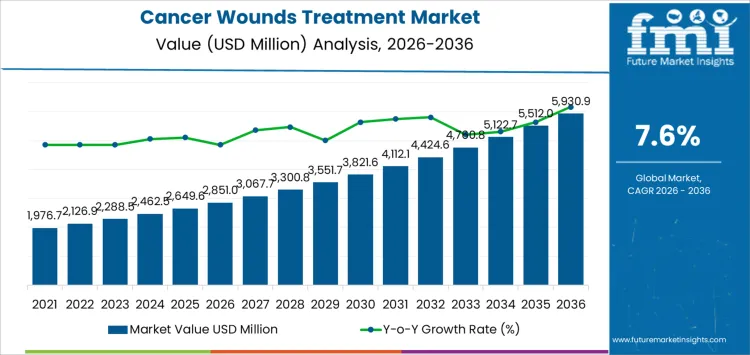
Cancer Wounds Treatment Market Key Takeaways
| Metric | Value |
|---|---|
| Market Value (2026) | USD 2,851.0 million |
| Market Forecast Value (2036) | USD 5,930.9 million |
| Forecast CAGR 2026 to 2036 | 7.6% |
Why is the Demand for Cancer Wounds Treatment Growing?
Demand for cancer wounds treatment is rising as oncologic care increasingly focuses on comprehensive management of complex wounds that arise from tumor invasion, surgical resection, radiation therapy, and treatment-related immunosuppression. Cancer wounds often present with persistent exudate, delayed healing, and high infection risk because impaired tissue perfusion and local immune dysfunction interfere with normal repair. Wound care clinicians and oncology specialists specify treatment regimens that combine advanced dressings, negative pressure wound therapy, debridement tools, and topical antimicrobial wound care solutions tailored to the unique pathophysiology of malignant wounds. Procurement teams at hospitals, cancer centers, and palliative care units assess product efficacy, ease of use, and compatibility with pain management protocols because minimizing patient discomfort and reducing dressing change frequency are critical operational goals. Professional judgment is guided by wound assessment scales and interdisciplinary review, which ensures that care plans reflect both healing objectives and quality of life considerations.
Expansion of cancer incidence worldwide and improvements in survival rates also contribute to increased prevalence of chronic and treatment-related wounds that require specialized care. As systemic therapies extend patient lifespan, clinicians encounter more cases where wound management becomes a persistent component of longitudinal care, prompting investment in solutions that address bacterial burden, odor control, and exudate management. Research into bioengineered tissues, protease modulators, and moisture-balanced therapy options supports adoption of products designed to function in compromised tissue environments that resist healing. Specialist training for nurses and wound care teams on cancer-specific protocols enhances treatment consistency and supports better documentation of healing trajectories. These clinical complexity and operational readiness drivers are contributing to sustained demand growth in the cancer wounds treatment market.
How Is the Cancer Wounds Treatment Industry Segmented by Product Category, Clinical Indication, and Care Channel?
Demand for cancer wounds treatment is shaped by symptom control needs, infection risk management, and continuity of care across oncology pathways. Care teams prioritize odor control, exudate management, pain reduction, and protection of surrounding skin. Adoption reflects longer survival, increased outpatient care, and preference for therapies suitable across settings. Selection decisions consider ease of use, compatibility with fragile tissue, and caregiver training requirements. Segmentation explains how therapeutic approach, wound etiology, and delivery setting influence utilization patterns across oncology-supportive care environments.
Which Product Category Accounts for the Largest Share in Cancer Wounds Treatment?
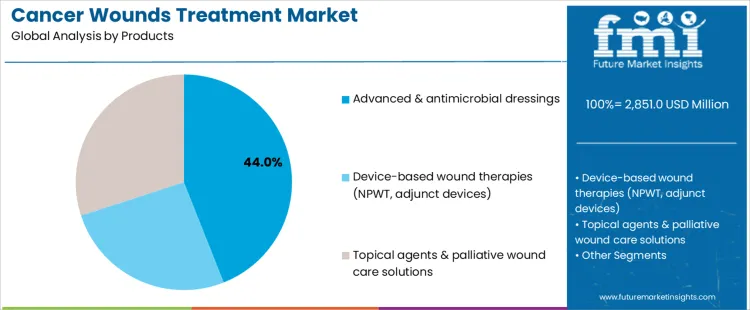
Advanced and antimicrobial dressings account for 44.0%, reflecting routine use for infection control, moisture balance, and atraumatic removal. These dressings support frequent changes while protecting compromised tissue. Device-based wound therapies at 26.0% include negative pressure and adjunct systems used selectively to manage exudate and promote granulation under supervision. Topical agents and palliative wound care solutions at 30.0% address odor, pain, and local symptom relief where curative closure is unlikely. Product-category segmentation shows concentration where daily management needs, comfort, and infection mitigation drive consistent utilization.
Key Points
- Advanced dressings support routine infection and moisture control.
- Devices serve selective cases requiring supervised intervention.
- Topicals prioritize symptom relief and comfort.
How Do Clinical Indications Shape Demand for Cancer Wounds Treatments?
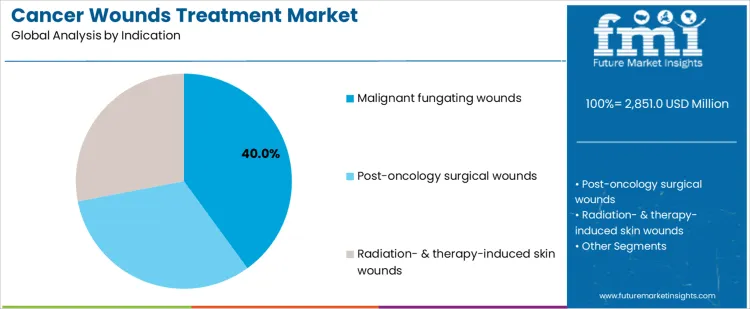
Malignant fungating wounds represent 40.0%, driven by complex symptom burden including odor, bleeding, and infection risk. Management focuses on palliation and quality of life rather than closure. Post-oncology surgical wounds at 32.0% require protection during healing amid immunosuppression and therapy schedules. Radiation- and therapy-induced skin wounds at 28.0% involve fragile tissue requiring gentle, protective care. Indication-based segmentation highlights higher utilization where symptom complexity, infection susceptibility, and treatment continuity necessitate tailored wound management strategies.
Key Points
- Fungating wounds require intensive palliative management.
- Surgical wounds need protection during compromised healing.
- Therapy-induced wounds demand gentle, protective solutions.
Which Care Channels Lead Delivery of Cancer Wounds Treatments?
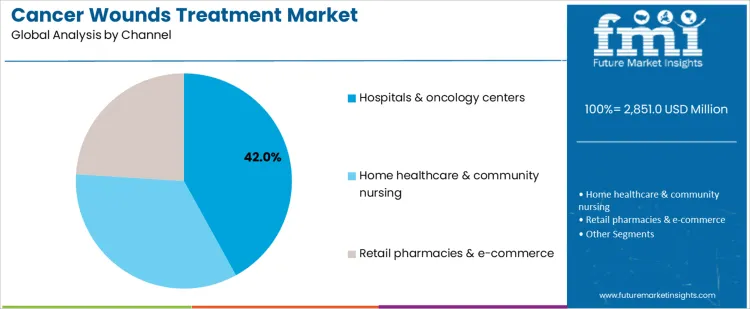
Hospitals and oncology centers account for 42.0%, reflecting management of complex cases, device use, and multidisciplinary oversight. Home healthcare and community nursing at 34.0% support ongoing dressing changes, symptom monitoring, and caregiver education. Retail pharmacies and e-commerce at 24.0% provide access to dressings and topicals for maintenance care. Channel segmentation indicates concentration where clinical complexity, frequency of care, and access convenience determine treatment delivery across care settings.
Key Points
- Hospitals manage complex and device-supported care.
- Home care sustains continuity and frequent management.
- Retail channels support maintenance access.
What are the Key Dynamics in the Cancer Wounds Treatment Market?
Demand for cancer wounds treatment reflects clinical need to manage malignant fungating wounds associated with advanced cancers. Adoption concentrates in oncology hospitals, palliative care units, wound care clinics, and home healthcare settings. Global scope aligns with rising cancer prevalence and extended survival in advanced disease stages. Usage centers on specialized dressings, topical antimicrobials, odor control agents, and exudate management products focused on symptom relief and infection control.
How do symptom burden management and palliative care integration shape adoption?
Cancer wounds present with pain, heavy exudate, bleeding, odor, and infection risk that significantly impair quality of life. Demand increases where curative treatment is no longer feasible and symptom control becomes primary care objective. Treatment selection prioritizes moisture balance, atraumatic dressing changes, and odor suppression to support patient comfort. Silver-based and charcoal dressings address microbial load and malodor. Hemostatic agents reduce bleeding episodes that complicate routine care. Multidisciplinary oncology and palliative teams coordinate wound management alongside systemic cancer therapy. Home-based care models influence product choice toward ease of use and reduced dressing frequency. Adoption reflects care focus on dignity, comfort, and complication prevention rather than wound closure.
How do clinical complexity, product cost, and care set variability influence market scalability?
Cancer wounds vary widely in size, depth, and tumor biology, limiting standardized treatment protocols. Demand sensitivity rises where frequent dressing changes increase care burden and cost. Reimbursement coverage for advanced dressings differs across regions and care settings. Infection control remains challenging due to immunosuppression and necrotic tissue. Training requirements affect consistent application by caregivers and home health staff. Limited clinical trial evidence restricts guideline standardization. Supply continuity matters for long-term management. Scalability remains constrained by case-specific care needs, reimbursement variability, and reliance on specialized clinical expertise across palliative care pathways.
How Is Demand for Cancer Wounds Treatment Evolving Globally?
Demand for cancer wounds treatment is expanding globally as oncology care increasingly addresses chronic, malignant, and treatment-related wounds. Longer survival periods, advanced radiotherapy, and complex surgical interventions elevate need for specialized wound management. Clinical emphasis on infection control, exudate management, and pain reduction supports adoption of advanced dressings and topical therapies. Access to palliative care and home-based services further influences utilization. Growth rates in India at 9.0%, China at 8.8%, Brazil at 8.4%, the USA at 7.2%, and Germany at 7.1% indicate sustained expansion driven by oncology care intensity, supportive treatment integration, and quality-of-life priorities rather than incidence growth alone.
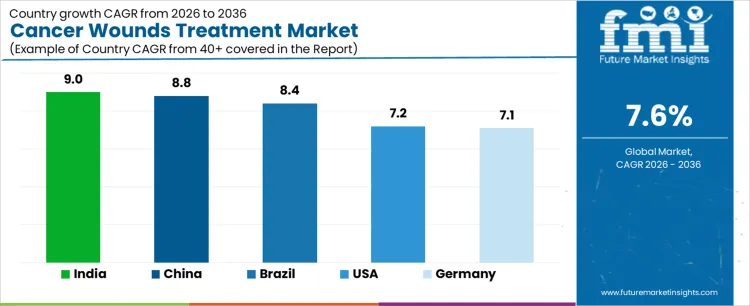
| Country | CAGR (%) |
|---|---|
| India | 9.0% |
| China | 8.8% |
| Brazil | 8.4% |
| USA | 7.2% |
| Germany | 7.1% |
What Is Driving Rising Utilization of Cancer Wounds Treatment in India?
Demand for cancer wounds treatment in India is growing at a CAGR of 9.0%, supported by increasing oncology caseloads and extended treatment durations. Advanced wound care productsin India are expanding due to rising tertiary hospital capacity and increased awareness of infection control protocols in oncology units. Advanced-stage presentations elevate prevalence of fungating and non-healing wounds. Tertiary hospitals expand wound care protocols within oncology departments. Growth of home healthcare services improves continuity of wound management. Cost-effective advanced dressings increase accessibility across private and charitable care settings. Expansion reflects supportive oncology integration and care pathway maturation rather than changes in diagnostic patterns.
- Higher prevalence of advanced-stage oncology cases
- Integration of wound care within oncology units
- Expansion of home-based supportive care
- Availability of cost-effective advanced dressings
Why Is China Experiencing Steady Growth in Cancer Wounds Treatment Demand?
Cancer wounds treatment demand in China is expanding at a CAGR of 8.8%, aligned with standardized cancer care delivery and hospital capacity expansion. Large oncology centers manage complex surgical and radiation-induced wounds. Institutional protocols emphasize infection prevention and symptom control. Public insurance coverage supports essential wound care products. Centralized hospitals ensure consistent clinical oversight. Growth reflects structured supportive care adoption and hospital-led treatment models rather than decentralized palliative expansion.
- High patient volumes at centralized oncology hospitals
- Standardized post-surgical wound protocols
- Public insurance coverage for essential therapies
- Emphasis on infection and symptom management
How Is Brazil Sustaining Expansion in Cancer Wounds Treatment?
Cancer wounds treatment demand in Brazil is growing at a CAGR of 8.4%, driven by expansion of comprehensive cancer care services. Public health networks address malignant wound complications within oncology pathways. Increased access to palliative care elevates demand for specialized dressings. Regional treatment centers extend wound management beyond major cities. Legal access frameworks support availability of necessary therapies. Growth reflects institutional care expansion and supportive service integration rather than rapid technology adoption.
- Expansion of comprehensive oncology care networks
- Rising palliative care service utilization
- Regional access to wound management services
- Legal frameworks supporting therapy availability
What Factors Are Supporting Cancer Wounds Treatment Demand in United States?
Cancer wounds treatment demand in the United States is expanding at a CAGR of 7.2%. Anti-biofilm dressing technologies address persistent microbial burden in malignant wounds, a strategic focus for wound care product development in advanced oncology care.Advanced wound care products are integrated within cancer treatment protocols. Insurance reimbursement supports use of specialized dressings and therapies. Strong hospice and palliative care infrastructure increases home-based wound management. Clinical emphasis on quality-of-life outcomes sustains consistent utilization. Growth reflects care optimization and supportive service strength rather than rising cancer incidence.
- Guideline inclusion of advanced wound care
- Insurance reimbursement for specialized products
- Strong hospice and palliative care networks
- Focus on quality-of-life outcomes
Why Is Germany Showing Consistent Growth in Cancer Wounds Treatment?
Cancer wounds treatment demand in Germany is growing at a CAGR of 7.1%, shaped by evidence-based oncology and palliative care frameworks. Certified cancer centers manage complex wounds using standardized protocols. Statutory insurance covers approved wound care products. Integration of nursing-led wound management improves continuity of care. Emphasis on symptom control guides appropriate therapy selection. Growth remains steady, reflecting structured supportive care delivery and reimbursement stability rather than accelerated oncology expansion.
- Certified oncology center wound protocols
- Statutory insurance coverage for wound care
- Nursing-led continuity of wound management
- Emphasis on symptom and infection control
What is the competitive landscape of demand for the cancer wounds treatment market globally?
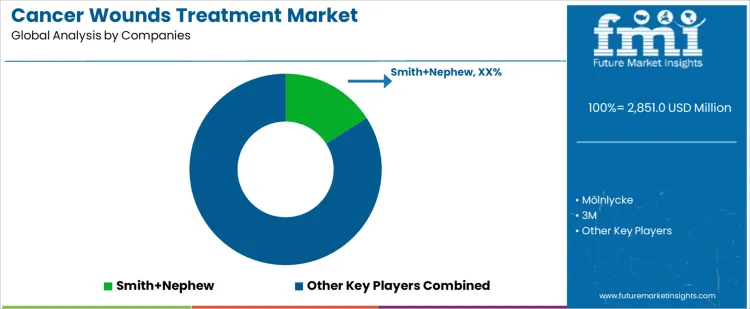
Demand for cancer wounds treatments is driven by rising oncology prevalence, palliative care needs, and management of malignant fungating wounds. Clinicians evaluate exudate control capability, odor management effectiveness, antimicrobial protection, pain reduction, and dressing conformity to irregular wound beds. Buyer assessment includes ease of application, frequency of dressing change, compatibility with radiotherapy or chemotherapy, and impact on patient quality of life. Procurement behavior reflects hospital tendering, hospice care requirements, and preference for clinically validated wound care protocols. Trend in the cancer wounds treatment market shows increasing focus on symptom control, infection prevention, and comfort-oriented care rather than curative outcomes.
Smith and Nephew leads competitive positioning through advanced wound care portfolios addressing complex oncology-related wounds with strong clinical backing. Mölnlycke competes via atraumatic dressings designed to reduce pain and skin damage during frequent changes. 3M supports demand with antimicrobial and absorbent wound care solutions integrated into hospital care pathways. ConvaTec maintains relevance through ostomy and wound management expertise supporting chronic and malignant wound cases. Coloplast participates by offering wound dressings focused on moisture balance, comfort, and patient dignity in long-term care settings. Competitive differentiation centers on clinical evidence, caregiver usability, patient comfort outcomes, and reliability across extended treatment durations.
Key Players in the Cancer Wounds Treatment Market
- Smith+Nephew
- Mölnlycke
- 3M
- ConvaTec
- Coloplast
- Others
Scope of the Report
| Items | Values |
|---|---|
| Quantitative Units | USD million |
| Products | Advanced & antimicrobial dressings; Device-based wound therapies (NPWT, adjunct devices); Topical agents & palliative wound care solutions |
| Indication | Malignant fungating wounds; Post-oncology surgical wounds; Radiation- & therapy-induced skin wounds |
| Channel | Hospitals & oncology centers; Home healthcare & community nursing; Retail pharmacies & e-commerce |
| Regions Covered | Asia Pacific, Europe, North America, Latin America, Middle East & Africa |
| Countries Covered | India, China, Brazil, USA, Germany, and 40+ countries |
| Key Companies Profiled | Smith+Nephew; Mölnlycke; 3M; ConvaTec; Coloplast; Others |
| Additional Attributes | Dollar sales by product type, indication, and channel; treatment efficacy in managing malignant fungating, post-surgical, and therapy-induced wounds; role of advanced dressings and NPWT devices in wound healing acceleration; palliative care integration and patient quality-of-life considerations; distribution dynamics driven by hospital oncology, home healthcare settings, and e-commerce platforms for consumer self-care products; reimbursement policies affecting hospital and homecare adoption. |
Cancer Wounds Treatment Market by Segment
Products
- Advanced & antimicrobial dressings
- Device-based wound therapies (NPWT, adjunct devices)
- Topical agents & palliative wound care solutions
Indication
- Malignant fungating wounds
- Post-oncology surgical wounds
- Radiation- & therapy-induced skin wounds
Channel
- Hospitals & oncology centers
- Home healthcare & community nursing
- Retail pharmacies & e-commerce
Region:
- Asia Pacific
- China
- Japan
- South Korea
- India
- Australia & New Zealand
- ASEAN
- Rest of Asia Pacific
- Europe
- Germany
- United Kingdom
- France
- Italy
- Spain
- Nordic
- BENELUX
- Rest of Europe
- North America
- United States
- Canada
- Mexico
- Latin America
- Brazil
- Chile
- Rest of Latin America
- Middle East & Africa
- Kingdom of Saudi Arabia
- Other GCC Countries
- Turkey
- South Africa
- Other African Union
- Rest of Middle East & Africa
Bibliography
- World Health Organization. (2023). WHO guidelines on cancer pain relief and palliative care. World Health Organization.
- National Cancer Institute. (2024). Supportive and palliative care for cancer patients (PDQ): Health professional version. National Institutes of Health.
- European Society for Medical Oncology. (2023). ESMO clinical practice guidelines for supportive and palliative care in oncology. ESMO.
- Centers for Disease Control and Prevention. (2024). Cancer treatment side effects and supportive care. USA Department of Health and Human Services.
Frequently Asked Questions
How big is the cancer wounds treatment market in 2026?
The global cancer wounds treatment market is estimated to be valued at USD 2,851.0 million in 2026.
What will be the size of cancer wounds treatment market in 2036?
The market size for the cancer wounds treatment market is projected to reach USD 5,930.9 million by 2036.
How much will be the cancer wounds treatment market growth between 2026 and 2036?
The cancer wounds treatment market is expected to grow at a 7.6% CAGR between 2026 and 2036.
What are the key product types in the cancer wounds treatment market?
The key product types in cancer wounds treatment market are advanced & antimicrobial dressings, device-based wound therapies (npwt, adjunct devices) and topical agents & palliative wound care solutions.
Which indication segment to contribute significant share in the cancer wounds treatment market in 2026?
In terms of indication, malignant fungating wounds segment to command 40.0% share in the cancer wounds treatment market in 2026.
Preview the report firsthand - request a free sample
Get SampleGet the brochure for pricing and purchase details.
Get PDFTable of Content
- Executive Summary
- Global Market Outlook
- Demand-side Trends
- Supply-side Trends
- Technology Roadmap Analysis
- Analysis and Recommendations
- Market Overview
- Market Coverage / Taxonomy
- Market Definition / Scope / Limitations
- Market Background
- Market Dynamics
- Drivers
- Restraints
- Opportunity
- Trends
- Scenario Forecast
- Demand in Optimistic Scenario
- Demand in Likely Scenario
- Demand in Conservative Scenario
- Opportunity Map Analysis
- Product Life Cycle Analysis
- Supply Chain Analysis
- Investment Feasibility Matrix
- Value Chain Analysis
- PESTLE and Porter’s Analysis
- Regulatory Landscape
- Regional Parent Market Outlook
- Production and Consumption Statistics
- Import and Export Statistics
- Market Dynamics
- Global Market Analysis 2021 to 2025 and Forecast, 2026 to 2036
- Historical Market Size Value (USD Million) Analysis, 2021 to 2025
- Current and Future Market Size Value (USD Million) Projections, 2026 to 2036
- Y-o-Y Growth Trend Analysis
- Absolute $ Opportunity Analysis
- Global Market Pricing Analysis 2021 to 2025 and Forecast 2026 to 2036
- Global Market Analysis 2021 to 2025 and Forecast 2026 to 2036, By Products
- Introduction / Key Findings
- Historical Market Size Value (USD Million) Analysis By Products , 2021 to 2025
- Current and Future Market Size Value (USD Million) Analysis and Forecast By Products , 2026 to 2036
- Advanced & antimicrobial dressings
- Device-based wound therapies (NPWT, adjunct devices)
- Topical agents & palliative wound care solutions
- Advanced & antimicrobial dressings
- Y-o-Y Growth Trend Analysis By Products , 2021 to 2025
- Absolute $ Opportunity Analysis By Products , 2026 to 2036
- Global Market Analysis 2021 to 2025 and Forecast 2026 to 2036, By Indication
- Introduction / Key Findings
- Historical Market Size Value (USD Million) Analysis By Indication, 2021 to 2025
- Current and Future Market Size Value (USD Million) Analysis and Forecast By Indication, 2026 to 2036
- Malignant fungating wounds
- Post-oncology surgical wounds
- Radiation- & therapy-induced skin wounds
- Malignant fungating wounds
- Y-o-Y Growth Trend Analysis By Indication, 2021 to 2025
- Absolute $ Opportunity Analysis By Indication, 2026 to 2036
- Global Market Analysis 2021 to 2025 and Forecast 2026 to 2036, By Channel
- Introduction / Key Findings
- Historical Market Size Value (USD Million) Analysis By Channel, 2021 to 2025
- Current and Future Market Size Value (USD Million) Analysis and Forecast By Channel, 2026 to 2036
- Hospitals & oncology centers
- Home healthcare & community nursing
- Retail pharmacies & e-commerce
- Hospitals & oncology centers
- Y-o-Y Growth Trend Analysis By Channel, 2021 to 2025
- Absolute $ Opportunity Analysis By Channel, 2026 to 2036
- Global Market Analysis 2021 to 2025 and Forecast 2026 to 2036, By Region
- Introduction
- Historical Market Size Value (USD Million) Analysis By Region, 2021 to 2025
- Current Market Size Value (USD Million) Analysis and Forecast By Region, 2026 to 2036
- North America
- Latin America
- Western Europe
- Eastern Europe
- East Asia
- South Asia and Pacific
- Middle East & Africa
- Market Attractiveness Analysis By Region
- North America Market Analysis 2021 to 2025 and Forecast 2026 to 2036, By Country
- Historical Market Size Value (USD Million) Trend Analysis By Market Taxonomy, 2021 to 2025
- Market Size Value (USD Million) Forecast By Market Taxonomy, 2026 to 2036
- By Country
- USA
- Canada
- Mexico
- By Products
- By Indication
- By Channel
- By Country
- Market Attractiveness Analysis
- By Country
- By Products
- By Indication
- By Channel
- Key Takeaways
- Latin America Market Analysis 2021 to 2025 and Forecast 2026 to 2036, By Country
- Historical Market Size Value (USD Million) Trend Analysis By Market Taxonomy, 2021 to 2025
- Market Size Value (USD Million) Forecast By Market Taxonomy, 2026 to 2036
- By Country
- Brazil
- Chile
- Rest of Latin America
- By Products
- By Indication
- By Channel
- By Country
- Market Attractiveness Analysis
- By Country
- By Products
- By Indication
- By Channel
- Key Takeaways
- Western Europe Market Analysis 2021 to 2025 and Forecast 2026 to 2036, By Country
- Historical Market Size Value (USD Million) Trend Analysis By Market Taxonomy, 2021 to 2025
- Market Size Value (USD Million) Forecast By Market Taxonomy, 2026 to 2036
- By Country
- Germany
- UK
- Italy
- Spain
- France
- Nordic
- BENELUX
- Rest of Western Europe
- By Products
- By Indication
- By Channel
- By Country
- Market Attractiveness Analysis
- By Country
- By Products
- By Indication
- By Channel
- Key Takeaways
- Eastern Europe Market Analysis 2021 to 2025 and Forecast 2026 to 2036, By Country
- Historical Market Size Value (USD Million) Trend Analysis By Market Taxonomy, 2021 to 2025
- Market Size Value (USD Million) Forecast By Market Taxonomy, 2026 to 2036
- By Country
- Russia
- Poland
- Hungary
- Balkan & Baltic
- Rest of Eastern Europe
- By Products
- By Indication
- By Channel
- By Country
- Market Attractiveness Analysis
- By Country
- By Products
- By Indication
- By Channel
- Key Takeaways
- East Asia Market Analysis 2021 to 2025 and Forecast 2026 to 2036, By Country
- Historical Market Size Value (USD Million) Trend Analysis By Market Taxonomy, 2021 to 2025
- Market Size Value (USD Million) Forecast By Market Taxonomy, 2026 to 2036
- By Country
- China
- Japan
- South Korea
- By Products
- By Indication
- By Channel
- By Country
- Market Attractiveness Analysis
- By Country
- By Products
- By Indication
- By Channel
- Key Takeaways
- South Asia and Pacific Market Analysis 2021 to 2025 and Forecast 2026 to 2036, By Country
- Historical Market Size Value (USD Million) Trend Analysis By Market Taxonomy, 2021 to 2025
- Market Size Value (USD Million) Forecast By Market Taxonomy, 2026 to 2036
- By Country
- India
- ASEAN
- Australia & New Zealand
- Rest of South Asia and Pacific
- By Products
- By Indication
- By Channel
- By Country
- Market Attractiveness Analysis
- By Country
- By Products
- By Indication
- By Channel
- Key Takeaways
- Middle East & Africa Market Analysis 2021 to 2025 and Forecast 2026 to 2036, By Country
- Historical Market Size Value (USD Million) Trend Analysis By Market Taxonomy, 2021 to 2025
- Market Size Value (USD Million) Forecast By Market Taxonomy, 2026 to 2036
- By Country
- Kingdom of Saudi Arabia
- Other GCC Countries
- Turkiye
- South Africa
- Other African Union
- Rest of Middle East & Africa
- By Products
- By Indication
- By Channel
- By Country
- Market Attractiveness Analysis
- By Country
- By Products
- By Indication
- By Channel
- Key Takeaways
- Key Countries Market Analysis
- USA
- Pricing Analysis
- Market Share Analysis, 2025
- By Products
- By Indication
- By Channel
- Canada
- Pricing Analysis
- Market Share Analysis, 2025
- By Products
- By Indication
- By Channel
- Mexico
- Pricing Analysis
- Market Share Analysis, 2025
- By Products
- By Indication
- By Channel
- Brazil
- Pricing Analysis
- Market Share Analysis, 2025
- By Products
- By Indication
- By Channel
- Chile
- Pricing Analysis
- Market Share Analysis, 2025
- By Products
- By Indication
- By Channel
- Germany
- Pricing Analysis
- Market Share Analysis, 2025
- By Products
- By Indication
- By Channel
- UK
- Pricing Analysis
- Market Share Analysis, 2025
- By Products
- By Indication
- By Channel
- Italy
- Pricing Analysis
- Market Share Analysis, 2025
- By Products
- By Indication
- By Channel
- Spain
- Pricing Analysis
- Market Share Analysis, 2025
- By Products
- By Indication
- By Channel
- France
- Pricing Analysis
- Market Share Analysis, 2025
- By Products
- By Indication
- By Channel
- India
- Pricing Analysis
- Market Share Analysis, 2025
- By Products
- By Indication
- By Channel
- ASEAN
- Pricing Analysis
- Market Share Analysis, 2025
- By Products
- By Indication
- By Channel
- Australia & New Zealand
- Pricing Analysis
- Market Share Analysis, 2025
- By Products
- By Indication
- By Channel
- China
- Pricing Analysis
- Market Share Analysis, 2025
- By Products
- By Indication
- By Channel
- Japan
- Pricing Analysis
- Market Share Analysis, 2025
- By Products
- By Indication
- By Channel
- South Korea
- Pricing Analysis
- Market Share Analysis, 2025
- By Products
- By Indication
- By Channel
- Russia
- Pricing Analysis
- Market Share Analysis, 2025
- By Products
- By Indication
- By Channel
- Poland
- Pricing Analysis
- Market Share Analysis, 2025
- By Products
- By Indication
- By Channel
- Hungary
- Pricing Analysis
- Market Share Analysis, 2025
- By Products
- By Indication
- By Channel
- Kingdom of Saudi Arabia
- Pricing Analysis
- Market Share Analysis, 2025
- By Products
- By Indication
- By Channel
- Turkiye
- Pricing Analysis
- Market Share Analysis, 2025
- By Products
- By Indication
- By Channel
- South Africa
- Pricing Analysis
- Market Share Analysis, 2025
- By Products
- By Indication
- By Channel
- USA
- Market Structure Analysis
- Competition Dashboard
- Competition Benchmarking
- Market Share Analysis of Top Players
- By Regional
- By Products
- By Indication
- By Channel
- Competition Analysis
- Competition Deep Dive
- Smith+Nephew
- Overview
- Product Portfolio
- Profitability by Market Segments (Product/Age /Sales Channel/Region)
- Sales Footprint
- Strategy Overview
- Marketing Strategy
- Product Strategy
- Channel Strategy
- Mölnlycke
- 3M
- ConvaTec
- Coloplast
- Others
- Smith+Nephew
- Competition Deep Dive
- Assumptions & Acronyms Used
- Research Methodology


