

- Market Size (2026)
- USD 853.3 Mn
- Forecast (2036)
- USD 1825.2 Mn
- CAGR (2026 to 2036)
- 7.9%
How big is Gene-Edited Porcine Organ Transplantation Market in 2026?
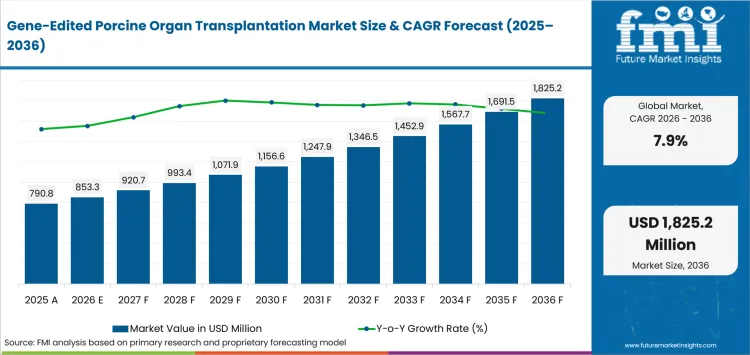
USD 853.3 million in 2026 and USD 1,825.2 million by 2036 at a 7.9% CAGR.
Sales in the Gene-Edited Porcine Organ Transplantation Market are projected to expand at 7.9% CAGR from 2026 to 2036. The industry valuation rises from USD 853.3 million in 2026 to USD 1825.2 million by 2036. Demand is expected to be driven by transplant scarcity and the need for controlled xenotransplant pathways. Hospitals need proof that an edited porcine organ can be sourced safely and monitored after surgery.
Kidney programs provide the clearest early qualification route because transplant teams can monitor graft function through familiar clinical markers. The operating context explains why extra graft supply matters when waiting lists remain larger than donor availability. Commercial adoption is expected to require patient selection rules and long-term safety monitoring before wider use.
Key Takeaways of Gene-Edited Porcine Organ Transplantation Market
- Demand for gene-edited porcine organ transplantation is driven by human-organ shortages and the potential to expand transplant availability through genetically modified donor animals with controlled clinical monitoring.
- By organ type, Kidney is expected to lead with 36.1% share in 2026, supported by measurable graft-function indicators and established nephrology follow-up pathways.
- CRISPR-Cas9 Gene Editing is projected to lead the technology category with 37.2% share in 2026, reflecting its role in developing multi-gene donor animals with defined compatibility edits.
- Clinical Organ Transplantation is estimated to account for 43.0% share in 2026, while Transplant Centers lead the end-user category with 43.5% share, supported by specialist eligibility assessment, surgery, and long-term monitoring.
- Infection surveillance, donor-animal screening, immune compatibility, and long-term patient monitoring remain key barriers to wider clinical adoption.
- Competition centers on eGenesis, United Therapeutics, Makana Therapeutics, and Qihan Bio, with companies differentiating through gene-edited donor-animal platforms and clinical translation capabilities.
Analyst Perspective
"Commercial progress will depend on whether gene-edited porcine organs demonstrate consistent clinical outcomes beyond individual milestone cases. Transplant centers are evaluating graft survival, infection surveillance, immunological management, and long-term monitoring costs as interconnected adoption factors. Companies that establish reproducible clinical protocols, clear safety responsibilities, and credible outcome evidence will be better positioned to advance routine transplantation."
- Anurag Sharma, Principal Analyst at Future Market Insights
Source: FMI's proprietary forecasting model and primary research
How is the Gene-Edited Porcine Organ Transplantation Market segmented?
The gene-edited porcine organ transplantation market is segmented by organ type, gene editing technology, application, end user, and region.
The segmentation framework separates the organ being transplanted from the editing method and the clinical setting that controls use. Organ Type covers kidney, heart, liver, lung, and pancreas pathways. Gene Editing Technology covers CRISPR-Cas9, TALEN-based editing, zinc finger nuclease editing, and multi-gene engineering platforms. Application analysis separates clinical transplantation from preclinical research and organ-failure treatment. End users include transplant centers, hospitals, biotechnology developers, and academic research institutes. Regional analysis shows how transplant capacity and hospital readiness influence adoption.
What supports demand for kidney within the organ type category?
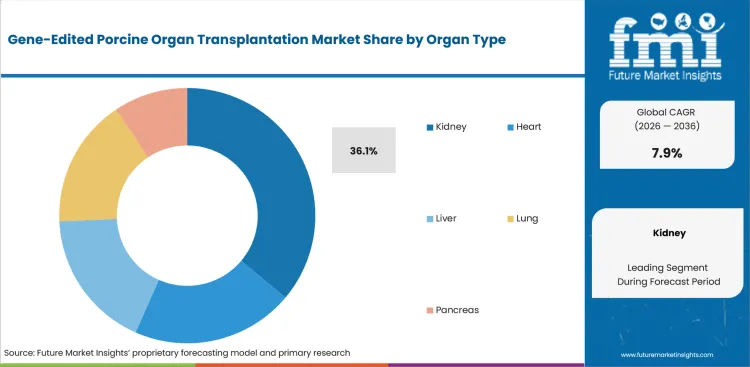
Kidney transplantation gives early programs a measurable clinical route because graft function can be followed through established blood tests and patient monitoring. This organ type gives sponsors a practical way to compare survival and rejection signals across transplant centers.
- Kidney is anticipated to hold 36.1% share in 2026. It leads the organ type category because kidney function can be followed through familiar laboratory markers after transplant.
- Transplant teams can build kidney protocols around nephrology follow-up and escalation rules. This makes early evidence easier to convert into hospital procedures and sponsor submissions.
What supports CRISPR-Cas9 gene editing within the technology category?
Gene-edited porcine organs require changes that address immune recognition and pathogen-safety concerns. CRISPR-Cas9 remains central because programs need edit records that can be traced from breeding through organ release.
- With an estimated 37.2% share in 2026, CRISPR-Cas9 Gene Editing is expected to lead technology demand. The method supports donor-animal programs that need several documented edits.
- Developers need clear editing records before hospitals can connect an organ to eligibility review and follow-up. Platform documentation becomes part of the commercial offer.
How does clinical organ transplantation shape the application category?
Clinical transplantation is the highest-value use case because it tests whether edited porcine organs can meet a defined patient need. Hospital review teams need evidence that the procedure can be governed beyond a single case.
- Clinical Organ Transplantation is forecast to account for 43.0% share in 2026. Its lead reflects higher value from supervised human use and patient outcome evidence.
- Academic hospitals favor evidence that connects organ survival with infection surveillance and immunosuppression decisions. Adoption remains selective until protocols can be repeated across specialist sites.
Why do transplant centers lead the end user category?
Transplant centers control patient selection and surgical readiness before a xenotransplantation program can begin. They manage immune-response review and long-term follow-up after the procedure.
- Transplant Centers are estimated to hold 43.5% share in 2026. Their lead is expected because these institutions control eligibility review and long-term follow-up.
- Hospitals outside major transplant networks may participate later through referral pathways or research partnerships. Direct procurement is expected to remain concentrated at specialist centers first.
What are the drivers, restraints, and opportunities in the Gene-Edited Porcine Organ Transplantation Market?
Demand is expected to be driven by organ scarcity and the need for monitored clinical pathways after transplant.
- Driver: Organ scarcity is expected to support demand for alternative graft sources that can be governed through transplant-center protocols.
- Restraint: Routine adoption is expected to slow when safety evidence and payment responsibility remain unclear.
- Opportunity: Kidney programs are likely to create value when monitoring duties are assigned before broader site expansion.
Organ scarcity is a direct driver because demand for transplantable organs remains above available supply in major health systems. Health Resources and Services Administration reporting showed more than 48,000 organ transplants in the United States during 2024. Edited porcine organs become commercially relevant only when evidence shows which patients qualify and how clinicians should respond to rejection signals.
Safety uncertainty is expected to limit routine adoption because xenotransplantation adds infection surveillance and donor-animal controls to normal transplant risk. Sponsors must document animal status and graft performance before hospitals can standardize eligibility decisions. Payment review is expected to require survival evidence and clear care responsibility before broader reimbursement develops.
The clearest opportunity is concentrated in kidney pathways that can be governed through transplant-center protocols. Kidney function can be monitored in a structured way after surgery. Programs that define patient selection and long-term follow-up before expansion are more likely to move beyond exceptional use.
Which country CAGRs are profiled in the Gene-Edited Porcine Organ Transplantation Market?
| Country | CAGR |
|---|---|
| Japan | 9.9% |
| Germany | 9.3% |
| UK | 8.1% |
| USA | 7.7% |
| South Korea | 6.1% |
How do country-level CAGRs compare in the Gene-Edited Porcine Organ Transplantation Market?
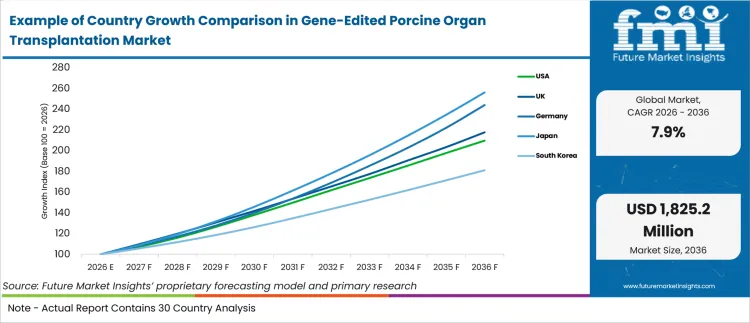
The country comparison shows a clear spread across the five profiled markets. Japan forms the upper band at 9.9% CAGR and Germany follows at 9.3%. The UK and USA form the middle group. South Korea remains lower in the comparison at 6.1%. The spread shows that market momentum depends on clinical readiness and transplant governance more than organ need alone.
- Japan and Germany lead the comparison and establish the strongest specialist-care cluster among the markets shown.
- The UK and USA follow in the middle band with established transplant systems and structured evidence review.
- South Korea records the slowest profiled growth although tertiary-care hospitals can support selective evaluation.
- The pattern shows a graded market profile instead of a sharp division between high-growth and low-growth countries.
- Countries with similar organ needs can still differ because regulatory review and hospital readiness are not equal.
Markets with broadly similar clinical needs can present different entry conditions due to transplant governance and site readiness. The full report provides country-level analysis across North America and Latin America. Coverage then extends to Europe and East Asia. It includes South Asia and Pacific plus the Middle East and Africa.
Country-wise Analysis
- Japan combines specialist hospital discipline with high attention to long-term clinical monitoring. Demand in Japan is estimated to expand at 9.9% CAGR from 2026 to 2036. Growth is expected to depend on whether edited kidney programs can reduce pressure created by limited donor availability. Local adoption should begin through controlled specialist pathways before wider hospital use. Developers need patient communication plans because animal-derived organs require careful consent. Commercial plans should focus on repeatable evidence and post-surgery monitoring capacity.
- Germany offers regulated hospital systems and university centers that can evaluate complex transplant technologies. The German market is projected to record 9.3% CAGR during the forecast period. Adoption is expected to depend on clear donor-animal controls and evidence that can satisfy clinical review. Hospitals are expected to need protocols that explain eligibility and escalation after surgery. Payer review may remain cautious until durability evidence improves. Supplier plans should prepare clinical documentation before broader site participation is proposed.
- The UK has centralized transplant governance and public-system review that can support controlled adoption. UK demand is forecast to rise at 8.1% CAGR from 2026 to 2036. Early use is expected to depend on whether specialist centers can show a clear effect on transplant capacity. Procurement review is expected to need evidence on patient outcomes and long-term monitoring cost. Ethics review may lengthen preparation when animal-source risk is part of the procedure. Developers should provide simple clinical pathways that public providers can evaluate consistently.
- United States adoption is expected to begin through academic medical centers and controlled clinical protocols. The USA is projected to post 7.7% CAGR over the forecast period. Growth is expected to depend on sponsor evidence and regulator engagement around xenotransplantation risk. Large transplant networks can evaluate edited kidneys through multidisciplinary review. Payment uncertainty may slow routine use until follow-up cost is clearer. Commercial contracts should define responsibility for infection surveillance and patient monitoring after surgery.
- South Korea has tertiary-care capacity and digital hospital systems that can support selective clinical evaluation. The market is predicted to advance at 6.1% CAGR by 2036. Growth is expected to remain measured until more public evidence supports routine xenotransplantation pathways. Specialist teams can test monitoring models before broader use. Procurement planning may be difficult when local readiness data are limited. Suppliers should prioritize training and long-term support before proposing wider adoption.
Who are the notable companies in the Gene-Edited Porcine Organ Transplantation Market?
eGenesis, United Therapeutics, Makana Therapeutics, Qihan Bio, and Recombinetics are the notable companies shaping this market.
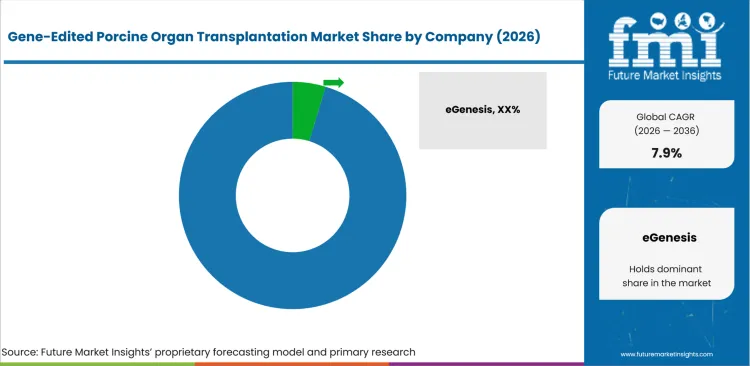
The competitive outlook separates direct donor-animal developers from adjacent gene-editing and organ-engineering platforms. eGenesis has the clearest direct connection to edited porcine organ transplantation. United Therapeutics is relevant through broader xenotransplantation assets. Makana Therapeutics and Qihan Bio remain relevant where donor-animal platforms and immune-compatibility work are assessed. Recombinetics is treated as an adjacent participant unless product-level evidence shows direct transplant alignment.
- eGenesis has the strongest alignment with edited porcine donor organs and human transplant evaluation.
- United Therapeutics is reviewed through xenotransplantation assets and development pathways that could support clinical translation.
- Makana Therapeutics and Qihan Bio remain relevant when donor-animal platforms and gene-editing work are assessed.
- Recombinetics is included for adjacent platform relevance and should not be positioned as a direct clinical supplier without product-level evidence.
Competitive Benchmarking: Gene-Edited Porcine Organ Transplantation Market
| Company | Donor-Animal Alignment | Clinical Translation Support | Platform Evidence | Geographic Reach |
|---|---|---|---|---|
| eGenesis | High | High | High | United States |
| United Therapeutics | High | Medium | High | United States |
| Makana Therapeutics | Medium | Low | Medium | United States |
| Qihan Bio | Medium | Low | Medium | China and United States |
| Recombinetics | Medium | Low | Medium | United States |
Scoring basis: High indicates documented alignment with edited porcine organ transplantation or a controlled clinical pathway. Medium indicates a relevant platform or adjacent capability. Low indicates limited direct evidence within the defined market boundary.
Key Developments in the Gene-Edited Porcine Organ Transplantation Market
- In 2025, eGenesis announced FDA clearance of an investigational new drug application for EGEN-2784. The clearance supported movement toward a clinical study of its gene-edited porcine kidney candidate.
Key Players in the Gene-Edited Porcine Organ Transplantation Market
Direct Xenotransplantation Developers
- eGenesis
- United Therapeutics
- Makana Therapeutics
- Qihan Bio
Gene-Editing and Translational Platforms
- Recombinetics
Gene-Edited Porcine Organ Transplantation Market - Report Scope
| Coverage field | Report scope |
|---|---|
| Market breakdown | Organ type, gene editing technology, application, end user, and region. |
| Quantitative Units | Revenue in USD Million, CAGR in %. |
| Market Definition | Gene-edited porcine organs and supporting clinical activities used to evaluate or perform xenotransplantation in humans. |
| Regions Covered | North America; Latin America; Europe; East Asia; South Asia; Oceania; and Middle East and Africa. |
| Countries Covered | USA; UK; Germany; Japan; and South Korea. |
| Key Companies Profiled | eGenesis; United Therapeutics; Makana Therapeutics; Qihan Bio; and Recombinetics. |
| Forecast Period | 2026 to 2036. |
| Approach | Hybrid bottom-up and top-down market sizing supported by primary interviews and official desk research. |
Gene-Edited Porcine Organ Transplantation Market - Research Methodology
| Method | Approach |
|---|---|
| Primary Research | FMI analysts gathered input from manufacturers, service providers, technology developers, distributors, end users, procurement teams, and subject-matter experts. Interviews examined purchasing decisions, product or service evaluation, adoption barriers, approval requirements, pricing considerations, and expectations for technical or commercial support. Respondents were also asked what evidence is required before a trial, pilot, or initial order develops into regular purchasing. |
| Desk Research | Desk research covered government statistics, regulatory publications, trade data, industry associations, technical literature, standards, company filings, product information, and official corporate announcements. Sources were reviewed for relevance, publication date, geographic coverage, and consistency with the defined market scope. Claims relating to performance, applications, approvals, capacity, investment, and commercial activity were retained only when supported by credible public evidence. |
| Market Sizing and Forecasting | The market combined the baseline value with historical performance, segment structure, pricing and volume indicators, adoption levels, company participation, and country-level demand conditions. Forecast assumptions considered economic activity, investment trends, regulatory developments, technology adoption, purchasing cycles, supply availability, and barriers to wider market use. Segment and regional estimates were reconciled before the final market total was calculated. |
| Data Validation | Estimates were checked against multiple independent indicators, including public data, company activity, trade patterns, industry developments, and findings from primary interviews. Validation also tested whether products, services, applications, and company revenues fell within the defined market boundaries. Adjacent categories, unsupported claims, overlapping revenues, and activities without direct market relevance were excluded to reduce double counting and maintain consistency across segments and countries. |
Gene-Edited Porcine Organ Transplantation Market by Segments
Gene-Edited Porcine Organ Transplantation Market segmented by Organ Type:
- Kidney
- Heart
- Liver
- Lung
- Pancreas
Gene-Edited Porcine Organ Transplantation Market segmented by Gene Editing Technology:
- CRISPR-Cas9 Gene Editing
- TALEN-based Editing
- Zinc Finger Nuclease Editing
- Multi-gene Engineering Platforms
Gene-Edited Porcine Organ Transplantation Market segmented by Application:
- Clinical Organ Transplantation
- Preclinical Research
- Organ Failure Treatment
- Regenerative Medicine Research
Gene-Edited Porcine Organ Transplantation Market segmented by End User:
- Transplant Centers
- Hospitals
- Biotechnology Companies
- Academic and Research Institutes
Gene-Edited Porcine Organ Transplantation Market by Region:
- North America
- United States
- Canada
- Latin America
- Brazil
- Mexico
- Argentina
- Chile
- Western Europe
- Germany
- France
- United Kingdom
- Italy
- Spain
- Benelux
- Nordics
- Eastern Europe
- Poland
- Czech Republic
- Romania
- Hungary
- East Asia
- China
- Japan
- South Korea
- South Asia and Pacific
- India
- ASEAN
- Australia and New Zealand
- Middle East and Africa
- GCC Countries
- South Africa
- Turkiye
- Israel
Research Sources and Bibliography
- Health Resources and Services Administration. (2025, January 15). Organ transplants exceeded 48,000 in 2024; a 3.3 percent increase from transplants performed in 2023.
- Massachusetts General Hospital. (2024, March 21). World’s first genetically-edited pig kidney transplant into living recipient performed at Massachusetts General Hospital.
- NYU Langone Health. (2024, April 24). Surgeons transplant gene-edited pig kidney into living patient with mechanical heart pump.
- eGenesis, Inc. (2025, September 8). eGenesis announces IND clearance for EGEN-2784 in kidney transplant and landmark patient updates in ongoing expanded access study.
- United Therapeutics Corporation. (2025, February 3). United Therapeutics Corporation announces FDA clearance of its investigational new drug application for the UKidney xenotransplantation clinical trial.
This bibliography is provided for reader reference and is not exhaustive. The full report contains the complete reference list and detailed citations.
This Report Answers
- How large is the gene-edited porcine organ transplantation market in 2026 and 2036?
- What supports the 7.9% CAGR in the gene-edited porcine organ transplantation market?
- Why does Kidney lead the Organ Type category in 2026?
- How does CRISPR-Cas9 Gene Editing influence platform selection?
- How do country growth rates differ across USA and UK with Germany and Japan plus South Korea?
- Which companies have the clearest market alignment?
- What limits adoption in the gene-edited porcine organ transplantation market?
- What evidence should procurement and clinical teams review before adoption?
- How does monitoring responsibility affect commercial value?
Frequently Asked Questions
How big is the Gene-Edited Porcine Organ Transplantation Market in 2026?
The gene-edited porcine organ transplantation market is valued at USD 853.3 million in 2026 and is forecast to reach USD 1,825.2 million by 2036, supported by human organ shortages driving demand for alternative graft sources governed through transplant-center protocols with defined patient selection and long-term safety monitoring.
What is the CAGR of the Gene-Edited Porcine Organ Transplantation Market from 2026 to 2036?
The gene-edited porcine organ transplantation market is projected to grow at a CAGR of 7.9% between 2026 and 2036, supported by transplant scarcity, expanding clinical kidney pathways with measurable graft-function monitoring, and growing sponsor evidence connecting gene-edited donor-animal platforms with controlled xenotransplantation outcomes.
Which organ type leads the Gene-Edited Porcine Organ Transplantation Market?
Kidney accounts for 36.1% of the gene-edited porcine organ transplantation market by organ type in 2026, driven by established nephrology follow-up pathways and familiar laboratory markers that allow transplant teams to monitor graft function and build repeatable clinical protocols around defined eligibility and escalation rules.
How much will the Gene-Edited Porcine Organ Transplantation Market add between 2026 and 2036?
The gene-edited porcine organ transplantation market is set to add USD 971.9 million between 2026 and 2036, growing from USD 853.3 million to USD 1,825.2 million as kidney transplant programs generate reproducible clinical outcome evidence, infection surveillance frameworks mature, and specialist transplant centers expand controlled xenotransplantation pathways globally.
Who are the leading companies in the Gene-Edited Porcine Organ Transplantation Market?
Leading companies in the gene-edited porcine organ transplantation market include eGenesis, United Therapeutics, Makana Therapeutics, Qihan Bio, and Recombinetics, competing across direct xenotransplantation donor-animal development, clinical translation support, and gene-editing and translational platforms with documented IND clearances and expanded access study experience.
Preview the report firsthand - request a free sample
Get SampleGet the brochure for pricing and purchase details.
Get PDFTable of Content
- Key Takeaways
- Market Size and CAGR
- Top Growth Driver
- Fastest Growing Segment
- Leading Region
- Key Companies
- Emerging Opportunities
- Executive Summary
- Global Market Outlook
- Demand-side Trends
- Supply-side Trends
- Technology Roadmap Analysis
- Analysis and Recommendations
- Analyst Perspective (What is happening? Why now? What should investors know?)
- Key Questions Answered
- How large is the market?
- What is the CAGR?
- What are key trends?
- Which region dominates?
- Who are the leaders?
- Market Overview
- Market Coverage / Taxonomy
- Market Definition / Scope / Limitations
- Research Methodology
- Chapter Orientation
- Analytical Lens and Working Hypotheses
- Market Structure, Signals, and Trend Drivers
- Benchmarking and Cross-market Comparability
- Market Sizing, Forecasting, and Opportunity Mapping
- Research Design and Evidence Framework
- Desk Research Programme (Secondary Evidence)
- Expert Input and Fieldwork (Primary Evidence)
- Tooling, Models, and Reference Databases
- Data Engineering and Model Build
- Quality Assurance and Audit Trail
- Market Background
- Market Dynamics (Drivers, Restraints, Opportunity, Trends)
- Scenario Forecast (Optimistic, Likely, Conservative)
- Impact Analysis
- AI Impact
- Sustainability Impact
- Regulatory Impact
- Technology Impact
- Consumer / Buyer Analysis
- Purchase Drivers
- Adoption Barriers
- Buyer Journey
- Opportunity Map Analysis
- Product Life Cycle Analysis
- Supply Chain Analysis
- Investment Feasibility Matrix
- Value Chain Analysis
- PESTLE and Porter's Analysis
- Regulatory Landscape
- Regional Parent Market Outlook
- Production and Consumption Statistics
- Import and Export Statistics
- Global Market Analysis and Forecast, 2021 to 2036
- Historical Market Size Value (USD Million) Analysis, 2021 to 2025
- Current and Future Market Size Value (USD Million) Projections, 2026 to 2036
- Y-o-Y Growth Trend Analysis
- Absolute $ Opportunity Analysis
- Global Market Pricing Analysis, 2021 to 2036
- Global Market Analysis and Forecast, By Organ Type, 2021 to 2036
- Introduction / Key Findings
- Historical Market Size Value (USD Million) Analysis By Organ Type, 2021 to 2025
- Current and Future Market Size Value (USD Million) Analysis and Forecast By Organ Type, 2026 to 2036
- Kidney
- Heart
- Liver
- Lung
- Pancreas
- Kidney
- Y-o-Y Growth Trend Analysis By Organ Type, 2021 to 2025
- Absolute $ Opportunity Analysis By Organ Type, 2026 to 2036
- Global Market Analysis and Forecast, By Gene Editing Technology, 2021 to 2036
- Introduction / Key Findings
- Historical Market Size Value (USD Million) Analysis By Gene Editing Technology, 2021 to 2025
- Current and Future Market Size Value (USD Million) Analysis and Forecast By Gene Editing Technology, 2026 to 2036
- CRISPR-Cas9 Gene Editing
- TALEN-based Editing
- Zinc Finger Nuclease Editing
- Multi-gene Engineering Platforms
- CRISPR-Cas9 Gene Editing
- Y-o-Y Growth Trend Analysis By Gene Editing Technology, 2021 to 2025
- Absolute $ Opportunity Analysis By Gene Editing Technology, 2026 to 2036
- Global Market Analysis and Forecast, By Application, 2021 to 2036
- Introduction / Key Findings
- Historical Market Size Value (USD Million) Analysis By Application, 2021 to 2025
- Current and Future Market Size Value (USD Million) Analysis and Forecast By Application, 2026 to 2036
- Clinical Organ Transplantation
- Preclinical Research
- Organ Failure Treatment
- Regenerative Medicine Research
- Clinical Organ Transplantation
- Y-o-Y Growth Trend Analysis By Application, 2021 to 2025
- Absolute $ Opportunity Analysis By Application, 2026 to 2036
- Global Market Analysis and Forecast, By End User, 2021 to 2036
- Introduction / Key Findings
- Historical Market Size Value (USD Million) Analysis By End User, 2021 to 2025
- Current and Future Market Size Value (USD Million) Analysis and Forecast By End User, 2026 to 2036
- Transplant Centers
- Hospitals
- Biotechnology Companies
- Academic & Research Institutes
- Transplant Centers
- Y-o-Y Growth Trend Analysis By End User, 2021 to 2025
- Absolute $ Opportunity Analysis By End User, 2026 to 2036
- Global Market Analysis and Forecast, By Region, 2021 to 2036
- Introduction
- Historical Market Size Value (USD Million) Analysis By Region, 2021 to 2025
- Current Market Size Value (USD Million) Analysis and Forecast By Region, 2026 to 2036
- North America
- Latin America
- Western Europe
- Eastern Europe
- East Asia
- South Asia and Pacific
- Middle East & Africa
- Market Attractiveness Analysis By Region
- North America Market Analysis and Forecast, By Country, 2021 to 2036
- Historical Market Size Value (USD Million) Trend Analysis By Market Taxonomy, 2021 to 2025
- Market Size Value (USD Million) Forecast By Market Taxonomy, 2026 to 2036
- By Country
- USA
- Canada
- By Organ Type
- By Gene Editing Technology
- By Application
- By End User
- By Country
- Market Attractiveness Analysis
- By Country
- By Organ Type
- By Gene Editing Technology
- By Application
- By End User
- Key Takeaways
- Latin America Market Analysis and Forecast, By Country
- Historical Market Size Value (USD Million) Trend Analysis By Market Taxonomy, 2021 to 2025
- Market Size Value (USD Million) Forecast By Market Taxonomy, 2026 to 2036
- By Country
- Brazil
- Mexico
- Chile
- Rest of Latin America
- By Organ Type
- By Gene Editing Technology
- By Application
- By End User
- By Country
- Market Attractiveness Analysis
- By Country
- By Organ Type
- By Gene Editing Technology
- By Application
- By End User
- Key Takeaways
- Western Europe Market Analysis and Forecast, By Country
- Historical Market Size Value (USD Million) Trend Analysis By Market Taxonomy, 2021 to 2025
- Market Size Value (USD Million) Forecast By Market Taxonomy, 2026 to 2036
- By Country
- Germany
- UK
- Italy
- Spain
- France
- Nordic
- BENELUX
- Rest of Western Europe
- By Organ Type
- By Gene Editing Technology
- By Application
- By End User
- By Country
- Market Attractiveness Analysis
- By Country
- By Organ Type
- By Gene Editing Technology
- By Application
- By End User
- Key Takeaways
- Eastern Europe Market Analysis and Forecast, By Country
- Historical Market Size Value (USD Million) Trend Analysis By Market Taxonomy, 2021 to 2025
- Market Size Value (USD Million) Forecast By Market Taxonomy, 2026 to 2036
- By Country
- Russia
- Poland
- Hungary
- Balkan & Baltic
- Rest of Eastern Europe
- By Organ Type
- By Gene Editing Technology
- By Application
- By End User
- By Country
- Market Attractiveness Analysis
- By Country
- By Organ Type
- By Gene Editing Technology
- By Application
- By End User
- Key Takeaways
- East Asia Market Analysis and Forecast, By Country
- Historical Market Size Value (USD Million) Trend Analysis By Market Taxonomy, 2021 to 2025
- Market Size Value (USD Million) Forecast By Market Taxonomy, 2026 to 2036
- By Country
- China
- Japan
- South Korea
- By Organ Type
- By Gene Editing Technology
- By Application
- By End User
- By Country
- Market Attractiveness Analysis
- By Country
- By Organ Type
- By Gene Editing Technology
- By Application
- By End User
- Key Takeaways
- South Asia and Pacific Market Analysis and Forecast, By Country
- Historical Market Size Value (USD Million) Trend Analysis By Market Taxonomy, 2021 to 2025
- Market Size Value (USD Million) Forecast By Market Taxonomy, 2026 to 2036
- By Country
- India
- ASEAN
- Australia & New Zealand
- Rest of South Asia and Pacific
- By Organ Type
- By Gene Editing Technology
- By Application
- By End User
- By Country
- Market Attractiveness Analysis
- By Country
- By Organ Type
- By Gene Editing Technology
- By Application
- By End User
- Key Takeaways
- Middle East & Africa Market Analysis and Forecast, By Country
- Historical Market Size Value (USD Million) Trend Analysis By Market Taxonomy, 2021 to 2025
- Market Size Value (USD Million) Forecast By Market Taxonomy, 2026 to 2036
- By Country
- Kingdom of Saudi Arabia
- Other GCC Countries
- Türkiye
- South Africa
- Other African Union
- Rest of Middle East & Africa
- By Organ Type
- By Gene Editing Technology
- By Application
- By End User
- By Country
- Market Attractiveness Analysis
- By Country
- By Organ Type
- By Gene Editing Technology
- By Application
- By End User
- Key Takeaways
- Key Countries Market Analysis
- USA
- Pricing Analysis
- Market Share Analysis, 2025
- By Organ Type
- By Gene Editing Technology
- By Application
- By End User
- Canada
- Pricing Analysis
- Market Share Analysis, 2025
- By Organ Type
- By Gene Editing Technology
- By Application
- By End User
- Mexico
- Pricing Analysis
- Market Share Analysis, 2025
- By Organ Type
- By Gene Editing Technology
- By Application
- By End User
- Brazil
- Pricing Analysis
- Market Share Analysis, 2025
- By Organ Type
- By Gene Editing Technology
- By Application
- By End User
- Chile
- Pricing Analysis
- Market Share Analysis, 2025
- By Organ Type
- By Gene Editing Technology
- By Application
- By End User
- Germany
- Pricing Analysis
- Market Share Analysis, 2025
- By Organ Type
- By Gene Editing Technology
- By Application
- By End User
- UK
- Pricing Analysis
- Market Share Analysis, 2025
- By Organ Type
- By Gene Editing Technology
- By Application
- By End User
- Italy
- Pricing Analysis
- Market Share Analysis, 2025
- By Organ Type
- By Gene Editing Technology
- By Application
- By End User
- Spain
- Pricing Analysis
- Market Share Analysis, 2025
- By Organ Type
- By Gene Editing Technology
- By Application
- By End User
- France
- Pricing Analysis
- Market Share Analysis, 2025
- By Organ Type
- By Gene Editing Technology
- By Application
- By End User
- India
- Pricing Analysis
- Market Share Analysis, 2025
- By Organ Type
- By Gene Editing Technology
- By Application
- By End User
- ASEAN
- Pricing Analysis
- Market Share Analysis, 2025
- By Organ Type
- By Gene Editing Technology
- By Application
- By End User
- Australia & New Zealand
- Pricing Analysis
- Market Share Analysis, 2025
- By Organ Type
- By Gene Editing Technology
- By Application
- By End User
- China
- Pricing Analysis
- Market Share Analysis, 2025
- By Organ Type
- By Gene Editing Technology
- By Application
- By End User
- Japan
- Pricing Analysis
- Market Share Analysis, 2025
- By Organ Type
- By Gene Editing Technology
- By Application
- By End User
- South Korea
- Pricing Analysis
- Market Share Analysis, 2025
- By Organ Type
- By Gene Editing Technology
- By Application
- By End User
- Russia
- Pricing Analysis
- Market Share Analysis, 2025
- By Organ Type
- By Gene Editing Technology
- By Application
- By End User
- Poland
- Pricing Analysis
- Market Share Analysis, 2025
- By Organ Type
- By Gene Editing Technology
- By Application
- By End User
- Hungary
- Pricing Analysis
- Market Share Analysis, 2025
- By Organ Type
- By Gene Editing Technology
- By Application
- By End User
- Kingdom of Saudi Arabia
- Pricing Analysis
- Market Share Analysis, 2025
- By Organ Type
- By Gene Editing Technology
- By Application
- By End User
- Türkiye
- Pricing Analysis
- Market Share Analysis, 2025
- By Organ Type
- By Gene Editing Technology
- By Application
- By End User
- South Africa
- Pricing Analysis
- Market Share Analysis, 2025
- By Organ Type
- By Gene Editing Technology
- By Application
- By End User
- USA
- Market Structure Analysis
- Competition Dashboard
- Competition Benchmarking
- Market Share Analysis of Top Players
- By Regional
- By Organ Type
- By Gene Editing Technology
- By Application
- By End User
- Emerging Startups
- Innovation Benchmarking
- Competition Analysis
- Competition Deep Dive
- eGenesis
- Overview
- Product Portfolio
- Profitability by Market Segments
- Sales Footprint
- Strategy Overview
- Marketing Strategy
- Product Strategy
- Channel Strategy
- Revivicor
- United Therapeutics
- Makana Therapeutics
- Qihan Bio
- XenoTherapeutics
- Recombinetics
- Miromatrix Medical
- OrganOx
- IVIVA Medical
- eGenesis
- Case Studies
- Success Stories
- Recent Developments
- Competition Deep Dive
- Assumptions & Acronyms Used


