

- Market Size (2026)
- USD 453.1 Mn
- Forecast (2036)
- USD 1092.4 Mn
- CAGR (2026 to 2036)
- 9.2%
How big is Organ Transplant Donor-Derived Cell-Free DNA Monitoring Market in 2026?
USD 453.1 million in 2026 and USD 1,092.4 million by 2036 at a 9.2% CAGR.
Demand for organ transplant donor-derived cell-free DNA monitoring is projected to expand at 9.2% CAGR between 2026 and 2036, increasing valuation from USD 453.1 million in 2026 to USD 1,092.4 million by 2036. Medical teams use serial graft-injury measurements to detect organ rejection early. This approach supports timely patient reviews without completely replacing standard tissue biopsies. Long-term clinical studies prove the practical value of such non-invasive molecular tracking tools. Natera reported in April 2024 an extensive ProActive kidney cohort study by tracking 1,631 recipients across at least 18 months. The study revealed for dd-cfDNA elevations emerging up to 5 months ahead of an official antibody-mediated rejection biopsy. An early molecular warning allows doctors to redirect surveillance intensity immediately. Resulting with clinician teams being able to accelerate confirmatory assessments during highly uncertain episodes, helping protect the transplanted organ from severe damage.
Regional healthcare needs strongly influence transplant networks to select specific monitoring platforms worldwide. United States and Germany transplant programs favor longitudinal validation records during their regular service reviews. Japan and South Korea clinical networks emphasize centralized specialist interpretation. Recent insurance updates further accelerate the clinical adoption of these testing methods. Natera reported in July 2026 a finalized MolDx coverage policy. This new policy includes up to 12 surveillance tests during year one for heart and lung recipients. Such expanded reimbursement parameters are anticipated to directly improve patient access across established United States programs. Clearer funding paths allow more clinics to incorporate molecular monitoring into standard post-transplant care.
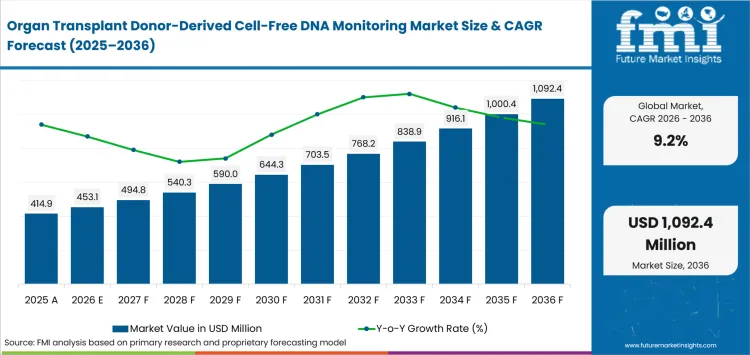
Key Takeaways of Organ Transplant Donor-Derived Cell-Free DNA Monitoring Market
- Demand for organ transplant dd-cfDNA monitoring is driven by specialist decisions requiring measurable graft-injury evidence earlier in care pathways, with serial testing protocols documenting links between molecular movement and biopsy review.
- By technology, targeted next-generation sequencing holds the leading share at 42.7% in 2026, led by scalable SNP-based discrimination of donor fragments.
- Kidney transplant monitoring is the dominant application segment, holding 40.2% share in 2026, due to established surveillance evidence and a substantial repeat-testing population.
- Acute rejection monitoring accounts for 35.0% share in 2026, as elevated results prompt faster diagnostic review during suspected graft injury.
- Dependable sample transport and consistent reporting remain critical to adoption, supporting organ-specific interpretation across kidney, heart, and liver programs.
- Japan, Germany, and South Korea record growth rates of 9.7%, 8.5%, and 8.0% CAGR respectively through 2036, shaped by centralized transplant follow-up, research-intensive university hospital programs, and concentrated specialist centers.
- Competition centers on Natera, CareDx, Thermo Fisher Scientific, and Bio-Rad Laboratories, with vendors differentiating through commercial dd-cfDNA monitoring portfolios, longitudinal outcome evidence, sequencing reagent infrastructure, and dPCR platform capability.
Analyst Perspective
"Long-term adoption of donor-derived cell-free DNA monitoring will depend on its ability to improve post-transplant surveillance through timely and actionable clinical insights. Transplant centers are evaluating how serial testing complements biopsy decisions, supports early graft injury detection, and integrates into established monitoring protocols. Companies that strengthen clinical validation, expand laboratory access, and support evidence-based interpretation will be better positioned to drive sustained adoption across transplant programs."
- Anurag Sharma, Principal Consultant for Healthcare at Future Market Insights
Source: Future Market Insights summary analysis, 2026.
How is the Organ Transplant Donor-Derived Cell-Free DNA Monitoring Market segmented?
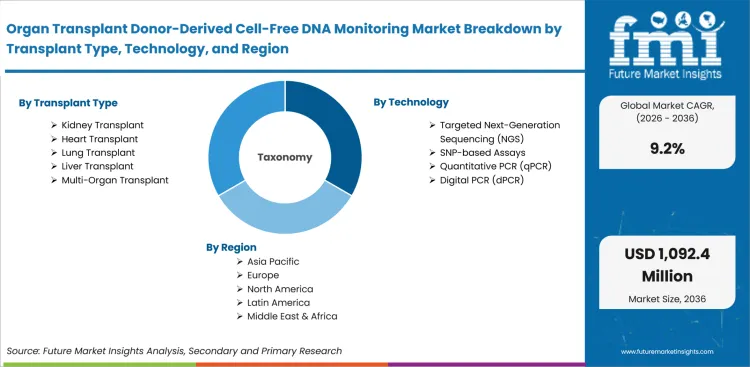
The organ transplant donor-derived cell-free DNA monitoring is segmented by technology, transplant type, application, end user, and region.
The organ transplant donor-derived cell-free DNA monitoring is segmented by technology, transplant type, application, end user, and region. Technology coverage includes targeted next-generation sequencing, SNP-based assays, quantitative PCR, and dPCR. Transplant-type coverage includes kidney, heart, lung, liver, and multi-organ transplantation. Application analysis addresses acute rejection monitoring, routine post-transplant surveillance, immunosuppression management, and graft injury assessment. End-user coverage includes transplant centers, hospitals, diagnostic laboratories, and academic or research institutes. Regional coverage spans North America, Latin America, Europe, East Asia, South Asia, Oceania, and Middle East and Africa.
Why does targeted next-generation sequencing shape technology selection?
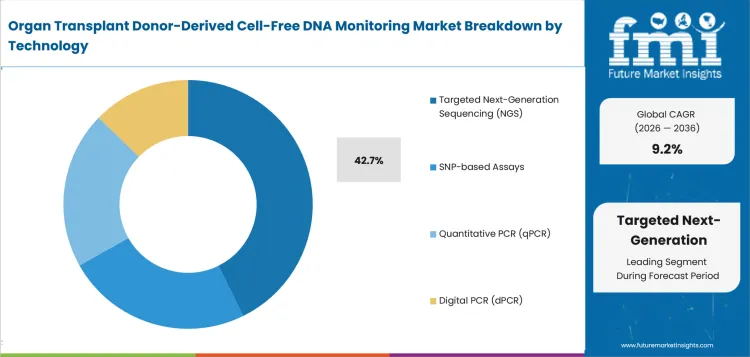
Targeted next-generation sequencing supports detailed donor-fragment identification across repeated post-transplant samples. SNP-based assays provide focused donor-recipient differentiation, whereas quantitative PCR and digital PCR address targeted measurement under separate laboratory configurations. Yang and colleagues reported in January 2024 an aggregate diagnostic area under the curve of 0.83 across 10 studies, helping with molecular review during kidney allograft rejection assessment.
- Based on technology, targeted next-generation sequencing captures 42.7% share in 2026 owing to scalable SNP panels designed for donor-fragment discrimination across serial samples. Laboratory teams assess sequence depth and analytical reproducibility to preserve consistency across kidney and liver surveillance programs.
- SNP-based assays support focused molecular differentiation through established donor-recipient markers, and quantitative PCR and digital PCR offer targeted measurement under separate instrument requirements. Selection reflects sample throughput and turnaround expectations combined with assay design and available bioinformatics resources.
Why does kidney transplant lead transplant-type demand?
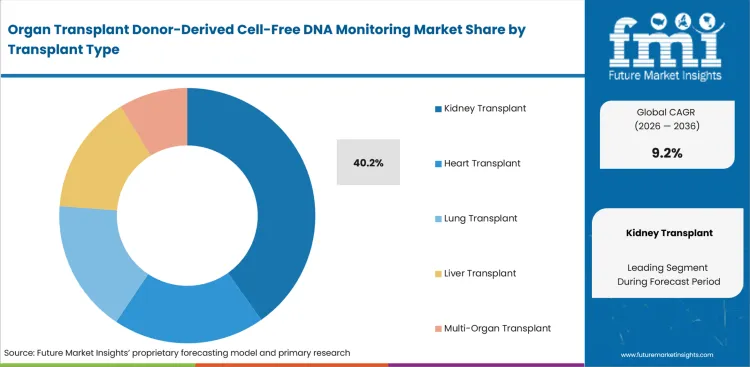
Aubert and colleagues reported in June 2024 a multinational study involving 2,882 kidney allograft recipients across 14 transplant centers, strengthening structured comparison with proteinuria and biopsy findings. Kidney transplant monitoring holds a substantial clinical evidence base across routine surveillance and suspected graft injury assessment. Heart and multi-organ programs require separate threshold interpretation due to differing injury patterns and clinical pathways.
- In 2026, kidney transplant monitoring accounts for 40.2% share, driven by established testing schedules and a sizeable population receiving repeated graft assessment. Extensive longitudinal evidence links molecular movement with antibody-mediated rejection and subclinical injury across specialist kidney programs.
- Heart and multi-organ recipients present distinct graft-injury patterns requiring separate clinical interpretation and surveillance timing. Commercial adoption across non-kidney indications relies on organ-specific validation involving function measures and treatment history.
How does acute rejection monitoring shape application demand?
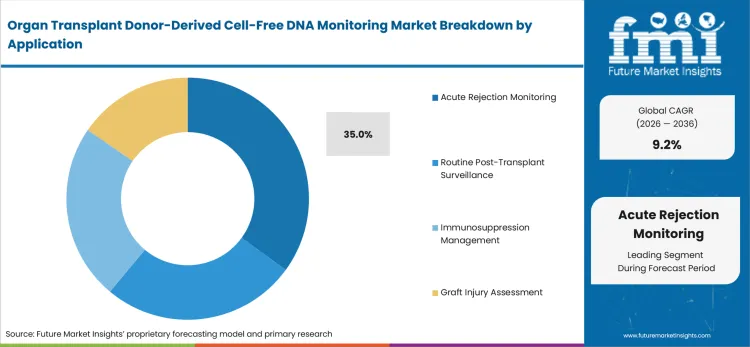
Acute rejection monitoring concentrates testing demand around suspected graft injury requiring timely diagnostic review. Routine post-transplant surveillance supports planned longitudinal measurement, and immunosuppression management inform treatment review across stable or clinically uncertain recipients. Natera reported in April 2025 evaluation of more than 1,100 dd-cfDNA samples, with elevated results predicting graft dysfunction about 3 times more effectively compared to biopsy status.
- Acute rejection monitoring secures 35.0% share of application in 2026, guided by specialist demand for earlier molecular evidence during suspected graft injury episodes. Elevated results increase biopsy priority and prompt closer organ-function assessment.
- Immunosuppression management assists treatment evaluation through longitudinal molecular movement. Graft injury assessment extends interpretation beyond rejection by incorporating infection status and recent clinical events.
Why do transplant centers lead end-user demand?
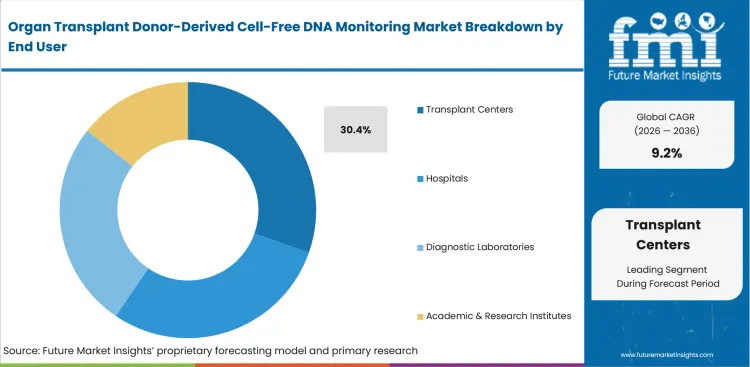
Transplant centers coordinate molecular interpretation and follow-up decisions across multidisciplinary organ programs. Diagnostic laboratories provide molecular infrastructure and academic institutes contribute assay validation. CareDx reported in August 2025 enrollment of 1,743 kidney recipients across 56 United States transplant centers, documenting large-scale use of dd-cfDNA surveillance.
- By end user, transplant centers garner 30.4% share in 2026, led by direct oversight of collection timing and clinical response across post-transplant pathways. Multidisciplinary teams compare molecular trends with graft function and histology during result interpretation.
- Diagnostic laboratories provide sequencing and PCR infrastructure for repeated sample processing. Academic and research institutes advance assay validation through controlled studies connecting analytical performance with biopsy findings and subsequent patient management.
What are the drivers, restraints, and opportunities in the Organ Transplant Donor-Derived Cell-Free DNA Monitoring Market?
Organ transplant dd-cfDNA monitoring receives sustained clinical review as recent evidence links longitudinal molecular changes with graft injury and subsequent outcomes.
- Driver: Serial dd-cfDNA testing translates biological movement into an earlier decision signal during post-transplant surveillance. Adoption strengthens as specialist teams connect changing results with biopsy timing and treatment assessment.
- Restraint: Variable thresholds and overlapping injury signals weaken confidence in isolated measurements across different organs. Reimbursement uncertainty and inconsistent care protocols may limit repeated use outside established transplant programs.
- Opportunity: Integrated monitoring services combine dd-cfDNA trends with organ function and treatment history. Integrated interpretation supports more selective biopsy use and clearer longitudinal risk assessment.
CareDx reported in June 2026 a KOAR cohort covering 1,258 adult kidney recipients, linking longitudinal dd-cfDNA elevation with subsequent graft dysfunction and loss. Earlier risk separation supports demand for serial monitoring as a decision aid beyond single-time-point testing. Clinical demand strengthens as longitudinal risk signals guide earlier surveillance adjustments across kidney transplant pathways.
Clinical adoption faces restraint as modest sensitivity reduces confidence in negative findings across routine surveillance. Xing and colleagues reported in February 2024 pooled sensitivity of 0.59 for any kidney allograft rejection, indicating meaningful false-negative exposure across heterogeneous studies. Limited sensitivity reinforces biopsy and clinical context during negative-result interpretation.
Commercial opportunity expands as trial evidence supports wider adoption across specialist heart transplant services. Natera announced in January 2026 completed ACES-EMB enrollment across more than 300 heart transplant recipients at 17 centers. Randomized comparison between dd-cfDNA surveillance and routine biopsy may expand evidence for next generation molecular assay use across heart programs.
How are country CAGRs aligned in the organ transplant donor-derived cell-free DNA monitoring market?
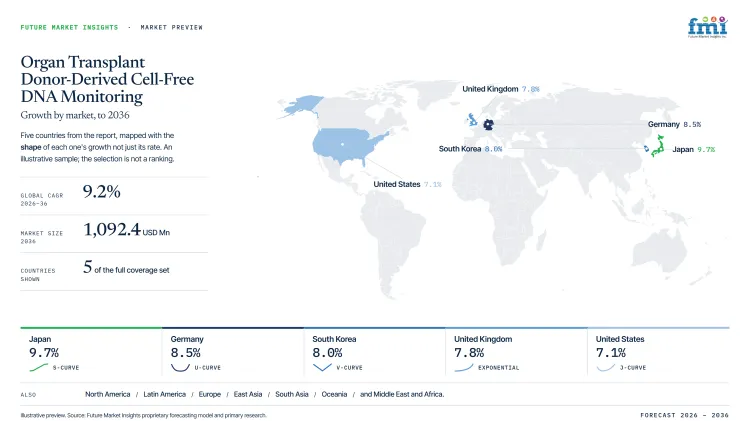
| Country or Market | CAGR |
|---|---|
| Japan | 9.7% |
| Germany | 8.5% |
| South Korea | 8.0% |
| United Kingdom | 7.8% |
| United States | 7.1% |
Source: Future Market Insights country forecast analysis, 2026.
How do country-level CAGRs compare in the Organ Transplant Donor-Derived Cell-Free DNA Monitoring Market?
Country comparison shows a gradual step-down across the five profiled forecasts. Japan occupies the upper end of the range, followed by Germany. South Korea and UK form a closely grouped middle tier. United States remains at the lower end of the comparison. The 2.6-percentage-point spread shows that the profiled countries share a steady growth outlook. Their relative positions reflect different levels of adoption momentum.
- Japan leads the comparison and establishes East Asia as the primary expansion cluster among the profiled countries.
- Germany follows Japan and maintains a relatively narrow gap from the leading country.
- South Korea and UK form the next forecast band, indicating comparable adoption prospects across structured transplant services.
- United States records the lowest CAGR among the listed countries, although its extensive transplant-center network supports substantial commercial potential.
- Centralized specialist follow-up supports Japan and South Korea, with Germany and UK benefit from research-intensive clinical pathways.
- Profiled rates form a gradual downward progression instead of a sharp separation between higher-growth and lower-growth countries.
Countries with broadly similar CAGRs may present different entry conditions due to reimbursement coverage and organ-specific care protocols. Full analysis covers North America, Latin America, Europe, East Asia, South Asia, Oceania, and Middle East and Africa.
Country-wise Analysis
- Organ transplant donor-derived cell-free DNA monitoring market in Japan is forecast to scale at 9.7% CAGR from 2026 to 2036, backed by centralized follow-up and sustained attention toward graft preservation. Specialist institutions provide concentrated settings for serial interpretation across organ-specific care pathways. Japanese Society of Lung and Heart-Lung Transplantation reported in 2025 a total of 148 lung transplants performed during 2024, reinforcing structured post-transplant surveillance across a donor-constrained system.
- Transplant programs in Germany maintain strong links between molecular research and biopsy-led kidney assessment across university hospitals. Demand in Germany is projected to rise at 8.5% CAGR during the assessment period, led by validation activity and specialist familiarity with donor-specific antibody pathways. Akifova and colleagues reported in November 2024 a randomized trial involving 40 kidney recipients, demonstrating practical interest in dd-cfDNA-guided biopsy timing for antibody-mediated rejection.
- Transplant services in South Korea operate based on concentrated specialist networks requiring efficient surveillance across limited donor availability. Ministry of Health and Welfare reported in October 2025 a total of 397 brain-dead donors during 2024, highlighting pressure to protect graft longevity through careful follow-up. Sector in South Korera is anticipated to progress at 8.0% CAGR between 2026 and 2036, aided by centralized clinical expertise and molecular laboratory access.
- Industry in the United Kingdom for organ transplant donor-derived cell-free DNA monitoring is estimated to expand at 7.8% CAGR during forecast period, reflecting structured transplant pathways and measured reimbursement review. National programs provide established settings for selective testing linked to biopsy or graft-function concerns. NHS Blood and Transplant reported in July 2025 a total of 4,583 transplant recipients during 2024/25, sustaining a sizeable population requiring longitudinal graft assessment.
- Extensive transplant-center coverage supports commercial testing access across kidney and liver programs in the United States. Sales in the United States are expected to increase at 7.1% CAGR from 2026 to 2036, backed by an established base and rigorous evidence expectations. OPTN/SRTR reported in June 2026 a total of 46,750 solid-organ transplants completed during 2024, enlarging recipient populations available for repeated molecular surveillance.
Who are notable companies in the Organ Transplant Donor-Derived Cell-Free DNA Monitoring Market?
Natera, Inc., CareDx, Inc., Thermo Fisher Scientific Inc., and Bio-Rad Laboratories, Inc. are the notable companies shaping this market.
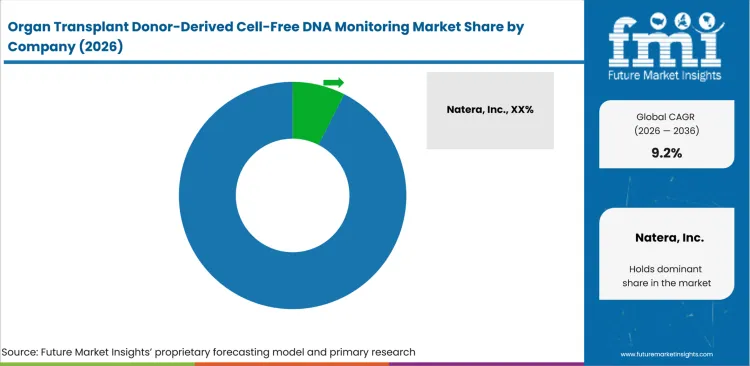
Competition is expected to center on clinical evidence and reporting support. Direct-service providers are likely to receive attention due to longitudinal outcome studies and transplant-center integration. Platform suppliers are projected to compete through assay compatibility and technical support.
- Natera competes due to a multi-organ Prospera portfolio and continuing interventional evidence across kidney and lung transplantation. Clinical programs assess result interpretation and links to biopsy reduction.
- CareDx receives review through AlloSure kidney and lung services supported by large registry studies. Transplant centers compare longitudinal risk information and operational integration across established workflows.
- Thermo Fisher Scientific supports laboratories adopting targeted sequencing through transplant-focused reagents and assay infrastructure. Molecular laboratories evaluate analytical sensitivity and compatibility with existing sequencing systems.
- Bio-Rad Laboratories supports assay development based on an expanded dPCR portfolio. Testing groups consider multiplexing and technical service during platform review.
Competitive Benchmarking: Organ Transplant Donor-Derived Cell-Free DNA Monitoring Market
| Company | Portfolio Depth | Clinical Match | Service Support | Service Reach |
|---|---|---|---|---|
| Natera, Inc. | High | High | High | United States and selected international programs |
| CareDx, Inc. | High | High | High | United States with selected international programs |
| Thermo Fisher Scientific Inc. | Medium | Medium | High | Global laboratory networks |
| Bio-Rad Laboratories, Inc. | Medium | Medium | High | Global research and diagnostic laboratories |
Source: Future Market Insights competitive analysis, 2026.
Key Developments in Organ Transplant Donor-Derived Cell-Free DNA Monitoring Market
- In July 2025, CareDx announced international prospective validation of AlloSure Plus using more than 2,700 renal-transplant biopsies. CareDx stated the AI-powered platform integrates donor-derived cell-free DNA with conventional clinical information to support personalized rejection-risk assessment.
- In January 2026, Natera reported a prospective lung transplant study involving 78 recipients, clinicians omitted a nine-month biopsy for more than 75% of low-risk participants. Results strengthened clinical review of dd-cfDNA-guided surveillance intended to reduce routine invasive procedures.
- In June 2026, Natera and Eledon Pharmaceuticals announced Prospera selection for a planned phase 3 kidney transplant trial involving approximately 600 recipients across more than 100 centers. Trial integration extends dd-cfDNA use into therapy development and standardized multicenter monitoring.
Key Players in Organ Transplant Donor-Derived Cell-Free DNA Monitoring Market
Commercial dd-cfDNA Monitoring Providers
- Natera, Inc.
- CareDx, Inc.
Molecular Assay and Platform Suppliers
- Thermo Fisher Scientific Inc.
- Bio-Rad Laboratories, Inc.
Organ Transplant Donor-Derived Cell-Free DNA Monitoring Market Report Scope
| Coverage field | Report scope |
|---|---|
| Market breakdown | Organ transplant donor-derived cell-free DNA monitoring by technology, transplant type, application, end user, and region. |
| Quantitative Units | Revenue in USD Million, CAGR in %. |
| Market Definition | Blood-based donor-derived cell-free DNA assays, testing services, and associated laboratory workflows used for post-transplant graft-injury monitoring. |
| Regions Covered | North America, Latin America, Europe, East Asia, South Asia, Oceania, and Middle East and Africa. |
| Countries Covered | Japan, Germany, South Korea, UK, and USA. |
| Key Companies Profiled | CareDx, Inc., Natera, Inc., Bio-Rad Laboratories, Inc., and Thermo Fisher Scientific Inc. |
| Forecast Period | 2026 to 2036 |
| Approach | Hybrid bottom-up and top-down assessment using segment shares, country forecasts, transplant activity, clinical evidence, company participation, and primary research. |
Source: Future Market Insights report-scope analysis, 2026.
Organ Transplant Donor-Derived Cell-Free DNA Monitoring Market - Research Methodology
| Method | Approach |
|---|---|
| Primary Research | FMI analysts gathered input from manufacturers, service providers, technology developers, distributors, end users, sourcing teams, and subject-matter experts. Interviews examined purchasing decisions, product or service evaluation, adoption barriers, approval requirements, pricing considerations, and expectations for technical or commercial support. Respondents were also asked what evidence is required before a trial, pilot, or initial order develops into regular purchasing. |
| Desk Research | Desk research covered government statistics, regulatory publications, trade data, industry associations, technical literature, standards, company filings, product information, and official corporate announcements. Sources were reviewed for relevance, publication date, geographic coverage, and consistency with the defined market scope. Claims relating to performance, applications, approvals, capacity, investment, and commercial activity were retained only when supported by credible public evidence. |
| Market Sizing and Forecasting | The market model combined the baseline value with historical performance, segment structure, pricing and volume indicators, adoption levels, company participation, and country-level demand conditions. Forecast assumptions considered economic activity, investment trends, regulatory developments, technology adoption, purchasing cycles, supply availability, and barriers to wider market use. Segment and regional estimates were reconciled before the final market total was calculated. |
| Data Validation | Estimates were checked against multiple independent indicators, including public data, company activity, trade patterns, industry developments, and findings from primary interviews. Validation also tested whether products, services, applications, and company revenues fell within the defined market boundaries. Adjacent categories, unsupported claims, overlapping revenues, and activities without direct market relevance were excluded to reduce double counting and maintain consistency across segments and countries. |
Source: Future Market Insights methodology analysis, 2026.
Organ Transplant Donor-Derived Cell-Free DNA Monitoring Market by Segments
Organ Transplant Donor-Derived Cell-Free DNA Monitoring Market segmented by Technology:
- Targeted Next-Generation Sequencing (NGS)
- SNP-based Assays
- Quantitative PCR (qPCR)
- dPCR
Organ Transplant Donor-Derived Cell-Free DNA Monitoring Market segmented by Transplant Type:
- Kidney Transplant
- Heart Transplant
- Lung Transplant
- Liver Transplant
- Multi-Organ Transplant
Organ Transplant Donor-Derived Cell-Free DNA Monitoring Market segmented by Application:
- Acute Rejection Monitoring
- Routine Post-Transplant Surveillance
- Immunosuppression Management
- Graft Injury Assessment
Organ Transplant Donor-Derived Cell-Free DNA Monitoring Market segmented by End User:
- Transplant Centers
- Hospitals
- Diagnostic Laboratories
- Academic and Research Institutes
Organ Transplant Donor-Derived Cell-Free DNA Monitoring Market segmented by Region:
- North America
- Latin America
- Europe
- East Asia
- South Asia
- Oceania
- Middle East and Africa
Research Sources and Bibliography
- Akifova, A., Budde, K., Amann, K., et al. (2024, November 29). Donor-derived cell-free DNA monitoring for early diagnosis of antibody-mediated rejection after kidney transplantation: A randomized trial. Nephrology Dialysis Transplantation, 40(7), 1384-1395.
- Aubert, O., Ursule-Dufait, C., Brousse, R., et al. (2024, June 2). Cell-free DNA for the detection of kidney allograft rejection. Nature Medicine, 30, 2320-2327.
- CareDx, Inc. (2025, July 31). CareDx announces landmark data in AI-powered transplant diagnostics showcased in over 40 abstracts and 16 oral presentations at the 2025 World Transplant Congress.
- CareDx, Inc. (2025, August 6). CareDx announces landmark KOAR study published in the American Journal of Transplantation.
- CareDx, Inc. (2026, June 16). CareDx announces second KOAR analysis published in the Journal of the American Society of Nephrology.
- Japanese Society of Lung and Heart-Lung Transplantation. (2025). Registry report of Japanese lung transplantation-2025. Japanese Journal of Transplantation, 60(4), 237-243.
- Ministry of Health and Welfare. (2025, October 17). MOHW establishes first comprehensive plan for organ and tissue donation.
- Natera, Inc. (2024, April 11). Natera announces publication of largest prospective dd-cfDNA study in kidney transplantation.
- Natera, Inc. (2025, April 29). Prospective DEFINE-HT study demonstrates Prospera Heart is predictive of clinical outcomes and outperforms biopsy in predicting graft dysfunction.
- Natera, Inc. (2026, January 26). Prospera featured in landmark interventional study advancing lung transplant care.
- Natera, Inc. (2026, January 28). Natera announces completion of enrollment in randomized ACES-EMB trial in heart transplantation.
- Natera, Inc. (2026, July 16). Finalized MolDx LCD includes expanded coverage for Natera’s Prospera portfolio.
- Natera, Inc., & Eledon Pharmaceuticals, Inc. (2026, June 25). Natera and Eledon announce strategic partnership for Prospera monitoring in planned phase 3 kidney transplant trial.
- NHS Blood and Transplant. (2025, July 9). Organ transplant waiting list hits record high as donor and transplant numbers fall.
- Hart, A., Schladt, D. P., & Snyder, J. J. (2026, June). OPTN/SRTR 2024 annual data report: Overview of United States solid organ transplantation. American Journal of Transplantation, 26(8S1), S11-S21.
- Xing, Y., Guo, Q., Wang, C., Shi, H., Zheng, J., Jia, Y., Li, C., & Hao, C. (2024, February 20). Donor-derived cell-free DNA as a diagnostic marker for kidney-allograft rejection: A systematic review and meta-analysis. Biomolecules and Biomedicine, 24(4), 731-740.
- Yang, H., Wang, D., Sun, X., Wang, H., Lan, Y., & Wei, L. (2024, January 9). Diagnostic performance of graft-derived cell-free DNA in kidney allograft rejection: A meta-analysis. Frontiers in Physiology, 14, 1293402.
This bibliography is provided for reader reference and is not exhaustive. The full report contains the complete reference list and detailed citations.
This Report Answers
- What segments influence demand across technology, transplant type, application, end user, and region?
- How do transplant teams evaluate organ transplant donor-derived cell-free DNA monitoring prior to routine clinical use?
- How do country CAGRs differ across profiled transplant systems with distinct laboratory capacity and specialist access?
- What companies compete through clinical evidence and specialist support?
- How are forecasts validated through hybrid bottom-up and top-down analysis using independent indicators and company evidence?
- What evidence do transplant centers examine prior to expanding serial testing across organ programs?
- How do assay reproducibility and longitudinal interpretation influence service selection across transplant programs?
- What limits return on investment for organizations adopting repeated dd-cfDNA monitoring?
- How do specialist guidance and reporting clarity influence clinical approval across multidisciplinary transplant teams?
- What company capabilities improve long-term confidence and continuing testing use across transplant networks?
Frequently Asked Questions
How big is the Organ Transplant Donor-Derived Cell-Free DNA Monitoring Market in 2026?
The organ transplant donor-derived cell-free DNA monitoring market is valued at USD 453.1 million in 2026 and is forecast to reach USD 1092.4 million by 2036. Growth reflects medical teams using serial graft-injury measurements to detect organ rejection earlier, supporting timely reviews without fully replacing standard tissue biopsies.
What is the CAGR of the Organ Transplant Donor-Derived Cell-Free DNA Monitoring Market from 2026 to 2036?
The organ transplant donor-derived cell-free DNA monitoring market grows at a CAGR of 9.2% between 2026 and 2036, supported by serial testing that translates biological movement into an earlier decision signal as specialist teams connect changing results with biopsy timing.
Which technology leads the Organ Transplant Donor-Derived Cell-Free DNA Monitoring Market?
Targeted next-generation sequencing accounts for 42.7% of the organ transplant donor-derived cell-free DNA monitoring market by technology in 2026, driven by scalable SNP panels designed for donor-fragment discrimination across repeated post-transplant samples.
How much will the Organ Transplant Donor-Derived Cell-Free DNA Monitoring Market add between 2026 and 2036?
The organ transplant donor-derived cell-free DNA monitoring market is set to add USD 639.3 million between 2026 and 2036, growing from USD 453.1 million to USD 1092.4 million as serial molecular surveillance extends across a widening base of transplant centers and hospital programs.
Who are the leading companies in the Organ Transplant Donor-Derived Cell-Free DNA Monitoring Market?
Four companies lead the organ transplant donor-derived cell-free DNA monitoring market, including Natera, CareDx, Thermo Fisher Scientific, and Bio-Rad Laboratories, competing through longitudinal outcome evidence, transplant-center integration, and molecular assay and platform infrastructure.
Preview the report firsthand - request a free sample
Get SampleGet the brochure for pricing and purchase details.
Get PDFTable of Content
- Key Takeaways
- Market Size and CAGR
- Top Growth Driver
- Fastest Growing Segment
- Leading Region
- Key Companies
- Emerging Opportunities
- Executive Summary
- Global Market Outlook
- Demand-side Trends
- Supply-side Trends
- Technology Roadmap Analysis
- Analysis and Recommendations
- Analyst Perspective (What is happening? Why now? What should investors know?)
- Key Questions Answered
- How large is the market?
- What is the CAGR?
- What are key trends?
- Which region dominates?
- Who are the leaders?
- Market Overview
- Market Coverage / Taxonomy
- Market Definition / Scope / Limitations
- Research Methodology
- Chapter Orientation
- Analytical Lens and Working Hypotheses
- Market Structure, Signals, and Trend Drivers
- Benchmarking and Cross-market Comparability
- Market Sizing, Forecasting, and Opportunity Mapping
- Research Design and Evidence Framework
- Desk Research Programme (Secondary Evidence)
- Expert Input and Fieldwork (Primary Evidence)
- Tooling, Models, and Reference Databases
- Data Engineering and Model Build
- Quality Assurance and Audit Trail
- Market Background
- Market Dynamics (Drivers, Restraints, Opportunity, Trends)
- Scenario Forecast (Optimistic, Likely, Conservative)
- Impact Analysis
- AI Impact
- Sustainability Impact
- Regulatory Impact
- Technology Impact
- Consumer / Buyer Analysis
- Purchase Drivers
- Adoption Barriers
- Buyer Journey
- Opportunity Map Analysis
- Product Life Cycle Analysis
- Supply Chain Analysis
- Investment Feasibility Matrix
- Value Chain Analysis
- PESTLE and Porter's Analysis
- Regulatory Landscape
- Regional Parent Market Outlook
- Production and Consumption Statistics
- Import and Export Statistics
- Global Market Analysis and Forecast, 2021 to 2036
- Historical Market Size Value (USD Million) Analysis, 2021 to 2025
- Current and Future Market Size Value (USD Million) Projections, 2026 to 2036
- Y-o-Y Growth Trend Analysis
- Absolute $ Opportunity Analysis
- Global Market Pricing Analysis, 2021 to 2036
- Global Market Analysis and Forecast, By Transplant Type, 2021 to 2036
- Introduction / Key Findings
- Historical Market Size Value (USD Million) Analysis By Transplant Type, 2021 to 2025
- Current and Future Market Size Value (USD Million) Analysis and Forecast By Transplant Type, 2026 to 2036
- Kidney Transplant
- Heart Transplant
- Lung Transplant
- Liver Transplant
- Multi-Organ Transplant
- Kidney Transplant
- Y-o-Y Growth Trend Analysis By Transplant Type, 2021 to 2025
- Absolute $ Opportunity Analysis By Transplant Type, 2026 to 2036
- Global Market Analysis and Forecast, By Technology, 2021 to 2036
- Introduction / Key Findings
- Historical Market Size Value (USD Million) Analysis By Technology, 2021 to 2025
- Current and Future Market Size Value (USD Million) Analysis and Forecast By Technology, 2026 to 2036
- Targeted Next-Generation Sequencing (NGS)
- SNP-based Assays
- Quantitative PCR (qPCR)
- Digital PCR (dPCR)
- Targeted Next-Generation Sequencing (NGS)
- Y-o-Y Growth Trend Analysis By Technology, 2021 to 2025
- Absolute $ Opportunity Analysis By Technology, 2026 to 2036
- Global Market Analysis and Forecast, By Application, 2021 to 2036
- Introduction / Key Findings
- Historical Market Size Value (USD Million) Analysis By Application, 2021 to 2025
- Current and Future Market Size Value (USD Million) Analysis and Forecast By Application, 2026 to 2036
- Acute Rejection Monitoring
- Routine Post-Transplant Surveillance
- Immunosuppression Management
- Graft Injury Assessment
- Acute Rejection Monitoring
- Y-o-Y Growth Trend Analysis By Application, 2021 to 2025
- Absolute $ Opportunity Analysis By Application, 2026 to 2036
- Global Market Analysis and Forecast, By End User, 2021 to 2036
- Introduction / Key Findings
- Historical Market Size Value (USD Million) Analysis By End User, 2021 to 2025
- Current and Future Market Size Value (USD Million) Analysis and Forecast By End User, 2026 to 2036
- Transplant Centers
- Hospitals
- Diagnostic Laboratories
- Academic & Research Institutes
- Transplant Centers
- Y-o-Y Growth Trend Analysis By End User, 2021 to 2025
- Absolute $ Opportunity Analysis By End User, 2026 to 2036
- Global Market Analysis and Forecast, By Region, 2021 to 2036
- Introduction
- Historical Market Size Value (USD Million) Analysis By Region, 2021 to 2025
- Current Market Size Value (USD Million) Analysis and Forecast By Region, 2026 to 2036
- North America
- Latin America
- Western Europe
- Eastern Europe
- East Asia
- South Asia and Pacific
- Middle East & Africa
- Market Attractiveness Analysis By Region
- North America Market Analysis and Forecast, By Country, 2021 to 2036
- Historical Market Size Value (USD Million) Trend Analysis By Market Taxonomy, 2021 to 2025
- Market Size Value (USD Million) Forecast By Market Taxonomy, 2026 to 2036
- By Country
- USA
- Canada
- By Transplant Type
- By Technology
- By Application
- By End User
- By Country
- Market Attractiveness Analysis
- By Country
- By Transplant Type
- By Technology
- By Application
- By End User
- Key Takeaways
- Latin America Market Analysis and Forecast, By Country
- Historical Market Size Value (USD Million) Trend Analysis By Market Taxonomy, 2021 to 2025
- Market Size Value (USD Million) Forecast By Market Taxonomy, 2026 to 2036
- By Country
- Brazil
- Mexico
- Chile
- Rest of Latin America
- By Transplant Type
- By Technology
- By Application
- By End User
- By Country
- Market Attractiveness Analysis
- By Country
- By Transplant Type
- By Technology
- By Application
- By End User
- Key Takeaways
- Western Europe Market Analysis and Forecast, By Country
- Historical Market Size Value (USD Million) Trend Analysis By Market Taxonomy, 2021 to 2025
- Market Size Value (USD Million) Forecast By Market Taxonomy, 2026 to 2036
- By Country
- Germany
- UK
- Italy
- Spain
- France
- Nordic
- BENELUX
- Rest of Western Europe
- By Transplant Type
- By Technology
- By Application
- By End User
- By Country
- Market Attractiveness Analysis
- By Country
- By Transplant Type
- By Technology
- By Application
- By End User
- Key Takeaways
- Eastern Europe Market Analysis and Forecast, By Country
- Historical Market Size Value (USD Million) Trend Analysis By Market Taxonomy, 2021 to 2025
- Market Size Value (USD Million) Forecast By Market Taxonomy, 2026 to 2036
- By Country
- Russia
- Poland
- Hungary
- Balkan & Baltic
- Rest of Eastern Europe
- By Transplant Type
- By Technology
- By Application
- By End User
- By Country
- Market Attractiveness Analysis
- By Country
- By Transplant Type
- By Technology
- By Application
- By End User
- Key Takeaways
- East Asia Market Analysis and Forecast, By Country
- Historical Market Size Value (USD Million) Trend Analysis By Market Taxonomy, 2021 to 2025
- Market Size Value (USD Million) Forecast By Market Taxonomy, 2026 to 2036
- By Country
- China
- Japan
- South Korea
- By Transplant Type
- By Technology
- By Application
- By End User
- By Country
- Market Attractiveness Analysis
- By Country
- By Transplant Type
- By Technology
- By Application
- By End User
- Key Takeaways
- South Asia and Pacific Market Analysis and Forecast, By Country
- Historical Market Size Value (USD Million) Trend Analysis By Market Taxonomy, 2021 to 2025
- Market Size Value (USD Million) Forecast By Market Taxonomy, 2026 to 2036
- By Country
- India
- ASEAN
- Australia & New Zealand
- Rest of South Asia and Pacific
- By Transplant Type
- By Technology
- By Application
- By End User
- By Country
- Market Attractiveness Analysis
- By Country
- By Transplant Type
- By Technology
- By Application
- By End User
- Key Takeaways
- Middle East & Africa Market Analysis and Forecast, By Country
- Historical Market Size Value (USD Million) Trend Analysis By Market Taxonomy, 2021 to 2025
- Market Size Value (USD Million) Forecast By Market Taxonomy, 2026 to 2036
- By Country
- Kingdom of Saudi Arabia
- Other GCC Countries
- Türkiye
- South Africa
- Other African Union
- Rest of Middle East & Africa
- By Transplant Type
- By Technology
- By Application
- By End User
- By Country
- Market Attractiveness Analysis
- By Country
- By Transplant Type
- By Technology
- By Application
- By End User
- Key Takeaways
- Key Countries Market Analysis
- USA
- Pricing Analysis
- Market Share Analysis, 2025
- By Transplant Type
- By Technology
- By Application
- By End User
- Canada
- Pricing Analysis
- Market Share Analysis, 2025
- By Transplant Type
- By Technology
- By Application
- By End User
- Mexico
- Pricing Analysis
- Market Share Analysis, 2025
- By Transplant Type
- By Technology
- By Application
- By End User
- Brazil
- Pricing Analysis
- Market Share Analysis, 2025
- By Transplant Type
- By Technology
- By Application
- By End User
- Chile
- Pricing Analysis
- Market Share Analysis, 2025
- By Transplant Type
- By Technology
- By Application
- By End User
- Germany
- Pricing Analysis
- Market Share Analysis, 2025
- By Transplant Type
- By Technology
- By Application
- By End User
- UK
- Pricing Analysis
- Market Share Analysis, 2025
- By Transplant Type
- By Technology
- By Application
- By End User
- Italy
- Pricing Analysis
- Market Share Analysis, 2025
- By Transplant Type
- By Technology
- By Application
- By End User
- Spain
- Pricing Analysis
- Market Share Analysis, 2025
- By Transplant Type
- By Technology
- By Application
- By End User
- France
- Pricing Analysis
- Market Share Analysis, 2025
- By Transplant Type
- By Technology
- By Application
- By End User
- India
- Pricing Analysis
- Market Share Analysis, 2025
- By Transplant Type
- By Technology
- By Application
- By End User
- ASEAN
- Pricing Analysis
- Market Share Analysis, 2025
- By Transplant Type
- By Technology
- By Application
- By End User
- Australia & New Zealand
- Pricing Analysis
- Market Share Analysis, 2025
- By Transplant Type
- By Technology
- By Application
- By End User
- China
- Pricing Analysis
- Market Share Analysis, 2025
- By Transplant Type
- By Technology
- By Application
- By End User
- Japan
- Pricing Analysis
- Market Share Analysis, 2025
- By Transplant Type
- By Technology
- By Application
- By End User
- South Korea
- Pricing Analysis
- Market Share Analysis, 2025
- By Transplant Type
- By Technology
- By Application
- By End User
- Russia
- Pricing Analysis
- Market Share Analysis, 2025
- By Transplant Type
- By Technology
- By Application
- By End User
- Poland
- Pricing Analysis
- Market Share Analysis, 2025
- By Transplant Type
- By Technology
- By Application
- By End User
- Hungary
- Pricing Analysis
- Market Share Analysis, 2025
- By Transplant Type
- By Technology
- By Application
- By End User
- Kingdom of Saudi Arabia
- Pricing Analysis
- Market Share Analysis, 2025
- By Transplant Type
- By Technology
- By Application
- By End User
- Türkiye
- Pricing Analysis
- Market Share Analysis, 2025
- By Transplant Type
- By Technology
- By Application
- By End User
- South Africa
- Pricing Analysis
- Market Share Analysis, 2025
- By Transplant Type
- By Technology
- By Application
- By End User
- USA
- Market Structure Analysis
- Competition Dashboard
- Competition Benchmarking
- Market Share Analysis of Top Players
- By Regional
- By Transplant Type
- By Technology
- By Application
- By End User
- Emerging Startups
- Innovation Benchmarking
- Competition Analysis
- Competition Deep Dive
- Natera, Inc.
- Overview
- Product Portfolio
- Profitability by Market Segments
- Sales Footprint
- Strategy Overview
- Marketing Strategy
- Product Strategy
- Channel Strategy
- CareDx, Inc.
- Eurofins Scientific
- Thermo Fisher Scientific Inc.
- Illumina, Inc.
- F. Hoffmann-La Roche Ltd.
- QIAGEN N.V.
- Bio-Rad Laboratories, Inc.
- Guardant Health, Inc.
- Revvity, Inc.
- Natera, Inc.
- Case Studies
- Success Stories
- Recent Developments
- Competition Deep Dive
- Assumptions & Acronyms Used


