

- Market Size (2026)
- USD 1062.2 Mn
- Forecast (2036)
- USD 2584.6 Mn
- CAGR (2026 to 2036)
- 9.3%
How big is multi-organ transplant monitoring market size?
USD 1,062.2 million in 2026 reaches USD 2,584.6 million by 2036 at a 9.3% CAGR.
Sales of multi-organ transplant monitoring are estimated to rise at 9.3% CAGR through 2036, increasing valuation from USD 1,062.2 million in 2026 to USD 2,584.6 million by 2036. Ongoing clinical care requires frequent surveillance to safeguard transplanted kidneys and hearts. Lung and liver recipients add distinct interpretation requirements across specialist programs. A significantly growing patient population drives this urgent need for consistent molecular monitoring. In January 2026, the Scientific Registry of Transplant Recipients reported 46,750 solid organ transplants during 2024. Such sustained procedure volume expands longitudinal testing requirements across transplant diagnostics and organ-specific care pathways. Healthcare providers are therefore required to adopt scalable surveillance methods to support such expanding patient volumes.
International healthcare systems prioritize different operational requirements when evaluating transplant monitoring technologies. United States and Germany programs emphasize organ-specific validation records with repeatable laboratory quality controls. Japan and South Korea services favor compact sampling pathways supported by specialist interpretation. Frequent international organ sharing makes standardized testing protocols critical for these connected medical networks. In January 2025, Eurotransplant reported for 22.5% of allocated organs crossing member-state borders during 2024. This cross-border activity raises demand for consistent reporting rules across shared transplantation networks.
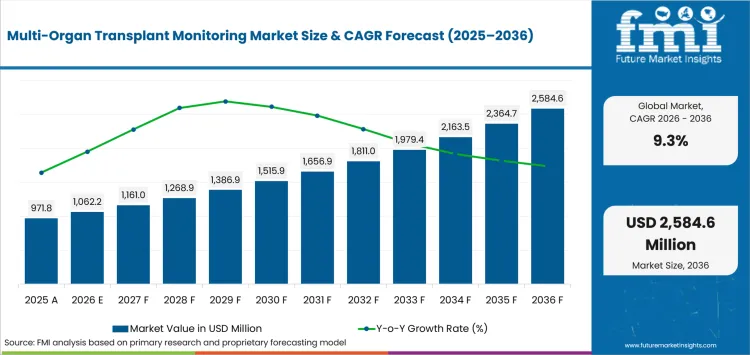
| Metric | Value |
|---|---|
| 2025 Market Size | USD 971.8 million |
| 2026 Market Size | USD 1,062.2 million |
| 2036 Market Size | USD 2,584.6 million |
| Forecast CAGR (2026-2036) | 9.3% |
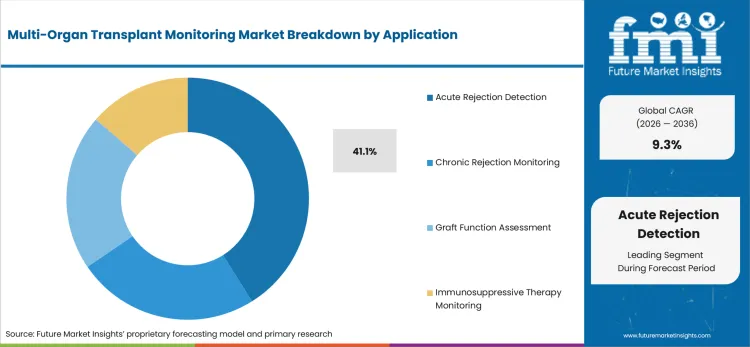
| Application Focus | Acute Rejection Detection (41.1% share in 2026) |
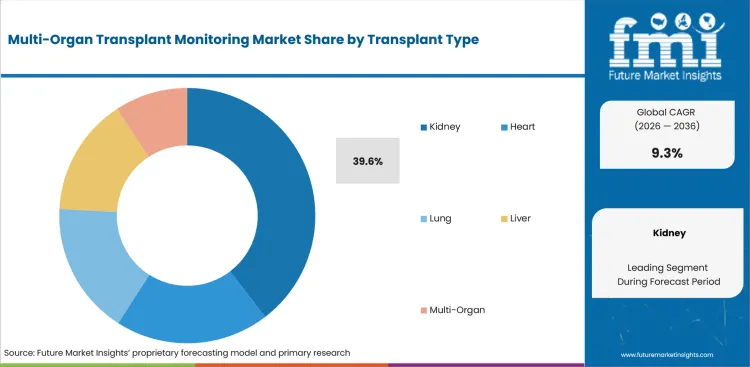
| Transplant Type Focus | Kidney (39.6% share in 2026) |
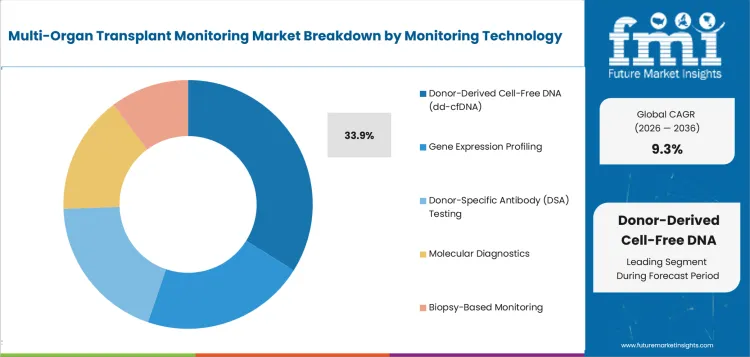
| Monitoring Technology Focus | Donor-Derived Cell-Free DNA (dd-cfDNA) (33.9% share in 2026) |
Summary of Multi-Organ Transplant Monitoring Market
| Market Signal | Commercial Impact |
|---|---|
| Demand and Growth Drivers | Multi-organ transplant monitoring gains attention as specialist teams seek earlier evidence of graft injury. Program decisions reflect organ-specific interpretation and repeat laboratory evidence across coordinated transplant services.
|
| Product and Segment View | Segment direction is led by acute rejection detection, followed by kidney and donor-derived cell-free DNA. Specification review is expected to center on clinical utility and organ-specific interpretation across transplant teams.
|
| Geography and Growth Outlook | Country movement differs through transplant activity and specialist laboratory capacity across national programs. Commercial progress reflects organ-specific evidence and coordinated follow-up across transplant centers.
|
| Competitive View | Competition centers on organ-specific evidence and dependable laboratory support across transplant-monitoring programs. Commercial progress favors companies offering validated assays and consistent reporting across participating centers.
|
| Analyst Perspective | Multi-organ surveillance supports clinical decisions requiring graft-specific interpretation across recurring follow-up. Commercial durability is expected to improve through documented utility and disciplined laboratory governance.
|
Source: Future Market Insights analysis, 2026.
How is multi-organ transplant monitoring market segmented?
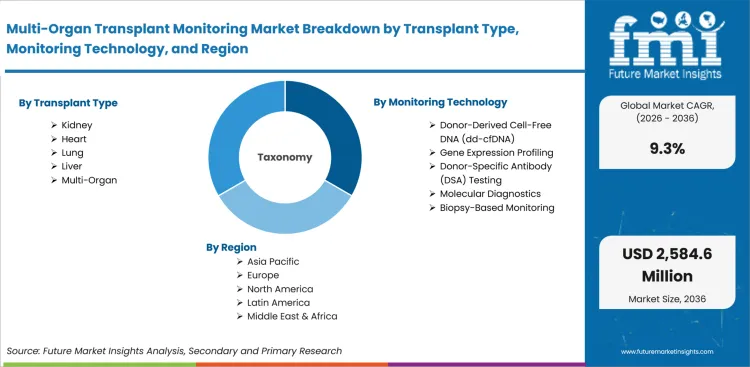
The multi-organ transplant monitoring sector is segmented by transplant type, monitoring technology, application, end user, and region.
The multi-organ transplant monitoring industry is segmented by transplant type, monitoring technology, application, end user, and region. Transplant type coverage includes kidney and heart recipients, lung and liver programs add separate clinical pathways, multi-organ recipients require combined-graft interpretation. Monitoring technology covers donor-derived cell-free DNA and gene expression profiling, donor-specific antibody testing supports immune-risk review, molecular diagnostics and biopsy-based monitoring complete technology coverage. Application analysis addresses acute rejection detection and chronic rejection monitoring, graft function assessment supports longitudinal review, immunosuppressive therapy monitoring examines medication exposure. Clinical diagnostics coverage spans transplant centers and hospitals, specialized laboratories extend assay access, academic research institutes support evidence generation. Regional analysis covers North America and Latin America, Europe and East Asia add established transplant networks, South Asia and Oceania extend geographic coverage, Middle East and Africa complete regional assessment.
Why does kidney shape transplant type demand?
Hirai and colleagues reported a multicenter Japanese study enrolled 73 living-donor kidney recipients for paired molecular testing and protocol biopsy in July 2025. Paired evidence illustrates how kidney programs connect noninvasive measurement with pathology confirmation across scheduled surveillance intervals. Heart and lung programs require separate thresholds before shared laboratory methods extend across additional graft types.
- Kidney is projected to represent 39.6% share of transplant type in 2026, driven by recurring follow-up across substantial recipient populations. Established biopsy pathways and molecular evidence encourage repeat testing across routine kidney transplant care programs.
- Distinct injury patterns across post-transplant physiology require separate interpretation for heart and lung recipients. Liver and multi-organ recipients add different monitoring needs across medication review and graft-function assessment processes.
Why does donor-derived cell-free DNA lead monitoring technology demand?
Organ-specific baselines remain necessary as one molecular workflow extends across kidney and thoracic transplant programs. Casas and colleagues reported multicenter analytical verification produced 247 sample libraries across independent laboratories during 2024. A 96.0% first-pass completion rate influences reproducible assay operation across decentralized testing environments with shared quality controls.
- By technology, donor-derived cell-free DNA is estimated to secure 33.9% share in 2026 since it reflects demand for noninvasive evidence of graft injury. Liquid biopsy methods support repeat assessment across scheduled care without routine dependence on invasive tissue collection.
- Gene expression profiling and donor-specific antibody testing provide complementary evidence during complex clinical review pathways. Molecular diagnostics and biopsy-based monitoring strengthen interpretation during infection or inflammation and uncertain graft dysfunction.
How does acute rejection detection shape application demand?
Bromberg and colleagues reported elevated donor-derived cell-free DNA produced 39% rejection yield among surveillance biopsies in August 2025. Improved pretest selection supports focused pathology use across recipients presenting clearly measurable molecular injury signals. Chronic surveillance extends clinical review beyond urgent episodes through repeated graft-function and treatment assessment.
- In 2026, acute rejection detection is anticipated to hold 41.1% share in 2026 as it is guided by urgent treatment decisions following suspected graft injury. Extensive evidence supports specialist triage across biopsy and antibody testing with imaging findings and medication review.
- Chronic rejection monitoring and graft function assessment address longer clinical horizons across recurring specialist follow-up. Therapeutic drug monitoring adds treatment-exposure evidence as clinicians assess changing molecular signals across scheduled surveillance.
Why do transplant centers lead end-user demand?
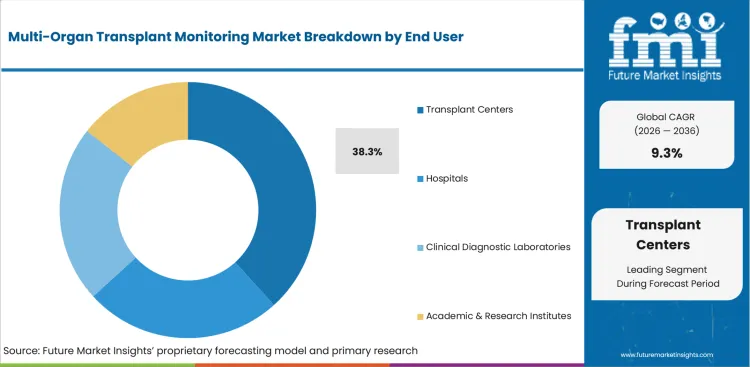
Community hospitals and diagnostic laboratories extend access as specialist pathways become established across referral networks. Gupta and colleagues reported a multicenter study evaluated 347 multi-organ recipients across 18 clinical sites in January 2026. Distributed participation demonstrates demand for standardized laboratory methods supporting several organ programs with comparable quality controls.
- Transplant centers are projected to hold 38.3% share in 2026, helped by coordinated follow-up and specialist decision authority. Centralized teams align sample timing with biopsy review and medication adjustment across graft-specific clinical pathways.
- Hospitals and clinical diagnostic laboratories extend testing through referral networks and specialist partnerships across transplant services. Academic research institutes support evidence generation as assay access and sample logistics influence continuing use.
What drivers, restraints, and opportunities shape multi-organ transplant monitoring market?
Multi-organ transplant monitoring gains commercial attention as clinical teams seek measurable evidence across recurring specialist follow-up.
- Driver: Molecular surveillance identifies graft injury signals earlier than conventional function tests across selected transplant pathways. Earlier evidence supports focused specialist review and more disciplined use of invasive confirmation.
- Restraint: Distinct organ combinations produce different biological baselines and complicate universal thresholds across multi-organ recipients. Inconsistent interpretation weakens physician confidence and limits repeat testing across standard follow-up pathways.
- Opportunity: Shared laboratory operations support several transplant services without erasing graft-specific clinical rules. Longitudinal analytics may connect changing molecular signals with treatment response and organ function.
Shared laboratory coordination helps transplant teams compare changing molecular signals across several graft pathways. NHS Blood and Transplant reported 3,882 deceased-donor organs were transplanted during 2024/25 in March 2026. National procedure volume supports recurring surveillance demand across kidney and heart programs. Lung and liver services add separate monitoring requirements, combined-organ programs require integrated interpretation.
Moeller and colleagues reported 25 multi-organ heart recipients displayed substantial variation in donor-derived cell-free DNA levels in October 2024. Organ-combination effects restrict uniform thresholds and reinforce graft-specific interpretation during longitudinal surveillance. Separate baselines support safer interpretation for each transplanted organ combination during clinical result review.
Bunnapradist and colleagues reported favorable donor-derived cell-free DNA trends corresponded with 60-fold greater odds of positive outcomes in July 2025. Transplant monitoring kits may strengthen post-rejection review by connecting repeated measurements with clinical recovery. Repeated testing may help clinicians distinguish sustained recovery from temporary post-treatment improvement.
How are country CAGRs aligned in multi-organ transplant monitoring market?
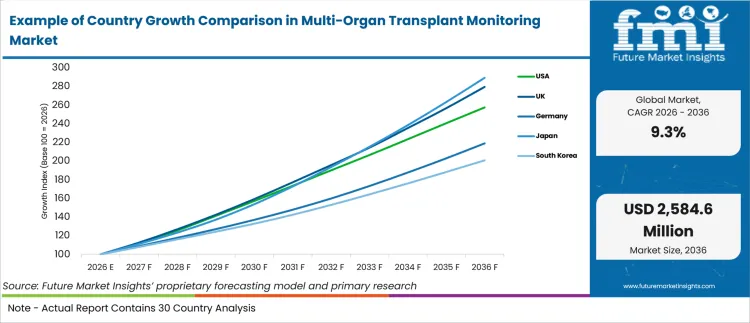
| Country or Market | CAGR |
|---|---|
| Japan | 11.2% |
| United Kigdom | 10.8% |
| United States | 9.9% |
| Germany | 8.1% |
| South Korea | 7.2% |
Source: Future Market Insights analysis, 2026.
How do country-level CAGRs compare in multi-organ transplant monitoring market?
Country comparison shows a gradual step-down across the transplant-monitoring markets covered. Japan sits at the upper end of the range followed by the United Kingdom. United States occupies the middle position. Germany and South Korea complete the comparison. The four-point spread reflects different transplant volumes and specialist service structures. National evidence and laboratory access create distinct entry conditions.
- Japan leads the comparison and establishes East Asia as a prominent expansion area among the markets shown.
- The United Kingdom follows Japan and maintains a narrow gap from the leading national program.
- The United States forms the middle growth band through extensive recipient surveillance and established testing access.
- Germany records the next growth position through structured transplant-center networks and laboratory assessment.
- South Korea completes the comparison with centralized tertiary care and disciplined follow-up services.
Markets with relatively close CAGRs present different entry conditions through transplant infrastructure and laboratory readiness. Full analysis covers North America, Latin America, Europe, East Asia, South Asia, Oceania and Middle East and Africa.
Country-wise Analysis
- Multi-organ transplant monitoring sector in Japan is projected to expand at 11.2% CAGR during the study period, driven by concentrated transplant services influencing repeat specialist surveillance. Organ-specific interpretation guides follow-up across kidney and thoracic programs within centralized centers. Japanese Society of Lung and Heart-Lung Transplantation reported 148 lung transplants during 2024 in March 2026, reflecting standardized monitoring across specialized national services.
- NHS Blood and Transplant reported 2,526 ethnic-minority candidates remained on United Kingdom transplant waiting lists at March 2025 in November 2025, strengthening the need for coordinated antibody assessment and molecular surveillance. National transplant services support structured follow-up across kidney and liver programs. Industry in the United Kingdom is forecast to increase at 10.8% CAGR between 2026 and 2036 due to coordinated specialist networks and centralized outcome review.
- Established transplant activity supports recurrent laboratory testing across United States kidney and heart programs. The market in United States is estimated to rise 9.9% CAGR by 2036, led by an extensive recipient surveillance and established molecular testing pathways. Scientific Registry of Transplant Recipients reported 16,989 deceased donors during 2024 in January 2026, expanding long-term follow-up requirements across national centers.
- Eurotransplant reported 2,930 deceased-donor transplants occurred across Germany during 2024 in its 2024 annual report, highlighting standardized post-transplant assessment across several organ services. Sector in Germany is anticipated to progress at 8.1% CAGR from 2026 to 2036, guided by structured transplant-center networks and combined molecular assessment. Heart and lung programs add organ-specific interpretation requirements across specialist laboratory pathways.
- Ministry of Health and Welfare reported South Korea recorded 7.75 deceased organ donors per million people during 2024 in October 2025, increasing emphasis on graft preservation across recurring follow-up. Centralized tertiary services support disciplined sample handling and specialist interpretation across transplant programs. Sales in South Korea are expected to scale at 7.2% CAGR during the assessment period, backed by concentrated specialist care and measured laboratory adoption.
Who are notable companies in multi-organ transplant monitoring market?
CareDx supplies molecular surveillance services across several transplanted organs. Natera supports donor-derived cell-free DNA testing through central laboratory workflows. Eurofins Scientific and Thermo Fisher Scientific add reference-laboratory and diagnostic-platform capabilities. Illumina and Abbott extend genomic or adjacent monitoring support.
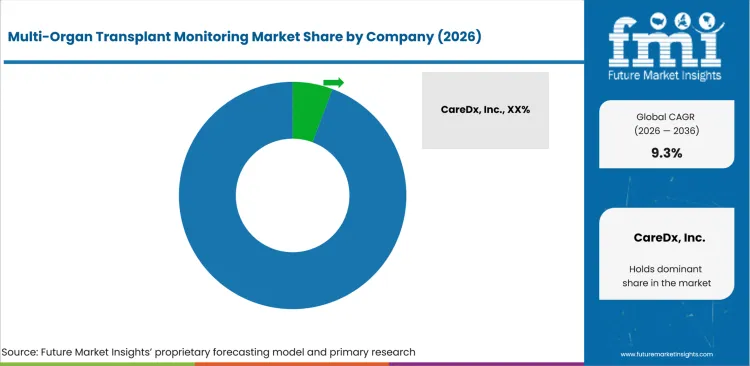
Competition in multi-organ transplant monitoring is anticipated to center on clinical evidence and reporting quality. Transplant teams are likely to compare companies based on organ coverage and laboratory consistency prior to service selection. CareDx is expected to receive attention due to established transplant-specific offerings. Natera is projected to add longitudinal evidence supporting molecular surveillance evaluation. Eurofins Scientific and Thermo Fisher Scientific are estimated to support centralized testing across hospital networks. Enabling-platform companies are anticipated to compete through assay infrastructure and specialist laboratory support.
- CareDx, Inc. and Natera, Inc. concentrate on donor-derived cell-free DNA services supported by organ-specific clinical studies. Product depth spans kidney and heart surveillance, lung monitoring adds longitudinal reporting across established transplant centers.
- Eurofins Scientific and Thermo Fisher Scientific Inc. combine transplant testing with reference-laboratory or diagnostic-system capabilities. Molecular assessment and antibody testing extend coverage across specialist programs.
- QIAGEN N.V. and Abbott Laboratories contribute infection testing or medication monitoring around post-transplant care. Point-of-care molecular diagnostics help clinicians separate rejection signals from viral activity and treatment exposure.
- Illumina, Inc. and Revvity, Inc. provide genomic or laboratory platforms supporting assay development. Nucleic acid extraction kit workflows and DNA/RNA extraction methods support sequencing analysis across transplant laboratories.
Competitive Benchmarking: Multi-Organ Transplant Monitoring Market
| Company | Portfolio Depth | Clinical Match | Service Support | Service Reach |
|---|---|---|---|---|
| CareDx, Inc. | High | High | High | United States and selected global markets |
| Natera, Inc. | High | High | High | United States and selected global markets |
| Eurofins Scientific | Medium | High | Medium | North America and Europe |
| Thermo Fisher Scientific Inc. | Medium | Medium | Medium | Global |
Source: Future Market Insights competitive analysis, 2026.
Key Developments in Multi-Organ Transplant Monitoring Market
- In February 2025, CareDx reported a multicenter European study finding AlloSeq cfDNA performance consistent with AlloSure Kidney across rejection scenarios. Company evidence strengthened international evaluation of decentralized donor-derived cell-free DNA testing.
- In May 2025, Natera reported publication of Prospera Heart with Donor Quantity Score evidence showing a 37.3% reduction in false-positive cases. Improved specificity may reduce unnecessary follow-up procedures across heart transplant surveillance.
- In June 2026, Natera and Eledon Pharmaceuticals announced Prospera selection as exclusive molecular monitoring assay for a planned Phase 3 kidney transplant trial. Planned enrollment of approximately 600 recipients extends molecular surveillance into immunosuppression evaluation across a large multicenter study.
Key Players in Multi-Organ Transplant Monitoring Market
Specialist molecular surveillance companies
- CareDx, Inc.
- Natera, Inc.
- Eurofins Scientific
Transplant diagnostic and laboratory companies
- Thermo Fisher Scientific Inc.
- QIAGEN N.V.
- F. Hoffmann-La Roche Ltd.
- Abbott Laboratories
Genomic and analytical platform companies
- Illumina, Inc.
- Bio-Rad Laboratories, Inc.
- Revvity, Inc.
Multi-Organ Transplant Monitoring Market Report Scope
| Coverage field | Report scope |
|---|---|
| Market breakdown | Multi-organ transplant monitoring breakdown by transplant type, monitoring technology, application, end user, and region |
| Market Definition | Products and services used for longitudinal assessment of graft injury, rejection risk, organ function, infection, antibodies, or immunosuppressive exposure across transplant recipients |
| Regions Covered | North America, Latin America, Europe, East Asia, South Asia, Oceania, and Middle East and Africa |
| Countries Covered | USA, Canada, Brazil, Mexico, Germany, UK, France, Italy, Spain, China, Japan, South Korea, India, ASEAN, Australia, New Zealand, GCC Countries, and South Africa |
| Key Companies Profiled | CareDx, Natera, Eurofins Scientific, Thermo Fisher Scientific, QIAGEN, Illumina, Bio-Rad Laboratories, Roche, Revvity, and Abbott Laboratories |
| Forecast Period | 2026 to 2036 |
| Approach | Hybrid bottom-up and top-down assessment using segment shares, country CAGRs, transplant activity, clinical evidence, company participation, and service coverage |
Source: Future Market Insights analysis, 2026.
Multi-Organ Transplant Monitoring Market - Research Methodology
| Method | Approach |
|---|---|
| Primary Research | FMI analysts gathered input from manufacturers, service providers, technology developers, distributors, end users, procurement teams, and subject-matter experts. Interviews examined purchasing decisions, product or service evaluation, adoption barriers, approval requirements, pricing considerations, and expectations for technical or commercial support. Respondents were also asked what evidence is required before a trial, pilot, or initial order develops into regular purchasing. |
| Desk Research | Desk research covered government statistics, regulatory publications, trade data, industry associations, technical literature, standards, company filings, product information, and official corporate announcements. Sources were reviewed for relevance, publication date, geographic coverage, and consistency with the defined market scope. Claims relating to performance, applications, approvals, capacity, investment, and commercial activity were retained only when supported by credible public evidence. |
| Market Sizing and Forecasting | The market model combined the baseline value with historical performance, segment structure, pricing and volume indicators, adoption levels, company participation, and country-level demand conditions. Forecast assumptions considered economic activity, investment trends, regulatory developments, technology adoption, purchasing cycles, supply availability, and barriers to wider market use. Segment and regional estimates were reconciled before the final market total was calculated. |
| Data Validation | Estimates were checked against multiple independent indicators, including public data, company activity, trade patterns, industry developments, and findings from primary interviews. Validation also tested whether products, services, applications, and company revenues fell within the defined market boundaries. Adjacent categories, unsupported claims, overlapping revenues, and activities without direct market relevance were excluded to reduce double counting and maintain consistency across segments and countries. |
Source: Future Market Insights analysis, 2026.
Multi-Organ Transplant Monitoring Market by Segments
Multi-Organ Transplant Monitoring Market segmented by Transplant Type:
- Kidney
- Heart
- Lung
- Liver
- Multi-Organ
Multi-Organ Transplant Monitoring Market segmented by Monitoring Technology:
- Donor-Derived Cell-Free DNA (dd-cfDNA)
- Gene Expression Profiling
- Donor-Specific Antibody (DSA) Testing
- Molecular Diagnostics
- Biopsy-Based Monitoring
Multi-Organ Transplant Monitoring Market segmented by Application:
- Acute Rejection Detection
- Chronic Rejection Monitoring
- Graft Function Assessment
- Immunosuppressive Therapy Monitoring
Multi-Organ Transplant Monitoring Market segmented by End User:
- Transplant Centers
- Hospitals
- Clinical Diagnostic Laboratories
- Academic & Research Institutes
Multi-Organ Transplant Monitoring Market by Region:
- North America
- Latin America
- Europe
- East Asia
- South Asia
- Oceania
- Middle East and Africa
Research Sources and Bibliography
- Scientific Registry of Transplant Recipients. (2026, January 15). OPTN/SRTR 2024 annual data report: Overview of US solid organ transplantation.
- Eurotransplant. (2025, January 30). Preliminary Eurotransplant annual figures 2024 online.
- Hirai, T., Banno, T., Omoto, K., Shimizu, T., Hidaka, S., Kijima, Y., Furusawa, M., Saitoh, A., Unagami, K., Inui, M., Ishida, H., & Takagi, T. (2025). Donor-derived cell-free DNA for diagnosing subclinical rejection: A pilot multicenter study in Japanese living-donor kidney transplantation. Clinical Transplantation, 39(7), e70221.
- Casas, S., Tangprasertchai, N. S., Oikonomaki, K., Mathers, S., Calderin Sollet, Z., Samara, S., Liu, J., Diaz Burlinson, N., Constantoulakis, P., Villard, J., & Viard, T. (2024). Multi-centre analytical performance verification of an IVD assay to quantify donor-derived cell-free DNA in solid organ transplant recipients. HLA, 103(5), e15518.
- Bromberg, J. S., Brennan, D. C., Taber, D. J., Cooper, M., Anand, S., Akalin, E., Huang, E., Klein, J. A., Glehn-Ponsirenas, R., Rogers, J., Chuang, P., Kothari, A. S., Shen, L., Woodward, R. N., Kumar, D., Wojciechowski, D., Mandelbrot, D., Costa, N., Bu, L., & Weir, M. R. (2025). Donor-derived cell-free DNA significantly improves rejection yield in kidney transplant biopsies. American Journal of Transplantation, 25(12), 2529-2542.
- Gupta, G., Wojciechowski, D., Sener, A., Gong, T., Dunn, T. B., Costa, N., Odorico, J. S., Daloul, R., Rohan, V. S., Biagini, D. G., Barnes, D., Kaur, N., Gude, G., Ahmed, E., Xie, J., Spellicy, C. J., Al Haj Baddar, N., Bloom, M. S., Demko, Z., ... Akkina, S. K. (2026, January 19). Donor-derived cell-free DNA in pancreas-kidney, heart-kidney, and liver-kidney multiorgan transplant recipients. Transplant International, 38, 15823.
- NHS Blood and Transplant. (2026, March 17). NHS starts machine preservation programme to enable more transplants.
- Moeller, C. M., Oren, D., Fernandez Valledor, A., Rubinstein, G., Lotan, D., Mehlman, Y., Slomovich, S., Rahman, S., Lee, C., Baranowska, J., Regan, M., Elad, B., DeFilippis, E. M., Hennecken, C., Salazar, R., Raikhelkar, J., Clerkin, K. J., Fried, J., Lin, E., ... Sayer, G. (2024). Clinical utility of donor-derived cell-free DNA in heart transplant recipients with multi-organ transplants. Clinical Transplantation, 38(10), e15479.
- Bunnapradist, S., Leca, N., Zaky, Z. S., Stratta, R. J., Khamash, H. A., Shihab, F., Ekwenna, O., Aldana-Campos, M., Kahwaji, J., Biancone, L., Maw, T. T., Biagini, D. G., Kaur, N., Prewett, A., Gude, G., Van Hummelen, P., Bloom, M. S., Demko, Z., Rabinowitz, M., ... Qazi, Y. (2025). Associations between donor-derived cell-free DNA dynamics and clinical outcomes after kidney allograft rejection: A prospective multicenter study. American Journal of Transplantation, 25(12), 2543-2553.
- Japanese Society of Lung and Heart-Lung Transplantation. (2026, March 24). Registry report of Japanese lung transplantation-2025.
- NHS Blood and Transplant. (2025, November 27). Ethnic minority organ donations increase despite a drop in the number of transplants.
- Scientific Registry of Transplant Recipients. (2026, January 15). OPTN/SRTR 2024 annual data report: Deceased organ donation.
- Eurotransplant. (2025). Annual report 2024.
- Ministry of Health and Welfare. (2025, October 17). MOHW establishes first comprehensive plan for organ and tissue donation.
- CareDx, Inc. (2025, February 20). CareDx announces study showing AlloSeq cfDNA highly accurate in detecting rejection in organ transplant patients.
- Natera, Inc. (2025, May 7). Prospera Heart test with DQS outperforms dd-cfDNA percentage in detecting allograft rejection, new AJT publication shows.
- Natera, Inc. (2026, June 25). Natera and Eledon announce strategic partnership for Prospera monitoring in planned Phase 3 kidney transplant trial.
This bibliography is provided for reader reference and is not exhaustive. The full report contains the complete reference list and detailed citations.
This Report Answers
- How large is multi-organ transplant monitoring market across 2026 and 2036?
- What CAGR is forecast for multi-organ transplant monitoring through 2036?
- How do application and transplant type segments compare with monitoring technology and end user segments?
- Why does acute rejection detection lead application demand across transplant services?
- How do country CAGRs differ across profiled national transplant programs?
- What evidence influences hospital adoption of multi-organ surveillance technologies?
- What companies compete through molecular testing with laboratory services and analytical platforms?
- How do organ-specific baselines affect donor-derived cell-free DNA interpretation?
- What operating barriers restrict repeat testing across standard transplant follow-up?
- How are forecasts validated using official statistics with clinical evidence and primary research?
Frequently Asked Questions
What supports demand in multi-organ transplant monitoring market?
Demand is expected to reflect recurring follow-up across kidney and heart recipients with separate interpretation for lung and liver programs. Hospitals favor evidence connected with defined biopsy decisions and medication review across combined-organ cases.
Who are notable companies in multi-organ transplant monitoring market?
Notable companies include CareDx and Abbott Laboratories among others. Competition is expected to reflect clinical evidence with organ coverage and dependable laboratory support.
What restraint affects multi-organ transplant monitoring market?
Organ combinations create different molecular baselines and complicate universal interpretation across transplant recipients. Adoption are likely to slow if results lack validated thresholds or fail to change a defined clinical decision.
Why do executives track multi-organ transplant monitoring market?
Executives track monitoring demand as repeat testing affects laboratory capacity and specialist service planning. Clinical utility and documented management changes are expected to guide reimbursement discussions and vendor selection.
What business problem does multi-organ transplant monitoring market address?
Multi-organ monitoring helps clinicians identify graft injury without uniform dependence on invasive surveillance. Integrated rejection and infection evidence adds context for antibody results with organ function and medication exposure.
What do transplant teams evaluate prior to selecting companies?
Transplant teams assess organ-specific evidence and sample logistics during company selection. Turnaround time and reporting clarity are expected to support multidisciplinary approval across transplant services.
What limits return on investment for hospital buyers?
Return weakens if testing frequency exceeds clinical utility or results fail to alter specialist management. Low recipient volume and fragmented workflows reduce operating value from repeat molecular surveillance.
How do companies build long-term transplant-center confidence?
Companies build transplant-center confidence through dependable assay performance and evidence specific to each organ pathway. Education records and responsive laboratory support are expected to influence continuing service use across participating programs.
Preview the report firsthand - request a free sample
Get SampleGet the brochure for pricing and purchase details.
Get PDFTable of Content
- Key Takeaways
- Market Size and CAGR
- Top Growth Driver
- Fastest Growing Segment
- Leading Region
- Key Companies
- Emerging Opportunities
- Executive Summary
- Global Market Outlook
- Demand-side Trends
- Supply-side Trends
- Technology Roadmap Analysis
- Analysis and Recommendations
- Analyst Perspective (What is happening? Why now? What should investors know?)
- Key Questions Answered
- How large is the market?
- What is the CAGR?
- What are key trends?
- Which region dominates?
- Who are the leaders?
- Market Overview
- Market Coverage / Taxonomy
- Market Definition / Scope / Limitations
- Research Methodology
- Chapter Orientation
- Analytical Lens and Working Hypotheses
- Market Structure, Signals, and Trend Drivers
- Benchmarking and Cross-market Comparability
- Market Sizing, Forecasting, and Opportunity Mapping
- Research Design and Evidence Framework
- Desk Research Programme (Secondary Evidence)
- Expert Input and Fieldwork (Primary Evidence)
- Tooling, Models, and Reference Databases
- Data Engineering and Model Build
- Quality Assurance and Audit Trail
- Market Background
- Market Dynamics (Drivers, Restraints, Opportunity, Trends)
- Scenario Forecast (Optimistic, Likely, Conservative)
- Impact Analysis
- AI Impact
- Sustainability Impact
- Regulatory Impact
- Technology Impact
- Consumer / Buyer Analysis
- Purchase Drivers
- Adoption Barriers
- Buyer Journey
- Opportunity Map Analysis
- Product Life Cycle Analysis
- Supply Chain Analysis
- Investment Feasibility Matrix
- Value Chain Analysis
- PESTLE and Porter's Analysis
- Regulatory Landscape
- Regional Parent Market Outlook
- Production and Consumption Statistics
- Import and Export Statistics
- Global Market Analysis and Forecast, 2021 to 2036
- Historical Market Size Value (USD Million) Analysis, 2021 to 2025
- Current and Future Market Size Value (USD Million) Projections, 2026 to 2036
- Y-o-Y Growth Trend Analysis
- Absolute $ Opportunity Analysis
- Global Market Pricing Analysis, 2021 to 2036
- Global Market Analysis and Forecast, By Transplant Type, 2021 to 2036
- Introduction / Key Findings
- Historical Market Size Value (USD Million) Analysis By Transplant Type, 2021 to 2025
- Current and Future Market Size Value (USD Million) Analysis and Forecast By Transplant Type, 2026 to 2036
- Kidney
- Heart
- Lung
- Liver
- Multi-Organ
- Kidney
- Y-o-Y Growth Trend Analysis By Transplant Type, 2021 to 2025
- Absolute $ Opportunity Analysis By Transplant Type, 2026 to 2036
- Global Market Analysis and Forecast, By Monitoring Technology, 2021 to 2036
- Introduction / Key Findings
- Historical Market Size Value (USD Million) Analysis By Monitoring Technology, 2021 to 2025
- Current and Future Market Size Value (USD Million) Analysis and Forecast By Monitoring Technology, 2026 to 2036
- Donor-Derived Cell-Free DNA (dd-cfDNA)
- Gene Expression Profiling
- Donor-Specific Antibody (DSA) Testing
- Molecular Diagnostics
- Biopsy-Based Monitoring
- Donor-Derived Cell-Free DNA (dd-cfDNA)
- Y-o-Y Growth Trend Analysis By Monitoring Technology, 2021 to 2025
- Absolute $ Opportunity Analysis By Monitoring Technology, 2026 to 2036
- Global Market Analysis and Forecast, By Application, 2021 to 2036
- Introduction / Key Findings
- Historical Market Size Value (USD Million) Analysis By Application, 2021 to 2025
- Current and Future Market Size Value (USD Million) Analysis and Forecast By Application, 2026 to 2036
- Acute Rejection Detection
- Chronic Rejection Monitoring
- Graft Function Assessment
- Immunosuppressive Therapy Monitoring
- Acute Rejection Detection
- Y-o-Y Growth Trend Analysis By Application, 2021 to 2025
- Absolute $ Opportunity Analysis By Application, 2026 to 2036
- Global Market Analysis and Forecast, By End User, 2021 to 2036
- Introduction / Key Findings
- Historical Market Size Value (USD Million) Analysis By End User, 2021 to 2025
- Current and Future Market Size Value (USD Million) Analysis and Forecast By End User, 2026 to 2036
- Transplant Centers
- Hospitals
- Clinical Diagnostic Laboratories
- Academic & Research Institutes
- Transplant Centers
- Y-o-Y Growth Trend Analysis By End User, 2021 to 2025
- Absolute $ Opportunity Analysis By End User, 2026 to 2036
- Global Market Analysis and Forecast, By Region, 2021 to 2036
- Introduction
- Historical Market Size Value (USD Million) Analysis By Region, 2021 to 2025
- Current Market Size Value (USD Million) Analysis and Forecast By Region, 2026 to 2036
- North America
- Latin America
- Western Europe
- Eastern Europe
- East Asia
- South Asia and Pacific
- Middle East & Africa
- Market Attractiveness Analysis By Region
- North America Market Analysis and Forecast, By Country, 2021 to 2036
- Historical Market Size Value (USD Million) Trend Analysis By Market Taxonomy, 2021 to 2025
- Market Size Value (USD Million) Forecast By Market Taxonomy, 2026 to 2036
- By Country
- USA
- Canada
- By Transplant Type
- By Monitoring Technology
- By Application
- By End User
- By Country
- Market Attractiveness Analysis
- By Country
- By Transplant Type
- By Monitoring Technology
- By Application
- By End User
- Key Takeaways
- Latin America Market Analysis and Forecast, By Country
- Historical Market Size Value (USD Million) Trend Analysis By Market Taxonomy, 2021 to 2025
- Market Size Value (USD Million) Forecast By Market Taxonomy, 2026 to 2036
- By Country
- Brazil
- Mexico
- Chile
- Rest of Latin America
- By Transplant Type
- By Monitoring Technology
- By Application
- By End User
- By Country
- Market Attractiveness Analysis
- By Country
- By Transplant Type
- By Monitoring Technology
- By Application
- By End User
- Key Takeaways
- Western Europe Market Analysis and Forecast, By Country
- Historical Market Size Value (USD Million) Trend Analysis By Market Taxonomy, 2021 to 2025
- Market Size Value (USD Million) Forecast By Market Taxonomy, 2026 to 2036
- By Country
- Germany
- UK
- Italy
- Spain
- France
- Nordic
- BENELUX
- Rest of Western Europe
- By Transplant Type
- By Monitoring Technology
- By Application
- By End User
- By Country
- Market Attractiveness Analysis
- By Country
- By Transplant Type
- By Monitoring Technology
- By Application
- By End User
- Key Takeaways
- Eastern Europe Market Analysis and Forecast, By Country
- Historical Market Size Value (USD Million) Trend Analysis By Market Taxonomy, 2021 to 2025
- Market Size Value (USD Million) Forecast By Market Taxonomy, 2026 to 2036
- By Country
- Russia
- Poland
- Hungary
- Balkan & Baltic
- Rest of Eastern Europe
- By Transplant Type
- By Monitoring Technology
- By Application
- By End User
- By Country
- Market Attractiveness Analysis
- By Country
- By Transplant Type
- By Monitoring Technology
- By Application
- By End User
- Key Takeaways
- East Asia Market Analysis and Forecast, By Country
- Historical Market Size Value (USD Million) Trend Analysis By Market Taxonomy, 2021 to 2025
- Market Size Value (USD Million) Forecast By Market Taxonomy, 2026 to 2036
- By Country
- China
- Japan
- South Korea
- By Transplant Type
- By Monitoring Technology
- By Application
- By End User
- By Country
- Market Attractiveness Analysis
- By Country
- By Transplant Type
- By Monitoring Technology
- By Application
- By End User
- Key Takeaways
- South Asia and Pacific Market Analysis and Forecast, By Country
- Historical Market Size Value (USD Million) Trend Analysis By Market Taxonomy, 2021 to 2025
- Market Size Value (USD Million) Forecast By Market Taxonomy, 2026 to 2036
- By Country
- India
- ASEAN
- Australia & New Zealand
- Rest of South Asia and Pacific
- By Transplant Type
- By Monitoring Technology
- By Application
- By End User
- By Country
- Market Attractiveness Analysis
- By Country
- By Transplant Type
- By Monitoring Technology
- By Application
- By End User
- Key Takeaways
- Middle East & Africa Market Analysis and Forecast, By Country
- Historical Market Size Value (USD Million) Trend Analysis By Market Taxonomy, 2021 to 2025
- Market Size Value (USD Million) Forecast By Market Taxonomy, 2026 to 2036
- By Country
- Kingdom of Saudi Arabia
- Other GCC Countries
- Türkiye
- South Africa
- Other African Union
- Rest of Middle East & Africa
- By Transplant Type
- By Monitoring Technology
- By Application
- By End User
- By Country
- Market Attractiveness Analysis
- By Country
- By Transplant Type
- By Monitoring Technology
- By Application
- By End User
- Key Takeaways
- Key Countries Market Analysis
- USA
- Pricing Analysis
- Market Share Analysis, 2025
- By Transplant Type
- By Monitoring Technology
- By Application
- By End User
- Canada
- Pricing Analysis
- Market Share Analysis, 2025
- By Transplant Type
- By Monitoring Technology
- By Application
- By End User
- Mexico
- Pricing Analysis
- Market Share Analysis, 2025
- By Transplant Type
- By Monitoring Technology
- By Application
- By End User
- Brazil
- Pricing Analysis
- Market Share Analysis, 2025
- By Transplant Type
- By Monitoring Technology
- By Application
- By End User
- Chile
- Pricing Analysis
- Market Share Analysis, 2025
- By Transplant Type
- By Monitoring Technology
- By Application
- By End User
- Germany
- Pricing Analysis
- Market Share Analysis, 2025
- By Transplant Type
- By Monitoring Technology
- By Application
- By End User
- UK
- Pricing Analysis
- Market Share Analysis, 2025
- By Transplant Type
- By Monitoring Technology
- By Application
- By End User
- Italy
- Pricing Analysis
- Market Share Analysis, 2025
- By Transplant Type
- By Monitoring Technology
- By Application
- By End User
- Spain
- Pricing Analysis
- Market Share Analysis, 2025
- By Transplant Type
- By Monitoring Technology
- By Application
- By End User
- France
- Pricing Analysis
- Market Share Analysis, 2025
- By Transplant Type
- By Monitoring Technology
- By Application
- By End User
- India
- Pricing Analysis
- Market Share Analysis, 2025
- By Transplant Type
- By Monitoring Technology
- By Application
- By End User
- ASEAN
- Pricing Analysis
- Market Share Analysis, 2025
- By Transplant Type
- By Monitoring Technology
- By Application
- By End User
- Australia & New Zealand
- Pricing Analysis
- Market Share Analysis, 2025
- By Transplant Type
- By Monitoring Technology
- By Application
- By End User
- China
- Pricing Analysis
- Market Share Analysis, 2025
- By Transplant Type
- By Monitoring Technology
- By Application
- By End User
- Japan
- Pricing Analysis
- Market Share Analysis, 2025
- By Transplant Type
- By Monitoring Technology
- By Application
- By End User
- South Korea
- Pricing Analysis
- Market Share Analysis, 2025
- By Transplant Type
- By Monitoring Technology
- By Application
- By End User
- Russia
- Pricing Analysis
- Market Share Analysis, 2025
- By Transplant Type
- By Monitoring Technology
- By Application
- By End User
- Poland
- Pricing Analysis
- Market Share Analysis, 2025
- By Transplant Type
- By Monitoring Technology
- By Application
- By End User
- Hungary
- Pricing Analysis
- Market Share Analysis, 2025
- By Transplant Type
- By Monitoring Technology
- By Application
- By End User
- Kingdom of Saudi Arabia
- Pricing Analysis
- Market Share Analysis, 2025
- By Transplant Type
- By Monitoring Technology
- By Application
- By End User
- Türkiye
- Pricing Analysis
- Market Share Analysis, 2025
- By Transplant Type
- By Monitoring Technology
- By Application
- By End User
- South Africa
- Pricing Analysis
- Market Share Analysis, 2025
- By Transplant Type
- By Monitoring Technology
- By Application
- By End User
- USA
- Market Structure Analysis
- Competition Dashboard
- Competition Benchmarking
- Market Share Analysis of Top Players
- By Regional
- By Transplant Type
- By Monitoring Technology
- By Application
- By End User
- Emerging Startups
- Innovation Benchmarking
- Competition Analysis
- Competition Deep Dive
- CareDx, Inc.
- Overview
- Product Portfolio
- Profitability by Market Segments
- Sales Footprint
- Strategy Overview
- Marketing Strategy
- Product Strategy
- Channel Strategy
- Natera, Inc.
- Eurofins Scientific
- Thermo Fisher Scientific Inc.
- QIAGEN N.V.
- Illumina, Inc.
- Bio-Rad Laboratories, Inc.
- F. Hoffmann-La Roche Ltd.
- Revvity, Inc.
- Abbott Laboratories
- CareDx, Inc.
- Case Studies
- Success Stories
- Recent Developments
- Competition Deep Dive
- Assumptions & Acronyms Used


