

- Market Size (2026)
- USD 514.5 Mn
- Forecast (2036)
- USD 1218.0 Mn
- CAGR (2026 to 2036)
- 9.0%
How big is Multi-Organ Transplant AlloSure Monitoring Market in 2026?
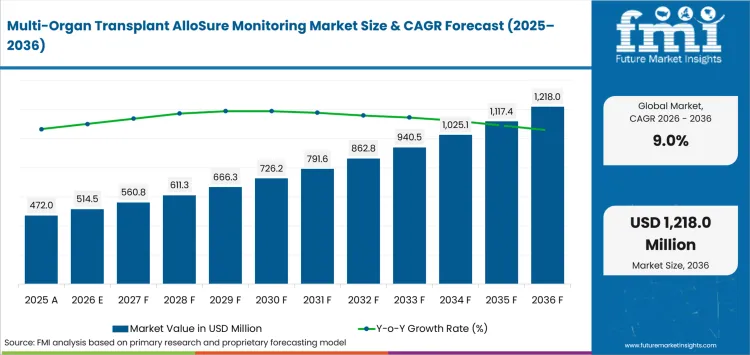
USD 514.5 million in 2026 and USD 1218.0 million by 2036 at a 9.0% CAGR.
Sales of multi-organ transplant AlloSure monitoring are projected to expand at 9.0% CAGR from 2026 to 2036, supported by recurring molecular surveillance. Industry value is forecast to rise from USD 514.5 million in 2026 to USD 1218.0 million by 2036 and remains linked to longer recipient follow-up. Clinical adoption depends on repeatable blood collection and organ-specific interpretation across established transplant diagnostics pathways and specialist care teams. Natera reported twenty-one Prospera presentations across kidney and heart or lung plus multi-organ transplantation in June 2026. The evidence base supports broader routine surveillance but each program must define escalation rules and confirm reimbursement coverage. Programs also need specimen tracking that protects collection timing and links unexpected results with urgent specialist review.
Kidney programs provide the largest operating base and heart or lung pathways require different clinical thresholds. United States reimbursement policy creates a separate commercial test through medical necessity criteria and covered testing intervals. CMS issued its solid-organ allograft rejection response in July 2026 and linked coverage to defined clinical uses. Laboratories must connect molecular testing results with treatment decisions instead of reporting isolated biomarker values. Point-of-care molecular systems remain adjacent workflow benchmarks rather than direct substitutes for centralized transplant interpretation and specialist clinical support. Investment becomes defensible once transplant teams measure avoided biopsies and faster intervention without weakening clinical oversight. Cross-border laboratory services face additional delays that can reduce rapid molecular detection value for distant transplant centers.
Key Takeaways of Multi-Organ Transplant AlloSure Monitoring Market
- Demand for multi-organ transplant AlloSure monitoring is driven by post-transplant programs gaining value from surveillance that identifies graft injury before routine chemistry produces a complete clinical explanation.
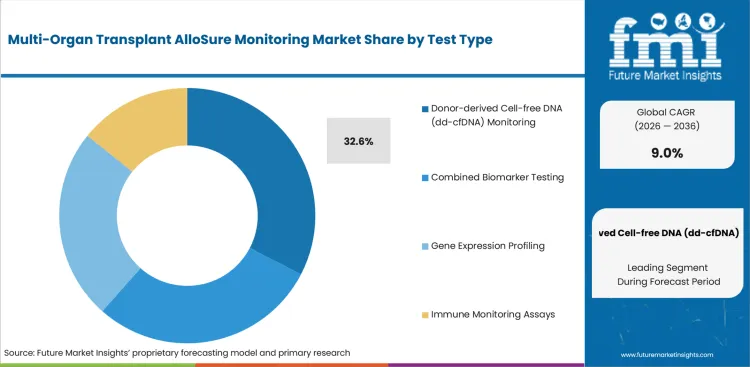
- By test type, donor-derived cell-free DNA monitoring holds the leading share at 32.6% in 2026, attributable to its direct connection with graft injury assessment across serial testing.
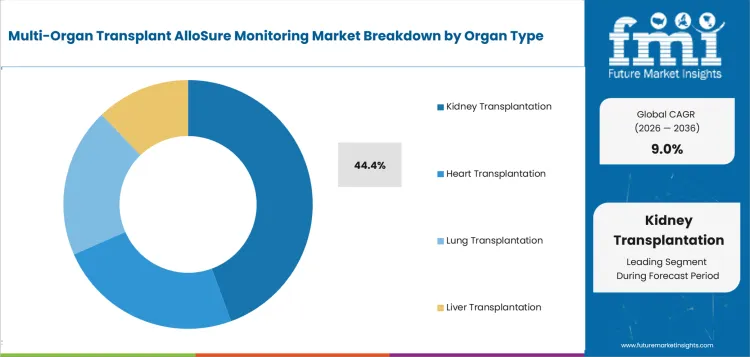
- Kidney transplantation is the dominant organ type segment, holding 44.4% share in 2026, underpinned by established post-transplant clinics and repeated graft assessment across a large recipient cohort.
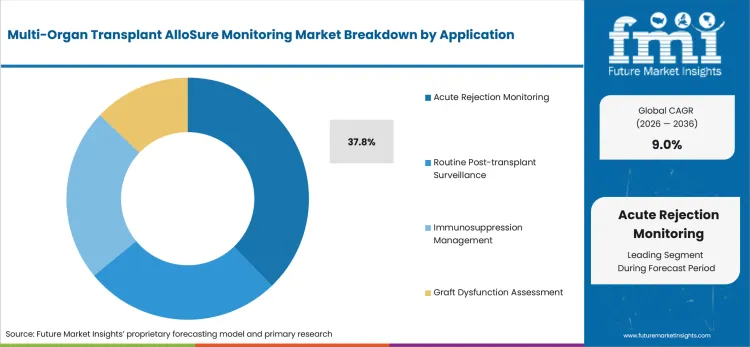
- Acute rejection monitoring accounts for 37.8% application share in 2026, owing to the consequence of delayed recognition and treatment during time-sensitive clinical episodes.
- Transplant centers lead end-user demand at 30.8% share in 2026, supported by specialist ownership of surveillance protocols and escalation decisions across multidisciplinary teams.
- Japan, the United Kingdom, and the USA record CAGRs of 9.9%, 9.6%, and 9.0% respectively through 2036, while Germany and South Korea require local validation strategies addressing reimbursement review and service support.
- Competition centers on CareDx, Natera, Eurofins Transplant Genomics, Verici Dx, Devyser Diagnostics, Insight Molecular Diagnostics, Thermo Fisher Scientific, and Bio-Rad Laboratories, with vendors differentiating through multi-organ dd-cfDNA services, kidney-specific biomarker approaches, and decentralized assay workflow support.
Analyst Perspective
A dd-cfDNA result only earns its commercial value once it connects to a documented threshold that triggers a biopsy decision or immunosuppression review, since a risk score without a clear escalation path is functionally an isolated lab finding rather than a clinical tool. Kidney's dominant share owes less to biological uniqueness than to sheer surveillance volume, given a waiting list running into the tens of thousands alongside established post-transplant clinic infrastructure that heart and lung programs haven't scaled to the same degree. Transplant centers will likely keep the coordination role regardless of where the actual sequencing happens, because service response during an elevated result depends on nephrologists and surgeons acting on it quickly, not on which laboratory ran the assay.
- Anurag Sharma, Principal Analyst at Future Market Insights
Source: FMI's proprietary forecasting model and primary research
How is the Multi-Organ Transplant AlloSure Monitoring Market segmented?
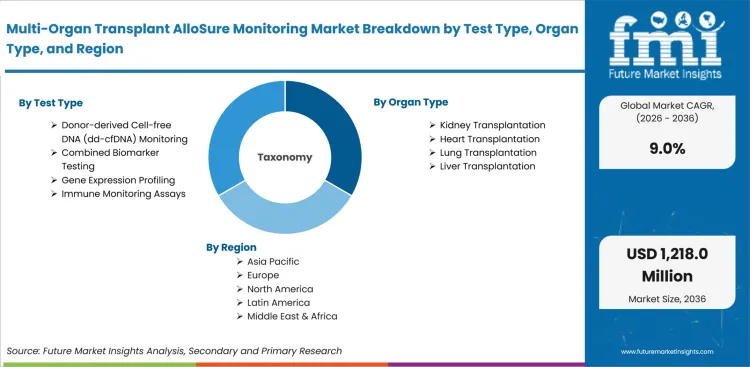
The multi-organ transplant AlloSure monitoring industry is segmented by test type, organ type, application, end user, and region.
The segmentation framework separates measurement technology from the organ receiving clinical surveillance and the decision supported by each result. Test type covers dd-cfDNA monitoring and complementary molecular approaches used to characterize graft injury or immune activity. Organ analysis follows kidney and heart programs alongside lung and liver pathways that require different baseline interpretation. Application categories distinguish acute rejection monitoring from routine surveillance and immunosuppression management or graft dysfunction assessment. End-user analysis separates transplant centers from hospitals and diagnostic laboratories or specialty clinics with different ownership of clinical action. Regional analysis considers transplant capacity and payment rules together with laboratory access across national health systems.
What supports demand for Donor-derived Cell-free DNA Monitoring within the Test Type category?
Transplant clinicians need a repeatable signal that complements organ function tests during uncertain post-transplant episodes. dd-cfDNA measures graft-derived injury through a blood sample and supports longitudinal review across liquid biopsy methods. CareDx reported in June 2026 that AlloSure studies covered kidney and heart or lung monitoring across more than 110 United States transplant centers. Clinical programs gain value from the biomarker once result thresholds connect with biopsy decisions and immunosuppression review.
- By test type, donor-derived cell-free DNA monitoring is expected to hold 32.6% share in 2026 attributable to its direct connection with graft injury assessment. The method supports serial testing without repeating invasive tissue collection during every uncertain clinical episode across long-term recipient follow-up. Commercial differentiation depends on organ-specific validation and clear interpretation rather than a generic cell-free DNA measurement.
- Transplant laboratories adopt dd-cfDNA workflows through centralized services or validated local assays based on staffing and sample logistics. Automated molecular platforms can reduce manual variability but laboratories retain responsibility for quality controls and report review. Service response during elevated results remains essential since delayed consultation can weaken the value of rapid analytical turnaround.
How does Kidney Transplantation shape demand within the Organ Type category?
Kidney recipients create sustained surveillance demand through large patient cohorts and long follow-up periods across transplant programs. Routine surveillance must balance early injury detection with testing discipline across nephrology and transplant teams. Recurrent testing affects payer review and laboratory capacity so programs need defined patient groups and escalation protocols. Organ-specific thresholds also require consistent sample timing and result interpretation across affiliated clinics that share recipient management responsibilities.
- Based on organ type, kidney transplantation is projected to represent 44.4% share in 2026 underpinned by established post-transplant clinics and repeated graft assessment. The January 2026 UNOS release recorded 27,573 United States kidney transplants during 2025 across established clinical programs. More than 90,000 people remained on the kidney waiting list and explain surveillance capacity without independently proving the approved share.
- Kidney programs can begin adoption through defined patient groups such as early surveillance or unexplained creatinine changes. Clinical diagnostics systems need interfaces that preserve collection timing and treatment context beside each molecular result. Hospitals face friction from coverage documentation and inconsistent ordering protocols across nephrology teams and outside laboratories.
Why is Acute Rejection Monitoring central to the Application category?
Acute rejection creates a time-sensitive decision that requires evidence beyond routine laboratory trends and clinical symptoms. Molecular monitoring can support biopsy selection or treatment assessment through protocols that define clinical ownership and follow-up timing. Programs therefore need rapid consultation and organ-specific thresholds that distinguish surveillance signals from findings requiring immediate intervention. Clinical value declines if reports present a risk score without explaining limitations or expected escalation actions.
- Acute rejection monitoring is forecast to account for 37.8% share in 2026 owing to the consequence of delayed recognition and treatment. Molecular testing can support biopsy selection or treatment assessment within a documented pathway that defines clinical ownership and follow-up timing. The share position reflects a specific clinical decision rather than universal replacement of histology and conventional laboratory measures.
- Transplant specialists favor monitoring programs that provide rapid consultation during unexpected molecular elevations and conflicting conventional results. Natera and Eledon announced in June 2026 that Prospera was selected exclusively for a planned Phase 3 kidney transplant trial. Clinical NGS analysis supports structured review while the trial demonstrates adoption through defined treatment evaluation rather than unrestricted routine testing.
How are Transplant Centers positioned within the End User category?
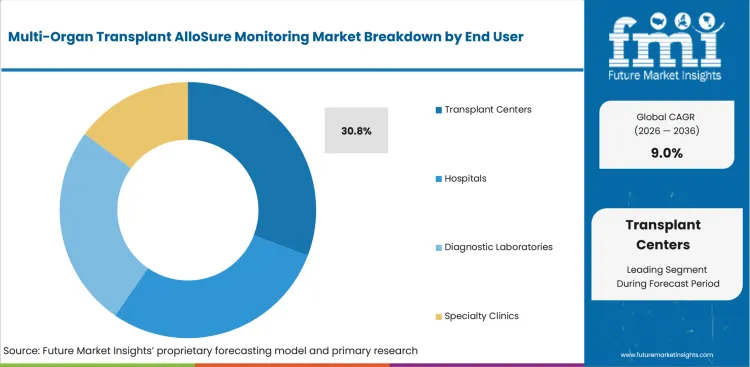
Transplant centers coordinate blood collection and organ-specific interpretation with treatment changes across multidisciplinary clinical teams. CareDx's current interpretation guidance provides organ-specific report walkthroughs and trend views for kidney or heart and lung results. The guidance also directs clinicians toward the Care Team for questions about reports or result interpretation. Transplant centers therefore control whether molecular evidence becomes a timely decision or remains an isolated laboratory result.
- In 2026, transplant centers are estimated to capture 30.8% share, supported by specialist ownership of surveillance protocols and escalation decisions. Centralized governance allows nephrologists and surgeons to align ordering cadence with biopsy and immunosuppression pathways. The end-user position depends on clinical coordination rather than the physical location of every analytical instrument.
- Large centers can support recurring testing volumes but smaller programs may rely on referral laboratories and remote interpretation services. Genomic workflows require validated collection procedures and secure transfer of organ-specific clinical context across participating organizations. Service contracts should define sample recollection and urgent result escalation plus payer documentation responsibilities across every participating clinical location.
What are the drivers, restraints, and opportunities in the Multi-Organ Transplant Allosure Monitoring Market?
Rising transplant activity supports structured molecular surveillance while reimbursement rules and interpretation demands limit indiscriminate testing.
- Driver: Larger post-transplant populations increase demand for repeatable injury assessment between routine visits and clinically indicated biopsies.
- Restraint: Coverage criteria and variable ordering protocols restrict adoption without documented medical necessity and organ-specific interpretation.
- Opportunity: Integrated molecular and clinical reporting can support earlier escalation through one governed surveillance pathway.
Expanding transplant activity creates a durable monitoring need across recipients who require years of follow-up. HRSA reported in January 2026 that the United States supported nearly 48,600 solid organ transplants during 2025. The larger active recipient base supports recurring tests but clinical teams must define cadence and treatment consequences. Diagnostic providers gain durable demand through protocols that improve longitudinal visibility without encouraging redundant testing.
Coverage discipline is one of the growth restraint because molecular testing can become repetitive without a documented clinical question. CMS published a future-effective billing article in July 2026 that permits one molecular service per patient indication and encounter. The article takes effect on August 30, 2026 and separates molecular testing from biopsy billing except under rare documented circumstances. Laboratories need documentation and appeal workflows that prevent reimbursement burden from shifting to transplant clinics.
Integrated reporting creates an opportunity to combine dd-cfDNA with organ function and antibody or transcriptomic evidence. For instance, CareDx's AlloSure Kidney documentation describes AlloSure Plus as an automated risk tool that combines dd-cfDNA with traditional clinical measures. NGS quality controls provide a broader framework for controlling analytical variation across sequencing workflows and repeated patient measurements. Clinical systems can display trends beside treatment events and biopsy findings through one patient record. Commercial value increases through fewer disconnected reports and clearer accountability for timely follow-up actions across transplant clinical teams.
Which country CAGRs are profiled in the Multi-Organ Transplant AlloSure Monitoring Market?
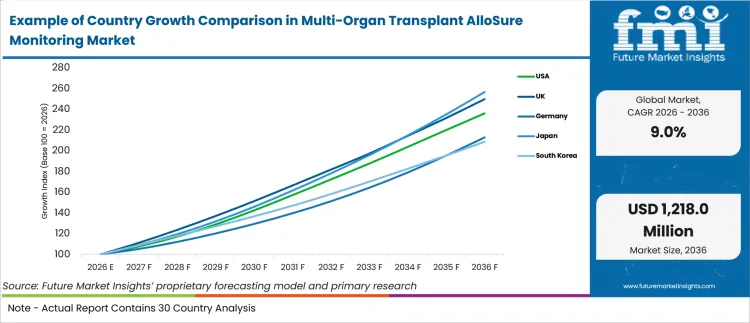
| Country | CAGR |
|---|---|
| USA | 9.0% |
| UK | 9.6% |
| Germany | 7.9% |
| Japan | 9.9% |
| South Korea | 7.6% |
How do country-level CAGRs compare in the Multi-Organ Transplant AlloSure Monitoring Market?
The country comparison shows a relatively narrow spread in projected growth rates across the market. Japan and the UK are closely aligned and create an upper group with only a small gap between them. The USA sits slightly below this group and remains separated by a modest margin. Germany and South Korea form a closely spaced lower pair with very little difference in their forecast expansion rates. The total gap between the first and last country is 2.3 percentage points which highlights a fairly concentrated growth outlook. These differences reflect variations in transplant monitoring adoption, reimbursement support and clinical testing practices across healthcare systems.
- Japan shows a notable position within the comparison as transplant centers continue to expand the use of non-invasive graft monitoring tools in routine patient follow-up.
- The UK remains close to Japan in CAGR terms but follows a different adoption path through structured clinical evaluation and healthcare system integration.
- The USA occupies a measured middle position as AlloSure monitoring benefits from an established transplant ecosystem and broad physician familiarity.
- Germany remains closely aligned with South Korea yet follows a distinct market path where adoption is often shaped by clinical evidence requirements and reimbursement considerations.
- South Korea holds a comparable position to Germany as growing use of precision diagnostics supports transplant monitoring while adoption continues to depend on hospital-level implementation.
Comparable CAGRs do not create identical market conditions across countries. Differences in reimbursement policies, transplant center capabilities, clinical workflow integration and regulatory requirements can influence adoption timing even when growth rates are closely aligned. Market opportunities therefore depend on local implementation conditions as much as forecast expansion. The full report provides country-level CAGR analysis across North America, Latin America, Europe, East Asia, South Asia, Oceania and the Middle East and Africa.
Country-wise Analysis
- United States transplant programs combine Medicare coverage rules with centralized molecular laboratories and large specialist referral networks. The multi-organ transplant AlloSure monitoring market in the USA is projected to expand at 9.0% CAGR over the forecast period, supported by established coverage pathways. In January 2026, the Centers for Medicare & Medicaid Services updated its United States billing article and listed covered assays for kidney or heart and lung indications. CareDx and Natera provide centralized multi-organ services while Eurofins supports kidney-focused monitoring through laboratory-developed testing. Medical-necessity criteria and payer-specific documentation create material friction across transplant programs with different referral patterns and payer mixes. Providers need local billing support and clearly assigned escalation routes before expanding recurring surveillance across affiliated transplant hospitals.
- United Kingdom transplant services use national registers and specialist centers that coordinate referrals across publicly funded clinical pathways. The multi-organ transplant AlloSure monitoring demand in the UK is forecast to rise at 9.6% CAGR through 2036, linked to coordinated clinical oversight. Centralized governance can support consistent ordering protocols but commissioning decisions remain local to participating services. NHS Blood and Transplant reported a waiting list of 8,237 people in March 2026 based on its January 29 2026 count and identified fifteen pilot assessment centers. Centralized foreign services and European assay kits require separate commissioning or validation routes across the United Kingdom. Commercial plans need health-economic evidence and dependable sample logistics across regional providers serving nationally coordinated transplant programs.
- Germany combines Eurotransplant allocation with a defined transplant center network and nationally regulated diagnostic services. The multi-organ transplant AlloSure monitoring market in Germany is estimated to advance at 7.9% CAGR by 2036, underpinned by specialist capacity and European assay availability. Official January 2026 data from Deutsche Stiftung Organtransplantation recorded forty-three German centers and 3,256 transplanted organs during 2025. Thermo Fisher Scientific distributes the kidney-focused One Lambda Devyser Accept cfDNA workflow for qualified laboratories. Reimbursement review and local integration can delay routine use beyond research programs across separate hospital systems. Entrants need German-language interpretation and responsive field service before transplant laboratories expand recurring clinical testing.
- Japanese transplant monitoring develops within highly specialized programs that emphasize graft preservation across long recipient follow-up. The multi-organ transplant AlloSure monitoring adoption in Japan is projected to advance at 9.9% CAGR from 2026 to 2036, shaped by concentrated expertise and long-term recipient management. National candidate registration supports coordinated specialist oversight but imported services face local authorization and sample logistics. The Japan Organ Transplant Network recorded 14,983 registered kidney candidates across Japan on June 30 2026. Limited deceased-donor activity restricts procedure scale and international transport can weaken clinically useful turnaround for foreign providers. Market entry should prioritize local clinical partnerships and structured training for dependable interpretation under Japanese regulatory requirements.
- South Korean adoption depends on tertiary hospitals that combine transplant surgery with advanced molecular laboratory capability. Hospital purchasing requires local authorization and Korean-language interpretation alongside reimbursement review for routine clinical use. The multi-organ transplant AlloSure monitoring market in South Korea is anticipated to record 7.6% CAGR between 2026 and 2036, sustained by specialist infrastructure and evolving technology review. An April 2025 Ministry of Health and Welfare notice proposed revised immediate-entry procedures for qualifying medical devices across South Korea. The proposed route can shorten selected technology reviews but it does not remove clinical evaluation or payment requirements. Commercial entry requires a domestic clinical partner and defined post-sale support for laboratory implementation and clinician education.
Who are the notable companies in the Multi-Organ Transplant AlloSure Monitoring Market?
CareDx, Natera, Eurofins Transplant Genomics, Thermo Fisher Scientific, Devyser Diagnostics, Insight Molecular Diagnostics, Bio-Rad Laboratories, and Verici Dx
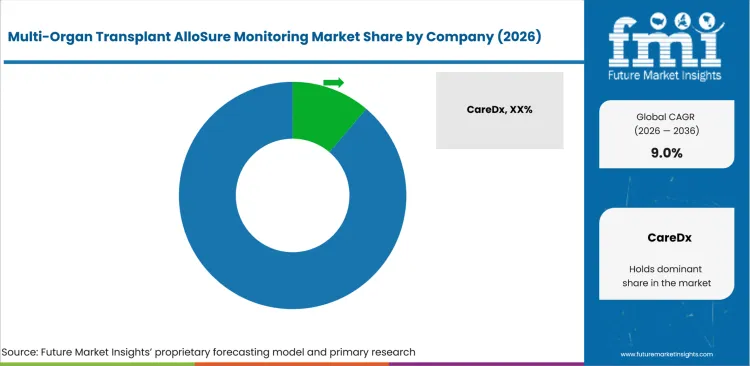
Competition separates complete clinical monitoring services from organ-specific assays and analytical platforms used inside transplant workflows. Current CareDx and Natera product documentation identifies dd-cfDNA pathways for kidney and heart or lung monitoring with organ-specific reporting. Their services depend on validated sequencing reagents and laboratory controls without transferring interpretation ownership to component suppliers. Eurofins Transplant Genomics and Verici Dx focus on kidney rejection through gene-expression or transcriptomic testing. Thermo Fisher Scientific distributes the One Lambda Devyser Accept cfDNA workflow for qualified laboratories in selected markets. Devyser Diagnostics and Insight Molecular Diagnostics pursue decentralized kidney assays through sequencing or digital PCR. Bio-Rad documented a strategic investment supporting an Oncocyte transplant-testing partnership for laboratory customers in February 2025.
- CareDx and Natera combine organ-specific dd-cfDNA testing with interpretation support across centralized United States workflows.
- Eurofins Transplant Genomics and Verici Dx provide laboratory-developed rejection assessments through distinct molecular signatures.
- Thermo Fisher Scientific and Devyser Diagnostics support assay implementation while Insight Molecular Diagnostics and Bio-Rad Laboratories provide digital PCR routes.
Competitive Benchmarking: Multi-Organ Transplant AlloSure Monitoring Market
| Company | Multi-Organ Monitoring | dd-cfDNA Workflow | Interpretation Support | Geographic Reach |
|---|---|---|---|---|
| CareDx | High | High | High | United States |
| Natera | High | High | High | United States |
| Eurofins Transplant Genomics | Medium | High | High | United States |
| Thermo Fisher Scientific | Medium | High | Medium | Europe and selected markets |
| Devyser Diagnostics | Medium | High | Medium | Europe and selected markets |
| Insight Molecular Diagnostics | Medium | Medium | Medium | United States research markets |
| Bio-Rad Laboratories | Low | Medium | Low | United States partnership |
| Verici Dx | Medium | Low | High | United States |
Key Developments in the Multi-Organ Transplant AlloSure Monitoring Market
- In July 2025, CareDx announced the launch of AlloSure Plus and initial integration with EPIC Aura during the third quarter of 2025. The platform combines AlloSure dd-cfDNA with clinical variables to provide a personalized rejection risk assessment. CareDx stated that an international prospective study used more than 2,700 renal transplant biopsies for validation and the implementation requires center-level governance across ordering or interpretation and treatment escalation.
- In November 2025, Devyser Diagnostics enrolled the first patient in a prospective United States study of Devyser Accept cfDNA for kidney transplant monitoring. The planned study covers up to 400 recipients across six transplant centers and compares the assay with biopsy results. The program advances an FDA submission pathway for qualified transplant testing laboratories and commercial timing remains dependent on study completion or regulatory review plus adoption evidence from United States centers.
- In April 2026, Insight Molecular Diagnostics reported that a De Novo submission for the GraftAssure dd-cfDNA assay had been filed with the FDA on March 25 2026. The company positioned the assay as a local laboratory workflow supported by digital PCR technology. Regulatory review represents a material step toward decentralized commercial use but approval status must remain separate from current research and laboratory deployment claims across every customer evaluation.
- In June 2026, Verici Dx received New York State approval for the Tutivia kidney transplant rejection test and established nationwide United States access through its clinical laboratory. Tutivia uses a preclinical acute rejection transcriptomic signature rather than dd-cfDNA measurement within its kidney-focused clinical assessment. The approval expands commercial reach for an organ-specific alternative but adoption depends on clinician education and payer acceptance across programs with different surveillance protocols or laboratory relationships.
Key Players in the Multi-Organ Transplant AlloSure Monitoring Market
Multi-Organ Clinical Monitoring Providers
- CareDx
- Natera
- Thermo Fisher Scientific
Kidney-Focused Diagnostic Providers
- Eurofins Transplant Genomics
- Devyser Diagnostics
- Verici Dx
Decentralized and Enabling Platforms
- Insight Molecular Diagnostics
- Bio-Rad Laboratories
Multi-Organ Transplant AlloSure Monitoring Market - Report Scope
| Coverage field | Report scope |
|---|---|
| Market breakdown | By Test Type, Organ Type, Application, End User, and region |
| Market Definition | Products and services used directly for molecular monitoring of graft injury or rejection across solid-organ transplant pathways. |
| Regions Covered | North America; Latin America; Western Europe; Eastern Europe; East Asia; South Asia and Pacific; Middle East and Africa |
| Countries Covered | USA; UK; Germany; Japan; South Korea |
| Key Companies Profiled | CareDx; Natera; Eurofins Transplant Genomics; Thermo Fisher Scientific; Devyser Diagnostics; Insight Molecular Diagnostics; Bio-Rad Laboratories; Verici Dx |
| Forecast Period | 2026 to 2036 |
| Approach | Hybrid bottom-up and top-down market sizing supported by official statistics and company records or regulatory evidence and defined commercial assumptions. |
Multi-Organ Transplant AlloSure Monitoring Market - Research Methodology
| Method | Approach |
|---|---|
| Primary Research | FMI analysts gathered input from manufacturers, service providers, technology developers, distributors, end users, sourcing teams, and subject-matter experts. Interviews examined purchasing decisions, product or service evaluation, adoption barriers, approval requirements, pricing considerations, and expectations for technical or commercial support. Respondents were also asked what evidence is required before a trial, pilot, or initial order develops into regular purchasing. |
| Desk Research | Desk research covered government statistics, regulatory publications, trade data, industry associations, technical literature, standards, company filings, product information, and official corporate announcements. Sources were reviewed for relevance, publication date, geographic coverage, and consistency with the defined market scope. Claims relating to performance, applications, approvals, capacity, investment, and commercial activity were retained only when supported by credible public evidence. |
| Market Sizing and Forecasting | The market model combined the baseline value with historical performance, segment structure, pricing and volume indicators, adoption levels, company participation, and country-level demand conditions. Forecast assumptions considered economic activity, investment trends, regulatory developments, technology adoption, purchasing cycles, supply availability, and barriers to wider market use. Segment and regional estimates were reconciled before the final market total was calculated. |
| Data Validation | Estimates were checked against multiple independent indicators, including public data, company activity, trade patterns, industry developments, and findings from primary interviews. Validation also tested whether products, services, applications, and company revenues fell within the defined market boundaries. Adjacent categories, unsupported claims, overlapping revenues, and activities without direct market relevance were excluded to reduce double counting and maintain consistency across segments and countries. |
Multi-Organ Transplant AlloSure Monitoring Market by Segments
Multi-Organ Transplant AlloSure Monitoring Market segmented by Test Type:
- Donor-derived Cell-free DNA (dd-cfDNA) Monitoring
- Combined Biomarker Testing
- Gene Expression Profiling
- Immune Monitoring Assays
Multi-Organ Transplant AlloSure Monitoring Market segmented by Organ Type:
- Kidney Transplantation
- Heart Transplantation
- Lung Transplantation
- Liver Transplantation
Multi-Organ Transplant AlloSure Monitoring Market segmented by Application:
- Acute Rejection Monitoring
- Routine Post-transplant Surveillance
- Immunosuppression Management
- Graft Dysfunction Assessment
Multi-Organ Transplant AlloSure Monitoring Market segmented by End User:
- Transplant Centers
- Hospitals
- Diagnostic Laboratories
- Specialty Clinics
Multi-Organ Transplant AlloSure Monitoring Market by Region:
- North America
- United States
- Canada
- Latin America
- Brazil
- Mexico
- Argentina
- Chile
- Western Europe
- Germany
- France
- United Kingdom
- Italy
- Spain
- Benelux
- Nordics
- Eastern Europe
- Poland
- Czech Republic
- Romania
- Hungary
- East Asia
- China
- Japan
- South Korea
- South Asia and Pacific
- India
- ASEAN
- Australia and New Zealand
- Middle East and Africa
- GCC Countries
- South Africa
- Türkiye
- Israel
Research Sources and Bibliography
- Natera, Inc.. (2026, June 18).
- Centers for Medicare & Medicaid Services. (2026, July 16).
- CareDx, Inc.. (2026, June 18).
- United Network for Organ Sharing. (2026, January 28).
- Natera, Inc.. (2026, June 25).
- CareDx, Inc.. (n.d.).
- Health Resources and Services Administration. (2026, January).
- Centers for Medicare & Medicaid Services. (2026, July 8).
- CareDx, Inc.. (n.d.).
- Centers for Medicare & Medicaid Services. (2026, January 22).
- NHS Blood and Transplant. (2026, March 17).
- Deutsche Stiftung Organtransplantation. (2026, January 13).
- Japan Organ Transplant Network. (2026, June 30).
- Ministry of Health and Welfare, Republic of Korea. (2025, April 30).
- Bio-Rad Laboratories, Inc.. (2025, February 13).
- CareDx, Inc.. (2025, July 31).
- Devyser Diagnostics AB. (2025, November 25).
- Insight Molecular Diagnostics Inc.. (2026, April 14).
- Verici Dx plc. (2026, June 24).
- Eurofins Transplant Genomics. (n.d.).
- Thermo Fisher Scientific. (n.d.).
- Insight Molecular Diagnostics Inc.. (n.d.).
- Verici Dx plc. (n.d.).
The bibliography provides verified reader references and does not represent every source used throughout the complete commercial research program. The full report contains the complete source base used for market sizing and forecasting or company and country assessment.
This Report Answers
- How large is the multi-organ transplant AlloSure monitoring market in 2026 and 2036?
- Which clinical and operating conditions support demand for molecular transplant surveillance?
- Why does donor-derived cell-free DNA monitoring hold the leading Test Type share in 2026?
- How does kidney transplantation influence test volume and clinical pathway design?
- Why does acute rejection monitoring account for the leading Application share in 2026?
- How do country growth rates differ across the USA, UK, Germany, Japan, and South Korea?
- Which companies provide multi-organ services or organ-specific transplant monitoring workflows?
- What limits reimbursement and routine adoption across transplant centers and diagnostic laboratories?
- How can integrated reporting connect molecular evidence with biopsy and immunosuppression decisions?
Frequently Asked Questions
How big is the Multi-Organ Transplant AlloSure Monitoring Market in 2026?
The multi-organ transplant AlloSure monitoring market is valued at USD 514.5 million in 2026 and is forecast to reach USD 1218.0 million by 2036. Growth reflects recurring molecular surveillance that supports repeatable blood collection and organ-specific interpretation across established transplant diagnostics pathways.
What is the CAGR of the Multi-Organ Transplant AlloSure Monitoring Market from 2026 to 2036?
The multi-organ transplant AlloSure monitoring market grows at a CAGR of 9.0% between 2026 and 2036, supported by larger post-transplant populations that increase demand for repeatable injury assessment between routine visits and clinically indicated biopsies.
Which organ type leads the Multi-Organ Transplant AlloSure Monitoring Market?
Kidney transplantation accounts for 44.4% of the multi-organ transplant AlloSure monitoring market by organ type in 2026, underpinned by established post-transplant clinics and repeated graft assessment across a large recipient cohort with long follow-up periods.
How much will the Multi-Organ Transplant AlloSure Monitoring Market add between 2026 and 2036?
The multi-organ transplant AlloSure monitoring market is set to add USD 703.5 million between 2026 and 2036, growing from USD 514.5 million to USD 1218.0 million as molecular surveillance extends across a widening base of kidney, heart, and lung transplant programs.
Who are the leading companies in the Multi-Organ Transplant AlloSure Monitoring Market?
Five companies lead the multi-organ transplant AlloSure monitoring market, including CareDx, Natera, Eurofins Transplant Genomics, Verici Dx, and Devyser Diagnostics, competing through multi-organ dd-cfDNA services, organ-specific biomarker approaches, and decentralized assay workflows.
Preview the report firsthand - request a free sample
Get SampleGet the brochure for pricing and purchase details.
Get PDFTable of Content
- Key Takeaways
- Market Size and CAGR
- Top Growth Driver
- Fastest Growing Segment
- Leading Region
- Key Companies
- Emerging Opportunities
- Executive Summary
- Global Market Outlook
- Demand-side Trends
- Supply-side Trends
- Technology Roadmap Analysis
- Analysis and Recommendations
- Analyst Perspective (What is happening? Why now? What should investors know?)
- Key Questions Answered
- How large is the market?
- What is the CAGR?
- What are key trends?
- Which region dominates?
- Who are the leaders?
- Market Overview
- Market Coverage / Taxonomy
- Market Definition / Scope / Limitations
- Research Methodology
- Chapter Orientation
- Analytical Lens and Working Hypotheses
- Market Structure, Signals, and Trend Drivers
- Benchmarking and Cross-market Comparability
- Market Sizing, Forecasting, and Opportunity Mapping
- Research Design and Evidence Framework
- Desk Research Programme (Secondary Evidence)
- Expert Input and Fieldwork (Primary Evidence)
- Tooling, Models, and Reference Databases
- Data Engineering and Model Build
- Quality Assurance and Audit Trail
- Market Background
- Market Dynamics (Drivers, Restraints, Opportunity, Trends)
- Scenario Forecast (Optimistic, Likely, Conservative)
- Impact Analysis
- AI Impact
- Sustainability Impact
- Regulatory Impact
- Technology Impact
- Consumer / Buyer Analysis
- Purchase Drivers
- Adoption Barriers
- Buyer Journey
- Opportunity Map Analysis
- Product Life Cycle Analysis
- Supply Chain Analysis
- Investment Feasibility Matrix
- Value Chain Analysis
- PESTLE and Porter's Analysis
- Regulatory Landscape
- Regional Parent Market Outlook
- Production and Consumption Statistics
- Import and Export Statistics
- Global Market Analysis and Forecast, 2021 to 2036
- Historical Market Size Value (USD Million) Analysis, 2021 to 2025
- Current and Future Market Size Value (USD Million) Projections, 2026 to 2036
- Y-o-Y Growth Trend Analysis
- Absolute $ Opportunity Analysis
- Global Market Pricing Analysis, 2021 to 2036
- Global Market Analysis and Forecast, By Test Type, 2021 to 2036
- Introduction / Key Findings
- Historical Market Size Value (USD Million) Analysis By Test Type, 2021 to 2025
- Current and Future Market Size Value (USD Million) Analysis and Forecast By Test Type, 2026 to 2036
- Donor-derived Cell-free DNA (dd-cfDNA) Monitoring
- Combined Biomarker Testing
- Gene Expression Profiling
- Immune Monitoring Assays
- Donor-derived Cell-free DNA (dd-cfDNA) Monitoring
- Y-o-Y Growth Trend Analysis By Test Type, 2021 to 2025
- Absolute $ Opportunity Analysis By Test Type, 2026 to 2036
- Global Market Analysis and Forecast, By Organ Type, 2021 to 2036
- Introduction / Key Findings
- Historical Market Size Value (USD Million) Analysis By Organ Type, 2021 to 2025
- Current and Future Market Size Value (USD Million) Analysis and Forecast By Organ Type, 2026 to 2036
- Kidney Transplantation
- Heart Transplantation
- Lung Transplantation
- Liver Transplantation
- Kidney Transplantation
- Y-o-Y Growth Trend Analysis By Organ Type, 2021 to 2025
- Absolute $ Opportunity Analysis By Organ Type, 2026 to 2036
- Global Market Analysis and Forecast, By Application, 2021 to 2036
- Introduction / Key Findings
- Historical Market Size Value (USD Million) Analysis By Application, 2021 to 2025
- Current and Future Market Size Value (USD Million) Analysis and Forecast By Application, 2026 to 2036
- Acute Rejection Monitoring
- Routine Post-transplant Surveillance
- Immunosuppression Management
- Graft Dysfunction Assessment
- Acute Rejection Monitoring
- Y-o-Y Growth Trend Analysis By Application, 2021 to 2025
- Absolute $ Opportunity Analysis By Application, 2026 to 2036
- Global Market Analysis and Forecast, By End User, 2021 to 2036
- Introduction / Key Findings
- Historical Market Size Value (USD Million) Analysis By End User, 2021 to 2025
- Current and Future Market Size Value (USD Million) Analysis and Forecast By End User, 2026 to 2036
- Transplant Centers
- Hospitals
- Diagnostic Laboratories
- Specialty Clinics
- Transplant Centers
- Y-o-Y Growth Trend Analysis By End User, 2021 to 2025
- Absolute $ Opportunity Analysis By End User, 2026 to 2036
- Global Market Analysis and Forecast, By Region, 2021 to 2036
- Introduction
- Historical Market Size Value (USD Million) Analysis By Region, 2021 to 2025
- Current Market Size Value (USD Million) Analysis and Forecast By Region, 2026 to 2036
- North America
- Latin America
- Western Europe
- Eastern Europe
- East Asia
- South Asia and Pacific
- Middle East & Africa
- Market Attractiveness Analysis By Region
- North America Market Analysis and Forecast, By Country, 2021 to 2036
- Historical Market Size Value (USD Million) Trend Analysis By Market Taxonomy, 2021 to 2025
- Market Size Value (USD Million) Forecast By Market Taxonomy, 2026 to 2036
- By Country
- USA
- Canada
- By Test Type
- By Organ Type
- By Application
- By End User
- By Country
- Market Attractiveness Analysis
- By Country
- By Test Type
- By Organ Type
- By Application
- By End User
- Key Takeaways
- Latin America Market Analysis and Forecast, By Country
- Historical Market Size Value (USD Million) Trend Analysis By Market Taxonomy, 2021 to 2025
- Market Size Value (USD Million) Forecast By Market Taxonomy, 2026 to 2036
- By Country
- Brazil
- Mexico
- Chile
- Rest of Latin America
- By Test Type
- By Organ Type
- By Application
- By End User
- By Country
- Market Attractiveness Analysis
- By Country
- By Test Type
- By Organ Type
- By Application
- By End User
- Key Takeaways
- Western Europe Market Analysis and Forecast, By Country
- Historical Market Size Value (USD Million) Trend Analysis By Market Taxonomy, 2021 to 2025
- Market Size Value (USD Million) Forecast By Market Taxonomy, 2026 to 2036
- By Country
- Germany
- UK
- Italy
- Spain
- France
- Nordic
- BENELUX
- Rest of Western Europe
- By Test Type
- By Organ Type
- By Application
- By End User
- By Country
- Market Attractiveness Analysis
- By Country
- By Test Type
- By Organ Type
- By Application
- By End User
- Key Takeaways
- Eastern Europe Market Analysis and Forecast, By Country
- Historical Market Size Value (USD Million) Trend Analysis By Market Taxonomy, 2021 to 2025
- Market Size Value (USD Million) Forecast By Market Taxonomy, 2026 to 2036
- By Country
- Russia
- Poland
- Hungary
- Balkan & Baltic
- Rest of Eastern Europe
- By Test Type
- By Organ Type
- By Application
- By End User
- By Country
- Market Attractiveness Analysis
- By Country
- By Test Type
- By Organ Type
- By Application
- By End User
- Key Takeaways
- East Asia Market Analysis and Forecast, By Country
- Historical Market Size Value (USD Million) Trend Analysis By Market Taxonomy, 2021 to 2025
- Market Size Value (USD Million) Forecast By Market Taxonomy, 2026 to 2036
- By Country
- China
- Japan
- South Korea
- By Test Type
- By Organ Type
- By Application
- By End User
- By Country
- Market Attractiveness Analysis
- By Country
- By Test Type
- By Organ Type
- By Application
- By End User
- Key Takeaways
- South Asia and Pacific Market Analysis and Forecast, By Country
- Historical Market Size Value (USD Million) Trend Analysis By Market Taxonomy, 2021 to 2025
- Market Size Value (USD Million) Forecast By Market Taxonomy, 2026 to 2036
- By Country
- India
- ASEAN
- Australia & New Zealand
- Rest of South Asia and Pacific
- By Test Type
- By Organ Type
- By Application
- By End User
- By Country
- Market Attractiveness Analysis
- By Country
- By Test Type
- By Organ Type
- By Application
- By End User
- Key Takeaways
- Middle East & Africa Market Analysis and Forecast, By Country
- Historical Market Size Value (USD Million) Trend Analysis By Market Taxonomy, 2021 to 2025
- Market Size Value (USD Million) Forecast By Market Taxonomy, 2026 to 2036
- By Country
- Kingdom of Saudi Arabia
- Other GCC Countries
- Türkiye
- South Africa
- Other African Union
- Rest of Middle East & Africa
- By Test Type
- By Organ Type
- By Application
- By End User
- By Country
- Market Attractiveness Analysis
- By Country
- By Test Type
- By Organ Type
- By Application
- By End User
- Key Takeaways
- Key Countries Market Analysis
- USA
- Pricing Analysis
- Market Share Analysis, 2025
- By Test Type
- By Organ Type
- By Application
- By End User
- Canada
- Pricing Analysis
- Market Share Analysis, 2025
- By Test Type
- By Organ Type
- By Application
- By End User
- Mexico
- Pricing Analysis
- Market Share Analysis, 2025
- By Test Type
- By Organ Type
- By Application
- By End User
- Brazil
- Pricing Analysis
- Market Share Analysis, 2025
- By Test Type
- By Organ Type
- By Application
- By End User
- Chile
- Pricing Analysis
- Market Share Analysis, 2025
- By Test Type
- By Organ Type
- By Application
- By End User
- Germany
- Pricing Analysis
- Market Share Analysis, 2025
- By Test Type
- By Organ Type
- By Application
- By End User
- UK
- Pricing Analysis
- Market Share Analysis, 2025
- By Test Type
- By Organ Type
- By Application
- By End User
- Italy
- Pricing Analysis
- Market Share Analysis, 2025
- By Test Type
- By Organ Type
- By Application
- By End User
- Spain
- Pricing Analysis
- Market Share Analysis, 2025
- By Test Type
- By Organ Type
- By Application
- By End User
- France
- Pricing Analysis
- Market Share Analysis, 2025
- By Test Type
- By Organ Type
- By Application
- By End User
- India
- Pricing Analysis
- Market Share Analysis, 2025
- By Test Type
- By Organ Type
- By Application
- By End User
- ASEAN
- Pricing Analysis
- Market Share Analysis, 2025
- By Test Type
- By Organ Type
- By Application
- By End User
- Australia & New Zealand
- Pricing Analysis
- Market Share Analysis, 2025
- By Test Type
- By Organ Type
- By Application
- By End User
- China
- Pricing Analysis
- Market Share Analysis, 2025
- By Test Type
- By Organ Type
- By Application
- By End User
- Japan
- Pricing Analysis
- Market Share Analysis, 2025
- By Test Type
- By Organ Type
- By Application
- By End User
- South Korea
- Pricing Analysis
- Market Share Analysis, 2025
- By Test Type
- By Organ Type
- By Application
- By End User
- Russia
- Pricing Analysis
- Market Share Analysis, 2025
- By Test Type
- By Organ Type
- By Application
- By End User
- Poland
- Pricing Analysis
- Market Share Analysis, 2025
- By Test Type
- By Organ Type
- By Application
- By End User
- Hungary
- Pricing Analysis
- Market Share Analysis, 2025
- By Test Type
- By Organ Type
- By Application
- By End User
- Kingdom of Saudi Arabia
- Pricing Analysis
- Market Share Analysis, 2025
- By Test Type
- By Organ Type
- By Application
- By End User
- Türkiye
- Pricing Analysis
- Market Share Analysis, 2025
- By Test Type
- By Organ Type
- By Application
- By End User
- South Africa
- Pricing Analysis
- Market Share Analysis, 2025
- By Test Type
- By Organ Type
- By Application
- By End User
- USA
- Market Structure Analysis
- Competition Dashboard
- Competition Benchmarking
- Market Share Analysis of Top Players
- By Regional
- By Test Type
- By Organ Type
- By Application
- By End User
- Emerging Startups
- Innovation Benchmarking
- Competition Analysis
- Competition Deep Dive
- CareDx
- Overview
- Product Portfolio
- Profitability by Market Segments
- Sales Footprint
- Strategy Overview
- Marketing Strategy
- Product Strategy
- Channel Strategy
- Natera
- Eurofins Scientific
- Thermo Fisher Scientific
- Bio-Rad Laboratories
- F. Hoffmann-La Roche
- QIAGEN
- Illumina
- Omixon
- Hologic
- CareDx
- Case Studies
- Success Stories
- Recent Developments
- Competition Deep Dive
- Assumptions & Acronyms Used


