

- Market Size (2026)
- USD 1.9 Bn
- Forecast (2036)
- USD 8.3 Bn
- CAGR (2026 to 2036)
- 15.9%
How big is Transplant Molecular Rejection Classification Market in 2026?
USD 1.9 billion in 2026 and USD 8.3 billion by 2036 at a 15.9% CAGR.
Transplant molecular rejection classification demand is projected to expand at 15.9% CAGR from 2026 to 2036, supported by recurring surveillance across solid-organ pathways. Industry valuation is forecast to rise from USD 1.9 billion in 2026 to USD 8.3 billion by 2036, reflecting broader use of structured molecular evidence. Clinical adoption depends on whether laboratories convert gene expression and donor-derived DNA results into clear biopsy or treatment decisions for specialist teams. CareDx reported in June 2026 that its transplant diagnostics appeared in more than thirty abstracts and nine oral presentations at the American Transplant Congress. The evidence program has commercial value through organ-specific validation and reproducible reporting required before transplant centers add recurring molecular tests to established surveillance protocols. Related transplant diagnostics workflows also require dependable specimen logistics and payer rules that support repeated testing across stable and symptomatic recipients.
United States programs face fragmented coverage and regional reference testing, while United Kingdom pathways rely more heavily on concentrated NHS transplant networks. The contrast changes purchasing priorities through different governance and service expectations across the two national systems. American laboratories often emphasize payer documentation and courier reach across diverse contractor jurisdictions and transplant-center networks. British centers place greater weight on protocol consistency and specialist capacity within coordinated public pathways. CareDx announced in February 2025 that an AlloSeq cell-free DNA study evaluated rejection detection across 580 kidney transplant patients at three European centers. The development illustrates the validation burden for blood-based assays without proving routine use across either national care model. Broader molecular diagnostics capacity supports complex testing, yet commercial uptake depends on turnaround performance and interpretation that changes a documented clinical action.
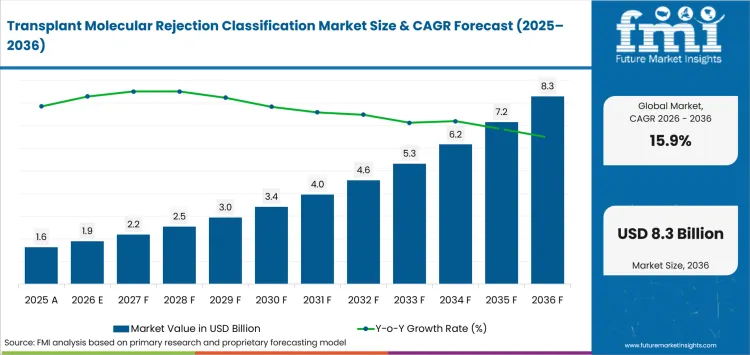
Key Takeaways of the Transplant Molecular Rejection Classification Market
- Demand for transplant molecular rejection classification is driven by the need to resolve diagnostic uncertainty in post-transplant surveillance, linking molecular evidence with documented biopsy and treatment decisions across growing recipient populations.
- By test type, Molecular Microscope Diagnostic System is projected to hold 37.1% of demand in 2026, reflecting its established multi-organ biopsy assessment pathway combining specimen handling, expression measurement, and algorithmic interpretation.
- Acute rejection classification is forecast to represent 38.0% of application demand in 2026, directly connected to immunosuppression escalation decisions and structured surveillance programs that identify clinically meaningful graft changes.
- By organ type, kidney transplantation is anticipated to capture 41.2% of demand in 2026, reinforced by procedure volume and repeated monitoring requirements, with OPTN and SRTR reporting 28,492 United States kidney transplants during 2024.
- The UK leads country growth at a 17.6% CAGR through 2036, followed by Germany at 15.5% CAGR through accredited laboratories and established biopsy practice.
- Competition centers on Thermo Fisher Scientific, Kashi Clinical Laboratories, CareDx, Natera, Verici Dx, Eurofins Viracor, and Devyser, with vendors differentiating through biopsy transcriptomics, donor-derived DNA portfolios, and reference laboratory access.
Analyst Perspective
"The transplant biomarker risk stratification market is moving toward decision-based adoption, where testing value depends on measurable changes in post-transplant management. Transplant centers are evaluating biomarker performance through biopsy avoidance, earlier injury detection, and workflow integration as distinct outcomes. Providers that ensure reliable specimen logistics, specialist interpretation, and defined escalation pathways will be better positioned to expand across transplant programs."
- Anurag Sharma, Principal Consultant at Future Market Insights
Source: FMI's proprietary forecasting model and primary research
How is the Transplant Molecular Rejection Classification Market segmented?
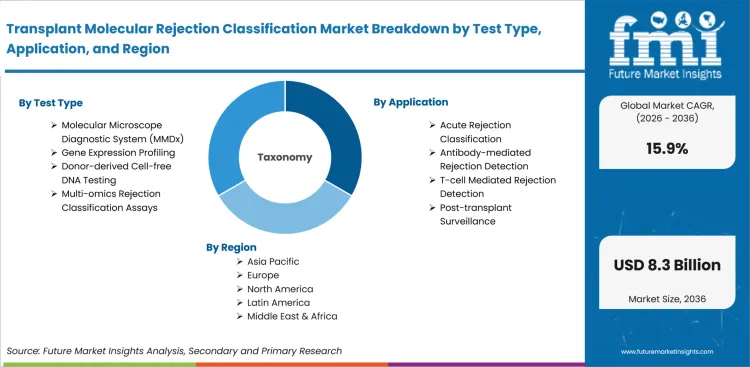
The transplant molecular rejection classification market is segmented by test type, application, end user, organ type, and region.
The segmentation framework separates molecular methods from rejection applications and organ pathways across distinct care settings and regional conditions. Test type distinguishes biopsy transcriptomics from blood-based DNA assays and multi-omics approaches used for rejection assessment. Application categories distinguish acute classification from antibody-mediated detection and T-cell-mediated detection alongside structured post-transplant surveillance. End-user analysis covers transplant centers and hospitals together with diagnostic laboratories and academic research institutes. Organ analysis covers kidney and heart transplantation alongside lung and liver pathways across the defined regional taxonomy.
How does molecular microscope diagnostic system (MMDx) shape the test type category?
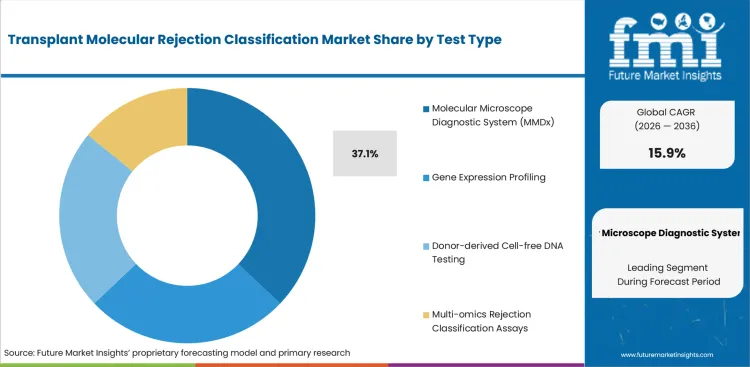
Biopsy interpretation remains difficult whenever histology and clinical findings provide conflicting signals about rejection activity. Thermo Fisher Scientific describes MMDx as a microarray system that compares biopsy expression against organ-specific reference sets. The workflow extends the tissue diagnostics through probability-based reports for T-cell-mediated rejection and antibody-mediated rejection alongside injury. Commercial value depends on biopsy access and specimen shipping as well as specialist confidence in the resulting interpretation.
- Molecular microscope diagnostic system is projected to hold 37.1% share in 2026, attributable to established multi-organ biopsy assessment. Share leadership reflects a complete pathway that combines specimen handling with expression measurement and algorithmic interpretation for clinicians across complex transplant cases.
- Transplant programs adopt MMDx to resolve uncertain biopsies and distinguish rejection activity from broader graft injury. Service adoption depends on validated reference sets and specialist reports that explain organ-specific probability scores. The adoption mechanism differs from share leadership because routine use also requires actionable reports and reliable sample logistics.
How does acute rejection classification shape the application category?
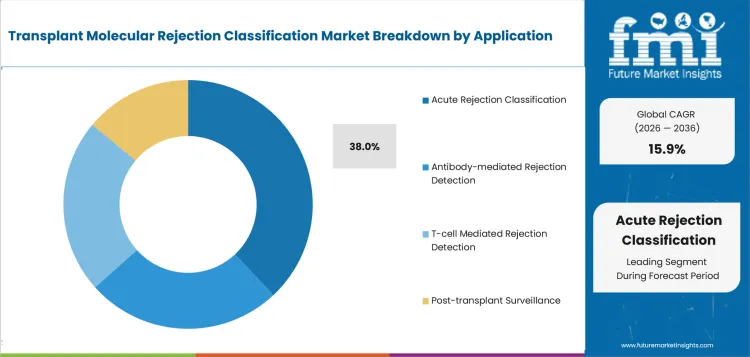
Acute rejection classification supports rapid treatment decisions during episodes of graft dysfunction or concerning biomarker change. The operating model connects liquid biopsy methods with biopsy findings and structured clinical assessment across transplant care. Laboratories gain relevance by reporting a defined rejection risk rather than presenting an isolated molecular measurement. Clinical teams then compare molecular evidence with graft function and pathology before selecting treatment escalation.
- In 2026, acute rejection classification is forecast to represent 38.0% share, underpinned by its direct connection to immunosuppression changes and diagnostic biopsy decisions. The segment captures testing performed during suspected rejection episodes and structured surveillance programs that identify clinically meaningful changes requiring specialist review.
- Clinicians use acute classification tools to prioritize biopsy and adjust therapy or continue observation under documented protocols. CareDx reported in August 2025 that its KOAR study included 1,743 kidney recipients across 56 centers. Adoption therefore depends on medical necessity criteria and ordering pathways with clear integration into standard clinical assessment.
How are transplant centers positioned within the end user category?
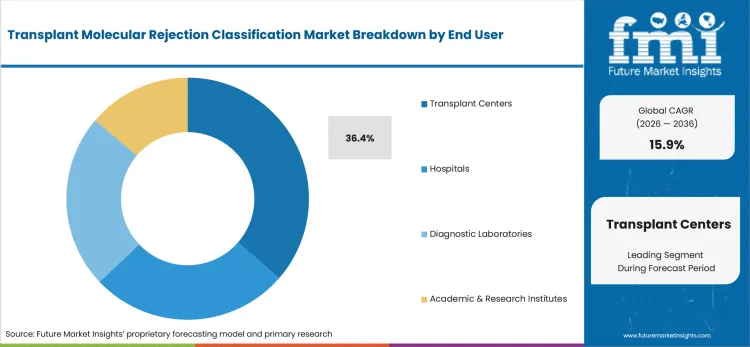
Transplant centers coordinate biopsy review and molecular testing alongside immunosuppression management within one accountable longitudinal surveillance pathway. NHS Blood and Transplant states that twenty-three adult kidney transplant centers facilitate living donation across the United Kingdom. National concentration supports specialized clinical diagnostics workflows through trained teams and defined referral routes. Smaller hospitals usually depend on reference laboratories or tertiary centers for interpretation and specialist follow-up across complex cases.
- Transplant Centers are estimated to account for 36.4% share in 2026, owing to their ownership of diagnostic escalation and treatment decisions. Their share position reflects concentrated expertise and biopsy access plus direct responsibility for coordinating molecular results with pathology and patient history.
- Centers adopt molecular rejection classification once laboratory turnaround and clinical governance support repeated use across the transplant pathway. Local protocols must define specimen collection and result review plus clear thresholds for therapy escalation across transplant teams. Adoption slows if off-site testing creates delays or reimbursement separates the assay from specialist interpretation.
Why does kidney transplantation lead the organ type category?
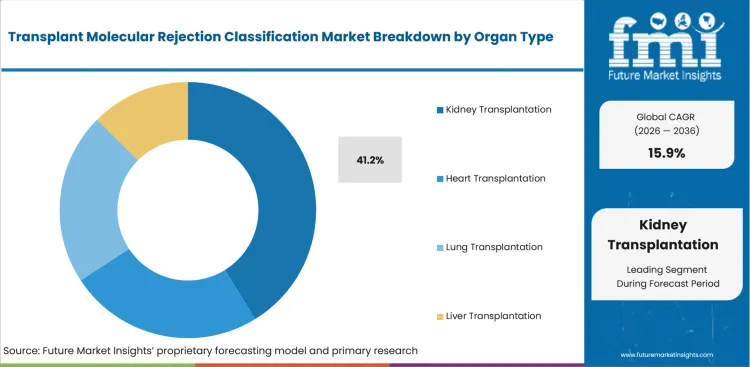
Kidney transplantation creates the largest recurring monitoring pool because recipients require long-term surveillance across varied rejection and injury patterns. Kidney pathways draw on nucleic acid testing methods that support donor-derived DNA and expression-based assessment. Commercial demand remains tied to test cadence and biopsy thresholds alongside coverage for stable and symptomatic recipients. Nephrology teams need longitudinal records that separate rejection activity from other causes of graft dysfunction.
- By organ type category, kidney transplantation is projected to hold 41.2% share in 2026, reinforced by procedure volume and established post-transplant monitoring pathways. The OPTN and SRTR reported 28,492 United States kidney transplants during 2024 through their latest annual data review. Repeated clinical touchpoints support biopsy classifiers and donor-derived DNA tests throughout longitudinal graft management decisions.
- Nephrology teams adopt molecular classification to separate active rejection from injury patterns that require different management. Service value increases with consistent longitudinal reporting and rapid access to prior results across each recipient monitoring cycle. A fragmented reimbursement route remains a material barrier for centers seeking routine surveillance beyond acute episodes.
What are the drivers, restraints, and opportunities in the Transplant Molecular Rejection Classification Market?
Transplant programs need molecular evidence that clarifies rejection risk without adding unmanageable cost, delay, or interpretive burden.
- Driver: Growing transplant volumes increase the number of recipients requiring structured rejection assessment and long-term graft surveillance.
- Restraint: Coverage restrictions and complex specimen workflows limit routine use outside established transplant programs and reference laboratories.
- Opportunity: Integrated molecular reports can connect blood markers with biopsy expression and pathology throughout one documented treatment history.
A growing recipient population supports demand for repeatable molecular assessment across post-transplant care and recurring specialist testing decisions. HRSA reported in January 2025 that 48,149 organ transplants occurred in the United States during 2024. Expanded in vitro diagnostics market capacity gives laboratories more platforms and quality systems for complex assays. Test developers gain durable demand by linking results with defined surveillance intervals and specialist actions.
Coverage requirements remain a practical restraint because payment often depends on documented medical necessity and transplant-center ordering. CMS maintained limited coverage for molecular allograft rejection tests under a local coverage determination reviewed in June 2026. Reference testing also adds specimen transport and turnaround risks for remote programs that lack local molecular laboratory capacity. Commercial expansion therefore requires clear eligibility rules and dependable service routes that preserve clinical timing across participating centers.
Integrated interpretation creates an opportunity to combine molecular signals across tissue and blood without treating either result as a complete diagnosis. CareDx announced HistoMap Kidney in November 2025 as a tissue-based gene-expression assay intended to complement pathology within its broader molecular portfolio. Related clinical NGS analysis market capabilities can support standardized reporting and longitudinal comparison across multi-organ transplant programs. Providers benefit most from systems that identify discordant findings and direct specialist review toward a documented clinical decision.
Which country CAGRs are profiled in the Transplant Molecular Rejection Classification Market?
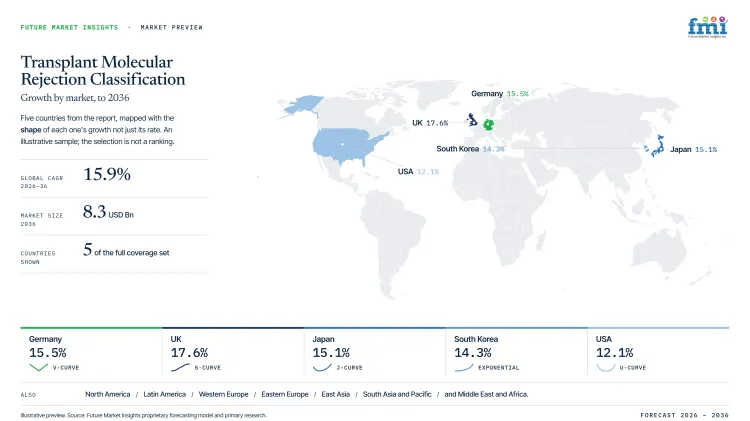
| Country | CAGR |
|---|---|
| USA | 12.1% |
| UK | 17.6% |
| Germany | 15.5% |
| Japan | 15.1% |
| South Korea | 14.3% |
How do country-level CAGRs compare in the Transplant Molecular Rejection Classification Market?
The country comparison shows a moderate spread in projected growth rates across the market. The UK forms the upper position within the group while Germany and Japan remain closely aligned with only a limited gap between their forecasts. South Korea follows as a nearby middle market and remains connected to the broader cluster. The USA sits apart from the other countries with a more pronounced gap. The overall difference between the first and last country is 5.5 percentage points which highlights varying adoption timelines for molecular rejection classification technologies. These differences reflect the pace of molecular diagnostics integration and the use of advanced transplant monitoring tools across healthcare systems.
- The UK shows a notable position within the comparison as transplant programs continue to expand the use of molecular testing to support earlier and more precise rejection assessment.
- Germany remains close to Japan in CAGR terms but follows a different adoption route through strong integration of transplant diagnostics within established laboratory networks.
- Japan sits within the central cluster as healthcare providers increasingly incorporate molecular classification tools alongside conventional transplant monitoring practices.
- South Korea remains moderately separated from Germany and Japan as investments in precision medicine support broader use of molecular approaches in transplant care.
- The USA occupies a distinct position within the comparison as adoption is supported by advanced transplant infrastructure while implementation patterns vary across healthcare providers and reimbursement settings.
Comparable CAGRs do not create identical market conditions across countries. Differences in laboratory capacity, reimbursement policies, clinical validation requirements and physician adoption can influence how quickly molecular rejection classification tools become part of routine transplant management. Market entry conditions therefore depend on local healthcare practices as well as forecast growth rates. The full report provides country-level CAGR analysis across North America, Latin America, Europe, East Asia, South Asia, Oceania and the Middle East and Africa.
Country-wise Analysis
- United States transplant programs operate through regional networks that combine transplant centers with established histocompatibility laboratories and national reference testing services. The USA is projected to expand at 12.1% CAGR from 2026 to 2036, shaped by reimbursement complexity and broad clinical capacity. HRSA reported 29 transplant centers and 15 histocompatibility laboratories in OPTN Region 3 during December 2025. Specialist infrastructure and national courier networks enable distant programs to use centralized molecular testing without building complete local laboratories. Medicare contractor variation creates material friction and requires manufacturers to support coverage documentation with dependable specimen logistics across regional pathways.
- United Kingdom transplant services use national allocation systems and concentrated specialist centers across the NHS care network. NHS Blood and Transplant reported nearly 4,600 transplants during 2024/25 while about eight thousand people remained listed. The UK is forecast to record 17.6% CAGR through 2036, supported by coordinated pathways and public procurement. Public budget limits create material friction for tests that add specialist workload or extend the interval between sampling and treatment decisions. Central governance and concentrated centers enable shared protocols that can evaluate clinical impact across coordinated reference laboratory routes.
- Germany combines university transplant centers with regulated laboratory services and cross-border organ allocation through the Eurotransplant network. Accredited laboratories and established biopsy practice provide a direct enabler for molecular workflows that require controlled specimen processing and specialist interpretation. Molecular rejection classification is estimated to advance at 15.5% CAGR between 2026 and 2036, enabled by specialist capacity and formal validation. The German Organ Transplantation Foundation reported 3,020 postmortem donor organs transplanted during 2025 across participating systems. Reimbursement negotiation creates material friction and can delay contracting without German-language support or protected turnaround across regional centers.
- Japanese transplant pathways operate through a concentrated national network with strict registration and organ allocation controls. The Japan Organ Transplant Network recorded 14,983 kidney candidates in its national registry on June 30 of 2026. Limited deceased donation creates material friction by concentrating recipient monitoring within a smaller group of high-volume specialist hospitals. Japan is projected to post 15.1% CAGR over the forecast period, influenced by kidney surveillance needs and specialist discipline. Established registry controls and disciplined referrals enable suppliers to use local clinical partners with compact logistics that fit hospital protocols.
- South Korean transplantation is centered in major tertiary hospitals with national recipient selection coordinated through the KONOS system. South Korea is anticipated to grow at 14.3% CAGR from 2026 to 2036, linked to digital hospital capacity and specialist adoption. Advanced tertiary laboratories provide a direct enabler for molecular workflows that can integrate with national recipient selection and hospital information systems. KONOS reported 3,096 deaths among waiting patients during 2024 and approximately fifty thousand people awaiting transplantation. Donor scarcity and reimbursement uncertainty create material friction for suppliers that lack local validation support and dependable service coverage beyond platform availability.
Who are the notable companies in the Transplant Molecular Rejection Classification Market?
Thermo Fisher Scientific, CareDx, Natera, Kashi Clinical Laboratories, Transcriptome Sciences, Verici Dx, Eurofins Viracor, and Devyser are notable companies in this market.
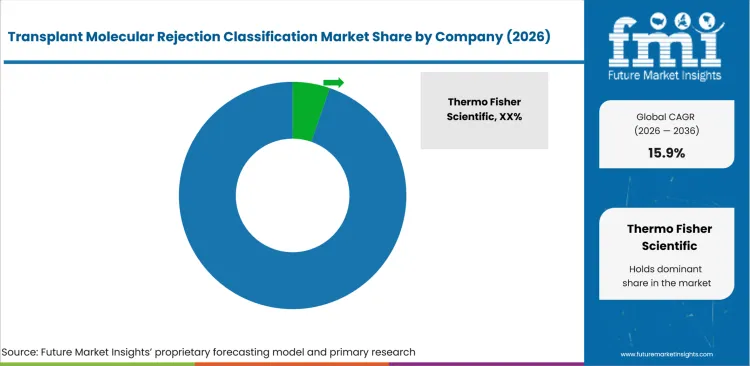
Competition combines biopsy transcriptomics developers with blood-based monitoring companies and reference laboratories that support interpretation across transplant programs. Thermo Fisher Scientific and Kashi Clinical Laboratories commercialize MMDx services through Transcriptome Sciences intellectual property, while CareDx and Natera provide multi-organ donor-derived DNA testing. Verici Dx describes Tutivia as a post-kidney transplant blood test that uses an RNA signature to estimate acute rejection risk. Eurofins Viracor and Devyser support reference testing or analytical workflows across selected geographies and laboratory operating models. Competitive strength also depends on sequencing reagents market quality and dependable controls that preserve reproducible results across service networks.
- Thermo Fisher Scientific and Kashi Clinical Laboratories work with Transcriptome Sciences across the principal biopsy transcriptomics group. Their roles cover commercialization and laboratory execution alongside algorithm development within organ-specific reference databases for transplant programs. The group differentiates through MMDx reports that estimate rejection and injury probabilities across kidney and heart biopsies as well as lung biopsies.
- CareDx and Natera compete with Verici Dx through donor-derived DNA or gene-expression approaches for blood-based rejection assessment. Their competitive positions depend on validated organ coverage and payer access alongside longitudinal reporting within transplant-center workflows. Each company offers a different balance between surveillance use and testing during suspected rejection across participating programs.
- Eurofins Viracor and Devyser support laboratory-led molecular monitoring through reference services or analytical software across transplant laboratories. Their relevance increases for institutions that prefer external testing or locally operated workflows with limited internal capacity. Commercial differentiation depends on geographic availability and assay standardization alongside interpretation support that connects laboratory output with transplant decisions.
Competitive Benchmarking: Transplant Molecular Rejection Classification Market
| Company | Molecular Offering Breadth | Organ Coverage | Interpretation Support | Geographic Reach |
|---|---|---|---|---|
| Thermo Fisher Scientific | High | High | High | Global |
| CareDx | High | High | High | North America and selected international markets |
| Natera | Medium | High | High | United States |
| Kashi Clinical Laboratories | Medium | High | High | United States with international reference service |
| Transcriptome Sciences | Medium | High | High | Canada with licensed global reach |
| Verici Dx | Medium | Low | High | United States |
| Eurofins Viracor | Medium | Low | Medium | United States |
| Devyser | Medium | Low | Medium | Europe and selected international markets |
Key Developments in the Transplant Molecular Rejection Classification Market
- In October 2025, Thermo Fisher Scientific introduced MMDx Lung in an expanded collaboration with Kashi Clinical Laboratories and Transcriptome Sciences. The laboratory-developed test added molecular biopsy assessment for lung recipients alongside existing kidney and heart services. The expansion broadened organ coverage while retaining centralized specimen logistics and laboratory-developed-test status across the commercial service pathway.
- In July 2025, CareDx presented AlloSure Plus during the World Transplant Congress and described an integrated kidney assessment that combines donor-derived DNA with traditional clinical tools. CareDx linked the launch with evidence from approximately 2,700 renal transplant biopsies within its kidney assessment program. Commercial rollout was scheduled for the third quarter of 2025 through established transplant-center channels and clinical support teams.
- In January 2026, Natera completed enrollment in the randomized ACES-EMB trial for heart transplantation. The study compares Prospera donor-derived DNA monitoring with routine endomyocardial biopsy strategies across participating heart transplant programs. Completion strengthened the evidence program for blood-based surveillance while preserving biopsy as the established comparator for clinical and economic evaluation by participating centers.
- In July 2026, Natera announced finalized MolDX coverage language for Prospera across kidney, heart, and lung transplant indications. The policy carries an August 30, 2026 effective date across participating Medicare contractor jurisdictions and covered transplant pathways. The development improves a future reimbursement route but does not remove commercial payer variation or center-specific ordering requirements across participating jurisdictions.
Key Players in the Transplant Molecular Rejection Classification Market
Biopsy Transcriptomics and Molecular Classification Providers
- Thermo Fisher Scientific
- Kashi Clinical Laboratories
- Transcriptome Sciences
Blood-based Rejection Monitoring Providers
- CareDx
- Natera
- Verici Dx
Reference Laboratory and Assay Workflow Providers
- Eurofins Viracor
- Devyser
Transplant Molecular Rejection Classification Market - Report Scope
| Coverage field | Report scope |
|---|---|
| Market breakdown | By Test Type, Application, End User, Organ Type, and Region. |
| Quantitative Units | Revenue in USD Billion, CAGR in %. |
| Market Definition | Products and services that classify molecular evidence of rejection or graft injury after solid organ transplantation. |
| Regions Covered | North America, Latin America, Western Europe, Eastern Europe, East Asia, South Asia and Pacific, and Middle East and Africa. |
| Countries Covered | USA, UK, Germany, Japan, and South Korea. |
| Key Companies Profiled | Thermo Fisher Scientific, CareDx, Natera, Kashi Clinical Laboratories, Transcriptome Sciences, Verici Dx, Eurofins Viracor, and Devyser. |
| Forecast Period | 2026 to 2036. |
| Approach | Market sizing combines baseline values with segment structure, clinical workflow, company participation, and country operating conditions. |
Transplant Molecular Rejection Classification Market - Research Methodology
| Method | Approach |
|---|---|
| Primary Research | FMI analysts gathered input from manufacturers, service providers, technology developers, distributors, end users, sourcing teams, and subject-matter experts. Interviews examined purchasing decisions, product or service evaluation, adoption barriers, approval requirements, pricing considerations, and expectations for technical or commercial support. Respondents were also asked what evidence is required before a trial, pilot, or initial order develops into regular purchasing. |
| Desk Research | Desk research covered government statistics, regulatory publications, trade data, industry associations, technical literature, standards, company filings, product information, and official corporate announcements. Sources were reviewed for relevance, publication date, geographic coverage, and consistency with the defined market scope. Claims relating to performance, applications, approvals, capacity, investment, and commercial activity were retained only when supported by credible public evidence. |
| Market Sizing and Forecasting | The market model combined the baseline value with historical performance, segment structure, pricing and volume indicators, adoption levels, company participation, and country-level demand conditions. Forecast assumptions considered economic activity, investment trends, regulatory developments, technology adoption, purchasing cycles, supply availability, and barriers to wider market use. Segment and regional estimates were reconciled before the final market total was calculated. |
| Data Validation | Estimates were checked against multiple independent indicators, including public data, company activity, trade patterns, industry developments, and findings from primary interviews. Validation also tested whether products, services, applications, and company revenues fell within the defined market boundaries. Adjacent categories, unsupported claims, overlapping revenues, and activities without direct market relevance were excluded to reduce double counting and maintain consistency across segments and countries. |
Transplant Molecular Rejection Classification Market by Segments
Transplant Molecular Rejection Classification Market segmented by Test Type:
- Molecular Microscope Diagnostic System (MMDx)
- Gene Expression Profiling
- Donor-derived Cell-free DNA Testing
- Multi-omics Rejection Classification Assays
Transplant Molecular Rejection Classification Market segmented by Application:
- Acute Rejection Classification
- Antibody-mediated Rejection Detection
- T-cell Mediated Rejection Detection
- Post-transplant Surveillance
Transplant Molecular Rejection Classification Market segmented by End User:
- Transplant Centers
- Hospitals
- Diagnostic Laboratories
- Academic & Research Institutes
Transplant Molecular Rejection Classification Market segmented by Organ Type:
- Kidney Transplantation
- Heart Transplantation
- Lung Transplantation
- Liver Transplantation
Transplant Molecular Rejection Classification Market by Region:
- North America
- United States
- Canada
- Latin America
- Brazil
- Mexico
- Argentina
- Chile
- Western Europe
- Germany
- France
- United Kingdom
- Italy
- Spain
- Benelux
- Nordics
- Eastern Europe
- Poland
- Czech Republic
- Romania
- Hungary
- East Asia
- China
- Japan
- South Korea
- South Asia and Pacific
- India
- ASEAN
- Australia and New Zealand
- Middle East and Africa
- GCC Countries
- South Africa
- Türkiye
- Israel
Research Sources and Bibliography
- Health Resources and Services Administration. (2025, January 15). Organ transplants exceeded 48,000 in 2024; a 3.3 percent increase from the transplants performed in 2023.
- Scientific Registry of Transplant Recipients. (2026). OPTN/SRTR 2024 annual data report: Overview of USA solid organ transplantation.
- NHS Blood and Transplant. (n.d.). Organ donation and transplantation.
- Deutsche Stiftung Organtransplantation. (2026, January 13). Organspendezahlen 2025 auf höchstem Stand seit 2012, dennoch weiterhin großer Bedarf.
- Japan Organ Transplant Network. (2026, June 30). Current number of registered transplant candidates.
- Korean Network for Organ Sharing. (n.d.). The need for organ and tissue donation.
- Centers for Medicare & Medicaid Services. (2026, June 18). MolDX: Molecular testing for solid organ allograft rejection (L38582).
- Thermo Fisher Scientific. (n.d.). MMDx for molecular biopsy assessment.
- Thermo Fisher Scientific. (n.d.). Molecular transplant assays and services.
- Kashi Clinical Laboratories. (2025, October 9). Introduction of MMDx for lung transplant.
- CareDx. (2025, July 31). CareDx announces landmark data in AI-powered transplant diagnostics showcased in over 40 abstracts and 16 oral presentations at the 2025 World Transplant Congress.
- CareDx. (2026, June 18). CareDx precision medicine diagnostics showcased in over 30 abstracts and 9 oral presentations at the 2026 American Transplant Congress.
- CareDx. (2025, August 6). CareDx announces landmark KOAR study published in the American Journal of Transplantation.
- Natera. (2026, January 28). Natera announces completion of enrollment in randomized ACES-EMB trial in heart transplantation.
- Natera. (2026, July 16). Finalized MolDX LCD includes expanded coverage for Natera’s Prospera portfolio.
- Verici Dx. (n.d.). Tutivia: A post-kidney transplant test.
- Eurofins Viracor. (2020, January 8). Eurofins expands kidney transplant diagnostics offering through Viracor TRAC™.
- Devyser. (n.d.). Advyser Solid Organs.
- Transcriptome Sciences. (n.d.). Molecular Microscope Diagnostic System.
- CareDx. (2025, February 20). CareDx announces study showing AlloSeq cfDNA highly accurate in detecting rejection in organ transplant patients.
- CareDx. (2025, November 6). CareDx announces new precision kidney transplant data and product innovations at ASN Kidney Week 2025.
- Natera. (n.d.). Blood test for kidney transplant rejection: Prospera.
- Kashi Clinical Laboratories. (n.d.). MMDx™.
- Health Resources and Services Administration. (2025, December). OPTN Region 3.
- NHS Blood and Transplant. (n.d.). Organ donation projects.
This bibliography provides reader access to the primary sources that support factual claims throughout the article. The full report contains the complete reference list with publication dates and supporting source notes for all cited claims.
This Report Answers
- How large is the transplant molecular rejection classification market in 2026 and 2036?
- Which clinical and operational factors support demand for molecular rejection assessment?
- Why does Molecular Microscope Diagnostic System hold the principal Test Type share in 2026?
- How does acute rejection classification influence biopsy and treatment decisions?
- Why do transplant centers account for the largest End User share in 2026?
- How do country growth rates compare across the USA, UK, Germany, Japan, and South Korea?
- Which companies provide biopsy transcriptomics, blood-based monitoring, or interpretation services?
- What coverage and workflow barriers limit routine molecular rejection testing?
- How can integrated molecular evidence improve post-transplant surveillance and specialist review?
Frequently Asked Questions
How big is the Transplant Molecular Rejection Classification Market in 2026?
The transplant molecular rejection classification market is valued at USD 1.9 billion in 2026 and is forecast to reach USD 8.3 billion by 2036.
What is the CAGR of the Transplant Molecular Rejection Classification Market from 2026 to 2036?
The transplant molecular rejection classification market is projected to grow at a CAGR of 15.9% between 2026 and 2036, supported by growing transplant volumes increasing the number of recipients requiring structured rejection assessment and long-term graft surveillance.
Which organ type leads the Transplant Molecular Rejection Classification Market?
Kidney transplantation accounts for 41.2% of the transplant molecular rejection classification market by organ type in 2026, driven by procedure volume and established post-transplant monitoring pathways requiring repeated molecular assessment across longitudinal graft management decisions.
Which country is growing fastest in the Transplant Molecular Rejection Classification Market?
The UK is the fastest-growing country in the transplant molecular rejection classification market, expanding at a 17.6% CAGR through 2036, ahead of the market average of 15.9%, supported by coordinated specialist networks, concentrated NHS transplant centers, and public procurement pathways enabling shared molecular testing protocols.
Who are the leading companies in the Transplant Molecular Rejection Classification Market?
Leading companies in the transplant molecular rejection classification market include Thermo Fisher Scientific, CareDx, Natera, Kashi Clinical Laboratories, Transcriptome Sciences, Verici Dx, Eurofins Viracor, and Devyser, competing across biopsy transcriptomics classification, blood-based rejection monitoring, and reference laboratory and assay workflow services.
Preview the report firsthand - request a free sample
Get SampleGet the brochure for pricing and purchase details.
Get PDFTable of Content
- Key Takeaways
- Market Size and CAGR
- Top Growth Driver
- Fastest Growing Segment
- Leading Region
- Key Companies
- Emerging Opportunities
- Executive Summary
- Global Market Outlook
- Demand-side Trends
- Supply-side Trends
- Technology Roadmap Analysis
- Analysis and Recommendations
- Analyst Perspective (What is happening? Why now? What should investors know?)
- Key Questions Answered
- How large is the market?
- What is the CAGR?
- What are key trends?
- Which region dominates?
- Who are the leaders?
- Market Overview
- Market Coverage / Taxonomy
- Market Definition / Scope / Limitations
- Research Methodology
- Chapter Orientation
- Analytical Lens and Working Hypotheses
- Market Structure, Signals, and Trend Drivers
- Benchmarking and Cross-market Comparability
- Market Sizing, Forecasting, and Opportunity Mapping
- Research Design and Evidence Framework
- Desk Research Programme (Secondary Evidence)
- Expert Input and Fieldwork (Primary Evidence)
- Tooling, Models, and Reference Databases
- Data Engineering and Model Build
- Quality Assurance and Audit Trail
- Market Background
- Market Dynamics (Drivers, Restraints, Opportunity, Trends)
- Scenario Forecast (Optimistic, Likely, Conservative)
- Impact Analysis
- AI Impact
- Sustainability Impact
- Regulatory Impact
- Technology Impact
- Consumer / Buyer Analysis
- Purchase Drivers
- Adoption Barriers
- Buyer Journey
- Opportunity Map Analysis
- Product Life Cycle Analysis
- Supply Chain Analysis
- Investment Feasibility Matrix
- Value Chain Analysis
- PESTLE and Porter's Analysis
- Regulatory Landscape
- Regional Parent Market Outlook
- Production and Consumption Statistics
- Import and Export Statistics
- Global Market Analysis and Forecast, 2021 to 2036
- Historical Market Size Value (USD Billion) Analysis, 2021 to 2025
- Current and Future Market Size Value (USD Billion) Projections, 2026 to 2036
- Y-o-Y Growth Trend Analysis
- Absolute $ Opportunity Analysis
- Global Market Pricing Analysis, 2021 to 2036
- Global Market Analysis and Forecast, By Test Type, 2021 to 2036
- Introduction / Key Findings
- Historical Market Size Value (USD Billion) Analysis By Test Type, 2021 to 2025
- Current and Future Market Size Value (USD Billion) Analysis and Forecast By Test Type, 2026 to 2036
- Molecular Microscope Diagnostic System (MMDx)
- Gene Expression Profiling
- Donor-derived Cell-free DNA Testing
- Multi-omics Rejection Classification Assays
- Molecular Microscope Diagnostic System (MMDx)
- Y-o-Y Growth Trend Analysis By Test Type, 2021 to 2025
- Absolute $ Opportunity Analysis By Test Type, 2026 to 2036
- Global Market Analysis and Forecast, By Application, 2021 to 2036
- Introduction / Key Findings
- Historical Market Size Value (USD Billion) Analysis By Application, 2021 to 2025
- Current and Future Market Size Value (USD Billion) Analysis and Forecast By Application, 2026 to 2036
- Acute Rejection Classification
- Antibody-mediated Rejection Detection
- T-cell Mediated Rejection Detection
- Post-transplant Surveillance
- Acute Rejection Classification
- Y-o-Y Growth Trend Analysis By Application, 2021 to 2025
- Absolute $ Opportunity Analysis By Application, 2026 to 2036
- Global Market Analysis and Forecast, By End User, 2021 to 2036
- Introduction / Key Findings
- Historical Market Size Value (USD Billion) Analysis By End User, 2021 to 2025
- Current and Future Market Size Value (USD Billion) Analysis and Forecast By End User, 2026 to 2036
- Transplant Centers
- Hospitals
- Diagnostic Laboratories
- Academic & Research Institutes
- Transplant Centers
- Y-o-Y Growth Trend Analysis By End User, 2021 to 2025
- Absolute $ Opportunity Analysis By End User, 2026 to 2036
- Global Market Analysis and Forecast, By Organ Type, 2021 to 2036
- Introduction / Key Findings
- Historical Market Size Value (USD Billion) Analysis By Organ Type, 2021 to 2025
- Current and Future Market Size Value (USD Billion) Analysis and Forecast By Organ Type, 2026 to 2036
- Kidney Transplantation
- Heart Transplantation
- Lung Transplantation
- Liver Transplantation
- Kidney Transplantation
- Y-o-Y Growth Trend Analysis By Organ Type, 2021 to 2025
- Absolute $ Opportunity Analysis By Organ Type, 2026 to 2036
- Global Market Analysis and Forecast, By Region, 2021 to 2036
- Introduction
- Historical Market Size Value (USD Billion) Analysis By Region, 2021 to 2025
- Current Market Size Value (USD Billion) Analysis and Forecast By Region, 2026 to 2036
- North America
- Latin America
- Western Europe
- Eastern Europe
- East Asia
- South Asia and Pacific
- Middle East & Africa
- Market Attractiveness Analysis By Region
- North America Market Analysis and Forecast, By Country, 2021 to 2036
- Historical Market Size Value (USD Billion) Trend Analysis By Market Taxonomy, 2021 to 2025
- Market Size Value (USD Billion) Forecast By Market Taxonomy, 2026 to 2036
- By Country
- USA
- Canada
- By Test Type
- By Application
- By End User
- By Organ Type
- By Country
- Market Attractiveness Analysis
- By Country
- By Test Type
- By Application
- By End User
- By Organ Type
- Key Takeaways
- Latin America Market Analysis and Forecast, By Country
- Historical Market Size Value (USD Billion) Trend Analysis By Market Taxonomy, 2021 to 2025
- Market Size Value (USD Billion) Forecast By Market Taxonomy, 2026 to 2036
- By Country
- Brazil
- Mexico
- Chile
- Rest of Latin America
- By Test Type
- By Application
- By End User
- By Organ Type
- By Country
- Market Attractiveness Analysis
- By Country
- By Test Type
- By Application
- By End User
- By Organ Type
- Key Takeaways
- Western Europe Market Analysis and Forecast, By Country
- Historical Market Size Value (USD Billion) Trend Analysis By Market Taxonomy, 2021 to 2025
- Market Size Value (USD Billion) Forecast By Market Taxonomy, 2026 to 2036
- By Country
- Germany
- UK
- Italy
- Spain
- France
- Nordic
- BENELUX
- Rest of Western Europe
- By Test Type
- By Application
- By End User
- By Organ Type
- By Country
- Market Attractiveness Analysis
- By Country
- By Test Type
- By Application
- By End User
- By Organ Type
- Key Takeaways
- Eastern Europe Market Analysis and Forecast, By Country
- Historical Market Size Value (USD Billion) Trend Analysis By Market Taxonomy, 2021 to 2025
- Market Size Value (USD Billion) Forecast By Market Taxonomy, 2026 to 2036
- By Country
- Russia
- Poland
- Hungary
- Balkan & Baltic
- Rest of Eastern Europe
- By Test Type
- By Application
- By End User
- By Organ Type
- By Country
- Market Attractiveness Analysis
- By Country
- By Test Type
- By Application
- By End User
- By Organ Type
- Key Takeaways
- East Asia Market Analysis and Forecast, By Country
- Historical Market Size Value (USD Billion) Trend Analysis By Market Taxonomy, 2021 to 2025
- Market Size Value (USD Billion) Forecast By Market Taxonomy, 2026 to 2036
- By Country
- China
- Japan
- South Korea
- By Test Type
- By Application
- By End User
- By Organ Type
- By Country
- Market Attractiveness Analysis
- By Country
- By Test Type
- By Application
- By End User
- By Organ Type
- Key Takeaways
- South Asia and Pacific Market Analysis and Forecast, By Country
- Historical Market Size Value (USD Billion) Trend Analysis By Market Taxonomy, 2021 to 2025
- Market Size Value (USD Billion) Forecast By Market Taxonomy, 2026 to 2036
- By Country
- India
- ASEAN
- Australia & New Zealand
- Rest of South Asia and Pacific
- By Test Type
- By Application
- By End User
- By Organ Type
- By Country
- Market Attractiveness Analysis
- By Country
- By Test Type
- By Application
- By End User
- By Organ Type
- Key Takeaways
- Middle East & Africa Market Analysis and Forecast, By Country
- Historical Market Size Value (USD Billion) Trend Analysis By Market Taxonomy, 2021 to 2025
- Market Size Value (USD Billion) Forecast By Market Taxonomy, 2026 to 2036
- By Country
- Kingdom of Saudi Arabia
- Other GCC Countries
- Türkiye
- South Africa
- Other African Union
- Rest of Middle East & Africa
- By Test Type
- By Application
- By End User
- By Organ Type
- By Country
- Market Attractiveness Analysis
- By Country
- By Test Type
- By Application
- By End User
- By Organ Type
- Key Takeaways
- Key Countries Market Analysis
- USA
- Pricing Analysis
- Market Share Analysis, 2025
- By Test Type
- By Application
- By End User
- By Organ Type
- Canada
- Pricing Analysis
- Market Share Analysis, 2025
- By Test Type
- By Application
- By End User
- By Organ Type
- Mexico
- Pricing Analysis
- Market Share Analysis, 2025
- By Test Type
- By Application
- By End User
- By Organ Type
- Brazil
- Pricing Analysis
- Market Share Analysis, 2025
- By Test Type
- By Application
- By End User
- By Organ Type
- Chile
- Pricing Analysis
- Market Share Analysis, 2025
- By Test Type
- By Application
- By End User
- By Organ Type
- Germany
- Pricing Analysis
- Market Share Analysis, 2025
- By Test Type
- By Application
- By End User
- By Organ Type
- UK
- Pricing Analysis
- Market Share Analysis, 2025
- By Test Type
- By Application
- By End User
- By Organ Type
- Italy
- Pricing Analysis
- Market Share Analysis, 2025
- By Test Type
- By Application
- By End User
- By Organ Type
- Spain
- Pricing Analysis
- Market Share Analysis, 2025
- By Test Type
- By Application
- By End User
- By Organ Type
- France
- Pricing Analysis
- Market Share Analysis, 2025
- By Test Type
- By Application
- By End User
- By Organ Type
- India
- Pricing Analysis
- Market Share Analysis, 2025
- By Test Type
- By Application
- By End User
- By Organ Type
- ASEAN
- Pricing Analysis
- Market Share Analysis, 2025
- By Test Type
- By Application
- By End User
- By Organ Type
- Australia & New Zealand
- Pricing Analysis
- Market Share Analysis, 2025
- By Test Type
- By Application
- By End User
- By Organ Type
- China
- Pricing Analysis
- Market Share Analysis, 2025
- By Test Type
- By Application
- By End User
- By Organ Type
- Japan
- Pricing Analysis
- Market Share Analysis, 2025
- By Test Type
- By Application
- By End User
- By Organ Type
- South Korea
- Pricing Analysis
- Market Share Analysis, 2025
- By Test Type
- By Application
- By End User
- By Organ Type
- Russia
- Pricing Analysis
- Market Share Analysis, 2025
- By Test Type
- By Application
- By End User
- By Organ Type
- Poland
- Pricing Analysis
- Market Share Analysis, 2025
- By Test Type
- By Application
- By End User
- By Organ Type
- Hungary
- Pricing Analysis
- Market Share Analysis, 2025
- By Test Type
- By Application
- By End User
- By Organ Type
- Kingdom of Saudi Arabia
- Pricing Analysis
- Market Share Analysis, 2025
- By Test Type
- By Application
- By End User
- By Organ Type
- Türkiye
- Pricing Analysis
- Market Share Analysis, 2025
- By Test Type
- By Application
- By End User
- By Organ Type
- South Africa
- Pricing Analysis
- Market Share Analysis, 2025
- By Test Type
- By Application
- By End User
- By Organ Type
- USA
- Market Structure Analysis
- Competition Dashboard
- Competition Benchmarking
- Market Share Analysis of Top Players
- By Regional
- By Test Type
- By Application
- By End User
- By Organ Type
- Emerging Startups
- Innovation Benchmarking
- Competition Analysis
- Competition Deep Dive
- Thermo Fisher Scientific
- Overview
- Product Portfolio
- Profitability by Market Segments
- Sales Footprint
- Strategy Overview
- Marketing Strategy
- Product Strategy
- Channel Strategy
- CareDx
- Natera
- Bio-Rad Laboratories
- F. Hoffmann-La Roche
- QIAGEN
- Illumina
- Omixon
- Eurofins Scientific
- Hologic
- Thermo Fisher Scientific
- Case Studies
- Success Stories
- Recent Developments
- Competition Deep Dive
- Assumptions & Acronyms Used


