

- Market Size (2026)
- USD 1037.9 Mn
- Forecast (2036)
- USD 4461.8 Mn
- CAGR (2026 to 2036)
- 15.7%
How big is Transplant Immunosuppression Molecular Monitoring Market in 2026?
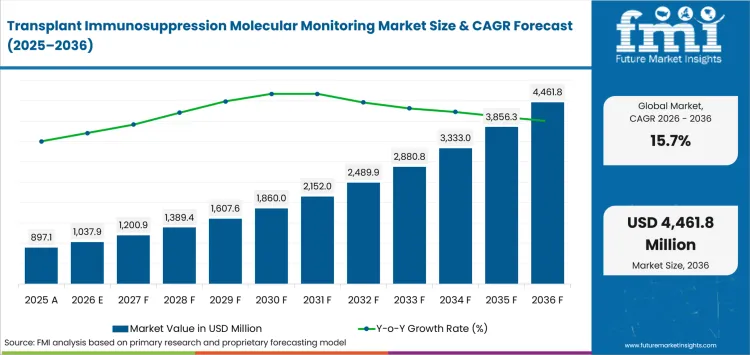
USD 1,037.9 million in 2026 and USD 4,461.8 million by 2036 at a 15.7% CAGR.
Demand for transplant immunosuppression molecular monitoring is forecast to expand at 15.7% CAGR between 2026 and 2036, pushing valuation from USD 1037.9 million in 2026 to USD 4,461.8 million by 2036 as repeated molecular surveillance enters defined transplant pathways. Transplant clinicians need molecular evidence that identifies graft injury or immune imbalance before routine chemistry supports an invasive assessment. UNOS reported in January 2026 that 49064 organ transplants were performed across the United States during 2025. The procedure base supports repeat surveillance across kidney and heart pathways together with lung and liver programs that carry organ-specific risk. Commercial value strengthens when transplant diagnostics connect molecular results with a defined biopsy or treatment decision across repeated care intervals.
United States transplant programs often use centralized reference laboratories, but Japanese care pathways rely more heavily on hospital-based testing and national coordination. The Japan Organ Transplant Network recorded 367 transplant procedures during the first half of 2026. The transplant activity supports repeat monitoring that protects graft function and guides careful immunosuppression adjustment across hospital pathways. American commercial models reward broad logistics support and payer coverage, whereas Japanese programs emphasize local validation and consistent laboratory workflows. Japanese clinical diagnostics platforms gain adoption when results enter specialist review quickly and remain comparable across repeated samples from the same recipient.
Key Takeaways of Transplant Immunosuppression Molecular Monitoring Market
- Demand for transplant immunosuppression molecular monitoring is driven by post-transplant surveillance creating commercial value when molecular findings reduce uncertainty around rejection risk and immunosuppression adjustment.
- By product, type assays hold the leading share at 39.1% in 2026, underpinned by their direct connection with rejection-risk assessment across repeated testing.
- PCR-based monitoring is the dominant technology segment, holding 41.1% share in 2026, linked to established clinical laboratory infrastructure and standardized viral-load comparison.
- Kidney transplant monitoring accounts for 44.2% transplant-type share in 2026, supported by procedure volume and follow-up duration across changing immunosuppression regimens.
- Hospitals and transplant centers lead end-user demand at 43.1% share in 2026, reflecting direct clinical ownership over immunosuppression changes and biopsy decisions.
- Germany, South Korea, and Japan record CAGRs of 18.9%, 17.9%, and 16.4% respectively through 2036, while the United States and United Kingdom require evidence that supports coverage decisions and routine placement inside established care pathways.
- Competition centers on CareDx, Natera, Thermo Fisher Scientific, Devyser Diagnostics, Eurofins Viracor, Verici Dx, QIAGEN, and Roche Diagnostics, with vendors differentiating through donor-derived cell-free DNA services, distributed molecular testing platforms, and immune-function/viral-load testing breadth.
Analyst Perspective
Type assays earn their commercial weight not from analytical novelty but from decision clarity, since a donor-derived cell-free DNA result that guides biopsy review carries different clinical value than an immune-function result supporting immunosuppression assessment, and transplant centers that can't define which decision attaches to which result range end up duplicating tests rather than building a coherent surveillance program. PCR-based monitoring's dominant share reflects workflow maturity in hospital laboratories that already run validated nucleic-acid testing for CMV, EBV, and BKV, not technical superiority over newer sequencing methods, so its position is likely to erode only as those alternative platforms match its turnaround and standardization rather than outperform it on sensitivity alone. Kidney's large addressable base masks real variation in how consistently molecular monitoring gets used, since payment policies that cap testing frequency or laboratory turnaround that lands after a clinical decision window has closed can leave a technically sound program with a large procedure count but limited real diagnostic influence.
-Anurag Sharma, Principal Consultant at Future Market Insights
Source: FMI's proprietary forecasting model and primary research
How is the Transplant Immunosuppression Molecular Monitoring Market segmented?
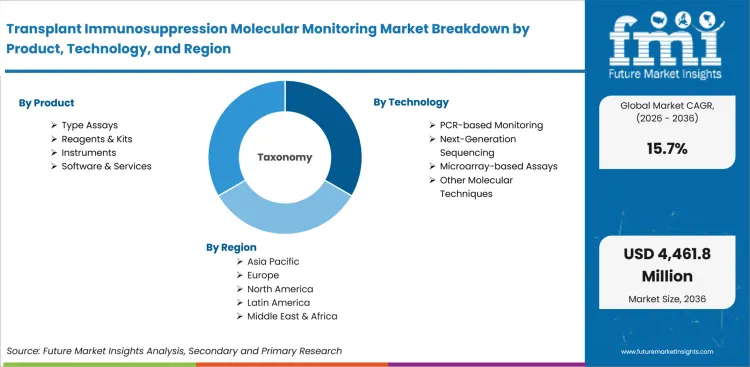
The transplant immunosuppression molecular monitoring industry is segmented by product, technology, transplant type, end user, and region.
The segmentation framework separates measurable products from the laboratory methods and clinical settings that generate revenue. Product analysis covers type assays together with reagents and kits plus instruments and supporting software services. Technology analysis compares PCR-based monitoring with next-generation sequencing and microarray methods alongside other molecular techniques. Transplant type analysis distinguishes kidney and liver recipients from heart and lung recipients plus other organ programs. End-user analysis separates hospitals and transplant centers from diagnostic laboratories and academic research institutes worldwide. Regional analysis explains how transplant capacity and reimbursement pathways influence adoption across national healthcare systems.
How do type assays shape the product category?
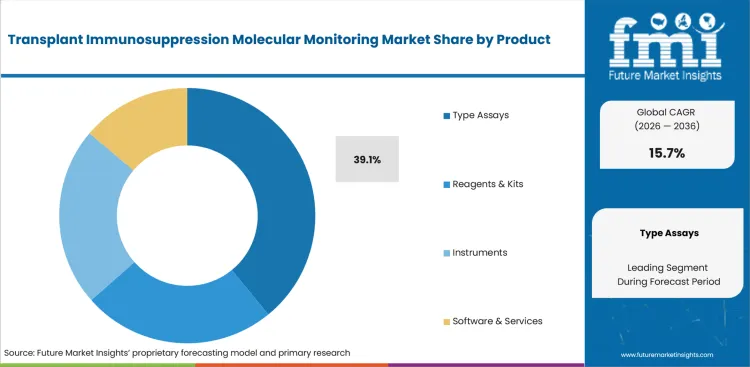
Type assays organize commercial offers around the molecular signal that informs a transplant decision rather than the instrument used for testing. CMS listed donor-derived cell-free DNA and gene-expression tests among the solid-organ rejection assays that completed MolDX technical assessment in its January 2026 coding article. The range shows how molecular diagnostics can support graft-injury surveillance and immune-quiescence assessment through distinct analytical designs. Transplant programs compare clinical interpretation and covered indications before choosing a test family for routine surveillance.
- Type assays are estimated to hold 39.1% share of the product category in 2026, underpinned by their direct connection with rejection-risk assessment. The category includes molecular measurements that translate blood or tissue signals into a clinically reviewable result. Revenue concentrates in repeated testing because one recipient can require several assessments across the post-transplant pathway.
- Transplant centers adopt type assays when clinical teams can define the decision attached to each result range. A donor-derived cell-free DNA result may guide biopsy review while an immune-function result may support immunosuppression assessment. Clear decision ownership reduces duplicate testing and improves the commercial value of longitudinal monitoring programs.
What supports PCR-based monitoring within the technology category?
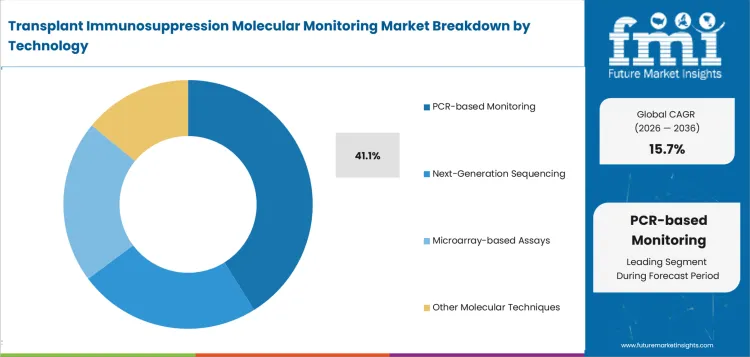
PCR-based monitoring fits hospital laboratories that already operate validated nucleic-acid workflows for immunocompromised transplant recipients. Roche documents automated CMV and EBV plus BKV tests that support treatment decisions and standardized viral-load comparison across institutions. The menu gives automated molecular testing systems a practical role in monitoring infection risk that can influence immunosuppression management. Laboratories value established controls and standardized units because longitudinal interpretation depends on comparable results across repeated samples.
- PCR-based monitoring is projected to account for 41.1% share of the technology category in 2026, linked to established clinical laboratory infrastructure. The method supports targeted assays with familiar quality-control procedures and predictable turnaround across routine post-transplant testing. Its share reflects workflow maturity rather than technical superiority across every rejection or graft-injury monitoring application.
- Hospital laboratories favor PCR-based monitoring for viral surveillance that must coordinate closely with immunosuppression decisions. Standardized assays reduce method variation and allow clinicians to compare viral-load changes across consecutive follow-up visits. Adoption weakens whenever test menus require separate instruments or incompatible sample preparation for related transplant pathogens.
How is kidney transplant positioned within the transplant type category?
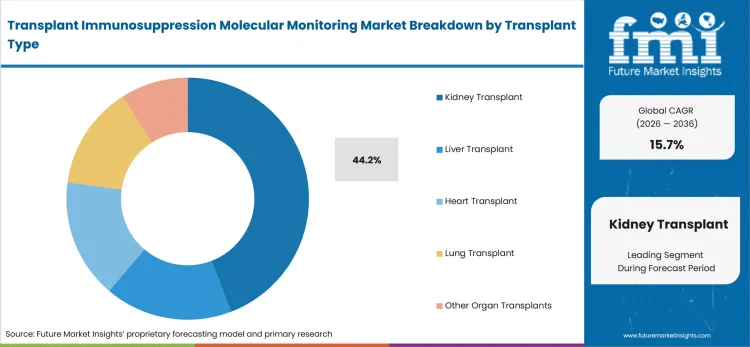
Kidney recipients require sustained follow-up because graft function can change across infection and rejection events during long-term immunosuppression. The OPTN and SRTR reported 28,492 kidney transplants in the United States during 2024 within the annual data report published in 2026. The procedure base creates a broad clinical setting for liquid biopsy approaches that measure donor-derived cell-free DNA without replacing confirmatory evaluation. Commercial models must support repeat sampling and interpretation across stable surveillance plus investigations triggered by clinical changes.
- Kidney transplant monitoring is forecast to represent 44.2% share of the transplant type category in 2026, supported by procedure volume and follow-up duration. Recipients may remain under surveillance for many years across changing immunosuppression regimens and infection risks. The share position reflects a large addressable testing base rather than a uniform protocol across every transplant center.
- Nephrologists and transplant surgeons use molecular monitoring when results complement creatinine trends and donor-specific antibody findings. Programs gain value from longitudinal baselines that distinguish a transient signal from a sustained change requiring biopsy review. Adoption slows when payment policies limit testing frequency or interpretation arrives after the clinical decision window.
Why do hospitals & transplant centers lead the end user category?
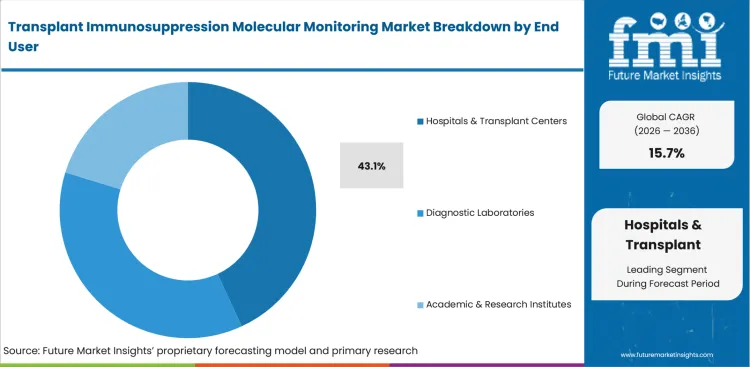
Hospitals and transplant centers control immunosuppression changes and biopsy decisions that determine whether molecular results influence patient management. Natera reported in July 2025 that the PEDAL study enrolled 488 kidney recipients across 28 transplant centers for longitudinal donor-derived cell-free DNA monitoring. The multicenter design shows why laboratory information systems must connect specimen status and molecular results with organ-specific clinical review. Centralized laboratories can perform testing, but specialist centers retain responsibility for interpreting results inside the complete care pathway.
- Hospitals and transplant centers are estimated to hold 43.1% share of the end-user category in 2026, reflecting direct clinical ownership. Specialist teams decide whether a result supports observation or medication review plus imaging and biopsy escalation. Their share reflects decision authority and repeated patient contact rather than exclusive ownership of laboratory instrumentation.
- Transplant centers adopt molecular monitoring through protocols that define test timing and responsible reviewers across organ programs. Programs need specimen collection support and result education together with documented routes for uncertain findings. A service loses value when laboratory turnaround and clinic scheduling prevent the result from changing a planned decision.
What are the drivers, restraints, and opportunities in the Transplant Immunosuppression Molecular Monitoring Market?
Market expansion depends on repeat surveillance value, while regulatory clarity and implementation discipline determine how rapidly new molecular tests enter routine pathways.
- Driver: Longitudinal molecular evidence can reduce uncertainty around rejection risk across repeated post-transplant clinical decisions.
- Restraint: Regulatory and coverage differences can limit routine placement despite credible analytical and clinical validation evidence.
- Opportunity: Distributed assay kits can extend molecular monitoring beyond centralized services through validated hospital laboratory workflows.
Longitudinal surveillance supports market growth because isolated chemistry results may not explain early graft injury or immune activation. CareDx reported in August 2025 that its KOAR study enrolled 1,743 patients across 56 United States transplant centers. The same study generated 18,584 AlloSure tests and documented repeat molecular monitoring across a large clinical cohort. The scale supports in vitro diagnostics adoption where repeated measurements guide biopsy selection and follow-up intensity across kidney recipients. Commercial demand strengthens when providers can connect test frequency with a defined clinical action and a covered care pathway.
Regulatory uncertainty limits expansion because transplant molecular tests can reach clinicians through different laboratory and distributed-product pathways. The FDA states that a federal district court vacated its 2024 laboratory-developed-test final rule on March 31 2025. The agency reverted the regulation in September 2025, leaving multiplex molecular diagnostics developers to navigate CLIA requirements and test-specific coverage routes. Commercial planning remains difficult when validation evidence and reimbursement decisions develop through separate authorities and schedules.
Distributed molecular kits create an opportunity for hospital laboratories that need local control over turnaround and specimen processing. CareDx reported in February 2025 that a European multicenter study compared AlloSeq cfDNA performance across 580 kidney transplant recipients. The study supports next-generation sequencing workflows that can place donor-derived cell-free DNA testing closer to regional transplant programs. Suppliers must pair assay performance with training and external quality controls plus clear interpretation support for routine clinical adoption.
Which country CAGRs are profiled in the Transplant Immunosuppression Molecular Monitoring Market?
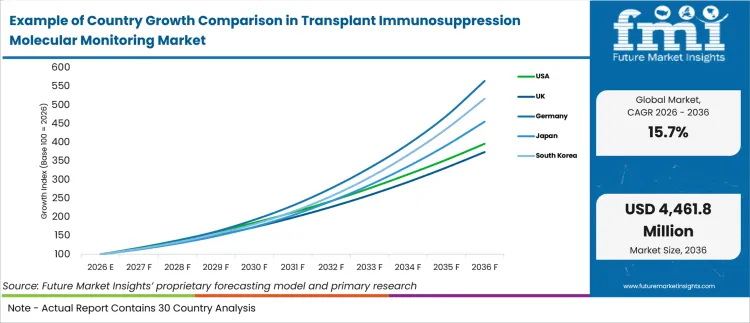
| Country | CAGR |
|---|---|
| USA | 14.8% |
| UK | 14.1% |
| Germany | 18.9% |
| Japan | 16.4% |
| South Korea | 17.9% |
How do country-level CAGRs compare in the Transplant Immunosuppression Molecular Monitoring Market?
The country growth prospects span 4.8 percentage points and form three distinct growth bands rather than one uniform commercial adoption pattern. Germany and South Korea occupy the upper band with a one-point separation between their approved growth rates. Japan forms the middle position through a 16.4% CAGR that reflects disciplined specialist pathways and hospital laboratory capacity. The United States and United Kingdom sit within the lower band despite mature transplant systems and established molecular testing options. Their relative positions reflect reimbursement and implementation conditions rather than weaker clinical need for post-transplant monitoring.
- Germany records 18.9% CAGR through 2036 and benefits from specialist center density plus regulated adoption across a broadly insured healthcare system.
- South Korea follows at 17.9% CAGR through 2036, supported by tertiary-care concentration and national reporting that supports structured transplant follow-up.
- Japan is forecast at 16.4% CAGR as hospital-centered pathways emphasize consistent testing and careful longitudinal interpretation.
- The United States is projected at 14.8% CAGR by 2036 despite broad assay availability because coverage and protocol placement vary by provider.
- The United Kingdom is estimated at 14.1% CAGR through 2036, supported by public procurement pathways that require service impact and capacity evidence.
Similar growth rates can produce different commercial routes because service delivery and purchasing authority vary across healthcare systems. Suppliers therefore need country-specific evidence for reimbursement and laboratory operations plus clinical ownership of uncertain results. The full report provides country-level CAGR analysis across North America, Latin America, Europe, East Asia, South Asia, Oceania and the Middle East and Africa.
Country-wise Analysis
- United States transplant programs combine large procedure volumes with centralized molecular laboratories and Medicare coverage pathways. The United States market is projected to expand at 14.8% CAGR over the assessment period. HRSA reported in January 2025 that 48,149 organ transplants occurred across the United States during 2024. Kidney procedures reached 27,759 and represented the largest transplant category within the national procedure base. The national procedure base enables repeat surveillance services with established specimen logistics and specialist ordering routes. Coverage varies across payers and indications, which creates material friction for protocols requiring frequent testing during stable surveillance. Suppliers need organ-specific coverage evidence and reliable nationwide collection support before transplant centers standardize routine schedules.
- United Kingdom transplant services operate through national registers and public procurement across a coordinated specialist network. The United Kingdom market is forecast to record 14.1% CAGR from 2026 to 2036. NHS Blood and Transplant reported in March 2026 that the active waiting list reached 8,237 people and fifteen assessment centers entered a preservation pilot. National coordination supports common protocols and structured evaluation across participating transplant centers throughout the country. Public budgets create material friction because new molecular services must demonstrate patient benefit and capacity impact before routine commissioning. Suppliers need evidence that testing changes biopsy use or clinic workload within existing NHS pathways.
- Germany supports organ transplantation through forty-three specialist centers connected directly with the Eurotransplant allocation network. The German market is projected to advance at 18.9% CAGR by 2036. Deutsche Stiftung Organtransplantation reported in January 2026 that German centers transplanted 3,256 organs during 2025. The same official release counted 8,199 people awaiting transplantation across Germany at the end of 2025. Specialist density and broad insurance coverage create a direct enabler for validated molecular monitoring across kidney and heart programs. Center-level laboratory practices create friction because evidence review and reimbursement implementation can differ across federal and hospital settings. Commercial entry requires German-language support and clear conformity status plus dependable nationwide regional service coverage.
- Japan manages transplant candidacy through a national network and hospital pathways that emphasize controlled specialist follow-up. The Japanese market is estimated to grow at 16.4% CAGR over the forecast period. The Japan Organ Transplant Network recorded 14,983 registered kidney candidates on June 30 2026 and showed the largest concentration in the Kanto-Koshinetsu block. Hospital-centered care enables consistent result review and careful linkage with immunosuppression decisions across repeated specialist visits. Limited deceased-donor activity and regional concentration create friction by narrowing testing volumes outside major transplant centers. Suppliers need local regulatory authorization and Japanese interpretation materials plus service routes that support regional laboratories.
- South Korea maintains annual official reporting for organ donation and transplantation through the national health administration. The South Korean market is forecast to expand at 17.9% CAGR from 2026 to 2036. The Ministry of Health and Welfare identifies organ donation and transplantation statistics as an annual approved reporting program under number 117112. National reporting and tertiary-hospital concentration support structured evaluation of new molecular monitoring technologies across transplant programs. Reliance on major urban centers creates material friction for specimen access and specialist interpretation outside established transplant hubs. Commercial programs need Korean regulatory clearance and local laboratory partnerships plus training that reaches clinical teams beyond Seoul.
Who are the notable companies in the Transplant Immunosuppression Molecular Monitoring Market?
CareDx, Natera, Thermo Fisher Scientific, Eurofins Viracor, Verici Dx, Devyser Diagnostics, QIAGEN, and Roche Diagnostics are notable companies shaping this market.
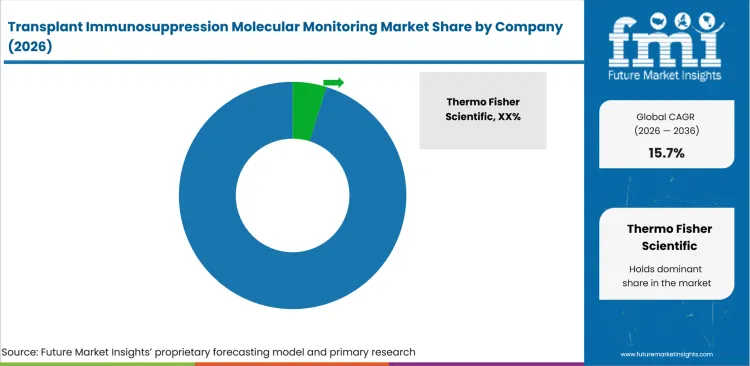
The competitive field combines centralized rejection-testing services with distributed assay platforms and broader post-transplant laboratory portfolios. CMS currently lists tests from CareDx and Natera plus Verici Dx and Eurofins within covered molecular rejection pathways under applicable policy criteria. Thermo Fisher Scientific and Devyser Diagnostics support transplant-focused point-of-care molecular testing through kits and laboratory workflows that can operate closer to clinical centers. QIAGEN and Roche Diagnostics address immune-function and viral-load monitoring that influences immunosuppression management across hospital laboratories. Commercial differentiation depends on organ coverage and interpretation support plus specimen logistics and reimbursement access rather than corporate scale alone.
- CareDx and Natera provide centralized donor-derived cell-free DNA services with organ-specific interpretation and established specimen collection support.
- Thermo Fisher Scientific and Devyser Diagnostics provide distributed transplant assays that give qualified laboratories greater control over testing workflows.
- Eurofins Viracor and Verici Dx provide specialized laboratory services while QIAGEN and Roche support immune and infection monitoring.
Competitive Benchmarking: Transplant Immunosuppression Molecular Monitoring Market
| Company | Transplant-Specific Molecular Testing | Clinical Interpretation Support | Integrated Testing Services | Geographic Reach |
|---|---|---|---|---|
| CareDx | High | High | High | North America and Europe |
| Natera | High | High | High | United States |
| Thermo Fisher Scientific | High | High | Medium | Global |
| Eurofins Viracor | High | High | High | United States and Europe |
| Verici Dx | Medium | High | High | United States |
| Devyser Diagnostics | Medium | Medium | Low | Europe and North America |
| QIAGEN | Medium | Medium | Low | Global |
| Roche Diagnostics | Medium | Medium | Low | Global |
Key Developments in the Transplant Immunosuppression Molecular Monitoring Market
- In March 2025, CareDx made AlloSure Heart commercially available for pediatric heart recipients under fifteen and expanded AlloSure Kidney to simultaneous pancreas-kidney recipients. The company stated that both indications received New York State Clinical Laboratory Evaluation Program approval. The expansion broadens addressable testing pathways across two clinically distinct recipient groups without changing the centralized service model.
- In November 2025, Devyser enrolled the first patient in its United States Accept cfDNA clinical study for kidney transplant monitoring. The prospective study plans to enroll up to 400 recipients across six transplant centers and compare molecular signals with kidney biopsy results. The program supports a potential FDA pathway for a distributed next-generation sequencing assay used by qualified laboratories.
- In June 2026, Verici Dx received New York State approval for Tutivia and extended commercial access across all fifty states. Tutivia uses a blood-based gene-expression result to classify kidney recipients as having low or high acute rejection risk. Nationwide authorization strengthens the company’s service route beyond jurisdictions that previously accepted its existing laboratory credentials.
- In June 2026, Natera and Eledon Pharmaceuticals selected Prospera as the exclusive donor-derived cell-free DNA assay for a planned Phase 3 kidney transplant trial. The planned study targets approximately 600 recipients across more than 100 transplant centers worldwide during enrollment. The collaboration positions longitudinal molecular monitoring inside an immunosuppression development program rather than a standalone diagnostic study.
Key Players in the Transplant Immunosuppression Molecular Monitoring Market
Centralized Rejection and Graft-Injury Testing Providers
- CareDx
- Natera
- Eurofins Viracor
- Verici Dx
Distributed Transplant Assay and Platform Providers
- Thermo Fisher Scientific
- Devyser Diagnostics
Immune-Function and Infection Monitoring Providers
- QIAGEN
- Roche Diagnostics
Transplant Immunosuppression Molecular Monitoring Market - Report Scope
| Coverage field | Report scope |
|---|---|
| Market breakdown | Product, technology, transplant type, end user, and region. |
| Quantitative Units | Revenue in USD Million, CAGR in %. |
| Market Definition | Molecular assays, kits, instruments, software, and testing services used to monitor graft injury, rejection risk, immune function, or transplant-related infection during immunosuppression management. |
| Regions Covered | North America, Latin America, Europe, East Asia, South Asia, Oceania, and Middle East and Africa. |
| Countries Covered | USA, UK, Germany, Japan, and South Korea, with additional countries assessed across the complete regional framework. |
| Key Companies Profiled | CareDx, Natera, Thermo Fisher Scientific, Eurofins Viracor, Verici Dx, Devyser Diagnostics, QIAGEN, and Roche Diagnostics |
| Forecast Period | 2026 to 2036. |
| Approach | Hybrid bottom-up and top-down market sizing supported by primary research and official desk research. |
Transplant Immunosuppression Molecular Monitoring Market - Research Methodology
| Method | Approach |
|---|---|
| Primary Research | FMI analysts gathered input from manufacturers, service providers, technology developers, distributors, end users, procurement teams, and subject-matter experts. Interviews examined purchasing decisions, product or service evaluation, adoption barriers, approval requirements, pricing considerations, and expectations for technical or commercial support. Respondents were also asked what evidence is required before a trial, pilot, or initial order develops into regular purchasing. |
| Desk Research | Desk research covered government statistics, regulatory publications, trade data, industry associations, technical literature, standards, company filings, product information, and official corporate announcements. Sources were reviewed for relevance, publication date, geographic coverage, and consistency with the defined market scope. Claims relating to performance, applications, approvals, capacity, investment, and commercial activity were retained only when supported by credible public evidence. |
| Market Sizing and Forecasting | The market model combined the baseline value with historical performance, segment structure, pricing and volume indicators, adoption levels, company participation, and country-level demand conditions. Forecast assumptions considered economic activity, investment trends, regulatory developments, technology adoption, purchasing cycles, supply availability, and barriers to wider market use. Segment and regional estimates were reconciled before the final market total was calculated. |
| Data Validation | Estimates were checked against multiple independent indicators, including public data, company activity, trade patterns, industry developments, and findings from primary interviews. Validation also tested whether products, services, applications, and company revenues fell within the defined market boundaries. Adjacent categories, unsupported claims, overlapping revenues, and activities without direct market relevance were excluded to reduce double counting and maintain consistency across segments and countries. |
Transplant Immunosuppression Molecular Monitoring Market by Segments
Transplant Immunosuppression Molecular Monitoring Market segmented by Product:
- Type Assays
- Reagents & Kits
- Instruments
- Software & Services
Transplant Immunosuppression Molecular Monitoring Market segmented by Technology:
- PCR-based Monitoring
- Next-Generation Sequencing
- Microarray-based Assays
- Other Molecular Techniques
Transplant Immunosuppression Molecular Monitoring Market segmented by Transplant Type:
- Kidney Transplant
- Liver Transplant
- Heart Transplant
- Lung Transplant
- Other Organ Transplants
Transplant Immunosuppression Molecular Monitoring Market segmented by End User:
- Hospitals & Transplant Centers
- Diagnostic Laboratories
- Academic & Research Institutes
Transplant Immunosuppression Molecular Monitoring Market by Region:
- North America
- United States
- Canada
- Latin America
- Brazil
- Mexico
- Argentina
- Chile
- Western Europe
- Germany
- France
- United Kingdom
- Italy
- Spain
- Benelux
- Nordics
- Eastern Europe
- Poland
- Czech Republic
- Romania
- Hungary
- East Asia
- China
- Japan
- South Korea
- South Asia and Pacific
- India
- ASEAN
- Australia and New Zealand
- Middle East and Africa
- GCC Countries
- South Africa
- Türkiye
- Israel
Research Sources and Bibliography
- United Network for Organ Sharing. (2026, January 28). USA surpasses 49,000 organ transplants while deceased organ donations dip.
- Japan Organ Transplant Network. (2026, June 30). [Organ donations and transplants].
- Centers for Medicare & Medicaid Services. (2026, January 13). Billing and coding: MolDX: Molecular testing for solid organ allograft rejection (A58168).
- Roche Diagnostics. (n.d.). Transplant transmitted infections.
- Organ Procurement and Transplantation Network & Scientific Registry of Transplant Recipients. (2026). OPTN/SRTR 2024 annual data report: Overview of USA solid organ transplantation.
- Natera, Inc. (2025, July 24). PEDAL study successful, shows monitoring with Prospera Kidney provides accurate prognosis of long-term clinical outcomes following rejection; now published in AJT.
- CareDx, Inc. (2025, August 6). CareDx announces landmark KOAR study published in the American Journal of Transplantation.
- USA Food and Drug Administration. (2025, September 19). Laboratory developed tests.
- CareDx, Inc. (2025, February 20). CareDx announces study showing AlloSeq cfDNA highly accurate in detecting rejection in organ transplant patients.
- Health Resources and Services Administration. (2025, January 15). Organ transplants exceeded 48,000 in 2024; a 3.3 percent increase from the transplants performed in 2023.
- NHS Blood and Transplant. (2026, March 17). NHS starts machine preservation programme to enable more transplants.
- Deutsche Stiftung Organtransplantation. (2026, January 15). Organspendezahlen 2025 auf höchstem Stand seit 2012 [Organ donation figures for 2025 at the highest level since 2012].
- Japan Organ Transplant Network. (2026, June 30). [Number of registered transplant candidates].
- Ministry of Health and Welfare, Republic of Korea. [Statistics on organ donation and transplantation].
- Natera, Inc. (2026, June 25). Natera and Eledon announce strategic partnership for Prospera monitoring in planned Phase 3 kidney transplant trial.
- Devyser Diagnostics AB. (2025, November 25). Devyser advances USA clinical strategy with first patient enrolled in Devyser Accept cfDNA study.
- CareDx, Inc. (2025, March 11). CareDx launches two expanded indications for AlloSure testing services.
- Verici Dx plc. (2026, June 24). Verici Dx receives New York State approval, establishing nationwide access to Tutivia kidney transplant rejection test.
- Thermo Fisher Scientific. (n.d.). Molecular transplant assays and services.
- Eurofins Viracor. (2025, April 21). Revolutionizing transplant management with Eurofins Transplant.
This bibliography is provided for reader reference and is not exhaustive. The full report contains the complete reference list and detailed citations
This Report Answers
- How large is the transplant immunosuppression molecular monitoring market in 2026 and 2036?
- Which clinical conditions support repeat molecular monitoring across post-transplant care pathways?
- Why do type assays hold the largest product share during 2026?
- How does PCR-based monitoring support infection and immunosuppression management?
- Why does kidney transplant monitoring account for the largest transplant type share?
- How do country growth rates differ across the USA, UK, Germany, Japan, and South Korea?
- Which companies provide centralized testing services or distributed transplant molecular assays?
- What regulatory and reimbursement conditions limit routine molecular monitoring adoption?
- How can transplant centers evaluate clinical value and implementation readiness before protocol expansion?
Frequently Asked Questions
How big is the Transplant Immunosuppression Molecular Monitoring Market in 2026?
The transplant immunosuppression molecular monitoring market is valued at USD 1037.9 million in 2026 and is forecast to reach USD 4461.8 million by 2036. Growth reflects transplant clinicians needing molecular evidence that identifies graft injury or immune imbalance before routine chemistry supports an invasive assessment.
What is the CAGR of the Transplant Immunosuppression Molecular Monitoring Market from 2026 to 2036?
The transplant immunosuppression molecular monitoring market grows at a CAGR of 15.7% between 2026 and 2036, supported by longitudinal molecular evidence that can reduce uncertainty around rejection risk across repeated post-transplant clinical decisions.
Which product leads the Transplant Immunosuppression Molecular Monitoring Market?
Type assays account for 39.1% of the transplant immunosuppression molecular monitoring market by product in 2026, underpinned by their direct connection with rejection-risk assessment across repeated testing throughout the post-transplant pathway.
How much will the Transplant Immunosuppression Molecular Monitoring Market add between 2026 and 2036?
The transplant immunosuppression molecular monitoring market is set to add USD 3423.9 million between 2026 and 2036, growing from USD 1037.9 million to USD 4461.8 million as longitudinal molecular surveillance extends across a widening base of hospital transplant programs.
Who are the leading companies in the Transplant Immunosuppression Molecular Monitoring Market?
Five companies lead the transplant immunosuppression molecular monitoring market, including CareDx, Natera, Thermo Fisher Scientific, Eurofins Viracor, and Verici Dx, competing through centralized rejection-testing services, distributed assay platforms, and clinical interpretation support.
Preview the report firsthand - request a free sample
Get SampleGet the brochure for pricing and purchase details.
Get PDFTable of Content
- Key Takeaways
- Market Size and CAGR
- Top Growth Driver
- Fastest Growing Segment
- Leading Region
- Key Companies
- Emerging Opportunities
- Executive Summary
- Global Market Outlook
- Demand-side Trends
- Supply-side Trends
- Technology Roadmap Analysis
- Analysis and Recommendations
- Analyst Perspective (What is happening? Why now? What should investors know?)
- Key Questions Answered
- How large is the market?
- What is the CAGR?
- What are key trends?
- Which region dominates?
- Who are the leaders?
- Market Overview
- Market Coverage / Taxonomy
- Market Definition / Scope / Limitations
- Research Methodology
- Chapter Orientation
- Analytical Lens and Working Hypotheses
- Market Structure, Signals, and Trend Drivers
- Benchmarking and Cross-market Comparability
- Market Sizing, Forecasting, and Opportunity Mapping
- Research Design and Evidence Framework
- Desk Research Programme (Secondary Evidence)
- Expert Input and Fieldwork (Primary Evidence)
- Tooling, Models, and Reference Databases
- Data Engineering and Model Build
- Quality Assurance and Audit Trail
- Market Background
- Market Dynamics (Drivers, Restraints, Opportunity, Trends)
- Scenario Forecast (Optimistic, Likely, Conservative)
- Impact Analysis
- AI Impact
- Sustainability Impact
- Regulatory Impact
- Technology Impact
- Consumer / Buyer Analysis
- Purchase Drivers
- Adoption Barriers
- Buyer Journey
- Opportunity Map Analysis
- Product Life Cycle Analysis
- Supply Chain Analysis
- Investment Feasibility Matrix
- Value Chain Analysis
- PESTLE and Porter's Analysis
- Regulatory Landscape
- Regional Parent Market Outlook
- Production and Consumption Statistics
- Import and Export Statistics
- Global Market Analysis and Forecast, 2021 to 2036
- Historical Market Size Value (USD Million) Analysis, 2021 to 2025
- Current and Future Market Size Value (USD Million) Projections, 2026 to 2036
- Y-o-Y Growth Trend Analysis
- Absolute $ Opportunity Analysis
- Global Market Pricing Analysis, 2021 to 2036
- Global Market Analysis and Forecast, By Product, 2021 to 2036
- Introduction / Key Findings
- Historical Market Size Value (USD Million) Analysis By Product, 2021 to 2025
- Current and Future Market Size Value (USD Million) Analysis and Forecast By Product, 2026 to 2036
- Type Assays
- Reagents & Kits
- Instruments
- Software & Services
- Type Assays
- Y-o-Y Growth Trend Analysis By Product, 2021 to 2025
- Absolute $ Opportunity Analysis By Product, 2026 to 2036
- Global Market Analysis and Forecast, By Technology, 2021 to 2036
- Introduction / Key Findings
- Historical Market Size Value (USD Million) Analysis By Technology, 2021 to 2025
- Current and Future Market Size Value (USD Million) Analysis and Forecast By Technology, 2026 to 2036
- PCR-based Monitoring
- Next-Generation Sequencing
- Microarray-based Assays
- Other Molecular Techniques
- PCR-based Monitoring
- Y-o-Y Growth Trend Analysis By Technology, 2021 to 2025
- Absolute $ Opportunity Analysis By Technology, 2026 to 2036
- Global Market Analysis and Forecast, By Transplant Type, 2021 to 2036
- Introduction / Key Findings
- Historical Market Size Value (USD Million) Analysis By Transplant Type, 2021 to 2025
- Current and Future Market Size Value (USD Million) Analysis and Forecast By Transplant Type, 2026 to 2036
- Kidney Transplant
- Liver Transplant
- Heart Transplant
- Lung Transplant
- Other Organ Transplants
- Kidney Transplant
- Y-o-Y Growth Trend Analysis By Transplant Type, 2021 to 2025
- Absolute $ Opportunity Analysis By Transplant Type, 2026 to 2036
- Global Market Analysis and Forecast, By End User, 2021 to 2036
- Introduction / Key Findings
- Historical Market Size Value (USD Million) Analysis By End User, 2021 to 2025
- Current and Future Market Size Value (USD Million) Analysis and Forecast By End User, 2026 to 2036
- Hospitals & Transplant Centers
- Diagnostic Laboratories
- Academic & Research Institutes
- Hospitals & Transplant Centers
- Y-o-Y Growth Trend Analysis By End User, 2021 to 2025
- Absolute $ Opportunity Analysis By End User, 2026 to 2036
- Global Market Analysis and Forecast, By Region, 2021 to 2036
- Introduction
- Historical Market Size Value (USD Million) Analysis By Region, 2021 to 2025
- Current Market Size Value (USD Million) Analysis and Forecast By Region, 2026 to 2036
- North America
- Latin America
- Western Europe
- Eastern Europe
- East Asia
- South Asia and Pacific
- Middle East & Africa
- Market Attractiveness Analysis By Region
- North America Market Analysis and Forecast, By Country, 2021 to 2036
- Historical Market Size Value (USD Million) Trend Analysis By Market Taxonomy, 2021 to 2025
- Market Size Value (USD Million) Forecast By Market Taxonomy, 2026 to 2036
- By Country
- USA
- Canada
- By Product
- By Technology
- By Transplant Type
- By End User
- By Country
- Market Attractiveness Analysis
- By Country
- By Product
- By Technology
- By Transplant Type
- By End User
- Key Takeaways
- Latin America Market Analysis and Forecast, By Country
- Historical Market Size Value (USD Million) Trend Analysis By Market Taxonomy, 2021 to 2025
- Market Size Value (USD Million) Forecast By Market Taxonomy, 2026 to 2036
- By Country
- Brazil
- Mexico
- Chile
- Rest of Latin America
- By Product
- By Technology
- By Transplant Type
- By End User
- By Country
- Market Attractiveness Analysis
- By Country
- By Product
- By Technology
- By Transplant Type
- By End User
- Key Takeaways
- Western Europe Market Analysis and Forecast, By Country
- Historical Market Size Value (USD Million) Trend Analysis By Market Taxonomy, 2021 to 2025
- Market Size Value (USD Million) Forecast By Market Taxonomy, 2026 to 2036
- By Country
- Germany
- UK
- Italy
- Spain
- France
- Nordic
- BENELUX
- Rest of Western Europe
- By Product
- By Technology
- By Transplant Type
- By End User
- By Country
- Market Attractiveness Analysis
- By Country
- By Product
- By Technology
- By Transplant Type
- By End User
- Key Takeaways
- Eastern Europe Market Analysis and Forecast, By Country
- Historical Market Size Value (USD Million) Trend Analysis By Market Taxonomy, 2021 to 2025
- Market Size Value (USD Million) Forecast By Market Taxonomy, 2026 to 2036
- By Country
- Russia
- Poland
- Hungary
- Balkan & Baltic
- Rest of Eastern Europe
- By Product
- By Technology
- By Transplant Type
- By End User
- By Country
- Market Attractiveness Analysis
- By Country
- By Product
- By Technology
- By Transplant Type
- By End User
- Key Takeaways
- East Asia Market Analysis and Forecast, By Country
- Historical Market Size Value (USD Million) Trend Analysis By Market Taxonomy, 2021 to 2025
- Market Size Value (USD Million) Forecast By Market Taxonomy, 2026 to 2036
- By Country
- China
- Japan
- South Korea
- By Product
- By Technology
- By Transplant Type
- By End User
- By Country
- Market Attractiveness Analysis
- By Country
- By Product
- By Technology
- By Transplant Type
- By End User
- Key Takeaways
- South Asia and Pacific Market Analysis and Forecast, By Country
- Historical Market Size Value (USD Million) Trend Analysis By Market Taxonomy, 2021 to 2025
- Market Size Value (USD Million) Forecast By Market Taxonomy, 2026 to 2036
- By Country
- India
- ASEAN
- Australia & New Zealand
- Rest of South Asia and Pacific
- By Product
- By Technology
- By Transplant Type
- By End User
- By Country
- Market Attractiveness Analysis
- By Country
- By Product
- By Technology
- By Transplant Type
- By End User
- Key Takeaways
- Middle East & Africa Market Analysis and Forecast, By Country
- Historical Market Size Value (USD Million) Trend Analysis By Market Taxonomy, 2021 to 2025
- Market Size Value (USD Million) Forecast By Market Taxonomy, 2026 to 2036
- By Country
- Kingdom of Saudi Arabia
- Other GCC Countries
- Türkiye
- South Africa
- Other African Union
- Rest of Middle East & Africa
- By Product
- By Technology
- By Transplant Type
- By End User
- By Country
- Market Attractiveness Analysis
- By Country
- By Product
- By Technology
- By Transplant Type
- By End User
- Key Takeaways
- Key Countries Market Analysis
- USA
- Pricing Analysis
- Market Share Analysis, 2025
- By Product
- By Technology
- By Transplant Type
- By End User
- Canada
- Pricing Analysis
- Market Share Analysis, 2025
- By Product
- By Technology
- By Transplant Type
- By End User
- Mexico
- Pricing Analysis
- Market Share Analysis, 2025
- By Product
- By Technology
- By Transplant Type
- By End User
- Brazil
- Pricing Analysis
- Market Share Analysis, 2025
- By Product
- By Technology
- By Transplant Type
- By End User
- Chile
- Pricing Analysis
- Market Share Analysis, 2025
- By Product
- By Technology
- By Transplant Type
- By End User
- Germany
- Pricing Analysis
- Market Share Analysis, 2025
- By Product
- By Technology
- By Transplant Type
- By End User
- UK
- Pricing Analysis
- Market Share Analysis, 2025
- By Product
- By Technology
- By Transplant Type
- By End User
- Italy
- Pricing Analysis
- Market Share Analysis, 2025
- By Product
- By Technology
- By Transplant Type
- By End User
- Spain
- Pricing Analysis
- Market Share Analysis, 2025
- By Product
- By Technology
- By Transplant Type
- By End User
- France
- Pricing Analysis
- Market Share Analysis, 2025
- By Product
- By Technology
- By Transplant Type
- By End User
- India
- Pricing Analysis
- Market Share Analysis, 2025
- By Product
- By Technology
- By Transplant Type
- By End User
- ASEAN
- Pricing Analysis
- Market Share Analysis, 2025
- By Product
- By Technology
- By Transplant Type
- By End User
- Australia & New Zealand
- Pricing Analysis
- Market Share Analysis, 2025
- By Product
- By Technology
- By Transplant Type
- By End User
- China
- Pricing Analysis
- Market Share Analysis, 2025
- By Product
- By Technology
- By Transplant Type
- By End User
- Japan
- Pricing Analysis
- Market Share Analysis, 2025
- By Product
- By Technology
- By Transplant Type
- By End User
- South Korea
- Pricing Analysis
- Market Share Analysis, 2025
- By Product
- By Technology
- By Transplant Type
- By End User
- Russia
- Pricing Analysis
- Market Share Analysis, 2025
- By Product
- By Technology
- By Transplant Type
- By End User
- Poland
- Pricing Analysis
- Market Share Analysis, 2025
- By Product
- By Technology
- By Transplant Type
- By End User
- Hungary
- Pricing Analysis
- Market Share Analysis, 2025
- By Product
- By Technology
- By Transplant Type
- By End User
- Kingdom of Saudi Arabia
- Pricing Analysis
- Market Share Analysis, 2025
- By Product
- By Technology
- By Transplant Type
- By End User
- Türkiye
- Pricing Analysis
- Market Share Analysis, 2025
- By Product
- By Technology
- By Transplant Type
- By End User
- South Africa
- Pricing Analysis
- Market Share Analysis, 2025
- By Product
- By Technology
- By Transplant Type
- By End User
- USA
- Market Structure Analysis
- Competition Dashboard
- Competition Benchmarking
- Market Share Analysis of Top Players
- By Regional
- By Product
- By Technology
- By Transplant Type
- By End User
- Emerging Startups
- Innovation Benchmarking
- Competition Analysis
- Competition Deep Dive
- Thermo Fisher Scientific
- Overview
- Product Portfolio
- Profitability by Market Segments
- Sales Footprint
- Strategy Overview
- Marketing Strategy
- Product Strategy
- Channel Strategy
- Eurofins Scientific
- CareDx
- Bio-Rad Laboratories
- Roche
- QIAGEN
- Illumina
- Natera
- Hologic
- Laboratory Corporation of America
- Thermo Fisher Scientific
- Case Studies
- Success Stories
- Recent Developments
- Competition Deep Dive
- Assumptions & Acronyms Used


