

- Market Size (2026)
- USD 1.35 Bn
- Forecast (2036)
- USD 3.06 Bn
- CAGR (2026 to 2036)
- 8.5%
How big is the Gene-Edited & Precision-Bred Crop Ingredients Market in 2026?
USD 1.35 billion in 2026 and USD 3.06 billion by 2036 at an 8.5% CAGR.
Sales of gene-edited and precision-bred crop ingredients are projected to expand at 8.5% CAGR from 2026 to 2036. The industry value is expected to increase from USD 1.35 billion in 2026 to USD 3.06 billion by 2036. Crop programs are gaining attention where seed changes improve yield or ingredient quality before commercial processing begins. USDA NASS reported in June 2025 that herbicide-tolerant soybean acreage remained at 96% in 2025. That adoption history shows how quickly a trait moves when farms see a clear operating return. CRISPR-based gene editing is expected to gain early demand where the edited crop also gives food processors a clear ingredient specification.
Market entry still depends on local review rules and customer proof. The European Commission reported in June 2026 that new EU rules cover plants produced by targeted mutagenesis and cisgenesis. The same page states that the rules entered into force on 16 July 2026 and apply from 17 July 2028. Food companies are expected to use that transition period to prepare label checks and ingredient records before broader procurement starts.
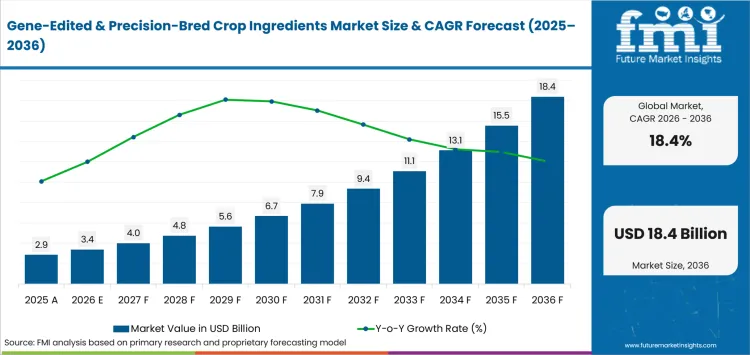
Key Takeaways of Gene-Edited & Precision-Bred Crop Ingredients Market
- Demand for gene-edited and precision-bred crop ingredients is shaped by the need to improve crop output and ingredient quality without foreign DNA, supported by clear NGT regulatory routes and proven field and processor performance within the same geography.
- By technology, CRISPR holds 61.8% share in 2026, while Cacao accounts for 40.7% share in 2026 within crop, reflecting targeted plant editing with cleaner trait records and direct ingredient security concerns across chocolate supply chains.
- China leads country growth at 9.1% CAGR through 2036, followed by Brazil at 8.9% and the Netherlands at 8.7%, shaped by grain-security planning, large crop acreage, and cocoa processing depth.
- Competition centers on Mars, Pairwise, Bayer, Corteva, Tropic Biosciences, Inari, and Benson Hill, spanning cacao research, breeding networks, tropical crop editing, and yield and ingredient performance programs.
- Regulatory traceability, edited trait reliability after field testing and processing, seed release mapping, and formulation validation remain key considerations for wider commercial ingredient adoption.
- Commercial expansion is expected to follow crops where field performance and customer formulation results are proven together, with contracts assigning regulatory records and traceability duties before supply begins.
Analyst Perspective
"The gene-edited & precision-bred crop ingredients market is increasingly shaped by the consistency of engineered traits from cultivation through ingredient processing. Food manufacturers are evaluating field performance, processing behavior, formulation compatibility, and regulatory status before expanding adoption. Suppliers that demonstrate reliable crop traits, traceable production, and consistent ingredient performance will be better positioned to build commercial acceptance."
— Nandini Roy Choudhury, Principal Analyst at Future Market Insights
Source: FMI's proprietary forecasting model and primary research
How is the Gene-Edited & Precision-Bred Crop Ingredients Market segmented?
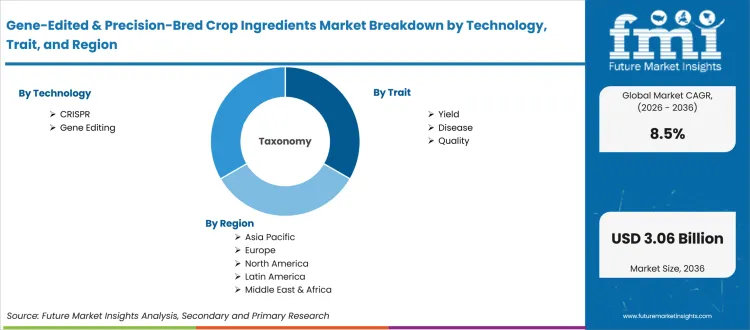
The gene-edited & precision-bred crop ingredients industry is segmented by technology, crop, trait, and region.
The segmentation framework separates the editing method from the crop base and the commercial trait being pursued. Technology covers CRISPR and other gene-editing approaches used in crop development. Crop analysis follows cacao and cereals along with produce so food companies assess supply risk by sourcing chain. Trait analysis separates yield from disease resistance and quality because each one changes validation work in a different way. Regional analysis shows how plant breeding differs across countries with separate release and food-use rules.
What supports demand for CRISPR within the technology category?
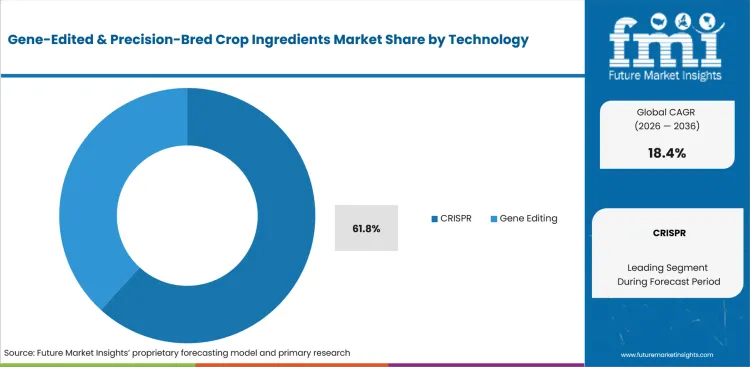
CRISPR is central to technology selection because it gives crop developers a direct way to target plant traits. The approach is useful where a company wants a yield or quality change that is easier to explain in a regulatory record. Commercial demand is expected to build first where edited seed output is measured through field trials and processor tests.
- With an estimated 61.8% share of technology spending in 2026, CRISPR is anticipated to lead because it supports targeted crop edits with clearer trait records. The method helps developers connect a genetic change with field output and ingredient behavior.
- Food companies are expected to prefer CRISPR-led programs when the edited trait has a clean review record. Adoption remains slower when the processor cannot connect the trait with yield, quality or a stable supply plan.
Why does cacao lead the crop category?
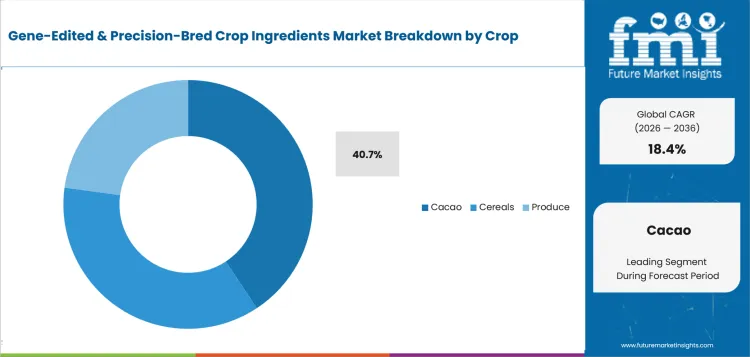
Cacao leads the crop view because chocolate makers face direct exposure to crop stress and bean-quality swings. Edited cacao research is expected to matter where disease pressure or climate stress affects the availability of consistent ingredients. Plant-based food ingredients planning becomes stronger when crop genetics and ingredient performance are reviewed together.
- By crop, cacao is expected to dominate with 40.7% share in 2026 due to ingredient security concerns across chocolate supply chains. Edited cacao traits are easier to defend when they protect bean supply or quality during processing.
- Cereals and produce add secondary demand where yield and quality traits affect everyday food manufacturing. Companies are expected to scale those crops after edited trait records become easier to explain to customers.
How does yield shape demand within the trait category?
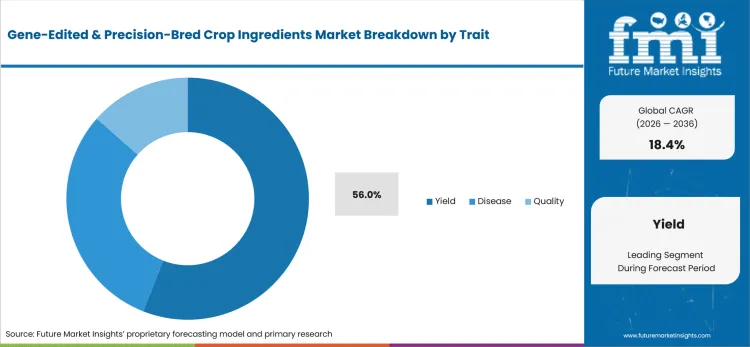
Yield leads the trait category because it gives farms and processors a measurable result. A yield trait is easier to test across field plots and then compare against ingredient output. Plant-based ingredient demand is expected to benefit when crop traits improve usable output without adding extra processing steps.
- Yield accounts for 56.0% of trait revenue in 2026 because output improvement is measured before full ingredient conversion. Seed developers gain a clearer commercial case when field gains carry into processor supply planning.
- Disease resistance and quality traits are expected to follow where they reduce rejected crop lots or improve finished-product consistency. Their adoption depends on proof from real growing conditions and not only controlled trials.
What are the drivers, restraints, and opportunities in the Gene-Edited & Precision-Bred Crop Ingredients Market?
Trait performance and clearer approval routes are increasing demand for edited crop ingredients that are tested from seed to finished product.
- Driver: Edited crop traits reduce uncertainty when farms and processors measure the same yield or quality gain.
- Restraint: Local review rules and customer label checks slow launch planning when documentation is incomplete.
- Opportunity: Cacao and tropical crops create room for edited traits that protect supply and ingredient quality.
Trait performance is the main demand driver because a food company needs proof before it changes its sourcing plan. USDA NASS reported in June 2025 that 94% of all USA corn acres planted were biotech varieties. The figure does not show demand for edited ingredients by itself. It does show that farms already work with trait-led seed systems at large scale. Edited crop programs are expected to gain faster acceptance when they convert that farm base into better processing yield or quality control.
Regulatory uncertainty is still the main restraint. APHIS stated in February 2025 that notifications apply to certain modified plants that meet the regulated-article definition under 7 CFR 340. The same page explains that some genome-edited organisms are outside APHIS biotechnology rules when plant-pest criteria are not met. Food companies are therefore expected to ask for case-by-case documentation before procurement. Genetically modified foods analysis gives a useful comparison for the approval and communication burden around edited ingredients.
The opportunity is strongest where edited crops solve an ingredient problem that processors already feel. Pairwise reported in August 2025 that Mars licensed its Fulcrum gene-editing tools for cacao research and development. It gives chocolate ingredient users a clearer route to test crop resilience before ingredient supply commitments expand.
Which country CAGRs are profiled in the Gene-Edited & Precision-Bred Crop Ingredients Market?
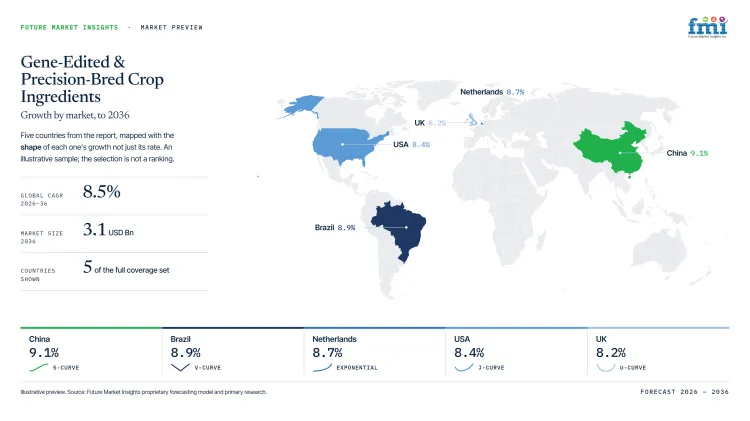
| Country | CAGR |
|---|---|
| China | 9.1% |
| Brazil | 8.9% |
| Netherlands | 8.7% |
| USA | 8.4% |
| UK | 8.2% |
How do country-level CAGRs compare in the Gene-Edited & Precision-Bred Crop Ingredients Market?
A global growth rate represents the weighted average of all markets included in the analysis. It does not need to match the rates of the five countries shown in the chart. Markets outside this comparison may therefore record different expansion rates. The selected countries provide an illustrative view of how regulatory systems and crop priorities shape the gene-edited and precision-bred crop ingredients market.
- The comparison is defined by a compressed range of 1.6 percentage points between China and the UK. China and Brazil form a closely aligned upper cluster. The Netherlands occupies a measured middle position while the USA and UK create another compact group. This narrow distribution indicates broadly comparable expansion expectations despite considerable differences in crop scale and commercial routes.
- China holds a notable position because grain-security planning supports edited yield and disease-resistance traits. Its development model depends on crop-specific approvals and processor acceptance.
- Brazil remains close to China in CAGR terms but follows an export-oriented route. Large soybean and grain acreage supports field validation while destination-market requirements influence ingredient commercialization.
- The Netherlands is separated moderately from Brazil and represents a processing-led market. Cocoa trade depth supports edited cacao ingredients while European regulatory and labeling requirements shape procurement timing.
- The USA is closely aligned with the Netherlands despite following an acreage-led adoption model. Established trait-based farming supports field testing while APHIS documentation and food-company traceability remain important.
- The UK is positioned slightly outside the middle group. Precision-breeding investment supports development in England while regulatory differences across the wider UK create separate commercialization requirements.
- Comparable CAGRs can therefore produce different market-entry conditions. Deployment timing will depend on crop approvals and processor validation rather than the CAGR position alone.
The full report provides country-level CAGR analysis across North America, Latin America, Europe, East Asia, South Asia, Oceania and the Middle East and Africa.
Country-wise Analysis
- China combines food-security planning with a large grain base that supports edited crop validation. Demand in China is forecast to rise at 9.1% CAGR from 2026 to 2036. The National Bureau of Statistics reported in December 2025 that total grain production reached 714.88 million tons in 2025. The figure supports a large testing base for yield and disease traits across cereals. The State Council provides the policy context through its 2030 grain-capacity target. Seed developers need crop-specific approval plans before edited ingredients move into routine processor use.
- Brazil combines large soybean output with export-facing food and feed chains. Demand in Brazil is projected to expand at 8.9% CAGR through 2036. Conab reported in July 2026 that grain production for the 2025/26 cycle was estimated at 360.1 million tonnes. The crop scale gives edited-trait developers room to test yield and quality gains across tropical growing zones. Ingredient companies are expected to ask for destination-market documentation before switching supply programs. Launch plans need to separate domestic processing from export approval risk.
- The Netherlands has a strong role in cocoa trade and ingredient processing for European food chains. Demand in the Netherlands is estimated to grow at 8.7% CAGR during the forecast period. EU NGT rules are expected to shape documentation work before broad food-use adoption begins. Companies need clear records on category status and labeling before procurement expands.
- United States crop programs already operate within a large trait-led seed environment. Demand in the USA is anticipated to advance at 8.4% CAGR by 2036. USDA NASS reported in June 2025 that corn planted area reached 95.2 million acres. The acreage base gives edited-trait developers room to test yield and quality claims before ingredient contracts are signed. APHIS gives the national biotechnology review context under 7 CFR part 340. Food companies still need traceability from seed release through processing before routine purchase begins.
- The UK is building a defined route for precision-bred plants through England’s regulatory system. Demand in the UK is forecast to rise at 8.2% CAGR from 2026 to 2036. Defra’s precision-breeding register shows how release and marketing notices are handled in England. UK-wide planning remains more complex because rules outside England require separate commercial review.
Who are the notable companies in the Gene-Edited & Precision-Bred Crop Ingredients Market?
Mars, Pairwise, Bayer, Tropic Biosciences, Corteva, Inari, Benson Hill and Hudson River Biotechnology are the notable companies shaping this market.
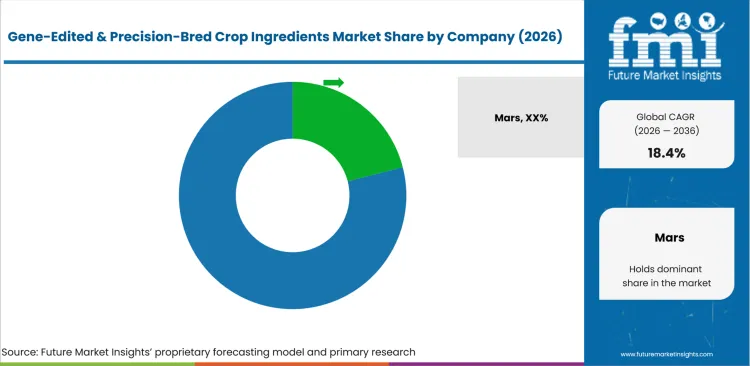
The competitive outlook combines food companies with crop-science groups and plant-editing specialists. Food companies compete through ingredient priorities and crop resilience programs. Seed and crop-science groups compete through breeding networks and field access. Platform developers compete through editing tools that shorten trait-development work. Commercial success depends on proof that an edited trait produces a usable ingredient gain after field testing and processing.
- Mars and Pairwise compete around cacao research where ingredient security is directly tied to crop resilience. Their commercial test is whether edited cacao traits improve reliable bean supply for chocolate applications.
- Bayer and Corteva bring crop-science reach and field-validation networks. Their position is strongest where edited traits fit existing seed channels and processor requirements.
- Tropic Biosciences, Inari and Benson Hill focus on crop platforms and trait development. Their value depends on field evidence that carries into yield, quality or processing performance.
Competitive Benchmarking by Operating Role
| Company | Edited Crop Trait Work | Ingredient Relevance | Platform or Field Depth | Geographic Reach |
|---|---|---|---|---|
| Mars, Incorporated | Medium | High | Medium | Global |
| Pairwise Plants Services, Inc. | High | High | High | North America and Europe |
| Bayer AG | High | Medium | High | Global |
| Tropic Biosciences UK Ltd. | High | Medium | High | Asia and Latin America approvals |
| Corteva, Inc. | High | Medium | High | Global |
| Inari Agriculture, Inc. | High | Medium | High | North America and Europe |
| Benson Hill, Inc. | Medium | High | Medium | North America |
| Hudson River Biotechnology B.V. | High | Medium | Medium | Europe |
Scoring basis: High indicates direct public evidence within edited crop traits or ingredient-facing crop work. Medium indicates a relevant crop platform or adjacent breeding role. Low indicates limited public evidence for this exact market.
Key Developments in the Gene-Edited & Precision-Bred Crop Ingredients Market
- In August 2025, Pairwise reported that Mars licensed its Fulcrum gene-editing tools for cacao research and development. The agreement gives Mars access to CRISPR tools for crop-resilience work in cacao.
- In May 2026, Pairwise and Hudson River Biotechnology signed a Fulcrum plant gene-editing platform licensing agreement. Hudson River said the tools would expand its editing services for crop-improvement customers. The agreement strengthens service capacity for vegetable and soft-fruit projects in Europe.
- In April 2026, Tropic Biosciences reported approval in Japan and Brazil for its non-browning banana variety. The approval shows a commercial path for edited tropical crops in two important fresh-produce markets.
- In May 2026, Corteva announced that Vylor would become the name of its planned advanced seed and genetics spin-off. The company stated that the Vylor pipeline includes gene editing and hybrid wheat.
Company Categories in the Gene-Edited & Precision-Bred Crop Ingredients Market
Food and Ingredient Companies
- Mars, Incorporated
Gene-Editing Platform Developers
- Pairwise Plants Services, Inc.
- Tropic Biosciences UK Ltd.
- Hudson River Biotechnology B.V.
Seed and Crop-Science Companies
- Bayer AG
- Corteva, Inc.
- Inari Agriculture, Inc.
- Benson Hill, Inc.
Gene-Edited & Precision-Bred Crop Ingredients Market - Report Scope
| Coverage field | Report scope |
|---|---|
| Market breakdown | Technology, crop, trait, and region. |
| Quantitative Units | Revenue in USD Billion, CAGR in %. |
| Market Definition | Gene-edited and precision-bred crop ingredients cover crop-derived food and processing inputs developed through targeted breeding tools such as CRISPR and related editing methods. The scope includes ingredient-facing crops where edited traits improve yield, disease response, quality or processing performance. |
| Regions Covered | North America, Latin America, Europe, East Asia, South Asia, Oceania, and Middle East and Africa. |
| Countries Covered | China, Brazil, Netherlands, USA and UK, with additional country coverage across the full report. |
| Key Companies Profiled | Mars, Pairwise, Bayer, Tropic Biosciences, Corteva, Inari, Benson Hill and Hudson River Biotechnology. |
| Forecast Period | 2026 to 2036. |
| Approach | Hybrid bottom-up and top-down market sizing supported by primary interviews and official desk research. |
Gene-Edited & Precision-Bred Crop Ingredients Market - Research Methodology
| Method | Approach |
|---|---|
| Primary Research | FMI analysts gathered input from manufacturers, service providers, technology developers, distributors, end users, procurement teams, and subject-matter experts. Interviews examined purchasing decisions, product or service evaluation, adoption barriers, approval requirements, pricing considerations, and expectations for technical or commercial support. Respondents were also asked what evidence is required before a trial, pilot, or initial order develops into regular purchasing. |
| Desk Research | Desk research covered government statistics, regulatory publications, trade data, industry associations, technical literature, standards, company filings, product information, and official corporate announcements. Sources were reviewed for relevance, publication date, geographic coverage, and consistency with the defined market scope. Claims relating to performance, applications, approvals, capacity, investment, and commercial activity were retained only when supported by credible public evidence. |
| Market Sizing and Forecasting | The market model combined the baseline value with historical performance, segment structure, pricing and volume indicators, adoption levels, company participation, and country-level demand conditions. Forecast assumptions considered economic activity, investment trends, regulatory developments, technology adoption, purchasing cycles, supply availability, and barriers to wider market use. Segment and regional estimates were reconciled before the final market total was calculated. |
| Data Validation | Estimates were checked against multiple independent indicators, including public data, company activity, trade patterns, industry developments, and findings from primary interviews. Validation also tested whether products, services, applications, and company revenues fell within the defined market boundaries. Adjacent categories, unsupported claims, overlapping revenues, and activities without direct market relevance were excluded to reduce double counting and maintain consistency across segments and countries. |
Gene-Edited & Precision-Bred Crop Ingredients Market by Segments
Gene-Edited & Precision-Bred Crop Ingredients Market Segmentation by Technology
- CRISPR
- Gene Editing
Gene-Edited & Precision-Bred Crop Ingredients Market Segmentation by Crop
- Cacao
- Cereals
- Produce
Gene-Edited & Precision-Bred Crop Ingredients Market Segmentation by Trait
- Yield
- Disease
- Quality
Gene-Edited & Precision-Bred Crop Ingredients Market by Region:
- North America
- United States
- Canada
- Latin America
- Brazil
- Mexico
- Argentina
- Chile
- Western Europe
- Germany
- France
- United Kingdom
- Italy
- Spain
- Benelux
- Nordics
- Eastern Europe
- Poland
- Czech Republic
- Romania
- Hungary
- East Asia
- China
- Japan
- South Korea
- South Asia and Pacific
- India
- ASEAN
- Australia and New Zealand
- Middle East and Africa
- GCC Countries
- South Africa
- Türkiye
- Israel
Research Sources and Bibliography
- Companhia Nacional de Abastecimento. (2026, July 14). Produção de grãos é estimada em 360,1 milhões de toneladas no ciclo 2025/2026.
- Department for Environment, Food & Rural Affairs. (2026, July 17). Precision breeding register: Notices and decisions.
- European Commission. (2026, June 17). EU legislation on new genomic techniques for plants.
- Pairwise Plants Services, Inc. (2025, August 6). Mars and Pairwise Collaborate to Accelerate Cacao Research and Development.
- Pairwise Plants Services, Inc. (2026, May 26). Hudson River Biotechnology and Pairwise Sign Fulcrum Licensing Agreement.
- Statistics Netherlands. (2026, April 3). The Netherlands is the world’s leading exporter of cocoa products.
- Tropic Biosciences. (2026, April 10). Tropic’s Non-Browning Banana Approved in Japan and Brazil.
- USA Department of Agriculture, Economic Research Service. (2025, December 12). Adoption of Genetically Engineered Crops in the United States - Recent Trends in GE Adoption.
- USA Department of Agriculture, National Agricultural Statistics Service. (2025, June 30). Corn planted acreage up 5% from 2024, soybean acreage down 4% from last year.
- UK Research and Innovation. (2026, February 2). Driving growth through precision-bred crops and low emissions farming.
- Corteva, Inc. (2026, May 4). Introducing Vylor: Corteva Spinoff to Propel Agriculture Further.
This bibliography is provided for reader reference and is not exhaustive. The full report contains the complete reference list and detailed citations.
This Report Answers
- What is the expected market size of the gene-edited & precision-bred crop ingredients market in 2026 and 2036?
- Which technology, crop and trait categories account for the highest 2026 share?
- How do country CAGRs compare across the five profiled countries?
- Which companies are active in cacao research, editing platforms and crop-trait commercialization?
- Which regulatory and customer-approval risks affect edited crop ingredient adoption?
Frequently Asked Questions
How big is the Gene-Edited & Precision-Bred Crop Ingredients Market in 2026?
The gene-edited and precision-bred crop ingredients market is valued at USD 1.35 billion in 2026 and is forecast to reach USD 3.06 billion by 2036, rising from USD 1.24 billion in 2025, driven by crop programs where edited traits improve yield or ingredient quality before commercial processing begins.
What is the CAGR of the Gene-Edited & Precision-Bred Crop Ingredients Market from 2026 to 2036?
The gene-edited and precision-bred crop ingredients market is projected to grow at a CAGR of 8.5% between 2026 and 2036, supported by expanding demand for edited crop traits that reduce supply uncertainty and improve ingredient performance across food manufacturing and processing chains.
Which technology leads the Gene-Edited & Precision-Bred Crop Ingredients Market?
CRISPR accounts for 61.8% of the gene-edited and precision-bred crop ingredients market by technology in 2026, driven by its role in targeted plant edits that connect genetic changes with measurable field output, ingredient behavior, and clearer regulatory records for food company procurement teams.
Which country is growing fastest in the Gene-Edited & Precision-Bred Crop Ingredients Market?
The gene-edited and precision-bred crop ingredients market in China is projected to grow at a CAGR of 9.1% through 2036, supported by grain-security planning, a large cereal production base of 714.88 million tonnes in 2025, and active crop modernization programs that favor yield and disease-resistance traits.
Who are the leading companies in the Gene-Edited & Precision-Bred Crop Ingredients Market?
Leading companies in the gene-edited and precision-bred crop ingredients market include Mars, Pairwise, Bayer, Corteva, Tropic Biosciences, Inari, Benson Hill, and Hudson River Biotechnology, spanning food ingredient programs, gene-editing platforms, seed and crop-science networks, and tropical crop approvals.
Preview the report firsthand - request a free sample
Get SampleGet the brochure for pricing and purchase details.
Get PDFTable of Content
- Key Takeaways
- Market Size and CAGR
- Top Growth Driver
- Fastest Growing Segment
- Leading Region
- Key Companies
- Emerging Opportunities
- Executive Summary
- Global Market Outlook
- Demand-side Trends
- Supply-side Trends
- Technology Roadmap Analysis
- Analysis and Recommendations
- Analyst Perspective (What is happening? Why now? What should investors know?)
- Key Questions Answered
- How large is the market?
- What is the CAGR?
- What are key trends?
- Which region dominates?
- Who are the leaders?
- Market Overview
- Market Coverage / Taxonomy
- Market Definition / Scope / Limitations
- Research Methodology
- Chapter Orientation
- Analytical Lens and Working Hypotheses
- Market Structure, Signals, and Trend Drivers
- Benchmarking and Cross-market Comparability
- Market Sizing, Forecasting, and Opportunity Mapping
- Research Design and Evidence Framework
- Desk Research Programme (Secondary Evidence)
- Expert Input and Fieldwork (Primary Evidence)
- Tooling, Models, and Reference Databases
- Data Engineering and Model Build
- Quality Assurance and Audit Trail
- Market Background
- Market Dynamics (Drivers, Restraints, Opportunity, Trends)
- Scenario Forecast (Optimistic, Likely, Conservative)
- Impact Analysis
- AI Impact
- Sustainability Impact
- Regulatory Impact
- Technology Impact
- Consumer / Buyer Analysis
- Purchase Drivers
- Adoption Barriers
- Buyer Journey
- Opportunity Map Analysis
- Product Life Cycle Analysis
- Supply Chain Analysis
- Investment Feasibility Matrix
- Value Chain Analysis
- PESTLE and Porter's Analysis
- Regulatory Landscape
- Regional Parent Market Outlook
- Production and Consumption Statistics
- Import and Export Statistics
- Global Market Analysis and Forecast, 2021 to 2036
- Historical Market Size Value (USD Billion) Analysis, 2021 to 2025
- Current and Future Market Size Value (USD Billion) Projections, 2026 to 2036
- Y-o-Y Growth Trend Analysis
- Absolute $ Opportunity Analysis
- Global Market Pricing Analysis, 2021 to 2036
- Global Market Analysis and Forecast, By Technology, 2021 to 2036
- Introduction / Key Findings
- Historical Market Size Value (USD Billion) Analysis By Technology, 2021 to 2025
- Current and Future Market Size Value (USD Billion) Analysis and Forecast By Technology, 2026 to 2036
- CRISPR
- Gene Editing
- CRISPR
- Y-o-Y Growth Trend Analysis By Technology, 2021 to 2025
- Absolute $ Opportunity Analysis By Technology, 2026 to 2036
- Global Market Analysis and Forecast, By Crop, 2021 to 2036
- Introduction / Key Findings
- Historical Market Size Value (USD Billion) Analysis By Crop, 2021 to 2025
- Current and Future Market Size Value (USD Billion) Analysis and Forecast By Crop, 2026 to 2036
- Cacao
- Cereals
- Produce
- Cacao
- Y-o-Y Growth Trend Analysis By Crop, 2021 to 2025
- Absolute $ Opportunity Analysis By Crop, 2026 to 2036
- Global Market Analysis and Forecast, By Trait, 2021 to 2036
- Introduction / Key Findings
- Historical Market Size Value (USD Billion) Analysis By Trait, 2021 to 2025
- Current and Future Market Size Value (USD Billion) Analysis and Forecast By Trait, 2026 to 2036
- Yield
- Disease
- Quality
- Yield
- Y-o-Y Growth Trend Analysis By Trait, 2021 to 2025
- Absolute $ Opportunity Analysis By Trait, 2026 to 2036
- Global Market Analysis and Forecast, By Region, 2021 to 2036
- Introduction
- Historical Market Size Value (USD Billion) Analysis By Region, 2021 to 2025
- Current Market Size Value (USD Billion) Analysis and Forecast By Region, 2026 to 2036
- North America
- Latin America
- Western Europe
- Eastern Europe
- East Asia
- South Asia and Pacific
- Middle East & Africa
- Market Attractiveness Analysis By Region
- North America Market Analysis and Forecast, By Country, 2021 to 2036
- Historical Market Size Value (USD Billion) Trend Analysis By Market Taxonomy, 2021 to 2025
- Market Size Value (USD Billion) Forecast By Market Taxonomy, 2026 to 2036
- By Country
- USA
- Canada
- By Technology
- By Crop
- By Trait
- By Country
- Market Attractiveness Analysis
- By Country
- By Technology
- By Crop
- By Trait
- Key Takeaways
- Latin America Market Analysis and Forecast, By Country
- Historical Market Size Value (USD Billion) Trend Analysis By Market Taxonomy, 2021 to 2025
- Market Size Value (USD Billion) Forecast By Market Taxonomy, 2026 to 2036
- By Country
- Brazil
- Mexico
- Chile
- Rest of Latin America
- By Technology
- By Crop
- By Trait
- By Country
- Market Attractiveness Analysis
- By Country
- By Technology
- By Crop
- By Trait
- Key Takeaways
- Western Europe Market Analysis and Forecast, By Country
- Historical Market Size Value (USD Billion) Trend Analysis By Market Taxonomy, 2021 to 2025
- Market Size Value (USD Billion) Forecast By Market Taxonomy, 2026 to 2036
- By Country
- Germany
- UK
- Italy
- Spain
- France
- Nordic
- BENELUX
- Rest of Western Europe
- By Technology
- By Crop
- By Trait
- By Country
- Market Attractiveness Analysis
- By Country
- By Technology
- By Crop
- By Trait
- Key Takeaways
- Eastern Europe Market Analysis and Forecast, By Country
- Historical Market Size Value (USD Billion) Trend Analysis By Market Taxonomy, 2021 to 2025
- Market Size Value (USD Billion) Forecast By Market Taxonomy, 2026 to 2036
- By Country
- Russia
- Poland
- Hungary
- Balkan & Baltic
- Rest of Eastern Europe
- By Technology
- By Crop
- By Trait
- By Country
- Market Attractiveness Analysis
- By Country
- By Technology
- By Crop
- By Trait
- Key Takeaways
- East Asia Market Analysis and Forecast, By Country
- Historical Market Size Value (USD Billion) Trend Analysis By Market Taxonomy, 2021 to 2025
- Market Size Value (USD Billion) Forecast By Market Taxonomy, 2026 to 2036
- By Country
- China
- Japan
- South Korea
- By Technology
- By Crop
- By Trait
- By Country
- Market Attractiveness Analysis
- By Country
- By Technology
- By Crop
- By Trait
- Key Takeaways
- South Asia and Pacific Market Analysis and Forecast, By Country
- Historical Market Size Value (USD Billion) Trend Analysis By Market Taxonomy, 2021 to 2025
- Market Size Value (USD Billion) Forecast By Market Taxonomy, 2026 to 2036
- By Country
- India
- ASEAN
- Australia & New Zealand
- Rest of South Asia and Pacific
- By Technology
- By Crop
- By Trait
- By Country
- Market Attractiveness Analysis
- By Country
- By Technology
- By Crop
- By Trait
- Key Takeaways
- Middle East & Africa Market Analysis and Forecast, By Country
- Historical Market Size Value (USD Billion) Trend Analysis By Market Taxonomy, 2021 to 2025
- Market Size Value (USD Billion) Forecast By Market Taxonomy, 2026 to 2036
- By Country
- Kingdom of Saudi Arabia
- Other GCC Countries
- Türkiye
- South Africa
- Other African Union
- Rest of Middle East & Africa
- By Technology
- By Crop
- By Trait
- By Country
- Market Attractiveness Analysis
- By Country
- By Technology
- By Crop
- By Trait
- Key Takeaways
- Key Countries Market Analysis
- USA
- Pricing Analysis
- Market Share Analysis, 2025
- By Technology
- By Crop
- By Trait
- Canada
- Pricing Analysis
- Market Share Analysis, 2025
- By Technology
- By Crop
- By Trait
- Mexico
- Pricing Analysis
- Market Share Analysis, 2025
- By Technology
- By Crop
- By Trait
- Brazil
- Pricing Analysis
- Market Share Analysis, 2025
- By Technology
- By Crop
- By Trait
- Chile
- Pricing Analysis
- Market Share Analysis, 2025
- By Technology
- By Crop
- By Trait
- Germany
- Pricing Analysis
- Market Share Analysis, 2025
- By Technology
- By Crop
- By Trait
- UK
- Pricing Analysis
- Market Share Analysis, 2025
- By Technology
- By Crop
- By Trait
- Italy
- Pricing Analysis
- Market Share Analysis, 2025
- By Technology
- By Crop
- By Trait
- Spain
- Pricing Analysis
- Market Share Analysis, 2025
- By Technology
- By Crop
- By Trait
- France
- Pricing Analysis
- Market Share Analysis, 2025
- By Technology
- By Crop
- By Trait
- India
- Pricing Analysis
- Market Share Analysis, 2025
- By Technology
- By Crop
- By Trait
- ASEAN
- Pricing Analysis
- Market Share Analysis, 2025
- By Technology
- By Crop
- By Trait
- Australia & New Zealand
- Pricing Analysis
- Market Share Analysis, 2025
- By Technology
- By Crop
- By Trait
- China
- Pricing Analysis
- Market Share Analysis, 2025
- By Technology
- By Crop
- By Trait
- Japan
- Pricing Analysis
- Market Share Analysis, 2025
- By Technology
- By Crop
- By Trait
- South Korea
- Pricing Analysis
- Market Share Analysis, 2025
- By Technology
- By Crop
- By Trait
- Russia
- Pricing Analysis
- Market Share Analysis, 2025
- By Technology
- By Crop
- By Trait
- Poland
- Pricing Analysis
- Market Share Analysis, 2025
- By Technology
- By Crop
- By Trait
- Hungary
- Pricing Analysis
- Market Share Analysis, 2025
- By Technology
- By Crop
- By Trait
- Kingdom of Saudi Arabia
- Pricing Analysis
- Market Share Analysis, 2025
- By Technology
- By Crop
- By Trait
- Türkiye
- Pricing Analysis
- Market Share Analysis, 2025
- By Technology
- By Crop
- By Trait
- South Africa
- Pricing Analysis
- Market Share Analysis, 2025
- By Technology
- By Crop
- By Trait
- USA
- Market Structure Analysis
- Competition Dashboard
- Competition Benchmarking
- Market Share Analysis of Top Players
- By Regional
- By Technology
- By Crop
- By Trait
- Emerging Startups
- Innovation Benchmarking
- Competition Analysis
- Competition Deep Dive
- Mars
- Overview
- Product Portfolio
- Profitability by Market Segments
- Sales Footprint
- Strategy Overview
- Marketing Strategy
- Product Strategy
- Channel Strategy
- Pairwise
- Corteva
- Bayer
- Tropic Biosciences
- Inari
- Benson Hill
- Mars
- Case Studies
- Success Stories
- Recent Developments
- Competition Deep Dive
- Assumptions & Acronyms Used


