

- Industry Size (2026)
- USD 1332.0 Mn
- Forecast (2036)
- USD 4521.6 Mn
- CAGR (2026 to 2036)
- 13.0%
Gigacasting Presses Market Forecast and Outlook (2026 to 2036)
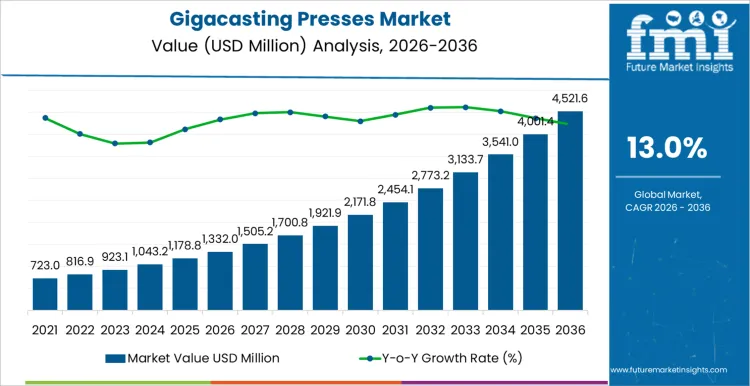
The gigacasting presses market is projected to expand from USD 1,332.0 million in 2026 to USD 4,521.6 million by 2036, registering a CAGR of 13.0%. Production control in this market is heavily influenced by high equipment concentration and limited global manufacturing capacity for ultra-large tonnage presses. A small group of suppliers dominates the ability to deliver presses above 6,000 tons, creating dependency risks for OEMs planning large-scale structural casting programs.
Manufacturing lead times are extended due to custom press design, long component procurement cycles, and the need for precision machining of oversized parts. Regional production control is becoming a strategic consideration, as OEMs seek localized service, faster commissioning support, and reduced exposure to cross-border logistics disruptions. Supply reliability is further constrained by dependencies on specialized alloys, die tooling suppliers, and skilled commissioning teams, all of which must be synchronized for successful ramp-up. As a result, press procurement is closely tied to long-term production planning, supplier alignment, and risk mitigation strategies rather than short-term capacity expansion decisions.
Quick Stats for Gigacasting Presses Market
- Gigacasting Presses Market Value (2026): USD 1,332.0 Million
- Gigacasting Presses Market Forecast Value (2036): USD 4,521.6 Million
- Gigacasting Presses Market Forecast CAGR (2026 to 2036): 13.0%
- Leading Alloy Process in Gigacasting Presses Market: High-Pressure Die-Casting (HPDC) (74% share)
- Key Growth Regions in Gigacasting Presses Market: Asia Pacific, Europe, North America, Latin America, Middle East & Africa
- Top Players in Gigacasting Presses Market: IDRA Group, Bühler Carat, LK Machinery (L.K. Technology), Toshiba Die Casting, UBE Machinery, Yizumi, Haitian, EMI, Zhixin
Gigacasting Presses Market Key Takeaways
| Metric | Value |
|---|---|
| Gigacasting Presses Market Value (2026) | USD 1,332.0 Million |
| Gigacasting Presses Market Forecast Value (2036) | USD 4,521.6 Million |
| Gigacasting Presses Market Forecast CAGR (2026 to 2036) | 13.0% |
How are Vehicle Platform Simplification and Manufacturing Economics Accelerating the Gigacasting Presses Market?
The gigacasting presses market is expanding rapidly as automotive OEMs restructure vehicle manufacturing around fewer, larger structural components. Gigacasting enables the replacement of dozens of stamped and welded parts with single-piece aluminum castings, significantly reducing body shop complexity, tooling count, and assembly time. For press manufacturers and casting suppliers, demand is increasingly tied to OEM programs pursuing platform simplification, faster model launches, and lower per-vehicle manufacturing costs particularly in electric and software-defined vehicle architectures.
Capital efficiency and throughput performance are central to purchasing decisions. OEMs and Tier-1s are evaluating gigacasting presses based on locking force capacity, shot size, cycle time stability, and integration with automated trimming and inspection systems. Program teams also compare die casting machine architectures during supplier selection, even when final builds require cold-chamber configurations. Reliability at high tonnage and predictable uptime are critical, as a single press can represent a major share of body-in-white output. Body-in-white (BIW) strategy determines where OEMs accept consolidation risk versus where they retain multi-part assemblies. Suppliers that can demonstrate proven press durability, die-change efficiency, and strong service support are gaining preferred supplier status during greenfield and brownfield plant planning.
Scale-up execution and supply-chain readiness are further shaping market dynamics. Gigacasting adoption requires coordinated investment in metal alloys, tooling, thermal management, and quality control, pushing OEMs toward long-term partnerships with press manufacturers. Many OEMs also qualify regional die-casting services to stabilize capacity and shorten ramp timelines. Expansion of EV production capacity in Asia Pacific, Europe, and North America is driving multi-press orders and localized service footprints. This investment cycle pulls the broader metal casting supply chain into multi-year capacity planning. For equipment suppliers, competitive advantage increasingly depends on engineering depth, automation integration, and the ability to support high-volume casting programs positioning gigacasting presses as a cornerstone of next-generation automotive manufacturing.
How is the Gigacasting Presses Market Organized Across Key Categories?
The gigacasting presses market is segmented by casting application and alloy process, reflecting how vehicle architecture consolidation and material flow requirements influence press selection. By casting application, rear underbody components lead adoption, as OEMs prioritize large, single-piece castings to replace multi-part welded assemblies. Other applications include front underbody structures and battery trays, where dimensional accuracy and structural integrity are critical. By alloy process, high-pressure die-casting (HPDC) dominates the market, while thixomolding serves niche use cases requiring semi-solid processing characteristics.
Why Does Rear Underbody Casting Lead Application Demand in the Gigacasting Presses Market?
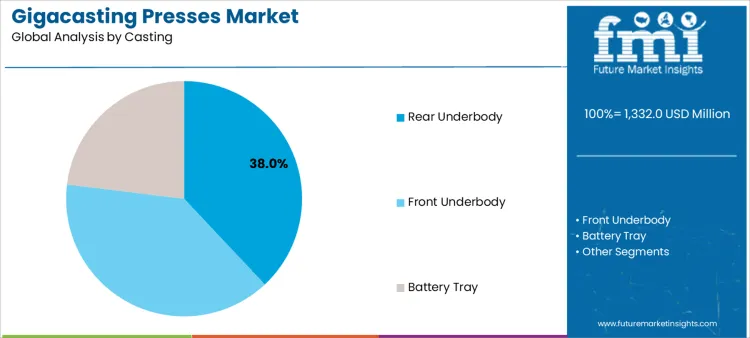
Rear underbody castings account for 38% share of the gigacasting presses market because they offer the highest consolidation benefit in vehicle body structures. OEMs use large rear castings to replace dozens of stamped and welded parts, reducing tooling count, assembly steps, and tolerance stack-up. Rear structures are well suited for single-piece casting due to relatively uniform load paths and fewer integration constraints compared to front modules. High-volume EV platforms favor rear gigacastings to improve dimensional consistency and production efficiency. These manufacturing simplification and scale advantages explain why rear underbody applications lead demand for gigacasting presses.
Why Does High-Pressure Die-Casting Dominate Alloy Process Selection In The Gigacasting Presses Market?
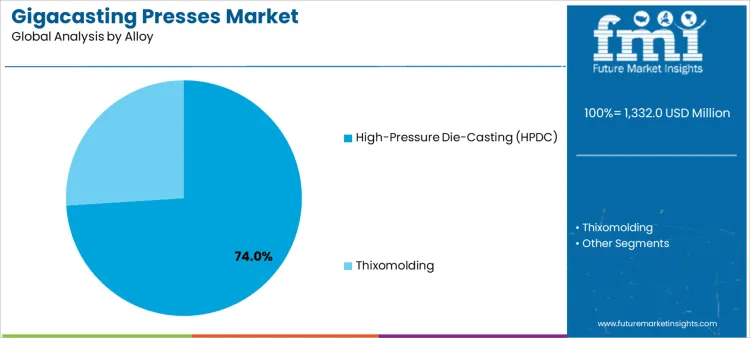
High-pressure die-casting holds 74% share of the gigacasting presses market because it supports rapid filling of large molds with consistent mechanical properties. HPDC enables high throughput, precise surface finish, and repeatable dimensional accuracy required for structural automotive components. OEMs favor HPDC due to its compatibility with aluminum alloys optimized for crash performance and lightweighting. The process integrates well with large-tonnage presses and automated trimming systems. Established supplier expertise and proven scalability further reinforce adoption. These productivity, quality, and industrial readiness factors explain why HPDC remains the dominant alloy process in gigacasting applications.
What Are The Key Dynamics Of The Gigacasting Presses Market?
The gigacasting presses market is driven by the automotive industry’s pursuit of manufacturing efficiency, part consolidation, and structural performance improvements. Gigacasting presses enable production of large, complex chassis and structural components-such as front and rear vehicle frames using high-pressure die casting of aluminum and other lightweight alloys. This reduces the number of welds and fasteners, shortens assembly time, and cuts overall material and labor cost per vehicle. For equipment manufacturers and suppliers, press tonnage capacity, die design flexibility, automation compatibility, cycle speed, and maintenance support are critical performance and procurement factors. Adoption correlates strongly with growth in electric vehicle (EV) production, where lightweight structural components are key to range and cost optimization.
How Are Automotive And Manufacturing Trends Shaping This Market?
Automotive and manufacturing trends are shaping the gigacasting presses market through adoption of high-throughput, connected, and predictive production systems. EV platforms increasingly use large structural die-cast components to replace multi-part stamped assemblies, driving OEM investment in gigacasting capabilities. Integration with high-volume automation such as robotic die handling, in-line inspection, and real-time process monitoring improves yield, reduces scrap, and enhances quality control. Use of digital twins, predictive maintenance analytics, and advanced process control software enables press builders to offer outcome-oriented performance guarantees and reduces unplanned downtime for manufacturers. For suppliers, providing turnkey press solutions with integrated hydraulics, controls, and safety systems accelerates plant deployment timelines.
Why Do Capital, Technical, And Supply Chain Challenges Restrain Market Growth?
Capital, technical, and supply chain challenges restrain growth in the gigacasting presses market because of the large upfront investment and engineering complexity required. High tonnage presses (often 4,000-9,000+ tons) and associated die tooling represent significant capital expenditure that may be prohibitive for smaller OEMs or low-volume vehicle programs. Gigacasting parts require sophisticated die design, thermal management, and melt handling systems that demand highly specialized engineering and validation time. Supply chain constraints for high-quality alloys, large-format dies, precision machined components, and skilled die-casting technicians can cause lead time variability and impact production ramp schedules. Adoption may also be slowed in regions with limited advanced foundry infrastructure.
What Is The Country-Wise Growth Outlook For The Gigacasting Presses Market?
The gigacasting presses market is expanding rapidly as automotive OEMs shift toward large, single-piece aluminum castings to reduce vehicle weight, part count, and manufacturing complexity. Gigacasting enables consolidation of dozens of stamped and welded components into a few structural castings, improving production efficiency and platform scalability, particularly for electric vehicles. Growth varies by country depending on EV manufacturing scale, investment in advanced foundry infrastructure, and OEM willingness to redesign vehicle architectures around large cast components. High-growth markets are driven by aggressive EV rollout and new plant construction, while mature automotive regions focus on selective adoption and platform transitions. Market value is shaped by press tonnage capability, casting precision, uptime reliability, and integration with automated die-casting lines.
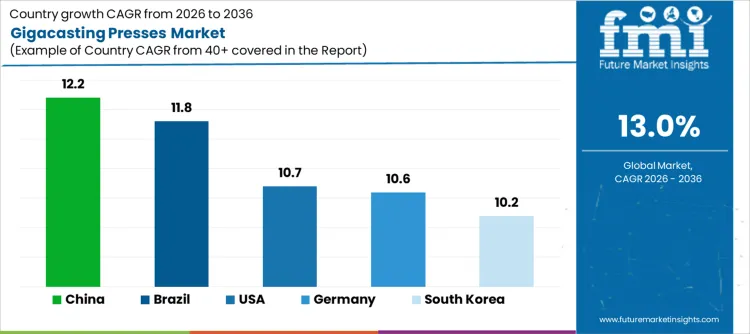
| Country | CAGR (%) |
|---|---|
| China | 12.2% |
| Brazil | 11.8% |
| United States | 10.7% |
| Germany | 10.6% |
| South Korea | 10.2% |
Why Is China Leading Growth In The Gigacasting Presses Market?
China’s gigacasting presses market is expanding at a CAGR of 12.2% during 2026 to 2036, driven by the rapid rise in electric vehicle (EV) production and the country’s dominant role in automotive manufacturing. As China’s EV market grows, OEMs are increasingly adopting gigacasting to streamline manufacturing processes and reduce vehicle weight, particularly in the body-in-white (BIW) and structural components. Gigacasting presses enable the production of large, single-piece aluminum castings, reducing complexity and part count in vehicle assemblies. Buyers prioritize press tonnage, casting precision, and the ability to support high-volume production, particularly for large-scale EV platforms. The casting precision segment underscores how exact surface and dimensional tolerances are increasingly essential for structural automotive components. With major Chinese OEMs leading the charge in EV production, demand for gigacasting presses is driven by the shift to aluminum-intensive structures, with gigacasting becoming integral to new manufacturing lines. The Chinese market benefits from competitive domestic production, low-cost foundry systems, and fast-cycle times.
Why Is Brazil Seeing Strong Demand For Gigacasting Presses?
Brazil’s gigacasting presses market is growing at a CAGR of 11.8% during 2026 to 2036, supported by increasing EV production and investments in automotive manufacturing technology. As Brazil's automotive industry modernizes, OEMs are shifting toward gigacasting to meet growing demand for EVs, which require lightweight, cost-effective structural components. Gigacasting presses enable the production of large, complex parts in a single operation, minimizing part count and welding processes. Buyers prioritize affordability, press versatility, and energy efficiency, particularly given the cost-sensitive nature of the Brazilian market. The market is also supported by the shift towards high-performance EVs, particularly in the local manufacturing of electric trucks and buses. Adoption is most prevalent in automakers that require large castings for chassis and structural parts. Procurement decisions are influenced by the ability to deliver high tonnage capacity, precision, and support local production needs.
How Is The United States Advancing Adoption Of Gigacasting Presses?
The United States gigacasting presses market is expanding at a CAGR of 10.7% during 2026 to 2036, driven by the rapid growth of electric vehicle (EV) production and ongoing innovation in manufacturing processes. USA automakers, particularly those leading the EV revolution, are shifting towards gigacasting to enable more efficient, lightweight, and cost-effective manufacturing for high-performance vehicles. Gigacasting presses allow OEMs to consolidate multiple parts into one large aluminum casting, reducing vehicle weight, complexity, and assembly time. Buyers prioritize high throughput, superior casting quality, and the ability to scale with increasing production demands. The USA market is characterized by a strong push toward production efficiency, with gigacasting becoming integral to automakers looking to reduce manufacturing costs while maintaining high levels of quality. OEMs demand state-of-the-art press technology capable of handling larger tonnages and providing high precision in casting. Procurement decisions are influenced by supplier innovation, scalability, and long-term operational reliability.
How Is Germany Integrating Gigacasting Presses Into EV Production?
Germany’s gigacasting presses market is growing at a CAGR of 10.6% during 2026 to 2036, driven by the country's strong automotive sector, which is undergoing a transformation with the rapid adoption of electric vehicle (EV) platforms. German OEMs are increasingly deploying gigacasting presses to produce large structural components for their EV models, allowing for more efficient production processes and reduced vehicle weight. Gigacasting presses are integral to improving manufacturing speed and cost, especially for the production of chassis, underbody, and other structural elements. Buyers focus on engineering precision, reliability, and the ability to support high-volume production runs for both high-performance and mass-market EVs. Procurement decisions often favor suppliers with advanced press technology that provides high cycle times, excellent material flow, and tight control over quality. Market value is driven by the need for consistent, high-quality casting and optimized manufacturing processes to maintain Germany’s leadership in automotive innovation.
Why Is South Korea Adopting Gigacasting Presses For Next-Generation EV Manufacturing?
South Korea’s gigacasting presses market is expanding at a CAGR of 10.2% during 2026 to 2036, supported by the country’s leading position in electric vehicle (EV) production and the growing adoption of gigacasting in manufacturing for high-performance EVs. South Korean OEMs are increasingly adopting gigacasting to streamline their production lines and reduce the number of parts in their EVs. The adoption of gigacasting presses enables the manufacturing of large, high-precision aluminum castings that improve vehicle performance and reduce overall production costs. Buyers prioritize energy efficiency, reliability, and the ability to process high-quality aluminum alloys used in structural and chassis components. Adoption is driven by South Korea’s strong domestic automotive sector, which is undergoing rapid transformation to meet global EV demands. Procurement decisions focus on suppliers that offer high-tonnage presses with optimized production capabilities, as well as flexibility to accommodate the high-speed nature of automotive manufacturing.
How Are OEMs Competing in the Gigacasting Presses Market?
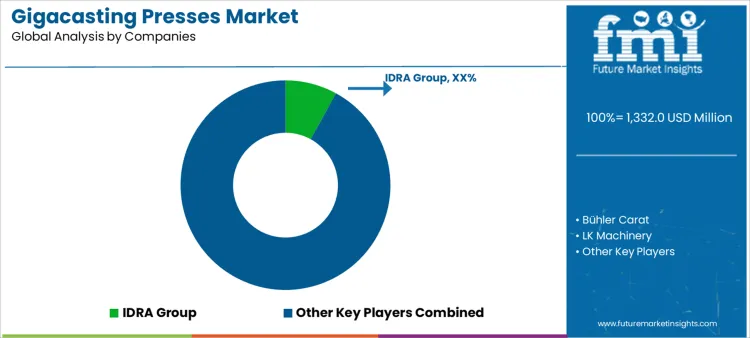
Competition in the gigacasting presses market is defined by clamping force scalability, casting precision, automation depth, and the ability to support large structural aluminum components for next-generation electric and lightweight vehicles. IDRA Group leads global visibility with ultra-large gigapresses engineered for single-piece body structures, emphasizing high locking force, real-time process control, and close collaboration with automotive OEMs. Its systems are positioned around repeatability, reduced cycle times, and compatibility with advanced aluminum alloys developed for structural casting.
European and Asian heavy machinery specialists compete through engineering depth and manufacturing scale. Bühler positions its Carat series around two-platen design advantages, offering uniform force distribution, energy efficiency, and precise shot control suited for large thin-wall castings. Toshiba Die Casting and UBE Machinery emphasize mechanical rigidity, long service life, and process stability, appealing to OEMs prioritizing dimensional accuracy and conservative ramp-up risk. Their gigacasting platforms focus on reliability and integration with automated melt handling and vacuum systems.
Chinese manufacturers are intensifying competition through rapid scale-up and cost-performance positioning. LK Machinery (also branded as L.K. Technology) and Yizumi offer high-tonnage presses with integrated automation and digital monitoring, targeting global OEMs and Tier-1s seeking faster deployment and localized support. Haitian leverages its large manufacturing footprint to scale gigacasting platforms competitively. Emerging players such as EMI and Zhixin focus on modular designs and domestic OEM alignment.
Key Players in Gigacasting Presses Market
- IDRA Group
- Bühler Carat
- LK Machinery
- Toshiba Die Casting
- UBE Machinery
- Yizumi
- Haitian
- EMI
- Zhixin
Scope of Report
| Attribute | Details |
|---|---|
| Market Size Unit | USD Million |
| Casting Covered | Rear Underbody Castings, Front Underbody Castings, Battery Tray Castings |
| Alloy | High-Pressure Die-Casting (HPDC), Thixomolding |
| Countries Covered | China, Japan, South Korea, India, Australia & New Zealand, ASEAN, Rest of Asia Pacific, Germany, United Kingdom, France, Italy, Spain, Nordic, BENELUX, Rest of Europe, United States, Canada, Mexico, Brazil, Chile, Rest of Latin America, Kingdom of Saudi Arabia, Other GCC Countries, Turkey, South Africa, Other African Union, Rest of Middle East & Africa |
| Regions Covered | Asia Pacific, Europe, North America, Latin America, Middle East & Africa |
| Key Companies Profiled | IDRA Group, Bühler Carat, LK Machinery, Toshiba Die Casting, UBE Machinery, Yizumi, Haitian, EMI, Zhixin |
| Additional Attributes | Dollar sales by casting type and alloy process are evaluated across automotive OEM and tier-one manufacturing facilities. The scope analyzes press tonnage requirements, cycle time reduction, tooling integration, and automation compatibility. Country-level assessment reflects EV platform localization, body-in-white consolidation trends, and adoption of large-scale aluminum casting technologies. |
Gigacasting Presses Market by Key Segments
Casting:
- Rear Underbody
- Front Underbody
- Battery Tray
Alloy:
- High‑Pressure Die‑Casting (HPDC)
- Thixomolding
Region:
- Asia Pacific
- China
- Japan
- South Korea
- India
- Australia & New Zealand
- ASEAN
- Rest of Asia Pacific
- Europe
- Germany
- United Kingdom
- France
- Italy
- Spain
- Nordic
- BENELUX
- Rest of Europe
- North America
- United States
- Canada
- Mexico
- Latin America
- Brazil
- Chile
- Rest of Latin America
- Middle East & Africa
- Kingdom of Saudi Arabia
- Other GCC Countries
- Turkey
- South Africa
- Other African Union
- Rest of Middle East & Africa
Bibliography
- European Aluminium Association. (2024). Structural aluminium castings for automotive lightweighting: Technical guidelines for high‑pressure die casting. EAA.
- International Organization for Standardization. (2024). ISO 4990:2024—Steel plates for pressure purposes—Dimensional and casting tolerances for large industrial equipment. ISO.
- National Institute of Standards and Technology. (2024). Advanced aluminum structural casting for electrified vehicle platforms: Metrology, defect control, and process optimization. NIST Technical Series.
Frequently Asked Questions
How big is the gigacasting presses market in 2026?
The global gigacasting presses market is estimated to be valued at USD 1,332.0 million in 2026.
What will be the size of gigacasting presses market in 2036?
The market size for the gigacasting presses market is projected to reach USD 4,521.6 million by 2036.
How much will be the gigacasting presses market growth between 2026 and 2036?
The gigacasting presses market is expected to grow at a 13.0% CAGR between 2026 and 2036.
What are the key product types in the gigacasting presses market?
The key product types in gigacasting presses market are rear underbody, front underbody and battery tray.
Which alloy segment to contribute significant share in the gigacasting presses market in 2026?
In terms of alloy, high‑pressure die‑casting (hpdc) segment to command 74.0% share in the gigacasting presses market in 2026.
Preview the report firsthand - request a free sample
Get SampleGet the brochure for pricing and purchase details.
Get PDFTable of Content
- Executive Summary
- Global Market Outlook
- Demand-side Trends
- Supply-side Trends
- Technology Roadmap Analysis
- Analysis and Recommendations
- Market Overview
- Market Coverage / Taxonomy
- Market Definition / Scope / Limitations
- Market Background
- Market Dynamics
- Drivers
- Restraints
- Opportunity
- Trends
- Scenario Forecast
- Demand in Optimistic Scenario
- Demand in Likely Scenario
- Demand in Conservative Scenario
- Opportunity Map Analysis
- Product Life Cycle Analysis
- Supply Chain Analysis
- Investment Feasibility Matrix
- Value Chain Analysis
- PESTLE and Porter’s Analysis
- Regulatory Landscape
- Regional Parent Market Outlook
- Production and Consumption Statistics
- Import and Export Statistics
- Market Dynamics
- Global Market Analysis 2021 to 2025 and Forecast, 2026 to 2036
- Historical Market Size Value (USD Million) Analysis, 2021 to 2025
- Current and Future Market Size Value (USD Million) Projections, 2026 to 2036
- Y-o-Y Growth Trend Analysis
- Absolute $ Opportunity Analysis
- Global Market Pricing Analysis 2021 to 2025 and Forecast 2026 to 2036
- Global Market Analysis 2021 to 2025 and Forecast 2026 to 2036, By Casting
- Introduction / Key Findings
- Historical Market Size Value (USD Million) Analysis By Casting , 2021 to 2025
- Current and Future Market Size Value (USD Million) Analysis and Forecast By Casting , 2026 to 2036
- Rear Underbody
- Front Underbody
- Battery Tray
- Rear Underbody
- Y-o-Y Growth Trend Analysis By Casting , 2021 to 2025
- Absolute $ Opportunity Analysis By Casting , 2026 to 2036
- Global Market Analysis 2021 to 2025 and Forecast 2026 to 2036, By Alloy
- Introduction / Key Findings
- Historical Market Size Value (USD Million) Analysis By Alloy, 2021 to 2025
- Current and Future Market Size Value (USD Million) Analysis and Forecast By Alloy, 2026 to 2036
- High‑Pressure Die‑Casting (HPDC)
- Thixomolding
- High‑Pressure Die‑Casting (HPDC)
- Y-o-Y Growth Trend Analysis By Alloy, 2021 to 2025
- Absolute $ Opportunity Analysis By Alloy, 2026 to 2036
- Global Market Analysis 2021 to 2025 and Forecast 2026 to 2036, By Region
- Introduction
- Historical Market Size Value (USD Million) Analysis By Region, 2021 to 2025
- Current Market Size Value (USD Million) Analysis and Forecast By Region, 2026 to 2036
- North America
- Latin America
- Western Europe
- Eastern Europe
- East Asia
- South Asia and Pacific
- Middle East & Africa
- Market Attractiveness Analysis By Region
- North America Market Analysis 2021 to 2025 and Forecast 2026 to 2036, By Country
- Historical Market Size Value (USD Million) Trend Analysis By Market Taxonomy, 2021 to 2025
- Market Size Value (USD Million) Forecast By Market Taxonomy, 2026 to 2036
- By Country
- USA
- Canada
- Mexico
- By Casting
- By Alloy
- By Country
- Market Attractiveness Analysis
- By Country
- By Casting
- By Alloy
- Key Takeaways
- Latin America Market Analysis 2021 to 2025 and Forecast 2026 to 2036, By Country
- Historical Market Size Value (USD Million) Trend Analysis By Market Taxonomy, 2021 to 2025
- Market Size Value (USD Million) Forecast By Market Taxonomy, 2026 to 2036
- By Country
- Brazil
- Chile
- Rest of Latin America
- By Casting
- By Alloy
- By Country
- Market Attractiveness Analysis
- By Country
- By Casting
- By Alloy
- Key Takeaways
- Western Europe Market Analysis 2021 to 2025 and Forecast 2026 to 2036, By Country
- Historical Market Size Value (USD Million) Trend Analysis By Market Taxonomy, 2021 to 2025
- Market Size Value (USD Million) Forecast By Market Taxonomy, 2026 to 2036
- By Country
- Germany
- UK
- Italy
- Spain
- France
- Nordic
- BENELUX
- Rest of Western Europe
- By Casting
- By Alloy
- By Country
- Market Attractiveness Analysis
- By Country
- By Casting
- By Alloy
- Key Takeaways
- Eastern Europe Market Analysis 2021 to 2025 and Forecast 2026 to 2036, By Country
- Historical Market Size Value (USD Million) Trend Analysis By Market Taxonomy, 2021 to 2025
- Market Size Value (USD Million) Forecast By Market Taxonomy, 2026 to 2036
- By Country
- Russia
- Poland
- Hungary
- Balkan & Baltic
- Rest of Eastern Europe
- By Casting
- By Alloy
- By Country
- Market Attractiveness Analysis
- By Country
- By Casting
- By Alloy
- Key Takeaways
- East Asia Market Analysis 2021 to 2025 and Forecast 2026 to 2036, By Country
- Historical Market Size Value (USD Million) Trend Analysis By Market Taxonomy, 2021 to 2025
- Market Size Value (USD Million) Forecast By Market Taxonomy, 2026 to 2036
- By Country
- China
- Japan
- South Korea
- By Casting
- By Alloy
- By Country
- Market Attractiveness Analysis
- By Country
- By Casting
- By Alloy
- Key Takeaways
- South Asia and Pacific Market Analysis 2021 to 2025 and Forecast 2026 to 2036, By Country
- Historical Market Size Value (USD Million) Trend Analysis By Market Taxonomy, 2021 to 2025
- Market Size Value (USD Million) Forecast By Market Taxonomy, 2026 to 2036
- By Country
- India
- ASEAN
- Australia & New Zealand
- Rest of South Asia and Pacific
- By Casting
- By Alloy
- By Country
- Market Attractiveness Analysis
- By Country
- By Casting
- By Alloy
- Key Takeaways
- Middle East & Africa Market Analysis 2021 to 2025 and Forecast 2026 to 2036, By Country
- Historical Market Size Value (USD Million) Trend Analysis By Market Taxonomy, 2021 to 2025
- Market Size Value (USD Million) Forecast By Market Taxonomy, 2026 to 2036
- By Country
- Kingdom of Saudi Arabia
- Other GCC Countries
- Turkiye
- South Africa
- Other African Union
- Rest of Middle East & Africa
- By Casting
- By Alloy
- By Country
- Market Attractiveness Analysis
- By Country
- By Casting
- By Alloy
- Key Takeaways
- Key Countries Market Analysis
- USA
- Pricing Analysis
- Market Share Analysis, 2025
- By Casting
- By Alloy
- Canada
- Pricing Analysis
- Market Share Analysis, 2025
- By Casting
- By Alloy
- Mexico
- Pricing Analysis
- Market Share Analysis, 2025
- By Casting
- By Alloy
- Brazil
- Pricing Analysis
- Market Share Analysis, 2025
- By Casting
- By Alloy
- Chile
- Pricing Analysis
- Market Share Analysis, 2025
- By Casting
- By Alloy
- Germany
- Pricing Analysis
- Market Share Analysis, 2025
- By Casting
- By Alloy
- UK
- Pricing Analysis
- Market Share Analysis, 2025
- By Casting
- By Alloy
- Italy
- Pricing Analysis
- Market Share Analysis, 2025
- By Casting
- By Alloy
- Spain
- Pricing Analysis
- Market Share Analysis, 2025
- By Casting
- By Alloy
- France
- Pricing Analysis
- Market Share Analysis, 2025
- By Casting
- By Alloy
- India
- Pricing Analysis
- Market Share Analysis, 2025
- By Casting
- By Alloy
- ASEAN
- Pricing Analysis
- Market Share Analysis, 2025
- By Casting
- By Alloy
- Australia & New Zealand
- Pricing Analysis
- Market Share Analysis, 2025
- By Casting
- By Alloy
- China
- Pricing Analysis
- Market Share Analysis, 2025
- By Casting
- By Alloy
- Japan
- Pricing Analysis
- Market Share Analysis, 2025
- By Casting
- By Alloy
- South Korea
- Pricing Analysis
- Market Share Analysis, 2025
- By Casting
- By Alloy
- Russia
- Pricing Analysis
- Market Share Analysis, 2025
- By Casting
- By Alloy
- Poland
- Pricing Analysis
- Market Share Analysis, 2025
- By Casting
- By Alloy
- Hungary
- Pricing Analysis
- Market Share Analysis, 2025
- By Casting
- By Alloy
- Kingdom of Saudi Arabia
- Pricing Analysis
- Market Share Analysis, 2025
- By Casting
- By Alloy
- Turkiye
- Pricing Analysis
- Market Share Analysis, 2025
- By Casting
- By Alloy
- South Africa
- Pricing Analysis
- Market Share Analysis, 2025
- By Casting
- By Alloy
- USA
- Market Structure Analysis
- Competition Dashboard
- Competition Benchmarking
- Market Share Analysis of Top Players
- By Regional
- By Casting
- By Alloy
- Competition Analysis
- Competition Deep Dive
- IDRA Group
- Overview
- Product Portfolio
- Profitability by Market Segments (Product/Age /Sales Channel/Region)
- Sales Footprint
- Strategy Overview
- Marketing Strategy
- Product Strategy
- Channel Strategy
- Bühler Carat
- LK Machinery
- Toshiba Die Casting
- UBE Machinery
- Yizumi
- Haitian
- EMI
- Zhixin
- IDRA Group
- Competition Deep Dive
- Assumptions & Acronyms Used
- Research Methodology


