

- Industry Size (2025)
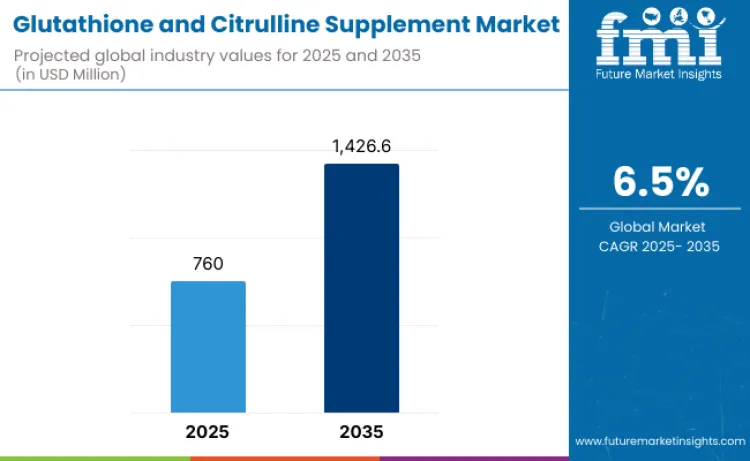
- USD 760.0 Mn
- Forecast (2035)
- USD 1426.6 Mn
- CAGR (2025 to 2035)
- 6.5%
Glutathione and Citrulline Supplement Market Forecast and Outlook 2025 to 2035
Global glutathione and citrulline supplement market is projected to reach USD 1,426.6 million by 2035, reflecting an absolute increase of USD 666.6 million from its 2025 valuation of USD 760.0 million. Rising at a CAGR of 6.5%, the market is expected to expand by nearly 1.8 times, supported by strong consumer focus on cellular antioxidation, detoxification, endurance performance, and healthy aging philosophies. Adoption continues to grow across sports nutrition, preventive care, and beauty-from-within segments as consumers seek amino acid-based solutions for metabolic resilience, nitric oxide enhancement, and immune reinforcement. Despite this growth, premium pricing for standardized formulations and regulatory scrutiny surrounding purity and efficacy claims may temper uptake among budget-sensitive groups.
Market expansion reflects evolving wellness behavior, with glutathione and citrulline formulations being used for oxidative stress management, vascular circulation support, and energy recovery. Active individuals and athletes increasingly prefer bioactive blends that improve endurance capacity and post-exercise fatigue response, driving demand for reduced glutathione, liposomal variants, and citrulline-malate combinations. Advances in ingredient stabilization, pharmaceutical-grade fermentation, encapsulation, and sustained-release technologies are reshaping formulation approaches.
Quick Stats for Glutathione and Citrulline Supplement Market
- Glutathione and Citrulline Supplement Market Value (2025): USD 760.0 million
- Glutathione and Citrulline Supplement Market Forecast Value (2035): USD 1,426.6 million
- Glutathione and Citrulline Supplement Market Forecast CAGR: 6.5%
- Leading Market Segment: Oral glutathione formulations (30%)
- Key Growth Regions: Europe, North America, and Asia Pacific
- Top Players: NOW Foods, Life Extension, Bulk Supplements, GSK (consumer brands)
Enhanced bioavailability techniques now support higher intracellular glutathione preservation and more efficient nitric oxide conversion. Co-factor integration with N-acetyl cysteine, vitamin C, and B complex nutrients strengthens multi-pathway absorption, while third-party testing and audit-driven traceability enhance consumer trust. Healthcare practitioner channels, fitness centers, dermatology programs, longevity clinics, and e-commerce subscription platforms are accelerating market penetration, reinforcing the shift toward clean-label, clinically validated, and compliance-focused nutraceutical models.
Glutathione and Citrulline Supplement Market Year-over-Year Forecast (2025 to 2035)
Between 2025 and 2030, the glutathione and citrulline supplement market is projected to grow from USD 760.0 million to USD 1,041.3 million, adding USD 281.2 million and accounting for 42.2% of total decade growth. This phase is driven by rising interest in cellular health, detoxification, antioxidant replenishment, and endurance support. Advances in liposomal delivery, fermentation-grade amino acid production, and sustained-release technologies strengthen premium brand differentiation as companies invest in clinically backed sourcing and expand across online and practitioner-guided channels.
From 2030 to 2035, the market is expected to increase from USD 1,041.3 million to USD 1,426.6 million, contributing USD 385.3 million or 57.8% of overall growth. Adoption will accelerate through advanced intracellular antioxidant systems, performance-focused amino acid blends, and longevity-oriented nutrition programs. Collaboration among ingredient manufacturers, research organizations, and regulated formulators will drive innovation, while clean-label compliance and traceable fermentation inputs enhance trust across athlete performance, dermatology-wellness, and immunity-support applications.
Glutathione and Citrulline Supplement Market Key Takeaways
| Metric | Value |
|---|---|
| Market Value (2025) | USD 760.0 million |
| Market Forecast Value (2035) | USD 1,426.6 million |
| Forecast CAGR (2025 to 2035) | 6.5% |
Why Is the Glutathione and Citrulline Supplement Market Growing Worldwide?
The glutathione and citrulline supplement market expands by enabling consumers to support antioxidant defense, detoxification, metabolic balance, and endurance performance. Rising interest in oxidative stress reduction, nitric oxide enhancement, and structured fitness routines has strengthened adoption of these amino acid formulations. Their integration into energy, recovery, immune, and circulation-focused wellness regimens has positioned them as essential components within performance-oriented nutrition portfolios, offering measurable improvements in fatigue reduction and exercise efficiency.
Scientific validation of glutathione’s redox and immune benefits, along with citrulline’s vasodilation and endurance-support advantages, has reinforced trust across clinical and wellness communities. Adoption continues to rise through dermatology-linked wellness, active lifestyle programs, and preventive health channels. Premium pricing for high-purity fermentation-derived and liposomal formulations, along with growing scrutiny around authenticity and labeling, may limit uptake in price-sensitive segments, making verified sourcing and transparent communication critical for sustained consumer confidence.
How Is the Glutathione and Citrulline Supplement Market Segmented by Product Type, Application, End User, and Region?
The market is segmented by product type, application, and end-user channel and region. By product type, the market is divided into oral glutathione formulations, sublingual and liposomal glutathione, citrulline powders and capsules, combination antioxidant blends, and others. Based on application, the market is categorized into general wellness and detox, sports recovery and performance, liver health and detox, clinical adjuncts, and anti-aging and cosmetic. End-user channels include retail and e-commerce, health stores and pharmacies, clinics and wellness centers, and athlete programs. Regionally, the market is divided into Asia Pacific, Europe, North America, Latin America, and Middle East & Africa.
By Product Type, the Oral Glutathione Formulations Segment Accounts for the Largest Market Share
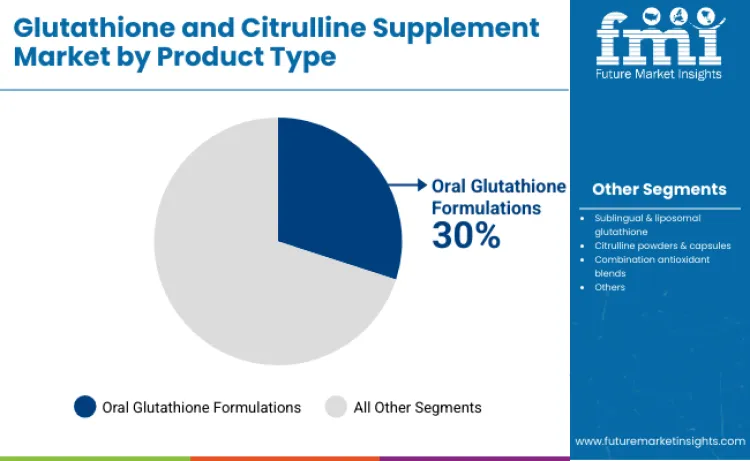
The oral glutathione segment holds a dominant 30% revenue share in 2025, driven by strong consumer preference for capsules, tablets, and powders that support intracellular antioxidant activity, immunity, and detoxification. Its leadership is reinforced by affordability, dosing convenience, and wide retail and online availability. The citrulline powder and capsule segment follows at 25%, supported by fitness and nitric oxide-enhancing routines. Sublingual and liposomal glutathione accounts for 20%, while combination antioxidant blends represent 15%. The remaining 10% comes from niche formulations and emerging delivery technologies, reflecting diversified adoption across wellness categories.
By Application, General Wellness and Detox Represents the Leading Market Segment
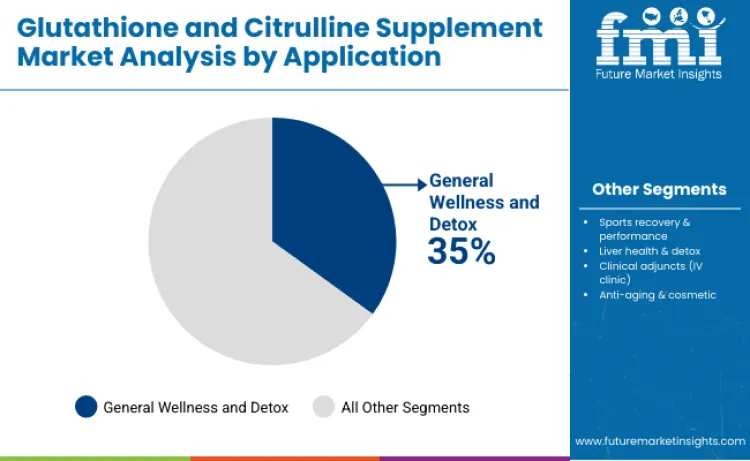
General wellness and detox applications lead the market with 35% revenue share in 2025, supported by rising focus on oxidative stress reduction, immune stability, metabolic cleansing, and energy-enhancing routines. Strong public awareness of toxin exposure and glutathione’s redox role reinforces consistent adoption. Sports recovery and performance follows at 20%, driven by citrulline-based endurance and muscle recovery regimens. Liver health accounts for 18%, while clinical adjunct use contributes 12% through IV and physician-guided programs. Anti-aging and cosmetic wellness holds 15%, supported by demand for antioxidant-driven skin radiance and healthy-aging benefits.
By End-User Channel, Retail and E-Commerce Holds the Highest Market Share
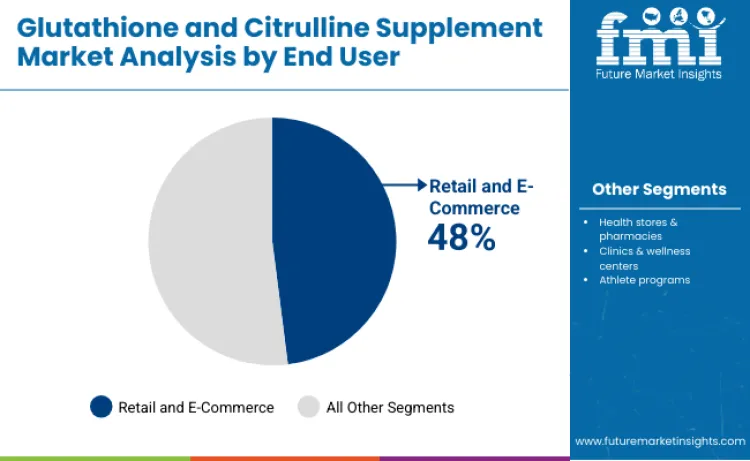
Retail and e-commerce channels lead with 48% share in 2025, driven by strong digital penetration, influencer-led awareness, subscription programs, and easy access to antioxidant and performance-nutrition products. Repeat purchases are reinforced by comparison tools, education content, and personalized wellness subscriptions. Health stores and pharmacies hold 22%, supported by guided selection and clinical-trust positioning. Clinics and wellness centers contribute 18% through practitioner-directed protocols and IV-supported detox programs. Athlete-focused programs represent 12%, driven by structured sports nutrition and endurance supplementation, strengthening diversified channel adoption across consumer groups.
What Are the Major Drivers, Restraints, and Emerging Trends Influencing the Glutathione and Citrulline Supplement Market?
The glutathione and citrulline supplement market is driven by rising global interest in preventive wellness, antioxidant therapy, and performance nutrition. Demand for glutathione continues to grow as consumers prioritize oxidative stress reduction, immune reinforcement, and cellular detoxification through structured wellness programs. Expanding fitness participation and endurance sports adoption strengthen the citrulline segment, as nitric-oxide-mediated vascular flow and muscle-recovery benefits gain recognition among recreational athletes. Clinical validation within integrative medicine, dermatology-wellness programs, and IV-nutrition centers reinforces practitioner-guided usage, while digital health education and subscription models support recurring consumer adoption across wellness and performance categories.
What Restraints Limit Broader Adoption of Glutathione and Citrulline Supplements?
Market restraints include premium pricing of pharmaceutical-grade and liposomal glutathione, driven by precision fermentation, stabilization technologies, and rigorous purity verification, which restrict access for cost-sensitive consumers. Heightened regulatory focus on label accuracy, banned-substance compliance, and substantiated efficacy claims increases operational complexity for brands. Product-differentiation challenges persist due to bioavailability variability across non-liposomal formats, influencing perception among informed buyers. Suppliers must invest in innovation, clinical substantiation, and transparent manufacturing to maintain credibility as educated consumers increasingly scrutinize formulation quality, performance outcomes, and ingredient sourcing within antioxidant and nitric-oxide supplement categories.
What Emerging Trends Are Shaping the Future of the Glutathione and Citrulline Supplement Market?
Key trends include advancements in delivery science, with liposomal encapsulation, sustained-release antioxidant complexes, and synergistic nutrient stacks combining glutathione, NAC, ALA, vitamin C, and citrulline-malate gaining traction for enhanced cellular defense and performance recovery. Alignment with longevity science and mitochondrial optimization is elevating premium positioning. Practitioner-supported supplementation through functional-medicine ecosystems, telehealth-enabled wellness programs, and sports analytics platforms is expanding. Clean-label sourcing, traceable fermentation processes, and third-party purity validation are emerging as critical credibility signals. Evolving clinical-evidence standards and technological gains in glutathione stabilization and citrulline production may further expand global accessibility.
How Are Leading Countries Driving Growth in the Glutathione and Citrulline Supplement Market?
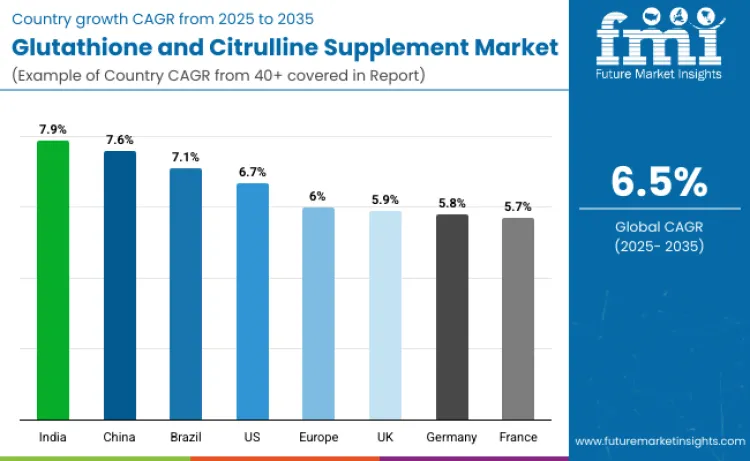
| Country | CAGR (2025 to 2035) |
|---|---|
| USA | 6.7% |
| Brazil | 7.1% |
| China | 7.6% |
| India | 7.9% |
| Europe | 6.0% |
| Germany | 5.8% |
| France | 5.7% |
| UK | 5.9% |
India leads global acceleration with a 7.9% growth rate, driven by rising fitness participation, detox adoption, and evidence-guided nutraceutical use. China follows at 7.6%, supported by expanding sports nutrition, skin-health demand, and strong e-commerce wellness integration. Brazil grows at 7.1% through functional nutrition awareness and bodybuilding communities. The USA expands at 6.7%, reinforced by mature nutraceutical use and physician-guided functional medicine. Europe grows at 6.0%, with Germany at 5.8%, the UK at 5.9%, and France at 5.7%, reflecting fitness-led routines, clinical nutrition advocacy, and regulated supplement quality.
The report covers an in-depth analysis of 40+ countries top-performing countries are highlighted below.
How Is Functional Wellness and Performance Nutrition Infrastructure Accelerating Market Growth in China?
Glutathione and citrulline supplement market in China shows the strongest growth potential with a 7.6% CAGR through 2035, driven by rising preventive wellness adoption, expanding fitness participation, and strong demand for antioxidant, detox, and performance-recovery solutions. Growth is concentrated in Shanghai, Beijing, Guangzhou, and Shenzhen, where fitness centers and beauty-wellness clinics incorporate glutathione and citrulline protocols. Large e-commerce platforms, cross-border marketplaces, and direct-to-consumer brands boost access to liposomal glutathione and citrulline endurance blends. Government support for active-aging and sports-health initiatives, along with expanding domestic nutraceutical production, strengthens availability of advanced antioxidant formulations and enhances consumer confidence.
Why Are Wellness and Performance Skill Development Programs Enhancing Market Adoption in India?
India’s adoption of glutathione and citrulline supplements is accelerating across gyms, performance centers, functional medicine clinics, and urban wellness communities, supported by Fit India initiatives and rising metabolic-health education. The market grows at a 7.9% CAGR through 2035, driven by structured fitness participation, recovery-focused nutrition, and awareness of oxidative stress, detoxification, and vascular support. Consumers and athletes increasingly use these supplements for stamina, immunity, muscle repair, and skin vitality. Leading clusters such as Bangalore, Mumbai, Delhi NCR, and Hyderabad boost nationwide uptake, supported by digital nutrition programs and practitioner-guided supplementation models expanding informed adoption.
How Does Scientific Rigor and Clinical-Grade Quality Focus Sustain Market Leadership in Germany?
Sales of glutathione and citrulline supplements in Germany shows disciplined adoption of glutathione and citrulline supplements, reinforced by research participation and precision-driven wellness practices. Major hubs such as Berlin, Munich, Hamburg, and Frankfurt integrate glutathione for immunity, detoxification, and skin vitality, while citrulline supports endurance and muscle recovery. Demand centers on pharmaceutical-grade purity, clean-label compliance, and validated physiological outcomes. Premium formats, including liposomal and fermentation-derived variants, see strong uptake. The segment expands steadily with a 5.8% CAGR through 2035, supported by sports science integration, medical-wellness protocols, and partnerships ensuring high-quality, traceable nutraceutical production.
How Do Expanding Fitness Culture and Wellness Adoption Strengthen Market Performance in Brazil?
Glutathione and citrulline supplement market in Brazil shows strong momentum with a 7.1% CAGR through 2035, driven by expanding fitness, bodybuilding, and endurance sports communities. High adoption across gyms and wellness centers in São Paulo, Rio de Janeiro, Brasília, and Porto Alegre reflects rising demand for antioxidant support, muscle recovery, and vascular-performance benefits. Growing access to liposomal glutathione and citrulline-malate through modern retail and digital platforms strengthens uptake. Influencers, sports coaches, and wellness practitioners promote metabolic resilience, endurance, and skin vitality, reinforcing sustained adoption across performance-focused and general wellness consumers.
How Do Advanced Sports Science and Integrative Wellness Systems Strengthen Market Performance in the United States?
The United States glutathione and citrulline supplement market shows mature adoption supported by elite athletic facilities, integrative medicine programs, and a well-developed nutraceutical ecosystem. Usage across centers in California, Texas, Florida, and New York reflects strong reliance on glutathione for detox and immune balance, and citrulline for vascular support and endurance. The market grows at a 6.7% CAGR through 2035, driven by widespread sports participation and expansion of longevity programs. Robust manufacturing, clinical research, and practitioner networks strengthen evidence-backed formulations, while clean-label standards and precision supplementation fuel demand for liposomal glutathione and high-purity citrulline.
How Is Performance-Wellness Expansion Supporting Market Growth in the United Kingdom?
Health-active clusters in London, Manchester, Birmingham, and Edinburgh are driving strong adoption of glutathione and citrulline supplements across fitness centers, sports rehab facilities, and integrative wellness clinics. Usage supports endurance, metabolic recovery, detox routines, and visible improvements in fatigue, performance, and skin vitality. The United Kingdom shows solid momentum with a 5.9% CAGR through 2035, supported by its preventive-health culture and rising endurance-sports participation. Consumers increasingly prefer pharmaceutical-grade amino-acid formulations, liposomal glutathione, and clinician-guided detox programs, while advisors and wellness clinics strengthen structured supplementation pathways across active and general-wellness populations.
How Are Preventive-Wellness Investments Advancing Market Expansion Across Europe?
The glutathione and citrulline supplement market in Europe is set to grow from USD 228.0 million in 2025 to USD 399.4 million by 2035, at a 5.7% CAGR. Germany leads with 17.0% in 2025, rising to 18.0% by 2035, supported by strong medical-wellness adoption across Berlin, Munich, Frankfurt, and Hamburg. France holds 16.0%, driven by detox, fatigue-reduction, and skin-radiance demand across Paris, Lyon, and Marseille. Italy maintains 13.0%, reflecting beauty-wellness and fitness-center usage.
Spain holds 9.0%, while the Netherlands remains at 6.0%, supported by performance-nutrition trends and practitioner guidance. The Rest of Europe accounts for 30.5% in both 2025 and 2035, driven by growing wellness participation in Nordic and Central European countries and broader access to clean-label antioxidant nutraceuticals.
Precision Supplementation Standards Dominate Requirements in Japan
Glutathione and citrulline supplement market in Japan reflects a highly mature, quality-driven ecosystem built on clinical validation, precision dosing, and premium formulation standards. Longevity clinics, metabolic wellness programs, and athletic conditioning centers increasingly rely on reduced and liposomal glutathione, along with high-grade citrulline designed for vascular support, fatigue reduction, and muscle recovery. Demand is shaped by Japan’s focus on purity, bioavailability, and proven physiological efficacy.
Strong collaboration between domestic nutraceutical manufacturers, research institutions, and pharmacist-supervised retail channels reinforces trust through traceable sourcing and strict regulatory compliance. Consumers in Tokyo, Osaka, and other metropolitan hubs adopt supplements with discipline, expecting transparent clinical substantiation and meticulous formulation quality aligned with Japan’s longevity-focused wellness culture.
International Providers Lead Clinical-Wellness Integration in South Korea
The glutathione and citrulline supplement market in South Korea is expanding as international nutraceutical and functional-wellness brands strengthen their presence with clinically positioned formulations focused on beauty, stamina, and metabolic health. Korean consumers increasingly prioritize antioxidant defense, vascular performance, skin clarity, and recovery support, driving strong adoption across integrative dermatology clinics, fitness-performance centers, and IV-therapy lounges. Glutathione is widely incorporated for radiance and detox support, while citrulline is favored for circulation and endurance enhancement.
Pharmacy and beauty-nutrition chains are extending market reach through partnerships with domestic and global manufacturers, supported by localized education and tailored wellness programs. Collaboration between international innovators and Korean healthcare-wellness associations is shaping hybrid distribution and practitioner-guided models that blend global formulation standards with local expectations for purity, efficacy, and skin-focused health outcomes.
How Competitive Is the Global Glutathione & Citrulline Supplement Market and What Defines Its Structure?
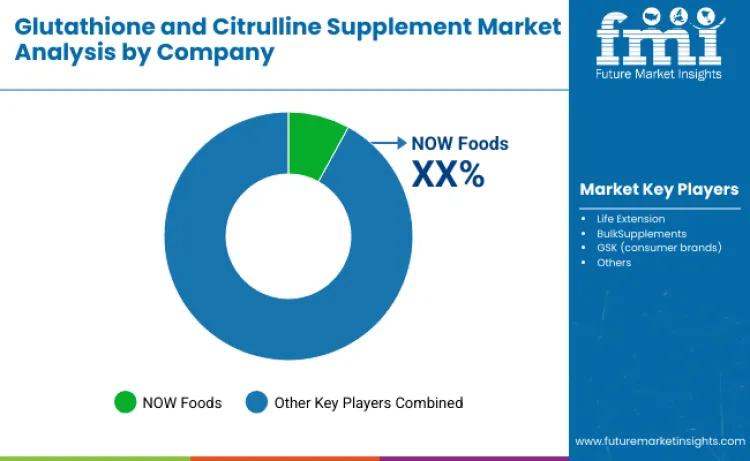
The glutathione & citrulline supplement market remains highly fragmented, with influence distributed across a wide base of nutraceutical and performance-nutrition brands. Even the leading companies hold only modest individual shares, reinforcing a landscape defined by formulation quality, purity assurance, and scientific validation rather than scale. Competition focuses on bioavailability, clean-label antioxidants and nitric-oxide support systems, and evidence-backed ingredient sourcing. Established brands strengthen their position through trusted raw materials, transparent documentation, practitioner-aligned formulations, and broad access across digital and specialty health channels, while traditional healthcare-affiliated brands participate selectively within antioxidant and amino-acid categories.
Emerging specialists and private-label manufacturers intensify competitive pressure by targeting sports recovery, anti-aging, and detox-wellness niches, often emphasizing liposomal technologies, fermentation-derived purity, and clinical substantiation. Digital-native companies and Asian nutraceutical producers add agility and price-performance competitiveness through rapid innovation cycles and global supply capabilities. Overall, market momentum favors firms prioritizing validated science, transparent communication, third-party testing, and consistent supply reliability while building long-term consumer trust through education-driven engagement.
Key Players in the Glutathione & Citrulline Supplement Market
- NOW Foods
- Life Extension
- BulkSupplements
- GSK (consumer brands)
- Others
Scope of the Report
| Items | Values |
|---|---|
| Quantitative Units | USD 760.0 million |
| Product Type | Oral glutathione formulations, Sublingual & liposomal glutathione, Citrulline powders & capsules, Combination antioxidant blends, Others |
| Application | General wellness & detox, Sports recovery & performance, Liver health & detox, Clinical adjuncts (IV clinic), Anti-aging & cosmetic |
| End User | Retail & e-commerce, Health stores & pharmacies, Clinics & wellness centers, Athlete programs |
| Regions Covered | Asia Pacific, Europe, North America, Latin America, Middle East & Africa |
| Country Covered | China, India, Germany, Brazil, USA, UK, Japan, and 40+ countries |
| Key Companies Profiled | NOW Foods, Life Extension, BulkSupplements, GSK (consumer brands), Others |
| Additional Attributes | Dollar sales by glutathione and citrulline format segments, application-driven demand across wellness, sports, liver support, clinical wellness, and beauty-aging, regional trends across North America, Europe, and Asia-Pacific, competitive nutraceutical landscape, and innovations in liposomal delivery, fermented glutathione, performance stacks, and practitioner-led distribution. |
Glutathione & Citrulline Supplement Market by Segments
Product Type:
- Oral glutathione formulations
- Sublingual & liposomal glutathione
- Citrulline powders & capsules
- Combination antioxidant blends
- Others
Application:
- General wellness & detox
- Sports recovery & performance
- Liver health & detox
- Clinical adjuncts (IV clinic)
- Anti-aging & cosmetic
End User:
- Retail & e-commerce
- Health stores & pharmacies
- Clinics & wellness centers
- Athlete programs
Region:
- Asia Pacific
- China
- India
- Japan
- South Korea
- Vietnam
- Australia & New Zealand
- ASEAN
- Rest of Asia Pacific
- Europe
- Germany
- United Kingdom
- France
- Italy
- Spain
- Netherlands
- Nordic
- BENELUX
- Rest of Europe
- North America
- United States
- Canada
- Mexico
- Latin America
- Brazil
- Argentina
- Rest of Latin America
- Middle East & Africa
- Kingdom of Saudi Arabia
- Other GCC Countries
- Turkey
- South Africa
- Other African Union
- Rest of Middle East & Africa
Frequently Asked Questions
How big is the glutathione and citrulline supplement market in 2025?
The global glutathione and citrulline supplement market is valued at USD 760.0 million in 2025.
What will be the size of the glutathione and citrulline supplement market in 2035?
The market is projected to reach USD 1,426.6 million by 2035.
How fast will the glutathione and citrulline supplement market grow between 2025 and 2035?
The market will grow at a CAGR of 6.5% during 2025 to 2035.
Which product type leads the glutathione and citrulline supplement market in 2025?
Oral glutathione formulations lead the market with a 30% share in 2025.
Who are the major players in the glutathione and citrulline supplement market?
Key players include NOW Foods, Life Extension, Bulk-Supplements, and GSK consumer brands.
Preview the report firsthand - request a free sample
Get SampleGet the brochure for pricing and purchase details.
Get PDFTable of Content
- Executive Summary
- Regional Level Market Outlook
- Demand-side Trends
- Supply-side Trends
- Technology Roadmap Analysis
- Analysis and Recommendations
- Market Overview
- Market Coverage / Taxonomy
- Market Definition / Scope / Limitations
- Market Background
- Market Dynamics
- Drivers
- Restraints
- Opportunity
- Trends
- Scenario Forecast
- Demand in Optimistic Scenario
- Demand in Likely Scenario
- Demand in Conservative Scenario
- Opportunity Assessment
- Market Trade Assessment
- Products Market Assessment
- Investment Feasibility Matrix
- Value Chain Analysis
- Participants and their Roles
- Profit Margin Analysis
- Operating Margins By Region
- PESTLE and Porter’s Analysis
- Regulatory Landscape
- By Key Regions
- By Key Countries
- Regional Parent Market Outlook
- Product Launches & Development
- Technological Innovation
- Market Dynamics
- Regional Level Market Analysis 2020 to 2024 and Forecast, 2025 to 2035
- Historical Market Size USD Million Analysis, 2020 to 2024
- Current and Future Market Size USD Million Projections, 2025 to 2035
- Y-o-Y Growth Trend Analysis
- Absolute $ Opportunity Analysis
- Regional Level Market Analysis 2020 to 2024 and Forecast 2025 to 2035, By Product Type
- Introduction / Key Findings
- Historical Market Size USD Million Analysis By Product Type, 2020 to 2024
- Current and Future Market Size USD Million Analysis and Forecast By Product Type, 2025 to 2035
- Oral glutathione formulations
- Sublingual & liposomal glutathione
- Citrulline powders & capsules
- Combination antioxidant blends
- Others
- Y-o-Y Growth Trend Analysis By Product Type, 2020 to 2024
- Absolute $ Opportunity Analysis By Product Type, 2025 to 2035
- Regional Level Market Analysis 2020 to 2024 and Forecast 2025 to 2035, By Application
- Introduction / Key Findings
- Historical Market Size USD Million Analysis By Application, 2020 to 2024
- Current and Future Market Size USD Million Analysis and Forecast By Application, 2025 to 2035
- General wellness & detox
- Sports recovery & performance
- Liver health & detox
- Clinical adjuncts (IV clinic)
- Anti-aging & cosmetic
- Y-o-Y Growth Trend Analysis By Application, 2020 to 2024
- Absolute $ Opportunity Analysis By Application, 2025 to 2035
- Regional Level Market Analysis 2020 to 2024 and Forecast 2025 to 2035, By End User
- Introduction / Key Findings
- Historical Market Size USD Million Analysis By End User, 2020 to 2024
- Current and Future Market Size USD Million Analysis and Forecast By End User, 2025 to 2035
- Retail & e-commerce
- Health stores & pharmacies
- Clinics & wellness centers
- Athlete programs
- Y-o-Y Growth Trend Analysis By End User, 2020 to 2024
- Absolute $ Opportunity Analysis By End User, 2025 to 2035
- Regional Level Market Analysis 2020 to 2024 and Forecast 2025 to 2035, By Channel
- Introduction / Key Findings
- Historical Market Size USD Million Analysis By Channel, 2020 to 2024
- Current and Future Market Size USD Million Analysis and Forecast By Channel, 2025 to 2035
- Sleep Dentists & Orofacial Pain Clinics
- Dental Labs & DSOs
- Hospitals & Sleep Centers
- D2C / Tele Dentistry Providers
- Y-o-Y Growth Trend Analysis By Channel, 2020 to 2024
- Absolute $ Opportunity Analysis By Channel, 2025 to 2035
- Regional Level Market Analysis 2020 to 2024 and Forecast 2025 to 2035, By Region
- Introduction
- Historical Market Size USD Million Analysis By Region, 2020 to 2024
- Current Market Size USD Million Analysis and Forecast By Region, 2025 to 2035
- North America
- Latin America
- East Asia
- South Asia
- Western Europe
- Eastern Europe
- Middle East & Africa
- Market Attractiveness Analysis By Region
- North America Market Analysis 2020 to 2024 and Forecast 2025 to 2035, By Country
- Historical Market Size USD Million Trend Analysis By Market Taxonomy, 2020 to 2024
- Market Size USD Million Forecast By Market Taxonomy, 2025 to 2035
- By Country
- USA
- Canada
- Mexico
- By Product Type
- By Application
- By End User
- By Channel
- By Country
- Market Attractiveness Analysis
- By Country
- By Product Type
- By Application
- By End User
- By Channel
- Key Takeaways
- Latin America Market Analysis 2020 to 2024 and Forecast 2025 to 2035, By Country
- Historical Market Size USD Million Trend Analysis By Market Taxonomy, 2020 to 2024
- Market Size USD Million Forecast By Market Taxonomy, 2025 to 2035
- By Country
- Brazil
- Argentina
- Rest of Latin America
- By Product Type
- By Application
- By End User
- By Channel
- By Country
- Market Attractiveness Analysis
- By Country
- By Product Type
- By Application
- By End User
- By Channel
- Key Takeaways
- East Asia Market Analysis 2020 to 2024 and Forecast 2025 to 2035, By Country
- Historical Market Size USD Million Trend Analysis By Market Taxonomy, 2020 to 2024
- Market Size USD Million Forecast By Market Taxonomy, 2025 to 2035
- By Country
- China
- Japan
- South Korea
- By Product Type
- By Application
- By End User
- By Channel
- By Country
- Market Attractiveness Analysis
- By Country
- By Product Type
- By Application
- By End User
- By Channel
- Key Takeaways
- South Asia Market Analysis 2020 to 2024 and Forecast 2025 to 2035, By Country
- Historical Market Size USD Million Trend Analysis By Market Taxonomy, 2020 to 2024
- Market Size USD Million Forecast By Market Taxonomy, 2025 to 2035
- By Country
- India
- ASEAN Countries
- Australia & New Zealand
- Rest of South Asia
- By Product Type
- By Application
- By End User
- By Channel
- By Country
- Market Attractiveness Analysis
- By Country
- By Product Type
- By Application
- By End User
- By Channel
- Key Takeaways
- Western Europe Market Analysis 2020 to 2024 and Forecast 2025 to 2035, By Country
- Historical Market Size USD Million Trend Analysis By Market Taxonomy, 2020 to 2024
- Market Size USD Million Forecast By Market Taxonomy, 2025 to 2035
- By Country
- Germany
- UK
- France
- Italy
- Spain
- BENELUX
- Nordic Countries
- Rest of Western Europe
- By Product Type
- By Application
- By End User
- By Channel
- By Country
- Market Attractiveness Analysis
- By Country
- By Product Type
- By Application
- By End User
- By Channel
- Key Takeaways
- Eastern Europe Market Analysis 2020 to 2024 and Forecast 2025 to 2035, By Country
- Historical Market Size USD Million Trend Analysis By Market Taxonomy, 2020 to 2024
- Market Size USD Million Forecast By Market Taxonomy, 2025 to 2035
- By Country
- Russia
- Hungary
- Poland
- Rest of Eastern Europe
- By Product Type
- By Application
- By End User
- By Channel
- By Country
- Market Attractiveness Analysis
- By Country
- By Product Type
- By Application
- By End User
- By Channel
- Key Takeaways
- Middle East & Africa Market Analysis 2020 to 2024 and Forecast 2025 to 2035, By Country
- Historical Market Size USD Million Trend Analysis By Market Taxonomy, 2020 to 2024
- Market Size USD Million Forecast By Market Taxonomy, 2025 to 2035
- By Country
- Saudi Arabia
- Other GCC Countries
- Türkiye
- South Africa
- Rest of MEA
- By Product Type
- By Application
- By End User
- By Channel
- By Country
- Market Attractiveness Analysis
- By Country
- By Product Type
- By Application
- By End User
- By Channel
- Key Takeaways
- Market Structure Analysis
- Competition Dashboard
- Competition Benchmarking
- Market Share Analysis of Top Players
- By Regional
- By Product Type
- By Application
- By End User
- By Channel
- Competition Analysis
- Competition Deep Dive
- NOW Foods
- Overview
- Product Portfolio
- Key Financials
- Key Developments
- Global/Regional Footprint
- Strategy Overview
- Marketing Strategy
- SWOT
- Analyst Comment
- Life Extension
- Overview
- Product Portfolio
- Key Financials
- Key Developments
- Global/Regional Footprint
- Strategy Overview
- Marketing Strategy
- SWOT
- Analyst Comment
- BulkSupplements
- Overview
- Product Portfolio
- Key Financials
- Key Developments
- Global/Regional Footprint
- Strategy Overview
- Marketing Strategy
- SWOT
- Analyst Comment
- GSK (consumer brands)
- Overview
- Product Portfolio
- Key Financials
- Key Developments
- Global/Regional Footprint
- Strategy Overview
- Marketing Strategy
- SWOT
- Analyst Comment
- NOW Foods
- Competition Deep Dive
- Assumptions & Acronyms Used
- Research Methodology


