

- Industry Size (2025)
- USD 0.5 Bn
- Forecast (2035)
- USD 1.1 Bn
- CAGR (2025 to 2035)
- 8.7%
Green Tea Polyphenols Market Forecast and Outlook 2025 to 2035
The global green tea polyphenols demand is valued at USD 0.5 billion in 2025 and is forecasted to reach USD 1.1 billion by 2035, with a CAGR of 8.7%. Growth reflects consistent utilization of catechin-rich extracts in skin-care formulations designed for antioxidant, anti-ageing, and inflammation-control benefits. Commercial adoption aligns with a broader shift toward natural actives supported by safety validation and established consumer familiarity with tea-derived ingredients.
Skin care is the leading application category. Green tea polyphenols are incorporated into serums, masks, lotions, and sunscreens to support environmental defence, photoprotection, and collagen stability. Manufacturers integrate encapsulation technologies to improve bioavailability and maintain formulation transparency without compromising functional concentration.
Quick Stats for Global Green Tea Polyphenols Demand
- Global Green Tea Polyphenols Sales Value (2025): USD 0.5 billion
- Global Green Tea Polyphenols Forecast Value (2035): USD 1.1 billion
- Global Green Tea Polyphenols Forecast CAGR (2025 to 2035): 8.7%
- Leading Application in Global Green Tea Polyphenols Demand: Skin Care
- Key Growth Regions in Global Green Tea Polyphenols Demand: Asia Pacific, Europe, North America
- Top Players in Global Green Tea Polyphenols Demand: BASF SE, Croda International, Evonik Industries, Symrise, Dow
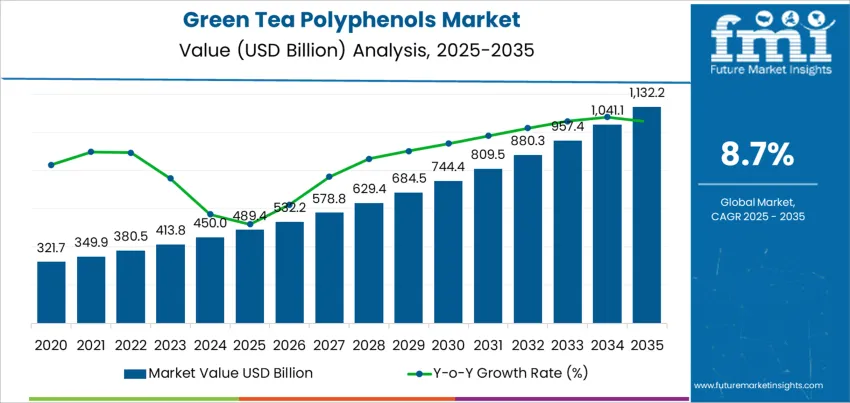
Key Takeaways, Market Size, and Forecast
| Metric | Value |
|---|---|
| Market Size (2025) | USD 0.5 Billion |
| Market Size (2035) | USD 1.1 Billion |
| CAGR (2025–2035) | 8.7% |
| Leading Application | Skin Care |
| Skin Care Share | 10.1% |
| Leading Product Form | Powder |
| Powder Share | 15.5% |
What is the Growth Forecast for the Green Tea Polyphenols Market through 2035?
Asia Pacific, Europe, and North America record the highest consumption due to strong personal-care manufacturing footprints and increasing alignment with clean-label preferences. Demand concentrates within premium and dermocosmetic product lines that emphasize efficacy supported by published research. Major suppliers include BASF SE, Croda International, Evonik Industries, Symrise, and Dow. Their focus involves process optimization for high-purity catechin extraction, clinical performance substantiation, and compatibility with multi-functional cosmetic ingredient systems.
A saturation point assessment for the global green tea polyphenols industry indicates that growth is steady but increasingly influenced by maturity in core supplement categories. Dietary supplements represent the most established segment, where high consumer awareness of antioxidant and anti-inflammatory benefits has already converted a large portion of health-focused users. This reduces headroom for rapid volume expansion and signals an approach toward partial saturation in developed regions.
Food and beverage applications provide incremental growth but also show limits, since product development depends on masking bitterness and maintaining ingredient stability, which slows broader adoption. Personal care remains less saturated, although usage is widespread in anti-aging and skin protection formulas. This segment still offers medium-term headroom because demand for natural actives continues to rise. Pharmaceutical and functional medical nutrition are the least saturated areas, reflecting ongoing research into metabolic, cardiovascular, and cognitive benefits. Stronger clinical evidence could delay saturation and unlock new therapeutic positioning. Regional saturation varies, with Asia Pacific being the most mature due to long-standing consumption patterns. North America and Europe offer more extension potential through clean label innovation and targeted health claims.
Green Tea Polyphenols Market Key Takeaways
| Metric | Value |
|---|---|
| Market Value (2025) | USD 0.5 billion |
| Market Forecast Value (2035) | USD 1.1 billion |
| Forecast CAGR (2025-2035) | 8.7% |
Why is the Demand for Green Tea Polyphenols Growing Globally?
Demand for green tea polyphenols is increasing worldwide because nutraceutical and beverage companies focus on ingredients that support metabolic health, antioxidant protection and cognitive wellness. Polyphenols such as catechins are widely used in dietary supplements targeting weight management, heart health and immune function, which align with growing interest in preventive health habits. Functional drink manufacturers include concentrated extracts in ready to drink teas, wellness shots and powdered blends to provide measurable health benefits in convenient formats.
Cosmetic producers adopt green tea polyphenols in anti-aging and anti-inflammation skincare products due to their potential role in reducing oxidative stress and supporting skin barrier resilience. Research continues to examine polyphenols in sports recovery and brain-health applications, encouraging broader product development in active lifestyle categories. Global expansion in clean label and plant derived ingredients strengthens adoption, supported by established supply from major tea growing regions.
Standardized extraction improves potency consistency for regulated markets in North America, Europe and Asia Pacific. Constraints include cost variations linked to tea leaf supply and the need for stability management in finished products that are sensitive to heat or light. Scientific validation remains important for health claims in highly regulated sectors.
Which End-Use Applications and Product Forms Lead Global Demand for Green Tea Polyphenols?
Global demand for green tea polyphenols is driven by their antioxidant strength, anti-inflammatory support, and UV-protective capabilities. Beauty and personal-care brands integrate these actives to address aging, pigmentation, sensitivity, and environmental stress. Formulations highlight catechin-rich extracts for pollution defense and soothing benefits. Premium dermocosmetic and men’s grooming launches further support adoption, along with hybrid wellness products positioned for sensitive-skin compatibility. Innovation focuses on stability enhancement, bioavailability improvements, and clean-label compliance across global cosmetic regulations.
By End-Use Application, Skin Care Holds the Largest Share

Skin care represents 10.1% of global consumption. Anti-aging, redness reduction, and improved skin texture remain primary claims, leading to deployment in serums, moisturizers, and essence-based systems. Body-care categories leverage antioxidants for firming and anti-pollution positioning. Hair-care formulations use catechins for scalp soothing and follicle protection from oxidative damage. Sun-care applications connect UV exposure defense with melanin-moderation benefits, while color cosmetics explore functional pigment stabilization. Men’s grooming benefits from sebum-balancing and after-shave soothing efficacy, and baby & kids care relies on gentler botanical protection. Dermocosmetic usage expands as brands prioritize clinical efficacy with minimal irritation.
Key Points:
- Skin-care demand driven by anti-aging and sensitivity repair claims
- Growing relevance in scalp defense and sun-care performance positioning
- Dermocosmetic adoption accelerates premium, clinically referenced use
By Product Form, Powder Holds the Largest Share

Powder format accounts for 15.5%, driven by enhanced stability, high active concentration, and seamless integration into solid and water-based formats. Powders support wide regulatory acceptance and long shelf durability across regions. Liquid solutions enable better bioavailability in high-absorption serums and ampoules, while concentrated liquid extracts target functional dosing in premium categories. Dispersions, gels, and emulsions enhance sensorial performance and allow controlled release in soothing masks. Oil-based and paste variants focus on occlusion and scalp-repair benefits. Product-form decisions align with targeted delivery, formulation stability, and compatibility with natural preservatives.
Key Points:
- Powders dominate due to stability, potency, and cost-efficient handling
- High-active liquids support advanced dermocosmetic innovation
- Diverse sensorial forms increase adoption across skin- and hair-focused SKUs
What are the Drivers, Restraints, and Key Trends of the Global Green Tea Polyphenols Market?
Rising consumer demand for antioxidants, growing interest in wellness and expanded use across food, beverages and nutraceuticals drive demand.
Worldwide, green tea polyphenols, especially catechins such as EGCG are valued for antioxidant effects, supporting market growth in dietary supplements, functional beverages, and fortified foods. Increasing awareness of oxidative stress, cardiovascular health, and healthy aging encourages consumers in North America, Europe, and Asia to adopt polyphenol-based products. Beverage manufacturers integrate green tea polyphenols into ready-to-drink teas, juices, and energy drinks. Nutraceutical and dietary supplement producers market capsules, tablets, and powders targeting immunity, metabolism, and skin health. Growth in health-conscious lifestyles and rising middle-class purchasing power across emerging economies expand the target consumer base globally.
Variability in raw material quality, regulatory constraints on health claims, and possible negative perception of caffeine restrain growth.
Green tea polyphenol concentration varies depending on tea cultivation region, harvest timing, and extraction method, which complicates standardization for manufacturers. Regulatory authorities in different regions apply strict rules to health claims related to antioxidant or disease-prevention benefits. This limits marketing messaging and may reduce perceived value among informed consumers. Additionally, concerns about caffeine content and possible interactions with medications lead some individuals, especially those sensitive to stimulants to avoid polyphenol-rich formulations. These factors constrain rapid expansion in mature and regulated markets.
Shift toward standardized high-purity extracts, increased incorporation into non-beverage formats, and rising demand for clean-label natural antioxidants define key trends.
Suppliers are producing standardized green tea polyphenol extracts with verified catechin profiles to improve consistency and support regulatory compliance. Food and personal-care brands incorporate polyphenols into snacks, bakery items, skincare products, and oral-care formulations to leverage antioxidant and anti-inflammatory properties beyond traditional tea beverages. Demand for antioxidant supplements without synthetic additives supports growth of clean-label, vegan, and non-GMO certified products. Emerging research on polyphenol benefits in metabolic health, skin aging, and cognitive support drives product innovation and broader application. These developments suggest sustained, multi-segment demand for green tea polyphenols across global health, food, beverage, and personal care markets.
Analysis of the Green Tea Polyphenols Market by Key Country
The global green tea polyphenols market is growing as consumers seek botanical antioxidants for metabolic regulation, cognitive support, skin health, and heart-wellness. Food, beverage, nutraceutical, and cosmetics manufacturers continue to expand applications using standardized extracts containing EGCG, catechins, and flavonoids. India registers 11.8% CAGR, driven by dietary supplement growth and herbal beverage premiumization.
China follows at 10.9%, supported by deep manufacturing integration and global export capability. Japan posts 10.1% with strong scientific validation and healthy-aging demand. The United Kingdom grows at 9.2% through preventive-nutrition categories. Germany records 8.3%, reinforcing regulated supplement use, while the United States expands at 7.4% through functional beverage innovation and clean-label positioning.

| Country | CAGR (%) |
|---|---|
| India | 11.8% |
| China | 10.9% |
| Japan | 10.1% |
| UK | 9.2% |
| Germany | 8.3% |
| USA | 7.4% |
How is India driving expansion of the Green Tea Polyphenols Market?
India grows at 11.8% CAGR, reinforced by expanding nutraceutical manufacturing, Ayurveda-guided antioxidant positioning, and rapid adoption of wellness beverages. Standardized EGCG extracts are increasingly incorporated into weight-management, blood-sugar balance, and immune-support capsules targeting young professionals and fitness-focused users. Herbal tea brands emphasize catechin content and natural caffeine alternatives, influencing purchasing decisions in urban retail channels. Cosmetic manufacturers adopt polyphenols for anti-pollution serums and hair vitality formulations. Indian tea-growing states provide consistent raw-leaf supply, enabling cost-efficient extraction for both domestic and export markets. Clean-label claims and vegan formulations drive higher-value SKUs in e-commerce channels.
- Ayurvedic positioning supporting preventive-wellness usage
- Functional weight-management blends driving volume
- Domestic cultivation securing raw-material continuity
- Cosmetics integration boosting antioxidant ingredient demand
How is China strengthening its leadership in polyphenol production?
China achieves 10.9% CAGR, supported by its extensive green-tea agricultural base and large-scale polyphenol extraction facilities distributed across Zhejiang and Fujian. Beauty-from-within categories grow rapidly, with EGCG-based ingestible products positioned for skin brightening, detox support, and fatigue reduction. Pharmaceutical-adjacent companies explore polyphenols for cardiovascular and metabolic-health outcomes. Domestic beverage producers introduce RTD teas and functional health drinks with quantified catechin content. Regulatory monitoring of pesticide and heavy-metal compliance supports global export acceptance. Proprietary extraction methods improve purity ratios and dissolution performance for tablets and drink powders.
- National supply dominance supporting low-cost scaling
- Ingestible beauty and metabolic health categories expanding
- Manufacturing innovation improving purity consistency
- Export compliance enhancing overseas market access
How is Japan expanding high-science adoption for polyphenols?

Japan grows at 10.1% CAGR, driven by healthy-aging priorities, clinical research focus, and consumer trust in green-tea bioactives. EGCG-based formulations target oxidative-stress management, skin rejuvenation, liver support, and cognitive maintenance for senior populations. Ready-to-drink health beverages, sachets, and powder sticks enable daily low-dose consumption aligned with local preferences. Supplement procurement requires validated bioavailability data, shelf-stability testing, and allergen-safe certifications suited for Japan’s regulatory environment. Collaboration between beverage manufacturers and research institutions sustains category credibility.
- Aging-population needs guiding antioxidant consumption
- Clinical-validation strategy shaping procurement decisions
- Convenient wellness beverage formats maintaining routine adherence
- High-purity standards enhancing brand trust at retail
How is the United Kingdom developing consumer-centric demand?
The United Kingdom posts 9.2% CAGR, led by preventive-nutrition interest and premium clean-label supplements. Brands promote green tea polyphenols for weight management, immune resilience, and skin support, packaged in capsules and flavored gummies tailored to habit-based supplementation. Supermarket and online subscription channels maintain consistent consumer access. Formulation diversity includes hybrids with collagen, vitamin C, probiotics, and minerals for targeted outcomes. Regulatory expectations around contaminant safety and oxidative marker stability shape supplier selections.
- Preventive-wellness mindset strengthening category traction
- Multi-ingredient blends expanding premium price bands
- Retail + subscription models supporting repeat purchases
- Clean-label and safety compliance driving procurement
How is Germany sustaining regulated nutraceutical growth?

Germany expands at 8.3% CAGR, driven by regulated supplement pathways emphasizing cardiometabolic and weight-support benefits. Pharmacist-guided sales contribute to steady adoption of standardized EGCG capsules with traceable analytical profiles. Beverage and functional-food applications remain niche but expanding under controlled claim frameworks. Manufacturers prioritize solvent-free extraction, low-residue guarantees, and validated polyphenol stability. Recyclable packaging and sustainability certifications support procurement aligned with environmental governance expectations.
- Medicalized purchasing environment improving trust
- Stability-verified catechin content ensuring regulatory alignment
- Focus on proven metabolic-support claims
- Sustainability credentials influencing brand selection
How is the United States enabling diversified application expansion?

The United States grows at 7.4% CAGR, led by strong functional beverage development, sports-nutrition adoption, and antioxidant dietary supplements. Product labels highlight catechin concentration, caffeine synergy, and oxidative-stress protection to appeal to active lifestyle consumers. Gummies, powders, and liquid shots expand flavor-driven engagement. Skincare brands integrate polyphenols into anti-aging and anti-pollution formulations using green-tea-derived concentrates. Retailers require non-GMO, allergen-free, and organic certifications for premium shelf placement. Scientific storytelling supports category visibility in digital marketing and practitioner-recommended channels.
- Functional energy drinks and powders driving trial rates
- Skincare and ingestible beauty combinations increasing demand
- Certification-based differentiation influencing shelf rotation
- Performance-wellness positioning boosting consumer adoption
What does the global competitive structure for green tea polyphenol demand show?

Global demand for green tea polyphenols spans nutraceutical, skincare, and functional beverage applications. Selection criteria emphasize EGCG concentration, oxidative-stability control, and traceability of leaf sourcing, particularly from Japan and China. Regulatory compliance requires suppliers to demonstrate contaminant testing, solvent-residue management, and accurate botanical identity. Buyers in North America, Europe, and East Asia prioritize predictable performance in formats targeting metabolic support, immune resilience, and environmental-stress defense for skin.
BASF SE holds roughly 11.7% share. It supplies tested extracts suitable for dermocosmetic lines and fortified nutrition products where validated antioxidant activity and shelf-life compatibility are required. Croda International supports premium skincare and personal-care formulations through concentrated actives designed for pollution-exposure routines and tone-support concepts. Evonik Industries and Symrise maintain influence in cosmetic channels by integrating polyphenols with delivery technologies that stabilize catechin activity under variable pH and temperature conditions.
Dow supports higher-volume wellness and beverage applications with reliable ingredient documentation and compatibility data. Ashland and Clariant supply clean-label-focused extracts that meet sustainability audits and environmental standards. Broader participation from Seppic, Lubrizol, Lonza, Inolex and related botanical specialists drives innovation in capsules, gummies, and skin defense serums. Competitive strength depends on controlled EGCG standardization, taste-profile optimization for beverages, and proven stability for topical use.
Key Players in the Green Tea Polyphenols Market
- BASF SE
- Croda International
- Evonik Industries
- Symrise (incl. IFF/Givaudan actives)
- Dow / Dow Inc.
- Ashland
- Clariant
- Others (Seppic, Lubrizol, Lonza, Inolex etc.)
Scope of the Report
| Items | Values |
|---|---|
| Quantitative Units | USD billion |
| End Use Application | Skin Care, Body Care, Hair Care, Sun Care, Color Cosmetics, Men’s Grooming, Baby & Kids Care, Dermocosmetic / Professional Care |
| Product Form | Powder, Granules / Agglomerates, Flakes, Pellets / Prills, Liquid (Solution), Concentrate (High-active Liquid), Dispersion / Suspension, Emulsion, Paste, Gel, Wax / Solid Block, Oil |
| Regions Covered | Asia Pacific, Europe, North America, Latin America, Middle East & Africa |
| Countries Covered | India, China, USA, Germany, South Korea, Japan, Italy, and 40+ countries |
| Key Companies Profiled | BASF SE, Croda International, Evonik Industries, Symrise (incl. IFF/Givaudan actives), Dow / Dow Inc., Ashland, Clariant, Others (Seppic, Lubrizol, Lonza, Inolex etc.) |
| Additional Attributes | Dollar sales by application and product form; influence of antioxidant and anti-inflammatory benefits in cosmetic and personal care formulations; strong sourcing and supply chains from green tea-producing Asia Pacific countries; demand acceleration in anti-aging, UV-protection, and sensitive-skin products; increasing usage in premium and dermocosmetic categories; regulatory compliance for EGCG content standards; competitive developments in high-purity extraction and stabilization technologies. |
Green Tea Polyphenols Market by Segment
End Use Application:
- Skin Care
- Body Care
- Hair Care
- Sun Care
- Color Cosmetics
- Men’s Grooming
- Baby & Kids Care
- Dermocosmetic / Professional Care
Product Form:
- Powder
- Granules / Agglomerates
- Flakes
- Pellets / Prills
- Liquid (Solution)
- Concentrate (High-active Liquid)
- Dispersion / Suspension
- Emulsion
- Paste
- Gel
- Wax / Solid Block
- Oil
Region:
- Asia Pacific
- China
- Japan
- South Korea
- India
- Australia & New Zealand
- ASEAN
- Rest of Asia Pacific
- Europe
- Germany
- United Kingdom
- France
- Italy
- Spain
- Nordic
- BENELUX
- Rest of Europe
- North America
- United States
- Canada
- Mexico
- Latin America
- Brazil
- Chile
- Rest of Latin America
- Middle East & Africa
- Kingdom of Saudi Arabia
- Other GCC Countries
- Turkey
- South Africa
- Other African Union
- Rest of Middle East & Africa
Frequently Asked Questions
How big is the green tea polyphenols market in 2025?
The global green tea polyphenols market is estimated to be valued at USD 0.5 billion in 2025.
What will be the size of green tea polyphenols market in 2035?
The market size for the green tea polyphenols market is projected to reach USD 1.1 billion by 2035.
How much will be the green tea polyphenols market growth between 2025 and 2035?
The green tea polyphenols market is expected to grow at a 8.7% CAGR between 2025 and 2035.
What are the key product types in the green tea polyphenols market?
The key product types in green tea polyphenols market are skin care, body care, hair care, sun care, color cosmetics, men’s grooming, baby & kids care and dermocosmetic / professional care.
Which product form segment to contribute significant share in the green tea polyphenols market in 2025?
In terms of product form, powder segment to command 15.5% share in the green tea polyphenols market in 2025.
Preview the report firsthand - request a free sample
Get SampleGet the brochure for pricing and purchase details.
Get PDFTable of Content
- Executive Summary
- Global Market Outlook
- Demand-side Trends
- Supply-side Trends
- Technology Roadmap Analysis
- Analysis and Recommendations
- Market Overview
- Market Coverage / Taxonomy
- Market Definition / Scope / Limitations
- Market Background
- Market Dynamics
- Drivers
- Restraints
- Opportunity
- Trends
- Scenario Forecast
- Demand in Optimistic Scenario
- Demand in Likely Scenario
- Demand in Conservative Scenario
- Opportunity Map Analysis
- Product Life Cycle Analysis
- Supply Chain Analysis
- Investment Feasibility Matrix
- Value Chain Analysis
- PESTLE and Porter’s Analysis
- Regulatory Landscape
- Regional Parent Market Outlook
- Production and Consumption Statistics
- Import and Export Statistics
- Market Dynamics
- Global Market Analysis 2020 to 2024 and Forecast, 2025 to 2035
- Historical Market Size Value (USD Million) Analysis, 2020 to 2024
- Current and Future Market Size Value (USD Million) Projections, 2025 to 2035
- Y-o-Y Growth Trend Analysis
- Absolute $ Opportunity Analysis
- Global Market Pricing Analysis 2020 to 2024 and Forecast 2025 to 2035
- Global Market Analysis 2020 to 2024 and Forecast 2025 to 2035, By End Use Application
- Introduction / Key Findings
- Historical Market Size Value (USD Million) Analysis By End Use Application , 2020 to 2024
- Current and Future Market Size Value (USD Million) Analysis and Forecast By End Use Application , 2025 to 2035
- Skin Care
- Body Care
- Hair Care
- Sun Care
- Color Cosmetics
- Men’s Grooming
- Baby & Kids Care
- Dermocosmetic / Professional Care
- Y-o-Y Growth Trend Analysis By End Use Application , 2020 to 2024
- Absolute $ Opportunity Analysis By End Use Application , 2025 to 2035
- Global Market Analysis 2020 to 2024 and Forecast 2025 to 2035, By Product Form
- Introduction / Key Findings
- Historical Market Size Value (USD Million) Analysis By Product Form, 2020 to 2024
- Current and Future Market Size Value (USD Million) Analysis and Forecast By Product Form, 2025 to 2035
- Powder
- Granules / Agglomerates
- Flakes
- Pellets / Prills
- Liquid (Solution)
- Concentrate (High-active Liquid)
- Dispersion / Suspension
- Emulsion
- Paste
- Gel
- Wax / Solid Block
- Y-o-Y Growth Trend Analysis By Product Form, 2020 to 2024
- Absolute $ Opportunity Analysis By Product Form, 2025 to 2035
- Global Market Analysis 2020 to 2024 and Forecast 2025 to 2035, By Region
- Introduction
- Historical Market Size Value (USD Million) Analysis By Region, 2020 to 2024
- Current Market Size Value (USD Million) Analysis and Forecast By Region, 2025 to 2035
- North America
- Latin America
- Western Europe
- Eastern Europe
- East Asia
- South Asia and Pacific
- Middle East & Africa
- Market Attractiveness Analysis By Region
- North America Market Analysis 2020 to 2024 and Forecast 2025 to 2035, By Country
- Historical Market Size Value (USD Million) Trend Analysis By Market Taxonomy, 2020 to 2024
- Market Size Value (USD Million) Forecast By Market Taxonomy, 2025 to 2035
- By Country
- USA
- Canada
- Mexico
- By End Use Application
- By Product Form
- By Country
- Market Attractiveness Analysis
- By Country
- By End Use Application
- By Product Form
- Key Takeaways
- Latin America Market Analysis 2020 to 2024 and Forecast 2025 to 2035, By Country
- Historical Market Size Value (USD Million) Trend Analysis By Market Taxonomy, 2020 to 2024
- Market Size Value (USD Million) Forecast By Market Taxonomy, 2025 to 2035
- By Country
- Brazil
- Chile
- Rest of Latin America
- By End Use Application
- By Product Form
- By Country
- Market Attractiveness Analysis
- By Country
- By End Use Application
- By Product Form
- Key Takeaways
- Western Europe Market Analysis 2020 to 2024 and Forecast 2025 to 2035, By Country
- Historical Market Size Value (USD Million) Trend Analysis By Market Taxonomy, 2020 to 2024
- Market Size Value (USD Million) Forecast By Market Taxonomy, 2025 to 2035
- By Country
- Germany
- UK
- Italy
- Spain
- France
- Nordic
- BENELUX
- Rest of Western Europe
- By End Use Application
- By Product Form
- By Country
- Market Attractiveness Analysis
- By Country
- By End Use Application
- By Product Form
- Key Takeaways
- Eastern Europe Market Analysis 2020 to 2024 and Forecast 2025 to 2035, By Country
- Historical Market Size Value (USD Million) Trend Analysis By Market Taxonomy, 2020 to 2024
- Market Size Value (USD Million) Forecast By Market Taxonomy, 2025 to 2035
- By Country
- Russia
- Poland
- Hungary
- Balkan & Baltic
- Rest of Eastern Europe
- By End Use Application
- By Product Form
- By Country
- Market Attractiveness Analysis
- By Country
- By End Use Application
- By Product Form
- Key Takeaways
- East Asia Market Analysis 2020 to 2024 and Forecast 2025 to 2035, By Country
- Historical Market Size Value (USD Million) Trend Analysis By Market Taxonomy, 2020 to 2024
- Market Size Value (USD Million) Forecast By Market Taxonomy, 2025 to 2035
- By Country
- China
- Japan
- South Korea
- By End Use Application
- By Product Form
- By Country
- Market Attractiveness Analysis
- By Country
- By End Use Application
- By Product Form
- Key Takeaways
- South Asia and Pacific Market Analysis 2020 to 2024 and Forecast 2025 to 2035, By Country
- Historical Market Size Value (USD Million) Trend Analysis By Market Taxonomy, 2020 to 2024
- Market Size Value (USD Million) Forecast By Market Taxonomy, 2025 to 2035
- By Country
- India
- ASEAN
- Australia & New Zealand
- Rest of South Asia and Pacific
- By End Use Application
- By Product Form
- By Country
- Market Attractiveness Analysis
- By Country
- By End Use Application
- By Product Form
- Key Takeaways
- Middle East & Africa Market Analysis 2020 to 2024 and Forecast 2025 to 2035, By Country
- Historical Market Size Value (USD Million) Trend Analysis By Market Taxonomy, 2020 to 2024
- Market Size Value (USD Million) Forecast By Market Taxonomy, 2025 to 2035
- By Country
- Kingdom of Saudi Arabia
- Other GCC Countries
- Turkiye
- South Africa
- Other African Union
- Rest of Middle East & Africa
- By End Use Application
- By Product Form
- By Country
- Market Attractiveness Analysis
- By Country
- By End Use Application
- By Product Form
- Key Takeaways
- Key Countries Market Analysis
- USA
- Pricing Analysis
- Market Share Analysis, 2024
- By End Use Application
- By Product Form
- Canada
- Pricing Analysis
- Market Share Analysis, 2024
- By End Use Application
- By Product Form
- Mexico
- Pricing Analysis
- Market Share Analysis, 2024
- By End Use Application
- By Product Form
- Brazil
- Pricing Analysis
- Market Share Analysis, 2024
- By End Use Application
- By Product Form
- Chile
- Pricing Analysis
- Market Share Analysis, 2024
- By End Use Application
- By Product Form
- Germany
- Pricing Analysis
- Market Share Analysis, 2024
- By End Use Application
- By Product Form
- UK
- Pricing Analysis
- Market Share Analysis, 2024
- By End Use Application
- By Product Form
- Italy
- Pricing Analysis
- Market Share Analysis, 2024
- By End Use Application
- By Product Form
- Spain
- Pricing Analysis
- Market Share Analysis, 2024
- By End Use Application
- By Product Form
- France
- Pricing Analysis
- Market Share Analysis, 2024
- By End Use Application
- By Product Form
- India
- Pricing Analysis
- Market Share Analysis, 2024
- By End Use Application
- By Product Form
- ASEAN
- Pricing Analysis
- Market Share Analysis, 2024
- By End Use Application
- By Product Form
- Australia & New Zealand
- Pricing Analysis
- Market Share Analysis, 2024
- By End Use Application
- By Product Form
- China
- Pricing Analysis
- Market Share Analysis, 2024
- By End Use Application
- By Product Form
- Japan
- Pricing Analysis
- Market Share Analysis, 2024
- By End Use Application
- By Product Form
- South Korea
- Pricing Analysis
- Market Share Analysis, 2024
- By End Use Application
- By Product Form
- Russia
- Pricing Analysis
- Market Share Analysis, 2024
- By End Use Application
- By Product Form
- Poland
- Pricing Analysis
- Market Share Analysis, 2024
- By End Use Application
- By Product Form
- Hungary
- Pricing Analysis
- Market Share Analysis, 2024
- By End Use Application
- By Product Form
- Kingdom of Saudi Arabia
- Pricing Analysis
- Market Share Analysis, 2024
- By End Use Application
- By Product Form
- Turkiye
- Pricing Analysis
- Market Share Analysis, 2024
- By End Use Application
- By Product Form
- South Africa
- Pricing Analysis
- Market Share Analysis, 2024
- By End Use Application
- By Product Form
- USA
- Market Structure Analysis
- Competition Dashboard
- Competition Benchmarking
- Market Share Analysis of Top Players
- By Regional
- By End Use Application
- By Product Form
- Competition Analysis
- Competition Deep Dive
- BASF SE
- Overview
- Product Portfolio
- Profitability by Market Segments (Product/Age /Sales Channel/Region)
- Sales Footprint
- Strategy Overview
- Marketing Strategy
- Product Strategy
- Channel Strategy
- Croda International
- Evonik Industries
- Symrise (incl. IFF/Givaudan actives)
- Dow / Dow Inc.
- Ashland
- Clariant
- Others (Seppic, Lubrizol, Lonza, Inolex etc.)
- BASF SE
- Competition Deep Dive
- Assumptions & Acronyms Used
- Research Methodology


