

- Industry Size (2026)
- USD 128.0 Mn
- Forecast (2036)
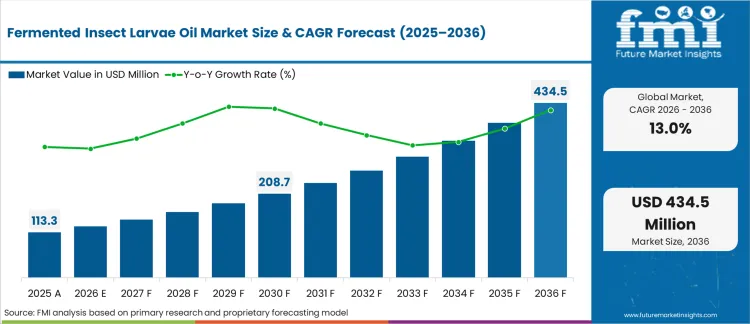
- USD 434.5 Mn
- CAGR (2026 to 2036)
- 13.0%
Fermented Insect Larvae Oil Market Size, Market Forecast and Outlook By FMI
In 2025, fermented insect larvae oil market valuation stood at USD 112.0 million. Projections indicate USD 128.0 million in 2026 and USD 434.5 million by 2036, returning a 13.0% CAGR, with momentum tied to procurement committees replacing volatile marine lipids with stable domestic extracts.
Global fisheries output reached 223.2 million tonnes during 2022, creating immense downstream requirements for formulated animal diets [1]. Feed mills face extreme pricing volatility from traditional fishmeal supply chains. According to FMI's estimates, procurement directors actively contract alternative fats to secure consistent calorie delivery for intensive farming operations. Substituting conventional ingredients with sustainable insect extracts allows feed producers to bypass ocean harvest quotas and stabilize quarterly operational costs.
Kees Aarts, CEO of Protix, comments: “We take pride in leading innovations within our industry on a pathway to low-footprint-no-footprint proteins. With our previous LCA, we shared the vision that the environmental footprint of our black soldier fly ingredients could be reduced and we have lived up to that promise: the latest DIL figures once again demonstrate an improvement in the footprint of our Protix ingredients. We look forward to translating these LCA numbers into new commercial opportunities to help our customers produce better and greener.” [5]
Summary of Fermented Insect Larvae Oil Market
- Fermented Insect Larvae Oil Market Definition
- Industry covers specialized lipids extracted from farmed insects and enhanced through fermentation for advanced nutrition applications.
- Demand Drivers in the Market
- Volatile marine ingredient pricing forces formulators to adopt alternative fats.
- Expanding intensive aquaculture demands sustainable energy sources.
- Corporate sustainability mandates require lower-emission feed ingredients.
- Key Segments Analyzed in the FMI Report
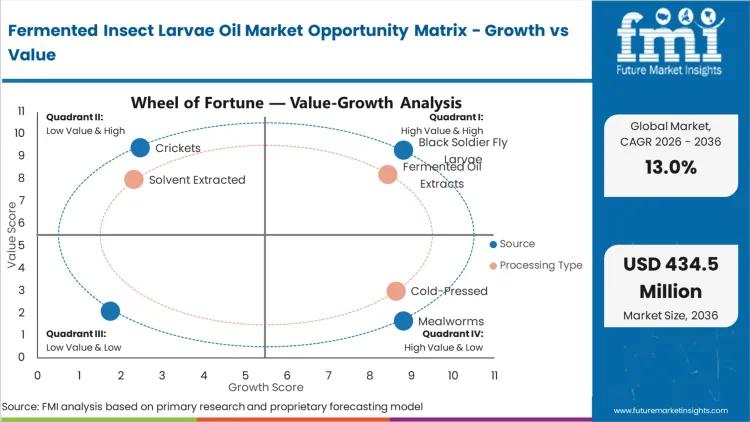
- Form: Dominant Black Soldier Fly Larvae source (46%) with fermented oil extracts (58%) versus cold-pressed and solvent extracted variants.
- Processing Type: Fermented oil extracts (58%) versus cold-pressed and solvent-extracted variants.
- Geography: High-growth Europe and North America (Netherlands 15.2%, United States 14.8%) versus emerging Asia-Pacific and Latin America.
- Analyst Opinion at FMI
- Nandini Roy Choudhury, Principal Consultant for Food & Beverage at Future Market Insights, opines, “In our latest Fermented Insect Larvae Oil Market evaluation, my team and I have identified process optimization, not raw material novelty, as the real inflection point. While insect lipids inherently offer strong sustainability credentials, commercial scalability hinges on fermentation precision, oxidation stability, and consistent fatty acid profiling. Feed formulators demand predictable performance metrics comparable to fish oil benchmarks. Companies that industrialize controlled bioconversion systems and invest in quality standardization frameworks will transform insect oil from a niche alternative into a mainstream functional lipid solution.”
- Strategic Implications/Executive Takeaways
- Align facility expansion with regional feed mill clusters to minimize logistics costs.
- Secure regulatory approvals early to capture institutional procurement contracts.
- Partner with major agricultural integrators to guarantee off-take agreements.
- Methodology
- Validated through first-hand corporate production and capacity data.
- Zero reliance on speculative third-party market research reports.
- Based on verifiable industrial benchmarks and verified sources.
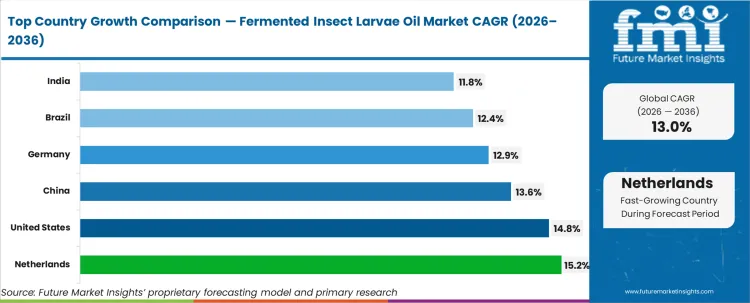
Country dispersion highlights concentrated adoption across key feed producing hubs, with Netherlands (15.2% CAGR), United States (14.8% CAGR), China (13.6% CAGR), Germany (12.9% CAGR), Brazil (12.4% CAGR), and India (11.8% CAGR) driving volume. Procurement clusters around massive aquaculture operations and progressive regulatory environments, redirecting capital toward localized aquafeed additives rather than imported marine resources.
Fermented Insect Larvae Oil Market Key Takeaways
| Metric | Details |
|---|---|
| Industry Size (2026) | USD 128.0 Million |
| Industry Value (2036) | USD 434.5 Million |
| CAGR (2026-2036) | 13.0% |
Fermented Insect Larvae Oil Market Definition
Fermented insect larvae oil encompasses specialized lipids extracted from farmed insect biomass subjected to controlled microbial fermentation. Operations primarily target animal nutrition, delivering concentrated energy sources high in functional fatty acids. Buyers utilize these specialized fats to replace scarce marine ingredients or volatile vegetable oils. Formulators rely on consistent nutritional profiles to improve feed conversion ratios in high-density livestock environments.
Fermented Insect Larvae Oil Market Inclusions
The Fermented Insect Larvae Oil category includes purified fats, fermented oil extracts, and blended lipid products derived from black soldier fly larvae, mealworms, and crickets. It captures revenues generated through business-to-business sales to feed manufacturers, pet nutrition companies, and specialty agricultural compounders. Proprietary extraction technologies and value-added functional insect-based lipid ingredients are fully integrated into volume and revenue calculations at the ingredient supply stage.
Fermented Insect Larvae Oil Market Exclusions
The scope excludes raw whole insects, defatted insect protein powders, and live larvae sold for direct feeding applications. It does not include unprocessed organic waste or substrates used for insect rearing. Finished consumer goods derived from animals raised on insect-based feed are excluded from valuation.
Fermented Insect Larvae Oil Market Research Methodology
- Primary Research: Direct interviews targeted facility managers, feed mill procurement heads, and aquaculture nutritionists.
- Desk Research: Analysts compiled regulatory filings, trade association bulletins, and facility capacity announcements to map global production footprints.
- Market-Sizing and Forecasting: Models triangulated animal feed production metrics against facility output capacities to derive precise consumption volumes.
- Data Validation and Update Cycle: Senior consultants verified findings against regional import records and corporate earnings disclosures prior to publication.
Segmental Analysis
Fermented Insect Larvae Oil Market Analysis by Source
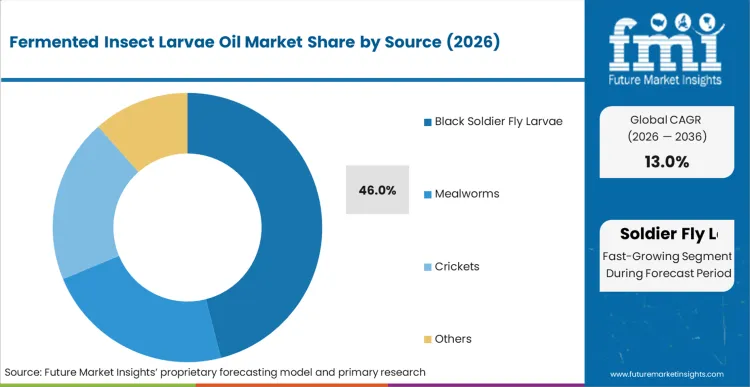
Black Soldier Fly Larvae commands 46% of segment volume in 2026. Producers favor BSF due to rapid growth cycles and extraordinary bio-conversion efficiency. Extracted fats yield favorable lipid profiles specifically suited for commercial diets. As per FMI's projection, formulators specify BSF extracts to boost lauric acid content within high-performance rations. Facilities aggressively scale BSF colonies to satisfy escalating aquafeed demands, linking substrate processing directly to premium lipid output.
- Procurement trigger: Formulators seek consistent fat profiles to replace erratic fish oil supplies. BSF extracts provide stable saturated fats matching critical animal dietary needs, backed by studies confirming high lauric acid content.
- Supply-side move: Facility operators engineer advanced rearing environments to maximize larvae fat content. Controlled temperatures and targeted substrates elevate lipid yields significantly, securing premium pricing contracts with major feed producers.
- Technology shift: Automated harvesting accelerates processing speeds for mature larvae. Continuous extraction lines reduce degradation risks and preserve delicate components, allowing mills to supply high-volume buyers efficiently.
Fermented Insect Larvae Oil Market Analysis by Processing Type
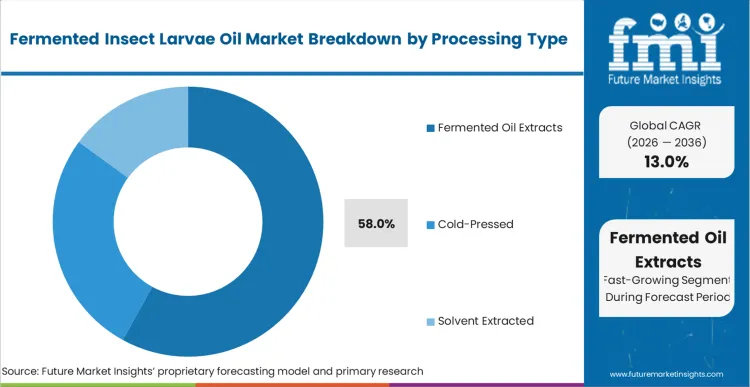
Fermentation is increasingly preferred over basic mechanical extraction as it improves stability, bioavailability, and overall ingredient functionality. Fermented oil extracts hold 58% share in 2026, reflecting strong industry movement toward value-added bio-processing. Through controlled microbial activity, processors break down complex matrices and refine crude insect fats into premium functional inputs with enhanced shelf life. FMI analysts opine that extraction and fermentation protocols largely determine final product quality and commercial positioning. Advanced processing unlocks nutritional characteristics not present in raw pressed oils, enabling manufacturers with dedicated fermentation infrastructure to secure higher-value contracts from specialized pet food brands focused on purity and performance.
- Buyer priority: Pet food brands demand highly stable lipid sources to maintain product quality. Fermentation neutralizes undesirable compounds and extends commercial shelf life, facilitating formulation updates prior to peak seasonal production runs.
- Regulatory signal: Authorities mandate strict hygiene parameters for processed animal proteins and fats. Fermentation steps inherently reduce pathogen loads to acceptable legislative limits, as demonstrated by EUR-Lex authorizations for poultry diets.
- Competitive maneuver: Suppliers partner with biotechnology firms to isolate superior fermentation strains. Customized microbial action yields proprietary lipid blends with distinct health claims, enabling early adopters to lock in exclusive supply agreements.
Fermented Insect Larvae Oil Market Drivers, Restraints, and Opportunities
Marine resource constraints propel systemic adoption of alternative lipids across global feed sectors. Traditional fishmeal and fish oil supplies face severe ecological and quota limitations. Formulators urgently seek scalable replacements to sustain expanding aquaculture operations. According to FMI's estimates, marine resource constraints force feed producers to diversify ingredient portfolios aggressively. Norway imported 218,000 MT of fishmeal valued at USD 440 million during 2024, reflecting the scale of feed demand generated by its massive salmon aquaculture sector [12]. Fermented insect larvae oil provides a structurally identical energy source, allowing feed mills to maintain output volumes without depleting ocean stocks. Procurement teams actively rewrite purchasing guidelines to include insect feed additives, securing steady operational inputs.
Intense capital expenditure requirements severely restrict rapid capacity scaling across alternative protein sectors. Building automated rearing and fermentation facilities demands massive upfront financial investments. Lengthy facility commissioning phases delay time-to-market and strain cash reserves. Investors hesitate due to unproven long-term economics and fluctuating commodity benchmarks. Operators navigate complex state-by-state permitting processes, slowing broad geographic expansion. Facilities must achieve massive economies of scale to compete directly with heavily subsidized vegetable oils. Manufacturers form strategic alliances to share financial burdens, mitigating individual corporate risk during early expansion phases.
- Regulatory Authorization: European regulatory easing unlocks full-ration formulations for porcine and poultry diets. EUR-Lex confirms insect processed animal protein authorization, expanding addressable markets significantly for regional processors [7].
- Localized Demand: Brazilian aquaculture expansion creates lucrative localized demand for high-performance lipids. Ministry reports 412 federal-water aquaculture concession contracts, driving immediate need for stable energy sources across Latin America [14].
- Premium Nutrition: Pet food premiumization allows brands to absorb higher ingredient costs for novel functional fats. Innovafeed unveiled Hilucia brand products, capturing high-margin companion animal nutrition segments globally [8].
Regional Analysis
Based on the regional analysis, the Fermented Insect Larvae Oil market is segmented into North America, Latin America, Europe, East Asia, South Asia, Oceania and Middle East & Africa across 40+ countries. The full report also offers market attractiveness analysis based on regional trends.
.webp "Top Country Growth Comparison Fermented Insect Larvae Oil Market Cagr (2026 2036)")
| Country | CAGR (2026 to 2036) |
|---|---|
| Netherlands | 15.2% |
| United States | 14.8% |
| China | 13.6% |
| Germany | 12.9% |
| Brazil | 12.4% |
| India | 11.8% |
Source: Future Market Insights (FMI) analysis, based on proprietary forecasting model and primary research
Europe Fermented Insect Larvae Oil Analysis
Europe leads global innovation through progressive regulatory frameworks and intense sustainability mandates. Regional feed producers actively seek alternatives to imported soy and marine oils to reduce supply chain emissions. Authorities continuously refine legislation to permit insect ingredients across broader livestock categories. FMI analysts opine that companies aggressively expand local production capacities to meet escalating institutional demand. Formulators integrate these functional lipids to meet stringent environmental targets while maintaining premium product quality.
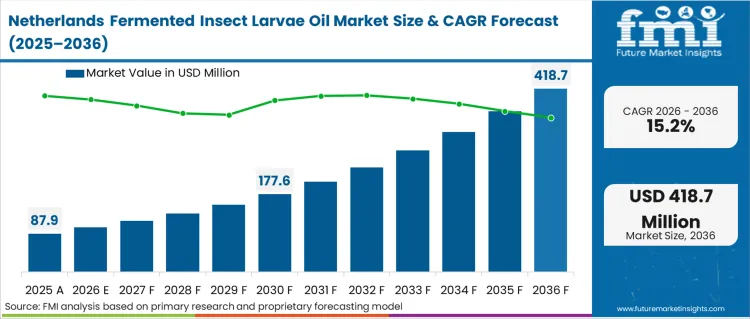
- Netherlands: Demand for fermented insect larvae oil in Netherlands is set to grow at 15.2% CAGR through 2036, supported by dense feed infrastructure before procurement cycles translate into higher deployment volumes. Strategic financing, such as the EUR 37 million EIB loan for Protix, accelerates capacity scaling and reduces logistics friction for top-tier feed mills [11].
- Germany: Fermented insect larvae oil sales in Germany are projected to rise at 12.9% CAGR from 2026 to 2036 as corporate sustainability mandates force ingredient substitution, creating a clearer pathway from policy intent to purchase orders.
FMI’s report includes an extensive evaluation of the Europe region, covering diverse national policies and competitive dynamics. France and Spain represent critical expansion territories due to large domestic agriculture bases and proactive government sustainability grants. Industry participants monitor changing EU legislation to capture early adoption advantages across these highly regulated zones.
North America Fermented Insect Larvae Oil Analysis
Across North America, rapid scaling is being driven by strategic partnerships between emerging insect producers and established agricultural integrators. Following recent global logistics disruptions, domestic feed mills have prioritized resilient, locally sourced supply chains. Regulatory clarity has also strengthened commercialization prospects, as AAFCO committee actions introduced formal definition language for Black Soldier Fly Larvae Oil for use in swine, finfish, and adult dog diets, clearing a major approval hurdle. Companies are increasingly co-locating facilities near large grain processing hubs to secure cost-effective substrate inputs, while Innovafeed’s Insect Innovation Center at ADM’s Decatur campus reinforces regional manufacturing depth [6].
- United States: With integrator partnerships accelerating market access and regulatory frameworks now in place, utilization rates are rising across feed and pet nutrition channels. AAFCO’s confirmed ingredient definitions have opened broader formulation pathways nationwide. As infrastructure investment and adoption expand in parallel, the fermented insect larvae oil sector in the United States is projected to grow at a 14.8% CAGR from 2026 to 2036.
FMI’s report includes a deep assessment of the North America region, detailing state-level regulatory variances and production capacities. Canada emerges as a highly prospective market, leveraging immense agricultural by-products and advanced biotechnology research clusters. Feed mills evaluate cross-border trade agreements to optimize regional animal feed protein ingredients sourcing strategies.
East Asia Fermented Insect Larvae Oil Analysis
East Asia consumes massive lipid volumes to sustain immense aquaculture operations. Formulators face intense pressure to replace expensive imported fishmeal with cost-effective domestic alternatives. Rapid urbanization drives demand for premium seafood, necessitating high-performance formulated diets. Chinese seafood imports reached 4.6 MMT valued at USD 18.8 billion in 2023, showcasing significant domestic consumption gaps [3]. Regional players invest heavily in automated rearing technologies to achieve competitive pricing.
- China: China is expected to record 13.6% CAGR in fermented insect larvae oil demand over 2026 to 2036 as massive aquaculture bases seek marine ingredient alternatives, tightening the link between operational constraints and adoption-led investment. Local aquaculture production reached 58.1 MMT, forcing coastal feed mills to integrate scalable functional fats to ensure continuous pellet extrusion [4].
FMI’s report includes detailed intelligence on the East Asia region, highlighting import dynamics and domestic capacity additions. Japan and South Korea demand rigorous quality certifications for fish feed ingredients used in high-value finfish production. Exporters must navigate complex regional trade policies to penetrate these lucrative, quality-driven markets.
Latin America Fermented Insect Larvae Oil Analysis
Across Latin America, expanding aquaculture operations and strong livestock export momentum are driving investment in advanced feed inputs. Producers are prioritizing functional lipids that enhance immunity and growth performance in tropical climates.
- Brazil: Rapid growth in farmed fish production, which reached 724.9 thousand tonnes in 2024, is strengthening demand for performance-enhancing feed ingredients such as lauric-rich insect oils that improve survival rates in dense aquatic environments [15]. As aquaculture budgets expand and feed producers scale adoption, the fermented insect larvae oil sector in Brazil is projected to grow at a 12.4% CAGR through 2036.
FMI’s report includes comprehensive data on the Latin America region, mapping major agricultural zones and processing hubs. Mexico and Chile represent high-potential territories due to established salmon feed industries and growing pet food manufacturing bases. Investors monitor local currency fluctuations and export tariffs when establishing new production sites.
South Asia Fermented Insect Larvae Oil Analysis
South Asia represents a massive emerging frontier, driven by explosive inland aquaculture growth and poultry production. Formulators aggressively substitute expensive imported fats with localized energy sources. Government bodies release ambitious production targets, stimulating investment across the entire feed value chain. Startups deploy decentralized rearing models to navigate complex regional logistics and localized substrate availability.
- India: Fermented insect larvae oil uptake in India is anticipated to climb at 11.8% CAGR over the forecast period as inland aquaculture modernization accelerates, helping suppliers align positioning with local buying triggers. National fish production reached 197.75 lakh tonnes, pulling immense volumes of functional feed supplements into cost-sensitive milling operations [16].
FMI’s report includes thorough analysis of the South Asia region, tracking decentralized production models and regulatory shifts. Bangladesh and Vietnam offer critical expansion opportunities owing to massive shrimp farming operations and export-oriented seafood processing. Nutritionists tailor formulations to perform optimally under unique tropical climate conditions.
Competitive Aligners for Market Players
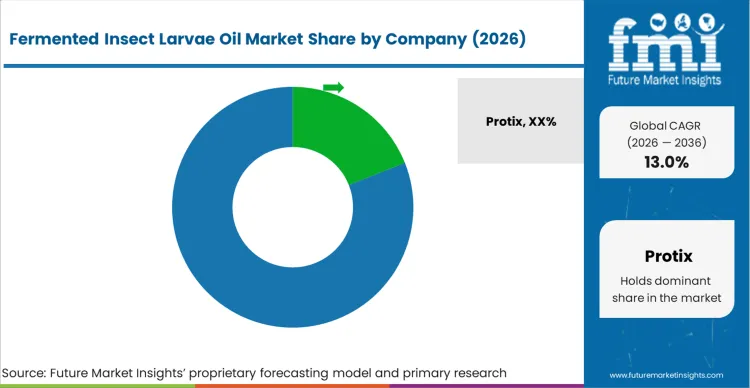
Strategic partnerships define competitive positioning within rapidly evolving alternative protein sectors. Insect producers lack expansive distribution networks required to penetrate global feed markets efficiently. As per FMI's projection, capacity additions rely heavily on massive capital injections from established agricultural giants. Tyson Foods formed a strategic alliance with Protix to scale sustainable lipid production, demonstrating vital corporate backing [2]. Joint ventures accelerate technology transfer and guarantee large-scale off-take agreements, derisking operational expansions.
Regulatory compliance capabilities strictly delineate market leaders from regional niche players. Navigating fragmented global feed legislation requires dedicated legal and scientific resources. Firms securing early approvals across major jurisdictions establish insurmountable competitive moats. AAFCO committee actions defining Black Soldier Fly Larvae Oil parameters allowed compliant US firms to capture lucrative early contracts [17]. Companies lacking rigorous quality assurance protocols face severe exclusion from high-margin institutional procurement channels.
Sustainability reporting emerges as a non-negotiable requirement for securing premium B2B contracts. Feed conglomerates demand verified Life Cycle Assessments to satisfy corporate carbon reduction targets. Suppliers capable of proving negative emissions profiles command premium pricing over conventional plant based feed ingredients. Brands utilize transparent supply chain data to market eco-friendly credentials directly to environmentally conscious consumers.
Recent Developments
The report includes full coverage of key trends from competitive benchmarking. Some of the recent developments covered in the reports:
- In September 2025, BioMar formed a tripartite partnership with Innovafeed and Auchan to accelerate commercialization of insect meal and associated lipid products [10].
- In November 2025, Skretting Vietnam commenced commercial production and launched innovative insect-based shrimp feed diets [9].
- In October 2025, Protix released peer-reviewed sustainability and LCA results for insect meal and fat product lines [13].
Key Players in Fermented Insect Larvae Oil
- Protix
- Innovafeed
- ADM
- Tyson Foods
- BioMar
- Skretting
- Entobel
- EnviroFlight
Scope of the Report
| Metric | Value |
|---|---|
| Quantitative Units | USD 128.0 Million (2026) to USD 434.5 Million (2036), at a CAGR of 13.0% |
| Market Definition | Fermented insect larvae oil covers specialized lipids extracted from farmed insect biomass subjected to controlled microbial fermentation, utilized primarily in animal nutrition to deliver concentrated energy sources. |
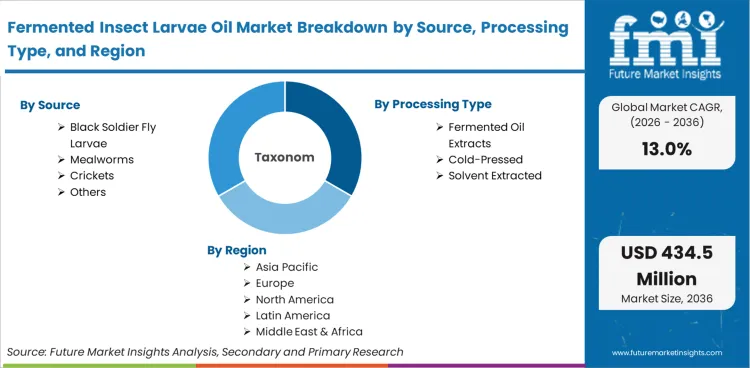
| Source Segmentation | Black Soldier Fly Larvae, Mealworms, Crickets, Others |
| Processing Type Segmentation | Fermented Oil Extracts, Cold-Pressed, Solvent Extracted |
| Application Coverage | Animal & Aquaculture Nutrition, Pet Food, Cosmetics, Others |
| Regions Covered | North America, Latin America, Europe, East Asia, South Asia, Oceania, Middle East and Africa |
| Countries Covered | United States, Canada, Mexico, Brazil, Argentina, Germany, France, United Kingdom, Italy, Spain, China, India, Japan, South Korea, Indonesia, Australia and 40 plus countries |
| Key Companies Profiled | Protix, Innovafeed, ADM, Tyson Foods, BioMar, Skretting, Entobel, EnviroFlight |
| Forecast Period | 2026 to 2036 |
| Approach | Hybrid top down and bottom up market modeling validated through primary interviews with facility managers and feed mill procurement heads, supported by trade data benchmarking and plant level capacity verification |
Fermented Insect Larvae Oil Market Analysis by Segments
-
Source
- Black Soldier Fly Larvae
- Mealworms
- Crickets
- Others
-
Processing Type
- Fermented Oil Extracts
- Cold-Pressed
- Solvent Extracted
-
Application
- Animal & Aquaculture Nutrition
- Pet Food
- Cosmetics
- Others
-
Distribution Channel
- B2B / Institutional Sales
- Online Retail
- Specialty Stores
-
Region
- Asia Pacific
- India
- China
- Japan
- South Korea
- Indonesia
- Australia & New Zealand
- ASEAN
- Rest of Asia Pacific
- Europe
- Germany
- Italy
- France
- United Kingdom
- Spain
- Benelux
- Nordics
- Central & Eastern Europe
- Rest of Europe
- North America
- United States
- Canada
- Mexico
- Latin America
- Brazil
- Argentina
- Chile
- Rest of Latin America
- Middle East & Africa
- Kingdom of Saudi Arabia
- United Arab Emirates
- South Africa
- Turkey
- Rest of Middle East & Africa
- Asia Pacific
Bibliography
- [1] FAO newsroom. Global fisheries + aquaculture production hit 223.2 million tonnes (2022). Published Jun 7, 2024.
- [2] Tyson Foods press release. Quote by Kees Aarts. Published Oct 17, 2023.
- [3] USDA FAS GAIN report. China seafood imports 4.6 MMT valued at $18.8B (2023). Published Mar 22, 2024.
- [4] USDA FAS GAIN report. China aquaculture 58.1 MMT (2023). Published Mar 22, 2024.
- [5] Protix. (2024). Insect-based proteins and ingredients.
- [6] ADM press release. ADM announced Innovafeed’s Insect Innovation Center in Decatur. Published Apr 18, 2024.
- [7] EUR-Lex. EU act notes insect processed animal protein authorized for poultry/porcine feed. Published Jul 16, 2025.
- [8] Aqua Asia Pac. Innovafeed unveiled Hilucia brand. Published Mar 5, 2024.
- [9] The Fish Site. Skretting Vietnam launch of insect-based shrimp feed. Published Nov 28, 2025.
- [10] BioMar announcement. Tripartite partnership to accelerate commercialization of insect meal. Published Sep 2, 2025.
- [11] Protix note. EIB financing agreement supporting a new Protix production site in Poland. Published Jan 2024.
- [12] USDA FAS report. Norway import dependence on marine ingredients quantified. Published Nov 24, 2025.
- [13] Aquafeed.com. Protix released peer-reviewed sustainability/LCA results. Published Oct 28, 2025.
- [14] Brazil MPA. Ministry reports 412 federal-water aquaculture concession contracts. Published Dec 27, 2024.
- [15] IBGE news. Brazil farmed fish estimate 724.9k tonnes (2024). Published Sep 18, 2025.
- [16] Govt. of India PIB. India fish production 197.75 lakh tonnes (FY 2024–25). Published Jan 12, 2026.
- [17] AAFCO minutes PDF. Business minutes include formal definition language for Black Soldier Fly Larvae Oil. Published 2025.
This bibliography is provided for reader reference and is not exhaustive. The full report contains the complete reference list and detailed citations.
This Report Addresses
- Market intelligence to enable structured strategic decision making across mature and emerging insect lipid economies
- Market size estimation and 10 year revenue forecasts from 2026 to 2036, supported by validated facility capacity benchmarks
- Growth opportunity mapping across Black Soldier Fly and mealworm sources with emphasis on automated extraction transitions
- Segment and regional revenue forecasts covering animal nutrition, aquaculture diets, and companion animal applications
- Competition strategy assessment including integration models, cost survivability positioning, and compliance capability benchmarking
- Product reformulation and emission compliance tracking including strict European and North American regulatory grades
- Regulatory impact analysis covering processed animal protein mandates, feed safety thresholds, and export driven specification upgrades
- Market report delivery in PDF, Excel, PPT, and interactive dashboard formats for executive and operational use
Frequently Asked Questions
How large is the demand for Fermented Insect Larvae Oil in the global market in 2026?
Demand for Fermented Insect Larvae Oil in the global market is estimated to be valued at USD 128.0 million in 2026.
What will be the market size of Fermented Insect Larvae Oil in the global market by 2036?
Market size for Fermented Insect Larvae Oil is projected to reach USD 434.5 million by 2036.
What is the expected demand growth for Fermented Insect Larvae Oil in the global market between 2026 and 2036?
Demand for Fermented Insect Larvae Oil in the global market is expected to grow at a CAGR of 13.0% between 2026 and 2036.
Which Source is poised to lead global sales by 2026?
Black Soldier Fly Larvae is expected to be the dominant form, capturing 46% of global market share in 2026 due to rapid rearing cycles and high lauric acid yields.
How significant is the role of Animal & Aquaculture Nutrition in driving Fermented Insect Larvae Oil adoption in 2026?
Animal & Aquaculture Nutrition represents a critical segment, projected to hold 44% share in 2026 as intensive farming prioritizes sustainable energy replacement for marine oils.
What is driving demand in Netherlands?
Dense feed manufacturing infrastructure and robust institutional financing frameworks drive demand for sustainable lipid integration.
What compliance standards or regulations are referenced for Netherlands?
EU EUR-Lex authorizations permitting insect processed animal protein for poultry and porcine applications dictate compliance benchmarks.
What is the Netherlands growth outlook in this report?
Netherlands is projected to grow at a CAGR of 15.2% during 2026 to 2036.
Why is North America described as a priority region in this report?
Growth is propelled by massive domestic agricultural integrator partnerships and progressive AAFCO ingredient definitions.
What type of demand dominates in North America?
Direct B2B procurement demand for premium, highly stable functional fats dominates regional consumption.
What is United States growth outlook in this report?
United States is projected to expand at a CAGR of 14.8% during 2026 to 2036.
Does the report cover China in its regional analysis?
China is included within East Asia under the regional scope of analysis.
What are the sources referred to for analyzing China?
Official statistics published by USDA FAS regarding massive domestic aquaculture production volumes are cited as primary reference sources.
What is the main demand theme linked to China in its region coverage?
Demand is primarily linked to securing stable domestic lipid alternatives to buffer against volatile imported marine ingredient costs.
Does the report cover Germany in its regional analysis?
Germany is included within Europe under the regional coverage framework.
What is the main Germany related demand theme in its region coverage?
Sustainability-driven procurement and strict retail scope-3 emissions targets force massive feed ingredient substitution.
Which product formats or configurations are strategically important for Europe supply chains?
Fermented oil extracts are prioritized due to superior shelf life and compliant microbial safety profiles across institutional channels.
What is Fermented Insect Larvae Oil and what is it mainly used for?
Fermented insect larvae oil is a specialized functional lipid utilized primarily in commercial animal and aquaculture nutrition to deliver stable energy.
What does Fermented Insect Larvae Oil mean in this report?
Fermented insect larvae oil refers to global production and industrial B2B sales of extracted insect fats subjected to microbial fermentation.
What is included in the scope of this Fermented Insect Larvae Oil report?
Scope covers extracted lipids by source type, processing format, and end use applications across major global agriculture markets.
What is excluded from the scope of this report?
Live larvae, raw organic waste substrates, and downstream consumer meat products are excluded from valuation models.
What does market forecast mean on this page?
Market forecast represents a model based projection built on defined assumptions for strategic planning purposes.
How does FMI build and validate the Fermented Insect Larvae Oil forecast?
Forecast is developed using hybrid top down and bottom up modeling validated through trade data, capacity checks, and industry review.
What does zero reliance on speculative third party market research mean here?
Primary interviews and verifiable public datasets are used instead of unverified syndicated market estimates.
Preview the report firsthand - request a free sample
Get SampleGet the brochure for pricing and purchase details.
Get PDFTable of Content
- Executive Summary
- Global Market Outlook
- Demand-side Trends
- Supply-side Trends
- Technology Roadmap Analysis
- Analysis and Recommendations
- Market Overview
- Market Coverage / Taxonomy
- Market Definition / Scope / Limitations
- Research Methodology
- Chapter Orientation
- Analytical Lens and Working Hypotheses
- Market Structure, Signals, and Trend Drivers
- Benchmarking and Cross-market Comparability
- Market Sizing, Forecasting, and Opportunity Mapping
- Research Design and Evidence Framework
- Desk Research Programme (Secondary Evidence)
- Company Annual and Sustainability Reports
- Peer-reviewed Journals and Academic Literature
- Corporate Websites, Product Literature, and Technical Notes
- Earnings Decks and Investor Briefings
- Statutory Filings and Regulatory Disclosures
- Technical White Papers and Standards Notes
- Trade Journals, Industry Magazines, and Analyst Briefs
- Conference Proceedings, Webinars, and Seminar Materials
- Government Statistics Portals and Public Data Releases
- Press Releases and Reputable Media Coverage
- Specialist Newsletters and Curated Briefings
- Sector Databases and Reference Repositories
- FMI Internal Proprietary Databases and Historical Market Datasets
- Subscription Datasets and Paid Sources
- Social Channels, Communities, and Digital Listening Inputs
- Additional Desk Sources
- Expert Input and Fieldwork (Primary Evidence)
- Primary Modes
- Qualitative Interviews and Expert Elicitation
- Quantitative Surveys and Structured Data Capture
- Blended Approach
- Why Primary Evidence is Used
- Field Techniques
- Interviews
- Surveys
- Focus Groups
- Observational and In-context Research
- Social and Community Interactions
- Stakeholder Universe Engaged
- C-suite Leaders
- Board Members
- Presidents and Vice Presidents
- R&D and Innovation Heads
- Technical Specialists
- Domain Subject-matter Experts
- Scientists
- Physicians and Other Healthcare Professionals
- Governance, Ethics, and Data Stewardship
- Research Ethics
- Data Integrity and Handling
- Primary Modes
- Tooling, Models, and Reference Databases
- Desk Research Programme (Secondary Evidence)
- Data Engineering and Model Build
- Data Acquisition and Ingestion
- Cleaning, Normalisation, and Verification
- Synthesis, Triangulation, and Analysis
- Quality Assurance and Audit Trail
- Market Background
- Market Dynamics
- Drivers
- Restraints
- Opportunity
- Trends
- Scenario Forecast
- Demand in Optimistic Scenario
- Demand in Likely Scenario
- Demand in Conservative Scenario
- Opportunity Map Analysis
- Product Life Cycle Analysis
- Supply Chain Analysis
- Investment Feasibility Matrix
- Value Chain Analysis
- PESTLE and Porter’s Analysis
- Regulatory Landscape
- Regional Parent Market Outlook
- Production and Consumption Statistics
- Import and Export Statistics
- Market Dynamics
- Global Market Analysis 2021 to 2025 and Forecast, 2026 to 2036
- Historical Market Size Value (USD Million) Analysis, 2021 to 2025
- Current and Future Market Size Value (USD Million) Projections, 2026 to 2036
- Y-o-Y Growth Trend Analysis
- Absolute $ Opportunity Analysis
- Global Market Pricing Analysis 2021 to 2025 and Forecast 2026 to 2036
- Global Market Analysis 2021 to 2025 and Forecast 2026 to 2036, By Source
- Introduction / Key Findings
- Historical Market Size Value (USD Million) Analysis By Source , 2021 to 2025
- Current and Future Market Size Value (USD Million) Analysis and Forecast By Source , 2026 to 2036
- Black Soldier Fly Larvae
- Mealworms
- Crickets
- Others
- Black Soldier Fly Larvae
- Y-o-Y Growth Trend Analysis By Source , 2021 to 2025
- Absolute $ Opportunity Analysis By Source , 2026 to 2036
- Global Market Analysis 2021 to 2025 and Forecast 2026 to 2036, By Processing Type
- Introduction / Key Findings
- Historical Market Size Value (USD Million) Analysis By Processing Type, 2021 to 2025
- Current and Future Market Size Value (USD Million) Analysis and Forecast By Processing Type, 2026 to 2036
- Fermented Oil Extracts
- Cold-Pressed
- Solvent Extracted
- Fermented Oil Extracts
- Y-o-Y Growth Trend Analysis By Processing Type, 2021 to 2025
- Absolute $ Opportunity Analysis By Processing Type, 2026 to 2036
- Global Market Analysis 2021 to 2025 and Forecast 2026 to 2036, By Application
- Introduction / Key Findings
- Historical Market Size Value (USD Million) Analysis By Application, 2021 to 2025
- Current and Future Market Size Value (USD Million) Analysis and Forecast By Application, 2026 to 2036
- Animal & Aquaculture Nutrition
- Pet Food
- Cosmetics
- Others
- Animal & Aquaculture Nutrition
- Y-o-Y Growth Trend Analysis By Application, 2021 to 2025
- Absolute $ Opportunity Analysis By Application, 2026 to 2036
- Global Market Analysis 2021 to 2025 and Forecast 2026 to 2036, By Distribution Channel
- Introduction / Key Findings
- Historical Market Size Value (USD Million) Analysis By Distribution Channel, 2021 to 2025
- Current and Future Market Size Value (USD Million) Analysis and Forecast By Distribution Channel, 2026 to 2036
- B2B / Institutional Sales
- Online Retail
- Specialty Stores
- B2B / Institutional Sales
- Y-o-Y Growth Trend Analysis By Distribution Channel, 2021 to 2025
- Absolute $ Opportunity Analysis By Distribution Channel, 2026 to 2036
- Global Market Analysis 2021 to 2025 and Forecast 2026 to 2036, By Region
- Introduction
- Historical Market Size Value (USD Million) Analysis By Region, 2021 to 2025
- Current Market Size Value (USD Million) Analysis and Forecast By Region, 2026 to 2036
- North America
- Latin America
- Western Europe
- Eastern Europe
- East Asia
- South Asia and Pacific
- Middle East & Africa
- Market Attractiveness Analysis By Region
- North America Market Analysis 2021 to 2025 and Forecast 2026 to 2036, By Country
- Historical Market Size Value (USD Million) Trend Analysis By Market Taxonomy, 2021 to 2025
- Market Size Value (USD Million) Forecast By Market Taxonomy, 2026 to 2036
- By Country
- USA
- Canada
- Mexico
- By Source
- By Processing Type
- By Application
- By Distribution Channel
- By Country
- Market Attractiveness Analysis
- By Country
- By Source
- By Processing Type
- By Application
- By Distribution Channel
- Key Takeaways
- Latin America Market Analysis 2021 to 2025 and Forecast 2026 to 2036, By Country
- Historical Market Size Value (USD Million) Trend Analysis By Market Taxonomy, 2021 to 2025
- Market Size Value (USD Million) Forecast By Market Taxonomy, 2026 to 2036
- By Country
- Brazil
- Chile
- Rest of Latin America
- By Source
- By Processing Type
- By Application
- By Distribution Channel
- By Country
- Market Attractiveness Analysis
- By Country
- By Source
- By Processing Type
- By Application
- By Distribution Channel
- Key Takeaways
- Western Europe Market Analysis 2021 to 2025 and Forecast 2026 to 2036, By Country
- Historical Market Size Value (USD Million) Trend Analysis By Market Taxonomy, 2021 to 2025
- Market Size Value (USD Million) Forecast By Market Taxonomy, 2026 to 2036
- By Country
- Germany
- UK
- Italy
- Spain
- France
- Nordic
- BENELUX
- Rest of Western Europe
- By Source
- By Processing Type
- By Application
- By Distribution Channel
- By Country
- Market Attractiveness Analysis
- By Country
- By Source
- By Processing Type
- By Application
- By Distribution Channel
- Key Takeaways
- Eastern Europe Market Analysis 2021 to 2025 and Forecast 2026 to 2036, By Country
- Historical Market Size Value (USD Million) Trend Analysis By Market Taxonomy, 2021 to 2025
- Market Size Value (USD Million) Forecast By Market Taxonomy, 2026 to 2036
- By Country
- Russia
- Poland
- Hungary
- Balkan & Baltic
- Rest of Eastern Europe
- By Source
- By Processing Type
- By Application
- By Distribution Channel
- By Country
- Market Attractiveness Analysis
- By Country
- By Source
- By Processing Type
- By Application
- By Distribution Channel
- Key Takeaways
- East Asia Market Analysis 2021 to 2025 and Forecast 2026 to 2036, By Country
- Historical Market Size Value (USD Million) Trend Analysis By Market Taxonomy, 2021 to 2025
- Market Size Value (USD Million) Forecast By Market Taxonomy, 2026 to 2036
- By Country
- China
- Japan
- South Korea
- By Source
- By Processing Type
- By Application
- By Distribution Channel
- By Country
- Market Attractiveness Analysis
- By Country
- By Source
- By Processing Type
- By Application
- By Distribution Channel
- Key Takeaways
- South Asia and Pacific Market Analysis 2021 to 2025 and Forecast 2026 to 2036, By Country
- Historical Market Size Value (USD Million) Trend Analysis By Market Taxonomy, 2021 to 2025
- Market Size Value (USD Million) Forecast By Market Taxonomy, 2026 to 2036
- By Country
- India
- ASEAN
- Australia & New Zealand
- Rest of South Asia and Pacific
- By Source
- By Processing Type
- By Application
- By Distribution Channel
- By Country
- Market Attractiveness Analysis
- By Country
- By Source
- By Processing Type
- By Application
- By Distribution Channel
- Key Takeaways
- Middle East & Africa Market Analysis 2021 to 2025 and Forecast 2026 to 2036, By Country
- Historical Market Size Value (USD Million) Trend Analysis By Market Taxonomy, 2021 to 2025
- Market Size Value (USD Million) Forecast By Market Taxonomy, 2026 to 2036
- By Country
- Kingdom of Saudi Arabia
- Other GCC Countries
- Turkiye
- South Africa
- Other African Union
- Rest of Middle East & Africa
- By Source
- By Processing Type
- By Application
- By Distribution Channel
- By Country
- Market Attractiveness Analysis
- By Country
- By Source
- By Processing Type
- By Application
- By Distribution Channel
- Key Takeaways
- Key Countries Market Analysis
- USA
- Pricing Analysis
- Market Share Analysis, 2025
- By Source
- By Processing Type
- By Application
- By Distribution Channel
- Canada
- Pricing Analysis
- Market Share Analysis, 2025
- By Source
- By Processing Type
- By Application
- By Distribution Channel
- Mexico
- Pricing Analysis
- Market Share Analysis, 2025
- By Source
- By Processing Type
- By Application
- By Distribution Channel
- Brazil
- Pricing Analysis
- Market Share Analysis, 2025
- By Source
- By Processing Type
- By Application
- By Distribution Channel
- Chile
- Pricing Analysis
- Market Share Analysis, 2025
- By Source
- By Processing Type
- By Application
- By Distribution Channel
- Germany
- Pricing Analysis
- Market Share Analysis, 2025
- By Source
- By Processing Type
- By Application
- By Distribution Channel
- UK
- Pricing Analysis
- Market Share Analysis, 2025
- By Source
- By Processing Type
- By Application
- By Distribution Channel
- Italy
- Pricing Analysis
- Market Share Analysis, 2025
- By Source
- By Processing Type
- By Application
- By Distribution Channel
- Spain
- Pricing Analysis
- Market Share Analysis, 2025
- By Source
- By Processing Type
- By Application
- By Distribution Channel
- France
- Pricing Analysis
- Market Share Analysis, 2025
- By Source
- By Processing Type
- By Application
- By Distribution Channel
- India
- Pricing Analysis
- Market Share Analysis, 2025
- By Source
- By Processing Type
- By Application
- By Distribution Channel
- ASEAN
- Pricing Analysis
- Market Share Analysis, 2025
- By Source
- By Processing Type
- By Application
- By Distribution Channel
- Australia & New Zealand
- Pricing Analysis
- Market Share Analysis, 2025
- By Source
- By Processing Type
- By Application
- By Distribution Channel
- China
- Pricing Analysis
- Market Share Analysis, 2025
- By Source
- By Processing Type
- By Application
- By Distribution Channel
- Japan
- Pricing Analysis
- Market Share Analysis, 2025
- By Source
- By Processing Type
- By Application
- By Distribution Channel
- South Korea
- Pricing Analysis
- Market Share Analysis, 2025
- By Source
- By Processing Type
- By Application
- By Distribution Channel
- Russia
- Pricing Analysis
- Market Share Analysis, 2025
- By Source
- By Processing Type
- By Application
- By Distribution Channel
- Poland
- Pricing Analysis
- Market Share Analysis, 2025
- By Source
- By Processing Type
- By Application
- By Distribution Channel
- Hungary
- Pricing Analysis
- Market Share Analysis, 2025
- By Source
- By Processing Type
- By Application
- By Distribution Channel
- Kingdom of Saudi Arabia
- Pricing Analysis
- Market Share Analysis, 2025
- By Source
- By Processing Type
- By Application
- By Distribution Channel
- Turkiye
- Pricing Analysis
- Market Share Analysis, 2025
- By Source
- By Processing Type
- By Application
- By Distribution Channel
- South Africa
- Pricing Analysis
- Market Share Analysis, 2025
- By Source
- By Processing Type
- By Application
- By Distribution Channel
- USA
- Market Structure Analysis
- Competition Dashboard
- Competition Benchmarking
- Market Share Analysis of Top Players
- By Regional
- By Source
- By Processing Type
- By Application
- By Distribution Channel
- Competition Analysis
- Competition Deep Dive
- Protix
- Overview
- Product Portfolio
- Profitability by Market Segments (Product/Age /Sales Channel/Region)
- Sales Footprint
- Strategy Overview
- Marketing Strategy
- Product Strategy
- Channel Strategy
- Innovafeed
- ADM
- Tyson Foods
- BioMar
- Skretting
- Entobel
- EnviroFlight
- Protix
- Competition Deep Dive
- Assumptions & Acronyms Used


