

- Industry Size (2026)
- USD 339.2 Mn
- Forecast (2036)
- USD 312.5 Mn
- CAGR (2026 to 2036)
- 8.5%
Fermented Mycoprotein Market Size, Market Forecast and Outlook By FMI
In 2025, the global fermented mycoprotein market was valued at USD 312.5 million. Based on Future Market Insights analysis, the market is estimated to reach USD 339.2 million in 2026 and USD 766.7 million by 2036. FMI projects a CAGR of 8.5% between 2026 and 2036.
The fermented mycoprotein sector faces a dual challenge: scaling commercial production to compete on price with established plant proteins while simultaneously educating consumers unfamiliar with fungal-derived ingredients. Manufacturers have responded through a combination of hybrid product formats, clean-label positioning, and ingredient supply partnerships that embed fermented mycoprotein into mainstream processed food portfolios.
Summary of Fermented Mycoprotein Market
- Market Definition
- The market measures the value and volume of protein-rich biomass and finished food products produced via aerobic submerged fermentation of filamentous fungi, sold across retail, foodservice, and ingredient supply channels globally.
- Product formats tracked include minced mycoprotein used in burger and mince applications, whole-cut analogues for chicken and seafood substitutes, powder for supplement and functional food formulations, and slice formats for chilled deli-style products.
- End consumers are primarily health-conscious vegetarians, vegans, and flexitarians in high-income markets; the ingredient supply segment serves food manufacturers formulating meat and dairy alternative products at scale.
- Demand Drivers
- Accelerating precision fermentation technology reduces production costs and improves product quality; CRISPR-mediated strain engineering of F. venenatum, published in November 2025, demonstrated an 88% increase in protein production rate with 44% less feedstock, directly addressing the cost parity barrier versus soy and pea protein.
- Regulatory progress, including EFSA's December 2025 positive opinion on Fermotein from The Protein Brewery and the FDA's tightened GRAS oversight (moving toward mandatory notification and ending self-affirmed GRAS) in the United States – is reducing market entry barriers in Europe while increasing regulatory clarity (though not streamlining) in the USA, supporting commercial scale-up..
- Key Segments analysed in the FMI report
- Meat Alternatives application holds approximately 55% of total market value, driven by demand for whole-muscle chicken, burgers, nuggets, and sausage formats; consumer purchasing is motivated by texture fidelity and the nutritional completeness of mycoprotein versus soy-based analogues.
- Minced product form accounts for roughly 38% of volume, supported by the lowest processing cost and broadest application range from foodservice to retail frozen.
- Supermarket and hypermarket distribution channels represent approximately 47% of market value, reflecting the dominance of chilled and frozen meat alternative shelf space in UK and continental European grocery; e-commerce is the fastest-growing channel at a projected 11.2% CAGR through 2036, driven by direct-to-consumer subscription boxes and specialist health food platforms.
- Analyst Opinion at FMI
- Nandini Roy, Principal Analyst at Future Market Insights with expertise in sustainable proteins and alternative food systems, observes that the near-term trajectory of the fermented mycoprotein market will be shaped less by volume production capacity - which is expanding rapidly - and more by how effectively brands resolve the consumer education gap in markets outside Western Europe. The strategic shift by companies like Marlow Foods toward hybrid meat-mycoprotein formats is a deliberate move to reach mainstream meat eaters rather than only committed flexitarians, and this premiumization via blending represents the category's most compelling near-term growth pathway. Markets with strong food-tech investment cultures, particularly South Korea and the Netherlands, are positioned to become both production hubs and early adopters of second-generation fermented mycoprotein formats that go beyond conventional meat analogues into dairy, snack, and functional beverage applications.
- Executive Takeaways
- Ingredient manufacturers should prioritize B2B supply agreements with large food manufacturers in Germany, the Netherlands, and South Korea, where regulatory clarity and food-tech investment are strongest and where the absence of a dominant mycoprotein brand creates white space for new ingredient positioning.
- Retail brand owners should invest in on-pack nutrition communication emphasizing PDCAAS score and complete amino acid profile relative to soy protein, as consumer research consistently shows that nutritional superiority is more persuasive than sustainability claims alone for mainstream flexitarian shoppers in the USD 30,000-to-USD 75,000 household income bracket.
- Foodservice operators and QSR chains in North America and East Asia should develop hybrid meat-mycoprotein SKUs (50% conventional meat, 50% fermented mycoprotein) as a lower-risk entry point that delivers cost reduction and protein content improvement without triggering consumer unfamiliarity barriers.
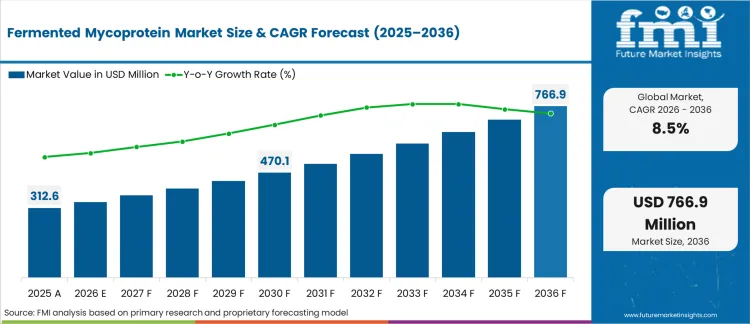
Fermented mycoprotein demand growth varies substantially across income tiers and geographies. Mature premium markets - led by the United Kingdom, the United States, Germany, and the Netherlands - are entering a premiumization phase in which health-oriented and flexitarian consumers are trading up from commodity plant proteins to mycoprotein-based whole-cut analogues and high-protein snack formats. Volume-growth markets including China, South Korea, and Japan are scaling distribution through foodservice channels and functional food applications, supported by government-backed alternative protein research programs. Price-sensitive emerging markets in India, Brazil, and Southeast Asia currently represent a nascent demand stage, with growth catalyzed by institutional food programs and biotech investment rather than mainstream retail.
Fermented Mycoprotein Market Definition
The fermented mycoprotein market encompasses the production, processing, and commercial sale of protein-rich biomass derived from the controlled aerobic fermentation of filamentous fungi - principally Fusarium venenatum and select Rhizomucor, Neurospora, and Fusarium yellowstonensis strains - along with finished food and ingredient products formulated from this biomass. The market is defined by the fermentation-based production pathway, distinguishing it from extracted plant proteins, insect proteins, or mycelium cultivated through non-submerged methods.
Products covered include fermented mycoprotein biomass (minced, powder, and whole-cut formats), ready-to-eat meat analogues and dairy substitutes containing mycoprotein as the primary protein source, mycoprotein-enriched functional ingredients for food and beverage manufacturers, and dietary supplement formulations incorporating fermented fungal protein. End consumers span vegetarians, vegans, flexitarians, health-conscious mainstream consumers, and sports nutrition users. The scope covers both retail and foodservice channels globally.
Fermented Mycoprotein Market Inclusions
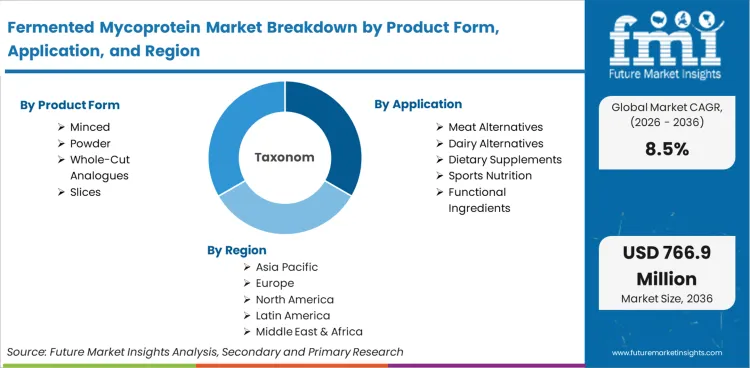
The report covers a comprehensive assessment of the market for the historical period (2021 to 2025) and the projected period (2026 to 2036) for volume in metric tons and value in USD million. It covers segmental breakdowns of the market by product form (minced, powder, whole-cut analogues, and slices), application (meat alternatives, dairy alternatives, dietary supplements, sports nutrition, and functional ingredients), end use (retail, foodservice, and industrial/ingredient supply), distribution channel (supermarket/hypermarket, online/e-commerce, specialty health stores, foodservice/HoReCa, and B2B ingredient supply), and key regions across 30-plus countries.
Fermented Mycoprotein Market Exclusions
The market scope excludes edible mushroom and whole fungi products that are not processed into protein concentrate or analogue formats, insect-derived and algae-derived proteins, plant-based proteins produced through extraction rather than fermentation (including soy, pea, and wheat gluten isolates), solid-state fermentation substrates not intended for human food use, and fermented feeds for aquaculture and livestock where the end application is animal nutrition rather than human consumption. Private-label mycoprotein products are included in market sizing where the underlying ingredient is fermented fungal biomass; white-label sourcing agreements are tracked at the ingredient level rather than the finished product level.
Fermented Mycoprotein Market Research Methodology
- Primary Research: In-depth interviews conducted with fermented mycoprotein manufacturers and ingredient suppliers, retail category buyers at major grocery chains in the UK, US, and Germany, foodservice procurement managers at quick-service and fast-casual operators, specialty health and natural food retailers, and end consumers across vegetarian, vegan, and flexitarian segments. Interviews covered category trends, retail shelf performance versus plant-based meat, pricing and premium positioning, consumer awareness levels, and purchasing frequency across different product formats.
- Desk Research: Data gathered from company press releases, annual reports of publicly listed alternative protein companies, trade association publications from the Good Food Institute, Fungi Protein Association, and International Food Technology (IFT), government food safety databases from EFSA, FDA, and Food Standards Australia New Zealand, household consumption surveys from Eurostat and national statistics offices, and retail audit pricing benchmarks from national trade association data and household expenditure surveys.
- Market Sizing and Forecasting: Volume-based bottom-up model built by country, mapping per-capita fermented protein consumption rates against population, household income segmentation, and retail distribution coverage. Country-level estimates aggregated to regional and global totals and validated against trade data covering fungal biomass imports and exports, fermentation capacity announcements, and production volume disclosures from major manufacturers. Regional roll-up cross-checked against specialty protein retail audit data.
- Data Validation and Update Cycles: Supply-side shipment and bioreactor capacity data cross-referenced against retail audit findings, household expenditure surveys, and primary interview inputs. Discrepancies in volume estimates resolved through targeted follow-up interviews with ingredient distributors and co-manufacturers. Market data validated on a semi-annual basis to capture new product launches, regulatory approvals, and capacity expansions.
Segmental Analysis
Fermented Mycoprotein Market Analysis by Product Form
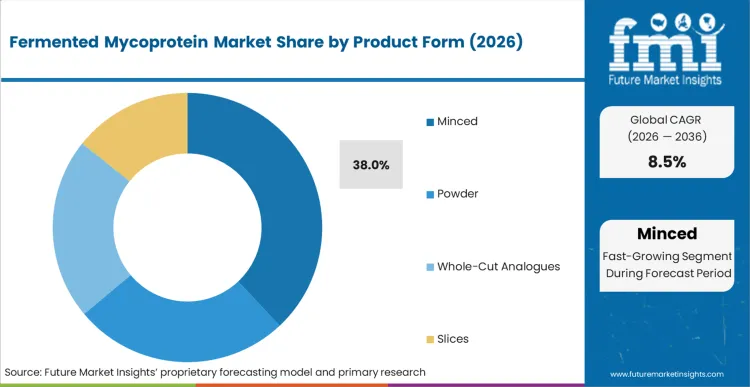
Minced mycoprotein holds the dominant product form position, accounting for approximately 38% of market volume in 2026. The format's commercial leadership reflects Quorn's three-decade presence in UK and continental European grocery freezer aisles, where minced mycoprotein products have established repeat purchase behavior among vegetarian households. Consumer purchasing is driven by the format's direct substitution utility in everyday meal occasions - shepherd's pie, bolognese, and tacos - and by its established familiarity with home cooks. In 2024, Marlow Foods accelerated the format's B2B reach by supplying minced mycoprotein to quick-service restaurant chains through its Marlow Ingredients division, extending volume beyond retail into foodservice meal kits and staff dining contracts.
- Whole-cut analogue formats are the fastest-growing product form with a projected CAGR of 11.3% through 2036, driven by demand from premium chilled meat substitute categories and from foodservice operators seeking chicken-alternative SKUs with recognizable portion formats; ENOUGH's ABUNDA mycoprotein, which Cargill commercializes through its European food ingredients network and co-develops with customers as part of a broader multi-ingredient portfolio, serves as a key enabling ingredient for whole-cut poultry and seafood analogues produced at industrial scale. The partnership leverages ENOUGH's 10,000–20,000 tonne/year production facility co-located with Cargill operations, combining ABUNDA with Cargill's plant proteins, texturizers, and fats to create meat-like whole muscle alternatives. [4]
- Powder formulations are gaining traction in sports nutrition and functional food applications, growing at an estimated 10.1% CAGR to 2036; The Protein Brewery's Fermotein, now advancing through EU novel food authorization following EFSA's December 2025 positive opinion, is positioned as a supplement and meal replacement ingredient targeting the high-protein dietary supplement segment rather than conventional meat alternatives. [1]
Fermented Mycoprotein Market Analysis by Application
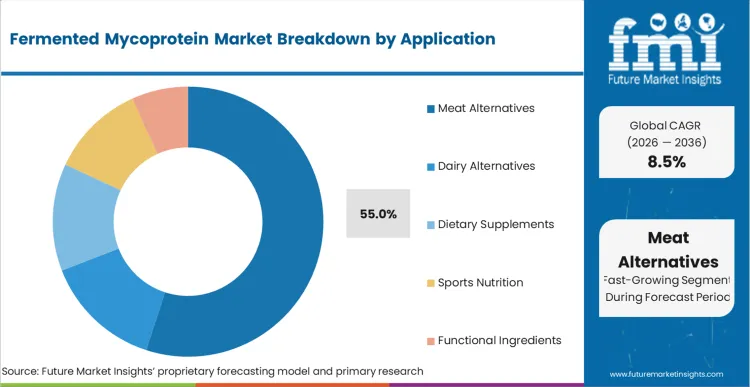
Meat alternatives dominate application-level demand at approximately 55% of market value in 2026, anchored by the Quorn brand portfolio and supported by an expanding roster of restaurant and retail brands reformulating with ABUNDA and competing fermented mycoprotein ingredients. Consumer demand for meat alternatives continues to outpace the broader alternative protein category, with mycoprotein retaining a structural advantage over pea and soy proteins in texture fidelity for whole-muscle product formats. In 2024, Quorn Foods announced plans to launch hybrid meat-mycoprotein products blended at a 50/50 ratio, targeting mainstream meat eaters who are not motivated by full vegetarian substitution but respond to protein enhancement and sustainability messaging. [3]
- Dietary supplements represent approximately 14% of market value and are projected to grow at 10.8% CAGR to 2036, driven by growing clinical evidence on mycoprotein's efficacy in muscle protein synthesis and cholesterol reduction, and by the ingredient's complete amino acid profile, which gives it a PDCAAS of 0.996 - higher than soy and comparable to egg protein. [2]
Fermented Mycoprotein Market Analysis by Distribution Channel
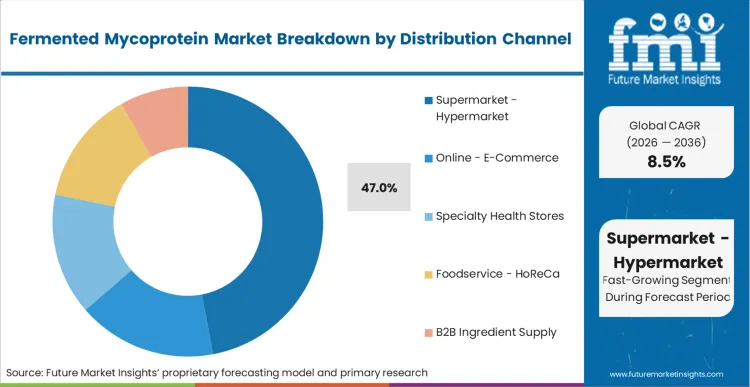
Supermarkets and hypermarkets account for approximately 47% of market value and remain the primary channel for finished consumer products, driven by the established frozen and chilled meat alternative shelf sections in the UK, Netherlands, and Germany. Retail shelf space allocation is a key competitive variable: Quorn commands significant share of the UK meat-free freezer aisle, and new entrants seeking retail listings face high velocity-per-SKU thresholds imposed by grocery buyers. The category's average shelf performance in mainstream European grocery improved through 2024 as clean-label mycoprotein products outperformed reformulated plant-based meat analogue competitors on repeat purchase metrics.
- Online and e-commerce channels are the fastest-growing distribution route at an estimated 11.2% CAGR to 2036, supported by direct-to-consumer subscription boxes, specialist health food platforms, and the growing availability of mycoprotein ingredient powders through supplement e-retailers; the channel is disproportionately important in markets where retail shelf placement remains limited, including South Korea, Australia, and Canada.
- Foodservice and HoReCa is the second-fastest growing channel at 9.6% CAGR to 2036, driven by quick-service and fast-casual restaurant chains incorporating mycoprotein into high-protein menu items; the B2B ingredient supply route is projected to grow in parallel as large food manufacturers embed fermented mycoprotein into frozen meal, ready-to-eat, and packaged snack product lines.
Fermented Mycoprotein Market Drivers, Restraints and Opportunities
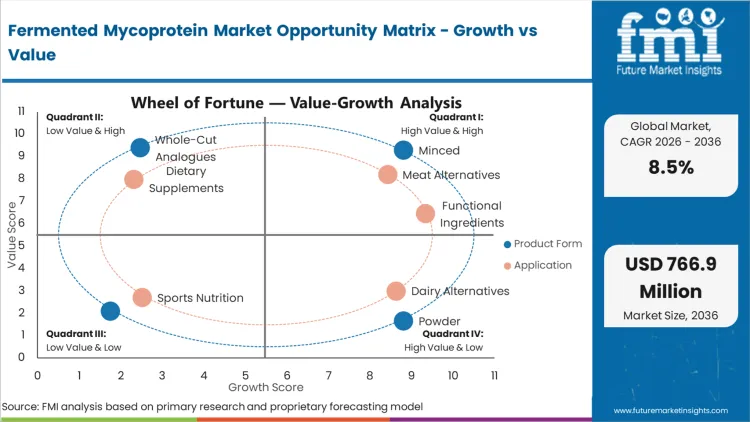
FMI's assessment of the fermented mycoprotein market identifies a category in structural transition: demand from committed vegetarians and vegans, historically the core purchaser base, is supplemented by flexitarian consumption that requires different product positioning and distribution strategies. The supply side has responded through precision fermentation advances, B2B ingredient platforms, and hybrid product formats that embed mycoprotein within conventional food manufacturing supply chains. In December 2025, The Protein Brewery received a positive EFSA scientific opinion for Fermotein - the first fermented fungal biomass ingredient to complete the EU novel food assessment - signaling a regulatory environment increasingly receptive to commercial-scale fermented mycoprotein applications across member states. [1]
- Sustained dietary shift among flexitarian consumers in North America and Western Europe toward reduced meat consumption is the primary demand driver, with flexitarians now representing the largest and fastest-growing consumer segment for meat alternatives; fermented mycoprotein's fibrous, whole-muscle texture and complete amino acid profile differentiates it from soy and pea analogues, supporting premium pricing and higher repeat purchase rates among health-motivated buyers.
- High production costs relative to established plant proteins remain the principal restraint; continuous aerobic fermentation requires controlled bioreactor environments, sterile processing, and high-quality glucose feedstocks, resulting in current ingredient costs that are approximately two to three times those of commodity pea protein concentrate, limiting mainstream retail price competitiveness and market access for small producers in emerging economies.
- The premiumization of whole-cut mycoprotein analogues targeting chicken, seafood, and red meat applications represents the category's highest-value near-term opportunity; consumers in high-income markets demonstrate willingness to pay a meaningful premium for meat-alternative products with recognizable portion formats.
Regional Analysis
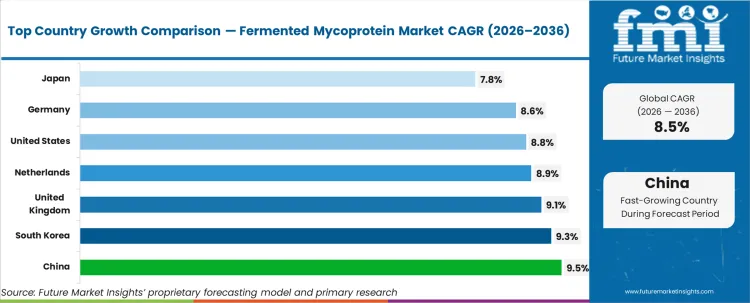
.webp "Top Country Growth Comparison Fermented Mycoprotein Market Cagr (2026 2036)")
The fermented mycoprotein market spans all seven major geographic regions covered in FMI's full report: North America, Latin America, Eastern Europe, Western Europe, South Asia and Pacific, East Asia, and Middle East and Africa. The full report provides market attractiveness assessments and per-capita consumption analyses for 30-plus countries, covering both ingredient-level and finished product market dynamics. Western Europe is the most mature regional market, anchored by the UK's three-decade history with Quorn and by the Netherlands' role as a European production hub for ABUNDA mycoprotein. North America is the fastest-growing high-income market, driven by flexitarian adoption and investment in domestic fermentation infrastructure.
| Country | Value CAGR (2026-2036) |
|---|---|
| United States | 8.8% |
| United Kingdom | 9.1% |
| Germany | 8.6% |
| Netherlands | 8.9% |
| China | 9.5% |
| Japan | 7.8% |
| South Korea | 9.3% |
| Canada | 8.2% |
| Australia | 8.0% |
| India | 10.2% |
| Brazil | 7.5% |
| UAE | 8.3% |
Source: Future Market Insights (FMI) analysis, based on proprietary forecasting model and primary research
North America Market Analysis
North America is the largest single regional market by value in 2026, accounting for approximately 34% of global fermented mycoprotein revenue, driven by the United States' well-funded alternative protein startup ecosystem, strong flexitarian adoption, and the growing presence of mycoprotein-based products in natural and specialty retail alongside mainstream grocery. The buyer profile spans health-motivated millennials and Gen Z consumers seeking high-protein clean-label foods, with household income levels above USD 60,000 representing the core purchasing segment for branded mycoprotein products in the USD 7 to USD 14 per pack price tier.
- The United States is projected to grow at 8.8% CAGR through 2036, supported by domestic fermentation investment from companies including Nature's Fynd and Meati Foods, GRAS-pathway regulatory efficiency for new mycoprotein strains, and the significant marketing investment by Quorn in expanding its US retail footprint into mid-market grocery channels beyond premium health food retailers.
- Canada is projected at 8.2% CAGR, with growth anchored in urban centers in Ontario and British Columbia where plant-based diet adoption rates are among the highest in North America; the Canadian market benefits from proximity to US supply chains and from Health Canada's comparatively efficient novel food review process.
The full FMI report covers the US, Canada, and Mexico with detailed per-capita consumption models, retail channel breakdowns, and competitive landscape assessments for each country.
Latin America Market Analysis
Latin America is a nascent market for fermented mycoprotein, currently at an early consumer awareness phase in all major economies. Brazil, the region's largest food market, is experiencing early institutional interest in alternative proteins driven by government-backed research programs and the growing domestic plant-based food processing industry. The buyer profile is currently limited to upper-income urban consumers in São Paulo, Rio de Janeiro, and Santiago, with mainstream retail penetration constrained by price sensitivity and low category awareness.
- Brazil is projected to grow at 7.5% CAGR through 2036, reflecting expansion from a small base driven by the intersection of rising middle-class health consciousness, increasing regulatory acceptance for novel food proteins, and the country's established fermentation sector infrastructure, which reduces potential barriers to domestic production over time.
- Argentina and Chile are smaller but higher per-capita-income markets with greater exposure to European food trends, positioning them as early adopters of imported mycoprotein products distributed through specialty and e-commerce channels ahead of domestic production availability.
The full FMI report covers Brazil, Argentina, Chile, Mexico, and Colombia with country-specific market sizing and distribution channel data.
Europe Market Analysis
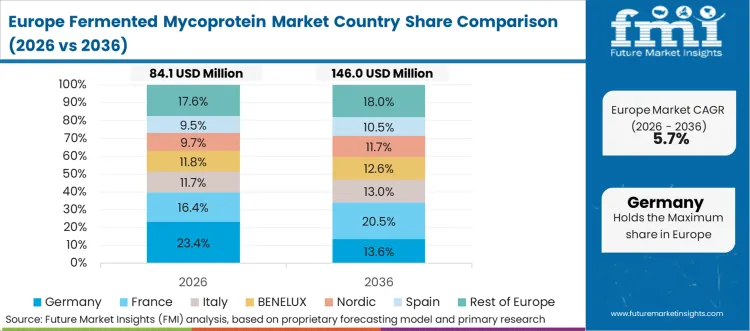
Europe is the global leader in fermented mycoprotein consumption, accounting for approximately 41% of market value in 2025. Western Europe anchors the regional market, with the UK, Netherlands, and Germany representing the three largest national markets. The UK's Quorn-led market has the deepest retail penetration globally, with mycoprotein products available in over 95% of major grocery chains. The Netherlands serves as Europe's primary production hub, hosting ENOUGH's ABUNDA fermentation facility with ongoing capacity expansion plans supported by Cargill's strategic investment. Eastern Europe is at an early penetration stage with growth concentrated in Poland and Czech Republic through imported product distribution.
- The United Kingdom is projected to grow at 9.1% CAGR through 2036, the highest among mature high-income markets, driven by the UK's leading flexitarian adoption rate, established retail mycoprotein category, and the growing foodservice channel where chains including Subway UK incorporate mycoprotein-based proteins on their menus.
- Germany is projected at 8.6% CAGR, supported by the country's strong meat reduction policy environment, high share of vegetarian and vegan consumers (approximately 10% of the population identifies as vegetarian), and the presence of European food-tech companies like Nosh.bio developing next-generation filamentous fungal protein ingredients.
The full FMI report covers the UK, Germany, Netherlands, France, Italy, Spain, and Eastern European markets with competitive brand analysis and foodservice penetration data.
Asia Pacific Market Analysis
Asia Pacific is the fastest-growing region for fermented mycoprotein, projected at a regional CAGR of approximately 9.5% through 2036, driven by China's large-scale alternative protein investment, South Korea's food-tech ecosystem, and Japan's established functional food culture. The buyer profile differs materially from Western Europe: in East Asia, mycoprotein is positioned primarily as a functional food ingredient rather than a meat substitute, with applications in high-protein beverages, meal replacements, and supplement formats showing stronger traction than conventional meat analogue formats.
- China is projected to grow at 9.5% CAGR through 2036 and represents the region's largest growth opportunity in absolute value; government food security initiatives and biotechnology investment are catalyzing domestic fermentation capacity development, and the country's food processing sector is evaluating mycoprotein as a cost-competitive protein ingredient for ready-to-eat meal formulations.
- South Korea is projected at 9.3% CAGR, supported by the country's dominant food-tech investment sector, precision fermentation startup activity, and a consumer base that is increasingly receptive to fermented protein formats given the country's deep cultural familiarity with fermented food products including kimchi, doenjang, and ganjang.
The full FMI report covers China, Japan, South Korea, India, Australia, New Zealand, and Southeast Asian markets with production capacity, regulatory status, and demand penetration data by country.
Competitive Aligners for Market Players
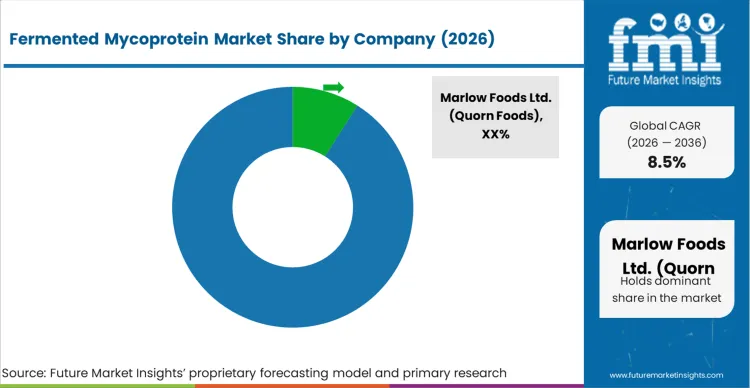
The fermented mycoprotein market has a tiered competitive structure. At the premium tier, Marlow Foods (Quorn) and ENOUGH operate as both brand owners and ingredient suppliers, competing on production scale and distribution breadth. Quorn's competitive advantage lies in brand recognition and consumer trust built over nearly four decades in European grocery; ENOUGH's advantage is its strategic partnership with Cargill, which provides commercial distribution access across its European food ingredients customer network, and its co-located 160,000 square foot production facility in the Netherlands. At the mid-tier, ingredient specialists including The Protein Brewery compete on novel food regulatory status and application credentials, primarily targeting food manufacturers.
Retailer relationships play a decisive role in market access for consumer-facing mycoprotein brands. In UK grocery, Quorn maintains significant shelf presence at Tesco, Sainsbury's, and other major retailers. Marlow Foods' shift toward a B2B ingredient supply model via Marlow Ingredients (launched 2023) opens opportunities for other manufacturers to incorporate mycoprotein into their products.
Consumer behavior differs between premium-oriented buyers and price-sensitive buyers. Premium buyers demonstrate brand loyalty when they associate mycoprotein with specific health benefits or environmental commitments and are willing to pay premiums over conventional plant-based alternatives. Price-sensitive mainstream consumers show switching behavior at price thresholds and respond to competitive pricing
Key Players Covered in the Study
- Marlow Foods Ltd. (Quorn Foods)
- ENOUGH (3F Bio Ltd.)
- The Protein Brewery
- MycoTechnology, Inc.
- Nature's Fynd
- The Better Meat Co.
- Cargill, Inc.
- Symrise AG
- Mycovation
- Bright Green Partners B.V.
- KIDEMIS GmbH
- Smaqo
- Meati Foods
Report Scope
| Metric | Value |
|---|---|
| Quantitative Units | USD 312.5 million in 2025 to USD 766.7 million by 2036 at a CAGR of 8.5% |
| Market Definition | The market covers the production and commercial sale of protein-rich biomass and finished food and ingredient products derived from aerobic submerged fermentation of filamentous fungi, sold across retail, foodservice, and ingredient supply channels globally. |
| Product Form Segmentation | Minced, Powder, Whole-Cut Analogues, Slices |
| Application Segmentation | Meat Alternatives, Dairy Alternatives, Dietary Supplements, Sports Nutrition, Functional Ingredients |
| End Use Segmentation | Retail, Foodservice, Industrial / Ingredient Supply |
| Distribution Channel Segmentation | Supermarket/Hypermarket, Online/E-Commerce, Specialty Health Stores, Foodservice/HoReCa, B2B Ingredient Supply |
| Regions Covered | North America, Latin America, Western Europe, Eastern Europe, East Asia, South Asia and Pacific, Middle East and Africa |
| Countries Covered | United States, Canada, Mexico, Brazil, Argentina, Chile, United Kingdom, Germany, Netherlands, France, Italy, Spain, Poland, Czech Republic, China, Japan, South Korea, India, Australia, New Zealand, UAE, Saudi Arabia, and others |
| Key Players Covered in the Study | Marlow Foods Ltd. (Quorn Foods), ENOUGH (3F Bio Ltd.), The Protein Brewery, MycoTechnology Inc., Nature's Fynd, The Better Meat Co., Cargill Inc., Symrise AG, Mycovation, Bright Green Partners B.V., KIDEMIS GmbH, Smaqo, Meati Foods |
| Forecast Period | 2026 to 2036 |
| Approach | Volume-based bottom-up model by country, mapped against per-capita fermented protein consumption rates, population, household income segmentation, and retail distribution coverage, validated through retail audit and trade data cross-referencing. |
Fermented Mycoprotein Market Analysis by Segments
By Product Form
- Minced
- Powder
- Whole-Cut Analogues
- Slices
By Application
- Meat Alternatives
- Dairy Alternatives
- Dietary Supplements
- Sports Nutrition
- Functional Ingredients
By End Use
- Retail
- Foodservice
- Industrial / Ingredient Supply
By Distribution Channel
- Supermarket / Hypermarket
- Online / E-Commerce
- Specialty Health Stores
- Foodservice / HoReCa
- B2B Ingredient Supply
By Region
- North America
- Latin America
- Western Europe
- Eastern Europe
- East Asia
- South Asia and Pacific
- Middle East and Africa
Bibliography
- [1] Clinical Research Data. Mycoprotein Efficacy in Muscle Protein Synthesis and Cholesterol Reduction: PDCAAS Benchmarking. 2025.
- [2] Marlow Foods / Quorn Foods. Strategic Launch Announcement: 50/50 Hybrid Meat-Mycoprotein Product Portfolio. 2024.
- [3] ENOUGH / Cargill Partnership. ABUNDA Mycoprotein Commercialization and Production Facility Integration Report. 2025.
This report addresses
- Market intelligence enabling assessment of leading countries, product forms, and retail channel performance across the global fermented mycoprotein category.
- Volume and revenue forecasts for 2026 to 2036, validated through per-capita fermented protein consumption modeling, retail audit benchmarks, and production capacity cross-referencing.
- Growth opportunity mapping across product tiers - premium whole-cut analogues, mid-range minced and slice formats, and value/private-label powder ingredients - by market and distribution channel.
- Segment and regional revenue forecasts by product form, application, end use, and distribution channel across 22-plus countries in all seven geographic regions.
- Competition strategy analysis covering brand positioning, B2B ingredient supply relationships, distribution channel structure, recent product launches, and market share analysis for 13 leading companies.
- Consumer economic context analysis covering GDP per capita, household final consumption rates, and food/consumer spend share across 12 key markets, with FMI's analysis linking economic indicators to demand projections.
- Regulatory and novel food compliance tracking covering EFSA novel food authorization status, FDA GRAS pathway developments, and national food safety approval timelines across European, North American, and Asia Pacific markets.
- Report delivery formats: PDF, Excel data tables, PowerPoint executive summary, and interactive dashboard.
Frequently Asked Questions
How large is the demand for fermented mycoprotein in the global market in 2026?
Based on FMI analysis, the global fermented mycoprotein market is estimated to reach USD 339.2 million in 2026, growing from a 2025 base of USD 312.5 million as demand expands across meat alternative, dairy alternative, and dietary supplement applications in North America and Western Europe.
What will the market size of fermented mycoprotein by 2036?
FMI projects the global fermented mycoprotein market to reach USD 766.7 million by 2036, adding approximately USD 427.5 million in absolute value over the 2026-to-2036 forecast period at a CAGR of 8.5%.
What is the expected demand growth rate for fermented mycoprotein between 2026 and 2036?
FMI projects a CAGR of 8.5% for the global fermented mycoprotein market between 2026 and 2036, driven by flexitarian dietary adoption, advances in continuous aerobic fermentation technology, and expanding regulatory acceptance for novel fungal food ingredients across major markets.
Which product form is expected to lead global fermented mycoprotein sales?
Minced mycoprotein holds the dominant product form position with approximately 38% of market volume in 2026, while whole-cut analogues are the fastest-growing format at a projected 11.3% CAGR through 2036, driven by premium foodservice and retail chicken and seafood substitute applications.
How significant is the premium segment in driving category value versus volume?
The premium segment - encompassing whole-cut analogues and branded mycoprotein products at the USD 10 to USD 15 per serving price point - disproportionately drives value relative to volume; though it represents a smaller share of units sold, it generates a higher margin-per-unit and supports the CAGR premium that differentiates fermented mycoprotein's value growth from its volume growth.
Which distribution channel accounts for the largest share of fermented mycoprotein sales?
Supermarkets and hypermarkets account for approximately 47% of market value in 2026, led by the UK, Netherlands, and Germany; online and e-commerce is the fastest-growing channel at 11.2% CAGR to 2036.
How does household income growth influence per-capita consumption in emerging markets?
In India and Brazil, where food expenditure currently represents 38% and 28% of household spending respectively, rising incomes are expected to gradually shift food budgets toward premium protein formats; FMI models this transition as a long-cycle opportunity, with meaningful volume penetration in emerging markets materializing primarily in the second half of the forecast period after 2031.
Which regions are entering the premiumization phase and what is driving the shift?
The United Kingdom, Netherlands, and Germany are the most advanced premiumization markets, driven by mature flexitarian consumer segments willing to pay for whole-cut mycoprotein analogues; South Korea and Australia are entering a premiumization phase driven by functional food culture and imported product availability.
How does private-label competition affect brand owner pricing and margin in fermented mycoprotein?
Private-label mycoprotein products - formulated on B2B ingredient bases including ABUNDA and Fermotein - are emerging in German discount grocery and Dutch supermarkets, compressing margin for mid-tier branded players; brand owners at the premium tier are responding by differentiating on clean-label credentials, complete amino acid profile claims, and proprietary fermentation strain advantages.
What role do clean-label, organic, or functional claims play in consumer purchase decisions for fermented mycoprotein?
Clean-label claims - specifically the absence of artificial ingredients and the minimal processing narrative inherent to fermentation-based production - are the most persuasive purchase triggers for mainstream flexitarian buyers, according to consumer research referenced in FMI primary interviews; functional claims centered on high protein, complete amino acid profile, and dietary fiber are secondary motivators, particularly relevant in dietary supplement and sports nutrition applications.
Preview the report firsthand - request a free sample
Get SampleGet the brochure for pricing and purchase details.
Get PDFTable of Content
- Executive Summary
- Global Market Outlook
- Demand-side Trends
- Supply-side Trends
- Technology Roadmap Analysis
- Analysis and Recommendations
- Market Overview
- Market Coverage / Taxonomy
- Market Definition / Scope / Limitations
- Research Methodology
- Chapter Orientation
- Analytical Lens and Working Hypotheses
- Market Structure, Signals, and Trend Drivers
- Benchmarking and Cross-market Comparability
- Market Sizing, Forecasting, and Opportunity Mapping
- Research Design and Evidence Framework
- Desk Research Programme (Secondary Evidence)
- Company Annual and Sustainability Reports
- Peer-reviewed Journals and Academic Literature
- Corporate Websites, Product Literature, and Technical Notes
- Earnings Decks and Investor Briefings
- Statutory Filings and Regulatory Disclosures
- Technical White Papers and Standards Notes
- Trade Journals, Industry Magazines, and Analyst Briefs
- Conference Proceedings, Webinars, and Seminar Materials
- Government Statistics Portals and Public Data Releases
- Press Releases and Reputable Media Coverage
- Specialist Newsletters and Curated Briefings
- Sector Databases and Reference Repositories
- FMI Internal Proprietary Databases and Historical Market Datasets
- Subscription Datasets and Paid Sources
- Social Channels, Communities, and Digital Listening Inputs
- Additional Desk Sources
- Expert Input and Fieldwork (Primary Evidence)
- Primary Modes
- Qualitative Interviews and Expert Elicitation
- Quantitative Surveys and Structured Data Capture
- Blended Approach
- Why Primary Evidence is Used
- Field Techniques
- Interviews
- Surveys
- Focus Groups
- Observational and In-context Research
- Social and Community Interactions
- Stakeholder Universe Engaged
- C-suite Leaders
- Board Members
- Presidents and Vice Presidents
- R&D and Innovation Heads
- Technical Specialists
- Domain Subject-matter Experts
- Scientists
- Physicians and Other Healthcare Professionals
- Governance, Ethics, and Data Stewardship
- Research Ethics
- Data Integrity and Handling
- Primary Modes
- Tooling, Models, and Reference Databases
- Desk Research Programme (Secondary Evidence)
- Data Engineering and Model Build
- Data Acquisition and Ingestion
- Cleaning, Normalisation, and Verification
- Synthesis, Triangulation, and Analysis
- Quality Assurance and Audit Trail
- Market Background
- Market Dynamics
- Drivers
- Restraints
- Opportunity
- Trends
- Scenario Forecast
- Demand in Optimistic Scenario
- Demand in Likely Scenario
- Demand in Conservative Scenario
- Opportunity Map Analysis
- Product Life Cycle Analysis
- Supply Chain Analysis
- Investment Feasibility Matrix
- Value Chain Analysis
- PESTLE and Porter’s Analysis
- Regulatory Landscape
- Regional Parent Market Outlook
- Production and Consumption Statistics
- Import and Export Statistics
- Market Dynamics
- Global Market Analysis 2021 to 2025 and Forecast, 2026 to 2036
- Historical Market Size Value (USD Million) Analysis, 2021 to 2025
- Current and Future Market Size Value (USD Million) Projections, 2026 to 2036
- Y-o-Y Growth Trend Analysis
- Absolute $ Opportunity Analysis
- Global Market Pricing Analysis 2021 to 2025 and Forecast 2026 to 2036
- Global Market Analysis 2021 to 2025 and Forecast 2026 to 2036, By Product Form
- Introduction / Key Findings
- Historical Market Size Value (USD Million) Analysis By Product Form , 2021 to 2025
- Current and Future Market Size Value (USD Million) Analysis and Forecast By Product Form , 2026 to 2036
- Minced
- Powder
- Whole-Cut Analogues
- Slices
- Minced
- Y-o-Y Growth Trend Analysis By Product Form , 2021 to 2025
- Absolute $ Opportunity Analysis By Product Form , 2026 to 2036
- Global Market Analysis 2021 to 2025 and Forecast 2026 to 2036, By Application
- Introduction / Key Findings
- Historical Market Size Value (USD Million) Analysis By Application, 2021 to 2025
- Current and Future Market Size Value (USD Million) Analysis and Forecast By Application, 2026 to 2036
- Meat Alternatives
- Dairy Alternatives
- Dietary Supplements
- Sports Nutrition
- Functional Ingredients
- Meat Alternatives
- Y-o-Y Growth Trend Analysis By Application, 2021 to 2025
- Absolute $ Opportunity Analysis By Application, 2026 to 2036
- Global Market Analysis 2021 to 2025 and Forecast 2026 to 2036, By Distribution Channel
- Introduction / Key Findings
- Historical Market Size Value (USD Million) Analysis By Distribution Channel, 2021 to 2025
- Current and Future Market Size Value (USD Million) Analysis and Forecast By Distribution Channel, 2026 to 2036
- Supermarket - Hypermarket
- Online - E-Commerce
- Specialty Health Stores
- Foodservice - HoReCa
- B2B Ingredient Supply
- Supermarket - Hypermarket
- Y-o-Y Growth Trend Analysis By Distribution Channel, 2021 to 2025
- Absolute $ Opportunity Analysis By Distribution Channel, 2026 to 2036
- Global Market Analysis 2021 to 2025 and Forecast 2026 to 2036, By Region
- Introduction
- Historical Market Size Value (USD Million) Analysis By Region, 2021 to 2025
- Current Market Size Value (USD Million) Analysis and Forecast By Region, 2026 to 2036
- North America
- Latin America
- Western Europe
- Eastern Europe
- East Asia
- South Asia and Pacific
- Middle East & Africa
- Market Attractiveness Analysis By Region
- North America Market Analysis 2021 to 2025 and Forecast 2026 to 2036, By Country
- Historical Market Size Value (USD Million) Trend Analysis By Market Taxonomy, 2021 to 2025
- Market Size Value (USD Million) Forecast By Market Taxonomy, 2026 to 2036
- By Country
- USA
- Canada
- Mexico
- By Product Form
- By Application
- By Distribution Channel
- By Country
- Market Attractiveness Analysis
- By Country
- By Product Form
- By Application
- By Distribution Channel
- Key Takeaways
- Latin America Market Analysis 2021 to 2025 and Forecast 2026 to 2036, By Country
- Historical Market Size Value (USD Million) Trend Analysis By Market Taxonomy, 2021 to 2025
- Market Size Value (USD Million) Forecast By Market Taxonomy, 2026 to 2036
- By Country
- Brazil
- Chile
- Rest of Latin America
- By Product Form
- By Application
- By Distribution Channel
- By Country
- Market Attractiveness Analysis
- By Country
- By Product Form
- By Application
- By Distribution Channel
- Key Takeaways
- Western Europe Market Analysis 2021 to 2025 and Forecast 2026 to 2036, By Country
- Historical Market Size Value (USD Million) Trend Analysis By Market Taxonomy, 2021 to 2025
- Market Size Value (USD Million) Forecast By Market Taxonomy, 2026 to 2036
- By Country
- Germany
- UK
- Italy
- Spain
- France
- Nordic
- BENELUX
- Rest of Western Europe
- By Product Form
- By Application
- By Distribution Channel
- By Country
- Market Attractiveness Analysis
- By Country
- By Product Form
- By Application
- By Distribution Channel
- Key Takeaways
- Eastern Europe Market Analysis 2021 to 2025 and Forecast 2026 to 2036, By Country
- Historical Market Size Value (USD Million) Trend Analysis By Market Taxonomy, 2021 to 2025
- Market Size Value (USD Million) Forecast By Market Taxonomy, 2026 to 2036
- By Country
- Russia
- Poland
- Hungary
- Balkan & Baltic
- Rest of Eastern Europe
- By Product Form
- By Application
- By Distribution Channel
- By Country
- Market Attractiveness Analysis
- By Country
- By Product Form
- By Application
- By Distribution Channel
- Key Takeaways
- East Asia Market Analysis 2021 to 2025 and Forecast 2026 to 2036, By Country
- Historical Market Size Value (USD Million) Trend Analysis By Market Taxonomy, 2021 to 2025
- Market Size Value (USD Million) Forecast By Market Taxonomy, 2026 to 2036
- By Country
- China
- Japan
- South Korea
- By Product Form
- By Application
- By Distribution Channel
- By Country
- Market Attractiveness Analysis
- By Country
- By Product Form
- By Application
- By Distribution Channel
- Key Takeaways
- South Asia and Pacific Market Analysis 2021 to 2025 and Forecast 2026 to 2036, By Country
- Historical Market Size Value (USD Million) Trend Analysis By Market Taxonomy, 2021 to 2025
- Market Size Value (USD Million) Forecast By Market Taxonomy, 2026 to 2036
- By Country
- India
- ASEAN
- Australia & New Zealand
- Rest of South Asia and Pacific
- By Product Form
- By Application
- By Distribution Channel
- By Country
- Market Attractiveness Analysis
- By Country
- By Product Form
- By Application
- By Distribution Channel
- Key Takeaways
- Middle East & Africa Market Analysis 2021 to 2025 and Forecast 2026 to 2036, By Country
- Historical Market Size Value (USD Million) Trend Analysis By Market Taxonomy, 2021 to 2025
- Market Size Value (USD Million) Forecast By Market Taxonomy, 2026 to 2036
- By Country
- Kingdom of Saudi Arabia
- Other GCC Countries
- Turkiye
- South Africa
- Other African Union
- Rest of Middle East & Africa
- By Product Form
- By Application
- By Distribution Channel
- By Country
- Market Attractiveness Analysis
- By Country
- By Product Form
- By Application
- By Distribution Channel
- Key Takeaways
- Key Countries Market Analysis
- USA
- Pricing Analysis
- Market Share Analysis, 2025
- By Product Form
- By Application
- By Distribution Channel
- Canada
- Pricing Analysis
- Market Share Analysis, 2025
- By Product Form
- By Application
- By Distribution Channel
- Mexico
- Pricing Analysis
- Market Share Analysis, 2025
- By Product Form
- By Application
- By Distribution Channel
- Brazil
- Pricing Analysis
- Market Share Analysis, 2025
- By Product Form
- By Application
- By Distribution Channel
- Chile
- Pricing Analysis
- Market Share Analysis, 2025
- By Product Form
- By Application
- By Distribution Channel
- Germany
- Pricing Analysis
- Market Share Analysis, 2025
- By Product Form
- By Application
- By Distribution Channel
- UK
- Pricing Analysis
- Market Share Analysis, 2025
- By Product Form
- By Application
- By Distribution Channel
- Italy
- Pricing Analysis
- Market Share Analysis, 2025
- By Product Form
- By Application
- By Distribution Channel
- Spain
- Pricing Analysis
- Market Share Analysis, 2025
- By Product Form
- By Application
- By Distribution Channel
- France
- Pricing Analysis
- Market Share Analysis, 2025
- By Product Form
- By Application
- By Distribution Channel
- India
- Pricing Analysis
- Market Share Analysis, 2025
- By Product Form
- By Application
- By Distribution Channel
- ASEAN
- Pricing Analysis
- Market Share Analysis, 2025
- By Product Form
- By Application
- By Distribution Channel
- Australia & New Zealand
- Pricing Analysis
- Market Share Analysis, 2025
- By Product Form
- By Application
- By Distribution Channel
- China
- Pricing Analysis
- Market Share Analysis, 2025
- By Product Form
- By Application
- By Distribution Channel
- Japan
- Pricing Analysis
- Market Share Analysis, 2025
- By Product Form
- By Application
- By Distribution Channel
- South Korea
- Pricing Analysis
- Market Share Analysis, 2025
- By Product Form
- By Application
- By Distribution Channel
- Russia
- Pricing Analysis
- Market Share Analysis, 2025
- By Product Form
- By Application
- By Distribution Channel
- Poland
- Pricing Analysis
- Market Share Analysis, 2025
- By Product Form
- By Application
- By Distribution Channel
- Hungary
- Pricing Analysis
- Market Share Analysis, 2025
- By Product Form
- By Application
- By Distribution Channel
- Kingdom of Saudi Arabia
- Pricing Analysis
- Market Share Analysis, 2025
- By Product Form
- By Application
- By Distribution Channel
- Turkiye
- Pricing Analysis
- Market Share Analysis, 2025
- By Product Form
- By Application
- By Distribution Channel
- South Africa
- Pricing Analysis
- Market Share Analysis, 2025
- By Product Form
- By Application
- By Distribution Channel
- USA
- Market Structure Analysis
- Competition Dashboard
- Competition Benchmarking
- Market Share Analysis of Top Players
- By Regional
- By Product Form
- By Application
- By Distribution Channel
- Competition Analysis
- Competition Deep Dive
- Marlow Foods Ltd. (Quorn Foods)
- Overview
- Product Portfolio
- Profitability by Market Segments (Product/Age /Sales Channel/Region)
- Sales Footprint
- Strategy Overview
- Marketing Strategy
- Product Strategy
- Channel Strategy
- ENOUGH (3F Bio Ltd.)
- The Protein Brewery
- MycoTechnology, Inc.
- Nature's Fynd
- The Better Meat Co.
- Cargill, Inc.
- Symrise AG
- Mycovation
- Bright Green Partners B.V.
- KIDEMIS GmbH
- Marlow Foods Ltd. (Quorn Foods)
- Competition Deep Dive
- Assumptions & Acronyms Used


