

- Industry Size (2026)
- USD 96.8 Mn
- Forecast (2036)
- USD 195.8 Mn
- CAGR (2026 to 2036)
- 7.3%
Fermented Garlic and Onion Digestive Comfort Bases Market Size, Market Forecast and Outlook By FMI
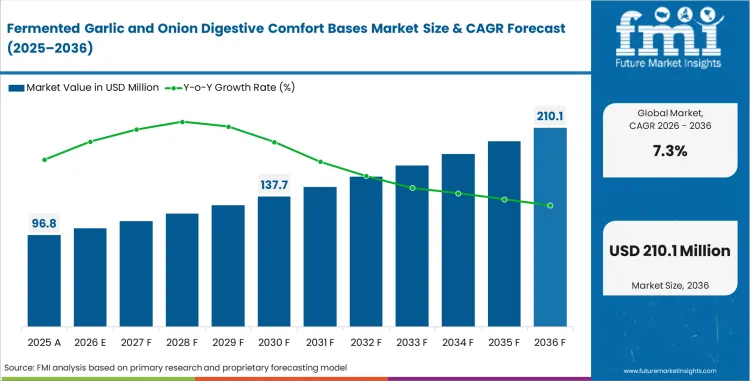
The fermented garlic and onion digestive comfort bases market was valued at USD 90.2 million in 2025. Market valuation is estimated to reach USD 96.8 million in 2026 and is projected to advance at a CAGR of 7.3% from 2026 to 2036, taking total market valuation to USD 195.8 million by 2036. Growth reflects stronger demand for digestive health supplements that use standardized ingredients with better dose control, easier flavor management, and smoother use across finished formats. Brand owners are moving beyond broad digestive claims and giving more attention to ingredient systems that fit capsules, gummies, shots, and daily mixes without heavy reformulation work.
Summary of Fermented Garlic and Onion Digestive Comfort Bases Market
- Market Snapshot
- Fermented Garlic and Onion Digestive Comfort Bases Market is valued at USD 90.2 million in 2025 and is projected to reach USD 195.8 million by 2036.
- Industry value is expected to reach USD 96.8 million in 2026, and the forecast implies a CAGR of 7.3% from 2026 to 2036.
- Category sits inside fermented ingredients and digestive-positioned wellness inputs, yet scope stays narrow because it covers standardized garlic and onion bases sold for functional use rather than broad fermented foods.
- Commercial viability depends on how well a base balances digestive positioning, aroma moderation, dose control, and finished-format ease across powders, liquids, and small single-serve products.
- Demand and Growth Drivers
- Digestive-support launches keep widening across digestive enzyme supplements, prebiotic blends, and small daily wellness products, which gives fermented allium bases a clearer use case than plain culinary extracts can usually offer.
- Fermentation matters because it softens raw pungency and helps a brand bring garlic or onion into daily-use routines without asking consumers to accept a sharp culinary profile.
- Small-format products give this niche a workable route into the shelf, since shots, sachets, and capsule systems suit concentrated inputs better than large-volume beverages.
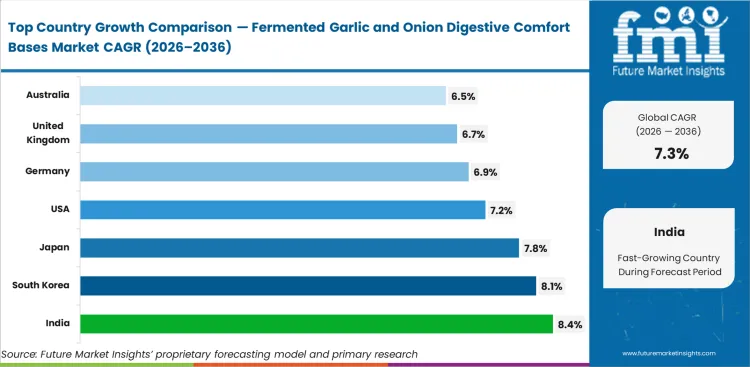
- India leads at 8.4% CAGR, followed by South Korea at 8.1%, Japan at 7.8%, United States at 7.2%, Germany at 6.9%, United Kingdom at 6.7%, and Australia at 6.5% through 2036.
- Taste masking, batch consistency, and proof of digestive benefit still slow wider rollout even where product interest is already visible.
- Product and Segment View
- Liquid concentrates are expected to account for 34.0% share in 2026 because they move easily into shots, tonics, and concentrated daily formats without locking a brand into one finished system too early.
- Garlic-led bases are projected to hold 52.0% share in 2026 as black garlic and related fermented garlic concepts sit closer to existing wellness familiarity than onion-first propositions.
- Lactic fermented systems are likely to capture 41.0% share in 2026 since digestibility language sits more naturally around this route than around less familiar fermentation descriptions.
- Fructan-rich profiles are estimated to represent 31.0% share in 2026 because prebiotic fiber language is easier for brands and retailers to communicate than more specialized sulfur-compound narratives.
- Supplement shots are expected to make up 29.0% share in 2026, while bloating relief is projected to account for 27.0% of functional positioning because both give fermented allium ingredients a clear daily-use promise.
- Scope includes standardized bases sold into dietary supplements, wellness beverages, and related digestive-support products, while fresh garlic, fresh onion, generic seasonings, and broad fermented foods for general eating occasions stay outside report coverage.
- Geography and Competitive Outlook
- Asia remains the strongest growth pocket because supply familiarity, fermentation know-how, and product acceptance line up more tightly there than in most Western demand centers.
- United States, Germany, and the United Kingdom remain commercially useful because finished-format digestive products already have stable retail and online routes, even when growth is slower than in Asia.
- Competition is shaped by sensory consistency, documentation quality, finished-format flexibility, and how easily a supplier can move a brand from bench work into launch.
- Key companies active in this space include Black Garlic North America, Dongseo Wellbeing, Green Jeeva LLC, Ryusendo Co., Ltd., and Bio-i Co., Ltd.
Key Takeaways, Market Size, and Forecast
- Fermented Garlic and Onion Digestive Comfort Bases Market is projected to grow from USD 96.8 million in 2026 to USD 195.8 million by 2036, at a CAGR of 7.3%.
- The fermented garlic and onion digestive comfort bases market was valued at USD 90.2 million in 2025.
- By 2036, the Fermented Garlic and Onion Digestive Comfort Bases Market is expected to be worth USD 195.8 million.
- From 2026 to 2036, the market is projected to expand at a CAGR of 7.3%.
- The market is projected to create an incremental opportunity of USD 99.0 million between 2026 and 2036.
- In 2026, Liquid Concentrates are expected to account for 34.0% of the base format segment.
- India (8.4%) and South Korea (8.1%) are two of the fastest growing markets.
Ingredient choice in this category increasingly depends on finished-format performance as much as botanical relevance. Garlic and onion are no longer being assessed only for digestive activity; manufacturers are also weighing odor control, sweetness balance, aftertaste, and consistency across delivery formats. Fermented allium bases are gaining ground where they reduce sensory problems and shorten development cycles, especially in products where repeat purchase depends as much on daily usability as on functional intent. FMI views this as a targeted gain within prebiotic ingredients, rather than a broad read-across to every fermented botanical input. Demand is building around botanical extracts that can deliver digestive positioning without creating avoidable formulation issues at launch.
Commercial scale becomes easier once suppliers can offer a base that performs reliably in early trials without repeated sensory adjustment. Product developers can then extend into powders, stick packs, capsules, or compact drink formats without reworking the concept at each stage. Wider category adoption still depends on documentation quality, disciplined claim support, and practical everyday use. Long-term market progress depends on fermented botanical extracts that work well in finished products, including digestive and gut health supplements, rather than on novelty alone.
India is projected to record a CAGR of 8.4% between 2026 to 2036, supported by broad familiarity with allium-based dietary ingredients and improving depth in fermentation-led ingredient processing. South Korea is expected to expand at 8.1%, while Japan is likely to post 7.8%, reflecting stronger formulation discipline and lower barriers to incorporating fermented inputs into compact wellness formats. United States demand is anticipated to rise at a 7.2% CAGR over the forecast period, backed by established shelf presence for gut health supplements across powders, capsules, and drinkable formats. Germany is estimated to grow at 6.9%, compared with 6.7% for the United Kingdom, as both markets benefit from steady demand for digestive-positioned products but face a more measured pace of format expansion. Australia is set to register 6.5% CAGR through 2036, with healthy category acceptance offset by a smaller consumer base. Cross-country differences depend more on commercialization readiness, sensory adaptation, and format scalability than on digestive-health awareness alone.
Segmental Analysis
Fermented Garlic and Onion Digestive Comfort Bases Market Analysis by Base Format
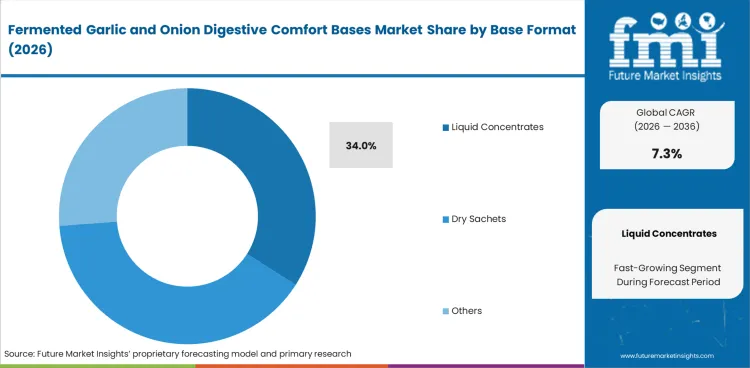
Base format shapes commercialization options early because it determines how easily a concept can move from pilot work into multiple finished products. Formulators usually prefer systems that leave room to adjust taste, strength, and serving size without reopening the full development process. Liquid concentrates fit that requirement well, and the segment is expected to account for 34.0% share in 2026. Early-stage programs gain flexibility from one master base that can move from shots into tonics, sticks, or capsules after sensory direction is finalized. This also matters in functional food ingredient programs, where one adaptable fermented base can support more than one launch path. Paste bases and powder premixes still suit dry blending or texture-led formulations, though they call for tighter control much earlier in development. Weak format selection usually leads to higher reformulation cost, slower shelf readiness, and fewer extension options once the first launch is complete.
- Dilution control: Liquid systems give formulators room to refine taste and strength during development. Poor control can delay shelf readiness.
- Dose clarity: Concentrates support clearer single-serve positioning in compact daily formats. Unclear dosing can weaken digestive communication at launch.
- Extension path: One liquid base can support an initial shot and later move into adjacent formats. Rigid starting points can narrow that route.
Fermented Garlic and Onion Digestive Comfort Bases Market Analysis by Ingredient Focus
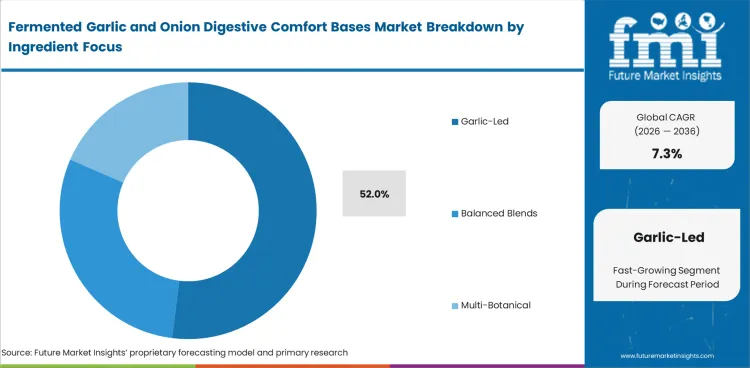
Ingredient focus matters in this category because familiarity often decides how quickly a digestive concept makes sense on the shelf. Garlic-led systems enter with an advantage since fermented garlic already sits closer to wellness language many buyers recognize without much explanation. Taste balance still determines commercial success, because recognition alone cannot carry a product that feels too sharp or too savory for repeated use. Garlic-led bases are projected to represent 52.0% share in 2026, helped by a cleaner fit with daily digestive positioning and easier placement alongside herbal nutraceuticals. Line builders also benefit from a clearer shelf story, especially in compact formats where the proposition must land quickly. Onion-led and balanced blends keep a role where prebiotic framing carries more weight, though they often need more explanation before the product promise feels immediate. Poor ingredient focus can leave a formula interesting in development but unclear once it reaches a buyer-facing shelf.
- Recognition value: Garlic-led concepts usually need less explanation than onion-first propositions. Lower recognition can stretch the education cycle.
- Story balance: Fermented garlic connects culinary familiarity with wellness intent in a commercially usable way. Weak balance can narrow appeal.
- Shelf fit: Garlic-led positioning often aligns well with nearby digestive categories. Limited adjacency can reduce expansion options.
Fermented Garlic and Onion Digestive Comfort Bases Market Analysis by Fermentation Type
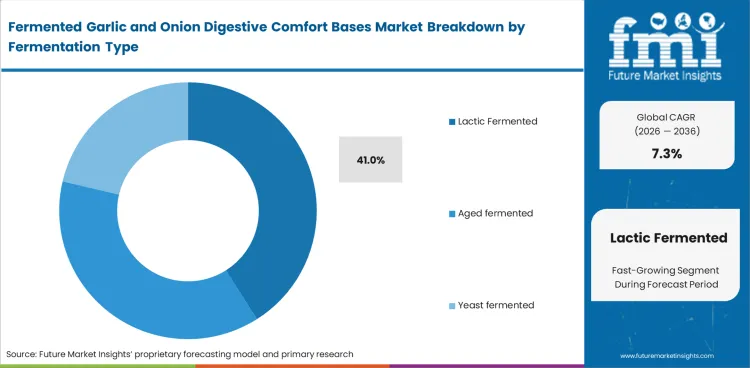
Fermentation route influences credibility because digestive positioning works best when the process sounds familiar, readable, and easy to explain. Buyers respond faster to systems that connect naturally with routine wellness language and require less interpretation across packs, sales copy, and digital pages. Sensory performance also improves when process choice aligns with the intended finished format, especially in daily-use products. Lactic fermented systems are likely to capture 41.0% share in 2026 because they offer a cleaner bridge into fermented wellness and fit comfortably within probiotic ingredients and digestive-adjacent product development. Aged, yeast, and mixed-culture routes still retain room where brands want deeper taste character or a broader functional story. Commercial traction weakens once process language becomes harder to understand. Even a technically sound base can lose momentum if the fermentation route adds confusion instead of clarity during first-read evaluation.
- Positioning ease: Lactic fermentation fits digestibility language with less explanation. Harder-to-read process routes raise the selling burden.
- Sensory moderation: Fermentation choice shapes aroma and aftertaste in ways that affect repeat use. Rougher outcomes can reduce routine consumption.
- Channel comfort: Retail and wellness channels read lactic cues faster than unfamiliar fermentation terminology. Slower understanding can delay distribution.
Fermented Garlic and Onion Digestive Comfort Bases Market Analysis by Bioactive Focus
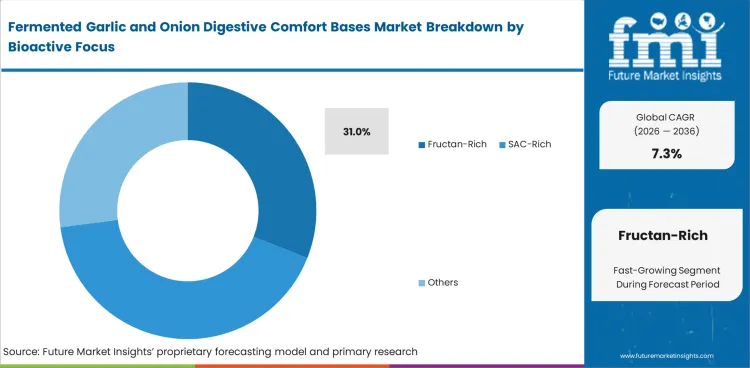
Bioactive focus determines how clearly the ingredient promise reaches consumers in a category built around daily digestive relevance. Readable active positioning usually travels farther because it reduces explanation time on shelf, online, and across launch materials. Fructan-rich profiles support that need especially well by giving brands a direct prebiotic message that feels easier to place in routine digestive products. Product developers can also use that logic across botanical ingredients ranges without adding a technical layer many consumers would skip. Fructan-rich profiles are expected to secure 31.0% share in 2026, while sulfur-compound-led, SAC-rich, and polyphenol-rich systems continue to serve brands looking for a deeper science-led angle. Mass-market acceptance usually starts with clarity rather than complexity. Once the active story becomes difficult to explain, shelf communication weakens, retailer confidence softens, and simpler digestive concepts often gain the advantage.
- Claim readability: Fructan-focused language makes digestive messaging easier for brands and retailers to communicate. Weak readability can slow acceptance.
- Education burden: Prebiotic framing lowers the explanation needed during launch. Heavy education requirements often slow wider placement.
- Range building: A clearer active story helps one base extend into related digestive products. Vague positioning can limit expansion.
Fermented Garlic and Onion Digestive Comfort Bases Market Analysis by Application
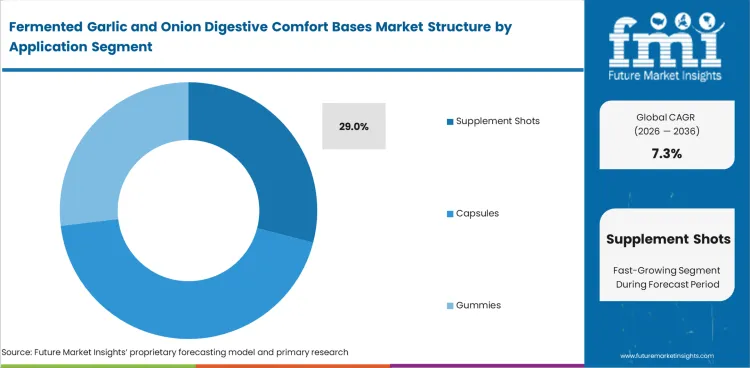
Application choice influences consumer understanding quickly because it defines how the product fits into everyday use. Daily digestive products perform better when the use occasion is simple, compact, and easy to repeat without much behavioral adjustment. Shot formats work well on that front since they carry strong taste in a small serving and present digestive comfort as a fast routine. Brands also benefit from a quicker route to shelf because broader food and beverage formats usually need more sensory refinement before launch. In 2026, supplement shots are expected to contribute 29.0% of total market share. Relevance also extends into adjacent functional foods opportunities once early consumer tolerance is understood and brands start widening the format mix. Capsules, gummies, and functional drinks will continue to broaden the category, but weak application choice usually shows up first in habit formation. Repeat purchase becomes harder once daily use feels awkward or forced.
- Use occasion: Shot formats connect digestive intent with a clear daily routine. Unclear timing can weaken habit formation.
- Pack economy: Small servings let strong allium inputs enter the diet without requiring high-volume intake. Larger formats can increase taste resistance.
- Launch speed: Shots give brands a faster opening route before expansion into wider format families. Slower routes can stretch commercialization time.
Fermented Garlic and Onion Digestive Comfort Bases Market Analysis by Function Positioning
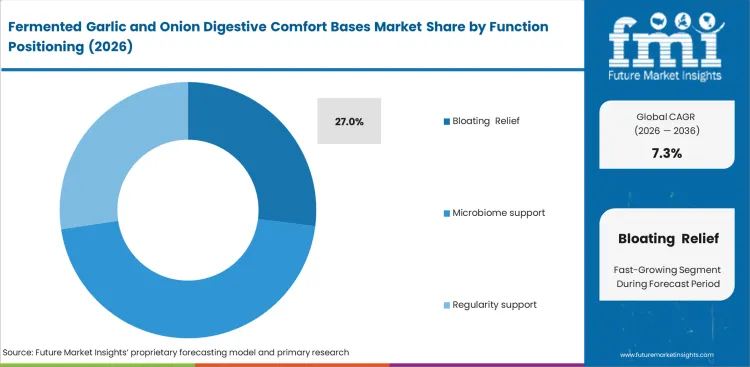
Function positioning carries unusual weight here because buyers need to understand the benefit quickly in digestive category. Bloating relief stays ahead because it gives fermented garlic and onion a direct problem-solution role in everyday wellness language. Immediate relevance improves first-read comprehension across pack copy and digital listings, while broader gut-wellness claims often ask for more consumer interpretation before the promise feels personal. Microbiome support, regularity support, and post-meal comfort continue to widen the category, especially for brands seeking a softer message architecture. Benefit language also fits neatly beside herbal supplements and other daily digestive products that depend on fast comprehension. Bloating relief is estimated to make up 27.0% share in 2026. Clear function wording remains central to conversion because vague messaging can make the formula feel optional. Urgency usually fades when consumers have to work too hard to understand the use case.
- Problem fit: Bloating relief gives the base a visible consumer issue to address. Weaker fit can reduce perceived usefulness.
- Conversion logic: Specific digestive wording improves first-read understanding on pack and online. Broad wellness language often lowers urgency.
- Message expansion: Once a focused promise lands, brands can extend into wider gut-support narratives. Starting too wide can slow the opening sell.
Regional Analysis
Regional demand moves at different speeds because fermentation familiarity, ingredient processing depth, and finished-product channels do not mature at the same pace everywhere. Countries with easier access to allium inputs and stronger digestive-wellness sell-through tend to commercialize these bases faster than countries where education and sensory caution still carry more weight.
.webp "Top Country Growth Comparison Fermented Garlic And Onion Digestive Comfort Bases Market Cagr (2026 2036)")
| Country | CAGR (2026 to 2036) |
|---|---|
| India | 8.4% |
| South Korea | 8.1% |
| Japan | 7.8% |
| United States | 7.2% |
| Germany | 6.9% |
| United Kingdom | 6.7% |
| Australia | 6.5% |
Source: Future Market Insights (FMI) analysis, based on proprietary forecasting model and primary research
Asia Pacific Fermented Garlic and Onion Digestive Comfort Bases Market Analysis
Asia Pacific carries the fastest part of the growth curve because fermented garlic and onion already sit closer to accepted taste and wellness behavior in several countries across the region. Raw material access also helps. Garlic and onion move through local processing systems with less distance between agricultural supply and ingredient adaptation, which shortens the route into finished digestive products. Brand work still matters because sensory control and claim discipline can make or break repeat use, yet the region starts with a lower explanation burden than most Western demand centers. FMI sees this as a practical overlap between fermented foods and beverages familiarity and a growing digestive wellness shelf.
- India: Garlic and onion availability gives India a natural supply advantage, though raw material alone does not explain the pace. Digestive powders, sachets, and wellness mixes already have room in daily-use routines, and that makes fermented allium bases easier to place than in countries where the format still feels unfamiliar. Demand in India is expected to rise at a CAGR of 8.4% from 2026 to 2036 as local processing depth and digestive-positioned product development continue to widen. Taste still decides conversion because a product that feels too sharp will struggle to move past first purchase. Brands that solve sensory balance well can widen from powders into shots and capsule systems with less friction.
- South Korea: Fermentation familiarity in South Korea lowers one of the hardest barriers in this category, which is the need to explain why a garlic or onion base belongs in daily wellness. Finished-product brands gain an easier starting point when the ingredient story already feels culturally legible. South Korea is projected to expand at a CAGR of 8.1% over the forecast years, supported by strong acceptance of fermented food cues and a cleaner route into small-format wellness products. Buyer expectations are still tight around consistency and finish. A base that drifts in aroma or sweetness can lose ground quickly, even in a market that understands fermentation well.
- Japan: Routine-friendly products suit Japan well, and that gives controlled digestive-positioned ingredients a clear commercial lane. Capsules, powders, and measured-use formats often gain more acceptance than broad taste-led propositions because everyday precision carries more weight in consumer choice. Japan is likely to post 7.8% CAGR during the forecast period as fermented allium concepts move forward inside carefully framed wellness products rather than loud novelty launches. Message discipline matters. Products that stay specific about use, dose, and digestive role tend to stand a better chance of holding repeat purchase.
- Australia: Digestive wellness demand is healthy in Australia, yet category scale stays more selective because the population base is smaller and the shelf rewards simple daily-use formats. Capsules, sachets, and clean routine products often suit this setting better than complex taste-led launches. Sales in Australia are expected to increase at a CAGR of 6.5% from 2026 to 2036 as niche digestive ingredients continue to enter premium wellness lines. Aroma control still matters at every step. Products that feel too culinary can narrow their own audience before the digestive message gets a fair read.
FMI coverage for this block also includes New Zealand and additional Asia Pacific demand centers beyond the countries highlighted above. Across the wider region, ingredients that feel routine-ready tend to scale faster than concepts that ask consumers to learn a new behavior before they buy again.
North America Fermented Garlic and Onion Digestive Comfort Bases Market Analysis
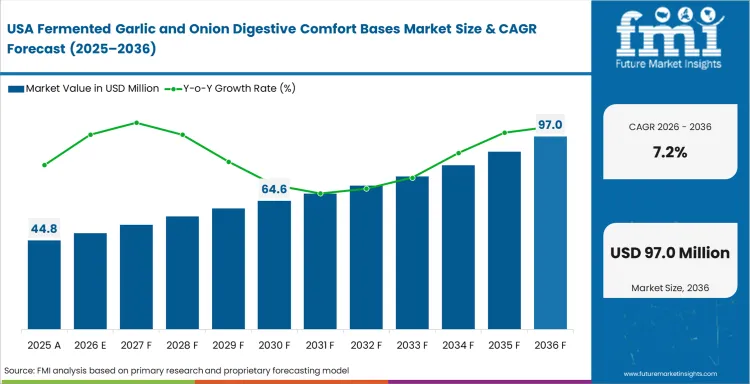
North America offers a visible commercial base because digestive-positioned wellness products already move through powder, capsule, and drinkable formats with good shelf access. Buyers in this region still ask harder questions on documentation and finished-product behavior than on raw ingredient novelty alone. That makes commercialization more selective, though not weak. Interest in nutraceuticals and related daily digestive routines gives fermented allium bases a workable path when odor, consistency, and use timing stay under control. Clear format fit matters more here than simple ingredient recognition.
- United States: Shelf visibility across powders, capsules, and small daily wellness formats keeps the United States commercially relevant even though growth is slower than in Asia. Brands can enter through focused digestive-use products instead of trying to sell fermented garlic or onion as a broad wellness idea. The United States is expected to grow at a CAGR of 7.2% over the forecast years because format diversity supports ingredient trials when sensory control is strong enough. Retail competition stays high. A base that needs too much flavor correction can lose time and margin before it finds a stable place in the shelf.
Canada and other North American demand pockets also sit inside FMI coverage for this regional view. Wider adoption across the region depends on bases that behave reliably in finished-product conditions, since documentation strength alone rarely saves a poor sensory result.
Europe Fermented Garlic and Onion Digestive Comfort Bases Market Analysis
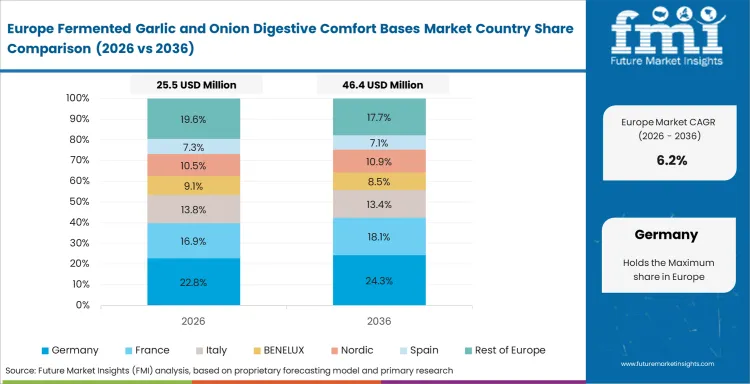
Europe grows through a steadier pattern because digestive product acceptance is real, yet buyers in the region often place more weight on formula discipline, claim control, and finished-product polish. Speed comes second. That creates a narrower opening for fermented allium bases than in parts of Asia, though it also rewards suppliers that can deliver repeatable quality. Germany and the United Kingdom illustrate this well, and both sit close to herb and spice extracts and botanical wellness channels where standardization already matters. Commercial success here usually starts with restraint rather than noise.
- Germany: Germany gives buyers a structured environment for digestive ingredients, and that favors suppliers whose bases arrive with stable behavior across dose formats. Precise formulation usually carries more weight than novelty because digestive products need to feel dependable before they widen into mainstream use. Germany is forecast to expand at a CAGR of 6.9% from 2026 to 2036 as quality-driven product development keeps giving fermented allium concepts a measured opening. Taste control remains central. A formula that sounds promising on paper can still lose buyer interest once the finished product feels harsh in daily use.
- United Kingdom: United Kingdom demand leans on products that can explain themselves quickly, especially in crowded wellness shelves where digestive claims compete with many other benefit stories. Straightforward positioning gives fermented allium bases their best chance in this setting. Demand in the United Kingdom is likely to advance at 6.7% CAGR during the forecast period as clear-format products widen their reach across powders, capsules, and small daily-use propositions. Pack language needs discipline. Once the message turns vague, a niche ingredient can lose attention before shoppers understand why it belongs in the routine.
France, Italy, Spain, and other Western European countries remain part of FMI coverage for the broader region. Across these markets, suppliers that bring calm sensory handling and clear digestive framing tend to earn more durable shelf acceptance than suppliers that lean too heavily on novelty alone.
Competitive Aligners for Market Players
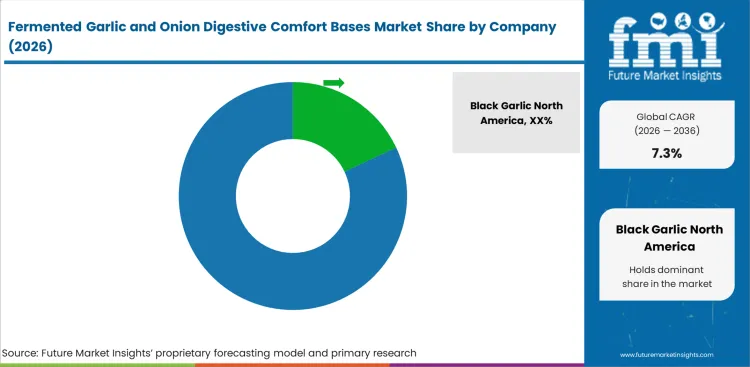
The competitive landscape remains fragmented because fermented allium processing, ingredient standardization, and finished-format adaptation are not usually integrated within a single supplier structure. This limits end-to-end capability across the supply base and creates space for both focused specialists and broader extract suppliers. Companies such as Black Garlic North America maintain visibility through garlic-centric application focus, while firms such as Dongseo Wellbeing are more closely associated with wider extract and ingredient supply. Across this market, purchase decisions are seldom driven by price alone; odor control consistency, formulation stability, and technical usability remain the primary selection criteria.
Supplier differentiation depends on how reliably ingredients perform in real product environments, especially across powder, liquid, and paste formats where development teams want to avoid repeated reformulation. These expectations are particularly important in fermented protein applications, where documentation quality, sensory stability, and practical technical support influence adoption.
Buyer leverage remains strong because manufacturers rarely commit an entire digestive or wellness line to a single sensory profile early in development. Supplier alignment typically occurs only after aroma stability, taste balance, and dose clarity have been validated across trials. As a result, competitive advantage comes less from brand visibility or scale alone and more from a supplier’s ability to solve finished-product challenges more effectively than generalized ingredient providers.
Key Players in Fermented Garlic and Onion Digestive Comfort Bases Market
- Black Garlic North America
- Dongseo Wellbeing
- Green Jeeva LLC
- Ryusendo Co., Ltd.
- Bio-i Co., Ltd.
Scope of the Report
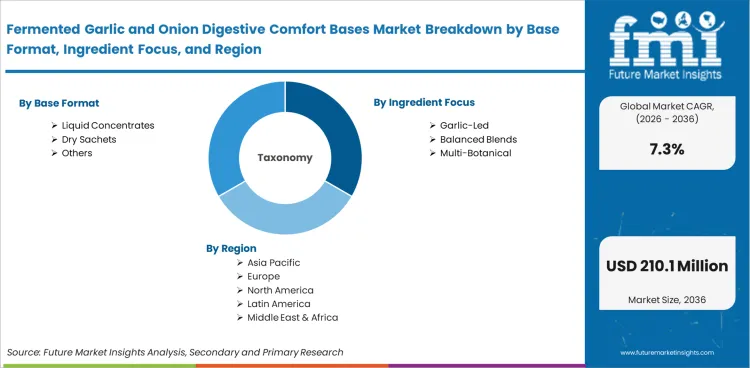
| Metric | Value |
|---|---|
| Quantitative Units | USD 96.8 million to USD 195.8 million, at a CAGR of 7.3% |
| Market Definition | Fermented garlic and onion digestive comfort bases are standardized B2B ingredient systems developed for supplement, wellness beverage, and related digestive-support formulations. Scope covers functional bases sold for commercial product development rather than fresh culinary ingredients or broad fermented foods. |
| Base Format Segmentation | Liquid concentrates, Paste bases, Powder premixes, Shot syrups, Dry sachets |
| Ingredient Focus Segmentation | Garlic-led, Onion-led, Balanced blends, Multi-botanical |
| Fermentation Type Segmentation | Lactic fermented, Aged fermented, Yeast fermented, Mixed culture |
| Bioactive Focus Segmentation | Fructan-rich, SAC-rich, Polyphenol-rich, Sulfur-active |
| Application Segmentation | Supplement shots, Functional drinks, Capsules, Gummies, Savory tonics |
| Function Positioning Segmentation | Bloating relief, Microbiome support, Regularity support, Post-meal comfort, Gut-immune support |
| Regions Covered | North America, Europe, Asia Pacific, Latin America, Oceania, Middle East & Africa |
| Countries Covered | India, South Korea, Japan, United States, Germany, United Kingdom, Australia, and 40 plus countries |
| Key Companies Profiled | Black Garlic North America, Dongseo Wellbeing, Jeeva LLC, Ryusendo Co., Ltd., Bio-i Co., Ltd. |
| Forecast Period | 2026 to 2036 |
| Approach | FMI combined primary discussions with ingredient suppliers and brand-side formulators, desk review of raw-material and functional-ingredient sources, and triangulation of digestive-positioned product activity across finished formats to develop the forecast. |
Source: Future Market Insights (FMI) analysis, based on proprietary forecasting model and primary research
Fermented Garlic and Onion Digestive Comfort Bases Market Analysis by Segments
Base Format
- Liquid concentrates
- Paste bases
- Powder premixes
- Shot syrups
- Dry sachets
Ingredient Focus
- Garlic-led
- Onion-led
- Balanced blends
- Multi-botanical
Fermentation Type
- Lactic fermented
- Aged fermented
- Yeast fermented
- Mixed culture
Bioactive Focus
- Fructan-rich
- SAC-rich
- Polyphenol-rich
- Sulfur-active
Application
- Supplement shots
- Functional drinks
- Capsules
- Gummies
- Savory tonics
Function Positioning
- Bloating relief
- Microbiome support
- Regularity support
- Post-meal comfort
- Gut-immune support
Region
- North America
- United States
- Canada
- Europe
- Germany
- United Kingdom
- France
- Italy
- Spain
- Asia Pacific
- India
- South Korea
- Japan
- Australia
- New Zealand
- China
- Latin America
- Brazil
- Mexico
- Middle East & Africa
- United Arab Emirates
- Saudi Arabia
- South Africa
Bibliography
- Yoo, Y., Kim, S., Lee, W. J., Kim, J., Son, B., Lee, K. J., & Shin, H. (2024). The prebiotic potential of dietary onion extracts: Shaping gut microbial structures and promoting beneficial metabolites.
- Tuohy, K., Vaughan, E. E., Harthoorn, L. F., Blaak, E. E., Burnet, P. W. J., Busetti, A., Chakrabarti, A., Delzenne, N., de Vos, P., Dye, L., Guillemet, D., Houghton, L. A., Kardinaal, A. F. M., Mersh, C., Musa-Veloso, K., Nielsen, A., Palasinska, J., Salminen, S., Walton, G., Venlet, N., Hubermont, C., & Calder, P. C. (2024). Prebiotics in food and dietary supplements: A roadmap to EU health claims.
- Li, T., Xie, C., Tian, Z., Chai, R., Ren, Y., Miao, J., Xu, W., Chang, S., & Zhao, C. (2024). A soluble garlic polysaccharide supplement alleviates fatigue in mice.
- Pihelgas, S., Ehala-Aleksejev, K., Kutti, M.-L., Kuldjärv, R., & Kazantseva, J. (2025). Impact of fresh and fermented vegetable consumption on gut microbiota and body composition: Insights from diverse data analysis approaches.
- Kelebek, H., Sasmaz, H. K., Kilic-Buyukkurt, O., & Selli, S. (2025). Functional and physicochemical properties during the transition from fresh to black garlic: A comparative review.
- USA Food and Drug Administration. (2024). Structure/function claims.
This Report Addresses
- Market intelligence to support decision making across fermented garlic bases, fermented onion bases, digestive shots, wellness mixes, and related supplement ingredients.
- Market size estimation and ten-year forecasting from 2026 to 2036, supported by format analysis, country comparison, and functional-positioning review.
- Growth opportunity mapping across base format, ingredient focus, fermentation type, bioactive focus, application, and function positioning.
- Segment and regional outlook across liquid concentrates, garlic-led systems, lactic fermented bases, fructan-rich profiles, supplement shots, and bloating-relief use cases.
- Competitive assessment across consistency, odor control, documentation quality, format flexibility, and formulation support.
- Scope clarification showing what belongs inside standardized digestive-comfort bases and what remains outside because it serves culinary or general fermented-food demand.
- Country review for India, South Korea, Japan, United States, Germany, United Kingdom, and Australia with attention to commercialization pace and product readiness.
- Planning support for brand screening, ingredient evaluation, line-extension review, regional entry work, and commercial benchmarking in digestive wellness.
Frequently Asked Questions
How large is the industry in 2026?
Industry value in 2026 is estimated at USD 96.8 million.
What is the projected value by 2036?
FMI projects the category to reach USD 195.8 million by 2036.
What growth rate is expected over the forecast period?
Demand is expected to expand at a CAGR of 7.3% from 2026 to 2036.
Which base format leads?
Liquid concentrates are expected to account for 34.0% share in 2026 because they give formulators easier dose control and wider finished-format flexibility.
Which ingredient focus leads?
Garlic-led bases are projected to represent 52.0% share in 2026 as they carry better wellness familiarity than most onion-first concepts.
Which fermentation route stays ahead?
Lactic fermented systems are anticipated to hold 41.0% share in 2026 because they fit digestive-positioned communication more naturally.
Which bioactive focus leads?
Fructan-rich profiles are expected to secure 31.0% share in 2026 because prebiotic language is easier to explain in daily-use digestive products.
Which application leads?
Supplement shots are likely to capture 29.0% share in 2026 because they give concentrated allium ingredients a simple daily use occasion.
Which function positioning leads?
Bloating relief is estimated to make up 27.0% share in 2026 because it gives the category an immediate consumer problem to answer.
What drives category expansion?
Growth comes from the push toward digestive formats that need a milder and more usable allium base than raw garlic or onion can usually provide.
What is the main restraint?
Sensory consistency remains the primary restraint because aroma, sweetness, and aftertaste shifts can slow repeat purchase and line extension.
Which country grows fastest?
India leads the forecast range with expected growth of 8.4% through 2036.
Why is South Korea important?
South Korea benefits from stronger fermentation familiarity, which lowers the explanation burden for black garlic and related allium concepts.
Why does Japan stay above the global average?
Japan favors precise and routine-friendly wellness formats, which supports carefully framed digestive-positioned products.
What keeps the United States attractive?
United States demand stays relevant because digestive supplements, powders, and wellness beverages already have good shelf visibility.
Why is Germany steady rather than fast?
Germany grows at a measured pace because formulation quality and careful claim language carry extra weight in product acceptance.
What shapes growth in the United Kingdom?
United Kingdom demand depends heavily on clear pack language and formats that feel easy to use in everyday wellness routines.
Why is Australia slightly slower?
Australia offers solid wellness demand, though population scale keeps absolute pace more selective than in larger demand centers.
How does competition usually play out?
Competition usually turns on consistency, odor control, documentation quality, and how easily a supplier helps a brand turn the base into a stable finished product.
What is the less obvious lesson in this category?
Ingredient familiarity helps early interest, yet real adoption depends more on sensory moderation and finished-format usability than on recognition alone.
Preview the report firsthand - request a free sample
Get SampleGet the brochure for pricing and purchase details.
Get PDFTable of Content
- Executive Summary
- Global Market Outlook
- Demand-side Trends
- Supply-side Trends
- Technology Roadmap Analysis
- Analysis and Recommendations
- Market Overview
- Market Coverage / Taxonomy
- Market Definition / Scope / Limitations
- Research Methodology
- Chapter Orientation
- Analytical Lens and Working Hypotheses
- Market Structure, Signals, and Trend Drivers
- Benchmarking and Cross-market Comparability
- Market Sizing, Forecasting, and Opportunity Mapping
- Research Design and Evidence Framework
- Desk Research Programme (Secondary Evidence)
- Company Annual and Sustainability Reports
- Peer-reviewed Journals and Academic Literature
- Corporate Websites, Product Literature, and Technical Notes
- Earnings Decks and Investor Briefings
- Statutory Filings and Regulatory Disclosures
- Technical White Papers and Standards Notes
- Trade Journals, Industry Magazines, and Analyst Briefs
- Conference Proceedings, Webinars, and Seminar Materials
- Government Statistics Portals and Public Data Releases
- Press Releases and Reputable Media Coverage
- Specialist Newsletters and Curated Briefings
- Sector Databases and Reference Repositories
- FMI Internal Proprietary Databases and Historical Market Datasets
- Subscription Datasets and Paid Sources
- Social Channels, Communities, and Digital Listening Inputs
- Additional Desk Sources
- Expert Input and Fieldwork (Primary Evidence)
- Primary Modes
- Qualitative Interviews and Expert Elicitation
- Quantitative Surveys and Structured Data Capture
- Blended Approach
- Why Primary Evidence is Used
- Field Techniques
- Interviews
- Surveys
- Focus Groups
- Observational and In-context Research
- Social and Community Interactions
- Stakeholder Universe Engaged
- C-suite Leaders
- Board Members
- Presidents and Vice Presidents
- R&D and Innovation Heads
- Technical Specialists
- Domain Subject-matter Experts
- Scientists
- Physicians and Other Healthcare Professionals
- Governance, Ethics, and Data Stewardship
- Research Ethics
- Data Integrity and Handling
- Primary Modes
- Tooling, Models, and Reference Databases
- Desk Research Programme (Secondary Evidence)
- Data Engineering and Model Build
- Data Acquisition and Ingestion
- Cleaning, Normalisation, and Verification
- Synthesis, Triangulation, and Analysis
- Quality Assurance and Audit Trail
- Market Background
- Market Dynamics
- Drivers
- Restraints
- Opportunity
- Trends
- Scenario Forecast
- Demand in Optimistic Scenario
- Demand in Likely Scenario
- Demand in Conservative Scenario
- Opportunity Map Analysis
- Product Life Cycle Analysis
- Supply Chain Analysis
- Investment Feasibility Matrix
- Value Chain Analysis
- PESTLE and Porter’s Analysis
- Regulatory Landscape
- Regional Parent Market Outlook
- Production and Consumption Statistics
- Import and Export Statistics
- Market Dynamics
- Global Market Analysis 2021 to 2025 and Forecast, 2026 to 2036
- Historical Market Size Value (USD Million) Analysis, 2021 to 2025
- Current and Future Market Size Value (USD Million) Projections, 2026 to 2036
- Y-o-Y Growth Trend Analysis
- Absolute $ Opportunity Analysis
- Global Market Pricing Analysis 2021 to 2025 and Forecast 2026 to 2036
- Global Market Analysis 2021 to 2025 and Forecast 2026 to 2036, By Base Format
- Introduction / Key Findings
- Historical Market Size Value (USD Million) Analysis By Base Format , 2021 to 2025
- Current and Future Market Size Value (USD Million) Analysis and Forecast By Base Format , 2026 to 2036
- Liquid Concentrates
- Dry Sachets
- Others
- Liquid Concentrates
- Y-o-Y Growth Trend Analysis By Base Format , 2021 to 2025
- Absolute $ Opportunity Analysis By Base Format , 2026 to 2036
- Global Market Analysis 2021 to 2025 and Forecast 2026 to 2036, By Ingredient Focus
- Introduction / Key Findings
- Historical Market Size Value (USD Million) Analysis By Ingredient Focus, 2021 to 2025
- Current and Future Market Size Value (USD Million) Analysis and Forecast By Ingredient Focus, 2026 to 2036
- Garlic-Led
- Balanced Blends
- Multi-Botanical
- Garlic-Led
- Y-o-Y Growth Trend Analysis By Ingredient Focus, 2021 to 2025
- Absolute $ Opportunity Analysis By Ingredient Focus, 2026 to 2036
- Global Market Analysis 2021 to 2025 and Forecast 2026 to 2036, By Fermentation Type
- Introduction / Key Findings
- Historical Market Size Value (USD Million) Analysis By Fermentation Type, 2021 to 2025
- Current and Future Market Size Value (USD Million) Analysis and Forecast By Fermentation Type, 2026 to 2036
- Lactic Fermented
- Aged fermented
- Yeast fermented
- Lactic Fermented
- Y-o-Y Growth Trend Analysis By Fermentation Type, 2021 to 2025
- Absolute $ Opportunity Analysis By Fermentation Type, 2026 to 2036
- Global Market Analysis 2021 to 2025 and Forecast 2026 to 2036, By Bioactive Focus
- Introduction / Key Findings
- Historical Market Size Value (USD Million) Analysis By Bioactive Focus, 2021 to 2025
- Current and Future Market Size Value (USD Million) Analysis and Forecast By Bioactive Focus, 2026 to 2036
- Fructan-Rich
- SAC-Rich
- Others
- Fructan-Rich
- Y-o-Y Growth Trend Analysis By Bioactive Focus, 2021 to 2025
- Absolute $ Opportunity Analysis By Bioactive Focus, 2026 to 2036
- Global Market Analysis 2021 to 2025 and Forecast 2026 to 2036, By Application
- Introduction / Key Findings
- Historical Market Size Value (USD Million) Analysis By Application, 2021 to 2025
- Current and Future Market Size Value (USD Million) Analysis and Forecast By Application, 2026 to 2036
- Supplement Shots
- Capsules
- Gummies
- Supplement Shots
- Y-o-Y Growth Trend Analysis By Application, 2021 to 2025
- Absolute $ Opportunity Analysis By Application, 2026 to 2036
- Global Market Analysis 2021 to 2025 and Forecast 2026 to 2036, By Function Positioning
- Introduction / Key Findings
- Historical Market Size Value (USD Million) Analysis By Function Positioning, 2021 to 2025
- Current and Future Market Size Value (USD Million) Analysis and Forecast By Function Positioning, 2026 to 2036
- Bloating Relief
- Microbiome support
- Regularity support
- Bloating Relief
- Y-o-Y Growth Trend Analysis By Function Positioning, 2021 to 2025
- Absolute $ Opportunity Analysis By Function Positioning, 2026 to 2036
- Global Market Analysis 2021 to 2025 and Forecast 2026 to 2036, By Region
- Introduction
- Historical Market Size Value (USD Million) Analysis By Region, 2021 to 2025
- Current Market Size Value (USD Million) Analysis and Forecast By Region, 2026 to 2036
- North America
- Latin America
- Western Europe
- Eastern Europe
- East Asia
- South Asia and Pacific
- Middle East & Africa
- Market Attractiveness Analysis By Region
- North America Market Analysis 2021 to 2025 and Forecast 2026 to 2036, By Country
- Historical Market Size Value (USD Million) Trend Analysis By Market Taxonomy, 2021 to 2025
- Market Size Value (USD Million) Forecast By Market Taxonomy, 2026 to 2036
- By Country
- USA
- Canada
- Mexico
- By Base Format
- By Ingredient Focus
- By Fermentation Type
- By Bioactive Focus
- By Application
- By Function Positioning
- By Country
- Market Attractiveness Analysis
- By Country
- By Base Format
- By Ingredient Focus
- By Fermentation Type
- By Bioactive Focus
- By Application
- By Function Positioning
- Key Takeaways
- Latin America Market Analysis 2021 to 2025 and Forecast 2026 to 2036, By Country
- Historical Market Size Value (USD Million) Trend Analysis By Market Taxonomy, 2021 to 2025
- Market Size Value (USD Million) Forecast By Market Taxonomy, 2026 to 2036
- By Country
- Brazil
- Chile
- Rest of Latin America
- By Base Format
- By Ingredient Focus
- By Fermentation Type
- By Bioactive Focus
- By Application
- By Function Positioning
- By Country
- Market Attractiveness Analysis
- By Country
- By Base Format
- By Ingredient Focus
- By Fermentation Type
- By Bioactive Focus
- By Application
- By Function Positioning
- Key Takeaways
- Western Europe Market Analysis 2021 to 2025 and Forecast 2026 to 2036, By Country
- Historical Market Size Value (USD Million) Trend Analysis By Market Taxonomy, 2021 to 2025
- Market Size Value (USD Million) Forecast By Market Taxonomy, 2026 to 2036
- By Country
- Germany
- UK
- Italy
- Spain
- France
- Nordic
- BENELUX
- Rest of Western Europe
- By Base Format
- By Ingredient Focus
- By Fermentation Type
- By Bioactive Focus
- By Application
- By Function Positioning
- By Country
- Market Attractiveness Analysis
- By Country
- By Base Format
- By Ingredient Focus
- By Fermentation Type
- By Bioactive Focus
- By Application
- By Function Positioning
- Key Takeaways
- Eastern Europe Market Analysis 2021 to 2025 and Forecast 2026 to 2036, By Country
- Historical Market Size Value (USD Million) Trend Analysis By Market Taxonomy, 2021 to 2025
- Market Size Value (USD Million) Forecast By Market Taxonomy, 2026 to 2036
- By Country
- Russia
- Poland
- Hungary
- Balkan & Baltic
- Rest of Eastern Europe
- By Base Format
- By Ingredient Focus
- By Fermentation Type
- By Bioactive Focus
- By Application
- By Function Positioning
- By Country
- Market Attractiveness Analysis
- By Country
- By Base Format
- By Ingredient Focus
- By Fermentation Type
- By Bioactive Focus
- By Application
- By Function Positioning
- Key Takeaways
- East Asia Market Analysis 2021 to 2025 and Forecast 2026 to 2036, By Country
- Historical Market Size Value (USD Million) Trend Analysis By Market Taxonomy, 2021 to 2025
- Market Size Value (USD Million) Forecast By Market Taxonomy, 2026 to 2036
- By Country
- China
- Japan
- South Korea
- By Base Format
- By Ingredient Focus
- By Fermentation Type
- By Bioactive Focus
- By Application
- By Function Positioning
- By Country
- Market Attractiveness Analysis
- By Country
- By Base Format
- By Ingredient Focus
- By Fermentation Type
- By Bioactive Focus
- By Application
- By Function Positioning
- Key Takeaways
- South Asia and Pacific Market Analysis 2021 to 2025 and Forecast 2026 to 2036, By Country
- Historical Market Size Value (USD Million) Trend Analysis By Market Taxonomy, 2021 to 2025
- Market Size Value (USD Million) Forecast By Market Taxonomy, 2026 to 2036
- By Country
- India
- ASEAN
- Australia & New Zealand
- Rest of South Asia and Pacific
- By Base Format
- By Ingredient Focus
- By Fermentation Type
- By Bioactive Focus
- By Application
- By Function Positioning
- By Country
- Market Attractiveness Analysis
- By Country
- By Base Format
- By Ingredient Focus
- By Fermentation Type
- By Bioactive Focus
- By Application
- By Function Positioning
- Key Takeaways
- Middle East & Africa Market Analysis 2021 to 2025 and Forecast 2026 to 2036, By Country
- Historical Market Size Value (USD Million) Trend Analysis By Market Taxonomy, 2021 to 2025
- Market Size Value (USD Million) Forecast By Market Taxonomy, 2026 to 2036
- By Country
- Kingdom of Saudi Arabia
- Other GCC Countries
- Turkiye
- South Africa
- Other African Union
- Rest of Middle East & Africa
- By Base Format
- By Ingredient Focus
- By Fermentation Type
- By Bioactive Focus
- By Application
- By Function Positioning
- By Country
- Market Attractiveness Analysis
- By Country
- By Base Format
- By Ingredient Focus
- By Fermentation Type
- By Bioactive Focus
- By Application
- By Function Positioning
- Key Takeaways
- Key Countries Market Analysis
- USA
- Pricing Analysis
- Market Share Analysis, 2025
- By Base Format
- By Ingredient Focus
- By Fermentation Type
- By Bioactive Focus
- By Application
- By Function Positioning
- Canada
- Pricing Analysis
- Market Share Analysis, 2025
- By Base Format
- By Ingredient Focus
- By Fermentation Type
- By Bioactive Focus
- By Application
- By Function Positioning
- Mexico
- Pricing Analysis
- Market Share Analysis, 2025
- By Base Format
- By Ingredient Focus
- By Fermentation Type
- By Bioactive Focus
- By Application
- By Function Positioning
- Brazil
- Pricing Analysis
- Market Share Analysis, 2025
- By Base Format
- By Ingredient Focus
- By Fermentation Type
- By Bioactive Focus
- By Application
- By Function Positioning
- Chile
- Pricing Analysis
- Market Share Analysis, 2025
- By Base Format
- By Ingredient Focus
- By Fermentation Type
- By Bioactive Focus
- By Application
- By Function Positioning
- Germany
- Pricing Analysis
- Market Share Analysis, 2025
- By Base Format
- By Ingredient Focus
- By Fermentation Type
- By Bioactive Focus
- By Application
- By Function Positioning
- UK
- Pricing Analysis
- Market Share Analysis, 2025
- By Base Format
- By Ingredient Focus
- By Fermentation Type
- By Bioactive Focus
- By Application
- By Function Positioning
- Italy
- Pricing Analysis
- Market Share Analysis, 2025
- By Base Format
- By Ingredient Focus
- By Fermentation Type
- By Bioactive Focus
- By Application
- By Function Positioning
- Spain
- Pricing Analysis
- Market Share Analysis, 2025
- By Base Format
- By Ingredient Focus
- By Fermentation Type
- By Bioactive Focus
- By Application
- By Function Positioning
- France
- Pricing Analysis
- Market Share Analysis, 2025
- By Base Format
- By Ingredient Focus
- By Fermentation Type
- By Bioactive Focus
- By Application
- By Function Positioning
- India
- Pricing Analysis
- Market Share Analysis, 2025
- By Base Format
- By Ingredient Focus
- By Fermentation Type
- By Bioactive Focus
- By Application
- By Function Positioning
- ASEAN
- Pricing Analysis
- Market Share Analysis, 2025
- By Base Format
- By Ingredient Focus
- By Fermentation Type
- By Bioactive Focus
- By Application
- By Function Positioning
- Australia & New Zealand
- Pricing Analysis
- Market Share Analysis, 2025
- By Base Format
- By Ingredient Focus
- By Fermentation Type
- By Bioactive Focus
- By Application
- By Function Positioning
- China
- Pricing Analysis
- Market Share Analysis, 2025
- By Base Format
- By Ingredient Focus
- By Fermentation Type
- By Bioactive Focus
- By Application
- By Function Positioning
- Japan
- Pricing Analysis
- Market Share Analysis, 2025
- By Base Format
- By Ingredient Focus
- By Fermentation Type
- By Bioactive Focus
- By Application
- By Function Positioning
- South Korea
- Pricing Analysis
- Market Share Analysis, 2025
- By Base Format
- By Ingredient Focus
- By Fermentation Type
- By Bioactive Focus
- By Application
- By Function Positioning
- Russia
- Pricing Analysis
- Market Share Analysis, 2025
- By Base Format
- By Ingredient Focus
- By Fermentation Type
- By Bioactive Focus
- By Application
- By Function Positioning
- Poland
- Pricing Analysis
- Market Share Analysis, 2025
- By Base Format
- By Ingredient Focus
- By Fermentation Type
- By Bioactive Focus
- By Application
- By Function Positioning
- Hungary
- Pricing Analysis
- Market Share Analysis, 2025
- By Base Format
- By Ingredient Focus
- By Fermentation Type
- By Bioactive Focus
- By Application
- By Function Positioning
- Kingdom of Saudi Arabia
- Pricing Analysis
- Market Share Analysis, 2025
- By Base Format
- By Ingredient Focus
- By Fermentation Type
- By Bioactive Focus
- By Application
- By Function Positioning
- Turkiye
- Pricing Analysis
- Market Share Analysis, 2025
- By Base Format
- By Ingredient Focus
- By Fermentation Type
- By Bioactive Focus
- By Application
- By Function Positioning
- South Africa
- Pricing Analysis
- Market Share Analysis, 2025
- By Base Format
- By Ingredient Focus
- By Fermentation Type
- By Bioactive Focus
- By Application
- By Function Positioning
- USA
- Market Structure Analysis
- Competition Dashboard
- Competition Benchmarking
- Market Share Analysis of Top Players
- By Regional
- By Base Format
- By Ingredient Focus
- By Fermentation Type
- By Bioactive Focus
- By Application
- By Function Positioning
- Competition Analysis
- Competition Deep Dive
- Black Garlic North America
- Overview
- Product Portfolio
- Profitability by Market Segments (Product/Age /Sales Channel/Region)
- Sales Footprint
- Strategy Overview
- Marketing Strategy
- Product Strategy
- Channel Strategy
- Dongseo Wellbeing
- Green Jeeva LLC
- Ryusendo Co., Ltd.
- Bio-i Co., Ltd.
- Black Garlic North America
- Competition Deep Dive
- Assumptions & Acronyms Used


