

- Industry Size (2026)
- USD 1.3 Bn
- Forecast (2036)
- USD 2.5 Bn
- CAGR (2026 to 2036)
- 6.2%
Fermented Mineral Ingredients Market Size, Market Forecast and Outlook By FMI
The fermented mineral ingredients market was valued at USD 1.3 billion in 2025. The industry is expected to reach USD 1.3 billion in 2026 at a CAGR of 6.2% during the forecast period. Sustained investment carries the valuation to USD 2.5 billion through 2036 as formulators across dietary supplement and functional food channels shift baseline specifications from synthetic inorganic salts to bio-transformed complexes to bypass gastrointestinal absorption barriers.
Formulation engineers are currently being forced to choose whether to continue managing the poor solubility and harsh sensory profiles of standard mineral oxides with artificial masking agents, or to migrate to inherently bio-compatible fermented complexes. Consumer tolerance for heavy, synthetic-tasting ingredients has collapsed, placing brands that rely on legacy mineral fortification at risk of immediate retail delisting. Switching to biologically transformed sources allows brands to drastically shorten their ingredient decks, which has become a baseline requirement for securing space within premium functional food ingredients retail networks. Brands that delay this ingredient transition lose their preferred supplier status and forfeit the pricing premium associated with whole-food nutrition labeling.
Summary of Fermented Mineral Ingredients Market
- Fermented Mineral Ingredients Market Definition
- This market tracks the commercial application of mineral elements that have been biologically digested and incorporated into the cellular matrix of microorganisms. It boundaries the shift from chemically synthesized mineral salts to biologically active, food-state mineral delivery systems.
- Demand Drivers in the Market
- Gastrointestinal distress associated with legacy inorganic salts forces supplement formulators to source bio-transformed alternatives that do not trigger acute nausea.
- Clean-label mandates compel product development teams to eliminate chemical masking agents required to cover the metallic taste of standard mineral fortifications.
- Premiumization in animal nutrition pushes feed producers to adopt highly bioavailable trace minerals to reduce overall environmental excretion rates.
- Key Segments Analyzed in the FMI Report
- Zinc: Zinc is poised to account for 34.5% share in 2026, as binding this specific mineral to peptides eliminates the severe nausea routinely caused by standard zinc supplements.
- Powder: Powder is estimated to hold 68.2% share in 2026, driven by the dominance of spray-drying infrastructure in global commercial yeast production.
- Dietary Supplements: Dietary Supplements are projected to hold 45.8% share in 2026, as margin structures in this channel easily absorb the premium pricing of fermented active inputs.
- Yeast-based: Yeast-based is likely to record 52.1% share in 2026, benefiting from decades of established safety dossiers and massive existing bioreactor capacities.
- India: 8.4% compound growth, driven by aggressive domestic upgrades to maternal anemia protocols moving away from harsh iron oxides.
- Analyst Opinion at FMI
- Nandini Roy Choudhury, Principal Analyst for Food and Beverage, opines, "Standard procurement metrics capture the per-kilogram cost differential perfectly, which is why sourcing teams consistently push back against fermented minerals. What these metrics miss entirely is the cost of structural customer churn. When a consumer experiences acute nausea from a cheap iron oxide, they do not critique the company's margin optimization strategy; they abandon the brand permanently. The adoption curve accelerates precisely when marketing directors prove that retaining users via bio-compatible inputs is vastly cheaper than acquiring new ones to replace those lost to gastrointestinal distress."
- Strategic Implications / Executive Takeaways
- Supplement formulators must update their baseline product specifications to include fermented mineral complexes to secure retention among consumers sensitive to side effects.
- Contract manufacturing organizations should qualify their blending lines to handle hygroscopic bio-matrices to avoid losing premium encapsulation contracts.
- Tier-1 ingredient suppliers face a narrowing window to secure proprietary yeast strains capable of high-density mineral uptake before the intellectual property landscape solidifies.
- Methodology
- Primary Research: Interviews with specific formulation scientists and procurement heads within the nutraceutical and medical nutrition sectors.
- Desk Research: Analysis of EFSA bioavailability opinions, novel food registries, and biological patent landscapes.
- Market-Sizing and Forecasting: Baseline established via commercial yeast procurement volumes designated for trace mineral enrichment.
- Data Validation and Update Cycle: Forecast models validated against retail-level velocity data for premium, clean-label supplement SKUs.
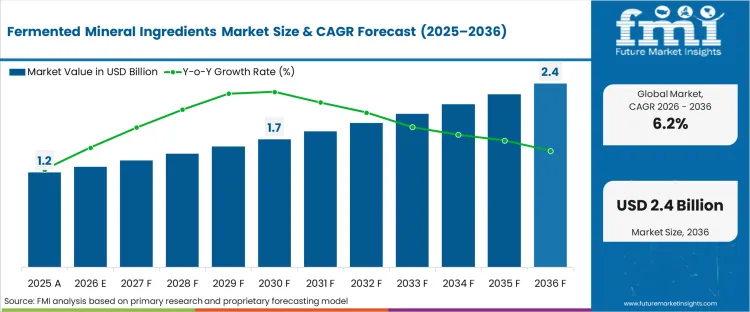
Before this transition becomes absolute, one specific operational gate must be crossed. Contract manufacturing organizations (CMOs) must standardize the tableting and encapsulation behavior of these highly hygroscopic fermented powders. Once major CMOs adjust their tooling and excipient ratios to handle moisture-sensitive biological complexes without requiring specialized low-humidity cleanrooms, the cost barrier drops sharply. Large-scale production environments that currently default to cheap carbonates flip to fermented alternatives purely for processing ease once this operational threshold is cleared.
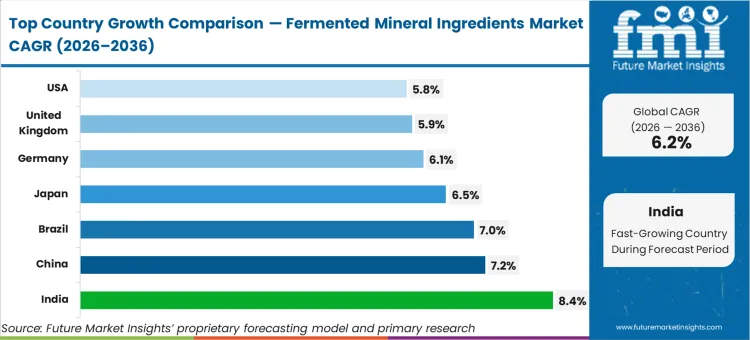
India is anticipated to advance at 8.4%, while China is set to register a 7.2% rate. Brazil follows at 7.0%, and Japan tracks closely at 6.5%. Germany is projected to grow at 6.1%, the United Kingdom at 5.9%, and the United States will expand at 5.8%. The divergence across this growth range is dictated entirely by how quickly domestic contract manufacturing infrastructure in each country can transition from handling stable, inert chemical salts to managing moisture-sensitive biological matrices efficiently.
Fermented Mineral Ingredients Market Key Takeaways
| Metric | Details |
|---|---|
| Industry Size (2026) | USD 1.3 billion |
| Industry Value (2036) | USD 2.5 billion |
| CAGR (2026–2036) | 6.2% |
Source: Future Market Insights (FMI) analysis, based on proprietary forecasting model and primary research
Fermented Mineral Ingredients Market Definition
The fermented mineral ingredients market encompasses organically bound mineral complexes produced through controlled biological fermentation. It represents the specific commercial intersection where inorganic mineral substrates are fed to microorganisms, typically yeast, fungi, or bacteria, which incorporate the target minerals into their cellular structure as peptides and amino acid chelates. This market is functionally distinct from basic chemical chelation, defined strictly by the use of a live biological conversion process to achieve bioavailability.
Fermented Mineral Ingredients Market Inclusions
Scope includes all nutritionally relevant minerals that have undergone a verified fermentation step prior to extraction or drying. This covers yeast-derived selenium, lactic acid-fermented calcium, fungi-bound zinc, and biologically transformed iron matrices. Secondary metabolites naturally co-produced during the mineral-enrichment process remain within scope. Powders, aqueous dispersions, and stabilized liquid formats intended for human or animal ingestion, particularly within dietary supplements, fall strictly within the measurement boundary.
Fermented Mineral Ingredients Market Exclusions
The market explicitly excludes synthetically manufactured amino acid chelates that use chemical reactions rather than live microorganism metabolism to bind the mineral. Simple mineral salts physically mixed with inactive yeast or probiotics post-production are omitted. These exclusions enforce the functional boundary: the economic value of this market is derived entirely from the biological transformation of the mineral, not from simple blending or chemical synthesis.
Fermented Mineral Ingredients Market Research Methodology
- Primary Research: FMI conducted structured interviews with formulation scientists, procurement directors at tier-1 supplement brands, and process engineers at global fermentation facilities.
- Desk Research: Aggregation of novel food application dossiers, European Food Safety Authority bioavailability opinions, and patent filings related to mineral-enriched yeast strains.
- Market-Sizing and Forecasting: The baseline anchors to the traceable volume of active yeast and bacterial strains procured specifically for mineral enrichment protocols.
- Data Validation and Update Cycle: Forecasts were triangulated against global import-export data for specialty yeast derivatives and matched with retail point-of-sale velocity for premium mineral SKUs.
Segmental Analysis
Fermented Mineral Ingredients Market Analysis by Mineral Type
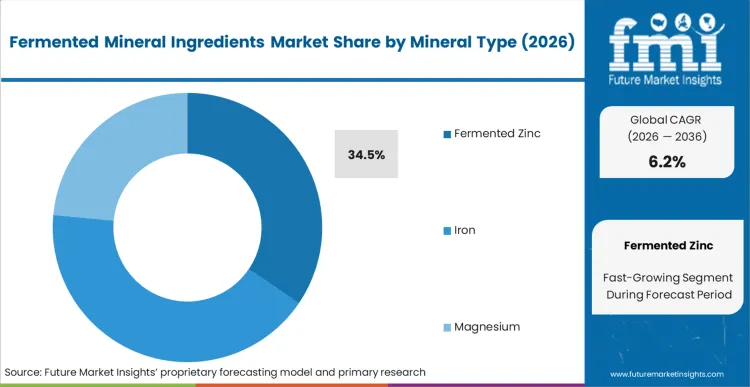
The commercial outcome for buyers specifying zinc hinges on a single physiological reaction: standard inorganic zinc salts consistently trigger acute nausea when taken on an empty stomach. According to FMI's estimates, this failure mode explains why fermented zinc secures a 34.5% share in 2026. Formulation teams do not choose fermented zinc merely to inch up absorption metrics; they specify it to eliminate the absolute highest cause of brand abandonment within the zinc supplements category. By binding the element to yeast peptides, the mineral bypasses gastric acid receptors entirely. R&D directors attempting to solve this with enteric coatings simply add complex excipients without addressing the root tolerability flaw. Brands refusing to adopt bio-transformed zinc find themselves permanently locked out of the premium health-food retail channels that actively screen out poorly tolerated formulations.
- Gastric distress: Standard zinc oxides interact harshly with stomach acids. Converting to a fermented matrix eliminates nausea for the end consumer.
- Formulation complexity: Legacy salts require heavy chemical buffering. Fermented alternatives allow research teams to simplify ingredient decks.
- Brand retention: Consumers immediately abandon products that cause discomfort. Formulators capture long-term loyalty by specifying bio-transformed minerals.
Fermented Mineral Ingredients Market Analysis by Form
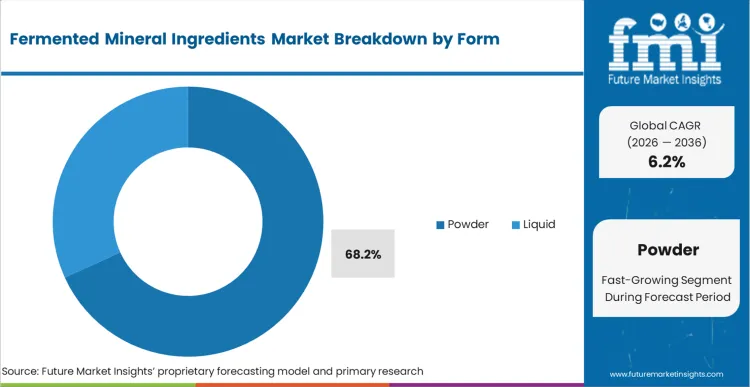
The reason powdered forms maintain a commanding 68.2% share in 2026 is grounded in global distribution realities: spray-drying is the only commercially viable method to stabilize liquid-grown biological biomass for international transit. Based on FMI's assessment, liquid formats carry prohibitive weight-to-value shipping ratios and restrictive shelf-life parameters that multinational supply chains cannot accommodate. Procurement directors require the 24-month stability that dehydrated matrices deliver. However, handling these inputs forces contract manufacturers to heavily manage ambient plant humidity, as biological powders are aggressively hygroscopic. Buyers who fail to mandate strict moisture-barrier packaging during transit experience rapid material caking, leading to total batch loss before encapsulation lines even commence operations.
- Production infrastructure: Spray-drying dominates active yeast processing. Ingredient manufacturers achieve global scale exclusively through dehydrated formats.
- Transit stability: Liquid biologicals mandate complex cold-chain management. Sourcing teams bypass this risk by requiring stable powder specifications.
- Integration parameters: Moisture-sensitive powders demand specialized environmental controls. Facility managers must implement rigid humidity thresholds to utilize these inputs efficiently.
Fermented Mineral Ingredients Market Analysis by Application
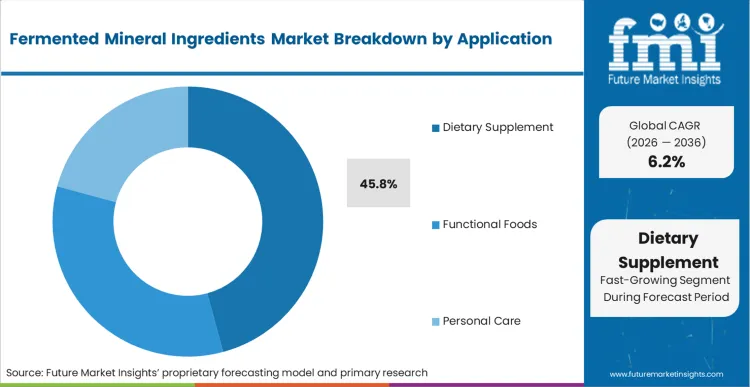
Product development directors in the dietary supplement space are currently deciding whether to defend legacy synthetic mineral formulations or absorb the cost of upgrading to whole-food matrices. This sector accounts for 45.8% of total demand in 2026. The shift is mandated by sophisticated retail buyers stripping shelves of products containing chemical excipients and harsh mineral oxides. In FMI's view, the margin structures in premium sports nutrition easily absorb the elevated per-kilogram cost of fermented inputs. Upgrading a label to declare food-state fermented iron instantly repositions a commoditized product into a premium tier. Brands refusing to authorize this specification change are rapidly relegated to discount channels, competing strictly on margin against synthetic generics.
- Retail screening: Major health retailers audit ingredient lists for harsh synthetics. Formulation engineers adopt fermented inputs to pass these stringent buyer qualifications.
- Margin structure: Premium supplements support elevated retail price points. Procurement heads leverage this buffer to justify biologically bound raw materials.
- Consumer preference: Shoppers actively seek whole-food vitamins. Marketing teams depend on fermented specifications to validate premium labeling claims.
Fermented Mineral Ingredients Market Analysis by Fermentation Process
Through 2036, the reliance on standard Saccharomyces cerevisiae will fracture as specialized bacterial and fungal platforms demonstrate superior uptake capacities for difficult elements like magnesium. Currently, yeast-based processes command a 52.1% share in 2026, driven largely by decades of established global regulatory familiarity. FMI analysts opine that specifying bodies are already drafting distinct quality parameters to separate fungal-mycelial mineral binding from traditional yeast outputs. While yeast pathways allow rapid compliance clearance globally, medical nutrition brands requiring higher concentration thresholds are pushing suppliers toward novel fungal bio-reactors. Ingredient suppliers failing to diversify their fermentation platforms beyond baker's yeast will find their product portfolios functionally obsolete as high-density medical requirements outpace yeast capabilities.
- Regulatory precedent: Yeast maintains established global safety status. Compliance officers clear yeast-based inputs efficiently through internal audits.
- Capacity limits: Standard yeast strains face absolute ceilings for mineral uptake. Clinical directors must turn to fungal platforms for high-dose medical applications.
- Specification evolution: Quality control parameters are splitting by organism type. Assurance managers must rewrite internal testing protocols to validate bacterial vectors.
Fermented Mineral Ingredients Market Drivers, Restraints, and Opportunities
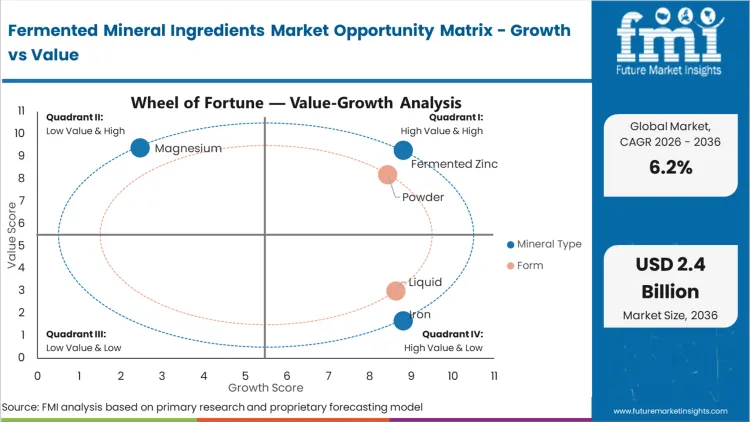
The structural shift toward clean-label nutrition forces product formulation teams to abandon chemically synthesized mineral salts across high-value categories. This transition represents a rigid procurement requirement dictated by major retail buyers who refuse to stock formulations relying on harsh inorganic oxides. Formulation engineers must evaluate biologically transformed alternatives that inherently eliminate the need for artificial flavor maskers and chemical buffers. The commercial stakes are definitive: brands qualifying fermented ingredients secure sustained placement in premium retail networks, while those clinging to legacy synthetic formulations face systemic exclusion from high-margin distribution channels.
The primary organizational friction slowing this transition is the severe cost-in-use differential inherent to biological processing. Fermented mineral complexes require capital-intensive bioreactor cultivation, rendering them significantly more expensive per kilogram than standard mined carbonates. This builds a structural wall within procurement departments, which are traditionally incentivized to reduce raw material expenditures. Although secondary extraction efficiencies continue to improve, they cannot erase the fundamental biological pricing gap. Formulation teams must navigate prolonged internal negotiations against their own finance departments to justify margin compression, systematically delaying premium product launch timelines.
Opportunities in the Fermented Mineral Ingredients Market
- Medical nutrition integration: Clinical data proving the superior cellular uptake of bio-transformed minerals is maturing. Medical formulation teams capture hospital contracts by specifying highly tolerated ingredients in oncology recovery protocols.
- Gummy format optimization: Extruded pectin matrices react poorly with raw mineral salts. Confectionery engineers utilize fermented complexes to prevent structural cross-linking, solving texture failures in functional delivery systems.
- Plant-based dairy fortification: Alternative milks suffer from rapid mineral precipitation. Beverage scientists deploy biologically bound calcium to maintain suspension stability without adding synthetic emulsifiers.
Regional Analysis
Based on the regional analysis, the Fermented Mineral Ingredients market is segmented into North America, Europe, Asia Pacific, and Latin America across 40 plus countries.
.webp "Top Country Growth Comparison Fermented Mineral Ingredients Market Cagr (2026 2036)")
| Country | CAGR (2026 to 2036) |
|---|---|
| India | 8.4% |
| China | 7.2% |
| Brazil | 7.0% |
| Japan | 6.5% |
| Germany | 6.1% |
| United Kingdom | 5.9% |
| United States | 5.8% |
Source: Future Market Insights (FMI) analysis, based on proprietary forecasting model and primary research
North America Fermented Mineral Ingredients Market Analysis
Procurement practices among tier-1 supplement brands define the adoption curve across North America. The domestic dietary space is saturated, forcing product development teams to hunt for specific, defensible differentiation rather than competing purely on dose concentration. According to FMI's estimates, North American buyers demonstrate a unique willingness to completely overhaul flagship products simply to upgrade the ingredient panel language from generic oxides to fermented cultures. The integration of cross-border supply chains ensures that Canadian and Mexican contract manufacturers must rapidly mirror these clean label ingredients sourcing standards to retain their North American client base.
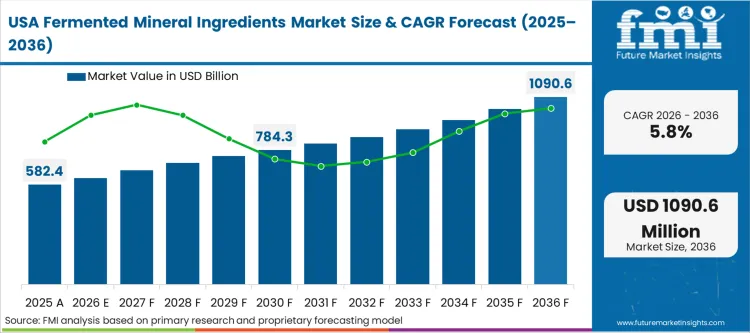
- United States: The extreme concentration of premium, direct-to-consumer nutraceutical brands in the United States forces rapid ingredient turnover. Marketing departments dictate formulation timelines, demanding biologically bound minerals to support whole-food campaigns. The United States market is set to expand at a CAGR of 5.8%. Contract manufacturers who quickly validate their equipment to run these sensitive bio-powders capture exclusive, high-volume production agreements with the fastest-growing digital-first wellness brands.
Europe Fermented Mineral Ingredients Market Analysis
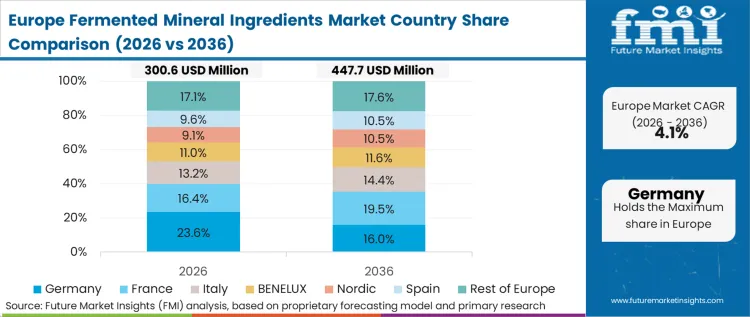
The regulatory environment dictates the pace and nature of mineral transition across Europe. The European Food Safety Authority sets the world's most rigid parameters for health claims, meaning formulators cannot market bioavailability without explicit, peer-reviewed clinical dossiers. In FMI's view, European buyers specify fermented minerals not for marketing appeal, but because ingredient suppliers have successfully navigated the novel food framework to secure specific health claims that standard mineral salts lack. Regulatory harmonization ensures that an approved fermented strain in one member state immediately triggers formulation updates across the bloc.
- Germany: Strict clinical validation standards for functional foods in Germany require brands to utilize ingredients with proven, localized absorption data. Formulators are systematically abandoning legacy chelates in favor of selenium yeast and fermented zinc to leverage EFSA-approved immunity claims. Demand in Germany is projected to rise at a CAGR of 6.1%. The domestic market is completing its transition from experimental novel food approvals into a standardized, highly regulated procurement environment.
- United Kingdom: UK procurement directors operate under intense pressure from consolidated retail pharmacy chains actively curating high-tolerability product sections. Brands transitioning their maternal and pediatric lines to fermented iron matrices capture premium shelf space in these defensive retail environments. A CAGR of 5.9% is expected for the United Kingdom over the forecast period. This trajectory positions UK-based formulation houses to export their highly vetted, gentle-on-the-stomach products competitively into adjacent European consumer markets.
Asia Pacific Fermented Mineral Ingredients Market Analysis
Capital availability and domestic infrastructure goals drive the structural reality in Asia Pacific. The region is not primarily focused on premium capsule supplements; it is fortifying massive volumes of foundational dairy and beverage products without altering taste profiles. As per FMI's projection, procurement directors evaluate fermented minerals purely as a functional solution to the sensory failures of standard fortification. The defining pattern across the region is the rapid localization of fermentation capabilities, shifting nations from importing finished active ingredients to cultivating specialized mineral-binding strains domestically.
- India: Massive pharmaceutical sector in the country is overhauling its approach to maternal nutrition, moving away from harsh iron oxides that suffer terrible patient compliance due to gastric distress. Formulation teams require bio-transformed iron that patients will actually consume daily without nausea. The India market is anticipated to record a CAGR of 8.4%. Local formulators are bypassing intermediate chelate technologies entirely, leapfrogging straight from synthetic salts to premium fermented matrices in their next-generation medical protocols.
- China: High-throughput dairy fortification defines China's trajectory in this sector. Dairy scientists require calcium and zinc inputs that will not precipitate out of suspension or cause protein coagulation during ultra-high-temperature pasteurization. FMI estimates the market in China to expand at an annual growth rate of 7.2%. China ingredient manufacturers are aggressively scaling domestic bioreactor capacity, threatening to undercut the global pricing models historically controlled by Western yeast specialists.
- Japan: Deeply established cultural infrastructure around microbial fermentation in Japan enables immediate consumer trust in bio-transformed active ingredients. Food scientists seamlessly integrate calcium supplements derived from fermentation into mainstream snacks and aging-population nutritional formats. Over the forecast period, Japan is set for a CAGR of 6.5%. The integration of these materials allows facility managers to strip out the complex chemical buffering steps previously required for mineral inclusion on the production line.
Latin America Fermented Mineral Ingredients Market Analysis
Cost structures and regional supply availability shape the adoption pace across Latin America. Domestic supplement brands operate within tighter margin environments, requiring explicit commercial justification before upgrading formulation inputs. Based on FMI's assessment, the shift occurs primarily in high-value animal nutrition and premium export-focused nutraceutical lines, where the biological transformation of trace minerals yields measurable reductions in environmental excretion rates.
- Brazil: Brazil's massive agricultural and meat production sectors are integrating highly bioavailable trace minerals to optimize feed conversion ratios while adhering to tightening environmental runoff standards. Feed producers recognize that animal feed additives containing fermented complexes reduce overall mineral waste. The Brazilian market is expected to witness growth at a CAGR of 7.0%. Suppliers who establish localized distribution networks for these bio-transformed inputs capture long-term supply agreements with the region's largest integrated poultry and swine integrators.
Competitive Aligners for Market Players
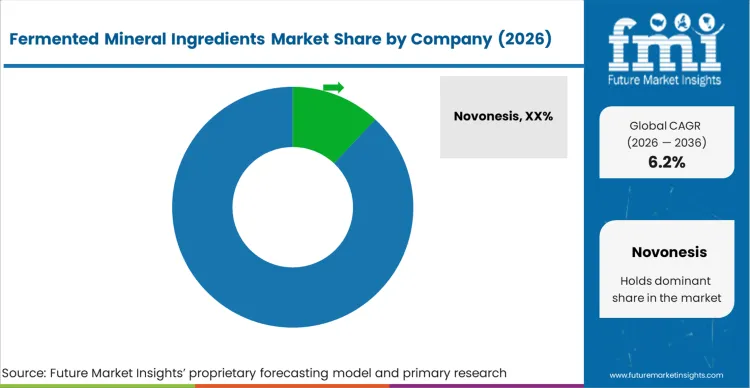
The competitive structure of this market is heavily concentrated at the raw biological processing tier. Global yeast and fermentation specialists dominate because the barrier to entry is not simply purchasing raw minerals; it requires owning and operating massive, precisely controlled bioreactor infrastructure. Procurement directors at major dietary supplement brands differentiate qualified from unqualified vendors based entirely on strain documentation. They require suppliers to prove analytically that the mineral is genuinely incorporated into the microbial cellular matrix, rather than just physically dry-blended with inactive yeast post-production.
To command premium pricing, incumbents rely on deep clinical dossiers proving their specific bacterial or yeast strains enhance human cellular uptake. Challengers attempting to enter this space must build comprehensive safety and bioavailability data packages, a category of regulatory and clinical capability that requires years and significant capital to replicate. An ingredient supplier lacking a proprietary, validated fermented strain cannot compete for tier-1 immunity boosting ingredients contracts, regardless of how aggressively they discount their generic products.
Large formulation houses resist locking themselves into single-supplier proprietary strains by demanding standard specifications that multiple vendors can fulfill. The structural tension, however, heavily favors the dominant fermentation specialists. Because changing an active microbial strain forces a brand to rewrite product labels and repeat complex stability testing, vendor switching costs remain aggressively high. FMI analysts opine that the market will likely see legacy chemical ingredient companies acquiring specialized biotechnology firms to secure the bioreactor capacity necessary to compete in this transitioning landscape through 2036.
Key Players in Fermented Mineral Ingredients Market
- Novonesis
- Kerry Group plc
- Alltech Inc.
- Lallemand Inc.
- Balchem Corporation (Albion Minerals)
- Novus International
- Lesaffre Group
- Angel Yeast Co., Ltd.
- Corbion N.V.
- DSM-Firmenich
Scope of the Report
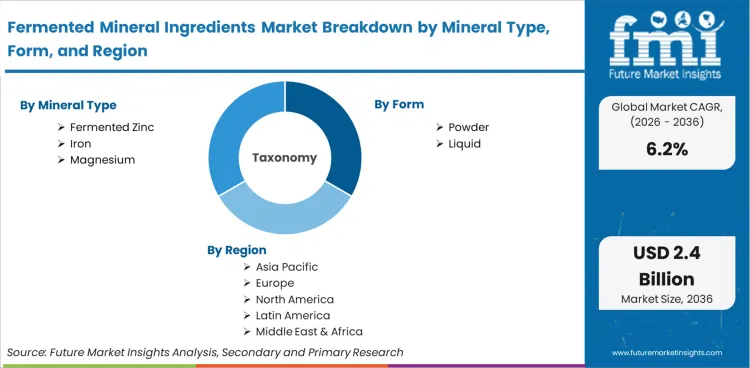
| Metric | Value |
|---|---|
| Quantitative Units | USD 1.3 billion to USD 2.5 billion, at a CAGR of 6.2% |
| Market Definition | The commercial application of mineral elements biologically digested and incorporated into the cellular matrix of microorganisms, transitioning away from chemically synthesized salts. |
| Mineral Type Segmentation | Zinc, Iron, Magnesium, Calcium, Selenium |
| Form Segmentation | Powder, Liquid |
| Application Segmentation | Dietary Supplements, Functional Foods, Personal Care, Animal Feed |
| Fermentation Process Segmentation | Yeast-based, Fungi-based, Bacteria-based |
| Regions Covered | North America, Europe, Asia Pacific, Latin America |
| Countries Covered | India, China, Brazil, Japan, Germany, United Kingdom, United States, and 40 plus countries |
| Key Companies Profiled | Novonesis, Kerry Group plc, Alltech Inc., Lallemand Inc., Balchem Corporation, Novus International, Lesaffre Group, Angel Yeast Co., Ltd., Corbion N.V., DSM-Firmenich |
| Forecast Period | 2026 to 2036 |
| Approach | FMI interviewed formulation scientists and procurement directors within the nutraceutical sectors. The baseline anchors to traceable volumes of active yeast strains procured specifically for mineral enrichment. Forecasts were cross-validated against global import-export data for specialty yeast derivatives and retail velocity metrics. |
Source: Future Market Insights (FMI) analysis, based on proprietary forecasting model and primary research
Fermented Mineral Ingredients Market Analysis by Segments
-
Mineral Type:
- Zinc
- Iron
- Magnesium
- Calcium
- Selenium
-
Form:
- Powder
- Liquid
-
Application:
- Dietary Supplements
- Functional Foods
- Personal Care
- Animal Feed
-
Fermentation Process:
- Yeast-based
- Fungi-based
- Bacteria-based
-
Region:
- North America
- United States
- Canada
- Europe
- Germany
- United Kingdom
- France
- Italy
- Asia Pacific
- China
- India
- Japan
- South Korea
- Latin America
- Brazil
- Mexico
- North America
Bibliography
- EFSA Panel on Additives and Products or Substances used in Animal Feed (FEEDAP). (2024).
Safety and efficacy of a feed additive consisting of inactivated selenised yeast (Saccharomyces cerevisiae CCTCC M 2022402). EFSA Journal, 22(4), e8627. - Zare, P., Giyahchi, M., Entezari, T., & Moghimi, H. (2025).
Development of a zinc-enriched yeast strain for nutritional applications using low-cost ingredients. Scientific Reports, 15, 42346. - Grimmer, G., Muenzner, J., Schmacht, M., et al. (2026).
Unlocking the Zn-enriching potential of industrial yeast strains, an experimental journey from metal analysis to proteomics. Applied Microbiology and Biotechnology. - EFSA Panel on Additives and Products or Substances used in Animal Feed (FEEDAP). (2024).
Safety and efficacy of selenised yeast as a nutritional feed additive. EFSA Journal. - Hossain, M. S., Wazed, M. A., Shuvo, S. D., et al. (2025).
Fortified and functional foods: Trends and innovations in nutrient enrichment. Journal of Agriculture and Food Research. - Dhiman, S., Kaur, S., Thakur, B., Singh, P., & Tripathi, M. (2025).
Nutritional enhancement of plant-based fermented foods: Microbial innovations for sustainable nutrition. Fermentation, 11(6).
This Report Addresses
- Market intelligence to support strategic decision making across functional foods, premium dietary supplements, and animal feed active ingredients.
- Market size estimation and 10-year revenue forecasts from 2026 to 2036, supported by baseline tracking of specialty yeast strain procurement volumes.
- Growth opportunity mapping across zinc, iron, and magnesium formulations with emphasis on the CMO standardization gate for hygroscopic powders.
- Segment and regional revenue forecasts covering yeast-based and fungi-based complexes across strict EFSA regulatory environments and rapid-scale domestic markets like India.
- Competition strategy assessment including proprietary strain documentation requirements, deep clinical dossier validation, and high switching costs among formulation houses.
- Technology development tracking including specific advances in spray-drying stabilization, fungal mycelial uptake capacities, and clean-label non-chemical excipient integration.
- Market access analysis covering EFSA novel food pathways, US retail screening mandates, and high-temperature pasteurization survival parameters in dairy matrices.
- Market report delivery in PDF, Excel, PPT, and interactive dashboard formats for executive strategy, procurement director planning, and operational benchmarking use.
Frequently Asked Questions
How large is the Fermented Mineral Ingredients market in 2026?
The market reaches USD 1.3 billion in 2026. This figure signals the exact scale at which major supplement brands have completely abandoned cheap synthetic salts in favor of premium, biologically compatible active inputs.
What will it be valued at by 2036?
The valuation advances to USD 2.5 billion by 2036. This cumulative buildup indicates that biological mineral binding is transitioning from a niche premium feature to the mandatory baseline specification for human nutrition globally.
What CAGR is projected?
A 6.2% CAGR is expected during the forecast period. This rate reflects the speed at which contract manufacturers can physically upgrade their plant humidity controls to handle sensitive fermented powders, not a lack of end-consumer demand.
Which Mineral Type segment leads?
Fermented zinc commands the segment. By binding zinc to yeast peptides, formulators entirely eliminate the severe acute nausea that causes massive consumer abandonment in standard immunity supplements.
Which Form segment leads?
Powder formats dominate the market infrastructure. Global yeast producers rely entirely on spray-drying to arrest biological activity and guarantee the 24-month transit stability that international procurement directors demand.
Which Application segment leads?
Dietary supplements maintain the lead position. The retail margin structures in the premium vitamin channel easily absorb the higher per-kilogram cost of fermented inputs, whereas high-volume feed applications struggle with the price premium.
What drives rapid growth?
Clean-label mandates at the retail buyer level compel brands to drop chemical flavor maskers. Formulators use naturally bio-compatible fermented complexes to clean up ingredient panels and secure premium shelf placements.
What is the primary restraint?
The severe cost-in-use differential creates deep internal friction. R&D engineers must wage internal battles against their own finance departments to justify the margin compression required to utilize capital-intensive bioreactor ingredients.
Which country grows fastest?
India expands rapidly at an 8.4% pace, structurally outpacing China. Indian formulators are aggressively updating maternal anemia lines to bypass the gastric distress of standard iron oxides, leapfrogging intermediate chelate technologies entirely.
How do EFSA regulations shape the European trajectory?
The European Food Safety Authority requires localized, peer-reviewed clinical dossiers for any absorption claims. Formulators buy fermented minerals in Europe specifically because major suppliers have already funded and secured these difficult novel food approvals.
Why is moisture management critical for this market?
Fermented biological powders are intensely hygroscopic. Plant managers must implement absolute humidity controls during blending; failing to do so results in rapid caking and total batch loss before tableting can occur.
How do incumbent suppliers defend their market position?
Global fermentation specialists lock in formulation contracts through deep safety dossiers and proprietary strain validation. Competitors cannot simply buy standard yeast; they must replicate years of clinical bioavailability data to win tier-1 brand accounts.
What role do contract manufacturers play in adoption?
CMOs act as the structural gatekeeper. Until a contract manufacturer validates its tooling to handle sticky, fermented powder formats without jamming, the brand relying on that CMO cannot launch a fermented SKU.
Why are fungal fermentation platforms emerging?
Traditional baker's yeast has absolute biological ceilings for mineral uptake. Medical nutrition formulation teams requiring extremely high-dose magnesium or calcium are forcing suppliers to develop novel fungal-mycelial vectors.
What is the functional difference between fermented minerals and amino acid chelates?
Chelates use chemical reactions to synthesize a bond, while fermented complexes use live microorganism metabolism. Clean-label retailers actively distinguish between the two, increasingly rejecting chemical chelates in favor of the biological approach.
Why are functional beverage makers adopting these ingredients?
Standard mineral salts precipitate out of solution and introduce heavy metallic off-notes. Beverage scientists deploy biologically bound minerals to maintain suspension stability during UHT pasteurization without adding artificial emulsifiers.
How does supplier switching work in this sector?
Switching costs are punitively high. Because a brand's label claims are tied to the specific clinical data of a supplier's proprietary yeast strain, changing vendors requires rewriting labels and repeating stability testing.
What prevents agricultural feed producers from adopting fermented minerals completely?
While fermented minerals vastly reduce environmental heavy-metal excretion, the high capital cost of bioreactor processing destroys the tight margin structures of commercial poultry and swine production, limiting use to premium breeder lines.
Why is standard zinc oxide losing market share?
Zinc oxide interacts harshly with stomach acid on an empty stomach. Premium brands are abandoning it entirely because this specific physiological failure directly causes high consumer churn rates.
What data anchors the FMI market sizing model?
The baseline forecast anchors directly to the measurable procurement volume of live yeast and bacterial biomass designated specifically for trace mineral enrichment protocols at the industrial scale.
Which ingredient category is excluded from this report scope?
Synthetically manufactured bisglycinates and other chemical chelates are explicitly excluded. The economic boundary of this report is defined entirely by the use of a live biological conversion step.
Why do North American brands reformulate so quickly?
The domestic direct-to-consumer supplement space is violently saturated. Marketing departments demand fermented specifications purely to differentiate their product language from generic competitors, forcing rapid ingredient turnover.
Preview the report firsthand - request a free sample
Get SampleGet the brochure for pricing and purchase details.
Get PDFTable of Content
- Executive Summary
- Global Market Outlook
- Demand-side Trends
- Supply-side Trends
- Technology Roadmap Analysis
- Analysis and Recommendations
- Market Overview
- Market Coverage / Taxonomy
- Market Definition / Scope / Limitations
- Research Methodology
- Chapter Orientation
- Analytical Lens and Working Hypotheses
- Market Structure, Signals, and Trend Drivers
- Benchmarking and Cross-market Comparability
- Market Sizing, Forecasting, and Opportunity Mapping
- Research Design and Evidence Framework
- Desk Research Programme (Secondary Evidence)
- Company Annual and Sustainability Reports
- Peer-reviewed Journals and Academic Literature
- Corporate Websites, Product Literature, and Technical Notes
- Earnings Decks and Investor Briefings
- Statutory Filings and Regulatory Disclosures
- Technical White Papers and Standards Notes
- Trade Journals, Industry Magazines, and Analyst Briefs
- Conference Proceedings, Webinars, and Seminar Materials
- Government Statistics Portals and Public Data Releases
- Press Releases and Reputable Media Coverage
- Specialist Newsletters and Curated Briefings
- Sector Databases and Reference Repositories
- FMI Internal Proprietary Databases and Historical Market Datasets
- Subscription Datasets and Paid Sources
- Social Channels, Communities, and Digital Listening Inputs
- Additional Desk Sources
- Expert Input and Fieldwork (Primary Evidence)
- Primary Modes
- Qualitative Interviews and Expert Elicitation
- Quantitative Surveys and Structured Data Capture
- Blended Approach
- Why Primary Evidence is Used
- Field Techniques
- Interviews
- Surveys
- Focus Groups
- Observational and In-context Research
- Social and Community Interactions
- Stakeholder Universe Engaged
- C-suite Leaders
- Board Members
- Presidents and Vice Presidents
- R&D and Innovation Heads
- Technical Specialists
- Domain Subject-matter Experts
- Scientists
- Physicians and Other Healthcare Professionals
- Governance, Ethics, and Data Stewardship
- Research Ethics
- Data Integrity and Handling
- Primary Modes
- Tooling, Models, and Reference Databases
- Desk Research Programme (Secondary Evidence)
- Data Engineering and Model Build
- Data Acquisition and Ingestion
- Cleaning, Normalisation, and Verification
- Synthesis, Triangulation, and Analysis
- Quality Assurance and Audit Trail
- Market Background
- Market Dynamics
- Drivers
- Restraints
- Opportunity
- Trends
- Scenario Forecast
- Demand in Optimistic Scenario
- Demand in Likely Scenario
- Demand in Conservative Scenario
- Opportunity Map Analysis
- Product Life Cycle Analysis
- Supply Chain Analysis
- Investment Feasibility Matrix
- Value Chain Analysis
- PESTLE and Porter’s Analysis
- Regulatory Landscape
- Regional Parent Market Outlook
- Production and Consumption Statistics
- Import and Export Statistics
- Market Dynamics
- Global Market Analysis 2021 to 2025 and Forecast, 2026 to 2036
- Historical Market Size Value (USD Million) Analysis, 2021 to 2025
- Current and Future Market Size Value (USD Million) Projections, 2026 to 2036
- Y-o-Y Growth Trend Analysis
- Absolute $ Opportunity Analysis
- Global Market Pricing Analysis 2021 to 2025 and Forecast 2026 to 2036
- Global Market Analysis 2021 to 2025 and Forecast 2026 to 2036, By Mineral Type
- Introduction / Key Findings
- Historical Market Size Value (USD Million) Analysis By Mineral Type , 2021 to 2025
- Current and Future Market Size Value (USD Million) Analysis and Forecast By Mineral Type , 2026 to 2036
- Fermented Zinc
- Iron
- Magnesium
- Fermented Zinc
- Y-o-Y Growth Trend Analysis By Mineral Type , 2021 to 2025
- Absolute $ Opportunity Analysis By Mineral Type , 2026 to 2036
- Global Market Analysis 2021 to 2025 and Forecast 2026 to 2036, By Form
- Introduction / Key Findings
- Historical Market Size Value (USD Million) Analysis By Form, 2021 to 2025
- Current and Future Market Size Value (USD Million) Analysis and Forecast By Form, 2026 to 2036
- Powder
- Liquid
- Powder
- Y-o-Y Growth Trend Analysis By Form, 2021 to 2025
- Absolute $ Opportunity Analysis By Form, 2026 to 2036
- Global Market Analysis 2021 to 2025 and Forecast 2026 to 2036, By Application
- Introduction / Key Findings
- Historical Market Size Value (USD Million) Analysis By Application, 2021 to 2025
- Current and Future Market Size Value (USD Million) Analysis and Forecast By Application, 2026 to 2036
- Dietary Supplement
- Functional Foods
- Personal Care
- Dietary Supplement
- Y-o-Y Growth Trend Analysis By Application, 2021 to 2025
- Absolute $ Opportunity Analysis By Application, 2026 to 2036
- Global Market Analysis 2021 to 2025 and Forecast 2026 to 2036, By Region
- Introduction
- Historical Market Size Value (USD Million) Analysis By Region, 2021 to 2025
- Current Market Size Value (USD Million) Analysis and Forecast By Region, 2026 to 2036
- North America
- Latin America
- Western Europe
- Eastern Europe
- East Asia
- South Asia and Pacific
- Middle East & Africa
- Market Attractiveness Analysis By Region
- North America Market Analysis 2021 to 2025 and Forecast 2026 to 2036, By Country
- Historical Market Size Value (USD Million) Trend Analysis By Market Taxonomy, 2021 to 2025
- Market Size Value (USD Million) Forecast By Market Taxonomy, 2026 to 2036
- By Country
- USA
- Canada
- Mexico
- By Mineral Type
- By Form
- By Application
- By Country
- Market Attractiveness Analysis
- By Country
- By Mineral Type
- By Form
- By Application
- Key Takeaways
- Latin America Market Analysis 2021 to 2025 and Forecast 2026 to 2036, By Country
- Historical Market Size Value (USD Million) Trend Analysis By Market Taxonomy, 2021 to 2025
- Market Size Value (USD Million) Forecast By Market Taxonomy, 2026 to 2036
- By Country
- Brazil
- Chile
- Rest of Latin America
- By Mineral Type
- By Form
- By Application
- By Country
- Market Attractiveness Analysis
- By Country
- By Mineral Type
- By Form
- By Application
- Key Takeaways
- Western Europe Market Analysis 2021 to 2025 and Forecast 2026 to 2036, By Country
- Historical Market Size Value (USD Million) Trend Analysis By Market Taxonomy, 2021 to 2025
- Market Size Value (USD Million) Forecast By Market Taxonomy, 2026 to 2036
- By Country
- Germany
- UK
- Italy
- Spain
- France
- Nordic
- BENELUX
- Rest of Western Europe
- By Mineral Type
- By Form
- By Application
- By Country
- Market Attractiveness Analysis
- By Country
- By Mineral Type
- By Form
- By Application
- Key Takeaways
- Eastern Europe Market Analysis 2021 to 2025 and Forecast 2026 to 2036, By Country
- Historical Market Size Value (USD Million) Trend Analysis By Market Taxonomy, 2021 to 2025
- Market Size Value (USD Million) Forecast By Market Taxonomy, 2026 to 2036
- By Country
- Russia
- Poland
- Hungary
- Balkan & Baltic
- Rest of Eastern Europe
- By Mineral Type
- By Form
- By Application
- By Country
- Market Attractiveness Analysis
- By Country
- By Mineral Type
- By Form
- By Application
- Key Takeaways
- East Asia Market Analysis 2021 to 2025 and Forecast 2026 to 2036, By Country
- Historical Market Size Value (USD Million) Trend Analysis By Market Taxonomy, 2021 to 2025
- Market Size Value (USD Million) Forecast By Market Taxonomy, 2026 to 2036
- By Country
- China
- Japan
- South Korea
- By Mineral Type
- By Form
- By Application
- By Country
- Market Attractiveness Analysis
- By Country
- By Mineral Type
- By Form
- By Application
- Key Takeaways
- South Asia and Pacific Market Analysis 2021 to 2025 and Forecast 2026 to 2036, By Country
- Historical Market Size Value (USD Million) Trend Analysis By Market Taxonomy, 2021 to 2025
- Market Size Value (USD Million) Forecast By Market Taxonomy, 2026 to 2036
- By Country
- India
- ASEAN
- Australia & New Zealand
- Rest of South Asia and Pacific
- By Mineral Type
- By Form
- By Application
- By Country
- Market Attractiveness Analysis
- By Country
- By Mineral Type
- By Form
- By Application
- Key Takeaways
- Middle East & Africa Market Analysis 2021 to 2025 and Forecast 2026 to 2036, By Country
- Historical Market Size Value (USD Million) Trend Analysis By Market Taxonomy, 2021 to 2025
- Market Size Value (USD Million) Forecast By Market Taxonomy, 2026 to 2036
- By Country
- Kingdom of Saudi Arabia
- Other GCC Countries
- Turkiye
- South Africa
- Other African Union
- Rest of Middle East & Africa
- By Mineral Type
- By Form
- By Application
- By Country
- Market Attractiveness Analysis
- By Country
- By Mineral Type
- By Form
- By Application
- Key Takeaways
- Key Countries Market Analysis
- USA
- Pricing Analysis
- Market Share Analysis, 2025
- By Mineral Type
- By Form
- By Application
- Canada
- Pricing Analysis
- Market Share Analysis, 2025
- By Mineral Type
- By Form
- By Application
- Mexico
- Pricing Analysis
- Market Share Analysis, 2025
- By Mineral Type
- By Form
- By Application
- Brazil
- Pricing Analysis
- Market Share Analysis, 2025
- By Mineral Type
- By Form
- By Application
- Chile
- Pricing Analysis
- Market Share Analysis, 2025
- By Mineral Type
- By Form
- By Application
- Germany
- Pricing Analysis
- Market Share Analysis, 2025
- By Mineral Type
- By Form
- By Application
- UK
- Pricing Analysis
- Market Share Analysis, 2025
- By Mineral Type
- By Form
- By Application
- Italy
- Pricing Analysis
- Market Share Analysis, 2025
- By Mineral Type
- By Form
- By Application
- Spain
- Pricing Analysis
- Market Share Analysis, 2025
- By Mineral Type
- By Form
- By Application
- France
- Pricing Analysis
- Market Share Analysis, 2025
- By Mineral Type
- By Form
- By Application
- India
- Pricing Analysis
- Market Share Analysis, 2025
- By Mineral Type
- By Form
- By Application
- ASEAN
- Pricing Analysis
- Market Share Analysis, 2025
- By Mineral Type
- By Form
- By Application
- Australia & New Zealand
- Pricing Analysis
- Market Share Analysis, 2025
- By Mineral Type
- By Form
- By Application
- China
- Pricing Analysis
- Market Share Analysis, 2025
- By Mineral Type
- By Form
- By Application
- Japan
- Pricing Analysis
- Market Share Analysis, 2025
- By Mineral Type
- By Form
- By Application
- South Korea
- Pricing Analysis
- Market Share Analysis, 2025
- By Mineral Type
- By Form
- By Application
- Russia
- Pricing Analysis
- Market Share Analysis, 2025
- By Mineral Type
- By Form
- By Application
- Poland
- Pricing Analysis
- Market Share Analysis, 2025
- By Mineral Type
- By Form
- By Application
- Hungary
- Pricing Analysis
- Market Share Analysis, 2025
- By Mineral Type
- By Form
- By Application
- Kingdom of Saudi Arabia
- Pricing Analysis
- Market Share Analysis, 2025
- By Mineral Type
- By Form
- By Application
- Turkiye
- Pricing Analysis
- Market Share Analysis, 2025
- By Mineral Type
- By Form
- By Application
- South Africa
- Pricing Analysis
- Market Share Analysis, 2025
- By Mineral Type
- By Form
- By Application
- USA
- Market Structure Analysis
- Competition Dashboard
- Competition Benchmarking
- Market Share Analysis of Top Players
- By Regional
- By Mineral Type
- By Form
- By Application
- Competition Analysis
- Competition Deep Dive
- Novonesis
- Overview
- Product Portfolio
- Profitability by Market Segments (Product/Age /Sales Channel/Region)
- Sales Footprint
- Strategy Overview
- Marketing Strategy
- Product Strategy
- Channel Strategy
- Kerry Group plc
- Alltech Inc.
- Lallemand Inc.
- Balchem Corporation (Albion Minerals)
- Novus International
- Lesaffre Group
- Novonesis
- Competition Deep Dive
- Assumptions & Acronyms Used


