

- Industry Size (2026)
- USD 55.2 Mn
- Forecast (2036)
- USD 78.7 Mn
- CAGR (2026 to 2036)
- 3.6%
Demand for Mineral Enrichment Ingredients in South Korea Forecast and Outlook 2026 to 2036
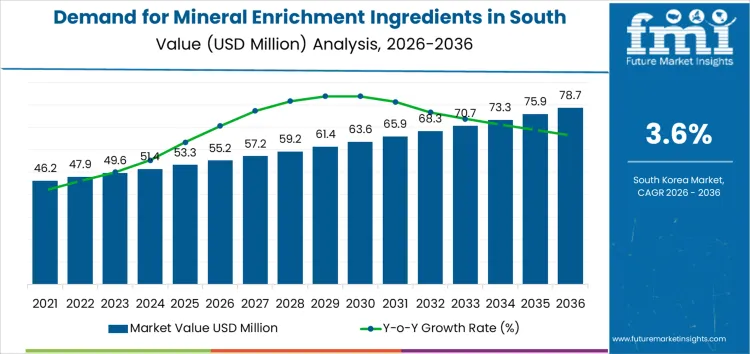
The demand for mineral enrichment ingredients in South Korea is projected to reach USD 55.2 million in 2026 and grow to USD 78.7 million by 2036, reflecting a 3.6% CAGR. For decision-makers, it is critical to understand the economic exposure in this space, as the price volatility of raw materials can influence margins and supply chain stability. Prioritization should focus on securing reliable, cost-effective sourcing while maintaining product quality, particularly as these ingredients are integral to health-focused food products and dietary supplements.
The timing of investments is also crucial-delayed decisions can lead to missed opportunities, especially as consumer demand for enriched products steadily increases. As this market is subject to both global and local economic fluctuations, staying ahead of regulatory shifts and consumer preferences will be key to capturing long-term growth. This demand profile, though steady, requires ongoing strategic alignment with broader market trends and operational efficiencies.
Quick Stats for the Demand for Mineral Enrichment Ingredients in South Korea
- Mineral Enrichment Ingredients in South Korea Value (2026): USD 55.2 million
- Mineral Enrichment Ingredients in South Korea Forecast Value (2036): USD 78.7 million
- Mineral Enrichment Ingredients in South Korea Forecast CAGR (2026 to 2036): 3.6%
- Mineral Enrichment Ingredients in South Korea Leading Segment: Powder (60%)
- Key Growth Regions of Mineral Enrichment Ingredients in South Korea: Jeju (leading CAGR ~4.3%)
- Top Players of Mineral Enrichment Ingredients in South Korea: Clover Hill Food Ingredients Ltd, Cargill, Incorporated, ADM WILD Europe GmbH & Co.KG, Nestlé, Wilmar International Limited
What is the Growth Forecast for the Demand for Mineral Enrichment Ingredients in South Korea through 2036?
The inflection point mapping for mineral enrichment ingredients in South Korea indicates steady growth with a slight acceleration in the early years of the forecast period, followed by a more stable growth rate as the market matures. In the first phase (2026 to 2030), demand is expected to rise gradually, driven by increasing consumer interest in functional foods and fortified beverages. The initial inflection point occurs as more mainstream brands begin offering enriched food and beverage products, signaling the start of broader market adoption.
By 2036, the market for mineral enrichment ingredients is projected to reach USD 78.7 million, reflecting a consistent, sustainable growth trajectory. However, as the market matures, the rate of growth will begin to stabilize after the initial phase of accelerated adoption. The inflection point occurs as the demand for enriched products becomes more integrated into everyday consumer choices, resulting in gradual but sustained growth. The market will reach a plateau in growth once mineral-enriched products become fully established within the consumer food and beverage segments, indicating the sector has reached its full potential for expansion within South Korea.
Key Takeaways for Demand for Mineral Enrichment Ingredients in South Korea
| Metric | Value |
|---|---|
| Industry Sales Value (2026) | USD 55.2 million |
| Industry Forecast Value (2036) | USD 78.7 million |
| Industry Forecast CAGR (2026 to 2036) | 3.6% |
Why is the Demand for Mineral Enrichment Ingredients Growing in South Korea?
Demand for mineral enrichment ingredients in South Korea reflects changes in dietary patterns and processing standards across food, feed, and supplement sectors. Food manufacturers incorporate minerals such as calcium, iron, zinc, and magnesium into cereals, dairy alternatives, snacks, and beverages to enhance nutritional profiles and meet consumer expectations for functional products. South Korean consumers show rising interest in health-oriented foods that address bone strength, immune support, and micronutrient balance, prompting formulators to adjust recipes accordingly.
Animal feed producers also rely on enriched premixes to support growth, reproductive health, and feed conversion in livestock and aquaculture operations. Procurement teams evaluate ingredient purity, bioavailability, and regulatory compliance to ensure fortified products align with safety and labeling standards. These technical and regulatory criteria influence ongoing purchases of mineral enrichment ingredients, especially where consistent quality affects both end-product performance and market acceptance.
Looking ahead, several factors support sustained growth in demand for mineral enrichment ingredients within South Korea. An aging population increases focus on age-related nutritional needs, encouraging food and supplement firms to fortify products with minerals that support metabolic and skeletal health. Public health initiatives that emphasize balanced diets and micronutrient sufficiency contribute to formulation strategies that include enriched ingredients to address documented nutrient gaps.
Expansion of ready-to-eat and convenience food categories, driven by urban lifestyles, leads manufacturers to differentiate offerings through added nutritional value, which often includes mineral components. Regulatory scrutiny on fortification claims and labeling enforces careful selection of ingredient sources with verified bioavailability. Advances in ingredient technology expand options for chelated and encapsulated minerals that enhance stability in complex matrices. Taken together, these trends influence how food, feed, and wellness producers in South Korea plan product portfolios and procurement for mineral enrichment.
What Shapes the Demand for Mineral Enrichment Ingredients in South Korea?
The demand for mineral enrichment ingredients in South Korea is shaped by two main factors: form and end-use application. Powder form leads the market, holding a 60% share, while the food industry represents the largest end-use segment at 40%. These segments reflect the increasing demand for fortified foods, driven by consumer interest in health, wellness, and balanced nutrition. As the demand for enriched food products grows, the use of powdered mineral ingredients, especially in processed foods, becomes more widespread.
Why Does Powder Form Hold the Largest Share in Mineral Enrichment Ingredients?

Powder form accounts for 60% of the mineral enrichment ingredients market in South Korea, primarily due to its versatility, ease of incorporation, and cost-effectiveness in the food production process. Powdered minerals can be easily mixed into various food matrices, including beverages, ready-to-eat meals, and bakery products, ensuring consistent distribution and maintaining nutritional quality. The ability to maintain stability and shelf-life in powdered form makes it highly favored by manufacturers in industries such as food, dairy, and meat processing. In addition, powdered mineral ingredients are more convenient for storage, handling, and transportation, offering greater flexibility in large-scale production environments. As the demand for functional and fortified foods increases in South Korea, particularly in health-conscious consumer segments, the use of powdered mineral ingredients is expected to remain dominant due to its ease of use, cost efficiency, and the ability to support high-volume food production while delivering enhanced nutritional content.
Why Does the Food Industry Lead the End-Use Demand for Mineral Enrichment Ingredients?
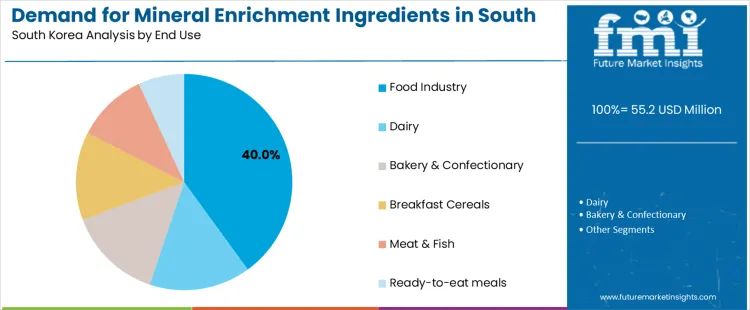
The food industry leads the demand for mineral enrichment ingredients in South Korea, accounting for 40% of the total market. This sector includes a wide range of products such as dairy, bakery, breakfast cereals, meat and fish, and ready-to-eat meals, all of which benefit from added minerals to improve nutritional profiles. With increasing consumer awareness about the importance of balanced nutrition, manufacturers are fortifying foods with minerals like calcium, iron, and magnesium to meet health needs and regulatory standards. The growing trend of functional foods, where consumers seek products that provide additional health benefits beyond basic nutrition, drives the need for mineral enrichment in these applications. The dairy and bakery sectors, in particular, rely heavily on mineral enrichment to offer products that support bone health, energy levels, and overall wellness. Ready-to-eat meals and breakfast cereals are also key drivers, as they cater to busy, health-conscious consumers looking for convenient yet nutritious options. With the continued growth of South Korea's processed food industry, the demand for mineral-enriched products is expected to rise, ensuring the ongoing role of mineral enrichment ingredients across various food categories.
What Is the Current Demand for Mineral Enrichment Ingredients in South Korea?
Demand for mineral enrichment ingredients in South Korea is sustained by requirements across food and beverage, dietary supplements, animal nutrition, and functional foods. These ingredients, which include minerals such as calcium, magnesium, iron, zinc, and trace elements, are incorporated to address nutritional needs, meet regulatory fortification standards, and support product differentiation. Procurement reflects consumption patterns in packaged foods, beverages, and health supplements, as well as production volumes in feed mills where fortified premixes are standard. Demand also aligns with consumer interest in products marketed for bone health, immune support, and metabolic wellness, which influences formulation choices by manufacturers seeking compliance with domestic nutrition guidelines.
What Factors Are Driving Demand for Mineral Enrichment Ingredients in South Korea?
Several forces drive demand for mineral enrichment ingredients in South Korea. Growth in the functional foods and nutraceuticals sectors encourages inclusion of minerals to deliver added health benefits beyond basic nutrition. Population aging and heightened focus on preventive health support demand for fortified foods and supplements tailored to bone density, heart health, and micronutrient balance. Regulatory frameworks that set fortification criteria for staples such as flour, dairy products, and infant formulas shape ingredient selection and volumes. Expansion of processing and packaged food industries also underpins mineral ingredient uptake, as manufacturers seek to differentiate offerings in a competitive marketplace. Export orientation of several food producers further reinforces the use of standardized enrichment to meet international quality expectations.
What Are the Constraints on Demand for Mineral Enrichment Ingredients in South Korea?
Despite ongoing uptake, constraints influence demand for mineral enrichment ingredients in South Korea. Price sensitivity can affect formulation decisions, as high-purity mineral salts and chelates often carry cost premiums compared to base ingredients, leading some producers to prioritize lower-cost nutrient options. Technical challenges in formulation, such as interactions between mineral compounds and sensory properties, may limit inclusion levels or require stabilizing technologies that add cost. Supply chain volatility, including fluctuations in global raw material availability or freight costs, can affect lead times and procurement planning. Regulatory compliance also imposes testing and documentation requirements for fortified products, which lengthen development cycles and influence adoption timing for new formulations.
What Trends Are Emerging in South Korea’s Mineral Enrichment Ingredients Market?
Emerging trends in South Korea’s mineral enrichment ingredients market reflect evolving consumer and industry priorities. There is growing interest in bioavailable and chelated mineral forms that improve absorption and reduce gastrointestinal side effects, especially in supplements and fortified beverages. Clean labeling and natural source claims are influencing choice of mineral carriers, with manufacturers exploring plant-derived and aquamin sources to meet consumer preferences. Integration of minerals into personalized nutrition solutions and condition-specific supplements, such as those targeting joint health or metabolic support, is gaining traction. Functional food developers are also leveraging advanced encapsulation and delivery technologies to address stability and taste challenges, enabling wider use of enrichment ingredients in diverse product formats. Sustainability considerations, including traceability of source materials and eco-efficient manufacturing processes, are shaping supplier selection and formulation strategies.
What is the Regional Outlook for the Demand for Mineral Enrichment Ingredients in South Korea?
The demand for mineral enrichment ingredients in South Korea is driven by increasing awareness of nutritional health, the growing food and beverage industry, and the rise of fortified food products. Jeju, South Gyeongsang, and South Jeolla are projected to see solid growth in the coming years, with Jeju leading the demand due to its expanding health-conscious consumer base and tourism-driven food sector. South Gyeongsang and South Jeolla also demonstrate steady demand, primarily driven by local manufacturing, food processing, and agricultural activities. North Jeolla, while showing moderate demand, benefits from its agricultural and food production base. As consumers seek healthier food options, the use of mineral enrichment ingredients is becoming more prevalent in various sectors, including beverages, dairy, and processed foods.
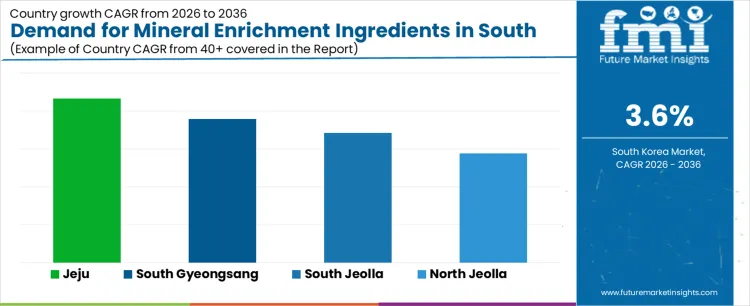
| Province | CAGR (2026 to 2036) |
|---|---|
| South Gyeongsang | 3.8% |
| North Jeolla | 2.9% |
| South Jeolla | 3.4% |
| Jeju | 4.3% |
What drives the demand for Mineral Enrichment Ingredients in South Gyeongsang?
South Gyeongsang is projected to experience a CAGR of 3.8% in the demand for mineral enrichment ingredients from 2026 to 2036. The region’s strong food processing and agriculture sectors play a major role in this demand. With an increasing focus on healthier food products, there is a growing demand for mineral enrichment ingredients in processed foods, beverages, and dairy products. The rising consumer interest in functional foods and nutritional supplements further contributes to this demand. South Gyeongsang’s expanding food manufacturing industry, along with its growing export activities, reinforces the need for mineral enrichment ingredients. As food producers continue to enhance the nutritional value of their products to meet health-conscious consumer demands, the use of mineral enrichment ingredients will remain essential.
What influences the growth of Mineral Enrichment Ingredients demand in North Jeolla?
North Jeolla is expected to see a moderate CAGR of 2.9% in the demand for mineral enrichment ingredients from 2026 to 2036. The region's agricultural industry, which is a major supplier of raw materials for food and beverage processing, contributes to the growing need for enrichment ingredients in a variety of food products. As consumer interest in health and wellness continues to rise, food manufacturers in North Jeolla are increasingly adopting mineral-enriched ingredients to meet nutritional demands. Additionally, the region's food production and beverage sectors, which are adapting to new trends in fortified products, are driving the demand for these ingredients. Despite a smaller food manufacturing base compared to other regions, North Jeolla's focus on improving food quality and meeting dietary requirements is expected to lead to steady demand growth for mineral enrichment ingredients.
What drives the demand for Mineral Enrichment Ingredients in South Jeolla?
South Jeolla is projected to grow at a CAGR of 3.4% in the demand for mineral enrichment ingredients from 2026 to 2036. The region’s strong presence in the food processing industry, particularly in the production of dairy products, processed foods, and beverages, is a key factor driving this demand. As more consumers seek functional foods that offer health benefits, the need for fortified ingredients such as vitamins, minerals, and trace elements in South Jeolla's food products continues to grow. Furthermore, South Jeolla's focus on sustainable agricultural practices and increasing food production efficiency supports the rising use of mineral enrichment ingredients. The growing export potential for South Jeolla's food products, coupled with a rising demand for healthy, fortified alternatives, will further boost the region's adoption of mineral-enriched ingredients.
Why is Jeju projected to have the highest demand growth for Mineral Enrichment Ingredients?
Jeju is projected to see the highest demand growth for mineral enrichment ingredients, with a CAGR of 4.3% from 2026 to 2036. The island’s growing tourism sector, alongside increasing consumer awareness of health and wellness, contributes to this rising demand. With an increasing number of health-conscious visitors and residents, there is a higher preference for functional foods and beverages that offer enhanced nutritional benefits. Jeju’s foodservice industry, particularly in hospitality, increasingly incorporates fortified ingredients in their offerings to cater to the health trends within the tourism market. As Jeju’s local food production sector adapts to these trends and expands, demand for mineral-enriched products, particularly in beverages, snacks, and dietary supplements, is expected to continue rising. Additionally, the island’s focus on eco-friendly and sustainable agricultural practices supports the use of clean, mineral-enriched ingredients, further driving demand.
How are Competitors Differentiating in the Mineral Enrichment Ingredients Market in South Korea?
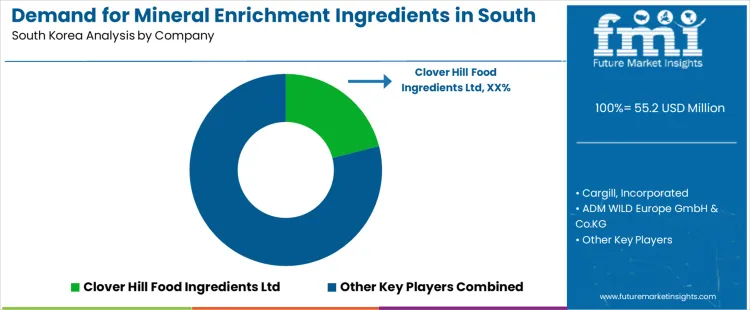
The demand for mineral enrichment ingredients in South Korea is growing, fueled by increasing consumer awareness about the health benefits of fortified food and beverages. Clover Hill Food Ingredients Ltd, the leading player, distinguishes itself with a comprehensive portfolio of high-quality, natural mineral ingredients designed to meet the specific needs of the food and beverage industry. Their products are formulated to enhance nutritional profiles, with a focus on minerals like calcium, magnesium, and potassium. Cargill, Incorporated competes by offering a wide range of mineral enrichment ingredients, with a focus on fortification solutions that meet both health regulations and consumer preferences for clean labels. Their strong supply chain and global reach allow them to offer reliable, high-quality ingredients for both the domestic and international market.
ADM WILD Europe GmbH & Co.KG emphasizes the use of sustainable sourcing practices for its mineral enrichment ingredients, positioning itself as a leader in both quality and environmental responsibility. Their products cater to the growing demand for plant-based and functional foods, where mineral fortification is key. Nestlé, a significant player, provides mineral-enriched ingredients that are specifically tailored for use in fortified food products, particularly in the dairy, beverage, and infant nutrition sectors. Their focus is on creating easy-to-integrate, highly bioavailable mineral solutions. Wilmar International Limited specializes in mineral ingredients for the food, beverage, and pharmaceutical industries, with an emphasis on providing cost-effective solutions without compromising on nutritional value or regulatory compliance. These companies use product brochures to highlight the benefits of their mineral ingredients, such as improved bioavailability, customization options, and alignment with consumer health trends, helping South Korean manufacturers meet growing consumer demand for fortified and nutritionally enhanced products.
Key Players of the Demand for Mineral Enrichment Ingredients in South Korea
- Clover Hill Food Ingredients Ltd
- Cargill, Incorporated
- ADM WILD Europe GmbH & Co.KG
- Nestlé
- Wilmar International Limited
Scope of the Report
| Items | Values |
|---|---|
| Quantitative Units (2026) | USD Million |
| Form | Powder, Granule |
| Ingredient Type | Calcium, Zinc, Sodium, Potassium, Phosphorous, Magnesium |
| End Use | Food Industry, Dairy, Bakery & Confectionary, Breakfast Cereals, Meat & Fish, Ready-to-eat meals |
| Companies | Clover Hill Food Ingredients Ltd, Cargill, Incorporated, ADM WILD Europe GmbH & Co.KG, Nestlé, Wilmar International Limited |
| Region Covered | South Korea |
| Provinces Covered | South Gyeongsang, North Jeolla, South Jeolla, Jeju |
| Additional Attributes | Dollar sales by form, ingredient type, and end use. Demand is driven by the increasing use of mineral enrichment ingredients in food and beverages, particularly in dairy, bakery, and ready-to-eat meals. Growth is supported by a focus on improving nutritional profiles across the food industry. |
Demand for Mineral Enrichment Ingredients in South Korea
Form
- Powder
- Granule
Ingredient Type
- Calcium
- Zinc
- Sodium
- Potassium
- Phosphorous
- Magnesium
- Other
End Use
- Food Industry
- Dairy
- Bakery & Confectionary
- Breakfast Cereals
- Meat & Fish
- Ready-to-eat Meals
- Other
Provinces
- South Gyeongsang
- North Jeolla
- South Jeolla
- Jeju
Bibliography
- Ministry of Health and Welfare (Republic of Korea). (2024). Nutritional policy and mineral fortification regulations in South Korea. Government of South Korea.
- Korea Food Research Institute. (2024). Advances in micronutrient fortification and mineral enrichment technologies. Korea Food Research Institute.
- Ministry of Food and Drug Safety (Republic of Korea). (2024). Food standards and specifications for mineral additives and fortificants. Government of South Korea.
Frequently Asked Questions
How big is the demand for mineral enrichment ingredients in south korea in 2026?
The demand for mineral enrichment ingredients in south korea is estimated to be valued at USD 55.2 million in 2026.
What will be the size of mineral enrichment ingredients in south korea in 2036?
The market size for the mineral enrichment ingredients in south korea is projected to reach USD 78.7 million by 2036.
How much will be the demand for mineral enrichment ingredients in south korea growth between 2026 and 2036?
The demand for mineral enrichment ingredients in south korea is expected to grow at a 3.6% CAGR between 2026 and 2036.
What are the key product types in the mineral enrichment ingredients in south korea?
The key product types in mineral enrichment ingredients in south korea are powder and granule.
Which ingredient type segment is expected to contribute significant share in the mineral enrichment ingredients in south korea in 2026?
In terms of ingredient type, calcium segment is expected to command 25.0% share in the mineral enrichment ingredients in south korea in 2026.
Preview the report firsthand - request a free sample
Get SampleGet the brochure for pricing and purchase details.
Get PDFTable of Content
- Executive Summary
- South Korea Market Outlook
- Demand-side Trends
- Supply-side Trends
- Technology Roadmap Analysis
- Analysis and Recommendations
- Market Overview
- Market Coverage / Taxonomy
- Market Definition / Scope / Limitations
- Market Background
- Market Dynamics
- Drivers
- Restraints
- Opportunity
- Trends
- Scenario Forecast
- Demand in Optimistic Scenario
- Demand in Likely Scenario
- Demand in Conservative Scenario
- Opportunity Map Analysis
- Product Life Cycle Analysis
- Supply Chain Analysis
- Investment Feasibility Matrix
- Value Chain Analysis
- PESTLE and Porter’s Analysis
- Regulatory Landscape
- Regional Parent Market Outlook
- Production and Consumption Statistics
- Import and Export Statistics
- Market Dynamics
- South Korea Market Analysis 2021 to 2025 and Forecast, 2026 to 2036
- Historical Market Size Value (USD Million) Analysis, 2021 to 2025
- Current and Future Market Size Value (USD Million) Projections, 2026 to 2036
- Y-o-Y Growth Trend Analysis
- Absolute $ Opportunity Analysis
- South Korea Market Pricing Analysis 2021 to 2025 and Forecast 2026 to 2036
- South Korea Market Analysis 2021 to 2025 and Forecast 2026 to 2036, By Form
- Introduction / Key Findings
- Historical Market Size Value (USD Million) Analysis By Form , 2021 to 2025
- Current and Future Market Size Value (USD Million) Analysis and Forecast By Form , 2026 to 2036
- Powder
- Granule
- Powder
- Y-o-Y Growth Trend Analysis By Form , 2021 to 2025
- Absolute $ Opportunity Analysis By Form , 2026 to 2036
- South Korea Market Analysis 2021 to 2025 and Forecast 2026 to 2036, By Ingredient Type
- Introduction / Key Findings
- Historical Market Size Value (USD Million) Analysis By Ingredient Type, 2021 to 2025
- Current and Future Market Size Value (USD Million) Analysis and Forecast By Ingredient Type, 2026 to 2036
- Calcium
- Zinc
- Sodium
- Potassium
- Phosphorous
- Magnesium
- Calcium
- Y-o-Y Growth Trend Analysis By Ingredient Type, 2021 to 2025
- Absolute $ Opportunity Analysis By Ingredient Type, 2026 to 2036
- South Korea Market Analysis 2021 to 2025 and Forecast 2026 to 2036, By End Use
- Introduction / Key Findings
- Historical Market Size Value (USD Million) Analysis By End Use, 2021 to 2025
- Current and Future Market Size Value (USD Million) Analysis and Forecast By End Use, 2026 to 2036
- Food Industry
- Dairy
- Bakery & Confectionary
- Breakfast Cereals
- Meat & Fish
- Ready-to-eat meals
- Food Industry
- Y-o-Y Growth Trend Analysis By End Use, 2021 to 2025
- Absolute $ Opportunity Analysis By End Use, 2026 to 2036
- Market Structure Analysis
- Competition Dashboard
- Competition Benchmarking
- Market Share Analysis of Top Players
- By Regional
- By Form
- By Ingredient Type
- By End Use
- Competition Analysis
- Competition Deep Dive
- Clover Hill Food Ingredients Ltd
- Overview
- Product Portfolio
- Profitability by Market Segments (Product/Age /Sales Channel/Region)
- Sales Footprint
- Strategy Overview
- Marketing Strategy
- Product Strategy
- Channel Strategy
- Cargill, Incorporated
- ADM WILD Europe GmbH & Co.KG
- Nestlé
- Wilmar International Limited
- Clover Hill Food Ingredients Ltd
- Competition Deep Dive
- Assumptions & Acronyms Used
- Research Methodology


