

- Industry Size (2026)
- USD 212.5 Mn
- Forecast (2036)
- USD 314.5 Mn
- CAGR (2026 to 2036)
- 4%
Demand for Mineral Enrichment Ingredients in United Kingdom Forecast and Outlook 2026 to 2036
The mineral enrichment ingredients market in the United Kingdom is projected to grow from USD 212.5 million in 2026 to USD 314.5 million by 2036, at a CAGR of 4%. Decision-makers should immediately recognize that economic exposure in this market is influenced by fluctuations in raw material prices, regulatory shifts, and evolving consumer preferences for fortified products. Prioritization should focus on securing reliable supply chains and ensuring compliance with increasingly stringent health and safety standards.
Timing will be critical as the market is shaped by both global and regional trends in food and beverage, pharmaceuticals, and animal nutrition sectors. While growth is steady, the pace of adoption will vary by industry, with some segments requiring faster innovation and others emphasizing cost-efficiency. Strategic investments in R&D and partnerships will be key to capitalizing on growth opportunities, allowing companies to adapt to market dynamics and maintain competitive positioning.
Quick Stats for the Demand for Mineral Enrichment Ingredients in United Kingdom
- Mineral Enrichment Ingredients in United Kingdom Value (2026): USD 212.5 million
- Mineral Enrichment Ingredients in United Kingdom Forecast Value (2036): USD 314.5 million
- Mineral Enrichment Ingredients in United Kingdom Forecast CAGR (2026 to 2036): 4%
- Mineral Enrichment Ingredients in United Kingdom Leading Segment: Powder (60% share)
- Key Growth Regions of Mineral Enrichment Ingredients in United Kingdom: England
- Top Players of Mineral Enrichment Ingredients in United Kingdom: Tate & Lyle, Cargill, Archer Daniels Midland, DSM-Firmenich, BASF SE
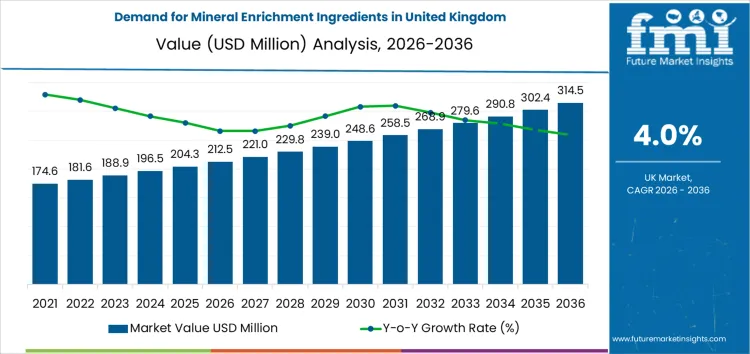
What is the Growth Forecast for Mineral Enrichment Ingredients in United Kingdom through 2036?
Demand for mineral enrichment ingredients in the United Kingdom is expected to grow steadily through the forecast period, supported by rising consumption of fortified foods, functional beverages, and dietary supplements. Increased health awareness, especially around immunity, bone health, and micronutrient deficiencies, is encouraging manufacturers to include mineral-enriched ingredients across mainstream and premium product categories. This trend is strengthening long-term demand from both food processors and supplement brands.
Inflection point mapping suggests a stronger growth phase in the early years of the forecast, driven by faster adoption of fortified product launches and rising consumer preference for preventive nutrition. Over time, the industry is expected to enter a more stable growth stage as mineral enrichment becomes a standard feature in many food and supplement formulations. Even as growth moderates, sustained demand will continue to be supported by ongoing innovation, regulatory support for nutritional labeling, and expanding applications across everyday food products.
Key Takeaways for Demand for Mineral Enrichment Ingredients in United Kingdom
| Metric | Value |
|---|---|
| Industry Sales Value (2026) | USD 212.5 million |
| Industry Forecast Value (2036) | USD 314.5 million |
| Industry Forecast CAGR (2026 to 2036) | 4% |
Why is Demand for Mineral Enrichment Ingredients in United Kingdom Growing?
Demand for mineral enrichment ingredients in the United Kingdom has increased from earlier levels as nutrition awareness and fortification practices expanded. Historically, mineral enrichment focused on addition of iron, calcium, and iodine to staple foods such as flour, milk, and salt to address broad deficiency concerns. Public health programs and regulatory guidelines encouraged manufacturers to adopt enrichment to improve population nutrient intake. Over recent years, consumer interest in fortified foods and beverages grew with a sharper focus on personalised nutrition, immune support, and wellness.
Food and beverage producers responded with formulations that incorporate minerals such as magnesium, zinc, and selenium to differentiate products and meet evolving consumer expectations. Retail channels, including supermarkets and health focused outlets, increased shelf space for fortified products, reinforcing demand for enrichment ingredients. Supply chains adjusted to provide consistent quality and traceability for mineral additives, supporting broader industry use. These developments anchored a trend where mineral enrichment became a regular feature of product portfolios, rather than a niche segment.
Looking ahead, demand for mineral enrichment ingredients in the United Kingdom is expected to continue upward as demographic shifts and health priorities evolve. An ageing population with specific nutrient needs will sustain interest in products enhanced with minerals that support bone health, cognitive function, and metabolic balance. Innovation in delivery formats such as ready to drink beverages, bars, and snack foods will broaden application areas for enrichment ingredients. Retailers and foodservice operators will seek solutions that align with clean label preferences and transparent sourcing. Regulatory attention on nutrient claims and labelling could influence product development, encouraging clarity around mineral content. Continued uptake of fortified products among consumers balancing convenience with health goals points to ongoing demand for mineral enrichment ingredients across the UK food system.
What Are the Key Segments in the Demand for Mineral Enrichment Ingredients in the United Kingdom?
Demand for mineral enrichment ingredients in the United Kingdom is driven by form and end-use applications. Powder form leads the market with 60%, while the dairy industry dominates the end-use segment at 30%. Other sectors such as food industry, bakery & confectionery, breakfast cereals, meat & fish, and ready-to-eat meals also contribute to the market. These segments reflect the growing demand for mineral fortification across various food categories to enhance nutritional value.
What Is the Form Segment of Demand for Mineral Enrichment Ingredients in the United Kingdom?

The form segment for mineral enrichment ingredients in the United Kingdom is predominantly led by powder, which captures 60% of the market share. Powdered mineral ingredients are highly versatile and are favored for their ease of incorporation into a variety of food products. They can be easily mixed into liquids or dry formulations, making them suitable for use across several sectors, including dairy, food processing, and ready-to-eat meals. The ability to control the amount of mineral added in powder form allows manufacturers to meet specific nutritional requirements and consumer demands for enriched products.
Granules follow as a smaller segment but still play an important role in applications that require a more solid form of enrichment. Granules are often used in bulk food manufacturing processes where slow release or controlled dissolution of minerals is necessary. They also offer advantages in terms of ease of handling and storage compared to powders. The preference for powder forms is driven by their flexibility, ease of blending, and ability to maintain the stability of the minerals during processing. As consumer awareness of nutrition and health continues to grow, the demand for powdered mineral enrichment ingredients remains strong, especially in sectors where fortification is critical for addressing dietary gaps.
What Is the End-Use Segment of Demand for Mineral Enrichment Ingredients in the United Kingdom?
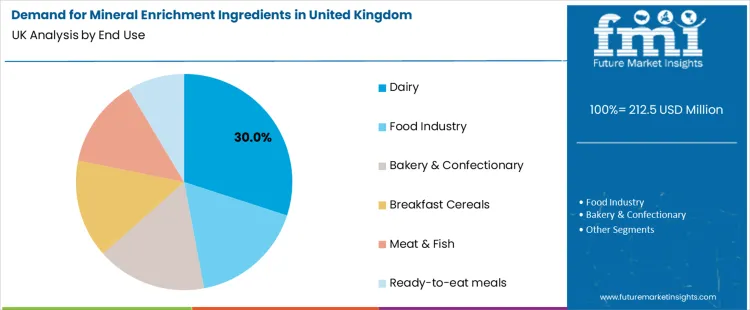
The end-use segment for mineral enrichment ingredients in the United Kingdom is led by the dairy industry, which accounts for 30% of the market share. Dairy products, including milk, yogurt, and cheese, are key sources of essential minerals like calcium and vitamin D. The fortification of dairy products with additional minerals helps to meet the nutritional needs of consumers, particularly in regions where mineral deficiencies are a concern. The use of mineral enrichment ingredients in dairy products helps to enhance their nutritional profile, making them more beneficial to health-conscious consumers. The food industry follows as another significant end user, where minerals are added to a wide range of products such as snacks, sauces, and frozen foods. The growing trend of functional foods, which offer additional health benefits beyond basic nutrition, drives the demand for mineral enrichment ingredients in this sector.
The bakery and confectionery sector also contributes to the market, as manufacturers fortify baked goods and sweets with minerals to meet dietary needs and attract health-conscious consumers. Breakfast cereals, another key application, often serve as a major vehicle for mineral fortification, especially in markets where consumers seek convenient and nutritious breakfast options. Meat & fish and ready-to-eat meals also utilize mineral enrichment to enhance the nutritional value of their products, catering to the demand for quick, balanced meals. As consumer interest in fortified foods continues to rise, the demand for mineral enrichment ingredients across these sectors is expected to grow, ensuring that essential minerals are more accessible in everyday foods.
What is the Demand for Mineral Enrichment Ingredients in the United Kingdom?
Demand for mineral enrichment ingredients in the United Kingdom reflects the use of fortified nutrients in food, beverage, animal feed, and dietary supplement products. These ingredients, including iron, calcium, zinc, magnesium, and micronutrient premixes, are incorporated to address nutritional gaps and meet regulatory fortification standards. Food manufacturers fortify bread, dairy, cereals, and beverages to deliver defined levels of essential minerals. Animal nutrition formulators use mineral premixes to optimise livestock health and productivity. Demand is linked to consumer awareness of nutrition, health policy on nutrient deficiencies, and industry practice in value added product formulation.
What are the Key Drivers for Mineral Enrichment Ingredient Demand in the United Kingdom?
Several factors drive demand for mineral enrichment ingredients in the United Kingdom. Public health guidelines that highlight micronutrient intake recommendations encourage food producers to fortify products to support population nutrition. Consumer preference for healthier food options with added functional benefits reinforces uptake of enriched products. Growth in the dietary supplement category, including multivitamins with trace minerals, contributes consistently to ingredient volumes. The animal feed sector also sustains demand as livestock producers incorporate mineral premixes to support growth, reproduction, and immune function. Regulatory frameworks that permit and standardise fortification levels shape formulation practices across food and feed industries.
What are the Restraints on Mineral Enrichment Ingredient Demand in the United Kingdom?
Despite broad application, several restraints affect the mineral enrichment ingredient market in the United Kingdom. Cost pressures on food and beverage manufacturers can limit the inclusion of higher cost fortified ingredients, particularly in price sensitive product categories. Technical challenges in formulation, such as mineral interactions affecting taste, stability, or bioavailability, can constrain use in certain matrices. Regulatory compliance requirements for nutrient labelling, safety assessment, and permitted levels add complexity for formulators. Consumer scepticism about fortified products, when perceived as processed or artificial, can temper broader acceptance. Competition from alternative nutritional strategies, such as whole food approaches or botanical supplements, may also dilute demand in specific segments.
What are the Key Trends in Mineral Enrichment Ingredient Demand in the United Kingdom?
Key trends influencing mineral enrichment ingredient demand in the United Kingdom include a shift toward personalised nutrition and targeted fortification to address specific demographic needs, such as bone health or immune support. Manufacturers are prioritising bioavailable mineral forms that improve absorption and reduce formulation challenges. Clean label positioning drives interest in naturally derived mineral sources and transparent ingredient declaration. In animal nutrition, precision premixes tailored to species, life stage, and production goals are becoming more prevalent. Industry innovation in micronutrient delivery systems, including microencapsulation to mask flavour and enhance stability, supports broader adoption in complex food and beverage applications.
What is the Country-Wise Demand for Mineral Enrichment Ingredients in the United Kingdom?
The country-wise demand for mineral enrichment ingredients in the United Kingdom shows varying levels of adoption across its regions. England leads the market, driven by its large food, beverage, and dietary supplement industries, where mineral enrichment is essential for fortifying products and meeting consumer health demands. Scotland, Wales, and Northern Ireland follow, with steady demand growth, particularly in the food production and wellness sectors. As consumers increasingly prioritize health and nutrition, the demand for mineral-enriched products is expected to rise across all regions. England remains the dominant market, while the other regions experience steady growth, supported by an increasing focus on fortified foods and supplements.
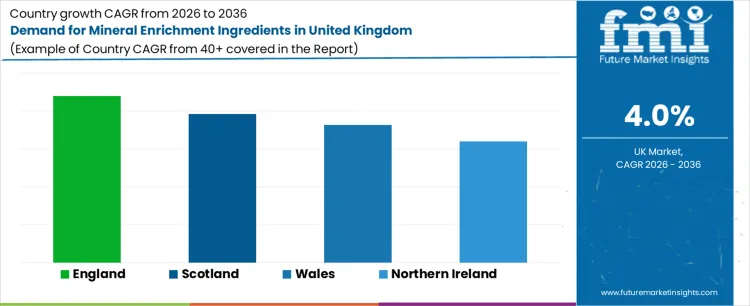
| Country | CAGR (2026 to 2036) |
|---|---|
| England | 4.4% |
| Scotland | 3.9% |
| Wales | 3.6% |
| Northern Ireland | 3.2% |
What is Driving the Demand for Mineral Enrichment Ingredients in England?
The demand for mineral enrichment ingredients in England is projected to grow at a CAGR of 4.4% from 2026 to 2036. England’s large food, beverage, and dietary supplement sectors are the primary drivers of this demand. As consumers become more health-conscious and seek out products that support their nutritional needs, the demand for mineral-enriched foods and supplements continues to rise. Mineral enrichment is increasingly being used to fortify products like cereals, dairy, and juices, helping to address nutrient deficiencies in the population. Additionally, the growing focus on preventive healthcare and the rising popularity of functional foods are expected to further drive the adoption of mineral enrichment ingredients in England. With its advanced food processing industry and strong consumer demand for health-focused products, England is expected to maintain its position as the largest market for mineral enrichment ingredients in the UK.
How is the Demand for Mineral Enrichment Ingredients Performing in Scotland?
In Scotland, the demand for mineral enrichment ingredients is expected to grow at a CAGR of 3.9% from 2026 to 2036. Scotland’s food and beverage industry, along with its growing health and wellness market, is driving the demand for mineral-enriched products. The increasing awareness of health issues such as osteoporosis, anemia, and heart disease is encouraging Scottish consumers to choose fortified foods that provide essential minerals. Scotland’s food processing sector is also adopting mineral enrichment to meet consumer demand for products that support better nutrition and overall well-being. Additionally, the rising popularity of plant-based and functional foods in Scotland is creating new opportunities for mineral enrichment in these product categories. As consumers seek products that offer added health benefits, the demand for mineral enrichment ingredients in Scotland is expected to grow steadily over the coming years.
What Are the Growth Drivers for Mineral Enrichment Ingredients in Wales?
The demand for mineral enrichment ingredients in Wales is projected to grow at a CAGR of 3.6% through 2036. Wales’ food and beverage sector is increasingly adopting mineral enrichment to meet consumer demand for more nutritious, fortified products. As health and wellness trends continue to influence consumer choices, the demand for products like fortified cereals, dairy, and plant-based foods is on the rise. The growing focus on preventive health care in Wales, combined with government initiatives aimed at addressing nutrient deficiencies, is driving the adoption of mineral enrichment ingredients. Furthermore, the growing popularity of functional foods, which offer added health benefits, is contributing to the increased demand for mineral enrichment in Wales. As consumers continue to prioritize health and nutrition, the demand for mineral-enriched foods and supplements is expected to maintain steady growth in Wales.
What is the Outlook for Mineral Enrichment Ingredients Demand in Northern Ireland?
Northern Ireland’s demand for mineral enrichment ingredients is expected to grow at a CAGR of 3.2% from 2026 to 2036. While Northern Ireland represents the smallest market for mineral enrichment ingredients in the United Kingdom, the demand is steadily increasing. The growing awareness of the importance of nutrition and the rising focus on fortified foods are key drivers of this demand. Northern Ireland’s food and beverage industry is increasingly incorporating mineral enrichment into its products to cater to the demand for healthier, more nutritionally balanced options. Additionally, as consumers become more aware of the benefits of specific minerals like calcium, iron, and magnesium, the demand for mineral-enriched foods is expected to rise. While the market remains smaller than in other regions, the steady growth in consumer interest in health and wellness will continue to fuel the adoption of mineral enrichment ingredients in Northern Ireland.
What is the Competitive Landscape for Demand for Mineral Enrichment Ingredients in the United Kingdom?

Demand for mineral enrichment ingredients in the United Kingdom is shaped by requirements from the food and beverage, animal nutrition, and fortified product segments. Procurement activity is driven by formulation needs for micronutrients such as iron, calcium, zinc, and magnesium that are added to health products, processed foods, and feed rations. Technical brochures are consulted to compare documented nutrient concentrations, stability profiles, and recommended inclusion rates. Tate & Lyle’s documented offerings cover a range of mineral carriers and fortification blends, with specification sheets listing solubility data, handling guidelines, and regulatory compliance notes.
Cargill participates with enriched ingredient systems that are detailed in product literature outlining trace mineral profiles, application notes, and documented efficacy data. Archer Daniels Midland’s brochures describe standardized mineral matrices, with documented physical and chemical attributes used by formulation teams when aligning ingredient choice with processing conditions. DSM Firmenich’s materials include documented micronutrient complexes tailored for food and beverage fortification, with technical documentation highlighting bioavailability measurements and suggested dosage ranges. BASF SE contributes mineral enrichment solutions with specification guides that list compound forms and documented stability under defined processing parameters.
Selection of suppliers in the United Kingdom is influenced by documented performance attributes and documented supply reliability. Buyers compare product literature to ensure that enriched ingredients meet targeted nutrient levels, meet regulatory standards, and support final product labeling requirements. Lead times, storage conditions, and documented handling instructions appear in official brochures and technical guides, informing procurement decisions during scheduled production cycles.
Nutrient stability under processing conditions is referenced in specification documents, and compatibility with other formulation components is assessed through documented data. Procurement teams assess documented regulatory compliance notes to align with United Kingdom food fortification guidelines and labeling frameworks. Competitive activity among suppliers is grounded in published material that outlines measured nutrient values, documented processing parameters, and documented quality controls, which support specification alignment for diverse product portfolios. Technical teams use these materials during tender evaluations to ensure that selected mineral enrichment ingredients satisfy both performance and compliance criteria.
Key Players of the Demand for Mineral Enrichment Ingredients in United Kingdom
- Tate & Lyle
- Cargill
- Archer Daniels Midland
- DSM-Firmenich
- BASF SE
Scope of the Report
| Items | Values |
|---|---|
| Quantitative Units (2026) | USD Million |
| Form | Powder, Granule |
| Ingredient Type | Zinc, Sodium, Potassium, Calcium, Phosphorus, Magnesium |
| End Use | Food Industry, Dairy, Bakery & Confectionery, Breakfast Cereals, Meat & Fish, Ready-to-eat meals |
| Companies | Tate & Lyle, Cargill, Archer Daniels Midland, DSM-Firmenich, BASF SE |
| Regions Covered | United Kingdom |
| Countries Covered | England, Scotland, Wales, Northern Ireland |
| Additional Attributes | Dollar by sales by form, ingredient type, end use, and region. Includes market trends towards health-conscious ingredients, cost-effectiveness, and the role of mineral enrichment in enhancing food products. |
Demand for Mineral Enrichment Ingredients in United Kingdom
Form
- Powder
- Granule
Ingredient Type
- Zinc
- Sodium
- Potassium
- Calcium
- Phosphorus
- Magnesium
End Use
- Food Industry
- Dairy
- Bakery & Confectionery
- Breakfast Cereals
- Meat & Fish
- Ready-to-eat meals
Countries
- England
- Scotland
- Wales
- Northern Ireland
Bibliography
- Office for National Statistics. (2024). UK manufacturers’ sales by product: 2023 (PRODCOM). Office for National Statistics.
- United Kingdom. (2024). The Bread and Flour (Amendment) (England) Regulations 2024 (S.I. 2024/1162). Legislation.gov.uk.
- Department of Health and Social Care. (2024, November 14). Birth defects prevented by fortifying flour with folic acid. Government of the United Kingdom.
Frequently Asked Questions
How big is the demand for mineral enrichment ingredients in United Kingdom in 2026?
The demand for mineral enrichment ingredients in United Kingdom is estimated to be valued at USD 212.5 million in 2026.
What will be the size of mineral enrichment ingredients in United Kingdom in 2036?
The market size for the mineral enrichment ingredients in United Kingdom is projected to reach USD 314.5 million by 2036.
How much will be the demand for mineral enrichment ingredients in United Kingdom growth between 2026 and 2036?
The demand for mineral enrichment ingredients in United Kingdom is expected to grow at a 4.0% CAGR between 2026 and 2036.
What are the key forms types in the mineral enrichment ingredients in United Kingdom?
The key forms types in mineral enrichment ingredients in United Kingdom are powder and granule.
Which ingredient type segment is expected to contribute significant share in the mineral enrichment ingredients in United Kingdom in 2026?
In terms of ingredient type, zinc segment is expected to command 25.0% share in the mineral enrichment ingredients in United Kingdom in 2026.
Preview the report firsthand - request a free sample
Get SampleGet the brochure for pricing and purchase details.
Get PDFTable of Content
- Executive Summary
- UK Market Outlook
- Demand-side Trends
- Supply-side Trends
- Technology Roadmap Analysis
- Analysis and Recommendations
- Market Overview
- Market Coverage / Taxonomy
- Market Definition / Scope / Limitations
- Market Background
- Market Dynamics
- Drivers
- Restraints
- Opportunity
- Trends
- Scenario Forecast
- Demand in Optimistic Scenario
- Demand in Likely Scenario
- Demand in Conservative Scenario
- Opportunity Map Analysis
- Product Life Cycle Analysis
- Supply Chain Analysis
- Investment Feasibility Matrix
- Value Chain Analysis
- PESTLE and Porter’s Analysis
- Regulatory Landscape
- Regional Parent Market Outlook
- Production and Consumption Statistics
- Import and Export Statistics
- Market Dynamics
- UK Market Analysis 2021 to 2025 and Forecast, 2026 to 2036
- Historical Market Size Value (USD Million) Analysis, 2021 to 2025
- Current and Future Market Size Value (USD Million) Projections, 2026 to 2036
- Y-o-Y Growth Trend Analysis
- Absolute $ Opportunity Analysis
- UK Market Pricing Analysis 2021 to 2025 and Forecast 2026 to 2036
- UK Market Analysis 2021 to 2025 and Forecast 2026 to 2036, By Form
- Introduction / Key Findings
- Historical Market Size Value (USD Million) Analysis By Form , 2021 to 2025
- Current and Future Market Size Value (USD Million) Analysis and Forecast By Form , 2026 to 2036
- Powder
- Granule
- Powder
- Y-o-Y Growth Trend Analysis By Form , 2021 to 2025
- Absolute $ Opportunity Analysis By Form , 2026 to 2036
- UK Market Analysis 2021 to 2025 and Forecast 2026 to 2036, By Ingredient Type
- Introduction / Key Findings
- Historical Market Size Value (USD Million) Analysis By Ingredient Type, 2021 to 2025
- Current and Future Market Size Value (USD Million) Analysis and Forecast By Ingredient Type, 2026 to 2036
- Zinc
- Sodium
- Potassium
- Calcium
- Phosphorus
- Magnesium
- Zinc
- Y-o-Y Growth Trend Analysis By Ingredient Type, 2021 to 2025
- Absolute $ Opportunity Analysis By Ingredient Type, 2026 to 2036
- UK Market Analysis 2021 to 2025 and Forecast 2026 to 2036, By End Use
- Introduction / Key Findings
- Historical Market Size Value (USD Million) Analysis By End Use, 2021 to 2025
- Current and Future Market Size Value (USD Million) Analysis and Forecast By End Use, 2026 to 2036
- Dairy
- Food Industry
- Bakery & Confectionery
- Breakfast Cereals
- Meat & Fish
- Ready-to-eat meals
- Dairy
- Y-o-Y Growth Trend Analysis By End Use, 2021 to 2025
- Absolute $ Opportunity Analysis By End Use, 2026 to 2036
- Market Structure Analysis
- Competition Dashboard
- Competition Benchmarking
- Market Share Analysis of Top Players
- By Regional
- By Form
- By Ingredient Type
- By End Use
- Competition Analysis
- Competition Deep Dive
- Tate & Lyle
- Overview
- Product Portfolio
- Profitability by Market Segments (Product/Age /Sales Channel/Region)
- Sales Footprint
- Strategy Overview
- Marketing Strategy
- Product Strategy
- Channel Strategy
- Cargill
- Archer Daniels Midland
- DSM-Firmenich
- BASF SE
- Tate & Lyle
- Competition Deep Dive
- Assumptions & Acronyms Used
- Research Methodology


