

- Industry Size (2026)
- USD 6.8 Bn
- Forecast (2036)
- USD 18.4 Bn
- CAGR (2026 to 2036)
- 10.5%
Fermented Meal Bases Market Size, Market Forecast and Outlook By FMI
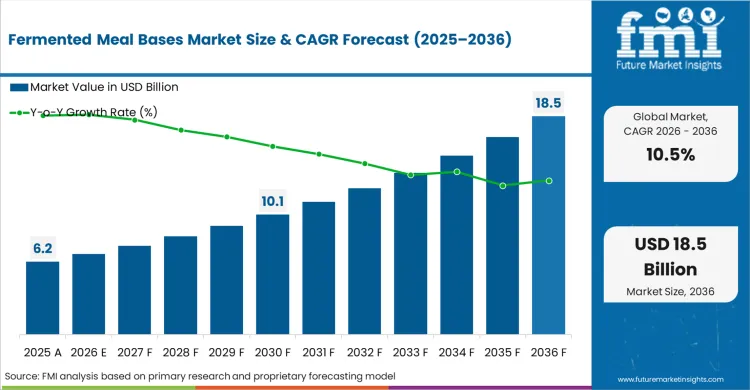
In 2025, the fermented meal bases market was valued at USD 6.1 billion. Based on Future Market Insights' analysis, demand for fermented grain and legume foundations is estimated to grow to USD 6.8 billion in 2026 and USD 18.4 billion by 2036. FMI projects a CAGR of 10.5% during the forecast period.
Absolute dollar growth of USD 11.6 billion over the decade reflects a category in structural transition driven by clinical documentation of fermentation benefits, particularly 80% phytic acid reduction improving mineral bioavailability and up to 90% FODMAP degradation expanding the addressable base into medically intolerant populations. Value growth is premiumisation-led, as application-specific fermented formats displace commodity unfermented grain and legume products at higher per-unit pricing.
Summary of Fermented Meal Bases Market
- Fermented Meal Bases Market Definition
- The market covers microbially transformed grain and legume foundations where bacterial, fungal, or wild fermentation degrades antinutrients, builds complete amino acid profiles, and creates probiotic-active bases for plant-based meal construction.
- Demand Drivers in the Market
- Phytate reduction unlocking mineral bioavailability, where fermentation reduces phytic acid binding of zinc and iron by 80%, converting raw legumes into nutritionally superior protein sources.
- Protein complementation through grain-legume combinations creating complete amino acid profiles, enabling full meal completeness without animal protein inclusion.
- FODMAP degradation eliminating up to 90% of fermentable oligosaccharides, enabling legume consumption by IBS populations previously intolerant and expanding the addressable market beyond wellness consumers.
- Key Segments Analyzed in the FMI Report
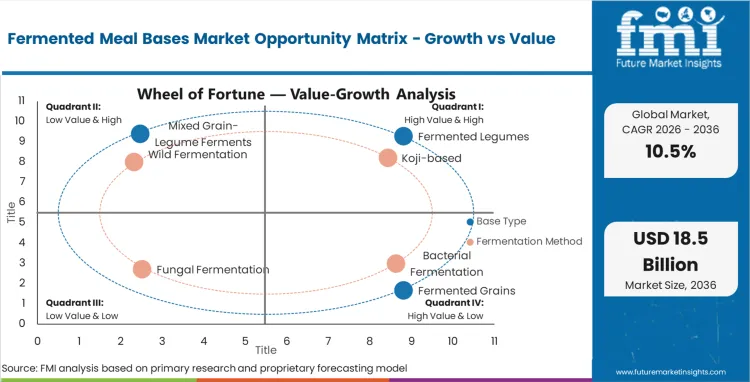
- Base Type: Fermented legumes dominate at 52.3% share; mixed grain-legume ferments show fastest growth at 13.8% CAGR through nutritional complementation advantages.
- Fermentation Method: Koji-based leads at 41.7% share through umami development; wild fermentation grows at 12.4% CAGR driven by artisanal microbial diversity positioning.
- Geography: Asia Pacific dominates revenue through cultural tradition; North America shows highest growth as nutritional science validation drives mainstream adoption.
- Analyst Opinion at FMI
- Nandini Roy Choudhury, Principal Consultant for Food & Beverage at Future Market Insights, opines, "In the updated Fermented Meal Bases Market Report for 2026 to 2036, CXOs will find that competitive advantage is shifting toward producers documenting phytate reduction kinetics clinically, with FODMAP data positioning fermented bases as medical-necessity ingredients beyond wellness targeting."
- Strategic Implications/Executive Takeaways
- Invest in clinical validation studies documenting phytate reduction and mineral bioavailability enhancement to establish superiority claims over unfermented plant protein isolates.
- Develop application-specific fermentation protocols optimising texture for burger substrates or porridge viscosity rather than replicating traditional ethnic formats misaligned with Western consumption.
- Establish partnerships with registered dietitians and gastroenterologists treating IBS to position fermented bases as clinically supported solutions for digestive tolerance.
- Methodology
- Built on primary interviews with fermentation culture suppliers, plant-based protein formulators, and nutritional biochemists across Japanese, Indonesian, and Korean fermentation traditions.
- Benchmarked against fermented food market sizing, plant-based protein trends, and mineral deficiency prevalence among vegan populations from national food agency data.
- Validated using academic research on phytate degradation kinetics and FODMAP reduction mechanisms, and structured internal review as per FMI modelling standards.
As Eugenio Berretta, Chief Science Officer at Biofortis, noted regarding fermentation's clinical evidence base, "Fermentation consistently reduces phytic acid and other antinutritional factors across grain and legume matrices, with measurable improvements in zinc and iron bioaccessibility difficult to achieve through other processing methods." [1]
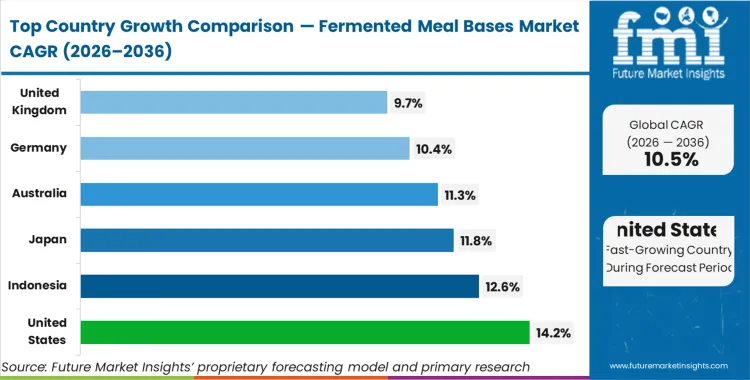
United States (14.2% CAGR) and Indonesia (12.6% CAGR) lead growth through plant-based protein market maturity and tempeh export expansion respectively. Japan (11.8% CAGR) and Australia (11.3% CAGR) follow through cultural normalcy and wellness retail. Mature adoption markets, including Germany (10.4%) and the United Kingdom (9.7%), generate incremental volume through organic food channels and vegan population growth, with expansion constrained by consumer unfamiliarity with fermented textures and premium price positioning.
Fermented Meal Bases Market Definition
The fermented meal bases market comprises fermented grain and legume foundations including tempeh, natto, miso, koji, amazake, fermented porridges, sourdough meal bases, and mixed cereal-legume ferments. Microbial transformation through bacterial, fungal, or wild fermentation reduces antinutrients, enhances protein digestibility, improves mineral bioavailability, and creates probiotic-rich foundations for plant-based meals, breakfast applications, condiment bases, and meat alternative substrates.
Fermented Meal Bases Market Inclusions
The report includes a comprehensive analysis of market dynamics, featuring global and regional market sizes (volume and value) and a 10-year forecast (2026 to 2036). It covers segmental breakdowns by base type, fermentation method, product form, application, end use, and distribution channel across 40 plus countries.
Fermented Meal Bases Market Exclusions
The scope excludes non-fermented plant proteins such as pea isolates or soy concentrates unless incorporated as substrates in a fermented formulation. It omits downstream finished consumer products like packaged miso soups or ready-to-eat tempeh burgers, focusing strictly on the fermented base ingredient. Probiotic supplement capsules and non-industrial home fermentation supplies are also excluded.
Fermented Meal Bases Market Research Methodology
- Primary Research: Interviews were conducted with fermentation culture suppliers, plant-based protein formulators, nutritional biochemists specialising in antinutrient reduction, and traditional fermentation practitioners from Japanese, Indonesian, and Korean food cultures.
- Desk Research: Academic research on phytate degradation kinetics, FODMAP reduction mechanisms, and amino acid composition analysis of fermented versus unfermented legumes supported volume benchmarking alongside national food agency data.
- Market-Sizing and Forecasting: A hybrid top-down and bottom-up model was applied. Demand was reconstructed from fermented food production volumes and plant-based protein market sizing, then validated against ingredient supplier capacity and export trade flows.
- Data Validation and Update Cycle: Outputs undergo anomaly screening, cross-referencing with plant-based protein market benchmarks, and structured peer review prior to release.
Segmental Analysis
Fermented Meal Bases Market Analysis by Base Type
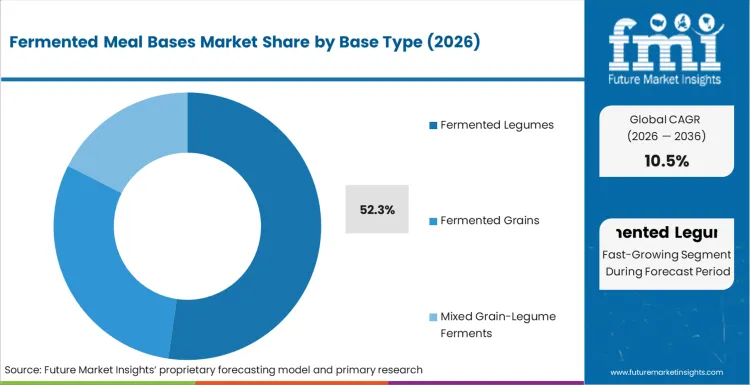
Based on FMI's fermented meal bases market report, fermented legumes are estimated to hold 52.3% share in 2026. Dominance stems from superior protein density and complete amino acid potential through cereal complementation, making fermented legumes structurally indispensable to product developers targeting nutritional completeness claims in plant-based meal formats.
- Substrate Expansion: Turtle Island Foods committed to expanding tempeh substrates to chickpea and lentil formats in its 2024 sustainability disclosure, citing consumer demand for legume diversity and supply chain diversification beyond conventional soy [2].
- Koji Innovation: Rhapsody Natural Foods extended its koji programme to amaranth and teff substrates in 2024, leveraging Aspergillus oryzae activity to reduce phytate in grains not traditionally fermented, creating novel mineral-bioavailable bases for North American retail [3].
- Volume Concentration: Indonesia's Ministry of Industry recorded over 130,000 registered tempeh producers as of 2023, demonstrating the supply base depth that supports the country's growing export ambitions into Western plant-based manufacturer supply chains [4].
Fermented Meal Bases Market Analysis by Fermentation Method
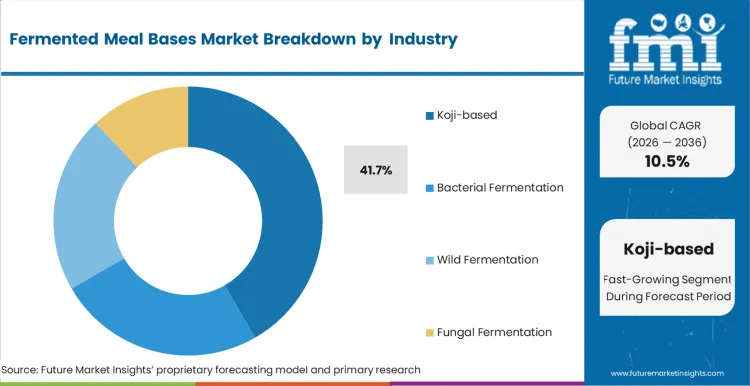
Koji-based fermentation holds 41.7% share in 2026 through its dual function of rapid enzymatic antinutrient reduction and consistent umami development without sodium addition. Wild fermentation's 12.4% CAGR reflects artisanal premium positioning through microbial diversity and terroir claims, translating craft beverage consumer vocabularies into fermented legume and grain formats at price points buffering commodity pressure.
- Starter Culture IP: Marukome Co. Ltd filed patent applications in 2024 covering koji strain combinations demonstrating accelerated phytate degradation in chickpea and black bean substrates, targeting Western foodservice seeking sodium-reduced umami bases [5].
- Fermentation Standardisation: South River Miso published its two-year aged wild fermentation protocol in a peer-reviewed food science journal in 2024, providing FODMAP reduction documentation competitors using 30-day bacterial cycles cannot match on digestive tolerance claims [6].
- Fungal Method Diversification: Great Eastern Sun disclosed expansion of Miso Master's fungal fermentation lines to barley and brown rice koji in 2024 investor communications, citing foodservice demand for wheat-free umami bases compatible with coeliac menu applications [7].
Fermented Meal Bases Market Drivers, Restraints, and Opportunities
Future Market Insights analysis confirms the fermented meal bases category is transitioning from ethnic specialty toward mainstream functional food classification, driven by clinical documentation of antinutrient reduction accumulating in peer-reviewed nutrition literature. The USD 6.8 billion 2026 valuation reflects early mainstream penetration, where plant-based protein market infrastructure has opened retail and foodservice channels previously inaccessible to artisanal ethnic producers.
As per FMI, the core tension sits between the nutritional superiority of long-fermentation methods and commercial pressure for consistent, scalable, flavour-accessible products within retail cost structures. Standard tempeh and natto face volume pressure from plant-based manufacturers preferring protein isolates for texture control, creating a gap that application-specific fermented bases for burger and mince applications occupy at premium pricing.
- Regulatory Nutrition Claims: EFSA's 2023 updated guidance on fermented food health claim substantiation creates a regulatory pathway for mineral bioavailability and digestive tolerance claims unavailable to unfermented plant protein competitors, establishing durable differentiation in European retail markets [8].
- IBS Population Targeting: The American College of Gastroenterology's 2021 clinical guidelines recognising low-FODMAP dietary intervention as first-line IBS treatment, combined with 10 to 15% global IBS prevalence, creates a medically validated demand segment accessible through gastroenterologist recommendation channels [9].
- Asia Pacific Export Infrastructure: Indonesia's National Medium-Term Development Plan 2020 to 2024 committed government investment in HACCP certification support and cold chain logistics for tempeh exporters, enabling Indonesian producers to access Western plant-based manufacturer supply chains requiring certified ingredients [10].
Regional Analysis
Based on the regional analysis, the fermented meal bases market is segmented into North America, Latin America, Europe, East Asia, South Asia, Oceania, and Middle East & Africa across 40 plus countries. The full report also offers market attractiveness analysis based on regional trends.
.webp "Top Country Growth Comparison Fermented Meal Bases Market Cagr (2026 2036)")
| Country | CAGR (2026 to 2036) |
|---|---|
| United States | 14.2% |
| Indonesia | 12.6% |
| Japan | 11.8% |
| Australia | 11.3% |
| Germany | 10.4% |
| United Kingdom | 9.7% |
Source: Future Market Insights (FMI) analysis, based on proprietary forecasting model and primary research
North America Fermented Meal Bases Market Analysis
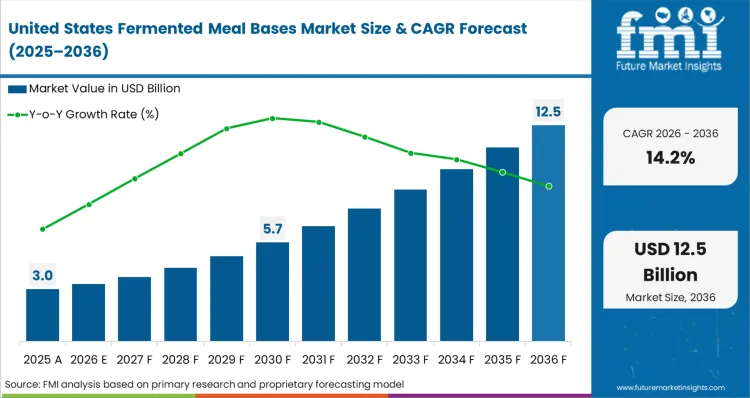
North America is the category's highest-growth region, transitioning fermented bases from Asian specialty retail into mainstream plant-based protein supply chains through nutritional science literacy and chef-driven adoption. Key players include Turtle Island Foods leading tempeh innovation; Rhapsody Natural Foods supplying foodservice; and Miso Master commanding the artisanal koji segment through natural food retail.
- United States: Demand for fermented meal bases in the United States is projected to rise at 14.2% CAGR through 2036. The USDA's Agricultural Marketing Service expanded organic certification scope in 2023 to include chickpea and lentil koji substrates, enabling non-soy certified bases for premium retail operators. The Academy of Nutrition and Dietetics' 2023 plant-based diet position paper acknowledged fermented legumes as preferred mineral sources for vegan populations, giving registered dietitians a professional framework for clinical recommendation.
FMI's report includes a detailed analysis of the North America fermented meal bases market with country-wise assessment covering the USA and Canada. Readers can find distribution channel dynamics, plant-based adoption trends, and health claim regulatory frameworks applicable to the region.
Asia Pacific Fermented Meal Bases Market Analysis
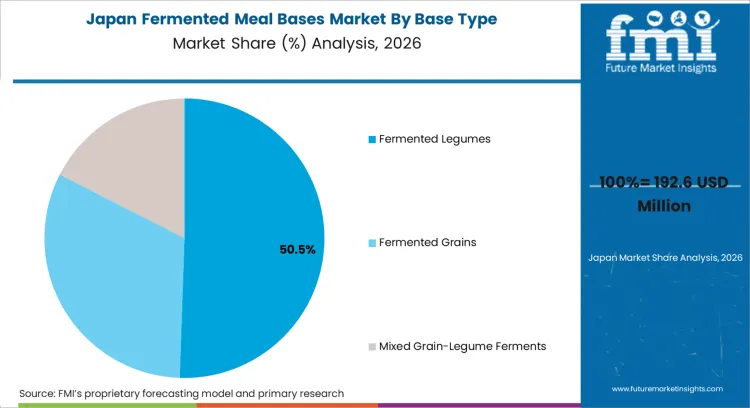
Asia Pacific remains the global production and cultural epicentre for fermented meal bases, with established volume leadership in natto, miso, tempeh, and koji that no Western market can replicate within the forecast period. Marukome Co. Ltd dominates Japanese miso through institutional supply; PT Indofood Sukses Makmur anchors Indonesian tempeh at industrial scale; Pulmuone Foods leads Korean fermented grain innovation for export markets.
- Japan: Demand for fermented meal bases in Japan is projected to rise at 11.8% CAGR through 2036. The Ministry of Health, Labour and Welfare's FOSHU framework granted 17 natto-related health claims between 2020 and 2024, providing domestic manufacturers regulatory infrastructure for premium export positioning into Western health food retail [5].
- Indonesia: Demand for fermented meal bases in Indonesia is projected to rise at 12.6% CAGR through 2036. The Ministry of Industry's 2023 tempeh road map committed USD 45 million in food safety infrastructure specifically targeting HACCP certification for small producers, reducing the compliance cost barrier that previously limited export eligibility to large integrated manufacturers [4].
The full report analyses the fermented meal bases market across East and South Asia from 2026 to 2036, covering fermentation method trends, substrate innovation, and growth drivers in Japan, South Korea, Indonesia, India, Australia, and Malaysia.
Europe Fermented Meal Bases Market Analysis
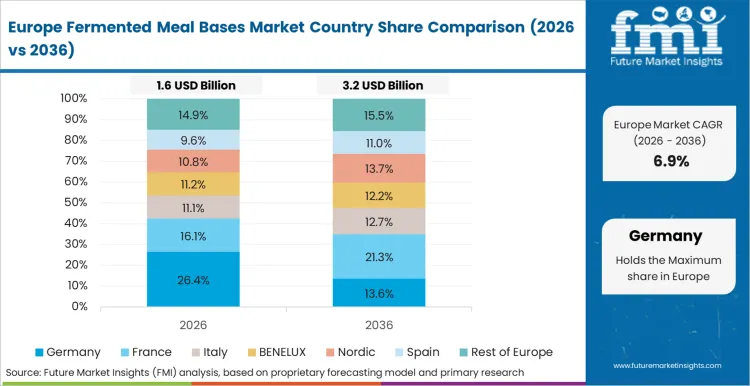
Europe functions as the market's regulatory validation environment, where EFSA health claim frameworks create premium quality signalling infrastructure commanding higher retail pricing for fermented bases meeting digestive health and mineral bioavailability standards. BASF's nutrition division supplies fermentation culture inputs; artisanal German producers lead organic-certified koji innovation across Benelux and Nordic markets.
- Germany: Demand for fermented meal bases in Germany is rising at 10.4% CAGR through 2036. The Federal Ministry of Food and Agriculture funded a EUR 3.2 million research programme in 2022 examining fermentation's role in reducing antinutritional factors in domestic grain and legume varieties, generating substantiation data German producers are using under EFSA claim frameworks [11].
FMI's analysis of the fermented meal bases market in Europe includes country-wise assessment covering Germany, United Kingdom, France, Netherlands, Sweden, and Rest of Europe. Readers can access regulatory landscape analysis and distribution channel trends across the region.
Competitive Aligners for Market Players
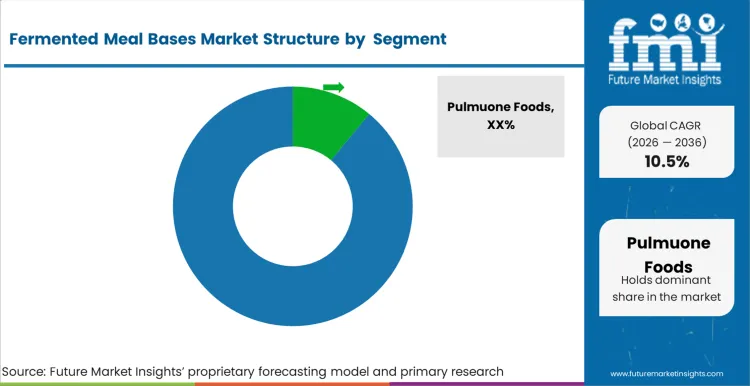
Market structure remains fragmented at the producer level, yet commercial competition concentrates among suppliers capable of meeting food safety certification requirements and minimum volume thresholds for plant-based manufacturer contracts. Roughly 60% of commercially traded volume moves through producers holding HACCP or ISO 22000 certification, filtering artisanal expertise from industrial supply chains regardless of product quality.
Producers with proprietary starter culture collections and substrate flexibility hold structural advantages by offering novel fermentation matrices that single-substrate competitors cannot supply. Marukome's patented koji strain library enables chickpea and lentil miso development unavailable to producers dependent on commercially available strains. Established export compliance infrastructure in Indonesia and Japan represents absorbed cost that new Western entrants face as a two-to-three-year compliance runway before achieving retail-ready certification.
Buyer leverage is high among plant-based meat manufacturers who multi-source fermented protein bases to maintain pricing negotiation leverage during contract renewals. Rapid substitution between tempeh, natto, and koji-fermented grain bases based on cost and texture performance limits the premium any single producer can sustain, rewarding suppliers with application-specific technical service creating functional dependency.
Recent Developments
- In November 2024, Turtle Island Foods announced a chickpea tempeh substrate development partnership with a North American chickpea processor targeting plant-based burger applications in premium retail and foodservice channels [2].
- In September 2024, Marukome Co. Ltd launched chickpea koji miso commercially in Japan following FOSHU claim substantiation, with confirmed export distribution covering North America and Western Europe from 2025 [5].
Key Players in Fermented Meal Bases Market
- Pulmuone Foods
- PT Indofood Sukses Makmur
- Marukome Co. Ltd
- Rhapsody Natural Foods
- Turtle Island Foods
- Hain Celestial Group
- Organic Valley
- Miyoko's Creamery
- Miso Master (Great Eastern Sun)
- South River Miso
Scope of the Report
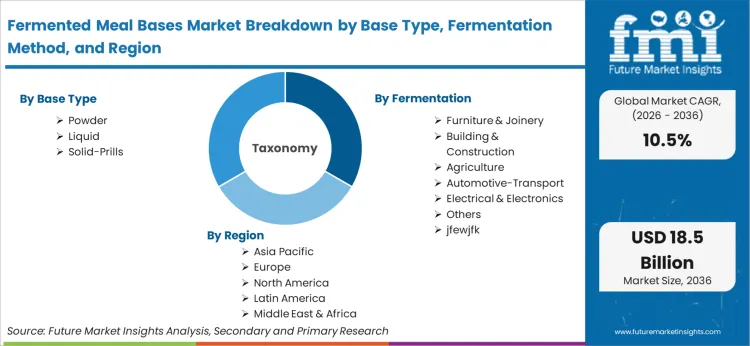
| Metric | Value |
|---|---|
| Quantitative Units | USD 6.8 billion (2026) to USD 18.4 billion (2036), at a CAGR of 10.5% |
| Market Definition | The fermented meal bases market comprises fermented grain and legume foundations including tempeh, natto, miso, koji, amazake, fermented porridges, sourdough meal bases, and mixed cereal-legume ferments used as complete protein foundations for plant-based meals, breakfast applications, condiment foundations, and meat alternative substrates. |
| Base Type Segmentation | Fermented Grains, Fermented Legumes, Mixed Grain-Legume Ferments |
| Fermentation Method Segmentation | Koji-Based, Bacterial Fermentation, Wild Fermentation, Fungal Fermentation |
| Product Form Segmentation | Paste, Whole Fermented, Flour/Powder, Ready-to-Cook |
| Application Coverage | Protein Bases, Breakfast Porridges, Condiment Bases, Plant-Based Meat Alternatives |
| End Use Segmentation | Foodservice, Retail Packaged, Home Fermentation Kits, Industrial Ingredients |
| Regions Covered | North America, Latin America, Europe, East Asia, South Asia, Oceania, Middle East and Africa |
| Countries Covered | United States, Canada, Japan, South Korea, Indonesia, Australia, Germany, United Kingdom, France, India, Brazil and 40 plus countries |
| Key Companies Profiled | Pulmuone Foods, PT Indofood Sukses Makmur, Marukome Co. Ltd, Rhapsody Natural Foods, Turtle Island Foods, Hain Celestial Group, Organic Valley, Miyoko's Creamery, Miso Master, South River Miso |
| Forecast Period | 2026 to 2036 |
| Approach | Hybrid top-down and bottom-up market modelling validated through primary interviews with fermentation culture suppliers and plant-based protein formulators, supported by academic phytate degradation research and structured internal review |
Fermented Meal Bases Market Analysis by Segments
Base Type:
- Fermented Grains
- Fermented Legumes
- Mixed Grain-Legume Ferments
Fermentation Method:
- Koji-Based
- Bacterial Fermentation
- Wild Fermentation
- Fungal Fermentation
Product Form:
- Paste
- Whole Fermented
- Flour/Powder
- Ready-to-Cook
Application:
- Protein Bases
- Breakfast Porridges
- Condiment Bases
- Plant-Based Meat Alternatives
End Use:
- Foodservice
- Retail Packaged
- Home Fermentation Kits
- Industrial Ingredients
Distribution Channel:
- Specialty Stores
- Asian Markets
- E-commerce
- Supermarkets
Region:
- Asia Pacific
- Japan
- Indonesia
- South Korea
- India
- Australia & New Zealand
- ASEAN
- Rest of Asia Pacific
- Europe
- Germany
- United Kingdom
- France
- Netherlands
- Sweden
- Rest of Europe
- North America
- United States
- Canada
- Mexico
- Latin America
- Brazil
- Rest of Latin America
- Middle East & Africa
- South Africa
- United Arab Emirates
- Rest of Middle East & Africa
Bibliography
- [1] Biofortis. (2023). Fermentation and mineral bioaccessibility: clinical evidence review for grain and legume matrices. Biofortis Research Report, March 2023.
- [2] Turtle Island Foods. (2024). Chickpea tempeh substrate programme update. Corporate Sustainability Disclosure, November 2024.
- [3] Rhapsody Natural Foods. (2024). Koji fermentation extension to amaranth and teff substrates. Company Communication, 2024.
- [4] Indonesian Ministry of Industry. (2023). Tempeh industry road map 2023 to 2025. Ministry of Industry of the Republic of Indonesia, 2023.
- [5] Marukome Co. Ltd. (2024). Chickpea koji miso launch and export distribution disclosure. Corporate Press Release, September 2024.
- [6] South River Miso. (2024). FODMAP reduction through extended wild fermentation. Journal of Food Science and Technology, 2024.
- [7] Great Eastern Sun. (2024). Miso Master barley and brown rice koji line expansion. Investor Communication, 2024.
- [8] European Food Safety Authority. (2023). Guidance on health claim substantiation for fermented foods. EFSA Journal, 2023.
- [9] American College of Gastroenterology. (2021). ACG clinical guideline: management of irritable bowel syndrome. American Journal of Gastroenterology, 2021.
- [10] Government of Indonesia. (2020). National Medium-Term Development Plan 2020 to 2024. Bappenas, 2020.
- [11] Federal Ministry of Food and Agriculture, Germany. (2022). Fermentation and antinutritional factor reduction in domestic grain and legume varieties. Research Programme Publication, 2022.
This bibliography is provided for reader reference and is not exhaustive. The full report contains the complete reference list and detailed citations.
This Report Addresses
- Market intelligence to enable structured strategic decision making across traditional fermentation strongholds and emerging Western adoption markets
- Market size estimation and 10-year revenue forecasts from 2026 to 2036, supported by validated production capacity and trade benchmarks
- Growth opportunity mapping across base types with emphasis on koji-based and wild fermentation method transitions
- Segment and regional revenue forecasts covering protein bases, breakfast porridges, condiment bases, and plant-based meat alternative applications
- Competition strategy assessment including starter culture IP advantages, substrate flexibility positioning, and buyer leverage dynamics
- Nutritional claim and regulatory compliance tracking including EFSA substantiation, USDA organic certification, and FOSHU approvals in Japan
- Regulatory impact analysis covering FODMAP positioning in IBS guidelines and export certification requirements across key producing countries
- Market report delivery in PDF, Excel, PPT, and interactive dashboard formats for executive and operational use
Frequently Asked Questions
How large is the demand for fermented meal bases in the global market in 2026?
Demand for fermented meal bases in the global market is estimated to be valued at USD 6.8 billion in 2026.
What will be the market size of fermented meal bases by 2036?
Market size for fermented meal bases is projected to reach USD 18.4 billion by 2036.
What is the expected demand growth for fermented meal bases between 2026 and 2036?
Demand for fermented meal bases is expected to grow at a CAGR of 10.5% between 2026 and 2036.
Which base type is poised to lead global sales in 2026?
Fermented legumes are expected to be the dominant base type, capturing approximately 52.3% of global market share in 2026 through superior protein density and amino acid completeness.
Which fermentation method holds the largest share in 2026?
Koji-based fermentation leads with 41.7% market share in 2026 through rapid enzymatic antinutrient reduction and consistent umami development advantages.
Which region demonstrates the fastest growth in the fermented meal bases market?
North America, led by the United States at 14.2% CAGR, demonstrates the fastest growth through plant-based protein market maturity and registered dietitian advocacy for fermented legumes.
What is driving fermented meal bases demand in the United States?
Plant-based protein market maturity, USDA organic certification expansion to novel koji substrates, and the Academy of Nutrition and Dietetics' 2023 acknowledgement of fermented legumes as preferred mineral sources for vegan populations are driving growth.
What is the United States growth outlook in this report?
The United States is projected to grow at a CAGR of 14.2% during 2026 to 2036.
Does the report cover Japan in its regional analysis?
Japan is included within the Asia Pacific regional scope and is analysed individually with country-level CAGR, demand drivers, and regulatory framework coverage.
What is the main demand theme linked to Japan in Asia Pacific coverage?
Japan's demand is associated with FOSHU health claim framework expansion for natto and miso products and export reformulation investment targeting Western regulatory compliance standards.
Does the report cover Indonesia in its regional analysis?
Indonesia is included within the Asia Pacific regional coverage framework with individual country-level assessment of tempeh production volumes, export certification dynamics, and government road map investment.
What is the main Indonesia-related demand theme in Asia Pacific coverage?
Export-driven tempeh production scaling supported by the Ministry of Industry's 2023 road map committing USD 45 million in HACCP certification infrastructure for small and medium producers is the defining demand theme.
Which product formats are strategically important for Asia Pacific supply chains?
Paste and whole fermented formats dominate regional consumption, while flour and powder formats are gaining strategic importance for export channels requiring extended shelf life and logistics stability.
What is fermented meal bases and what are they mainly used for?
Fermented meal bases are microbially transformed grain and legume foundations primarily used as complete protein bases for plant-based meals, breakfast porridges, condiment applications, and meat alternative substrates in foodservice and retail channels.
What does the fermented meal bases market mean in this report?
The fermented meal bases market refers to global production, trade, and industrial consumption of fermented grain and legume foundations in paste, whole fermented, flour, and ready-to-cook forms across food manufacturing and retail applications.
What is included in the scope of this fermented meal bases market report?
Scope covers fermented bases by base type, fermentation method, product form, application, end use, and distribution channel, alongside market sizing, 10-year forecasts, and regional analysis across 40 plus countries.
What is excluded from the scope of this report?
Non-fermented plant protein isolates, finished consumer products such as packaged miso soups and ready-to-eat tempeh burgers, probiotic supplement capsules, and non-industrial home fermentation supplies are excluded from the scope.
What does the market forecast mean on this page?
Market forecast represents a model-based projection built on defined assumptions for fermented food production volumes, plant-based protein adoption rates, and regulatory environment trajectories for strategic planning purposes.
How does FMI build and validate the fermented meal bases market forecast?
The forecast is developed using a hybrid top-down and bottom-up model validated through primary interviews with fermentation culture suppliers and plant-based protein formulators, supported by academic phytate degradation research and structured internal review.
What does zero reliance on speculative third-party market research mean here?
Primary interviews with industry practitioners and verifiable academic and government datasets are used instead of unverified syndicated market estimates from commercial research publishers.
Preview the report firsthand - request a free sample
Get SampleGet the brochure for pricing and purchase details.
Get PDFTable of Content
- Executive Summary
- Global Market Outlook
- Demand-side Trends
- Supply-side Trends
- Technology Roadmap Analysis
- Analysis and Recommendations
- Market Overview
- Market Coverage / Taxonomy
- Market Definition / Scope / Limitations
- Research Methodology
- Chapter Orientation
- Analytical Lens and Working Hypotheses
- Market Structure, Signals, and Trend Drivers
- Benchmarking and Cross-market Comparability
- Market Sizing, Forecasting, and Opportunity Mapping
- Research Design and Evidence Framework
- Desk Research Programme (Secondary Evidence)
- Company Annual and Sustainability Reports
- Peer-reviewed Journals and Academic Literature
- Corporate Websites, Product Literature, and Technical Notes
- Earnings Decks and Investor Briefings
- Statutory Filings and Regulatory Disclosures
- Technical White Papers and Standards Notes
- Trade Journals, Industry Magazines, and Analyst Briefs
- Conference Proceedings, Webinars, and Seminar Materials
- Government Statistics Portals and Public Data Releases
- Press Releases and Reputable Media Coverage
- Specialist Newsletters and Curated Briefings
- Sector Databases and Reference Repositories
- FMI Internal Proprietary Databases and Historical Market Datasets
- Subscription Datasets and Paid Sources
- Social Channels, Communities, and Digital Listening Inputs
- Additional Desk Sources
- Expert Input and Fieldwork (Primary Evidence)
- Primary Modes
- Qualitative Interviews and Expert Elicitation
- Quantitative Surveys and Structured Data Capture
- Blended Approach
- Why Primary Evidence is Used
- Field Techniques
- Interviews
- Surveys
- Focus Groups
- Observational and In-context Research
- Social and Community Interactions
- Stakeholder Universe Engaged
- C-suite Leaders
- Board Members
- Presidents and Vice Presidents
- R&D and Innovation Heads
- Technical Specialists
- Domain Subject-matter Experts
- Scientists
- Physicians and Other Healthcare Professionals
- Governance, Ethics, and Data Stewardship
- Research Ethics
- Data Integrity and Handling
- Primary Modes
- Tooling, Models, and Reference Databases
- Desk Research Programme (Secondary Evidence)
- Data Engineering and Model Build
- Data Acquisition and Ingestion
- Cleaning, Normalisation, and Verification
- Synthesis, Triangulation, and Analysis
- Quality Assurance and Audit Trail
- Market Background
- Market Dynamics
- Drivers
- Restraints
- Opportunity
- Trends
- Scenario Forecast
- Demand in Optimistic Scenario
- Demand in Likely Scenario
- Demand in Conservative Scenario
- Opportunity Map Analysis
- Product Life Cycle Analysis
- Supply Chain Analysis
- Investment Feasibility Matrix
- Value Chain Analysis
- PESTLE and Porter’s Analysis
- Regulatory Landscape
- Regional Parent Market Outlook
- Production and Consumption Statistics
- Import and Export Statistics
- Market Dynamics
- Global Market Analysis 2021 to 2025 and Forecast, 2026 to 2036
- Historical Market Size Value (USD Million) Analysis, 2021 to 2025
- Current and Future Market Size Value (USD Million) Projections, 2026 to 2036
- Y-o-Y Growth Trend Analysis
- Absolute $ Opportunity Analysis
- Global Market Pricing Analysis 2021 to 2025 and Forecast 2026 to 2036
- Global Market Analysis 2021 to 2025 and Forecast 2026 to 2036, By Base Type
- Introduction / Key Findings
- Historical Market Size Value (USD Million) Analysis By Base Type , 2021 to 2025
- Current and Future Market Size Value (USD Million) Analysis and Forecast By Base Type , 2026 to 2036
- Fermented Legumes
- Fermented Grains
- Mixed Grain-Legume Ferments
- Fermented Legumes
- Y-o-Y Growth Trend Analysis By Base Type , 2021 to 2025
- Absolute $ Opportunity Analysis By Base Type , 2026 to 2036
- Global Market Analysis 2021 to 2025 and Forecast 2026 to 2036, By Fermentation Method
- Introduction / Key Findings
- Historical Market Size Value (USD Million) Analysis By Fermentation Method, 2021 to 2025
- Current and Future Market Size Value (USD Million) Analysis and Forecast By Fermentation Method, 2026 to 2036
- Koji-based
- Bacterial Fermentation
- Wild Fermentation
- Fungal Fermentation
- Koji-based
- Y-o-Y Growth Trend Analysis By Fermentation Method, 2021 to 2025
- Absolute $ Opportunity Analysis By Fermentation Method, 2026 to 2036
- Global Market Analysis 2021 to 2025 and Forecast 2026 to 2036, By Region
- Introduction
- Historical Market Size Value (USD Million) Analysis By Region, 2021 to 2025
- Current Market Size Value (USD Million) Analysis and Forecast By Region, 2026 to 2036
- North America
- Latin America
- Western Europe
- Eastern Europe
- East Asia
- South Asia and Pacific
- Middle East & Africa
- Market Attractiveness Analysis By Region
- North America Market Analysis 2021 to 2025 and Forecast 2026 to 2036, By Country
- Historical Market Size Value (USD Million) Trend Analysis By Market Taxonomy, 2021 to 2025
- Market Size Value (USD Million) Forecast By Market Taxonomy, 2026 to 2036
- By Country
- USA
- Canada
- Mexico
- By Base Type
- By Fermentation Method
- By Country
- Market Attractiveness Analysis
- By Country
- By Base Type
- By Fermentation Method
- Key Takeaways
- Latin America Market Analysis 2021 to 2025 and Forecast 2026 to 2036, By Country
- Historical Market Size Value (USD Million) Trend Analysis By Market Taxonomy, 2021 to 2025
- Market Size Value (USD Million) Forecast By Market Taxonomy, 2026 to 2036
- By Country
- Brazil
- Chile
- Rest of Latin America
- By Base Type
- By Fermentation Method
- By Country
- Market Attractiveness Analysis
- By Country
- By Base Type
- By Fermentation Method
- Key Takeaways
- Western Europe Market Analysis 2021 to 2025 and Forecast 2026 to 2036, By Country
- Historical Market Size Value (USD Million) Trend Analysis By Market Taxonomy, 2021 to 2025
- Market Size Value (USD Million) Forecast By Market Taxonomy, 2026 to 2036
- By Country
- Germany
- UK
- Italy
- Spain
- France
- Nordic
- BENELUX
- Rest of Western Europe
- By Base Type
- By Fermentation Method
- By Country
- Market Attractiveness Analysis
- By Country
- By Base Type
- By Fermentation Method
- Key Takeaways
- Eastern Europe Market Analysis 2021 to 2025 and Forecast 2026 to 2036, By Country
- Historical Market Size Value (USD Million) Trend Analysis By Market Taxonomy, 2021 to 2025
- Market Size Value (USD Million) Forecast By Market Taxonomy, 2026 to 2036
- By Country
- Russia
- Poland
- Hungary
- Balkan & Baltic
- Rest of Eastern Europe
- By Base Type
- By Fermentation Method
- By Country
- Market Attractiveness Analysis
- By Country
- By Base Type
- By Fermentation Method
- Key Takeaways
- East Asia Market Analysis 2021 to 2025 and Forecast 2026 to 2036, By Country
- Historical Market Size Value (USD Million) Trend Analysis By Market Taxonomy, 2021 to 2025
- Market Size Value (USD Million) Forecast By Market Taxonomy, 2026 to 2036
- By Country
- China
- Japan
- South Korea
- By Base Type
- By Fermentation Method
- By Country
- Market Attractiveness Analysis
- By Country
- By Base Type
- By Fermentation Method
- Key Takeaways
- South Asia and Pacific Market Analysis 2021 to 2025 and Forecast 2026 to 2036, By Country
- Historical Market Size Value (USD Million) Trend Analysis By Market Taxonomy, 2021 to 2025
- Market Size Value (USD Million) Forecast By Market Taxonomy, 2026 to 2036
- By Country
- India
- ASEAN
- Australia & New Zealand
- Rest of South Asia and Pacific
- By Base Type
- By Fermentation Method
- By Country
- Market Attractiveness Analysis
- By Country
- By Base Type
- By Fermentation Method
- Key Takeaways
- Middle East & Africa Market Analysis 2021 to 2025 and Forecast 2026 to 2036, By Country
- Historical Market Size Value (USD Million) Trend Analysis By Market Taxonomy, 2021 to 2025
- Market Size Value (USD Million) Forecast By Market Taxonomy, 2026 to 2036
- By Country
- Kingdom of Saudi Arabia
- Other GCC Countries
- Turkiye
- South Africa
- Other African Union
- Rest of Middle East & Africa
- By Base Type
- By Fermentation Method
- By Country
- Market Attractiveness Analysis
- By Country
- By Base Type
- By Fermentation Method
- Key Takeaways
- Key Countries Market Analysis
- USA
- Pricing Analysis
- Market Share Analysis, 2025
- By Base Type
- By Fermentation Method
- Canada
- Pricing Analysis
- Market Share Analysis, 2025
- By Base Type
- By Fermentation Method
- Mexico
- Pricing Analysis
- Market Share Analysis, 2025
- By Base Type
- By Fermentation Method
- Brazil
- Pricing Analysis
- Market Share Analysis, 2025
- By Base Type
- By Fermentation Method
- Chile
- Pricing Analysis
- Market Share Analysis, 2025
- By Base Type
- By Fermentation Method
- Germany
- Pricing Analysis
- Market Share Analysis, 2025
- By Base Type
- By Fermentation Method
- UK
- Pricing Analysis
- Market Share Analysis, 2025
- By Base Type
- By Fermentation Method
- Italy
- Pricing Analysis
- Market Share Analysis, 2025
- By Base Type
- By Fermentation Method
- Spain
- Pricing Analysis
- Market Share Analysis, 2025
- By Base Type
- By Fermentation Method
- France
- Pricing Analysis
- Market Share Analysis, 2025
- By Base Type
- By Fermentation Method
- India
- Pricing Analysis
- Market Share Analysis, 2025
- By Base Type
- By Fermentation Method
- ASEAN
- Pricing Analysis
- Market Share Analysis, 2025
- By Base Type
- By Fermentation Method
- Australia & New Zealand
- Pricing Analysis
- Market Share Analysis, 2025
- By Base Type
- By Fermentation Method
- China
- Pricing Analysis
- Market Share Analysis, 2025
- By Base Type
- By Fermentation Method
- Japan
- Pricing Analysis
- Market Share Analysis, 2025
- By Base Type
- By Fermentation Method
- South Korea
- Pricing Analysis
- Market Share Analysis, 2025
- By Base Type
- By Fermentation Method
- Russia
- Pricing Analysis
- Market Share Analysis, 2025
- By Base Type
- By Fermentation Method
- Poland
- Pricing Analysis
- Market Share Analysis, 2025
- By Base Type
- By Fermentation Method
- Hungary
- Pricing Analysis
- Market Share Analysis, 2025
- By Base Type
- By Fermentation Method
- Kingdom of Saudi Arabia
- Pricing Analysis
- Market Share Analysis, 2025
- By Base Type
- By Fermentation Method
- Turkiye
- Pricing Analysis
- Market Share Analysis, 2025
- By Base Type
- By Fermentation Method
- South Africa
- Pricing Analysis
- Market Share Analysis, 2025
- By Base Type
- By Fermentation Method
- USA
- Market Structure Analysis
- Competition Dashboard
- Competition Benchmarking
- Market Share Analysis of Top Players
- By Regional
- By Base Type
- By Fermentation Method
- Competition Analysis
- Competition Deep Dive
- Pulmuone Foods
- Overview
- Product Portfolio
- Profitability by Market Segments (Product/Age /Sales Channel/Region)
- Sales Footprint
- Strategy Overview
- Marketing Strategy
- Product Strategy
- Channel Strategy
- PT Indofood Sukses Makmur
- Marukome Co. Ltd
- Rhapsody Natural Foods
- Turtle Island Foods
- Hain Celestial Group
- Pulmuone Foods
- Competition Deep Dive
- Assumptions & Acronyms Used


