

- Industry Size (2026)
- USD 642.3 Mn
- Forecast (2036)
- USD 916.9 Mn
- CAGR (2026 to 2036)
- 3.6%
Insect-Repellent Sacks Market Forecast and Outlook 2026 to 2036
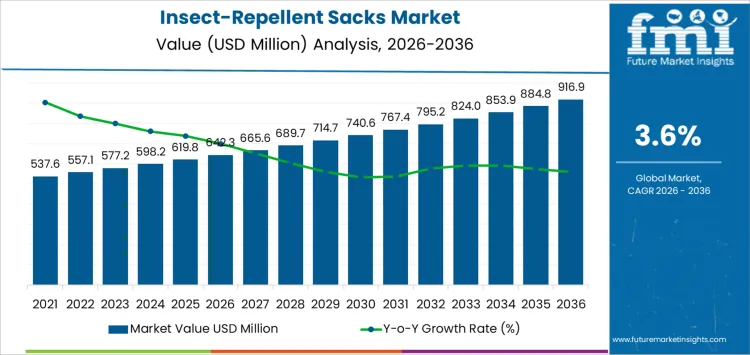
In 2026, the insect-repellent sacks market is valued at USD 642.3 million and is projected to reach USD 916.9 million by 2036, reflecting a CAGR of 3.6%. During the first five-year block from 2026 to 2031, the market expands to approximately USD 766.4 million. This phase is shaped by steady demand from agricultural storage, food grain handling, and commodity transport applications where pest prevention remains routine. Growth in this block reflects gradual volume increases and replacement demand, supported by consistent use in storage cycles rather than new application development.
The second growth block from 2031 to 2036 carries the market from about USD 766.4 million to USD 916.9 million, indicating moderate absolute value addition. Annual increments remain uniform, showing stable procurement patterns across established end users. Demand in this phase is driven by continued reliance on treated sacks for inventory protection, particularly in regions with seasonal pest exposure. The later block reflects maturation, with growth linked to throughput expansion and storage capacity alignment rather than accelerated adoption or product diversification.
Quick Stats of the Insect-Repellent Sacks Market
- Insect-Repellent Sacks Market Value (2026): USD 642.3 million
- Insect-Repellent Sacks Market Forecast Value (2036): USD 916.9 million
- Insect-Repellent Sacks Market Forecast CAGR (2026-2036): 3.6%
- Leading Application: Grain Storage (42%)
- Key Growth Regions: India, China, Brazil, United States, Germany, Japan
- Top Players: UFlex, Starlinger, Klabin, Berry Global, Mondi, SCG Packaging
What is the Growth Forecast for the Insect-Repellent Sacks Market through 2036?
From 2026 to 2031, the insect-repellent sacks market increases from USD 642.3 million to around USD 739.8 million, reflecting growth driven by storage protection needs rather than short-term seasonal spikes. Demand in this phase is anchored in agricultural produce storage, grain handling, and export packaging where pest exposure directly affects quality and loss rates. Adoption remains steady as users prioritize proven efficacy, material durability, and compatibility with existing storage practices. Growth progresses incrementally, shaped by replacement cycles, wider use in organized warehousing, and gradual penetration across regions with high post-harvest loss sensitivity.
Between 2031 and 2036, the market expands from approximately USD 739.8 million to USD 916.9 million, indicating a firmer upward trajectory in value creation. This phase reflects broader normalization of insect-repellent sacks as a standard storage component rather than an optional safeguard. Demand strengthens through higher utilization in long-duration storage, expanded application in cross-border commodity trade, and increased reliance by cooperatives and bulk handlers. Earlier growth followed gradual adoption, while later expansion is driven by higher sack turnover, wider coverage across stored commodities, and integration into standardized storage and logistics protocols across global agricultural supply chains.
Insect Repellent Sacks Market Key Takeaways
| Metric | Value |
|---|---|
| Market Value (2026) | USD 642.3 million |
| Forecast Value (2036) | USD 916.9 million |
| Forecast CAGR (2026-2036) | 3.6% |
How Are Storage Protection Needs Influencing the Insect-Repellent Sacks Market from 2026 to 2036?
Insect-repellent sacks gained use in agriculture, food storage, and commodity logistics where pest exposure caused measurable losses. Grain handlers, seed producers, and traders adopted treated sacks to protect contents during storage and transport without relying on fumigation at every stage. Historical demand reflected challenges in humid climates, long storage cycles, and decentralized warehousing where pest monitoring was limited. Buyers valued sacks that integrated repellent properties directly into fabric or coatings, offering continuous protection. Adoption focused on cereals, pulses, animal feed, and other dry goods sensitive to insect infestation and contamination.
From 2026 to 2036 demand is expected to expand with rising emphasis on post-harvest loss reduction and safer storage practices. Growth aligns with expansion of cross-border agricultural trade and longer storage durations driven by supply chain buffering. Manufacturers develop sacks using embedded repellents with controlled release and durability across reuse cycles. Buyers assess effectiveness duration, material strength, and regulatory acceptance for food contact. Demand also reflects reduced reliance on chemical fumigants, increased use of bag-based storage systems, and investment in low-cost pest mitigation solutions across agricultural and food supply networks.
What Is the Demand for the Insect-Repellent Sacks Market by Application and Product Type for 2026 to 2036?
From 2026 to 2036, the insect-repellent sacks market expands as storage operators seek passive protection against infestation during handling, warehousing, and transport. Grain storage accounts for 42% of application demand as post-harvest losses remain a persistent concern across supply chains. HDPE woven sacks lead product type adoption with a 45% share due to durability, load-bearing strength, and compatibility with embedded repellent treatments. Demand reflects a shift toward packaging-led pest control that reduces reliance on fumigation while preserving product quality during extended storage cycles.
Why does grain storage account for 42% of demand in the insect-repellent sacks market by application from 2026 to 2036?
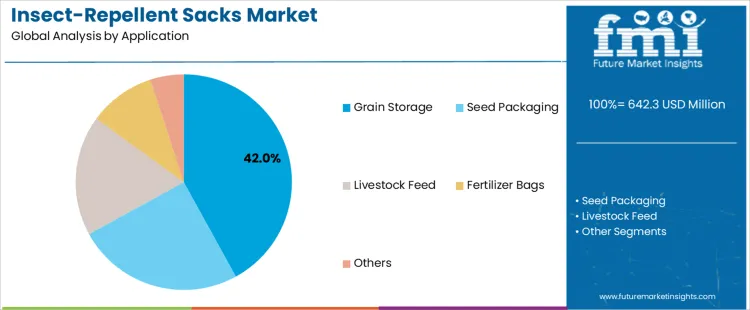
Grain storage accounts for 42% of demand because cereals and pulses remain vulnerable to insects during aggregation, storage, and distribution stages. Consumption intensity is high in silos, warehouses, procurement centers, and export handling facilities where grains are stored for prolonged periods. Usage remains steady as insect-repellent sacks provide continuous protection without requiring active intervention. Procurement decisions prioritize sacks that maintain repellency under varying humidity and temperature conditions common in storage environments. Buyers favor solutions that reduce infestation risk while preserving grain moisture balance and flow characteristics. Price sensitivity stays moderate since losses from insect damage far exceed packaging cost differentials. Specification control focuses on repellent longevity, fabric permeability, and mechanical strength during stacking and transport. Demand continues from 2026 to 2036 as governments, cooperatives, and private traders strengthen post-harvest management practices. Repeat utilization remains predictable due to seasonal harvest cycles and recurring storage requirements. Substitution pressure from chemical fumigation remains limited where packaging-based prevention lowers handling complexity and contamination concerns.
Why do HDPE woven sacks represent 45% of demand in the insect-repellent sacks market by product type from 2026 to 2036?
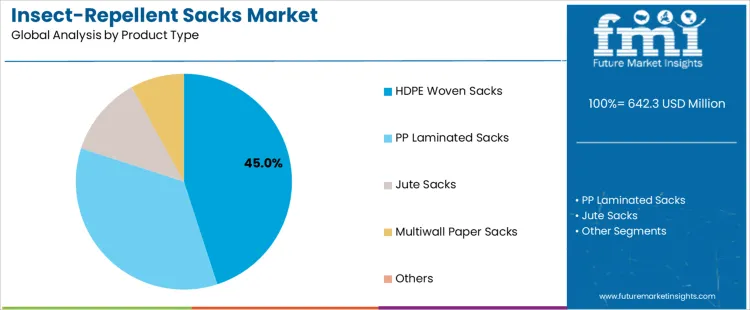
HDPE woven sacks represent 45% of demand because they combine tensile strength, moisture resistance, and consistent structure suitable for repellent integration. Consumption is strong across grain, seed, fertilizer, and feed applications where sacks must withstand rough handling and repeated movement. Usage remains steady as HDPE fabrics retain repellent treatments over longer storage durations compared with natural fibers. Procurement favors sacks that maintain dimensional stability and resist tearing during stacking and palletization. Buyers prioritize uniform weave density that supports even distribution of insect-repellent additives. Price sensitivity stays moderate since HDPE sacks offer longer service life and lower replacement rates. Specification control emphasizes yarn quality, coating adhesion, and repellency retention after exposure to dust and abrasion. Demand persists from 2026 to 2036 as logistics systems favor standardized, high-capacity sacks compatible with mechanized filling and discharge operations. Repeat purchasing remains consistent due to predictable consumption across agricultural cycles and bulk commodity movements.
How Are Insect Repellent Sacks Being Used Within Storage and Transport Environments?
Use appears in locations where stored goods face exposure to insects during holding or transit. Grain warehouses place repellent sacks near pallet stacks to reduce contact with stored crops. Textile storage facilities apply them inside containers to protect fabrics from moth damage. Logistics operators use sacks in shipping crates during long transit routes where inspection access is limited. Household storage suppliers include them in seasonal storage kits. These applications reflect placement based protection methods tied to storage duration, material sensitivity, and space constraints rather than active pest control systems.
What Storage Conditions Support Adoption of Insect Repellent Sacks Across Sectors?
Selection aligns with environments that require passive protection without electrical devices or sprays. Agricultural cooperatives favor sacks for use in rural warehouses lacking controlled climate systems. Exporters handling natural fibers rely on them to limit pest exposure during port delays. Furniture storage operators use sacks in enclosed units where ventilation is minimal. Retail packaging suppliers include them for customers storing goods for extended periods. These conditions favor solutions that operate continuously without maintenance, matching settings where access, power, or routine treatment is limited.
Which Considerations Restrict Wider Use of Insect Repellent Sacks?
Effectiveness varies depending on enclosure size and airflow conditions. Some users prefer integrated pest control programs for high value goods. Cost sensitivity affects adoption in bulk storage where margins are narrow. Regulatory limits on active ingredients affect use in food adjacent environments. Scent presence raises concern in sensitive storage applications. Replacement frequency also influences purchasing decisions. These considerations result in selective application where passive insect control must align with regulatory, economic, and material handling requirements.
What is the Demand for Insect Repellent Sacks by Country?
| Country | CAGR (%) |
|---|---|
| India | 11.2% |
| China | 9.8% |
| Brazil | 8.3% |
| USA | 7.2% |
| Germany | 6.1% |
| Japan | 4.9% |
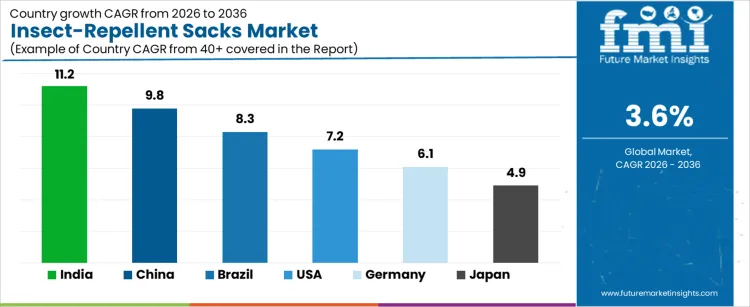
The demand for insect repellent sacks differs across regions due to agricultural storage needs, climate conditions, and pest management practices. India leads with an 11.20% CAGR, supported by large scale grain storage requirements, post-harvest loss reduction efforts, and wider adoption of treated packaging for cereals and pulses. China follows at 9.80%, driven by food security initiatives and modernization of agricultural logistics. Brazil records 8.30%, reflecting the scale of soybean, maize, and coffee storage operations. The USA grows at 7.20%, supported by commercial farming and warehouse storage applications. Germany posts 6.10%, shaped by regulated agricultural storage practices, while Japan records 4.90%, reflecting mature storage infrastructure and lower pest pressure in controlled environments.
How Is Agricultural Storage Protection Driving Growth in India?
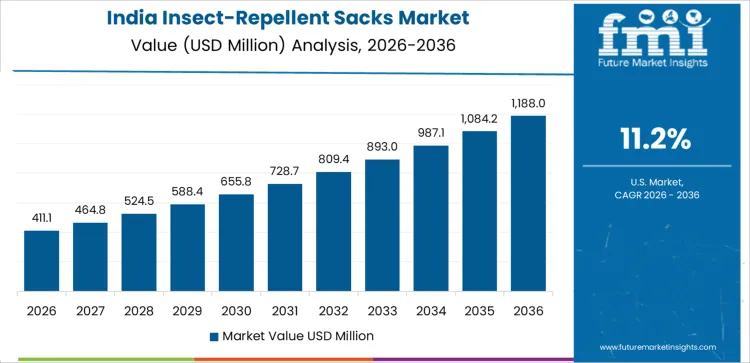
India is witnessing expansion in the Insect Repellent Sacks Market at a CAGR of 11.20% through 2035, driven by rising demand for protected grain storage and post harvest loss reduction. Agricultural cooperatives, grain traders, and government agencies are increasing adoption of insect repellent sacks to limit pest infestation during storage and transportation. Growth in food grain procurement programs and warehouse infrastructure is supporting wider use across rural and semi urban regions. Domestic manufacturers are scaling production using polymer blends and treated fabrics aligned with local handling practices. Seasonal procurement cycles and recurring replacement needs are sustaining consistent demand across major crop producing states nationwide.
- Grain storage protection needs support sack adoption.
- Government procurement programs drive volume demand.
- Domestic manufacturing expansion improves supply availability.
- Replacement cycles sustain recurring purchasing activity.
How Is Food Security Focus Supporting Demand Expansion in China?
In China, revenue from the Insect Repellent Sacks Market is growing at a CAGR of 9.80% through 2035, supported by national food security priorities and modernization of agricultural storage systems. Grain storage operators and logistics providers are adopting treated sacks to reduce infestation risks during extended storage periods. Expansion of centralized warehouses and bulk handling facilities is strengthening demand across major grain producing provinces. Domestic producers supply a wide range of sack formats, supported by established polymer processing capacity. Stable grain volumes and structured procurement practices are sustaining predictable purchasing patterns across state linked storage networks nationwide.
- Food security initiatives support storage protection demand.
- Warehouse modernization drives treated sack usage.
- Domestic suppliers maintain strong production capacity.
- Centralized procurement sustains volume consistency.
How Is Export Oriented Agriculture Influencing Adoption in Brazil?
Brazil is seeing steady growth in the Insect Repellent Sacks Market at a CAGR of 8.30% through 2035, driven by large scale grain production and export oriented agricultural supply chains. Producers and storage operators are using insect repellent sacks to preserve quality during inland transport and interim storage. Demand is concentrated in maize, soybean, and rice producing regions. Imports supply some specialized treatment materials, while local manufacturers expand conversion capacity. Consistent export volumes and storage turnover are supporting recurring procurement across agricultural logistics networks nationwide.
- Export focused grain handling supports sack demand.
- Transport related storage needs drive adoption.
- Local conversion capacity continues to expand.
- Recurring export cycles sustain procurement volumes.
How Are Commercial Storage Practices Sustaining Growth in the United States?
The United States is experiencing measured expansion in the Insect Repellent Sacks Market at a CAGR of 7.20% through 2035, supported by commercial grain storage practices and quality preservation requirements. Agricultural operators use treated sacks for specialty crops, seed storage, and short term holding applications. Demand reflects strict quality control standards and pest management protocols. Domestic suppliers provide standardized sack formats compatible with mechanized handling systems. Replacement demand and seasonal usage patterns are sustaining stable purchasing activity across farming cooperatives and storage operators nationwide.
- Quality control standards support treated sack usage.
- Specialty crop storage drives targeted demand.
- Domestic suppliers ensure standardized product supply.
- Seasonal cycles sustain recurring procurement.
How Do Structured Farming Systems Shape Demand in Germany?
Germany continues to record moderate growth in the Insect Repellent Sacks Market at a CAGR of 6.10% through 2035, supported by structured farming systems and regulated storage practices. Farmers and cooperatives use insect repellent sacks to protect grains and seeds during controlled storage periods. Demand remains focused on quality preservation and compliance with storage guidelines. Domestic and regional suppliers provide treated sack solutions aligned with handling standards. Stable agricultural output and predictable storage needs are sustaining consistent procurement across organized farming networks nationwide.
- Regulated storage practices support adoption.
- Seed and grain protection drives usage.
- Regional suppliers ensure steady availability.
- Predictable output sustains procurement stability.
How Does Mature Agricultural Infrastructure Influence Demand in Japan?
Japan is maintaining steady demand in the Insect Repellent Sacks Market at a CAGR of 4.90% through 2035, supported by mature agricultural infrastructure and controlled storage practices. Usage is concentrated in rice storage, seed preservation, and small scale grain handling operations. Farmers prioritize quality retention and pest control within limited storage durations. Domestic manufacturers supply treated sacks aligned with local handling requirements. Stable production volumes and replacement driven purchasing are sustaining consistent demand across agricultural cooperatives and storage facilities nationwide.
- Rice storage applications anchor baseline demand.
- Quality focused handling supports treated sack use.
- Domestic suppliers maintain reliable availability.
- Replacement demand sustains procurement consistency.
What Is Driving the Demand for Insect Repellent Sacks and Which Packaging Groups Shape Agricultural and Storage Use?
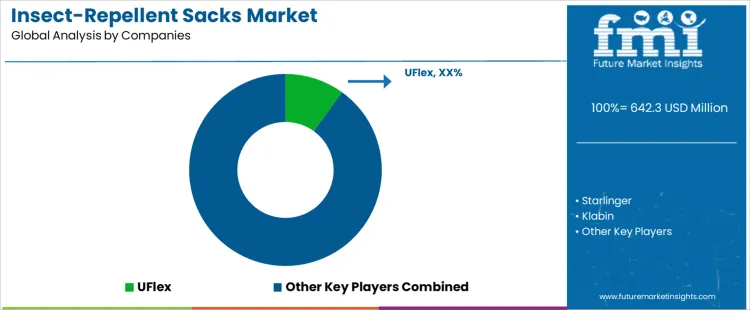
Insect repellent sacks are gaining use in grain storage, animal feed handling, and agricultural export logistics where pest damage leads to direct product loss. These sacks integrate repellents into woven or laminated structures to deter insects during storage and transport without additional fumigation. UFlex supports adoption through laminated sack structures used for rice, pulses, and seed packaging. Starlinger influences the market through machinery and technical know-how that enables insect repellent additives to be incorporated during sack production. Klabin supports fiber based sack applications for specialty agricultural products. Berry Global contributes through polymer based sack materials suited to high humidity conditions. Mondi and SCG Packaging participate through industrial sack solutions used in regional agricultural supply chains.
Material choice is governed by repellent longevity, food contact compliance, and resistance to tearing and moisture. Storage operators favor sacks that maintain strength while reducing infestation risk over extended holding periods. Exporters value compatibility with international phytosanitary requirements and reduced reliance on chemical fumigation. Usage spans grains, fertilizers, animal feed, and specialty crops. Demand visibility tracks post-harvest loss reduction initiatives, expansion of agricultural exports, and increased focus on integrated pest management practices within storage and logistics operations.
Key Players in the Insect Repellent Sacks Market
- UFlex
- Starlinger
- Klabin
- Berry Global
- Mondi
- SCG Packaging
Scope of the Report
| Items | Values |
|---|---|
| Quantitative Units (2026) | USD million |
| Application | Grain Storage; Seed Packaging; Livestock Feed; Fertilizer Bags; Other Applications |
| Product Type | HDPE Woven Sacks; PP Laminated Sacks; Jute Sacks; Multiwall Paper Sacks; Other Sack Types |
| Technology | Repellent Coating; Embedded Insecticide; Natural Oil Infusion; Barrier Micro Coating; Other Technologies |
| Regions Covered | Asia Pacific; Europe; North America; Latin America; Middle East and Africa |
| Countries Covered | China; Japan; South Korea; India; Australia and New Zealand; ASEAN; Germany; United Kingdom; France; Italy; Spain; Nordic; BENELUX; United States; Canada; Mexico; Brazil; Chile; Kingdom of Saudi Arabia; Turkey; South Africa; plus additional countries across Asia Pacific, Europe, Latin America, and Middle East and Africa |
| Key Companies Profiled | UFlex; Starlinger; Klabin; Berry Global; Mondi; SCG Packaging |
| Additional Attributes | Dollar by sales across applications and sack types; use of insect repellent sacks in grain storage, seed preservation, livestock feed handling, and fertilizer packaging; demand driven by post-harvest loss reduction, long duration storage, and pest exposure during transport; adoption of HDPE woven and laminated sack structures for durability and repellent retention; role of embedded insecticide, natural oil infusion, and coating technologies in providing passive pest protection; integration of treated sacks into agricultural storage, warehousing, and export logistics; influence of regulatory acceptance, food contact compliance, and reuse cycles on sack selection across regions |
Insect Repellent Sacks Market Segmentation
By Application
- Grain Storage
- Seed Packaging
- Livestock Feed
- Fertilizer Bags
- Others
By Product Type
- HDPE Woven Sacks
- PP Laminated Sacks
- Jute Sacks
- Multiwall Paper Sacks
- Others
By Technology
- Repellent Coating
- Embedded Insecticide
- Natural Oil Infusion
- Barrier Micro-Coating
- Others
Region
- Asia Pacific
- China
- Japan
- South Korea
- India
- Australia & New Zealand
- ASEAN
- Rest of Asia Pacific
- Europe
- Germany
- United Kingdom
- France
- Italy
- Spain
- Nordic
- BENELUX
- Rest of Europe
- North America
- United States
- Canada
- Mexico
- Latin America
- Brazil
- Chile
- Rest of Latin America
- Middle East & Africa
- Kingdom of Saudi Arabia
- Other GCC Countries
- Turkey
- South Africa
- Other African Union
- Rest of Middle East & Africa
Frequently Asked Questions
How big is the insect-repellent sacks market in 2026?
The global insect-repellent sacks market is estimated to be valued at USD 642.3 million in 2026.
What will be the size of insect-repellent sacks market in 2036?
The market size for the insect-repellent sacks market is projected to reach USD 916.9 million by 2036.
How much will be the insect-repellent sacks market growth between 2026 and 2036?
The insect-repellent sacks market is expected to grow at a 3.6% CAGR between 2026 and 2036.
What are the key product types in the insect-repellent sacks market?
The key product types in insect-repellent sacks market are grain storage, seed packaging, livestock feed, fertilizer bags and others.
Which product type segment to contribute significant share in the insect-repellent sacks market in 2026?
In terms of product type, hdpe woven sacks segment to command 45.0% share in the insect-repellent sacks market in 2026.
Preview the report firsthand - request a free sample
Get SampleGet the brochure for pricing and purchase details.
Get PDFTable of Content
- Executive Summary
- Global Market Outlook
- Demand-side Trends
- Supply-side Trends
- Technology Roadmap Analysis
- Analysis and Recommendations
- Market Overview
- Market Coverage / Taxonomy
- Market Definition / Scope / Limitations
- Market Background
- Market Dynamics
- Drivers
- Restraints
- Opportunity
- Trends
- Scenario Forecast
- Demand in Optimistic Scenario
- Demand in Likely Scenario
- Demand in Conservative Scenario
- Opportunity Map Analysis
- Product Life Cycle Analysis
- Supply Chain Analysis
- Investment Feasibility Matrix
- Value Chain Analysis
- PESTLE and Porter’s Analysis
- Regulatory Landscape
- Regional Parent Market Outlook
- Production and Consumption Statistics
- Import and Export Statistics
- Market Dynamics
- Global Market Analysis 2021 to 2025 and Forecast, 2026 to 2036
- Historical Market Size Value (USD Million) Analysis, 2021 to 2025
- Current and Future Market Size Value (USD Million) Projections, 2026 to 2036
- Y-o-Y Growth Trend Analysis
- Absolute $ Opportunity Analysis
- Global Market Pricing Analysis 2021 to 2025 and Forecast 2026 to 2036
- Global Market Analysis 2021 to 2025 and Forecast 2026 to 2036, By Application
- Introduction / Key Findings
- Historical Market Size Value (USD Million) Analysis By Application , 2021 to 2025
- Current and Future Market Size Value (USD Million) Analysis and Forecast By Application , 2026 to 2036
- Grain Storage
- Seed Packaging
- Livestock Feed
- Fertilizer Bags
- Others
- Y-o-Y Growth Trend Analysis By Application , 2021 to 2025
- Absolute $ Opportunity Analysis By Application , 2026 to 2036
- Global Market Analysis 2021 to 2025 and Forecast 2026 to 2036, By Product Type
- Introduction / Key Findings
- Historical Market Size Value (USD Million) Analysis By Product Type, 2021 to 2025
- Current and Future Market Size Value (USD Million) Analysis and Forecast By Product Type, 2026 to 2036
- HDPE Woven Sacks
- PP Laminated Sacks
- Jute Sacks
- Multiwall Paper Sacks
- Others
- Y-o-Y Growth Trend Analysis By Product Type, 2021 to 2025
- Absolute $ Opportunity Analysis By Product Type, 2026 to 2036
- Global Market Analysis 2021 to 2025 and Forecast 2026 to 2036, By Technology
- Introduction / Key Findings
- Historical Market Size Value (USD Million) Analysis By Technology, 2021 to 2025
- Current and Future Market Size Value (USD Million) Analysis and Forecast By Technology, 2026 to 2036
- Repellent Coating
- Embedded Insecticide
- Natural Oil Infusion
- Barrier Micro-Coating
- Others
- Y-o-Y Growth Trend Analysis By Technology, 2021 to 2025
- Absolute $ Opportunity Analysis By Technology, 2026 to 2036
- Global Market Analysis 2021 to 2025 and Forecast 2026 to 2036, By Region
- Introduction
- Historical Market Size Value (USD Million) Analysis By Region, 2021 to 2025
- Current Market Size Value (USD Million) Analysis and Forecast By Region, 2026 to 2036
- North America
- Latin America
- Western Europe
- Eastern Europe
- East Asia
- South Asia and Pacific
- Middle East & Africa
- Market Attractiveness Analysis By Region
- North America Market Analysis 2021 to 2025 and Forecast 2026 to 2036, By Country
- Historical Market Size Value (USD Million) Trend Analysis By Market Taxonomy, 2021 to 2025
- Market Size Value (USD Million) Forecast By Market Taxonomy, 2026 to 2036
- By Country
- USA
- Canada
- Mexico
- By Application
- By Product Type
- By Technology
- By Country
- Market Attractiveness Analysis
- By Country
- By Application
- By Product Type
- By Technology
- Key Takeaways
- Latin America Market Analysis 2021 to 2025 and Forecast 2026 to 2036, By Country
- Historical Market Size Value (USD Million) Trend Analysis By Market Taxonomy, 2021 to 2025
- Market Size Value (USD Million) Forecast By Market Taxonomy, 2026 to 2036
- By Country
- Brazil
- Chile
- Rest of Latin America
- By Application
- By Product Type
- By Technology
- By Country
- Market Attractiveness Analysis
- By Country
- By Application
- By Product Type
- By Technology
- Key Takeaways
- Western Europe Market Analysis 2021 to 2025 and Forecast 2026 to 2036, By Country
- Historical Market Size Value (USD Million) Trend Analysis By Market Taxonomy, 2021 to 2025
- Market Size Value (USD Million) Forecast By Market Taxonomy, 2026 to 2036
- By Country
- Germany
- UK
- Italy
- Spain
- France
- Nordic
- BENELUX
- Rest of Western Europe
- By Application
- By Product Type
- By Technology
- By Country
- Market Attractiveness Analysis
- By Country
- By Application
- By Product Type
- By Technology
- Key Takeaways
- Eastern Europe Market Analysis 2021 to 2025 and Forecast 2026 to 2036, By Country
- Historical Market Size Value (USD Million) Trend Analysis By Market Taxonomy, 2021 to 2025
- Market Size Value (USD Million) Forecast By Market Taxonomy, 2026 to 2036
- By Country
- Russia
- Poland
- Hungary
- Balkan & Baltic
- Rest of Eastern Europe
- By Application
- By Product Type
- By Technology
- By Country
- Market Attractiveness Analysis
- By Country
- By Application
- By Product Type
- By Technology
- Key Takeaways
- East Asia Market Analysis 2021 to 2025 and Forecast 2026 to 2036, By Country
- Historical Market Size Value (USD Million) Trend Analysis By Market Taxonomy, 2021 to 2025
- Market Size Value (USD Million) Forecast By Market Taxonomy, 2026 to 2036
- By Country
- China
- Japan
- South Korea
- By Application
- By Product Type
- By Technology
- By Country
- Market Attractiveness Analysis
- By Country
- By Application
- By Product Type
- By Technology
- Key Takeaways
- South Asia and Pacific Market Analysis 2021 to 2025 and Forecast 2026 to 2036, By Country
- Historical Market Size Value (USD Million) Trend Analysis By Market Taxonomy, 2021 to 2025
- Market Size Value (USD Million) Forecast By Market Taxonomy, 2026 to 2036
- By Country
- India
- ASEAN
- Australia & New Zealand
- Rest of South Asia and Pacific
- By Application
- By Product Type
- By Technology
- By Country
- Market Attractiveness Analysis
- By Country
- By Application
- By Product Type
- By Technology
- Key Takeaways
- Middle East & Africa Market Analysis 2021 to 2025 and Forecast 2026 to 2036, By Country
- Historical Market Size Value (USD Million) Trend Analysis By Market Taxonomy, 2021 to 2025
- Market Size Value (USD Million) Forecast By Market Taxonomy, 2026 to 2036
- By Country
- Kingdom of Saudi Arabia
- Other GCC Countries
- Turkiye
- South Africa
- Other African Union
- Rest of Middle East & Africa
- By Application
- By Product Type
- By Technology
- By Country
- Market Attractiveness Analysis
- By Country
- By Application
- By Product Type
- By Technology
- Key Takeaways
- Key Countries Market Analysis
- USA
- Pricing Analysis
- Market Share Analysis, 2025
- By Application
- By Product Type
- By Technology
- Canada
- Pricing Analysis
- Market Share Analysis, 2025
- By Application
- By Product Type
- By Technology
- Mexico
- Pricing Analysis
- Market Share Analysis, 2025
- By Application
- By Product Type
- By Technology
- Brazil
- Pricing Analysis
- Market Share Analysis, 2025
- By Application
- By Product Type
- By Technology
- Chile
- Pricing Analysis
- Market Share Analysis, 2025
- By Application
- By Product Type
- By Technology
- Germany
- Pricing Analysis
- Market Share Analysis, 2025
- By Application
- By Product Type
- By Technology
- UK
- Pricing Analysis
- Market Share Analysis, 2025
- By Application
- By Product Type
- By Technology
- Italy
- Pricing Analysis
- Market Share Analysis, 2025
- By Application
- By Product Type
- By Technology
- Spain
- Pricing Analysis
- Market Share Analysis, 2025
- By Application
- By Product Type
- By Technology
- France
- Pricing Analysis
- Market Share Analysis, 2025
- By Application
- By Product Type
- By Technology
- India
- Pricing Analysis
- Market Share Analysis, 2025
- By Application
- By Product Type
- By Technology
- ASEAN
- Pricing Analysis
- Market Share Analysis, 2025
- By Application
- By Product Type
- By Technology
- Australia & New Zealand
- Pricing Analysis
- Market Share Analysis, 2025
- By Application
- By Product Type
- By Technology
- China
- Pricing Analysis
- Market Share Analysis, 2025
- By Application
- By Product Type
- By Technology
- Japan
- Pricing Analysis
- Market Share Analysis, 2025
- By Application
- By Product Type
- By Technology
- South Korea
- Pricing Analysis
- Market Share Analysis, 2025
- By Application
- By Product Type
- By Technology
- Russia
- Pricing Analysis
- Market Share Analysis, 2025
- By Application
- By Product Type
- By Technology
- Poland
- Pricing Analysis
- Market Share Analysis, 2025
- By Application
- By Product Type
- By Technology
- Hungary
- Pricing Analysis
- Market Share Analysis, 2025
- By Application
- By Product Type
- By Technology
- Kingdom of Saudi Arabia
- Pricing Analysis
- Market Share Analysis, 2025
- By Application
- By Product Type
- By Technology
- Turkiye
- Pricing Analysis
- Market Share Analysis, 2025
- By Application
- By Product Type
- By Technology
- South Africa
- Pricing Analysis
- Market Share Analysis, 2025
- By Application
- By Product Type
- By Technology
- USA
- Market Structure Analysis
- Competition Dashboard
- Competition Benchmarking
- Market Share Analysis of Top Players
- By Regional
- By Application
- By Product Type
- By Technology
- Competition Analysis
- Competition Deep Dive
- UFlex
- Overview
- Product Portfolio
- Profitability by Market Segments (Product/Age /Sales Channel/Region)
- Sales Footprint
- Strategy Overview
- Marketing Strategy
- Product Strategy
- Channel Strategy
- Starlinger
- Klabin
- Berry Global
- Mondi
- SCG Packaging
- UFlex
- Competition Deep Dive
- Assumptions & Acronyms Used
- Research Methodology


